

EN 4491:2013
(Main)Aerospace series - Non-metallic materials - Anaerobic polymerisable compounds - Threadlocking - Torque strength 16 Nm
- Abstract
This European Standard specifies the requirements relating to anaerobic polymerisable threadlocking compounds having a torque strength of 16 Nm for aerospace applications.
- Status
- Published
- Publication Date
- 22-Jan-2013
- Withdrawal Date
- 30-Jul-2013
- Technical Committee
- ASD-STAN - Aerospace
- Drafting Committee
- ASD-STAN/D 5 - Non-Metallic
- Current Stage
- 9093 - Decision to confirm - Review Enquiry
- Start Date
- 21-Jan-2024
- Completion Date
- 21-Oct-2026


Overview
EN 4491:2013 is a European Standard developed by CEN, focusing on anaerobic polymerisable threadlocking compounds designed specifically for aerospace applications. This standard sets the requirements for non-metallic materials with a torque strength rating of 16 Nm. The purpose of EN 4491 is to ensure reliability, safety, and performance consistency of these adhesives when used to secure threaded components in aerospace assemblies. The document is essential for manufacturers, quality assurance professionals, and engineers within the aerospace and defense industries.
Key Topics
Scope and Application
EN 4491:2013 applies to anaerobic polymerisable compounds that lock threaded parts with a torque strength of 16 Nm. It covers materials used in aerospace where threaded fasteners require secure and vibration-resistant locking.Material Description
The compounds are one-part, liquid threadlocking adhesives formulated as acrylic esters of polyhydroxy compounds. The standard specifies three grades to accommodate different viscosity and performance needs.Performance Requirements
Key technical characteristics include:- Torque strength: 16 ± 3 Nm
- Static shear strength: approximately 21 MPa depending on grade
- Flashpoint: above 100 °C ensuring safe handling
- Cure rates and reactivity times to ensure proper setting without premature hardening
- Stability under environmental stresses such as dry heat and water immersion
Testing and Quality Assurance
The standard defines strict test methods and acceptance criteria for batch testing, including visual inspection, viscosity measurement, fluorescence checking, and environmental resistance tests. These ensure the compounds maintain performance through temperature extremes and moisture exposure.Storage and Shelf Life
Recommended storage conditions are below 25 °C out of direct sunlight with oxygen exposure, guaranteeing a shelf life of at least 12 months.
Applications
Aerospace Manufacturing
EN 4491 compliant adhesives are used widely in aircraft assembly and maintenance to lock threaded fasteners in engines, airframes, and avionics, preventing loosening from vibration or thermal cycling.Defense Industry
Secure threadlocking adhesives meeting EN 4491 standards contribute to reliability and safety in military aerospace equipment, where mission-critical fastener security is paramount.Maintenance, Repair, and Overhaul (MRO)
Aerospace MRO facilities use standardized anaerobic threadlocking compounds to maintain consistent performance and regulatory compliance when servicing aircraft components.
Related Standards
EN 3792
Technical specification for aerospace anaerobic polymerisable compounds - forms the basis of many requirements referenced by EN 4491.EN 4385
Describes the general organization and structure of the series of aerospace non-metallic materials standards, providing the framework for EN 4491 and related documents.TR 7000-7
Aerospace series technical report on drafting material standards for anaerobic polymerisable compounds, outlining the methodology and presentation rules used in EN 4491.
Practical Value
Complying with EN 4491 ensures that aerospace-grade threadlocking adhesives meet rigorous performance thresholds critical for safety and reliability. Using these compounds helps manufacturers and maintenance operators prevent threaded fastener loosening - a common cause of mechanical failures. The standard also facilitates regulatory compliance and harmonizes quality across European aerospace industries. Aerospace engineers and quality managers benefit from defined material specifications, processing conditions, and environmental testing requirements to select and validate adhesives aligned with aviation industry best practices.
Keywords: EN 4491, anaerobic polymerisable compounds, aerospace threadlocking, torque strength 16 Nm, aerospace adhesives, non-metallic aerospace materials, threadlocking standard, aerospace fasteners, aerospace manufacturing standards, CEN aerospace standards
Get Certified
Connect with accredited certification bodies for this standard

BUREAU VERITAS Certification Germany
Bureau Veritas certification in Germany.

Element Materials Technology
Materials testing and product certification.

AQMS Ltd.
AQMS provides ISO certification to SMEs across the UK.
Sponsored listings
Frequently Asked Questions
EN 4491:2013 is a standard published by the European Committee for Standardization (CEN). Its full title is "Aerospace series - Non-metallic materials - Anaerobic polymerisable compounds - Threadlocking - Torque strength 16 Nm". This standard covers: This European Standard specifies the requirements relating to anaerobic polymerisable threadlocking compounds having a torque strength of 16 Nm for aerospace applications.
This European Standard specifies the requirements relating to anaerobic polymerisable threadlocking compounds having a torque strength of 16 Nm for aerospace applications.
EN 4491:2013 is classified under the following ICS (International Classification for Standards) categories: 49.025.50 - Adhesives. The ICS classification helps identify the subject area and facilitates finding related standards.
EN 4491:2013 is available in PDF format for immediate download after purchase. The document can be added to your cart and obtained through the secure checkout process. Digital delivery ensures instant access to the complete standard document.
Standards Content (Sample)
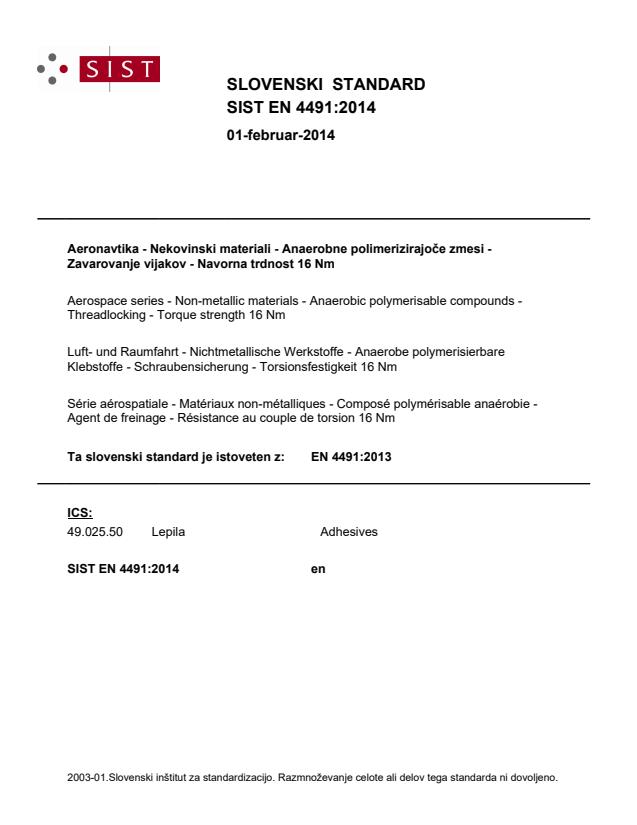
2003-01.Slovenski inštitut za standardizacijo. Razmnoževanje celote ali delov tega standarda ni dovoljeno.Luft- und Raumfahrt - Nichtmetallische Werkstoffe - Anaerobe polymerisierbare Klebstoffe - Schraubensicherung - Torsionsfestigkeit 16 NmSérie aérospatiale - Matériaux non-métalliques - Composé polymérisable anaérobie - Agent de freinage - Résistance au couple de torsion 16 NmAerospace series - Non-metallic materials - Anaerobic polymerisable compounds - Threadlocking - Torque strength 16 Nm49.025.50LepilaAdhesivesICS:Ta slovenski standard je istoveten z:EN 4491:2013SIST EN 4491:2014en01-februar-2014SIST EN 4491:2014SLOVENSKI
STANDARD
EUROPEAN STANDARD NORME EUROPÉENNE EUROPÄISCHE NORM
EN 4491
January 2013 ICS 49.025.50 English Version
Aerospace series - Non-metallic materials - Anaerobic polymerisable compounds - Threadlocking - Torque strength 16 Nm
Série aérospatiale - Matériaux non-métalliques - Composé polymérisable anaérobie - Agent de freinage - Résistance au couple de torsion 16 Nm
Luft- und Raumfahrt - Nichtmetallische Werkstoffe - Anaerobe polymerisierbare Klebstoffe - Schraubensicherung - Torsionsfestigkeit 16 Nm This European Standard was approved by CEN on 10 November 2012.
CEN members are bound to comply with the CEN/CENELEC Internal Regulations which stipulate the conditions for giving this European Standard the status of a national standard without any alteration. Up-to-date lists and bibliographical references concerning such national standards may be obtained on application to the CEN-CENELEC Management Centre or to any CEN member.
This European Standard exists in three official versions (English, French, German). A version in any other language made by translation under the responsibility of a CEN member into its own language and notified to the CEN-CENELEC Management Centre has the same status as the official versions.
CEN members are the national standards bodies of Austria, Belgium, Bulgaria, Croatia, Cyprus, Czech Republic, Denmark, Estonia, Finland, Former Yugoslav Republic of Macedonia, France, Germany, Greece, Hungary, Iceland, Ireland, Italy, Latvia, Lithuania, Luxembourg, Malta, Netherlands, Norway, Poland, Portugal, Romania, Slovakia, Slovenia, Spain, Sweden, Switzerland, Turkey and United Kingdom.
EUROPEAN COMMITTEE FOR STANDARDIZATION
COMITÉ EUROPÉEN DE NORMALISATION EUROPÄISCHES KOMITEE FÜR NORMUNG
Management Centre:
Avenue Marnix 17,
B-1000 Brussels © 2013 CEN All rights of exploitation in any form and by any means reserved worldwide for CEN national Members. Ref. No. EN 4491:2013: ESIST EN 4491:2014
...