

EN 2243-2:2005
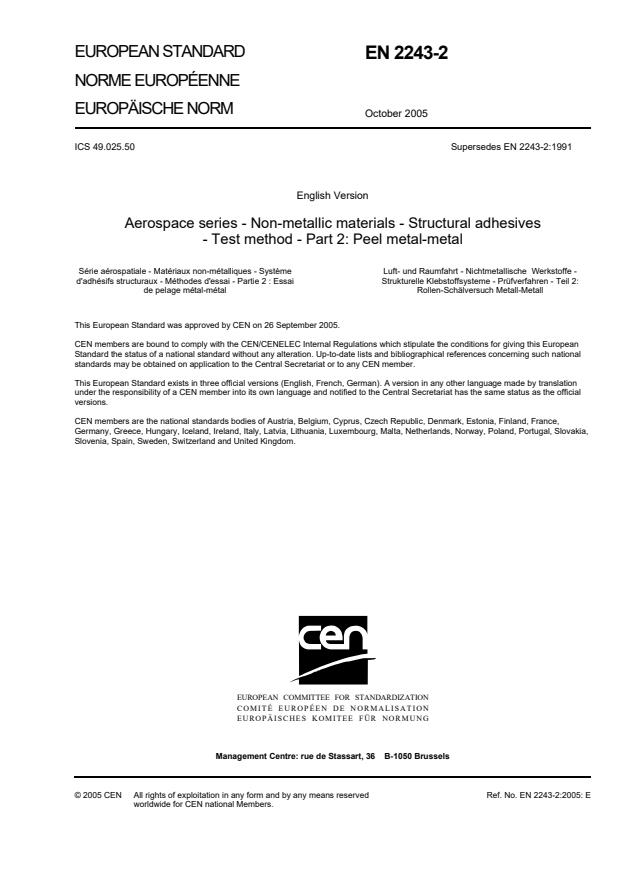
(Main)Aerospace series - Non-metallic materials - Structural adhesives - Test method - Part 2: Peel metal-metal
- Abstract
This standard defines the general requirements for the determination of strength of structural adhesives by testing in peel metal to metal joints, at ambient or other temperatures.
This method is not suitable for adhesives having an average peeling strength of less than 30 N per 25 mm.
- Status
- Published
- Publication Date
- 25-Oct-2005
- Withdrawal Date
- 29-Apr-2006
- Technical Committee
- ASD-STAN - Aerospace
- Drafting Committee
- ASD-STAN/D 4 - Metallic
- Current Stage
- 6060 - Definitive text made available (DAV) - Publishing
- Start Date
- 26-Oct-2005
- Completion Date
- 26-Oct-2005

Overview
EN 2243-2:2005 is a European aerospace standard established by CEN, focusing on the testing of structural adhesives used in metal-to-metal peel joints. Specifically designed for non-metallic materials within the aerospace industry, this standard defines the general requirements and procedures to determine the peeling strength of structural adhesives under ambient or controlled temperature conditions. It is essential for ensuring the reliability and performance of adhesive bonds in aerospace applications.
This test method applies to adhesives with a peeling strength exceeding 30 N per 25 mm and provides a detailed framework for preparing test specimens, conducting peel tests, and interpreting results. EN 2243-2:2005 supersedes the earlier EN 2243-2:1991, reflecting updated best practices in adhesive testing.
Key Topics
Scope and Applicability
- Measures peeling strength of metal-to-metal bonded joints.
- Suitable for adhesives with average peeling strength ≥ 30 N / 25 mm.
- Applicable at ambient or other specified temperatures.
Test Specimen Preparation
- Uses aluminium alloy EN 2090 substrates.
- Surface preparation in accordance with EN 2334 (chromic-sulphuric acid pickle).
- Bonding and curing follow manufacturer specifications unless otherwise agreed.
- Test panels cut carefully to avoid damaging the adhesive joint.
Testing Procedure
- Peeling jig fixes the test piece in a tensile testing machine conforming to EN ISO 7500-1.
- Load applied at uniform jaw separation rates of 50-150 mm/min.
- Peel length of minimum 150 mm, with test temperature controlled and stabilized.
- Continuous recording of load-displacement curve until joint failure.
Results Evaluation
- Peeling strength expressed in newtons per centimetre (N/cm).
- Average peeling load calculated over 125 mm, excluding first 10 mm after initial load peak.
- Use of graphical analysis or planimeter for load data assessment.
Reporting
- Detailed documentation including machine type, test conditions, adhesive system data, metal type, surface preparation, bonding conditions, test results, failure modes, and test personnel traceability.
- Inclusion of load-displacement diagrams and statistical data for multiple specimens.
Health and Safety
- Users must comply with general laboratory safety and applicable regulations.
Applications
Aerospace Manufacturing and Quality Control
- Ensures consistency and reliability of structural adhesive bonds critical for aircraft safety.
- Validates adhesive performance during design qualification and batch acceptance testing.
Adhesive Development and Research
- Provides a standardized method for testing new adhesive formulations under realistic service conditions.
Material Certification
- Supports certification efforts for aerospace materials by providing trusted, repeatable peel strength data.
Failure Analysis
- Assists in diagnosing bonding failures by characterizing peel strength and joint integrity through standardized methods.
Related Standards
- EN ISO 7500-1 – Calibration and verification of tensile testing machines, ensuring accurate force measurement.
- EN 2090 – Specification for aerospace-grade aluminium alloy substrates used in bonding tests.
- EN 2334 – Surface treatment standard for aluminium alloys prior to adhesive bonding.
- EN 4385 – Framework for standardization of non-metallic aerospace materials, describing the organization and links between related standards.
With its rigorous methodology and clear criteria, EN 2243-2:2005 is a critical standard for aerospace structural adhesives, helping engineers, manufacturers, and quality professionals ensure durable and reliable adhesive joints in metal-to-metal applications. The standard promotes safety, traceability, and consistent performance evaluation, vital for modern aerospace engineering.
Relations
- Replaces
EN 2243-2:1991 - Aerospace series - Structural adhesives - Test methods - Part 2: Peel metal-metal - Effective Date
- 22-Dec-2008
- Refers
EN 2090:2005 - Aerospace series - Aluminium alloy AL-P2024-T3 - Clad sheet and strip 0,3 mm <a <6 mm - Effective Date
- 28-Jan-2026
- Effective Date
- 28-Jan-2026
- Refers
EN 2334:1997 - Aerospace series - Chromic-sulphuric acid pickle of aluminium and aluminium alloys - Effective Date
- 28-Jan-2026
- Effective Date
- 28-Jan-2026
- Effective Date
- 28-Jan-2026
- Effective Date
- 28-Jan-2026
Get Certified
Connect with accredited certification bodies for this standard

BUREAU VERITAS Certification Germany
Bureau Veritas certification in Germany.

Element Materials Technology
Materials testing and product certification.

AQMS Ltd.
AQMS provides ISO certification to SMEs across the UK.
Sponsored listings
Frequently Asked Questions
EN 2243-2:2005 is a standard published by the European Committee for Standardization (CEN). Its full title is "Aerospace series - Non-metallic materials - Structural adhesives - Test method - Part 2: Peel metal-metal". This standard covers: This standard defines the general requirements for the determination of strength of structural adhesives by testing in peel metal to metal joints, at ambient or other temperatures. This method is not suitable for adhesives having an average peeling strength of less than 30 N per 25 mm.
This standard defines the general requirements for the determination of strength of structural adhesives by testing in peel metal to metal joints, at ambient or other temperatures. This method is not suitable for adhesives having an average peeling strength of less than 30 N per 25 mm.
EN 2243-2:2005 is classified under the following ICS (International Classification for Standards) categories: 49.025.50 - Adhesives. The ICS classification helps identify the subject area and facilitates finding related standards.
EN 2243-2:2005 has the following relationships with other standards: It is inter standard links to EN 2243-2:1991, EN 2090:2005, EN ISO 7500-1:2018, EN 2334:1997, EN 2243-5:2005, EN 4106:2013, EN 14125:2004. Understanding these relationships helps ensure you are using the most current and applicable version of the standard.
EN 2243-2:2005 is available in PDF format for immediate download after purchase. The document can be added to your cart and obtained through the secure checkout process. Digital delivery ensures instant access to the complete standard document.
Standards Content (Sample)
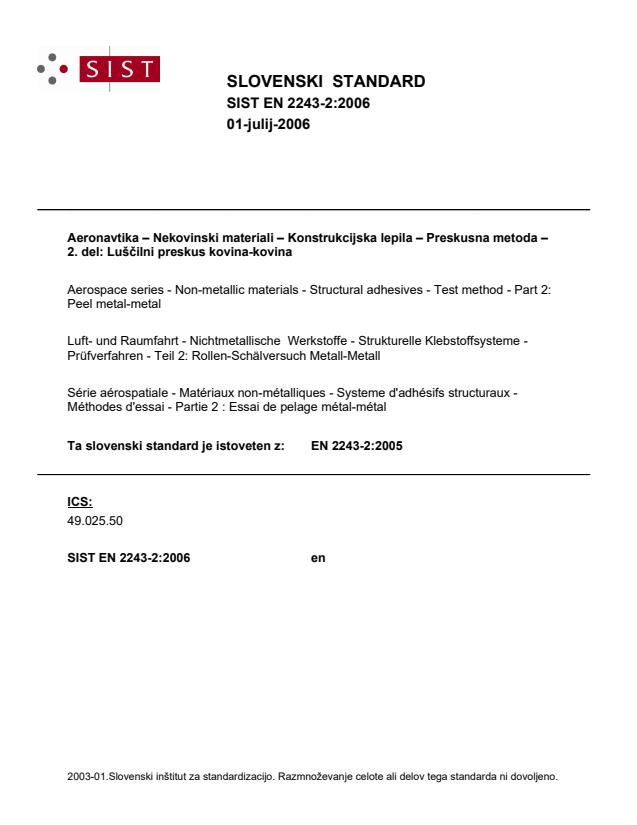
2003-01.Slovenski inštitut za standardizacijo. Razmnoževanje celote ali delov tega standarda ni dovoljeno.Aerospace series - Non-metallic materials - Structural adhesives - Test method - Part 2: Peel metal-metalSérie aérospatiale - Matériaux non-métalliques - Systeme d'adhésifs structuraux - Méthodes d'essai - Partie 2 : Essai de pelage métal-métalLuft- und Raumfahrt - Nichtmetallische
Werkstoffe - Strukturelle Klebstoffsysteme - Prüfverfahren - Teil 2: Rollen-Schälversuch Metall-MetallTa slovenski standard je istoveten z:EN 2243-2:2005SIST EN 2243-2:2006en49.025.50ICS:SLOVENSKI
STANDARDSIST EN 2243-2:200601-julij-2006
EUROPEAN STANDARDNORME EUROPÉENNEEUROPÄISCHE NORMEN 2243-2October 2005ICS 49.025.50Supersedes EN 2243-2:1991
English VersionAerospace series - Non-metallic materials - Structural adhesives- Test method - Part 2: Peel metal-metalSérie aérospatiale - Matériaux non-métalliques - Systèmed'adhésifs structuraux - Méthodes d'essai - Partie 2 : Essaide pelage métal-métalLuft- und Raumfahrt - Nichtmetallische
Werkstoffe -Strukturelle Klebstoffsysteme - Prüfverfahren - Teil 2:Rollen-Schälversuch Metall-MetallThis European Standard was approved by CEN on 26 September 2005.CEN members are bound to comply with the CEN/CENELEC Internal Regulations which stipulate the conditions for giving this EuropeanStandard the status of a national standard without any alteration. Up-to-date lists and bibliographical references concerning such nationalstandards may be obtained on application to the Central Secretariat or to any CEN member.This European Standard exists in three official versions (English, French, German). A version in any other language made by translationunder the responsibility of a CEN member into its own language and notified to the Central Secretariat has the same status as the officialversions.CEN members are the national standards bodies of Austria, Belgium, Cyprus, Czech Republic, Denmark, Estonia, Finland, France,Germany, Greece, Hungary, Iceland, Ireland, Italy, Latvia, Lithuania, Luxembourg, Malta, Netherlands, Norway, Poland, Portugal, Slovakia,Slovenia, Spain, Sweden, Switzerland and United Kingdom.EUROPEAN COMMITTEE FOR STANDARDIZATIONCOMITÉ EUROPÉEN DE NORMALISATIONEUROPÄISCHES KOMITEE FÜR NORMUNGManagement Centre: rue de Stassart, 36
B-1050 Brussels© 2005 CENAll rights of exploitation in any form and by any means reservedworldwide for CEN national Members.Ref. No. EN 2243-2:2005: E
1) Published as AECMA Prestandard at the date of publication of this standard.
...