


EN 13458-2:2002
(Main)Cryogenic vessels - Static vacuum insulated vessels - Part 2: Design, fabrication, inspection and testing
General Information
- Abstract
This standard is applicable to the design, fabrication, inspection and testing of static vacuum insulated cryogenic vessels designed for a maximum allowable pressure of more than 0,5 bar. This standard applies to static vacuum insulated cryogenic vessels for fluids as specified in WI 00268006 and is not applicable to vessels designed for toxic fluids. For static vacuum insulated cryogenic vessels designed for a maximum allowable pressure of not more than 0,5 bar this standard may be used as a guide.
- Status
- Published
- Publication Date
- 19-Nov-2002
- Technical Committee
- CEN/TC 268 - Cryogenic vessels
- Drafting Committee
- CEN/TC 268/WG 2 - Compatibility, insulation, accessories
- Current Stage
- 9092 - Decision on results of review/2YR ENQ - revise - Review Enquiry
- Start Date
- 04-Mar-2024
- Completion Date
- 17-Sep-2026
- Directive
- Harmonized Standard2014/68/EU - Directive 2014/68/EU of the European Parliament and of the Council of 15 May 2014 on the harmonisation of the laws of the Member States relating to the making available on the market of pressure equipmentOJ Ref: C 293/01 OJ Date: 12-Aug-2016
Not Harmonized97/23/EC - Pressure equipmentOJ Ref: C, C 115, C 266 OJ Date: 09-Sep-2011



Overview
EN 13458-2:2002 is a CEN European Standard for cryogenic vessels - specifically static vacuum insulated vessels - covering design, fabrication, inspection and testing. It applies to stationary cryogenic storage vessels designed for a maximum allowable pressure greater than 0.5 bar and for the range of cryogenic fluids defined in EN 13458‑1. The standard excludes vessels designed for toxic fluids and may be used as a guidance document for vessels with maximum allowable pressure ≤ 0.5 bar.
Key topics and technical requirements
- Design principles
- Options for design by calculation, pressure-strengthening (for austenitic stainless steels) or experimental verification.
- Requirements for design documentation, load cases and combinations (pressure, liquid head, supports, thermal and external loads).
- Special provisions for material selection and use of cold properties (see Annex E).
- Materials and metallurgy
- Material selection and toughness requirements referenced (EN 1252 series).
- Additional requirements for 9% Ni steels given in Annex B.
- Fabrication
- Welding qualifications, procedures and joint details; acceptance criteria referenced to relevant EN welding and brazing standards.
- Minimum wall thickness rules and provisions for supports, nozzles and joints.
- Inspection and testing
- Non‑destructive testing (radiography, radioscopy) and NDT personnel qualifications.
- Pressure testing, proof testing and the use of relief devices (Annex D and I), bursting discs and relief plates.
- Normative vs informative annexes
- Normative: A (elastic stress analysis), B (9% Ni steel), E (cold properties), G (flammable fluids), I (outer jacket relief devices), K (base materials).
- Informative: C (pressure strengthening guidance), F (weld details), H, J, ZA (EU Directives relation).
Practical applications and users
- Primary applications
- Design and production of stationary cryogenic storage tanks for industrial gases and other cryogenic fluids covered by EN 13458‑1.
- Commissioning, inspection and routine testing procedures for installed vessels.
- Who uses this standard
- Mechanical engineers and designers of cryogenic storage systems.
- Fabrication shops and welding coordinators manufacturing vacuum insulated vessels.
- Inspection bodies, NDT technicians and testing laboratories.
- Plant safety engineers, procurement and compliance teams ensuring PED/EU directive alignment.
Related standards
- EN 13458‑1 (Fundamental requirements)
- EN 1252‑1 / EN 1252‑2 (Material toughness at low temperatures)
- EN 13445 (Unfired pressure vessels)
- EN 13648 series (Safety devices / discharge sizing)
- EN 1626 (Valves for cryogenic service)
- Relevant welding, NDT and materials standards cited in EN 13458‑2
This standard is essential for anyone involved in the lifecycle of static vacuum insulated cryogenic vessels and ensures consistency, safety and regulatory compliance in design, manufacture and testing.
Relations
- Effective Date
- 25-Aug-2026
- Effective Date
- 08-Jul-2026
- Effective Date
- 18-Feb-2026
- Effective Date
- 28-Jan-2026
- Effective Date
- 28-Jan-2026
- Effective Date
- 28-Jan-2026
- Effective Date
- 28-Jan-2026
- Effective Date
- 28-Jan-2026
- Effective Date
- 28-Jan-2026
- Effective Date
- 28-Jan-2026
- Refers
EN 10028-7:2000 - Flat products made of steels for pressure purposes - Part 7: Stainless steels - Effective Date
- 28-Jan-2026
- Effective Date
- 28-Jan-2026
- Effective Date
- 28-Jan-2026
- Effective Date
- 28-Jan-2026
- Effective Date
- 28-Jan-2026
Get Certified
Connect with accredited certification bodies for this standard

Institut za varilstvo d.o.o. (Welding Institute)
Slovenia's leading welding institute since 1952. ISO 3834, EN 1090, pressure equipment certification, NDT personnel, welder qualification. Only IIW Au
Sponsored listings
Frequently Asked Questions
EN 13458-2:2002 is a standard published by the European Committee for Standardization (CEN). Its full title is "Cryogenic vessels - Static vacuum insulated vessels - Part 2: Design, fabrication, inspection and testing". This standard covers: This standard is applicable to the design, fabrication, inspection and testing of static vacuum insulated cryogenic vessels designed for a maximum allowable pressure of more than 0,5 bar. This standard applies to static vacuum insulated cryogenic vessels for fluids as specified in WI 00268006 and is not applicable to vessels designed for toxic fluids. For static vacuum insulated cryogenic vessels designed for a maximum allowable pressure of not more than 0,5 bar this standard may be used as a guide.
This standard is applicable to the design, fabrication, inspection and testing of static vacuum insulated cryogenic vessels designed for a maximum allowable pressure of more than 0,5 bar. This standard applies to static vacuum insulated cryogenic vessels for fluids as specified in WI 00268006 and is not applicable to vessels designed for toxic fluids. For static vacuum insulated cryogenic vessels designed for a maximum allowable pressure of not more than 0,5 bar this standard may be used as a guide.
EN 13458-2:2002 is classified under the following ICS (International Classification for Standards) categories: 23.020.40 - Cryogenic vessels. The ICS classification helps identify the subject area and facilitates finding related standards.
EN 13458-2:2002 has the following relationships with other standards: It is inter standard links to ISO 1106-1:1984, EN 13445-3:2026, EN 13445-3:2021+A1:2026, EN 288-4:1992, EN ISO 21028-2:2018, EN 10028-4:2017, EN ISO 9606-1:2017, EN 1626:2008, EN ISO 23208:2019, EN 910:1996, EN 10028-7:2000, EN ISO 14732:2025, EN ISO 17779:2025, EN 10216-5:2021, EN 1797:2001. Understanding these relationships helps ensure you are using the most current and applicable version of the standard.
EN 13458-2:2002 is associated with the following European legislation: EU Directives/Regulations: 2014/68/EU, 97/23/EC; Standardization Mandates: M/071. When a standard is cited in the Official Journal of the European Union, products manufactured in conformity with it benefit from a presumption of conformity with the essential requirements of the corresponding EU directive or regulation.
EN 13458-2:2002 is available in PDF format for immediate download after purchase. The document can be added to your cart and obtained through the secure checkout process. Digital delivery ensures instant access to the complete standard document.
Standards Content (Sample)
2003-01.Slovenski inštitut za standardizacijo. Razmnoževanje celote ali delov tega standarda ni dovoljeno.Cryogenic vessels - Static vacuum insulated vessels - Part 2: Design, fabrication, inspection and testing1DþUWRYDQMHRécipients cryogéniques - Récipients fixes isolés sous vide - Partie 2: Conception, fabrication, inspection et essaisKryo-Behälter - Ortsfeste vakuum-isolierte Behälter - Teil 2: Bemessung, Herstellung und PrüfungTa slovenski standard je istoveten z:EN 13458-2:2002SIST EN 13458-2:2003en23.020.40ICS:SLOVENSKI
STANDARDSIST EN 13458-2:200301-december-2003
EUROPEAN STANDARDNORME EUROPÉENNEEUROPÄISCHE NORMEN 13458-2November 2002ICS 23.020.40English versionCryogenic vessels - Static vacuum insulated vessels - Part 2:Design, fabrication, inspection and testingRécipients cryogéniques - Récipients fixes isolés sous vide- Partie 2: Conception, fabrication, inspection et essaisKryo-Behälter - Ortsfeste vakuum-isolierte Behälter - Teil 2:Bemessung, Herstellung und PrüfungThis European Standard was approved by CEN on 12 August 2002.CEN members are bound to comply with the CEN/CENELEC Internal Regulations which stipulate the conditions for giving this EuropeanStandard the status of a national standard without any alteration. Up-to-date lists and bibliographical references concerning such nationalstandards may be obtained on application to the Management Centre or to any CEN member.This European Standard exists in three official versions (English, French, German). A version in any other language made by translationunder the responsibility of a CEN member into its own language and notified to the Management Centre has the same status as the officialversions.CEN members are the national standards bodies of Austria, Belgium, Czech Republic, Denmark, Finland, France, Germany, Greece,Iceland, Ireland, Italy, Luxembourg, Malta, Netherlands, Norway, Portugal, Spain, Sweden, Switzerland and United Kingdom.EUROPEAN COMMITTEE FOR STANDARDIZATIONCOMITÉ EUROPÉEN DE NORMALISATIONEUROPÄISCHES KOMITEE FÜR NORMUNGManagement Centre: rue de Stassart, 36
B-1050 Brussels© 2002 CENAll rights of exploitation in any form and by any means reservedworldwide for CEN national Members.Ref. No. EN 13458-2:2002 E
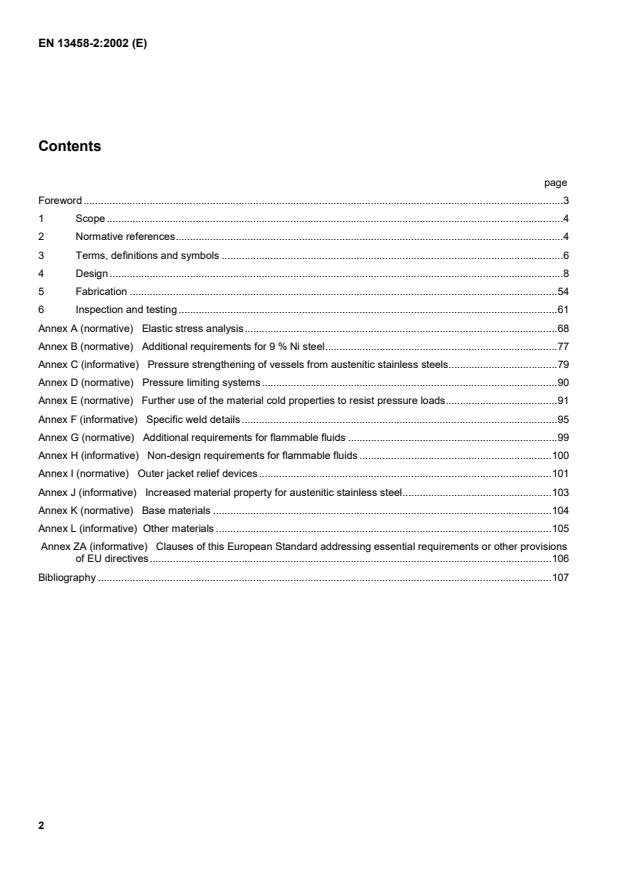
Elastic stress analysis.68Annex B (normative)
Additional requirements for 9 % Ni steel.77Annex C (informative)
Pressure strengthening of vessels from austenitic stainless steels.79Annex D (normative)
Pressure limiting systems.90Annex E (normative)
Further use of the material cold properties to resist pressure loads.91Annex F (informative)
Specific weld details.95Annex G (normative)
Additional requirements for flammable fluids.99Annex H (informative)
Non-design requirements for flammable fluids.100Annex I (normative)
Outer jacket relief devices.101Annex J (informative)
Increased material property for austenitic stainless steel.103Annex K (normative)
Base materials.104Annex L (informative)
Other materials.105Annex ZA (informative)
Clauses of this European Standard addressing essential requirements or other provisionsof EU directives.106Bibliography.107
K20K shall be the minimum value at 20 °C taken from the material standard, (see annex J).4.3.2.3.3
KtThe permissible value of K shall be determined for the material at the operating temperature corresponding to thesaturation temperature at the maximum allowable pressure of the vessel, of the contained cryogenic fluid. Thevalue of K and E shall be determined from the material standard (see EN 10028-7:2000, annex F for austeniticstainless steels) or shall be guaranteed by the material manufacturer.4.3.2.4 Safety factors S, TS, pS and kSSafety factors are the ratio of material property K over the maximum allowable stress.a) internal pressure (pressure on the concave surface):¾ at vessel maximum allowable pressureS = 1,5¾ at vessel proof test pressureTS = 1,05b) external pressure (pressure on the convex surface):¾ cylinders and conespS = 1,6kS = 3,0¾ spherical regionpS = 2,4kS = 3,0 + 0,002 R/s¾ knuckle regionpS = 1,84.3.2.5 Weld joint factors vFor internal pressure (pressure on the concave surface)v = 0,85 or 1,0 (see clause 6, Table 6).For external pressure (pressure on the convex surface)v = 1,0.
*) For well proven designs a factor of safety Sk equal to 1,5 is acceptable provided that :D is not more than 2 300 mm ;lb is not more than 10 200 mm ;and the annular space is perlite insulated.
v 40b(11)For hemispherical ends a b value of 1,1 shall be applied within the distance x from the tangent line joining the endto the cylinder,where()csR,x-=50b is taken from Figure 5 for 10 % torispherical ends and from Figure 6 for 2:1 torispherical ends as a function of()aDcs-. Iteration is necessary.When there are openings outside the area 0,6 Da the required thickness is found using ß from Figures 5 and 6using the appropriate curve for the relevant value of aiDd.The ß factor is derived from the lower curves of Figures 5 and 6 when there are no openings outside the area0,6 Da.Da is the diameter of the end as shown in Figures 4a) and 4b).4.3.6.4.4.3If a domed end is welded together from crown and knuckle components, the joint shall be at asufficient distance x from the knuckle. The distance regarded as sufficient is as follows, but with a minimum,however, of at least 100 mm (see Figure 4c)):¾ the crown and knuckle are of different wall thickness:()csRx-=50,where s is the required wall thickness of the knuckle.¾ the crown and knuckle are of equal wall thickness:¾ for 10 % torispherical ends x = 3,5 s;¾ for 2:1 torispherical ends x = 3,0 s.
...