

EN 1825-1:2004
(Main)Grease separators - Part 1: Principles of design, performance and testing, marking and quality control
- Abstract
This standard specifies definitions, nominal sizes, principles of design, performance requirements, marking, testing and quality control for grease separators.
This standard applies to separators for the separation of greases and oils of vegetable and animal origin from wastewater by means of gravity and without any external energy.
This standard does not cover grease separators intended to treat domestic wastewater from kitchen areas of single family dwellings, where the separator has a nominal size less than 1.
The standard is not applicable for the separation of light liquids, e.g. petrol, fuel and heating oil, and does not cover the treatment of wastewater exclusively containing stable emulsions of greases and oils.
The standard does not cover the use of biological means (bacteria and enzymes).
- Status
- Published
- Publication Date
- 01-Sep-2004
- Technical Committee
- CEN/TC 165 - Waste water engineering
- Drafting Committee
- CEN/TC 165/WG 8 - Separators
- Current Stage
- 9060 - Closure of 2 Year Review Enquiry - Review Enquiry
- Start Date
- 04-Jun-2026
- Completion Date
- 04-Jun-2026
- Directive
- 305/2011 - Regulation (eu) No 305/2011 of the European Parliament and of the Council of 9 march 2011 laying down harmonised conditions for the marketing of construction products and repealing council directive 89/106/eecOJ Ref: C, C 259 OJ Date: 08-Aug-2014
89/106/EEC - Construction productsOJ Ref: C, C 139, C 319 OJ Date: 08-Jun-2005



Overview
EN 1825-1:2004 - Grease separators defines the principles for the design, performance, testing, marking and quality control of gravity-operated grease separators used to remove vegetable and animal fats and oils from wastewater. Published by CEN, this standard applies to factory-made and site-built separators that operate without external energy. It excludes separators for domestic single-family dwellings with a nominal size less than 1, separation of light liquids (e.g., petrol, fuel, heating oil), treatment of exclusively stable emulsions, and does not cover biological treatment methods (bacteria or enzymes). Part 2 of EN 1825 covers selection, installation, operation and maintenance.
Key Topics and Requirements
- Scope & Definitions: Terminology, nominal size classifications and limits of applicability.
- Materials: Requirements and test methods for concrete, metallic materials, plastics, vitrified clay, sealing materials, coatings/linings and chemical resistance.
- Design Requirements: Dimensions, dimensional tolerances, watertightness, accessibility, inlets/outlets/connectors, internal components, sludge traps, access covers, grease collection area height/capacity, fall and ventilation.
- Structural Stability: Design provisions for unreinforced, fibre-reinforced and reinforced concrete, and glass fibre-reinforced plastics.
- Functional Requirements: Determination of nominal size, volume of sludge traps, and provisions for automatic warning devices and auxiliary equipment.
- Testing & Type Testing: Methods for material testing, chemical resistance, watertightness, reaction to fire and determination of nominal size for prefabricated and in-situ separators. Includes laboratory methods (IR, gas chromatography) for effluent analysis.
- Marking & Manufacturer Information: Mandatory product marking, labelling and the manufacturer’s technical documentation.
- Quality Control & Conformity: Factory production control, type testing, third-party control options and procedures for CE marking in line with EU Construction Products Directive (informative Annex ZA).
Applications
- Commercial kitchens, restaurants, catering facilities, food processing plants and other food-service wastewater sources where gravity separation of fats, oils and greases (FOG) is required.
- Regulatory compliance, procurement specifications and product certification for grease management systems.
- Basis for product design verification, factory production control and third-party conformity assessment.
Who Should Use This Standard
- Manufacturers developing or certifying grease separators
- Design engineers specifying separator size and layout
- Testing laboratories performing material and performance tests
- Facilities managers / consultants ensuring regulatory compliance and correct product selection
- Authorities and specifiers writing procurement or permitting requirements
Related Standards
- EN 1825-2 (selection, installation, operation and maintenance) and other CEN water quality and wastewater engineering standards referenced within EN 1825-1.
Relations
- Effective Date
- 10-Jun-2026
- Effective Date
- 10-Jun-2026
- Effective Date
- 10-Jun-2026
- Effective Date
- 10-Jun-2026
- Effective Date
- 10-Jun-2026
- Effective Date
- 10-Jun-2026
- Effective Date
- 10-Jun-2026
- Effective Date
- 10-Jun-2026
- Effective Date
- 10-Jun-2026
- Effective Date
- 10-Jun-2026
- Refers
ISO 1521:1973 - Paints and varnishes — Determination of resistance to water — Water immersion method - Effective Date
- 10-Jun-2026
- Effective Date
- 10-Jun-2026
- Effective Date
- 10-Jun-2026
- Effective Date
- 10-Jun-2026
- Effective Date
- 11-Mar-2026
Get Certified
Connect with accredited certification bodies for this standard

CIS Institut d.o.o.
Personal Protective Equipment (PPE) certification body. Notified Body NB-2890 for EU Regulation 2016/425 PPE.

Kiwa BDA Testing
Building and construction product certification.
Kmetijski inštitut Slovenije
Agricultural Institute of Slovenia. Soil testing, plant health, agricultural product analysis.
Sponsored listings
Frequently Asked Questions
EN 1825-1:2004 is a standard published by the European Committee for Standardization (CEN). Its full title is "Grease separators - Part 1: Principles of design, performance and testing, marking and quality control". This standard covers: This standard specifies definitions, nominal sizes, principles of design, performance requirements, marking, testing and quality control for grease separators. This standard applies to separators for the separation of greases and oils of vegetable and animal origin from wastewater by means of gravity and without any external energy. This standard does not cover grease separators intended to treat domestic wastewater from kitchen areas of single family dwellings, where the separator has a nominal size less than 1. The standard is not applicable for the separation of light liquids, e.g. petrol, fuel and heating oil, and does not cover the treatment of wastewater exclusively containing stable emulsions of greases and oils. The standard does not cover the use of biological means (bacteria and enzymes).
This standard specifies definitions, nominal sizes, principles of design, performance requirements, marking, testing and quality control for grease separators. This standard applies to separators for the separation of greases and oils of vegetable and animal origin from wastewater by means of gravity and without any external energy. This standard does not cover grease separators intended to treat domestic wastewater from kitchen areas of single family dwellings, where the separator has a nominal size less than 1. The standard is not applicable for the separation of light liquids, e.g. petrol, fuel and heating oil, and does not cover the treatment of wastewater exclusively containing stable emulsions of greases and oils. The standard does not cover the use of biological means (bacteria and enzymes).
EN 1825-1:2004 is classified under the following ICS (International Classification for Standards) categories: 13.060.99 - Other standards related to water quality. The ICS classification helps identify the subject area and facilitates finding related standards.
EN 1825-1:2004 has the following relationships with other standards: It is inter standard links to ISO 630:1995, ISO 4012:1978, ISO 1083:2004, ISO 1920:1976, ISO 3755:1991, ISO 1183-1:2004, ISO 185:1988, ISO 8217:1996, ISO 877:1994, ISO 1133:1997, ISO 1521:1973, ISO 1183-2:2004, ISO 48:1994, ISO 6272:1993, EN 206-2:2026. Understanding these relationships helps ensure you are using the most current and applicable version of the standard.
EN 1825-1:2004 is associated with the following European legislation: EU Directives/Regulations: 305/2011, 89/106/EEC, 93/38/EEC; Standardization Mandates: M/118, M/BC/CEN/88/15. When a standard is cited in the Official Journal of the European Union, products manufactured in conformity with it benefit from a presumption of conformity with the essential requirements of the corresponding EU directive or regulation.
EN 1825-1:2004 is available in PDF format for immediate download after purchase. The document can be added to your cart and obtained through the secure checkout process. Digital delivery ensures instant access to the complete standard document.
Standards Content (Sample)
2003-01.Slovenski inštitut za standardizacijo. Razmnoževanje celote ali delov tega standarda ni dovoljeno.Grease separators - Part 1: Principles of design, performance and testing, marking and quality controlãDQMHSéparateurs a graisses - Partie 1 : Principes pour la conception, les performances et les essais, le marquage et la maîtrise de la qualitéAbscheideranlagen für Fette - Teil 1: Bau-, Funktions- und Prüfgrundsätze, Kennzeichnung und Güteüberwachung13.060.99Drugi standardi v zvezi s kakovostjo vodeOther standards related to water qualityICS:SIST EN 1825-1:2004enTa slovenski standard je istoveten z:EN 1825-1:200401-oktober-2004SIST EN 1825-1:2004SLOVENSKI
STANDARD
EUROPEAN STANDARDNORME EUROPÉENNEEUROPÄISCHE NORMEN 1825-1September 2004ICS 13.060.99English versionGrease separators - Part 1: Principles of design, performanceand testing, marking and quality controlSéparateurs à graisses - Partie 1 : Principes pour laconception, les performances et les essais, le marquage etla maîtrise de la qualitéAbscheideranlagen für Fette - Teil 1: Bau-, Funktions- undPrüfgrundsätze, Kennzeichnung und GüteüberwachungThis European Standard was approved by CEN on 1 July 2004.CEN members are bound to comply with the CEN/CENELEC Internal Regulations which stipulate the conditions for giving this EuropeanStandard the status of a national standard without any alteration. Up-to-date lists and bibliographical references concerning such nationalstandards may be obtained on application to the Central Secretariat or to any CEN member.This European Standard exists in three official versions (English, French, German). A version in any other language made by translationunder the responsibility of a CEN member into its own language and notified to the Central Secretariat has the same status as the officialversions.CEN members are the national standards bodies of Austria, Belgium, Cyprus, Czech Republic, Denmark, Estonia, Finland, France,Germany, Greece, Hungary, Iceland, Ireland, Italy, Latvia, Lithuania, Luxembourg, Malta, Netherlands, Norway, Poland, Portugal, Slovakia,Slovenia, Spain, Sweden, Switzerland and United Kingdom.EUROPEAN COMMITTEE FOR STANDARDIZATIONCOMITÉ EUROPÉEN DE NORMALISATIONEUROPÄISCHES KOMITEE FÜR NORMUNGManagement Centre: rue de Stassart, 36
B-1050 Brussels© 2004 CENAll rights of exploitation in any form and by any means reservedworldwide for CEN national Members.Ref. No. EN 1825-1:2004: E
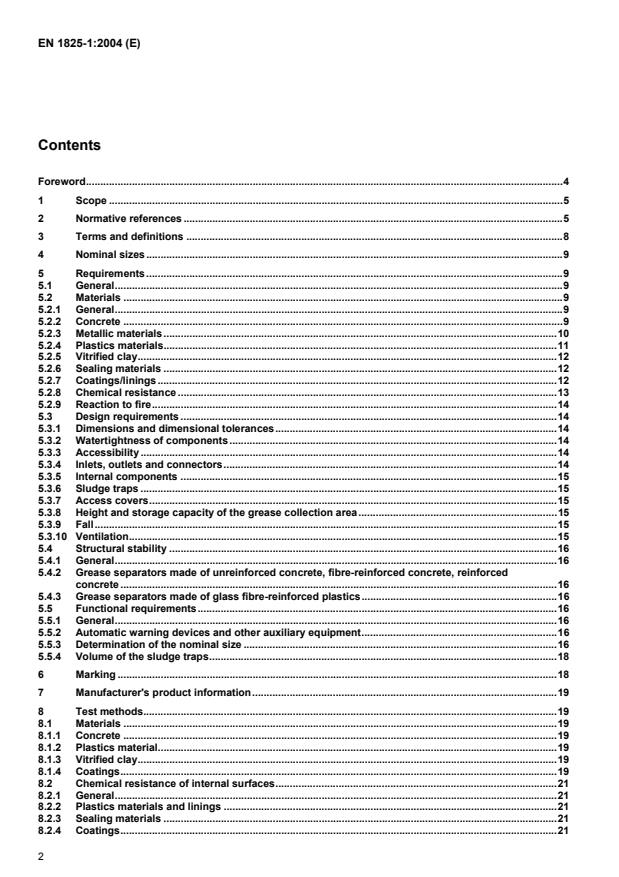
Analysis of effluent samples.33 A.1 General.33 A.2 Infrared spectroscopy method.33 A.2.1 Extraction and preparation of the extract.33 A.2.2 Evaluation.34 A.3 Gas chromatography method.35 A.3.1 General.35 A.3.2 Reagents.35 A.3.3 Interferences.35 A.3.4 Procedure.35 A.3.5 Gas chromatographic analysis.35 A.3.6 Example GC conditions.36 A.3.7 Calibration.36 A.3.8 Calculation of the oil concentration.37 Annex B (normative)
Factory production control.38 Annex C (informative)
Established methods of calculation and testing.42 C.1 Germany.42 C.2 The Netherlands.42 C.3 France.42 C.4 Austria.42 Annex D (informative)
Control by third party (third party control).43 D.1 General.43 D.2 Procedure of the third party control.43 D.2.1 Factories certified to EN ISO 9001.43 D.2.2 Factories not certified to EN ISO 9001.43 D.3 Report by the third party.44 D.4 Non-conforming units.44 Annex E (normative)
Relevant extracts from EC Decision 96/603/EC, as amended.45 Annex ZA (informative)
Clauses of this European Standard addressing the provisions of EU Construction Products Directive.46 ZA.1 Scope and relevant characteristics.46 ZA.2 Procedure for the attestation of conformity of grease separators.47 ZA.2.1 System of attestation of conformity.47 ZA.2.2 Declaration of conformity.47 ZA.3 CE Marking and labelling.48
The standard is not applicable for the separation of light liquids, e.g. petrol, fuel and heating oil, and does not cover the treatment of wastewater exclusively containing stable emulsions of greases and oils. The standard does not cover the use of biological means (bacteria and enzymes). 2 Normative references The following referenced documents are indispensable for the application of this document. For dated references, only the edition cited applies. For undated references, the latest edition of the referenced document (including any amendments) applies.
EN 124:1994, Gully tops and manhole tops for vehicular and pedestrian areas – Design requirements, type testing, marking, quality control. EN 206-1, Concrete – Part 1: Specification, performance, production and conformity. EN 288-2, Specification and approval of welding procedures for metallic materials – Part 2: Welding procedure specification for arc welding. EN 295-3, Vitrified clay pipes and fittings and pipe joints for drains and sewers – Part 3: Test methods. EN 476, General requirements for components used in discharge pipes, drains and sewers for gravity systems. EN 681-1, Elastomeric seals – Material requirements for pipe joint seals used in water and drainage applications – Part 1: Vulcanised rubber. EN 976-1:1997, Underground tanks of glass-reinforced plastics (GRP) – Horizontal cylindrical tanks for the non-pressure storage of liquid petroleum based fuels – Part 1: Requirements and test methods for single wall tanks. EN 978, Underground tanks of glass-reinforced plastics (GRP) – Determination of factor . and factor . EN 1253-4, Gullies for buildings – Part 4: Access covers. EN 10088-1, Stainless steels – Part 1: List of stainless steels. EN 10088-2, Stainless steels – Part 2: Technical delivery conditions for sheet/plate and strip for general purposes. EN 10088-3, Stainless steels – Part 3: Technical delivery conditions for semi-finished products, bars, rods and sections for general purposes. EN 12350-1, Testing fresh concrete - Part 1: Sampling. EN 12390-2, Testing hardened concrete - Part 2: Making and curing specimens for strength tests. EN 13501-1, Fire classification of construction products and building elements – Part 1: Classification using data from reaction to fire tests. EN ISO 178, Plastics – Determination of flexural properties (ISO 178:2001)
EN ISO 4624, Paints and varnishes – Pull-off test for adhesion (ISO 4624:2002). EN ISO 4628-2, Paints and varnishes - Evaluation of degradation of coatings - Designation of quantity and size of defects, and of intensity of uniform changes in appearance - Part 2: Assessment of degree of blistering (ISO 4628-2:2003). EN ISO 4628-3, Paints and varnishes - Evaluation of degradation of coatings - Designation of quantity and size of defects, and of intensity of uniform changes in appearance - Part 3: Assessment of degree of rusting (ISO 4628-3:2003). EN ISO 7253, Paints and varnishes -
Determination of resistance to
neutral salt spray (fog) (ISO
7253:1996) EN ISO 8501-1, Preparation of steel substrates before application of paints and related products – Visual assessment of surface cleanliness – Part 1: Rust grades and preparation grades of uncoated steel substrates and of steel substrates after overall removal of previous coatings (ISO 8501-1:1988). EN ISO 9377-2, Water quality – Determination of hydrocarbon oil index – Part 2: Method using solvent extraction and gas chromatography (ISO 9377-2:2000). EN ISO 14125, Fibre-reinforced plastic composites - Determination of flexural properties (ISO 14125:1998). EN ISO 15607, Specification and qualification of welding procedures for metallic materials - General rules (ISO 15607:2003) EN ISO 15614-1, Specification and qualification of welding procedures for metallic materials - Welding procedure test - Part 1: Arc and gas welding of steels and arc welding of nickel and nickel alloys (ISO 15614-1:2004). ENV 10080, Steel for reinforcement of concrete
weldable ribbed reinforcing steel B 500 – Technical delivery conditions for bars, coils and welded fabric. ISO 48, Rubber vulcanized or thermoplastic – Determination of hardness (hardness between 10 IRHD and 100 IRHD). ISO 185, Grey cast iron – Classification. ISO 630, Structural steels – Plates, wide flats, bars, sections and profiles.
Plastics -- Methods for determining the density of non-cellular plastics -- Part 1: Immersion method, liquid pyknometer method and titration method
ISO 1183-2:2004
Plastics -- Methods for determining the density of non-cellular plastics -- Part 2: Density gradient column method (available in English only) ISO 1521, Paints and varnishes – Determination of resistance to water – Water immersion method. ISO 1817, Rubber vulcanized – Determination of the effect of liquids. ISO 1920, Concrete tests – Dimensions tolerances and applicability of test specimens. ISO 3755, Cast carbon steels for general engineering purposes. ISO 4012, Concrete – Determination of compressive strength of test specimens. ISO 6272, Paints and varnishes – Falling-weight test. ISO 8217, Petroleum products – Fuels (class F) – Specifications of marine fuels.
5.2.2 Concrete The concrete shall comply with the minimum compressive strength class C 35/45 in accordance with EN 206-1.
Flake graphite cast iron
ISO 185 Reinforcing steel ENV 10080
Spheroidial graphite cast irons ISO 1083 Stainless steel EN 10088-1
EN 10088-2
EN 10088-3
Cast steel ISO 3755
Rolled steel ISO 630 b) Additional requirements for metallic materials Stainless steel For good general corrosion resistance and stability against intercrystalline corrosion effects of the various steels listed in the EN 10088-1, EN 10088-2 and EN 10088-3, only austenitic steels of minimum quality X6 CrNi 1810 shall be used. Welding of steel The requirements given in EN ISO 15607, EN 288-2 and EN ISO 15614-1 shall apply.
NOTE A minimum thickness can be required by national procedures and/or regulations. b) Adhesion – at least 6 N/mm2 on steel and at least 2 N/mm2 on concrete in accordance with
EN ISO 4624. c) Impact resistance
– at least 4 Nm in accordance with ISO 6272. d) Scratch resistance – at least 50 N in accordance with EN ISO 1518. e) Porosity
– the coating shall have no pores when tested in accordance with 8.1.4.2.5. 5.2.8 Chemical resistance 5.2.8.1 Internal surfaces 5.2.8.1.1 General All materials referred to in 5.2 shall be resistant to animal and vegetable grease and decomposing products, to reactive salts, high temperature, detergents and their decomposing products or protected accordingly. When tested in accordance with 8.2 the following requirements shall be met. 5.2.8.1.2 Concrete When uncoated and/or coated concrete is tested in accordance with 8.2.1, it shall comply with the requirements given in 5.2.2. 5.2.8.1.3 Plastics materials The test specimens from the test in 8.2.1 and 8.2.2 shall retain the following tensile strength, flexural strength, modulus of elasticity and Izod impact resistance, when compared with the control specimen: at least 80 % for glass reinforced plastics; at least 70 % for polyethylene. 5.2.8.1.4 Sealing materials When sealing materials others than those in 5.2.6 tested in accordance with 8.2.3, the test pieces shall not show any signs which may affect their fitness for use. 5.2.8.1.5 Coatings When tested in accordance with 8.2.4 the following requirements shall be met: Degree of blistering :
no worse than degree 2, class 2 gradation in accordance with EN ISO 4628-2. Degree of rusting :
Re0 in accordance with EN ISO 4628-3. Width of coating detachment :
not greater than 1 mm along the surface scratch in accordance with
EN ISO 1518. Degree of Buchholz :
not more than 50 % indentation in accordance with EN ISO 2815.
no worse than degree 2, class 2 gradation in accordance with EN ISO 4628-2. Degree of rusting :
Re0 in accordance with EN ISO 4628-3. Width of coating detachment :
not greater than 1 mm along the surface scratch in accordance with
EN ISO 1518. For steel separators, the cathodic protection and electrical resistance shall be tested in accordance with provisions valid in the country of use of the product. 5.2.9 Reaction to fire Where subject to national regulatory requirements, the reaction to fire of grease separators shall be declared in accordance with the provisions of 8.6. NOTE It is recommended that the National Foreword (or a National Annex) to this standard states whether regulations for reaction to fire of
wastewater engineering products exist in that country. 5.3 Design requirements 5.3.1 Dimensions and dimensional tolerances When not otherwise stated in this standard the dimensions and dimensional tolerances of the grease separators and their components shall be such as to ensure the functioning of the grease separators and their components and fulfil the requirements of this standard. 5.3.2 Watertightness of components All components of a grease separator (including joints, seals, connections and partitions) shall be watertight and the grease separator including extension shafts shall be tested in accordance with 8.4.1. 5.3.3 Accessibility All parts of the grease separator shall be accessible for inspection, testing, maintenance, clearance of obstruction and removal of grease and debris. The dimensions of manholes and inspection chambers shall comply with the requirements as given in EN 476. On separators equal to or greater than NS 4, there shall be at least one access point in accordance with EN 124:1994, 7.3. 5.3.4 Inlets, outlets and connectors The minimum nominal diameters DNmin of inlets and outlets and, where necessary, the connector between the sludge trap and grease separation chamber, are specified in Table 1 and shall be compatible with standardized pipe systems.
Provisions shall be made for possible movement and settlement when joining inlet, outlet and connection pipes. 5.3.5 Internal components All parts necessary for the effectiveness of a separator shall be secured. In order to ensure correct functioning and to avoid clogging in service, all internal components shall have a free passage for a ball of 80 mm diameter. 5.3.6 Sludge traps Sludge traps shall be constructed with a flow-control baffle behind the inlet, providing reduction in velocity and an even flow pattern. In the case of separators without partition between the sludge trap and the grease separator chamber, the sludge collection area shall be clearly defined in design and function (e.g. by an inclined bottom). 5.3.7 Access covers Grease separators shall be fitted with access covers which comply with EN 124:1994 or EN 1253-4. Grease separators inside buildings shall have odour-tight covers. 5.3.8 Height and storage capacity of the grease collection area The storage capacity of the grease collection area shall be at least 40 × NS in litres. The grease collection area shall be high enough to allow the maximum grease storage capacity to be collected. 5.3.9 Fall The total fall through the grease separator, grease separation chamber and sludge trap shall be sufficient to ensure that no back-up of the wastewater occurs up stream of the unit and shall be specified in the manufacturer's specification as the difference between the level of the bottom of the inlet and the bottom of the outlet. It shall be at least 70 mm for the grease separator. When there is a partition between the sludge trap and the separation chamber the fall in the sludge trap shall be at least 50 mm, and in the grease separation chamber at least 20 mm. 5.3.10 Ventilation The grease separator shall be manufactured in such a way that ventilation is possible between the inlet and outlet. The ventilation cross-section shall at least correspond to the area of the inlet pipe.
5.4.3 Grease separators made of glass fibre-reinforced plastics Under the design load the laminate shall not be strained beyond 0,26 % or 1,3 Ed, whichever is smaller, where Ed is the least strain determined from allowable loadings and the resin properties. The strain level shall be determined by calculation. For general and local stability the separator shall withstand the negative pressure tests in accordance with EN 976-1:1997, 5.8.2.2 and 5.8.3, where the separator is installed at a minimum depth of 650 mm and a maximum depth of 2000 mm. 5.5 Functional requirements 5.5.1 General The grease separator shall be constructed so as to facilitate the flow. In particular, the flow through the separator shall be as uniform as possible. The wastewater shall be supplied to the grease separation chamber via the sludge trap. 5.5.2 Automatic warning devices and other auxiliary equipment Automatic warning devices and other auxiliary equipment may be installed. 5.5.3 Determination of the nominal size The nominal size of grease separators shall be determin
...