

prEN 1748-1-1
(Main)Glass in building - Special basic products - Borosilicate float glass - Part 1-1: Definitions and general physical and mechanical properties
- Abstract
This European Standard specifies and classifies special basic products - borosilicate float glass, indicates their chemical composition, their main physical and mechanical characteristics, their dimensional and minimum quality requirements (in respect of optical and visual faults).
This European Standard applies to special basic products - borosilicate float glass supplied in stock sizes, supplied sizes or in cut sizes for final end use.
This European Standard does not apply to final cut sizes having a dimension less than 100 mm or a surface area less than 0,05 m².
- Status
- Not Published
- Publication Date
- 17-Feb-2019
- Technical Committee
- CEN/TC 129 - Glass in building
- Drafting Committee
- CEN/TC 129/WG 1 - Basic glass products
- Current Stage
- 4098 - Decision to abandon - Enquiry
- Start Date
- 23-Jan-2020
- Completion Date
- 07-Oct-2026

Overview
The European standard prEN 1748-1-1 titled Glass in building - Special basic products - Borosilicate float glass - Part 1-1: Definitions and general physical and mechanical properties is developed by the Committee for European Norms (CEN). This standard specifies and classifies borosilicate float glass used as a special basic product in construction. It details the chemical composition, principal physical and mechanical characteristics, dimensional requirements, and minimum quality criteria concerning optical and visual faults.
Primarily, this standard applies to borosilicate float glass supplied in stock sizes, supplied sizes, or cut sizes intended for final end use, provided the cut size dimensions are not less than 100 mm or below 0.05 m² in surface area. It excludes the use of smaller final cut sizes from the scope.
Key Topics
Chemical Composition: Borosilicate float glass contains 2-5% boron, along with specific amounts of silicon, aluminum, sodium, and potassium. This composition ensures high thermal shock resistance and considerable hydrolytic and acid resistance.
Physical and Mechanical Properties:
- Density ranges from 2200 to 2500 kg/m³
- Knoop hardness between 450 to 600 (measured per ISO 9385)
- Young’s modulus approximately (6 to 7) × 10¹⁰ Pa
- Coefficient of linear thermal expansion between 3.1 to 6.0 ×10⁻⁶/K (20°C to 300°C)
- Thermal conductivity around 1.2 W/m·K
Characteristic Bending Strength: The standard sets the characteristic bending strength at 45 MPa for annealed borosilicate float glass, applicable under quasi-static loading conditions.
Terminology Definitions: Precise terms such as borosilicate float glass, stock size, supplied size, final cut size, optical fault, visual fault, spot fault, halo, linear/extended fault, and edge defect are clearly defined to unify understanding across the industry.
Dimensional Requirements: It specifies manufacturing dimensions, thickness tolerances, and the method for assessing length, width, and squareness of glass panes, including expressing squareness by the diagonal differences.
Quality Control and Faults:
- Differentiates optical faults (which affect object appearance through glass) and visual faults (which alter glass visual quality).
- Defines methods for detecting faults using techniques such as the Zebra method.
- Establishes acceptance levels and addresses edge defects seen in final cut sizes.
Designation of Clear Glass: Glass is designated as clear borosilicate float glass if it is untinted and meets minimum light transmittance thresholds after surface treatments, measured in accordance with EN 410.
Applications
prEN 1748-1-1 supports manufacturers, suppliers, architects, engineers, and quality control professionals in the building and glazing sectors by providing standardized criteria for borosilicate float glass. This product is widely utilized for applications where enhanced thermal resistance and chemical durability are essential, such as:
- High-performance glazing for facades and structural glass elements in buildings
- Laboratory and pharmaceutical environments requiring resistant glass
- Architectural and decorative panels requiring stable optical properties
- Components needing resistance to thermal shock or aggressive chemical environments
The standard ensures that products meet stringent quality and durability requirements critical for safety and performance in architectural glass installations.
Related Standards
- EN 410: Glass in building - Determination of luminous and solar characteristics of glazing.
- ISO 9385: Glass and glass-ceramics - Knoop hardness test.
- prEN 1748-1-2: Glass in building - Special basic products - Borosilicate float glass - Part 1-2: Product standard.
- EN 1288 series: Methods for determining bending strength of glass.
- prEN 16612: Design of glass panes under load.
These standards complement prEN 1748-1-1 by addressing performance testing, product specifics, and safety factors, ensuring a comprehensive framework for borosilicate glass in construction.
Keywords: borosilicate float glass, glass in building, building glass standards, prEN 1748-1-1, borosilicate glass chemical composition, physical properties glass, mechanical properties glass, optical faults in glass, quality requirements borosilicate glass, European construction glass standards.
Relations
- Effective Date
- 19-Apr-2017
Frequently Asked Questions
prEN 1748-1-1 is a draft published by the European Committee for Standardization (CEN). Its full title is "Glass in building - Special basic products - Borosilicate float glass - Part 1-1: Definitions and general physical and mechanical properties". This standard covers: This European Standard specifies and classifies special basic products - borosilicate float glass, indicates their chemical composition, their main physical and mechanical characteristics, their dimensional and minimum quality requirements (in respect of optical and visual faults). This European Standard applies to special basic products - borosilicate float glass supplied in stock sizes, supplied sizes or in cut sizes for final end use. This European Standard does not apply to final cut sizes having a dimension less than 100 mm or a surface area less than 0,05 m².
This European Standard specifies and classifies special basic products - borosilicate float glass, indicates their chemical composition, their main physical and mechanical characteristics, their dimensional and minimum quality requirements (in respect of optical and visual faults). This European Standard applies to special basic products - borosilicate float glass supplied in stock sizes, supplied sizes or in cut sizes for final end use. This European Standard does not apply to final cut sizes having a dimension less than 100 mm or a surface area less than 0,05 m².
prEN 1748-1-1 is classified under the following ICS (International Classification for Standards) categories: 81.040.20 - Glass in building. The ICS classification helps identify the subject area and facilitates finding related standards.
prEN 1748-1-1 has the following relationships with other standards: It is inter standard links to EN 1748-1-1:2004. Understanding these relationships helps ensure you are using the most current and applicable version of the standard.
prEN 1748-1-1 is associated with the following European legislation: EU Directives/Regulations: 305/2011; Standardization Mandates: M/135. When a standard is cited in the Official Journal of the European Union, products manufactured in conformity with it benefit from a presumption of conformity with the essential requirements of the corresponding EU directive or regulation.
prEN 1748-1-1 is available in PDF format for immediate download after purchase. The document can be added to your cart and obtained through the secure checkout process. Digital delivery ensures instant access to the complete standard document.
Standards Content (Sample)
SLOVENSKI STANDARD
01-september-2017
Steklo v gradbeništvu - Posebni osnovni proizvodi - 1. del: Borosilikatno ravno
steklo -1-1. del: Definicija in splošne fizikalne in mehanske lastnosti
Glass in building - Special basic products - Borosilicate float glass - Part 1-1: Definitions
and general physical and mechanical properties
Glas im Bauwesen - Spezielle Basiserzeugnisse - Borosilikat-Floatglas - Teil 1-1:
Definitionen und allgemeine physikalische und mechanische Eigenschaften
Verre dans la construction - Produits de base spéciaux - Glace borosilicate - Partie 1-1 :
Définitions et propriétés physiques et mécaniques générales
Ta slovenski standard je istoveten z: prEN 1748-1-1
ICS:
81.040.20 Steklo v gradbeništvu Glass in building
2003-01.Slovenski inštitut za standardizacijo. Razmnoževanje celote ali delov tega standarda ni dovoljeno.
DRAFT
EUROPEAN STANDARD
NORME EUROPÉENNE
EUROPÄISCHE NORM
July 2017
ICS 81.040.20 Will supersede EN 1748-1-1:2004
English Version
Glass in building - Special basic products - Borosilicate
float glass - Part 1-1: Definitions and general physical and
mechanical properties
Verre dans la construction - Produits de base spéciaux Glas im Bauwesen - Spezielle Basiserzeugnisse -
- Glace de borosilicate - Partie 1-1 : Définitions et Borosilikat-Floatglas - Teil 1-1: Definitionen und
propriétés physiques et mécaniques générales allgemeine physikalische und mechanische
Eigenschaften
This draft European Standard is submitted to CEN members for enquiry. It has been drawn up by the Technical Committee
CEN/TC 129.
If this draft becomes a European Standard, CEN members are bound to comply with the CEN/CENELEC Internal Regulations
which stipulate the conditions for giving this European Standard the status of a national standard without any alteration.
This draft European Standard was established by CEN in three official versions (English, French, German). A version in any other
language made by translation under the responsibility of a CEN member into its own language and notified to the CEN-CENELEC
Management Centre has the same status as the official versions.
CEN members are the national standards bodies of Austria, Belgium, Bulgaria, Croatia, Cyprus, Czech Republic, Denmark, Estonia,
Finland, Former Yugoslav Republic of Macedonia, France, Germany, Greece, Hungary, Iceland, Ireland, Italy, Latvia, Lithuania,
Luxembourg, Malta, Netherlands, Norway, Poland, Portugal, Romania, Serbia, Slovakia, Slovenia, Spain, Sweden, Switzerland,
Turkey and United Kingdom.
Recipients of this draft are invited to submit, with their comments, notification of any relevant patent rights of which they are
aware and to provide supporting documentation.
Warning : This document is not a European Standard. It is distributed for review and comments. It is subject to change without
notice and shall not be referred to as a European Standard.
EUROPEAN COMMITTEE FOR STANDARDIZATION
COMITÉ EUROPÉEN DE NORMALISATION
EUROPÄISCHES KOMITEE FÜR NORMUNG
CEN-CENELEC Management Centre: Avenue Marnix 17, B-1000 Brussels
© 2017 CEN All rights of exploitation in any form and by any means reserved Ref. No. prEN 1748-1-1:2017 E
worldwide for CEN national Members.
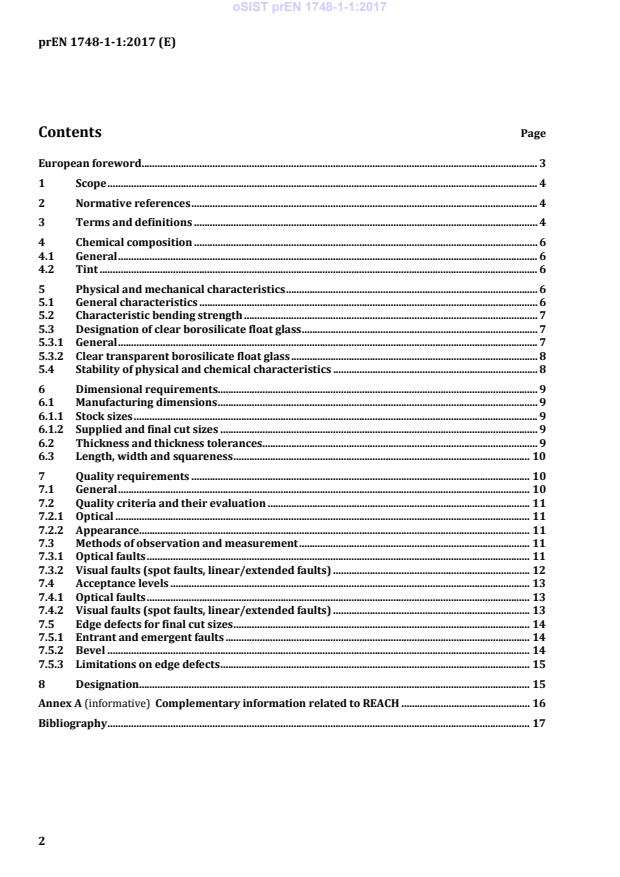
Contents Page
European foreword . 3
1 Scope . 4
2 Normative references . 4
3 Terms and definitions . 4
4 Chemical composition . 6
4.1 General . 6
4.2 Tint . 6
5 Physical and mechanical characteristics . 6
5.1 General characteristics . 6
5.2 Characteristic bending strength . 7
5.3 Designation of clear borosilicate float glass . 7
5.3.1 General . 7
5.3.2 Clear transparent borosilicate float glass . 8
5.4 Stability of physical and chemical characteristics . 8
6 Dimensional requirements. 9
6.1 Manufacturing dimensions . 9
6.1.1 Stock sizes . 9
6.1.2 Supplied and final cut sizes . 9
6.2 Thickness and thickness tolerances . 9
6.3 Length, width and squareness . 10
7 Quality requirements . 10
7.1 General . 10
7.2 Quality criteria and their evaluation . 11
7.2.1 Optical . 11
7.2.2 Appearance . 11
7.3 Methods of observation and measurement . 11
7.3.1 Optical faults . 11
7.3.2 Visual faults (spot faults, linear/extended faults) . 12
7.4 Acceptance levels . 13
7.4.1 Optical faults . 13
7.4.2 Visual faults (spot faults, linear/extended faults) . 13
7.5 Edge defects for final cut sizes . 14
7.5.1 Entrant and emergent faults . 14
7.5.2 Bevel . 14
7.5.3 Limitations on edge defects . 15
8 Designation. 15
Annex A (informative) Complementary information related to REACH . 16
Bibliography . 17
European foreword
This document (prEN 1748-1-1:2017) has been prepared by Technical Committee CEN/TC 129 “Glass
in Building”, the secretariat of which is held by NBN.
This document is currently submitted to the CEN Enquiry.
This document will supersede EN 1748-1-1:2004.
This document has been prepared under a mandate given to CEN by the European Commission and the
European Free Trade Association.
This European Standard consists of the following parts:
— EN 1748-1-1 Glass in Building — Special basic products - Borosilicate float glass — Part 1-1:
Definitions and general physical and mechanical properties;
— EN 1748-1-2 Glass in Building — Special basic products - Borosilicate float glass — Part 1-2:
Product standard.
This European Standard differs from EN 1748-1-1:2004 as follows:
a) Rolled and Drawn sheet production methods have been removed, the standard scope is reduced to
Borosilicate float glass (scope and title have been modified);
b) chemical composition has been modified in Table 1;
c) classes for linear expansion coefficients have been deleted (notes in Table 2);
d) Clause 5 and Clause 6 have been revised, further nominal thicknesses have been added, sub
Clause 6.3 “Tolerances and squareness” has been completely revised; the squareness of rectangular
glass panes is now expressed by the difference between its diagonals;
e) Clause 5 translucent borosilicate glass has been removed;
f) Clause 7 has been completely revised (including the Zebra method of observation optical faults);
g) Clause 7: categories of defects have been removed, only one quality is defined (Table 8);
h) a new informative Annex A given complementary information related to REACH has been added;
i) the document has been editorial revised.
1 Scope
This European Standard specifies and classifies special basic products - borosilicate float glass, indicates
their chemical composition, their main physical and mechanical characteristics, their dimensional and
minimum quality requirements (in respect of optical and visual faults).
This European Standard applies to special basic products - borosilicate float glass supplied in stock
sizes, supplied sizes or in cut sizes for final end use.
This European Standard does not apply to final cut sizes having a dimension less than 100 mm or a
surface area less than 0,05 m .
2 Normative references
The following documents, in whole or in part, are normatively referenced in this document and are
indispensable for its application. For dated references, only the edition cited applies. For undated
references, the latest edition of the referenced document (including any amendments) applies.
EN 410, Glass in building — Determination of luminous and solar characteristics of glazing
ISO 9385, Glass and glass-ceramics — Knoop hardness test
3 Terms and definitions
For the purposes of this document, the following terms and definitions apply.
3.1
borosilicate glass
silicate glass containing between 2 % and 5 % boron and with a chemical composition according to 4.1
of this standard
Note 1 to entry: As a result of the composition it has a high thermal shock resistance and a very high hydrolytic
and acid resistance.
3.2
borosilicate float glass
flat, transparent, clear or tinted borosilicate glass having parallel and polished faces obtained by
continuous casting and floatation on a metal bath
Note 1 to entry: In French called 'glace' and in German 'Floatglas'.
3.3
length, H and width, B
defined with reference to the direction of draw of the glass ribbon as shown in Figure 1
Key
1 → direction of draw
H length
B width
Figure 1 — Relationship between length, width and direction of draw
3.4
stock sizes
glass delivered in manufacturer's standard stock sizes
3.5
supplied size
pane of glass that has been supplied either as raw material for further processing and/or cutting down
to a size for installation
Note 1 to entry: This is a size that is outside the stock size.
3.6
final cut size
pane of glass that has been cut down to the dimensions being required either for installation or
processing into a final product
Note 1 to entry: Examples of processed final products are insulating glass units and thermally toughened safety
glass of those dimensions.
3.7
optical fault
fault which leads to distortions in the appearance of objects observed through the glass
3.8
visual fault
fault which alters the visual quality of the glass
Note 1 to entry: Visual faults include spot faults and linear / extended faults.
3.9
spot fault
nucleus which is generally accompanied by a halo of distorted glass
Note 1 to entry: Spot fault can be solid inclusions, bubbles, etc.
3.10
halo
area locally distorted, generally around a point defect
3.11
linear/extended fault
fault which can be on or in the glass, in the form of deposits, marks or scratches that occupy an
extended length or area
3.12
edge defect
defect which can occur on the edge of a cut size piece in the form of entrant and emergent fault and/or
bevel
4 Chemical composition
4.1 General
The magnitude of the proportions by mass of the principal constituents of borosilicate float glass
covered by this European Standard is given in Table 1, see also Annex A.
NOTE Oxygen is not mentioned in Table 1 (see Annex A).
Table 1 — Magnitude of the proportions by mass of the constituents of borosilicate glass
Constituents Proportion by mass of element
Silicon (Si) 32 % to 41 %
Aluminium (Al) 0 % to 4,3 %
Boron (Bo) 2 % to 5 %
Sodium (Na) 0 % to 6 %
Potassium (K) 0 % to 6,7 %
a < 5 %
Other components excluding oxygen
a
Properties other than photometric characteristics shall not be significantly altered by these other
components.
4.2 Tint
Body tinted glass is obtained by the addition of suitable materials.
5 Physical and mechanical characteristics
5.1 General characteristics
Conventional numerical values for the physical and mechanical characteristics of borosilicate float glass
excluding ‘Characteristic bending strength’ (f ) are given in Table 2. These values, for normal
g,k
annealed glass without any further toughening, are not precise requirements with which the glass shall
strictly comply, but are the generally accepted figures for use in calculations where a high degree of
accuracy is not required.
Table 2 — General characteristic values of borosilicate glass
Characteristic Symbol Value and unit
Density (at 18 °C) ρ 2 200 kg/m to
2 500 kg/m
Hardness (Knoop) HK a
450 to 600
0,1/20
Young's modulus (modulus of elasticity) E (6 to 7) × 10 Pa
Poisson's ratio
...