

EN 1015-12:2016
(Main)Methods of test for mortar for masonry - Part 12: Determination of adhesive strength of hardened rendering and plastering mortars on substrates
- Abstract
This European Standard specifies a method for the determination of the adhesive strength between rendering and plastering mortars and a substrate.
- Status
- Published
- Publication Date
- 07-Jun-2016
- Technical Committee
- CEN/TC 125 - Masonry
- Drafting Committee
- CEN/TC 125/WG 4 - Test methods
- Current Stage
- 9093 - Decision to confirm - Review Enquiry
- Start Date
- 22-Mar-2022
- Completion Date
- 21-Oct-2026

Overview
EN 1015-12:2016 is a European Standard developed by CEN that specifies the method for determining the adhesive strength of hardened rendering and plastering mortars on different substrates. This standard plays a crucial role in evaluating the bonding performance of masonry mortars, ensuring their reliability and durability when applied in construction works.
The test focuses on the maximum tensile stress that hardened mortars can withstand when pulled perpendicular to their surface on substrates such as concrete, masonry units, or other specified backgrounds. Adhesive strength is a key indicator of mortar performance, influencing the longevity and structural integrity of rendering and plastering applications.
Key Topics
Scope and Application
EN 1015-12:2016 is essential for testing the adhesive bond between mortars and various substrates including concrete panels and masonry units. It helps assess whether the mortar meets quality requirements for construction and renovation projects.Test Principle
The adhesive strength is obtained by applying a direct tensile load via a metal pull-head plate glued onto the mortar surface and measuring the failure load. The load is applied perpendicular to the mortar-substrate interface, and adhesive strength is calculated by dividing the failure load by the test area.Sample Preparation
The standard outlines procedures for preparing substrates and applying mortar layers, including the use of controlled concrete panels or masonry units as substrates. Mortar samples can either be laboratory-prepared or taken from factory-made mixes. Test specimens are prepared either on fresh or hardened mortar for subsequent adhesive strength testing.Testing Procedure and Equipment
The test requires specific equipment: stainless steel or brass truncated conical rings for sample preparation, metal pull-head plates for tensile loading, adhesives (such as epoxy resin), and a core drilling machine. Testing machines apply a tensile load at a controlled rate to ensure accurate measurement between 20 and 60 seconds until failure occurs.Result Interpretation
Adhesive strength results are expressed as the mean of at least five tests, reported in N/mm². The standard distinguishes valid failure modes-adhesion fractures at the mortar-substrate interface versus cohesive failures within the mortar or substrate, which indicate minimum adhesive strength values.Storage and Curing Conditions
Test specimens are cured and stored under controlled temperature and humidity (20 °C and ~65% RH) conditions for 28 days before testing, ensuring consistent and comparable results.
Applications
EN 1015-12:2016 is widely used by:
- Manufacturers of Masonry Mortars to validate and certify product adhesive properties in compliance with EN 998 specifications.
- Construction Engineers and Quality Control Teams to verify proper mortar adhesion in building façades, internal and external plastering, and rendering applications.
- Laboratories and Testing Facilities performing routine testing for product development, quality assurance, or forensic analysis of mortar failures.
- Architects and Consultants specifying construction materials to ensure adherence to performance standards that prevent delamination or premature mortar failure.
This method supports improved durability of masonry finishes by ensuring that mortars provide the necessary adhesive bond for long-lasting applications.
Related Standards
EN 1015-12:2016 is part of the EN 1015 series addressing various test methods for masonry mortars. Related standards include:
- EN 1015-2: Bulk sampling and preparation of test mortars
- EN 1015-3: Determination of fresh mortar consistence by flow table
- EN 1015-11: Determination of flexural and compressive strength of hardened mortar
- EN 772-11: Water absorption testing for masonry units relevant to substrate characterization
- EN 998 (all parts): Specification for mortar for masonry
Together, these standards provide comprehensive guidance on mortar properties, performance testing, and quality assurance within the masonry and construction sector.
Keywords: EN 1015-12:2016, adhesive strength, rendering mortar, plastering mortar, masonry mortar testing, mortar-substrate bond, tensile strength test, masonry standards, CEN mortar tests, mortar durability, concrete substrate testing, plastering adhesive test, European mortar standards.
Relations
- Effective Date
- 15-Jun-2016
- Effective Date
- 28-Jan-2026
- Effective Date
- 28-Jan-2026
- Effective Date
- 28-Jan-2026
- Effective Date
- 28-Jan-2026
- Effective Date
- 28-Jan-2026
- Referred By
EN 998-1:2010 - Specification for mortar for masonry - Part 1: Rendering and plastering mortar - Effective Date
- 28-Jan-2026
- Effective Date
- 28-Jan-2026
- Referred By
EN 15286:2013 - Agglomerated stone - Slabs and tiles for wall finishes (internal and external) - Effective Date
- 28-Jan-2026
- Effective Date
- 28-Jan-2026
- Effective Date
- 28-Jan-2026
- Referred By
EN 998-1:2016 - Specification for mortar for masonry - Part 1: Rendering and plastering mortar - Effective Date
- 28-Jan-2026
Get Certified
Connect with accredited certification bodies for this standard

DIBt (Deutsches Institut für Bautechnik)
German Institute for Building Technology.
DIN CERTCO
DIN Group product certification.

Aboma Certification B.V.
Specialized in construction, metal, and transport sectors.
Sponsored listings
Frequently Asked Questions
EN 1015-12:2016 is a standard published by the European Committee for Standardization (CEN). Its full title is "Methods of test for mortar for masonry - Part 12: Determination of adhesive strength of hardened rendering and plastering mortars on substrates". This standard covers: This European Standard specifies a method for the determination of the adhesive strength between rendering and plastering mortars and a substrate.
This European Standard specifies a method for the determination of the adhesive strength between rendering and plastering mortars and a substrate.
EN 1015-12:2016 is classified under the following ICS (International Classification for Standards) categories: 91.100.10 - Cement. Gypsum. Lime. Mortar. The ICS classification helps identify the subject area and facilitates finding related standards.
EN 1015-12:2016 has the following relationships with other standards: It is inter standard links to EN 1015-12:2000, EN 1015-11:2019, EN 1015-2:1998, EN 1015-3:1999, EN 772-11:2011, EN 998-2:2016, EN 998-1:2010, EN 14411:2012, EN 15286:2013, EN 12058:2004, EN 17187:2020, EN 998-1:2016. Understanding these relationships helps ensure you are using the most current and applicable version of the standard.
EN 1015-12:2016 is associated with the following European legislation: EU Directives/Regulations: 305/2011; Standardization Mandates: M/116. When a standard is cited in the Official Journal of the European Union, products manufactured in conformity with it benefit from a presumption of conformity with the essential requirements of the corresponding EU directive or regulation.
EN 1015-12:2016 is available in PDF format for immediate download after purchase. The document can be added to your cart and obtained through the secure checkout process. Digital delivery ensures instant access to the complete standard document.
Standards Content (Sample)
2003-01.Slovenski inštitut za standardizacijo. Razmnoževanje celote ali delov tega standarda ni dovoljeno.Prüfverfahren für Mörtel für Mauerwerk - Teil 12: Bestimmung der Haftfestigkeit von erhärteten PutzmörtelnMéthodes d'essai des mortiers pour maçonnerie - Partie 12 : Détermination de l'adhérence des mortiers d'enduit durcis appliqués sur supportsMethods of test for mortar for masonry - Part 12: Determination of adhesive strength of hardened rendering and plastering mortars on substrates91.100.10Cement. Mavec. Apno. MaltaCement. Gypsum. Lime. MortarICS:Ta slovenski standard je istoveten z:EN 1015-12:2016SIST EN 1015-12:2016en,fr,de01-oktober-2016SIST EN 1015-12:2016SLOVENSKI
STANDARDSIST EN 1015-12:20011DGRPHãþD
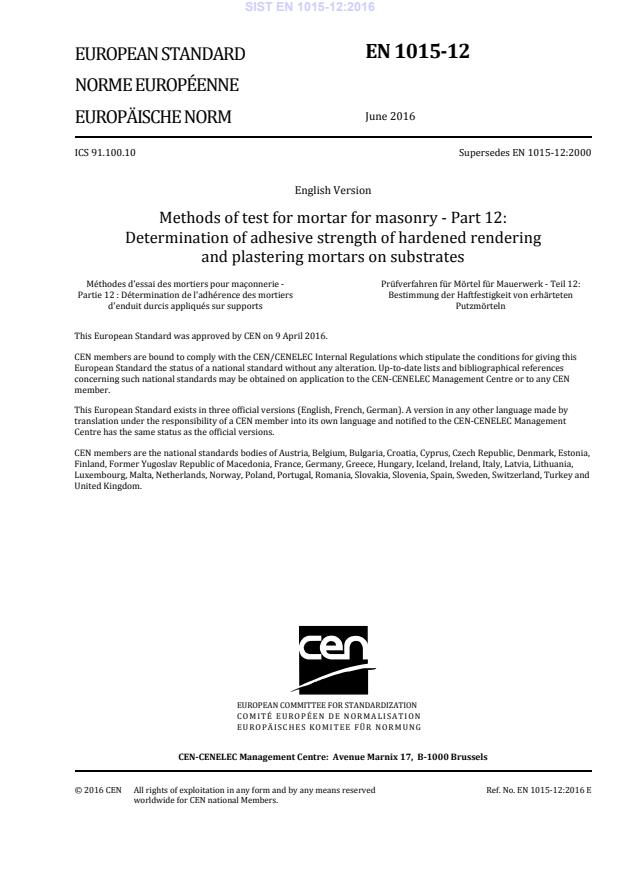
EUROPEAN STANDARD NORME EUROPÉENNE EUROPÄISCHE NORM
EN 1015-12
June
t r s x ICS
{ sä s r rä s r Supersedes EN
s r s wæ s tã t r r rEnglish Version
Methods of test for mortar for masonry æ Part
s tã Determination of adhesive strength of hardened rendering and plastering mortars on substrates Méthodes d 5essai des mortiers pour maçonnerie æ Partie
s t ã Détermination de l 5adhérence des mortiers d 5enduit durcis appliqués sur supports
Prüfverfahren für Mörtel für Mauerwerk æ Teil
s tã Bestimmung der Haftfestigkeit von erhärteten Putzmörteln This European Standard was approved by CEN on
{ April
t r s xä
egulations which stipulate the conditions for giving this European Standard the status of a national standard without any alterationä Upætoædate lists and bibliographical references concerning such national standards may be obtained on application to the CENæCENELEC Management Centre or to any CEN memberä
translation under the responsibility of a CEN member into its own language and notified to the CENæCENELEC Management Centre has the same status as the official versionsä
CEN members are the national standards bodies of Austriaá Belgiumá Bulgariaá Croatiaá Cyprusá Czech Republicá Denmarká Estoniaá Finlandá Former Yugoslav Republic of Macedoniaá Franceá Germanyá Greeceá Hungaryá Icelandá Irelandá Italyá Latviaá Lithuaniaá Luxembourgá Maltaá Netherlandsá Norwayá Polandá Portugalá Romaniaá Slovakiaá Sloveniaá Spainá Swedená Switzerlandá Turkey and United Kingdomä
EUROPEAN COMMITTEE FOR STANDARDIZATION COMITÉ EUROPÉEN DE NORMALISATION EUROPÄISCHES KOMITEE FÜR NORMUNG
CEN-CENELEC Management Centre:
Avenue Marnix 17,
B-1000 Brussels
t r s x CEN All rights of exploitation in any form and by any means reserved worldwide for CEN national Membersä Refä Noä EN
s r s wæ s tã t r s x ESIST EN 1015-12:2016
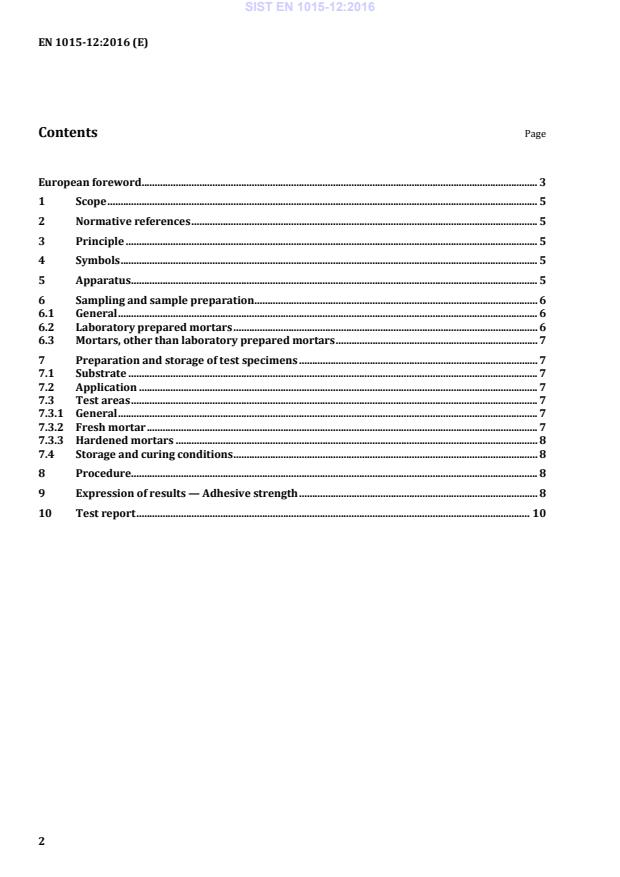
European foreword . 3 1 Scope . 5 2 Normative references . 5 3 Principle . 5 4 Symbols . 5 5 Apparatus . 5 6 Sampling and sample preparation . 6 6.1 General . 6 6.2 Laboratory prepared mortars . 6 6.3 Mortars, other than laboratory prepared mortars . 7 7 Preparation and storage of test specimens . 7 7.1 Substrate . 7 7.2 Application . 7 7.3 Test areas . 7 7.3.1 General . 7 7.3.2 Fresh mortar . 7 7.3.3 Hardened mortars . 8 7.4 Storage and curing conditions . 8 8 Procedure. 8 9 Expression of results — Adhesive strength . 8 10 Test report . 10
...