

EN 1329-1:2026
(Main)Plastics piping systems for soil and waste discharge (low and high temperature) within the building structure - Unplasticized poly(vinyl chloride) (PVC-U) - Part 1: Specifications for pipes, fittings and the system
- Abstract
This document specifies the requirements for solid wall pipes with smooth internal and external surfaces, extruded from the same formulation throughout the wall, fittings and the piping system of unplasticized poly(vinyl chloride) (PVC-U) intended for soil and waste discharge applications (low and high temperature)
- above ground inside the building, or outside buildings fixed onto the wall; which is reflected in the marking by “B”;
- for both inside buildings and buried in ground within the building structure, which is reflected in the marking by “BD”. This intended use is only applicable for components with nominal outside diameters equal to or greater than 75 mm.
NOTE 1 Multilayer pipes with different formulations throughout the wall and foamed core pipes are covered by EN 1453-1[1].
PVC-U pipes, fittings and the system complying with this document are also suitable for the following purposes:
- ventilating part of the pipework in association with discharge applications;
- rainwater pipework within the building structure.
This document covers a range of nominal sizes, a range of pipes and fittings series and gives recommendations concerning colours.
Pipes, fittings and other components conforming to any of the plastics product standards listed in Annex B can be used with pipes and fittings conforming to this document, provided they conform to the requirements for joint dimensions given in Clause 7 and to the requirements of Table 26.
NOTE 2 EN 476[2] specifies the general requirements for components used in discharge pipes, drains and sewers for gravity systems. Pipes and fittings conforming to EN 1329-1 fully meet the EN 476 requirements.
- Status
- Published
- Publication Date
- 05-May-2026
- Technical Committee
- CEN/TC 155 - Plastics piping systems and ducting systems
- Current Stage
- 6060 - Definitive text made available (DAV) - Publishing
- Start Date
- 06-May-2026
- Due Date
- 02-Jun-2026
- Completion Date
- 06-May-2026

Overview
EN 1329-1:2026 is a European Standard developed by CEN specifying the requirements for plastics piping systems, specifically those made of unplasticized poly(vinyl chloride) (PVC-U), intended for soil and waste discharge (for both low and high temperature flows) within building structures. This standard covers the requirements for solid-wall PVC-U pipes and fittings, extruded from a consistent formulation, as well as the complete piping system. The standard supports safe and efficient soil and waste removal in domestic, commercial, and public buildings, ensuring compatibility and long-term system performance.
EN 1329-1:2026 applies to systems used:
- Inside buildings and above ground, on walls (marked as “B”)
- Both inside buildings and buried in ground within the building structure (marked as “BD” for components with nominal outside diameters ≥ 75 mm)
It also provides guidance for ventilation pipes and rainwater drainage within the building infrastructure.
Key Topics
- Material Specifications: Defines acceptable PVC-U raw materials, including use of virgin, reworked, and recycled plastics, and sets formulation requirements to ensure durability and safety.
- Pipe and Fitting Requirements: Details requirements for solid-wall construction with smooth internal and external surfaces, dimensional tolerances, and wall thickness for various nominal sizes.
- Application Areas: Specifies marking for above-ground (“B”) and buried/dual-use (“BD”) components to enhance system clarity and compliance.
- Mechanical and Physical Properties: Outlines performance criteria such as impact resistance, chemical stability, and ability to withstand temperature variations.
- Joint Compatibility: Ensures that pipes and fittings from different manufacturers or complying with related plastics piping standards can be used together, provided joint dimensions meet specified requirements.
- System Marking: Prescribes minimum marking requirements for traceability and verification of intended use.
- Sustainability: Permits and provides guidance for the use of up to 100% recycled PVC-U in certain components.
Applications
Soil and waste discharge piping systems built according to EN 1329-1:2026 are widely used in construction and renovation projects, offering dependable solutions for:
- Internal Soil and Waste Removal: Safely conveying wastewater and other discharge from within buildings, above ground or in buried applications.
- Ventilation: Venting parts of the pipework used with discharge applications, ensuring system balance and odor control.
- Rainwater Drainage: Managing rainwater conveyance within the building structure.
- Combined System Installations: Facilitating integration with products complying with other plastics piping standards, as specified in the annexes, for unified system assembly.
The clear specification of sizes, dimension series, and mechanical performance ensures installers, engineers, and specifiers can select components suitable for residential, commercial, and industrial buildings, reducing the risk of leaks, blockages, or premature failures.
Related Standards
EN 1329-1:2026 is closely aligned and compatible with several other key European and international standards, including:
- EN 1453-1: Multilayer and foamed core pipes for similar applications.
- EN 476: General requirements for pipelines and fittings in gravity discharge systems, ensuring the broader system consistently meets safety and performance expectations.
- EN 681-1, EN 681-2: Requirements for elastomeric seals used in joints.
- EN 14680: Specifications for adhesives in non-pressure thermoplastic piping.
- EN ISO 1167, EN ISO 3126, EN ISO 13254: Test methods for mechanical and physical properties.
Adopting EN 1329-1:2026 helps organizations meet updated legislative and regulatory requirements in plastics pipes and drainage systems, while enhancing long-term reliability and sustainability of building infrastructure.
Keywords: EN 1329-1:2026, plastics piping systems, PVC-U pipes, soil and waste discharge, building drainage, pipe standards, waste pipe fittings, recycled PVC, system marking, mechanical requirements.
Relations
- Effective Date
- 28-Feb-2024
- Effective Date
- 23-Sep-2026
- Effective Date
- 02-Sep-2026
- Effective Date
- 25-Aug-2026
- Effective Date
- 01-Jul-2026
- Effective Date
- 03-Jun-2026
- Referred By
EN 1366-3:2021 - Fire resistance tests for service installations - Part 3: Penetration seals - Effective Date
- 13-May-2026
- Referred By
EN 14680:2015 - Adhesives for non-pressure thermoplastics piping systems - Specifications - Effective Date
- 13-May-2026
- Effective Date
- 13-May-2026
- Referred By
EN 1366-3:2021+A1:2024 - Fire resistance tests for service installations - Part 3: Penetration seals - Effective Date
- 13-May-2026
- Effective Date
- 13-May-2026
- Effective Date
- 13-May-2026
- Effective Date
- 13-May-2026
- Effective Date
- 13-May-2026
- Effective Date
- 13-May-2026
Get Certified
Connect with accredited certification bodies for this standard

DIBt (Deutsches Institut für Bautechnik)
German Institute for Building Technology.
DIN CERTCO
DIN Group product certification.

Aboma Certification B.V.
Specialized in construction, metal, and transport sectors.
Sponsored listings
Frequently Asked Questions
EN 1329-1:2026 is a standard published by the European Committee for Standardization (CEN). Its full title is "Plastics piping systems for soil and waste discharge (low and high temperature) within the building structure - Unplasticized poly(vinyl chloride) (PVC-U) - Part 1: Specifications for pipes, fittings and the system". This standard covers: This document specifies the requirements for solid wall pipes with smooth internal and external surfaces, extruded from the same formulation throughout the wall, fittings and the piping system of unplasticized poly(vinyl chloride) (PVC-U) intended for soil and waste discharge applications (low and high temperature) - above ground inside the building, or outside buildings fixed onto the wall; which is reflected in the marking by “B”; - for both inside buildings and buried in ground within the building structure, which is reflected in the marking by “BD”. This intended use is only applicable for components with nominal outside diameters equal to or greater than 75 mm. NOTE 1 Multilayer pipes with different formulations throughout the wall and foamed core pipes are covered by EN 1453-1[1]. PVC-U pipes, fittings and the system complying with this document are also suitable for the following purposes: - ventilating part of the pipework in association with discharge applications; - rainwater pipework within the building structure. This document covers a range of nominal sizes, a range of pipes and fittings series and gives recommendations concerning colours. Pipes, fittings and other components conforming to any of the plastics product standards listed in Annex B can be used with pipes and fittings conforming to this document, provided they conform to the requirements for joint dimensions given in Clause 7 and to the requirements of Table 26. NOTE 2 EN 476[2] specifies the general requirements for components used in discharge pipes, drains and sewers for gravity systems. Pipes and fittings conforming to EN 1329-1 fully meet the EN 476 requirements.
This document specifies the requirements for solid wall pipes with smooth internal and external surfaces, extruded from the same formulation throughout the wall, fittings and the piping system of unplasticized poly(vinyl chloride) (PVC-U) intended for soil and waste discharge applications (low and high temperature) - above ground inside the building, or outside buildings fixed onto the wall; which is reflected in the marking by “B”; - for both inside buildings and buried in ground within the building structure, which is reflected in the marking by “BD”. This intended use is only applicable for components with nominal outside diameters equal to or greater than 75 mm. NOTE 1 Multilayer pipes with different formulations throughout the wall and foamed core pipes are covered by EN 1453-1[1]. PVC-U pipes, fittings and the system complying with this document are also suitable for the following purposes: - ventilating part of the pipework in association with discharge applications; - rainwater pipework within the building structure. This document covers a range of nominal sizes, a range of pipes and fittings series and gives recommendations concerning colours. Pipes, fittings and other components conforming to any of the plastics product standards listed in Annex B can be used with pipes and fittings conforming to this document, provided they conform to the requirements for joint dimensions given in Clause 7 and to the requirements of Table 26. NOTE 2 EN 476[2] specifies the general requirements for components used in discharge pipes, drains and sewers for gravity systems. Pipes and fittings conforming to EN 1329-1 fully meet the EN 476 requirements.
EN 1329-1:2026 is classified under the following ICS (International Classification for Standards) categories: 23.040.20 - Plastics pipes; 91.140.80 - Drainage systems. The ICS classification helps identify the subject area and facilitates finding related standards.
EN 1329-1:2026 has the following relationships with other standards: It is inter standard links to EN 1329-1:2020, EN ISO 6259-1:2015, EN 681-1:1996, EN ISO 11925-2:2026, EN 13823:2020+A1:2022, EN ISO 472:2013, EN 1366-3:2021, EN 14680:2015, EN 1453-1:2000, EN 1366-3:2021+A1:2024, EN 1124-3:2008, EN 12380:2002, EN 12729:2023, EN 13434:2021, EN 1123-2:2006+A1:2007. Understanding these relationships helps ensure you are using the most current and applicable version of the standard.
EN 1329-1:2026 is available in PDF format for immediate download after purchase. The document can be added to your cart and obtained through the secure checkout process. Digital delivery ensures instant access to the complete standard document.
Standards Content (Sample)
SLOVENSKI STANDARD
01-julij-2026
Cevni sistemi iz polimernih materialov za nizko- in visokotemperaturne odvodne
sisteme v zgradbah - Nemehčan polivinilklorid (PVC-U) - 1. del: Zahteve za cevi,
fitinge in sistem
Plastics piping systems for soil and waste discharge (low and high temperature) within
the building structure - Unplasticized poly(vinyl chloride) (PVC-U) - Part 1: Specifications
for pipes, fittings and the system
Kunststoff-Rohrleitungssysteme zum Ableiten von Abwasser (niedriger und hoher
Temperatur) innerhalb der Gebäudestruktur - Weichmacherfreies Polyvinylchlorid (PVC-
U) - Teil 1: Anforderungen an Rohre, Formstücke und das Rohrleitungssystem
Systèmes de canalisations en plastique pour l'évacuation des eaux-vannes et des eaux
usées (à basse et à haute température) à l'intérieur de la structure des bâtiments - Poly
(chlorure de vinyle) non plastifié (PVC-U) - Partie 1 : Spécifications pour tubes, raccords
et le système
Ta slovenski standard je istoveten z: EN 1329-1:2026
ICS:
23.040.20 Cevi iz polimernih materialov Plastics pipes
91.140.80 Drenažni sistemi Drainage systems
2003-01.Slovenski inštitut za standardizacijo. Razmnoževanje celote ali delov tega standarda ni dovoljeno.
EN 1329-1
EUROPEAN STANDARD
NORME EUROPÉENNE
May 2026
EUROPÄISCHE NORM
ICS 23.040.20; 91.140.80 Supersedes EN 1329-1:2020
English Version
Plastics piping systems for soil and waste discharge (low
and high temperature) within the building structure -
Unplasticized poly(vinyl chloride) (PVC-U) - Part 1:
Specifications for pipes, fittings and the system
Systèmes de canalisations en plastique pour Kunststoff-Rohrleitungssysteme zum Ableiten von
l'évacuation des eaux-vannes et des eaux usées (à Abwasser (niedriger und hoher Temperatur) innerhalb
basse et à haute température) à l'intérieur de la der Gebäudestruktur - Weichmacherfreies
structure des bâtiments - Poly(chlorure de vinyle) non Polyvinylchlorid (PVC-U) - Teil 1: Anforderungen an
plastifié (PVC-U) - Partie 1 : Spécifications pour tubes, Rohre, Formstücke und das Rohrleitungssystem
raccords et le système
This European Standard was approved by CEN on 27 March 2026.
CEN members are bound to comply with the CEN/CENELEC Internal Regulations which stipulate the conditions for giving this
European Standard the status of a national standard without any alteration. Up-to-date lists and bibliographical references
concerning such national standards may be obtained on application to the CEN-CENELEC Management Centre or to any CEN
member.
This European Standard exists in three official versions (English, French, German). A version in any other language made by
translation under the responsibility of a CEN member into its own language and notified to the CEN-CENELEC Management
Centre has the same status as the official versions.
CEN members are the national standards bodies of Austria, Belgium, Bulgaria, Croatia, Cyprus, Czech Republic, Denmark, Estonia,
Finland, France, Germany, Greece, Hungary, Iceland, Ireland, Italy, Latvia, Lithuania, Luxembourg, Malta, Netherlands, Norway,
Poland, Portugal, Republic of North Macedonia, Romania, Serbia, Slovakia, Slovenia, Spain, Sweden, Switzerland, Türkiye and
United Kingdom.
EUROPEAN COMMITTEE FOR STANDARDIZATION
COMITÉ EUROPÉEN DE NORMALISATION
EUROPÄISCHES KOMITEE FÜR NORMUNG
CEN-CENELEC Management Centre: Rue de la Science 23, B-1040 Brussels
© 2026 CEN All rights of exploitation in any form and by any means reserved Ref. No. EN 1329-1:2026 E
worldwide for CEN national Members.
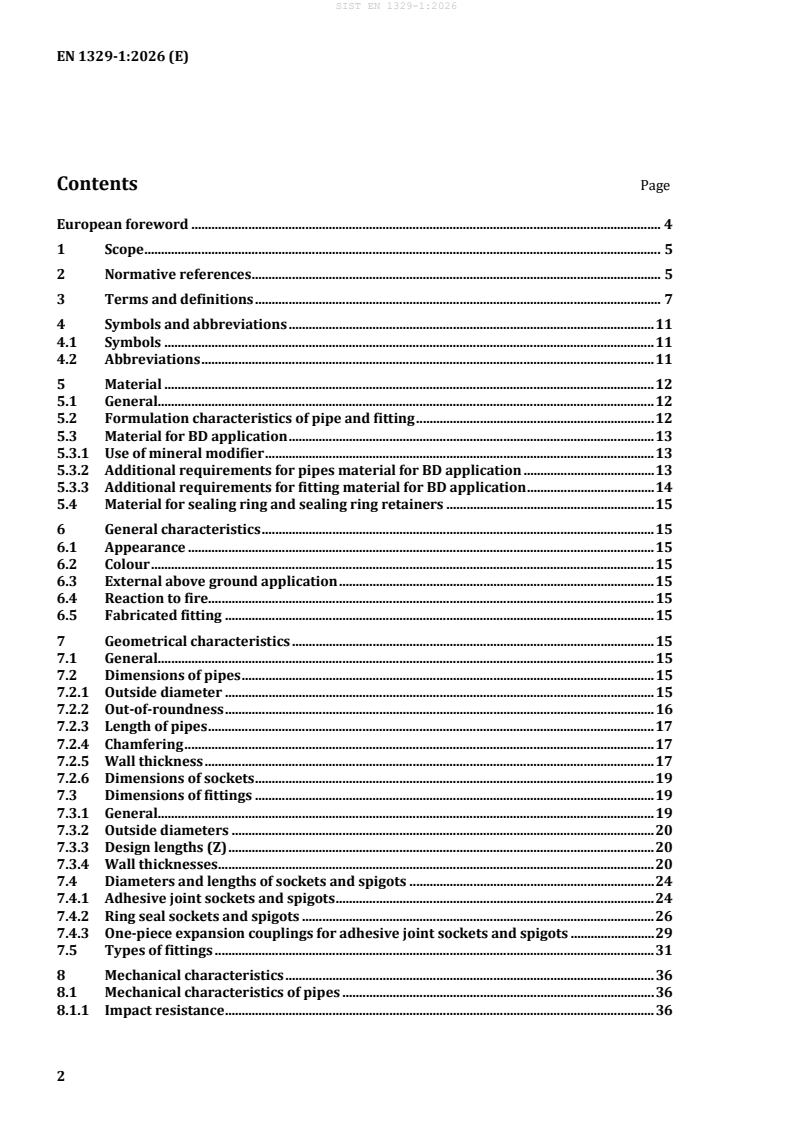
Contents Page
European foreword . 4
1 Scope . 5
2 Normative references . 5
3 Terms and definitions . 7
4 Symbols and abbreviations . 11
4.1 Symbols . 11
4.2 Abbreviations . 11
5 Material . 12
5.1 General. 12
5.2 Formulation characteristics of pipe and fitting . 12
5.3 Material for BD application . 13
5.3.1 Use of mineral modifier . 13
5.3.2 Additional requirements for pipes material for BD application . 13
5.3.3 Additional requirements for fitting material for BD application . 14
5.4 Material for sealing ring and sealing ring retainers . 15
6 General characteristics . 15
6.1 Appearance . 15
6.2 Colour . 15
6.3 External above ground application . 15
6.4 Reaction to fire. 15
6.5 Fabricated fitting . 15
7 Geometrical characteristics . 15
7.1 General. 15
7.2 Dimensions of pipes . 15
7.2.1 Outside diameter . 15
7.2.2 Out-of-roundness . 16
7.2.3 Length of pipes . 17
7.2.4 Chamfering . 17
7.2.5 Wall thickness . 17
7.2.6 Dimensions of sockets . 19
7.3 Dimensions of fittings . 19
7.3.1 General. 19
7.3.2 Outside diameters . 20
7.3.3 Design lengths (Z) . 20
7.3.4 Wall thicknesses . 20
7.4 Diameters and lengths of sockets and spigots . 24
7.4.1 Adhesive joint sockets and spigots . 24
7.4.2 Ring seal sockets and spigots . 26
7.4.3 One-piece expansion couplings for adhesive joint sockets and spigots . 29
7.5 Types of fittings . 31
8 Mechanical characteristics . 36
8.1 Mechanical characteristics of pipes . 36
8.1.1 Impact resistance . 36
8.1.2 Optional requirement for low temperature application . 37
8.2 Mechanical characteristics of fittings for application area code BD . 38
9 Physical characteristics . 39
9.1 Physical characteristics of pipes . 39
9.2 Physical characteristics of fittings . 41
10 Performance requirements . 41
11 Sealing rings . 42
12 Adhesives . 42
13 Marking . 43
13.1 General . 43
13.2 Minimum required marking of pipes . 43
13.3 Minimum required marking of fittings . 44
13.4 Additional marking . 44
Annex A (normative) Utilization of PVC-U recyclates . 45
Annex B (informative) Product standards . 47
Bibliography . 48
European foreword
This document (EN 1329-1:2026) has been prepared by Technical Committee CEN/TC 155 “Plastics
piping systems and ducting systems”, the secretariat of which is held by NEN.
This European Standard shall be given the status of a national standard, either by publication of an
identical text or by endorsement, at the latest by November 2026, and conflicting national standards shall
be withdrawn at the latest by November 2026.
Attention is drawn to the possibility that some of the elements of this document may be the subject of
patent rights. CEN shall not be held responsible for identifying any or all such patent rights.
This document supersedes EN 1329-1:2020.
— allowance of the use of recyclates up to 100 %;
— updating of the “terms” and “definitions” in line with EN 14541-1;
— extension to PVC-U material sources which may be virgin material, reworked material or recyclates
(pre- or post-consumer);
— editorial updates through the document;
— in 5.1, clarification that the conformity with all the requirements shall be demonstrated with one
formulation with the 100 % virgin material and a second formulation with the maximum content of
recyclate;
— in 9.1 and 9.2, introduction of an annealing prior to determining the Vicat softening temperature
(VST) to bring it in line with the annealing happening during the elevated temperature cycling test
and in service operations; this change also reduce the variability in Vicat measurement which occurs
without annealing;
— in Annex A, addition of detailed information about the use of PVC-U recyclates.
EN 1329 consists of the following parts, under the general title Plastics piping systems for soil and waste
discharge (low and high temperature) within the building structure — Unplasticized poly(vinyl chloride)
(PVC-U):
— Part 1: Specifications for pipes, fittings and the system;
— Part 2: Assessment of conformity (technical specification).
Any feedback and questions on this document should be directed to the users’ national standards body.
A complete listing of these bodies can be found on the CEN website.
According to the CEN-CENELEC Internal Regulations, the national standards organisations of the
following countries are bound to implement this European Standard: Austria, Belgium, Bulgaria, Croatia,
Cyprus, Czech Republic, Denmark, Estonia, Finland, France, Germany, Greece, Hungary, Iceland, Ireland,
Italy, Latvia, Lithuania, Luxembourg, Malta, Netherlands, Norway, Poland, Portugal, Republic of North
Macedonia, Romania, Serbia, Slovakia, Slovenia, Spain, Sweden, Switzerland, Türkiye and the United
Kingdom.
1 Scope
This document specifies the requirements for solid wall pipes with smooth internal and external surfaces,
extruded from the same formulation throughout the wall, fittings and the piping system of unplasticized
poly(vinyl chloride) (PVC-U) intended for soil and waste discharge applications (low and high
temperature)
— above ground inside the building, or outside buildings fixed onto the wall; which is reflected in the
marking by “B”;
— for both inside buildings and buried in ground within the building structure, which is reflected in the
marking by “BD”. This intended use is only applicable for components with nominal outside
diameters equal to or greater than 75 mm.
NOTE 1 Multilayer pipes with different formulations throughout the wall and foamed core pipes are covered by
[1]
EN 1453-1 .
PVC-U pipes, fittings and the system complying with this document are also suitable for the following
purposes:
— ventilating part of the pipework in association with discharge applications;
— rainwater pipework within the building structure.
This document covers a range of nominal sizes, a range of pipes and fittings series and gives
recommendations concerning colours.
Pipes, fittings and other components conforming to any of the plastics product standards listed in
Annex B can be used with pipes and fittings conforming to this document, provided they conform to the
requirements for joint dimensions given in Clause 7 and to the requirements of Table 26.
[2]
NOTE 2 EN 476 specifies the general requirements for components used in discharge pipes, drains and sewers
for gravity systems. Pipes and fittings conforming to EN 1329-1 fully meet the EN 476 requirements.
2 Normative references
The following documents are referred to in the text in such a way that some or all of their content
constitutes requirements of this document. For dated references, only the edition cited applies. For
undated references, the latest edition of the referenced document (including any amendments) applies.
EN 681-1, Elastomeric seals — Materials requirements for pipe joint seals used in water and drainage
applications — Part 1: Vulcanized rubber
EN 681-2, Elastomeric seals — Material requirements for pipe joint seals used in water and drainage
applications — Part 2: Thermoplastic elastomers
EN 14680, Adhesives for non-pressure thermoplastics piping systems — Specifications
EN 13501-1, Fire classification of construction products and building elements — Part 1: Classification
using data from reaction to fire tests
EN 13823, Reaction to fire tests for building products — Building products excluding floorings exposed to
the thermal attack by a single burning item
EN 16000, Plastics piping systems — Systems within the building structure — Mounting and fixing of
components in the test apparatus to thermal attack by a single burning item
EN ISO 472, Plastics — Vocabulary (ISO 472)
EN ISO 580, Plastics piping and ducting systems — Injection-moulded thermoplastics fittings — Methods
for visually assessing the effects of heating (ISO 580)
EN ISO 1043-1, Plastics — Symbols and abbreviated terms — Part 1: Basic polymers and their special
characteristics (ISO 1043-1)
EN ISO 1158, Plastics — Vinyl chloride homopolymers and copolymers — Determination of chlorine content
(ISO 1158)
EN ISO 1167-1:2006, Thermoplastics pipes, fittings and assemblies for the conveyance of fluids —
Determination of the resistance to internal pressure — Part 1: General method (ISO 1167-1:2006)
EN ISO 1167-2:2006, Thermoplastics pipes, fittings and assemblies for the conveyance of fluids —
Determination of the resistance to internal pressure — Part 2: Preparation of pipe test pieces (ISO 1167-
2:2006)
EN ISO 2505, Thermoplastics pipes — Longitudinal reversion — Test method and parameters (ISO 2505)
EN ISO 3126, Plastics piping systems — Plastics components — Determination of dimensions (ISO 3126)
EN ISO 3127, Thermoplastics pipes — Determination of resistance to external blows — Round-the-clock
method (ISO 3127)
EN ISO 3451-5, Plastics — Determination of ash — Part 5: Poly(vinyl chloride) (ISO 3451-5)
EN ISO 6259-1, Thermoplastics pipes — Determination of tensile properties — Part 1: General test method
(ISO 6259-1)
EN ISO 9852, Unplasticized poly(vinyl chloride) (PVC-U) pipes — Dichloromethane resistance at specified
temperature (DCMT) — Test method (ISO 9852)
EN ISO 11925-2, Reaction to fire tests — Ignitability of products subjected to direct impingement of flame
— Part 2: Single-flame source test (ISO 11925-2)
EN ISO 13254, Thermoplastics piping systems for non-pressure applications — Test method for
watertightness (ISO 13254)
EN ISO 13255, Thermoplastics piping systems for soil and waste discharge inside buildings — Test method
for airtightness of joints (ISO 13255)
EN ISO 13257, Thermoplastics piping systems for non-pressure applications — Test method for resistance
to elevated temperature cycling (ISO 13257)
EN ISO 13259, Thermoplastics piping systems for underground non-pressure applications — Test method
for leaktightness of elastomeric sealing ring type joints (ISO 13259)
EN ISO 13263, Thermoplastics piping systems for non-pressure underground drainage and sewerage —
Thermoplastics fittings — Test method for impact strength (ISO 13263)
EN ISO 13264, Thermoplastics piping systems for non-pressure underground drainage and sewerage —
Thermoplastics fittings — Test method for mechanical strength or flexibility of fabricated fittings (ISO
13264)
ISO 2507:2026, Thermoplastics pipes and fittings — Vicat softening temperature — General test method
and test conditions for vinyl chloride-based (PVC-U, PVC-C, PVC-HI) and acrylonitrile-based (ABS, ASA) pipes
and fittings
ISO 6259-2, Thermoplastics pipes — Determination of tensile properties — Part 2: Pipes made of
unplasticized poly(vinyl chloride) (PVC-U), oriented unplasticized poly(vinyl chloride) (PVC-O), chlorinated
poly(vinyl chloride) (PVC-C) and high-impact poly(vinyl chloride) (PVC-HI)
ISO 18373-1, Rigid PVC pipes — Differential scanning calorimetry (DSC) method — Part 1: Measurement
of the processing temperature
3 Terms and definitions
For the purposes of this document, the terms and definitions given in EN ISO 472 and EN ISO 1043-1 and
the following apply.
ISO and IEC maintain terminology databases for use in standardization at the following addresses:
— ISO Online browsing platform: available at https://www.iso.org/obp/
— IEC Electropedia: available at https://www.electropedia.org/
3.1
application area code
code used in the marking of pipes and fittings to indicate the application area(s) for which they are
intended, as follows:
— B: for components intended for use above ground inside the building, or for components outside
buildings fixed onto the wall;
— BD: for application area B and the area under and within 1 m from the building where the pipes and
fittings are buried in ground and are connected to the underground drains and sewers system
Note 1 to entry: Other application area codes U and UD not covered by this document are defined elsewhere, e.g. in
EN 1401-1.
3.2 Nominal size
3.2.1
nominal size
DN
numerical designation of the size of a component, which is a convenient round number approximately
equal to the manufacturing dimension
Note 1 to entry: Nominal size is expressed in millimetres (mm).
Note 2 to entry: This designation is not used for threaded components.
3.2.2
nominal size
DN/OD
nominal size, related to the outside diameter
3.3
nominal outside diameter
d
n
specified outside diameter assigned to a nominal size DN/OD
Note 1 to entry: It is expressed in millimetres (mm).
3.4
outside diameter
d
e
value of the measurement of the outside diameter through its cross section at any point of a pipe or spigot
end, rounded up to the nearest 0,1 mm
3.5
mean outside diameter
d
em
value of the measurement of the outer circumference of a pipe or spigot of a fitting in any cross section,
divided by π (≈ 3,142), rounded up to the nearest 0,1 mm
3.6
inside diameter of a socket
d
s
value of the measurement of the inside diameter through its cross section at any point of a socket,
rounded up to the nearest 0,1 mm
3.7
mean inside diameter of a socket
d
sm
arithmetical mean of a number of measurements of the inside diameter of a socket in the same cross
section
3.8
out-of-roundness
ovality
difference between the measured maximum and the measured minimum outside diameter in the same
cross section of a component
3.9
wall thickness
e
value of measurement of the wall thickness at any point around the circumference of a component
3.10
mean wall thickness
e
m
arithmetical mean of a number of measurements of the wall thickness, regularly spaced around the
circumference and in the same cross section of a component, including the measured minimum and the
measured maximum values of the wall thickness in that cross section
3.11
standard dimension ratio
SDR
numerical designation of a pipe series, which is a convenient round number, approximately equal to the
dimension ratio of the nominal outside diameter, d , and the nominal wall thickness, e
n n
3.12
nominal ring stiffness class
SN
numerical designation of the ring stiffness of the pipe or fitting which is a convenient round number,
indicating the minimum required ring stiffness of the pipe or stiffness of the fitting
3.13
assembled fittings
fittings which are made from several injection moulded parts to be assembled together by screwing or
clipping
Note 1 to entry: Such fittings can incorporate rubber membranes or joints.
3.14
fabricated fittings
fitting produced by welding, thermoforming or adhesive joint from pipes and/or from injection-moulded
fittings
3.15
solid wall pipe or fitting
pipe or fitting with smooth internal and external surface with the same compound/formulation
throughout the wall
Note 1 to entry: Pipes having more than one layer are considered as solid wall pipes, provided all layers are made
from the same compound/formulation.
3.16
virgin material
plastics material in the form of pellets, granules, powder, floc, etc. that has not been subjected to use or
processing other than that required for its initial manufacture
Note 1 to entry: Does not contain any reworked plastics material and/or plastics recyclate.
Note 2 to entry: Sometimes also referred to as “primary material” or “primary plastics feedstock”.
Note 3 to entry: It is understood that the addition of additives such as stabilizers and pigments is still resulting into
a virgin (plastics) material.
[SOURCE: EN 14541-1:2022, 3.1]
3.17
reworked material
plastics material from rejected unused products or trimmings capable of being reclaimed within the same
process that generated it
Note 1 to entry: Reworked material does not change the status of the feedstock.
Note 2 to entry: This definition does not cover the conditions for the use of reworked material, which can be found
in the applicable product standard.
Note 3 to entry: Previously referred to as “own reprocessed material”.
[SOURCE: EN 14541-1:2022, 3.2]
3.18
pre-consumer material
plastics material diverted from the waste stream during a manufacturing process, excluding reworked
(plastics) material
Note 1 to entry: Previously referred to as “post-industrial material”.
Note 2 to entry: Different categories of pre-consumer material may be considered in the applicable product
standard.
[SOURCE: EN 14541-1:2022, 3.3]
3.19
post-consumer material
plastics material generated by households or by commercial, industrial and institutional facilities in their
role as end-users of the product which can no longer be used for its intended purpose
Note 1 to entry: This includes returns of material from the distribution chain.
Note 2 to entry: Different categories of post-consumer material may be considered in the applicable product
standard.
[SOURCE: EN 14541-1:2022, 3.4]
3.20
recyclate
plastics material resulting from the recycling of pre-consumer and post-consumer plastics products
Note 1 to entry: Also referred to as “secondary raw material” or “recycled plastics” or “regenerate”.
Note 2 to entry: Recycling can be chemical, physical or mechanical.
[SOURCE: EN 14541-1:2022, 3.5]
3.21
agreed specification
specification of the relevant material characteristics agreed between the supplier of the recyclate and the
pipes and/or fittings manufacturer
Note 1 to entry: The agreed specification is often considered in the context of certification by a third party
organization.
[SOURCE: EN 14541-1:2022, 3.15]
4 Symbols and abbreviations
4.1 Symbols
For the purposes of this document, the following symbols apply.
A length of engagement
α nominal angle of fitting
C depth of sealing zone
d outside diameter
e
d mean outside diameter
em
d inside diameter of socket
s
e wall thickness
e minimum wall thickness
min
e wall thickness of socket
e wall thickness at the groove
L length of spigot
L length of adhesive joint socket
l effective length of pipe
R radius of swept fittings
X stop width
Z design length of fitting
4.2 Abbreviations
For the purposes of this document, the following abbreviations apply.
DN nominal size
DN/OD nominal size, outside diameter related
DSC differential scanning calorimetry
PVC-U unplasticised poly(vinyl chloride)
SDR standard dimension ratio
SN nominal ring stiffness class
TIR true impact rate
Type L long socket type for ring seal joints
Type M medium socket type for ring seal joints
Type S short socket type for ring seal joints
VST Vicat softening temperature
RAL colour reference system
5 Material
5.1 General
The formulation for production of pipes and fittings shall be PVC-U material to which additives are added
to enable conformity with the requirements of this document.
The dosage level of each ingredient of the formulation shall be specified by the manufacturer as part of
the quality documentation.
Conformity of the product (pipes, fittings or the system as applicable) with all the requirements of this
document shall be demonstrated.
PVC-U material may be virgin material, reworked material or recyclates (pre- or post-consumer).
The formulation (including virgin material, reworked material, recyclates or a mixture, if applicable) shall
comply with the requirements given in 5.2.
Recyclates may be used under the following conditions:
— recyclates shall be supplied with an agreed specification in accordance with Annex A;
— for each agreed specification, the minimum and maximum amounts of recyclate in the formulation
shall be specified by the manufacturer and the conformity with all the requirements of this document
shall be demonstrated by testing the product:
— with no or minimum recyclate content, and
— with maximum recyclate content;
NOTE 1 Formulations with recyclate content between minimum and maximum are deemed to comply as well.
NOTE 2 Recyclates from different suppliers complying with the same agreed specification are deemed to be
interchangeable.
— the quantity of recyclates that is added in each production batch shall be recorded by the
manufacturer.
NOTE 3 The total recyclate content in the formulation is the sum of the recyclate added and the recyclate present
in reworked material.
[4]
NOTE 4 CEN/TS 1329-2 gives specific recommendation with regard to test frequency when recyclate is used.
5.2 Formulation characteristics of pipe and fitting
The formulation shall comply with the requirements given in Table 1 and, if applicable in 5.3.1 and 5.3.2
for pipes and 5.3.3 for fittings.
Table 1 — Minimum PVC-U content
Characteristics Requirements Test method
a
PVC-U content for pipes ≥ 80 % by mass
Calculation or EN ISO 1158 or
b
EN ISO 3451-5, Method A
PVC-U content for injection-moulded ≥ 85 % by mass
fittings
a
The PVC-U content is equal to (m /56,8) × 100, where m is the chlorine content expressed as a percentage
cl cl
by mass in accordance with EN ISO 1158.
b
The measurement of filler content by ash rest is an alternative to the measurement of PVC-U content. This
measurement should be conducted at 950°C. In case of dispute, EN ISO 1158 applies.
5.3 Material for BD application
5.3.1 Use of mineral modifier
For pipes ≥ 110 mm and intended for BD application, a further reduction of the PVC-U content to ≥ 75 %
by mass is permitted provided the PVC-U is substituted by coated or uncoated CaCO conforming to the
following:
a) the composition of the CaCO , before coating if any, shall conform to the following:
1) content of CaCO ≥ 96 % by mass;
2) content of MgCO ≤ 4 % by mass;
3) content of CaCO and MgCO in total ≥ 98 % by mass;
3 3
b) the physical properties of the material shall conform to the following:
1) mean particle size D50 ≤ 2,5 μm;
2) top cut D98 ≤ 20 μm.
5.3.2 Additional requirements for pipes material for BD application
The material of pipes intended to be used in application area BD shall comply with the additional
requirement given in Table 2, when tested in accordance with the test method as specified in Table 2,
using the indicated parameters.
The pipe formulation shall be tested in the form of a pipe.
Table 2 — Formulation characteristics of pipes intended for BD application
Characteristic Requirements Test parameters Test method
a
Resistance to No failure End caps Type A or B
EN ISO 1167-1:2006 and
internal during the test
EN ISO 1167-2:2006
Test temperature 60 °C
pressure period
Orientation Free
Number of test 3
pieces
Circumferential 10 MPa
(hoop) stress
Conditioning period 1 h
Type of test Water-in-water
Test period 1 000 h
a
Pressure shall be calculated according to EN ISO 1167-1:2006, 7.2 (measured dimensions of the test piece).
5.3.3 Additional requirements for fitting material for BD application
The material of fittings intended to be used in application area BD shall comply with the additional
requirement given in Table 3, when tested in accordance with the test method as specified in Table 3,
using the indicated parameters.
The fitting formulation shall be tested in the form of an extruded or injection-moulded pipe.
Table 3 — Formulation characteristics of fittings intended for BD application
Characteristic Requirements Test parameters Test method
a
Resistance to No failure End caps Type A or B
EN ISO 1167-1:2006
internal during the test
and
Dimensions 50 mm ≤ d ≤ 110 mm
n
pressure period
EN ISO 1167-2:2006
3 mm ≤ e ≤ 5 mm
Free length for ≥ 140 mm
injection-moulded
pipe
Test temperature 60 °C
Orientation Free
Number of test 3
pieces
Circumferential 6,3 MPa
(hoop) stress
Conditioning 1 h
period
Type of test Water-in-water
Test period 1 000 h
a
Pressure shall be calculated according to EN ISO 1167-1:2006, 7.2 (measured dimensions of the test piece).
5.4 Material for sealing ring and sealing ring retainers
The sealing ring material shall conform to all the requirements of EN 681-1 or EN 681-2, as applicable for
soil and waste discharge applications. Sealing ring retainers may be made from polymers other than PVC-
U, provided the joints conform to the requirements given in Clause 10.
6 General characteristics
6.1 Appearance
When viewed without magnification the following requirements apply:
— internal and external surfaces of pipes and fittings shall be smooth, clean and free from defects likely
to prevent their conformity to this document. The manufacturer shall define acceptance criteria for
visual appearance;
NOTE Examples of defects can be grooving, blistering, impurities or pores.
— pipe ends shall be cleanly cut and the ends of pipes and fittings shall be square to their axis.
6.2 Colour
The pipes and the fittings shall have the same colour through the wall.
® [5]
The recommended colour of pipes and fittings is grey (e.g. RAL 7037 ).
6.3 External above ground application
Additional requirements depending on the climate should be considered and mentioned in technical
documentation.
6.4 Reaction to fire
Where required, the reaction to fire performance of products complying with this document shall be
classified according to EN 13501-1 using, as applicable, EN ISO 11925-2 and EN 13823 with mounting
and fixing according to EN 16000.
6.5 Fabricated fitting
The pipes and/or injection moulded fittings which are used to produce fabricated fittings shall conform
to this document.
7 Geometrical characteristics
7.1 General
Dimensions shall be measured in accordance with EN ISO 3126.
NOTE All figures in this document are schematic sketches only, to indicate the relevant dimensions. They do
not necessarily represent the manufactured components.
7.2 Dimensions of pipes
7.2.1 Outside diameter
The mean outside diameter, d , shall conform to Table 4 or Table 5 as applicable.
em
Table 4 — Mean outside diameters (metric series)
Dimensions in millimetres
Nominal size Nominal outside Mean outside diameter
diameter
DN/OD d d d
n em,min em,max
32 32 32,0 32,2
40 40 40,0 40,2
50 50 50,0 50,2
63 63 63,0 63,2
75 75 75,0 75,3
80 80 80,0 80,3
82 82 82,0 82,3
90 90 90,0 90,3
100 100 100,0 100,3
110 110 110, 0 110,3
125 125 125,0 125,3
140 140 140,0 140,4
160 160 160,0 160,4
180 180 180,0 180,4
200 200 200,0 200,5
250 250 250,0 250,5
315 315 315,0 315,6
Table 5 — Mean outside diameters (series based on inch dimensions)
Dimensions in millimetres
Nominal size Nominal outside Mean outside diameter
diameter
DN/OD d d d
n em,min em,max
36 36 36,2 36,5
43 43 42,8 43,1
56 56 55,8 56,1
7.2.2 Out-of-roundness
The out-of-roundness, measured directly after production, shall be less than or equal to 0,024d .
n
7.2.3 Length of pipes
The effective length of a pipe, l, shall be not less than that declared by the manufacturer when measured
as shown in Figure 1.
Figure 1 — Effective length of pipes
7.2.4 Chamfering
If a chamfer is applied, the angle of chamfering shall be between 15° and 45° to the axis of the pipe (see
Figure 2 or Figure 3, as applicable).
The remaining wall thickness of the end of the pipe shall be at least ∕ of e .
3 min
7.2.5 Wall thickness
The wall thickness, e, shall conform to Table 6 or Table 7 respectively, where for metric series a maximum
wall thickness at any point up to 1,2e is permitted provided that the mean wall thickness, e , is less
min m
than or equal to the specified e .
m,max
Table 6 — Wall thickness (metric series)
Dimensions in millimetres
Nominal size Wall thickness
DN/OD Application area
a b
B BD
e e e e
min m,max min m,max
32 3,0 3,5 - -
40 3,0 3,5 - -
50 3,0 3,5 - -
63 3,0 3,5 - -
75 3,0 3,5 3,0 3,5
80 3,0 3,5 3,0 3,5
82 3,0 3,5 3,0 3,5
90 3,0 3,5 3,0 3,5
100 3,0 3,5 3,0 3,5
110 3,2 3,8 3,2 3,8
125 3,2 3,8 3,2 3,8
140 3,2 3,8 3,5 4,1
160 3,2 3,8 4,0 4,6
180 3,6 4,2 4,4 5,0
200 3,9 4,5 4,9 5,6
250 4,9 5,6 6,2 7,1
315 6,2 7,1 7,7 8,7
a
This series provides max SDR 51 which is reached for DN/OD 160 and
above.
b
This series provides max SDR 41 which is reached for DN/OD 140 and above
and is classified SN 4.
Table 7 — Wall thickness (series based on inch dimensions)
Dimensions in millimetres
Nominal size Wall thickness
DN/OD Application area B
e e
min m,max
36 3,0 3,5
43 3,0 3,5
56 3,0 3,5
7.2.6 Dimensions of sockets
If pipes are provided with sockets, the dimensions of sockets shall comply with the relevant requirements
as specified in 7.4.
7.3 Dimensions of fittings
7.3.1 General
The dimensions of the fittings shall be measured according to Figure 2 and Figure 3 and shall comply with
the requirements given in 7.3.2 to 7.3.4 and 7.4.
Key
A length of engagement
C depth of sealing zone
d outside diameter
e
d inside diameter of socket
s
e wall thickness
e wall thickness of socket
e wall thickness at the groove
L length of spigot
Figure 2 — General dimensions of sockets and spigots for elastomeric sealing joints
Key
d outside diameter
e
d inside diameter of socket
s
e wall thickness
e wall thickness of socket
L length of spigot
L length of adhesive joint socket
Figure 3 — Basic dimensions of sockets and spigots for adhesive joints
7.3.2 Outside diameters
The mean outside diameter, d , of the spigot shall conform to Table 4 or Table 5, as applicable.
em
The out-of-roundness, measured directly after production, shall be less than or equal to 0,024d .
n
7.3.3 Design lengths (Z)
The design length(s) [Z-length(s)] of fittings (see Figures 7 to 10 and Figures 12 to 16) shall be given by
the manufacturer.
NOTE The Z-lengths are intended to assist in the design of moulds and are not intended to be used for quality
[6]
control purposes. ISO 265-1 can be used as a guideline.
7.3.4 Wall thicknesses
7.3.4.1 General
Fittings and those parts of fittings not intended to come into contact with the fluid being conveyed are
not required to conform to the wall thickness given in Table 8, Table 9 or Table 10, as applicable.
7.3.4.2 Adhesive joint fittings
For adhesive joint fittings the wall thicknesses, e and e (see Figure 3), shall comply with the
requirements given in Table 8 or Table 9, as applicable.
For adhesive joint fittings a reduction of 5 % of the wall thickness resulting from core shifting is
permitted. In such case the average of two opposite wall thicknesses shall be equal to, or exceed, the
values given in Table 8 or Table 9, as applicable.
Table 8 — Wall thicknesses for adhesive joint fittings (metric series)
Dimensions in millimetres
a
Nominal size Wall thickness
Wall thickness of sockets
DN/OD
(e = 0,75e)
Application area Application area
B BD B BD
e e e e
min min 2,min 2,min
b
32 3,0 − −
2,0
b
40 3,0 − −
2,0
b
50 3,0 − −
2,0
b
63 3,0 − −
2,0
b b
75 3,0 3,0
2,0 2,0
80 3,0 3,0 2,3 2,3
82 3,0 3,0 2,3 2,3
90 3,0 3,0 2,3 2,3
100 3,0 3,0 2,3 2,3
110 3,2 3,2 2,4 2,4
125 3,2 3,2 2,4 2,4
140 3,2 3,5 2,4 2,6
160 3,2 4,0 2,4 3,0
180 3,6 4,4 2,7 3,3
200 3,9 4,9 2,9 3,7
250 4,9 6,2 3,7 4,7
315 6,2 7,7 4,7 5,8
a
This requirement is also applicable to the wall thickness of the spigot.
b
e = 0,65e. This kind of fittings may only be used in an adhesive joint system and
shall be marked accordingly.
Table 9 — Wall thicknesses for adhesive joint fittings (series based on inch dimensions)
Dimensions in millimetres
a
Nominal size Nominal Wall thickness
Wall thickness of sockets
outside
DN/OD
(e = 0,75e)
diameter
Application area Application area
B B
d e e
n min 2,min
b b
36 36
2,3
3,0
b b
43 43
3,0 2,3
b b
56 56
3,0 2,3
a
This requirement is also applicable to the wall thickness of the spigot.
b
For existing tools a wall thickness of 2,7 mm and a wall thickness of sockets of 2,0 mm is allowed,
provided that the deviating value for the wall thickness, e, is marked on the fitting.
7.3.4.3 Ring seal fittings
For ring seal fittings the wall thicknesses e, e and e (see Figure 2), shall comply with the requirements
2 3
given in Table 10 or Table 11, as applicable.
For ring seal fittings a reduction of 5 % of the wall thickness resulting from core shifting is permitted. In
such case, the average of two opposite wall thicknesses shall be equal to, or exceed, the values given in
Table 10 or Table 11, as applicable.
Where a sealing ring is located by means of a retaining cap or ring (see
...