


EN 18120-4:2026
(Main)Packaging - Design for recycling of plastic packaging - Part 4: Guideline for PET bottles
General Information
- Abstract
This document covers the design of any bottle with the main body of the packaging unit predominantly made of PET and the design of separate components predominantly made of PET, with respect to compatibility of the design with state-of-the-art collecting, sorting and recycling processes and useability of the recyclates in an application.
Packaging constituents and packaging components made of other materials than PET are also covered by this document as they need to be evaluated on compatibility with PET polymer recycling.
- Status
- Published
- Publication Date
- 14-Apr-2026
- Technical Committee
- CEN/TC 261 - Packaging
- Current Stage
- 6060 - Definitive text made available (DAV) - Publishing
- Start Date
- 15-Apr-2026
- Due Date
- 02-Dec-2024
- Completion Date
- 15-Apr-2026

Overview
EN 18120-4:2026 - Packaging - Design for Recycling of Plastic Packaging - Part 4: Guideline for PET Bottles provides guidance for the design of plastic bottles predominantly made of polyethylene terephthalate (PET). Developed by CEN, this standard focuses on the compatibility of PET bottles and their components with modern collecting, sorting, and recycling systems. It addresses not only PET but also other materials used as components, emphasizing their effect on the recyclability of the bottle as a whole. The document seeks to facilitate the effective recovery and reuse of PET recyclates, particularly in high-quality applications such as bottle-to-bottle recycling.
Key Topics
- Design for Recycling: Guidance to maximize the recyclability of PET bottles, considering both the main PET body and all separate components.
- Component Evaluation: Assessment of closures, labels, adhesives, sleeves, barrier layers, and other constituents for their compatibility with PET recycling.
- Material Compatibility: Clear categorization of materials and design practices into full compatibility (green), limited compatibility (yellow), and not compatible (red) with recycling processes.
- Transparency and Colour: Recommendations for bottle colour and clarity to optimize sortability and maintain product protection requirements.
- Design Principles:
- Prefer mono-material, unpigmented PET bottles
- Minimize the use of non-PET components and ensure they can be easily separated during recycling
- Avoid certain materials such as bio-/oxo-/photodegradable or compostable components
- Ensure labels, adhesives, and inks do not interfere with recycling processes
Applications
EN 18120-4:2026 is relevant to a range of stakeholders in the packaging and recycling sectors:
- Packaging Designers and Manufacturers: Offers practical guidance for developing PET bottle designs that enhance collection, sorting, and recycling efficiencies.
- Brand Owners and Retailers: Assists in meeting regulatory and sustainability commitments by ensuring packaging is compatible with existing recycling infrastructure.
- Recyclers and Waste Management Companies: Improves transparency regarding which packaging formats contribute to high-quality recyclates, reducing contamination risks.
- Regulatory Authorities: Supports legislative initiatives aimed at increasing plastic packaging recycling rates and promoting a circular economy for plastics.
- Consumers: Encourages better on-pack communication on recyclability, aiding recycling participation and proper disposal behaviors.
Practical use cases include the development of beverage bottles, personal care containers, household product packaging, and medical product containers, all designed to maintain product integrity while ensuring the potential for high-value recyclate recovery. This standard also helps in evaluating existing and new PET packaging lines for recyclability improvements.
Related Standards
For a comprehensive approach to the recyclability of plastic packaging, the following standards are closely related to EN 18120-4:2026:
- EN 18120-1: Definitions and principles for design-for-recycling of plastic packaging
- EN 18120-2: Process and governance to evaluate the recyclability of plastic packaging
- EN 18120-3: Sortability evaluation process for plastic packaging
- EN 18120-10: Protocols for PET bottle recyclability evaluation
- CEN/TR 13688: Report on requirements for substances and materials to prevent impediments to recycling
- EPBP and Recyclass Guidelines: Industry guidelines for PET bottle design compatible with recycling (available at www.epbp.org and www.recyclass.eu)
By implementing EN 18120-4:2026, organizations contribute to environmental sustainability by supporting efficient plastic waste management and high-quality PET recycling. This ensures compliance with European best practices and positions products favorably in markets prioritizing sustainable packaging solutions.
Relations
- Effective Date
- 27-May-2026
- Effective Date
- 27-May-2026
- Effective Date
- 27-May-2026
Get Certified
Connect with accredited certification bodies for this standard

DIN CERTCO
DIN Group product certification.
BRCGS (Brand Reputation Compliance Global Standards)
Global food safety and quality standards owner.
CIS Institut d.o.o.
Personal Protective Equipment (PPE) certification body. Notified Body NB-2890 for EU Regulation 2016/425 PPE.
Sponsored listings
Frequently Asked Questions
EN 18120-4:2026 is a standard published by the European Committee for Standardization (CEN). Its full title is "Packaging - Design for recycling of plastic packaging - Part 4: Guideline for PET bottles". This standard covers: This document covers the design of any bottle with the main body of the packaging unit predominantly made of PET and the design of separate components predominantly made of PET, with respect to compatibility of the design with state-of-the-art collecting, sorting and recycling processes and useability of the recyclates in an application. Packaging constituents and packaging components made of other materials than PET are also covered by this document as they need to be evaluated on compatibility with PET polymer recycling.
This document covers the design of any bottle with the main body of the packaging unit predominantly made of PET and the design of separate components predominantly made of PET, with respect to compatibility of the design with state-of-the-art collecting, sorting and recycling processes and useability of the recyclates in an application. Packaging constituents and packaging components made of other materials than PET are also covered by this document as they need to be evaluated on compatibility with PET polymer recycling.
EN 18120-4:2026 is classified under the following ICS (International Classification for Standards) categories: 13.030.50 - Recycling; 55.020 - Packaging and distribution of goods in general; 83.080.20 - Thermoplastic materials. The ICS classification helps identify the subject area and facilitates finding related standards.
EN 18120-4:2026 has the following relationships with other standards: It is inter standard links to EN 18120-1:2026, EN 18120-3:2026, EN 18120-10:2026. Understanding these relationships helps ensure you are using the most current and applicable version of the standard.
EN 18120-4:2026 is associated with the following European legislation: Standardization Mandates: M/584. When a standard is cited in the Official Journal of the European Union, products manufactured in conformity with it benefit from a presumption of conformity with the essential requirements of the corresponding EU directive or regulation.
EN 18120-4:2026 is available in PDF format for immediate download after purchase. The document can be added to your cart and obtained through the secure checkout process. Digital delivery ensures instant access to the complete standard document.
Standards Content (Sample)
SLOVENSKI STANDARD
01-junij-2026
Embalaža - Načrtovanje za recikliranje plastične embalaže - 4. del: Smernica za
plastenke iz polietilen tereftalata (PET-plastenke)
Packaging - Design for recycling of plastic packaging - Part 4: Guideline for PET bottles
Verpackung - Recyclingorientierte Gestaltung von Kunststoffverpackungsprodukten - Teil
4: Leitfaden und Protokolle für Flaschen aus PET
Emballages - Conception des emballages plastiques en vue de leur recyclage - Partie 4 :
Lignes directrices pour les bouteilles en PET
Ta slovenski standard je istoveten z: EN 18120-4:2026
ICS:
13.030.50 Recikliranje Recycling
55.020 Pakiranje in distribucija blaga Packaging and distribution of
na splošno goods in general
83.080.20 Plastomeri Thermoplastic materials
2003-01.Slovenski inštitut za standardizacijo. Razmnoževanje celote ali delov tega standarda ni dovoljeno.
EN 18120-4
EUROPEAN STANDARD
NORME EUROPÉENNE
April 2026
EUROPÄISCHE NORM
ICS 13.030.50; 55.020
English Version
Packaging - Design for recycling of plastic packaging - Part
4: Guideline for PET bottles
Emballages - Conception des emballages plastiques en Verpackung - Recyclingorientierte Gestaltung von
vue de leur recyclage - Partie 4 : Lignes directrices Kunststoffverpackungsprodukten - Teil 4: Leitfaden
pour les bouteilles en PET und Protokolle für Flaschen aus PET
This European Standard was approved by CEN on 9 February 2026.
CEN members are bound to comply with the CEN/CENELEC Internal Regulations which stipulate the conditions for giving this
European Standard the status of a national standard without any alteration. Up-to-date lists and bibliographical references
concerning such national standards may be obtained on application to the CEN-CENELEC Management Centre or to any CEN
member.
This European Standard exists in three official versions (English, French, German). A version in any other language made by
translation under the responsibility of a CEN member into its own language and notified to the CEN-CENELEC Management
Centre has the same status as the official versions.
CEN members are the national standards bodies of Austria, Belgium, Bulgaria, Croatia, Cyprus, Czech Republic, Denmark, Estonia,
Finland, France, Germany, Greece, Hungary, Iceland, Ireland, Italy, Latvia, Lithuania, Luxembourg, Malta, Netherlands, Norway,
Poland, Portugal, Republic of North Macedonia, Romania, Serbia, Slovakia, Slovenia, Spain, Sweden, Switzerland, Türkiye and
United Kingdom.
EUROPEAN COMMITTEE FOR STANDARDIZATION
COMITÉ EUROPÉEN DE NORMALISATION
EUROPÄISCHES KOMITEE FÜR NORMUNG
CEN-CENELEC Management Centre: Rue de la Science 23, B-1040 Brussels
© 2026 CEN All rights of exploitation in any form and by any means reserved Ref. No. EN 18120-4:2026 E
worldwide for CEN national Members.
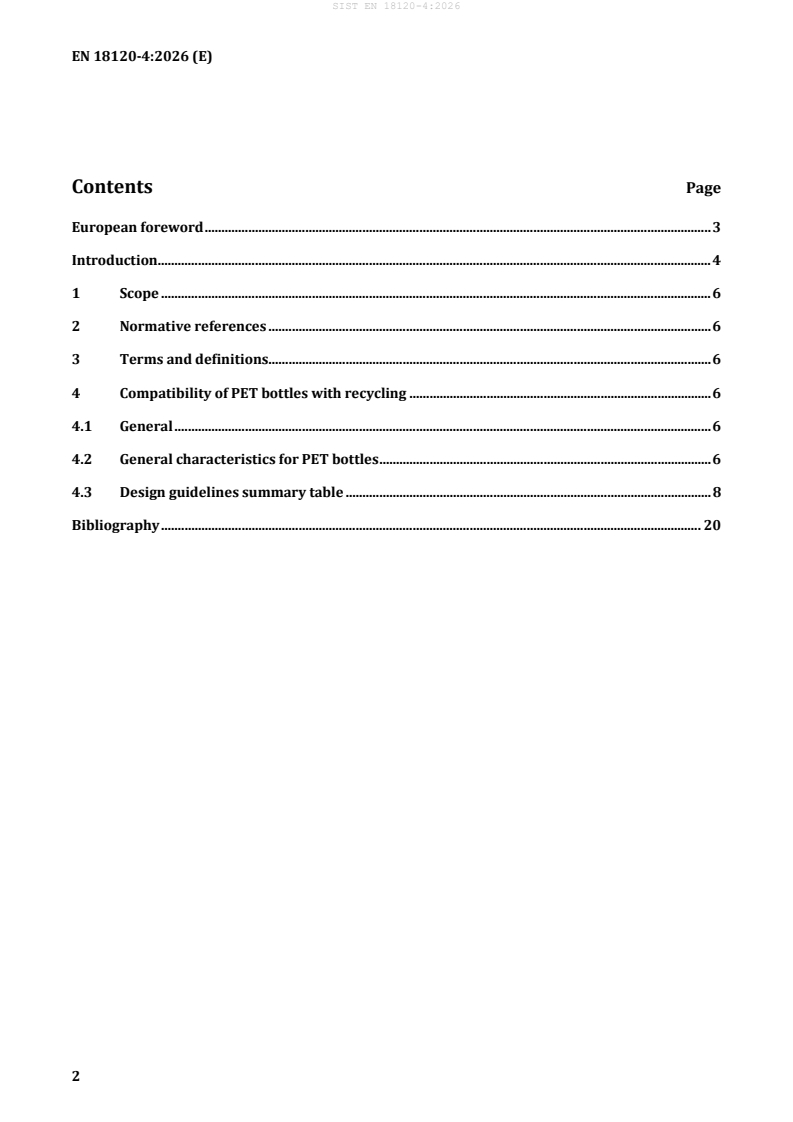
Contents Page
European foreword . 3
Introduction. 4
1 Scope . 6
2 Normative references . 6
3 Terms and definitions. 6
4 Compatibility of PET bottles with recycling . 6
4.1 General . 6
4.2 General characteristics for PET bottles . 6
4.3 Design guidelines summary table . 8
Bibliography . 20
European foreword
This document (EN 18120-4:2026) has been prepared by Technical Committee CEN/TC 261 “Packaging”,
the secretariat of which is held by AFNOR.
This European Standard shall be given the status of a national standard, either by publication of an
identical text or by endorsement, at the latest by October 2026, and conflicting national standards shall
be withdrawn at the latest by October 2026.
Attention is drawn to the possibility that some of the elements of this document may be the subject of
patent rights. CEN shall not be held responsible for identifying any or all such patent rights.
This document has been prepared under a standardization request addressed to CEN by the European
Commission. The Standing Committee of the EFTA States subsequently approves these requests for its
Member States.
Any feedback and questions on this document should be directed to the users’ national standards body.
A complete listing of these bodies can be found on the CEN website.
According to the CEN-CENELEC Internal Regulations, the national standards organisations of the
following countries are bound to implement this European Standard: Austria, Belgium, Bulgaria, Croatia,
Cyprus, Czech Republic, Denmark, Estonia, Finland, France, Germany, Greece, Hungary, Iceland, Ireland,
Italy, Latvia, Lithuania, Luxembourg, Malta, Netherlands, Norway, Poland, Portugal, Republic of North
Macedonia, Romania, Serbia, Slovakia, Slovenia, Spain, Sweden, Switzerland, Türkiye and the United
Kingdom.
Introduction
The EN 18120 series, under the general title Packaging — Design for recycling of plastic packaging, which
aims via a series of guidelines and protocols to establish consistency and improvement for the design for
recycling of household, industrial and commercial plastic packaging, consists of the following parts:
— Part 1: Definitions and principles for design-for-recycling of plastic packaging
— Part 3: Evaluation processes for the sortability of plastic packaging
— Part 4: Guideline for PET bottles
— Part 5: Guideline for PET rigid packaging (except bottles)
— Part 6: Guideline for PE and PP rigid packaging
— Part 7: Guideline for PE and PP flexible packaging
— Part 8: Guideline for PS and XPS rigid packaging
— Part 9: Guideline for EPS packaging
— Part 10: Recyclability evaluation process for plastic packaging — Protocols for PET bottles
— Part 11: Recyclability evaluation process for plastic packaging — Protocols for PET rigid packaging
(except bottles)
— Part 12: Recyclability evaluation process for plastic packaging — Protocols for PE and PP rigid
packaging
— Part 13: Recyclability evaluation process for plastic packaging — Protocols for PE and PP flexible
packaging
— Part 14: Recyclability evaluation process for plastic packaging — Protocols for PS and XPS rigid
packaging
— Part 15: Recyclability evaluation process for plastic packaging — Protocols for EPS packaging
Design for recycling guidelines are a common way of evaluating the compatibility with plastic-packaging
collection, sorting and recycling which enables the use of secondary raw materials that are of sufficient
quality when compared to the original material, in state-of-the-art facilities.
They provide guidance on the level of compatibility, defined as:
— green: packaging constituents and components with full compatibility with state-of-the-art
collection, sorting and recycling;
— yellow: packaging constituents and components with limited compatibility with state-of-the-art
collection, sorting and recycling;
— red: packaging constituents and components which are not compatible with state-of-the-art
collection, sorting and recycling.
The design for recycling guidelines provided in the EN 18120 series cover the design for recycling based
on the knowledge available at the time of the development of this document and are representative of the
state-of-the-art. They consider packaging waste collection, sorting and recycling, so that the recycled
plastic can substitute primary raw materials in packaging application or other applications. Compliance
with the design guidelines in the EN 18120 series does not guarantee that the recycled plastic quality will
be fit for purpose for a specific targeted end application or compliant with applicable regulations.
Packaging recyclability is the combination of design of recycling, proven collection, sorting and recycling
in practice.
1 Scope
This document covers the design of any bottle with the main body of the packaging unit predominantly
made of PET and the design of separate components predominantly made of PET, with respect to
compatibility of the design with state-of-the-art collecting, sorting and recycling processes and useability
of the recyclates in an application.
Packaging constituents and packaging components made of other materials than PET are also covered by
this document as they need to be evaluated on compatibility with PET polymer recycling.
2 Normative references
The following documents are referred to in the text in such a way that some or all of their content
constitutes requirements of this document. For dated references, only the edition cited applies. For
undated references, the latest edition of the referenced document (including any amendments) applies.
EN 18120-1:2026, Packaging — Design for recycling of plastic packaging — Part 1: Definitions and
principles for design for recycling of plastic packaging
EuPIA Exclusion Policy for Printing Inks and Related Products. https://www.eupia.org/our-
commitment/eupia-exclusion-policy-for-printing-inks-and-related-products/
3 Terms and definitions
For the purposes of this document, the terms and definitions given in EN 18120-1 apply.
ISO and IEC maintain terminology databases for use in standardization at the following addresses:
— ISO Online browsing platform: available at https://www.iso.org/obp/
— IEC Electropedia: available at https://www.electropedia.org/
4 Compatibility of PET bottles with recycling
4.1 General
Generic aspects for design compatibility with recycling are covered in EN 18120-1.
4.2 General characteristics for PET bottles
PET rigid packaging is designed to be lightweight, highly functional and to provide protection for
sensitive goods. PET bottles shall be designed in a way that the recycled material can go back into the
highest possible application and can stay in the packaging loop (i.e. bottle-to-bottle).
PET bottles which are part of a deposit return system shall also follow the design and marking of such
system and shall at minima follow the guidance set forth in this document.
When it is designed for a food contact application (which is the most prominent use of PET bottles) it
should be done in a way that the recycled material can go back into food contact applications.
When it is designed for a non-food application it should be designed in a way that it does not harm the
recycling of food contact rigid packaging into food contact applications (i.e. by preventing the use of
unwanted substances).
There are many non-food packaging items where the inclusion of recycled material can be
accommodated. All the different applications of PET rigid packaging (food and beverage, medical,
personal care, homecare, industrial and others) need to be considered.
The following bottle constituents and components shall be addressed in standard design for recycling
guidelines:
— body of the packaging unit:
— material composition;
— colours/pigments;
— additives/fillers;
— barriers, barrier coating;
— direct printing;
— decoration and closures:
— labels and labelling adhesives;
— sleeves;
— closure/openings;
— seals/valves;
— tamper evidence components;
— inks, lacquers, varnishes, coating and ink binders;
— other constituents and components:
— others.
Besides the main bottle body made from PET, closures, labels and sleeves (including inks, varnishes and
adhesives) play an essential role in providing useful and legally required information to consumers such
as nutritional information, health and safety warnings, manufacturers address and recycling information
as well as barcodes and branding.
Full body sleeves, coloured bottles and/or additives and barrier layers can also be necessary to protect
the packaged product (e.g. from UV radiation or ambient light to enhance shelf life). The functions of these
mentioned additional constituents need to be considered when setting thresholds of allowed amounts
and components.
The following general principles should be followed when designing rigid PET bottles:
— transparent clear and transparent light blue PET bottles shall be preferred;
— the bottle shall be made of mono material PET unless a second material is strictly necessary for
technical reasons e.g. to avoid product waste;
— if the main bottle body needs additives or barrier layers, they shall not contaminate and/or disrupt
recycling for the intended use targeted by the design guidelines;
— the labels and sleeves shall be minimized without prejudice to useful and legally required
information to consumers and without prejudice to the functionality, be compatible with recycling
processes. The document provides guidance on partial and full coverage labels and sleeves, the
definition of “partial” and “full” are outlined in EN 18120-1:2026, 6.4, Determination of partial and
full coverage;
— adhesives shall be minimized and compatible with recycling processes;
— for sleeves, perforated solutions should be preferred to ease the removal during the collection,
sorting and recycling process and/or if needed by the consumer;
— the closure or lidding system, label and/or
...