

EN ISO 8666:2020
(Main)Small craft - Principal data (ISO 8666:2020)
- Abstract
This document establishes definitions of main dimensions and related data and of mass specifications and loading conditions. It applies to small craft having a length of the hull (LH) of up to 24 m.
- Status
- Published
- Publication Date
- 17-Nov-2020
- Withdrawal Date
- 30-May-2021
- Technical Committee
- CEN/TC 464 - Small Craft
- Drafting Committee
- CEN/TC 464 - Small Craft
- Current Stage
- 6060 - Definitive text made available (DAV) - Publishing
- Start Date
- 18-Nov-2020
- Completion Date
- 18-Nov-2020
- Directive
- 2013/53/EU - Directive 2013/53/EU of the European Parliament and of the Council of 20 November 2013 on recreational craft and personal watercraft and repealing Directive 94/25/ECOJ Ref: L, L 172 OJ Date: 29-Jun-2022



Overview
EN ISO 8666:2020 - Small craft - Principal data (ISO 8666:2020) is the harmonized European adoption of the ISO standard that defines principal dimensions, mass specifications and loading conditions for small craft. It applies to recreational and commercial small craft with a length of the hull (LH) up to 24 m. The standard establishes consistent terminology and measurement methods for boat dimensions, masses and standard loading conditions used for design, certification and compliance (including linkage to Directive 2013/53/EU for CE marking).
Key topics
This standard provides authoritative definitions and measurement requirements for:
- Main dimensions: maximum length (Lmax), length of hull (LH), waterline length (LWL), maximum beam (Bmax), beam of hull, waterline beam, depths and midship depth.
- Vertical and clearance data: draught (T), air draught (Ha), freeboard (F), headroom and deadrise angle.
- Areas and volumes: windage area, reference/standard sail areas, total volume (V).
- Mass specifications: net shipping mass, gross shipping mass, light craft mass (mLC), performance test mass (mP), trailer/towed mass (mT), and maximum load (mML) (manufacturer’s recommended maximum load).
- Loading conditions: standardized conditions such as test condition, ready-for-use, fully loaded ready-for-use, empty, light craft, minimum operating and loaded arrival conditions.
- Symbols, units and measurement procedures: harmonized symbols and measurement locations to ensure repeatability across manufacturers and authorities.
Practical applications and users
EN ISO 8666:2020 is used where consistent principal data are required:
- Boat designers and naval architects for specifying hull geometry and mass allocations.
- Manufacturers and boatbuilders to declare principal data on builder’s plates and documentation.
- Certification bodies and notified bodies assessing conformity with Directive 2013/53/EU and assigning design categories.
- Surveyors, importers and dealers for valuation, safety checks and registration.
- Yacht clubs, marinas and owners for operational limits, trailering and handling guidance. The standard ensures that dimension and mass data used for structural scantlings (EN ISO 12215), stability and buoyancy assessments (EN ISO 12217), cockpit flooding calculations (EN ISO 12216) and load labeling (EN ISO 14946) are consistent and comparable.
Related standards
- EN ISO 12215 (Hull construction/scantlings)
- EN ISO 12217 (Stability and buoyancy requirements)
- EN ISO 12216 (Cockpit drainage/flooding)
- EN ISO 14946 (Manufacturer’s recommended maximum load)
- Directive 2013/53/EU (Recreational craft safety and CE marking)
EN ISO 8666:2020 is essential for consistent small craft principal data, enabling reliable design, certification and regulatory compliance across the EU and internationally.
Relations
- Effective Date
- 08-Jun-2022
- Consolidated By
ISO 8666:2020 - Small craft — Principal data - Effective Date
- 12-Feb-2026
- Effective Date
- 29-Sep-2021
Get Certified
Connect with accredited certification bodies for this standard

DNV
DNV is an independent assurance and risk management provider.

Lloyd's Register
Lloyd's Register is a global professional services organisation specialising in engineering and technology.

FSC International
Forest Stewardship Council certification.
Sponsored listings
Frequently Asked Questions
EN ISO 8666:2020 is a standard published by the European Committee for Standardization (CEN). Its full title is "Small craft - Principal data (ISO 8666:2020)". This standard covers: This document establishes definitions of main dimensions and related data and of mass specifications and loading conditions. It applies to small craft having a length of the hull (LH) of up to 24 m.
This document establishes definitions of main dimensions and related data and of mass specifications and loading conditions. It applies to small craft having a length of the hull (LH) of up to 24 m.
EN ISO 8666:2020 is classified under the following ICS (International Classification for Standards) categories: 47.080 - Small craft. The ICS classification helps identify the subject area and facilitates finding related standards.
EN ISO 8666:2020 has the following relationships with other standards: It is inter standard links to EN ISO 8666:2018, ISO 8666:2020, EN ISO 8666:2020/A11:2021. Understanding these relationships helps ensure you are using the most current and applicable version of the standard.
EN ISO 8666:2020 is associated with the following European legislation: EU Directives/Regulations: 2013/53/EU; Standardization Mandates: M/542. When a standard is cited in the Official Journal of the European Union, products manufactured in conformity with it benefit from a presumption of conformity with the essential requirements of the corresponding EU directive or regulation.
EN ISO 8666:2020 is available in PDF format for immediate download after purchase. The document can be added to your cart and obtained through the secure checkout process. Digital delivery ensures instant access to the complete standard document.
Standards Content (Sample)
SLOVENSKI STANDARD
01-januar-2021
Nadomešča:
SIST EN ISO 8666:2018
Mala plovila - Osnovni podatki (ISO 8666:2020)
Small craft - Principal data (ISO 8666:2020)
Kleine Wasserfahrzeuge - Hauptdaten (ISO 8666:2020)
Petits navires - Données principales (ISO 8666:2020)
Ta slovenski standard je istoveten z: EN ISO 8666:2020
ICS:
47.080 Čolni Small craft
2003-01.Slovenski inštitut za standardizacijo. Razmnoževanje celote ali delov tega standarda ni dovoljeno.
EN ISO 8666
EUROPEAN STANDARD
NORME EUROPÉENNE
November 2020
EUROPÄISCHE NORM
ICS 47.080 Supersedes EN ISO 8666:2018
English Version
Small craft - Principal data (ISO 8666:2020)
Petits navires - Données principales (ISO 8666:2020) Kleine Wasserfahrzeuge - Hauptdaten (ISO 8666:2020)
This European Standard was approved by CEN on 3 November 2020.
CEN members are bound to comply with the CEN/CENELEC Internal Regulations which stipulate the conditions for giving this
European Standard the status of a national standard without any alteration. Up-to-date lists and bibliographical references
concerning such national standards may be obtained on application to the CEN-CENELEC Management Centre or to any CEN
member.
This European Standard exists in three official versions (English, French, German). A version in any other language made by
translation under the responsibility of a CEN member into its own language and notified to the CEN-CENELEC Management
Centre has the same status as the official versions.
CEN members are the national standards bodies of Austria, Belgium, Bulgaria, Croatia, Cyprus, Czech Republic, Denmark, Estonia,
Finland, France, Germany, Greece, Hungary, Iceland, Ireland, Italy, Latvia, Lithuania, Luxembourg, Malta, Netherlands, Norway,
Poland, Portugal, Republic of North Macedonia, Romania, Serbia, Slovakia, Slovenia, Spain, Sweden, Switzerland, Turkey and
United Kingdom.
EUROPEAN COMMITTEE FOR STANDARDIZATION
COMITÉ EUROPÉEN DE NORMALISATION
EUROPÄISCHES KOMITEE FÜR NORMUNG
CEN-CENELEC Management Centre: Rue de la Science 23, B-1040 Brussels
© 2020 CEN All rights of exploitation in any form and by any means reserved Ref. No. EN ISO 8666:2020 E
worldwide for CEN national Members.
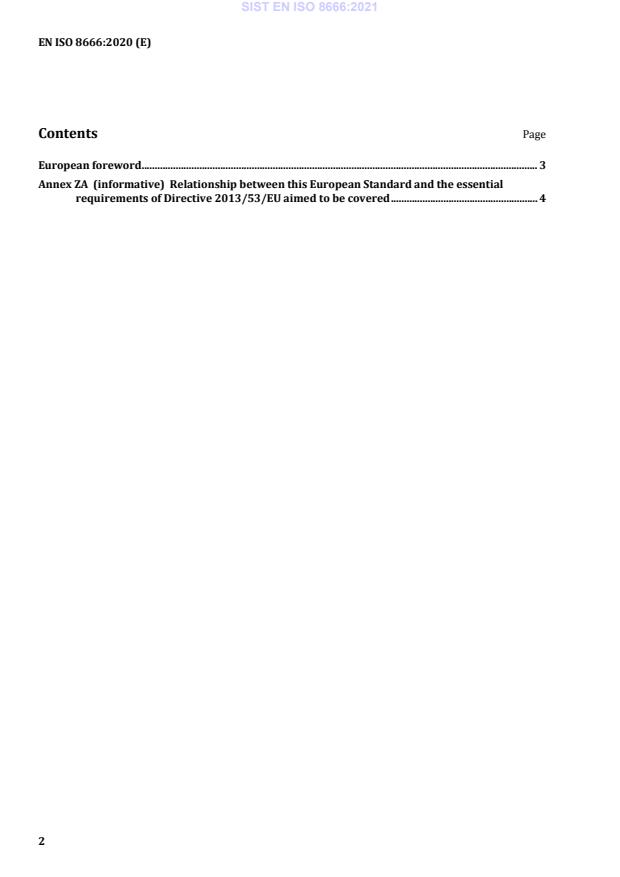
Contents Page
European foreword . 3
Annex ZA (informative) Relationship between this European Standard and the essential
requirements of Directive 2013/53/EU aimed to be covered . 4
European foreword
This document (EN ISO 8666:2020) has been prepared by Technical Committee ISO/TC 188 "Small
craft" in collaboration with Technical Committee CEN/TC 464 “Small Craft” the secretariat of which is
held by SIS.
This European Standard shall be given the status of a national standard, either by publication of an
identical text or by endorsement, at the latest by May 2021, and conflicting national standards shall be
withdrawn at the latest by May 2021.
Attention is drawn to the possibility that some of the elements of this document may be the subject of
patent rights. CEN shall not be held responsible for identifying any or all such patent rights.
This document supersedes EN ISO 8666:2018.
This document has been prepared under a mandate given to CEN by the European Commission and the
European Free Trade Association, and supports essential requirements of EU Directive(s).
For the relationship with EU Directive(s) see informative Annex ZA, which is an integral part of this
document.
According to the CEN-CENELEC Internal Regulations, the national standards organizations of the
following countries are bound to implement this European Standard: Austria, Belgium, Bulgaria,
Croatia, Cyprus, Czech Republic, Denmark, Estonia, Finland, France, Germany, Greece, Hungary, Iceland,
Ireland, Italy, Latvia, Lithuania, Luxembourg, Malta, Netherlands, Norway, Poland, Portugal, Republic of
North Macedonia, Romania, Serbia, Slovakia, Slovenia, Spain, Sweden, Switzerland, Turkey and the
United Kingdom.
Endorsement notice
The text of ISO 8666:2020 has been approved by CEN as EN ISO 8666:2020 without any modification.
Annex ZA
(informative)
Relationship between this European Standard and the essential
requirements of Directive 2013/53/EU aimed to be covered
This European standard has been prepared under a Commission’s standardization request
M/542 C(2015) 8736 final to provide one voluntary means of conforming to essential requirements of
Directive 2013/53/EU.
Once this standard is cited in the Official Journal of the European Union under that Directive,
compliance with the normative clauses of this standard given in Table ZA.1 confers, within the limits of
the scope of this standard, a presumption of conformity with the corresponding essential requirements
of that Directive, and associated EFTA regulations.
Table ZA.1 — Correspondence between this European Standard and
Annex I of Directive 2013/53/EU
Essential Requirements of Clause(s)/sub-clause(s) Remarks/Notes
Directive 2013/53/EU of this EN
Article 3(10) – Definitions - ‘Hull 4.2.1, 4.2.3, 7.3 - ‘Hull length’ means the length of
length’ hull measured in accordance
with the harmonised standard.
This standard establishes the
methodology for measuring the
length of hull L .
H
Annex I, Part A, 2 GENERAL
REQUIREMENTS
Annex I, Part A, 2.2 (d) – 5.6 The Standard establishes the
Watercraft builder’s plate definition for “maximum load
mML”. This is to be understood
as the “manufacturer's
recommended maximum load” in
accordance with EN ISO 14946.
Annex I, Part A, 3 INTEGRITY
AND STRUCTURAL
REQUIREMENTS
Annex I, Part A, 3.1 - Structure Clauses 2, 3, 4, 5, 6, 7 This Standard establishes
definitions for main dimensions
and related data, mass
specifications and loading
conditions that are required for
determining hull construction
and scantlings derived from
EN ISO 12215.
Annex I, Part A, 3.2 - Stability and Clauses 2, 3, 4, 5, 6, 7 This Standard establishes
freeboard definitions for main dimensions
and related data, mass
specifications and loading
conditions that are required for
evaluating the stability and
buoyancy of intact (i.e.
undamaged) boats in accordance
with EN ISO 12217 in order to
assign a design category
appropriate to the design and
maximum load.
Annex I, Part A, 3.3 – Buoyancy Clauses 2, 3, 4, 5, 6, 7 This Standard establishes
and floatation definitions for main dimensions
and related data, mass
specifications and loading
conditions that are required for
evaluating the flotation
characteristics of boats
susceptible to swamping and the
requirements for inverted
buoyancy in accordance with
EN ISO 12217.
Annex I, Part A, 3.4 - Flooding 4.2.3, 4.3.2, 4.4.3.3 In respect of dimensions for
calculating the cockpit volume
coefficient in accordance with
EN ISO 12216.
Annex I.A.3.6 - Manufacturer’s 5.6 The Standard establishes the
maximum recommended load definition for “maximum load
mML”. This is to be understood
as the “manufacturer's
recommended maximum load” in
accordance with EN ISO 14946.
Annex I, Part A, 5
INSTALLATION
REQUIREMENTS
Annex I, Part A, 5.4.2 – Steering 2.8, 2.9 The Standard establishes
systems -Emergency definitions for a “sailing craft”
arrangements for sailing and a “non-sailing craft”.
recreational craft and single-
These definitions shall be used
propulsion engine non-sailing
wherever required for the
recreational craft
application of the essential
requirements set out in Annex I
of Directive 2013/53/EU.
WARNING 1 — Presumption of conformity stays valid only as long as a reference to this
European Standard is maintained in the list published in the Official Journal of the European
Union. Users of this standard should consult frequently the latest list published in the Official
Journal of the European Union.
WARNING 2 — Other Union legislation may be applicable to the product(s) falling within the
scope of this standard.
INTERNATIONAL ISO
STANDARD 8666
Third edition
2020-10
Small craft — Principal data
Petits navires — Données principales
Reference number
ISO 8666:2020(E)
©
ISO 2020
ISO 8666:2020(E)
© ISO 2020
All rights reserved. Unless otherwise specified, or required in the context of its implementation, no part of this publication may
be reproduced or utilized otherwise in any form or by any means, electronic or mechanical, including photocopying, or posting
on the internet or an intranet, without prior written permission. Permission can be requested from either ISO at the address
below or ISO’s member body in the country of the requester.
ISO copyright office
CP 401 • Ch. de Blandonnet 8
CH-1214 Vernier, Geneva
Phone: +41 22 749 01 11
Email: copyright@iso.org
Website: www.iso.org
Published in Switzerland
ii © ISO 2020 – All rights reserved
ISO 8666:2020(E)
Contents Page
Foreword .v
1 Scope . 1
2 Normative references . 1
3 Terms and definitions . 1
4 Symbols, designations and units . 3
5 Measurements . 4
5.1 General . 4
5.2 Longitudinal . 4
5.2.1 General. 4
5.2.2 Maximum length, L . 4
max
5.2.3 Length of the hull, L . 4
H
5.2.4 Waterline length, L . 7
WL
5.3 Athwartship . 8
5.3.1 General. 8
5.3.2 Maximum beam, B . 8
max
5.3.3 Beam of hull, B . 8
H
5.3.4 Beam, waterline, B . 8
WL
5.3.5 Maximum beam, waterline, B . 8
WLmax
5.3.6 Beam between hull centres, B . 8
CB
5.4 Vertical . 9
5.4.1 Maximum depth, D . 9
max
5.4.2 Midship depth, D . 9
LWL/2
5.4.3 Freeboard, F .10
5.4.4 Draught, T .10
5.4.5 Draught, air, H .10
a
5.4.6 Headroom .11
5.5 Other data .11
5.5.1 Deadrise angle, β . .11
5.5.2 Reference sail area, A .12
S
5.5.3 Standard sail area, A’ .12
S
5.5.4 Windage area, A .12
lv
5.5.5 Volume of the craft, V .12
6 Masses.13
6.1 Mass, net shipping, m .13
N
6.2 Mass, gross shipping, m .13
G
6.3 Mass, light craft, m .14
LC
6.3.1 Items of equipment included in m .14
LC
6.3.2 Items of equipment and other items not included in m .15
LC
6.4 Performance test mass, m .15
P
6.5 Mass of the craft when towed on a trailer, m .16
T
6.5.1 General.16
6.5.2 Items of equipment included in m .16
T
6.5.3 Items of equipment not included in m .18
T
6.5.4 Exclusions, inclusions .18
6.6 Maximum load, m .18
ML
7 Loading conditions .19
7.1 Test condition .19
7.2 Ready-for-use condition.19
7.3 Fully loaded ready-for-use condition .19
7.4 Empty craft condition .19
7.5 Light craft condition .20
7.6 Minimum operating condition.21
ISO 8666:2020(E)
7.7 Loaded arrival condition .21
7.8 Maximum load condition .21
8 Tolerances .21
8.1 Published data .21
8.2 Preliminary specification .22
8.3 Reference lengths .22
Bibliography .23
iv © ISO 2020 – All rights reserved
ISO 8666:2020(E)
Foreword
ISO (the International Organization for Standardization) is a worldwide federation of national standards
bodies (ISO member bodies). The work of preparing International Standards is normally carried out
through ISO technical committees. Each member body interested in a subject for which a technical
committee has been established has the right to be represented on that committee. International
organizations, governmental and non-governmental, in liaison with ISO, also take part in the work.
ISO collaborates closely with the International Electrotechnical Commission (IEC) on all matters of
electrotechnical standardization.
The procedures used to develop this document and those intended for its further maintenance are
described in the ISO/IEC Directives, Part 1. In particular, the different approval criteria needed for the
different types of ISO documents should be noted. This document was drafted in accordance with the
editorial rules of the ISO/IEC Directives, Part 2 (see www .iso .org/ directives).
Attention is drawn to the possibility that some of the elements of this document may be the subject of
patent rights. ISO shall not be held responsible for identifying any or all such patent rights. Details of
any patent rights identified during the development of the document will be in the Introduction and/or
on the ISO list of patent declarations received (see www .iso .org/ patents).
Any trade name used in this document is information given for the convenience of users and does not
constitute an endorsement.
For an explanation of the voluntary nature of standards, the meaning of ISO specific terms and
expressions related to conformity assessment, as well as information about ISO's adherence to the
World Trade Organization (WTO) principles in the Technical Barriers to Trade (TBT), see www .iso .org/
iso/ foreword .html.
This document was prepared by Technical Committee ISO/TC 188, Small craft, in collaboration with
the European Committee for Standardization (CEN) Technical Committee CEN/TC 464, Small craft, in
accordance with the Agreement on technical cooperation between ISO and CEN (Vienna Agreement).
This third edition cancels and replaces the second edition (ISO 8666:2016), of which it constitutes a
minor revision. The changes compared to the previous edition are as follows:
— the document has been aligned to the latest edition of the ISO/IEC Directives, Part 2, resulting in
the addition of Clause 2, Normative references, and the renumbering of the remaining clauses; all
cross-references have been accordingly updated;
— the “allowance for the maximum mass of optional equipment and fittings not included in the
manufacturer’s basic outfit” has been moved from 6.6 (Maximum load, former 5.6) to 7.8 (Maximum
load condition, former 6.8).
Any feedback or questions on this document should be directed to the user’s national standards body. A
complete listing of these bodies can be found at www .iso .org/ members .html.
INTERNATIONAL STANDARD ISO 8666:2020(E)
Small craft — Principal data
1 Scope
This document establishes definitions of main dimensions and related data and of mass specifications
and loading conditions. It applies to small craft having a length of the hull (L ) of up to 24 m.
H
2 Normative references
There are no normative references in this document.
3 Terms and definitions
For the purposes of this document, the following terms and definitions apply.
NOTE For units, see Clause 4.
ISO and IEC maintain terminological databases for use in standardization at the following addresses:
— ISO Online browsing platform: available at https:// www .iso .org/ obp
— IEC Electropedia: available at http:// www .electropedia .org/
3.1
waterline
WL
intersection line of the water’s surface with the craft’s hull when the craft (3.15) is afloat
3.2
maximum load waterline
reference waterline
WL
ref
waterline (3.1) of the craft (3.15) when upright in the maximum loaded displacement (3.6)
3.3
sheerline
intersection between deck and hull, for rounded deck edges the natural intersection, or, where no deck
is fitted or the hull extends above the deck (bulwark), the upper edge of the craft's hull
Note 1 to entry: The upper position of the sheerline depends on the inclination between the hull/deck intersection
and the actual deck.
3.4
transom beam
B
T
maximum width of the hull at the transom at or below the sheerline (3.3), excluding extensions, handles
and fittings
Note 1 to entry: Where spray rails act as chines or part of the planing surface, they are included in the transom
beam measurement.
Note 2 to entry: For craft (3.15) with a rounded or pointed stern or with a transom beam of less than half the
maximum beam of the craft, the transom beam, B , is the widest beam at or below the sheerline at the aft quarter
T
length of the hull.
ISO 8666:2020(E)
3.5
displacement
mass of water displaced by the craft (3.15), including all appendages
3.6
loaded displacement
m
LDC
mass of water displaced by the craft (3.15), including all appendages, when in the fully loaded ready-
for-use condition
Note 1 to entry: Fully loaded ready-for use condition is described in 7.3.
3.7
displacement volume
V
D
volume of water displaced by the craft (3.15) that corresponds to the displacement (3.5)
Note 1 to entry: Where the density of water used to calculate the volume of displacement is not salt water at a
density of 1 025 kg/m , the density of water used to calculate the volume of displacement is specified.
3.8
tank capacity
net usable volume of the tank(s) for the craft (3.15) in design trim (3.13) at rest at the maximum load
waterline (3.2)
3.9
wing mast
spar characterized by its cross-section which shows a smooth transition at the aft end into the sail,
thus, contributing to its driving force
3.10
non-sailing boat
craft (3.15) for which the primary means of propulsion is other than by wind power, having reference
2/3
sail area (3.12) (A ) < 0,07 (m )
S LDC
3.11
sailing boat
craft (3.15) for which the primary means of propulsion is by wind power, having reference sail area
2/3
(3.12) (A ) ≥ 0,07 (m )
S LDC
3.12
reference sail area
A
S
actual profile area of sails set abaft a mast, plus the maximum profile areas of all masts, plus reference
triangle area(s) forward of each mast
3.13
design trim
longitudinal attitude of the craft (3.15) when upright, with crew, fluids, stores, and equipment in the
position(s) and load condition(s) designated by the designer or builder
3.14
underway
not at anchor, or made fast to the shore, or aground
3.15
craft
small craft
recreational boat, and other watercraft using similar equipment, of up to 24 m length of hull (L )
H
2 © ISO 2020 – All rights reserved
ISO 8666:2020(E)
4 Symbols, designations and units
Unless specifically otherwise defined, the symbols, designations and units used in this document are
given in Table 1.
Table 1 — Symbols, designations and units
Symbol Designation Unit Clause
A Windage area m 5.5.4
lV
A Reference sail area m 5.5.2
S
A’ Standard sail area m 5.5.3
S
B Beam between hull centres m 5.3.6
CB
B Beam of hull m 5.3.3
H
B Maximum beam m 5.3.2
max
B Beam, waterline m 5.3.4
WL
B Maximum beam, waterline m 5.3.5
WLmax
B Transom beam m 3.4
T
D Maximum depth m 5.4.1
max
D Midship depth m 5.4.2
LWL/2
F Freeboard m 5.4.3
F Freeboard, aft m 5.4.3.2
A
F Freeboard, forward m 5.4.3.4
F
F Freeboard, amidships m 5.4.3.3
M
H Draught, air m 5.4.5
a
L Length of the hull m 5.2.3
H
L Maximum length m 5.2.2
max
L Waterline length m 5.2.4
WL
m Gross shipping mass kg 6.2
G
m Loaded displacement kg 3.6
LDC
m Light craft mass kg 6.3
LC
m Net shipping mass kg 6.1
N
m Performance test mass kg 6.4
P
m Mass of craft when towed on trailer kg 6.5
T
m Maximum load kg 6.6
ML
T Draught m 5.4.4
T Draught, canoe body m 5.4.4.4
C
T Draught, maximum m 5.4.4.2
max
T Draught, minimum m 5.4.4.3
min
V Displacement volume m 3.7
D
V Volume of the craft m 5.5.5
V Volume of the hull m 5.5.5.2
H
V Volume of the superstructure m 5.5.5.3
S
WL Waterline 3.1
WL Maximum load waterline 3.2
ref
β Deadrise angle degrees 5.5.1
ISO 8666:2020(E)
5 Measurements
5.1 General
Measurements shall be established with the craft at rest at the maximum load waterline/reference
waterline, WL , unless otherwise stated.
ref
5.2 Longitudinal
5.2.1 General
The lengths of a craft shall be measured parallel to the maximum load waterline/reference waterline
and craft centreline as the distance between two vertical planes, perpendicular to the centreplane of
the craft.
5.2.2 Maximum length, L
max
The maximum length (L ) shall be measured in accordance with 5.2.1, one plane tangent through the
max
foremost part and the other through the aftermost part of the craft.
This length includes all structural and integral parts of the craft, such as stems or sterns, bulwarks, and
hull/deck joints.
This length includes parts which are normally fixed, such as fixed spars, bowsprits, pulpits at either
end of the craft, stemhead fittings, rudders, outboard motor brackets, outdrives, waterjets, and any
propulsion units extending beyond the transom, diving and boarding platforms, rubbing strakes, and
permanent fenders.
Outdrives, waterjets, other propulsion units, and all mo
...