


EN 1278:2026
(Main)Chemicals used for treatment of water intended for human consumption - Ozone
General Information
- Abstract
This document is applicable to ozone used for treatment of water intended for human consumption. It describes the characteristics of ozone, specifies tests methods for determining the ozone concentration in gases and determines rules for safe handling of the chemical ozone.
- Status
- Published
- Publication Date
- 15-Sep-2026
- Technical Committee
- CEN/TC 164 - Water supply
- Drafting Committee
- CEN/TC 164/WG 9 - Drinking water treatment
- Current Stage
- 6060 - Definitive text made available (DAV) - Publishing
- Start Date
- 16-Sep-2026
- Due Date
- 01-Jun-2026
- Completion Date
- 16-Sep-2026

Overview
EN 1278:2026 is a European standard published by the European Committee for Standardization (CEN), specifically addressing the use of ozone as a chemical for the treatment of water intended for human consumption. This standard is essential for ensuring the safety and effectiveness of ozone in water treatment processes, detailing its characteristics, test methods for ozone concentration, and guidelines for safe handling. The document also aligns with current regulatory requirements, such as the EU Biocidal Products Regulation (BPR) and REACH, making it a key reference for organizations and professionals involved in potable water treatment and water purification.
Key Topics
Scope and Identification
EN 1278:2026 specifies requirements for ozone generated and used on-site for drinking water treatment. It covers the chemical’s characteristics, physical and chemical properties, and risk classifications.Test Methods
The standard outlines accepted methods for determining ozone concentration in treatment gases, such as titration and UV absorption, ensuring accurate dosing and process control.Purity and Composition
- Relies on FprEN 17971 for details on ozone generator technology and feed gas purity.
- Sets expectations for minimal impurities and by-products, emphasizing ozone’s high reactivity and rapid decomposition.
- Provides information concerning the absence of regulated impurities within the ozone itself.
Labelling, Transportation, and Storage
- Ozone is highly unstable and cannot be transported or stored.
- The standard focuses on in-situ generation and immediate application.
Safety Protocols
- Classifies ozone under EU CLP Regulation with hazard statements (e.g., “Danger: Ox. Gas 1, H270; Acute Tox. 1, H330”).
- Includes recommendations for personal protective equipment (PPE) and emergency procedures in case of exposure.
Regulatory Alignment
- References BPR for biocidal (disinfection) applications and REACH for non-biocidal (oxidative) uses.
- Stresses user responsibility to ensure conformity with local and European regulations.
Applications
EN 1278:2026 is specifically relevant for:
Drinking Water Treatment Plants
- Disinfection: Ozone destroys pathogens, viruses, and parasites, offering an effective alternative to chlorine-based systems.
- Oxidation: Used to remove taste, odor, color, iron, manganese, and persistent organic pollutants.
- Advanced Oxidation Processes: Enhances removal of micropollutants when used alongside hydrogen peroxide or UV.
- Coagulation Aid: Supports the removal of suspended particles by promoting coagulation in certain cases.
Utility and Municipal Water Providers
- Ensures consistent and safe production of potable water, supporting compliance with EU water quality directives.
Engineering and Equipment Manufacturers
- Provides technical guidance for the design and operation of ozone generation devices and integration into water treatment systems.
Research and Analytical Laboratories
- Delivers standardized analytical methods for measuring ozone concentrations and by-products in both gas and water phases.
Related Standards
Organizations implementing EN 1278:2026 should also be aware of the following:
- FprEN 17971 - Devices for in-situ generation of biocides - Ozone (details on equipment and operational control)
- Directive (EU) 2020/2184 - Drinking water quality requirements
- Regulation (EU) No 528/2012 (BPR) - Placing and use of biocidal products
- Regulation (EC) No 1907/2006 (REACH) - Registration, evaluation, and authorization of chemicals
- EN ISO 3696:1987 - Water for analytical laboratory use
EN 1278:2026 plays a vital role in the standardized, safe, and effective use of ozone for drinking water treatment, supporting public health and regulatory compliance across Europe. For detailed procedural requirements, practitioners should consult the full text and related standards.
Relations
- Effective Date
- 29-Jun-2022
- Effective Date
- 17-Sep-2026
- Effective Date
- 17-Sep-2026
Get Certified
Connect with accredited certification bodies for this standard

ECOCERT
Organic and sustainability certification.

Eurofins Food Testing Global
Global leader in food, environment, and pharmaceutical product testing.

Intertek Bangladesh
Intertek certification and testing services in Bangladesh.
Sponsored listings
Frequently Asked Questions
EN 1278:2026 is a draft published by the European Committee for Standardization (CEN). Its full title is "Chemicals used for treatment of water intended for human consumption - Ozone". This standard covers: This document is applicable to ozone used for treatment of water intended for human consumption. It describes the characteristics of ozone, specifies tests methods for determining the ozone concentration in gases and determines rules for safe handling of the chemical ozone.
This document is applicable to ozone used for treatment of water intended for human consumption. It describes the characteristics of ozone, specifies tests methods for determining the ozone concentration in gases and determines rules for safe handling of the chemical ozone.
EN 1278:2026 is classified under the following ICS (International Classification for Standards) categories: 71.100.80 - Chemicals for purification of water. The ICS classification helps identify the subject area and facilitates finding related standards.
EN 1278:2026 has the following relationships with other standards: It is inter standard links to EN 1278:2010, EN 15074:2006, EN 17971:2024. Understanding these relationships helps ensure you are using the most current and applicable version of the standard.
EN 1278:2026 is available in PDF format for immediate download after purchase. The document can be added to your cart and obtained through the secure checkout process. Digital delivery ensures instant access to the complete standard document.
Standards Content (Sample)
SLOVENSKI STANDARD
oSIST prEN 1278:2024
01-julij-2024
Kemikalije, ki se uporabljajo za pripravo pitne vode - Ozon
Chemicals used for treatment of water intended for human consumption - Ozone
Produkte zur Aufbereitung von Wasser für den menschlichen Gebrauch - Ozon
Produits chimiques utilisés pour le traitement de l'eau destinée à la consommation
humaine - Ozone
Ta slovenski standard je istoveten z: prEN 1278
ICS:
13.060.20 Pitna voda Drinking water
71.100.80 Kemikalije za čiščenje vode Chemicals for purification of
water
oSIST prEN 1278:2024 en,fr,de
2003-01.Slovenski inštitut za standardizacijo. Razmnoževanje celote ali delov tega standarda ni dovoljeno.
oSIST prEN 1278:2024
oSIST prEN 1278:2024
DRAFT
EUROPEAN STANDARD
prEN 1278
NORME EUROPÉENNE
EUROPÄISCHE NORM
May 2024
ICS 71.100.80 Will supersede EN 1278:2010
English Version
Chemicals used for treatment of water intended for human
consumption - Ozone
Produits chimiques utilisés pour le traitement de l'eau Produkte zur Aufbereitung von Wasser für den
destinée à la consommation humaine - Ozone menschlichen Gebrauch - Ozon
This draft European Standard is submitted to CEN members for enquiry. It has been drawn up by the Technical Committee
CEN/TC 164.
If this draft becomes a European Standard, CEN members are bound to comply with the CEN/CENELEC Internal Regulations
which stipulate the conditions for giving this European Standard the status of a national standard without any alteration.
This draft European Standard was established by CEN in three official versions (English, French, German). A version in any other
language made by translation under the responsibility of a CEN member into its own language and notified to the CEN-CENELEC
Management Centre has the same status as the official versions.
CEN members are the national standards bodies of Austria, Belgium, Bulgaria, Croatia, Cyprus, Czech Republic, Denmark, Estonia,
Finland, France, Germany, Greece, Hungary, Iceland, Ireland, Italy, Latvia, Lithuania, Luxembourg, Malta, Netherlands, Norway,
Poland, Portugal, Republic of North Macedonia, Romania, Serbia, Slovakia, Slovenia, Spain, Sweden, Switzerland, Türkiye and
United Kingdom.
Recipients of this draft are invited to submit, with their comments, notification of any relevant patent rights of which they are
aware and to provide supporting documentation.
Warning : This document is not a European Standard. It is distributed for review and comments. It is subject to change without
notice and shall not be referred to as a European Standard.
EUROPEAN COMMITTEE FOR STANDARDIZATION
COMITÉ EUROPÉEN DE NORMALISATION
EUROPÄISCHES KOMITEE FÜR NORMUNG
CEN-CENELEC Management Centre: Rue de la Science 23, B-1040 Brussels
© 2024 CEN All rights of exploitation in any form and by any means reserved Ref. No. prEN 1278:2024 E
worldwide for CEN national Members.
oSIST prEN 1278:2024
prEN 1278:2024 (E)
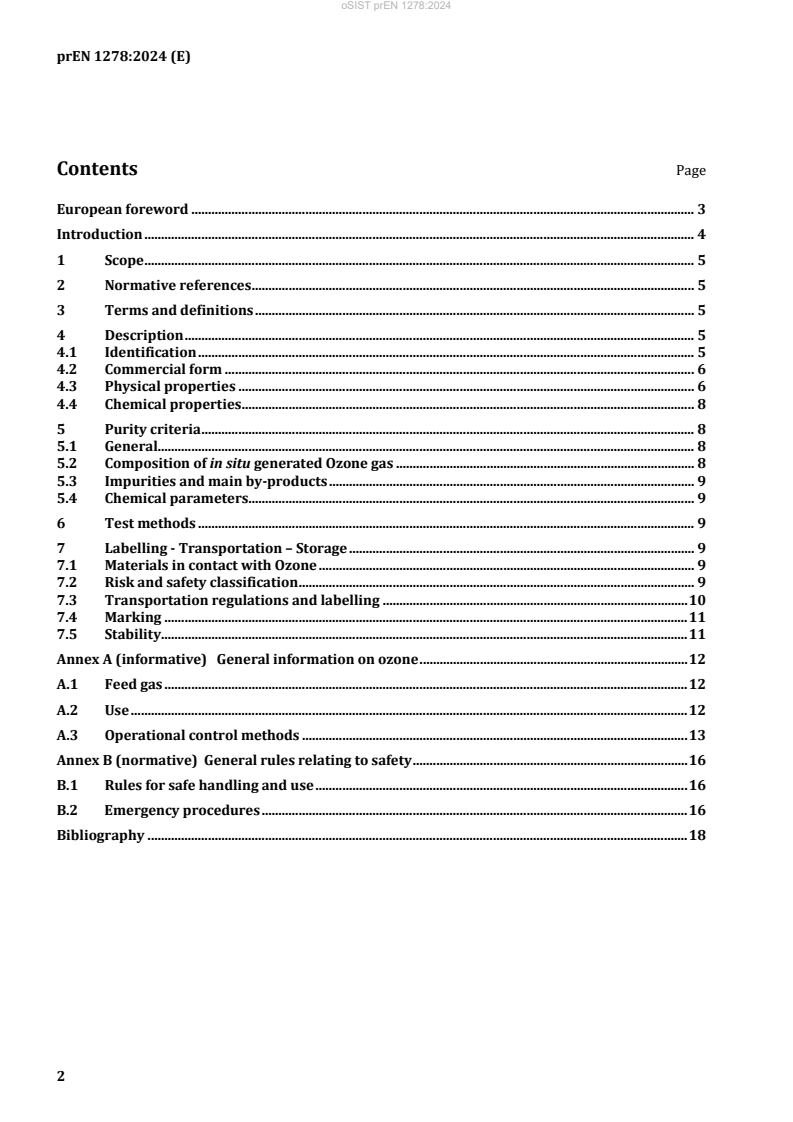
Contents Page
European foreword . 3
Introduction . 4
1 Scope . 5
2 Normative references . 5
3 Terms and definitions . 5
4 Description . 5
4.1 Identification . 5
4.2 Commercial form . 6
4.3 Physical properties . 6
4.4 Chemical properties . 8
5 Purity criteria . 8
5.1 General. 8
5.2 Composition of in situ generated Ozone gas . 8
5.3 Impurities and main by-products . 9
5.4 Chemical parameters. 9
6 Test methods . 9
7 Labelling - Transportation – Storage . 9
7.1 Materials in contact with Ozone . 9
7.2 Risk and safety classification . 9
7.3 Transportation regulations and labelling . 10
7.4 Marking . 11
7.5 Stability . 11
Annex A (informative) General information on ozone . 12
A.1 Feed gas . 12
A.2 Use . 12
A.3 Operational control methods . 13
Annex B (normative) General rules relating to safety . 16
B.1 Rules for safe handling and use . 16
B.2 Emergency procedures . 16
Bibliography . 18
oSIST prEN 1278:2024
prEN 1278:2024 (E)
European foreword
This document (prEN 1278:2024) has been prepared by Technical Committee CEN/TC 164 “Water
Supply”, the secretariat of which is held by AFNOR.
This document is currently submitted to the CEN Enquiry.
This document will supersede EN 1278:2010.
prEN 1278:2024 includes the following significant technical changes with respect to EN 1278:2010:
— proposed harmonized classification of ozone according to EU CLP regulation is added;
— reference for use of ozone is made to EU BPR and EU REACH regulation;
— new threshold limit for ozone in air;
— reference is made to FprEN 17971, standard for ozone generation devices. Device related matters
are shifted to FprEN 17971, e.g. operational safety of the installation room. Matters of the chemical
ozone itself remain within this standard.
oSIST prEN 1278:2024
prEN 1278:2024 (E)
Introduction
In respect of potential adverse effects on the quality of water intended for human consumption, caused
by the product covered by this document, it provides no information as to whether the product may be
used without restriction in any of the Member States of the EU or EFTA.
NOTE 1 While awaiting the adoption of verifiable European criteria, attention is drawn to national regulations.
Ozone is a biocidal product according to the regulation (EU) No 528/2012 [1]. The use of in situ generated
ozone for disinfection purposes falls under the provisions of the BPR, requiring access by the user to a
data set for the product authorization of ozone under the BPR. This access may be achieved directly or
indirectly e.g. via the manufacturers’ authorization for ozone generated by their devices.
Users of in situ generated ozone should verify with their device manufacturer, if they can use ozone in
accordance to his product authorization for the disinfection of water intended for human consumption
(included in the BPR for drinking water use).
Non biocidal use of ozone, e.g. for oxidative purposes, falls under the provisions of the REACH Regulation
[2]. The use of ozone for non-biocidal purposes requires individual access by the user to the data set
provided for the authorization of ozone under REACH.
NOTE 2 Conformity with the standard does not confer or imply authorization of the product in any of the
Member States of the EU or EFTA. The use of the product covered by this document is subject to regulation or control
by National Authorities.
oSIST prEN 1278:2024
prEN 1278:2024 (E)
1 Scope
This document is applicable to ozone used for treatment of water intended for human consumption. It
describes the characteristics of ozone, specifies tests methods for determining the ozone concentration
in gases and determines rules for safe handling of the chemical ozone.
2 Normative references
The following documents are referred to in the text in such a way that some or all of their content
constitutes requirements of this document. For dated references, only the edition cited applies. For
undated references, the latest edition of the referenced document (including any amendments) applies.
FprEN 17971, Devices for in-situ generation of biocides — Ozone
3 Terms and definitions
For the purposes of this document, the following terms and definitions apply.
ISO and IEC maintain terminology databases for use in standardization at the following addresses:
— ISO Online browsing platform: available at https://www.iso.org/obp/
— IEC Electropedia: available at https://www.electropedia.org/
3.1
normal temperature and pressure of gas
NTP
gas under the conditions of normal temperature tn = 0 °C and normal pressure pn = 101 325 Pa
3.2
feed gas
substance that is fed as gas to the ozone generation device to generate ozone
4 Description
4.1 Identification
4.1.1 chemical name
Ozone.
General information on Ozone is described in Annex A.
4.1.2 synonym or common name
None (has sometimes been called improperly “allotropic oxygen”).
4.1.3 relative molecular mass
48.
4.1.4 Empirical formula
O
3.
4.1.5 chemical formula
O
3.
oSIST prEN 1278:2024
prEN 1278:2024 (E)
1)
4.1.6 CAS Registry Number
10028-15-6.
2)
4.1.7 EINECS reference
Not applicable.
4.2 Commercial form
Ozone is very unstable; it is exclusively generated on-site nearby its use by ozone generation devices.
4.3 Physical properties
4.3.1 Appearance
Bluish gas, the liquid is dark blue.
NOTE A weak absorption in the visual range between 435 nm and 475 nm.
4.3.2 Density
Gas: 2,144 kg/m at NTP (Normal Temperature Pressure, 273 K and 1013,25 hPa);
Liquid: 1,574 g/cm at - 183 °C;
Solid: 1,728 g/cm .
4.3.3 The gas-liquid partition coefficient
In pure water, the partition coefficient values (S) expressed in grams per cubic meter water per (grams
per cubic meter) gas at 1013,25 hPa are given in Table 1.
Table 1 — The gas-liquid partition coefficient between water and gas phase
Temperature Solubility
of water
g / m HO
°C S, in
g / m gas
0 0,64
5 0,5
10 0,39
15 0,31
20 0,24
25 0,19
30 0,15
35 0,12
NOTE 1 Recent surveys of literature data are given in Bibliography. See [3], [4] and [5].
NOTE 2 S is a ratio, not an absolute concentration.
1)
Chemical Abstracts Service Registry Number
2)
European Inventory of Existing Commercial Chemical Substances
oSIST prEN 1278:2024
prEN 1278:2024 (E)
4.3.4 Vapour pressure
The vapour pressure of ozone depending on temperature is given in Table 2.
Table 2 — Vapour pressure
Temperature Vapour pressure
°C hPa
- 183 0,147
- 180 0,28
- 170 01,88
- 160 8,97
- 150 33,06
- 140 98,92
- 130 253,31
- 120 569,28
- 110 1153,22
- 100 2 1390,79
3)
4.3.5 Boiling point at 1000 hPa
− 112 °C.
NOTE Vaporization heat: 681 kJ/m3at NTP.
4.3.6 Melting point
− 196 °C.
4.3.7 Specific heat (liquid)
Not applicable.
4.3.8 Viscosity (dynamic)
0,004 2 Pa.s at – 195 °C;
0,0015 5 Pa.s at – 183 °C.
4.3.9 Critical temperature
− 12,1 °C.
4.3.10 Critical pressure
5 4600 hPa.
4.3.11 Physical hardness
Not applicable.
3)
1000 hPa = 1 bar
oSIST prEN 1278:2024
prEN 1278:2024 (E)
4.4 Chemical properties
Ozone is a powerful oxidant and disinfectant. The standard redox potentials (ORP) at 25 °C are:
H
( E values in volts):
O
H
+ - O + H O (1)
O + 2H + 2e → 2 2 = 2,07 V
E
O
H
- - (2)
O + H O + 2e → O + 2OH
E = 1,24 V
3 2 2
O
H
+ - H O (3)
OH° + H + e → 2
E = 2,42 V (calculated value)
O
H
If the pH increases by one unit, the E -values shall decrease by 30 mV per electron transferred. At
H
1000 hPa and 25 °C and pH = 7 the E -values, versus the normal hydrogen electrode, become:
O (1) = 1,66 V;
O3 (2) = 0,82 V;
OH° (3) = 2,21V
In water treatment most of the direct reactions of ozone are dipolar cyclo-additions and electrophilic
substitution reactions. Moreover ozone, in water, can generate radicals such as OH° in particular at
alkaline pH: (O + H O → 2 OH° + O ). The OH° radical is a strong general oxidant.
3 2 2
5 Purity criteria
5.1 General
The purity of the generated ozone depends strongly on the purity of the precursors and the technology
of the applied ozone generation device. The generation of ozone used for the treatment of water intended
for human consumption takes place usually by the technology of dielectric barrier discharge. This
technology uses ambient air or oxygen as feed gas for the ozone generation device to generate ozone. The
generation technology, purity requirements for the feed gas, by-products of the ozone generation, and by
products of ozone dosed in water are described in the FprEN 17971. The purity requirements of
FprEN 17971 apply for this standard.
NOTE Attention is drawn to national regulation for the users of Ozone in order to clarify whether it is of
appropriate purity for treatment of water intended for human consumption, taking into account raw water quality,
required dosage, contents of other impurities and additives used in the product not stated in this product document.
5.2 Composition of in situ generated Ozone gas
According to FprEN 17971 the nominal ozone concentration using:
3 3
— clean dry air is typically 20 g ozone per m n of process gas = ca. 1,5 % w/w (in practice 70 g/m n = ca.
5,3 % w/w can be achieved).
— oxygen as a feed gas is typically 100 g per m n of process gas = ca. 7 % w/w (in practice
300 g/m = ca. 21 % w/w can be achieved).
n
The concentration (in grams per cubic metre NTP) at the nominal operating condition of the generators
shall be specified in the tendering documents.
oSIST prEN 1278:2024
prEN 1278:2024 (E)
5.3 Impurities and main by-products
See A.3.2.
5.4 Chemical parameters
None of the chemical parameters according to the EU directive on the quality of water intended for human
consumption [7] are found in the gaseous ozone phase. Pesticides and polycyclic aromatic hydrocarbons
are not by-products of the ozone manufacturing processes.
NOTE For the purpose of this document “chemical parameters” are those defined in the EU directive on the
quality of water intended for human consumption [7].
6 Test methods
The test methods by titration and by UV-absorption are described in detail in the FprEN 17971.
7 Labelling - Transportation – Storage
7.1 Materials in conta
...