

prEN 1213
(Main)Building valves - Metallic stop valves for potable water supply in buildings - Tests and requirements
- Abstract
This document is applicable to metallic stop valves for use with water intended for human consumption.
This document specifies:
— requirements for the design of stop valves;
— mechanical, hydraulic and acoustic requirements;
— test methods;
— marking requirements.
This document is applicable to metallic stop valves, dimensions DN 10 to DN 100, for potable water installation in buildings for PN10 or PN16 and a distribution temperature of 65 °C.
This document is applicable to stop valves in combination with accessories in the same body.
This document is not applicable to regulating or servicing valves, designed specially to isolate sanitary tapware or other sanitary appliances.
- Status
- Not Published
- Publication Date
- 01-May-2028
- Technical Committee
- CEN/TC 164 - Water supply
- Current Stage
- 4020 - Submission to enquiry - Enquiry
- Start Date
- 10-Sep-2026
- Due Date
- 18-Jan-2027
- Completion Date
- 18-Jan-2027
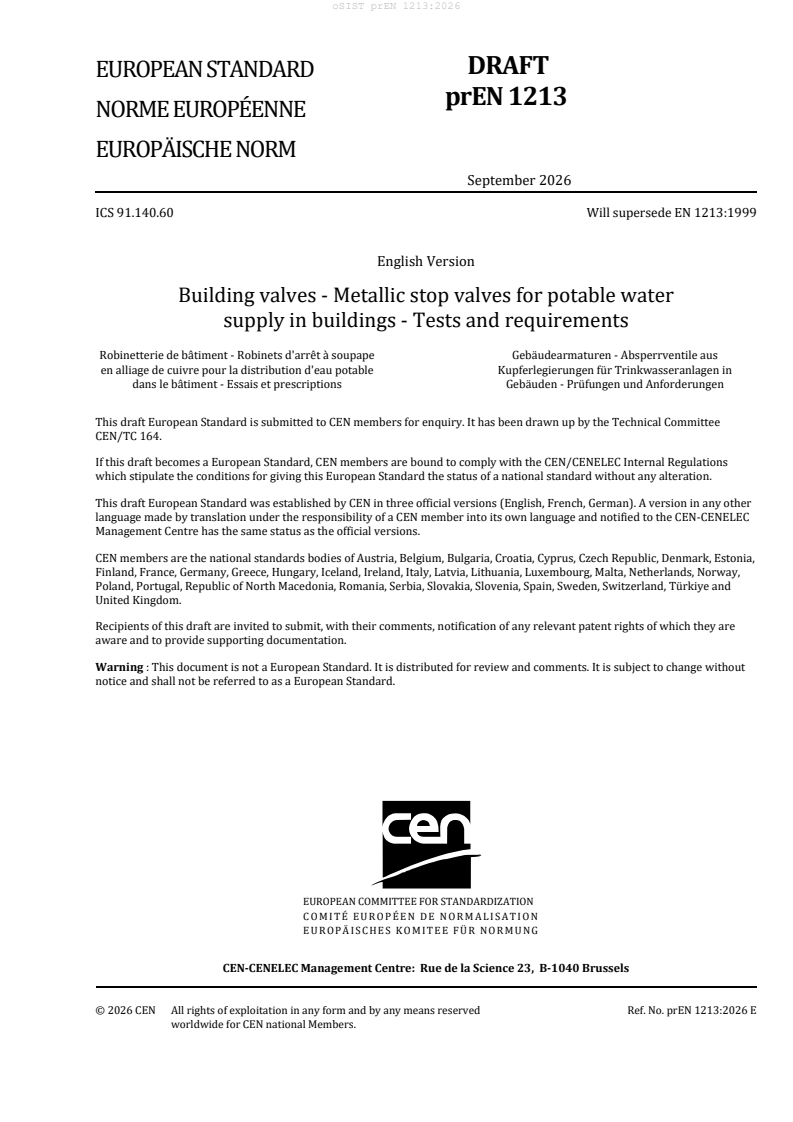

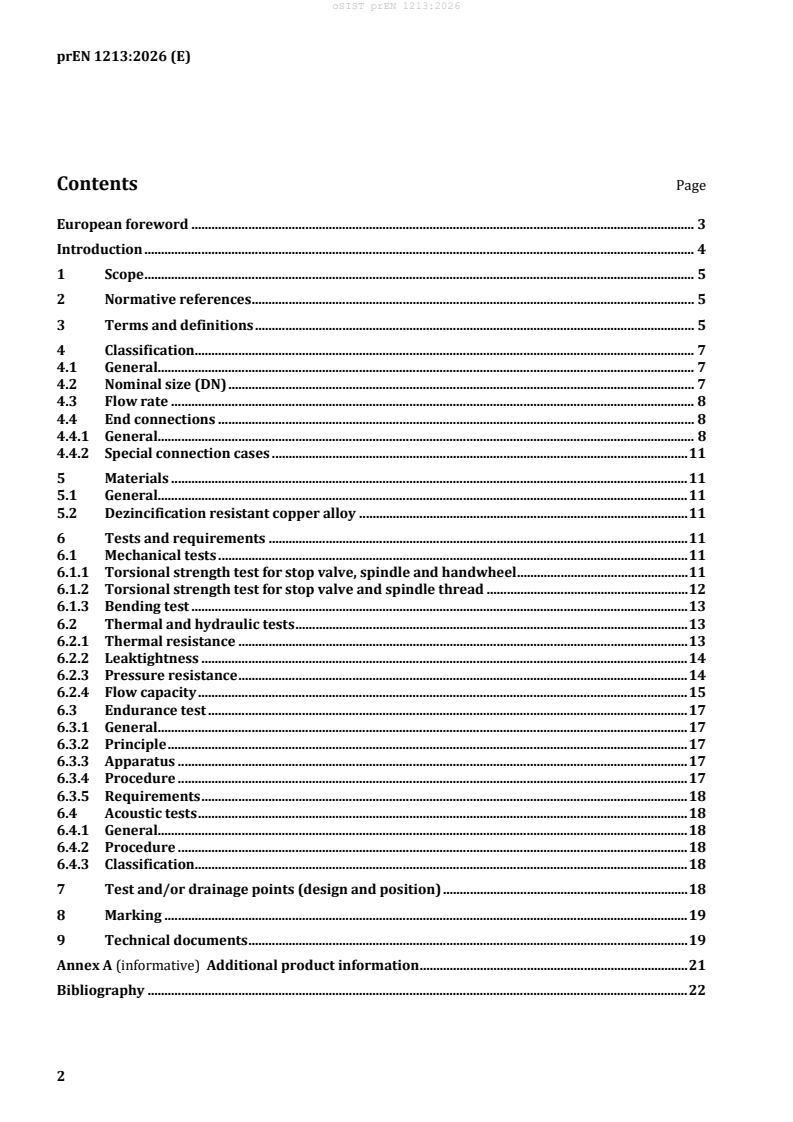
prEN 1213 is a CEN draft European Standard for metallic stop valves used with water intended for human consumption in buildings. It specifies design, mechanical, hydraulic and acoustic requirements, test methods and marking for these valves for manufacturers, test laboratories, specifiers and purchasers. The document covers DN 10 to DN 100 valves for PN10 or PN16 and a distribution temperature of 65 °C.
What does prEN 1213 specify?
prEN 1213 applies to metallic stop valves for potable water installations in buildings, including stop valves combined with accessories in the same body. It sets requirements for how the valves are built, how they are tested, how they are classified and how they are marked so they can be identified and used correctly in practice.
The document is organized into clauses 1 to 9, covering scope, normative references, terms and definitions, classification, materials, tests and requirements, test and/or drainage points, marking, and technical documents. Annex A is informative and gives additional product information for designation.
| Annex | What it covers |
|---|---|
| Annex A | Additional product information, including an example designation |
What are the key requirements of prEN 1213?
Classification and construction
prEN 1213 classifies stop valves by nominal size (DN), flow rate and end connection. This matters because the valve has to fit the pipework, deliver the required flow and match the chosen connection type.
Clause 4 also requires the obturator to be removable with standard available tools for servicing without removing the stop valve from the system. In practice, that supports maintenance and reduces downtime.
For end connections, Table 1 lists the typical connection types and the DN ranges they apply to, including threaded, soldered, compression, press and flanged ends. For special connection cases not covered by the table, the valve may use another end connection if dimensional interchangeability is not required, suitability is verified and the manufacturer’s literature and installation instructions clearly state that the valve is for special application.
Materials in contact with water
Clause 5 requires all materials that contact water intended for human consumption to present no health risk and not change the water’s quality, appearance, smell or taste. This is a basic hygiene requirement and is directly relevant to material selection and product approval.
For dezincification resistant copper alloy, the document points out that copper-zinc alloys with more than 15 % zinc can be vulnerable in water capable of dezincification. Where dezincification resistant materials are required, the material must limit dezincification depth to less than 200 μm in any direction, be tested to EN ISO 6509-1 and be marked accordingly.
Mechanical, thermal and hydraulic tests
Clause 6 combines the main verification tests for strength, tightness, pressure resistance, flow and durability. These tests show whether a valve can survive handling, installation and long-term service without leaking or breaking.
- Torsional strength tests check the spindle and handwheel, and then the spindle thread, under applied torque.
- The bending test applies only to stop valves with internal thread and checks resistance to bending loads from connected pipework.
- The thermal resistance test exposes the valve to hot water before tightness checks.
- The leaktightness test checks the obturator and the assembled valve under cold water pressure.
- The pressure resistance test checks that the valve withstands hydraulic pressure without permanent deformation, rupture or breakage.
- The flow capacity test confirms that the valve achieves the minimum flow rate at a pressure loss of 0,01 MPa.
- The endurance test applies to valves up to DN 20 and uses 10 000 opening and closing cycles with hot and cold water alternately.
For a buyer or specifier, the practical point is that a valve meeting the document is not only the right size and connection type, but has also passed strength, tightness, flow and durability checks.
Acoustic performance
prEN 1213 requires acoustic tests for devices with DN up to 32. The tests use EN ISO 3822-1 and EN ISO 3822-3 and classify the valve into acoustic groups based on the measured A-weighted sound pressure level. This matters where quiet operation is important, for example in occupied buildings.
Test and drainage points, marking and documents
Clause 7 allows valve bodies to include test and/or drain ports, provided they are not obstructed by internal parts and include an outlet-side plug to help downstream draining in situ. This is useful for installation, maintenance and commissioning.
Clause 8 requires permanent, visible and durable marking with the manufacturer identification, nominal size, pressure rating and a flow-direction arrow. Clause 9 requires technical documents to accompany the product or be available electronically, and to provide the information needed for installation, operation, maintenance and service, including the acoustics class, materials, flow rate class, dimensions, supplier details and DZR or DR where relevant.
What terms does prEN 1213 define?
- Stop valve - A valve in which the obturator moves in a straight line and closes longitudinally against the direction of flow.
- Flow rate class - The classification used for a stop valve’s flow performance; the document distinguishes classes for straight and angle patterns and for oblique patterns.
- Acoustic group - The class assigned from the measured sound pressure level, used to identify whether the valve falls into group I, II or unclassified.
- Obturator - The closing element inside the valve that moves to stop the flow.
- Nominal size (DN) - The size designation used to classify the valve and relate it to its flow rate and end connections.
- Dezincification resistant copper alloy (DZR) - A copper alloy intended to resist dezincification when used in suitable water conditions.
Who uses prEN 1213?
prEN 1213 is used by valve manufacturers, test laboratories, and technical designers who need to build and verify stop valves for potable water systems. It is also used by engineers, quality managers and procurement teams who specify DN, PN rating, end connection, flow rate class and acoustic group for building water installations.
Installers and service personnel use it together with the technical documents to understand mounting, operation, maintenance and service. Water supply professionals and product conformity teams use it to check whether a valve design, marking and test evidence match the requirements for building use.
What changed in prEN 1213 from the previous edition?
prEN 1213 will supersede EN 1213:1999. The foreword states these significant changes compared with the previous edition:
- the scope was extended to PN16 and combination with check valves (family E)
- the clause for end connections was updated
- the clause on “Designation” was moved to an informative annex as “Additional product information”
- the test rig clause was improved and updated for flow rate and pressure difference
- figures were redrawn
- the whole document was editorially revised
Which standards are used with prEN 1213?
prEN 1213 refers to several other standards that support installation, connection design, testing and terminology:
- EN 200 - used for the mounting and operation conditions in the endurance test
- EN 806-1 - provides general requirements for water installations inside buildings and the symbol referenced for stop valves
- EN 1254-20 - supplies definitions, thread dimensions, test methods and reference data for end-connection dimensions
- EN 1717 - provides water pollution protection requirements and supporting terms and definitions
- EN 10255 - supplies the steel pipe used in the bending test rig
- EN ISO 3822-1 and EN ISO 3822-3 - provide the acoustic measurement method and mounting/operating conditions for noise tests
- EN 10226-1, EN ISO 228-1, EN 1254-1, EN 1254-2, EN 1254-3, EN 1254-4, EN 1254-7, EN 1254-8 and ISO 7005-3 - define the threaded, soldered, compression, press and flanged end connections used in Table 1
What does the prEN 1213 document contain?
The document contains classification tables for DN, flow rate classes and end connections, plus figures showing the stop valve patterns, symbol and test rigs. It also sets out step-by-step procedures for torsional strength, bending, thermal resistance, leaktightness, pressure resistance, flow capacity, endurance and acoustic testing.
Tables give the required flow rates, torque values, bending loads, pressure conditions and acoustic groups, while Annex A gives an example of how to designate a valve. In practice, this makes the document useful both for product design and for test planning, inspection and technical documentation.
Relations
- Effective Date
- 20-Jan-2026
Get Certified
Connect with accredited certification bodies for this standard

DIBt (Deutsches Institut für Bautechnik)
German Institute for Building Technology.

DIN CERTCO
DIN Group product certification.

Aboma Certification B.V.
Specialized in construction, metal, and transport sectors.
Sponsored listings
Frequently Asked Questions
prEN 1213 is a draft published by the European Committee for Standardization (CEN). Its full title is "Building valves - Metallic stop valves for potable water supply in buildings - Tests and requirements". This standard covers: This document is applicable to metallic stop valves for use with water intended for human consumption. This document specifies: — requirements for the design of stop valves; — mechanical, hydraulic and acoustic requirements; — test methods; — marking requirements. This document is applicable to metallic stop valves, dimensions DN 10 to DN 100, for potable water installation in buildings for PN10 or PN16 and a distribution temperature of 65 °C. This document is applicable to stop valves in combination with accessories in the same body. This document is not applicable to regulating or servicing valves, designed specially to isolate sanitary tapware or other sanitary appliances.
This document is applicable to metallic stop valves for use with water intended for human consumption. This document specifies: — requirements for the design of stop valves; — mechanical, hydraulic and acoustic requirements; — test methods; — marking requirements. This document is applicable to metallic stop valves, dimensions DN 10 to DN 100, for potable water installation in buildings for PN10 or PN16 and a distribution temperature of 65 °C. This document is applicable to stop valves in combination with accessories in the same body. This document is not applicable to regulating or servicing valves, designed specially to isolate sanitary tapware or other sanitary appliances.
prEN 1213 is classified under the following ICS (International Classification for Standards) categories: 91.140.60 - Water supply systems. The ICS classification helps identify the subject area and facilitates finding related standards.
prEN 1213 has the following relationships with other standards: It is inter standard links to EN 1213:1999. Understanding these relationships helps ensure you are using the most current and applicable version of the standard.
prEN 1213 is associated with the following European legislation: EU Directives/Regulations: 305/2011. When a standard is cited in the Official Journal of the European Union, products manufactured in conformity with it benefit from a presumption of conformity with the essential requirements of the corresponding EU directive or regulation.
prEN 1213 is available in PDF format for immediate download after purchase. The document can be added to your cart and obtained through the secure checkout process. Digital delivery ensures instant access to the complete standard document.
Standards Content (Sample)
Contents
- Introduction
- 1 Scope
- 2 Normative references
- 3 Terms and definitions
- 3.1 stop valve
- 3.2 flow rate class
- 4 Classification
- 4.1 General
- 4.2 Nominal size (DN)
- 4.3 Flow rate
- 4.4 End connections
- 5 Materials
- 5.1 General
- 5.2 Dezincification resistant copper alloy
- 6 Tests and requirements
- 6.1 Mechanical tests
- 6.2 Thermal and hydraulic tests
- 1 Obturator Closed Open
- 2 Open Closed
- 6.3 Endurance test
- 6.4 Acoustic tests
- 7 Test and/or drainage points (design and position)
- 8 Marking
- 9 Technical documents
- Annex A
- Bibliography
Introduction
With regard to potential adverse effect on the quality of water intended for human consumption, caused by the product covered by this document:
a) This document provides no information as to whether the product may be used without restriction in any of the Member States of the EU or EFTA.
b) It should be noted that, whilst awaiting the adoption of verifiable European criteria, existing national regulations concerning the use and or the characteristics of this product remain in force.
oSIST prEN 1213:2026 prEN 1213:2026 (E)
1 Scope
This document is applicable to metallic stop valves for use with water intended for human consumption. This document specifies:
- requirements for the design of stop valves;
- mechanical, hydraulic and acoustic requirements;
- test methods;
- marking requirements.
This document is applicable to metallic stop valves, dimensions DN 10 to DN 100, for potable water installation in buildings for PN10 or PN16 and a distribution temperature of 65 °C. This document is applicable to stop valves in combination with accessories in the same body. This document is not applicable to regulating or servicing valves, designed specially to isolate sanitary tapware or other sanitary appliances.
2 Normative references
The following documents are referred to in the text in such a way that some or all of their content constitutes requirements of this document. For dated references, only the edition cited applies. For undated references, the latest edition of the referenced document (including any amendments) applies. EN 200, Sanitary tapware - Single taps and combination taps for water supply systems of type 1 and type 2 - General technical specification EN 806-1, Specifications for installations inside buildings conveying water for human consumption - Part 1:
General EN 1254-20, Copper and copper alloys — Plumbing fittings — Part 20: Definitions, thread dimensions, test methods, reference data and supporting information EN 1717, Protection against pollution of water intended for human consumption in potable water installations and general requirements for devices to prevent pollution by backflow EN 10255, Non-Alloy steel tubes suitable for welding and threading — Technical delivery conditions EN ISO 3822-1, Acoustics - Laboratory tests on noise emission from appliances and equipment used in water supply installations - Part 1: Method of measurement (ISO 3822-1) EN ISO 3822-3, Acoustics - Laboratory tests on noise emission from appliances and equipment used in water supply installations - Part 3: Mounting and operating conditions for in-line valves and appliances (ISO 3822- 3)
3 Terms and definitions
For the purposes of this document, the terms and definitions given in EN 806-1, EN 1717 and the following apply.
oSIST prEN 1213:2026 prEN 1213:2026 (E) ISO and IEC maintain terminology databases for use in standardization at the following addresses:
- ISO Online browsing platform: available at https://www.iso.org/obp/
- IEC Electropedia: available at https://www.electropedia.org/
3.1 stop valve
valve in which the obturator moves in a straight line and, in the seating area, longitudinally against the direction of flow Note 1 to entry: Stop valves ensure the complete prevention of flow in a water pipe. Note 1 to entry: Typical stop valves are shown in Figure 2, Figure 3 and Figure 4. Note 2 to entry: The appropriate symbol in EN 806-1 is shown in Figure 1:
Figure 1 — Symbol stop valve Note 3 to entry: The following patterns are covered:
- straight pattern stop valves (see Figure 2);
- angle pattern stop valves (see Figure 3);
- oblique pattern stop valves (see Figure 4).
Figure 2 — Straight pattern stop valve
oSIST prEN 1213:2026 prEN 1213:2026 (E)
Figure 3 — Angle pattern stop valve
Figure 4 — Oblique pattern stop valve
3.2 flow rate class
V classification of a stop valve Note 1 to entry: V is used for classification of straight- or angle-pattern stop valves. A Note 2 to entry: V is used for classification of oblique-pattern stop valves. B Note 3 to entry: Angle-pattern stop valves have a lower flow capacity relative to oblique-pattern stop valves. Note 4 to entry: Oblique-pattern stop valves have a higher flow capacity relative to angle-pattern stop valves.
4 Classification
4.1 General
Stop valves shall be classified by the nominal size (DN), the flow rate and the end connection. The obturator shall be removable with standard available tools for servicing without having to remove the stop valve from the system.
4.2 Nominal size (DN)
The nominal sizes of stop valves, which correspond to the flow rates, are indicated in Table 7.
oSIST prEN 1213:2026 prEN 1213:2026 (E)
4.3 Flow rate
The flow rate classification of straight and angle-pattern stop valves (V ), and oblique-pattern stop valves A (V ) shall be in accordance with Table 6.
B
4.4 End connections
4.4.1 General
For typical end connections, see Table 1.
oSIST prEN 1213:2026 prEN 1213:2026 (E) Table 1 — End connections and nominal sizes (DN) Type Principle design Maß DN 10 DN 15 DN 20 DN 25 DN 32 DN 40 DN 50 DN 65 DN 80 DN 100 Rp 7/8 Internal thread Rp 2 1/ A Rp 3/8 Rp 1/2 Rp 3/4 Rp1 1/4 Rp 1 1/2 Rp 2 Rp 3 Rp 4 to EN 10226-1 2 Rp 1
External thread A R 3/8 R 1/2 R 3/4 R 1 R 1 1/4 R 1 1/2 R 2 R 2 1/2 R 3 R 4 to EN 10226-1
Internal thread A G 3/8 G 1/2 G 3/4 G 1 G 1 1/4 G 1 1/2 G 2 G 2 1/2 G 3 G 4 to EN ISO 228-1
Connection G 7/8 G 1 3/4 G 2 3/8 with coupling A G 1/2 G 3/4 G 1 1/4 G 1 1/2 — — — nut to G 1 G 2 G 2 1/2
EN ISO 228-1 External thread G 1 1/2 B G 2 B without A G 1/2 B G 3/4 B G 1 B G 1 1/4 B G 2 1/2 B G 3 B G 4 B — a shoulder to G 1 3/4 B G 2 3/8 B
EN ISO 228-1 External thread G 1 1/2 B G 2 B G 2 1/2 with shoulder A G 3/8 B G 1/2 B G 3/4B G 1 B G 1 1/4 B G 3 B G 4 B a B G 1 3/4 B G 2 3/8 B to EN ISO 228-1 G 1 1/2 B G 2 B A G 1/2 B G 3/4B G 1 B G 1 1/4 B G 2 1/2 B G 3 B G 3 1/2 B — Flattened a G 1 3/4 B G 2 3/8 B external thread to EN ISO 228-1 P ≥ 1,5 ≥ 1,7 ≥ 2 ≥ 2,2 ≥ 2,5 ≥ 2,5 ≥ 3 ≥ 3 ≥ 3 ≥ 3
Capillary soldering A 12 15/18 22 28 35 42 54 76,1 88,9 108 socket to
EN 1254-1 Male capillary soldering A 12 15/18 22 28 35 42 54 76,1 88,9 108 socket to
EN 1254-1
oSIST prEN 1213:2026 prEN 1213:2026 (E) Type Principle design Maß DN 10 DN 15 DN 20 DN 25 DN 32 DN 40 DN 50 DN 65 DN 80 DN 100 Flange connection to ISO 7005-3, DN — 15 20 25 32 40 50 65 80 100 EN 1092-1,
EN 1092-2 or EN 1092-3 Compression end for copper 14/15/1 64/76, to EN 1254-2 A 12 22 28 35 42 54 88,9 108 6/18 1 and stainless
steel Polyethylene pipe compression A — 20 25 32 40 50 63 75 90 110 joints to
EN 1254-3 Press ends for 14/15/ metallic pipes A 12 22 28 35 42 54 76,1 88,9 108
EN 1254-7
Ends for use with plastics 15/16/ and multilayer A 20 25/26 32 40 50 63 75 90 /-
pipes to
b EN 1254-8 a Although this dimension is not included in ISO 228-1, it is used to connect the stop valves to other standardized device appliances. b Values as stated are indicative. The actual values shall be determined according to the method specified in EN 1254-20.
oSIST prEN 1213:2026 prEN 1213:2026 (E)
4.4.2 Special connection cases
For connection cases which are not covered by Table 1, the following applies:
- Stop valves intended to be used where dimensional interchangeability is not a requirement, can incorporate other end connections provided that all other requirements of this document are satisfied.
- These special connections are permitted provided their suitability is verified. A test report only for this kind of special connection shall be documented.
- The manufacturer’s literature and the installation instructions applied (if applicable) shall indicate clearly that the stop valve is for special application.
5 Materials
5.1 General
All materials coming into contact with water intended for human consumption shall present no health risk nor cause any change to the water in terms of quality, appearance, smell or taste.
5.2 Dezincification resistant copper alloy
Copper-zinc alloys containing more than 15 % zinc are subject to dezincification when submitted to water capable of dezincification. In the countries where the use of products made of dezincification resistant materials is required, the materials used shall guarantee a dezincification depth less than 200 μm in any direction. For this purpose, materials shall be tested in accordance with the standard EN ISO 6509-1 and the product shall be marked in compliance with the indications according to Clause 7 (refer to the relevant product standard).
...