

EN 17983:2024
(Main)Algae and algae products - Measurement for renewable algal raw material for energy and non-energy applications
- Abstract
This document specifies methods for the measurement of energy content and main elements balances of algae from cultivation or from wild growth and algae products to provide biomass, intended for renewable algal raw material used as bioenergy and in bio-based products.
This document also specifies carbon source parameters specific to algae as bio-based and it is applicable to studies covering algae production life cycle assessment (LCA) e.g. algal biomass farming or wild collection.
This document does not apply to methods of algae and algae products sampling, harvesting and pre/postprocessing.
This document does not apply to algae and algae products intended for the food and feed sector.
- Status
- Published
- Publication Date
- 02-Jul-2024
- Technical Committee
- CEN/TC 454 - Algae and algae products
- Drafting Committee
- CEN/TC 454/WG 5 - Specifications for non-food/feed sector applications
- Current Stage
- 6060 - Definitive text made available (DAV) - Publishing
- Start Date
- 03-Jul-2024
- Due Date
- 30-Jun-2024
- Completion Date
- 03-Jul-2024

Overview
EN 17983:2024 - published by CEN - defines methods for the measurement of energy content and main element balances of algae and algae products intended as renewable algal raw material for bioenergy and bio-based applications. It applies to algae from cultivation (closed and open systems) and wild growth, and provides carbon-source parameters tailored to algae for consistent carbon accounting and life cycle assessment (LCA).
This standard explicitly excludes methods for sampling, harvesting, pre/post‑processing and does not apply to algae intended for food or feed.
Key topics and technical requirements
- Energy measurement and balances
- Procedures to quantify energy inputs and outputs for algae facilities (used in LCA and techno-economic analysis).
- Guidance for simplified energy balances for land-based and offshore cultivation.
- Mass balances of main elements
- Frameworks for tracking carbon, nitrogen, phosphorus, hydrogen, oxygen and mineral fractions through algae systems.
- Consideration of gas exchanges (CO2, dissolved inorganic/organic carbon) and nutrient flows.
- Carbon source parameters
- Metrics to distinguish algae-specific carbon sources (e.g., dissolved inorganic carbon, atmospheric CO2 vs. fossil CO2 inputs) for bio-based product assessments.
- Water and air management
- Measurements and boundaries for closed systems, seawater cultivation and atmospheric equilibria in photosynthetic/heterotrophic systems.
- Green box concept and system boundaries
- Recommendations on defining inputs/outputs and cultivation site area for consistent productivity and comparability.
- Supporting material
- Informative annexes with sample calculations, LCA overview, carbon neutrality discussion and biofuel feedstock considerations.
Applications and who should use it
EN 17983:2024 is practical for:
- Algae producers and farm operators (microalgae, macroalgae) for benchmarking energy and nutrient performance.
- LCA practitioners and environmental consultants performing life cycle inventories and carbon accounting for algal biomass.
- Bioenergy developers assessing algal feedstocks for fuels and bioproducts.
- Research institutions and technology developers optimizing cultivation systems (closed photobioreactors, ponds, offshore farms).
- Policymakers, certification bodies and sustainability assessors looking for standardized metrics for algal raw materials.
Benefits include improved comparability between algae systems, scientifically robust carbon accounting, and support for regulatory and commercial decision-making.
Related standards
Relevant referenced documents and standards for cross-reference:
- EN 17399 (Terms and definitions), EN 17480 (Productivity), EN 17605 (Sampling/analysis)
- EN ISO 16948, EN ISO 18125 (elemental and calorific analysis)
- LCA and bio-based product standards: EN ISO 14040, EN ISO 14044, EN 16760, EN 16751, ISO 13065, EN 16785-1
Keywords: EN 17983:2024, algae measurement, algal biomass, bioenergy, life cycle assessment, carbon accounting, renewable algal raw material, algae products.
Relations
- Effective Date
- 28-Jan-2026
- Refers
EN 17605:2022 - Algae and algae products - Methods of sampling and analysis - Sample treatment - Effective Date
- 28-Jan-2026
- Effective Date
- 28-Jan-2026
- Effective Date
- 28-Jan-2026
- Effective Date
- 28-Jan-2026
- Effective Date
- 28-Jan-2026
- Effective Date
- 28-Jan-2026
Get Certified
Connect with accredited certification bodies for this standard

BSI Group
BSI (British Standards Institution) is the business standards company that helps organizations make excellence a habit.

Bureau Veritas
Bureau Veritas is a world leader in laboratory testing, inspection and certification services.

DNV
DNV is an independent assurance and risk management provider.
Sponsored listings
Frequently Asked Questions
EN 17983:2024 is a standard published by the European Committee for Standardization (CEN). Its full title is "Algae and algae products - Measurement for renewable algal raw material for energy and non-energy applications". This standard covers: This document specifies methods for the measurement of energy content and main elements balances of algae from cultivation or from wild growth and algae products to provide biomass, intended for renewable algal raw material used as bioenergy and in bio-based products. This document also specifies carbon source parameters specific to algae as bio-based and it is applicable to studies covering algae production life cycle assessment (LCA) e.g. algal biomass farming or wild collection. This document does not apply to methods of algae and algae products sampling, harvesting and pre/postprocessing. This document does not apply to algae and algae products intended for the food and feed sector.
This document specifies methods for the measurement of energy content and main elements balances of algae from cultivation or from wild growth and algae products to provide biomass, intended for renewable algal raw material used as bioenergy and in bio-based products. This document also specifies carbon source parameters specific to algae as bio-based and it is applicable to studies covering algae production life cycle assessment (LCA) e.g. algal biomass farming or wild collection. This document does not apply to methods of algae and algae products sampling, harvesting and pre/postprocessing. This document does not apply to algae and algae products intended for the food and feed sector.
EN 17983:2024 is classified under the following ICS (International Classification for Standards) categories: 13.020.55 - Biobased products. The ICS classification helps identify the subject area and facilitates finding related standards.
EN 17983:2024 has the following relationships with other standards: It is inter standard links to EN 17480:2021, EN 17605:2022, EN ISO 16948:2015, EN ISO 18125:2017, EN ISO 4064-1:2025, EN 17399:2024, EN 14268:2005. Understanding these relationships helps ensure you are using the most current and applicable version of the standard.
EN 17983:2024 is associated with the following European legislation: Standardization Mandates: M/547. When a standard is cited in the Official Journal of the European Union, products manufactured in conformity with it benefit from a presumption of conformity with the essential requirements of the corresponding EU directive or regulation.
EN 17983:2024 is available in PDF format for immediate download after purchase. The document can be added to your cart and obtained through the secure checkout process. Digital delivery ensures instant access to the complete standard document.
Standards Content (Sample)
SLOVENSKI STANDARD
01-september-2024
Alge in izdelki iz alg - Merjenje obnovljivih surovin iz alg za energetske in
neenergetske namene
Algae and algae products - Measurement for renewable algal raw material for energy
and non-energy applications
Algen und Algenprodukte - Charakterisierung nachwachsender Algenrohmaterialien für
Energie- und Nichtenergieanwendungen
Algues et produits à base d’algues - Mesure de la matière première algale renouvelable
pour les applications énergétiques et non énergétiques
Ta slovenski standard je istoveten z: EN 17983:2024
ICS:
13.020.55 Biološki izdelki Biobased products
2003-01.Slovenski inštitut za standardizacijo. Razmnoževanje celote ali delov tega standarda ni dovoljeno.
EN 17983
EUROPEAN STANDARD
NORME EUROPÉENNE
July 2024
EUROPÄISCHE NORM
ICS 13.020.55
English Version
Algae and algae products - Measurement for renewable
algal raw material for energy and non-energy applications
Algues et produits à base d'algues - Mesure de la Algen und Algenprodukte - Charakterisierung
matière première algale renouvelable pour les nachwachsender Algenrohmaterialien für Energie- und
applications énergétiques et non énergétiques Nichtenergieanwendungen
This European Standard was approved by CEN on 26 May 2024.
CEN members are bound to comply with the CEN/CENELEC Internal Regulations which stipulate the conditions for giving this
European Standard the status of a national standard without any alteration. Up-to-date lists and bibliographical references
concerning such national standards may be obtained on application to the CEN-CENELEC Management Centre or to any CEN
member.
This European Standard exists in three official versions (English, French, German). A version in any other language made by
translation under the responsibility of a CEN member into its own language and notified to the CEN-CENELEC Management
Centre has the same status as the official versions.
CEN members are the national standards bodies of Austria, Belgium, Bulgaria, Croatia, Cyprus, Czech Republic, Denmark, Estonia,
Finland, France, Germany, Greece, Hungary, Iceland, Ireland, Italy, Latvia, Lithuania, Luxembourg, Malta, Netherlands, Norway,
Poland, Portugal, Republic of North Macedonia, Romania, Serbia, Slovakia, Slovenia, Spain, Sweden, Switzerland, Türkiye and
United Kingdom.
EUROPEAN COMMITTEE FOR STANDARDIZATION
COMITÉ EUROPÉEN DE NORMALISATION
EUROPÄISCHES KOMITEE FÜR NORMUNG
CEN-CENELEC Management Centre: Rue de la Science 23, B-1040 Brussels
© 2024 CEN All rights of exploitation in any form and by any means reserved Ref. No. EN 17983:2024 E
worldwide for CEN national Members.
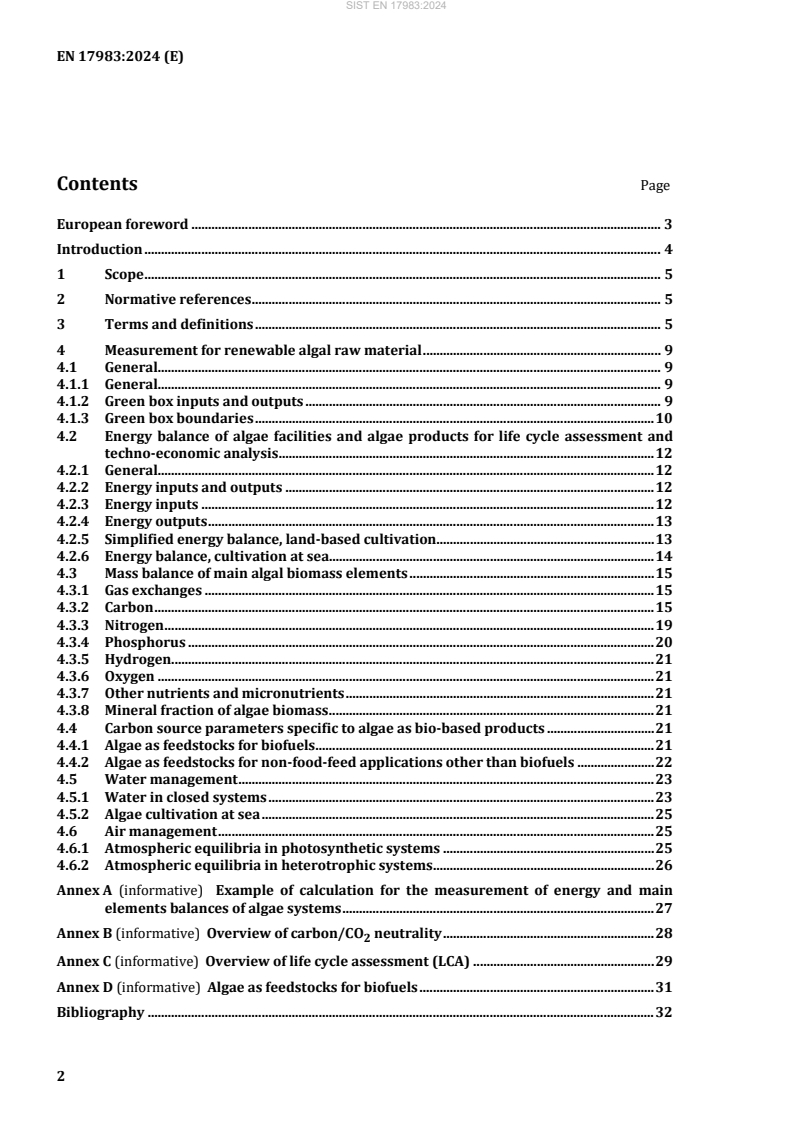
Contents Page
European foreword . 3
Introduction . 4
1 Scope . 5
2 Normative references . 5
3 Terms and definitions . 5
4 Measurement for renewable algal raw material . 9
4.1 General. 9
4.1.1 General. 9
4.1.2 Green box inputs and outputs . 9
4.1.3 Green box boundaries . 10
4.2 Energy balance of algae facilities and algae products for life cycle assessment and
techno-economic analysis . 12
4.2.1 General. 12
4.2.2 Energy inputs and outputs . 12
4.2.3 Energy inputs . 12
4.2.4 Energy outputs . 13
4.2.5 Simplified energy balance, land-based cultivation. 13
4.2.6 Energy balance, cultivation at sea. 14
4.3 Mass balance of main algal biomass elements . 15
4.3.1 Gas exchanges . 15
4.3.2 Carbon . 15
4.3.3 Nitrogen . 19
4.3.4 Phosphorus . 20
4.3.5 Hydrogen. 21
4.3.6 Oxygen . 21
4.3.7 Other nutrients and micronutrients . 21
4.3.8 Mineral fraction of algae biomass . 21
4.4 Carbon source parameters specific to algae as bio-based products . 21
4.4.1 Algae as feedstocks for biofuels . 21
4.4.2 Algae as feedstocks for non-food-feed applications other than biofuels . 22
4.5 Water management . 23
4.5.1 Water in closed systems . 23
4.5.2 Algae cultivation at sea . 25
4.6 Air management . 25
4.6.1 Atmospheric equilibria in photosynthetic systems . 25
4.6.2 Atmospheric equilibria in heterotrophic systems . 26
Annex A (informative) Example of calculation for the measurement of energy and main
elements balances of algae systems . 27
Annex B (informative) Overview of carbon/CO neutrality . 28
Annex C (informative) Overview of life cycle assessment (LCA) . 29
Annex D (informative) Algae as feedstocks for biofuels . 31
Bibliography . 32
European foreword
This document (EN 17983:2024) has been prepared by Technical Committee CEN/TC 454 “Algae and
algae products”, the secretariat of which is held by NEN.
This European Standard shall be given the status of a national standard, either by publication of an
identical text or by endorsement, at the latest by January 2025, and conflicting national standards shall
be withdrawn at the latest by January 2025.
Attention is drawn to the possibility that some of the elements of this document may be the subject of
patent rights. CEN shall not be held responsible for identifying any or all such patent rights.
This document has been prepared under a standardization request addressed to CEN by the European
Commission. The Standing Committee of the EFTA States subsequently approves these requests for its
Member States.
Any feedback and questions on this document should be directed to the users’ national standards body.
A complete listing of these bodies can be found on the CEN website.
According to the CEN-CENELEC Internal Regulations, the national standards organisations of the
following countries are bound to implement this European Standard: Austria, Belgium, Bulgaria, Croatia,
Cyprus, Czech Republic, Denmark, Estonia, Finland, France, Germany, Greece, Hungary, Iceland, Ireland,
Italy, Latvia, Lithuania, Luxembourg, Malta, Netherlands, Norway, Poland, Portugal, Republic of North
Macedonia, Romania, Serbia, Slovakia, Slovenia, Spain, Sweden, Switzerland, Türkiye and the United
Kingdom.
Introduction
This document has been prepared by CEN/TC 454 “Algae and algae products”.
The European Committee for Standardization (CEN) was requested by the European Commission (EC) to
draft European standards or European Standardization deliverables to support the implementation of
Article 3 of Directive 2009/28/EC for algae and algae-based products or intermediates.
This request, presented as Mandate M/547, also contributes to the Communication on “Innovating for
Sustainable Growth: A Bio economy for Europe”.
The former working group CEN Technical Board Working Group 218 “Algae” was created in 2016 to
develop a work program as part of this Mandate. The technical committee CEN/TC 454 “Algae and algae
products” was established to carry out the work program that will prepare a series of standards.
The interest in algae and algae-based products or intermediates has increased significantly in Europe as
a valuable source of, including but not limited to, carbohydrates, proteins, lipids, and several pigments.
These materials are suitable for use in a wide range of applications from food and feed purposes to other
sectors, such as textile, cosmetics, biopolymers, biofuel and fertilizer/biostimulants. Standardization was
identified as having an important role in promoting the use of algae and algae products.
The work of CEN/TC 454 should improve the reliability of the supply chain, thereby improving the
confidence of industry and consumers in algae, which include macroalgae, microalgae, cyanobacteria,
Labyrinthulomycetes, algae-based products or intermediates and will promote and support
commercialization of the European algae industry.
In industrial and scientific assessments, many methodological differences occur with regard to mass and
energy balances. This constitutes a major issue, as the results often are difficult to compare.
The goal of this document is to define basic metrics for carbon accounting of algae, so as to allow a more
scientifically sound comparison between algae systems and other biomass feedstocks.
The need for such metrics and methodology is related to the wide existing differences in algae growth
sites and strategies. For example, there are significant differences in the application of the “green box
concept” to closed cultivation units and wild harvested algae. However, common sustainability and life
cycle assessment (LCA) approaches are needed.
These metrics can be used to apply existing LCA standards to algae systems.
An overview of LCA standards is given in Annex C.
This document aims to provide specific life cycle assessment requirements and guidance for algae
cultivation, based on EN ISO 14040 Environmental management — Life cycle assessment — Principles and
framework, EN ISO 14044 Environmental management — Life cycle assessment — Requirements and
guidelines and EN 16760 Bio-based products — Life Cycle Assessment. These standards are all applicable
to algae-based products, but the topic which is not clearly defined in these standards is the accounting of
the main parameters of algae cultivation sites. The sustainability aspects of algae cultivation can be
assessed either by EN 16751 Bio-based products — Sustainability criteria when the outcome is a product,
or by ISO 13065 Sustainability criteria for bioenergy, when the outcome is energy. Both these documents
provide a framework for considering environmental, social and economic aspects that can be used to
facilitate the evaluation and comparability of biomass for products or energy, respectively.
This document covers the problem of using fossil CO as photosynthesis feed to algae in relation to
EN 16785-1 Bio-based products — Bio-based content — Part 1: Determination of the bio-based content
using the radiocarbon analysis and elemental analysis. This situation calls for proper application criteria
opposite to plant photosynthesis. A similar situation can arise for nitrogen and phosphorus capture in
open seas.
1 Scope
This document specifies methods for the measurement of energy content and main elements balances of
algae from cultivation or from wild growth and algae products to provide biomass, intended for
renewable algal raw material used as bioenergy and in bio-based products.
This document also specifies carbon source parameters specific to algae as bio-based and it is applicable
to studies covering algae production life cycle assessment (LCA) e.g. algal biomass farming or wild
collection.
This document does not apply to methods of algae and algae products sampling, harvesting and
pre/postprocessing.
This document does not apply to algae and algae products intended for the food and feed sector.
2 Normative references
The following documents are referred to in the text in such a way that some or all of their content
constitutes requirements of this document. For dated references, only the edition cited applies. For
undated references, the latest edition of the referenced document (including any amendments) applies.
EN 14268, Irrigation techniques — Meters for irrigation water
EN 17399, Algae and algae products — Terms and definitions
EN 17480, Algae and algae products — Methods for the determination of productivity of algae growth sites
EN 17605, Algae and algae products — Methods of sampling and analysis — Sample treatment
EN ISO 4064-1, Water meters for cold potable water and hot water — Part 1: Metrological and technical
requirements (ISO 4064-1)
EN ISO 16948, Solid biofuels — Determination of total content of carbon, hydrogen and nitrogen
(ISO 16948)
EN ISO 18125, Solid biofuels — Determination of calorific value (ISO 18125)
3 Terms and definitions
For the purposes of this document, the terms and definitions given in EN 17399, EN 17480, EN 17605
and the following apply.
ISO and IEC maintain terminology databases for use in standardization at the following addresses:
— ISO Online browsing platform: available at https://www.iso.org/obp/
— IEC Electropedia: available at https://www.electropedia.org/
3.1
biomass dry matter
material remaining after removal of moisture under specific conditions
Note 1 to entry: It is measured by determination of moisture content.
[SOURCE: EN ISO 16559:2022, 3.71, modified – biomass added to the term, Note 1 to entry added]
3.2
biomass ash content
mass of microalgae and macroalgae residue remaining after the sample is placed in a muffle furnace at a
temperature of (575 ± 10) °C
3.3
illumination
exposition to light from other sources than sun
3.4
photosynthetic production area
insolated horizontal surface of the cultivation unit where photosynthesis is driven by natural light in
natural basins, natural sites and insolated ponds
Note 1 to entry: The production area of non-horizontal systems results in multi-interpretable outcomes; therefore,
non-horizontal systems use the volume productivity formula to calculate productivity.
Note 2 to entry: Wild growth areas are excluded.
Note 3 to entry: Systems that use illumination (see 3.11) use volume productivity formula to calculate productivity.
3.5
algae growth site area
area of a single or multiple algae cultivation unit(s)or natural sites, including auxiliary equipment needed
to operate the unit and service area
Note 1 to entry: Cultivation unit area includes ponds, bubble columns, tubular photobioreactors, green-wall panels
or any kind of devices utilized to grow algae, and all the equipment, tubing and connections necessary for the specific
unit to function (e.g. the area occupied by the pumps and recirculating reservoir/ degasser in a tubular
photobioreactor), and the service area around. If the service area is not clearly defined, it is by default 1 m all around
the cultivation unit.
Note 2 to entry: Cultivation unit area does not include equipment upstream and downstream of the cultivation unit,
e.g. the reservoirs for water preparation and/or harvesting.
Note 3 to entry: The specification of the area in a wild growth site where macroalgae are growing in nature without
human interference, except when harvesting, is misleading for the calculation of productivity as many factors
influence the growth (e.g. currents, mixture of species, natural regeneration cycles, etc.).
3.6
total carbon
TC
quantity of carbon present in a product in the form of organic, inorganic and elemental carbon
[SOURCE: EN 16575:2014, 2.17]
3.7
dissolved inorganic carbon
DIC
carbon dissolved in water in inorganic form as carbonates and bicarbonates in equilibrium with gaseous
dissolved CO
Note 1 to entry: Dissolved CO molecules are notated CO2aq.
3.8
dissolved organic carbon
DOC
carbon dissolved in water in organic molecules
Note 1 to entry: Glycerol, acetic acid and sugar are examples of DOC molecules.
3.9
carbon accounting
evaluation of carbon-containing mass flows transferred from inputs to biomass in algae cultivation for
sustainability and/or credit claims
3.10
bio-based product
product wholly or partly derived from biomass
Note 1 to entry: The bio-based product is normally characterized by the bio-based carbon content or the bio-based
content. For the determination and declaration of the bio-based content and the bio-based carbon content, see the
relevant standards of CEN/TC 411.
Note 2 to entry: Product can be an intermediate, material, semifinished or final product.
Note 3 to entry: “Bio-based product” is often used to refer to a product which is partly bio-based. In these cases,
the claim should be accompanied by a quantification of the bio-based content.
[SOURCE: EN 16575:2014, 2.5]
3.11
carbon footprint
CFP
sum of GHG emissions and GHG removals in a product system, expressed as CO equivalents and based
on a life cycle assessment using the single impact category of climate change
[SOURCE: EN ISO 14067:2018, 3.1.1.1, modified – Note 1 and 2 to entry omitted]
3.12
greenhouse gas
GHG
gaseous constituent of the atmosphere, both natural and anthropogenic, that absorbs and emits radiation
at specific wavelengths within the spectrum of infrared radiation emitted by the earth’s surface, the
atmosphere, and clouds
[SOURCE: EN ISO 14067:2018, 3.1.2.1, modified – Note 1 and 2 to entry omitted]
3.13
flue gas
gases produced by combustion of a fuel that are normally emitted to the atmosphere
Note 1 to entry: Flue gas from combustion processes exploited for other purposes than CO production are
examples of flue gas, e.g. power plants CO emissions.
[SOURCE: ISO/TR 27912:2016, 3.31, modified – Note 1 to entry added]
3.14
cryogenic CO
liquid CO stored and transported as industrial product
3.15
biogenic CO
carbon dioxide generated from the combustion or degradation of biogenic carbon (bio-based carbon)
(3.24)
3.16
carbon neutral CO
carbon dioxide generated as byproduct or waste, after its carbon footprint is fully cleared over the
production system
Note 1 to entry: Examples of this carbon dioxide are flue gas from combustion of fossil fuels for energy production,
roasting of carbonates, steam reforming of natural gas, as far as the CFP (carbon footprint) of these sources are
completely accounted for over the main product, e.g. electric power, calcium oxide, hydrogen.
Note 2 to entry: An overview of carbon/CO neutrality is reported in Annex B.
3.17
open land-based cultivation
controlled growth cultivation performed on land without totally controlled mass flow referring to all solid
and liquid mass flows which enter or exit the system without passing a measurable section, e.g. unlined
pond
3.18
closed cultivation
controlled growth cultivation performed with controlled mass flow
Note 1 to entry: Uncontrolled gaseous mass flow from/to atmosphere is possible, e.g. CO absorption and/or O
2 2
release and water vapor release.
Note 2 to entry: Open ponds without bottom liner including natural basins are not considered as closed cultivation
systems.
3.19
open water
aqueous environment where algae exchange elements without controlled mass flow
3.20
photosynthetic system
algae cultivation based on phototrophy as defined in EN 17399
3.21
mixotrophic system
algae cultivation based on mixotrophy or photoheterotrophy as defined in EN 17399
3.22
heterotrophic system
algae cultivation based on heterotrophy as defined in EN 17399
3.23
biomass
material of biological origin excluding material embedded in geological formations and/or fossilized
EXAMPLES (Whole or parts of) plants, trees, algae, marine organisms, microorganisms, animals, etc.
[SOURCE: EN 16575:2014, 2.7]
3.24
bio-based carbon
biogenic carbon
carbon derived from biomass
Note 1 to entry: Biogenic carbon is defined in EN ISO 14067:2018, by the same definition.
[SOURCE: EN 16575:2014, 2.2, modified – Note 1 to entry updated]
3.25
photosynthetic conversion efficiency
η
ratio between energy content of algae biomass and energy inputs to phototrophic algae cultivation
Note 1 to entry: The photosynthetic efficiency is the fraction of light energy (photons) converted into algae
chemical energy during phototrophic algae cultivation. The ratio between energy content of the grown algae
biomass and energy needed to cultivate them is the efficiency.
4 Measurement for renewable algal raw material
4.1 General
4.1.1 General
The measurement for renewable algal raw material can be carried out by means of the “Green Box”
approach [1], see Figure 1. It describes the industry’s environmental, economic, and carbon footprint via
quantifying the inputs and outputs of an algae growth site. These input/output measurements
systematically allow for economic projections (through techno-economic analyses) and sustainability
calculations (through life cycle assessments).
4.1.2 Green box inputs and outputs
Inputs include the carbon, water, energy, and nutrients required by the algae, as well as land
requirements, process consumables, and human resources required by the infrastructure. Green Box
outputs include the different classes of algal products as well as industrial waste emissions including gas,
liquid, and solid discharges.
Together, the measured inputs and outputs generically carve out the total economic and environmental
footprint of any algal operation. Identifying this total footprint is central in the technical and
sustainability review of an expanding algae industry. Sample treatment of algae and algae products
should be performed in accordance with EN 17605.
Figure 1 — Green box for the measurement of renewable algal raw material
4.1.3 Green box boundaries
The boundaries for algae production are limited by the Green Box approach where it accounts for one
year production or other relevant operative time in natural sites, open land-based cultivation, and closed
cultivation.
These production pathways shall be separately considered. In natural sites, water, carbon, nutrients
inputs and energy, gas and liquid emissions are not measured. In open land-based cultivation, liquid
streams in not-controlled flow are present (leakage from unlined ponds, spreading in agriculture, etc.)
which cannot be measured. In closed cultivation all mass flow is controlled and can be measured except
CO and O release/absorption from atmosphere. In the same way, all other non-controlled gas exchange
2 2
(diffusion) from algae to atmosphere can happen and is neglected (e.g. ammonia release, etc.).
Examples of the processes are shown in Figure 2, Figure 3 and Figure 4.
In all the cases, infrastructure (e.g. facility capex and component materials) shall be considered (see
EN ISO 14064-1). Infrastructure should be referred to as its amortization figures (e.g. measured in
€/(time∗kg) units and component materials weight divided by life time.
When there are other bio-products as outputs or associated energy production, system should be
subdivided or expanded to include the additional impacts related to the co-products or allocation concept
should be considered (EN ISO 14044). The environmental impact should be allocated to the products
(outputs of the Green Box) by weight, energy, or economic value.
Figure 2 — Green box boundaries for natural sites
Figure 3 — Green box boundaries for open land-based cultivation
In open land-based cultivation liquid streams in not-controlled flow are present (leakage from unlined
ponds, spreading in agriculture, etc.) which cannot be measured.
Figure 4 — Green box boundaries for closed cultivation
In closed cultivation all mass flow is controlled and can be measured except CO absorption/release from
atmosphere and O release/absorption from atmosphere. In the same way, all other non-controlled gas
exchange (diffusion) from algae to atmosphere can happen and is neglected, e.g. ammonia release, etc.
4.2 Energy balance of algae facilities and algae products for life cycle assessment and
techno-economic analysis
4.2.1 General
Energy includes all flows measurable in kWh/yr (or kJ/yr), if any, e.g. the output of a biogas digestor +
power station included in the algae facility, or e.g. the energy value (combustion heat) of biomass; and all
energy input consumed to perform cultivation, related to the production of the functional unit (i.e. 1 kg
of algae).
4.2.2 Energy inputs and outputs
Figure 5 provides an overview of all energy input and output for land-based cultivation which holds both
for open and closed systems.
Figure 5 — Overview of all energy input and output for land-based cultivation
4.2.3 Energy inputs
4.2.3.1 General
With reference to Figure 5, the different energy inputs which can be used in land-based algae cultivation
systems are described in this clause with the aim to identify relevant measurements and requirements
for evaluation of each energy flow and the overall balance across the green box.
4.2.3.2 Electric power
Electric power is the energy supplied to the green box through electricity. This power is always quantified
by a meter and can originate from an external source (transported by the grid) or a local source. All
electric power originates from a renewable source (wind turbines or solar panels) or a non-renewable
source (local CHP plants or external fossil powered electricity plants). Regularly electric power is a mix
of sources where the renewability of all individual sources shall be known in order to perform any LCA
calculation.
4.2.3.3 Solar energy
Solar energy is the energy directly put into the green box from solar radiation. Part of the photon influx
is converted into biomass and a part is transferred into heat. In practice solar energy cannot be measured
directly. Indirect measurements on biomass production (conversion ratio) and increase of temperature
through heat participation are ways to indicate the magnitude. With algal production solar energy can
also solely be used as thermal energy through culture heating. It cannot be measured directly beside
specific application of solar energy panels.
4.2.3.4 Chemical energy
Chemical energy includes all forms of energy inputs coming from free energy of reactants such as organic
substances fed to heterotrophic or mixotrophic systems and biofuels used as well as fossil source fuels.
It should be calculated from fiscal documents and conventional thermodynamics.
4.2.4 Energy outputs
Algal heat value is the calorific value of dry matter as measured according to EN ISO 18125. If the product
is wet or fresh algae, the amount of energy required to bring the water in the sample to vapor state in
reference conditions shall be deducted from the calorific value (i.e. balance performed on the basis of the
Lower Calorific Value).
Electric power is the energy fed to the grid usually sold and measured by fiscal meter(s), coming from
use of algal biomass or algae product(s) as source in power production system e.g. biogas or CHP facility.
For uses as biofuels, the calorific value measurement shall be carried out according to EN ISO 18125.
Energy losses shall be calculated by energy balance over the green box (see Figure 5).
4.2.5 Simplified energy balance, land-based cultivation
In phototrophic land-based systems where only power and fuels provide energy for system operation
other than solar light, heat value can provide useful information of photosynthetic energy conversion.
The photosynthetic energy E stored in biomass is given by Formula (1):
E = m’*H / 3600 (1)
DM
where
E is the photosynthetic energy stored in biomass [kWh/yr];
m' is the mass flow of algae [kg/yr];
H is the heat value of dry matter sample [kJ/kg].
DM
When energy losses in output can be assumed or demonstrated to be negligible (10 % or 5 % of heat
value) it is possible to calculate the photosynthetic conversion efficiency η according to Formula (2):
η 100 */E PAR * A++W F (2)
( )
where
η is the photosynthetic conversion efficiency [%];
PAR
is the yearly mean photosynthetic active radiation fraction of solar light [kWh/(m∗yr)];
A
is the photosynthetic a
...