


EN 14428:2004+A1:2008
(Main)Shower enclosures - Functional requirements and test methods
Shower enclosures - Functional requirements and test methods
This document specifies requirements for shower enclosures for domestic purposes which ensure that the product,
when installed in accordance with the manufacturer's installation instructions, gives satisfactory performance when
used as intended.
This document does not apply to shower cabinets or curtains and does not specify aesthetic and dimensional
requirements.
NOTE For the purposes of this document the term "domestic purposes" includes use in hotels, accommodation for
students, hospitals and similar buildings, except when special medical provisions are required.
Duschabtrennungen - Funktionsanforderungen und Prüfverfahren
Dieses Dokument legt Anforderungen an Duschabtrennungen für den Hausgebrauch fest, die sicherstellen, dass das nach den Einbauanweisungen des Herstellers eingebaute Produkt für den vorgesehenen Verwendungszweck eine zufrieden stellende Gebrauchstauglichkeit aufweist.
Dieses Dokument gilt nicht für Komplettduschen oder Duschvorhänge und legt keine ästhetischen und maßlichen Anforderungen fest.
ANMERKUNG Der Begriff "für den Hausgebrauch" in dieser Norm schließt die Verwendung in Hotels, Studenten-wohnheimen, Krankenhäusern und ähnlichen Einrichtungen ein; ausgenommen ist die medizinische Verwendung.
Parois de douche - Prescriptions fonctionnelles et méthodes d'essai
La présente Norme européenne spécifie les exigences relatives aux parois de douche à usage domestique assurant que le produit, lorsqu’il est installé conformément aux instructions d’installation du fabricant, fonctionne de manière satisfaisante pour l’usage prévu.
La présente norme ne concerne pas les cabines de douche complètes ou les rideaux de douche et ne spécifie pas d’exigences esthétiques et dimensionnelles.
NOTE Pour les besoins de la présente norme l’expression «à usage domestique» comprend les utilisations dans les hôtels, les logements d’étudiants, les hôpitaux et bâtiments similaires, sous réserve de dispositions médicales spéciales.
Zasloni za prhanje - Funkcionalne zahteve in preskusne metode
General Information
- Status
- Withdrawn
- Publication Date
- 22-Jan-2008
- Withdrawal Date
- 13-Apr-2025
- Technical Committee
- CEN/TC 163 - Sanitary appliances
- Drafting Committee
- CEN/TC 163/WG 4 - Baths (W/Pools) - Shower trays (Performance testing)
- Current Stage
- 9960 - Withdrawal effective - Withdrawal
- Start Date
- 27-May-2015
- Completion Date
- 14-Apr-2025
- Directive
- 89/106/EEC - Construction products
Relations
- Effective Date
- 22-Dec-2008
- Effective Date
- 08-Jun-2022


Frequently Asked Questions
EN 14428:2004+A1:2008 is a standard published by the European Committee for Standardization (CEN). Its full title is "Shower enclosures - Functional requirements and test methods". This standard covers: This document specifies requirements for shower enclosures for domestic purposes which ensure that the product, when installed in accordance with the manufacturer's installation instructions, gives satisfactory performance when used as intended. This document does not apply to shower cabinets or curtains and does not specify aesthetic and dimensional requirements. NOTE For the purposes of this document the term "domestic purposes" includes use in hotels, accommodation for students, hospitals and similar buildings, except when special medical provisions are required.
This document specifies requirements for shower enclosures for domestic purposes which ensure that the product, when installed in accordance with the manufacturer's installation instructions, gives satisfactory performance when used as intended. This document does not apply to shower cabinets or curtains and does not specify aesthetic and dimensional requirements. NOTE For the purposes of this document the term "domestic purposes" includes use in hotels, accommodation for students, hospitals and similar buildings, except when special medical provisions are required.
EN 14428:2004+A1:2008 is classified under the following ICS (International Classification for Standards) categories: 91.140.70 - Sanitary installations. The ICS classification helps identify the subject area and facilitates finding related standards.
EN 14428:2004+A1:2008 has the following relationships with other standards: It is inter standard links to EN 14428:2004, EN 14428:2015. Understanding these relationships helps ensure you are using the most current and applicable version of the standard.
EN 14428:2004+A1:2008 is associated with the following European legislation: EU Directives/Regulations: 305/2011, 89/106/EEC; Standardization Mandates: M/110. When a standard is cited in the Official Journal of the European Union, products manufactured in conformity with it benefit from a presumption of conformity with the essential requirements of the corresponding EU directive or regulation.
You can purchase EN 14428:2004+A1:2008 directly from iTeh Standards. The document is available in PDF format and is delivered instantly after payment. Add the standard to your cart and complete the secure checkout process. iTeh Standards is an authorized distributor of CEN standards.
Standards Content (Sample)
2003-01.Slovenski inštitut za standardizacijo. Razmnoževanje celote ali delov tega standarda ni dovoljeno.Shower enclosures - Functional requirements and test methodsZasloni za prhanje - Funkcionalne zahteve in preskusne metodeParois de douche - Prescriptions fonctionnelles et méthodes d'essaiDuschabtrennungen - Funktionsanforderungen und PrüfverfahrenTa slovenski standard je istoveten z:EN 14428:2004+A1:2008SIST EN 14428:2005+A1:2008en,fr,de91.140.70ICS:SLOVENSKI
STANDARDSIST EN 14428:2005+A1:200801-marec-2008
EUROPEAN STANDARD NORME EUROPÉENNE EUROPÄISCHE NORM
EN 14428:2004+A1
January 2008 ICS 91.140.70 Supersedes EN 14428:2004 English Version
Shower enclosures - Functional requirements and test methods Parois de douche - Prescriptions fonctionnelles et méthodes d'essai
Duschabtrennungen - Funktionsanforderungen und Prüfverfahren This European Standard was approved by CEN on 2 September 2004 and includes Amendment 1 approved by CEN on 24 November 2007.
CEN members are bound to comply with the CEN/CENELEC Internal Regulations which stipulate the conditions for giving this European Standard the status of a national standard without any alteration. Up-to-date lists and bibliographical references concerning such national standards may be obtained on application to the CEN Management Centre or to any CEN member.
This European Standard exists in three official versions (English, French, German). A version in any other language made by translation under the responsibility of a CEN member into its own language and notified to the CEN Management Centre has the same status as the official versions.
CEN members are the national standards bodies of Austria, Belgium, Bulgaria, Cyprus, Czech Republic, Denmark, Estonia, Finland, France, Germany, Greece, Hungary, Iceland, Ireland, Italy, Latvia, Lithuania, Luxembourg, Malta, Netherlands, Norway, Poland, Portugal, Romania, Slovakia, Slovenia, Spain, Sweden, Switzerland and United Kingdom.
EUROPEAN COMMITTEE FOR STANDARDIZATION
COMITÉ EUROPÉEN DE NORMALISATION EUROPÄISCHES KOMITEE FÜR NORMUNG
Management Centre: rue de Stassart, 36
B-1050 Brussels © 2008 CEN All rights of exploitation in any form and by any means reserved worldwide for CEN national Members. Ref. No. EN 14428:2004+A1:2008: E
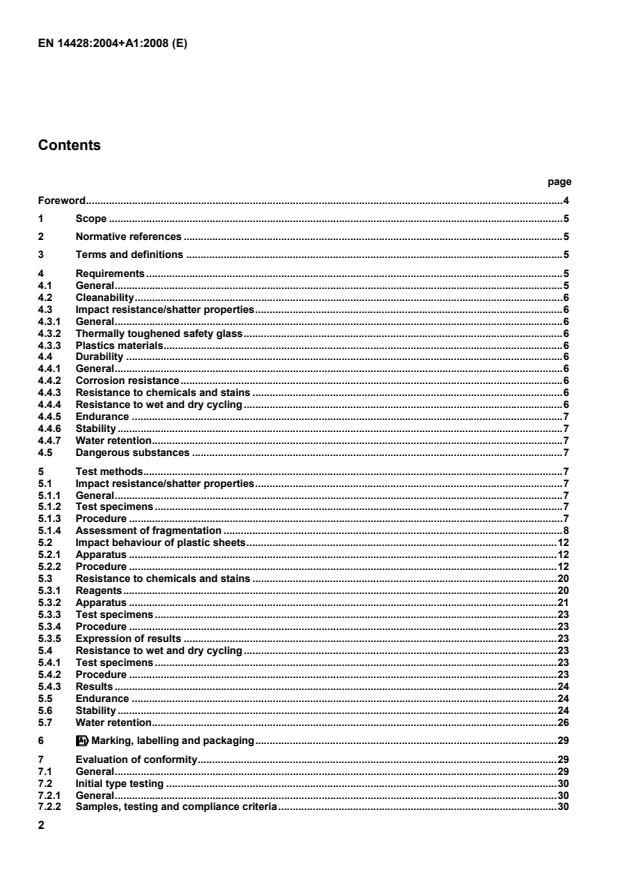
!!!!Relationship between this European Standard and the essential Requirements of EU Directive 89/106/EEC, EU Construction Products Directive.32 ZA.1 Scope and relevant characteristics.32 ZA.2 Procedure for attestation of conformity of shower enclosures.33 ZA.2.1 System of attestation of conformity.33 ZA.2.2 Declaration of conformity.33 ZA.3 CE marking.34 !!!!Bibliography.36
4.3.1 General Shower enclosures may be glazed with various materials. Where glass is used, this shall meet the requirements of 4.3.2, and where plastics materials are used, they shall meet the requirements of 4.3.3. 4.3.2 Thermally toughened safety glass Thermally toughened safety glass shall meet the requirements of EN 12150-1:2000, except in respect of Clause 8 which is replaced by 5.1 of this document. When tested in accordance with 5.1, the minimum particle count shall be 40. 4.3.3 Plastics materials When tested in accordance with 5.2, sheets shall not break or they shall break safely. 4.4 Durability 4.4.1 General Products conforming with the requirements of 4.2 and 4.3 and the following are deemed to be durable. 4.4.2 Corrosion resistance All components shall consist of corrosion-proof materials or shall be corrosion-protected. All corrosion protection shall conform with the relevant requirements specified in European and International Standards. For example: the minimum paint adhesion performance for powder-coated or wet-painted surfaces shall comply with a cross-cut value ≤ 2 when tested in accordance with EN ISO 2409; the minimum average thickness of coating on aluminium shall be of grade AA 8 when tested in accordance with one of the methods given in ISO 7599. In no cases shall the minimum local thickness be less than 80 % of the minimum average thickness. 4.4.3 Resistance to chemicals and stains When tested in accordance with 5.3 the glazing materials shall not show permanent staining or deterioration. 4.4.4 Resistance to wet and dry cycling When tested in accordance with 5.4, the glazing materials shall not show any cracks, crazing or discoloration.
Key 1 Impact point Figure 1 — Position of impact point For thermally toughened soda lime silicate safety glass manufactured by vertical toughening, the impact point shall not be on the tong mark edge. 5.1.4 Assessment of fragmentation The particle count and measuring of the dimensions of the largest particle shall be made between 4 min to 5 min after fracture. An area of radius 100 mm, centred on the impact point, and a border of 25 mm, round the edge of the test specimen (see Figure 2), shall be excluded from the assessment.
Dimensions in millimetres
Key 1 Excluded area Figure 2 — Area to be excluded from the particle count determination and largest particle measurement The particle count shall be made in the region of coarsest fracture (the aim being to obtain the minimum value). The particle count shall be made by placing a mask of (50 ± 1) mm x (50 ± 1) mm on the test piece (see Figures 3,
Figure 3 — Select the area of coarsest fracture, place the template on the test specimen and draw round the template
NOTE Number of perimeter particles = 32/2 = 16 Figure 4 — Mark and count the perimeter fragments as 1/2 particle each
NOTE Number of central particles
= 53
Total number of particles = 16 + 53 = 69 Figure 5 — Mark and count the central fragments and add these to the perimeter count to obtain the particle count for the specimen
Figure 6 — Examples of crack-free particles and the assessment regarding their number
Figure 10 so that the test piece can make contact only with the strips of chloroprene or similar material. These strips shall be capable of being compressed by 10 % to 15 % of their original depth without a permanent set being introduced. The edge cover of the chloroprene on the test pieces shall be such that for the nominal
865 mm x 1 930 mm specimens the central area of (845 ± 3) mm x (1 910 ± 3) mm is unsupported. NOTE In order to limit the compression of the chloroprene strips to within approximately 15 %, spacers of appropriate thickness and material are recommended (see Figure 10). The components of the sub-frame shall be held together, and the sub-frame shall be held to the test frame, by bolts, toggle clamps or similar fixing devices as convenient, these being uniformly spaced no more than
450 mm apart and no fewer than two per side. c) impactor, consisting of a leather case of a punch bag type, modified with a central support rod and fitting system as shown in Figure 11, and filled with chilled lead shot. The leather case shall be made from six panels, as shown in Figure 12, which shall be securely stitched together leaving a slit approximately 175 mm long to allow for filling with the lead shot. Lace holes shall be inserted on each side of the slit which is closed by a leather thong. The neck shall be taped separately to cover the worm-drive hose clamp. The complete impactor shall weigh (45 ± 0,1) kg. The impactor shall be suppor
...
The standard EN 14428:2004+A1:2008 outlines essential functional requirements and test methods specific to shower enclosures intended for domestic use. The relevance of this standard is underscored by its comprehensive approach to ensuring that shower enclosures perform satisfactorily when installed according to the manufacturer's guidelines, thereby prioritizing user safety and satisfaction. One of the noteworthy strengths of this standard is its clear delineation of performance criteria, which are crucial for manufacturers aiming to ensure their products meet a consistent level of quality and reliability. The focus on practical functionality without delving into aesthetic or dimensional specifications allows manufacturers to innovate and design according to their style choices while still adhering to safety and usability standards. Additionally, the document's applicability extends beyond typical domestic environments, encompassing usage in hotels, student accommodations, hospitals, and similar facilities. This broad scope reinforces the standard's importance as it addresses the varying demands of different living and accommodation situations, ensuring that shower enclosures meet the needs of diverse user groups. Furthermore, EN 14428:2004+A1:2008 emphasizes the necessity for compliance with installation instructions, which serves to enhance the reliability of the entire system when used appropriately. By omitting shower cabinets and curtains from its applicability, the standard sharpens its focus, providing clarity in its enforceable criteria for shower enclosures specifically. In conclusion, the EN 14428:2004+A1:2008 standard is a crucial document for the industry, as it provides a systematic framework for evaluating the performance of shower enclosures, ensuring they deliver both safety and functionality in various domestic and quasi-domestic contexts. Its strengths lie in its precise requirements, applicability across different setting types, and the promotion of best practices in product installation and performance.
EN 14428:2004+A1:2008は、家庭用のシャワーキャビンに関する機能的要件と試験方法を規定した文書です。この標準の重要な範囲は、製品が製造者の設置指示に従って取り付けられた場合に、意図した用途で満足のいく性能を提供することを保証する点にあります。特に、家庭用の用途に焦点を当てているため、ホテルや学生宿舎、病院などの施設においても適用可能ですが、特別な医療上の規定が必要な場合には適用されません。 この標準の強みは、シャワーキャビンの使用における機能性を重視していることです。使用者が求める基本的な安全性と操作性を確保しているため、ユーザーエクスペリエンスを向上させる要因となります。また、テスト方法を明確に規定しているため、製品の品質管理も効率的に行うことができます。これにより、製造者は自社の製品が標準に準拠していることを証明でき、市場における信頼性を高めることができます。 さらに、標準がデザインや寸法に関する要件を規定していないため、製品の柔軟な設計が可能です。これにより、様々なスタイルの浴室に適合しやすく、消費者の多様なニーズに対応できる点も本標準の大きな強みです。標準の明確な定義により、製品の仕様が一貫性を持ち、市場における信頼性と安全性を担保することができます。 総じて、EN 14428:2004+A1:2008は、シャワーキャビンの使用における機能的要件を高い水準で満たし、製品の性能評価を効率化するための重要なガイドラインを提供しています。家庭用の用途だけでなく、他の施設における使用においてもその有用性が伺えるため、ユーザー、製造者ともに重要な標準と言えるでしょう。
La norme EN 14428:2004+A1:2008, intitulée « Enceintes de douche - Exigences fonctionnelles et méthodes d'essai », établit un cadre essentiel pour garantir la performance et la sécurité des enceintes de douche destinées à un usage domestique. Cette norme se concentre spécifiquement sur les exigences fonctionnelles qui doivent être respectées lors de l’installation des produits, afin de garantir leur efficacité lors de leur utilisation conforme aux instructions du fabricant. L'un des points forts de cette norme est sa capacité à couvrir une large gamme d’applications domestiques, incluant non seulement les maisons individuelles, mais aussi les hôtels, les résidences étudiantes et les hôpitaux. En intégrant ces divers contextes, la norme démontre son utilité pour une multitude d'environnements où des enceintes de douche sont nécessaires, tout en précisant qu’elle ne s'applique pas aux cabines de douche ou aux rideaux de douche. Les exigences spécifiées dans la norme permettent d'assurer une performance satisfaisante, garantissant ainsi la sécurité des utilisateurs tout en minimisant les risques liés à l'eau et à l'humidité. Ce souci de la performance est fondamental, car il se traduit directement par une meilleure satisfaction client et une durabilité accrue des produits. De plus, la norme NE définit pas les exigences esthétiques et dimensionnelles, ce qui laisse une plus grande liberté d'innovation aux fabricants. Cela peut favoriser la créativité dans la conception des produits tout en maintenant des standards de sécurité et de fonctionnalité robustes. En résumé, la norme EN 14428:2004+A1:2008 représente un outil crucial pour les fabricants d'enceintes de douche, leur fournissant des lignes directrices claires et précises pour garantir un produit sûr et performant, adapté à des usages variés dans le secteur domestique.
SIST EN 14428:2005+A1:2008 표준은 가정용 샤워 공간의 설계와 성능 요건을 체계적으로 규정하는 중요한 문서입니다. 이 표준은 제조업체의 설치 지침에 따라 설치될 경우, 제품이 의도된 대로 사용될 때 만족스러운 성능을 보장하도록 요구하는 내용을 포함하고 있습니다. 이 표준의 범위는 주로 가정용 샤워 공간에 적용되며, 호텔, 학생 기숙사, 병원 및 유사한 건물에서도 사용될 수 있습니다. 그러나, 특별한 의료적 요구가 필요한 경우에는 적용되지 않습니다. 이는 다양한 환경에서도 적용 가능한 유용성을 보여 줍니다. SIST EN 14428은 샤워 관련 제품의 기능적 요건과 시험 방법을 명확히 하여 소비자가 안전하게 사용할 수 있도록 도와줍니다. 특히, 이 표준은 미적 또는 치수적인 요구 사항을 포함하지 않고, 기능성과 안전성에 중점을 두고 있다는 점에서 강점을 가집니다. 이러한 접근은 샤워 공간이 주어진 목적에 맞게 실용적으로 설계될 수 있도록 지원합니다. 결론적으로, SIST EN 14428:2005+A1:2008 표준은 샤워 공간의 안전성과 성능을 보장하는 데 중대한 역할을 하며, 관련 업계에서의 지속적인 사용을 통해 더욱 정밀한 제품 개발과 개선에 기여할 것입니다.
Die Norm EN 14428:2004+A1:2008 legt klare und spezifische Anforderungen für Duschkabinen fest, die für den privaten Gebrauch bestimmt sind. Der Umfang dieser Norm ist besonders relevant, da sie sicherstellt, dass die Produkte bei korrekter Installation gemäß den Anweisungen des Herstellers eine zufriedenstellende Leistung erbringen. Dies ist entscheidend für die Sicherheit und den Komfort der Nutzer, da die Norm klare Richtlinien für die Funktionalität der Duschkabinen bereitstellt. Ein wesentliches Stärke dieser Norm ist die Fokussierung auf funktionale Anforderungen und Prüfmethoden, die dazu beitragen, die Qualität und Zuverlässigkeit von Duschkabinen zu gewährleisten. Die Norm schließt explizit Duschkabinen und Vorhänge aus und konzentriert sich damit auf die wesentlichen Aspekte der Konstruktion und Handhabung von Duschkabinen. Dies ermöglicht eine präzise Bewertung der Produkte, ohne von ästhetischen oder dimensionalen Anforderungen abgelenkt zu werden. Ein weiterer bemerkenswerter Aspekt ist die Definition von "häuslichen Zwecken". Diese Klassifizierung umfasst nicht nur private Haushalte, sondern auch die Nutzung in Hotels, Studentenunterkünften, Krankenhäusern und ähnlichen Einrichtungen. Dies hebt die Vielseitigkeit und Anwendbarkeit der Norm hervor, da sie in verschiedenen Kontexten relevant ist und somit einen breiteren Markt für Hersteller und Verbraucher erschließt. Zusammenfassend lässt sich sagen, dass die EN 14428:2004+A1:2008 eine wertvolle Norm im Bereich der Duschkabinen darstellt. Ihre klaren funktionalen Anforderungen und Prüfmethoden garantieren, dass Produkte, die dieser Norm entsprechen, den Ansprüchen der Nutzer gerecht werden und gleichzeitig hohe Sicherheitsstandards erfüllen. Diese Relevanz in der alltäglichen Anwendung macht die Norm zu einem unverzichtbaren Leitfaden für Hersteller und Verbraucher im Bereich der Duschkabinen für den häuslichen Gebrauch.
Questions, Comments and Discussion
Ask us and Technical Secretary will try to provide an answer. You can facilitate discussion about the standard in here.
Loading comments...