

prEN 1401-1
(Main)Plastics piping systems for non-pressure underground drains and sewers - Unplasticized poly(vinyl chloride) (PVC-U) - Part 1: Specifications for pipes, fittings and the systems
- Abstract
This document specifies the definitions and requirements for solid wall pipes with smooth internal and external surfaces, extruded from the same formulation throughout the wall, fittings and the system of unplasticized poly(vinyl chloride) (PVC-U) piping systems in the field of non-pressure underground drains and sewers for wastewater.
NOTE 1 Products complying with this document can also be used in non-pressure underground drains and sewers for surface water.
This document also specifies test methods and test parameters.
This document is applicable to:
- solid wall pipes and fittings which are intended to be used buried underground outside the building structure reflected in the marking of the products by “U”, and
- solid wall pipes and fittings which are intended to be used buried underground both outside (application area code “U”) and within the building structure reflecting on the marking of products by “UD”.
NOTE 2 Multilayer pipes with different formulations throughout the wall and foamed core pipes are covered by EN 13476-2 [1].
This document covers a range of pipe and fitting sizes, stiffness classes, and gives recommendations concerning colours.
NOTE 3 It is the responsibility of the purchaser or specifier to make the appropriate selection from these aspects, taking into account their particular requirements and any relevant national regulations and installation practices or codes.
In conjunction with CEN/TS 1401 2 [7] it is applicable to PVC-U pipes and fittings, their joints and to joints with components of other plastics and non-plastics materials intended for buried piping systems for non-pressure underground drains and sewers.
NOTE 4 Pipes, fittings and other components conforming to any of the plastics product standards listed in Annex C can be used with pipes and fittings conforming to this document, provided they conform to the requirements for joint dimensions given in Clause 10 and to the requirements of Table 16.
- Status
- Not Published
- Publication Date
- 10-Feb-2027
- Technical Committee
- CEN/TC 155 - Plastics piping systems and ducting systems

prEN 1401-1 is a CEN draft European Standard for plastics piping systems in unplasticized poly(vinyl chloride) (PVC-U) used for non-pressure underground drains and sewers. It specifies the definitions, material requirements, dimensions, test methods and marking for solid wall pipes, fittings and complete systems. It is aimed at manufacturers, specifiers, purchasers, installers and test laboratories that need to select, verify or identify compliant PVC-U components.
What does prEN 1401-1 specify?
prEN 1401-1 specifies solid wall PVC-U pipes and fittings with smooth internal and external surfaces, together with the system they form for wastewater drainage and sewerage. The same document also covers use for surface water, and it applies to buried systems outside buildings marked U and to systems used both outside and within the building structure marked UD.
The standard is organised into clauses on scope, normative references, terms and definitions, symbols and abbreviations, material, general characteristics, geometrical characteristics, mechanical characteristics, physical characteristics, performance requirements, sealing rings, adhesives and marking. Annex A is normative and Annexes B and C are informative.
| Annex | What it covers |
|---|---|
| Annex A | Utilization of recyclates |
| Annex B | General characteristics of PVC-U pipes and fittings |
| Annex C | Product standards of components that can be connected to components conforming to this document |
What are the key requirements of prEN 1401-1?
prEN 1401-1 sets requirements for the PVC-U formulation, the dimensions and joint geometry, the mechanical and physical performance of pipes and fittings, and the way products are marked. In practice, it tells manufacturers what to make, how to test it, and what to show on the product so that buyers and inspectors can identify the correct component.
Material and recyclates
Clause 5 requires the pipe and fitting formulation to be PVC-U with additives chosen so the product meets the document. The manufacturer has to define the dosage of each ingredient in the quality documentation, and the product has to meet the clause 5 material rules and the relevant pipe or fitting requirements.
Recyclates are permitted when they comply with Annex A, and the manufacturer has to state the minimum and maximum recyclate content and demonstrate conformity at both ends of that range. Clause 5 also allows a reduction in PVC content for pipes only when mineral modifier conditions are met, so material selection is controlled rather than open-ended.
General appearance and geometry
Clause 6 requires smooth, clean internal and external surfaces and square, cleanly cut pipe ends. It also keeps the pipe and fitting colour consistent through the wall, with recommended colours given in the standard. For users, this means visual inspection is part of acceptance, not just laboratory testing.
Clause 7 controls the geometry of pipes, fittings, sockets and spigots. It covers outside diameter, ovality, length, chamfering, wall thickness, design length, and socket dimensions for both elastomeric ring seal joints and adhesive joints. The standard also lists the fitting types it covers, such as bends, couplers, reducers, branches, saddle branches and plugs, so users can check whether a particular geometry falls inside the document.
Mechanical, physical and performance requirements
Clause 8 classifies pipe stiffness into SN classes and sets impact resistance requirements for pipes. It also gives an optional low-temperature impact test for installations where the national foreword calls for it, and products that pass that option are marked with the ice crystal symbol. For buyers and installers, this is the part to check when the installation environment is cold or when soil loading and handling risk matter.
Clauses 9 and 10 set the physical and performance tests for pipes, fittings, joints and the assembled system. These include Vicat softening temperature, longitudinal reversion, resistance to dichloromethane, tensile properties, DSC, watertightness, leaktightness of elastomeric ring joints, and resistance to elevated temperature cycling for components marked UD. In practice, these clauses separate material quality from joint performance, which matters because a pipe can be dimensionally correct but still fail if the joint system does not hold water.
Sealing rings, adhesives and marking
Clauses 11 and 12 control the jointing materials. Sealing rings have to meet the relevant EN 681-1 or EN 681-2 requirements, and the adhesive for PVC-U jointing has to be solvent cement specified by the manufacturer and meet EN 14680. This matters because joint components are part of the system performance, not accessories.
Clause 13 defines the required marking on pipes and fittings, including the standard reference, manufacturer identification, size, material, application area code and stiffness class, plus traceability information. The marking has to remain legible for the intended stage of use, and the marking process must not damage the component.
What terms does prEN 1401-1 define?
prEN 1401-1 defines the terms used to identify the product type, dimensions and material control. The definitions matter because they are the basis for ordering, testing and marking the correct component.
- application area code - The marking code that shows whether the component is intended for area U or UD use.
- nominal size (DN) and DN/OD - The size designation used for components, with DN/OD related to the outside diameter.
- solid wall pipe and fitting - A pipe or fitting with smooth inner and outer surfaces and the same formulation throughout the wall.
- fabricated fitting - A fitting made by welding, thermoforming or adhesive joint from pipes and/or injection-moulded fittings.
- standard dimension ratio (SDR) - The series designation that relates nominal outside diameter to nominal wall thickness.
- nominal ring stiffness class (SN) - The stiffness class name used for pipes and fittings.
- true impact rate (TIR) - The impact test result used in the pipe impact resistance clause.
- recyclate - Plastics material obtained by recycling pre-consumer or post-consumer plastics products.
Who uses prEN 1401-1?
prEN 1401-1 is used by pipe and fitting manufacturers, material suppliers, test laboratories, conformity assessors, purchasers, specifiers, quality managers and installers. Manufacturers use it to choose materials, design wall thickness and sockets, run type tests, and prepare marking.
Purchasers and specifiers use it to select the correct size, stiffness class, application area and colour for a buried drainage or sewer application. Quality and conformity teams use it for incoming material control, traceability, recyclate control and product release. Laboratories use it for the test conditions and acceptance criteria for pipes, fittings and joints.
What changed in prEN 1401-1 from the previous edition?
prEN 1401-1 will supersede EN 1401-1:2019+A1:2023. The foreword states these main changes:
- clarified the products covered in Clause 1
- updated normative references
- updated definitions and symbols
- revised the material clause and deleted the former non-virgin material subclause
- updated appearance requirements
- updated geometrical requirements, including wall thickness, design lengths, socket and spigot details, and fitting types, with new drawings
- updated mechanical characteristics, including the optional requirement and additional requirements tables
- updated physical characteristics tables
- updated performance requirements table
- clarified adhesive use as solvent cement specified by the manufacturer
- updated marking
- revised Annex A on recyclates and aligned it with FprEN 1329-1:2025
- updated Annex B material characteristics
- updated Annex C
Which standards are used with prEN 1401-1?
prEN 1401-1 relies on several cited standards for materials, tests and compatibility. The most important are:
- EN 681-1 and EN 681-2 - material requirements for sealing rings
- EN 14680 - adhesive specifications for non-pressure thermoplastics piping systems
- EN 15346:2024 - characterization of PVC recyclates, used in Annex A
- EN ISO 472:2013 and EN ISO 1043-1:2011 - vocabulary and symbols for plastics
- EN ISO 3126 - dimensional measurement of plastics components
- EN ISO 9969 and EN ISO 13967 - pipe and fitting ring stiffness
- EN ISO 13259, EN ISO 13254 and EN ISO 13257:2018 - joint tightness, watertightness and elevated temperature cycling
- EN ISO 1167-1/2, EN ISO 6259-1/2, EN ISO 9852, EN ISO 2505, EN ISO 3127, EN ISO 11173, ISO 306 and ISO 18373-1 - test methods for pressure, tensile, chemical and thermal behaviour
- CEN/TS 1401-2 - guidance for assessment of conformity
- CEN/TS 15223:2025 and CEN/TS 1046 - design and installation guidance named in the foreword
What does the prEN 1401-1 document contain?
prEN 1401-1 contains detailed clauses, tables and figures for the whole PVC-U drainage system. The body of the document gives the test methods and acceptance conditions for material, dimensions, mechanical behaviour, physical properties, system tightness and marking.
Its tables cover pipe sizes, wall thicknesses, socket and spigot dimensions, stiffness classes, impact test parameters, performance requirements and marking content. Its figures show the main fitting forms and joint geometries, including bends, branches, reducers, saddle branches and plugs. Annex A gives the recyclate control scheme, Annex B adds general material behaviour information, and Annex C helps users see which other product standards can be connected to this system.
Relations
- Effective Date
- 13-Aug-2025
Get Certified
Connect with accredited certification bodies for this standard

Institut za varilstvo d.o.o. (Welding Institute)
Slovenia's leading welding institute since 1952. ISO 3834, EN 1090, pressure equipment certification, NDT personnel, welder qualification. Only IIW Au
Sponsored listings
Frequently Asked Questions
prEN 1401-1 is a draft published by the European Committee for Standardization (CEN). Its full title is "Plastics piping systems for non-pressure underground drains and sewers - Unplasticized poly(vinyl chloride) (PVC-U) - Part 1: Specifications for pipes, fittings and the systems". This standard covers: This document specifies the definitions and requirements for solid wall pipes with smooth internal and external surfaces, extruded from the same formulation throughout the wall, fittings and the system of unplasticized poly(vinyl chloride) (PVC-U) piping systems in the field of non-pressure underground drains and sewers for wastewater. NOTE 1 Products complying with this document can also be used in non-pressure underground drains and sewers for surface water. This document also specifies test methods and test parameters. This document is applicable to: - solid wall pipes and fittings which are intended to be used buried underground outside the building structure reflected in the marking of the products by “U”, and - solid wall pipes and fittings which are intended to be used buried underground both outside (application area code “U”) and within the building structure reflecting on the marking of products by “UD”. NOTE 2 Multilayer pipes with different formulations throughout the wall and foamed core pipes are covered by EN 13476-2 [1]. This document covers a range of pipe and fitting sizes, stiffness classes, and gives recommendations concerning colours. NOTE 3 It is the responsibility of the purchaser or specifier to make the appropriate selection from these aspects, taking into account their particular requirements and any relevant national regulations and installation practices or codes. In conjunction with CEN/TS 1401 2 [7] it is applicable to PVC-U pipes and fittings, their joints and to joints with components of other plastics and non-plastics materials intended for buried piping systems for non-pressure underground drains and sewers. NOTE 4 Pipes, fittings and other components conforming to any of the plastics product standards listed in Annex C can be used with pipes and fittings conforming to this document, provided they conform to the requirements for joint dimensions given in Clause 10 and to the requirements of Table 16.
This document specifies the definitions and requirements for solid wall pipes with smooth internal and external surfaces, extruded from the same formulation throughout the wall, fittings and the system of unplasticized poly(vinyl chloride) (PVC-U) piping systems in the field of non-pressure underground drains and sewers for wastewater. NOTE 1 Products complying with this document can also be used in non-pressure underground drains and sewers for surface water. This document also specifies test methods and test parameters. This document is applicable to: - solid wall pipes and fittings which are intended to be used buried underground outside the building structure reflected in the marking of the products by “U”, and - solid wall pipes and fittings which are intended to be used buried underground both outside (application area code “U”) and within the building structure reflecting on the marking of products by “UD”. NOTE 2 Multilayer pipes with different formulations throughout the wall and foamed core pipes are covered by EN 13476-2 [1]. This document covers a range of pipe and fitting sizes, stiffness classes, and gives recommendations concerning colours. NOTE 3 It is the responsibility of the purchaser or specifier to make the appropriate selection from these aspects, taking into account their particular requirements and any relevant national regulations and installation practices or codes. In conjunction with CEN/TS 1401 2 [7] it is applicable to PVC-U pipes and fittings, their joints and to joints with components of other plastics and non-plastics materials intended for buried piping systems for non-pressure underground drains and sewers. NOTE 4 Pipes, fittings and other components conforming to any of the plastics product standards listed in Annex C can be used with pipes and fittings conforming to this document, provided they conform to the requirements for joint dimensions given in Clause 10 and to the requirements of Table 16.
prEN 1401-1 is classified under the following ICS (International Classification for Standards) categories: 23.040.01 - Pipeline components and pipelines in general. The ICS classification helps identify the subject area and facilitates finding related standards.
prEN 1401-1 has the following relationships with other standards: It is inter standard links to EN 1401-1:2019+A1:2023. Understanding these relationships helps ensure you are using the most current and applicable version of the standard.
prEN 1401-1 is available in PDF format for immediate download after purchase. The document can be added to your cart and obtained through the secure checkout process. Digital delivery ensures instant access to the complete standard document.
Standards Content (Sample)
SLOVENSKI STANDARD
01-julij-2026
Cevni sistemi iz polimernih materialov za odpadno vodo in kanalizacijo, ki delujejo
po težnostnem principu in so položeni v zemljo - Nemehčani polivinilklorid (PVC-
U) - 1. del: Specifikacije za cevi, fitinge in sisteme
Plastics piping systems for non-pressure underground drains and sewers - Unplasticized
poly(vinyl chloride) (PVC-U) - Part 1: Specifications for pipes, fittings and the systems
Kunststoff-Rohrleitungssysteme für erdverlegte drucklose Abwasserkanäle und -
leitungen - Weichmacherfreies Polyvinylchlorid (PVC-U) - Teil 1: Anforderungen an
Rohre, Formstücke und das Rohrleitungssystem
Systèmes de canalisations en plastique pour les branchements et les collecteurs
d'assainissement enterrés sans pression - Poly(chlorure de vinyle) non plastifié (PVC-U)
- Partie 1 : Spécifications pour tubes, raccords et le système
Ta slovenski standard je istoveten z: prEN 1401-1
ICS:
23.040.05 Cevovodi za zunanje Pipeline and its parts for
sisteme za odpadno vodo in external sewage systems
njihovi deli
91.140.80 Drenažni sistemi Drainage systems
93.030 Zunanji sistemi za odpadno External sewage systems
vodo
2003-01.Slovenski inštitut za standardizacijo. Razmnoževanje celote ali delov tega standarda ni dovoljeno.
DRAFT
EUROPEAN STANDARD
NORME EUROPÉENNE
EUROPÄISCHE NORM
April 2026
ICS 23.040.01 Will supersede EN 1401-1:2019+A1:2023
English Version
Plastics piping systems for non-pressure underground
drains and sewers - Unplasticized poly(vinyl chloride)
(PVC-U) - Part 1: Specifications for pipes, fittings and the
systems
Systèmes de canalisations en plastique pour les Kunststoff-Rohrleitungssysteme für erdverlegte
branchements et les collecteurs d'assainissement drucklose Abwasserkanäle und -leitungen -
enterrés sans pression - Poly(chlorure de vinyle) non Weichmacherfreies Polyvinylchlorid (PVC-U) - Teil 1:
plastifié (PVC-U) - Partie 1 : Spécifications pour tubes, Anforderungen an Rohre, Formstücke und das
raccords et le système Rohrleitungssystem
This draft European Standard is submitted to CEN members for enquiry. It has been drawn up by the Technical Committee
CEN/TC 155.
If this draft becomes a European Standard, CEN members are bound to comply with the CEN/CENELEC Internal Regulations
which stipulate the conditions for giving this European Standard the status of a national standard without any alteration.
This draft European Standard was established by CEN in three official versions (English, French, German). A version in any other
language made by translation under the responsibility of a CEN member into its own language and notified to the CEN-CENELEC
Management Centre has the same status as the official versions.
CEN members are the national standards bodies of Austria, Belgium, Bulgaria, Croatia, Cyprus, Czech Republic, Denmark, Estonia,
Finland, France, Germany, Greece, Hungary, Iceland, Ireland, Italy, Latvia, Lithuania, Luxembourg, Malta, Netherlands, Norway,
Poland, Portugal, Republic of North Macedonia, Romania, Serbia, Slovakia, Slovenia, Spain, Sweden, Switzerland, Türkiye and
United Kingdom.
Recipients of this draft are invited to submit, with their comments, notification of any relevant patent rights of which they are
aware and to provide supporting documentation.
Warning : This document is not a European Standard. It is distributed for review and comments. It is subject to change without
notice and shall not be referred to as a European Standard.
EUROPEAN COMMITTEE FOR STANDARDIZATION
COMITÉ EUROPÉEN DE NORMALISATION
EUROPÄISCHES KOMITEE FÜR NORMUNG
CEN-CENELEC Management Centre: Rue de la Science 23, B-1040 Brussels
© 2026 CEN All rights of exploitation in any form and by any means reserved Ref. No. prEN 1401-1:2026 E
worldwide for CEN national Members.
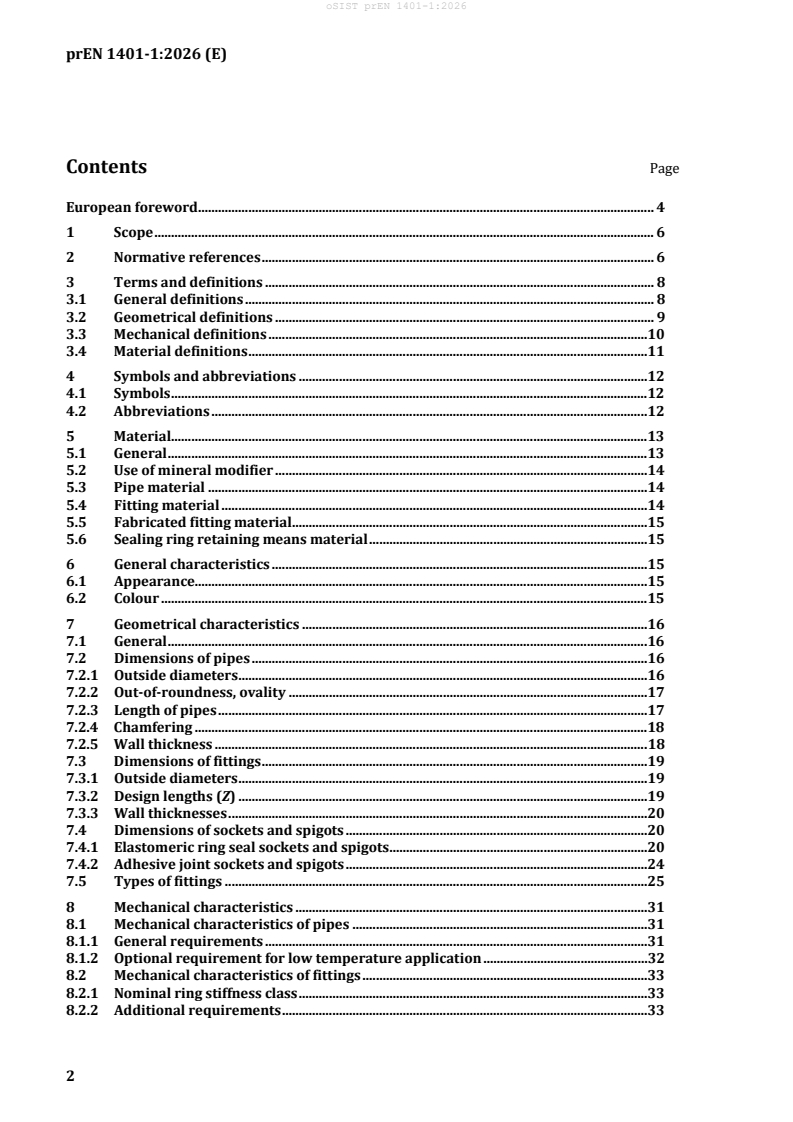
Contents Page
European foreword. 4
1 Scope . 6
2 Normative references . 6
3 Terms and definitions . 8
3.1 General definitions . 8
3.2 Geometrical definitions . 9
3.3 Mechanical definitions .10
3.4 Material definitions .11
4 Symbols and abbreviations .12
4.1 Symbols .12
4.2 Abbreviations .12
5 Material .13
5.1 General .13
5.2 Use of mineral modifier .14
5.3 Pipe material .14
5.4 Fitting material .14
5.5 Fabricated fitting material .15
5.6 Sealing ring retaining means material .15
6 General characteristics .15
6.1 Appearance.15
6.2 Colour .15
7 Geometrical characteristics .16
7.1 General .16
7.2 Dimensions of pipes .16
7.2.1 Outside diameters .16
7.2.2 Out-of-roundness, ovality .17
7.2.3 Length of pipes .17
7.2.4 Chamfering .18
7.2.5 Wall thickness .18
7.3 Dimensions of fittings .19
7.3.1 Outside diameters .19
7.3.2 Design lengths (Z) .19
7.3.3 Wall thicknesses .20
7.4 Dimensions of sockets and spigots .20
7.4.1 Elastomeric ring seal sockets and spigots .20
7.4.2 Adhesive joint sockets and spigots .24
7.5 Types of fittings .25
8 Mechanical characteristics .31
8.1 Mechanical characteristics of pipes .31
8.1.1 General requirements .31
8.1.2 Optional requirement for low temperature application .32
8.2 Mechanical characteristics of fittings .33
8.2.1 Nominal ring stiffness class .33
8.2.2 Additional requirements .33
9 Physical characteristics . 34
9.1 Physical characteristics of pipes . 34
9.2 Physical characteristics of fittings . 36
10 Performance requirements . 36
11 Sealing rings . 37
12 Adhesives . 37
13 Marking . 38
13.1 General . 38
13.2 Marking process . 38
13.3 Size . 38
13.4 Minimum required marking of pipes . 38
13.5 Minimum required marking of fittings . 39
13.6 Additional marking . 39
Annex A (normative) Utilization of Recyclates . 40
Annex B (informative) General characteristics of PVC-U pipes and fittings . 42
Annex C (informative) Product standards of components that can be connected to
components conforming to this document . 44
Bibliography . 46
European foreword
This document (prEN 1401-1:2026) has been prepared by Technical Committee CEN/TC 155 “Plastics
piping systems and ducting systems”, the secretariat of which is held by NEN.
This document is currently submitted to CEN Enquiry.
This document will supersede EN 1401-1:2019+A1:2023.
This revision of the EN 1401 series is proposed by CEN/TC155/WG13 members in order to improve
the “level of sustainability” and the “environmental impact” of PVC piping systems, whilst improving
the recommendations and safe use of recycled material.
EN 1401-1:2019+A1:2023:
a) clarified of products covered (Clause 1);
b) updated normative references;
c) updated definitions (3.1 General definitions, 3.2 Geometrical definitions, 3.3 Mechanical
definitions, 3.4 Material definitions) and symbols;
d) updated material clause (5.1 general) and deleted sub Clause 5.6 Utilization of non-virgin
material);
e) updated general characteristics (sub Clause 6.1 Appearance);
f) updated geometrical characteristics (for pipes 7.2.5 Wall thickness and for fittings, 7.3.3 Wall
thickness, 7.3.2 Design lengths (Z)), 7.4.1 Elastomeric ring seal sockets and spigots, 7.4.2 Adhesive
joint sockets and spigots and 7.5 Types of fittings including new drawings for Figures 9, 10 and
11;
g) updated mechanical characteristics sub Clause 8.1.2 Optional and Table 12, sub Clause 8.2.2
Additional requirements and Table 13;
h) updated physical characteristics on Tables 14 and 15;
i) updated performance requirements on Table 16;
j) adhesives, clarified that the adhesive for jointing of PVC-U shall be solvent cement and shall be as
specified by the manufacturer;
k) updated marking;
l) completed review of Annex A concerning the use of recyclates (aligned with FprEN 1329-1:2025);
m) updated Annex B – general material characteristics for material;
n) updated Annex C.
This document is a System Standard for plastics piping systems of a particular material for a specified
application. There are a number of such System Standards, see Annex C.
System Standards are based on the results of the work undertaken in ISO/TC 138 “Plastics pipes,
fittings and valves for the transport of fluids”, which is a Technical Committee of the International
Organization for Standardization (ISO).
System Standards are supported by separate standards on test methods to which references are made
throughout the System Standard.
System Standards are consistent with general standards on functional requirements and on
recommended practice for installation.
prEN 1401:2025 consists of the following parts, under the general title Plastics piping systems for non-
pressure underground drains and sewers — Unplasticized poly(vinyl chloride) (PVC-U):
— Part 1: Specifications for pipes, fittings and the system (this document);
— Part 2: Assessment of conformity (CEN/TS).
For guidance for installation, see CEN/TS 1046, and for guidance for design, see
CEN/TS 15223:2025[15].
1 Scope
This document specifies the definitions and requirements for solid wall pipes with smooth internal
and external surfaces, extruded from the same formulation throughout the wall, fittings and the system
of unplasticized poly(vinyl chloride) (PVC-U) piping systems in the field of non-pressure underground
drains and sewers for wastewater.
NOTE 1 Products complying with this document can also be used in non-pressure underground drains and
sewers for surface water.
This document also specifies test methods and test parameters.
This document is applicable to:
— solid wall pipes and fittings which are intended to be used buried underground outside the
building structure reflected in the marking of the products by “U”, and
— solid wall pipes and fittings which are intended to be used buried underground both outside
(application area code “U”) and within the building structure reflecting on the marking of products
by “UD”.
NOTE 2 Multilayer pipes with different formulations throughout the wall and foamed core pipes are covered
by EN 13476-2 [1].
This document covers a range of pipe and fitting sizes, stiffness classes, and gives recommendations
concerning colours.
NOTE 3 It is the responsibility of the purchaser or specifier to make the appropriate selection from these
aspects, taking into account their particular requirements and any relevant national regulations and installation
practices or codes.
[7]
In conjunction with CEN/TS 1401-2 it is applicable to PVC-U pipes and fittings, their joints and to
joints with components of other plastics and non-plastics materials intended for buried piping systems
for non-pressure underground drains and sewers.
NOTE 4 Pipes, fittings and other components conforming to any of the plastics product standards listed in
Annex C can be used with pipes and fittings conforming to this document, provided they conform to the
requirements for joint dimensions given in Clause 10 and to the requirements of Table 16.
2 Normative references
The following documents are referred to in the text in such a way that some or all of their content
constitutes requirements of this document. For dated references, only the edition cited applies. For
undated references, the latest edition of the referenced document (including any amendments)
applies.
EN 681-1, Elastomeric seals - Materials requirements for pipe joint seals used in water and drainage
applications - Part 1: Vulcanized rubber
EN 681-2, Elastomeric Seals - Materials requirements for pipe joint seals used in water and drainage
applications - Part 2: Thermoplastic elastomers
EN 14680, Adhesives for non-pressure thermoplastics piping systems - Specifications
EN 15346:2024, Plastics — Recycled plastics — Characterization of poly(vinyl chloride) (PVC) recyclates
EN ISO 472:2013, Plastics - Vocabulary (ISO 472:2013)
EN ISO 527-2, Plastics - Determination of tensile properties - Part 2: Test conditions for moulding and
extrusion plastics (ISO 527-2)
EN ISO 580, Plastics piping and ducting systems - Injection-moulded thermoplastics fittings - Methods for
visually assessing the effects of heating (ISO 580)
EN ISO 1043-1:2011, Plastics - Symbols and abbreviated terms - Part 1: Basic polymers and their special
characteristics (ISO 1043-1:2011)
EN ISO 1158, Plastics - Vinyl chloride homopolymers and copolymers - Determination of chlorine content
(ISO 1158)
EN ISO 1167-1:2006, Thermoplastics pipes, fittings and assemblies for the conveyance of fluids -
Determination of the resistance to internal pressure - Part 1: General method (ISO 1167-1:2006)
EN ISO 1167-2, Thermoplastics pipes, fittings and assemblies for the conveyance of fluids - Determination
of the resistance to internal pressure - Part 2: Preparation of pipe test pieces (ISO 1167-2)
EN ISO 1183-1, Plastics - Methods for determining the density of non-cellular plastics - Part 1: Immersion
method, liquid pycnometer method and titration method (ISO 1183-1)
EN ISO 2505, Thermoplastics pipes - Longitudinal reversion - Test method and parameters (ISO 2505)
prEN ISO 2507:2025, Thermoplastics pipes and fittings — Vicat softening temperature: General test
method and test conditions for Vinyl chloride - based (PVC-U, PVC-C, PVC-Hi) and Acryl nitrile - based
(ABS, ASA) pipes and fittings (ISO/DIS 2507:2025)EN ISO 3126, Plastics piping systems — Plastics
components — Determination of dimensions (ISO 3126)
EN ISO 3127, Thermoplastics pipes - Determination of resistance to external blows - Round-the-clock
method (ISO 3127)
EN ISO 3451-5, Plastics - Determination of ash - Part 5: Poly(vinyl chloride) (ISO 3451-5)
EN ISO 6259-1, Thermoplastics pipes - Determination of tensile properties - Part 1: General test method
(ISO 6259-1)
EN ISO 6259-2, Thermoplastics pipes - Determination of tensile properties - Part 2: Pipes made of
unplasticized poly(vinyl chloride) (PVC-U), oriented unplasticized poly(vinyl chloride (PVC-O),
chlorinated poly (vinyl chloride) (PVC-C) and high-impact poly (vinyl chloride) (PVC-HI) (ISO 6259-2)
EN ISO 9852, Unplasticized poly(vinyl chloride) (PVC-U) pipes - Dichloromethane resistance at specified
temperature (DCMT) - Test method (ISO 9852)
EN ISO 9969, Thermoplastics pipes - Determination of ring stiffness (ISO 9969)
EN ISO 11173, Thermoplastics pipes - Determination of resistance to external blows - Staircase method
(ISO 11173)
EN ISO 13254, Thermoplastics piping systems for non-pressure applications - Test method for
watertightness (ISO 13254)
EN ISO 13257:2018, Thermoplastics piping systems for non-pressure applications - Test method for
resistance to elevated temperature cycling (ISO 13257:2018)
EN ISO 13259, Thermoplastics piping systems for underground non-pressure applications - Test method
for leaktightness of elastomeric sealing ring type joints (ISO 13259)
EN ISO 13263, Thermoplastics piping systems for non-pressure underground drainage and sewerage -
Thermoplastics fittings - Test method for impact strength (ISO 13263)
EN ISO 13264, Thermoplastics piping systems for non-pressure underground drainage and sewerage -
Thermoplastics fittings - Test method for mechanical strength or flexibility of fabricated fittings
(ISO 13264)
ISO 306, Plastics — Thermoplastic materials — Determination of Vicat softening temperature (VST)
ISO 18373-1, Rigid PVC pipes — Differential scanning calorimetry (DSC) method — Part 1: Measurement
of the processing temperature
3 Terms and definitions
For the purposes of this document, the terms and definitions given in EN ISO 472:2013 and
EN ISO 1043-1:2011 and the following apply.
ISO and IEC maintain terminology databases for use in standardization at the following addresses:
— IEC Electropedia: available at https://www.electropedia.org/
— ISO Online browsing platform: available at https://www.iso.org/obp
3.1 General definitions
3.1.1
application area code
code used in the marking of pipes and fittings to indicate the application area(s) for which they are
intended, as follows:
— U: for the area more than 1 m from the building to which the buried piping system is connected;
— UD: for application area U and the area under and within 1 m from the building where the pipes
and the fittings are buried in ground and are connected to the soil and waste discharge system of the
building
3.1.2
solid wall pipe and fitting
pipe or fitting with smooth internal and external surface with the same formulation through the wall
Note 1 to entry: Pipes having more than one layer are considered as solid wall pipes, provided they are all made
from the same formulation
3.1.3
fabricated fitting
fitting produced by welding, thermoforming or adhesive joint from pipes and/or from injection-
moulded fittings
3.1.4
drain
pipeline, usually underground, designed to carry wastewater from a source to a sewer
[SOURCE: EN 16323:2014, 2.2.3.1]
3.1.5
sewer
pipeline or other construction, usually underground, design to carry wastewater from more than one
source
[SOURCE: EN 16323:2014, 2.2.3.12]
3.1.6
wastewater
water composed of any combination of water discharged from domestic, industrial or commercial
premises, surface run-off and accidentally any sewer infiltration water
[SOURCE: EN 16323:2014, 2.3.10.65, modified – sewage (deprecated) deleted]
3.1.7
surface water
water from precipitation, which has not seeped into the ground and is discharged to the drain or sewer
system directly from the ground or from exterior building surfaces
[SOURCE: EN 16323:2014, 2.1.1.3]
3.2 Geometrical definitions
3.2.1
nominal size
DN
numerical designation of the size of a component, which is a convenient round number approximately
equal to the manufacturing dimension
Note 1 to entry: Nominal size is expressed in millimetres (mm).
Note 2 to entry: This designation is not used for threaded components.
3.2.2
nominal size
DN/OD
nominal size, related to the outside diameter
3.2.3
nominal diameter
d
n
specified diameter, assigned to a nominal size
Note to entry: It is expressed in millimetres (mm)
3.2.4
outside diameter
d
e
value of the measurement of the outside diameter through its cross-section at any point of a pipe or
spigot end, rounded up to the nearest 0,1 mm
3.2.5
mean outside diameter
d
em
value of the measurement of the outer circumference of a pipe or spigot end of a fitting in any cross
section, divided by π (≈ 3,142), rounded to the nearest 0,1 mm
3.2.6
mean inside diameter of a socket
d
sm
arithmetical mean of a number of measurements of the inside diameter of a socket in the same cross-
section
3.2.7
out-of-roundness, ovality
difference between the measured maximum and the measured minimum outside diameter in the same
cross section of a component
3.2.8
nominal wall thickness
e
n
numerical designation of the wall thickness of a component which is identical to the minimum
permissible wall thickness at any point
3.2.9
wall thickness
e
value of measurement of the wall thickness at any point around the circumference of a component
3.2.10
mean wall thickness
e
m
arithmetical mean of a number of measurements of the wall thickness, regularly spaced around the
circumference and in the same cross section of a component, including the measured minimum and
the measured maximum values of the wall thickness in that cross section
3.2.11
standard dimension ratio
SDR
numerical designation of a pipe series, which is a convenient round number, approximately equal to
the dimension ratio of the nominal outside diameter, d , and the nominal wall thickness, e
n n
3.3 Mechanical definitions
3.3.1
pipe stiffness
mechanical characteristic of a pipe, which is a measure of the resistance to diametric (ring) deflection
under an external force as determined in accordance with EN ISO 9969
3.3.2
fitting stiffness
mechanical characteristic of a fitting which is a measure of the resistance to diametric (ring) deflection
under an external force as determined in accordance with EN ISO 13967 [8]
3.3.3
nominal ring stiffness class
SN
numerical designation of the ring stiffness of the pipe or fitting which is a convenient round number,
indicating the minimum required ring stiffness of the pipe or stiffness of the fitting
3.4 Material definitions
3.4.1
virgin material
plastics material in the form of pellets, granules, powder, floc, etc. that has not been subjected to use
or processing other than that required for its initial manufacture
Note 1 to entry: Does not contain any reworked plastics material and/or plastics recyclates.
Note 2 to entry: Sometimes also referred to as “primary material” or “primary plastics feedstock”.
Note 3 to entry: It is understood that the addition of additives such as stabilizers and pigments is still resulting
into a virgin (plastics) material.
[18]
[SOURCE: EN 14541-1:2022 ]
3.4.2
reworked material
plastics material from rejected unused products or trimmings capable of being reclaimed within the
same process that generated it
Note 1 to entry: Reworked material does not change the status of the feedstock.
Note 2 to entry: This definition does not cover the conditions for the use of reworked material, which can be
found in the applicable product standard
Note 3 to entry: Previously referred to as “own reprocessed material”
[18]
[SOURCE: EN 14541-1:2022 ]
3.4.3
recyclate
plastics material resulting from the recycling of pre-consumer and post-consumer plastics products
Note 1 to entry: Also referred to as “secondary raw material” or “recycled plastics” or “regenerate”.
Note 2 to entry: Recycling can be chemical, physical or mechanical.
[18]
[SOURCE: EN 14541-1:2022 ]
3.4.4
formulation
clearly defined homogenous mixture of substances used for the manufacture of the product
Note 1 to entry: For metals and when dealing with water and food contact regulations the term “composition”
is often used instead of formulation.
[18]
[SOURCE: EN 14541-1:2022 , term compound is deleted and note 1 is deleted]
3.4.5
agreed specification
specification of the relevant material characteristics agreed between the supplier of the recyclate and
the pipe and/or fitting manufacturer
Note 1 to entry: The agreed specification is often considered in the context of certification by a third party
organization.
[18]
[SOURCE: EN 14541-1:2022 ]
4 Symbols and abbreviations
4.1 Symbols
A length of engagement
a circumferential side cover of a saddle branch
c
Α nominal angle of a fitting
C depth of sealing zone
d outside diameter
e
d mean outside diameter
em
d nominal outside diameter
n
d inside diameter of a socket
s
d mean inside diameter of a socket
sm
E wall thickness
e nominal wall thickness
n
e mean wall thickness
m
e minimum wall thickness
min
e wall thickness of a socket
e wall thickness in the groove area
H length of chamfer
L axial cover of a saddle branch
L length of spigot
L length of adhesive joint socket
L effective length of a pipe
M length of spigot of a plug
R radius of swept fittings
Z design length of a fitting
α nominal angle of fitting
4.2 Abbreviations
DN nominal size
DN/OD nominal size, outside diameter related
PVC-U unplasticized poly(vinyl chloride)
SDR standard dimension ratio
SN nominal ring stiffness class
TIR true impact rate
5 Material
5.1 General
The formulation for production of pipes and fittings shall be PVC-U material to which additives are
added to enable conformity with the requirements of this document.
The dosage level of each ingredient of the formulation shall be specified by the manufacturer as part
of the quality documentation.
Conformity of the product (pipes, fittings or the system as applicable) with all the requirements of this
document shall be demonstrated. PVC-U material may be virgin material, reworked material or
recyclates (pre- or post-consumer).
The formulation (including virgin material, reworked material, recyclates or a mixture, if applicable)
shall comply with the requirements given in Table 1 and in 5.3 for pipes and 5.4 for fittings.
Table 1 — Requirements applicable for the formulation
Characteristics Requirements Test method
a b
PVC content for pipes ≥ 80 % by mass Calculation or EN ISO 1158
c
or EN ISO 3451-5, Method A
PVC content for ≥ 85 % by mass
injection-moulded
fittings
3 3
Density 1 350 kg/m ≤ density ≤ 1 600 kg/m
a
A reduction of the PVC content to ≥ 75 % by mass is permitted for pipes only, provided the PVC is
substituted by CaCO , see subclause 5.2
b
The PVC content is equal to (mcl/56,8) x 100, where mcl is the chlorine content expressed as a percentage
by mass in accordance with EN ISO 1158.
c
The measurement of filler content by ash rest is an alternative to the measurement of PVC content and is
recommended when external reprocessed and/or recycled material is used. This measurement should be
conducted at 950°C. In case of dispute, EN ISO 1158 applies.
Recyclates are permitted if they comply with Annex A.
The minimum and maximum amounts of recyclate in the formulation shall be specified by the
manufacturer and the conformity with all the requirements of this document shall be demonstrated
by testing the product:
— with no or minimum recyclate content, and
— with maximum recyclate content.
NOTE 1 Formulations with recyclate content between minimum and maximum are deemed to comply as
well.
The quantity of recyclates that is added in each production batch shall be recorded by the
manufacturer.
NOTE 2 The total recyclate content in the formulation is the sum of the recyclate added and the recyclate
present in reworked material.
NOTE 3 Additional information on general characteristics of PVC-U pipes and fittings is given in Annex B.
5.2 Use of mineral modifier
A reduction of the PVC content to ≥ 75 % by mass is permitted for pipes only provided the PVC is
substituted by coated or uncoated CaCO conforming to the following:
a) The composition of the CaCO , before coating if any, shall conform to the following:
1) content of CaCO ≥ 96 % by mass;
2) content of MgCO ≤ 4 % by mass;
3) content of CaCO and MgCO in total ≥ 98 % by mass.
3 3
b) The physical properties of the material shall conform to the following:
4) mean particle size D50 ≤ 2,5 μm;
5) top cut D98 ≤ 20 μm.
5.3 Pipe material
When tested in accordance with the test methods as specified in Table 2, using the indicated
parameters, the pipe formulation shall have characteristics conforming to the requirement given.
The pipe formulation shall be tested in the form of a pipe.
Table 2 — Formulation characteristics of pipes
Characteristic Requirements Test parameters Test method
a
Resistance to No failure End caps Type A or B EN ISO 1167-1:2006
internal during the test and
Test temperature 60 °C
pressure period EN ISO 1167-2:2006
Orientation Free
Number of test
pieces
Circumferential
10 MPa
(hoop) stress
Conditioning
1 h
period
Type of test Water-in-water
Test period 1 000 h
a
Pressure shall be calculated according to EN ISO 1167-1:2006, 7.2 (measured dimensions of the test piece).
5.4 Fitting material
When tested in accordance with the test methods as specified in Table 3, using the indicated
parameters, the fitting formulation shall have characteristics conforming to the requirement given.
The fitting formulation shall be tested in the form of an extruded or injection-moulded pipe.
Table 3 — Formulation characteristics of fittings
Characteristic Requirements Test parameters Test method
a
Resistance to No failure End caps Type A or B
EN ISO 1167-1:2006
internal during the test conforming to
and
pressure period EN ISO 1167-1:2006
EN ISO 1167-2:2006
Dimensions 50 mm ≤ d ≤ 110 mm
n
3 mm ≤ e ≤ 5 mm
Free length for
injection-moulded ≥ 140 mm
pipe
Test temperature 60 °C
Orientation Free
Number of test pieces 3
Circumferential
6,3 MPa
(hoop) stress
Conditioning period 1 h
Type of test Water-in-water
Test period 1 000 h
a
Pressure shall be calculated according to EN ISO 1167-1:2006, 7.2 (measured dimensions of the test piece).
5.5 Fabricated fitting material
Fabricated fittings shall be made from parts of pipes and/or injection moulded fittings conforming to
this document.
5.6 Sealing ring retaining means material
Sealing rings may be retained using means made from polymers other than PVC-U, provided the joints
conform to the requirements given in Clause 10.
6 General characteristics
6.1 Appearance
When viewed without magnification, the following requirements apply:
— internal and external surfaces of pipes and fittings shall be smooth, clean and free from defects
likely to prevent their conformity to this document. The manufacturer shall define acceptance
criteria for visual appearance;
NOTE Examples of defects can be grooving, blistering, impurities or pores.
— pipe ends shall be cleanly cut and the ends of pipes and fittings shall be square to their axis.
6.2 Colour
The pipes and the fittings shall have the same colour through the wall.
1) ®
The recommended colour of pipes and fittings is orange-brown (approximately RAL 8023 ) or
1) ®
dusty grey (approximately RAL 7037 ).
7 Geometrical characteristics
7.1 General
Dimensions shall be measured in accordance with EN ISO 3126.
NOTE All figures in this document are schematic sketches only, to indicate the relevant dimensions. They
do not necessarily represent the manufactured components.
7.2 Dimensions of pipes
7.2.1 Outside diameters
The mean outside diameter, d , shall conform to Table 5.
em
® [3]
1) According to RAL 840-HR, Colour register .
Table 5 — Mean outside diameters
Dimensions in millimetres
Nominal size Nominal outside Mean outside diameter
diameter
DN/OD d d d
n em,min em,max
110 110 110,0 110,3
125 125 125,0 125,3
160 160 160,0 160,4
200 200 200,0 200,5
250 250 250,0 250,5
315 315 315,0 315,6
355 355 355,0 355,7
400 400 400,0 400,7
450 450 450,0 450,8
500 500 500,0 500,9
630 630 630,0 631,1
710 710 710,0 711,2
800 800 800,0 801,3
900 900 900,0 901,5
1 000 1 000 1 000,0 1 001,6
7.2.2 Out-of-roundness, ovality
The out-of-roundness, ovality, measured directly after production, shall be less than or equal to
0,024 d .
n
7.2.3 Length of pipes
The effective length of a pipe, l, shall be not less than that declared by the manufacturer when
measured as shown in Figure 1.
Figure 1 — Effective length of pipes
7.2.4 Chamfering
If a chamfer is applied, the angle of chamfering shall be between 15° and 45° to the axis of the pipe (see
Figure 2 and Table 7 or Figure 6 and Table 9, as applicable).
The remaining wall thickness of the end of the pipe shall be at least ∕ of e .
3 min
7.2.5 Wall thickness
The wall thickness, e, shall conform to Table 6, where a maximum wall thickness at any point up to
1,2 e is permitted provided that the mean wall thickness, e , is less than or equal to the specified
min m
e .
m,max
For DN 200 and greater a reduction of e up to 5 % is permitted, provided e is equal or exceeds the
min m
values of e given in Table 6. In such case, the ring stiffness shall be measured according to
min
EN ISO 9969 and shall be greater than or equal to the nominal value.
For the calculation of the pipe stiffness the values of e as given in Table 6 should be used.
min
Table 6 — Wall thicknesses
Dimensions in millimetres
SN 2 SN 4 SN 8 SN 16
a
Nominal SDR 51 SDR 41 SDR 34 SDR 27,6
size
DN/OD e e e e e e e e
min m,max min m,max min m,max min m,max
b
110 — — 3,2 3,8 3,2 3,8 4,0 4,6
b
125 — — 3,2 3,8 3,7 4,3 4,6 5,3
160 3,2 3,8 4,0 4,6 4,7 5,4 5,8 6,6
200 3,9 4,5 4,9 5,6 5,9 6,7 7,3 8,3
250 4,9 5,6 6,2 7,1 7,3 8,3 9,1 10,3
315 6,2 7,1 7,7 8,7 9,2 10,4 11,4 12,8
355 7,0 7,9 8,7 9,8 10,4 11,7 12,9 14,4
400 7,9 8,9 9,8 11,0 11,7 13,1 14,5 16,2
450 8,8 9,9 11,0 12,3 13,2 14,8 16,3 18,2
500 9,8 11,0 12,3 13,8 14,6 16,3 18,1 20,2
630 12,3 13,8 15,4 17,2 18,4 20,5 22,8 25,3
710 13,9 15,5 17,4 19,4 20,8 23,2 25,7 28,5
800 15,7 17,5 19,6 21,8 23,4 27,0 29,0 32,1
900 17,6 19,6 22,0 24,4 26,3 30,3 32,6 36,1
1 000 19,6 21,8 24,5 27,2 29,2 33,6 36,2 40,1
NOTE The tolerances for wall thickness conform to ISO 11922-1 [4], Grade W.
a
SDR 51 is applicable for application area code “U” only.
b
These values are based on experience.
7.3 Dimensions of fittings
7.3.1 Outside diameters
The mean outside diameter, d , of the spigot shall conform to Table 5.
em
The out-of-roundness, ovality, shall conform to the requirements given in 7.2.2.
7.3.2 Design lengths (Z)
The design lengths, Z, shall be declared by the manufacturer.
NOTE The design lengths (see the dimensions Z in Figures 7 to 10 and Figures 12 to 17) are intended to
[
5] can be
assist in the design of moulds and are not intended to be used for quality control purposes. ISO 265-1
used as a guideline.
7.3.3 Wall thicknesses
The minimum wall thickness, e , of the body or the spigot of a fitting shall conform to Table 6, except
min
that a reduction of 5 % resulting from core shift is permitted. In such a case, the mean of two opposite
wall thicknesses shall be equal to or exceed the values given in this table.
Where a fitting or adaptor provides for a transition between two nominal sizes, the wall thickness of
each connecting part shall conform to the requirements for the applicable nominal size. In such a case,
the wall thickness of the fitting body is permitted to change gradually from the one wall thickness to
the other.
The wall thickness of the cover of a saddle branch (see Figure 17) shall be equal to or greater than e
min
of the applicable size and series (see Table 6) of the inlet.
The wall thickness of fabricated fittings, except for spigot and socket, may be changed locally by the
fabrication process, providing that the minimum wall thickness of the body conforms to e , as given
3,min
in Table 8, as appropriate for the SDR concerned.
7.4 Dimensions of sockets and spigots
7.4.1 Elastomeric ring seal sockets and spigots
7.4.1.1 Diameters and lengths
The diameters and lengths of elastomeric ring seal sockets and spigots shall conform to Table 7, except
dimension “H” which is informative (see Figures 2, 3 or 4, as applicable).
Where sealing rings are firmly retained, the dimensions for the minimum value for A and the maximum
value for C shall be measured to the effective sealing point (see Figure 4) as specified by the
manufacturer. This point shall give a full sealing action.
Different designs of elastomeric ring seal sockets and spigots are permitted, provided the joints
conform to the requirements given in Table 16.
Table 7 — Socket diameters and lengths of sockets and spigots
Dimensions in millimetres
Nominal size Socket Spigot
a b a c
DN/OD d A C L H M
sm,min min max 1,min min
110 110,4 32 26 60 6 36
125 125,4 35 26 67 6 36
160 160,5 42 32 81 7 42
200 200,6 50 40 99 9 50
250 250,8 55 70 125 9 80
315 316,0 62 70 132 12 80
355 356,1 66 70 136 13 80
400 401,2 70 80 150 15 90
450 451,4 75 80 155 17 90
500 501,5 80 80 160 18 90
630 631,9 93 95 188 23 105
710 712,1 101 109 210 28 119
800 802,4 110 110 220 32 120
900 902,7 120 125 245 36 135
1 000 1 003,0 130 140 270 41 150
a
Higher values for C are allowed, provided the manufacturer states in his documentation the
actual required L1,min according to the formula L1,min = Amin + C and the actual required Mmin for plugs
according to the formula Mmin = C + 10.
b
Approximate values, when a 15 ° chamfer is appl
...