


EN 792-10:2000
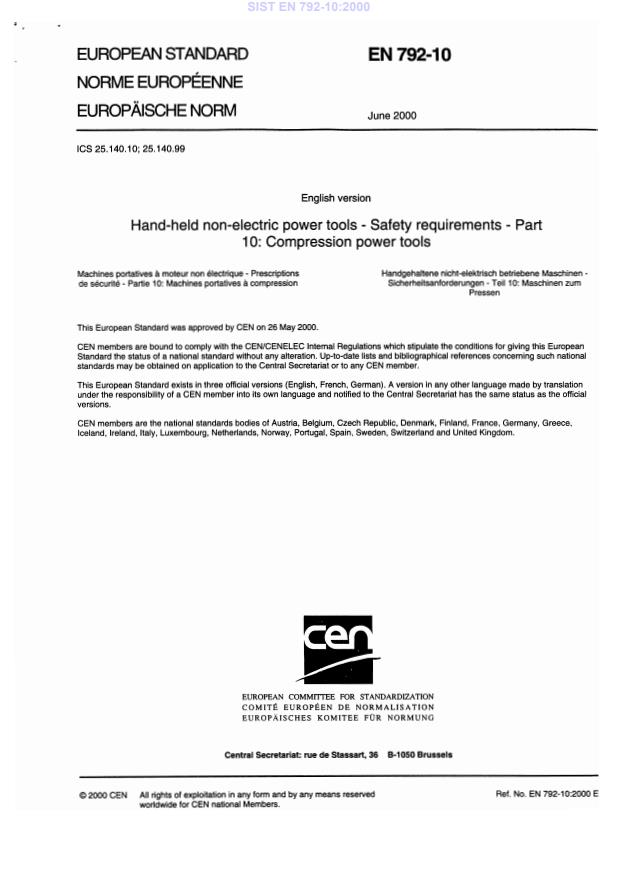
(Main)Hand-held non-electric power tools - Safety requirements - Part 10: Compression power tools
Hand-held non-electric power tools - Safety requirements - Part 10: Compression power tools
The standard EN 792 applies to non-electric hand-held power tools driven by rotary or linear motors, powered by compressed air, hydraulic fluid and intended to be used by one operator and supported by: - the operator's hand or hands; - a suspension, e.g. a balancer. This Part, EN 792-10, applies to hand-held non-electric compression power tools with yoke, e.g. for squeeze riveting, punching, shaping, pressing and cutting of metal, plastics or other materials.
Handgehaltene nicht-elektrisch betriebene Maschinen - Sicherheitsanforderungen - Teil 10: Maschinen zum Pressen
Die Norm EN 792 gilt für handgehaltene nicht-elektrisch betriebene Maschinen, die durch Motore mit drehender oder linearer Bewegung angetrieben werden, wobei die Energie aus Druckluft oder über Hydraulikflüssigkeit bezogen werden kann. Die Maschinen sind dazu bestimmt, durch eine Person verwendet und - mit einer oder beiden Händen gehalten, - in einer Halterung, z.B. Aufhängevorrichtung, aufgenommen zu werden.
Machines portatives à moteur non électrique - Prescriptions de sécurité - Partie 10: Machines portatives à compression
La norme EN 792 s'applique aux machines portatives non électriques entraînées par des moteurs rotatifs ou linéaires, alimentés par air comprimé, fluide hydraulique et prévues pour être utilisées par un seul opérateur et portée par: - la ou les main(s) de l'opérateur, - en suspension, p.e. à l'aide d'un équilibreur. Cette, EN 792-10, s'applique aux machines portatives non électriques à compression utilisées pour (squeeze) river, poinçonner, former, presser le métal, la matière plastique ou d'autres matériaux.
Hand-held non-electric power tools - Safety requirements - Part 10: Compression power tools
General Information
- Status
- Withdrawn
- Publication Date
- 20-Jun-2000
- Withdrawal Date
- 23-Sep-2008
- Technical Committee
- CEN/TC 255 - Hand-held, non-electric power tools - Safety
- Drafting Committee
- CEN/TC 255 - Hand-held, non-electric power tools - Safety
- Current Stage
- 9960 - Withdrawal effective - Withdrawal
- Start Date
- 24-Sep-2008
- Completion Date
- 24-Sep-2008
- Directive
- 98/37/EC - Machinery
Relations
- Effective Date
- 19-Jan-2023

Get Certified
Connect with accredited certification bodies for this standard

National Aerospace and Defense Contractors Accreditation Program (NADCAP)
Global cooperative program for special process quality in aerospace.
CARES (UK Certification Authority for Reinforcing Steels)
UK certification for reinforcing steels and construction.
DVS-ZERT GmbH
German welding certification society.
Sponsored listings
Frequently Asked Questions
EN 792-10:2000 is a standard published by the European Committee for Standardization (CEN). Its full title is "Hand-held non-electric power tools - Safety requirements - Part 10: Compression power tools". This standard covers: The standard EN 792 applies to non-electric hand-held power tools driven by rotary or linear motors, powered by compressed air, hydraulic fluid and intended to be used by one operator and supported by: - the operator's hand or hands; - a suspension, e.g. a balancer. This Part, EN 792-10, applies to hand-held non-electric compression power tools with yoke, e.g. for squeeze riveting, punching, shaping, pressing and cutting of metal, plastics or other materials.
The standard EN 792 applies to non-electric hand-held power tools driven by rotary or linear motors, powered by compressed air, hydraulic fluid and intended to be used by one operator and supported by: - the operator's hand or hands; - a suspension, e.g. a balancer. This Part, EN 792-10, applies to hand-held non-electric compression power tools with yoke, e.g. for squeeze riveting, punching, shaping, pressing and cutting of metal, plastics or other materials.
EN 792-10:2000 is classified under the following ICS (International Classification for Standards) categories: 25.140.10 - Pneumatic tools; 25.140.99 - Other hand-held tools. The ICS classification helps identify the subject area and facilitates finding related standards.
EN 792-10:2000 has the following relationships with other standards: It is inter standard links to EN 792-10:2000+A1:2008. Understanding these relationships helps ensure you are using the most current and applicable version of the standard.
EN 792-10:2000 is associated with the following European legislation: EU Directives/Regulations: 98/37/EC; Standardization Mandates: M/BC/CEN/88/13. When a standard is cited in the Official Journal of the European Union, products manufactured in conformity with it benefit from a presumption of conformity with the essential requirements of the corresponding EU directive or regulation.
EN 792-10:2000 is available in PDF format for immediate download after purchase. The document can be added to your cart and obtained through the secure checkout process. Digital delivery ensures instant access to the complete standard document.
Standards Content (Sample)
2003-01.Slovenski inštitut za standardizacijo. Razmnoževanje celote ali delov tega standarda ni dovoljeno.Hand-held non-electric power tools - Safety requirements - Part 10: Compression power toolsHandgehaltene nicht-elektrisch betriebene Maschinen - Sicherheitsanforderungen - Teil 10: Maschinen zum PressenMachines portatives a moteur non électrique - Prescriptions de sécurité - Partie 10: Machines portatives a compressionHand-held non-electric power tools - Safety requirements - Part 10: Compression power tools25.140.10Pneumatic toolsICS:Ta slov
...
Questions, Comments and Discussion
Ask us and Technical Secretary will try to provide an answer. You can facilitate discussion about the standard in here.
Loading comments...