

FprEN 14453
(Main)Devices to prevent pollution by backflow of potable water - Pipe interrupter with permanent atmospheric vent DN 10 to DN 20 - Family D, type C
- Abstract
This document specifies the field of application, the dimensional, the physico-chemical properties and the properties of general hydraulic, mechanical and acoustic design of pipe interrupters with permanent atmospheric vent family D Type C, intended to prevent pollution of potable water by backflow, caused by backsiphoning only.
It is applicable to pipe interrupters with permanent atmospheric vent in denominations DN 10 up to DN 20.
It covers pipe interrupters with permanent atmospheric vent of PN 10 that are capable of working without modification or adjustment:
- at any pressure, up to 1 MPa (10 bar);
- with any pressure variation, up to 1 MPa (10 bar);
- in permanent duty at a limited temperature of 65 °C and for maximum 1 h at 90 °C.
It specifies also the test methods and requirements for verifying their characteristics, the marking and the presentation at delivery.
Backflow protection devices integrated in flushing valves are similar to DC and are not covered under this document. The requirements are stated in EN 12541.
- Status
- Not Published
- Publication Date
- 24-Feb-2027
- Technical Committee
- CEN/TC 164 - Water supply
- Current Stage
- 4599 - Dispatch of FV draft to CMC - Finalization for Vote
- Start Date
- 03-Nov-2026
- Due Date
- 16-Sep-2027
- Completion Date
- 16-Sep-2027

FprEN 14453 is a CEN draft European Standard for pipe interrupters with permanent atmospheric vent, family D type C, in DN 10 to DN 20. It specifies the design, materials, dimensions, test methods, marking and delivery information for devices that protect potable water against backflow caused by backsiphoning only.
What does FprEN 14453 specify?
FprEN 14453 specifies the requirements for pipe interrupters with permanent atmospheric vent that are used on potable water installations. It applies to devices in DN 10 to DN 20 and covers how they are identified, built, tested and marked so that users can check whether a product matches the intended application.
The scope is limited to PN 10 devices that can operate without modification or adjustment at pressures up to 1 MPa, with pressure variations up to 1 MPa, and in permanent duty at 65 °C with a maximum of 1 h at 90 °C. The document also excludes backflow protection devices integrated in flushing valves, which are covered by EN 12541.
The document is organized into clauses on scope, normative references, terms and definitions, nominal size, designation, marking and technical documents, graphic symbol, design characteristics, materials and surface finishes, tolerances and measuring accuracy, characteristics and tests, and acoustic characteristics.
| Annex | What it covers |
|---|---|
| Annex A | Sampling and the recommended test sequence |
| Annex B | Pressure take-off tee for the test rig |
What are the key requirements of FprEN 14453?
FprEN 14453 focuses on a small set of practical controls that matter to manufacturers, testers and purchasers: size and connection compatibility, visible marking, safe design of the air inlets, material suitability, performance under pressure and vacuum, and acoustic classification.
Nominal size, designation and marking
Clause 4 links the nominal size of the device to the threaded inlet connection, so DN 10, DN 15 and DN 20 are tied to the corresponding thread sizes. Clause 5 requires the designation to state the name, family, type, nominal size, acoustic group and reference to EN 14453, which helps buyers and specifiers identify the exact product type.
Clause 6 requires permanent and visible marking on the housing or on a fixed plate. The mandatory items include the manufacturer identification, flow direction, nominal size, and family and type; the optional items include the acoustic group and the dezincification resistant marking. In practice, this lets installers verify orientation and product identity on site.
General design and air inlets
Clause 8 requires the connections to comply with EN ISO 228-1 or EN 10226-1, so the device can be matched with the intended threaded installation. The air inlets must be shrouded and made so they are not easily blocked by deposits, because the device works by admitting air to break the siphon effect.
The document also sets dimensional expectations for the air passages and for the separation between the water pipe disconnection and the air inlet. That matters because the air path has to stay open and effective if the device is to prevent backsiphoning reliably.
Materials and surface finish
Clause 9 requires materials and coatings not to contaminate potable water and to be suitable for the temperatures used in the tests. The manufacturer has responsibility for material selection, but must state the nature of the materials and coatings in the technical documents.
Where copper-zinc alloys are used, the document points to dezincification resistance requirements and testing with EN ISO 6509. Clause 9 also requires corrosion resistance in accordance with EN 248. In practice, this means the product must survive water contact and long-term use without unacceptable material damage.
Tolerances, measuring instruments and test media
Clause 10 sets default tolerances for flow rate, pressure, temperature, time and force when a procedure does not give tighter limits. It also requires measuring instruments to have specified accuracy, and it uses water up to 30 °C as the default test medium unless another medium is specified.
For testing, this matters because a manufacturer or laboratory cannot claim compliance from loosely controlled measurements. The clause keeps results comparable from one test rig to another.
Performance tests
Clause 11 covers the main verification tests. Visual verification checks conformity with the drawings and description. The bending moment test applies to every size and connection type and checks whether the body resists mechanical stress without breakage or permanent deformation.
The vacuum test checks the device under suction conditions and sets a pass criterion based on the rise of water in the transparent tube. The flow rate and leakage test measures the flow at a stated pressure difference and then increases pressure in steps to check that no leakage escapes from the air inlet. For the reader, this is the core evidence that the device will function as a backflow protection device under use and fault-like conditions.
Acoustic classification
Clause 12 classifies the device by acoustic group. The test uses EN ISO 3822-1 and EN ISO 3822-4, with the flow pressure adjusted to 0.3 MPa, and the results are expressed as appliance sound level pressures. The device is then assigned to acoustic group I, II, or not classified, which helps specifiers choose products for noise-sensitive installations.
What terms does FprEN 14453 define?
- Pipe interrupter with permanent atmospheric vent - A device that prevents backflow by venting both upstream and downstream elements to the atmosphere through one or more permanently open air inlets.
- Backsiphoning - The backflow condition addressed by this document, where potable water is protected by breaking the siphon effect.
- Nominal size (DN) - The size designation used for the device, tied in this document to the threaded inlet connection.
- Nominal pressure (PN) - The pressure rating used to identify the device class; the scope covers PN 10 devices.
- Acoustic group - The sound classification assigned after the acoustic test in Clause 12.
- Dezincification resistant copper alloy - A copper-zinc alloy required to resist dezincification where such resistance is demanded.
- Appliance sound level pressure, L_AP - The measured noise result used to assign the acoustic group.
Who uses FprEN 14453?
FprEN 14453 is used by manufacturers of backflow prevention devices, test laboratories, and product certification or conformity assessment bodies. It is also relevant to specifiers, installers, and water supply professionals who need to select or install a device that fits a potable water installation.
Quality managers and buyers use it to confirm the product type, connection size, markings, material declarations and test evidence. In practice, it supports procurement checks, type testing, and installation documentation for devices used in water supply systems.
What changed in FprEN 14453 from the previous edition?
FprEN 14453 will supersede EN 14453:2005. The European foreword also states that the document has been developed with reference to EN 1717.
Which standards are used with FprEN 14453?
- EN 1717 - Provides the general framework for protection against pollution of potable water and the installation principles that the technical documents must follow.
- EN 806-1:2000 - Provides general specifications for water installations inside buildings conveying water for human consumption.
- EN 248 - Gives the corrosion resistance requirement used for the device’s surface finish and material performance.
- EN 10226-1 - Covers pressure-tight threaded pipe connections for one of the permitted connection types.
- EN ISO 228-1 - Covers non-pressure-tight threaded pipe connections for the permitted connection type.
- EN ISO 3822-1 - Gives the laboratory method for measuring noise emission.
- EN ISO 3822-4 - Gives the mounting and operating conditions for the acoustic test.
- EN ISO 6509 - Gives the test method for dezincification resistance of brass.
- EN 12541 - Is the cited standard for backflow protection devices integrated in flushing valves, which are outside the scope of this document.
What does the FprEN 14453 document contain?
FprEN 14453 includes the main product definitions, identification rules and installation-related information, plus the test methods used to verify compliance. It contains a graphic symbol for the device and a design principle figure that shows the water flow and air flow directions.
The document also contains tables for nominal size and thread size, bending moment, minimum flow rate and acoustic groups. Annex A gives a sample test sequence, and Annex B gives the pressure take-off tee used in the flow and leakage test rig. These parts are used for design verification, laboratory testing and product assessment rather than for day-to-day operation.
Relations
- Effective Date
- 06-Dec-2025
Get Certified
Connect with accredited certification bodies for this standard

CIS Institut d.o.o.
Personal Protective Equipment (PPE) certification body. Notified Body NB-2890 for EU Regulation 2016/425 PPE.
Institut za varilstvo d.o.o. (Welding Institute)
Slovenia's leading welding institute since 1952. ISO 3834, EN 1090, pressure equipment certification, NDT personnel, welder qualification. Only IIW Au

Kiwa BDA Testing
Building and construction product certification.
Sponsored listings
Frequently Asked Questions
FprEN 14453 is a draft published by the European Committee for Standardization (CEN). Its full title is "Devices to prevent pollution by backflow of potable water - Pipe interrupter with permanent atmospheric vent DN 10 to DN 20 - Family D, type C". This standard covers: This document specifies the field of application, the dimensional, the physico-chemical properties and the properties of general hydraulic, mechanical and acoustic design of pipe interrupters with permanent atmospheric vent family D Type C, intended to prevent pollution of potable water by backflow, caused by backsiphoning only. It is applicable to pipe interrupters with permanent atmospheric vent in denominations DN 10 up to DN 20. It covers pipe interrupters with permanent atmospheric vent of PN 10 that are capable of working without modification or adjustment: - at any pressure, up to 1 MPa (10 bar); - with any pressure variation, up to 1 MPa (10 bar); - in permanent duty at a limited temperature of 65 °C and for maximum 1 h at 90 °C. It specifies also the test methods and requirements for verifying their characteristics, the marking and the presentation at delivery. Backflow protection devices integrated in flushing valves are similar to DC and are not covered under this document. The requirements are stated in EN 12541.
This document specifies the field of application, the dimensional, the physico-chemical properties and the properties of general hydraulic, mechanical and acoustic design of pipe interrupters with permanent atmospheric vent family D Type C, intended to prevent pollution of potable water by backflow, caused by backsiphoning only. It is applicable to pipe interrupters with permanent atmospheric vent in denominations DN 10 up to DN 20. It covers pipe interrupters with permanent atmospheric vent of PN 10 that are capable of working without modification or adjustment: - at any pressure, up to 1 MPa (10 bar); - with any pressure variation, up to 1 MPa (10 bar); - in permanent duty at a limited temperature of 65 °C and for maximum 1 h at 90 °C. It specifies also the test methods and requirements for verifying their characteristics, the marking and the presentation at delivery. Backflow protection devices integrated in flushing valves are similar to DC and are not covered under this document. The requirements are stated in EN 12541.
FprEN 14453 is classified under the following ICS (International Classification for Standards) categories: 13.060.20 - Drinking water; 23.060.50 - Check valves. The ICS classification helps identify the subject area and facilitates finding related standards.
FprEN 14453 has the following relationships with other standards: It is inter standard links to EN 14453:2005. Understanding these relationships helps ensure you are using the most current and applicable version of the standard.
FprEN 14453 is associated with the following European legislation: EU Directives/Regulations: 305/2011. When a standard is cited in the Official Journal of the European Union, products manufactured in conformity with it benefit from a presumption of conformity with the essential requirements of the corresponding EU directive or regulation.
FprEN 14453 is available in PDF format for immediate download after purchase. The document can be added to your cart and obtained through the secure checkout process. Digital delivery ensures instant access to the complete standard document.
Standards Content (Sample)
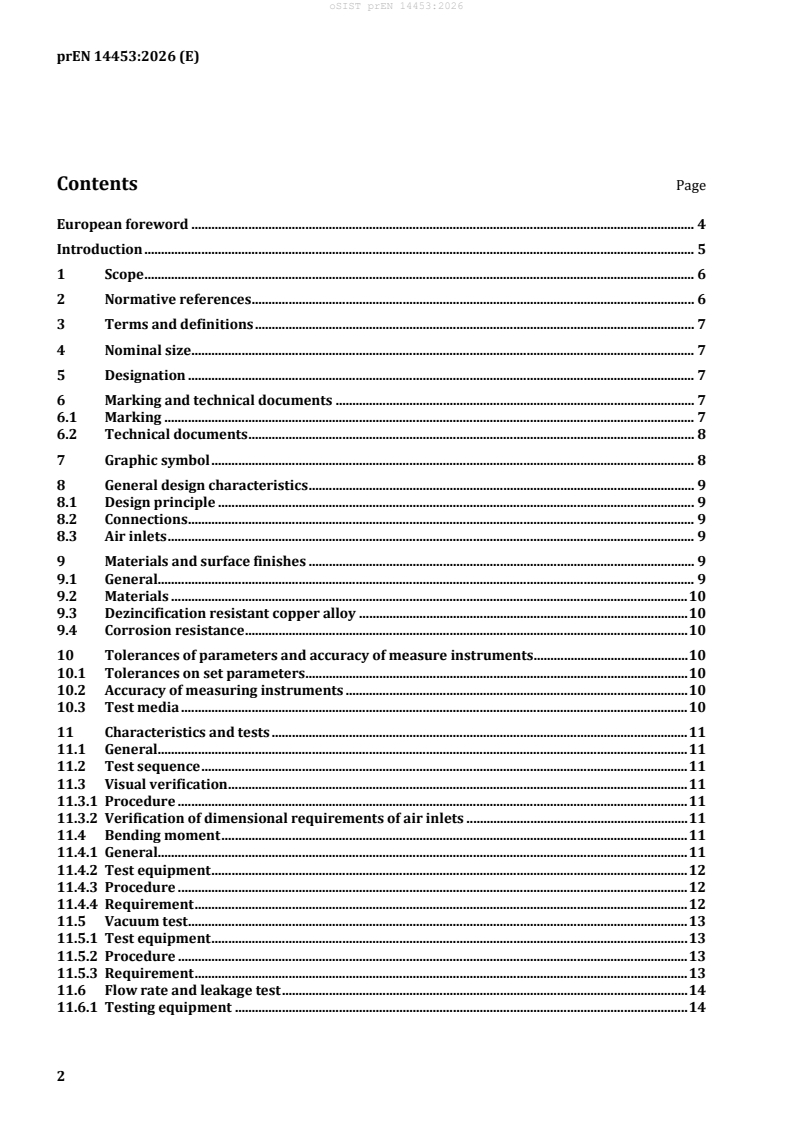
Contents
- Introduction
- 1 Scope
- 2 Normative references
- 3 Terms and definitions
- 3.1 pipe interrupter with permanent atmospheric vent
- 4 Nominal size
- 5 Designation
- 6 Marking and technical documents
- 6.1 Marking
- 6.2 Technical documents
- 7 Graphic symbol
- 8 General design characteristics
- 8.1 Design principle
- 1 Direction of water flow
- 2 Direction of air flow
- 8.2 Connections
- 8.3 Air inlets
- 9 Materials and surface finishes
- 9.1 General
- 9.2 Materials
- 9.3 Dezincification resistant copper alloy
- 9.4 Corrosion resistance
- 10 Tolerances of parameters and accuracy of measure instruments
- 10.1 Tolerances on set parameters
- 10.2 Accuracy of measuring instruments
- 10.3 Test media
- 11 Characteristics and tests
- 11.1 General
- 11.2 Test sequence
- 11.3 Visual verification
- 11.4 Bending moment
- 1 Mounting fixture for test device
- 2 Test device
- 3 Steel pipe
- 11.5 Vacuum test
- 1 Vacuum pump
- 2 Vacuum vessel
- 3 Full-way valve
- 4 Water trap
- 5 Vacuum gauge
- 6 Test device
- 7 Transparent tube
- 8 Measurement scale
- 9 Water reservoir
- 11.6 Flow rate and leakage test
- 1 Needle type valves
- 2 Flow meter
- 3 Stop valves
- 4 Standardized pressure take off (see Annex B)
- 5 Pressure gauge
- 6 Test device
- 12 Acoustic characteristics
- 12.1 General
- 12.2 Procedure
- 12.3 Test criteria
- Annex A
- Annex B
- 1 Hex. or spanner flats
- Bibliography
Introduction
In respect of potential adverse effects on the quality of water intended for human consumption, caused by the product covered by this document:
a) this document provides no information as to whether the product may be used without restriction in any of the Member States of the EU or EFTA; b) it should be noted that, while awaiting the adoption of verifiable European criteria, existing national regulations concerning the use and/or the characteristics of this product remain in force.
oSIST prEN 14453:2026 prEN 14453:2026 (E)
1 Scope
This document specifies the field of application, the dimensional, the physico-chemical properties and the properties of general hydraulic, mechanical and acoustic design of pipe interrupters with permanent atmospheric vent family D Type C, intended to prevent pollution of potable water by backflow, caused by backsiphoning only.
It is applicable to pipe interrupters with permanent atmospheric vent in denominations DN 10 up to DN 20.
It covers pipe interrupters with permanent atmospheric vent of PN 10 that are capable of working without modification or adjustment:
- at any pressure, up to 1 MPa (10 bar);
- with any pressure variation, up to 1 MPa (10 bar);
- in permanent duty at a limited temperature of 65 °C and for maximum 1 h at 90 °C. It specifies also the test methods and requirements for verifying their characteristics, the marking and the presentation at delivery.
Backflow protection devices integrated in flushing valves are similar to DC and are not covered under this document. The requirements are stated in EN 12541.
2 Normative references
The following documents are referred to in the text in such a way that some or all of their content constitutes requirements of this document. For dated references, only the edition cited applies. For undated references, the latest edition of the referenced document (including any amendments) applies. EN 248, Sanitary tapware — General specification for electrodeposited coatings of Ni-Cr EN 806-1:2000, Specifications for installations inside buildings conveying water for human consumption — Part 1: General EN 1717, Protection against pollution of water intended for human consumption in potable water installations and general requirements for devices to prevent pollution by backflow EN 10226-1, Pipe threads where pressure tight joints are made on the threads — Part 1: Taper external threads and parallel internal threads — Dimensions, tolerances and designation EN ISO 228-1, Pipe threads where pressure-tight joints are not made on the threads — Part 1: Dimensions, tolerances and designation (ISO 228-1) EN ISO 3822-1, Acoustics — Laboratory tests on noise emission from appliances and equipment used in water supply installations — Part 1: Method of measurement (ISO 3822-1) EN ISO 3822-4, Acoustics — Laboratory tests on noise emission from appliances and equipment used in water supply installations — Part 4: Mounting and operating conditions for special appliances (ISO 3822-4) EN ISO 6509, Corrosion of metals and alloys — Determination of dezincification resistance of brass (ISO 6509)
oSIST prEN 14453:2026 prEN 14453:2026 (E)
3 Terms and definitions
For the purposes of this document, the terms and definitions given in EN 1717, EN 806-1 and the following apply.
ISO and IEC maintain terminology databases for use in standardization at the following addresses:
- ISO Online browsing platform: available at https://www.iso.org/obp/
- IEC Electropedia: available at https://www.electropedia.org/
3.1 pipe interrupter with permanent atmospheric vent
device which prevents back flow by venting all the downstream and upstream elements to the atmosphere with one or multiple air inlet(s) that is/are totally and permanently unrestricted Note 1 to entry: Water flows vertically downwards.
Note 2 to entry: For the purpose of this document “pipe interrupter with permanent atmospheric vent DC” is hereafter referred to as “device”.
4 Nominal size
The nominal size of the device (DN designated) shall correspond to the nominal size of the threaded inlet connection according to Table 1.
For specifications of threads refer to 8.2.
Table 1 — Nominal size vs thread size DN 10 15 20 Thread size 3/8 1/2 3/4
5 Designation
The device shall be designated by:
a) name; b) family; c) type; d) nominal size; e) acoustic group; f) reference to this document (EN 14453).
Example of designation: Pipe interrupter, family D, type C, DN 20, I, EN 14453
6 Marking and technical documents
6.1 Marking
Devices shall be marked permanently and visibly on the housing, or on a fixed identification plate.
oSIST prEN 14453:2026 prEN 14453:2026 (E) The marking shall indicates:
a) name, manufacturer's brand or logo; b) arrow indicating direction of flow; c) nominal size (DN); d) letters indicating family and type of device; e) acoustic group ; f) dezincification resistant.
Marking a) to d) are obligatory all other markings are optional.
6.2 Technical documents
The technical documentation shall be delivered with the product and/or available electronically, shall be written at least in the language a commonly spoken of the country in which the products are distributed giving all the necessary information for their installation and use. It shall provide the following information:
a) designation and purpose of the product; b) installation instructions in accordance with EN 1717; c) minimum installation height in accordance with EN 1717; d) (brand) name and address of supplier/manufacturer; e) instructions for maintenance, if any; f) spare part list, if any; g) nature of materials; h) maximum operating temperature; i) acoustic group; j) nominal pressure (PN).
7 Graphic symbol
In this document, the devices are expressed graphically in Figure 1 by:
oSIST prEN 14453:2026 prEN 14453:2026 (E)
Figure 1 — Pipe interrupter DC symbol
...