

EN 1888-1:2018/FprA1
(Amendment)Child care articles - Wheeled child conveyances - Part 1: Pushchairs and prams
- Abstract
This European Standard specifies the safety requirements and test methods for pushchairs and prams, designed for the carriage of one or more children, up to 15 kg each and up to 20 kg for any integrated platform on which a child can stand.
This European Standard does not cover toys, baby carriers fitted with wheels; pushchairs and prams propelled by a motor and pushchairs and prams designed for children with special needs.
Where a pushchair or pram or any part of the pushchair or pram has several functions or can be converted into another function it is due to comply with relevant standard(s).
- Status
- Not Published
- Publication Date
- 23-Jun-2022
- Withdrawal Date
- 25-Sep-2022
- Technical Committee
- CEN/TC 252 - Child use and care articles
- Drafting Committee
- CEN/TC 252/WG 3 - Wheeled transportation
- Current Stage
- 5060 - Closure of Vote - Formal Approval
- Start Date
- 23-Dec-2021
- Due Date
- 08-Mar-2022
- Completion Date
- 23-Dec-2021

Overview
EN 1888-1:2018/FprA1 is a European Standard developed by CEN (European Committee for Standardization) that specifies safety requirements and test methods for pushchairs and prams. These wheeled child conveyances are designed for the safe carriage of one or more children, each weighing up to 15 kg, and up to 20 kg for any integrated standing platform.
EN 1888-1:2018/FprA1 excludes toy strollers, wheeled baby carriers, motor-propelled models, and products specifically designed for children with special needs. Products that serve multiple functions or are convertible must also comply with other relevant standards. This document ensures that manufacturers, retailers, and testing bodies have a clear understanding of the essential safety, chemical, and mechanical requirements for pushchairs and prams placed on the European market.
Key Topics
- Safety Requirements: The standard covers general safety, chemical, and mechanical hazard specifications for prams and pushchairs to minimize risks during daily use.
- Test Methods: Detailed procedures for testing structural integrity, stability, and resistance to hazards, such as entrapment and detachment, are included to ensure consistent product evaluation.
- Product Modifications: EN 1888-1:2018/FprA1 incorporates enhancements to key definitions and testing protocols, addressing issues like child standing platforms, folding mechanisms, and handle adjustability.
- Chemical Hazards: Requirements on material safety are updated, referencing EN 71-3 for element migration, particularly for surfaces and parts accessible to children, reducing the risk of exposure to harmful substances.
- Mechanical Hazards: The document clarifies risks related to cords, loops, and removable parts, providing stringent measurement methods for free length and loops that could pose a strangulation hazard.
- Labelling and Product Information: Amendments standardize pictograms and warnings to communicate safe use and maximum weight limits more effectively to consumers and carers.
- Purchase Information: The standard highlights the importance of transparency at the point of sale, including both physical and online platforms.
Applications
EN 1888-1:2018/FprA1 is vital for:
- Manufacturers: Ensuring pushchairs and prams meet strict European safety criteria before entering the market.
- Product Designers: Guiding the design of prams and pushchairs to prevent foreseeable hazards and ensure compliance from the initial concept stage.
- Testing and Certification Bodies: Providing uniform procedures for assessing product safety and granting compliance certificates.
- Retailers and Distributors: Assisting in product selection to guarantee the availability of compliant, safe child conveyances to consumers.
- Consumers: Offering confidence that products conform to recognized safety standards, reducing injury risks during every day use.
Complying with EN 1888-1:2018/FprA1 is essential for regulatory approval and for demonstrating due diligence in product safety throughout the supply chain in the European Union and EFTA member states.
Related Standards
- EN 71-3: Specifies requirements and limits for the migration of elements in toy materials, referenced by EN 1888-1 for chemical safety of accessible surfaces and materials.
- EN 1888-2: Addresses safety requirements for pushchairs for children above 15 kg up to 22 kg.
- EN 13210: Covers safety for child harnesses and reins, relevant for restraint systems used in child conveyances.
- Other EN 1888 Parts: Additional sections cover more specialized types of wheeled child conveyances.
Compliance with EN 1888-1:2018/FprA1 helps advance child safety, ensures harmonization across European markets, and supports safer innovation in pushchair and pram design. For businesses, adherence is a critical part of regulatory compliance and market access.
Relations
- Effective Date
- 12-Jan-2022
- Amends
EN 1888-1:2018 - Child care articles - Wheeled child conveyances - Part 1: Pushchairs and prams - Effective Date
- 25-Dec-2019
Frequently Asked Questions
EN 1888-1:2018/FprA1 is a draft published by the European Committee for Standardization (CEN). Its full title is "Child care articles - Wheeled child conveyances - Part 1: Pushchairs and prams". This standard covers: This European Standard specifies the safety requirements and test methods for pushchairs and prams, designed for the carriage of one or more children, up to 15 kg each and up to 20 kg for any integrated platform on which a child can stand. This European Standard does not cover toys, baby carriers fitted with wheels; pushchairs and prams propelled by a motor and pushchairs and prams designed for children with special needs. Where a pushchair or pram or any part of the pushchair or pram has several functions or can be converted into another function it is due to comply with relevant standard(s).
This European Standard specifies the safety requirements and test methods for pushchairs and prams, designed for the carriage of one or more children, up to 15 kg each and up to 20 kg for any integrated platform on which a child can stand. This European Standard does not cover toys, baby carriers fitted with wheels; pushchairs and prams propelled by a motor and pushchairs and prams designed for children with special needs. Where a pushchair or pram or any part of the pushchair or pram has several functions or can be converted into another function it is due to comply with relevant standard(s).
EN 1888-1:2018/FprA1 is classified under the following ICS (International Classification for Standards) categories: 97.190 - Equipment for children. The ICS classification helps identify the subject area and facilitates finding related standards.
EN 1888-1:2018/FprA1 has the following relationships with other standards: It is inter standard links to EN 1888-1:2018+A1:2022, EN 1888-1:2018. Understanding these relationships helps ensure you are using the most current and applicable version of the standard.
EN 1888-1:2018/FprA1 is associated with the following European legislation: Standardization Mandates: M/264. When a standard is cited in the Official Journal of the European Union, products manufactured in conformity with it benefit from a presumption of conformity with the essential requirements of the corresponding EU directive or regulation.
EN 1888-1:2018/FprA1 is available in PDF format for immediate download after purchase. The document can be added to your cart and obtained through the secure checkout process. Digital delivery ensures instant access to the complete standard document.
Standards Content (Sample)
SLOVENSKI STANDARD
SIST EN 1888-1:2019/oprA1:2021
01-april-2021
Izdelki za otroke - Otroški vozički - 1. del: Otroški vozički s sedežem in otroški
vozički s košaro - Dopolnilo A1
Child care articles - Wheeled child conveyances - Part 1: Pushchairs and prams
Artikel für Säuglinge und Kleinkinder - Transportmittel auf Rädern für Kinder - Teil 1:
Kinderwagen und Kinderwagenaufsätze
Articles de puériculture - Voitures d’enfant - Partie 1 : Poussettes et landaus
Ta slovenski standard je istoveten z: EN 1888-1:2018/prA1
ICS:
97.190 Otroška oprema Equipment for children
SIST EN 1888-1:2019/oprA1:2021 en,fr,de
2003-01.Slovenski inštitut za standardizacijo. Razmnoževanje celote ali delov tega standarda ni dovoljeno.
SIST EN 1888-1:2019/oprA1:2021
SIST EN 1888-1:2019/oprA1:2021
DRAFT
EUROPEAN STANDARD
EN 1888-1:2018
NORME EUROPÉENNE
EUROPÄISCHE NORM
prA1
March 2021
ICS 97.190
English Version
Child care articles - Wheeled child conveyances - Part 1:
Pushchairs and prams
Articles de puériculture - Voitures d'enfant - Partie 1 : Artikel für Säuglinge und Kleinkinder - Transportmittel
Poussettes et landaus auf Rädern für Kinder - Teil 1: Kinderwagen und
Kinderwagenaufsätze
This draft amendment is submitted to CEN members for enquiry. It has been drawn up by the Technical Committee CEN/TC 252.
This draft amendment A1, if approved, will modify the European Standard EN 1888-1:2018. If this draft becomes an amendment,
CEN members are bound to comply with the CEN/CENELEC Internal Regulations which stipulate the conditions for inclusion of
this amendment into the relevant national standard without any alteration.
This draft amendment was established by CEN in three official versions (English, French, German). A version in any other
language made by translation under the responsibility of a CEN member into its own language and notified to the CEN-CENELEC
Management Centre has the same status as the official versions.
CEN members are the national standards bodies of Austria, Belgium, Bulgaria, Croatia, Cyprus, Czech Republic, Denmark, Estonia,
Finland, France, Germany, Greece, Hungary, Iceland, Ireland, Italy, Latvia, Lithuania, Luxembourg, Malta, Netherlands, Norway,
Poland, Portugal, Republic of North Macedonia, Romania, Serbia, Slovakia, Slovenia, Spain, Sweden, Switzerland, Turkey and
United Kingdom.
Recipients of this draft are invited to submit, with their comments, notification of any relevant patent rights of which they are
aware and to provide supporting documentation.
Warning : This document is not a European Standard. It is distributed for review and comments. It is subject to change without
notice and shall not be referred to as a European Standard.
EUROPEAN COMMITTEE FOR STANDARDIZATION
COMITÉ EUROPÉEN DE NORMALISATION
EUROPÄISCHES KOMITEE FÜR NORMUNG
CEN-CENELEC Management Centre: Rue de la Science 23, B-1040 Brussels
© 2021 CEN All rights of exploitation in any form and by any means reserved Ref. No. EN 1888-1:2018/prA1:2021 E
worldwide for CEN national Members.
SIST EN 1888-1:2019/oprA1:2021
EN 1888-1:2018/prA1:2021 (E)
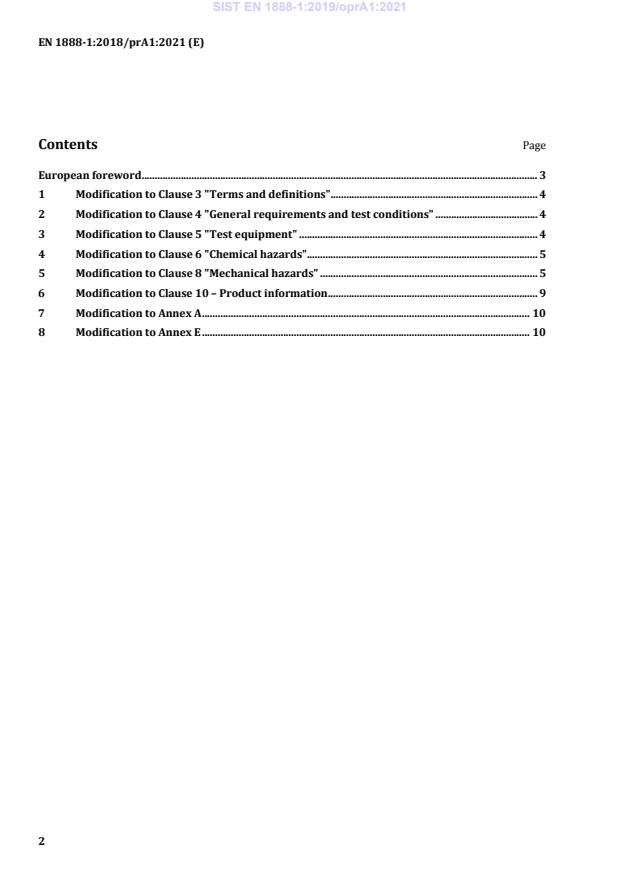
Contents Page
European foreword . 3
1 Modification to Clause 3 "Terms and definitions". 4
2 Modification to Clause 4 "General requirements and test conditions" . 4
3 Modification to Clause 5 "Test equipment" . 4
4 Modification to Clause 6 "Chemical hazards". 5
5 Modification to Clause 8 "Mechanical hazards" . 5
6 Modification to Clause 10 – Product information . 9
7 Modification to Annex A . 10
8 Modification to Annex E . 10
SIST EN 1888-1:2019/oprA1:2021
EN 1888-1:2018/prA1:2021 (E)
European foreword
This document (EN 1888-1:2018/prA1:2021) has been prepared by Technical Committee CEN/TC 252
“Child care articles”, the secretariat of which is held by AFNOR.
This document is currently submitted to the CEN Enquiry.
This document has been prepared under a mandate given to CEN by the European Commission and the
European Free Trade Association.
SIST EN 1888-1:2019/oprA1:2021
EN 1888-1:2018/prA1:2021 (E)
1 Modification to Clause 3 "Terms and definitions"
Modify definition 3.4 to read
integral part of the vehicle designed to support a child in a standing position
Modify definition 3.18 to read
assembly of moving parts which enables the vehicle to be changed from an erected position of use to a
folded position and vice versa under the control of the carer
Modify definition 3.23 to read
handle that can be rotated on the chassis to change the direction of pushing or pulling.
2 Modification to Clause 4 "General requirements and test conditions"
Modify second sentence in 4.7.1 to read
The occupant space is defined 550mm from the mid-point of the junction line, on the uncompressed upper
surface of the seat unit or car seat and the sides of the inner upper surface that support the child. The
volume stops at the vertical projection of the front edge of the seat.
3 Modification to Clause 5 "Test equipment"
Add key in Figure 17 in clause 5.2.1.2
Key
A Lateral view
B Top view
C Front view
Add the following clause after 5.2.4, and renumber all subsequent figures in the document
5.2.5 Small head probe
The small head probe shall be made from plastic or other hard smooth material, with dimensions as
shown in Figure 22.
Dimensions in millimetres
Key
A 106 R 53
e
b 145 Rd 40
C 126
Figure 22 — Small head probe
SIST EN 1888-1:2019/oprA1:2021
EN 1888-1:2018/prA1:2021 (E)
4 Modification to Clause 6 "Chemical hazards"
Replace the existing clause with the following:
A separate sample may be used for these tests.
For seat units, inside the protected volume defined in 4.5.1 the surface of the seat and the parts located
within the volume above the surface of the seat the migration of elements from the materials used shall
comply with EN 71-3.
For pram bodies with an internal length greater or less that 800 mm and for car seats, the inner upper
surfaces that support the child and the inner surface of the sides and ends of the pram body the migration
of elements from the materials used shall comply with EN 71-3.
NOTE All the parts or components that are accessible to the mouth of the child when installed in accordance
with the manufacturer’s instruction are covered by the above sentences (e.g. bumper bar, armrest, tray, child
restraint system…).
5 Modification to Clause 8 "Mechanical hazards"
Replace reference to Figure 27 by reference to Figure 30 in indent 8.1.1.1.1 b)
b) a seat unit where the angle between the backrest and the seat (angle “1” in Figure 30) is capable of
adjustment to an angle of 150° or more measured in accordance with 8.1.1.2.1 and conforming to
8.1.2: any parts, whose function is essential for complying to 8.1.2, shall not allow the test ball to fall
from the seat unit when tested in accordance with 8.1.1.2.2. In this configuration, the restraint system
shall be capable of being removed or hidden or covered in accordance with the manufacturer's
instructions to avoid any risk of strangulation; or
Add the following NOTE at the beginning of 8.3.5.1.1.3
NOTE 2 The removal of a child is not considered as an operating action.
Modify indent a) 1) to read
1) the operating device shall require at least two consecutive actions, the second being dependent on
the first having been carried out and maintained by the carer; and
Modify indents b) and b) 1) to read
b) there shall be two separate and independent operating devices which fulfil one of the following:
1) where one or both operating device(s) are intended to be operated by foot (e.g. for its position,
shape etc.) at least one of them shall automatically return to its original status and the locking
device shall reengage when tested in accordance with 8.3.5.1.2.3; or
Replace the whole of clause 8.4 with the following
8.4.1 Requirements
Free length and loops of the restraint system, bags and carrying handles of pram bodies are excluded
from these requirements.
8.4.1.1 Hazards from free lengths
Cords, strings and other narrow fabrics that originate within the pram body, seat unit or car seat shall not
have a free stretched length that exceeds a length of 220 mm, when measured in accordance with 8.4.2.1.
Cords strings and other narrow fabrics that do not originate within the occupant space (4.7) but that can
extend into the pram body, seat unit or car seat shall not have a free stretched length that exc
...