

EN IEC 62020-1:2021/prA1:2026
(Amendment)Amendment 1 - Electrical accessories - Residual current monitors (RCMs) - Part 1: RCMs for household and similar uses
- Status
- Not Published
- Publication Date
- 21-Feb-2028
- Current Stage
- 4020 - Enquiry circulated - Enquiry
- Start Date
- 31-Jul-2026
- Due Date
- 26-Jun-2026
- Completion Date
- 31-Jul-2026

EN IEC 62020-1:2021/prA1:2026 is Amendment 1 to the IEC/EN document on residual current monitors (RCMs) for household and similar uses. It updates the base part by adding guidance for on-site verification of RCMs in electrical installations and by adjusting the scope notes. The amendment is for people who select, install, inspect, test, and maintain RCMs and the test equipment used with them.
What does EN IEC 62020-1:2021/prA1:2026 specify?
EN IEC 62020-1:2021/prA1:2026 amends the part for RCMs for household and similar uses. The amendment changes the scope note, then adds an informative Annex C on on-site verification of RCMs in electrical installations.
| Annex | What it covers |
|---|---|
| Annex C | Guidance for initial and periodic on-site verification of RCMs, including inspection, testing, and documentation |
Annex C is organized into objective, general guidance, verification, and documentation. It also includes example figures for use in installations and tables that link RCM types to test methods and waveforms.
What are the key requirements of EN IEC 62020-1:2021/prA1:2026?
EN IEC 62020-1:2021/prA1:2026 gives practical guidance for verifying RCMs in service. The main point is that RCMs are checked in the installation by inspection and by tests that confirm they work without causing unwanted tripping of protective devices.
On-site verification follows IEC 60364-6
Annex C states that initial and periodic verification of electrical installations follows IEC 60364-6, and that RCM verification is part of that work. In practice, the verifier must check both the device and its effect in the actual installation, not just the device on its own.
RCMs are used for monitoring, not for replacement of protection
The amendment says RCMs are suited to applications where supply availability matters and disconnection should be avoided when possible. It also states that RCMs are not intended to replace protective devices in electrical installations. For the reader, that means an RCM is used to warn about leakage current and support maintenance decisions, while the protective function remains with the relevant protective devices.
Selection depends on the application and residual current type
Annex C identifies types AC, A, F, and B, and notes that RCMs may have direction discrimination and either external or internal current transformers. This matters because the device type must match the residual current expected in the circuit, otherwise the alarm function may not respond as intended.
Inspection covers condition, wiring, location, and settings
The amendment says inspection includes visual checks, a manual test, checking the selection of the RCM and current transformer, checking installation location, checking wiring, and checking settings. In practice, the verifier looks for correct supply, tight conductors, correct routing through the current transformer, and settings that give early warning without nuisance alarms.
Testing uses suitable equipment and matched waveforms
Annex C points to test equipment complying with IEC 61557-11 and gives testing guidance by RCM type. It also links test waveforms to the RCM type, so the test method must match the device being checked. That is important because a test that is not matched to the RCM type can give a false result.
Documentation must record the verification result
The amendment says verification passes when inspection and all applicable tests pass, and that results are recorded comprehensively. In practice, the record should identify the person, date, test equipment, device tested, results, limitations, repairs, and the next verification plan.
What terms does EN IEC 62020-1:2021/prA1:2026 define?
- Residual current monitor (RCM) - a device that monitors residual current and gives an alarm or warning instead of acting as the primary protective device.
- Residual current protective device (RCD) - a protective device referenced for coordination with RCMs, especially when an RCM is installed upstream.
- Insulation fault location system (IFLS) - a system used in IT systems to indicate first-fault insulation conditions, coupled with an IMD.
- Insulation monitoring device (IMD) - the device paired with an IFLS to indicate insulation faults in IT systems.
- Residual current transformer - the current transformer through which the live conductors are routed so the RCM can measure residual current.
- Pollution degree 2 - the environmental condition named for intended RCM use, where installation dirt and moisture are limited.
Who uses EN IEC 62020-1:2021/prA1:2026?
EN IEC 62020-1:2021/prA1:2026 is used by electrical engineers, installers, and verification personnel who need to select, mount, test, and document RCMs. It is also relevant to maintenance teams and facility managers in datacentres, banks, medical locations, power generation plants, broadcast installations, traffic control sites, and continuously running production processes.
For buyers and quality managers, the document is useful when they need to define what type of RCM, current transformer, alarm indication, and test method is suitable for a given installation.
What changed in EN IEC 62020-1:2021/prA1:2026 from the previous edition?
EN IEC 62020-1:2021/prA1:2026 amends IEC 62020-1:2020. The amendment removes NOTE 1 from the scope and renumbers the following notes, and it adds a new informative Annex C with guidance for on-site verification of RCMs in electrical installations.
Which standards are used with EN IEC 62020-1:2021/prA1:2026?
- IEC 60364-6 - gives the framework for initial and periodic verification of electrical installations, which Annex C follows.
- IEC 60364-5-53 - is used for RCM location and coordination with upstream RCDs.
- IEC 60364-4-41:2005 + AMD1:2017 - is referenced for IT systems and first-fault indication using IFLS, IMD, or RCMs.
- IEC 61557-11:2020 - gives the test equipment requirements and test waveforms used for verifying the effectiveness of RCMs in installation.
What does the EN IEC 62020-1:2021/prA1:2026 document contain?
The amendment contains a foreword, the updated scope note, and informative Annex C. Annex C brings together the practical guidance for on-site verification: general application notes, selection guidance, examples of RCM use in installations, inspection steps, test methods, and documentation expectations.
It also includes Figure C.1 and Figure C.2, which show example uses of RCDs and RCMs and an RCM arrangement for higher-availability sites such as datacentres. Table C.1 summarizes how to test different RCM characteristics with IEC 61557-11 equipment, and Table C.2 links RCM types to the applicable test waveforms.
Relations
- Effective Date
- 24-Jun-2025
Get Certified
Connect with accredited certification bodies for this standard

IMQ S.p.A. (Certification)
Italian electrical product certification.

SLG Prüf- und Zertifizierungs GmbH
German testing and certification body.

UL Solutions
Global safety science company with testing, inspection and certification.
Sponsored listings
Frequently Asked Questions
EN IEC 62020-1:2021/prA1:2026 is a draft published by CLC. Its full title is "Amendment 1 - Electrical accessories - Residual current monitors (RCMs) - Part 1: RCMs for household and similar uses". This standard covers: Amendment 1 - Electrical accessories - Residual current monitors (RCMs) - Part 1: RCMs for household and similar uses
Amendment 1 - Electrical accessories - Residual current monitors (RCMs) - Part 1: RCMs for household and similar uses
EN IEC 62020-1:2021/prA1:2026 is classified under the following ICS (International Classification for Standards) categories: 29.120.50 - Fuses and other overcurrent protection devices. The ICS classification helps identify the subject area and facilitates finding related standards.
EN IEC 62020-1:2021/prA1:2026 has the following relationships with other standards: It is inter standard links to EN IEC 62020-1:2021. Understanding these relationships helps ensure you are using the most current and applicable version of the standard.
EN IEC 62020-1:2021/prA1:2026 is associated with the following European legislation: EU Directives/Regulations: 2014/30/EU, 2014/35/EU; Standardization Mandates: M/511, M/552. When a standard is cited in the Official Journal of the European Union, products manufactured in conformity with it benefit from a presumption of conformity with the essential requirements of the corresponding EU directive or regulation.
EN IEC 62020-1:2021/prA1:2026 is available in PDF format for immediate download after purchase. The document can be added to your cart and obtained through the secure checkout process. Digital delivery ensures instant access to the complete standard document.
Standards Content (Sample)
SLOVENSKI STANDARD
01-oktober-2026
Električni pribor - Nadzorovanje preostalega (difernečnega) toka (RCM) - 1. Del:
RCM za gospodinjske in podobne namene
Electrical accessories - Residual current monitors (RCMs) - Part 1: RCMs for household
and similar uses
Elektrisches Installationsmaterial - Differenzstrom-Überwachungsgeräte (RCMs) - Teil 1:
RCMs für Hausinstallationen und ähnliche Verwendungen
Petit appareillage électrique - Contrôleurs d'isolement à courant différentiel résiduel
(RCM) - Partie 1: Rcm pour usages domestiques et analogues
Ta slovenski standard je istoveten z: EN IEC 62020-1:2021/prA1:2026
ICS:
29.120.50 Varovalke in druga Fuses and other overcurrent
nadtokovna zaščita protection devices
2003-01.Slovenski inštitut za standardizacijo. Razmnoževanje celote ali delov tega standarda ni dovoljeno.
23E/1424/CDV
COMMITTEE DRAFT FOR VOTE (CDV)
PROJECT NUMBER:
IEC 62020-1/AMD1 ED1
DATE OF CIRCULATION: CLOSING DATE FOR VOTING:
2026-07-31 2026-10-23
SUPERSEDES DOCUMENTS:
23E/1402/CD, 23E/1422/CC
IEC SC 23E : CIRCUIT-BREAKERS AND SIMILAR EQUIPMENT FOR HOUSEHOLD USE
SECRETARIAT: SECRETARY:
Italy Mr Sergio Bossi
OF INTEREST TO THE FOLLOWING COMMITTEES: HORIZONTAL FUNCTION(S):
TC 64,TC 85
ASPECTS CONCERNED:
Electromagnetic Compatibility,Safety
SUBMITTED FOR CENELEC PARALLEL VOTING NOT SUBMITTED FOR CENELEC PARALLEL VOTING
Attention IEC-CENELEC parallel voting
The attention of IEC National Committees, members of
CENELEC, is drawn to the fact that this Committee Draft
for Vote (CDV) is submitted for parallel voting.
The CENELEC members are invited to vote through the
CENELEC online voting system.
This document is still under study and subject to change. It should not be used for reference purposes.
Recipients of this document are invited to submit, with their comments, notification of any relevant patent rights of
which they are aware and to provide supporting documentation.
Recipients of this document are invited to submit, with their comments, notification of any relevant “In Some
Countries” clauses to be included should this proposal proceed. Recipients are reminded that the CDV stage is the
final stage for submitting ISC clauses. (SEE AC/22/2007 OR NEW GUIDANCE DOC).
TITLE:
Amendment 1 - Electrical accessories - Residual current monitors (RCMs) - Part 1: RCMs for
household and similar uses
PROPOSED STABILITY DATE: 2031
NOTE FROM TC/SC OFFICERS:
download this electronic file, to make a copy and to print out the content for the sole purpose of preparing National
Committee positions. You may not copy or "mirror" the file or printed version of the document, o r any part of it, for
any other purpose without permission in writing from IEC.
IEC CDV 62020-1/AMD1 © IEC 2026
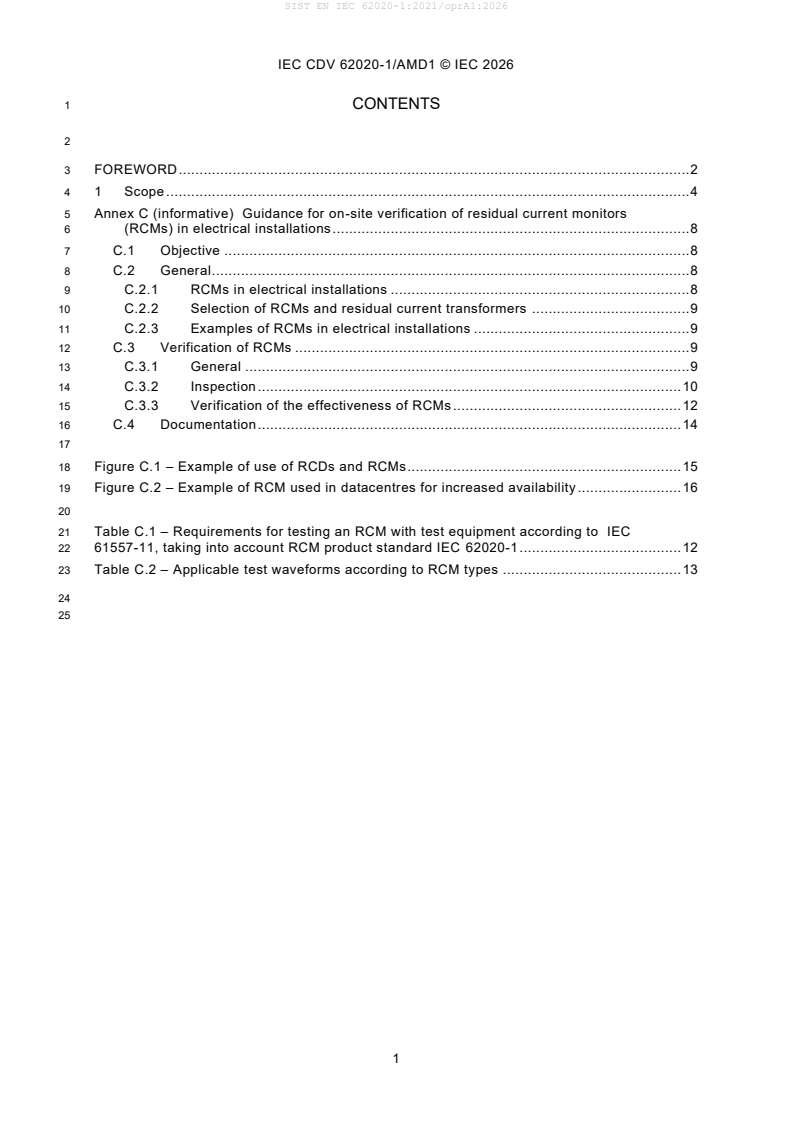
1 CONTENTS
3 FOREWORD . 2
4 1 Scope . 4
5 Annex C (informative) Guidance for on-site verification of residual current monitors
6 (RCMs) in electrical installations . 8
7 C.1 Objective . 8
8 C.2 General . 8
9 C.2.1 RCMs in electrical installations . 8
10 C.2.2 Selection of RCMs and residual current transformers . 9
11 C.2.3 Examples of RCMs in electrical installations . 9
12 C.3 Verification of RCMs . 9
13 C.3.1 General . 9
14 C.3.2 Inspection . 10
15 C.3.3 Verification of the effectiveness of RCMs . 12
16 C.4 Documentation . 14
18 Figure C.1 – Example of use of RCDs and RCMs. 15
19 Figure C.2 – Example of RCM used in datacentres for increased availability . 16
21 Table C.1 – Requirements for testing an RCM with test equipment according to IEC
22 61557-11, taking into account RCM product standard IEC 62020-1 . 12
23 Table C.2 – Applicable test waveforms according to RCM types . 13
IEC CDV 62020-1/AMD1 © IEC 2026
28 INTERNATIONAL ELECTROTECHNICAL COMMISSION
29 ____________
31 ELECTRICAL ACCESSORIES –
32 RESIDUAL CURRENT MONITORS (RCM)
34 Part 1: RCMs for household and similar uses
36 AMENDMENT 1
38 FOREWORD
39 1) The International Electrotechnical Commission (IEC) is a worldwide organization for standardization comprising
40 all national electrotechnical committees (IEC National Committees). The object of IEC is to promote international
41 co-operation on all questions concerning standardization in the electrical and electronic fields. To this end and
42 in addition to other activities, IEC publishes International Standards, Technical Specifications, Technical Reports,
43 Publicly Available Specifications (PAS) and Guides (hereafter referred to as “IEC Publication(s)”). Their
44 preparation is entrusted to technical committees; any IEC National Committee interested in the subject dealt with
45 may participate in this preparatory work. International, governmental and non-governmental organizations liaising
46 with the IEC also participate in this preparation. IEC collaborates closely with the International Organization for
47 Standardization (ISO) in accordance with conditions determined by agreement between the two organizations.
48 2) The formal decisions or agreements of IEC on technical matters express, as nearly as possible, an international
49 consensus of opinion on the relevant subjects since each technical committee has representation from all
50 interested IEC National Committees.
51 3) IEC Publications have the form of recommendations for international use and are accepted by IEC National
52 Committees in that sense. While all reasonable efforts are made to ensure that the technical content of IEC
53 Publications is accurate, IEC cannot be held responsible for the way in which they are used or for any
54 misinterpretation by any end user.
55 4) In order to promote international uniformity, IEC National Committees undertake to apply IEC Publications
56 transparently to the maximum extent possible in their national and regional publications. Any divergence between
57 any IEC Publication and the corresponding national or regional publication shall be clearly indicated in the latter.
58 5) IEC itself does not provide any attestation of conformity. Independent certification bodies provide conformity
59 assessment services and, in some areas, access to IEC marks of conformity. IEC is not responsible for any
60 services carried out by independent certification bodies.
61 6) All users should ensure that they have the latest edition of this publication.
62 7) No liability shall attach to IEC or its directors, employees, servants or agents including individual experts and
63 members of its technical committees and IEC National Committees for any personal injury, property damage or
64 other damage of any nature whatsoever, whether direct or indirect, or for costs (including legal fees) and
65 expenses arising out of the publication, use of, or reliance upon, this IEC Publication or any other IEC
66 Publications.
67 8) Attention is drawn to the Normative references cited in this publication. Use of the referenced publications is
68 indispensable for the correct application of this publication.
69 9) IEC draws attention to the possibility that the implementation of this document may involve the use of (a)
70 patent(s). IEC takes no position concerning the evidence, validity or applicability of any claimed patent rights in
71 respect thereof. As of the date of publication of this document, IEC had not received notice of (a) patent(s), which
72 may be required to implement this document. However, implementers are cautioned that this may not represent
73 the latest information, which may be obtained from the patent database available at https://patents.iec.ch [and/or]
74 www.iso.org/patents. IEC shall not be held responsible for identifying any or all such patent rights.
75 Amendment 1 to IEC 62020-1:2020 has been prepared by subcommittee 23E: Circuit-breakers
76 and similar equipment for household use, of IEC technical committee 23: Electrical accessories.
IEC CDV 62020-1/AMD1 © IEC 2026
77 The text of this Amendment is based on the following documents:
Draft Report on voting
XX/XX/XXXX XX/XX/XXX
79 Full information on the voting for its approval can be found in the report on voting indicated in
80 the above table.
81 The language used for the development of this Amendment is English
82 This document was drafted in accordance with ISO/IEC Directives, Part 2, and developed in
83 accordance with ISO/IEC Directives, Part 1 and ISO/IEC Directives, IEC Supplement, available
84 at www.iec.ch/members_experts/refdocs. The main document types developed by IEC are
85 described in greater detail at www.iec.ch/publications/.
86 The committee has decided that the contents of this document will remain unchanged until the
87 stability date indicated on the IEC website under webstore.iec.ch in the data related to the
88 specific document. At this date, the document will be
89 • reconfirmed,
90 • withdrawn, or
91 • revised.
IEC CDV 62020-1/AMD1 © IEC 2026
95 1 Scope
96 To remove NOTE 1 and renumber the following NOTES
IEC CDV 62020-1/AMD1 © IEC 2026
98 To add, after the Annex B, the new Annex C
IEC CDV 62020-1/AMD1 © IEC 2026
IEC CDV 62020-1/AMD1 © IEC 2026
IEC CDV 62020-1/AMD1 © IEC 2026
101 Annex C
102 (informative)
104 Guidance for on-site verification of residual current monitors (RCMs) in
105 electrical installations
106 C.1 Objective
107 This annex intends to provide information for initial and periodic on-site verification of residual
108 current monitors (RCMs) within electrical installations as defined in IEC 60364-6.
109 NOTE : this annex does not intend to address RCM type tests.
110 This annex does not take precedence over IEC 60364-6 but intends to complement it for in-situ
111 RCM verification.
112 This annex provides information when conducting:
113 – inspections of RCMs, e.g. ensuring the correct selection of RCMs, correct settings, and
114 the satisfactory condition for use of RCMs;
115 – in-situ tests of RCMs to ensure they operate correctly without interfering with the
116 protective measures implemented in the electrical installation, either with the RCM test
117 device, or with a test equipment complying with IEC 61557-11;
118 NOTE The requirements and type tests for the test equipment used for testing the effectiveness of RCMs already in
119 use in electrical installations are specified in IEC 61557-11.
120 C.2 General
121 C.2.1 RCMs in electrical installations
122 RCMs are monitoring devices which are suitable in applications where high availability of the
123 power supply is needed and disconnection of distribution circuits is intended to be avoided
124 whenever possible.
125 Note 1 RCMs are not intended to be used nor to replace protective devices in electrical installations.
126 Main reasons for using RCMs are:
127 – the monitoring of possible increases of leakage currents in electrical installations to
128 anticipate the operation of residual current protective devices (RCDs) in the event of
129 excessive leakage current (i.e. fault currents) in the electrical installation according to
130 IEC 60364-5-53;
131 – the integration of RCMs within a preventive maintenance management system with
132 adequate procedures for ensuring continuous monitoring of the electrical installation. In
133 this case periodic verification of the insulation resistance is not necessary (see IEC
134 60364-6)
135 – in IT systems, where the system is designed not to disconnect in the event of first fault,
136 an insulation fault location system (IFLS, coupled with an IMD) or an RCM is used to
137 indicate first fault insulation (see IEC 60364-4-41:2005 + AMD1:2017, clause 411.6.3.1).
138 RCM applications may include for example:
139 – datacentres;
140 – banks, stock exchange;
141 – medical locations;
142 – power generation plants;
IEC CDV 62020-1/AMD1 © IEC 2026
143 – television and radio installation (to identify EMC disturbances);
144 – traffic control (e.g. airports, trains);
145 – continuously running production processes (also those with controlled drives).
146 C.2.2 Selection of RCMs and residual current transformers
147 RCMs are intended to be used within their rated characteristics.
148 RCMs are intended to be used in an environment with pollution degree 2 and overvoltage
149 category III. For an environment with a higher pollution degree, RCMs can be installed in
150 enclosures giving the appropriate degree of protection.
151 Depending on the intended use, RCMs are designed to detect different types of residual
152 currents circulating (e.g. residual alternating current, residual pulsating direct current, residual
153 smooth direct current). Therefore, RCMs are selected according to the type of application and
154 currents. RCMs are classified according to Clause 4. Main differences in RCMs are:
155 – RCMs according to the type of the residual current monitored for electrical installations
156 distributed in AC (see clause 4.13):
157 – Type AC (see clause 5.2.6.1);
158 – Type A (see clause 5.2.6.2);
159 – Type F (see clause 5.2.6.3);
160 – Type B (see clause 5.2.6.4).
161 – RCMs with the ability to directionally discriminate (see clause 4.11);
162 – RCMs with external or internal current transformers (see clause 4.14).
163 C.2.3 Examples of RCMs in electrical installations
164 C.2.3.1 General example of RCM use
165 Figure C.1 provides an example with RCDs in final circuits for additional protection and in the
166 upstream distribution board. RCD types AC, A, F or B can be used depending on the type of
167 electrical installation and the types of loads. RCMs may also be used to increase the availability
168 of the power supply through pre-warning and subsequent preventive maintenance. In general,
169 RCDs and RCMs of the same type, e.g. AC type, are used in a particular circuit.
170 C.2.3.2 Example of use of RCMs in applications with increased availability of power
171 supply
172 Figure C.2 represents an example of installations where increased availability of power supply
173 is needed (e.g. datacenters, control rooms). For such installations, monitoring systems are
174 usually used for permanently monitoring the electrical installation or particular distribution
175 circuits prior to automatic disconnection of the supply.
176 C.3 Verification of RCMs
177 C.3.1 General
178 Initial and periodic verification of electrical installations are conducted following the
179 requirements of IEC 60364-6. Verification of RCMs encompasses
180 – inspections of RCMs, and;
181 – verification of the effectiveness of RCMs.
182 Note 1 According to IEC 60364-6:20XX, 6.5.2, the frequency of periodic verification of an electrical installation is
...