

EN 50131-1:2006/A1:2009
(Amendment)Alarm systems - Intrusion and hold-up systems - Part 1: System requirements
General Information
- Abstract
2021: CLC legacy converted by DCLab NISOSTS
- Status
- Published
- Publication Date
- 28-May-2009
- Withdrawal Date
- 30-Apr-2012
- Technical Committee
- CLC/TC 79 - Alarm systems
- Drafting Committee
- CLC/TC 79 - Alarm systems
- Current Stage
- 6060 - Document made available - Publishing
- Start Date
- 29-May-2009
- Completion Date
- 29-May-2009

Overview
EN 50131-1:2006/A1:2009 is the CENELEC amendment to EN 50131-1:2006 that specifies system requirements for intrusion and hold-up alarm systems (I&HAS). Approved in May 2009, this amendment refines definitions, functional requirements and operational rules for compliant alarm installations across supervised premises. It targets manufacturers, integrators, security consultants and compliance teams working with graded alarm systems.
Key Topics
- Scope and applicability: Amendment A1 modifies terminology and clarifies requirements relevant to system-level behaviour of I&HAS, including interactions with alarm transmission systems and alarm receiving centres.
- Definitions and abbreviations: Updated definitions for key terms (e.g., alarm transmission system, subsystem, supervised premises transceiver (SPT), event recording, inhibit/override) help ensure consistent interpretation across components and national implementations.
- Security grading and access levels: The standard preserves graded system requirements (Grades 1–4) and defines access levels (1–4) for user functions such as setting/unsetting, restore, inhibit/isolate and program changes. Additional rules clarify when optional functions must meet the requirements of a claimed grade.
- Indications and notifications: Requirements cover mandatory and optional local indications (set/unset state, zone identification, pending/alert indications) and remote notification practices. A key operational rule requires a warning device or indicator to operate for a minimum time (e.g., 30 s) before remote notification in certain unsetting procedures.
- Tamper detection and monitoring: The amendment details tamper detection expectations for components (CIE/ACE/SPT/WD/PS, detectors, junction boxes), means to be detected, and exceptions for portable devices or specific component types.
- Interconnections and power: Monitoring of interconnections is addressed with stated exceptions for portable devices; power supply types and fault handling are part of system-level considerations.
Applications
This amendment is practical for:
- Manufacturers ensuring system-level compliance for I&HAS as part of product families.
- Security integrators implementing graded alarm solutions that must meet access, indication and notification rules.
- Risk assessors and facility managers requiring clear operational behaviours (e.g., tamper responses, alarm transmission path independence) for premises protection.
Benefits include clearer definitions that reduce ambiguity in installations, guidance on access controls to protect system integrity, and enhanced interoperability with alarm transmission systems (ATS).
Related Standards
- EN 50136-1-1 - referenced for alarm transmission system performance and general ATS requirements.
- EN 61000-6-3 (EMC) - emission standard for residential, commercial and light-industrial environments (referenced in amendment).
Additional context: amendment A1 was prepared by CENELEC TC 79 (Alarm systems) and provides national implementation dates and guidance for endorsement. For full compliance and implementation details, consult the complete EN 50131-1:2006/A1:2009 document and associated component standards.
Relations
- Effective Date
- 02-Jun-2026
- Effective Date
- 03-Feb-2026
- Effective Date
- 03-Feb-2026
- Effective Date
- 03-Mar-2026
- Effective Date
- 09-Feb-2026
- Referred By
EN 15713:2023 - Secure destruction of confidential and sensitive material - Code of practice - Effective Date
- 09-Feb-2026
- Effective Date
- 03-Feb-2026
- Effective Date
- 03-Feb-2026
- Effective Date
- 03-Feb-2026
- Effective Date
- 28-Jan-2023
Get Certified
Connect with accredited certification bodies for this standard

CIS Institut d.o.o.
Personal Protective Equipment (PPE) certification body. Notified Body NB-2890 for EU Regulation 2016/425 PPE.

Kiwa BDA Testing
Building and construction product certification.
Kmetijski inštitut Slovenije
Agricultural Institute of Slovenia. Soil testing, plant health, agricultural product analysis.
Sponsored listings
Frequently Asked Questions
EN 50131-1:2006/A1:2009 is a amendment published by CLC. Its full title is "Alarm systems - Intrusion and hold-up systems - Part 1: System requirements". This standard covers: 2021: CLC legacy converted by DCLab NISOSTS
2021: CLC legacy converted by DCLab NISOSTS
EN 50131-1:2006/A1:2009 is classified under the following ICS (International Classification for Standards) categories: 13.310 - Protection against crime. The ICS classification helps identify the subject area and facilitates finding related standards.
EN 50131-1:2006/A1:2009 has the following relationships with other standards: It is inter standard links to EN IEC 61000-6-3:2026, EN 50136-1:2012, EN IEC 61000-6-3:2021, EN 50131-3:2026, EN 15999-2:2025, EN 15713:2023, EN 50131-3:2009, EN 50600-2-5:2016, EN 50600-2-5:2021, EN 50131-1:2006. Understanding these relationships helps ensure you are using the most current and applicable version of the standard.
EN 50131-1:2006/A1:2009 is available in PDF format for immediate download after purchase. The document can be added to your cart and obtained through the secure checkout process. Digital delivery ensures instant access to the complete standard document.
Standards Content (Sample)
SLOVENSKI STANDARD
01-oktober-2009
Alarmni sistemi - Sistemi za javljanje vloma in ropa - 1. del: Sistemske zahteve
Alarm systems - Intrusion and hold-up systems -- Part 1: System requirements
Alarmanlagen - Einbruch- und Überfallmeldeanlagen -- Teil 1: Systemanforderungen
Systèmes d'alarme - Systèmes d'alarme contre l’intrusion et les hold-up -- Partie 1:
Exigences système
Ta slovenski standard je istoveten z: EN 50131-1:2006/A1:2009
ICS:
13.310 Varstvo pred kriminalom Protection against crime
13.320 Alarmni in opozorilni sistemi Alarm and warning systems
2003-01.Slovenski inštitut za standardizacijo. Razmnoževanje celote ali delov tega standarda ni dovoljeno.
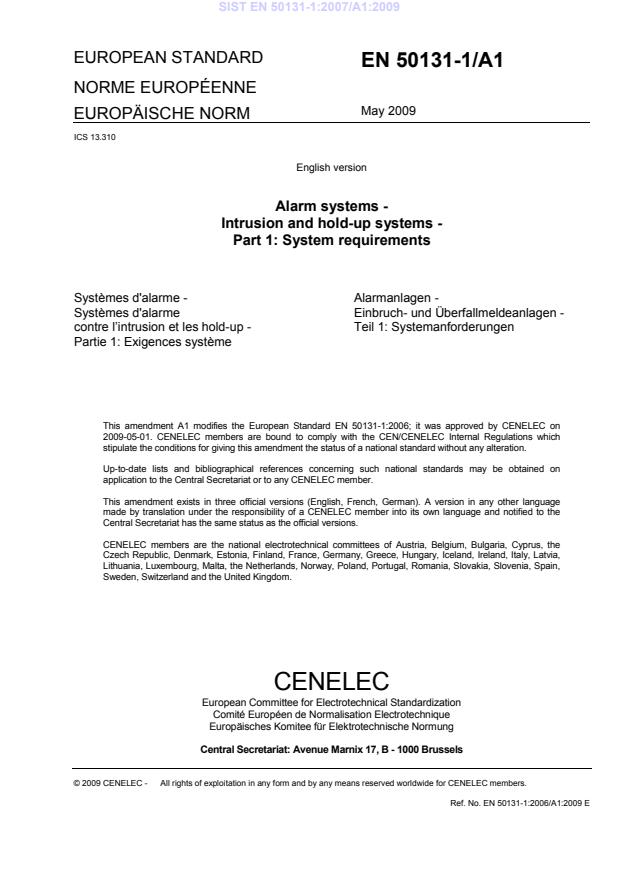
EUROPEAN STANDARD
EN 50131-1/A1
NORME EUROPÉENNE
May 2009
EUROPÄISCHE NORM
ICS 13.310
English version
Alarm systems -
Intrusion and hold-up systems -
Part 1: System requirements
Systèmes d'alarme - Alarmanlagen -
Systèmes d'alarme Einbruch- und Überfallmeldeanlagen -
contre l’intrusion et les hold-up - Teil 1: Systemanforderungen
Partie 1: Exigences système
This amendment A1 modifies the European Standard EN 50131-1:2006; it was approved by CENELEC on
2009-05-01. CENELEC members are bound to comply with the CEN/CENELEC Internal Regulations which
stipulate the conditions for giving this amendment the status of a national standard without any alteration.
Up-to-date lists and bibliographical references concerning such national standards may be obtained on
application to the Central Secretariat or to any CENELEC member.
This amendment exists in three official versions (English, French, German). A version in any other language
made by translation under the responsibility of a CENELEC member into its own language and notified to the
Central Secretariat has the same status as the official versions.
CENELEC members are the national electrotechnical committees of Austria, Belgium, Bulgaria, Cyprus, the
Czech Republic, Denmark, Estonia, Finland, France, Germany, Greece, Hungary, Iceland, Ireland, Italy, Latvia,
Lithuania, Luxembourg, Malta, the Netherlands, Norway, Poland, Portugal, Romania, Slovakia, Slovenia, Spain,
Sweden, Switzerland and the United Kingdom.
CENELEC
European Committee for Electrotechnical Standardization
Comité Européen de Normalisation Electrotechnique
Europäisches Komitee für Elektrotechnische Normung
Central Secretariat: Avenue Marnix 17, B - 1000 Brussels
© 2009 CENELEC - All rights of exploitation in any form and by any means reserved worldwide for CENELEC members.
Ref. No. EN 50131-1:2006/A1:2009 E
Foreword
This amendment to EN 50131-1:2006 was prepared by the Technical Committee CENELEC TC 79,
Alarm systems.
The text of the draft was submitted to the Unique Acceptance Procedure and was approved by
CENELEC as amendment A1 to EN 50131-1:2006 on 2009-05-01.
The following dates were fixed:
– latest date by which the amendment has to be
implemented at national level by publication of
an identical national standard or by endorsement (dop) 2010-05-01
– latest date by which the national standards conflicting
with the amendment have to be withdrawn (dow) 2012-05-01
__________
– 3 – EN 50131-1:2006/A1:2009
1 Scope
rd
In the 3 paragraph, last sentence, replace ‘operation’ by ‘functioning’.
th nd
In the 4 paragraph, 2 sentence, replace ‘operate’ by ‘function’.
2 Normative references
th
Replace the 5 reference by the following:
EN 50136-1-1 1998 Alarm systems – Alarm transmission systems and equipment –
Part 1-1: General requirements for alarm transmission systems
Replace the last reference by the following:
EN 61000-6-3 2007 Electromagnetic compatibility (EMC) – Part 6-3: Generic standards –
Emission standard for residential, commercial and light-industrial
environments (IEC 61000-6-3:2006)
3 Definitions and abbreviations
3.1 Definitions
Replace definition 3.1.11 by the following:
3.1.11
alarm transmission system
equipment and network used to transfer information from one or more I&HAS to one or more alarm
receiving centres
NOTE Alarm transmission systems exclude local direct connections, i.e. interconnections between parts of an I&HAS which do
not require an interface to transform the I&HAS information into a form suitable for transmission.
In definition 3.1.13, replace 'system' by 'I&HAS'.
Replace definition 3.1.16 by the following:
3.1.16
authorisation
permission to gain access to the various control functions of an I&HAS
In definition 3.1.17, replace 'physical' by 'mechanical'.
In definition 3.1.19, replace 'operating' by 'functioning'.
Replace definition 3.1.24 by the following:
3.1.24
event
condition arising from the operation of an I&HAS e.g. setting/unsetting or the functioning of an I&HAS,
e.g. alarm signal or message
Replace definition 3.1.25 by the following:
3.1.25
event recording
storage of events arising from the operation e.g. setting or unsetting of an I&HAS or the functioning of
an I&HAS for future analysis
Replace definition 3.1.32 by the following:
3.1.32
inhibit
status of a part of an I&HAS in which an alarm condition cannot be notified, such status remaining until
the I&HAS or part thereof passes from the set to the unset status
In definition 3.1.33, replace 'transmitted' by 'communicated'.
In definition 3.1.41, replace ‘manually cancelled’ by 'cancelled by a user'.
In definition 3.1.44, replace 'operation' by 'functioning'.
Replace definition 3.1.50 by the following:
3.1.50
override
intervention, by a user, to permit setting when an I&HAS is not in a normal condition
In definition 3.1.51, delete 'a zone of'.
In definition 3.1.54, add 'or any part thereof' to end of the definition.
In definition 3.1.55, replace 'operating' by 'working'.
Replace definition 3.1.65 by the following:
3.1.65
subsystem
part of an I&HAS located in a clearly defined area of the supervised premises capable of functioning
independently of other parts of the I&HAS
Replace definitions 3.1.68 and 3.1.69 by the following:
3.1.68
system components
individual items of equipment which constitute an I&HAS when configured together
3.1.69
supervised premises transceiver
equipment at the supervised premises, including the interface to the I&HAS and the interface to the
alarm transmission network
– 5 – EN 50131-1:2006/A1:2009
Replace definition 3.1.79 by the following:
3.1.79
unset
status of an I&HAS or part thereof in which an intruder and/or hold-up alarm condition cannot be
notified
Replace definition 3.1.82 by the following:
3.1.82
warning device
device that gives an audible alarm in response to a notification
NOTE 1 A warning device may also provide alert indications.
NOTE 2 Such indications should be easily distinguishable from those related to the notification of an alarm condition.
Replace definition 3.1.84 by the following:
3.1.84
zone
area of the supervised premises where an intrusion, attempted intrusion, or the triggering of a hold-up
device may be detected by an I&HAS
NOTE Although a zone could contain just one detector, the term “zone” is not synonymous with one detector input. A zone may
include any number of detectors. Examples of zones include: a storey of a building, the perimeter of a building, an outbuilding.
3.2 Abbreviations
Add the following after the last abbreviation:
SPT - supervised premises transceiver
6 Security grading
Add the following paragraph before NOTE 1:
If a function is provided that is optional for a particular grade and a claim of compliance is made, it
shall meet the applicable requirements for the grade for which compliance is claimed (if any are
given). If there are no specifications for the grade in question, the requirements for any higher grade
(as identified by the manufacturer) shall apply.
8 Functional requirements
Table 1 – Faults
b
Replace ‘Other faults’ by ‘Other faults ’.
a
Add the following after table footnote :
b
Other faults as specified in components standards.
8.3.1 Access levels
Replace the paragraph after the note by the following:
Access at level 3 shall be prevented unless either
a) access has been permitted by a user with level 2 access, or
b) in grades 1, 2 and 3 I&HAS, access at level 3 may be provided without authorisation by a level 2
user providing
1) the user to be given access at level 3 is at the supervised premises and accesses the CIE
locally, and
2) the I&HAS is unset, and
3) in grade 1 I&HAS notification is given by a warning device when the access at level 3 is
granted,
4) in grades 2 and 3 notification is given by a warning device and remotely, i.e. by an ATS,
when the access at level 3 is granted.
Access at level 4 shall be prevented until access has been authorized by a user with level 2 access
and by a user with level 3 access.
Table 2 – Levels of access
Replace by the following table:
Functions Access levels
a b
1 2 3 4
e
Setting NP P P NP
Unsetting NP P P NP
Restore I&HAS NP P P NP
NP P P NP
Verify I&HAS functions
NP P P NP
Interrogate event log
c
Inhibit/isolate/override NP P P NP
d d d
Add/change individual authorisation codes NP P P P
Add/delete level 2 users & codes NP P P NP
Add/change site specific data NP NP P NP
Change/replace basic programme NP NP NP P
Key: P = Permitted NP = Not permitted.
NOTE 1 The inclusion of the functions shown in this table does not imply that provision of such functions in I&HAS is
mandatory.
NOTE 2 This table specifies access levels for each function; further conditions, applicable to each function, are specified
elsewhere in this standard.
NOTE 3 Requirements relating to user access are not
...