

EN 50600-1:2026
(Main)Information technology - Data centre facilities and infrastructures - Part 1: General concepts
- Abstract
This document: a) describes the general principles for data centres upon which the requirements of the EN 50600 series are based; b) defines the common aspects of data centres including terminology, parameters and reference models (functional elements and their accommodation) addressing both the size and complexity of their intended purpose; c) describes general aspects of the facilities and infrastructures required to support data centres; d) specifies a classification system, based upon the key criteria of "availability", "security" and "resource and energy efficiency enablement" over the planned lifetime of the data centre, for the provision of effective facilities and infrastructure; e) details the issues to be addressed in a business risk and operating cost analysis enabling application of the classification of the data centre; f) provides reference to documentation, operation and management of data centres; g) introduces the concepts of Key Performance Indicators (KPIs) for resource management and resilience of data centre facilities and infrastructures; h) defines the use of an environmental sustainability strategy. The following topics are outside of the scope of this series of documents: 1) the selection of information technology and network telecommunications equipment, software and associated configuration issues are outside the scope of this document; 2) quantitative analysis of overall service availability resulting from multi-site data centres; 3) safety and electromagnetic compatibility (EMC) requirements (covered by other standards and regulations. However, information given in this document can be of assistance in meeting these standards and regulations).
- Status
- Published
- Publication Date
- 13-Aug-2026
- Technical Committee
- CLC/TC 215 - Electrotechnical aspects of telecommunication equipment
- Drafting Committee
- CLC/TC 215/WG 03 - Facilities and infrastructures
- Current Stage
- 6060 - Document made available - Publishing
- Start Date
- 14-Aug-2026
- Due Date
- 15-Sep-2026
- Completion Date
- 14-Aug-2026

EN 50600-1:2026 is a CLC European Standard for data centre facilities and infrastructures, Part 1 of the EN 50600 series. It sets out the common concepts used across the series, including terminology, reference models, classification by availability, security, and resource and energy efficiency enablement, and the planning logic used by owners, designers and operators. In practice, it is the base document for deciding what level of facility and infrastructure a data centre needs before the detailed EN 50600-2-X parts are applied.
What does EN 50600-1:2026 specify?
EN 50600-1:2026 specifies the general principles for data centres, the common terms and parameters, and the classification framework used to design their supporting facilities and infrastructures. It also covers business risk analysis, documentation, management information, KPIs, and an environmental sustainability strategy.
The document is organized into clauses on scope, references, terms, conformance, business risk analysis, design overview, classification, design and implementation, and design principles. It also includes two informative annexes that explain availability, resilience and efficiency in more detail.
| Annex | What it covers |
|---|---|
| Annex A | Availability classes, resilience and efficiency |
| Annex B | Availability and resilience criteria |
The scope makes clear that EN 50600-1:2026 is not the document for selecting information technology and network telecommunications equipment, software, or their configuration. It also leaves out quantitative analysis of overall service availability in multi-site data centres, and safety and EMC requirements are handled by other standards and regulations.
What are the key requirements of EN 50600-1:2026?
EN 50600-1:2026 requires a data centre design to start from business risk analysis and then select the design classifications and processes that match the required service level. Clause 4 makes this the conformance route: complete the risk analysis, choose an Availability Class, choose Protection Classes, select an energy efficiency enablement level, apply the design process, and apply the design principles.
Business risk analysis and design decisions
Clause 5 ties design choices to business impact and risk. The document treats downtime cost, business reputation, external threats, and other consequences as design inputs, so the chosen infrastructure is based on what failure would mean in practice.
Clause 5 also defines event risk as a combination of impact and probability. That matters because it pushes the reader to compare real threats such as flooding, fire, hostile action, or location-related risks against the protection and availability needed for the facility.
Availability classes for supporting infrastructures
Clause 7.2 defines four Availability Classes, from low to very high, for the infrastructures that support the data centre. The classes apply to power supply and distribution, environmental control, and telecommunications cabling.
The classes progress from single path, to single path with redundancy, to multiple paths with concurrent repair and operate, and then to fault tolerant solutions except during maintenance. In practice, this means the designer chooses whether the infrastructure can tolerate a single failure, whether maintenance can occur without shutting down the load, and whether the whole path must remain operational after a fault.
Clause 7.2 also recognizes that a multi-site structure may be used to improve overall service availability. The standard points readers to resilience analysis and KPI methods for comparing an individual data centre with a wider multi-site arrangement.
Physical security by space and pathway
Clause 7.3 requires each data centre space and pathway to be assigned its own Protection Class. EN 50600-1:2026 does not treat physical security as one overall setting for the whole site.
The physical security concept must address unauthorized access, intrusion, fire events, and internal and external environmental events. In practical terms, the reader needs to document how each space, boundary and pathway is protected, and how those choices relate to the risk analysis and the selected Availability Classes.
Resource and energy efficiency enablement
Clause 7.4 introduces energy efficiency enablement and the measurement granularity used to support it. The owner or user defines the level before design starts.
The document distinguishes three measurement levels: global data centre information, detailed information for specific facilities and infrastructures, and granular data for systems within spaces and pathways. That matters because the chosen level determines how much monitoring infrastructure is needed to measure energy use, resource use and efficiency trends.
Clause 7.4 also links this area to KPIs and to the maturity model in CLC/TS 50600-5-1. In practice, the design must support both measurement and reporting, not just efficient equipment selection.
Design process and design principles
Clause 8 breaks the work into 11 phases, from strategy and objectives through specifications, proposal, decision, functional design, approval, final design, contract, construction and acceptance testing, and operation. The phased approach matters because it forces decisions on risk, layout, responsibilities and acceptance before the site goes live.
Clause 9 requires a design reference document that collects the outputs of the risk analysis, the chosen Availability Class, the physical security concept, the energy efficiency enablement level, and the operational concept. It also requires the design to consider energy efficiency, resource efficiency, environmental sustainability, EMI, operational excellence, and resilience, including operation during planned maintenance and unplanned restrictions.
What terms does EN 50600-1:2026 define?
- Availability - the ability to be in a state to perform as required.
- Data centre - a structure or group of structures dedicated to centralized accommodation, interconnection and operation of ICT and network telecommunications equipment, together with the facilities and infrastructures needed for power distribution and environmental control.
- Functional capability - the ability of the data centre, system or subsystem to deliver its intended function.
- Physical security - the measures, procedures and responsibilities used to maintain the desired level of availability against access control, intrusion and environmental events.
- Resilience - the ability to withstand and reduce the magnitude and/or duration of disruptive events, including anticipating, absorbing, adapting to, and recovering from them.
- KPI - key performance indicator, used here for resource management and resilience assessment.
- UPS - uninterruptible power system, a combination of converters, switches and energy storage devices that maintains load continuity during input power failure.
- NOC - network operating centre, the room or workplace used to monitor ICT and network equipment and receive alarms.
Who uses EN 50600-1:2026?
EN 50600-1:2026 is intended for collaboration among owners, operators, facility managers, ICT managers, project managers and main contractors, as well as consulting engineers, architects, building designers, system and installation designers, auditors, test and commissioning agents, integrators, suppliers, installers and maintainers.
In practice, they use it to define requirements, plan sites, choose availability and protection levels, design power and cooling support, document operational concepts, and verify that the finished data centre matches the intended service, security and efficiency goals.
What changed in EN 50600-1:2026 from the previous edition?
EN 50600-1:2026 supersedes EN 50600-1:2019. The document states these significant technical changes:
- the whole document has been revised technically and editorially and aligned with EN 50600-2-2 and EN 50600-2-3
- resource enablement aspects have been included
- Clause 3 has been updated and aligned with CLC/TS 50600-4-31 terminology
- Clause 5 has been updated to include resilience analysis aspects and to use “functional capability” in place of “services”
- Clause 7 has been revised, including application of the data centre maturity model of CLC/TS 50600-5-1 and new treatment of multi-site data centres
- Clause 8 phases 1 to 4, 6 and 10 have been revised and aligned with EN 50600-2-5
- Clause 9 has been updated and includes a new 9.5 on design principles for improved resilience
- Annex A has been completely revised with CLC/TS 50600-4-31 in mind
- Annex B includes a new Table B.2 for telecommunications cabling
Which standards are used with EN 50600-1:2026?
EN 50600-1:2026 normatively refers to CLC/TS 50600-5-1 for the maturity model for energy management and environmental sustainability.
It also points readers to these related standards and documents for supporting topics:
- EN 50600-2-1 to EN 50600-2-5 - building construction, power supply and distribution, environmental control, telecommunications cabling infrastructure, and security systems
- EN 50600-3-1 - management and operational information, including operation and acceptance-related process support
- EN 50600-4 (all parts) - KPIs for resource usage efficiency, effectiveness and resilience
- CLC/TS 50600-4-31 - KPIs for resilience, including methods and criteria used in the annexes and updates
- EN IEC 31010, ISO 31000, ISO/TS 22317 and EN ISO 22301 - guidance for risk assessment and business impact analysis
- EN 50173-1, EN 50173-5, EN 50174-1 and EN 50174-2 - cabling and installation context used in definitions and related concepts
- EN IEC 62040-1 - safety reference for the UPS definition
- ETSI EN 305 174-2 - recommended practice for energy efficient data centre design
- IEC 60050-151 - vocabulary source for the definition of system
What does the EN 50600-1:2026 document contain?
EN 50600-1:2026 contains a risk-based framework for planning and classifying data centre facilities and infrastructures. It includes a business impact analysis and risk analysis approach, a six-to-eleven phase design and implementation workflow, and design principles for energy efficiency, sustainability, EMI, operational excellence and resilience.
The annexes add practical interpretation. Annex A explains why availability alone is not enough and introduces resilience-related thinking, while Annex B summarizes how the availability classes relate to power, distribution, environmental control and telecommunications cabling. The document also includes figures for the series relationship, a risk map, a typical premises layout, the design phases, and the duration-versus-cost behavior of unplanned disruptions.
Relations
- Effective Date
- 09-Apr-2024
- Effective Date
- 18-Aug-2026
- Effective Date
- 18-Aug-2026
- Effective Date
- 18-Aug-2026
- Effective Date
- 18-Aug-2026
- Effective Date
- 18-Aug-2026
- Effective Date
- 18-Aug-2026
- Effective Date
- 18-Aug-2026
- Effective Date
- 18-Aug-2026
- Effective Date
- 18-Aug-2026
- Effective Date
- 18-Aug-2026
- Referred By
EN 50134-5:2021 - Alarm systems - Social alarm systems - Part 5: Interconnections and communications - Effective Date
- 18-Aug-2026
- Effective Date
- 18-Aug-2026
- Effective Date
- 18-Aug-2026
- Effective Date
- 18-Aug-2026
Get Certified
Connect with accredited certification bodies for this standard

BSI Group
BSI (British Standards Institution) is the business standards company that helps organizations make excellence a habit.

NYCE
Mexican standards and certification body.
Sponsored listings
Frequently Asked Questions
EN 50600-1:2026 is a standard published by CLC. Its full title is "Information technology - Data centre facilities and infrastructures - Part 1: General concepts". This standard covers: This document: a) describes the general principles for data centres upon which the requirements of the EN 50600 series are based; b) defines the common aspects of data centres including terminology, parameters and reference models (functional elements and their accommodation) addressing both the size and complexity of their intended purpose; c) describes general aspects of the facilities and infrastructures required to support data centres; d) specifies a classification system, based upon the key criteria of "availability", "security" and "resource and energy efficiency enablement" over the planned lifetime of the data centre, for the provision of effective facilities and infrastructure; e) details the issues to be addressed in a business risk and operating cost analysis enabling application of the classification of the data centre; f) provides reference to documentation, operation and management of data centres; g) introduces the concepts of Key Performance Indicators (KPIs) for resource management and resilience of data centre facilities and infrastructures; h) defines the use of an environmental sustainability strategy. The following topics are outside of the scope of this series of documents: 1) the selection of information technology and network telecommunications equipment, software and associated configuration issues are outside the scope of this document; 2) quantitative analysis of overall service availability resulting from multi-site data centres; 3) safety and electromagnetic compatibility (EMC) requirements (covered by other standards and regulations. However, information given in this document can be of assistance in meeting these standards and regulations).
This document: a) describes the general principles for data centres upon which the requirements of the EN 50600 series are based; b) defines the common aspects of data centres including terminology, parameters and reference models (functional elements and their accommodation) addressing both the size and complexity of their intended purpose; c) describes general aspects of the facilities and infrastructures required to support data centres; d) specifies a classification system, based upon the key criteria of "availability", "security" and "resource and energy efficiency enablement" over the planned lifetime of the data centre, for the provision of effective facilities and infrastructure; e) details the issues to be addressed in a business risk and operating cost analysis enabling application of the classification of the data centre; f) provides reference to documentation, operation and management of data centres; g) introduces the concepts of Key Performance Indicators (KPIs) for resource management and resilience of data centre facilities and infrastructures; h) defines the use of an environmental sustainability strategy. The following topics are outside of the scope of this series of documents: 1) the selection of information technology and network telecommunications equipment, software and associated configuration issues are outside the scope of this document; 2) quantitative analysis of overall service availability resulting from multi-site data centres; 3) safety and electromagnetic compatibility (EMC) requirements (covered by other standards and regulations. However, information given in this document can be of assistance in meeting these standards and regulations).
EN 50600-1:2026 is classified under the following ICS (International Classification for Standards) categories: 35.020 - Information technology (IT) in general; 35.160 - Microprocessor systems. The ICS classification helps identify the subject area and facilitates finding related standards.
EN 50600-1:2026 has the following relationships with other standards: It is inter standard links to EN 50600-1:2019, CLC/TS 50600-5-1:2023, EN 50600-2-3:2014, CLC/TR 50600-99-1:2020, CLC/TR 50600-99-1:2021, EN 50600-4-7:2020, EN 50600-2-5:2021, EN 50600-2-2:2014, EN 50600-3-1:2026, CLC/TR 50600-99-2:2021, CLC/TR 50600-99-3:2018, EN 50134-5:2021, CLC/TS 50600-5-1:2021, CLC/TR 50600-99-1:2016, EN 50600-2-5:2016. Understanding these relationships helps ensure you are using the most current and applicable version of the standard.
EN 50600-1:2026 is associated with the following European legislation: Standardization Mandates: M/462. When a standard is cited in the Official Journal of the European Union, products manufactured in conformity with it benefit from a presumption of conformity with the essential requirements of the corresponding EU directive or regulation.
EN 50600-1:2026 is available in PDF format for immediate download after purchase. The document can be added to your cart and obtained through the secure checkout process. Digital delivery ensures instant access to the complete standard document.
Standards Content (Sample)
SLOVENSKI STANDARD
01-oktober-2026
Nadomešča:
SIST EN 50600-1:2019
Informacijska tehnologija - Vzpostavitev podatkovnega centra in infrastruktura - 1.
del: Splošna zasnova
Information technology - Data centre facilities and infrastructures - Part 1: General
concepts
Informationstechnik - Einrichtungen und Infrastrukturen von Rechenzentren - Teil 1:
Allgemeine Konzepte
Technologie de l'information - Installation et infrastructures de centres de traitement de
données - Partie 1: Concepts généraux
Ta slovenski standard je istoveten z: EN 50600-1:2026
ICS:
35.020 Informacijska tehnika in Information technology (IT) in
tehnologija na splošno general
2003-01.Slovenski inštitut za standardizacijo. Razmnoževanje celote ali delov tega standarda ni dovoljeno.
EUROPEAN STANDARD EN 50600-1
NORME EUROPÉENNE
EUROPÄISCHE NORM August 2026
ICS 35.020; 35.160 Supersedes EN 50600-1:2019
English Version
Information technology - Data centre facilities and infrastructures
- Part 1: General concepts
Technologie de l'information - Installation et infrastructures Informationstechnik - Einrichtungen und Infrastrukturen von
de centres de traitement de données - Partie 1: Concepts Rechenzentren - Teil 1: Allgemeine Konzepte
généraux
This European Standard was approved by CENELEC on 2026-06-28. CENELEC members are bound to comply with the CEN/CENELEC
Internal Regulations which stipulate the conditions for giving this European Standard the status of a national standard without any alteration.
Up-to-date lists and bibliographical references concerning such national standards may be obtained on application to the CEN-CENELEC
Management Centre or to any CENELEC member.
This European Standard exists in three official versions (English, French, German). A version in any other language made by translation
under the responsibility of a CENELEC member into its own language and notified to the CEN-CENELEC Management Centre has the
same status as the official versions.
CENELEC members are the national electrotechnical committees of Austria, Belgium, Bulgaria, Croatia, Cyprus, the Czech Republic,
Denmark, Estonia, Finland, France, Germany, Greece, Hungary, Iceland, Ireland, Italy, Latvia, Lithuania, Luxembourg, Malta, the
Netherlands, Norway, Poland, Portugal, Republic of North Macedonia, Romania, Serbia, Slovakia, Slovenia, Spain, Sweden, Switzerland,
Türkiye and the United Kingdom.
European Committee for Electrotechnical Standardization
Comité Européen de Normalisation Electrotechnique
Europäisches Komitee für Elektrotechnische Normung
CEN-CENELEC Management Centre: Rue de la Science 23, B-1040 Brussels
© 2026 CENELEC All rights of exploitation in any form and by any means reserved worldwide for CENELEC Members.
Ref. No. EN 50600-1:2026 E
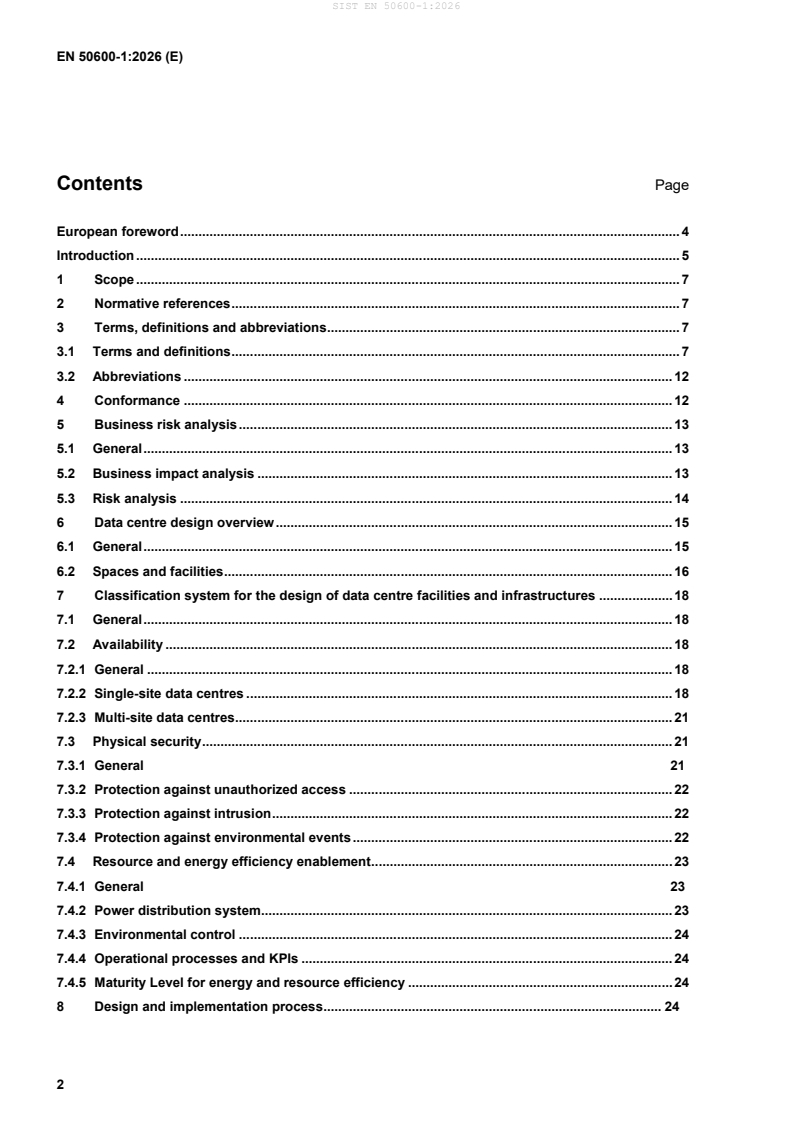
Contents Page
European foreword . 4
Introduction . 5
1 Scope . 7
2 Normative references . 7
3 Terms, definitions and abbreviations . 7
3.1 Terms and definitions . 7
3.2 Abbreviations . 12
4 Conformance . 12
5 Business risk analysis . 13
5.1 General . 13
5.2 Business impact analysis . 13
5.3 Risk analysis . 14
6 Data centre design overview . 15
6.1 General . 15
6.2 Spaces and facilities . 16
7 Classification system for the design of data centre facilities and infrastructures . 18
7.1 General . 18
7.2 Availability . 18
7.2.1 General . 18
7.2.2 Single-site data centres . 18
7.2.3 Multi-site data centres . 21
7.3 Physical security . 21
7.3.1 General 21
7.3.2 Protection against unauthorized access . 22
7.3.3 Protection against intrusion . 22
7.3.4 Protection against environmental events . 22
7.4 Resource and energy efficiency enablement . 23
7.4.1 General 23
7.4.2 Power distribution system. 23
7.4.3 Environmental control . 24
7.4.4 Operational processes and KPIs . 24
7.4.5 Maturity Level for energy and resource efficiency . 24
8 Design and implementation process . 24
8.1 General . 24
8.2 Design phases . 25
8.2.1 Phase 1 – Strategy . 25
8.2.2 Phase 2 – Objectives. 26
8.2.3 Phase 3 – System specifications . 26
8.2.4 Phase 4 – Design proposal . 26
8.2.5 Phase 5 – Decision . 27
8.2.6 Phase 6 – Functional design . 27
8.2.7 Phase 7 – Approval . 27
8.2.8 Phase 8 – Final design and project plan . 27
8.2.9 Phase 9 – Contract . 27
8.2.10 Phase 10 – Construction and acceptance testing . 28
8.2.11 Phase 11 - Operation. 28
9 Design principles to support energy efficiency, resource efficiency and environmental
sustainability . 28
9.1 Design reference documentation . 28
9.2 Design principles to support energy efficiency, resource efficiency and environmental
sustainability . 28
9.3 Design principles for EMI . 28
9.4 Design principles to support operational excellence . 28
9.5 Design principles to improve resilience . 29
Annex A (informative) Availability classes, resilience and efficiency . 30
Annex B (informative) Availability and resilience criteria . 35
Bibliography . 37
Tables
Table 1 — Availability Classes and example implementations . 20
Table A.1 — Availability and annual downtime . 32
Table B.1 — Summary of availability classification for power supply, power distribution and environmental
control . 35
Table B.2 — Summary of availability classification for telecommunications cabling . 36
Figures
Figure 1 — Schematic relationship between EN 50600 series of documents . 6
Figure 2 — Example of risk map . 15
Figure 3 — Typical schematic diagram of premises containing a data centre . 17
Figure 4 — Design phases . 25
Figure A.1 — Unplanned disruptions — duration vs. cost . 31
European foreword
This document (EN 50600-1:2026) has been prepared by CLC/TC 215 “Electrotechnical aspects of
telecommunication equipment”.
The following dates are fixed.
• latest date by which this document has to be (dop) 2027-08-31
implemented at national level by publication of
an identical national standard or by
endorsement
• latest date by which the national standards (dow) 2029-08-31
conflicting with this document have to be
withdrawn
This document supersedes EN 50600-1:2019.
a) the whole document has been revised technically and editorially, aligning with EN 50600-2-2 and
EN 50600-2-3;
b) resource enablement aspects included;
c) Clause 3 updated and aligned with terms and definitions of CLC/TS 50600-4-31 and implemented
throughout the document;
d) Clause 5 updated to include e.g. resilience analysis aspects according to CLC/TS 50600-4-31 and
improved terminology (“services” replaced with “functional capability”);
e) Clause 7 revised, in particular regarding the application of the data centre maturity model of CLC/TS 50600-
5-1 and 7.2.3 on multi-site data centres;
f) Clause 8 design phases 1 to 4, 6 and 10 revised and aligned with EN 50600-2-5;
g) Clause 9 updated and supplemented with new 9.5 on design principles for improved resilience;
h) Annex A completely revised considering the specifications of CLC/TS 50600-4-31;
i) Annex B contains a new Table B.2 summarizing the availability classification for telecommunications
cabling.
Attention is drawn to the possibility that some of the elements of this document may be the subject of patent
rights. CENELEC shall not be held responsible for identifying any or all such patent rights.
Any feedback and questions on this document should be directed to the users’ national committee. A complete
listing of these bodies can be found on the CENELEC website.
Introduction
The unrestricted access to internet-based information demanded by the information society has led to an
exponential growth of both internet traffic and the volume of stored/retrieved data. Data centres are housing and
supporting the information technology and network telecommunications equipment for data processing, data
storage and data transport. They are required both by network operators (delivering those services to customer
premises) and by enterprises within those customer premises.
Data centres usually need to provide modular, scalable and flexible facilities and infrastructures to easily
accommodate the rapidly changing requirements of the market. In addition, energy consumption and
water/resource usage of data centres has become critical both from an environmental point of view (reduction
of environmental footprint) and with respect to economical considerations (cost of energy) for the data centre
operator.
The implementation of data centres varies in terms of:
a) purpose (enterprise, co-location, co-hosting or network operator facilities);
b) security level;
c) physical size;
d) accommodation (mobile, temporary and permanent constructions).
The needs of data centres also vary in terms of availability of service, the provision of security and the objectives
for energy efficiency. These needs and objectives influence the design of data centres in terms of building
construction, power distribution, environmental control, telecommunications cabling and physical security as
well as the operation of the data centre. Effective management and operational information is required to monitor
achievement of the defined needs and objectives.
Recognizing the substantial resource consumption, particularly of energy, of larger data centres, it is also
important to provide tools for the assessment of that consumption both in terms of overall value and of source
mix and to provide Key Performance Indicators (KPIs) to evaluate trends and drive performance improvements.
At the time of publication of this document, the EN 50600 series have been designed as a framework of
standards, technical specifications and technical reports covering the design, the operation and management,
the key performance indicators for energy efficient operation of the data centre as well as a maturity model for
energy management and environmental sustainability.
This series of documents specifies requirements and recommendations to support the various parties involved
in the design, planning, procurement, integration, installation, operation and maintenance of facilities and
infrastructures within data centres. These parties include:
1) owners, operators, facility managers, ICT managers, project managers, main contractors;
2) consulting engineers, architects, building designers and builders, system and installation designers,
auditors, test and commissioning agents;
3) facility and infrastructure integrators, suppliers of equipment;
4) installers, maintainers.
This document is intended for use by and collaboration between all parties involved, however, at least by
consulting engineers, architects, building designers and builders, system and installation designers.
The inter-relationship of the documents within the EN 50600 series is shown in Figure 1.
Figure 1 — Schematic relationship between EN 50600 series of documents
EN 50600-1 introduces the general concepts relevant for the design and operation of data centres.
EN 50600-2-X documents define the requirements for the data centre design and specify requirements and
recommendations for particular facilities and infrastructures to support the relevant classification for
“availability”, “physical security” and “energy efficiency enablement” selected from EN 50600-1.
EN 50600-3-1 specifies requirements and recommendations for data centre operations, processes and
management.
EN 50600-4-X documents specify requirements and recommendations for key performance indicators (KPIs)
used to assess and improve the resource usage efficiency and effectiveness, respectively, and criteria of
resilience of a data centre.
CLC/TS 50600-5-1 specifies the maturity model for energy management and environmental sustainability and
refers amongst others to EN 50600-4-X for KPIs as appropriate.
This document, EN 50600-1, specifies general requirements for all kinds of data centres irrespective of their
size and physical construction. It introduces a classification system for availability, physical security and energy
efficiency enablement based on business risk/impact analysis outcome.
This series of documents does not address the selection of information technology and network
telecommunications equipment, software and associated configuration issues.
1 Scope
This document:
a) describes the general principles for data centres upon which the requirements of the EN 50600 series are
based;
b) defines the common aspects of data centres including terminology, parameters and reference models
(functional elements and their accommodation) addressing both the size and complexity of their intended
purpose;
c) describes general aspects of the facilities and infrastructures required to support data centres;
d) specifies a classification system, based upon the key criteria of “availability”, “security” and “resource and
energy efficiency enablement” over the planned lifetime of the data centre, for the provision of effective
facilities and infrastructure;
e) details the issues to be addressed in a business risk and operating cost analysis enabling application of
the classification of the data centre;
f) provides reference to documentation, operation and management of data centres;
g) introduces the concepts of Key Performance Indicators (KPIs) for resource management and resilience of
data centre facilities and infrastructures;
h) defines the use of an environmental sustainability strategy.
The following topics are outside of the scope of this series of documents:
1) the selection of information technology and network telecommunications equipment, software and
associated configuration issues are outside the scope of this document;
2) quantitative analysis of overall service availability resulting from multi-site data centres;
3) safety and electromagnetic compatibility (EMC) requirements (covered by other standards and regulations.
However, information given in this document can be of assistance in meeting these standards and
regulations).
2 Normative references
The following documents are referred to in the text in such a way that some or all of their content constitutes
requirements of this document. For dated references, only the edition cited applies. For undated references, the
latest edition of the referenced document (including any amendments) applies.
CLC/TS 50600-5-1, Information technology - Data centre facilities and infrastructures - Part 5-1: Maturity Model
for Energy Management and Environmental Sustainability
3 Terms, definitions and abbreviations
3.1 Terms and definitions
For the purposes of this document, the following terms and definitions apply.
ISO and IEC maintain terminology databases for use in standardization at the following addresses:
— IEC Electropedia: available at https://www.electropedia.org/
— ISO Online browsing platform: available at https://www.iso.org/obp
3.1.1
availability
ability to be in a state to perform as required
[SOURCE: CLC/TS 50600-4-31:2024, 3.1.1.]
3.1.2
building entrance facility
facility that provides all necessary services, and which complies with all relevant regulations for the entry of
infrastructures or specific services into a building
[SOURCE: EN 50173-1:2018, 3.1.18, modified — “telecommunication cables” was replaced with
“infrastructures or specific services”; “and which can enable transmission from outdoor to indoor cable” was
deleted; “mechanical and electrical” was deleted]
3.1.3
cabinet
enclosed construction for housing closures and other information technology equipment
[SOURCE: EN 50174-1:2018, 3.1.7]
3.1.4
co-hosting data centre
data centre in which multiple customers are provided with access to network(s), servers and storage equipment
on which they operate their own services/applications
Note 1 to entry: Both the information technology equipment and the support infrastructure of the building are provided as a
service by the data centre operator.
[SOURCE: EN 50174-2:2018, 3.1.2]
3.1.5
co-location data centre
data centre in which multiple customers locate their own network(s), servers and storage equipment
Note 1 to entry: The support infrastructure of the building (such as power distribution and environmental control) is provided
as a service by the data centre operator.
[SOURCE: EN 50174-2:2018, 3.1.3]
3.1.6
computer room space
area within the data centre that accommodates the data processing, data storage and telecommunication
equipment that provides the primary function of the data centre
3.1.7
control room space
area within the data centre used to control the operation of the data centre and to act as a central point for all
control and monitoring functions
3.1.8
data centre
structure, or group of structures, dedicated to the centralised accommodation, interconnection and operation of
information technology and network telecommunications equipment providing data storage, processing and
transport services together with all the facilities and infrastructures for power distribution and environmental
control together with the necessary levels of resilience and security required to provide the desired service
availability
Note 1 to entry: A structure can consist of multiple buildings and/or spaces with specific functions to support the primary
function.
Note 2 to entry: The boundaries of the structure or space considered the data centre which includes the information and
communication technology equipment and supporting environmental controls can be defined within a larger structure or
building.
3.1.9
demarcation point
point where the operational control or ownership changes
3.1.10
downtime
duration of the time interval for which the item is in a down state
Note 1 to entry: Item can be a device, a functional element or a system.
3.1.11
electrical distribution space
area used for housing facilities to distribute electrical power between the transformer space and electrical
spaces within the data centre or elsewhere within the premises or individual buildings within the premises
3.1.12
electrical space
area within the data centre used for housing facilities to deliver and control electrical power to the data centre
spaces (including switchboards, batteries, uninterruptible power systems (UPS) etc.)
3.1.13
enterprise data centre
data centre that is operated by an enterprise which has the sole purpose of the delivery and management of
services to its employees and customers
[SOURCE: EN 50174-2:2018, 3.1.8]
3.1.14
energy efficiency enablement
ability to measure the energy consumption and to allow calculation and reporting of energy efficiency of the
various facilities and infrastructures
3.1.15
facility
spaces and pathways that accommodate a specific infrastructure
3.1.16
failure
loss of ability to perform as required
Note 1 to entry: In this context it is irrelevant if the cause was planned or unplanned.
[SOURCE: CLC/TS 50600-4-31:2024, 3.1.8]
3.1.17
fault
inability to perform as required, due to an internal state
Note 1 to entry: Opposite of success. In the context of the expected resilience level (RL), at a specified operation point (OP).
[SOURCE: CLC/TS 50600-4-31:2024, 3.1.10]
3.1.18
functional capability
ability of the data centre (or system or subsystem) to deliver its intended function
3.1.19
functional element
source of supply, device or path
3.1.20
generator space
area used for housing the installation of electrical power supply generation equipment together with control
systems, storage of associated fuels or energy conversion equipment
3.1.21
holding space
area within the data centre used for the holding of equipment prior to being brought into service or having been
taken out of service
3.1.22
infrastructure
technical systems providing functional capability of the data centre (e.g. power distribution, environmental
control and physical security)
3.1.23
main distributor
distributor used to make connections between the main distribution cabling subsystem, network access cabling
subsystem and active equipment
[SOURCE: EN 50173-5:2018, 3.1.10]
3.1.24
mechanical space
area that is used for housing mechanical equipment and infrastructure that provides environmental control for
the data centre spaces (including chillers and water treatment, air handling and fire suppression systems)
3.1.25
network operating centre
room or workplace to monitor ICT and network equipment and receive alarms from building management
systems
3.1.26
network operator data centre
data centre that has the primary purpose of the delivery and management of broadband services to the
operators’ customers
[SOURCE: EN 50174-2:2018, 3.1.18]
3.1.27
physical security
measures (combining physical and technological controls), procedures and responsibilities to maintain the
desired level of availability for the facilities and infrastructures of the data centres in relation to access control,
intrusion and environmental events
3.1.28
planned downtime
period of time during which a system or subsystem does not provide functional capability whilst it undergoes
maintenance or is switched off to test the response of a related system or subsystem
3.1.29
premises entrance facility
space that provides all necessary mechanical and electrical services for the entry of cables into the premises
3.1.30
redundancy
provision of more than one means for performing a function
Note 1 to entry: In a data centre, redundancy can be achieved by duplication of devices, functional elements, and/or supply
paths.
[SOURCE: CLC/TS 50600-4-31:2024, 3.1.27]
3.1.31
reliability
ability to perform as required, without failure, for a given time interval, under given conditions
[SOURCE: CLC/TS 50600-4-31:2024, 3.1.28.]
3.1.32
resilience
ability to withstand and reduce the magnitude and/or duration of disruptive events, including the capability to
anticipate, absorb, adapt to, and/or rapidly recover from such an event
[SOURCE: CLC/TS 50600-4-31:2024, 3.1.25]
3.1.33
storage space
area where general goods and/or data centre goods to be used in the premises and data centre are stored
3.1.34
system
set of interrelated functional elements considered in a defined context as a whole and separated from their
environment
[SOURCE: IEC 60050-151:2001, 151-11-27, modified – Note 1 to entry to Note 4 to entry were deleted]
3.1.35
telecommunications
technology concerned with the transmission, emission, and reception of signs, signals, writings, images, and
sounds, by cable, radio, optical, or other electromagnetic systems
Note 1 to entry: The term telecommunications has no legal meaning when used in this document
[SOURCE: EN 50173-1:2018, 3.1.49]
3.1.36
telecommunications cabling
infrastructure from the telecommunications space(s) to the premises entrance facility
3.1.37
telecommunication equipment
equipment within the data centre that provides telecommunication services
3.1.38
telecommunications space
area which may house demarcation points and telecommunication equipment associated with the building
entrance facility
3.1.39
testing space
area within the data centre used for the testing and configuring of equipment prior to being brought into service
Note 1 to entry: Testing space is sometimes called staging area.
3.1.40
transformer space
area used for housing equipment necessary to convert voltage levels and/or provide necessary isolation for the
connection to the equipment within the premises or individual buildings within the premises
3.1.41
uninterruptible power system
combination of convertors, switches and energy storage devices (such as batteries), constituting a power
system for maintaining continuity of load power in case of input power failure
Note 1 to entry: Continuity of load power occurs when voltage and frequency are within rated steady-state and transient
tolerance bands and with distortion and interruptions within the limits specified for the output port. Input power failure occurs
when voltage and frequency are outside rated steady-state and transient tolerance bands or with distortion or interruptions
outside the limits specified for the UPS.
[SOURCE: EN IEC 62040-1:2019, 3.101]
3.1.42
unplanned downtime
unexpected time taken, following a failure of functional capability, to repair the relevant infrastructure together
with the “re-boot” time necessary to recover functional capability following that repair
3.2 Abbreviations
For the purposes of this document the following abbreviations apply:
CFR cabinet, frame or rack
CRAC computer room air conditioning (unit)
CRAH computer room air handler (unit)
EMI electromagnetic interference
ffs for further study
ICT information and communications technology
ITE information technology equipment
KPI key performance indicator
MTBF mean time between failures
MTTR mean time to repair
NOC network operating centre
UPS uninterruptible power system
4 Conformance
For a data centre design to conform to this document:
a) a business risk analysis according to Clause 5 shall be completed;
b) an appropriate Availability Class in 7.2 shall be selected using a business risk analysis in Clause 5;
c) appropriate Protection Classes for the data centre pathways and spaces shall be selected in accordance
with 7.3.1;
d) an appropriate energy efficiency enablement level in 7.4 shall be selected;
e) the design process of Clause 8 (or equivalent) shall be applied;
f) the design principles of Clause 9 shall be applied.
NOTE The application of the design process in Clause 8 is not mandatory for an assessment of existing data centres.
5 Business risk analysis
5.1 General
The overall availability of a data centre is a measure of the continuity of its data processing, storage and
transport functions. The acceptable level of the overall availability of a data centre is determined by a number
of factors including:
a) a business impact analysis (see 5.2) evaluating the cost and/or other consequences associated with a
failure of service provision, which depends upon a number of factors including the function and importance
of the data centre;
b) externally applied commercial pressures (e.g. insurance cost, market/customer expectations).
There is a link between the availability of the infrastructures specified in EN 50600-2-X standards and the overall
availability but it should be recognized that the recovery of intended data processing, storage, and transport
functionality following the repair of an infrastructure failure depends on many factors related to the configuration
of the hardware and software providing that functionality.
As a result, the role of the infrastructure is to support overall availability objectives but is not the sole factor in
their attainment.
The availability of each of the facilities and infrastructures of the data centre required to support the desired
overall availability is described by an availability classification (see 7.2). The design of each of the data centre
infrastructures shall take account of their impact on overall availability and the costs associated with the
predicted downtime associated with failure or planned downtime for maintenance.
The design and physical security of the facilities and infrastructures of the data centre shall be subjected to a
risk analysis (see 5.3) which maps identified risk events against the requirements of the availability classification
(see 7.2). The availability classification for each infrastructure is described as providing low, medium, high and
very high availability. Clause 7 further describes the situations (risk events) for which each infrastructure is
protected against failure. A further optimization approach within the given Availability Classes is an availability
analysis of the infrastructures in accordance with CLC/TS 50600-4-31.
A business risk analysis identifies the aspects of the facilities and infrastructures that require investment in terms
of design improvements to reduce their impact and/or probability of those risk events. Appropriate Availability
Classes, as defined in 7.2, shall be selected for each infrastructure to reduce business risks to an acceptable
level. The benefits and effectiveness of individual optimizations within a given Availability Class can be
demonstrated by resilience analysis as described in CLC/TS 50600-4-31.
5.2 Business impact analysis
This document does not define methods of analysis for the cost of downtime. Standards such as EN IEC 31010,
ISO/TS 22317 or EN ISO 22301 provide useful guidance.
The parameters to be considered within such an analysis will depend upon the purpose of the data centre.
Some organisations can assign a monetary value (or range) to loss of service which may include the following:
a) immediate financial penalties;
b) consequential losses;
c) an assessment of longer-term damage to business reputation e.g. an Internet Service Provider or a financial
institution.
Although cost is often considered when analysing downtime, other impacts should also be considered. Data
centres containing life safety, legal, medical and criminal information may have individually recognized
consequences from unplanned downtime.
5.3 Risk analysis
This document does not define methods of risk analysis. Standards such as ISO 31000 and EN IEC 31010
provide useful guidance on this topic.
Risk analysis may be used as a management tool allowing the comparison with the acceptable total risk and
showing trends resulting from mitigation activity. For the purposes of this document the risk associated with an
event concerning the facilities and infrastructures of the data centre which disrupts the provision of the ICT
service of the data centre is defined as event risk which is a function of impact and probability where
a) impact is the magnitude or severity of adverse incidents or impacts, expressed numerically or nominally
expected duration of loss of service (availability) of the event;
b) probability is the likelihood that an event will occur.
The impact of risk may be assessed using different units of measure e.g. expected downtime, cost and/or other
consequences, safety etc.
The total risk to the functional capability of the data centre is a function of the event risks associated with each
facility and infrastructure provided that those risks are quantified on the same basis. If related to the output of
the business impact analysis (see 5.2) the financial value and other consequences of the total risk can be
estimated.
The risks considered should include external threats which can affect the facilities and infrastructures including
in particular the location, which could be geographical (e.g. air traffic, flooding etc.), political (e.g. wars, trouble
spots, terror etc.) or affecting neighbourhood relations (e.g. fire hazards exist due to filling stations, chemical
storage etc.) and thus influence the likelihood of a potential downtime. In addition, potential risks resulting from
internal and external attacks by the staff or others should be part of the overall risk evaluation.
Impact can be categorized as:
1) low: e.g. loss of non-critical functional capability;
2) medium: e.g. failure of critical system functional elements but no loss of redundancy;
3) high: e.g. loss of critical system redundancy but no loss of functional capability;
4) critical: e.g. loss of critical functional capability or loss of life (which may be extended to address
personal injury).
The probability of an event occurring can be categorized in a similar way, that is:
1) very low: e.g. event expected in more than 100 years;
2) low: e.g. event expected in 25 to 100 years;
3) medium: e.g. event expected in 10 to 25 years;
4) high: e.g. event expected in 10 years.
Each risk can be categorized on a risk map as shown in Figure 2 and can differ from project to project. High risk
events inhabit the top right-hand corner of the figure and low risk events inhabit the bottom left-hand corner.
Figure 2 — Example of risk map
Having identified the risk of the possible events associated with data centre facilities and infrastructures, the
downtime cost and/or other consequences with that event shall be determined to enable design decisions to be
made that reduce the risk (by means of reducing the impact or probability of the event).
6 Data centre design overview
6.1 General
Data centres differ in terms of their purpose e.g. co-hosting data centre, co-location data centre, enterprise data
centre, network operator data centre. Data centres can also differ significantly with respect to their physical size
ranging from:
a) a data centre in a building housing a small quantity of storage and server equipment to provide information
technology services to the occupants of that building, to
b) a data centre housing a large quantity of such equipment providing information technology services via
diverse internal and external telecommunications networks and requiring sophisticated power distribution
and environmental control facilities housed in one or more buildings dedicated to ensure the operation of
the data centre.
This clause provides a general design overview for data centres independent of their purpose and their size.
6.2 Spaces and facilities
Figure 3 shows a schematic representation of the spaces required by a large data centre within a building and
within premises containing one or more building.
The data centre may share certain spaces with the rest of the building including:
a) building entrance facilities;
b) personnel entrance(s);
c) docking/loading bay(s);
d) generators space(s);
e) transformer space(s);
f) electrical distribution space(s);
g) mechanical space(s) accommodating environmental control systems;
h) telecommunications spaces(s).
The need for the above spaces and facilities within the building depends upon the purpose of both the building
and the data centre. Any sharing of these spaces and facilities and the corresponding pathways will depend not
only on the size but also on the defined Availability and Protection Classes of the data centre and the functions
of the remainder of the building. For example, in buildings housing large data centres, the facilities and spaces
supporting the data centre can be dedicated to the data centre with separate spaces being provided for the
remainder of the building.
The area within the building designated as a data centre can contain the following spaces:
1) personnel entrance(s);
2) main distributor space(s);
3) computer room space(s) and associated testing space(s);
4) electrical space(s);
5) mechanical space(s) accommodating e.g. environmental control systems;
6) control room space(s) accommodating e.g. the NOC;
7) office space(s);
8) fuel storage;
9) storage space(s) and holding space(s).
Figure 3 — Typical schematic diagram of premises containing a data centre
Within the area of the building designated as a data centre, the need for, and contents of, the spaces depend
upon the purpose of the data centre, its anticipated power consumption and the need for environmental control.
The need for segregation of spaces depends on availability and fire protection considerations, requirements for
security and upon the need for environmental control.
As examples, a small enterprise data centre can comprise a single room having the function of a computer room
space and an electrical space without physical segregation whereas a large data centre can require one or more
segregated spaces of each type identified in Figure 3.
7 Classification system for the design of data centre facilities and infrastructures
7.1 General
For the purposes of the EN 50600 series, data centres facilities and infrastructures are designated with respect
to:
a) Availability Classes (see 7.2);
b) Protection Classes (see 7.3);
c) resource and energy efficiency enablement levels (see 7.4).
These designations are used in combination to determine the relevant requirements and recommendations for
the following facilities and infrastructures:
1) building construction (see EN 50600-2-1);
2) power distribution (see EN 50600-2-2);
...