

prEN IEC 60447:2026
(Main)Basic and safety principles for man-machine interface, marking and identification - Actuating principles
- Status
- Not Published
- Publication Date
- 18-Jan-2028
- Technical Committee
- CLC/SR 3 - Information structures, documentation and graphical symbols
- Current Stage
- 4020 - Enquiry circulated - Enquiry
- Start Date
- 14-Aug-2026
- Due Date
- 01-Oct-2025
- Completion Date
- 14-Aug-2026


prEN IEC 60447:2026 is a CLC/IEC draft standard on basic and safety principles for the man-machine interface, marking and identification - actuating principles. It specifies how manually operated actuators in the human-machine interface (HMI) of electrical equipment, machines and plant should be arranged, identified and operated so that people can act safely and in the right sequence. It is intended for IEC technical committees preparing safety publications, and it is also relevant to designers, manufacturers and integrators of controls, panels and screen-based actuators.
What does prEN IEC 60447:2026 specify?
prEN IEC 60447:2026 sets general actuating principles for manually operated HMI actuators. It covers normal operation, fault conditions and emergency conditions, and it links the direction or location of an actuator to the effect it produces.
The document is organized into the scope, references, terms, general requirements, actions and effects, actuator identification requirements, and special requirements for particular actuator types. It also includes two annexes that support the main text with classification rules and examples.
| Annex | What it covers |
|---|---|
| Annex A | Classification of actions and their resulting final effects, including how direction and relative location are correlated |
| Annex B | Typical examples of monofunction actuators, including rotation and linear motion |
What are the key requirements of prEN IEC 60447:2026?
prEN IEC 60447:2026 focuses on making actuator operation clear, predictable and safe. The core idea is that the user should be able to identify the control, understand the effect, and carry out the command without creating a hazardous state.
Design the HMI so operation is unambiguous
Clause 4 requires the actuating principles, disposition and sequence of actuators to be considered early in equipment design. The type, form, size and arrangement of each actuator should match its function, the operating conditions, the skill of the user and ergonomic needs.
In practice, this means the control layout is not an afterthought. Designers need to think about unintended operation, manoeuvrability limits and how the operator will monitor and control the equipment. Actuators and their indicators should be arranged in a functional way, and actuators should be clearly identifiable and positioned so they can be operated safely and on time.
Use grouping and sequence rules to reduce operator error
Clause 4 also requires actuators to be grouped according to their operational or functional correlation. The document lists grouping by function, sequence of use, frequency of use, priority, operating procedure and layout modeling.
This matters because a consistent layout helps the user build a mental model of the system. The standard also says that all start actuators should be positioned with the stop actuator for the same function, mirror-symmetric panel layouts should be avoided, and higher-priority controls should be placed above or to the left of lower-priority ones.
Apply the three-step operating sequence where panels or displays are used
Clause 4.2 describes a three-step principle for HMI panels or displays: select the function, select the command, then execute the command. The document allows this to be implemented with one group of actuators for monofunction systems or with separate groups for multifunction systems.
In practice, the user should see what is selected, what command is being prepared, and what has been executed. The clause also says the final effect should be confirmed clearly and quickly after the command is carried out, so the operator knows whether the machine or process responded as intended.
Correlate actions to effects by direction or position
Clause 5 links actuator movement or location to the resulting effect. Where possible, an increasing effect should match movements such as left to right, bottom to top, clockwise, or away from the operator, while the opposite movement should decrease the effect.
The same idea applies to the relative location of actuators. Associated controls should be placed so that the control that increases the effect is to the right, above or behind its partner control. Annex A classifies these action-effect relationships and Table A.2 classifies final effects such as increase, decrease, start, stop, brake, accelerate, close and open.
Use clear STOP and emergency controls
Clause 5.3 gives rules for operational STOP positions, and Clause 5.4 covers emergency stopping and emergency switching-off. The emergency actuator shall be available at all times, activated by a single human action, easy to reach, clearly visible and identifiable, and it shall stay in its state until manually reset.
This is important in real installations because emergency controls must work quickly and without confusion. The standard also gives placement rules for STOP positions in moving actuators and actuator sets, and it requires the STOP function to have priority if it is touched together with another function on a display screen.
Identify safety-related actuators clearly
Clause 6 requires safety-related actuators to be identified with visual information such as graphical symbols, colours or letters, and it allows tactile or acoustic information as additional means. The identification has to be easy to recognize and unambiguous in meaning, effect and linkage to the actuator or its position.
The practical message is that operators should not need to guess what a safety control does. Visual signals must be in the operator’s field of view, acoustic signals should not be the only identification method, and tactile signals should work even when visibility is poor or the operator cannot keep the control in view.
Treat special actuator types with specific rules
Clause 7 gives separate requirements for combined start/stop controls, push-pull buttons, raise/lower levers, foot-operated actuators, numeric/alphanumeric keys, function keys and sensitive areas on a visual display unit (VDU). Some of these controls are restricted for safety-related functions, while others need extra measures to prevent accidental operation.
For example, combined start/stop with one actuator should not be used for hazardous or safety-related functions. Foot-operated start devices need construction and mounting that reduce inadvertent operation, and foot-operated emergency stopping pedals shall not have a mechanical guard. Sensitive areas on a display need sufficient size, spacing, confirmation and protection against accidental touching or double-clicks.
What terms does prEN IEC 60447:2026 define?
- HMI actuator - a part of the actuating system that is directly operated by a person, such as a push-button, knob, mouse or touch area.
- Human-machine interface (HMI) - a system that lets a person communicate directly with a process or equipment to monitor and control it.
- Monofunction actuator - one actuator, or a set of actuators, that is correlated to one final effect.
- Keyboard - a device with captioned keys, each of which can produce a discrete signal or an action when pressed or touched.
- Function keys - HMI actuators in a keyboard that represent specific equipment, machines, functions or commands.
- XY-VDU controller - a free-moving actuator used to select a specific area on a screen, such as a joystick, mouse, track ball, light pen or touch sensitive screen.
- Emergency stopping - an operation intended to stop dangerous movement as quickly as possible.
- Emergency switching-off - an operation intended to remove electric power from equipment, machines, systems or installations to avert or reduce a hazardous situation.
Who uses prEN IEC 60447:2026?
prEN IEC 60447:2026 is mainly used by IEC technical committees when they prepare safety publications for electrical and electronic equipment. It is also used by manufacturers, panel builders, automation engineers and HMI designers who need to decide where to place controls, how to label them and how to prevent wrong operation.
Quality managers, safety engineers and buyers use it when checking whether a control layout, emergency stop arrangement or touch-screen control concept follows recognized actuating principles. It is relevant across equipment, machines, central process control stations and complete plant where operators must work under normal, fault or emergency conditions.
What changed in prEN IEC 60447:2026 from the previous edition?
prEN IEC 60447:2026 is the fourth edition and it cancels and replaces the third edition published in 2004. The foreword states that this edition is a technical revision.
The stated changes are:
- the title was modified to be gender neutral
- the definitions were updated
- the term “information” was defined
- requirements based on outdated technology were removed
- the wording was improved to make the requirements clearer
Which standards are used with prEN IEC 60447:2026?
The document names these normative references:
- IEC Guide 104 - used for preparing safety publications and for using basic safety publications and group safety publications
- IEC 60073 - provides coding principles for indicators and actuators, including colour use for safety-related meanings
- ISO/IEC Guide 51 - gives guidelines for including safety aspects in standards
The foreword and notes also point to the ISO 9241 series, ISO 9355-1 and ISO 11064 series as relevant ergonomic and control-room references for related design topics.
What does the prEN IEC 60447:2026 document contain?
The document contains the three-step operating sequence in Clause 4, the direction-and-location rules in Clause 5, and the identification rules in Clause 6. Annex A provides classification tables for actions and final effects, while Annex B gives typical examples of monofunction actuators.
It also includes Figures 1 to 6, which illustrate mono-function and multifunction sequences, STOP positions, push-pull buttons, and raise-lower lever operation. Table A.1 and Table A.2 support the action-effect rules, and Table B.1 shows example actuator movements used to explain rotation and linear motion in practice.
Relations
- Effective Date
- 11-Jun-2024
Get Certified
Connect with accredited certification bodies for this standard

IMQ S.p.A. (Certification)
Italian electrical product certification.

SLG Prüf- und Zertifizierungs GmbH
German testing and certification body.

UL Solutions
Global safety science company with testing, inspection and certification.
Sponsored listings
Frequently Asked Questions
prEN IEC 60447:2026 is a draft published by CLC. Its full title is "Basic and safety principles for man-machine interface, marking and identification - Actuating principles". This standard covers: Basic and safety principles for man-machine interface, marking and identification - Actuating principles
Basic and safety principles for man-machine interface, marking and identification - Actuating principles
prEN IEC 60447:2026 is classified under the following ICS (International Classification for Standards) categories: 29.020 - Electrical engineering in general. The ICS classification helps identify the subject area and facilitates finding related standards.
prEN IEC 60447:2026 has the following relationships with other standards: It is inter standard links to EN 60447:2004. Understanding these relationships helps ensure you are using the most current and applicable version of the standard.
prEN IEC 60447:2026 is available in PDF format for immediate download after purchase. The document can be added to your cart and obtained through the secure checkout process. Digital delivery ensures instant access to the complete standard document.
Standards Content (Sample)
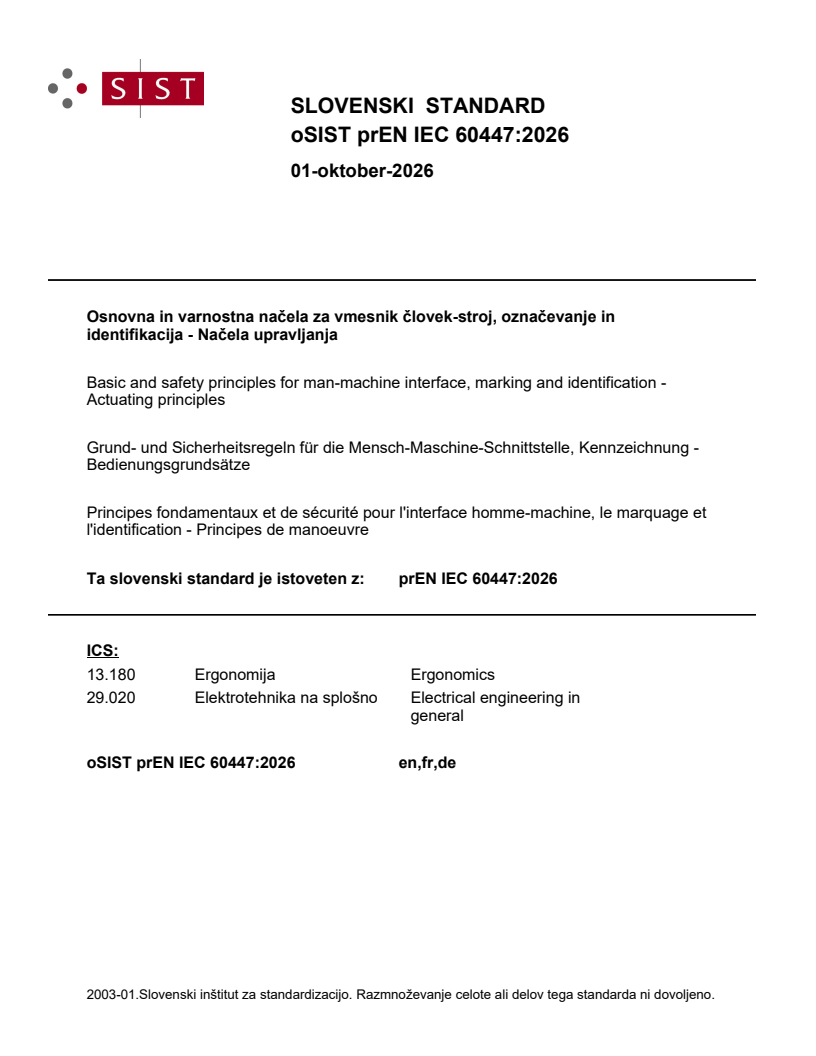
SLOVENSKI STANDARD
01-oktober-2026
Osnovna in varnostna načela za vmesnik človek-stroj, označevanje in
identifikacija - Načela upravljanja
Basic and safety principles for man-machine interface, marking and identification -
Actuating principles
Grund- und Sicherheitsregeln für die Mensch-Maschine-Schnittstelle, Kennzeichnung -
Bedienungsgrundsätze
Principes fondamentaux et de sécurité pour l'interface homme-machine, le marquage et
l'identification - Principes de manoeuvre
Ta slovenski standard je istoveten z: prEN IEC 60447:2026
ICS:
13.180 Ergonomija Ergonomics
29.020 Elektrotehnika na splošno Electrical engineering in
general
2003-01.Slovenski inštitut za standardizacijo. Razmnoževanje celote ali delov tega standarda ni dovoljeno.
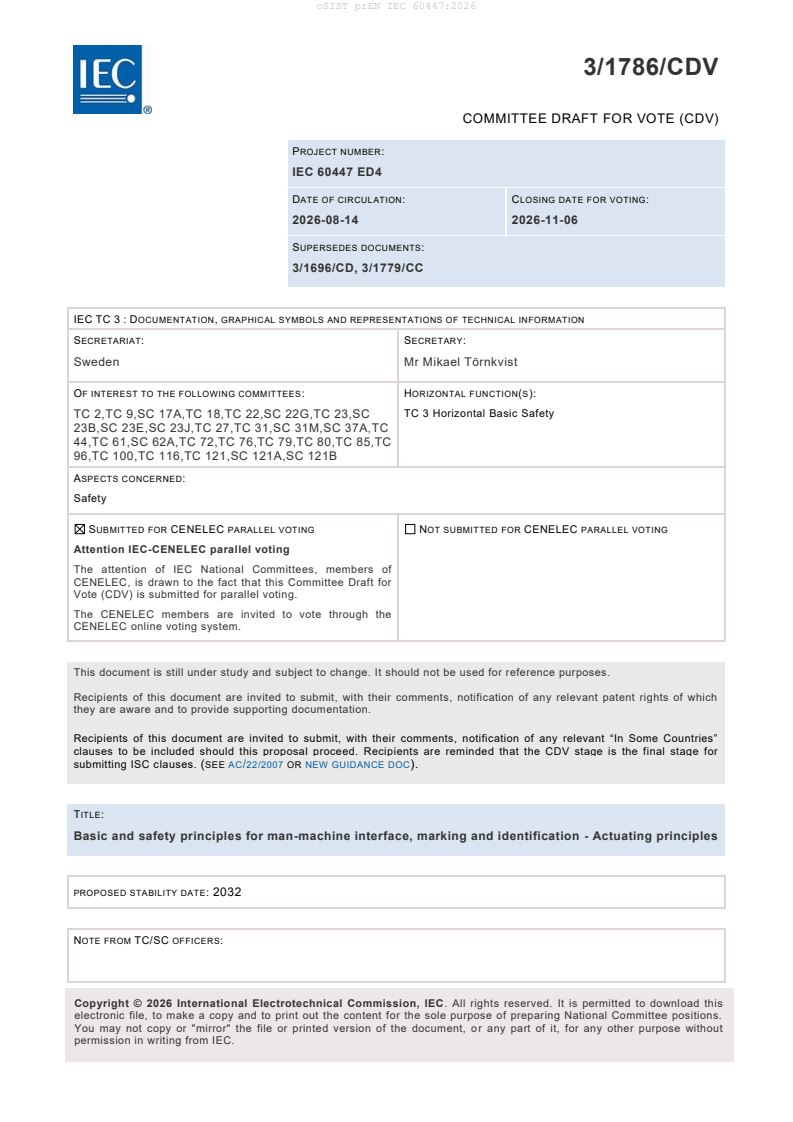
3/1786/CDV
COMMITTEE DRAFT FOR VOTE (CDV)
PROJECT NUMBER:
IEC 60447 ED4
DATE OF CIRCULATION: CLOSING DATE FOR VOTING:
2026-08-14 2026-11-06
SUPERSEDES DOCUMENTS:
3/1696/CD, 3/1779/CC
IEC TC 3 : DOCUMENTATION, GRAPHICAL SYMBOLS AND REPRESENTATIONS OF TECHNICAL INFORMATION
SECRETARIAT: SECRETARY:
Sweden Mr Mikael Törnkvist
OF INTEREST TO THE FOLLOWING COMMITTEES: HORIZONTAL FUNCTION(S):
TC 2,TC 9,SC 17A,TC 18,TC 22,SC 22G,TC 23,SC TC 3 Horizontal Basic Safety
23B,SC 23E,SC 23J,TC 27,TC 31,SC 31M,SC 37A,TC
44,TC 61,SC 62A,TC 72,TC 76,TC 79,TC 80,TC 85,TC
96,TC 100,TC 116,TC 121,SC 121A,SC 121B
ASPECTS CONCERNED:
Safety
SUBMITTED FOR CENELEC PARALLEL VOTING NOT SUBMITTED FOR CENELEC PARALLEL VOTING
Attention IEC-CENELEC parallel voting
The attention of IEC National Committees, members of
CENELEC, is drawn to the fact that this Committee Draft for
Vote (CDV) is submitted for parallel voting.
The CENELEC members are invited to vote through the
CENELEC online voting system.
This document is still under study and subject to change. It should not be used for reference purposes.
Recipients of this document are invited to submit, with their comments, notification of any relevant patent rights of which
they are aware and to provide supporting documentation.
Recipients of this document are invited to submit, with their comments, notification of any relevant “In Some Countries”
clauses to be included should this proposal proceed. Recipients are reminded that the CDV stage is the final stage for
submitting ISC clauses. (SEE AC/22/2007 OR NEW GUIDANCE DOC).
TITLE:
Basic and safety principles for man-machine interface, marking and identification - Actuating principles
PROPOSED STABILITY DATE: 2032
NOTE FROM TC/SC OFFICERS:
electronic file, to make a copy and to print out the content for the sole purpose of preparing National Committee positions.
You may not copy or "mirror" the file or printed version of the document, or any part of it, for any other purpose without
permission in writing from IEC.
Link to Committee Draft for Vote (CDV) online document:
Click here
How to access
This link leads you to the Online Standards Development (OSD) platform for National Mirror Committee’s
(NMC) comments. The project draft may be found further down this document.
Resource materials
We recommend NCs to review the available materials to better understand the member commenting on the
OSD platform. This includes the:
• OSD NC roles overview
• How to add and submit comments to the IEC
Contact
Should you require any assistance, please contact the IEC IT Helpdesk.
IEC CDV 60447 © IEC 2026
CONTENTS
FOREWORD . 3
INTRODUCTION . 5
1 Scope . 6
2 Normative references . 6
3 Terms and definitions . 6
4 General requirements . 9
4.1 Basic principles . 9
4.2 Operating sequence . 10
5 Actions and effects . 12
5.1 General . 12
5.2 Actions to initiate opposite effects . 12
5.2.1 General . 12
5.2.2 Correlation according to the operating direction (movement) of an
actuator . 12
5.2.3 Correlations according to the relative location of actuators . 13
5.3 Stopping an effect . 13
5.4 HMI actuators for emergency stopping and emergency switching-of . 14
5.5 Actions to initiate only one effect . 14
6 Actuator identification requirements . 14
6.1 General . 14
6.2 Visual signal . 14
6.3 Acoustic signal . 14
6.4 Tactile signal . 15
7 Requirements for special kinds and particular use of actuators . 15
7.1 Single actuator for combined start/stop control . 15
7.2 Push-pull buttons . 15
7.3 Raise and lower with a lever . 16
7.4 Foot-operated actuators . 16
7.5 Numeric/alphanumeric keys . 16
7.6 Function keys . 16
7.7 Sensitive areas (actuators) on a visual display unit (VDU) . 17
Annex A (normative) Classification of, and correlation between, actions and their
resulting final effects . 18
Annex B (informative) Typical examples of monofunction actuators . 20
B.1 Kinds of actuators . 20
B.2 Rotation . 20
B.3 Linear motion . 20
Bibliography . 22
Figure 1 – Example of a three-step actuation sequence for mono-function application . 11
Figure 2 – Example of a three-step actuation sequence for multifunction application . 12
Figure 3 – STOP position as part of a moving actuator(example for a linear motion) . 13
Figure 4 – STOP push-button as part of a set of actuators . 13
Figure 5 – Push-pull buttons . 16
Figure 6 – Raise-lower with a horizontal mounted lever . 16
IEC CDV 60447 © IEC 2026
Table 1 – . 4
Table A.1 – Classification of actions . 18
Table A.2 – Classification of final effects . 18
Table B.1 – Examples of movement of some types of HMI actuators . 20
IEC CDV 60447 © IEC 2026
INTERNATIONAL ELECTROTECHNICAL COMMISSION
____________
Basic and safety principles for man-machine interface, marking and
identification - Actuating principles
FOREWORD
1) The International Electrotechnical Commission (IEC) is a worldwide organization for
standardization comprising all national electrotechnical committees (IEC National Committees).
The object of IEC is to promote international co-operation on all questions concerning
standardization in the electrical and electronic fields. To this end and in addition to other
activities, IEC publishes International Standards, Technical Specifications, Technical Reports,
Publicly Available Specifications (PAS) and Guides (hereafter referred to as “IEC
Publication(s)”). Their preparation is entrusted to technical committees; any IEC National
Committee interested in the subject dealt with may participate in this preparatory work.
International, governmental and non-governmental organizations liaising with the IEC also
participate in this preparation. IEC collaborates closely with the International Organization for
Standardization (ISO) in accordance with conditions determined by agreement between the two
organizations.
2) The formal decisions or agreements of IEC on technical matters express, as nearly as
possible, an international consensus of opinion on the relevant subjects since each technical
committee has representation from all interested IEC National Committees.
3) IEC Publications have the form of recommendations for international use and are accepted
by
IEC National Committees in that sense. While all reasonable efforts are made to ensure that
the
technical content of IEC Publications is accurate, IEC cannot be held responsible for the way
in
which they are used or for any misinterpretation by any end user.
4) In order to promote international uniformity, IEC National Committees undertake to apply
IEC Publications transparently to the maximum extent possible in their national and regional
publications. Any divergence between any IEC Publication and the corresponding national or
regional publication shall be clearly indicated in the latter.
5) IEC itself does not provide any attestation of conformity. Independent certification bodies
provide conformity assessment services and, in some areas, access to IEC marks of conformity.
IEC is not responsible for any services carried out by independent certification bodies.
6) All users should ensure that they have the latest edition of this publication.
7) No liability shall attach to IEC or its directors, employees, servants or agents including
individual experts and members of its technical committees and IEC National Committees for
any
personal injury, property damage or other damage of any nature whatsoever, whether direct or
indirect, or for costs (including legal fees) and expenses arising out of the publication, use of,
or reliance upon, this IEC Publication or any other IEC Publications.
8) Attention is drawn to the Normative references cited in this publication. Use of the
referenced publications is indispensable for the correct application of this publication.
IEC CDV 60447 © IEC 2026
9) IEC draws attention to the possibility that the implementation of this document may involve
the use of (a) patent(s). IEC takes no position concerning the evidence, validity or applicability
of any claimed patent rights in respect thereof. As of the date of publication of this document,
IEC [had/had not] received notice of (a) patent(s), which may be required to implement this
document. However, implementers are cautioned that this may not represent the latest
information, which may be obtained from the patent database available at https://patents.iec.ch.
IEC shall not be held responsible for identifying any or all such patent rights.
International Standard IEC 60447 has been prepared by IEC technical committee 3:
Documentation, graphical symbols and technical representations of information. It is an
International Standard.
This fourth edition cancels and replaces the third edition published in 2004. This edition
constitutes a technical revision.
This edition includes the following significant technical changes with respect to the
previous edition:
a) the title of the document has been modified to be gender neutral;
b) definition of terms has been updated;
c) definition of the term "information" is provided;
d) requirements based on out-dated technology has been removed;
e) wording improved to make requirements clearer.
It has the status of a basic safety publication in accordance with IEC Guide 104.
The text of this International Standard is based on the following documents:
Table 1 –
FDIS Report on voting
XX/XX/FDIS XX/XX/RVD
Full information on the voting for its approval can be found in the report on voting indicated in
the above table.
The language used for the development of this International Standard is English .
This document was drafted in accordance with ISO/IEC Directives, Part 2, and developed in
accordance with ISO/IEC Directives, Part 1 and ISO/IEC Directives, IEC Supplement, available
at www.iec.ch/members_experts/refdocs. The main document types developed by IEC are
described in greater detail at www.iec.ch/publications.
The committee has decided that the contents of this document will remain unchanged until the
stability date indicated on the IEC website under webstore.iec.ch in the data related to the
specific document. At this date, the document
will be
– reconfirmed,
– withdrawn, or
– revised.
IEC CDV 60447 © IEC 2026
INTRODUCTION
This basic safety publication is intended for use by technical committees in the preparation of
standards; it is not intended to be used on its own except in the absence of such standards.
Where no safety consideration is involved, the relevant technical committee may permit specific
exclusions within the framework of this basic safety publication, and according to the rules given
in IEC Guide 104 and ISO/IEC Guide 51.
Different kinds of actuators enable electrical equipment and processes to be operated
and maintained under normal and fault conditions.
In modern equipment, the moving of an actuator in a certain direction is only one method of
actuation. In addition, actuators or data input devices arranged in the form of function or
alphanumeric keyboards, or other kinds of actuator (e.g. light pen, touc h sensitive screen,
mouse), are in general use for computerized equipment.
Actuators as a part of the human-machine interface may have a different importance in the
dialogue between the operator and the equipment or machine.
Standardization is especially important where safety is concerned (e.g. where an incorrect
actuation may cause damage, or where a frequent or rapid actuation is necessary, such as in
the operation of cranes or transport vehicles), and is particularly necessary in the case of
equipment likely to be operated by unskilled persons.
Ergonomic aspects should also be taken into account.
IEC CDV 60447 © IEC 2026
1 Scope
This International Standard establishes general actuating principles for manually operated
actuators forming part of the human-machine interface associated with electrical equipment, in
order to:
– increase the safety (e.g. of persons, property, environment) through the safe operation
of the equipment;
– facilitate the proper and timely operation of the actuators.
These principles apply, not only for the operation of electrical equipment, machines,
or complete plant under normal conditions, but also under fault or emergency conditions.
This standard is for general application, from simple cases such as single actuators
(e.g. push-buttons) to multiple actuators, forming part of a large assembly of electrical and
non-electrical equipment, or part of a central process control station.
This standard establishes correlations between the function of an actuator and its direction of
actuating or location in relation to other actuators.
In the absence of particular rules, this standard can also be applied to actuators operated by a
part of the human body other than the hand (e.g. to foot-operated devices).
This BASIC SAFETY PUBLICATION focusing on SAFETY essential requirement is primarily
intended for use by technical committees in the preparation of SAFETY publications in
accordance with the principles laid down in IEC Guide 104 and ISO/IEC Guide 51.
One of the responsibilities of a technical committee is, wherever applicable, to make use of
basic safety publications in the preparation of its publications.
2 Normative references
The following documents are referred to in the text in such a way that some or all of their content
constitutes requirements of this document. For dated references, only the edition cited applies.
For undated references, the latest edition of the referenced document (including any
amendments) applies.
IEC Guide 104, The preparation of safety publications and the use of basic safety publications
and group
safety publications
IEC 60073, Basic and safety principles for man-machine interface, marking and identification –
Coding
principles for indicators and actuators
ISO/IEC Guide 51, Safety aspects – Guidelines for their inclusion in standards
3 Terms and definitions
For the purposes of this document, the following terms and definitions apply.
3.1
HMI actuator
part of the actuating system which is subject to a direct human intervention
IEC CDV 60447 © IEC 2026
Note 1 to entry: The actuator may take the form of a handle, knob, push-button, push-push button, push-pull button,
roller, plunger, mouse, light pen, keyboard (3.4), touch sensitive screen, voice actuator.
Note 2 to entry: The definition of an actuator is based on IEV 441‑15‑22 and, for
the purposes of this standard, is narrowed to human actuation.
[SOURCE: IEV 441-15-22, modified – The word "HMI" added to the term, the phrase "to which
an external actuating force is applied" is replaced by "which is subject to a direct human
intervention ", and more examples are added to Note 1 to entry.]
3.2
monofunction actuator
one or a set of actuators correlated to one final effect (e.g. by direction of
movement, or by disposition of actuators)
3.3
3.4
keyboard
device comprising a number of captioned keys, each of which can cause a discrete signal (3.12)
or an action when pressed or touched
Note 1 to entry: A keyboard (3.4) can be simulated on a screen area, where the virtual push-buttons are activated
by a pointing device.
[SOURCE: IEC 60050-171: 2019, 171-04-38, modified – "input device" replaced by "device".]
3.5
key
push-button or sensitive touchable area for activating the appropriate response
associated with the push-button or the sensible touchable area
3.6
numeric keys
keys representing numerals
3.7
alphanumeric keys
keys representing alphanumeric characters or function
3.8
function keys
HMI actuators located in a keyboard representing certain equipment, machines, functions or
commands
3.9
alphanumeric keyboard
keyboard (3.4) with arrangement of keys representing alphanumerical characters and functions
3.10
3.11
human-machine interface
HMI
system intended to enable a direct means of communication between a human and a process
or equipment, enabling the human to monitor and control the equipment or process
Note 1 to entry: Such parts may include manually operated actuators, indicators and
screens.
IEC CDV 60447 © IEC 2026
3.12
signal
physical phenomenon whose presence, absence, or variation is considered as representing
information (3.18)
Note 1 to entry: The physical phenomenon can be, for instance, an electromagnetic or acoustic wave, and variation
can be, for instance, that of an electric field, a voltage or a sound pressure.
Note 2 to entry: The information (3.18) is generally represented by one or more quantities, which are called the
"characteristics carrying information (3.18)".
Note 3 to entry: Specific definitions are given in IEV 351-41-17 and IEV 714-06-01 for use of the term "signal" in
the domains of control technology and signalling in telecommunication, respectively.
[SOURCE: IEC 60050-171: 2019, 171-01-03]
3.13
visual signal
information (3.18) conveyed by means of brightness, contrast, colour, shape, size or position
3.14
acoustic signal
information (3.18) conveyed by means of tone, frequency and intermittency, emanating from a
sound source
3.15
tactile signal
information (3.18) conveyed by means of vibration, force, surface roughness, contour or
position
3.16
computer screen
visual display terminal
screen
display
monitor
VDT
device that gives a visual representation of data
[SOURCE: IEC 60050-171: 2019, 171-04-39, modified – visual display terminal and VDT added
as synonyms and "output device" replaced by "device".]
3.17
XY-VDU controller
free moving actuator to select a specific area on a screen, which represents a certain equipment
or command
Note 1 to entry: This actuator may take the form of a joystick, mouse, track ball, light pen
or touch sensitive screen.
3.18
information
knowledge represented for communication, storage or processing
Note 1 to entry: Information may be represented for example, by signs, symbols, pictures or sounds.
[SOURCE: IEC 60050-181:-, 181-01-03]
IEC C
...