

prEN IEC 62675:2025
(Main)Secondary cells and batteries containing alkaline or other non-acid electrolytes - Sealed nickel-metal hydride prismatic rechargeable cells and batteries for use in industrial applications.
- Status
- Not Published
- Publication Date
- 10-Mar-2027
- Technical Committee
- CLC/TC 21X - Secondary cells and batteries
- Current Stage
- 4060 - Enquiry results established and sent to TC, SR, BTTF - Enquiry
- Start Date
- 14-Nov-2025
- Completion Date
- 14-Nov-2025

prEN IEC 62675:2025 is a draft IEC/CENELEC standard for sealed nickel-metal hydride prismatic rechargeable cells and batteries used in industrial applications. It specifies how these cells and battery systems are designated, marked, sized, tested, and accepted so that manufacturers, system integrators, buyers, and test laboratories use the same basis for performance and quality claims.
What does prEN IEC 62675:2025 specify?
prEN IEC 62675:2025 specifies the marking, designation, dimensions, tests, and requirements for sealed nickel-metal hydride prismatic secondary single cells and battery systems made from them. In this document, prismatic means a cell with rectangular sides and base.
Where this standard conflicts with another IEC standard for a special application, the special-application standard takes precedence. That matters in practice because a product intended for a particular industrial use may need to meet both this document and a more specific IEC requirement.
| Clause | Topic |
|---|---|
| 1 | Scope |
| 2 | Normative references |
| 3 | Terms and definitions |
| 4 | Parameter measurement tolerances |
| 5 | Designation and marking |
| 6 | Dimensions |
| 7 | Electrical tests |
| 8 | Mechanical tests |
| 9 | Physical appearance |
| 10 | Conditions for approval and acceptance |
What are the key requirements of prEN IEC 62675:2025?
prEN IEC 62675:2025 is mainly a performance-and-acceptance standard. The most important requirements are the measurement tolerances, the naming and marking system, the dimensional limits, the electrical test methods, and the approval/acceptance checks that support type approval and batch release.
Measurement, designation, and marking
Clause 4 sets the overall tolerances for test and measurement results: voltage, current, temperature, time, and capacity all have defined accuracy limits. This matters because pass/fail results depend on controlled measurements, not just nominal instrument settings.
Clause 5 defines the cell designation system. Sealed nickel-metal hydride prismatic cells are identified by HP plus a discharge-rate letter - L, M, H, or X - followed by the rated capacity, with optional markings for the T5 test condition and for steel containers. The marking also has to show the cell type, manufacturer or supplier identification, and the positive terminal symbol or red washer, so users can identify the product and connect it correctly.
Dimensions and product form
Clause 6 gives preferred maximum dimensions for cells in steel containers and plastic containers, with separate tables for each container type. The table values are not tied to a single capacity class, so the same dimensional framework applies to L, M, H, and X cells.
The clause also sets the measurement tolerance for width and length. For a buyer or designer, that means a cell can be checked against a clear dimensional envelope before it is built into a module, cabinet, or industrial battery system.
Electrical performance tests
Clause 7 starts with common test conditions. Test currents are based on rated capacity, liquid electrolyte leakage is not acceptable in the electrical tests, and charge or discharge should be stopped if the cell reaches 70 °C. The standard also gives a defined charging procedure before the tests, which keeps results comparable between laboratories.
The discharge tests cover 20 °C, +5 °C, and −18 °C, with minimum discharge durations defined for each cell designation. The practical point is that the cell has to prove usable capacity not only at room temperature but also in colder conditions relevant to industrial service.
Clause 7.3.5 adds a high-rate current test. The cell is pulsed for 5 s at a current that depends on the designation, and the acceptance criteria are no fusing, no case deformation, and no internal component deformation. That test checks whether the cell can tolerate short, heavy loads without mechanical damage.
Internal resistance, pulse power, and constant power
Clause 7.4 measures internal resistance by either an AC or DC method. The DC method uses pulsed discharge measurements at 20 %, 50 %, and 80 % final acceptance state of charge (SoC); the AC method is optional and uses 1,0 kHz ± 0,1 kHz. In practice, these values let a manufacturer declare resistance behavior and let a purchaser compare aging performance over time.
Clause 7.5 uses the same pulsed test data to calculate pulse power capability. Clause 7.6 adds a constant power measurement test and notes that the result can be used for round-trip efficiency (RTE) calculations in representative energy applications. This is useful when the user needs to know not just how much energy the cell stores, but how well it supports repeated charge/discharge cycling.
Durability, safety, and acceptance
Clause 7.7 checks charge retention after 28 days on open circuit. Clause 7.8 then runs endurance cycling and requires repeated performance checks until the discharge duration falls below the stated limit, with a total endurance of not less than 500 cycles. The clause also tracks capacity fade, internal DC resistance increase, pulse power fade, constant power fade, and energy RTE fade.
Clause 7.10 covers overcharge, Clause 7.12 checks safety device operation, Clause 7.13 checks gas leakage, and Clause 7.14 covers storage followed by discharge performance. These tests matter because industrial users need cells that remain safe, retain performance, and recover properly after storage or abnormal charging.
Clause 10 brings the tests together for type approval and batch acceptance. It gives the sample grouping and the test sequences used to approve a design and to inspect delivered cells.
What terms does prEN IEC 62675:2025 define?
- Sealed cell - A cell that remains closed and does not release gas or liquid when used within the manufacturer’s stated charge and temperature limits.
- Nominal voltage - The approximate voltage used to identify a cell or battery; for a sealed nickel-metal hydride rechargeable single cell, the document gives 1,2 V.
- Ageing factor - A quantitative measure of how usage reduces the ability of the battery to deliver electrical energy under specified conditions.
- Battery module - A group of cells connected in series and/or parallel without protective devices such as a fuse or temperature sensor.
- End user - The organization that operates the battery system, usually the operator of the equipment using it.
- System integrator - The organization technically responsible for the complete battery system and charging system.
- Cumulated requested service (CRS) - The total service the buyer or end user asks for, expressed as time or delivered energy.
- Rated capacity - The capacity value declared by the manufacturer under specified conditions; the document links it to the 0,2 I A reference discharge.
Who uses prEN IEC 62675:2025?
prEN IEC 62675:2025 is used by cell manufacturers, battery system manufacturers, system integrators, equipment manufacturers, test laboratories, and certification bodies. It is also relevant to buyers, quality managers, and end users who need a common technical basis for industrial procurement, type approval, and batch acceptance.
The document is especially useful when a battery system has to be specified, tested, and documented in a way that can be compared across suppliers. In practice, it supports design review, incoming inspection, qualification testing, and service-life claims.
What changed in prEN IEC 62675:2025 from the previous edition?
prEN IEC 62675:2025 is the second edition. The foreword says it cancels and replaces the first edition published in 2014 and that this edition is a technical revision.
Which standards are used with prEN IEC 62675:2025?
- IEC 60050-482:2004 - Provides the core vocabulary for primary and secondary cells and batteries, and is the basis for the terms used in Clause 3.
- IEC 60417 (all parts) - Supplies graphical symbols for equipment; this document uses it for the positive terminal marking symbol.
- IEC 61438 - The document points users to this guide for possible safety and health hazards in the use of alkaline secondary cells and batteries.
- IEC 60410 - Provides sampling plans and procedures for inspection by attributes, which supports the batch acceptance approach in Clause 10.
What does the prEN IEC 62675:2025 document contain?
The document contains preferred dimensions for steel and plastic container designs, example figures of prismatic cell constructions, and tables for measurement tolerances and discharge performance at different temperatures. It also contains test methods and calculation steps for internal resistance, pulse power, constant power, capacity fade, resistance increase, and efficiency fade.
For qualification work, the most useful parts are the detailed electrical test sequences, the type-approval grouping in Table 10, and the batch acceptance guidance in Table 11. For design and reporting, the formulas and the pulse-discharge graph explain how to derive the declared performance values from measured voltage and current data.
Relations
- Effective Date
- 09-Jul-2024
Get Certified
Connect with accredited certification bodies for this standard

IMQ S.p.A. (Certification)
Italian electrical product certification.

SLG Prüf- und Zertifizierungs GmbH
German testing and certification body.

UL Solutions
Global safety science company with testing, inspection and certification.
Sponsored listings
Frequently Asked Questions
prEN IEC 62675:2025 is a draft published by CLC. Its full title is "Secondary cells and batteries containing alkaline or other non-acid electrolytes - Sealed nickel-metal hydride prismatic rechargeable cells and batteries for use in industrial applications.". This standard covers: Secondary cells and batteries containing alkaline or other non-acid electrolytes - Sealed nickel-metal hydride prismatic rechargeable cells and batteries for use in industrial applications.
Secondary cells and batteries containing alkaline or other non-acid electrolytes - Sealed nickel-metal hydride prismatic rechargeable cells and batteries for use in industrial applications.
prEN IEC 62675:2025 is classified under the following ICS (International Classification for Standards) categories: 29.220.99 - Other cells and batteries. The ICS classification helps identify the subject area and facilitates finding related standards.
prEN IEC 62675:2025 has the following relationships with other standards: It is inter standard links to EN 62675:2014. Understanding these relationships helps ensure you are using the most current and applicable version of the standard.
prEN IEC 62675:2025 is available in PDF format for immediate download after purchase. The document can be added to your cart and obtained through the secure checkout process. Digital delivery ensures instant access to the complete standard document.
Standards Content (Sample)
SLOVENSKI STANDARD
01-oktober-2025
Sekundarni členi in baterije z alkalnimi ali drugimi nekislinskimi elektroliti -
Zatesnjeni nikelj-kovinski hidridni prizmatični ponovno polnljivi členi in baterije za
industrijsko uporabo
Secondary cells and batteries containing alkaline or other non-acid electrolytes - Sealed
nickel-metal hydride prismatic rechargeable cells and batteries for use in industrial
applications.
Akkumulatoren und Batterien mit alkalischen oder anderen nichtsäurehaltigen
Elektrolyten - Prismatische wiederaufladbare gasdichte Nickel-Metallhydrid-Einzelzellen
für industrielle Anwendungen
Accumulateurs alcalins et autres accumulateurs à électrolyte non acide - Accumulateurs
étanches parallélépipédiques au nickel-métal hydrure destinés à l’utilisation dans les
applications industrielles
Ta slovenski standard je istoveten z: prEN 62675:2025
ICS:
29.220.99 Drugi členi in baterije Other cells and batteries
2003-01.Slovenski inštitut za standardizacijo. Razmnoževanje celote ali delov tega standarda ni dovoljeno.
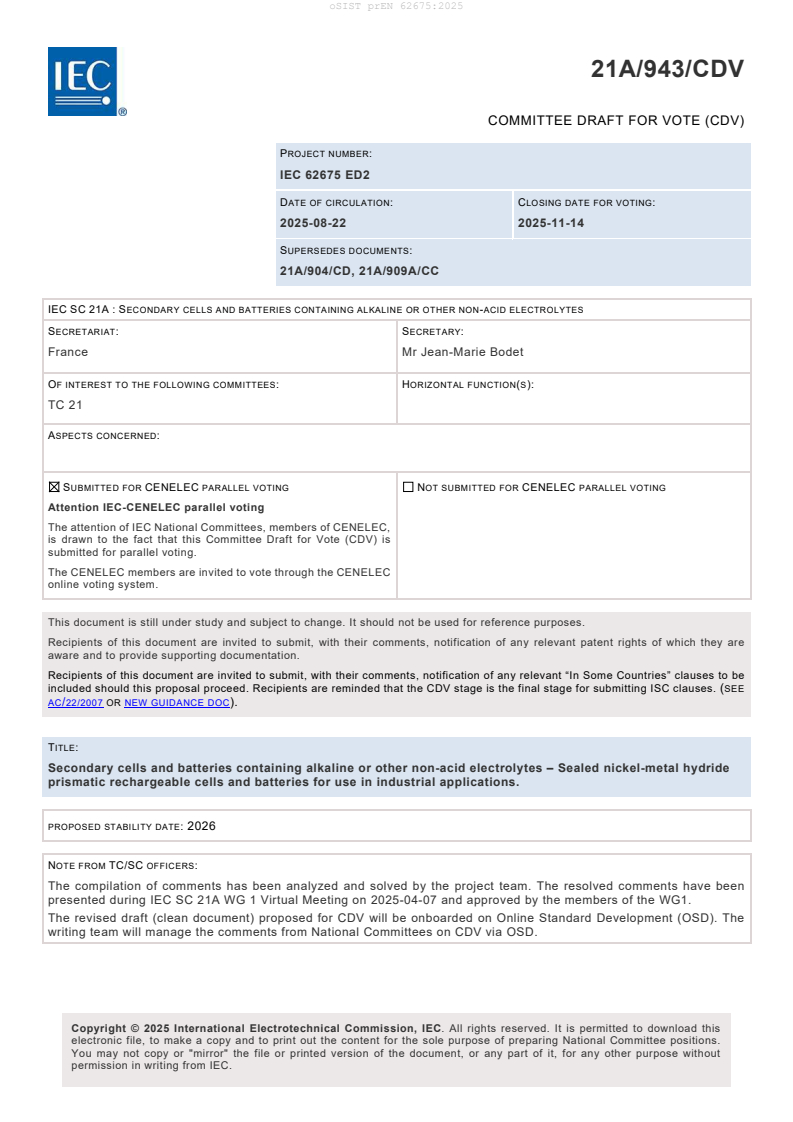
21A/943/CDV
COMMITTEE DRAFT FOR VOTE (CDV)
PROJECT NUMBER:
IEC 62675 ED2
DATE OF CIRCULATION: CLOSING DATE FOR VOTING:
2025-08-22 2025-11-14
SUPERSEDES DOCUMENTS:
21A/904/CD, 21A/909A/CC
IEC SC 21A : SECONDARY CELLS AND BATTERIES CONTAINING ALKALINE OR OTHER NON-ACID ELECTROLYTES
SECRETARIAT: SECRETARY:
France Mr Jean-Marie Bodet
OF INTEREST TO THE FOLLOWING COMMITTEES: HORIZONTAL FUNCTION(S):
TC 21
ASPECTS CONCERNED:
SUBMITTED FOR CENELEC PARALLEL VOTING NOT SUBMITTED FOR CENELEC PARALLEL VOTING
Attention IEC-CENELEC parallel voting
The attention of IEC National Committees, members of CENELEC,
is drawn to the fact that this Committee Draft for Vote (CDV) is
submitted for parallel voting.
The CENELEC members are invited to vote through the CENELEC
online voting system.
This document is still under study and subject to change. It should not be used for reference purposes.
Recipients of this document are invited to submit, with their comments, notification of any relevant patent rights of which they are
aware and to provide supporting documentation.
Recipients of this document are invited to submit, with their comments, notification of any relevant “In Some Countries” clauses to be
included should this proposal proceed. Recipients are reminded that the CDV stage is the final stage for submitting ISC clauses. (SEE
AC/22/2007 OR NEW GUIDANCE DOC).
TITLE:
Secondary cells and batteries containing alkaline or other non-acid electrolytes – Sealed nickel-metal hydride
prismatic rechargeable cells and batteries for use in industrial applications.
PROPOSED STABILITY DATE: 2026
NOTE FROM TC/SC OFFICERS:
The compilation of comments has been analyzed and solved by the project team. The resolved comments have been
presented during IEC SC 21A WG 1 Virtual Meeting on 2025-04-07 and approved by the members of the WG1.
The revised draft (clean document) proposed for CDV will be onboarded on Online Standard Development (OSD). The
writing team will manage the comments from National Committees on CDV via OSD.
electronic file, to make a copy and to print out the content for the sole purpose of preparing National Committee positions.
You may not copy or "mirror" the file or printed version of the document, or any part of it, for any other purpose without
permission in writing from IEC.
Link to Committee Draft for Vote (CDV) online document:
https://osd.iec.ch/#/editor/archive/38efc27b-2747-84ef-e063-b912000a4406/en/CCDV/1
How to access
This link leads you to the Online Standards Development (OSD) platform for National Mirror Committee’s
(NMC) comments. The project draft may be found further down this document.
Resource materials
We recommend NCs to review the available materials to better understand the member commenting on
the OSD platform. This includes the:
• OSD NC roles overview
• How to add and submit comments to the IEC
Contact
Should you require any assistance, please contact the IEC IT Helpdesk.
IEC CDV 62675 ED2 © IEC 2025
CONTENTS
CONTENTS . 1
FOREWORD . 3
Introduction. 5
1 Scope . 6
2 Normative references . 6
3 Terms and definitions . 6
4 Parameter measurement tolerances . 7
5 Designation and marking . 8
5.1 Cell designation . 8
5.2 Cell termination . 8
5.3 Marking . 8
5.4 Safety recommendations . 9
6 Dimensions . 9
7 Electrical tests . 11
7.1 General . 11
7.2 Charging procedure for test purposes . 11
7.3 Discharge performance . 11
7.3.1 General . 11
7.3.2 Discharge performance at 20 °C . 11
7.3.3 Discharge performance at +5 °C . 12
7.3.4 Discharge performance at −18 °C . 12
7.3.5 High rate current test . 13
7.4 Internal resistance . 13
7.4.1 General . 13
7.4.2 Measurement of the internal DC resistance . 14
7.4.3 Measurement of the internal AC resistance (optional) . 15
7.5 Pulse power calculation . 16
7.5.1 General . 16
7.5.2 Test method . 16
7.5.3 Acceptance criteria . 17
7.6 Constant power measurement test . 17
7.6.1 General . 17
7.6.2 Test method . 17
7.6.3 Test result . 17
7.7 Charge retention . 17
7.8 Endurance . 18
7.8.1 Endurance in cycles . 18
7.8.2 Final test after completion of endurance in cycles test . 19
7.8.3 General . 20
7.8.4 Permanent charge endurance . 21
7.9 Charge acceptance at constant voltage. 21
7.10 Overcharge . 21
7.11 Vent plug operation . 21
7.12 Safety device operation . 21
7.13 Gas leakage test . 22
IEC CDV 62675 ED2 © IEC 2025
7.14 Storage . 22
7.15 Power measurement Test . 22
8 Mechanical tests . 22
9 Physical appearance . 22
10 Conditions for approval and acceptance . 22
10.1 Type approval . 22
10.2 Batch acceptance . 23
Bibliography . 25
Figure 1 – Example of a sealed prismatic cell in steel container with two terminals and
four lugs . 9
Figure 2 – Example of a sealed prismatic cell in plastic container with two terminals . 10
Figure 3 – Pulsed Discharge graph showing the voltage behaviour under a current
pulse . 15
Table 1 – Dimensions for sealed nickel-metal hydride prismatic cells in steel containers . 10
Table 2 – Dimensions for sealed nickel-metal hydride prismatic cells in plastic
containers . 10
Table 3 – Measurement tolerances in millimetres (valid for widths and lengths) . 11
Table 4 – Discharge performance at 20 °C . 12
Table 5 – Discharge performance at +5 °C . 12
Table 6 – Discharge performance at −18 °C . 12
Table 7 – High currents values . 13
Table 8 – Discharge current and pulse current applied during the measurement of the
internal DC resistance . 14
Table 9 – Endurance in cycles . 18
Table 10 – Sequence of tests for type approval . 23
Table 11 – Recommended test sequence for batch acceptance . 23
IEC CDV 62675 ED2 © IEC 2025
INTERNATIONAL ELECTROTECHNICAL COMMISSION
____________
Secondary cells and batteries containing alkaline or other non-acid
electrolytes - Sealed nickel-metal hydride prismatic rechargeable cells
and batteries for use in industrial applications.
FOREWORD
1) The International Electrotechnical Commission (IEC) is a worldwide organization for
standardization comprising all national electrotechnical committees (IEC National Committees).
The object of IEC is to promote international co-operation on all questions concerning
standardization in the electrical and electronic fields. To this end and in addition to other
activities, IEC publishes International Standards, Technical Specifications, Technical Reports,
Publicly Available Specifications (PAS) and Guides (hereafter referred to as "IEC
Publication(s)"). Their preparation is entrusted to technical committees; any IEC National
Committee interested in the subject dealt with may participate in this preparatory work.
International, governmental and non-governmental organizations liaising with the IEC also
participate in this preparation. IEC collaborates closely with the International Organization for
Standardization (ISO) in accordance with conditions determined by agreement between the two
organizations.
2) The formal decisions or agreements of IEC on technical matters express, as nearly as
possible, an international consensus of opinion on the relevant subjects since each technical
committee has representation from all interested IEC National Committees.
3) IEC Publications have the form of recommendations for international use and are accepted
by IEC National Committees in that sense. While all reasonable efforts are made to ensure that
the technical content of IEC Publications is accurate, IEC cannot be held responsible for the
way in which they are used or for any misinterpretation by any end user.
4) In order to promote international uniformity, IEC National Committees undertake to apply IEC
Publications transparently to the maximum extent possible in their national and regional
publications. Any divergence between any IEC Publication and the corresponding national or
regional publication shall be clearly indicated in the latter.
5) IEC itself does not provide any attestation of conformity. Independent certification bodies
provide conformity assessment services and, in some areas, access to IEC marks of conformity.
IEC is not responsible for any services carried out by independent certification bodies.
6) All users should ensure that they have the latest edition of this publication.
7) No liability shall attach to IEC or its directors, employees, servants or agents including
individual experts and members of its technical committees and IEC National Committees for
any personal injury, property damage or other damage of any nature whatsoever, whether direct
or indirect, or for costs (including legal fees) and expenses arising out of the publication, use
of, or reliance upon, this IEC Publication or any other IEC Publications.
8) Attention is drawn to the Normative references cited in this publication. Use of the referenced
publications is indispensable for the correct application of this publication.
9) IEC draws attention to the possibility that the implementation of this document may involve
the use of (a) patent(s). IEC takes no position concerning the evidence, validity or applicability
of any claimed patent rights in respect thereof. As of the date of publication of this document,
IEC CDV 62675 ED2 © IEC 2025
IEC [had/had not] received notice of (a) patent(s), which may be required to implement this
document. However, implementers are cautioned that this may not represent the latest
information, which may be obtained from the patent database available at https://patents.iec.ch.
IEC shall not be held responsible for identifying any or all such patent rights.
IEC 62675 has been prepared by subcommittee 21A: Secondary cells and batteries containing
alkaline or other non-acid electrolytes, of IEC technical committee 21: Secondary cells and
batteries. It is an International Standard.
This second edition cancels and replaces the first edition published in 2014. This edition
constitutes a technical revision.
This edition includes the following significant technical changes with respect to the previous
edition:
a) .;
The text of this International Standard is based on the following documents:
Draft Report on voting
XX/XX/FDIS XX/XX/RVD
Full information on the voting for its approval can be found in the report on voting indicated in
the above table.
The language used for the development of this International Standard is English [change
language if necessary].
This document was drafted in accordance with ISO/IEC Directives, Part 2, and developed in
accordance with ISO/IEC Directives, Part 1 and ISO/IEC Directives, IEC Supplement, available
at www.iec.ch/members_experts/refdocs. The main document types developed by IEC are
described in greater detail at www.iec.ch/publications.
The committee has decided that the contents of this document will remain unchanged until the
stability date indicated on the IEC website under webstore.iec.ch in the data related to the
specific document. At this date, the document will be
– reconfirmed,
– withdrawn, or
– revised.
IEC CDV 62675 ED2 © IEC 2025
Introduction
The following item was listed in the bibliography but not cited in the text. Please find a suitable
place to cite it to justify its inclusion in the bibliography:
IEC 60051 (all parts), Direct acting indicating analogue electrical measuring instruments and
their accessoriesIEC 60051 (all parts) [1]
IEC 60417 (all parts), Graphical symbols for use on equipmentIEC 60417 (all parts) [2]
IEC 60485, Digital electronic d.c. voltmeters and d.c. electronic analogue-to-digital
convertorsIEC 60485 [3]
IEC 61434:1996, Secondary cells and batteries containing alkaline or other non-acid
electrolytes - Guide to designation of current in alkaline secondary cell and battery
standardsIEC 61434:1996 [4]
___________
This publication was withdrawn.
IEC CDV 62675 ED2 © IEC 2025
1 Scope
This International Standard specifies marking, designation, dimensions, tests and requirements
for sealed nickel-metal hydride prismatic secondary single cells and battery systems made of
them.
NOTE In this context, "prismatic" refers to cells having rectangular sides and base.
When there exists an IEC standard specifying test conditions and requirements for cells used
in special applications and which is in conflict with this standard, the former takes precedence.
2 Normative references
The following documents are referred to in the text in such a way that some or all of their content
constitutes requirements of this document. For dated references, only the edition cited applies.
For undated references, the latest edition of the referenced document (including any
amendments) applies.
IEC 60050-482:2004, International Electrotechnical Vocabulary (IEV) - Part 482: Primary and
secondary cells and batteries
3 Terms and definitions
For the purposes of this document, the terms and definitions given in IEC 60050-482:2004 and
the following apply.
ISO and IEC maintain terminology databases for use in standardization at the following
addresses:
– IEC Electropedia: available at https://www.electropedia.org/
– ISO Online browsing platform: available at https://www.iso.org/obp
3.1
sealed cell
cell which remains closed and does not release either gas or liquid when operated within the
limits of charge and temperature specified by the manufacturer
Note 1 to entry: The cell is equipped with a safety device to prevent dangerously high internal pressure.
Note 2 to entry: The cell does not require addition to the electrolyte and is designed to operate during its life in its
original sealed state.
Note 3 to entry: The nickel-metal hydride cell, however, may release gas towards the end of its life due to the
accumulation of hydrogen in the cell.
[SOURCE: IEC 60050-482:2004, 482-05-17, modified - The existing note has been developed
into Notes 1, 2 and 3 to entry.]
3.2
nominal voltage
suitable approximate value of voltage used to designate or identify the voltage of a cell or
battery
Note 1 to entry: The nominal voltage of a sealed nickel-metal hydride rechargeable single cell: 1,2 V.
Note 2 to entry: The nominal voltage of a battery of n series connected cells is equal to n times the nominal voltage
of a single cell.
[SOURCE: IEC 60050-482:2004, 482-03-31, modified - Addition of Notes 1 and 2 to entry.]
IEC CDV 62675 ED2 © IEC 2025
3.3
ageing factor
quantitative factor expressing the degradation in the ability of the battery, due to usage, to
deliver electrical energy under specified operating conditions such as, but not limited to,
operating ambient temperature, cycling considering depth of discharge (DOD), and
maintenance practices
3.4
battery module
group of cells connected together either in a series and/or parallel configuration without
protective devices (e.g. fuse or temperature sensor)
3.5
end user
organization which operates the battery system
Note 1 to entry: The end user is normally an organization which operates the device equipped with the battery
system, unless the responsibility is delegated to a main contractor or consultant.
3.6
system integrator
organization which has the technical responsibility of the complete battery system and charging
system
Note 1 to entry: The system integrator can be the end user or the equipment manufacturer, or none of them.
3.7
manufacturer
organization which has the technical responsibility for its scope of supply
Note 1 to entry: The manufacturer can be the equipment manufacturer or the system integrator of a battery system,
a cell manufacturer, etc. If necessary to explicitly distinguish, "equipment manufacturer", "battery system
manufacturer" or "cell manufacturer" is expressed.
3.8
cumulated requested service
CRS
total amount of service requested by the buyer or the end user, expressed in duration (months
or years) or delivered energy in kWh, under e.g representative ambient and operating conditions
as expressed
3.9
rated capacity
capacity value of a battery determined under specified conditions and declared by the
manufacturer
Note 1 to entry: The rated capacity is the quantity of electricity C Ah (ampere-hours) declared by the manufacturer
which a battery can deliver when discharged at the reference test current of 0,2 I A to a final voltage of 1,0 V at +20
t
°C when charged, stored and discharged under the conditions specified in Clause 7.
[SOURCE: IEC 60050-482:2004, 482-03-15, modified - Addition of Note 1 to entry.]
4 Parameter measurement tolerances
The overall accuracy of controlled or measured values, relative to the specified or actual values,
shall be within these tolerances:
a) ±1 % for voltage;
b) ±1 % for current;
IEC CDV 62675 ED2 © IEC 2025
c) ±2 °C for temperature;
d) ±0,1 % for time;
e) ±1 % for capacity.
These tolerances comprise the combined accuracy of the measuring instruments, the
measurement techniques used, and all other sources of error in the test procedure.
The details of the instrumentation used shall be provided in any report of results.
5 Designation and marking
5.1 Cell designation
Sealed nickel-metal hydride prismatic secondary single cells shall be designated by the letter
"HP" followed by a letter L, M, H or X which signifies:
– low rate of discharge (L);
– medium rate of discharge (M);
– high rate of discharge (H);
– very high rate of discharge (X).
NOTE These types of cells are typically but not exclusively used for the following discharge rates
– L up to 0,5 I A,
t
– M up to 3,5 I A,
t
– H up to 7,0 I A,
t
– X up to and above 7,0 I A.
t
This group of two letters shall be followed by a group of figures indicative of the rated capacity
of the cell in ampere-hours.
Cells that have been tested at 20 °C and 5 °C but not at −18 °C shall carry an additional marking
of T5.
For example: HPH 100 or HPH 100 T5.
Cells in cases of steel material shall be designated by the letter "S" after the figures.
For example: HPH 100 S or HPH 100 S T5.
5.2 Cell termination
This standard does not specify cell termination.
5.3 Marking
Each cell or monobloc shall carry durable markings giving the following minimum information:
– type of cell (designation as specified in 5.1; in addition, it is permissible for a manufacturer
to use his own type designation);
– name or identification of manufacturer or supplier;
– positive terminal: either a red washer or an indented or raised symbol, (see graphical symbol
5005 of IEC 60417 (all parts) [2]).
IEC CDV 62675 ED2 © IEC 2025
5.4 Safety recommendations
The manufacturer shall provide recommendations for the safe handling of the cell. See also IEC
61438 [5]:update last version.
6 Dimensions
Dimensions of cells shown in Figure 1 and Figure 2 are given in Table 1 and Table 2.
NOTE Cells in steel container can have two or more terminals and four or more lugs.
Figure 1 – Example of a sealed prismatic cell in steel container with two terminals and
four lugs
IEC CDV 62675 ED2 © IEC 2025
NOTE Cells in plastic container can have two or more terminals.
Figure 2 – Example of a sealed prismatic cell in plastic container with two terminals
Table 1 – Dimensions for sealed nickel-metal hydride prismatic cells in steel containers
Maximum height,h Width,b Length,d
mm mm mm
210 155 55
320 230 61
Table 2 – Dimensions for sealed nickel-metal hydride prismatic cells in plastic
containers
Maximum height,h Width,b Length,d
mm mm mm
125 83 36
146 98 41
168 83 34
178 116 37, 40
191 134 49
195 60 78
200 120 47
224 182 55
300 220 224
NOTE 1 The dimensions given in Table 1 and Table 2 represent preferred values.
NOTE 2 The widths relate to the overall width dimension of the cell excluding for cells in steel container the
thickness of the lug flanges. The values for widths and lengths given in Table 1 and Table 2 are maximum values;
their negative tolerances are given in Table 3.
NOTE 3 The values for height given in Table 1 and Table 2 relate to the maximum height over the terminals or the
closed cell vent, whichever is the greater. No lower limits are stated.
IEC CDV 62675 ED2 © IEC 2025
NOTE 4 The dimensions shown in Table 1 and Table 2 are not associated to particular cell capacities. They apply
to all kinds of sealed nickel-metal hydride prismatic cells, i.e. L, M, H and X types.
Table 3 – Measurement tolerances in millimetres (valid for widths and lengths)
Up to and including 60 mm 0 to −2
Above 60 mm, up to and including 120 mm 0 to −3
Above 120 mm 0 to −4
7 Electrical tests
7.1 General
Charge and discharge currents for the tests in accordance with 7.2 to 7.10 inclusive shall be
based on the value of the rated capacity.
In all tests, except where noted, no leakage of electrolyte in liquid form shall be observed. A
cooling device may be necessary, referring to manufacturer’s instructions. When the
temperature on the cell reaches a level of 70 °C, the charge or discharge should be
discontinued.
In all electrical tests, safety pressure plate may be used at outside of the cell to prevent a
deformation of cell case.
7.2 Charging procedure for test purposes
Prior to charging, the cells shall have been discharged in an ambient temperature of 20 °C ±
5 °C, at a constant current of 0,2 I A, down to a final voltage of 1,0
...