


EN 50522:2022
(Main)Earthing of power installations exceeding 1 kV a.c.
Earthing of power installations exceeding 1 kV a.c.
This document is applicable to specify the requirements for the design and erection of earthing systems of electrical installations, in systems with nominal voltage above 1 kV AC and nominal frequency up to and including 60 Hz, so as to provide safety and proper functioning for the use intended. NOTE 1 The technical and procedural principles of this document can be applied when 3rd parties’ installations and facilities are planned and/or erected in the vicinity of HV electrical power installations. For the purpose of interpreting this document, an electrical power installation is considered to be one of the following: a) substation, including substation for railway power supply; b) electrical power installations on mast, pole and tower; switchgear and/or transformers located outside a closed electrical operating area; c) one (or more) power station(s) located on a single site; the electrical power installation includes generators and transformers with all associated switchgear and all electrical auxiliary systems. Connections between generating stations located on different sites are excluded; d) the electrical system of a factory, industrial plant or other industrial, agricultural, commercial or public premises; e) electrical power installations on offshore facilities for the purpose of generation, transmission, distribution and/or storage of electricity; f) transition towers/poles between overhead lines and underground lines. The electrical power installation includes, among others, the following equipment: — rotating electrical machines; — switchgear; — transformers and reactors; — converters; — cables; — wiring systems; — batteries; — capacitors; — earthing systems; — buildings and fences which are part of a closed electrical operating area; — associated protection, control and auxiliary systems; — large air core reactor. NOTE 2 In general, a standard for an item of equipment takes precedence over this document. This document does not apply to the design and erection of earthing systems of any of the following: — overhead and underground lines between separate installations; NOTE 3 The standard, EN 50341 series Overhead lines exceeding AC 1 kV, specifies requirements for the design and erection of earthing systems in overhead lines. — electrified railway tracks and rolling stock; — mining equipment and installations; — fluorescent lamp installations; — installations on ships and off-shore installations; — electrostatic equipment (e.g. electrostatic precipitators, spray-painting units); — test sites; — medical equipment, e.g. medical X-ray equipment. NOTE 4 The scope of this document does not include the requirements for carrying out live working on electrical power installations. NOTE 5 The scope of this document considers safety requirements for HV installations and its influences on LV installations. For electrical installation up to 1 kV, the standard IEC 60364 series applies.
Erdung von Starkstromanlagen mit Nennwechselspannungen über 1 kV
Dieses Dokument ist anwendbar zur Festlegung von Anforderungen für die Projektierung und Errichtung von Erdungsanlagen für Starkstromanlagen in Netzen mit Nennwechselspannungen über 1 kV AC und einer Nennfrequenz bis einschließlich 60 Hz, um damit eine sichere und störungsfreie Funktion im bestimmungs-gemäßen Betrieb sicherzustellen. ANMERKUNG 1 Die technischen Prinzipien und Verfahren dieses Dokuments können auch Anwendung finden, wenn in unmittelbarer Nähe der Starkstromanlagen weitere Anlagen und Installationen geplant und/oder errichtet werden. Im Sinne dieses Dokumentes gilt als eine Starkstromanlage eine der folgenden: a) Schalt- und Umspannanlagen, einschließlich Schaltanlagen zur Speisung von Bahnanlagen; b) elektrische Starkstromanlagen auf Masten oder in Türmen, Schaltgeräte und/oder Transformatoren außerhalb abgeschlossener elektrischer Betriebsstätten; c) eine (oder mehrere) Stromerzeugungsanlage(n) an einem räumlich begrenzten Ort; die Anlage enthält Generatoren und Transformatoren mit zugehörigen Schaltgeräten und elektrischen Hilfseinrichtungen. Verbindungen zwischen Stromerzeugungsanlagen an unterschiedlichen Orten sind ausgeschlossen; d) das elektrische Netz einer Fabrik, Industrieanlage oder anderer industrieller, landwirtschaftlicher, gewerblicher oder öffentlicher Räumlichkeiten; e) elektrische Starkstromanlagen auf Offshore-Plattformen mit der Aufgabe der Erzeugung, der Übertragung, der Verteilung und/oder der Speicherung von elektrischer Energie; f) Übergangsmaste zwischen Freileitungs- und Kabelstrecken. Starkstromanlagen enthalten unter anderem folgende Betriebsmittel: - drehende elektrische Maschinen; - Schaltgeräte; - Transformatoren und Spulen; - Stromrichter; - Kabel; - Verdrahtungen; - Batterien; - Kondensatoren; - Erdungsanlagen; - Gebäude und Umzäunungen, die zu einer abgeschlossenen elektrischen Betriebsstätte gehören; - zugehörige Schutz-, Steuerungs- und Hilfssysteme; - große Luftdrosselspulen. ANMERKUNG 2 Grundsätzlich haben Festlegungen von Betriebsmittelnormen Vorrang vor diesem Dokument. Dieses Dokument gilt nicht für die Projektierung und Errichtung von Erdungsanlagen für eine der folgenden: - Freileitungen und Kabel zwischen getrennten Anlagen; - elektrifizierte Bahnstrecken und Fahrzeuge; - Bergwerksausrüstungen und -anlagen; - Leuchtröhrenanlagen; - Anlagen auf Schiffen entsprechend IEC 60092 (alle Teile) und Offshore-Plattformen entsprechend IEC 61892 (alle Teile), die in der Offshore Petroleum Industrie zum Bohren, Verarbeiten und Speichern verwendet werden; - elektrostatischen Einrichtungen (z. B. Elektrofilter, Pulverbeschichtungsanlagen); - Prüffeldern; - medizinischen Einrichtungen, z. B. medizinischen Röntgeneinrichtungen. ANMERKUNG 3 Die Normenreihe EN 50341, Freileitungen über 1 kV AC, legt die Anforderungen an Planung und Errichtung der Erdungsanlagen von Freileitungen fest. ANMERKUNG 4 Der Anwendungsbereich dieses Dokuments gilt nicht für die Anforderungen zur Durchführung von Arbeiten unter Spannung an elektrischen Starkstromanlagen. ANMERKUNG 5 Anwendungsbereich dieses Dokuments umfasst die Sicherheitsanforderungen an Hochspannungs-anlagen und ihre Wirkung auf Niederspannungsanlagen. Für elektrische Installationen bis zu 1 kV ist die Normenreihe HD 60364 maßgebend.
Prises de terre des installations électriques de puissance en courant alternatif de tension supérieure à 1 kV
Le présent document a pour objectif de spécifier les exigences relatives à la conception et la mise en œuvre des installations de mise à la terre des installations électriques, dans des réseaux où la tension nominale est supérieure à 1 kV en courant alternatif et pour une fréquence nominale jusqu’à 60 Hz inclus, afin d'assurer la sécurité et le fonctionnement correct dans le cadre de l'utilisation prévue. NOTE 1 Les principes techniques et de procédure du présent document peuvent être appliqués lorsque des installations et des équipements de tiers sont prévus et/ou construits à proximité d'installations électriques à haute tension. Pour l’interprétation du présent document, une installation électrique est considérée comme étant l'une des suivantes: a) poste, y compris les postes d’alimentation de ligne ferroviaire; b) installations électriques sur mât, pylône et tour; appareillage et/ou transformateurs situés à l'extérieur d'une installation électrique fermée; c) une ou plusieurs centrales électriques placées dans un site unique; l'installation électrique comprend les générateurs et les transformateurs avec tout l'appareillage et tous les auxiliaires électriques associés. Les liaisons entre les postes faisant partie du réseau de transmission ou de distribution sont cependant exclues; d) le système électrique d’une usine, d’un site industriel ou d’autres installations industrielles, agricoles, commerciales ou publiques; e) les installations électriques en pleine mer à des fins de production, de transport, de distribution et/ou de stockage d'électricité; f) les tours/pylônes de transition entre les lignes aériennes et les lignes souterraines. L'installation électrique comprend notamment les matériels suivants: — machines électriques tournantes; — appareillage; — transformateurs et réactances; — convertisseurs; — câbles; — canalisations électriques; — batteries; — condensateurs; — installations de mise à la terre; — bâtiments et clôtures qui font partie intégrante d'une installation électrique fermée; — systèmes associés de protection, de commande et auxiliaires; — réactance élevée à noyau d’air. NOTE 2 Généralement, une norme traitant d'un équipement particulier prévaut sur le présent document. Le présent document ne s'applique pas à la conception et la mise en œuvre des installations de mise à la terre des installations suivantes: — lignes aériennes et souterraines entre des installations différentes; — voies ferrées et matériel roulant électrifiés; — matériels et installations de mine; — installations d’éclairages fluorescents; — installations sur les bateaux selon l’IEC 60092 (toutes les parties) et unités en mer selon l’IEC 61892 (toutes les parties), qui sont utilisées dans l'industrie pétrolière en mer à des fins de forage, de traitement et de stockage; — matériels électrostatiques (par exemple, précipiteurs électrostatiques, cabines de peinture); — stations d'essai; — matériel médical, par exemple, équipement à rayons X. NOTE 3 La série de normes EN 50341 Lignes électriques aériennes dépassant 1 kV en courant alternatif, spécifie les exigences relatives à la conception et la mise en œuvre des installations de mise à la terre des lignes aériennes. NOTE 4 Les exigences relatives aux travaux effectués sous tension sur des installations électriques ne relèvent pas du domaine d'application du présent document. NOTE 5 Le domaine d'application du présent document inclut les exigences de sécurité pour les installations HT et ses influences sur les installations BT. Pour les installations électriques jusqu'à 1 kV, la série de normes HD 60364 s'applique.
Ozemljitev elektroenergetskih postrojev, ki presegajo 1 kV izmenične napetosti
Ta dokument se uporablja za določanje zahtev za načrtovanje in postavitev ozemljitvenih sistemov električnih inštalacij v sisteme z nazivnimi napetostmi nad 1 kV pri izmeničnem toku in nazivni frekvenci do vključno 60 Hz, tako da se zagotovita varnost in primerno delovanje za predvideno uporabo.
OPOMBA 1: Tehnična in postopkovna načela tega dokumenta se lahko uporabljajo, kadar so inštalacije in oprema drugih ponudnikov načrtovane in/ali postavljene v bližini visokonapetostnih električnih močnostnih inštalacij.
Za namene razlage tega dokumenta se šteje, da je električna močnostna inštalacija ena izmed naslednjih:
a) postaja, vključno s postajo z električnim napajalnikom za uporabo pri železnici;
b) električne močnostne inštalacije na drogu ali stolpu;
stikalne naprave in/ali transformatorji, locirani zunaj zaprtega območja električnega delovanja;
c) ena električna centrala (ali več), locirana na enem mestu;
električna močnostna inštalacija vključuje generatorje in transformatorje z vsemi pridruženimi stikalnimi napravami in vsemi električnimi pomožnimi sistemi. Povezave med postajami za proizvodnjo električne energije na različnih mestih so izključene;
d) električni sistem tovarne, industrijskega obrata ali drugih industrijskih, kmetijskih, gospodarskih ali javnih
prostorov;
e) električne močnostne inštalacije obratov na morju, namenjene proizvodnji, prenosu, distribuciji in/ali shranjevanju električne energije;
f) prehodni stebri/drogovi med nadzemnimi in podzemnimi vodi.
Električna močnostna inštalacija med drugim vključuje naslednjo opremo:
– električne vrtljive stroje;
– stikalne naprave;
– transformatorje in reaktorje;
– pretvornike;
– kable;
– inštalacijske sisteme;
– akumulatorje;
– kondenzatorje;
– ozemljitvene sisteme;
– zgradbe in ograje, ki so del zaprtega področja električnega delovanja;
– pridružene varnostne, nadzorne in pomožne sisteme;
– veliki reaktor z zračno sredico.
OPOMBA 2: Na splošno ima standard za element opreme prednost pred tem dokumentom.
Ta dokument se ne uporablja za načrtovanje in postavitev ozemljitvenih sistemov pri:
– nadzemnih in podzemnih vodih med ločenimi inštalacijami;
– električnih železniških tirih in voznih sredstvih;
– rudarski opremi in inštalacijah;
– inštalacijah fluorescenčnih sijalk;
– inštalacijah na ladjah v skladu s standardom IEC 60092 (vsi deli) in enotah na morju v skladu s
standardom IEC 61892 (vsi deli), ki se uporabljajo na področju naftne industrije na odprtem morju za vrtanje, obdelavo in shranjevanje;
– elektrostatični opremi (npr. elektrofiltri, enote barvanja z razpršilom);
– preskusnih poljih;
– medicinski opremi, na primer pri medicinskih rentgenski opremi.
OPOMBA 3: Zahteve za načrtovanje in postavitev ozemljitvenih sistemov nadzemnih električnih vodov določajo standardi skupine EN 50341 – Nadzemni električni vodi za izmenične napetosti nad 1 kV.
OPOMBA 4: Področje uporabe tega dokumenta ne vključuje zahtev za izvedbo dela na električnih inštalacijah pod napetostjo.
OPOMBA 5: Področje uporabe tega dokumenta vključuje varnostne zahteve za visokonapetostne inštalacije in njihove vplive na nizkonapetostne inštalacije. Za električne inštalacije do 1 kV se uporabljajo standardi skupine HD 60364.
General Information
- Status
- Published
- Publication Date
- 03-Mar-2022
- Technical Committee
- CLC/TC 99X - Power installations exceeding 1 kV a.c. (1,5 kV d.c.)
- Drafting Committee
- CLC/TC 99X - Power installations exceeding 1 kV a.c. (1,5 kV d.c.)
- Current Stage
- 6060 - Document made available - Publishing
- Start Date
- 04-Mar-2022
- Due Date
- 05-Sep-2020
- Completion Date
- 04-Mar-2022
Relations
- Effective Date
- 08-Mar-2022
- Effective Date
- 03-Feb-2026
- Effective Date
- 03-Feb-2026
- Referred By
EN IEC 61936-1:2021/A11:2025 - Power installations exceeding 1 kV AC and 1,5 kV DC - Part 1: AC - Effective Date
- 03-Feb-2026
- Effective Date
- 15-Nov-2022
Overview
EN 50522:2022 - Earthing of power installations exceeding 1 kV a.c. specifies requirements for the design and erection of earthing (grounding) systems for electrical power installations with nominal voltage above 1 kV AC (up to 60 Hz). The standard addresses safety and functional performance of earthing systems used in substations, power stations, pole- and tower-mounted equipment, industrial plants, transition towers and related HV installations. It updates and supersedes the previous EN 50522 edition and integrates procedural guidance referenced to IEC documents.
Key topics and technical requirements
- Fundamental requirements for safety, functional performance and electrical behaviour of earthing systems.
- Methods of neutral earthing and dimensioning for short-circuit and fault currents.
- Design principles covering corrosion/mechanical strength, thermal rating of earth electrodes and conductors, and bonding conductors.
- Touch and step voltages: permissible values, calculation methods and design measures to limit hazardous potentials (normative calculation methods in Annex A/B).
- Transferred potentials: mitigation of transferred potential to low-voltage (LV), telecommunication and other systems.
- Construction and installation of earth electrodes and earthing conductors, including installation guidance and jointing practices (informative annexes).
- Measurements and testing: soil resistivity (Wenner method and multilayer analysis), resistance/impedance to earth, touch voltage measurements and measurement best practices.
- Maintainability, inspection and documentation requirements for long-term safety and verifiability.
- Extensive normative annexes on materials, current rating calculations, high-frequency interference mitigation, fence bonding, and measurement techniques.
Practical applications - who uses this standard
SIST EN 50522 is essential for:
- Power system designers and electrical engineers designing substation earthing and HV installations.
- Utility companies and grid operators implementing earthing strategies for substations, overhead/transformer installations and switchyards.
- Consultants and contractors performing soil resistivity surveys, earthing installation and testing.
- Protection and safety engineers assessing touch/step hazards and transferred potentials to LV or telecom systems.
- Regulatory bodies and specifiers creating procurement and compliance documentation.
Use this standard when you need to ensure safe, reliable earthing for high-voltage infrastructure and to document compliance with European electrotechnical practice.
Related standards and notes
- Equipment-specific standards take precedence where applicable (see EN 50522 NOTE 2).
- EN 50341 series covers earthing for overhead lines >1 kV (related guidance).
- IEC 60364 series applies to installations up to 1 kV.
Keywords: earthing, grounding, EN 50522, high-voltage earthing, substation earthing, touch voltage, earth electrodes, soil resistivity, earthing system design, HV safety.

Get Certified
Connect with accredited certification bodies for this standard

Intertek Testing Services NA Inc.
Intertek certification services in North America.

UL Solutions
Global safety science company with testing, inspection and certification.

ANCE
Mexican certification and testing association.
Sponsored listings
Frequently Asked Questions
EN 50522:2022 is a standard published by CLC. Its full title is "Earthing of power installations exceeding 1 kV a.c.". This standard covers: This document is applicable to specify the requirements for the design and erection of earthing systems of electrical installations, in systems with nominal voltage above 1 kV AC and nominal frequency up to and including 60 Hz, so as to provide safety and proper functioning for the use intended. NOTE 1 The technical and procedural principles of this document can be applied when 3rd parties’ installations and facilities are planned and/or erected in the vicinity of HV electrical power installations. For the purpose of interpreting this document, an electrical power installation is considered to be one of the following: a) substation, including substation for railway power supply; b) electrical power installations on mast, pole and tower; switchgear and/or transformers located outside a closed electrical operating area; c) one (or more) power station(s) located on a single site; the electrical power installation includes generators and transformers with all associated switchgear and all electrical auxiliary systems. Connections between generating stations located on different sites are excluded; d) the electrical system of a factory, industrial plant or other industrial, agricultural, commercial or public premises; e) electrical power installations on offshore facilities for the purpose of generation, transmission, distribution and/or storage of electricity; f) transition towers/poles between overhead lines and underground lines. The electrical power installation includes, among others, the following equipment: — rotating electrical machines; — switchgear; — transformers and reactors; — converters; — cables; — wiring systems; — batteries; — capacitors; — earthing systems; — buildings and fences which are part of a closed electrical operating area; — associated protection, control and auxiliary systems; — large air core reactor. NOTE 2 In general, a standard for an item of equipment takes precedence over this document. This document does not apply to the design and erection of earthing systems of any of the following: — overhead and underground lines between separate installations; NOTE 3 The standard, EN 50341 series Overhead lines exceeding AC 1 kV, specifies requirements for the design and erection of earthing systems in overhead lines. — electrified railway tracks and rolling stock; — mining equipment and installations; — fluorescent lamp installations; — installations on ships and off-shore installations; — electrostatic equipment (e.g. electrostatic precipitators, spray-painting units); — test sites; — medical equipment, e.g. medical X-ray equipment. NOTE 4 The scope of this document does not include the requirements for carrying out live working on electrical power installations. NOTE 5 The scope of this document considers safety requirements for HV installations and its influences on LV installations. For electrical installation up to 1 kV, the standard IEC 60364 series applies.
This document is applicable to specify the requirements for the design and erection of earthing systems of electrical installations, in systems with nominal voltage above 1 kV AC and nominal frequency up to and including 60 Hz, so as to provide safety and proper functioning for the use intended. NOTE 1 The technical and procedural principles of this document can be applied when 3rd parties’ installations and facilities are planned and/or erected in the vicinity of HV electrical power installations. For the purpose of interpreting this document, an electrical power installation is considered to be one of the following: a) substation, including substation for railway power supply; b) electrical power installations on mast, pole and tower; switchgear and/or transformers located outside a closed electrical operating area; c) one (or more) power station(s) located on a single site; the electrical power installation includes generators and transformers with all associated switchgear and all electrical auxiliary systems. Connections between generating stations located on different sites are excluded; d) the electrical system of a factory, industrial plant or other industrial, agricultural, commercial or public premises; e) electrical power installations on offshore facilities for the purpose of generation, transmission, distribution and/or storage of electricity; f) transition towers/poles between overhead lines and underground lines. The electrical power installation includes, among others, the following equipment: — rotating electrical machines; — switchgear; — transformers and reactors; — converters; — cables; — wiring systems; — batteries; — capacitors; — earthing systems; — buildings and fences which are part of a closed electrical operating area; — associated protection, control and auxiliary systems; — large air core reactor. NOTE 2 In general, a standard for an item of equipment takes precedence over this document. This document does not apply to the design and erection of earthing systems of any of the following: — overhead and underground lines between separate installations; NOTE 3 The standard, EN 50341 series Overhead lines exceeding AC 1 kV, specifies requirements for the design and erection of earthing systems in overhead lines. — electrified railway tracks and rolling stock; — mining equipment and installations; — fluorescent lamp installations; — installations on ships and off-shore installations; — electrostatic equipment (e.g. electrostatic precipitators, spray-painting units); — test sites; — medical equipment, e.g. medical X-ray equipment. NOTE 4 The scope of this document does not include the requirements for carrying out live working on electrical power installations. NOTE 5 The scope of this document considers safety requirements for HV installations and its influences on LV installations. For electrical installation up to 1 kV, the standard IEC 60364 series applies.
EN 50522:2022 is classified under the following ICS (International Classification for Standards) categories: 29.120.50 - Fuses and other overcurrent protection devices. The ICS classification helps identify the subject area and facilitates finding related standards.
EN 50522:2022 has the following relationships with other standards: It is inter standard links to EN 50522:2010, EN 50341-2-19:2015, EN 50216-4:2015, EN IEC 61936-1:2021/A11:2025, EN 50522:2022/A1:2024. Understanding these relationships helps ensure you are using the most current and applicable version of the standard.
EN 50522:2022 is available in PDF format for immediate download after purchase. The document can be added to your cart and obtained through the secure checkout process. Digital delivery ensures instant access to the complete standard document.
Standards Content (Sample)
SLOVENSKI STANDARD
01-julij-2022
Nadomešča:
SIST EN 50522:2011
Ozemljitev elektroenergetskih postrojev, ki presegajo 1 kV izmenične napetosti
Earthing of power installations exceeding 1 kV a.c.
Erdung von Starkstromanlagen mit Nennwechselspannungen über 1 kV
Prises de terre des installations électriques en courant alternatif de puissance supérieure
à 1 kV
Ta slovenski standard je istoveten z: EN 50522:2022
ICS:
29.240.01 Omrežja za prenos in Power transmission and
distribucijo električne energije distribution networks in
na splošno general
2003-01.Slovenski inštitut za standardizacijo. Razmnoževanje celote ali delov tega standarda ni dovoljeno.
EUROPEAN STANDARD EN 50522
NORME EUROPÉENNE
EUROPÄISCHE NORM March 2022
ICS 29.120.50 Supersedes EN 50522:2010 and all of its amendments
and corrigenda (if any)
English Version
Earthing of power installations exceeding 1 kV a.c.
Prises de terre des installations électriques de puissance en Erdung von Starkstromanlagen mit
courant alternatif de tension supérieure à 1 kV Nennwechselspannungen über 1 kV
This European Standard was approved by CENELEC on 2022-01-10. CENELEC members are bound to comply with the CEN/CENELEC
Internal Regulations which stipulate the conditions for giving this European Standard the status of a national standard without any alteration.
Up-to-date lists and bibliographical references concerning such national standards may be obtained on application to the CEN-CENELEC
Management Centre or to any CENELEC member.
This European Standard exists in three official versions (English, French, German). A version in any other language made by translation
under the responsibility of a CENELEC member into its own language and notified to the CEN-CENELEC Management Centre has the
same status as the official versions.
CENELEC members are the national electrotechnical committees of Austria, Belgium, Bulgaria, Croatia, Cyprus, the Czech Republic,
Denmark, Estonia, Finland, France, Germany, Greece, Hungary, Iceland, Ireland, Italy, Latvia, Lithuania, Luxembourg, Malta, the
Netherlands, Norway, Poland, Portugal, Republic of North Macedonia, Romania, Serbia, Slovakia, Slovenia, Spain, Sweden, Switzerland,
Turkey and the United Kingdom.
European Committee for Electrotechnical Standardization
Comité Européen de Normalisation Electrotechnique
Europäisches Komitee für Elektrotechnische Normung
CEN-CENELEC Management Centre: Rue de la Science 23, B-1040 Brussels
© 2022 CENELEC All rights of exploitation in any form and by any means reserved worldwide for CENELEC Members.
Ref. No. EN 50522:2022 E
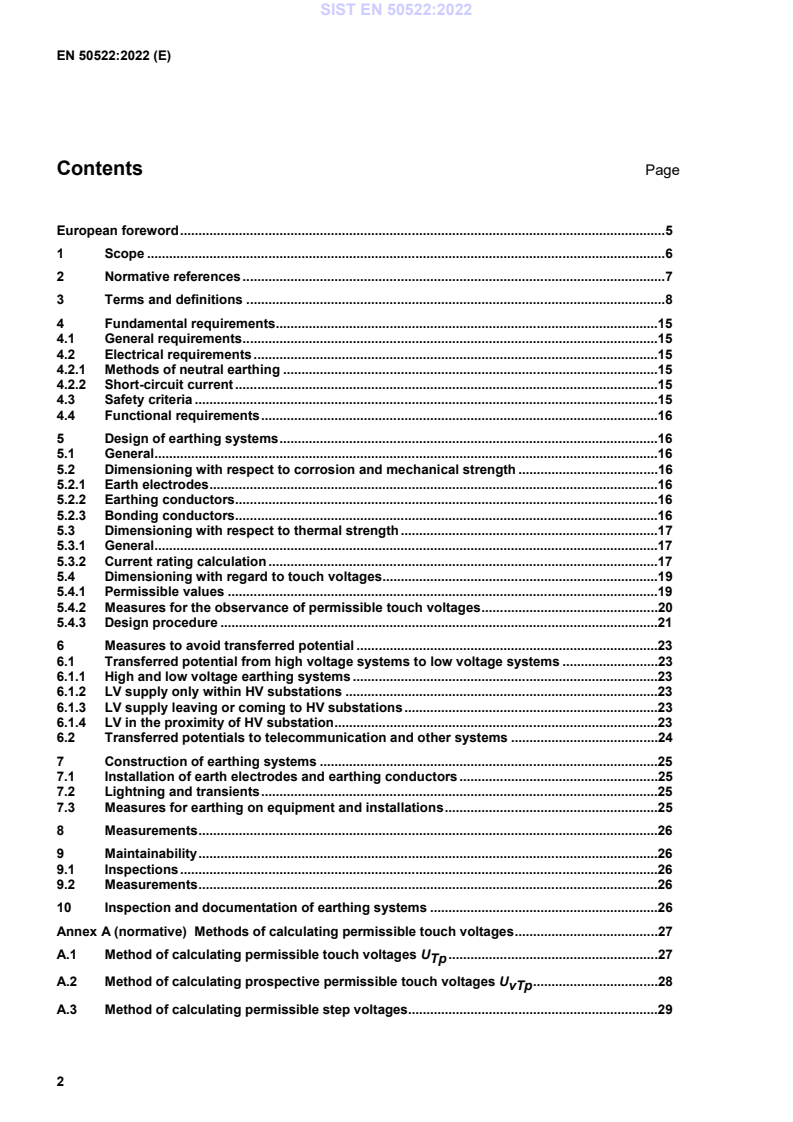
Contents Page
European foreword . 5
1 Scope . 6
2 Normative references . 7
3 Terms and definitions . 8
4 Fundamental requirements .15
4.1 General requirements .15
4.2 Electrical requirements .15
4.2.1 Methods of neutral earthing .15
4.2.2 Short-circuit current .15
4.3 Safety criteria .15
4.4 Functional requirements .16
5 Design of earthing systems .16
5.1 General .16
5.2 Dimensioning with respect to corrosion and mechanical strength .16
5.2.1 Earth electrodes .16
5.2.2 Earthing conductors .16
5.2.3 Bonding conductors .16
5.3 Dimensioning with respect to thermal strength .17
5.3.1 General .17
5.3.2 Current rating calculation .17
5.4 Dimensioning with regard to touch voltages .19
5.4.1 Permissible values .19
5.4.2 Measures for the observance of permissible touch voltages .20
5.4.3 Design procedure .21
6 Measures to avoid transferred potential .23
6.1 Transferred potential from high voltage systems to low voltage systems .23
6.1.1 High and low voltage earthing systems .23
6.1.2 LV supply only within HV substations .23
6.1.3 LV supply leaving or coming to HV substations .23
6.1.4 LV in the proximity of HV substation .23
6.2 Transferred potentials to telecommunication and other systems .24
7 Construction of earthing systems .25
7.1 Installation of earth electrodes and earthing conductors .25
7.2 Lightning and transients .25
7.3 Measures for earthing on equipment and installations .25
8 Measurements .26
9 Maintainability .26
9.1 Inspections .26
9.2 Measurements .26
10 Inspection and documentation of earthing systems .26
Annex A (normative) Methods of calculating permissible touch voltages .27
A.1 Method of calculating permissible touch voltages U .27
Tp
A.2 Method of calculating prospective permissible touch voltages U .28
vTp
A.3 Method of calculating permissible step voltages.29
Annex B (normative) Calculation of Permissible touch voltage U , Prospective permissible touch
Tp
voltage U . 30
vTp
B.1 General . 30
B.2 Calculation of permissible touch voltage . 30
B.3 Calculation of the permissible touch voltage U curve values of Figure 8 . 30
Tp
B.4 Calculation of prospective permissible touch voltage . 33
Annex C (normative) Type and minimum dimensions of earth electrode materials ensuring
mechanical strength and corrosion resistance . 35
Annex D (normative) Current rating calculation of earthing conductors and earth electrodes . 37
Annex E (normative) Description of the recognized specified measures M . 42
Annex F (normative) Measures on earthing systems to reduce the effects of high frequency
interference . 45
Annex G (normative) Detailed measures for earthing of equipment and installations . 46
G.1 Fences around substation installations . 46
G.2 Pipes . 47
G.3 Traction rails . 47
G.4 Pole mounted transforming and/or switching installations. 47
G.5 Secondary circuits of instrument transformers . 48
Annex H (normative) Measuring touch voltages . 49
Annex I (informative) Reduction factors related to earth wires of overhead lines and metal sheaths
of underground cables. 50
I.1 General . 50
I.2 Typical values of reduction factors of overhead lines and cables (50 Hz). 51
I.3 Influence of the resistances to earth on current in cable sheath . 52
Annex J (informative) Basis for the design of earthing systems . 53
J.1 Soil resistivity . 53
J.2 Resistance to earth . 53
Annex K (informative) Installing the earth electrodes and earthing conductors . 59
K.1 Installation of earth electrodes . 59
K.1.1 Horizontal earth electrodes . 59
K.1.2 Vertical or inclined driven rods . 59
K.1.3 Jointing the earth electrodes . 59
K.2 Installation of earthing conductors . 59
K.2.1 General . 59
K.2.2 Installing the earthing conductors . 59
K.2.3 Jointing the earthing conductors . 60
Annex L (informative) Measurements for and on earthing systems . 61
L.1 Soil resistivity measurement and analysis . 61
L.1.1 Introduction . 61
L.1.2 Soil resistivity measurement . 61
L.1.2.1 General .61
L.1.2.2 Wenner Method .61
L.1.2.3 Guidance on appropriate Wenner spacings .62
L.1.2.4 Sources of error .62
L.1.2.5 Seasonal variations .62
L.1.3 Soil resistivity analysis .62
L.1.3.1 General .62
L.1.3.2 Uniform soil model .62
L.1.3.3 Two-layer soil model .63
L.1.3.4 Multi-layer soil model .63
L.2 Measurement of resistances to earth and impedances to earth .63
L.3 Determination of the earth potential rise .65
L.4 Measurements of touch voltage and prospective touch voltage .66
L.5 Elimination of interference and disturbance voltages for earthing measurements .70
Annex M (informative) The use of reinforcing bars in concrete for earthing purpose.71
Annex N (informative) Global Earthing System .72
Annex O (normative) Special national conditions.73
Annex P (informative) A-deviations .74
Bibliography .77
European foreword
This document (EN 50522:2022) has been prepared by CLC/TC 99X “Power installations exceeding 1 kV AC
(1,5 kV DC)”.
The following dates are fixed:
• latest date by which this document has to be (dop) 2023-01-10
implemented at national level by publication of
an identical national standard or by
endorsement
• latest date by which the national standards (dow) 2025-01-10
conflicting with this document have to be
withdrawn
This document will supersede EN 50522:2010 and all of its amendments and corrigenda (if any).
— Text sections in italic which were indicating that the section is a copy of an IEC 61936-1 text replaced by
reference note to IEC 61936-1 due to copyright reasons.
— Clause 3 is updated regarding touch voltages.
— Improved figures in Clause 3 for distribution of earth fault currents.
— The process of designing earthing system is clarified in 5.4 and Figure 9.
— Rearranged Annex A and B including prospective permissible touch voltage and permissible step voltage.
— Introduction of stainless steel in Annex C and Annex D.
— More details and figures regarding fences in Annex G.
— Enlarged table of reduction factors and application on cables in Annex I.
— New figures in Annex J (J.4 and J.5).
— Details on soil resistivity measurements and touch voltage measurements including flow chart in Annex L.
— Clause 10 was Annex M in previous version.
Attention is drawn to the possibility that some of the elements of this document may be the subject of patent
rights. CENELEC shall not be held responsible for identifying any or all such patent rights.
Any feedback and questions on this document should be directed to the users’ national committee. A complete
listing of these bodies can be found on the CENELEC website.
1 Scope
This document is applicable to specify the requirements for the design and erection of earthing systems of
electrical installations, in systems with nominal voltage above 1 kV AC and nominal frequency up to and
including 60 Hz, so as to provide safety and proper functioning for the use intended.
NOTE 1 The technical and procedural principles of this document can be applied when third parties’ installations and
facilities are planned and/or erected in the vicinity of HV electrical power installations.
For the purpose of interpreting this document, an electrical power installation is considered to be one of the
following:
a) substation, including substation for railway power supply;
b) electrical power installations on mast, pole and tower;
switchgear and/or transformers located outside a closed electrical operating area;
c) one (or more) power station(s) located on a single site;
the electrical power installation includes generators and transformers with all associated switchgear and all
electrical auxiliary systems. Connections between generating stations located on different sites are
excluded;
d) the electrical system of a factory, industrial plant or other industrial, agricultural, commercial or public
premises;
e) electrical power installations on offshore facilities for the purpose of generation, transmission, distribution
and/or storage of electricity;
f) transition towers/poles between overhead lines and underground lines.
The electrical power installation includes, among others, the following equipment:
— rotating electrical machines;
— switchgear;
— transformers and reactors;
— converters;
— cables;
— wiring systems;
— batteries;
— capacitors;
— earthing systems;
— buildings and fences which are part of a closed electrical operating area;
— associated protection, control and auxiliary systems;
— large air core reactor.
NOTE 2 In general, a standard for an item of equipment takes precedence over this document.
This document does not apply to the design and erection of earthing systems of any of the following:
— overhead and underground lines between separate installations;
— electrified railway tracks and rolling stock;
— mining equipment and installations;
— fluorescent lamp installations;
— installations on ships according to IEC 60092 (all parts) and offshore units according to
IEC 61892 (all parts), which are used in the offshore petroleum industry for drilling, processing and storage
purposes;
— electrostatic equipment (e.g. electrostatic precipitators, spray-painting units);
— test sites;
— medical equipment, e.g. medical X-ray equipment.
NOTE 3 The standard EN 50341 series, Overhead lines exceeding AC 1 kV, specifies requirements for the design and
erection of earthing systems in overhead lines.
NOTE 4 The scope of this document does not include the requirements for carrying out live working on electrical power
installations.
NOTE 5 The scope of this document considers safety requirements for HV installations and its influences on LV
installations. For electrical installation up to 1 kV, the standard HD 60364 series applies.
2 Normative references
The following documents are referred to in the text in such a way that some or all of their content constitutes
requirements of this document. For dated references, only the edition cited applies. For undated references, the
latest edition of the referenced document (including any amendments) applies.
EN 60909 (series), Short-circuit currents in three-phase a.c. systems (IEC 60909 series)
EN IEC 62561-2, Lightning protection system components (LPSC) - Part 2: Requirements for conductors and
earth electrodes (IEC 62561-2)
HD 60364-1, Low-voltage electrical installations - Part 1: Fundamental principles, assessment of general
characteristics, definitions (IEC 60364-1)
IEC 60479-1:2018, Effects of current on human beings and livestock – Part 1: General aspects
IEC 61936-1:2010, Power installations exceeding 1 kV a.c. - Part 1: Common rules
3 Terms and definitions
For the purposes of this document, the terms and definitions given in IEC 61936-1:2010 and the following apply.
ISO and IEC maintain terminological databases for use in standardization at the following addresses:
— ISO Online browsing platform: available at https://www.iso.org/obp
— IEC Electropedia: available at https://www.electropedia.org/
3.1
earth ring electrode
earth electrode embedded in the soil around a building or pole as a closed ring
3.2
effective touch voltage
touch voltage
U
T
voltage between conductive parts when touched simultaneously
Note 1 to entry: The value of the effective touch voltage could be appreciably influenced by the impedance of the person
in electric contact with these conductive parts.
Note 2 to entry: The person is touching the conductive parts with bare skin.
[SOURCE: IEC 60050-195:1998, 195-05-11, modified]
[SOURCE: IEC 61936-1:2010, 3.7.14, modified – Note 2 added]
3.3
permissible touch voltage
U
Tp
limit value of touch voltage U
T
Note 1 to entry: See Figure 8.
3.4
prospective touch voltage
U
vT
voltage between simultaneously accessible conductive parts when those conductive parts are not being touched
Note 1 to entry: See Figure 1.
[SOURCE: IEC 60050-195:1998, 195-05-09, modified]
[SOURCE: IEC 61936-1:2010, 3.7.15, modified – note added]
3.5
prospective permissible touch voltage
U
vTp
limit value of prospective touch voltage U
vT
3.6
transferred potential
potential rise of an earthing system caused by a current to earth transferred by means of a connected conductor
(for example a metallic cable sheath, PEN conductor, pipeline, rail) into areas with low or no potential rise
relative to reference earth, resulting in a potential difference occurring between the conductor and its
surroundings
Note 1 to entry: See Figure 1.
[SOURCE: IEC 61936-1:2010, 3.7.17, modified – reference Figure 1 added]
3.7
global earthing system
equivalent earthing system created by the interconnection of local earthing systems that ensures, by the
proximity of the earthing systems, that there are no touch voltages exceeding permissible limit values
Note 1 to entry: Such systems permit the division of the earth fault current in a way that results in a reduction of the earth
potential rise at the local earthing system. Such a system could be said to form a quasi equipotential surface.
Note 2 to entry: The existence of a global earthing system may be determined by sample measurements or calculation for
typical systems. Typical examples of global earthing systems are in city centres; urban or industrial areas with distributed
low- and high-voltage earthing (see Annex N).
[SOURCE: IEC 61936-1:2010, 3.7.19, modified “that there are no touch voltages exceeding permissible limit
values” and Note 2 reference to Annex added]
3.8
system with isolated neutral
system in which the neutrals of transformers and generators are not intentionally connected to earth, except for
high impedance connections for signalling, measuring or protection purposes
[SOURCE: IEV 601-02-24, modified]
3.9
system with resonant earthing
system in which at least one neutral of a transformer or earthing transformer is earthed via an arc suppression
coil and the combined inductance of all arc suppression coils is essentially tuned to the earth capacitance of the
system for the operating frequency
Note 1 to entry: In case of no self-extinguishing arc fault there are two different operation methods used:
— automatic disconnection;
— continuous operation during fault localization process.
In order to facilitate the fault localization and operation there are different supporting procedures:
— short term earthing for detection;
— short term earthing for tripping;
— operation measures, such as disconnection of coupled busbars;
— phase earthing.
Note 2 to entry: Arc suppression coil may have high ohmic resistor in parallel to facilitate fault detection.
3.10
system with low-impedance neutral earthing
system in which at least one neutral of a transformer, earthing transformer or generator is earthed directly or
via an impedance designed such that due to an earth fault at any location the magnitude of the fault current
leads to a reliable automatic tripping due to the magnitude of the fault current
[SOURCE: IEV 601-02-25, modified, 601-02-26, modified]
3.11
earth fault current
I
F
current which flows from the main circuit to earth or earthed parts at the fault location (earth fault location)
Note 1 to entry: See Figures 2 to 7.
Note 2 to entry: For single earth faults, this is:
— in systems with isolated neutral, the capacitive earth fault current,
— in systems with high resistive earthing, the RC composed earth fault current,
— in systems with resonant earthing, the earth fault residual current,
— in systems with solid or low impedance neutral earthing, the line-to-earth short-circuit current.
Note 3 to entry: Further earth fault current could result from double earth fault and line to line to earth fault according to
EN 60909 (all parts).
[SOURCE: IEC 61936-1:2010, 3.7.25, modified – reference to Figures added]
3.12
current to earth
I
E
current flowing to earth via the impedance to earth
Note 1 to entry: See Figure 2.
Note 2 to entry: The current to earth is the part of the earth fault current I , which causes the potential rise of the earthing
F
system. For the determination of I see also Annex L.
E
3.13
reduction factor
r
factor r of a three-phase line is the ratio of the current to earth over the sum of the zero sequence currents in
the phase conductors of the main circuit (r = I / 3 I ) at a point remote from the short-circuit location and the
E 0
earthing system of an installation
3.14
horizontal earth electrode
electrode which is generally buried at a depth of up to approximately 1 m. It can consist of strip, round bar or
stranded conductor and can be laid out to form a radial, ring or mesh earth electrode or a combination of these
3.15
cable with earth electrode effect
cable whose sheaths, screens or armourings have the same effect as a horizontal electrode consisting of bare
round earth-wire
3.16
foundation earth electrode
conductive structural embedded in concrete which is in conductive contact with the earth via a large surface
[SOURCE: IEV 826-13-08, modified]
3.17
potential grading earth electrode
conductor which due to shape and arrangement is principally used for potential grading rather than for
establishing a certain resistance to earth
Key
E Earth electrode
S1, S2, S3 Potential grading earth electrodes (e.g. ring earth electrodes), connected to the earth electrode E
U Earth potential rise
E
U Prospective step voltage
vS
U Prospective touch voltage
vT
A Prospective touch voltage resulting from transferred potential in case of single side cable sheath earthing
B Prospective touch voltage resulting from transferred potential in case of cable sheath earthed on both sides
φ Earth surface potential
Figure 1 — Example for the surface potential profile and for the voltages in case of current carrying
earth electrodes
Key
3 I Three times zero sequence current of the line
I Current via neutral earthing of the transformer
N
I
Earth fault current
F
I
Current to earth (cannot be measured directly)
E
I
Current via the resistance to earth of the mesh earth electrode
RS
r
Reduction factor of the overhead line
E
R , R
Resistance to earth of the mesh earth electrode
ES ESx
R
Resistance to earth of the tower
ET
Chain impedance (several number of towers with resistance to earth, R ) represents a value of the
Z∞
ET
overhead line assumed to be infinite
Z Impedance to earth
E
U Earth potential rise
E
n Number of overhead lines leaving the substation (here: n = 2)
Figure 2 — Example for currents, voltages and resistances for an earth fault in a transformer
substation with low impedance neutral earthing
Key
I
Earth fault current
F
I
Capacitive earth fault current (complex value, including ohmic component)
C
NOTE I may include ohmic component.
C
Figure 3 — Earth fault current in a system with isolated neutral
Key
I
Earth fault current
F
I
Capacitive earth fault current (complex value, including ohmic component)
C
I
Sum of the currents of the parallel arc-suppression coils (complex value, including ohmic component)
L
I
Harmonic current (different frequencies)
H
I
Earth fault residual current
RES
NOTE I is the ohmic part of the complex value of (I + I ).
R C L
Figure 4 — Earth fault current in a system with resonant earthing
Key
I
Earth fault current
F
I“
Initial symmetrical short-circuit current for a line-to-earth short circuit
k1
NOTE If I is in the same order as I” this current shall be considered additionally.
C k1
Figure 5 — Earth fault current in a system with low impedance neutral earthing
Key
I
Earth fault current
F
I
Earth fault residual current
RES
I“
Initial symmetrical short-circuit current for a line-to-earth short circuit
k1
Figure 6 — Earth fault current in a system with resonant earthing and temporary low impedance
neutral earthing
Key
I
Earth fault current
F
I“
Double earth fault current
kEE
Figure 7 — Double earth fault current in a system with isolated neutral or resonant earthing
4 Fundamental requirements
4.1 General requirements
This document provides the criteria for design, installation, testing and maintenance of an earthing system such
that it operates under all conditions and ensures the safety of human life in any place to which persons have
legitimate access. It also provides the criteria to ensure that the integrity of equipment connected and in
proximity to the earthing system is maintained.
The requirements of IEC 61936-1:2010, 4.1.1 first and second paragraph apply.
4.2 Electrical requirements
4.2.1 Methods of neutral earthing
The requirements of IEC 61936-1:2010, 4.2.1 apply.
4.2.2 Short-circuit current
The requirements of IEC 61936-1:2010, 4.2.4 paragraph 1, 2, 3, 4, 5 and NOTE 1 apply.
The rated duration should be determined taking into consideration the fault clearance time described in
IEV 448-13-15.
4.3 Safety criteria
The requirements of IEC 61936-1:2010, 10.2.1 paragraph 1 and 2 apply.
For installation design, the curve shown in Figure 8 is calculated according to the method defined in Annex A
and Annex B.
The requirements of IEC 61936-1:2010, 10.2.1 NOTE apply.
The curve in Figure 8, which gives the permissible touch voltage, shall be used.
The requirements of IEC 61936-1:2010, 10.2.1 paragraph 5 apply.
See A.3.
For installations where high voltage equipment is not located in closed electrical operating areas, e.g. in an
industrial environment, a global earthing system should be applied to prevent touch voltages exceeding
permissible limit values.
4.4 Functional requirements
The requirements of IEC 61936-1:2010, 10.2.2 paragraph 1, 2, 3 and 4 apply.
NOTE The requirement to keep step and touch voltages within permissible levels does not apply to temporary earth
connections (portable earthing equipment) at work locations.
The requirements of IEC 61936-1:2010, 10.2.2 paragraph 5 apply.
5 Design of earthing systems
5.1 General
Parameters relevant to earthing system dimensioning are:
— value of fault current;
— fault duration;
— soil characteristics.
NOTE The value of fault current and fault duration mainly depend on the method of neutral earthing of the high voltage
system.
5.2 Dimensioning with respect to corrosion and mechanical strength
5.2.1 Earth electrodes
The electrodes, being directly in contact with the soil, shall be of materials capable of withstanding corrosion
(chemical or biological attack, oxidation, formation of an electrolytic couple, electrolysis, etc.). They shall resist
the mechanical influences during their installation as well as those occurring during normal service. It is
acceptable to use steel embedded in concrete foundations and steel piles or other natural earth electrodes as
a part of the earthing system. Mechanical strength and corrosion considerations dictate the minimum
dimensions for earth electrodes given in Table C.1 of Annex C. If a different material is used, this material and
its dimensions shall meet the functional requirements.
5.2.2 Earthing conductors
Due to mechanical strength and stability against corrosion minimum cross-sections are:
— copper: 16 mm (but see also G.5)
— aluminium: 35 mm
— steel: 50 mm
5.2.3 Bonding conductors
It is recommended that the sizing of bonding conductors is in line with 5.2.2.
NOTE Earthing and bonding conductors made of steel need appropriate and suitable protection against corrosion.
5.3 Dimensioning with respect to thermal strength
5.3.1 General
The currents to be taken into account for earthing conductors and earth electrodes are specified in Table 1.
NOTE In some cases, steady-state zero-sequence currents are taken into account for the dimensioning of the relevant
earthing system.
For design purposes, the currents used to calculate the conductor size should take into account the possibility
of future growth.
The fault current is often subdivided in the earth electrode system; it is, therefore, feasible to dimension each
electrode and earthing conductor for only a fraction of the fault current.
Final temperatures involved in the design and to which reference is made in Annex D shall be chosen in order
to avoid reduction of the material strength and to avoid damage of the material surrounding, for example
concrete or insulating materials. No permissible temperature rise of the soil surrounding the earth electrodes is
given in this document because experience shows that soil temperature rise is usually not significant.
5.3.2 Current rating calculation
The calculation of the cross-section of the earthing conductors or earth electrodes depending on the value and
the duration of the fault current is given in Annex D. There is discrimination between fault duration lower than
5 s (adiabatic temperature rise) and greater than 5 s. The final temperature is to be chosen taking into account
the material and the surroundings. Nevertheless, the minimum cross-sections of 5.2.2 shall be considered.
The current carrying capacity of the connecting elements, e.g. joints, as a function of the short-circuit current
duration and the current intensity should be taken into account. (e.g. 4 kA (50 Hz) / 1 s / 300 °C).
Table 1 — Relevant currents for the design of earthing systems
a
Relevant for thermal loading
e
Relevant for earth potential
Type of high voltage system
rise and touch voltages
Earth Earthing
electrode conductor
Systems with isolated neutral
b
I” I”
I = r ∙ I
kEE kEE
E C
System with resonant earthing
Includes short time earthing for detection
f b
I” I” I = r ∙ I
Substations without arc-suppression coils
kEE kEE E RES
Substations with arc-suppression coils
c 22
I” b h
I”
kEE I = r ∙ II +
kEE
E
L Res
Systems with low-impedance neutral earthing
g
Includes short time earthing for tripping
I” I” I = r ∙ I”
Substation without neutral earthing
k1 k1 E k1
d
I” I”
Substation with neutral earthing I = r ∙ (I” -I )
k1 k1
E k1 N
Legend:
I
Calculated or measured capacitive earth fault current.
C
I
Earth fault residual current (see Figure 4).
RES
If the exact value is not available, 10 % of I may be assumed.
C
I
Sum of the rated currents of the parallel arc-suppression coils in the relevant substation.
L
I”
Double earth fault current calculated in accordance with the IEC 60909 series.
kEE
For I“kEE 85 % of the initial symmetrical short-circuit current may be used as a maximum value.
I”
Initial symmetrical short-circuit current for a line-to-earth short-circuit, calculated in accordance with the EN 60909 series.
k1
I
Current to earth (see Figure 2).
E
I
Current via neutral earthing of the transformer (see Figure 2).
N
r Reduction factor (see Annex I).
If the lines and cables leaving the substation have different reduction factors, the relevant current shall be determined (in
accordance with Annex L).
a
If several current paths are possible a split up may be considered.
b
If there is no automatic disconnection of earth faults, the need to consider double earth faults depends on operational
experience.
c
The earthing conductor of the Petersen coil shall be sized according to the maximum coil current.
d
It shall be checked if external fault may be decisive.
e
The minimum cross-sections of Annex C are to be considered.
f
In case of not well compensated system the general approach of 10 % I cannot be applied. The reactive/capacitive
C
component of residual current shall be considered additionally.
g
Short-term earthing of system with resonant earthing starts automatically within 5 s after earth fault detection.
h
In case of a fault in the substation the capacitive earth fault current I shall be considered. In case of further coils external to
C
the substation they may be considered.
5.4 Dimensioning with regard to touch voltages
5.4.1 Permissible values
The limit value of the touch voltage (U ) is the permissible touch voltage (U ) and is given in Figure 8 as stated
T Tp
in 4.3 (safety criteria). The Figure 8 represents the limit values of this permissible touch voltage U depending
Tp
on the fault duration.
Step voltage limits can be derived according to A.3, but are only needed in exceptional cases.
Any voltage over the human body (bare skin to bare skin) due to the simultaneous touching of two conductive
parts shall be lower than or equal to the values of the curve in Figure 8.
Figure 8 is based only on bare hand to hand or hand to feet contact (direct skin contact). It is allowable to use
the calculations given in Annex A and B to take account of additional resistances e.g. footwear, gloves and
surface materials of higher resistivity.
Every earth fault will be disconnected automatically or manually. Thus, touch voltages of very long or indefinite
duration do not appear as a consequence of earth faults.
[SOURCE: IEC 61936-1:2010, Figure 12]
NOTE For duration of current flow considerably longer than 10 s a value of 80 V may be used as permissible touch
voltage U .
Tp
Figure 8 — Permissible touch voltage
5.4.2 Measures for the observance of permissible touch voltages
Application of the fundamental requirements will give the basic design of the earthing system. This design shall
be checked with respect to touch voltages and could then be considered as a type design for similar situations.
For the values of the permissible touch voltages U Figure 8 shall be used. These permissible values are
Tp
considered to be satisfied
C1: if the relevant installation becomes a part of a global earthing system.
C2: if C1 is not satisfied and the earth potential rise, determined by measurement or calculation does not
exceed double the value of the permissible touch voltage U in accordance with Figure 8.
Tp
C3: if C2 is not satisfied and the earth potential rise, determined by measurement or calculation does not
exceed four times the value of the permissible touch voltage in accordance with Figure 8 and the
relevant recognized specified measures M are carried out in accordance with the magnitude of the
earth potential rise and the fault duration. These measures are described in Table E.1 of Annex E.
C4: if C3 is not satisfied the criteria for the permissible touch voltage (U ) of Figure 8 shall be proved by
Tp
calculation and/or measurement of touch voltage (U ). Additional resistances may be taken into
T
account to determine the prospective permissible touch voltage (U ) according to Annex A and
vTp
Annex B and proved by calculation and/or measurement of U . Generally, the verification of the
vT
criteria of permissible voltages (U or U ) is done by measurements. If the criteria for U or U are
Tp vTp T vT
still not satisfied, the design shall be improved and steps C2 to C4 shall be reconsidered.
A flowchart of the design process from C2 to C4 is given in Figure 9.
Alternatively, a type design may be used that ensures the requirements in 5.4.1 are fully met.
NOTE 1 Examples of high earth potential rise where step voltages could be necessary to be considered at the boundaries
of the earthing system are e.g. when UE > 20 x U
Tp
NOTE 2 As an alternative to using one of the conditions C1 to C4, the values of the touch voltages can be checked by
field measurements.
Transferred potentia
...
Questions, Comments and Discussion
Ask us and Technical Secretary will try to provide an answer. You can facilitate discussion about the standard in here.
Loading comments...