Electric components - Reliability - Reference conditions for failure rates and stress models for conversion

This document gives guidance on the use of failure rate data for reliability prediction of
electric components used in equipment.
The method presented in this document uses the concept of reference conditions which are
the typical values of stresses that are observed by components in the majority of applications.
Reference conditions are useful since they provide a known standard basis from which failure
rates can be modified to account for differences in environment from the environments taken
as reference conditions. Each user can use the reference conditions defined in this document
or use their own. When failure rates stated at reference conditions are used it allows realistic
reliability predictions to be made in the early design phase.
The stress models described herein are generic and can be used as a basis for conversion of
failure rate data given at these reference conditions to actual operating conditions when
needed and this simplifies the prediction approach. Conversion of failure rate data is only
possible within the specified functional limits of the components.
This document also gives guidance on how a database of component failure data can be
constructed to provide failure rates that can be used with the included stress models.
Reference conditions for failure rate data are specified, so that data from different sources
can be compared on a uniform basis. If failure rate data are given in accordance with this
document then additional information on the specified conditions can be dispensed with.
This document does not provide base failure rates for components – rather it provides models
that allow failure rates obtained by other means to be converted from one operating condition
to another operating condition.
The prediction methodology described in this document assumes that the parts are being
used within its useful life. The methods in this document have a general application but are
specifically applied to a selection of component types as defined in Clauses 6 to 20 and I.2.

Elektrische Bauelemente - Zuverlässigkeit - Referenzbedingungen für Ausfallraten und Beanspruchungsmodelle zur Umrechnung

Composants électriques - Fiabilité - Conditions de référence pour les taux de défaillance et modèles de contraintes pour la conversion

Električne komponente - Zanesljivost - Referenčni pogoji za pogostost odpovedi in modele obremenjevanja za pretvarjanje - Popravek AC (IEC 61709:2017/COR1:2019)

Ta dokument podaja napotke o uporabi podatkov o pogostosti odpovedi za napoved zanesljivosti električnih komponent v opremi.
Metoda, predstavljena v tem dokumentu, uporablja koncept referenčnih pogojev, ki so tipične vrednosti obremenitev, ki se pojavljajo pri komponentah v večini načinov uporabe.
Referenčni pogoji so uporabni, ker podajajo poznano osnovo standarda, na podlagi katere se lahko spremenijo pogostosti odpovedi, da se upoštevajo razlike okolja od okolij, ki predstavljajo referenčne pogoje. Vsak uporabnik lahko uporabi referenčne pogoje, določene v tem dokumentu, ali lastne referenčne pogoje. Kadar so v referenčnih pogojih uporabljene pogostosti odpovedi, to omogoča realistično napoved zanesljivosti v zgodnji fazi načrtovanja.
V tem dokumentu opisani modeli obremenjevanja so generični in se lahko po potrebi uporabijo kot osnova za pretvarjanje podatkov o pogostosti odpovedi, podanih v teh referenčnih pogojih, v dejanske obratovalne pogoje, kar poenostavlja pristop k napovedi. Pretvarjanje podatkov o pogostosti odpovedi je mogoče le znotraj podanih funkcijskih omejitev komponent.
Ta dokument podaja tudi napotke, kako zdelati zbirko podatkov o odpovedih komponent, ki podaja pogostosti odpovedi, ki se lahko uporabijo z vključenimi modeli obremenjevanja.
Referenčni pogoji za podatke o pogostosti odpovedi so podani, tako da je mogoče podatke iz drugih virov primerjati na enotni osnovi. Če so podatki o pogostosti odpovedi podani v skladu s tem dokumentom, se lahko dodatne informacije o podanih pogojih izpustijo.
Ta dokument ne podaja osnovnih pogostosti odpovedi za komponente, ampak podaja modele, ki omogočajo pretvarjanje pogostosti odpovedi, pridobljenih z drugimi sredstvi, iz enega obratovalnega pogoja v drug obratovalni pogoj.
Metodologija napovedi, opisana v tem dokumentu, predpostavlja, da se deli uporabljajo v življenjski dobi. Metode v tem dokumentu so splošno uporabne, vendar se uporabljajo posebej za izbiro tipov komponent, kot določajo točke od 6 do 20 in točka I.2.

General Information

Status
Published
Publication Date
14-Nov-2019
Technical Committee
CLC/SR 56 - Dependability
Drafting Committee
CLC/SR 56 - Dependability
Current Stage
6060 - Document made available - Publishing
Start Date
15-Nov-2019
Completion Date
15-Nov-2019

Relations

Effective Date
05-Nov-2019
Corrigendum

EN 61709:2017/AC:2020

French language
3 pages
Preview
Preview
e-Library read for
1 day

Frequently Asked Questions

EN 61709:2017/AC:2019-11 is a corrigendum published by CLC. Its full title is "Electric components - Reliability - Reference conditions for failure rates and stress models for conversion". This standard covers: This document gives guidance on the use of failure rate data for reliability prediction of electric components used in equipment. The method presented in this document uses the concept of reference conditions which are the typical values of stresses that are observed by components in the majority of applications. Reference conditions are useful since they provide a known standard basis from which failure rates can be modified to account for differences in environment from the environments taken as reference conditions. Each user can use the reference conditions defined in this document or use their own. When failure rates stated at reference conditions are used it allows realistic reliability predictions to be made in the early design phase. The stress models described herein are generic and can be used as a basis for conversion of failure rate data given at these reference conditions to actual operating conditions when needed and this simplifies the prediction approach. Conversion of failure rate data is only possible within the specified functional limits of the components. This document also gives guidance on how a database of component failure data can be constructed to provide failure rates that can be used with the included stress models. Reference conditions for failure rate data are specified, so that data from different sources can be compared on a uniform basis. If failure rate data are given in accordance with this document then additional information on the specified conditions can be dispensed with. This document does not provide base failure rates for components – rather it provides models that allow failure rates obtained by other means to be converted from one operating condition to another operating condition. The prediction methodology described in this document assumes that the parts are being used within its useful life. The methods in this document have a general application but are specifically applied to a selection of component types as defined in Clauses 6 to 20 and I.2.

This document gives guidance on the use of failure rate data for reliability prediction of electric components used in equipment. The method presented in this document uses the concept of reference conditions which are the typical values of stresses that are observed by components in the majority of applications. Reference conditions are useful since they provide a known standard basis from which failure rates can be modified to account for differences in environment from the environments taken as reference conditions. Each user can use the reference conditions defined in this document or use their own. When failure rates stated at reference conditions are used it allows realistic reliability predictions to be made in the early design phase. The stress models described herein are generic and can be used as a basis for conversion of failure rate data given at these reference conditions to actual operating conditions when needed and this simplifies the prediction approach. Conversion of failure rate data is only possible within the specified functional limits of the components. This document also gives guidance on how a database of component failure data can be constructed to provide failure rates that can be used with the included stress models. Reference conditions for failure rate data are specified, so that data from different sources can be compared on a uniform basis. If failure rate data are given in accordance with this document then additional information on the specified conditions can be dispensed with. This document does not provide base failure rates for components – rather it provides models that allow failure rates obtained by other means to be converted from one operating condition to another operating condition. The prediction methodology described in this document assumes that the parts are being used within its useful life. The methods in this document have a general application but are specifically applied to a selection of component types as defined in Clauses 6 to 20 and I.2.

EN 61709:2017/AC:2019-11 is classified under the following ICS (International Classification for Standards) categories: 31.020 - Electronic components in general. The ICS classification helps identify the subject area and facilitates finding related standards.

EN 61709:2017/AC:2019-11 has the following relationships with other standards: It is inter standard links to EN 61709:2017. Understanding these relationships helps ensure you are using the most current and applicable version of the standard.

You can purchase EN 61709:2017/AC:2019-11 directly from iTeh Standards. The document is available in PDF format and is delivered instantly after payment. Add the standard to your cart and complete the secure checkout process. iTeh Standards is an authorized distributor of CLC standards.

Standards Content (Sample)


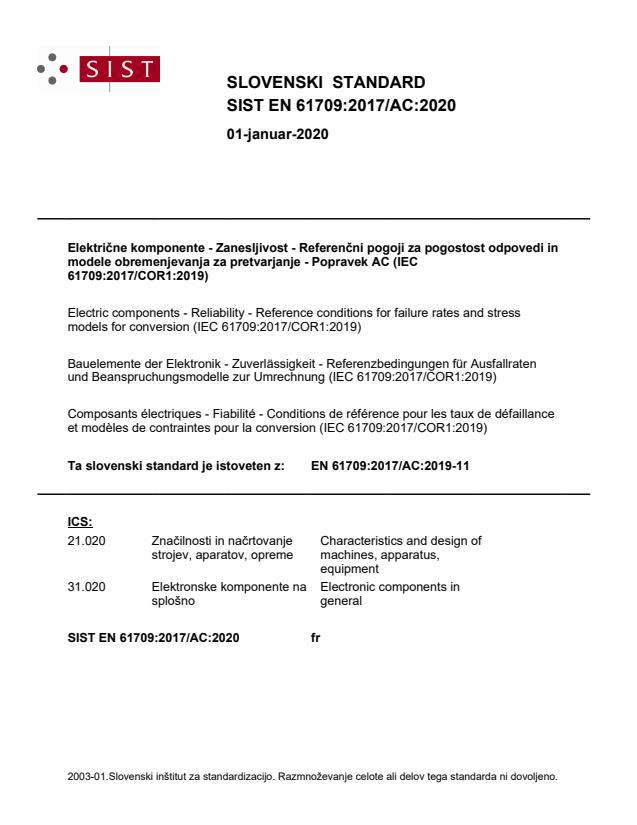
SLOVENSKI STANDARD
01-januar-2020
Električne komponente - Zanesljivost - Referenčni pogoji za pogostost odpovedi in
modele obremenjevanja za pretvarjanje - Popravek AC (IEC
61709:2017/COR1:2019)
Electric components - Reliability - Reference conditions for failure rates and stress
models for conversion (IEC 61709:2017/COR1:2019)
Bauelemente der Elektronik - Zuverlässigkeit - Referenzbedingungen für Ausfallraten
und Beanspruchungsmodelle zur Umrechnung (IEC 61709:2017/COR1:2019)
Composants électriques - Fiabilité - Conditions de référence pour les taux de défaillance
et modèles de contraintes pour la conversion (IEC 61709:2017/COR1:2019)
Ta slovenski standard je istoveten z: EN 61709:2017/AC:2019-11
ICS:
21.020 Značilnosti in načrtovanje Characteristics and design of
strojev, aparatov, opreme machines, apparatus,
equipment
31.020 Elektronske komponente na Electronic components in
splošno general
2003-01.Slovenski inštitut za standardizacijo. Razmnoževanje celote ali delov tega standarda ni dovoljeno.

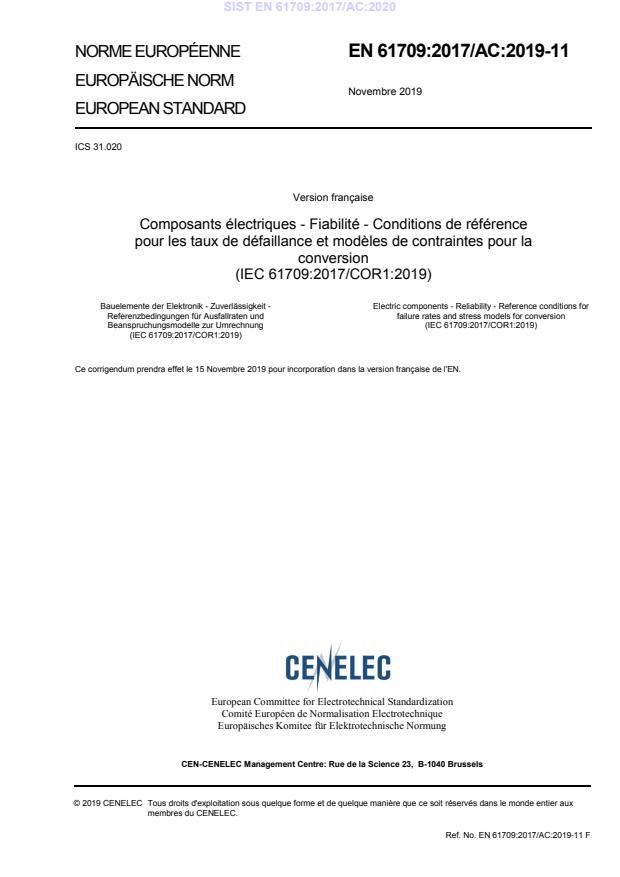
NORME EUROPÉENNE EN 61709:2017/AC:2019-11

EUROPÄISCHE NORM
Novembre 2019
EUROPEAN STANDARD
ICS 31.020
Version française
Composants électriques - Fiabilité - Conditions de référence
pour les taux de défaillance et modèles de contraintes pour la
conversion
(IEC 61709:2017/COR1:2019)
Bauelemente der Elektronik - Zuverlässigkeit - Electric components - Reliability - Reference conditions for
Referenzbedingungen für Ausfallraten und
failure rates and stress models for conversion
Beanspruchungsmodelle zur Umrechnung (IEC 61709:2017/COR1:2019)
(IEC 61709:2017/COR1:2019)
Ce corrigendum prendra effet le 15 Novembre 2019 pour incorporation dans la version française de l'EN.

European Committee for Electrotechnical Standardization
Comité Europé
...

Questions, Comments and Discussion

Ask us and Technical Secretary will try to provide an answer. You can facilitate discussion about the standard in here.

Loading comments...

La norme EN 61709:2017/AC:2019-11, intitulée "Composants électriques - Fiabilité - Conditions de référence pour les taux de défaillance et modèles de contrainte pour la conversion", offre une approche structurée et méthodique pour évaluer la fiabilité des composants électroniques. Son champ d'application est essentiel, car elle fournit des recommandations sur l'utilisation des données de taux de défaillance pour la prédiction de la fiabilité de ces composants, ce qui est crucial pour garantir la qualité et la durabilité des équipements. Parmi les forces de cette norme, on note l'introduction des conditions de référence, qui représentent des valeurs typiques des contraintes auxquelles les composants sont soumis dans la majorité des applications. Ces conditions de référence sont d'une grande pertinence, car elles permettent de modifier les taux de défaillance en tenant compte des différences d'environnement. Grâce à cette flexibilité, chaque utilisateur peut soit adopter les conditions de référence fournies, soit créer ses propres critères, ce qui enrichit l'applicabilité de la norme dans divers contextes. Un autre point fort de cette norme est sa capacité à simplifier l'approche de prédiction. Les modèles de contrainte proposés peuvent être utilisés pour convertir les données de taux de défaillance exprimées dans les conditions de référence en taux adaptés aux conditions réelles d'exploitation. Cela permet des prédictions de fiabilité réalistes dès les premières phases de conception, ce qui se révèle être un atout considérable dans le développement de nouveaux produits. De plus, la norme encourage la construction d'une base de données de données de défaillance des composants, offrant ainsi les moyens de comparer les taux de défaillance sur une base uniforme. Cela contribue à une meilleure compréhension et à une gestion effective des risques associés aux composants électriques. Enfin, il est important de souligner que la méthodologie de prédiction stipule que les pièces doivent être utilisées dans leur durée de vie utile, assurant ainsi que les modèles restent applicables et pertinents. Bien que la norme n'établisse pas de taux de défaillance de base, elle fournit des modèles précieux permettant la conversion des taux de défaillance entre différentes conditions d'exploitation, ce qui en fait un outil indispensable pour les ingénieurs et les concepteurs œuvrant dans le domaine de la fiabilité des composants électriques. En résumé, la norme EN 61709:2017/AC:2019-11 se distingue par son approche systématique concernant les conditions de référence et les modèles de contrainte, ce qui en fait un document fondamental pour quiconque souhaite améliorer la fiabilité et optimiser la conception des équipements utilisant des composants électriques.

Die Norm EN 61709:2017/AC:2019-11 beschäftigt sich umfassend mit der Zuverlässigkeit von elektrischen Komponenten und bietet eine wertvolle Grundlage für die Vorhersage von Ausfallraten. Der Anwendungsbereich dieser Norm ist klar definiert: Sie gibt Leitlinien zur Nutzung von Ausfallraten-Daten, die für die Zuverlässigkeitsprognose von elektrischen Bauelementen in verschiedenen Anwendungen benötigt werden. Ein herausragendes Merkmal der Norm ist das Konzept der Referenzbedingungen. Diese typischen Stresswerte, die in den meisten Anwendungen beobachtet werden, schaffen eine einheitliche Basis, von der aus Ausfallraten angepasst werden können. Durch diese Standardisierung wird eine realistische Vorhersage der Zuverlässigkeit bereits in der frühen Entwicklungsphase möglich, was für Ingenieure und Entwickler von entscheidender Bedeutung ist. Die in der Norm beschriebenen Belastungsmodelle sind generisch gestaltet und bieten somit eine flexible Grundlage, um Ausfallraten-Daten von den festgelegten Referenzbedingungen auf reale Betriebsbedingungen zu übertragen. Dies vereinfacht die Prognose-Methoden erheblich und ermöglicht es den Anwendern, maßgeschneiderte Anpassungen vorzunehmen, die den spezifischen Anforderungen ihrer Anwendungen gerecht werden. Ein weiterer Vorteil von EN 61709 ist die Anleitung zur Erstellung einer Datenbank mit Ausfalldaten von Komponenten, die in Verbindung mit den Stressmodellen verwendet werden kann. Die Angabe von Referenzbedingungen für Ausfallraten-Daten ermöglicht den Vergleich von Daten aus unterschiedlichen Quellen auf einer einheitlichen Grundlage. Dies reduziert die Notwendigkeit zusätzlicher Informationen über die spezifischen Bedingungen, was die Anwendung der Norm weiter vereinfacht. Es ist wichtig zu beachten, dass die Norm keine Basisausfallraten für Komponenten bereitstellt, sondern vielmehr Modelle anbietet, die es ermöglichen, bestehende Ausfallraten von einer Betriebsbedingung auf eine andere zu übertragen. Dies fördert die Flexibilität und Anpassungsfähigkeit in der Nutzung der bereitgestellten Daten. Insgesamt stellt EN 61709:2017/AC:2019-11 einen bedeutenden Beitrag zur Zuverlässigkeitsvorhersage von elektrischen Komponenten dar, indem sie robuste Methoden und klare Richtlinien bereitstellt, die für eine Vielzahl von Komponentenarten anwendbar sind. Dies unterstreicht die Relevanz der Norm in der aktuellen Praxis der Elektronikentwicklung.

표준 EN 61709:2017/AC:2019-11은 전기 부품의 신뢰성 예측을 위한 실패율 데이터 사용에 대한 지침을 제공합니다. 이 문서의 범위는 전기 장비에 사용되는 부품의 신뢰성 예측을 위한 기준 조건과 스트레스 모델을 정의하는 데 중점을 두고 있습니다. 이러한 기준 조건은 대부분의 응용 프로그램에서 부품이 관찰되는 일반적인 스트레스 값으로 구성되어 있어, 이를 통해 환경 차이를 고려하여 실패율을 조정할 수 있는 표준 기반을 제공합니다. 이 표준의 강점 중 하나는 사용자가 정의된 기준 조건을 활용하거나 자신의 기준 조건을 사용할 수 있도록 허용한다는 점입니다. 이는 초기 설계 단계에서 보다 현실적인 신뢰성 예측을 가능하게 합니다. 문서에서 설명하는 스트레스 모델은 일반적이며, 특정 작업 조건으로부터 기준 조건에서 주어진 실패율 데이터를 변환하는 기반으로 사용할 수 있어 예측 접근 방식을 단순화합니다. 실패율 데이터의 변환은 부품의 지정된 기능적 한계 내에서만 가능하다는 점도 명확히 합니다. 또한, 이 문서는 부품 실패 데이터베이스를 구축하는 방법에 대한 지침을 제공하여 포함된 스트레스 모델과 함께 사용할 수 있는 실패율을 제공할 수 있도록 합니다. 실패율 데이터에 대한 기준 조건이 명시되어 있어, 다양한 출처의 데이터를 균일한 기준으로 비교하는 것이 가능합니다. 문서에 따라 실패율 데이터가 제공될 경우, 지정된 조건에 대한 추가 정보를 생략할 수 있다는 점은 실용성 측면에서 중요한 요소입니다. 마지막으로, 이 표준은 특정 부품 유형에 일반적으로 적용될 수 있지만, 제6조부터 20조 및 I.2에 정의된 다양한 부품 유형에 구체적으로 적용됩니다. 이러한 통합된 접근 방식은 전기 부품의 신뢰성 예측에 있어 중요한 자원이 될 것입니다.

EN 61709:2017/AC:2019-11の標準は、電気部品の信頼性に関する重要なガイダンスを提供しており、そのスコープは電気機器に使用されるコンポーネントの故障率データを用いた信頼性予測に特化しています。この文書は、部品が多くのアプリケーションにおいて観測される典型的なストレスの値を基にしたリファレンス条件の概念を使用しています。リファレンス条件は、環境の違いを考慮しつつ故障率を修正するための既知の標準基盤を提供し、初期設計段階での現実的な信頼性予測を可能にします。 この標準の強みは、提供されるストレスモデルが一般的であり、リファレンス条件で示された故障率データを実際の稼働条件へと変換する基盤として使用できる点にあります。このプロセスは予測アプローチを簡素化し、指定された機能的限界内での故障率データの変換を可能にします。さらに、部品故障データのデータベースを構築するためのガイダンスも提供しており、これにより含まれたストレスモデルと組み合わせて使用できる故障率を得ることができます。 リファレンス条件に関する故障率データが明示されているため、異なるソースから得られたデータを均一な基準で比較することができます。この文書に従って提供される故障率データは、指定された条件に関する追加情報を不要とさせる利点があります。重要なのは、本標準がコンポーネントの基本的な故障率を提供するのではなく、他の手段で取得された故障率を一つの稼働条件から別の稼働条件に変換するためのモデルを提供している点です。 この予測方法論は、部品がその有用な寿命内で使用されていることを前提としており、一般的な適用が可能ですが、特に第6条から第20条およびI.2で定義された選択されたコンポーネントタイプに特化しています。このように、EN 61709:2017/AC:2019-11は電気部品の信頼性予測において非常に関連性が高く、実用的なアプローチを提供する標準であると言えます。

The EN 61709:2017/AC:2019-11 standard provides essential guidance on the use of failure rate data for the reliability prediction of electric components in various equipment applications. It thoroughly addresses the methodology necessary for effectively assessing reliability through the establishment of reference conditions, which represent the typical stress values encountered by components in most applications. This aspect of the standard is critically important as it lays a uniform groundwork for reliability assessments, enabling users to modify failure rates according to differing environmental factors. One of the significant strengths of this standard is its emphasis on the practicality of the reference conditions. By providing a defined set of conditions, it allows for improved comparison and evaluation of failure rate data across different sources. The ability to dispense with additional information regarding specified conditions when data is provided according to this standard increases its usability and efficiency in reliability predictions. Furthermore, the generic stress models in this document simplify the process of converting failure rate data from reference conditions to actual operating conditions, ensuring that the methodology remains adaptable within specified functional limits of the components. The document also emphasizes the construction of a database for component failure data, guiding users in building a robust resource that aligns with the included stress models for reliability prediction. This focus on a collaborative approach enhances the relevance of the document, making it valuable for a wide range of users, whether they choose to adopt the reference conditions outlined or develop their own tailored models. While the EN 61709 standard does not provide base failure rates for components, it serves a vital purpose by offering a framework for converting failure rates obtained through alternative means. This flexibility in application is particularly relevant for engineers and designers during early design phases, where accurate reliability predictions are crucial for effective product development. In conclusion, the EN 61709:2017/AC:2019-11 standard exhibits a comprehensive approach to electric component reliability prediction, backed by well-defined reference conditions, practical conversion methodologies, and guidance for database creation. Its relevance in the field remains significant as it aids in enhancing the reliability assessment processes necessary for modern equipment design and sustainability.