

EN 50631-1:2023
(Main)Household appliances network and grid connectivity - Part 1: General requirements, generic data modelling and neutral messages
General Information
- Abstract
This document defines data models for Interoperable Connected Household Appliances. The data models are derived from a logical decomposition of use cases into functional blocks that themselves were realized by abstract actions on the data model itself. This document is part of the EN 50631 series, which defines the information exchange between Smart Appliances and management systems in homes and buildings including energy management.
- Status
- Withdrawn
- Publication Date
- 16-Mar-2023
- Technical Committee
- CLC/TC 59X - Consumer information related to household electrical appliances
- Drafting Committee
- CLC/TC 59X/WG 07 - Smart house
- Current Stage
- 9960 - Withdrawal effective - Withdrawal
- Start Date
- 20-Feb-2026
- Completion Date
- 25-Aug-2026

Overview
EN 50631-1:2023 - published by CLC/CENELEC - defines general requirements, generic data modelling and neutral messages for interoperable connected household appliances. The standard specifies logical data models derived from use-case decomposition and abstract actions on those models. It is the first part of the EN 50631 series that standardizes information exchange between smart appliances and home/building management systems, with a strong focus on energy management and grid connectivity.
Key topics and technical requirements
- Generic data modelling: Logical decomposition of appliance behaviour into data objects and functional blocks to enable consistent, vendor-neutral representations.
- Neutral messages: Message patterns and neutral formats for exchanging state, measurement and control information between appliances and management systems.
- Interoperability process & architecture: Guidance on processes and architectural elements to ensure appliances interoperate reliably with energy managers, controllers and external systems.
- User stories, use cases and UCFs (Use Case Functions): Detailed user stories and use cases such as flexible start, incentive-based power management, monitoring and manual operation; followed by UCF details (e.g., measurements, characteristics, configure power sequences).
- Energy management features: Mechanisms for flexible start, limiting power consumption, monitoring consumption, optimizing self-consumption (examples include heat pump compressor flexibility).
- Requirements and prerequisites: Actors, scenario flows, dependencies and assumptions to support real-world implementations and testing.
Practical applications
- Enable interoperable smart appliances that can participate in demand response, local energy optimisation and grid-aware operation.
- Support home and building energy management systems (HEMS/BEMS) with neutral data formats for monitoring, control and scheduling.
- Provide manufacturers and integrators with a blueprint for implementing appliance-side APIs and message handling to achieve cross-vendor compatibility.
- Facilitate utilities and aggregators to interact with domestic appliances for load shifting, peak shaving and self-consumption maximization.
- Assist test labs and certification bodies in verifying conformance against defined use cases and UCFs.
Who should use this standard
- Appliance manufacturers and firmware/software developers
- Smart home and energy management platform vendors
- System integrators and installers
- Utilities, aggregators and energy service providers
- Test laboratories and conformity assessors
- Standards developers and regulators focusing on smart grid and IoT interoperability
Related standards
- Part of the EN 50631 series (information exchange for smart appliances). EN 50631-1:2023 supersedes EN 50631-1:2017 and aligns with CENELEC procedures for European electrotechnical standardization.
Keywords: EN 50631-1:2023, household appliances network, grid connectivity, smart appliances, data models, interoperability, energy management, neutral messages, UCF, flexible start, power consumption management.
Relations
- Effective Date
- 08-Sep-2020
- Effective Date
- 03-Feb-2026
Frequently Asked Questions
EN 50631-1:2023 is a standard published by CLC. Its full title is "Household appliances network and grid connectivity - Part 1: General requirements, generic data modelling and neutral messages". This standard covers: This document defines data models for Interoperable Connected Household Appliances. The data models are derived from a logical decomposition of use cases into functional blocks that themselves were realized by abstract actions on the data model itself. This document is part of the EN 50631 series, which defines the information exchange between Smart Appliances and management systems in homes and buildings including energy management.
This document defines data models for Interoperable Connected Household Appliances. The data models are derived from a logical decomposition of use cases into functional blocks that themselves were realized by abstract actions on the data model itself. This document is part of the EN 50631 series, which defines the information exchange between Smart Appliances and management systems in homes and buildings including energy management.
EN 50631-1:2023 is classified under the following ICS (International Classification for Standards) categories: 97.120 - Automatic controls for household use. The ICS classification helps identify the subject area and facilitates finding related standards.
EN 50631-1:2023 has the following relationships with other standards: It is inter standard links to EN 50631-1:2017, EN IEC 62351-6:2020. Understanding these relationships helps ensure you are using the most current and applicable version of the standard.
EN 50631-1:2023 is available in PDF format for immediate download after purchase. The document can be added to your cart and obtained through the secure checkout process. Digital delivery ensures instant access to the complete standard document.
Standards Content (Sample)
SLOVENSKI STANDARD
01-maj-2023
Omrežje gospodinjskih aparatov in povezljivost mreže - 1. del: Splošne zahteve,
modeliranje rodovnih podatkov in nevtralna sporočila
Household appliances network and grid connectivity - Part 1: General requirements,
generic data modelling and neutral messages
Netzwerk- und Stromnetz-Konnektivität von Haushaltsgeräten - Teil 1: Allgemeine
Anforderungen, allgemeine Datenmodellierung und neutrale Meldungen
Appareils domestiques connectés au réseau et réseau intelligent - Partie 1: Exigences
générales, modélisation de données génériques et messages neutres génériques
Ta slovenski standard je istoveten z: EN 50631-1:2023
ICS:
97.120 Avtomatske krmilne naprave Automatic controls for
za dom household use
2003-01.Slovenski inštitut za standardizacijo. Razmnoževanje celote ali delov tega standarda ni dovoljeno.
EUROPEAN STANDARD EN 50631-1
NORME EUROPÉENNE
EUROPÄISCHE NORM March 2023
ICS 97.120 Supersedes EN 50631-1:2017
English Version
Household appliances network and grid connectivity - Part 1:
General requirements, generic data modelling and neutral
messages
Appareils domestiques connectés au réseau et réseau Netzwerk- und Stromnetz-Konnektivität von
intelligent - Partie 1: Exigences générales, modélisation de Haushaltsgeräten - Teil 1: Allgemeine Anforderungen,
données génériques et messages neutres génériques allgemeine Datenmodellierung und neutrale Meldungen
This European Standard was approved by CENELEC on 2023-02-07. CENELEC members are bound to comply with the CEN/CENELEC
Internal Regulations which stipulate the conditions for giving this European Standard the status of a national standard without any alteration.
Up-to-date lists and bibliographical references concerning such national standards may be obtained on application to the CEN-CENELEC
Management Centre or to any CENELEC member.
This European Standard exists in three official versions (English, French, German). A version in any other language made by translation
under the responsibility of a CENELEC member into its own language and notified to the CEN-CENELEC Management Centre has the
same status as the official versions.
CENELEC members are the national electrotechnical committees of Austria, Belgium, Bulgaria, Croatia, Cyprus, the Czech Republic,
Denmark, Estonia, Finland, France, Germany, Greece, Hungary, Iceland, Ireland, Italy, Latvia, Lithuania, Luxembourg, Malta, the
Netherlands, Norway, Poland, Portugal, Republic of North Macedonia, Romania, Serbia, Slovakia, Slovenia, Spain, Sweden, Switzerland,
Türkiye and the United Kingdom.
European Committee for Electrotechnical Standardization
Comité Européen de Normalisation Electrotechnique
Europäisches Komitee für Elektrotechnische Normung
CEN-CENELEC Management Centre: Rue de la Science 23, B-1040 Brussels
© 2023 CENELEC All rights of exploitation in any form and by any means reserved worldwide for CENELEC Members.
Ref. No. EN 50631-1:2023 E
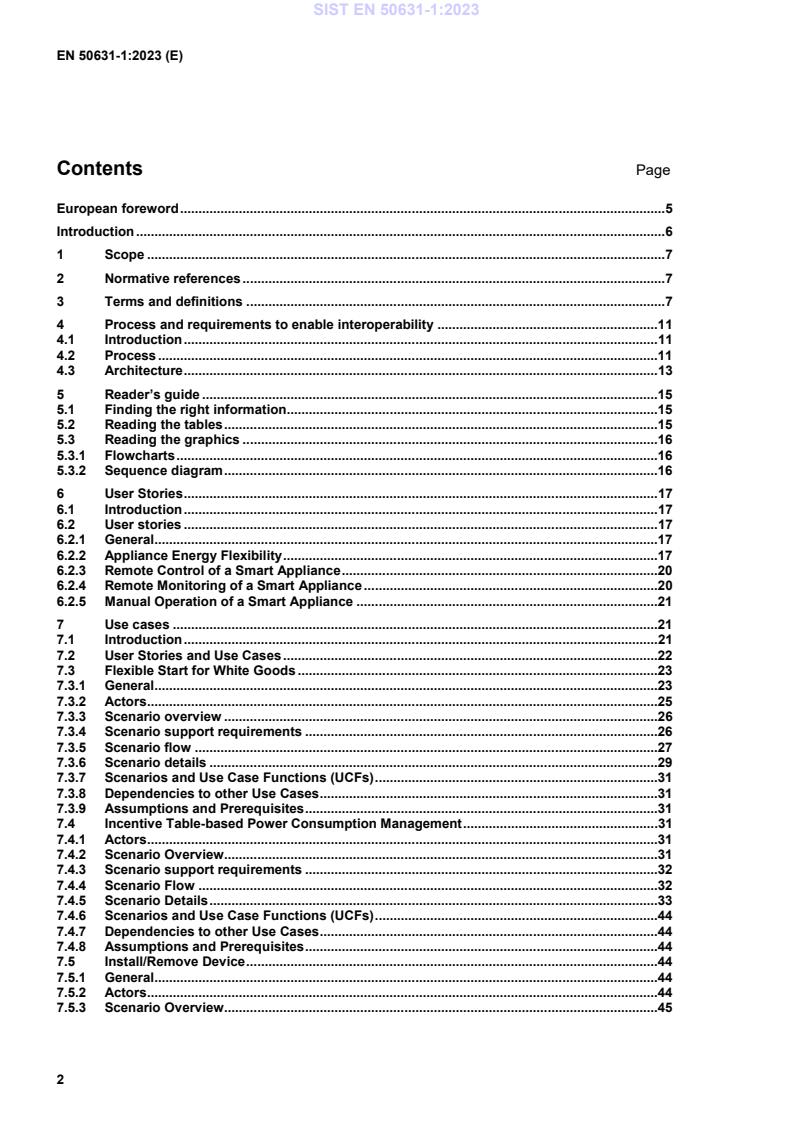
Contents Page
European foreword . 5
Introduction . 6
1 Scope . 7
2 Normative references . 7
3 Terms and definitions . 7
4 Process and requirements to enable interoperability .11
4.1 Introduction .11
4.2 Process .11
4.3 Architecture .13
5 Reader’s guide .15
5.1 Finding the right information.15
5.2 Reading the tables .15
5.3 Reading the graphics .16
5.3.1 Flowcharts .16
5.3.2 Sequence diagram .16
6 User Stories .17
6.1 Introduction .17
6.2 User stories .17
6.2.1 General .17
6.2.2 Appliance Energy Flexibility .17
6.2.3 Remote Control of a Smart Appliance .20
6.2.4 Remote Monitoring of a Smart Appliance .20
6.2.5 Manual Operation of a Smart Appliance .21
7 Use cases .21
7.1 Introduction .21
7.2 User Stories and Use Cases .22
7.3 Flexible Start for White Goods .23
7.3.1 General .23
7.3.2 Actors .25
7.3.3 Scenario overview .26
7.3.4 Scenario support requirements .26
7.3.5 Scenario flow .27
7.3.6 Scenario details .29
7.3.7 Scenarios and Use Case Functions (UCFs) .31
7.3.8 Dependencies to other Use Cases .31
7.3.9 Assumptions and Prerequisites .31
7.4 Incentive Table-based Power Consumption Management .31
7.4.1 Actors .31
7.4.2 Scenario Overview .31
7.4.3 Scenario support requirements .32
7.4.4 Scenario Flow .32
7.4.5 Scenario Details .33
7.4.6 Scenarios and Use Case Functions (UCFs) .44
7.4.7 Dependencies to other Use Cases .44
7.4.8 Assumptions and Prerequisites .44
7.5 Install/Remove Device .44
7.5.1 General .44
7.5.2 Actors .44
7.5.3 Scenario Overview .45
7.5.4 Scenario support requirements . 45
7.5.5 Scenario Flow . 45
7.5.6 Scenario details . 46
7.5.7 Scenarios and Use Case Functions (UCFs). 46
7.5.8 Dependencies to other Use Cases . 47
7.5.9 Assumptions and Prerequisites . 47
7.6 Limitation of Power Consumption . 47
7.6.1 General . 47
7.6.2 Actors . 49
7.6.3 Scenario Overview . 49
7.6.4 Scenario support requirements . 49
7.6.5 Scenario Flow . 50
7.6.6 Scenario details . 50
7.6.7 Scenarios and Use Case Functions (UCFs). 53
7.6.8 Dependencies to other Use Cases . 53
7.6.9 Further information and rules . 54
7.6.10 Assumptions and Prerequisites . 54
7.7 Limit Consumption to own Production . 54
7.8 Manual Operation . 54
7.8.1 General . 54
7.8.2 Actors . 55
7.8.3 Scenario Overview . 55
7.8.4 Dependencies to other Use Cases . 55
7.8.5 Assumptions and Prerequisites . 55
7.9 Monitoring and Control of Smart Grid Ready Conditions . 55
7.9.1 General . 55
7.9.2 Actors . 57
7.9.3 Scenario overview . 57
7.9.4 Scenario support requirements . 57
7.9.5 Scenario flow . 58
7.9.6 Scenario details . 58
7.9.7 Scenarios and Use Case Functions . 59
7.9.8 Dependencies to other Use Cases . 59
7.9.9 Assumptions and Prerequisites . 59
7.10 Monitoring of Power Consumption . 59
7.10.1 General . 59
7.10.2 Actors . 60
7.10.3 Scenario Overview . 60
7.10.4 Scenario Support Requirements . 61
7.10.5 Scenario Flow . 62
7.10.6 Scenario details . 62
7.10.7 Scenarios and Use Case Functions (UCFs). 64
7.10.8 Dependencies to other Use Cases . 65
7.10.9 Assumptions and Prerequisites . 65
7.11 Optimization of Self Consumption by Heat Pump Compressor Flexibility . 65
7.11.1 General . 65
7.11.2 User Story as an example . 66
7.11.3 Detailed background information . 66
7.11.4 Actors . 68
7.11.5 Scenario Overview . 68
7.11.6 Scenario Support Requirements . 69
7.11.7 Scenario Flow . 69
7.11.8 Scenario Details . 72
7.11.9 Scenarios and Use Case Functions (UCFs). 74
7.11.10 Dependencies to other Use Cases . 74
7.11.11 Assumptions and Prerequisites . 74
8 Use Case Function (UCF) details . 75
8.1 General . 75
8.2 Concepts . 75
8.3 UCF_AC_Measurement .76
8.3.1 Generic Description .76
8.3.2 Additional Information .91
8.4 UCF_Characteristics .91
8.4.1 Generic Description .91
8.4.2 Additional Information .93
8.5 UCF_Configure_Current_Power_Sequence .93
8.5.1 Generic Description .93
8.5.2 Additional Information .95
8.6 UCF_Consumption_Curve .95
8.6.1 Generic Description .95
8.6.2 Additional Information .100
8.7 UCF_Device_Configuration .100
8.7.1 Generic Description .100
8.7.2 Additional Information .106
8.8 UCF_Device_Connected .106
8.8.1 Generic Description .106
8.8.2 Additional Information .107
8.9 UCF_Heartbeat .107
8.9.1 Generic Description .107
8.9.2 Additional Information .108
8.10 UCF_Incentive_Table .108
8.10.1 Generic Description .108
8.10.2 Additional Information .131
8.11 UCF_Overrun .131
8.11.1 Generic Description .131
8.11.2 Additional Information .132
8.12 UCF_Plan_With_Power_Sequences .133
8.12.1 Generic Description .133
8.12.2 Additional Information .142
8.13 UCF_Power_Limit .142
8.13.1 Generic Description .142
8.13.2 Additional Information .144
8.14 UCF_Report_Status_Of_Power_Sequence .144
8.14.1 Generic Description .144
8.14.2 Additional Information .148
8.15 UCF_Select_Power_Sequence .148
8.15.1 Generic Description .148
8.15.2 Additional Information .151
8.16 UCF_Shift_Preferred_Power_Sequence .151
8.16.1 Generic Description .151
8.16.2 Additional Information .152
8.17 UCF_System_Function .152
8.17.1 Generic Description .152
8.17.2 Additional Information .154
9 Glossary of definitions for UCFs .154
Bibliography .162
European foreword
This document (EN 50631-1:2023) has been prepared by WG 7 “Smart Household Appliances” of CLC/TC 59X
“Performance of household and similar electrical appliances”.
The following dates are fixed:
• latest date by which this document has to be (dop) 2024-02-07
implemented at national level by publication of
an identical national standard or by
endorsement
• latest date by which the national standards (dow) 2026-02-07
conflicting with this document have to be
withdrawn
This document supersedes EN 50631-1:2017 and all of its amendments and corrigenda (if any).
— Simplified adoption of the series of standards through logical partitioning of the document structure;
— Ensured interoperability through more precise, neutral definition of information and sequences to be
exchanged;
— Neutralization of requirements and description of information to be exchanged on a generic level, permitting
mapping to different data models and languages;
— Extension of use cases and data models to Heating, Ventilation, Cooling devices for a holistic approach
regarding energy management at home / on premises;
— Definition of possible transport protocols to ensure more complete interoperability;
— Primary focus on energy management;
— Preparation for further developments.
Attention is drawn to the possibility that some of the elements of this document may be the subject of patent
rights. CENELEC shall not be held responsible for identifying any or all such patent rights.
Any feedback and questions on this document should be directed to the users’ national committee. A complete
listing of these bodies can be found on the CENELEC website.
Introduction
Energy management systems will more and more become necessary due to change from fossil and nuclear to
renewable production and the associated decentralization. Since an appropriate standard for a home and
building management is in preparation, this document specifies how sets of products from multiple
manufacturers can exchange information with Home and Building / Customer Energy Management Systems,
located in a home network or in the cloud.
This document focuses on interoperability of household appliances and describes the necessary control and
monitoring. It defines a set of functions of household and similar electrical appliances. The functions in this
document cover next to energy-management main remote-control and – monitoring use cases.
This document does not deal with safety and security requirements. Safety requirements have been set in the
EN 60335 series [2].
The EN 50631 series will provide interoperability on information exchange among various appliances in the
home. The EN 50631 document series will be re-arranged regarding the further development and will be split
into 6 parts:
EN 50631-1, Household appliances network and grid connectivity — Part 1: General Requirements, Generic
Data Modelling and Neutral Messages
EN 50631-2, Household appliances network and grid connectivity — Part 2: Product Specific mappings, details,
requirements and deviations
EN 50631-3-x, Household appliances network and grid connectivity — Part 3: Specific Data Model Mapping
EN 50631-4-x, Household appliances network and grid connectivity — Part 4: Communication Protocol Specific
Aspects
EN 50631-5, Household appliances network and grid connectivity — Part 5: General Test-Requirements and -
Specification
EN 50631-6, Household appliances network and grid connectivity — Part 6: SPINE Data Model Toolbox
Data communication heavily depends on the environment of appliances. Sometimes low bitrate or energy
efficient communication puts strict requirements to selected communication technologies. Therefore, popular
and de facto standards had been and will be developed by the industry to fulfil such requirements. To not
influence common data modelling for appliances because of such restrictions, the standardized data models
and neutral message structures need to be applied to communication technologies.
This standard series therefore is intended to separate data modelling and neutral message structure from the
attached communication.
Part 1 defines general requirements, generic data modelling and generic neutral messages without relation to
any specific communication technology or any product specific layout.
Part 2 lists and specifies product specific requirements and implementation guidance based on the generic data
model and generic neutral messages.
Part 3 defines the mapping of neutral messages to examples of typical data models like SPINE, SPINE-IoT,
OCF, and so forth. These data models are neither mandatory nor to be seen as complete spectrum of data
models.
Part 4 defines the mapping of neutral messages to examples of typical communication protocols. These
communication protocols are neither mandatory, nor do they provide an exhaustive list of communication
protocols.
Part 5 defines testing requirements and testing specifications. This part will be covered in the future by a New
Work Item Proposal.
Part 6 provides the technical reference specification for the SPINE data model. This part will be covered in the
future by a New Work Item Proposal.
1 Scope
This document defines data models for Interoperable Connected Household Appliances. The data models are
derived from a logical decomposition of use cases into functional blocks that themselves were realized by
abstract actions on the data model itself.
This document is part of the EN 50631 series, which defines the information exchange between Smart
Appliances and management systems in homes and buildings including energy management.
2 Normative references
There are no normative references in this document.
3 Terms and definitions
For the purposes of this document, the following terms and definitions apply.
ISO and IEC maintain terminological databases for use in standardization at the following addresses:
— ISO Online browsing platform: available at https://www.iso.org/obp
— IEC Electropedia: available at https://www.electropedia.org/
3.1
“alternatives” group
grouping of one or more Power sequences over a specified time
3.2
appliance
electrical apparatus intended for household or similar use
EXAMPLES Refrigerators, dishwashers, clothes washers, clothes dryers, air conditioners, water heaters, circulation
pumps, heat pumps, etc.
3.3
Appliance Energy Flexibility
ability of an appliance to change power consumption in response to an external stimulus
3.4
client
role that specifies that a node uses data from a “server” or can request for change
3.5
command
functional part of a Message
3.6
CCM
Customer Connectivity Manager
component or set of functions with the capability to:
1. Receive and process Grid Information, Appliance Information and User Instructions, and
2. Manage one or more Smart Appliances
Note 1 to entry: A CCM may be integrated with a Smart Appliance or may be physically separate.
Note 2 to entry: A CCM manages the energy-using behaviour as well as other aspects of device behaviour (e.g. setting of
job status like starting, stopping, pausing, parameters like temperature, notifications.) of one or more Smart Appliances.
Note 3 to entry: In other documentation, CCM is often called Customer Energy Manager (CEM) with a dedicated focus on
energy management or called Energy Management System (EMS) with a dedicated focus on energy management.
3.7
data model
definition of possible data (data structures, values) for the exchange of information (especially for
communications systems)
[SOURCE: IEC 60050, IEV]
3.8
Demand Response
DR
action resulting from management of the electricity demand in response to supply conditions
[SOURCE: IEC 60050, IEV]
3.9
Demand Side Management
DSM
process that is intended to influence the quantity or patterns of use of electric energy consumed by end-use
customers
3.10
DHW
Domestic Hot Water
3.11
grid information
information received by a CCM directly from or relating to the electricity grid
Note 1 to entry: Such information may include (but is not restricted to) the following categories:
— current and future energy prices;
— current and future network constraints;
— emissions-intensity of electricity supply;
— level of renewable energy generation;
— requests or instructions for load modification;
— directly sensed information (e.g. frequency and voltage).
3.12
interoperability
property permitting smart appliances and energy management systems in homes and buildings to exchange
data together for the purpose of energy management
[SOURCE: IEC 60050, IEV]
3.13
HAN
Home Area Network
3.14
JWG
Joint Working Group
Joint working Group Use Cases & Requirements is a working group under the roof of IEC/TC 57/WG 21; it is a
cross functional working group and develops Smart Grid and Smart Home & Building related user stories and
use cases
Note 1 to entry: See IEC/TR 62746-2:2015 Use cases and requirements [1]
3.15
manual operation
operation of a Device under direct user control
Note 1 to entry: Includes operation under the influence of remote controls provided with the appliance or device.
3.16
manual override
return to Normal User Operation that terminates or prevents a period of Smart Operation, that is initiated by the
User
3.17
neutral message
information exchange that is independent of any specific communication solution
Note 1 to entry: EN 50631-4-1) describes the mapping of neutral messages to examples of typical communication
protocols.
3.18
power sequence
expected power consumption over time (i.e., represented as a “curve” of power over time) including options on
its flexibility
3.19
power slot
single step of a Power sequence; each power slot is modelled with at least one constant power value for its
duration
3.20
RMS
rms
abbreviation for “root mean square” (used for electricity measurement)
3.21
scope
Scope Type
definition of scope types to allow identification of specific functionalities unambiguously
EXAMPLE outsideAirTemperature
3.22
server
role that specifies that a node offers own data to be read or written by a node with role client
Note 1 to entry: A server can notify its data to other nodes (with role client).
3.23
smart appliance
appliance that is capable of Smart Operation
Note 1 to entry: Notwithstanding the possibly broader concept related to the term “smart appliance”, a smart appliance
under the framework of this document needs to be understood as follows:
1) It is an appliance that can respond to an external stimulus initiated by a CCM and/or Remote Agent to provide
activities such as
a. Support Appliance Energy Flexibility
b. job status related functions such as starting, stopping, pausing,
c. content or level related functions such as temperature, door status;
2) The appliance will respond when the user sets conditions and its status allows for a response,
3) The response is a change of the appliance’s behaviour like electricity consumption, job status and/or level or
content pattern, or a notification thereof;
4) The specific technical smart capabilities need not be activated when the product is placed on the market; the
activation can be done at a later point in time by the consumer or a service provider.
Note 2 to entry: Smart appliances in this context can communicate through a Customer Connectivity Manager function
processing external signals, such as price information or availability of Renewable Energy Sources (demand response), or
direct control signals (demand side management), being able to consider households’ preferences or the behaviour of the
other home appliances.
3.24
smart operation
operation of an Appliance where the CCM has been set to modify operation automatically in response to Trigger
Criteria
Note 1 to entry: Smart operation may be initiated by a CCM.
3.25
SPINE
Smart Premises Interoperable Neutral-message Exchange
3.26
SPINE-IoT
Smart Premises Interoperable Neutral-message Exchange for Internet of Things
3.27
subscription
functionality that enables the receiving of messages of interest from another device without polling it
3.28
use case
textual description of a re-usable functionality, consisting of one or more messages from one or more
participating actors, which may be visualized with a sequence diagram
EXAMPLE “A CCM shifts the energy usage of a washing machine”
3.29
Use Case Functions
functions which group basic functionalities that had been derived from use cases, and which provide the entire
information exchange required to implement the considered use cases and user stories
3.30
user story
complete (but specific) business case described from the perspective of a user which can be separated into
several use cases
EXAMPLE “The user wants to get the laundry done by 8:00 pm”
4 Process and requirements to enable interoperability
4.1 Introduction
Energy management systems will more and more become a requirement due to the switch from fossil and
nuclear to renewable production and the associated decentralization. The success of energy management is
highly dependent on interoperability of the smart appliances within the premises, which means that all devices
will need a common, manufacturer-independent and brand-independent understanding of messages and data
(in a broader perspective, it does not matter if it is an energy-related message, a home management message
or an information message); see also [8].
This document specifies how different products from different manufacturers can exchange information with
Home and Building / Customer Energy Management Systems located in a home network or in the cloud. It
defines a set of functions of household and similar electrical appliances covering energy management, remote
control and monitoring.
There exist different networking technologies for interoperability in Homes and Buildings. Regardless of the
communication technology, they all have rules or standards (collectively known as protocols) that define the
syntax, semantics and synchronization of communication and error recovery methods which have to be taken
into account when defining specific protocols used for the scope. EN 50631-4 defines this process.
4.2 Process
The Smart Grid Architecture Model (SGAM) [9], published by the Smart Grid Coordination Group based on EU
mandate M/490, defines five interoperability layers representing business objectives and processes, functions,
information exchange and models, communication protocols and components.
Figure 1 shows the interoperability layer and the corresponding domains and zones, defined in the SGAM
Model.
Figure 1 — SGAM Framework (from [9])
In analogy to the SGAM Framework, this series of documents uses a top-down process and sequence of steps
to describe an open interface for integrating with Smart Appliances within the Customer Premises SGAM
domain (see Figure 2).
Figure 2 — Process used in this document
User stories and derived use cases are collections of ideas how to use Smart Appliances. User stories and use
cases are not binding and describe one possible solution (see Clause 6 and 7). However, they can be used to
deduce common Use Case Functions which can be used/referenced in certain use cases.
Use Case Functions (see Clause 8) contain a set of information and instructions to be exchanged between two
peers such as CCM and Device, described as a data model.
The data model needs to be placed into a message, combined with rules like addressing scheme, capabilities
of addressee and so forth. As this is specific to the protocol(s) at hand, this mapping to specific protocols has
been split out of this document into EN 50631-4-x.
4.3 Architecture
In general, a Smart Appliance connects to a CCM, but has in principle three operation modes:
— Standalone: The end user directly controls the Smart Appliance and all its functionality.
— Local: The Smart Appliance is connected to a local CCM via the HAN.
— IoT/Cloud: The Smart Appliance communicates via its cloud representation or directly with an IoT/cloud
based CCM.
NOTE As described in 3.6, the CCM manages the energy-using behaviour and may as well manage other aspects of
device behaviour. Thus, in Figure 4, it represents a logical component that in reality may be represented by one or more
physical and/or logical entities. According to EN 50491-12-x, for example, it might represent the combination of a Customer
Energy Manager (CEM) and a Resource Manager. EN 50631 does not prescribe the architecture of the CCM.
This document will describe further in detail the local and IoT/Cloud operation modes. The standalone mode is
not described in this document.
Figure 3 describes the application of EN 50631 series for the local and IoT/Cloud based operating modes.
Figure 3 — Application of EN 50631 series for the local and IoT/Cloud based operating modes
As the Use Case Functions are described in a general way without detailing the mapping of the information
content to specific protocols, it is possible to refer to these Use Case Functions both in a local Home Area
Network (HAN) and in a cloud. While the transport layer may change, the information content shall remain the
same. Figure 4 clarifies this concept showing a case of a “HAN-based protocol A” using a specific “transport
protocol C” and a “web-based protocol B”.
Figure 4 — Applicability of resources to different scenarios
This series of standards focuses on the interface between Smart Appliances and the CCM and describes this
interface from the Smart Appliance’s point of view. Figure 5 shows the applicability of EN 50631 (orange
arrows). All participating actors described in this figure are logical actors. The CCM may have other interactions
with the grid or with other actors in the premises, different from smart appliances, but these interactions are not
in the scope of EN 50631.
NOTE Arrows represent logical data flows. Images used with kind permission from EEBUS Initiative e.V.
Figure 5 — Applicability of EN 50631
Protocols
...