


EN 50341-2-22:2022
(Main)Overhead electrical lines exceeding AC 1 kV - Part 2-22: National Normative Aspects (NNA) for Poland (based on EN 50341-1:2012)
General Information
- Abstract
1.1 General (ncpt) PL.1 Scope of application This NNA applies to designing and constructing of new overhead lines with nominal system voltages exceeding 1 kV AC. "New overhead line" means a totally new line between two points, A and B, built up with new components. The standard PN-EN 50341-1 (Part 1) with this NNA does not apply to modernisation, reconstruction and renovation of the existing lines, unless otherwise specified in the Project Specification. 1.2 Field of application (ncpt) PL.1 All Dielectric Self Supporting (ADSS) cables This NNA applies to All Dielectric Self Supporting (ADSS) cables only within the scope of their impact on the supports and minimum clearances which shall be taken as for insulated cable systems. (ncpt) PL.2 Telecommunication equipment This NNA relates to the telecommunication equipment mounted on the new overhead line supports.
- Status
- Published
- Publication Date
- 24-Mar-2022
- Technical Committee
- CLC/TC 11 - Overhead electrical lines exceeding 1 kV a.c. (1,5 kV d.c.)
- Drafting Committee
- CLC/TC 11 - Overhead electrical lines exceeding 1 kV a.c. (1,5 kV d.c.)
- Current Stage
- 6060 - Document made available - Publishing
- Start Date
- 25-Mar-2022
- Due Date
- 23-May-2024
- Completion Date
- 25-Mar-2022

Overview
EN 50341-2-22:2022 - Overhead electrical lines exceeding AC 1 kV, Part 2-22 - is the National Normative Aspects (NNA) for Poland based on EN 50341-1:2012 and published by CLC/CENELEC. It specifies national provisions for the design and construction of new overhead lines with nominal AC voltages above 1 kV, including requirements that affect supports, clearances and telecommunication equipment mounted on line supports. Note: this NNA applies to new lines only (not to modernization, reconstruction or renovation unless stated in the Project Specification).
Key topics and technical requirements
This NNA supplements EN 50341-1 with Poland-specific rules and guidance. Major technical topics include:
Scope and field of application
- Applies to new overhead lines (>1 kV AC).
- ADSS (All Dielectric Self Supporting) cables: included only with respect to their impact on supports and minimum clearances, treated like insulated cable systems.
- Telecommunication equipment mounted on supports is covered.
Design basis and reliability
- Requirements for reliability, security and durability of overhead line installations.
- Use of design values and partial factors for actions.
Actions and load cases
- Wind loads (basic and mean velocities, pressures, drag/structural factors).
- Ice loads and combined wind‑and‑ice scenarios.
- Temperature effects, safety and security loads, and short‑circuit mechanical forces.
- Defined standard load cases for structural and electrical checks.
Electrical and clearance requirements
- Insulation coordination and minimum air and external clearances (to ground, buildings, traffic routes, other lines, recreational areas).
- Load cases for clearance calculations (maximum conductor temperature, wind/ice combinations).
Supports, foundations and geotechnical design
- Requirements for lattice towers, steel/wood/concrete poles: structural analysis, ultimate and serviceability limit states, connection resistance, assembly and erection.
- Foundations and geotechnical design referenced to EN 1997 principles.
Earthing, conductors, insulators and hardware
- Earthing measures, touch‑voltage criteria, conductor and earth‑wire requirements (including optical fibre-containing ground wires), pollution and mechanical performance of insulators, and hardware quality.
Quality assurance
- Tests, loading trials, supervision, checks and taking‑over procedures.
Practical applications and users
Who uses EN 50341-2-22:2022:
- Transmission and distribution utilities designing new overhead lines in Poland
- Transmission line designers and structural/geo‑technical engineers
- Contractors and fabricators of towers, poles and foundations
- Consultants for clearance, earthing and conductor selection
- Regulators and procurement teams ensuring compliance with Polish NNA for high‑voltage overhead lines
Practical value:
- Ensures safe clearances and reliability under national wind/ice/geotechnical conditions
- Guides integration of ADSS cables and telecom equipment on power line supports
- Harmonizes structural and electrical design with EN 50341-1 while reflecting Polish norms
Related standards
- EN 50341-1:2012 (base European standard)
- EN 1993 (steel structures), EN 1997 (geotechnical design) - referenced for supports and foundations
- National Polish project specifications and complementary regulations
Keywords: EN 50341-2-22:2022, overhead electrical lines, NNA Poland, ADSS cables, line clearances, wind and ice loads, earthing, supports, foundations, CENELEC.
Relations
- Effective Date
- 29-Mar-2022
Get Certified
Connect with accredited certification bodies for this standard

IMQ S.p.A. (Certification)
Italian electrical product certification.

SLG Prüf- und Zertifizierungs GmbH
German testing and certification body.

UL Solutions
Global safety science company with testing, inspection and certification.
Sponsored listings
Frequently Asked Questions
EN 50341-2-22:2022 is a standard published by CLC. Its full title is "Overhead electrical lines exceeding AC 1 kV - Part 2-22: National Normative Aspects (NNA) for Poland (based on EN 50341-1:2012)". This standard covers: 1.1 General (ncpt) PL.1 Scope of application This NNA applies to designing and constructing of new overhead lines with nominal system voltages exceeding 1 kV AC. "New overhead line" means a totally new line between two points, A and B, built up with new components. The standard PN-EN 50341-1 (Part 1) with this NNA does not apply to modernisation, reconstruction and renovation of the existing lines, unless otherwise specified in the Project Specification. 1.2 Field of application (ncpt) PL.1 All Dielectric Self Supporting (ADSS) cables This NNA applies to All Dielectric Self Supporting (ADSS) cables only within the scope of their impact on the supports and minimum clearances which shall be taken as for insulated cable systems. (ncpt) PL.2 Telecommunication equipment This NNA relates to the telecommunication equipment mounted on the new overhead line supports.
1.1 General (ncpt) PL.1 Scope of application This NNA applies to designing and constructing of new overhead lines with nominal system voltages exceeding 1 kV AC. "New overhead line" means a totally new line between two points, A and B, built up with new components. The standard PN-EN 50341-1 (Part 1) with this NNA does not apply to modernisation, reconstruction and renovation of the existing lines, unless otherwise specified in the Project Specification. 1.2 Field of application (ncpt) PL.1 All Dielectric Self Supporting (ADSS) cables This NNA applies to All Dielectric Self Supporting (ADSS) cables only within the scope of their impact on the supports and minimum clearances which shall be taken as for insulated cable systems. (ncpt) PL.2 Telecommunication equipment This NNA relates to the telecommunication equipment mounted on the new overhead line supports.
EN 50341-2-22:2022 is classified under the following ICS (International Classification for Standards) categories: 29.240.20 - Power transmission and distribution lines. The ICS classification helps identify the subject area and facilitates finding related standards.
EN 50341-2-22:2022 has the following relationships with other standards: It is inter standard links to EN 50341-2-22:2016. Understanding these relationships helps ensure you are using the most current and applicable version of the standard.
EN 50341-2-22:2022 is available in PDF format for immediate download after purchase. The document can be added to your cart and obtained through the secure checkout process. Digital delivery ensures instant access to the complete standard document.
Standards Content (Sample)
SLOVENSKI STANDARD
01-junij-2022
Nadomešča:
SIST EN 50341-2-22:2016
Nadzemni električni vodi za izmenične napetosti nad 1 kV - 2-22. del: Nacionalna
normativna določila (NNA) za Poljsko (na podlagi EN 50341-1:2012)
Overhead electrical lines exceeding AC 1 kV - Part 2-22: National Normative Aspects
(NNA) for Poland (based on EN 50341-1:2012)
Ta slovenski standard je istoveten z: EN 50341-2-22:2022
ICS:
29.240.20 Daljnovodi Power transmission and
distribution lines
2003-01.Slovenski inštitut za standardizacijo. Razmnoževanje celote ali delov tega standarda ni dovoljeno.
EUROPEAN STANDARD EN 50341-2-22
NORME EUROPÉENNE
EUROPÄISCHE NORM March 2022
ICS 29.240.20 Supersedes EN 50341-2-22:2016 and all of its
amendments and corrigenda (if any)
English Version
Overhead electrical lines exceeding AC 1 kV - Part 2-22:
National Normative Aspects (NNA) for Poland (based on EN
50341-1:2012)
To be completed To be completed
This European Standard was approved by CENELEC on 2022-01-12. CENELEC members are bound to comply with the CEN/CENELEC
Internal Regulations which stipulate the conditions for giving this European Standard the status of a national standard without any alteration.
Up-to-date lists and bibliographical references concerning such national standards may be obtained on application to the CEN-CENELEC
Management Centre or to any CENELEC member.
This European Standard exists in three official versions (English, French, German). A version in any other language made by translation
under the responsibility of a CENELEC member into its own language and notified to the CEN-CENELEC Management Centre has the
same status as the official versions.
CENELEC members are the national electrotechnical committees of Austria, Belgium, Bulgaria, Croatia, Cyprus, the Czech Republic,
Denmark, Estonia, Finland, France, Germany, Greece, Hungary, Iceland, Ireland, Italy, Latvia, Lithuania, Luxembourg, Malta, the
Netherlands, Norway, Poland, Portugal, Republic of North Macedonia, Romania, Serbia, Slovakia, Slovenia, Spain, Sweden, Switzerland,
Turkey and the United Kingdom.
European Committee for Electrotechnical Standardization
Comité Européen de Normalisation Electrotechnique
Europäisches Komitee für Elektrotechnische Normung
CEN-CENELEC Management Centre: Rue de la Science 23, B-1040 Brussels
© 2022 CENELEC All rights of exploitation in any form and by any means reserved worldwide for CENELEC Members.
Ref. No. EN 50341-2-22:2022 E
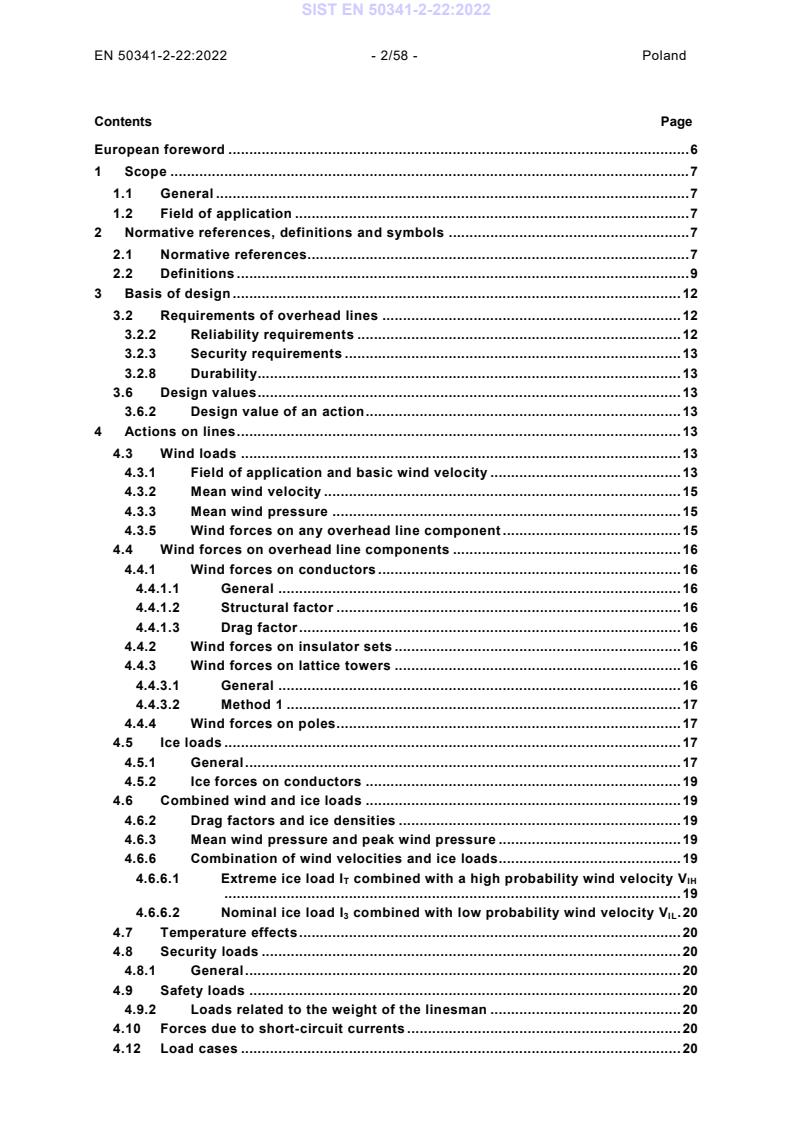
Contents Page
European foreword . 6
1 Scope . 7
1.1 General . 7
1.2 Field of application . 7
2 Normative references, definitions and symbols . 7
2.1 Normative references. 7
2.2 Definitions . 9
3 Basis of design . 12
3.2 Requirements of overhead lines . 12
3.2.2 Reliability requirements . 12
3.2.3 Security requirements . 13
3.2.8 Durability. 13
3.6 Design values . 13
3.6.2 Design value of an action . 13
4 Actions on lines . 13
4.3 Wind loads . 13
4.3.1 Field of application and basic wind velocity . 13
4.3.2 Mean wind velocity . 15
4.3.3 Mean wind pressure . 15
4.3.5 Wind forces on any overhead line component . 15
4.4 Wind forces on overhead line components . 16
4.4.1 Wind forces on conductors . 16
4.4.1.1 General . 16
4.4.1.2 Structural factor . 16
4.4.1.3 Drag factor . 16
4.4.2 Wind forces on insulator sets . 16
4.4.3 Wind forces on lattice towers . 16
4.4.3.1 General . 16
4.4.3.2 Method 1 . 17
4.4.4 Wind forces on poles . 17
4.5 Ice loads . 17
4.5.1 General . 17
4.5.2 Ice forces on conductors . 19
4.6 Combined wind and ice loads . 19
4.6.2 Drag factors and ice densities . 19
4.6.3 Mean wind pressure and peak wind pressure . 19
4.6.6 Combination of wind velocities and ice loads . 19
4.6.6.1 Extreme ice load I combined with a high probability wind velocity V
T IH
.............................................................................................................. 19
4.6.6.2 Nominal ice load I combined with low probability wind velocity V . 20
3 IL
4.7 Temperature effects . 20
4.8 Security loads . 20
4.8.1 General . 20
4.9 Safety loads . 20
4.9.2 Loads related to the weight of the linesman . 20
4.10 Forces due to short-circuit currents . 20
4.12 Load cases . 20
Poland - 3/58 - EN 50341-2-22:2022
4.12.1 General . 20
4.12.2 Standard load cases . 21
4.13 Partial factors for actions . 23
5 Electrical requirements . 23
5.3 Insulation co – ordination . 23
5.5 Minimum air clearance distances to avoid flashover . 24
5.6 Load cases for calculation of clearances . 24
5.6.2 Maximum conductor temperature . 24
5.6.3 Wind loads for determination of electric clearances . 25
5.6.3.2 Nominal wind loads for determination of internal and external
clearances . 25
5.6.3.3 Extreme wind loads for determination of internal clearances . 25
5.6.4 Ice loads for determination of electric clearances . 25
5.6.5 Combined wind and ice loads . 25
5.8 Internal clearances within the span and at the top of support . 25
5.9 External clearances . 32
5.9.1 General . 32
5.9.2 External clearances to ground in areas remote from buildings,
roads, etc. . 34
5.9.3 External clearances to residential and other buildings . 36
5.9.4 External clearances to line crossing traffic routes . 38
5.9.5 External clearances to adjacent traffic routes . 40
5.9.6 External clearances to other power lines or overhead
telecommunication lines . 41
5.9.7 External clearances to recreational areas (playgrounds, sport
areas, etc.) . 43
6 Earthing systems . 43
6.1 Introduction . 43
6.1.1 Purpose . 43
6.1.3 Earthing measures against lightning effects . 43
6.2 Ratings with regard to corrosion and mechanical strength. 44
6.2.2 Earthing and bonding conductors . 44
6.4 Dimensioning with regard to human safety . 44
6.4.3 Basic design of earthing systems with regard to permissible touch
voltage . 44
7 Supports . 44
7.3 Lattice steel towers . 44
7.3.1 General . 44
7.3.5 Structural analysis . 44
7.3.6 Ultimate limit states . 45
7.3.6.1 General . 45
7.3.6.3 Tension, bending and compression resistance of members . 45
7.3.6.4 Buckling resistance of members in compression . 45
7.3.7 Serviceability limit states . 45
7.3.8 Resistance of connections . 46
7.3.9 Design assisted by testing . 46
7.4 Steel poles. 46
7.4.1 General . 46
7.4.5 Structural analysis (EN 1993-1-1:2005 – Chapter 5) . 46
7.4.6 Ultimate limit states (EN 1993-1-1:2005 – Chapter 6) . 46
7.4.6.1 General . 46
7.4.7 Serviceability limit states (EN 1993-1-1:2005 – Chapter 7) . 46
7.4.8 Resistance of connections . 47
7.4.8.2 Bolts (other than holding-down bolts) . 47
7.4.9 Design assisted by testing . 47
7.5 Wood poles . 47
7.5.1 General . 47
7.5.5 Ultimate limit states . 47
7.5.5.3 Resistance of wood elements . 47
7.6 Concrete poles . 47
7.6.1 General . 47
7.6.3 Materials . 47
7.6.4 Ultimate limit states . 48
7.6.5 Serviceability limit states . 48
7.10 Maintenance facilities . 48
7.10.3 Safety requirements . 48
7.11 Loading tests . 48
7.12 Assembly and erection . 48
8 Foundations . 49
8.1 Introduction . 49
8.2 Basis of geotechnical design (EN 1997-1:2004 – Section 2) . 49
8.2.2 Geotechnical design by calculation . 49
8.2.4 Load tests and tests on experimental models. 50
8.3 Soil investigation and geotechnical data (EN 1997-1:2004 – Section 3) . 50
8.4 Supervision of construction, monitoring and maintenance (EN 1997-1:2004 –
Section 4) . 51
9 Conductors and earth-wires . 52
9.2 Aluminium based conductors . 52
9.2.3 Conductor service temperatures and grease characteristics . 52
9.3 Steel based conductors . 52
9.3.3 Conductor service temperatures and grease characteristics . 52
9.5 Conductors and ground wires containing optical fibre telecommunication
circuits . 53
9.5.3 Conductor service temperatures . 53
9.6 General requirements . 53
9.6.2 Partial factor for conductors . 53
10 Insulators . 54
10.4 Pollution performance requirements . 54
10.5 Power arc requirements. 54
10.7 Mechanical requirements . 55
11 Hardware . 55
11.6 Mechanical requirements . 55
12 Quality assurance, checks and taking-over . 55
Annex J (normative) Angles in lattice steel towers . 56
J.2 General . 56
J.3 Tension resistance of angles connected through one leg (see 7.3.6.2) . 56
Poland - 5/58 - EN 50341-2-22:2022
Annex K (normative) Steel poles . 57
K.2 Classification of cross sections (EN 1993-1-1:2005 – 5.5) . 57
K.4 Resistance of circular cross sections . 57
Annex M (informative) Geotechnical and structural design of foundations . 58
M.2 Sample analytical models for uplift resistance calculation . 58
M.2.2 Calculation of R . 58
W
European Foreword
1. The Polish Committee for Standardization (NC) is identified by the following address:
Polski Komitet Normalizacyjny
ul. Świętokrzyska 14
00-050 Warszawa
Polska
phone: +48 22 55 67 591
e-mail: intdoc@pkn.pl
Name of the relevant technical body: Komitet Techniczny nr 80 ds. “Ogólnych w Sieciach
Elektroenergetycznych” (Technical Committee No 80 “for General Issues in Power Networks”).
2. The Polish NC has prepared this Part 2-22 (EN 50341-2-22) listing the Polish National
Normative Aspects (NNA), under its sole responsibility, and duly passed it through the
CENELEC and CLC/TC11 procedures.
NOTE:
The Polish NC also takes sole responsibility for the technically correct co-ordination of this NNA with EN
50341-1. It has performed the necessary checks in the frame of quality assurance / control. However, it is
noted that this quality control has been made in the framework of the general responsibility of a standards
committee under the national laws / regulations.
3. This NNA is normative in Poland and informative for other countries.
4. This NNA has to be read in conjunction with Part 1 (EN 50341-1). All clause numbers used in
this NNA correspond to those of Part 1. Specific subclauses, which are prefixed “PL”, are to be
read as amendments to the relevant text in Part 1. Any necessary clarification regarding the
application of this NNA in conjunction with Part 1 shall be referred to the Polish NC who will, in
co-operation with CLC/TC11, clarify the requirements.
Where no reference is made in this NNA to a specific sub-clause, then Part 1 shall apply.
5. In case of “boxed values” defined in Part 1, amended values (if any), which are defined in this
NNA, shall be taken into account in Poland.
However, any boxed value whether in Part 1 or in this NNA, shall not be amended in the direction
of greater risk in the Project Specification.
NOTE:
All national standards referred to in this Part 2-22 will be replaced by the relevant European Standards as
soon as they become available and declared by the Polish NC to be applicable and thus reported to the
secretary of CLC/TC 11.
Poland - 7/58 - EN 50341-2-22:2022
1 Scope
1.1 General
(ncpt) PL.1 Scope of application
This NNA applies to designing and constructing of new overhead lines with nominal system
voltages exceeding 1 kV AC.
“New overhead line” means a totally new line between two points, A and B, built up with new
components.
The standard PN-EN 50341-1 (Part 1) with this NNA does not apply to modernisation,
reconstruction and renovation of the existing lines, unless otherwise specified in the Project
Specification.
1.2 Field of application
(ncpt) PL.1 All Dielectric Self Supporting (ADSS) cables
This NNA applies to All Dielectric Self Supporting (ADSS) cables only within the scope of their
impact on the supports and minimum clearances which shall be taken as for insulated cable
systems.
(ncpt) PL.2 Telecommunication equipment
This NNA relates to the telecommunication equipment mounted on the new overhead line
supports.
2 Normative references, definitions and symbols
2.1 Normative references
(ncpt) PL.1 General
The following documents which are quoted partly or as a whole in this document are necessary
for the application of this document. In case of non-dated references the last edition of the
referred document (including all modifications) is applicable.
(A-Dev) PL.2 Normative references
Reference Title
PN-EN 1992-1-1:2008 Eurocode 2: Design of concrete structures – Part 1-1: General rules and
rules for buildings
Eurokod 2: Projektowanie konstrukcji z betonu -- Część 1-1: Reguły
ogólne i reguły dla budynków
PN-EN 1993-1-1:2006 Eurocode 3: Design of steel structures – Part 1-1: General rules and
rules for buildings
Eurokod 3: Projektowanie konstrukcji stalowych -- Część 1-1: Reguły
ogólne i reguły dla budynków
PN-EN 1993-1-6:2009 Eurocode 3: Design of steel structures – Part 1-6: Strength and stability
of shell structures
Eurokod 3: Projektowanie konstrukcji stalowych -- Część 1-6:
Wytrzymałość i stateczność konstrukcji powłokowych
PN-EN 1993-1-8:2006 Eurocode 3: Design of steel structures – Part 1-8: Design of joints
Eurokod 3: Projektowanie konstrukcji stalowych -- Część 1-8:
Projektowanie węzłów
PN-EN 1993-3-1:2008 Eurocode 3: Design of steel structures – Part 3-1: Towers, masts and
chimneys – Towers and masts
Eurokod 3: Projektowanie konstrukcji stalowych -- Część 3-1: Wieże,
maszty i kominy -- Wieże i maszty
PN-EN 1997-1:2008 Eurocode 7: Geotechnical design – Part 1: General rules
Eurokod 7: Projektowanie geotechniczne -- Część 1: Zasady ogólne
PN-EN 1997- National Normative Aspects for Poland based on Eurocode 7:
Geotechnical design – Part 1: General rules
1:2008/NA:2011
Załącznik krajowy do PN-EN 1997-1:2008 Eurokod 7: Projektowanie
geotechniczne -- Część 1: Zasady ogólne
PN-EN 1090-1 Execution of steel structures and aluminium structures – Part 1:
Requirements for conformity assessment of structural components
Wykonanie konstrukcji stalowych i aluminiowych -- Część1:
Zasady oceny zgodności elementów konstrukcyjnych
PN-EN 1090-2:2018-09 Execution of steel structures and aluminium structures – Part 2:
Technical requirements for the execution of steel structures
Wykonanie konstrukcji stalowych i aluminiowych – Część 2:
Wymagania techniczne dotyczące konstrukcji stalowych
PN-EN 12843 Precast concrete products - Masts and poles
Prefabrykaty z betonu -- Maszty i słupy
PN-EN 14229 Structural timber - Wooden poles for overhead lines
Drewno konstrukcyjne -- Słupy drewniane do linii napowietrznych
PN-EN ISO 1461 Hot dip galvanized coatings on fabricated iron and steel articles –
Specifications and test methods
Powłoki cynkowe nanoszone na stal metodą zanurzeniową --
Wymagania i metody badań
PN-EN ISO 10684 Fasteners – Hot dip galvanized coatings
Części złączne -- Powłoki cynkowe nanoszone metodą zanurzeniową
PN-B-02482:1983 Building foundations – Bearing capacity of piles and pile foundations
Fundamenty budowlane -- Nośność pali i fundamentów palowych
PN-B-02483:1978 Large diameter bored piles – Specifications and tests
Pale wielkośrednicowe wiercone -- Wymagania i badania
PN-B-03322:1980 Electric overhead lines – Foundations of supporting structures – Static
calculations and design
Elektroenergetyczne linie napowietrzne -- Fundamenty konstrukcji
wsporczych − Obliczenia statyczne i projektowanie
PN-EN 61773 Overhead lines – Testing of foundations for structures
Elektroenergetyczne linie napowietrzne -- Badanie fundamentów
konstrukcji wsporczych
PN-E-06303:1998 Exposure of outdoor insulation to pollution and selection of insulators
under polluted conditions
Narażenie zabrudzeniowe izolacji napowietrznej i dobór izolatorów do
warunków zabrudzeniowych
PN-EN 60071-1 Insulation co-ordination – Part 1: Definitions, principles and rules
Koordynacja izolacji -- Część 1: Definicje, zasady i reguły
PN-EN 50182:2002 Conductors for overhead lines – Round wire concentric lay stranded
conductors
Przewody do linii napowietrznych -- Przewody z drutów okrągłych
skręconych współosiowo
Poland - 9/58 - EN 50341-2-22:2022
2.2 Definitions
List of definitions given in Part 1, in alphabetical order in Polish language, is given below.
Item
No. Definition number
in Part 1
1 safety 2.2. 79
2 earth fault 2.2. 27
3 effect of action 2.2. 37
4 element 2.2. 39
5 purpose 2.2. 68
6 magnetic flux density 2.2. 57
7 exclusion limit probability of a variable 2.2. 41
8 impedance to earth of an earthing system 2.2. 51
9 composite insulator 2.2. 15
10 combination of actions 2.2. 11
11 structure 2.2. 87
12 support (tower) 2.2. 88
13 temporary line 2.2. 102
14 voltage difference 2.2. 109
15 highest system voltage 2.2. 49
16 touch voltage 2.2. 103
17 step voltage 2.2. 85
18 earth potential rise 2.2. 29
19 nominal system voltage 2.2. 59
20 unavailability 2.2. 106
21 reliability (electrical) 2.2. 74
22 reliability (structural) 2.2. 75
23 resistance (structural) 2.2. 76
24 characteristic resistance 2.2. 6
25 design resistance 2.2. 19
26 design working life 2.2. 23
27 frequently occupied area 2.2. 47
28 action 2.2. 1
29 dynamic action 2.2. 24
30 quasi – static action 2.2. 69
31 permanent action 2.2. 64
32 static action 2.2. 84
33 free action 2.2. 46
34 fixed action 2.2. 44
35 accidental action 2.2. 2
Item
No. Definition number
in Part 1
36 variable action 2.2. 108
37 clearance 2.2. 9
38 internal clearance 2.2. 52
39 external clearances 2.2. 42
40 reference period 2.2. 73
41 return period 2.2. 78
42 security 2.2. 80
43 component 2.2. 14
44 electric field 2.2. 38
45 magnetic field 2.2. 56
46 equipotential bonding 2.2. 40
47 earth surface potential 2.2. 31
48 transferred potential 2.2. 104
49 earth fault current 2.2. 28
50 current to earth 2.2. 18
51 sparkover 2.2. 83
52 conductor (of an overhead line) 2.2. 16
53 earth wire 2.2. 35
54 optical groundwire, OPGW 2.2. 61
55 earthing conductor 2.2. 33
56 covered conductor 2.2. 16.1
57 bonding conductor 2.2. 4
58 optical conductor, OPCON 2.2. 60
59 load case 2.2. 55
60 resistance to earth of an earth electrode 2.2. 77
61 soil resistivity 2.2. 82
62 load arrangements 2.2. 54
63 system with resonant earthing 2.2. 100
64 system with isolated neutral 2.2. 97
65 system with low-impedance neutral or phase earthing 2.2. 99
66 system with low-impedance neutral earthing 2.2. 98
67 support, terminal (dead end) 2.2. 94
68 support, tension 2.2. 93
69 support, tangent 2.2. 92
70 support, angle 2.2. 89
71 support, section 2.2. 90
72 anti-cascading tower 2.2. 3
Poland - 11/58 - EN 50341-2-22:2022
Item
No. Definition number
in Part 1
73 support, suspension 2.2. 91
74 glu-lam wood poles 2.2. 48
75 Project Specification 2.2. 67
76 limit state (structural) 2.2. 53
77 ultimate limit state 2.2. 105
78 serviceability limit state 2.2. 81
79 potential grading 2.2. 65
80 system (electrical) 2.2. 96
81 system (mechanical) 2.2. 95
82 design situation 2.2. 20
83 earthing system 2.2. 34
84 corona 2.2. 17
85 failure (structural) 2.2. 43
86 maintenance 2.2. 58
87 earthing 2.2. 32
88 earth electrode 2.2. 26
89 foundation earth electrode 2.2. 45
90 earth rod 2.2. 30
91 horizontal earth electrode 2.2. 50
92 potential grading earth electrode 2.2. 66
93 box values 2.2. 5
94 characteristic value of an action 2.2. 8
95 characteristic value of a material property 2.2. 7
96 combination value for an action 2.2. 13
97 design value of an action 2.2. 22
98 design value of a material property 2.2. 21
99 effective field strength 2.2. 36
100 partial factor for an action 2.2. 62
101 partial factor for a material property 2.2. 63
102 combination factor for an action 2.2. 12
103 reduction factor for a three phase line 2.2. 71
104 coefficient of variation 2.2. 10
105 strength 2.2. 86
106 radio interference 2.2. 70
107 television interface 2.2. 101
108 unreliability (structural) 2.2. 107
109 overhead insulated cable system 2.2. 16.2
Item
No. Definition number
in Part 1
110 earth 2.2. 25
111 reference earth (remote earth) 2.2. 72
Definitions given below are supplementary to Part 1, Subclause 2.2.
(ncpt) PL.1 Nominal line voltage
Nominal voltage of the system in which the line can operate.
(ncpt) PL.2 Design temperature of the phase conductor
The phase conductor temperature used to determine the sag of the conductor for calculating
clearances to ground and crossed objects (in Tables of Chapter 5 determined as “Maximum
conductor temperature” in reference to phase conductors).
(ncpt) PL.3 Permissible continuous service temperature
Temperature at which the conductor can continuously work without deterioration of material
properties.
(ncpt) PL.4 Basic tension
The horizontal conductor tension at a temperature of +10 °C.
(ncpt) PL.5 Line restriction
Set of additional measures implemented on line sections in order to ensure enhanced safety of
the crossed objects.
Restriction levels I, II and III are specified.
(ncpt) PL.6 Conductor bouncing
A sudden momentary change of the position of the conductor as a result of ice falling off from
the conductor.
(ncpt) PL.7 Pole tip load
Notional force applied horizontally at a specified distance “d” from the top of the pole. The value
of pole tip load is such that its effects in terms of bending moment at the base of the pole is
equivalent to the effect of the design loads.
(ncpt) PL.8 Crossing
A location of the line where the orthogonal projections of line conductors and another object on
a horizontal plane coincide or cross with each other, or the horizontal clearance of the line to
the object is less than the clearance specified in the respective clauses of the NNA.
3 Basis of design
3.2 Requirements of overhead lines
3.2.2 Reliability requirements
(ncpt) PL.1 Reliability levels
Unless otherwise specified in the Project Specification, the reliability level is determined as
follows:
− Level 1 – temporary lines,
− Level 2 – all lines except temporary and special lines,
Poland - 13/58 - EN 50341-2-22:2022
− Level 3 – special lines according to the Project Specification.
(ncpt) PL.2 Temporary lines
The seasonal factor cseason shall be taken as 1.
For temporary lines installed for a period between May and September, the ice load need not
be taken into consideration.
3.2.3 Security requirements
(ncpt) PL.1 Additional partial factor
The Project Specification may introduce the additional partial factor used for the values of the
effects of actions for all load cases according to 4.12.2.
NOTE:
It is recommended to apply additional partial factor, so-called factor for the expected consequences of
failure, in case of supports of lines directly exporting power from generating units, multi-circuit lines (over
2 circuits) and lines running over forests.
3.2.8 Durability
(ncpt) PL.1 Environmental corrosion
The Project Specification shall specify the atmospheric-corrosivity category for the area which
the line traverses.
3.6 Design values
3.6.2 Design value of an action
(ncpt) PL.1 Partial factors
The partial factors γ , γ , γ , γ , γ shall be applied to the characteristic values of the actions.
I W G A1 A2
partial factor for safety load cases (Table 4.12.2/PL.2, Load case 6) shall be applied to
The γP
the action effect of the characteristic values of the actions, i.e. to the conductor tension.
4 Actions on lines
4.3 Wind loads
4.3.1 Field of application and basic wind velocity
(ncpt) PL.1 Reference height above ground
Rules given in Part 1, p. 4.3 related to the wind loads on overhead line components are
applicable for any reference height above ground.
(snc) PL.2 Map of wind load zones
Wind load zones are shown in Figure 4.3.1/PL.1.
Figure 4.3.1/PL.1 – Map of wind load zones
(snc) PL.3 Basic wind velocity V
b,0
Values of the basic wind velocity V are given in Table 4.3.1/PL.1.
b,0
Table 4.3.1/PL.1 – Basic wind velocity
Wind load
V (m/s)
b,0
zone
W1 22∙c
ALT
W2 26
W3 22∙c
ALT
where:
cALT – altitude factor to be taken as:
c = 1,0 if H ≤ 300 m
ALT
cALT = 1 + 0,0006 (H – 300) if H > 300 m
H – terrain altitude above sea level (m)
Poland - 15/58 - EN 50341-2-22:2022
4.3.2 Mean wind velocity
(ncpt) PL.1 Terrain categories
Terrain categories shall be taken according to Part 1, Table 4.1, with the stipulation, that in the
mountain regions or in other regions characterised by a complicated topography – in which the
wind velocity might locally increase or drop – the data obtained from the local meteorological
stations shall be used.
NOTE:
Usually, terrain category II is used for overhead lines, unless otherwise specified in the Project
Specification.
(ncpt) PL.2 Wind directional factor
Wind directional factor cdir shall be taken as 1.
(ncpt) PL.3 Orography factor
Orography factor co shall be taken as 1.
(ncpt) PL.4 Mean wind velocity for lines with nominal voltage up to and including 45 kV
For components of the line with nominal voltage up to and including 45 kV and maximum height
of 15 m, it is allowed to apply a constant mean wind velocity, calculated for a height of 10 m
above ground level.
4.3.3 Mean wind pressure
(ncpt) PL.1 Air density
The air density ρ shall be taken as 1,25 kg/m . Part 1, Table 4.2 is not applicable.
4.3.5 Wind forces on any overhead line component
(ncpt) PL.1 Structural factor
Values of the structural factor are given in Table 4.3.5/PL.1.
Table 4.3.5/PL.1 – Structural factor
Symbol
Line component according to Factor value
Part 1
1,0
Lm ≤ 200 m
Conductors G
c
Lm >200 m 0,6+80/Lm
Lattice towers Gtc 1,05
Supports
Poles Gpol 1,0
Insulators Gins 1,0
Warning elements 1,0
Lm – the mean value of the two adjacent span lengths (m)
(ncpt) PL.2 Drag factor
Values of the drag factor are given in Table 4.3.5/PL.2.
Table 4.3.5/PL.2 – Drag factor
Symbol
Line component Factor value
according
to Part 1
Ice-free Cc 1,0
Conductors
Ice-covered Clc 1,1
Lattice towers Ctn, Ctc according to Part 1, p. 4.4.3.2
Supports
Poles Cpol according to Part 1, p. 4.4.4
Insulators Cins 1,2
Warning spheres 0,6
Other warning elements To be determined individually
4.4 Wind forces on overhead line components
4.4.1 Wind forces on conductors
4.4.1.1 General
(ncpt) PL.1 Reference height above ground for conductors
Method 7 according to Part 1, Table 4.3 shall be applied for the calculation of wind loads on
conductors.
(ncpt) PL.2 Conductor tension
Conductor (both phase conductor and earth wire) tension in a section, shall be calculated taking
into consideration the wind forces determined for the height of the highest conductor – phase
conductor or earth wire respectively, in this section. It is not allowed to take into account
a reduction in the effect of the wind pressure due to the section length.
4.4.1.2 Structural factor
(ncpt) PL.1 Structural factor for conductors
is given in Table 4.3.5/PL.1.
Structural factor for conductors Gc
4.4.1.3 Drag factor
(ncpt) PL.1 Drag factor for conductors
Drag factor for conductor Cc is given in Table 4.3.5/PL.2.
4.4.2 Wind forces on insulator sets
(ncpt) PL.1 Requirements
The wind forces on insulators themselves shall be taken into consideration.
(ncpt) PL.2 Structural factor for insulators
is given in Table 4.3.5/PL.1.
Structural factor for insulators Gins
(ncpt) PL.3 Drag factor for insulators
Drag factor for insulators C is given in Table 4.3.5/PL.2.
ins
4.4.3 Wind forces on lattice towers
4.4.3.1 General
(ncpt) PL.1 Calculation method
Method 1 shall be used for calculation of wind forces on lattice towers.
Poland - 17/58 - EN 50341-2-22:2022
(ncpt) PL.2 Reference height above ground of tower section
Wind forces shall be determined independently for particular tower section, assuming the
reference height above ground at half height of the section. This rule shall apply to all structures
of lines with nominal voltage above 45 kV and structures of the height exceeding 15 m in case
of lines with nominal voltage up to and including 45 kV.
4.4.3.2 Method 1
(ncpt) PL.1 Structural factor for lattice towers
is given in Table 4.3.5/PL.1.
Structural factor for lattice towers Gt
(ncpt) PL.2 Drag factor for lattice towers
Drag factor for lattice towers Ctn and Ctc is given in Table 4.3.5/PL.2.
NOTE:
In the formula for calculation of wind force for a lattice cross-arm, QWtc, it is necessary to take into
consideration the drag factor Ctc, given in Table 4.3.5/PL.2.
4.4.4 Wind forces on poles
(ncpt) PL.1 Calculation method
Method 1 shall be used for calculation of wind forces on poles.
(ncpt) PL.2 Structural factor for poles
Structural factor for poles G is given in Table 4.3.5/PL.1.
pol
(ncpt) PL.3 Drag factor for poles
Drag factor for poles C is given in Table 4.3.5/PL.2.
pol
4.5 Ice loads
4.5.1 General
(snc) PL.1 Map of ice load zones
Ice load zones are shown in Figure 4.5.1/PL.1.
Figure 4.5.1/PL.1 – Map of ice load zones
NOTE:
Project Specification may require that a special ice load zone S shall be assumed within a certain area,
spec
rather than that resulting from Figure 4.5.1/PL.1.
(snc) PL.2 Ice density
The ice density ρ shall be taken as 700 kg/m . Part 1, Table 4.5 is not applicable.
I
(snc) PL.3 Rules for consideration of ice loads
Only ice load on conductors, insulators and other elements installed on the conductors (e.g.
warning spheres) shall be considered. Icing of supports shall not be taken into consideration.
Ice load on elements installed on the conductors shall be calculated with the assumption that
the thickness of the ice cover on those elements is equal to the thickness of the ice cover on
the conductors on which those elements are installed.
(snc) PL.4 Ice load on insulators
The following values of ice load shall be assumed:
- Zone S1 – 150 N per each meter of the length of each string or post insulator
Poland - 19/58 - EN 50341-2-22:2022
- Zone S2 – 200 N per each meter of the length of each string or post insulator
- Zone S3 – 250 N per each meter of the length of each string or post insulator
- Zone Sspec – according to the Project Specification.
4.5.2 Ice forces on conductors
(ncpt) PL.1 Characteristic ice load on conductors
The characteristic ice load on conductors I is given in Table 4.5.2/PL.1.
K
Table 4.5.2/PL.1 – Characteristic ice load on conductors
Characteristic ice load I
K
Ice load zone
(N/m)
S1 5,5 + 0,55 d
S2 8,2 + 0,82 d
S3 16,4 + 0,82 d
S according to the Project Specification
spec
d – conductor diameter (mm)
4.6 Combined wind and ice loads
4.6.2 Drag factors and ice densities
(ncpt) PL.1 Drag factor for ice covered conductors
Drag factor for ice covered conductors CIc is given in Table 4.3.5/PL.2.
(ncpt) PL.2 Ice density
Ice density shall be taken according to 4.5.1/PL.2.
4.6.3 Mean wind pressure and peak wind pressure
(ncpt) PL.1 Ice density
Air density shall be taken according to 4.3.3/PL.1.
4.6.6 Combination of wind velocities and ice loads
4.6.6.1 Extreme ice load I combined with a high probability wind velocity V
T IH
(snc) PL.1 Comb
...