

IEC 62107:2000
(Main)Super video compact disc - Disc-interchange system-specification
General Information
- Abstract
Defines the basic specification of the Super Video Compact Disc, (SuperVCD), characterized by high resolution and high picture quality, which matches current TV receivers.
- Status
- Published
- Publication Date
- 20-Jul-2000
- Technical Committee
- TC 100 - Audio, video and multimedia systems and equipment
- Current Stage
- PPUB - Publication issued
- Start Date
- 20-Jul-2000
- Completion Date
- 15-Aug-2000
Buy Documents

IEC 62107:2000 - Super video compact disc - Disc-interchange system-specification Released:7/21/2000

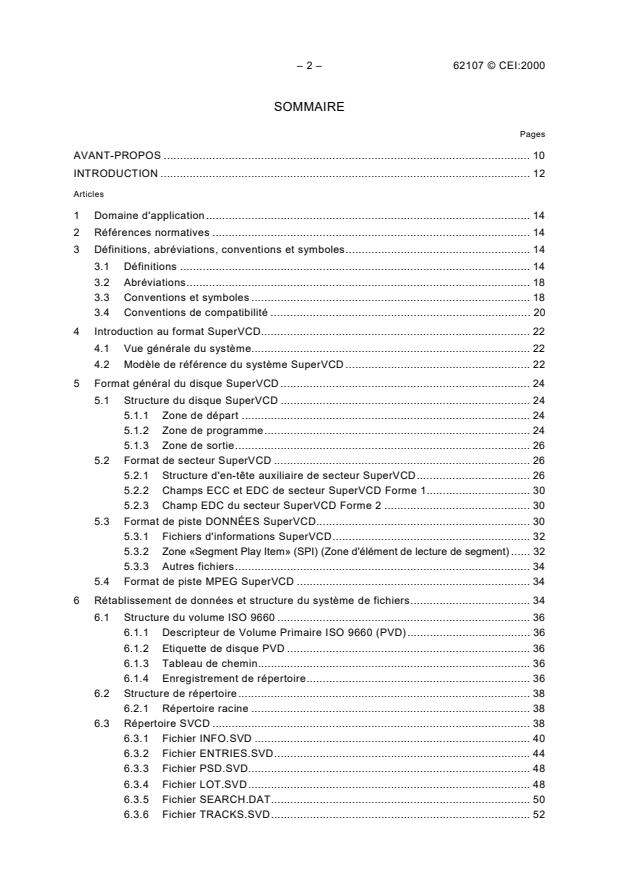
IEC 62107:2000 - Super video compact disc - Disc-interchange system-specification Released:7/21/2000
Overview
IEC 62107:2000 - Super Video Compact Disc (SuperVCD) - is the IEC disc-interchange system specification that defines the format, file structure and playback requirements for Super Video Compact Discs. The standard upgrades the Video CD concept to deliver higher resolution and improved picture quality compatible with contemporary TV receivers by using MPEG‑2 variable bit rate (VBR) program streams and expanded audio options (including multi‑channel/surround). It is intended as a baseline for disc authors, player manufacturers and test laboratories to ensure interoperability and consistent user experience.
Key topics and technical highlights
- Disc format & structure
- Built on the CD‑ROM data model (ISO/IEC 10149 / ISO 9660). Defines lead‑in, program and lead‑out areas and SuperVCD sector formats.
- Uses CD Mode 2 sector conventions including Form 1/Form 2 handling and sector subheaders, ECC/EDC considerations.
- File system and directory layout
- Mandates ISO 9660 volume structure and specific SuperVCD files/directories (e.g., INFO.SVD, ENTRIES.SVD, PSD.SVD, LOT.SVD, TRACKS.SVD; MPEG2/SEGMENT/EXT directories; AVSEQnn.MPG files).
- Describes Segment Play Items (SPI) and Play Sequence Descriptor (PSD) structures for navigation and playlists.
- MPEG‑2 stream & coding rules
- Specifies use of MPEG‑2 Program Stream (PS) packaging, PES packet structures, synchronization and stream constraints tailored for disc playback.
- Video encoding restrictions and still‑picture handling for reliable player behavior.
- Audio & user data
- Support for MPEG audio (including surround/multi‑channel options), variable audio bit rate handling, closed captions and scan information.
- Playback/device conformance
- Requirements for access points, indexing, sector-level handling and compatibility conventions to ensure consistent decoding across players and PCs.
Practical applications
- Authoring and producing SuperVCD discs for commercial distribution or archival use.
- Designing and validating SuperVCD playback devices, consumer electronics, and PC software players.
- Developing authoring tools that generate compliant file structures, MPEG‑2 streams and playlist/segment metadata.
- Interoperability and compliance testing in certification labs to verify sector, file system and stream-level behavior.
Who should use this standard
- Disc manufacturers and content publishers
- Consumer electronics and software player engineers
- Encoding and authoring tool developers
- Test labs and standards compliance engineers
- Archivists managing optical media collections
Related standards
- ISO/IEC 10149 (CD‑ROM data interchange)
- ISO 9660 (CD file system)
- ISO/IEC 13818‑1/2/3 (MPEG‑2 systems, video, audio)
- ISO/IEC 11172‑3 (MPEG‑1 audio)
- ANSI/EIA‑608 (closed caption Line 21)
Keywords: IEC 62107, SuperVCD, Super Video Compact Disc, MPEG‑2 VBR, ISO 9660, disc‑interchange specification, playback compatibility, PSD, SPI, AVSEQ.
Buy Documents
IEC 62107:2000 - Super video compact disc - Disc-interchange system-specification Released:7/21/2000
IEC 62107:2000 - Super video compact disc - Disc-interchange system-specification Released:7/21/2000
Get Certified
Connect with accredited certification bodies for this standard

ANCE
Mexican certification and testing association.

Intertek Slovenia
Intertek testing, inspection, and certification services in Slovenia.

LNE (Laboratoire National de Métrologie et d'Essais)
French national laboratory for metrology and testing.
Sponsored listings
Frequently Asked Questions
IEC 62107:2000 is a standard published by the International Electrotechnical Commission (IEC). Its full title is "Super video compact disc - Disc-interchange system-specification". This standard covers: Defines the basic specification of the Super Video Compact Disc, (SuperVCD), characterized by high resolution and high picture quality, which matches current TV receivers.
Defines the basic specification of the Super Video Compact Disc, (SuperVCD), characterized by high resolution and high picture quality, which matches current TV receivers.
IEC 62107:2000 is classified under the following ICS (International Classification for Standards) categories: 33.160.40 - Video systems. The ICS classification helps identify the subject area and facilitates finding related standards.
IEC 62107:2000 is available in PDF format for immediate download after purchase. The document can be added to your cart and obtained through the secure checkout process. Digital delivery ensures instant access to the complete standard document.
Standards Content (Sample)
INTERNATIONAL IEC
STANDARD
First edition
2000-07
Super Video Compact Disc –
Disc-interchange system-specification
Super Vidéodisque Compact –
Système d'échange de disques – Spécifications
Reference number
Numbering
As from 1 January 1997 all IEC publications are issued with a designation in the
60000 series.
Consolidated publications
Consolidated versions of some IEC publications including amendments are
available. For example, edition numbers 1.0, 1.1 and 1.2 refer, respectively, to the
base publication, the base publication incorporating amendment 1 and the base
publication incorporating amendments 1 and 2.
Validity of this publication
The technical content of IEC publications is kept under constant review by the IEC,
thus ensuring that the content reflects current technology.
Information relating to the date of the reconfirmation of the publication is available
in the IEC catalogue.
Information on the subjects under consideration and work in progress undertaken
by the technical committee which has prepared this publication, as well as the list
of publications issued, is to be found at the following IEC sources:
• IEC web site*
•
Catalogue of IEC publications
Published yearly with regular updates
(On-line catalogue)*
• IEC Bulletin
Available both at the IEC web site* and as a printed periodical
Terminology, graphical and letter symbols
For general terminology, readers are referred to IEC 60050: International
Electrotechnical Vocabulary (IEV).
For graphical symbols, and letter symbols and signs approved by the IEC for
general use, readers are referred to publications IEC 60027: Letter symbols to be
used in electrical technology, IEC 60417: Graphical symbols for use on equipment.
Index, survey and compilation of the single sheets and IEC 60617: Graphical symbols
for diagrams.
* See web site address on title page.
INTERNATIONAL IEC
STANDARD
First edition
2000-07
Super Video Compact Disc –
Disc-interchange system-specification
Super Vidéodisque Compact –
Système d'échange de disques – Spécifications
IEC 2000 Copyright - all rights reserved
No part of this publication may be reproduced or utilized in any form or by any means, electronic or
mechanical, including photocopying and microfilm, without permission in writing from the publisher.
International Electrotechnical Commission 3, rue de Varembé Geneva, Switzerland
Telefax: +41 22 919 0300 e-mail: inmail@iec.ch IEC web site http://www.iec.ch
Commission Electrotechnique Internationale
PRICE CODE
XA
International Electrotechnical Commission
For price, see current catalogue
– 2 – 62107 © IEC:2000(E)
CONTENTS
Page
FOREWORD . 4
INTRODUCTION .5
Clause
1 Scope . 6
2 Normative references. 6
3 Definitions, abbreviations, conventions and symbols. 6
3.1 Definitions . 6
3.2 Abbreviations. 8
3.3 Conventions and symbols . 8
3.4 Compatibility conventions . 9
4 SuperVCD introduction . 10
4.1 System overview. 10
4.2 SuperVCD system reference model . 10
5 General SuperVCD disc format . 10
5.1 SuperVCD disc structure. 11
5.1.1 Lead-in area . 11
5.1.2 Program area. 11
5.1.3 Lead-out area . 11
5.2 SuperVCD sector format . 11
5.2.1 SuperVCD sector Subheader structure. 12
5.2.2 Form 1 SuperVCD sector ECC and EDC fields. 13
5.2.3 Form 2 SuperVCD sector EDC field. 13
5.3 SuperVCD DATA track format . 13
5.3.1 SuperVCD Information files. 14
5.3.2 Segment Play Item (SPI) area. 14
5.3.3 Other files . 15
5.4 SuperVCD MPEG track format . 15
6 Data Retrieval and File system structure. 16
6.1 ISO 9660 Volume structure . 16
6.1.1 ISO 9660 Primary Volume Descriptor (PVD). 16
6.1.2 PVD Disc Label. 16
6.1.3 Path Table . 16
6.1.4 Directory record . 16
6.2 Directory structure . 17
6.2.1 Root directory . 17
6.3 SVCD directory. 17
6.3.1 INFO.SVD file . 18
6.3.2 ENTRIES.SVD file. 20
6.3.3 PSD.SVD file . 22
6.3.4 LOT.SVD file. 22
6.3.5 SEARCH.DAT file . 23
6.3.6 TRACKS.SVD file. 23
62107 © IEC:2000(E) – 3 –
Clause Page
6.4 MPEG2 directory. 25
6.4.1 AVSEQnn.MPG files . 25
6.5 SEGMENT directory. 25
6.5.1 Segment Play Items . 25
6.6 EXT directory. 25
6.6.1 SCANDATA.DAT file . 25
6.6.2 CAPTnn.DAT file. 27
7 MPEG2 stream coding . 28
7.1 MPEG sector format . 29
7.1.1 MPEG Video sector. 29
7.1.2 MPEG Audio sector. 29
7.1.3 Access Point sector . 30
7.2 MPEG PS coding . 30
7.2.1 PS pack_header. 30
7.2.2 PS system_header . 31
7.2.3 PES_packet structure . 31
7.2.4 Synchronization . 32
7.3 MPEG VIDEO format . 33
7.3.1 MPEG2 video formats . 33
7.3.2 MPEG2 video encoding restrictions. 33
7.3.3 Special Information in the MPEG video signal . 34
7.3.4 MPEG video parameters for Still Pictures. 34
7.4 MPEG AUDIO format . 35
7.4.1 Audio PES_packets. 36
7.4.2 Variable audio stream bit rate . 36
7.4.3 Surround Sound coding. 36
7.5 USER data. 38
7.5.1 User data structure . 38
7.5.2 Scan Information Data . 39
7.5.3 Closed Caption Data . 40
8 Segment Play Item (SPI) coding . 40
8.1 General. 40
8.2 Segment Play Motion Video . 41
8.3 Segment Play Still Picture. 41
8.4 Segment Play Audio . 41
9 Play Sequence Descriptor (PSD) . 41
9.1 General. 41
9.2 PSD file constraints . 42
9.3 Play List. 42
9.4 Selection list . 44
9.5 End List . 46
Annex A (informative) PSD interpretation . 47
Annex B (informative) Playback device function support. 50
Bibliography . 51
– 4 – 62107 © IEC:2000(E)
INTERNATIONAL ELECTROTECHNICAL COMMISSION
____________
Super Video Compact Disc –
Disc-interchange system-specification
FOREWORD
1) The IEC (International Electrotechnical Commission) is a worldwide organization for standardization comprising
all national electrotechnical committees (IEC National Committees). The object of the IEC is to promote
international co-operation on all questions concerning standardization in the electrical and electronic fields. To
this end and in addition to other activities, the IEC publishes International Standards. Their preparation is
entrusted to technical committees; any IEC National Committee interested in the subject dealt with may
participate in this preparatory work. International, governmental and non-governmental organizations liaising
with the IEC also participate in this preparation. The IEC collaborates closely with the International
Organization for Standardization (ISO) in accordance with conditions determined by agreement between the
two organizations.
2) The formal decisions or agreements of the IEC on technical matters express, as nearly as possible, an
international consensus of opinion on the relevant subjects since each technical committee has representation
from all interested National Committees.
3) The documents produced have the form of recommendations for international use and are published in the form
of standards, technical specifications, technical reports or guides and they are accepted by the National
Committees in that sense.
4) In order to promote international unification, IEC National Committees undertake to apply IEC International
Standards transparently to the maximum extent possible in their national and regional standards. Any
divergence between the IEC Standard and the corresponding national or regional standard shall be clearly
indicated in the latter.
5) The IEC provides no marking procedure to indicate its approval and cannot be rendered responsible for any
equipment declared to be in conformity with one of its standards.
6) Attention is drawn to the possibility that some of the elements of this International Standard may be the subject
of patent rights. The IEC shall not be held responsible for identifying any or all such patent rights.
International Standard IEC 62107 has been prepared by subcommittee 100B: Audio, video
and multimedia information storage systems, of IEC technical committee 100: Audio, video
and multimedia systems and equipment.
The text of this standard is based on the following documents:
FDIS Report on voting
100B/261/FDIS 100B/272/RVD
Full information on the voting for the approval of this standard can be found in the report on
voting indicated in the above table.
This publication has been drafted in accordance with the ISO/IEC Directives, Part 3.
Annexes A and B are for information only.
A bilingual version of this standard may be issued at a later date.
The committee has decided that the contents of this publication will remain unchanged
until 2005. At this date, the publication will be
• reconfirmed;
• withdrawn;
• replaced by a revised edition, or
• amended.
62107 © IEC:2000(E) – 5 –
INTRODUCTION
There is a market need for a standardized fully digital Compact Disc based video reproduction
system. This Super Video CD specification standardizes and upgrades the current Video CD
format. It utilizes better Video and Audio quality. It also includes extensions for surround
sound multi-channel audio and provisions for PC playback, and is prepared for further future
improvements. This standard is based on using variable bit rate (VBR) MPEG2 coding for
more efficient use of disc capacity. The target for this standard is further to ensure the best
price/performance combination possible with the latest state-of-the-art technology available,
and to offer more flexibility for publishers to use the best video/audio quality given limited disc
capacity.
Attention is drawn to the possibility that some of the elements of this International Standard
may be the subject of patent rights. Recipients of this standard are invited to submit, with their
comments, notification of any relevant patent rights of which they are aware and to provide
supporting documentation.
– 6 – 62107 © IEC:2000(E)
Super Video Compact Disc –
Disc-interchange system-specification
1 Scope
This International Standard defines the basic specification of the Super Video Compact Disc,
(SuperVCD), characterized by high resolution and high picture quality, which matches current
TV receivers.
This standard is intended to be used as a basis for the design, production and compliance
testing of SuperVCD discs and playback devices to achieve compatibility with current and
future products.
The general SuperVCD disc structure is based on the CD-ROM system (see ISO/IEC 10149).
2 Normative references
The following normative documents contain provisions which, through reference in this text,
constitute provisions of this International Standard. For dated references, subsequent
amendments to, or revisions of, any of these publications do not apply. However, parties to
agreements based on this International Standard are encouraged to investigate the possibility
of applying the most recent editions of the normative documents indicated below. For undated
references, the latest edition of the normative document referred to applies. Members of IEC
and ISO maintain registers of currently valid International Standards.
ISO/IEC 10149:1995, Information technology – Data interchange on read-only 120 mm optical
data disks (CD-ROM)
ISO/IEC 11172-3:1993, Information technology – Coding of moving pictures and associated
audio for digital storage media at up to about 1,5 Mbit/s – Part 3: Audio
ISO/IEC 13818-1:1996, Information technology – Generic coding of moving pictures and
associated audio information: Systems
ISO/IEC 13818-2:1996, Information technology – Generic coding of moving pictures and
associated audio information: Video
ISO/IEC 13818-3:1998, Information technology – Generic coding of moving pictures and
associated audio information – Part 3: Audio
ISO 646:1991, Information technology – ISO 7-bit coded character set for information
interchange
ISO 9660:1988, Information processing – Volume and file structure of CD-ROM for
information interchange
ANSI/EIA-608-94, Recommended Practice for Line 21 Data Service
3 Definitions, abbreviations, conventions and symbols
3.1 Definitions
3.1.1
bit rate
rate at which a compressed bit stream is delivered to the input of a decoder
62107 © IEC:2000(E) – 7 –
3.1.2
mnemonics
descriptions of different data types used in this standard
3.1.3
mode 2 form 1
CD-ROM track type
3.1.4
mode 2 form 2
CD-ROM track type
3.1.5
mux rate
rate value derived from the sector rate
3.1.6
playback device
any SuperVCD compliant player or other product, such as a PC
3.1.7
program stream
a collection of elementary streams
3.1.8
real-time stream
MPEG2 program stream containing video and audio components to be decoded and
presented in time, controlled by timing characteristics in the stream to the decoder
3.1.9
system clock reference
time stamp in the Program Stream
3.1.10
sector
smallest addressable part of a Digital Data Track in the information area that can be accessed
independently of other addressable parts of the area [ISO/IEC 10149]
3.1.11
sector and subcode address representation
all Sector addresses and Subcode addresses are represented in the 3-byte BCD encoded
form mm:ss:ff. The minutes field is represented by "mm", the seconds field is represented by
"ss", the blocks (Sector) or frames (Subcode) field is represented by "ff"
3.1.12
time-stamp
time of a specific action such as the arrival of a byte or the presentation of a picture
3.1.13
track
continuous area on the disc with one and the same Track Number in the CD Subcode
3.1.14
variable bit rate
variation in time of arrival of the bytes at the input of a decoder
– 8 – 62107 © IEC:2000(E)
3.2 Abbreviations
BCD Binary Code Decimal
bslbf bit string, left bit first
CBR Constant Bit Rate
CD-ROM Compact Disc Read Only Memory
CRC Cyclic Redundancy Check
DTS
Decoding Time Stamp
ECC Error Correction Code
EDC Error Detection Code
EOF End of File
EOR End of Record
kbps kilo bit per second (1 024 bits/s)
lsb
least significant bit
LSB Least Significant Byte
mbps mega bit per second (1 000 000 bits/s)
MPEG Moving Picture Experts Group
MPEG PS MPEG2 Program Stream
msb most significant bit
MSB
Most Significant Byte
N/A Not Applicable
NRT Non-Real-Time
PES Packetized Elementary Stream
PS Program Stream
PSD Play Sequence Descriptor
PTS
Presentation Time Stamp
PVD Primary Volume Descriptor
RT Real Time
SCR System Clock Reference
SPI Segment Play Item
TOC Table of Contents
uimsbf unsigned integer, most significant bit first
VBR Variable Bit Rate
3.3 Conventions and symbols
Text written in italics is informative.
The mathematical operators used are similar to those used in the C programming language
and the use of brackets – {} – in tables is in accordance with the pseudo-c syntax (see 2.2
and 2.3 of ISO/IEC 13818-1).
Unless otherwise indicated, in this document the conventions used are as follows.
Bit ordering – The graphical representation of all multiple-bit quantities is such that the most
significant bit (msb) is on the left and the least significant bit (lsb) is on the right.
msb lsb
b7 b6 b5 b4 b3 b2 b1 b0
IEC 1012/2000
The most significant bit is the bit with the highest bit position number.
Figure 1 – Example of bit ordering for one 8-bit byte
62107 © IEC:2000(E) – 9 –
Byte ordering – Quantities which require more than eight bits for their representation are
held in more than one byte on the disc. For all such quantities, the ordering of bytes on the
disc (as seen at the interface to the disc driver) is such that the Most Significant Byte (MSB)
is first and the Least Significant Byte (LSB) is last.
Multiple-byte quantities are represented graphically such that the left-most or upper-most byte
is most significant and the right-most or lower-most byte is least significant.
__ MSB __ __ LSB __
‰ �‰ �
b15 . b8 b7 . b0
__ byte Bn __ __ byte Bn+1 __
‰ �‰ �
IEC 1013/2000
The most significant byte is the byte with the lowest byte position number.
Figure 2 – Example of byte ordering for 2 bytes
Character String – Character Strings are always given between double quotation marks, as
"_____", coded according to ISO 646 if not indicated otherwise.
Hex – All hexadecimal values are preceded by a $. The most significant nibble is on the left,
the least significant nibble is on the right.
Binary – Binary values are preceded by a % or presented within single quotation marks ' '.
The most significant bit is on the left, the least significant bit is on the right. A binary value is
represented by a 0, 1 or x where x is a 0 or a 1.
Decimal – All decimal values are preceded by a blank space or the range indicator (.) when
included in a range. The most significant digit is on the left, the least significant digit is on
the right.
Units of measure – 1 K denotes 1 024 units.
Range – Constant_1.Constant_2 or (Constant_1.Constant_2) denotes the range from and
including Constant_1 up to and including Constant_2, in increments of 1.
Ordering within tables – The items within a table are contiguous, starting with the top line
from the left to the right item, then the next line from the left to the right item, and so on, down
to and including the bottom line from the left to the right item.
3.4 Compatibility conventions
The SuperVCD specification is intended to ensure full compatibility, so that all discs can play,
with at least those functions designated as mandatory in the SuperVCD specifications, in all
compliant playback devices.
All mandatory parts of the specification have to be recorded on all discs and are intended to
be implemented in all playback devices.
Extension parts of the specification define non-mandatory additional functionality.
A disc with extensions should play on a playback device only supporting the mandatory
functionality of the specification, and a playback device supporting some or all extensions
should also play discs without these extensions.
The specification also includes optional meta-data, intended to support improved performance
of a playback device. It is recommended that optional items be recorded on the disc, but it is
not required that they be included.
– 10 – 62107 © IEC:2000(E)
4 SuperVCD introduction
4.1 System overview
SuperVCD is a reproduction system for presenting full motion pictures with associated audio
by using the Compact Disc format. The system uses the ISO/IEC MPEG2 standard definitions
to compress the video, still picture and audio information for full screen TV quality pictures
together with associated high-quality audio. The SuperVCD disc can also carry high-quality
still pictures with associated audio and a Play Sequence Descriptor file for interactive control
of the playback of still and motion pictures.
Variable bit rate (VBR) MPEG coding is used for more efficient use of the disc capacity. The
playing time for a fully recorded disc can vary from 35 min to more than 70 min depending on
the average bit rate used.
The SuperVCD format is based on the CD-ROM Mode 2 disc format. SuperVCD discs can be
played on SuperVCD playback devices, and other compliant hardware and software platforms.
4.2 SuperVCD system reference model
The SuperVCD system consists of a SuperVCD disc and the playback device, normally a
SuperVCD player.
SuperVCD playback device
CD module MPEG
module
Super EFM CDROM CDROM Form 2 MPEG MPEG Video
VCD 2324 b sector output
disc CIRC decoder 2352 Mode 2 Decoder Audio
bytes output
de-mux Form 1 DATA Playback User
2048 b sector I/O
Controller Remote
control
PLAYER
module
IEC 1014/2000
Figure 3 – SuperVCD system reference model
5 General SuperVCD disc format
The general SuperVCD disc structure is based on the CD-ROM system (ISO/IEC 10149) with
the specific additions and restrictions defined in this clause.
The disc is intended to be played either sequentially starting from the first MPEG Track, or by
playing Play Lists using the Play Sequence Descriptor (PSD) with on-screen “menu” control.
A karaoke/music application has normally one track per song. This means that song number 1
is recorded in Track No. 2, and song number 2 in Track No. 3, and so on.
62107 © IEC:2000(E) – 11 –
A movie title can be divided into different coded parts, such as INTRO, COPYRIGHT, FILM,
CREDITS. The film itself can also be subdivided into chapters.
5.1 SuperVCD disc structure
The SuperVCD disc has a lead-in area, a program area, and a lead-out area.
Lead-in area
Track No. 1 SuperVCD DATA track
Program area Track No. 2
... SuperVCD MPEG tracks
Track No. n
Lead-out area
IEC 1015/2000
Figure 4 – SuperVCD disc layout
5.1.1 Lead-in area
The lead-in area is encoded as a CD-ROM DATA track (with track number = 00) containing
Empty Sectors of Mode 2 Form 2 with file number = $00, and Submode = $20.
Table 1 – Lead-in area subcode
POINT $A0
PSEC $20
PFRAME $00
5.1.2 Program area
There are two types of SuperVCD track format:
– SuperVCD DATA track format
– SuperVCD MPEG track format
The first track shall be a SuperVCD DATA track and other tracks shall be SuperVCD MPEG
tracks with playable MPEG2 audio/video Program Streams.
All sectors in a SuperVCD track are of CD-ROM Mode 2.
5.1.3 Lead-out area
The lead-out area is encoded as a CD-ROM DATA track containing Empty Sectors of Mode 2
Form 2 with file number = $00, and Submode = $20.
5.2 SuperVCD sector format
A track is divided into Mode 2 sectors of 2 352 sequential bytes each. Each sector can be
uniquely addressed by a BCD-coded absolute time value in the header field of the sector.
SuperVCD information is stored in SuperVCD sectors.
There are two types of SuperVCD sectors, namely Form 1 and Form 2 sectors. A Form 1
sector has an extra Error Correction Code (ECC) field, as in CD-ROM Mode 1. A Form 2
sector is intended for real time MPEG data and has no ECC field, but 2 324 user data bytes
instead, giving a 14 % higher bit rate or capacity.
– 12 – 62107 © IEC:2000(E)
Table 2 – Form 1 SuperVCD sector fields
Field type Number of bytes Note
Synchronization 12 See CD-ROM
Header 4 See CD-ROM
Subheader 8 4 bytes repeated
Form 1 User Data 2 048 Same as CD-ROM Mode 1
Form 1 EDC 4 Same as CD-ROM Mode 1
Form 1 ECC 276 Same as CD-ROM Mode 1
Table 3 – Form 2 SuperVCD sector fields
Field type Number of bytes Note
Synchronization 12 See CD-ROM
Header 4 See CD-ROM
Subheader 8 4 bytes repeated
Form 2 User Data 2 324 Used for MPEG data
Form 2 EDC 4 Same as CD-ROM Mode 1
5.2.1 SuperVCD sector Subheader structure
The SuperVCD Subheader field consists of eight bytes: File Number, Channel Number,
Submode, and Coding Information bytes, each written twice for better data integrity.
Table 4 – Layout of Subheader field
Sector byte number Byte value
16 File Number
17 Channel Number
18 Submode
19 Coding Information
20 File Number
21 Channel Number
22 Submode
23 Coding Information
The Subheader is used to define different types of sectors for storing information with special
characteristics. The values are defined in table 5.
Depending on the SuperVCD information, three types of sectors are defined, namely an
Empty sector with no user data information, a Data sector with non-real-time data and an
MPEG sector for MPEG real-time data.
The Submode byte defines the global attributes of a sector, and the Coding Information byte
defines if the sector contains MPEG PS stream data.
62107 © IEC:2000(E) – 13 –
Table 5 – Sub-header bytes
Sector Type File Channel Submode bits Coding Used for
number number (msb.lsb) Information
Empty sector $00 $00 %00100000 $00 Lead-in, Lead-out, MPEG Track
Pause, padding of Play Item
Form 2, NRT
Segments to 150 sector boundary
Data sector $00 $00 %y0001000 $00 All sectors with valid data in a Data
Track that are not MPEG sectors
Form 1, NRT
MPEG sector $01 $01 %y11x001z $80 All sectors that contain an MPEG
Program Stream
Form 2, RT
The bits indicated as x, y, and z are defined below; other bits shall be set as indicated above.
Table 6 – Submode bit definitions
Bit number Indication Type Definition
0 z EOR Sectors containing the sequence_end_code of a Still Picture have
the End of Record bit set to %1
4 x Trigger The Trigger bit is set to %1 in a sector where the playback device
shall execute the Auto_pause function (see 9.3), or else set to
%0
7 y EOF The End of File bit to be set to %1 in last sector of any file or Play
Item, else set to %0
5.2.2 Form 1 SuperVCD sector ECC and EDC fields
The EDC and ECC fields are defined as for CD-ROM Mode 1, with the following exceptions.
– The EDC shall be calculated from the beginning of the Subheader field to the end of
the 2 048 byte User Data field.
– Parity P of the ECC shall be calculated from the beginning of the Header field to the end
of the EDC field as if the content of the Header field were all zero.
– Parity Q of the ECC shall be calculated from the beginning of the Header field to the end
of the EDC field as if the content of the Header field were all zero.
5.2.3 Form 2 SuperVCD sector EDC field
The EDC field is defined as for CD-ROM Mode 1 with the following exception.
– The EDC shall be calculated from the beginning of the Subheader field to the end of
the 2 324 byte User Data field.
5.3 SuperVCD DATA track format
This shall be the first track of the disc.
The DATA TRACK starts with a pre-gap of 150 Empty sectors.
Data files use Mode 2, Form 1 (2 048 byte sector) DATA sectors, and MPEG files use Mode 2,
Form 2 (2 324 bytes) MPEG sectors.
– 14 – 62107 © IEC:2000(E)
The DATA TRACK contains ISO 9660 file management, SuperVCD Information files, Segment
Play Item Area and, optionally, other program data files.
(mm:ss:ff)
00:00:00 Pre-gap 150 sectors
00:02:00 User Area –
00:02:16 Primary Volume Descriptor ISO 9660
– –
00:04:00 SuperVCD Information files Disc Information "INFO.SVD" (mandatory)
Entry table "ENTRIES.SVD"(mandatory)
List ID Offset table "LOT.SVD" (extension)
Play Sequence Descriptor "PSD.SVD" (extension)
Search table “SEARCH.DAT”
Tracks table “TRACKS.SVD” (mandatory)
Segment Play Item area Segment Play Items (Still Picture, Motion Picture, Audio) in
segments of 150 sectors
Other Files "EXT" directory
"SCANDATA.DAT"
IEC 1016/2000
Figure 5 – Example of layout of a DATA TRACK
5.3.1 SuperVCD Information files
These files are located in the SuperVCD directory and are defined in 6.3.
They are encoded in successive sectors starting at Sector 00:04:00.
The "INFO.SVD" file is located at Sector 00:04:00 and the "ENTRIES.SVD" file is located at
Sector 00:04:01.
The optional file "LOT.SVD" is located from 00:04:02 to 00:04:33.
The optional file "PSD.SVD" has a start location 00:04:34 and a variable length up to a
maximum of 256 sectors.
5.3.2 Segment Play Item (SPI) area
This area in the DATA track contains Segment Play Items as described in 6.5.1.
A Segment Play Item (SPI) is a SuperVCD MPEG2 Program Stream stored in a Data Track,
intended for interactive playback under control of the Play Sequence Descriptor.
Segment Play Items are not accessed directly by the normal track playing mechanism, but
indirectly by interpretation of the Play Sequence Descriptor (PSD).
The SPI is stored into contiguous segments of 150 sectors in length and is addressed by a
segment number. The length of the SPI Area shall be any integer number of segments
ranging from 1 to a maximum of 1 980. The segments are numbered consecutively starting
from No. 1, which is the first segment.
The start sector address of the SPI Area is indicated in the First Segment Address entry of
"INFO.SVD".
62107 © IEC:2000(E) – 15 –
Segment Play Items shall conform to Program Stream coding as described in the Program
Stream format Section.
Segment Play Items may occupy one or more segments, and the data shall start at a segment
boundary. The SPI data is padded with Empty Sectors to the end of a whole segment. An
SPI is identified by its SPI number, which is equal to the number of its first segment. Only
segment numbers that correspond to the first segments of Segment Play Items and are in the
range 1.1980 are valid SPI numbers. The figure below gives an example of the Segment Play
Items in the SPI Area.
First Segment address
Segment #1
Segment #2
Segment #n Segment #n+1
MPEG2 MPEG2
MPEG2 STREAM
STREAM Still picture
150 MPEG 150 sectors
sectors
Empty sectors
Empty sectors
IEC 1017/2000
Figure 6 – Example of Segment Play Items in the Segment Play Item Area
5.3.3 Other files
Other SuperVCD files are stored in the EXT directory.
5.4 SuperVCD MPEG track format
The SuperVCD disc shall contain at least one MPEG track. Each MPEG track is identified by
a sequence number starting from 01 which is incremented for each following MPEG track, so
that the MPEG track with track number 02 has the sequence number of 01.
In general these tracks are intended for linear playback in sequential order.
Each MPEG track shall contain only one MPEG2 Program Stream, stored in MPEG sectors.
The Program Stream coding is described in clause 7. The Program Stream shall contain
Motion Video. (Audio-only tracks are not allowed.)
An MPEG track starts with a Pause encoding of minimum 150 Empty sectors. Thus a movie,
which needs to be played back seamlessly, shall be recorded in one track.
An MPEG Track can be subdivided into parts or chapters (see the ENTRIES.SVD file
description in 6.3.2).
No. n-1 __ TRACK __ No. n+1
‰ �
No. n
Pause
MPEG Program Stream
TOC value –�
IEC 1018/2000
Figure 7 – Example of an MPEG track
– 16 – 62107 © IEC:2000(E)
6 Data Retrieval and File system structure
The SuperVCD disc contains a data retrieval structure with a File System structure that
conforms to ISO 9660, and the DATA track shall contain a Primary Volume Descriptor (PVD).
Next to this some files in the DATA track have fixed start addresses.
6.1 ISO 9660 Volume structure
The disc has only one Volume.
6.1.1 ISO 9660 Primary Volume Descriptor (PVD)
Sector No.16 contains the PVD for the disc and is located at the absolute address
of 00:02:16.
The PVD Volume Set Size field (BP 121 - 124) and the Volume Sequence Number shall be set to 1.
6.1.2 PVD Disc Label
SuperVCD discs require the presence of an identical Disc Label in all copies of the PVD. The
Disc Label is located at offset 1024 of the PVD (byte position 1025).
Table 7 – SuperVCD Disc Label
Byte position Field name Content Note
1025 – 1032 ID signature “CD-XA001” Character coded
1033 – 1050 reserved all zero bytes $00 bytes
6.1.3 Path Table
The ISO 9660 Path table is stored in SuperVCD DATA sectors. The ISO 9660 defined version
number of all files shall be "1", but in this document the version numbers are not shown.
6.1.4 Directory record
Directory records are stored in SuperVCD DATA sectors.
In the Directory Record the file flags (BP 26) of Record bit, Associated File bit,
Protection bit and Multi-Extent bit shall be set to %0. There shall not be more than one
version of a file.
All SuperVCD defined files shall include additional system use information in the Directory
as follows:
Record
Table 8 – System Use Extension Information
Byte position Field name Content
1 – 4 Owner ID All bytes set to $00
Bits 0.10 are set to
5 – 6 Attributes %0
Bit 11 is set to %1 for a file with Form 1 sectors
Bit 12 is set to %1 for a file with Form 2 sectors
Bits 13.14 are set to %0
Bit 15 is set to %1 if the file is a Directory file
7 Signature byte 1 Set to $58 “X”
8 Signature byte 2 Set to $41 “A”
9 – 14 Reserved All bytes set to $00
62107 © IEC:2000(E) – 17 –
6.2 Directory structure
The SuperVCD information files (see 6.3) shall be located in the directory "SVCD".
All files that represent the MPEG audio/video tracks shall be located in the directory
"MPEG2".
If the SPI Area is available on a disc then the "ITEMnnn" files shall be located in the directory
"SEGMENT".
The "SCANDATA.DAT" and "CAPTnn.DAT" files are located in the "EXT" directory.
Additional non-SuperVCD specified files or directories may exist outside the mandatory
SuperVCD directory hierarchy. Figure 8 gives an example of the file structure for a SuperVCD
disc.
ROOT directory
|-- SVCD
| |-- INFO.SVD
| |-- ENTRIES.SVD
| |-- LOT.SVD
| |-- PSD.SVD
| |-- SEARCH.DAT
| |-- TRACKS.SVD
|
|-- MPEG2
| |-- AVSEQ01.MPG (track No. 2)
| |-- AVSEQ02.MPG (track No. 3)
| |-- AVSEQnn.MPG (track No. nn+1)
|
|-- SEGMENT
| |-- ITEM0001.MPG (segment item No. 1)
| |-- ITEM0002.MPG (segment item No. 2)
| |-- ITEMnnnn.MPG (segment item No. nnnn)
|
|-- EXT
| |-- SCANDATA.DAT
| |-- CAPTnn.DAT
IEC 1019/2000
Figure 8 – Example of the directory structure
6.2.1 Root directory
This is the Root directory of the disc. It contains directories and files as shown in figure 8.
6.3 SVCD directory
This directory contains all the SuperVCD Information files. Mandatory files are "INFO.SVD",
"ENTRIES.SVD", and "TRACKS.SVD". The file "SEARCH.DAT" is mandatory depending on
the System profile Tag.
It is recommended that all these files be recorded consecutively so a playback device can
read all the files with one seek access, which will improve the start-up performance of the
disc.
If the Play Sequence Descriptor (PSD) is present, then the SVCD directory shall also include
the files "LOT.SVD" and "PSD.SVD".
– 18 – 62107 © IEC:2000(E)
6.3.1 INFO.SVD file
The mandatory file "INFO.SVD" contains the SuperVCD system identification and a provision
for identifying the discs belonging to one album. An album is a series of discs which contain
related Audio/Video programs. The INFO.SVD file also contains information associated with
the Play Sequence Descriptor.
The "INFO.SVD" file is located at Sector 00:04:00 and has a fixed size of one sector.
A detailed layout of the file is given below.
Table 9 – Layout of INFO.SVD
Byte Position Size (bytes) Entry name Contents
1 to 8 8 System Identification ISO 646 characters
9 1 Version number = $01
10 1 System profile tag Binary coded value
11 to 26 16 Album Identification ISO 646 characters
27 to 28 2 Number of Volumes in Album Binary coded value
29 to 30 2 Album Set Sequence Number Binary coded value
31 to 43 13 Video-Type Map of MPEG2 Tracks Bit Map
44 1 Status Flags Status byte
45 to 48 4 PSD Size Binary coded value
49 to 51 3 First Segment address BCD sector location
52 1 Offset multiplier = $08
53 to 54 2 Maximum List ID Binary coded value
55 to 56 2 Maximum Segment Number Binary coded value
57 to 2 036 1 980 Segment Play Item Contents Table Segment Play Item Contents bytes
2 037 to 2 048 12 Reserved = $00
NOTE Contents of bytes 49. 2026 shall be $00 in the case of no PSD (PSD Size = 0).
System Identification – This 8-character field is coded as ISO 646 upper-case characters,
and the string value is defined in table 10.
Version Number – This one-byte entry contains $01.
System profile tag – This one-byte unsigned integer is used to define the set of mandatory
parts to be applied for compatibility with current products in the market.
Parts containing a tag value are defined as mandatory or optional, depending on the tag value.
Table 10 – System profile tags
System System identification field value Note
profile tag (8 characters)
$00 "SUPERVCD"
$01 "HQ-VCD " The last two characters are space characters ($20).
62107 © IEC:2000(E) – 19 –
Album Identification – This ISO 646 encoded string contains the Album Identification as
defined by the publisher. For example the ISO 646 encoded UPC code, padded at the end
with spaces, can be used.
Number of Volumes in Album – This two-byte binary coded number specifies the total
number of discs (Volumes) in an Album. An Album is a set of SuperVCD discs.
Album Set Sequence Number – This two-byte binary coded number specifies the ordinal
number of the Volume in the Album. The first disc of an Album has value $0000.
Video Type Map of MPEG2 Tracks – This 104-bit entry contains the Picture Size Flag Map
for Track 2 and higher. The one-bit flag specifies the encoded video type for the
corresponding track. The flag is set to zero if the encoded video type is NTSC, and to one if it
is PAL. Non-existing or SuperVCD DATA tracks have the flag set to zero.
Bit 0 of the first byte of this map contains the flag for Track No. 2. Bit 1 of the last byte on this
map contains the flag for Track No. 99.
Status Flags – This 8-bit entry contains status flags as defined in the table below.
Table 11 – Status Flags
Position Flag Contents
Bit[0] %0 Reserved
Bits[1.2] %00 Disc for unrestricted use.
%01 Disc with Restriction Category 1.
%10 Disc with Restriction Category 2.
%11 Disc with Restriction Category 3.
Bit[3] %0 No Special Information is encoded in the MPEG picture.
%1 Special Information is encoded in the MPEG picture (see 7.3.3).
Bit[4] %0 MPEG User Data is not used for Closed Caption.
%1 MPEG User Data is used for Closed Caption (see 7.5.3).
Bit[5] %0 Start the next disc at List ID No. 1.
%1 If the PSD is interpreted and if the next disc has the same Album Identification as this
disc, then start the next disc at List ID No. 2, otherwise start at List ID No. 1.
Bit[6] %0 Start the next disc with Track 2.
%1 If the PSD is not interpreted (linear play) and if the next disc has the sa
...
IEC 62107
Edition 1.0 2000-07
INTERNATIONAL
STANDARD
NORME
INTERNATIONALE
Super video compact disc – Disc-interchange system-specification
Super vidéodisque compact – Système d’échange de disques – Spécifications
All rights reserved. Unless otherwise specified, no part of this publication may be reproduced or utilized in any form or by
any means, electronic or mechanical, including photocopying and microfilm, without permission in writing from either IEC or
IEC's member National Committee in the country of the requester.
If you have any questions about IEC copyright or have an enquiry about obtaining additional rights to this publication,
please contact the address below or your local IEC member National Committee for further information.
Droits de reproduction réservés. Sauf indication contraire, aucune partie de cette publication ne peut être reproduite
ni utilisée sous quelque forme que ce soit et par aucun procédé, électronique ou mécanique, y compris la photocopie
et les microfilms, sans l'accord écrit de la CEI ou du Comité national de la CEI du pays du demandeur.
Si vous avez des questions sur le copyright de la CEI ou si vous désirez obtenir des droits supplémentaires sur cette
publication, utilisez les coordonnées ci-après ou contactez le Comité national de la CEI de votre pays de résidence.
IEC Central Office
3, rue de Varembé
CH-1211 Geneva 20
Switzerland
Email: inmail@iec.ch
Web: www.iec.ch
About the IEC
The International Electrotechnical Commission (IEC) is the leading global organization that prepares and publishes
International Standards for all electrical, electronic and related technologies.
About IEC publications
The technical content of IEC publications is kept under constant review by the IEC. Please make sure that you have the
latest edition, a corrigenda or an amendment might have been published.
ƒ Catalogue of IEC publications: www.iec.ch/searchpub
The IEC on-line Catalogue enables you to search by a variety of criteria (reference number, text, technical committee,…).
It also gives information on projects, withdrawn and replaced publications.
ƒ IEC Just Published: www.iec.ch/online_news/justpub
Stay up to date on all new IEC publications. Just Published details twice a month all new publications released. Available
on-line and also by email.
ƒ Electropedia: www.electropedia.org
The world's leading online dictionary of electronic and electrical terms containing more than 20 000 terms and definitions
in English and French, with equivalent terms in additional languages. Also known as the International Electrotechnical
Vocabulary online.
ƒ Customer Service Centre: www.iec.ch/webstore/custserv
If you wish to give us your feedback on this publication or need further assistance, please visit the Customer Service
Centre FAQ or contact us:
Email: csc@iec.ch
Tel.: +41 22 919 02 11
Fax: +41 22 919 03 00
A propos de la CEI
La Commission Electrotechnique Internationale (CEI) est la première organisation mondiale qui élabore et publie des
normes internationales pour tout ce qui a trait à l'électricité, à l'électronique et aux technologies apparentées.
A propos des publications CEI
Le contenu technique des publications de la CEI est constamment revu. Veuillez vous assurer que vous possédez
l’édition la plus récente, un corrigendum ou amendement peut avoir été publié.
ƒ Catalogue des publications de la CEI: www.iec.ch/searchpub/cur_fut-f.htm
Le Catalogue en-ligne de la CEI vous permet d’effectuer des recherches en utilisant différents critères (numéro de référence,
texte, comité d’études,…). Il donne aussi des informations sur les projets et les publications retirées ou remplacées.
ƒ Just Published CEI: www.iec.ch/online_news/justpub
Restez informé sur les nouvelles publications de la CEI. Just Published détaille deux fois par mois les nouvelles
publications parues. Disponible en-ligne et aussi par email.
ƒ Electropedia: www.electropedia.org
Le premier dictionnaire en ligne au monde de termes électroniques et électriques. Il contient plus de 20 000 termes et
définitions en anglais et en français, ainsi que les termes équivalents dans les langues additionnelles. Egalement appelé
Vocabulaire Electrotechnique International en ligne.
ƒ Service Clients: www.iec.ch/webstore/custserv/custserv_entry-f.htm
Si vous désirez nous donner des commentaires sur cette publication ou si vous avez des questions, visitez le FAQ du
Service clients ou contactez-nous:
Email: csc@iec.ch
Tél.: +41 22 919 02 11
Fax: +41 22 919 03 00
IEC 62107
Edition 1.0 2000-07
INTERNATIONAL
STANDARD
NORME
INTERNATIONALE
Super video compact disc – Disc-interchange system-specification
Super vidéodisque compact – Système d’échange de disques – Spécifications
INTERNATIONAL
ELECTROTECHNICAL
COMMISSION
COMMISSION
ELECTROTECHNIQUE
PRICE CODE
INTERNATIONALE
XA
CODE PRIX
ICS 33.160.40 ISBN 2-8318-5337-0
– 2 – 62107 © CEI:2000
SOMMAIRE
Pages
AVANT-PROPOS . 10
INTRODUCTION . 12
Articles
1 Domaine d'application. 14
2 Références normatives . 14
3 Définitions, abréviations, conventions et symboles. 14
3.1 Définitions . 14
3.2 Abréviations. 18
3.3 Conventions et symboles . 18
3.4 Conventions de compatibilité . 20
4 Introduction au format SuperVCD. 22
4.1 Vue générale du système. 22
4.2 Modèle de référence du système SuperVCD . 22
5 Format général du disque SuperVCD . 24
5.1 Structure du disque SuperVCD . 24
5.1.1 Zone de départ . 24
5.1.2 Zone de programme. 24
5.1.3 Zone de sortie. 26
5.2 Format de secteur SuperVCD . 26
5.2.1 Structure d'en-tête auxiliaire de secteur SuperVCD. 26
5.2.2 Champs ECC et EDC de secteur SuperVCD Forme 1. 30
5.2.3 Champ EDC du secteur SuperVCD Forme 2 . 30
5.3 Format de piste DONNÉES SuperVCD. 30
5.3.1 Fichiers d'informations SuperVCD. 32
5.3.2 Zone «Segment Play Item» (SPI) (Zone d'élément de lecture de segment) . 32
5.3.3 Autres fichiers. 34
5.4 Format de piste MPEG SuperVCD . 34
6 Rétablissement de données et structure du système de fichiers. 34
6.1 Structure du volume ISO 9660 . 36
6.1.1 Descripteur de Volume Primaire ISO 9660 (PVD). 36
6.1.2 Etiquette de disque PVD . 36
6.1.3 Tableau de chemin. 36
6.1.4 Enregistrement de répertoire. 36
6.2 Structure de répertoire. 38
6.2.1 Répertoire racine . 38
6.3 Répertoire SVCD . 38
6.3.1 Fichier INFO.SVD . 40
6.3.2 Fichier ENTRIES.SVD. 44
6.3.3 Fichier PSD.SVD. 48
6.3.4 Fichier LOT.SVD. 48
6.3.5 Fichier SEARCH.DAT. 50
6.3.6 Fichier TRACKS.SVD. 52
62107 © IEC:2000 – 3 –
CONTENTS
Page
FOREWORD .11
INTRODUCTION . 13
Clause
1 Scope . 15
2 Normative references. 15
3 Definitions, abbreviations, conventions and symbols. 15
3.1 Definitions . 15
3.2 Abbreviations. 19
3.3 Conventions and symbols . 19
3.4 Compatibility conventions . 21
4 SuperVCD introduction . 23
4.1 System overview. 23
4.2 SuperVCD system reference model . 23
5 General SuperVCD disc format . 25
5.1 SuperVCD disc structure. 25
5.1.1 Lead-in area . 25
5.1.2 Program area. 25
5.1.3 Lead-out area . 27
5.2 SuperVCD sector format . 27
5.2.1 SuperVCD sector Subheader structure. 27
5.2.2 Form 1 SuperVCD sector ECC and EDC fields. 31
5.2.3 Form 2 SuperVCD sector EDC field. 31
5.3 SuperVCD DATA track format . 31
5.3.1 SuperVCD Information files. 33
5.3.2 Segment Play Item (SPI) area. 33
5.3.3 Other files . 35
5.4 SuperVCD MPEG track format . 35
6 Data Retrieval and File system structure. 35
6.1 ISO 9660 Volume structure . 37
6.1.1 ISO 9660 Primary Volume Descriptor (PVD). 37
6.1.2 PVD Disc Label. 37
6.1.3 Path Table . 37
6.1.4 Directory record . 37
6.2 Directory structure . 39
6.2.1 Root directory . 39
6.3 SVCD directory. 39
6.3.1 INFO.SVD file . 41
6.3.2 ENTRIES.SVD file. 45
6.3 3 PSD.SVD file . 49
6.3.4 LOT.SVD file. 49
6.3.5 SEARCH.DAT file . 51
6.3.6 TRACKS.SVD file. 53
– 4 – 62107 © CEI:2000
Articles Pages
6.4 Répertoire MPEG2. 54
6.4.1 Fichiers AVSEQnn.MPG. 54
6.5 Répertoire SEGMENT. 54
6.5.1 Eléments de lecture de segment . 54
6.6 Répertoire EXT . 56
6.6.1 Fichier SCANDATA.DAT . 56
6.6.2 Fichier CAPTnn.DAT. 60
7 Codage de flux MPEG2. 62
7.1 Format de secteur MPEG. 62
7.1.1 Secteur vidéo MPEG. 62
7.1.2 Secteur audio MPEG. 64
7.1.3 Secteur de point d'accès . 64
7.2 Codage MPEG PS . 66
7.2.1 Pack_header PS . 66
7.2.2 System_header PS . 66
7.2.3 Structure de PES_packet . 68
7.2.4 Synchronisation . 70
7.3 Format MPEG VIDEO . 70
7.3.1 Formats MPEG2 vidéo . 72
7.3.2 Restrictions de codage vidéo MPEG2 . 72
7.3.3 Informations spéciales dans le signal vidéo MPEG. 72
7.3.4 Paramètres vidéo MPEG pour images fixes. 74
7.4 Format MPEG AUDIO . 74
7.4.1 PES_packets Audio. 76
7.4.2 Débit binaire variable de série audio . 76
7.4.3 Codage de son spatial . 78
7.5 Données USER (UTILISATEUR) . 80
7.5.1 Structure des données utilisateur . 82
7.5.2 Données d'informations de balayage. 82
7.5.3 Données d'insertion fermée. 86
8 Codage de l'élément de lecture de segment (SPI). 86
8.1 Généralités . 86
8.2 Vidéo animée de lecture de segment . 86
8.3 Image fixe de lecture de segment . 86
8.4 Audio/lecture de segment . 88
9 Descripteur de séquence de lecture (PSD). 88
9.1 Généralités . 88
9.2 Contraintes du fichier PSD. 90
9.3 Commande Play list . 90
9.4 Commande Selection List . 94
9.5 Commande End List. 100
Annexe A (informative) Interprétation du PSD . 102
Annexe B (informative) Support de fonction du lecteur . 110
Bibliographie . 112
62107 © IEC:2000 – 5 –
Clause Page
6.4 MPEG2 directory. 55
6.4.1 AVSEQnn.MPG files . 55
6.5 SEGMENT directory. 55
6.5.1 Segment Play Items . 55
6.6 EXT directory. 57
6.6.1 SCANDATA.DAT file . 57
6.6.2 CAPTnn.DAT file. 61
7 MPEG2 stream coding . 63
7.1 MPEG sector format . 63
7.1.1 MPEG Video sector. 63
7.1.2 MPEG Audio sector. 65
7.1.3 Access Point sector . 65
7.2 MPEG PS coding . 67
7.2.1 PS pack_header. 67
7.2.2 PS system_header . 67
7.2.3 PES_packet structure . 69
7.2.4 Synchronization . 71
7.3 MPEG VIDEO format . 71
7.3.1 MPEG2 video formats . 73
7.3.2 MPEG2 video encoding restrictions. 73
7.3.3 Special Information in the MPEG video signal . 73
7.3.4 MPEG video parameters for Still Pictures. 75
7.4 MPEG AUDIO format . 75
7.4.1 Audio PES_packets. 77
7.4.2 Variable audio stream bit rate . 77
7.4.3 Surround Sound coding. 79
7.5 USER data. 81
7.5.1 User data structure . 83
7.5.2 Scan Information Data . 83
7.5.3 Closed Caption Data . 87
8 Segment Play Item (SPI) coding . 87
8.1 General. 87
8.2 Segment Play Motion Video . 87
8.3 Segment Play Still Picture. 87
8.4 Segment Play Audio . 89
9 Play Sequence Descriptor (PSD) . 89
9.1 General. 89
9.2 PSD file constraints . 91
9.3 Play List. 91
9.4 Selection list . 95
9.5 End List . 101
Annex A (informative) PSD interpretation . 103
Annex B (informative) Playback device function support. 111
Bibliography . 113
– 6 – 62107 © CEI:2000
Pages
Figure 1 – Exemple d'ordre des bits pour un octet composé de 8 bits. 18
Figure 2 – Exemple d'ordre d'octets pour 2 octets . 20
Figure 3 – Modèle de référence du système SuperVCD. 22
Figure 4 – Disposition d'un disque SuperVCD . 24
Figure 5 – Exemple de disposition de PISTE DONNÉES . 30
Figure 6 – Exemple d'éléments de lecture de Segment dans la zone d'élément de
lecture de Segment .34
Figure 7 – Exemple de piste MPEG . 34
Figure 8 – Exemple de structure de répertoire. 38
Figure 9 – Un secteur vidéo MPEG . 62
Figure 10 – Un secteur MPEG Audio sans flux d'extension. 64
Figure 11 – Un secteur MPEG Audio avec flux d'extension. 64
Figure 12 – Structure de secteur de point d'accès . 64
Figure 13 – Exemple d'une structure de bloc valable avec trame de base éclatée sur
deux secteurs. 80
Figure 14 – Exemple de structure de bloc valable avec trame d'extension éclatée sur
deux secteurs. 80
Figure 15 – Exemple de sélection Multi défaut . 98
Tableau 1 – Code auxiliaire de zone de départ. 24
Tableau 2 – Champs de secteur SuperVCD de Forme 1. 26
Tableau 3 – Champs de secteur SuperVCD de Forme 2. 26
Tableau 4 – Disposition du champ d'en-tête auxiliaire . 28
Tableau 5 – Octets d'en-tête auxiliaire . 28
Tableau 6 – Définitions de bit auxiliaire . 28
Tableau 7 – Etiquette du disque SuperVCD. 36
Tableau 8 – Informations d'extension d'utilisation de système . 36
Tableau 9 – Disposition de INFO.SVD. 40
Tableau 10 – Indicateurs de profil système . 40
Tableau 11 – Drapeaux d'état. 42
Tableau 12 – Octet du contenu de l'élément de lecture de segment . 44
Tableau 13 – Disposition du fichier ENTRIES.SVD. 46
Tableau 14 – Disposition du champ Entrée dans le fichier ENTRIES.SVD . 46
Tableau 15 – Exemple d'une piste MPEG avec entrées complémentaires. 48
Tableau 16 – Exemple de tableau de décalage d'ID de liste . 50
Tableau 17 – Disposition du fichier SEARCH.DAT. 50
Tableau 18 – Disposition du fichier TRACKS.SVD. 52
Tableau 19 – Octet de contenu de piste . 54
Tableau 20 – Disposition du fichier SCANDATA.DAT . 56
Tableau 21 – Disposition de scandata_table() . 58
62107 © IEC:2000 – 7 –
Pages
Figure 1 – Example of bit ordering for one 8-bit byte . 19
Figure 2 – Example of byte ordering for 2 bytes . 21
Figure 3 – SuperVCD system reference model . 23
Figure 4 – SuperVCD disc layout. 25
Figure 5 – Example of layout of a DATA TRACK . 31
Figure 6 – Example of Segment Play Items in the Segment Play Item Area . 35
Figure 7 – Example of an MPEG track. 35
Figure 8 – Example of the directory structure . 39
Figure 9 – One MPEG Video sector. 63
Figure 10 – One MPEG Audio sector without extension stream . 65
Figure 11 – One MPEG Audio sector with extension stream . 65
Figure 12 – Access Point sector structure . 65
Figure 13 – Example of a valid pack structure with base frame split over two sectors. 81
Figure 14 – Example of a valid pack structure with extension frame split over two sectors . 81
Figure 15 – Example of Multi Default Selection . 99
Table 1 – Lead-in area subcode . 25
Table 2 – Form 1 SuperVCD sector fields. 27
Table 3 – Form 2 SuperVCD sector fields. 27
Table 4 – Layout of Subheader field . 29
Table 5 – Sub-header bytes . 29
Table 6 – Submode bit definitions . 29
Table 7 – SuperVCD Disc Label . 37
Table 8 – System Use Extension Information . 37
Table 9 – Layout of INFO.SVD . 41
Table 10 – System profile tags . 41
Table 11 – Status Flags . 43
Table 12 – Segment Play Item Contents byte . 45
Table 13 – Layout of ENTRIES.SVD file . 47
Table 14 – Layout of the Entry field in ENTRIES.SVD file. 47
Table 15 – Example of an MPEG track with additional Entries . 49
Table 16 – Example of the List ID Offset table. 51
Table 17 – Layout of SEARCH.DAT file. 51
Table 18 – Layout of TRACKS.SVD file . 53
Table 19 – Track Content byte . 55
Table 20 – Layout of SCANDATA.DAT file. 57
Table 21 – Layout of scandata_table(). 59
– 8 – 62107 © CEI:2000
Pages
Tableau 22 – Disposition du fichier CAPTnn.DAT. 60
Tableau 23 – Disposition du C_Group N. 60
Tableau 24 – Champs Pack_header . 66
Tableau 25 – Contraintes system_header PS . 66
Tableau 26 – Codes stream_id valables pour PES_packets . 68
Tableau 27 – Contraintes d'en-tête PES_packet. 68
Tableau 28 – Contraintes de taille de tampons . 70
Tableau 29 – Contraintes de codage temporel. 70
Tableau 30 – Formats vidéo acceptés pour les images animées compressées . 72
Tableau 31 – Restrictions de codage vidéo MPEG2 . 72
Tableau 32 – Champs de Sequence_header pour les images fixes. 74
Tableau 33 – Codage de voie Audio. 76
Tableau 34 – Contraintes audio MPEG1 (ISO/CEI 11172-3) . 76
Tableau 35 – En-tête de PES_packet audio. 76
Tableau 36 – Contraintes audio MPEG2. 78
Tableau 37 – Structure générale des données utilisateur . 82
Tableau 38 – Disposition générale du User_data_group. 82
Tableau 39 – Usage de Tag_name. 82
Tableau 40 – Disposition d'un User_data_group pour les Informations de balayage . 84
Tableau 41 – Disposition d'un User_data_group avec données d'insertion fermée. 86
Tableau 42 – Structure de la liste de lecture. 90
Tableau 43 – Disposition de l'entrée d'ID de liste . 92
Tableau 44 – Disposition de l'entrée de temps d'attente de l'élément de lecture. 92
Tableau 45 – Définition du PIN. 94
Tableau 46 – Structure de la liste de sélection . 94
Tableau 47 – Définition de comptage de boucle et de synchronisation de saut. 98
Tableau 48 – Structure du End List . 100
Tableau A.1 – Exemple de touches de fonction pour mode d'interaction utilisateur. 106
Tableau A.2 – Exemple de touches de fonction pour le mode de lecture linéaire . 108
Tableau B.1 – Vue d'ensemble de support spécifié sur le disque pour mettre en œuvre
des fonctions nécessaires du lecteur. 110
62107 © IEC:2000 – 9 –
Pages
Table 22 – Layout of the CAPTnn.DAT file . 61
Table 23 – Layout of C_Group N . 61
Table 24 – Pack_header fields . 67
Table 25 – PS system_header constraints. 67
Table 26 – Valid stream_id codes for PES_packets. 69
Table 27 – PES_packet header constraints . 69
Table 28 – Buffer size constraints . 71
Table 29 – Time coding constraints . 71
Table 30 – Accepted video formats for compressed moving pictures . 73
Table 31 – MPEG2 video encoding restrictions. 73
Table 32 – Sequence_header fields for Still Pictures. 75
Table 33 – Audio channel encoding. 77
Table 34 – MPEG1 (ISO/IEC 11172-3) audio constraints. 77
Table 35 – Audio PES_packet header . 77
Table 36 – MPEG2 audio constraints. 79
Table 37 – General structure of User Data . 83
Table 38 – General layout of a User_data_group. 83
Table 39 – Usage of Tag_name. 83
Table 40 – Layout of a User_data_group for Scan Information . 85
Table 41 – Layout of a User_data_group with Closed Caption Data. 87
Table 42 – Play List structure . 91
Table 43 – Layout of the List ID entry. 93
Table 44 – Layout of the Play Item Wait Time entry. 93
Table 45 – Definition of Play Item Number. 95
Table 46 – Selection List structure . 95
Table 47 – Definition of Loop Count and Jump Timing. 99
Table 48 – End List structure. 101
Table A.1 – Example of function keys for User Interaction mode . 107
Table A.2 – Example of function keys for Linear Play mode. 109
Table B.1 – Overview of specified support on the disc for implementation of
required playback device functions. 111
– 10 – 62107 © CEI:2000
COMMISSION ÉLECTROTECHNIQUE INTERNATIONALE
____________
SUPER VIDÉODISQUE COMPACT –
Système d'échange de disques – Spécifications
AVANT-PROPOS
1) La Commission Electrotechnique Internationale (CEI) est une organisation mondiale de normalisation
composée de l'ensemble des comités électrotechniques nationaux (Comités nationaux de la CEI). La CEI a
pour objet de favoriser la coopération internationale pour toutes les questions de normalisation dans les
domaines de l'électricité et de l'électronique. A cet effet, la CEI – entre autres activités – publie des Normes
internationales, des Spécifications techniques, des Rapports techniques, des Spécifications accessibles au
public (PAS) et des Guides (ci-après dénommés "Publication(s) de la CEI"). Leur élaboration est confiée à des
comités d'études, aux travaux desquels tout Comité national intéressé par le sujet traité peut participer. Les
organisations internationales, gouvernementales et non gouvernementales, en liaison avec la CEI, participent
également aux travaux. La CEI collabore étroitement avec l'Organisation Internationale de Normalisation (ISO),
selon des conditions fixées par accord entre les deux organisations.
2) Les décisions ou accords officiels de la CEI concernant les questions techniques représentent, dans la mesure
du possible, un accord international sur les sujets étudiés, étant donné que les Comités nationaux de la CEI
intéressés sont représentés dans chaque comité d’études.
3) Les Publications de la CEI se présentent sous la forme de recommandations internationales et sont agréées
comme telles par les Comités nationaux de la CEI. Tous les efforts raisonnables sont entrepris afin que la CEI
s'assure de l'exactitude du contenu technique de ses publications; la CEI ne peut pas être tenue responsable
de l'éventuelle mauvaise utilisation ou interprétation qui en est faite par un quelconque utilisateur final.
4) Dans le but d'encourager l'uniformité internationale, les Comités nationaux de la CEI s'engagent, dans toute la
mesure possible, à appliquer de façon transparente les Publications de la CEI dans leurs publications
nationales et régionales. Toutes divergences entre toutes Publications de la CEI et toutes publications
nationales ou régionales correspondantes doivent être indiquées en termes clairs dans ces dernières.
5) La CEI n’a prévu aucune procédure de marquage valant indication d’approbation et n'engage pas sa
responsabilité pour les équipements déclarés conformes à une de ses Publications.
6) Tous les utilisateurs doivent s'assurer qu'ils sont en possession de la dernière édition de cette publication.
7) Aucune responsabilité ne doit être imputée à la CEI, à ses administrateurs, employés, auxiliaires ou
mandataires, y compris ses experts particuliers et les membres de ses comités d'études et des Comités
nationaux de la CEI, pour tout préjudice causé en cas de dommages corporels et matériels, ou de tout autre
dommage de quelque nature que ce soit, directe ou indirecte, ou pour supporter les coûts (y compris les frais
de justice) et les dépenses découlant de la publication ou de l'utilisation de cette Publication de la CEI ou de
toute autre Publication de la CEI, ou au crédit qui lui est accordé.
8) L'attention est attirée sur les références normatives citées dans cette publication. L'utilisation de publications
référencées est obligatoire pour une application correcte de la présente publication.
9) L’attention est attirée sur le fait que certains des éléments de la présente Publication de la CEI peuvent fair
...