


IEC TR 61850-90-17:2017
(Main)Communication networks and systems for power utility automation - Part 90-17: Using IEC 61850 to transmit power quality data
Communication networks and systems for power utility automation - Part 90-17: Using IEC 61850 to transmit power quality data
IEC TR 61850-90-17:2017(en) provides a way of exchanging power quality data between instruments whose functions include measuring, recording and possibly monitoring power quality phenomena in power supply systems, and clients using them in a way that is compliant to the concepts of IEC 61850. The main goal is the interoperability of power quality instruments. This document provides::
- Guidelines for using of IEC 61850 for power quality domain;
- Name space extensions based on power quality function assessment;
- Profile for using IEC 61850 in the specific context of IEC 61000-4-30.
General Information
- Status
- Published
- Publication Date
- 21-May-2017
- Technical Committee
- TC 57 - Power systems management and associated information exchange
- Current Stage
- PPUB - Publication issued
- Start Date
- 22-May-2017
- Completion Date
- 15-May-2017
Overview
IEC TR 61850-90-17:2017 is a technical report from the International Electrotechnical Commission (IEC) providing guidance on the transmission of power quality data within power utility automation systems. This document outlines how power quality data generated by instruments-responsible for measuring, recording, and monitoring power quality phenomena-can be exchanged using IEC 61850 standards. The primary goal is to facilitate interoperability of power quality instruments in line with established communication and information models, thereby supporting both operational monitoring and compliance reporting within power supply systems.
Key Topics
- Power Quality Data Exchange: IEC TR 61850-90-17 describes how power quality (PQ) data can be integrated and transmitted between PQ instruments and data consumers, such as SCADA or substation automation systems, within the IEC 61850 framework.
- Interoperability: The report addresses the need for standardized information models and communication profiles to ensure that instruments from different vendors or different system levels work together smoothly.
- Guidelines for the Power Quality Domain: It sets recommendations for using IEC 61850 protocols, including namespace extensions for PQ functions and compliance with IEC 61000-4-30 methodologies for PQ assessment.
- Profile for IEC 61000-4-30: It introduces a specific profile for the use of IEC 61850 in accordance with the requirements and practices of IEC 61000-4-30, which defines power quality measurement methods.
- Extensions and Naming Conventions: The document specifies necessary extensions to the IEC 61850 data model and consistent naming conventions to capture the full range of power quality phenomena.
Applications
IEC TR 61850-90-17:2017 is especially valuable in the following practical applications:
- Utility Substation Automation: Integration of power quality monitoring devices and advanced meters in substations to automatically gather, analyze, and report on voltage quality, disturbances, and performance indices.
- SCADA Integration: Seamless flow of power quality data into supervisory control and data acquisition (SCADA) systems, allowing utilities to improve operational decision-making and event response times.
- Regulatory Compliance: Standardized methods for monitoring and reporting power quality metrics to ensure compliance with grid codes and relevant international or national standards.
- Incident Analysis and Grid Optimization: Comprehensive recording and analysis of power quality events-such as sags, swells, flicker, and harmonics-supporting root cause analysis and ongoing network performance improvements.
- Vendor-agnostic Implementations: By defining standard interfaces and models, utilities can deploy multi-vendor environments without bespoke integration, reducing costs and complexity.
Related Standards
The document aligns closely with several other key standards in the domains of power quality measurement and utility automation:
- IEC 61850 Series: Framework for communication networks and systems in substation automation.
- IEC 61000-4-30: Power quality measurement methods, defining classes and procedures for obtaining reproducible and comparable PQ data.
- IEC 62586-1: Requirements for power quality instruments in supply systems.
- EN 50160, IEC TS 62749: Define characteristics and limits for electricity supplied by public networks.
- IEEE Std. 1159.3: Power Quality Data Interchange Format (PQDIF) for exchanging PQ records.
- IEC TR 61850-90-2: Guidelines for using IEC 61850 between substations and control centers.
- IEC 60255-24/IEEE C37.111: Common format for transient data exchange (COMTRADE) for fault records.
Conclusion
IEC TR 61850-90-17:2017 offers vital guidance for ensuring the effective, standardized, and interoperable transmission of power quality data within modern utility communication networks. By leveraging IEC 61850 protocols and profiles, utilities can enhance their monitoring, compliance, and operational capabilities, ensuring reliable power delivery and streamlined integration in a multi-vendor landscape. This technical report is an essential reference for professionals involved in utility automation, grid management, and power quality analysis.
Get Certified
Connect with accredited certification bodies for this standard

ANCE
Mexican certification and testing association.

Intertek Slovenia
Intertek testing, inspection, and certification services in Slovenia.

LNE (Laboratoire National de Métrologie et d'Essais)
French national laboratory for metrology and testing.
Sponsored listings
Frequently Asked Questions
IEC TR 61850-90-17:2017 is a technical report published by the International Electrotechnical Commission (IEC). Its full title is "Communication networks and systems for power utility automation - Part 90-17: Using IEC 61850 to transmit power quality data". This standard covers: IEC TR 61850-90-17:2017(en) provides a way of exchanging power quality data between instruments whose functions include measuring, recording and possibly monitoring power quality phenomena in power supply systems, and clients using them in a way that is compliant to the concepts of IEC 61850. The main goal is the interoperability of power quality instruments. This document provides:: - Guidelines for using of IEC 61850 for power quality domain; - Name space extensions based on power quality function assessment; - Profile for using IEC 61850 in the specific context of IEC 61000-4-30.
IEC TR 61850-90-17:2017(en) provides a way of exchanging power quality data between instruments whose functions include measuring, recording and possibly monitoring power quality phenomena in power supply systems, and clients using them in a way that is compliant to the concepts of IEC 61850. The main goal is the interoperability of power quality instruments. This document provides:: - Guidelines for using of IEC 61850 for power quality domain; - Name space extensions based on power quality function assessment; - Profile for using IEC 61850 in the specific context of IEC 61000-4-30.
IEC TR 61850-90-17:2017 is classified under the following ICS (International Classification for Standards) categories: 33.200 - Telecontrol. Telemetering. The ICS classification helps identify the subject area and facilitates finding related standards.
IEC TR 61850-90-17:2017 is available in PDF format for immediate download after purchase. The document can be added to your cart and obtained through the secure checkout process. Digital delivery ensures instant access to the complete standard document.
Standards Content (Sample)
IEC TR 61850-90-17 ®
Edition 1.0 2017-05
TECHNICAL
REPORT
colour
inside
Communication networks and systems for power utility automation –
Part 90-17: Using IEC 61850 to transmit power quality data
All rights reserved. Unless otherwise specified, no part of this publication may be reproduced or utilized in any form
or by any means, electronic or mechanical, including photocopying and microfilm, without permission in writing from
either IEC or IEC's member National Committee in the country of the requester. If you have any questions about IEC
copyright or have an enquiry about obtaining additional rights to this publication, please contact the address below or
your local IEC member National Committee for further information.
IEC Central Office Tel.: +41 22 919 02 11
3, rue de Varembé Fax: +41 22 919 03 00
CH-1211 Geneva 20 info@iec.ch
Switzerland www.iec.ch
About the IEC
The International Electrotechnical Commission (IEC) is the leading global organization that prepares and publishes
International Standards for all electrical, electronic and related technologies.
About IEC publications
The technical content of IEC publications is kept under constant review by the IEC. Please make sure that you have the
latest edition, a corrigenda or an amendment might have been published.
IEC Catalogue - webstore.iec.ch/catalogue Electropedia - www.electropedia.org
The stand-alone application for consulting the entire The world's leading online dictionary of electronic and
bibliographical information on IEC International Standards, electrical terms containing 20 000 terms and definitions in
Technical Specifications, Technical Reports and other English and French, with equivalent terms in 16 additional
documents. Available for PC, Mac OS, Android Tablets and languages. Also known as the International Electrotechnical
iPad. Vocabulary (IEV) online.
IEC publications search - www.iec.ch/searchpub IEC Glossary - std.iec.ch/glossary
The advanced search enables to find IEC publications by a 65 000 electrotechnical terminology entries in English and
variety of criteria (reference number, text, technical French extracted from the Terms and Definitions clause of
committee,…). It also gives information on projects, replaced IEC publications issued since 2002. Some entries have been
and withdrawn publications. collected from earlier publications of IEC TC 37, 77, 86 and
CISPR.
IEC Just Published - webstore.iec.ch/justpublished
Stay up to date on all new IEC publications. Just Published IEC Customer Service Centre - webstore.iec.ch/csc
details all new publications released. Available online and If you wish to give us your feedback on this publication or
also once a month by email. need further assistance, please contact the Customer Service
Centre: csc@iec.ch.
IEC TR 61850-90-17 ®
Edition 1.0 2017-05
TECHNICAL
REPORT
colour
inside
Communication networks and systems for power utility automation –
Part 90-17: Using IEC 61850 to transmit power quality data
INTERNATIONAL
ELECTROTECHNICAL
COMMISSION
ICS 33.200 ISBN 978-2-8322-4291-9
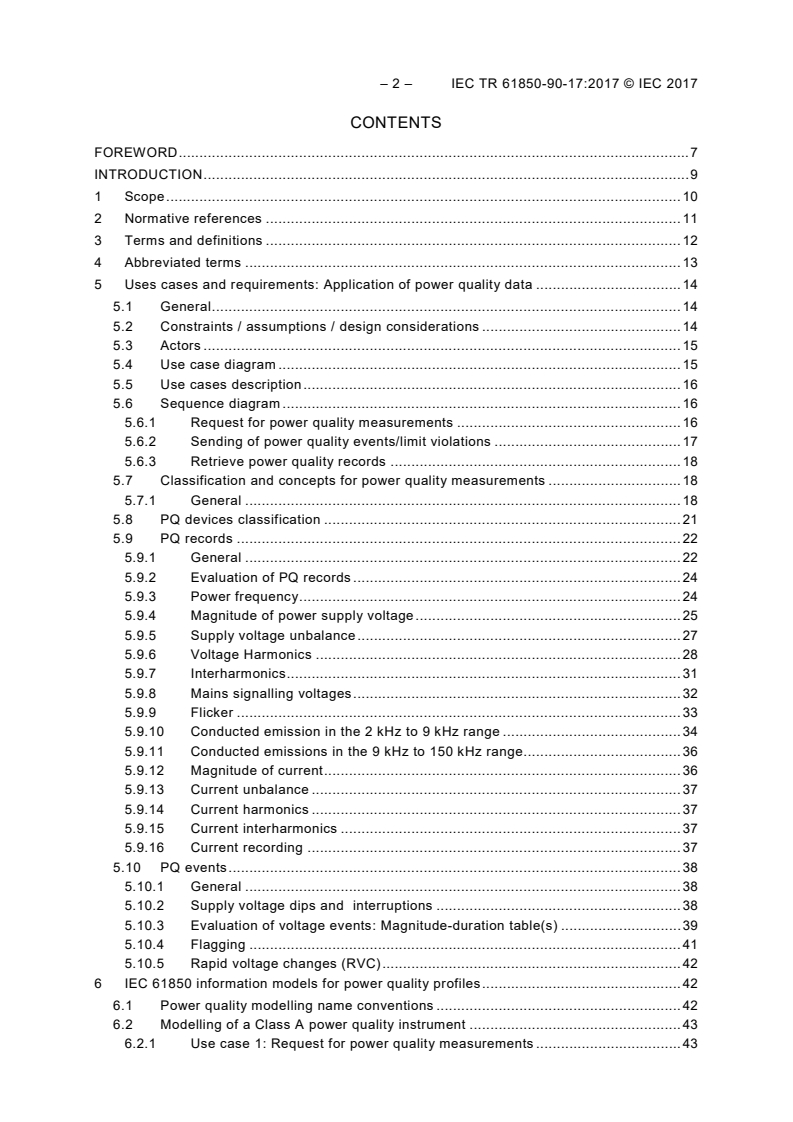
– 2 – IEC TR 61850-90-17:2017 © IEC 2017
CONTENTS
FOREWORD . 7
INTRODUCTION . 9
1 Scope . 10
2 Normative references . 11
3 Terms and definitions . 12
4 Abbreviated terms . 13
5 Uses cases and requirements: Application of power quality data . 14
5.1 General . 14
5.2 Constraints / assumptions / design considerations . 14
5.3 Actors . 15
5.4 Use case diagram . 15
5.5 Use cases description . 16
5.6 Sequence diagram . 16
5.6.1 Request for power quality measurements . 16
5.6.2 Sending of power quality events/limit violations . 17
5.6.3 Retrieve power quality records . 18
5.7 Classification and concepts for power quality measurements . 18
5.7.1 General . 18
5.8 PQ devices classification . 21
5.9 PQ records . 22
5.9.1 General . 22
5.9.2 Evaluation of PQ records . 24
5.9.3 Power frequency . 24
5.9.4 Magnitude of power supply voltage . 25
5.9.5 Supply voltage unbalance . 27
5.9.6 Voltage Harmonics . 28
5.9.7 Interharmonics . 31
5.9.8 Mains signalling voltages . 32
5.9.9 Flicker . 33
5.9.10 Conducted emission in the 2 kHz to 9 kHz range . 34
5.9.11 Conducted emissions in the 9 kHz to 150 kHz range . 36
5.9.12 Magnitude of current . 36
5.9.13 Current unbalance . 37
5.9.14 Current harmonics . 37
5.9.15 Current interharmonics . 37
5.9.16 Current recording . 37
5.10 PQ events . 38
5.10.1 General . 38
5.10.2 Supply voltage dips and interruptions . 38
5.10.3 Evaluation of voltage events: Magnitude-duration table(s) . 39
5.10.4 Flagging . 41
5.10.5 Rapid voltage changes (RVC) . 42
6 IEC 61850 information models for power quality profiles . 42
6.1 Power quality modelling name conventions . 42
6.2 Modelling of a Class A power quality instrument . 43
6.2.1 Use case 1: Request for power quality measurements . 43
6.2.2 Use case 2: Sending of power quality events/limit violations . 44
6.2.3 Use case 3: Retrieve power quality records . 45
6.3 IEC 61850 PQ mapping . 45
6.4 PQ monitoring . 46
6.4.1 General . 46
6.4.2 Use of LN MMXU/MMXN . 46
6.4.3 Use of LN MHAI/MHAN . 47
6.4.4 Use of LN MHFE – new LN . 49
6.4.5 Use of LN MFLK . 49
6.4.6 Use of LN MSQI . 50
6.5 PQ event monitoring and PQ evaluation . 50
6.5.1 General . 50
6.5.2 Use of LN QVVR voltage variations . 50
6.5.3 Use of LN QSVV Supply Voltage Variations – new LN . 54
6.5.4 Use of LN QRVC rapid voltage changes – new LN . 54
6.5.5 Use of LN QFVR frequency variations. 55
6.5.6 Use of LN QVUB voltage unbalance . 55
6.5.7 Use of LN QIUB current unbalance . 55
6.5.8 Use of LN QFLK flicker limit violation . 55
6.5.9 Use of LN QVHA harmonics/interharmonics limit violation – new LN - . 56
6.5.10 Use of LN QMSV mains signalling voltage limit violation – new LN - . 56
6.5.11 Use of LN QCPR continuous power quality recorder – new LN - . 56
6.5.12 Use of LN QVTR voltage transients . 57
6.5.13 Use of LN QITR current transients . 57
7 Data model of namespace IEC 61850-90-17 for power quality . 57
7.1 Namespace name and version . 57
7.2 Abbreviated terms . 57
7.3 Logical node classes . 58
7.3.1 General . 58
7.3.2 Package LNGroupM. 58
7.3.3 Package LNGroupQ . 61
7.4 Data semantics . 80
7.5 Enumerated data attribute types . 83
7.5.1 General . 83
7.5.2 AffectedPhases90-17Kind enumeration . 84
7.5.3 CalcMethod90-17Kind enumeration . 85
7.5.4 FlickerCalcMethodKind enumeration . 86
7.5.5 FreqRangeGroupKind enumeration . 86
7.5.6 NumHarmonicPcbKind enumeration . 87
7.5.7 VoltInterruptDetection90-17Kind enumeration . 87
8 Communication services for data transfer . 87
Annex A (normative) SCL enumerations (IEC TR 61850-90-17) . 89
A.1 SCL enumerations (from DOEnums_90_17) . 89
Figure 1 – Use cases related to Power Quality monitoring application . 16
Figure 2 – Use case "Request for power quality measurements” . 17
Figure 3 – Use case "Sending of power quality event/limit violation” . 17
Figure 4 – Use case "Retrieve power quality records” . 18
– 4 – IEC TR 61850-90-17:2017 © IEC 2017
Figure 5 – File transfer of PQ records from IED to user . 23
Figure 6 – File transfer of PQ reports from IED to user . 23
Figure 7 – Voltage record example (6 h): 10 min r.m.s values of magnitude of supply
voltage and additional record containing voltage variations (1/2 cycle r.m.s. values) in
a single phase LV system (Udin = 230 V) . 24
Figure 8 – One-month power frequency record (10 s) and limits of frequency deviation
50 Hz ± 1 % according to EN 50160 . 24
Figure 9 – Example of a one day 10 min voltage r.m.s record in a single phase LV
system (Udin = 230 V) with dip (90 %) and swell (110 %) limits . 26
Figure 10 – Harmonic subgroup calculation method according to IEC 61000-4-
7/IEC 61000-4-30 . 28
rd
Figure 11 – Example of 10 min 3 harmonic record (single phase, LV 230 V), 5 weeks . 29
Figure 12 – Interharmonic centred subgroup calculation method according to
IEC 61000-4-7 and IEC 61000-4-30 . 32
Figure 13 – Voltage levels of signal frequencies in percent of nominal voltage U used
n
in public LV and MV networks from EN 50160 standard . 33
Figure 14 – Example of a one month long term Flicker record (single phase, 230 V) . 34
Figure 15 – Grouping of 5 Hz frequencies to 200 Hz frequency bands Y . 35
Figure 16 – Voltage events with hysteresis explanation . 38
Figure 17 – Example of a voltage event: voltage dip with limits (dip, swell,
interruption), hysteresis = 2 % of Udin and additional record of voltage variations (1/2
cycle r.m.s. values) . 40
Figure 18 – Voltage dip event with additional fault record . 40
Figure 19 – Flagged data: supply voltage magnitude is flagged if a voltage dip
occurred in aggregation interval . 41
Figure 20 – RVC characterization . 42
Figure 21 – State of the art data modeling for use case “Request for power quality
measurements” (new in IEC 61000-4-30:2015) . 44
Figure 22 – State of the art data modeling for use case "Sending of power quality
events/limit violations" (new in IEC 61000-4-30:2015) . 45
Figure 23 – State of the art data modelling for use case “Retrieve power quality
records" (new in IEC 61000-4-30:2015) . 45
Figure 24 – Modelling of magnitude-duration table for voltage events with histogram HST . 53
Figure 25 – Visualization of example event in Figure 17/Figure 18/Figure 24 in ITI
curve . 53
Figure 26 – Class diagram LogicalNodes_90_17::LogicalNodes_90_17 . 58
Figure 27 – Class diagram LNGroupM::LNGroupM. 59
Figure 28 – Class diagram LNGroupQ::LNGroupQ1 . 62
Figure 29 – Class diagram LNGroupQ::LNGroupQ2 . 63
Figure 30 – Voltage events with hysteresis explanation . 78
Figure 31 – Enumerated data attribute types . 84
Table 1 – Actors and roles . 15
Table 2 – Use cases and applications . 16
Table 3 – Use case "Request for power quality measurements" . 16
Table 4 – Use case "Sending of power quality events/limits violations" . 17
Table 5 – Use case "Retrieve power quality records" . 18
Table 6 – Mapping between PQ measurement methods, evaluation/reporting
requirements and IEC 61850 modelling . 19
Table 7 – Relation between LN and PQ use cases . 21
Table 8 – PQ records for Class A and Class S devices . 22
Table 9 – Transfer of PQ records vs. transfer of PQ reports . 23
Table 10 – Evaluation of power frequency data according to EN 50160 . 25
Table 11 – Evaluation of a voltage magnitude record (single phase, LV: 230 V) . 27
Table 12 – Limits for harmonics in LV/MV networks . 29
Table 13 – Limits for harmonics in HV networks . 30
Table 14 – LV/MV network limits for harmonics/interharmonics according to IEC TS 62749 . 30
Table 15 – HV network limits for harmonics/interharmonics according to IEC TS 62749 . 31
Table 16 – Flicker severity Plt recommended values . 34
Table 17 – Evaluation of a Flicker record (single phase, nominal voltage 230 V) . 34
Table 18 – Requirements from IEC 61000-4-7:2009 . 35
Table 19 – Requirements from IEC 61000-4-30:2015 . 36
Table 20 – PQ event overview . 38
Table 21 – Voltage dip/interruption and swell classification according to EN 50160. 39
Table 22 – Voltage event classification according to IEC TS 62749 . 39
Table 23 – Example of single event assessment according to IEC TS 62749 . 40
Table 24 – Flagging requirements vs. use cases according to Figure 1 . 41
Table 25 – Calculation methods for power quality values according to IEC 61000-4-30 . 43
Table 26 – Calculation methods for modified power quality values . 43
Table 27 – PQ mapping . 46
Table 28 – Relation between nominal frequency, number of cycles and
harmonics/interharmonics grouping for PQ application . 48
Table 29 – Order of DC, harmonics and interharmonics in MHAI for PQ application . 49
Table 30 – hstVal indices (e.g. according to IEC TS 62749) . 51
Table 31 – Array arrangement for voltage events . 52
Table 32 – Normative abbreviations for data object names . 58
Table 33 – Data objects of MHFE . 60
Table 34 – Data objects of QCPR . 64
Table 35 – Data objects of QFLK . 65
Table 36 – Data objects of QFVRext . 67
Table 37 – Data objects of QITRext . 68
Table 38 – Data objects of QIUBext . 70
Table 39 – Data objects of QMSV . 71
Table 40 – Data objects of QRVC . 72
Table 41 – Data objects of QSVV . 74
Table 42 – Data objects of QVHA . 75
Table 43 – Data objects of QVTRext . 76
Table 44 – Data objects of QVUBext . 77
Table 45 – Data objects of QVVRext . 79
Table 46 – Attributes defined on classes of LogicalNodes_90_17 package . 81
Table 47 – Literals of AffectedPhases90-17Kind . 85
– 6 – IEC TR 61850-90-17:2017 © IEC 2017
Table 48 – Literals of CalcMethod90-17Kind . 86
Table 49 – Literals of FlickerCalcMethodKind . 86
Table 50 – Literals of FreqRangeGroupKind . 87
Table 51 – Literals of NumHarmonicPcbKind . 87
Table 52 – Literals of VoltInterruptDetection90-17Kind . 87
INTERNATIONAL ELECTROTECHNICAL COMMISSION
____________
COMMUNICATION NETWORKS AND SYSTEMS
FOR POWER UTILITY AUTOMATION –
Part 90-17: Using IEC 61850 to transmit power quality data
FOREWORD
1) The International Electrotechnical Commission (IEC) is a worldwide organization for standardization comprising
all national electrotechnical committees (IEC National Committees). The object of IEC is to promote interna-
tional co-operation on all questions concerning standardization in the electrical and electronic fields. To this
end and in addition to other activities, IEC publishes International Standards, Technical Specifications, Tech-
nical Reports, Publicly Available Specifications (PAS) and Guides (hereafter referred to as “IEC Publica-
tion(s)”). Their preparation is entrusted to technical committees; any IEC National Committee interested in the
subject dealt with may participate in this preparatory work. International, governmental and non-governmental
organizations liaising with the IEC also participate in this preparation. IEC collaborates closely with the Interna-
tional Organization for Standardization (ISO) in accordance with conditions determined by agreement between
the two organizations.
2) The formal decisions or agreements of IEC on technical matters express, as nearly as possible, an international
consensus of opinion on the relevant subjects since each technical committee has representation from all inter-
ested IEC National Committees.
3) IEC Publications have the form of recommendations for international use and are accepted by IEC National
Committees in that sense. While all reasonable efforts are made to ensure that the technical content of IEC
Publications is accurate, IEC cannot be held responsible for the way in which they are used or for any misinter-
pretation by any end user.
4) In order to promote international uniformity, IEC National Committees undertake to apply IEC Publications
transparently to the maximum extent possible in their national and regional publications. Any divergence be-
tween any IEC Publication and the corresponding national or regional publication shall be clearly indicated in
the latter.
5) IEC itself does not provide any attestation of conformity. Independent certification bodies provide conformity
assessment services and, in some areas, access to IEC marks of conformity. IEC is not responsible for any
services carried out by independent certification bodies.
6) All users should ensure that they have the latest edition of this publication.
7) No liability shall attach to IEC or its directors, employees, servants or agents including individual experts and
members of its technical committees and IEC National Committees for any personal injury, property damage or
other damage of any nature whatsoever, whether direct or indirect, or for costs (including legal fees) and ex-
penses arising out of the publication, use of, or reliance upon, this IEC Publication or any other IEC Publica-
tions.
8) Attention is drawn to the Normative references cited in this publication. Use of the referenced publications is
indispensable for the correct application of this publication.
9) Attention is drawn to the possibility that some of the elements of this IEC Publication may be the subject of
patent rights. IEC shall not be held responsible for identifying any or all such patent rights.
The main task of IEC technical committees is to prepare International Standards. However, a
technical committee may propose the publication of a technical report when it has collected
data of a different kind from that which is normally published as an International Standard, for
example "state of the art".
IEC 61850-90-17, which is a technical report, has been prepared by IEC technical committee
57: Power systems management and associated information exchange, in cooperation with
IEC technical committee 85: Measuring equipment for electrical and electromagnetic quanti-
ties.
– 8 – IEC TR 61850-90-17:2017 © IEC 2017
The text of this technical report is based on the following documents:
Enquiry draft Report on voting
57/1676/DTR 57/1836/RVDTR
Full information on the voting for the approval of this technical report can be found in the re-
port on voting indicated in the above table.
This document has been drafted in accordance with the ISO/IEC Directives, Part 2.
A list of all parts of the IEC 61850 series, under the general title Communication networks and
systems for power utility automation, can be found on the IEC website.
The committee has decided that the contents of this document will remain unchanged until the
stability date indicated on the IEC website under "http://webstore.iec.ch" in the data related to
the specific document. At this date, the document will be
• reconfirmed,
• withdrawn,
• replaced by a revised edition, or
• amended.
A bilingual version of this publication may be issued at a later date.
IMPORTANT – The 'colour inside' logo on the cover page of this publication indicates
that it contains colours which are considered to be useful for the correct understand-
ing of its contents. Users should therefore print this document using a colour printer.
INTRODUCTION
Power quality (PQ) measurement methods are defined in IEC 61000-4-30.
Power quality measurement instruments are used to evaluate the quality of electricity (voltage
characteristics) supplied by distribution and transmission systems and to evaluate the perfor-
mance (emission) of equipment.
These instruments provide different types of data for different applications of PQ data:
• Power quality monitoring:
– Continuity of supply monitoring,
– Monitoring of different voltage characteristics: Voltage quality (VQ) covers a wide
range of voltage disturbances and deviations in voltage magnitude or waveform from
the optimum values.
• Power quality compliance reporting:
– Continuous monitoring and compliance reporting of different voltage characteristics at
point of connection.
– Additional data are helpful for:
a) Detailed problem analysis (e.g. waveform or transient records),
b) Flexible data evaluation (e.g. grid codes for data post processing).
NOTE See also “Document on Guidelines of Good Practice on the Implementation and Use of Voltage Quality
Monitoring Systems for Regulatory Purposes, which has been jointly developed by CEER and the ECRB” (C12-
EQS-51-03) and CIGRÉ/CIRED Joint Working Group (JWG) C4.112: “Guidelines for Power quality monitoring –
measurement locations, processing and presentation of data”.
IEC 61850 provides the services and data modeling for transmission of PQ related data from
instruments to substation/SCADA systems.
There is a desire to have a communication mechanism that is compliant to the concept of
IEC 61850. This document lays out how this shall be done.
File based transmission of PQ data is based on the following standards:
• IEC 60255-24/IEEE Std. C37.111, Measuring relays and protection equipment – Part 24:
Common format for transient data exchange (COMTRADE) for power systems for fault
records,
• IEEE Std. 1159.3, PQDIF for PQ records (events, measurements, records).
During modelling of PQ applications IEC 61850-7-4 and IEC 61850-7-3 will be reviewed.
– 10 – IEC TR 61850-90-17:2017 © IEC 2017
COMMUNICATION NETWORKS AND SYSTEMS
FOR POWER UTILITY AUTOMATION –
Part 90-17: Using IEC 61850 to transmit power quality data
1 Scope
This part of IEC 61850, which is a technical report, provides a way of exchanging power quali-
ty data between instruments whose functions include measuring, recording and possibly moni-
toring power quality phenomena in power supply systems, and clients using them in a way
that is compliant to the concepts of IEC 61850.
The main goal is the interoperability of power quality instruments.
NOTE 1 The measurement of PQ phenomena maybe provided by communication e.g. IEC 61850-9-2 or instru-
ment transformers. Their application is outside of the scope of this document.
NOTE 2 This document does not set any limits for power quality values, but only repeats limits from other sources
(e.g. EN 50160, IEC TS 62749) as suitable examples.
NOTE 3 This document provides recommendations for naming conventions for PQ measurements provided by
power quality instruments to manifest the usage of Power quality measurement methods and to ensure interopera-
bility.
This document provides
• Guidelines for using of IEC 61850 for power quality domain,
• Name space extensions based on power quality function assessment,
• Profile for using IEC 61850 in the specific context of IEC 61000-4-30.
Specific power quality requirements that cannot be wholly covered with existing Logical
Nodes (LN) or Common Data Classes (CDC) (e.g. LN for continuous power quality recorders,
LN for RVC, etc.) will be addressed and added in the next editions of IEC 61850-7-3 and
IEC 61850-7-4.
NOTE 4 This document references to/is compliance with the future 61850 amendment 2.1, and also bring the
needed elements which are mandatory to understand the document; at least the new presence conditions rules, as
well as the enumeration models.
The namespace introduced by this document in Clause 7 has the following properties:
• Namespace Version: 2016
• Namespace Revision:
• UML model file which reflects this namespace edition: wg10uml02v20draftPQ00-
wg18uml02v11b-wg17uml02v17c-jwg25uml02v04c-tc17umlv0-tc38umlv0.eap, UML model
version WG10UML02v20DraftUpdate
• Namespace release date: 2017-01-17
• Namespace name: “(Tr)IEC61850-90-17:2016”
This name space is considered as "transitional" since the models are expected to be included
in future editions of IEC 61850-7-4xx. Potential extensions/modifications may happen if/when
the models are moved to International Standard status. Only the new data objects and CDCs
which are represented in bold-italic will be tagged with this namespace name. The others still
refer to the namespace where they are primarily defined.
The Profile (set of additional rules) for using IEC 61850 in the specific context of
IEC 61000-4-30, introduced in this document in Clause 6 is named
“Profile_61000-4-30_(Tr)IEC61850-90-17:2016”.
2 Normative references
The following documents are referred to in the text in such a way that some or all of their con-
tent constitutes requirements of this document. For dated references, only the edition cited
applies. For undated references, the latest edition of the referenced document (including any
amendments) applies.
IEC TR 61000-3-6, Electromagnetic compatibility (EMC) – Part 3-6: Limits – Assessment of
emission limits for the connection of distorting installations to MV, HV and EHV power sys-
tems
IEC TR 61000-3-7, Electromagnetic compatibility (EMC) – Part 3-7: Limits – Assessment of
emission limits for the connection of fluctuating installations to MV, HV and EHV power sys-
tems
IEC TR 61000-3-13, Electromagnetic compatibility (EMC) – Part 3-13: Limits – Assessment of
emission limits for the connection of unbalanced installations to MV, HV and EHV power sys-
tems
IEC TR 61000-3-14, Electromagnetic compatibility (EMC) – Part 3-14: Assessment of emis-
sion limits for harmonics, interharmonics, voltage fluctuations and unbalance for the connec-
tion of disturbing installations to LV power systems
IEC 61000-4-7:2009, Electromagnetic compatibility (EMC) – Part 4-7: Testing and measure-
ment techniques – General guide on harmonics and interharmonics measurements and in-
strumentation, for power supply systems and equipment connected thereto
IEC 61000-4-15:2010, Electromagnetic compatibility (EMC) – Part 4-15: Testing and meas-
urement techniques – Flickermeter – Functional and design specifications
IEC 61000-4-30:2015, Electromagnetic compatibility (EMC) – Part 4-30: Testing and meas-
urement techniques – Power quality measurement methods
IEC TS 61850-2, Communication networks and systems in substations – Part 2: Glossary
IEC 61850-7-1:2011, Communication networks and systems for power utility automation –
Part 7-1: Basic communication structure – Principles and models
IEC 61850-7-2:2010, Communication networks and systems for power utility automation –
Part 7-2: Basic information and communication structure – Abstract communication service
interface (ACSI)
IEC 61850-7-4, Communication networks and systems for power utility automation – Part 7-4:
Basic communication structure – Compatible logical node classes and data object classes
IEC 61850-8-1:2011, Communication networks and systems for power utility automation –
Part 8-1: Specific communication service mapping (SCSM) – Mappings to MMS (ISO 9506-1
and ISO 9506-2) and to ISO/IEC 8802-3
IEC TR 61850-90-2, Communication networks and systems for power utility automation –
Part 90-2: Using IEC 61850 for the communication between substations and control centres
– 12 – IEC TR 61850-90-17:2017 © IEC 2017
IEC 62586-1:2013, Power quality measurement in power supply systems – Part 1: Power
quality instruments (PQI)
IEC TS 62749:2015, Assessment of power quality – Characteristics of electricity supplied by
public networks
IEEE Std. 1159.3:2003, Power Quality Data Interchange Format (PQDIF)
EN 51060, Voltage characteristics in public distribution systems
3 Terms and definitions
For the purposes of this document, the following terms and definitions apply.
ISO and IEC maintain terminological databases for use in standardization at the following
addresses:
• IEC Electropedia: available at http://electropedia.org/
• ISO Online browsing platform: available at http://www.iso.org/obp
3.1
power quality instrument
PQI
instrument according to IEC 62586-1 whose main function is to measure, record and possibly
monitor power quality parameters in power supply systems, and whose measuring methods
(class A or class S) are defined in IEC 61000-4-30
3.2
power quality instrument class A
PQI-A
PQI according to IEC 62586-1 whose measuring methods comply with class A of IEC 61000-
4-30
3.3
channel
individual measurement path through an instrument
Note 1 to entry: “Channel” and “phase” are not the same. A voltage channel is by definition the difference in
potential between 2 conductors. Phase refers to a single conductor. On polyphase systems, a channel may be
between 2 phases, or between a phase and neutral, or between a phase and earth, or between neutral and earth.
3.4
power quality instrument class S
PQI-S
PQI according to IEC 62586-1 whose measuring methods comply with class S of IEC 61000-
4-30
3.5
declared input voltage
Udin
value obtained from the declared supply voltage by a transducer ratio
3.6
declared supply voltage
Uc
nominal voltage Un of the system
Note 1 to entry: If by agreement between the supplier and the customer a voltage different from the nominal volt-
age is applied to the terminals, then this voltage is the declared supply voltage Uc.
3.7
flicker
impression of unsteadiness of visual sensation induced by a light stimulus whose luminance
or spectral distribution fluctuates with time
[SOURCE: IEC 60050-161:1990, 161-08-13]
3.8
power quality
characteristics of the electricity at a given point on an electrical system, evaluated against a
set of reference technical parameters
Note 1 to entry: These parameters might, in some cases, relate to the compatibility between electricity supplied
on a network and the loads connected to that network.
3.9
r.m.s. (root-mean-square) value
square root of the arithmetic mean of the squares of the instantaneous values of a quantity
taken over a specified time interval and a specified bandwidth
4 Abbreviated terms
For the purposes of this document, the abbreviated terms given in IEC TS 61850-2 and
IEC 61850-7-2 and the following apply.
ACSI Abstract communication service interface
CDC Common Data Class
COMFEDE Common format for event data exchange
COMTRADE Common format for transient data exchange
Ds derived statistics
DB Database
DMS Distribution Management System
DO Data Object
EHV Extra high voltage
EMS Energy management system
EMC Electromagnetic Compatibility
F Element is forbidden
GMS Generation Management System
HV High voltage (> 35 kV)
IED Intelligent Electronic Device
IP Internet Protocol
LAN Local Area Network
LD Logical Device
LN Logical Node
LV Low voltage (< 1 kV)
M Element is mandatory
MMS Manufacturing Messaging Specification. See IEC 61850-8-1
M-O-C mandatory – optional – conditional
MS Management System
MSV Mains signalling voltage (ripple control)
MV Medium voltage (1 kV to 35 kV)
n/a Not applicable
– 14 – IEC TR 61850-90-17:2017 © IEC 2017
nds not derived statistics
O Element is optional.
Pinst Instantaneous flicker sensation. See IEC 61000-4-15
Plt Long-term flicker evaluation. See IEC 61000-4-15
PQ Power Quality
PQI Power Quality Instrument. See IEC 62586-1
PQDIF Quality Data Interchange Format
Pst Short-term flicker evaluation based on an observation period of 10 minutes. See IEC 61000-4-15
PQI Power Quality Instrument
RMS root-mean-square value
r.m.s. root-mean-square value
RVC Rapid voltage change
SAIFI System Average Interruption Frequency Index
SBM Specified by manufacturer
SCADA Supervisory Control and Data Acquisition
SCD Substation Configuration Description
SCL Substation Configuration Language
TCP Transmission Control Protocol
THD Total Harmonic Distortion
TR Technical Report
TS Technical Specification
Uc Declared supply voltage
Udin Declared input voltage
Un Nominal voltage
XML Extensible Markup Language
NOTE Abbreviations used for the identification of the common data classes/Logical Nodes (LN) and as names of
the attributes are specified in the specific clauses of this document and are not repeated here.
5 Uses cases and requirements: Application of power quality data
5.1 General
Modelling of power quality instruments includes all methods to transfer power quality infor-
mation from IED (e.g. PQI) to an application in the substation, control centre or maintenance
centre.
5.2 Constraints / assumptions / design considerations
The IED is equipped with a communication interface to send the power quality information to
the substation, control centre or maintenance centre. Additionally the IED may store power
quality information in local records that can be retrieved from the substation, control centre or
maintenance centre.
Power quality information is used either for operational purpose and / or for offline analysis
and grid code evaluation:
1) SCADA-Control and PQ Monitoring:
• Provide measurements of power quality values (10 s, 10/12 cycle, 150/180 cycle, etc.)
in order to make operational decisions: obtain information to evaluate PQ trends (with-
out PQ limit violations, e.g. increase of harmonics, THD, unbalance, etc.)
• Continuity of supply monitoring: detect and transmit voltage events (alarming or critical
limit violation) in
...
Questions, Comments and Discussion
Ask us and Technical Secretary will try to provide an answer. You can facilitate discussion about the standard in here.
Loading comments...