

IEC 62149-1:2011
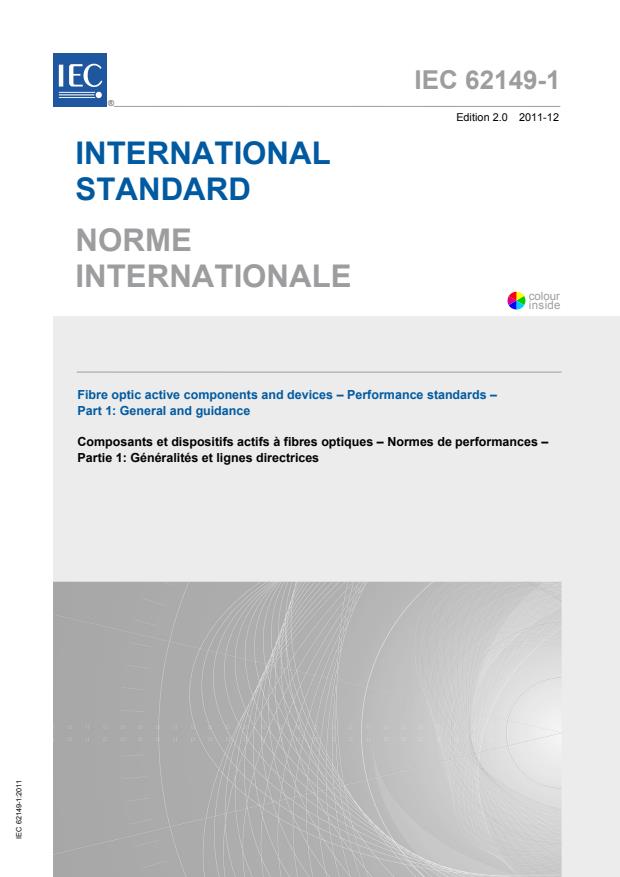
(Main)Fibre optic active components and devices - Performance standards - Part 1: General and guidance
- Abstract
IEC 62149-1:2011 provides references, definitions and rules for creating active fibre optic device performance standards, as well as related information pertinent to the subject. Subsequent parts of IEC 62149 are sequentially numbered and contain performance criteria for specific applications. Each part will be added as the performance criteria become standardised for international use. This second edition cancels and replaces the first edition published in 2004 and its corrigendum 1 (2004). It is a technical revision. The technical change consists of an update in Table A.1.
- Status
- Published
- Publication Date
- 06-Dec-2011
- Technical Committee
- SC 86C - Fibre optic systems, sensing and active devices
- Drafting Committee
- WG 4 - Fibre optic active devices including optoelectronic devices
- Current Stage
- PPUB - Publication issued - 60 Publication
- Start Date
- 07-Dec-2011
- Due Date
- 31-Mar-2012
- Completion Date
- 31-Mar-2012
Overview
IEC 62149-1:2011, titled Fibre optic active components and devices - Performance standards - Part 1: General and guidance, is an international standard published by the International Electrotechnical Commission (IEC). This second edition updates and replaces the 2004 first edition, reflecting revised technical requirements for creating performance standards applicable to active fibre optic devices.
This part of the IEC 62149 series lays out the foundational framework-defining terminologies, references, and rules-necessary for developing standardized performance benchmarks for fibre optic active components. It ensures a consistent approach towards design verification, test methodologies, and evaluation criteria, facilitating international harmonization and interoperability within the fibre optics industry.
Key Topics
Definitions and Scope
- Provides essential definitions and terminologies related to active fibre optic devices.
- Establishes the scope for performance standards applicable to active fibre optic components, guiding the development of subsequent parts targeting specific applications.
Performance Standard Development
- Defines essential elements for drafting performance standards, including:
- Product definition
- Test procedures
- Details and requirements
- Sample size
- Groupings and test sequences
- Pass/fail criteria
- Reference product specifications
- Emphasizes transparency and clarity in detailing test methods and performance expectations.
Test Methods and Environmental Conditions
- Recommends adopting test procedures primarily from IEC 61300 series for measuring various mechanical and environmental resilience parameters.
- Covers testing against diverse environmental categories, such as controlled environments, uncontrolled environments, outside plant, and extreme environmental conditions, detailed in annex tables to guarantee product suitability across deployment scenarios.
- Outlines critical tests including:
- Mechanical shock and vibration
- Temperature cycling and endurance
- Humidity and damp heat
- Dust and salt mist exposure
- Industrial atmosphere impact
Reporting and Compliance
- Specifies the need for a performance standard test report documenting test results, pass/fail outcomes, and conformance with the standard.
- Clarifies that meeting performance standards demonstrates initial design verification but does not guarantee ongoing reliability or lifetime performance-separate reliability and service life testing protocols are recommended.
Applications
IEC 62149-1:2011 serves as a vital guideline for manufacturers, test laboratories, and certification bodies involved in the design, validation, and quality assurance of active fibre optic components such as transmitters, receivers, and amplifiers. It enables:
- Development of consistent industry-wide performance standards, fostering interoperability among components.
- Establishing criteria to verify product suitability for various environmental and operational conditions.
- Supporting international trade and collaboration by harmonizing test methodologies and pass/fail criteria.
- Facilitation of quality assurance programs by providing a clear framework on sample size, test grouping, and reporting.
The standard benefits sectors including telecommunications, data centers, and industrial automation relying on fiber optic technology for secure, efficient signal transmission.
Related Standards
- IEC 61300 Series: Basic test and measurement procedures for fibre optic interconnecting devices and passive components.
- IEC 60068 Series: Environmental testing standards covering shock, vibration, temperature, and humidity tests applicable to electronic components.
- IEC 62005: Reliability testing guidelines for fibre optic components.
- IEC 61751: Standards for fibre optic equipment reliability and quality assurance.
- ISO/IEC Directives, Part 2: Guidelines on drafting and formatting international standards relevant for IEC 62149-1.
By adhering to IEC 62149-1:2011, industry stakeholders establish a robust foundation for the development and certification of active fibre optic devices. This ensures consistent quality, performance, and compatibility necessary for the evolving demands of modern optical communication systems.
Relations
- Effective Date
- 05-Sep-2023
- Effective Date
- 05-Sep-2023
Get Certified
Connect with accredited certification bodies for this standard

ANCE
Mexican certification and testing association.

Intertek Slovenia
Intertek testing, inspection, and certification services in Slovenia.

LNE (Laboratoire National de Métrologie et d'Essais)
French national laboratory for metrology and testing.
Sponsored listings
Frequently Asked Questions
IEC 62149-1:2011 is a standard published by the International Electrotechnical Commission (IEC). Its full title is "Fibre optic active components and devices - Performance standards - Part 1: General and guidance". This standard covers: IEC 62149-1:2011 provides references, definitions and rules for creating active fibre optic device performance standards, as well as related information pertinent to the subject. Subsequent parts of IEC 62149 are sequentially numbered and contain performance criteria for specific applications. Each part will be added as the performance criteria become standardised for international use. This second edition cancels and replaces the first edition published in 2004 and its corrigendum 1 (2004). It is a technical revision. The technical change consists of an update in Table A.1.
IEC 62149-1:2011 provides references, definitions and rules for creating active fibre optic device performance standards, as well as related information pertinent to the subject. Subsequent parts of IEC 62149 are sequentially numbered and contain performance criteria for specific applications. Each part will be added as the performance criteria become standardised for international use. This second edition cancels and replaces the first edition published in 2004 and its corrigendum 1 (2004). It is a technical revision. The technical change consists of an update in Table A.1.
IEC 62149-1:2011 is classified under the following ICS (International Classification for Standards) categories: 33.180.20 - Fibre optic interconnecting devices. The ICS classification helps identify the subject area and facilitates finding related standards.
IEC 62149-1:2011 has the following relationships with other standards: It is inter standard links to IEC 62149-1:2004, IEC 62149-1:2004/COR1:2004. Understanding these relationships helps ensure you are using the most current and applicable version of the standard.
IEC 62149-1:2011 is available in PDF format for immediate download after purchase. The document can be added to your cart and obtained through the secure checkout process. Digital delivery ensures instant access to the complete standard document.
Standards Content (Sample)
IEC 62149-1 ®
Edition 2.0 2011-12
INTERNATIONAL
STANDARD
NORME
INTERNATIONALE
colour
inside
Fibre optic active components and devices – Performance standards –
Part 1: General and guidance
Composants et dispositifs actifs à fibres optiques – Normes de performances –
Partie 1: Généralités et lignes directrices
All rights reserved. Unless otherwise specified, no part of this publication may be reproduced or utilized in any form or by
any means, electronic or mechanical, including photocopying and microfilm, without permission in writing from either IEC or
IEC's member National Committee in the country of the requester.
If you have any questions about IEC copyright or have an enquiry about obtaining additional rights to this publication,
please contact the address below or your local IEC member National Committee for further information.
Droits de reproduction réservés. Sauf indication contraire, aucune partie de cette publication ne peut être reproduite
ni utilisée sous quelque forme que ce soit et par aucun procédé, électronique ou mécanique, y compris la photocopie
et les microfilms, sans l'accord écrit de la CEI ou du Comité national de la CEI du pays du demandeur.
Si vous avez des questions sur le copyright de la CEI ou si vous désirez obtenir des droits supplémentaires sur cette
publication, utilisez les coordonnées ci-après ou contactez le Comité national de la CEI de votre pays de résidence.
IEC Central Office
3, rue de Varembé
CH-1211 Geneva 20
Switzerland
Email: inmail@iec.ch
Web: www.iec.ch
About the IEC
The International Electrotechnical Commission (IEC) is the leading global organization that prepares and publishes
International Standards for all electrical, electronic and related technologies.
About IEC publications
The technical content of IEC publications is kept under constant review by the IEC. Please make sure that you have the
latest edition, a corrigenda or an amendment might have been published.
Catalogue of IEC publications: www.iec.ch/searchpub
The IEC on-line Catalogue enables you to search by a variety of criteria (reference number, text, technical committee,…).
It also gives information on projects, withdrawn and replaced publications.
IEC Just Published: www.iec.ch/online_news/justpub
Stay up to date on all new IEC publications. Just Published details twice a month all new publications released. Available
on-line and also by email.
Electropedia: www.electropedia.org
The world's leading online dictionary of electronic and electrical terms containing more than 20 000 terms and definitions
in English and French, with equivalent terms in additional languages. Also known as the International Electrotechnical
Vocabulary online.
Customer Service Centre: www.iec.ch/webstore/custserv
If you wish to give us your feedback on this publication or need further assistance, please visit the Customer Service
Centre FAQ or contact us:
Email: csc@iec.ch
Tel.: +41 22 919 02 11
Fax: +41 22 919 03 00
A propos de la CEI
La Commission Electrotechnique Internationale (CEI) est la première organisation mondiale qui élabore et publie des
normes internationales pour tout ce qui a trait à l'électricité, à l'électronique et aux technologies apparentées.
A propos des publications CEI
Le contenu technique des publications de la CEI est constamment revu. Veuillez vous assurer que vous possédez
l’édition la plus récente, un corrigendum ou amendement peut avoir été publié.
Catalogue des publications de la CEI: www.iec.ch/searchpub/cur_fut-f.htm
Le Catalogue en-ligne de la CEI vous permet d’effectuer des recherches en utilisant différents critères (numéro de référence,
texte, comité d’études,…). Il donne aussi des informations sur les projets et les publications retirées ou remplacées.
Just Published CEI: www.iec.ch/online_news/justpub
Restez informé sur les nouvelles publications de la CEI. Just Published détaille deux fois par mois les nouvelles
publications parues. Disponible en-ligne et aussi par email.
Electropedia: www.electropedia.org
Le premier dictionnaire en ligne au monde de termes électroniques et électriques. Il contient plus de 20 000 termes et
définitions en anglais et en français, ainsi que les termes équivalents dans les langues additionnelles. Egalement appelé
Vocabulaire Electrotechnique International en ligne.
Service Clients: www.iec.ch/webstore/custserv/custserv_entry-f.htm
Si vous désirez nous donner des commentaires sur cette publication ou si vous avez des questions, visitez le FAQ du
Service clients ou contactez-nous:
Email: csc@iec.ch
Tél.: +41 22 919 02 11
Fax: +41 22 919 03 00
IEC 62149-1 ®
Edition 2.0 2011-12
INTERNATIONAL
STANDARD
NORME
INTERNATIONALE
colour
inside
Fibre optic active components and devices – Performance standards –
Part 1: General and guidance
Composants et dispositifs actifs à fibres optiques – Normes de performances –
Partie 1: Généralités et lignes directrices
INTERNATIONAL
ELECTROTECHNICAL
COMMISSION
COMMISSION
ELECTROTECHNIQUE
PRICE CODE
INTERNATIONALE
CODE PRIX N
ICS 33.180.20 ISBN 978-2-88912-816-7
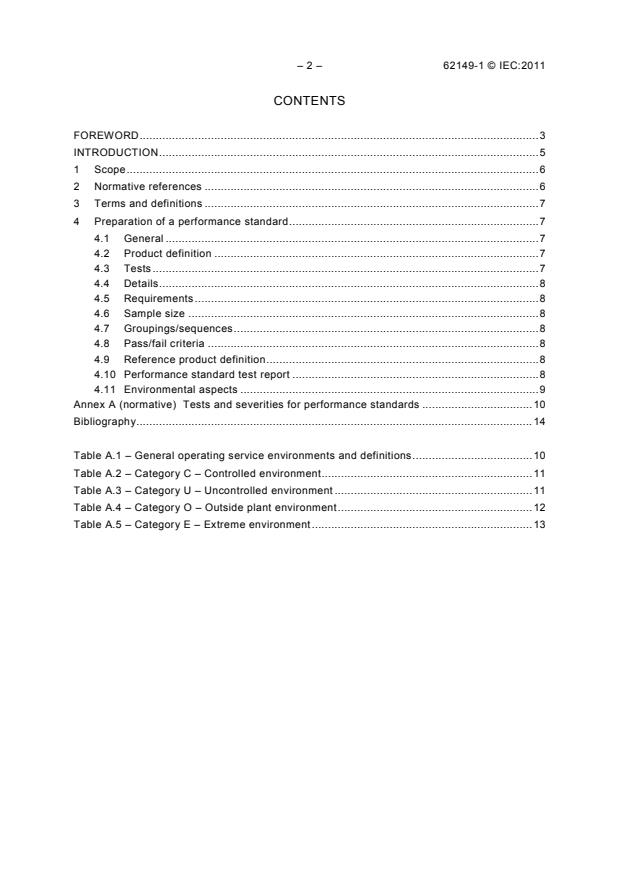
– 2 – 62149-1 © IEC:2011
CONTENTS
FOREWORD . 3
INTRODUCTION . 5
1 Scope . 6
2 Normative references . 6
3 Terms and definitions . 7
4 Preparation of a performance standard . 7
4.1 General . 7
4.2 Product definition . 7
4.3 Tests . 7
4.4 Details . 8
4.5 Requirements . 8
4.6 Sample size . 8
4.7 Groupings/sequences . 8
4.8 Pass/fail criteria . 8
4.9 Reference product definition . 8
4.10 Performance standard test report . 8
4.11 Environmental aspects . 9
Annex A (normative) Tests and severities for performance standards . 10
Bibliography . 14
Table A.1 – General operating service environments and definitions . 10
Table A.2 – Category C – Controlled environment . 11
Table A.3 – Category U – Uncontrolled environment . 11
Table A.4 – Category O – Outside plant environment . 12
Table A.5 – Category E – Extreme environment . 13
62149-1 © IEC:2011 – 3 –
INTERNATIONAL ELECTROTECHNICAL COMMISSION
____________
FIBRE OPTIC ACTIVE COMPONENTS AND DEVICES –
PERFORMANCE STANDARDS –
Part 1: General and guidance
FOREWORD
1) The International Electrotechnical Commission (IEC) is a worldwide organization for standardization comprising
all national electrotechnical committees (IEC National Committees). The object of IEC is to promote
international co-operation on all questions concerning standardization in the electrical and electronic fields. To
this end and in addition to other activities, IEC publishes International Standards, Technical Specifications,
Technical Reports, Publicly Available Specifications (PAS) and Guides (hereafter referred to as “IEC
Publication(s)”). Their preparation is entrusted to technical committees; any IEC National Committee interested
in the subject dealt with may participate in this preparatory work. International, governmental and non-
governmental organizations liaising with the IEC also participate in this preparation. IEC collaborates closely
with the International Organization for Standardization (ISO) in accordance with conditions determined by
agreement between the two organizations.
2) The formal decisions or agreements of IEC on technical matters express, as nearly as possible, an international
consensus of opinion on the relevant subjects since each technical committee has representation from all
interested IEC National Committees.
3) IEC Publications have the form of recommendations for international use and are accepted by IEC National
Committees in that sense. While all reasonable efforts are made to ensure that the technical content of IEC
Publications is accurate, IEC cannot be held responsible for the way in which they are used or for any
misinterpretation by any end user.
4) In order to promote international uniformity, IEC National Committees undertake to apply IEC Publications
transparently to the maximum extent possible in their national and regional publications. Any divergence
between any IEC Publication and the corresponding national or regional publication shall be clearly indicated in
the latter.
5) IEC itself does not provide any attestation of conformity. Independent certification bodies provide conformity
assessment services and, in some areas, access to IEC marks of conformity. IEC is not responsible for any
services carried out by independent certification bodies.
6) All users should ensure that they have the latest edition of this publication.
7) No liability shall attach to IEC or its directors, employees, servants or agents including individual experts and
members of its technical committees and IEC National Committees for any personal injury, property damage or
other damage of any nature whatsoever, whether direct or indirect, or for costs (including legal fees) and
expenses arising out of the publication, use of, or reliance upon, this IEC Publication or any other IEC
Publications.
8) Attention is drawn to the Normative references cited in this publication. Use of the referenced publications is
indispensable for the correct application of this publication.
9) Attention is drawn to the possibility that some of the elements of this IEC Publication may be the subject of
patent rights. IEC shall not be held responsible for identifying any or all such patent rights.
International Standard IEC 62149-1 has been prepared by subcommittee SC 86C: Fibre optic
systems and active devices of IEC technical committee TC 86: Fibre optics.
This second edition cancels and replaces the first edition published in 2004 and its
corrigendum 1 (2004). It is a technical revision. The technical change consists of an update in
Table A.1.
The text of this standard is based on the following documents:
CDV Report on voting
86C/1016/CDV 86C/1037A/RVC
Full information on the voting for the approval of this standard can be found in the report on
voting indicated in the above table.
– 4 – 62149-1 © IEC:2011
This publication has been drafted in accordance with the ISO/IEC Directives, Part 2.
The committee has decided that the contents of this publication will remain unchanged until
the stability date indicated on the IEC web site under "http://webstore.iec.ch" in the data
related to the specific publication. At this date, the publication will be
• reconfirmed,
• withdrawn,
• replaced by a revised edition, or
• amended.
62149-1 © IEC:2011 – 5 –
INTRODUCTION
Performance standards define standard electro-optical performance under a set of prescribed
conditions and contain a series or a set of tests and measurements (which may or may not be
grouped into a specific schedule) with clearly defined conditions, severities and pass/fail
criteria. The tests are intended to be run on as an initial design verification to prove the
product’s ability to satisfy the requirements of a specific application, market sector or user
group.
The subsequent parts of this document contain those sets of performance criteria that have
been standardised for international use. A product that has been shown to meet all the
requirements of a performance standard may be declared as complying with that performance
standard.
Products from one manufacturer that are tested to a performance standard will operate
together within the bounds of the criteria set by the performance standard. There is however
no guarantee that products from different suppliers having the same standard interface, which
have been independently tested to a performance standard, will meet the same levels of
optical performance when mated together as those supplied by one manufacturer.
Compliance with a performance standard demonstrates that a product has in essence passed
a design verification test, it is not a guarantee of lifetime assured performance nor reliability.
Both service life tests and reliability testing must be the subject of a separate test schedule
where the tests and severities selected are such that they are truly representative of the
requirements of these test programmes. Consistency of manufacture should be maintained
using a recognised quality assurance programme while the reliability of the product should be
evaluated using the procedures recommended in IEC 62005 and IEC 61751.
Where possible, tests and measurements should be selected from IEC 61300. Where this is
not possible, the required test method shall be attached as an annex to the performance
standard.
– 6 – 62149-1 © IEC:2011
FIBRE OPTIC ACTIVE COMPONENTS AND DEVICES –
PERFORMANCE STANDARDS –
Part 1: General and guidance
1 Scope
This part of IEC 62149 provides references, definitions and rules for creating active fibre optic
device performance standards, as well as related information pertinent to the subject.
Subsequent parts of IEC 62149 are sequentially numbered and contain performance criteria
for specific applications. Each part will be added as the performance criteria become
standardised for international use.
2 Normative references
The following documents, in whole or in part, are normatively referenced in this document and
are indispensable for its application. For dated references, only the edition cited applies. For
undated references, the latest edition of the referenced document (including any
amendments) applies.
IEC 60068-2-27, Environmental testing – Part 2-27: Tests – Test Ea and guidance: Shock
IEC 61300-2-1, Fibre optic interconnecting devices and passive components – Basic test and
measurement procedures – Part 2-1: Tests – Vibration (sinusoidal)
IEC 61300-2-4, Fibre optic interconnecting devices and passive components – Basic test and
measurement procedures – Part 2-4: Tests – Fibre/cable retention
IEC 61300-2-5, Fibre optic interconnecting devices and passive components – Basic test and
measurement procedures – Part 2-5: Tests – Torsion
IEC 61300-2-9, Fibre optic interconnecting devices and passive components – Basic test and
measurement procedures – Part 2-9: Tests – Shock
IEC 61300-2-17, Fibre optic interconnecting devices and passive components – Basic test
and measurement procedures – Part 2-17: Tests – Cold
IEC 61300-2-18, Fibre optic interconnecting devices and passive components – Basic test
and measurement procedures – Part 2-18: Tests – Dry heat – High temperature endurance
IEC 61300-2-19, Fibre optic interconnecting devices and passive components – Basic test
and measurement procedures – Part 2-19: Tests – Damp heat (steady state)
IEC 61300-2-21, Fibre optic interconnecting devices and passive components – Basic test
and measurement procedures – Part 2-21: Tests – Composite temperature/humidity cyclic test
IEC 61300-2-22, Fibre optic interconnecting devices and passive components – Basic test
and measurement procedures – Part 2-22: Tests – Change of temperature
IEC 61300-2-26, Fibre optic interconnecting devices and passive components – Basic test
and measurement procedures – Part 2-26: Tests – Salt mist
62149-1 © IEC:2011 – 7 –
IEC 61300-2-27, Fibre optic interconnecting devices and passive components – Basic test
and measurement procedures – Part 2-27: Tests – Dust – Laminar flow
IEC 61300-2-28, Fibre optic interconnecting devices and passive components – Basic test
and measurement procedures – Part 2-28: Tests – Industrial atmosphere (sulphur dioxide)
IEC 61300-2-42, Fibre optic interconnecting devices and passive components – Basic test
and measurement procedures – Part 2-42: Tests – Static side load for connectors
IEC 61300-2-44, Fibre optic interconnecting devices and passive components – Basic test
and measurement procedures – Part 2-44: Tests – Flexing of the strain relief of fibre optic
devices
IEC 61300-2-45, Fibre optic interconnecting devices and passive components – Basic test
and measurement procedures – Part 2-45: Tests – Durability test by water immersion
IEC 61300-2-46, Fibre optic interconnecting devices and passive components – Basic test
and measurement procedures – Part 2-46: Tests – Damp heat, cyclic
IEC 61300-2-48, Fibre optic interconnecting devices and passive components – Basic test
and measurement procedures – Part 2-48: Tests – Temperature-humidity cycling
3 Terms and definitions
For the purposes of this document, the following definition applies.
3.1
performance standard test report
report to be produced on completion of testing to a performance standard
4 Preparation of a performance standard
4.1 General
In the preparation of a performance standard, the following items shall be considered and
instructions pertaining to them included.
• Product definition
• Tests
• Details
• Requirements
• Sample size
• Groupings/sequences
• Pass/fail criteria
• Reference product definition
4.2 Product definition
The product to which the performance standard relates shall be clearly defined.
4.3 Tests
The tests to be carried out on the product in order for it to meet the performance standard
shall be clearly defined. No ambiguity or options shall be allowed.
– 8 – 62149-1 © IEC:2011
The tests selected combined with the severities/durations, groupings/sequencing, method
used and pass/fail criteria should be indicative of a defined product location within a service
environment.
The test method to be used shall be clearly defined for each test. Wherever possible the test
method shall be selected from IEC referenced tests; where this is not possible other test
methods may be defined. If a previously undefined test method is used, the test method and
details to be specified shall be included in an annex of the performance standard.
4.4 Details
Severities, durations and the details to be considered, shall be given for all tests and
measurements presented in a performance standard. These should be directly related to the
requirements specified for a product location within a service environment to which the
performance standard is intended to correspond. No ambiguity or options shall be allowed.
4.5 Requirements
The performance requirements that must be satisfied in order for the product to comply with
the standard shall be specified for each test and/or measurement. No ambiguities shall be
allowed.
4.6 Sample size
The sample size for each test shall be defined in an annex of the performance standard. No
deviations shall be allowed.
4.7 Groupings/sequences
Test groups and test sequences shall be defined in an annex as required by the user, user
group or manufacturer. The number of samples for each test group shall also be defined in
the annex. Where prohibitive cost is associated with the active devices, numbers of samples
may be reduced.
4.8 Pass/fail criteria
The pass/fail criteria shall be unambiguously stated for each test within the performance
standard. No deviation or exceptions shall be allowed.
4.9 Reference product definition
Where a reference product is called for in any of the test and measurement methods used
within a performance standard, the reference product shall be clearly defined in an annex of
the performance standard.
4.10 Performance standard test report
Conformance to a performance standard shall be supported by a test report. The test report
may be prepared by an independent test laboratory. The test report shall clearly demonstrate
that the tests were carried out as per the requirements of the performance standard and
provide full details of the tests, together with a pass/fail declaration.
Any product failing a particular test or sequence of tests shall be reported in the performance
standard test report. The cause of the failure shall be given and any corrective action taken
shall be described.
If no design changes are made to the product, the test or test sequence where the failure
occurred shall be rerun with the results of both the tests reported.
62149-1 © IEC:2011 – 9 –
Any design changes shall be identified in the performance standard test report. The full set of
performance tests must be rerun and the results reported in this case.
4.11 Environmental aspects
The requirements concerning the reduction of adverse environmental impacts over the whole
life cycle of products are not subject to this specification. The environmental aspects as
appropriate shall be implemented according to the guidelines given in IEC Guide 109.
– 10 – 62149-1 © IEC:2011
Annex A
(normative)
Tests and severities for performance standards
This annex contains the preferred tests and recommended severities associated with these
tests for typical system locations in which active fibre optic components may be installed (see
Tables A.2 to A.5).
Where tests have been grouped it is intended that the tests be run as a group, in the order
indicated, to simulate a particular aspect of the conditions to which the product may be
submitted.
The general system location for which performance standard schedules are provided is given
in Table A.1.
Table A.1 – General operating service environments and definitions
Category Environment Temperature range Water/Humidity Typical location
°C
C Controlled − 10 to + 60 5 % to 93 % Typically within an office, equipment room,
telecommunication centre or building. Not
subjected to condensed water
U Semi-controlled − 25 to + 70 0 % to 95 % Typically outdoors but enclosed or covered.
Locations: shacks, lofts, telephone booths,
street cabinets. Subject to condensed water
and limited wind driven precipitation. In close
proximity to sand or dust.
O Outside plant 0 % to 95 % Typically outdoors but enclosed or
− 40 to + 75
covered. Locations: garages, cellars,
entrances of buildings and unattended
equipment stations. Subject to
condensed water.
E Extreme − 40 to + 85 0 % to 95 % Typically outdoors, not enclosed.
Locations: direct exposed to open air
climate. Subject to industrial sources of
chemical emission.
Table A.1 indicates the ambient temperature ranges for optical network equipment under
various environmental categories and does not indicate the operating temperature ranges for
active optical components. The operating temperature range for each active component shall
be specified by its case temperature, unless otherwise stated, and defined in each
performance standard document in order that the component operates under the specific
environmental category described in Table A.1. The system designer should design the heat
flow of the equipment to maintain the case temperature of the installed active components
within their specifications. The performance tests for each active component should be carried
out within the specified case temperature range.
62149-1 © IEC:2011 – 11 –
Table A.2 – Category C – Controlled environment
Test Severity
Cold
–10 °C ± 2 °C
IEC 61300-2-17
96 h duration
High temperature endurance +60 °C ± 2 °C
IEC 61300-2-18 96 h duration
Damp heat
+40 °C ± 2 °C
Steady state
(93 ± 2) % RH
IEC 61300-2-19
96 h duration
Vibration (sinusoidal) 10 Hz to 55 Hz
IEC 61300-2-1 15 sweeps (10 Hz – 55 Hz – 10 Hz) 1 octave/minute
3 axes
0,75 mm amplitude
Change of temperature
–10 °C ± 2 °C to +60 °C ± 2 °C
IEC 61300-2-22
60 min duration at extremes
1 °C/min rate of change
5 cycles
Table A.3 – Category U – Uncontrolled environment
Test Severity
Vibration (sinusoidal) 10 Hz to 55 Hz
IEC 61300-2-1 15 sweeps (10 Hz – 55 Hz – 10 Hz)
1 octave/minute
3 axes
0,75 mm amplitude
Cold
– 25 °C ± 2 °C
IEC 61300-2-17 96 h duration
High temperature endurance
+ 70 °C ± 2 °C
IEC 61300-2-18
96 h duration
Damp heat + 40 °C ± 2 °C
Steady state
(93 ± 2) % RH
IEC 61300-2-19
96 h duration
Change of temperature
– 25 °C ± 2 °C to + 70 °C ± 2 °C
IEC 61300-2-22 60 min duration at extreme
Test Nb 1 °C/min rate of change
12 cycles
Dust
Particle size d < 150 µm
IEC 61300-2-27 Dust type talc
+ 35 °C RH, 60 % RH, 10 min duration
Damp heat (cyclic) + 25 °C ± 2 °C to + 55 °C ± 2 °C, RH > 95 %
(See IEC 61300-2-46) [Variant 1]
96 h duration
– 12 – 62149-1 © IEC:2011
Table A.4 – Category O – Outside plant environment
Test Severity
Damp heat (steady state) + 75 °C ± 2 °C
IEC 61300-2-19
90 ± 5 % RH
168 hours
Vibration (sinusoidal) 10 – 55 Hz
IEC 61300-2-1 2 hours per axis
1 octave/minute
3 axes
1,52 mm amplitude
Change of temperature
– 40 °C ± 2 °C to + 75 °C ± 2 °C
IEC 61300-2-22 1 hour duration at extremes
Test Nb
≥ 1 °C /min rate of change
10 cycles
Dwell at + 23 °C allowed between temperature
extremes
Temperature-humidity cycling – 40 °C ± 2 °C to + 85 °C ± 2 °C
IEC 61300-2-48, method A 85 ± 5 % RH at the maximum temperature
(Need to add method B to 1 hour minimum duration at extremes
accommodate GR-326
≥ 1 °C/min rate of change
method)
42 cycles
Optical fibre cable flexing 5 N for reinforced cable
IEC 61300-2-44 30 cycles ± 90 °
Torsion/twist 5 N at 0,1 N/s for reinforced cables
IEC 61300-2-5 10 cycles ± 180 °
Static side load 5 N for 5 s for reinforced cable
IEC 61300-2-42 2,3 N for 5 s for buffered fibres
Two mutually perpendicular directions
Fibre/cable retention
10 ± 1 N at 0,5 N/s for reinforced cables
IEC 61300-2-4
5 ± 0,5 N at 0,5 N/s for buffered fibres
120 s duration at 10 N
60 s duration at 5 N
Shock 500 g , 3 axes in 2 directions,
n
For passive components 2 shocks per axis, 12 shocks total.
IEC 61300-2-9 Nominal 1 ms duration, half sine pulse
Shock Mass (kg) Drop height (mm)
For modules
0 to < 10 100
0 to < 25 75
(Free drop, IEC 60068-2-27)
62149-1 © IEC:2011 – 13 –
Table A.5 – Category E – Extreme environment
Test Severity
Vibration (sinusoidal) 10 Hz to 55 Hz
IEC 61300-2-1 15 sweeps (10 Hz – 55 Hz – 10 Hz) 1 octave/minute
3 axes
0,75 mm amplitude
Cold – 40 °C ± 2 °C
IEC 61300-2-17 96 h duration
High temperature endurance
+ 85 °C ± 2 °C
IEC 61300-2-18 96 h duration
Damp heat
+ 40 °C ± 2 °C
Steady state
(93 ± 3) % RH
IEC 61300-2-19
96 h duration
Change of temperature – 40 °C ± 2 °C to + 85 °C ± 2 °C
IEC 61300-2-22 1 h duration at extremes
1 °C/min rate of change
Test Nb
12 cycles
Dust Particle size d < 150 µm
IEC 61300-2-27
Dust type talc
+ 35 °C, RH 60 %, 10 min duration
Composite temperature humidity Z/AD profile with exposure to cold – 10 °C ± 2 °C to
cyclic test
...