

IEC 62149-1:2004
(Main)Fibre optic active components and devices - Performance standards - Part 1: General and guidance
- Abstract
Provides references, definations and rules for creating active fibre optic device performance standards, as well as related information pertinent to the subject. Subsequent parts of IEC 62149 are sequentially numbered and contain performance criteria for specific applications. Each part will be added as the performance criteria become standardised for international use. The contents of the corrigendum of April 2004 have been included in this copy.
- Status
- Published
- Publication Date
- 08-Jan-2004
- Technical Committee
- SC 86C - Fibre optic systems, sensing and active devices
- Drafting Committee
- WG 4 - Fibre optic active devices including optoelectronic devices
- Current Stage
- DELPUB - Deleted publication - 99 Deleted
- Start Date
- 07-Dec-2011
Overview
IEC 62149-1:2004 is the foundational part of the IEC 62149 series, titled Fibre optic active components and devices - Performance standards - Part 1: General and guidance. Developed by the International Electrotechnical Commission (IEC), this standard establishes general references, definitions, and procedural rules essential for developing performance standards specific to active fibre optic devices. It is designed to offer clear and practical guidelines for preparing, applying, and interpreting performance criteria in international contexts, supporting the advancement and harmonization of fibre optic technology standards globally.
Key Topics
- Performance Standard Structure: Provides guidance on essential components such as product definitions, required tests, test details, performance requirements, sample sizes, test groupings/sequences, pass/fail criteria, and reference product definitions.
- Standard Development Process: Outlines the methodology for establishing standardized performance tests that ensure products' suitability for defined environments and applications.
- Clarity and Consistency: Emphasizes elimination of ambiguity in test methods, requirements, and acceptance criteria to support consistent evaluation and interoperability.
- Reference to Other Standards: Specifies the use of internationally recognized IEC test procedures whenever possible, or requiring detailed annexes for any new test methods.
- Performance Validation: Explains the purpose of performance tests as initial design verification to validate products for targeted applications or market sectors.
- Service Environments: Introduces the classification of operating environments (such as controlled, uncontrolled, outside plant, and extreme environments) for appropriate product assessment.
Applications
IEC 62149-1:2004 serves as a critical reference for:
- Manufacturers of Fibre Optic Active Components: Assisting in the development, validation, and declaration of product performance based on internationally harmonized criteria.
- Standard Developers and Committees: Guiding the creation of detailed performance standards for various active device families, such as transceivers, modulators, and laser sources used in fibre optic communications.
- Product Testing Laboratories: Providing a systematic approach to design, conduct, and report tests for compliance with defined performance standards, ensuring products meet the needs of global markets.
- System Integrators and Network Providers: Supporting selection and qualification of components expected to operate reliably within designated service environments, contributing to robust fibre optic network infrastructure.
- Quality Assurance Programs: Recommending the maintenance of consistency in production through recognized quality systems, and the use of established reliability assessment practices.
Related Standards
The general guidance of IEC 62149-1:2004 is complemented by other standards in the IEC 62149 series, each dealing with specific performance criteria for distinct device categories. Additionally, the standard references important supporting documents for testing and reliability evaluation:
- IEC 60068 Series: Environmental testing methods (e.g., shock, free fall)
- IEC 61300 Series: Basic test and measurement procedures for fibre optic components (e.g., vibration, temperature cycling, humidity, salt mist)
- IEC 62005: Reliability qualification of fibre optic components
- IEC 61751: Procedures for assessing reliability in fibre optic systems
Subsequent parts of IEC 62149 (e.g., Parts 2-6) provide specific requirements for products such as vertical cavity surface emitting laser devices, transceivers for Gigabit Ethernet, and plastic optical fibre modules.
Adhering to IEC 62149-1:2004 ensures a unified, transparent, and effective approach for the standardization and evaluation of fibre optic active devices, benefiting manufacturers, regulators, and end-users across the communications industry. For organizations involved in fibre optic component development or procurement, following this standard is critical for achieving high compatibility, reliability, and international market acceptance.
Relations
- Effective Date
- 05-Sep-2023
- Effective Date
- 05-Sep-2023
Get Certified
Connect with accredited certification bodies for this standard

ANCE
Mexican certification and testing association.

Intertek Slovenia
Intertek testing, inspection, and certification services in Slovenia.

LNE (Laboratoire National de Métrologie et d'Essais)
French national laboratory for metrology and testing.
Sponsored listings
Frequently Asked Questions
IEC 62149-1:2004 is a standard published by the International Electrotechnical Commission (IEC). Its full title is "Fibre optic active components and devices - Performance standards - Part 1: General and guidance". This standard covers: Provides references, definations and rules for creating active fibre optic device performance standards, as well as related information pertinent to the subject. Subsequent parts of IEC 62149 are sequentially numbered and contain performance criteria for specific applications. Each part will be added as the performance criteria become standardised for international use. The contents of the corrigendum of April 2004 have been included in this copy.
Provides references, definations and rules for creating active fibre optic device performance standards, as well as related information pertinent to the subject. Subsequent parts of IEC 62149 are sequentially numbered and contain performance criteria for specific applications. Each part will be added as the performance criteria become standardised for international use. The contents of the corrigendum of April 2004 have been included in this copy.
IEC 62149-1:2004 is classified under the following ICS (International Classification for Standards) categories: 33.180.20 - Fibre optic interconnecting devices. The ICS classification helps identify the subject area and facilitates finding related standards.
IEC 62149-1:2004 has the following relationships with other standards: It is inter standard links to IEC 62149-1:2004/COR1:2004, IEC 62149-1:2011. Understanding these relationships helps ensure you are using the most current and applicable version of the standard.
IEC 62149-1:2004 is available in PDF format for immediate download after purchase. The document can be added to your cart and obtained through the secure checkout process. Digital delivery ensures instant access to the complete standard document.
Standards Content (Sample)
NORME CEI
INTERNATIONALE
IEC
62149-1
INTERNATIONAL
Première édition
STANDARD
First edition
2004-01
Composants et dispositifs actifs
à fibres optiques –
Normes de fonctionnement –
Partie 1:
Généralités et guide
Fibre optic active components and devices –
Performance standards –
Part 1:
General and guidance
Numéro de référence
Reference number
CEI/IEC 62149-1:2004
Numérotation des publications Publication numbering
Depuis le 1er janvier 1997, les publications de la CEI As from 1 January 1997 all IEC publications are
sont numérotées à partir de 60000. Ainsi, la CEI 34-1 issued with a designation in the 60000 series. For
devient la CEI 60034-1. example, IEC 34-1 is now referred to as IEC 60034-1.
Editions consolidées Consolidated editions
Les versions consolidées de certaines publications de la The IEC is now publishing consolidated versions of its
CEI incorporant les amendements sont disponibles. Par publications. For example, edition numbers 1.0, 1.1
exemple, les numéros d’édition 1.0, 1.1 et 1.2 indiquent and 1.2 refer, respectively, to the base publication,
respectivement la publication de base, la publication de the base publication incorporating amendment 1 and
base incorporant l’amendement 1, et la publication de the base publication incorporating amendments 1
base incorporant les amendements 1 et 2. and 2.
Informations supplémentaires Further information on IEC publications
sur les publications de la CEI
Le contenu technique des publications de la CEI est The technical content of IEC publications is kept
constamment revu par la CEI afin qu'il reflète l'état under constant review by the IEC, thus ensuring that
actuel de la technique. Des renseignements relatifs à the content reflects current technology. Information
cette publication, y compris sa validité, sont dispo- relating to this publication, including its validity, is
nibles dans le Catalogue des publications de la CEI available in the IEC Catalogue of publications
(voir ci-dessous) en plus des nouvelles éditions, (see below) in addition to new editions, amendments
amendements et corrigenda. Des informations sur les and corrigenda. Information on the subjects under
sujets à l’étude et l’avancement des travaux entrepris consideration and work in progress undertaken by the
par le comité d’études qui a élaboré cette publication, technical committee which has prepared this
ainsi que la liste des publications parues, sont publication, as well as the list of publications issued,
également disponibles par l’intermédiaire de: is also available from the following:
• Site web de la CEI (www.iec.ch) • IEC Web Site (www.iec.ch)
• Catalogue des publications de la CEI • Catalogue of IEC publications
Le catalogue en ligne sur le site web de la CEI The on-line catalogue on the IEC web site
(www.iec.ch/searchpub) vous permet de faire des (www.iec.ch/searchpub) enables you to search by a
recherches en utilisant de nombreux critères, variety of criteria including text searches,
comprenant des recherches textuelles, par comité technical committees and date of publication. On-
d’études ou date de publication. Des informations en line information is also available on recently
ligne sont également disponibles sur les nouvelles issued publications, withdrawn and replaced
publications, les publications remplacées ou retirées, publications, as well as corrigenda.
ainsi que sur les corrigenda.
• IEC Just Published • IEC Just Published
Ce résumé des dernières publications parues This summary of recently issued publications
(www.iec.ch/online_news/justpub) est aussi dispo- (www.iec.ch/online_news/justpub) is also available
nible par courrier électronique. Veuillez prendre by email. Please contact the Customer Service
contact avec le Service client (voir ci-dessous) Centre (see below) for further information.
pour plus d’informations.
• Service clients • Customer Service Centre
Si vous avez des questions au sujet de cette If you have any questions regarding this
publication ou avez besoin de renseignements publication or need further assistance, please
supplémentaires, prenez contact avec le Service contact the Customer Service Centre:
clients:
Email: custserv@iec.ch Email: custserv@iec.ch
Tél: +41 22 919 02 11 Tel: +41 22 919 02 11
Fax: +41 22 919 03 00 Fax: +41 22 919 03 00
.
NORME CEI
INTERNATIONALE
IEC
62149-1
INTERNATIONAL
Première édition
STANDARD
First edition
2004-01
Composants et dispositifs actifs
à fibres optiques –
Normes de fonctionnement –
Partie 1:
Généralités et guide
Fibre optic active components and devices –
Performance standards –
Part 1:
General and guidance
IEC 2004 Droits de reproduction réservés Copyright - all rights reserved
Aucune partie de cette publication ne peut être reproduite ni No part of this publication may be reproduced or utilized in any
utilisée sous quelque forme que ce soit et par aucun procédé, form or by any means, electronic or mechanical, including
électronique ou mécanique, y compris la photocopie et les photocopying and microfilm, without permission in writing from
microfilms, sans l'accord écrit de l'éditeur. the publisher.
International Electrotechnical Commission, 3, rue de Varembé, PO Box 131, CH-1211 Geneva 20, Switzerland
Telephone: +41 22 919 02 11 Telefax: +41 22 919 03 00 E-mail: inmail@iec.ch Web: www.iec.ch
CODE PRIX
M
PRICE CODE
Commission Electrotechnique Internationale
International Electrotechnical Commission
МеждународнаяЭлектротехническаяКомиссия
Pour prix, voir catalogue en vigueur
For price, see current catalogue
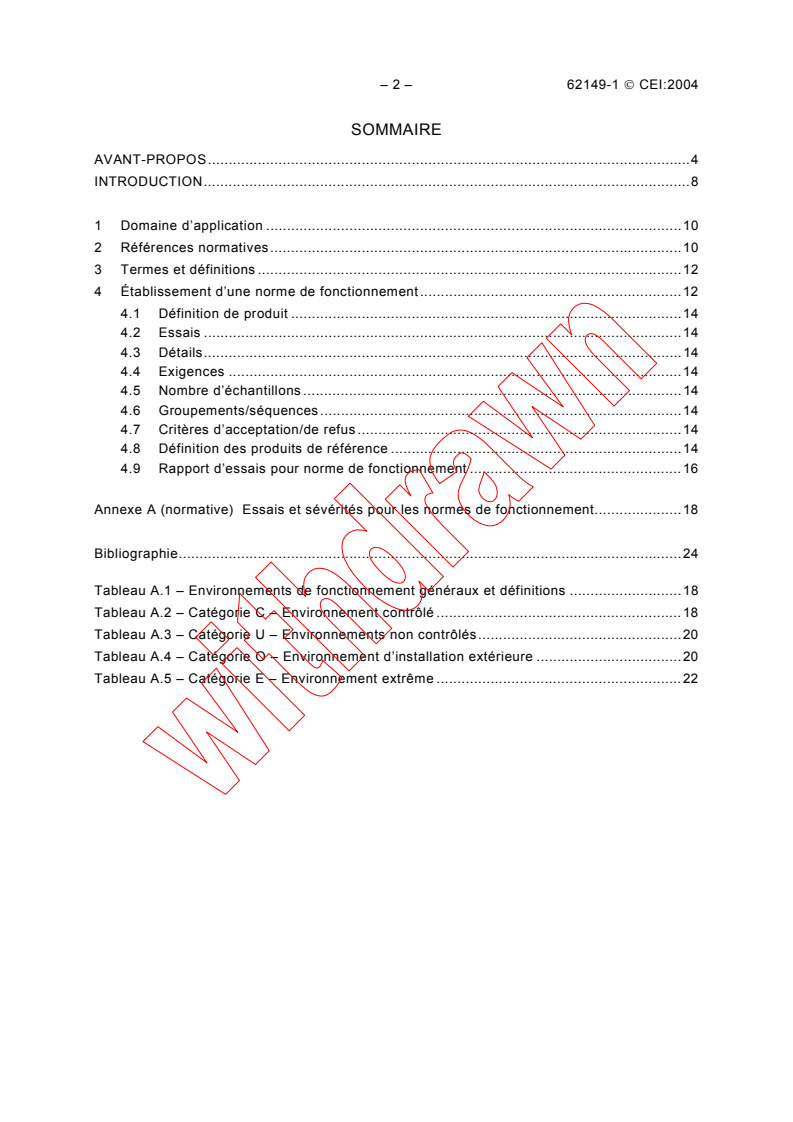
– 2 – 62149-1 CEI:2004
SOMMAIRE
AVANT-PROPOS.4
INTRODUCTION.8
1 Domaine d’application.10
2 Références normatives.10
3 Termes et définitions .12
4 Établissement d’une norme de fonctionnement.12
4.1 Définition de produit .14
4.2 Essais.14
4.3 Détails.14
4.4 Exigences.14
4.5 Nombre d’échantillons.14
4.6 Groupements/séquences.14
4.7 Critères d’acceptation/de refus.14
4.8 Définition des produits de référence .14
4.9 Rapport d’essais pour norme de fonctionnement .16
Annexe A (normative) Essais et sévérités pour les normes de fonctionnement.18
Bibliographie.24
Tableau A.1 – Environnements de fonctionnement généraux et définitions .18
Tableau A.2 – Catégorie C – Environnement contrôlé .18
Tableau A.3 – Catégorie U – Environnements non contrôlés.20
Tableau A.4 – Catégorie O – Environnement d’installation extérieure .20
Tableau A.5 – Catégorie E – Environnement extrême .22
62149-1 IEC:2004 – 3 –
CONTENTS
FOREWORD.5
INTRODUCTION.9
1 Scope.11
2 Normative references.11
3 Terms and definitions .13
4 Preparation of a performance standard.13
4.1 Product definition.15
4.2 Tests.15
4.3 Details.15
4.4 Requirements.15
4.5 Sample size.15
4.6 Groupings/sequences.15
4.7 Pass/fail criteria.15
4.8 Reference product definition.15
4.9 Performance standard test report .17
Annex A (normative) Tests and severities for performance standards .19
Bibliography.25
Table A.1 – General operating service environments and definitions.19
Table A.2 – Category C – Controlled environment.19
Table A.3 – Category U – Uncontrolled environment .21
Table A.4 – Category O – Outside plant environment.21
Table A.5 – Category E – Extreme environment.23
– 4 – 62149-1 CEI:2004
COMMISSION ÉLECTROTECHNIQUE INTERNATIONALE
____________
COMPOSANTS ET DISPOSITIFS ACTIFS À FIBRES OPTIQUES –
NORMES DE FONCTIONNEMENT –
Partie 1: Généralités et guide
AVANT-PROPOS
1) La Commission Electrotechnique Internationale (CEI) est une organisation mondiale de normalisation
composée de l'ensemble des comités électrotechniques nationaux (Comités nationaux de la CEI). La CEI a
pour objet de favoriser la coopération internationale pour toutes les questions de normalisation dans les
domaines de l'électricité et de l'électronique. A cet effet, la CEI – entre autres activités – publie des Normes
internationales, des Spécifications techniques, des Rapports techniques, des Spécifications accessibles au
public (PAS) et des Guides (ci-après dénommés "Publication(s) de la CEI"). Leur élaboration est confiée à des
comités d'études, aux travaux desquels tout Comité national intéressé par le sujet traité peut participer. Les
organisations internationales, gouvernementales et non gouvernementales, en liaison avec la CEI, participent
également aux travaux. La CEI collabore étroitement avec l'Organisation Internationale de Normalisation (ISO),
selon des conditions fixées par accord entre les deux organisations.
2) Les décisions ou accords officiels de la CEI concernant les questions techniques représentent, dans la mesure
du possible, un accord international sur les sujets étudiés, étant donné que les Comités nationaux de la CEI
intéressés sont représentés dans chaque comité d’études.
3) Les Publications de la CEI se présentent sous la forme de recommandations internationales et sont agréées
comme telles par les Comités nationaux de la CEI. Tous les efforts raisonnables sont entrepris afin que la CEI
s'assure de l'exactitude du contenu technique de ses publications; la CEI ne peut pas être tenue responsable
de l'éventuelle mauvaise utilisation ou interprétation qui en est faite par un quelconque utilisateur final.
4) Dans le but d'encourager l'uniformité internationale, les Comités nationaux de la CEI s'engagent, dans toute la
mesure possible, à appliquer de façon transparente les Publications de la CEI dans leurs publications
nationales et régionales. Toutes divergences entre toutes Publications de la CEI et toutes publications
nationales ou régionales correspondantes doivent être indiquées en termes clairs dans ces dernières.
5) La CEI n’a prévu aucune procédure de marquage valant indication d’approbation et n'engage pas sa
responsabilité pour les équipements déclarés conformes à une de ses Publications.
6) Tous les utilisateurs doivent s'assurer qu'ils sont en possession de la dernière édition de cette publication.
7) Aucune responsabilité ne doit être imputée à la CEI, à ses administrateurs, employés, auxiliaires ou
mandataires, y compris ses experts particuliers et les membres de ses comités d'études et des Comités
nationaux de la CEI, pour tout préjudice causé en cas de dommages corporels et matériels, ou de tout autre
dommage de quelque nature que ce soit, directe ou indirecte, ou pour supporter les coûts (y compris les frais
de justice) et les dépenses découlant de la publication ou de l'utilisation de cette Publication de la CEI ou de
toute autre Publication de la CEI, ou au crédit qui lui est accordé.
8) L'attention est attirée sur les références normatives citées dans cette publication. L'utilisation de publications
référencées est obligatoire pour une application correcte de la présente publication.
9) L’attention est attirée sur le fait que certains des éléments de la présente Publication de la CEI peuvent faire
l’objet de droits de propriété intellectuelle ou de droits analogues. La CEI ne saurait être tenue pour
responsable de ne pas avoir identifié de tels droits de propriété et de ne pas avoir signalé leur existence.
La Norme internationale CEI 62149-1 a été établie par le sous-comité 86C: Systèmes et
dispositifs actifs à fibres optiques, du comité d'études 86 de la CEI: Fibres optiques.
Le texte de la présente norme est issu des documents suivants:
FDIS Rapport de vote
86C/567/FDIS 86C/580/RVD
Le rapport de vote indiqué dans le tableau ci-dessus donne toute information sur le vote ayant
abouti à l'approbation de cette norme.
Cette publication a été rédigée selon les Directives ISO/CEI, Partie 2.
62149-1 IEC:2004 – 5 –
INTERNATIONAL ELECTROTECHNICAL COMMISSION
____________
FIBRE OPTIC ACTIVE COMPONENTS AND DEVICES –
PERFORMANCE STANDARDS –
Part 1: General and guidance
FOREWORD
1) The International Electrotechnical Commission (IEC) is a worldwide organization for standardization comprising
all national electrotechnical committees (IEC National Committees). The object of IEC is to promote
international co-operation on all questions concerning standardization in the electrical and electronic fields. To
this end and in addition to other activities, IEC publishes International Standards, Technical Specifications,
Technical Reports, Publicly Available Specifications (PAS) and Guides (hereafter referred to as “IEC
Publication(s)”). Their preparation is entrusted to technical committees; any IEC National Committee interested
in the subject dealt with may participate in this preparatory work. International, governmental and non-
governmental organizations liaising with the IEC also participate in this preparation. IEC collaborates closely
with the International Organization for Standardization (ISO) in accordance with conditions determined by
agreement between the two organizations.
2) The formal decisions or agreements of IEC on technical matters express, as nearly as possible, an international
consensus of opinion on the relevant subjects since each technical committee has representation from all
interested IEC National Committees.
3) IEC Publications have the form of recommendations for international use and are accepted by IEC National
Committees in that sense. While all reasonable efforts are made to ensure that the technical content of IEC
Publications is accurate, IEC cannot be held responsible for the way in which they are used or for any
misinterpretation by any end user.
4) In order to promote international uniformity, IEC National Committees undertake to apply IEC Publications
transparently to the maximum extent possible in their national and regional publications. Any divergence
between any IEC Publication and the corresponding national or regional publication shall be clearly indicated in
the latter.
5) IEC provides no marking procedure to indicate its approval and cannot be rendered responsible for any
equipment declared to be in conformity with an IEC Publication.
6) All users should ensure that they have the latest edition of this publication.
7) No liability shall attach to IEC or its directors, employees, servants or agents including individual experts and
members of its technical committees and IEC National Committees for any personal injury, property damage or
other damage of any nature whatsoever, whether direct or indirect, or for costs (including legal fees) and
expenses arising out of the publication, use of, or reliance upon, this IEC Publication or any other IEC
Publications.
8) Attention is drawn to the Normative references cited in this publication. Use of the referenced publications is
indispensable for the correct application of this publication.
9) Attention is drawn to the possibility that some of the elements of this IEC Publication may be the subject of
patent rights. IEC shall not be held responsible for identifying any or all such patent rights.
International Standard IEC 62149-1 has been prepared by subcommittee 86C: Fibre optic
systems and active devices, of IEC technical committee 86: Fibre optics.
The text of this standard is based on the following documents:
FDIS Report on voting
86C/567/FDIS 86C/580/RVD
Full information on the voting for the approval of this standard can be found in the report on
voting indicated in the above table.
This publication has been drafted in accordance with the ISO/IEC Directives, Part 2.
– 6 – 62149-1 CEI:2004
La présente norme constitue la Partie 1 de la CEI 62149, publiée sous le titre général
Composants et dispositifs actifs à fibres optiques – Normes de fonctionnement. Cette série se
compose de la Partie 1, consacrée aux prescriptions générales, et d’un certain nombre de
parties spécifiques à diverses familles d’émetteurs-récepteurs.
Partie 1: Généralités et lignes directrices
Partie 2: Dispositifs laser de surface émissive avec cavité verticale discrète
Partie 3: Emetteurs-récepteurs de diodes laser avec modulateur intégré de 2,5 Gbit/s
Partie 4: Emetteurs-récepteurs à fibres optiques de 1 300 nm pour application Gigabit Ethernet
Partie 5: Emetteurs-récepteurs ATM-PON avec programme de gestion LD et CDR Ics
Partie 6: Emetteurs-récepteurs de 650 nm 250 Mbit/s à fibres optiques en plastique
Le comité a décidé que le contenu de cette publication ne sera pas modifié avant 2010.
A cette date, la publication sera
• reconduite;
• supprimée;
• remplacée par une édition révisée, ou
• amendée.
Le contenu du corrigendum d'avril 2004 a été pris en considération dans cet exemplaire.
62149-1 IEC:2004 – 7 –
This standard constitutes Part 1 of the IEC 62149 series, published under the general title
Fibre optic active components and devices – Performance standards. This series consists of
Part 1, devoted to general requirements, and various additional parts, specific to individual
module families.
Part 1: General and guidance
Part 2: Discrete vertical cavity surface emitting laser devices
Part 3: 2,5 Gbit/s modulator-integrated laser diode transmitters
Part 4: 1300-nm transceivers for Gigabit Ethernet application
Part 5: ATM-PON transceivers with LD driver circuits and CDR ICs
Part 6: 650-nm 250-Mbit/s plastic optical fibre transceivers
The committee has decided that the contents of this publication will remain unchanged until
2010. At this date, the publication will be
• reconfirmed;
• withdrawn;
• replaced by a revised edition, or
• amended.
The contents of the corrigendum of April 2004 have been included in this copy.
– 8 – 62149-1 CEI:2004
INTRODUCTION
Les normes de fonctionnement définissent le fonctionnement électro-optique normalisé sous
un ensemble de conditions prescrites et contiennent une série ou un jeu d’essais et de
mesures (qui peut ou non être groupé dans un programme spécifique) aux conditions,
sévérités et critères d’acceptation/de refus clairement définis. Les essais sont destinés à être
effectués à titre de vérification initiale de conception, pour prouver la capacité des produits à
satisfaire aux exigences d’une application spécifique, d'un secteur du marché ou d'un groupe
d'utilisateurs.
Les autres parties qui constituent la présente norme contiennent les ensembles de critères de
fonctionnement qui ont été normalisés en vue d’une utilisation au niveau international. Un
produit qui s’est avéré remplir toutes les prescriptions d’une norme de fonctionnement peut
être déclaré conforme à ladite norme de fonctionnement.
Les produits d’un fabricant qui sont soumis aux essais selon une norme de fonctionnement
fonctionneront ensemble dans la limite des critères établis par la norme de fonctionnement.
Cependant, il n’existe aucune garantie que des produits ayant la même interface normalisée,
qui ont été essayés de façon indépendante selon une norme de fonctionnement, mais qui
proviennent de différents fournisseurs, répondent aux même niveaux de fonctionnement
optique, lorsqu’ils sont accouplés ensemble.
La conformité à une norme de fonctionnement démontre qu’un produit a essentiellement
réussi un essai de vérification de conception, elle ne constitue ni une garantie de fiabilité, ni
une garantie de fonctionnement assuré pour toute la durée de vie du produit. Il est nécessaire
que tant les essais de durée de vie que les essais de fiabilité fassent l’objet d’un programme
d’essais séparé où les essais et les sévérités sélectionnés soient tels qu’ils soient vraiment
représentatifs des prescriptions de ces programmes d’essais. Il convient que la cohérence de
fabrication soit maintenue en utilisant un programme d’assurance de la qualité reconnu tandis
qu’il convient que la fiabilité du produit soit évaluée en utilisant les procédures recom-
mandées dans la CEI 62005 et la CEI 61751.
Lorsque c’est possible, il convient que les essais et mesures soient sélectionnés dans la
CEI 61300. Lorsque ce n’est pas possible, la méthode d’essai exigée sera jointe en annexe à
la norme de fonctionnement.
62149-1 IEC:2004 – 9 –
INTRODUCTION
Performance standards define standard electro-optical performance under a set of prescribed
conditions and contain a series or a set of tests and measurements (which may or may not be
grouped into a specific schedule) with clearly defined conditions, severities and pass/fail
criteria. The tests are intended to be run on as an initial design verification to prove the
product’s ability to satisfy the requirements of a specific application, market sector or user
group.
The subsequent parts of this document contain those sets of performance criteria that have
been standardised for international use. A product that has been shown to meet all the
requirements of a performance standard may be declared as complying with that performance
standard.
Products from one manufacturer that are tested to a performance standard will operate
together within the bounds of the criteria set by the performance standard. There is however
no guarantee that products from different suppliers having the same standard interface, which
have been independently tested to a performance standard, will meet the same levels of
optical performance when mated together as those supplied by one manufacturer.
Compliance with a performance standard demonstrates that a product has in essence passed
a design verification test, it is not a guarantee of lifetime assured performance nor reliability.
Both service life tests and reliability testing must be the subject of a separate test schedule
where the tests and severities selected are such that they are truly representative of the
requirements of these test programmes. Consistency of manufacture should be maintained
using a recognised quality assurance programme while the reliability of the product should be
evaluated using the procedures recommended in IEC 62005 and IEC 61751.
Where possible tests and measurements should be selected from IEC 61300. Where this is
not possible, the required test method shall be attached as an annex to the performance
standard.
– 10 – 62149-1 CEI:2004
COMPOSANTS ET DISPOSITIFS ACTIFS À FIBRES OPTIQUES –
NORMES DE FONCTIONNEMENT –
Partie 1: Généralités et guide
1 Domaine d’application
La présente partie de la CEI 62149 fournit des références, des définitions et des règles pour
l’élaboration de normes de fonctionnement applicables aux dispositifs actifs à fibres optiques,
ainsi que des informations utiles sur ce sujet.
Les autres parties qui composent la CEI 62149 sont numérotées de manière séquentielle et
contiennent des critères de fonctionnement relatifs à des applications spécifiques. De
nouvelles parties seront ajoutées à mesure que les critères de fonctionnement seront
normalisés en vue de leur application internationale.
2 Références normatives
Les documents de référence suivants sont indispensables pour l'application du présent
document. Pour les références datées, seule l'édition citée s'applique. Pour les références
non datées, la dernière édition du document de référence s'applique (y compris les éventuels
amendements).
CEI 60068-2-27, Essais fondamentaux climatiques et de robustesse mécanique – Partie 2:
Essais – Essai Ea et guide: Chocs
CEI 60068-2-32, Essais fondamentaux climatiques et de robustesse mécanique – Partie 2:
Essais – Essai Ed: Chute libre
CEI 61300-2-1, Dispositifs d'interconnexion et composants passifs à fibres optiques –
Méthodes fondamentales d'essais et de mesures – Partie 2-1: Essais – Vibrations
(sinusoïdales)
CEI 61300-2-4, Dispositifs d'interconnexion et composants passifs à fibres optiques –
Méthodes fondamentales d'essais et de mesures – Partie 2-4: Essais – Rétention de la fibre
ou du câble
CEI 61300-2-5, Dispositifs d'interconnexion et composants passifs à fibres optiques –
Méthodes fondamentales d'essais et de mesures – Partie 2-5: Essais – Torsion/rotation
CEI 61300-2-9, Dispositifs d'interconnexion et composants passifs à fibres optiques –
Méthodes fondamentales d'essais et de mesures – Partie 2-9: Essais – Choc
CEI 61300-2-17, Dispositifs d'interconnexion et composants passifs à fibres optiques –
Méthodes fondamentales d'essais et de mesures – Partie 2-17: Essais – Froid
CEI 61300-2-18, Dispositifs d'interconnexion et composants passifs à fibres optiques –
Méthodes fondamentales d'essais et de mesures – Partie 2-18: Essais – Chaleur sèche –
Résistance à haute température
CEI 61300-2-19, Dispositifs d'interconnexion et composants passifs à fibres optiques –
Méthodes fondamentales d'essais et de
...