

IEC 63041-1:2017
(Main)Piezoelectric sensors - Part 1: Generic specifications
General Information
- Abstract
IEC 63041-1:2017 applies to piezoelectric sensors of resonator, delay-line and non‑acoustic types, which are used in physical and engineering sciences, chemistry and biochemistry, medical and environmental sciences, etc. The purpose of this document is to specify the terms and definitions for the piezoelectric sensors, and to make sure from a technological perspective that users understand the state‑of-art piezoelectric sensors and how to use them correctly.
- Status
- Published
- Publication Date
- 12-Dec-2017
- Technical Committee
- TC 49 - Piezoelectric, dielectric and electrostatic devices and associated materials for frequency control, selection and detection
- Drafting Committee
- WG 13 - TC 49/WG 13
- Current Stage
- DELPUB - Deleted Publication
- Start Date
- 17-Sep-2021
- Completion Date
- 03-Apr-2020
Buy Documents
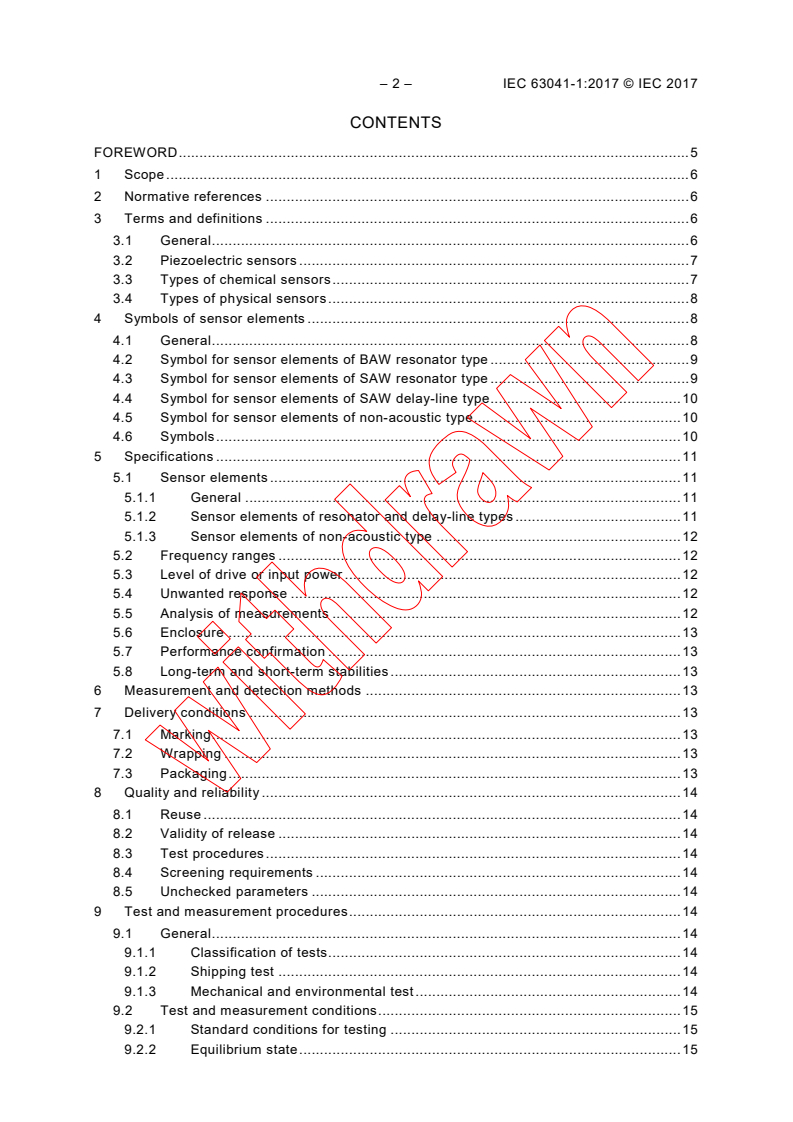
IEC 63041-1:2017 - Piezoelectric sensors - Part 1: Generic specifications Released:12/13/2017
IEC 63041-1:2017 - Piezoelectric sensors - Part 1: Generic specifications Released:11/13/2019
Overview
IEC 63041-1:2017 - "Piezoelectric sensors - Part 1: Generic specifications" defines generic terminology, symbols, measurement and detection practices, and baseline specification items for piezoelectric sensors (resonator, delay-line and non‑acoustic types). The standard helps engineers, manufacturers and researchers understand state‑of‑the‑art piezoelectric sensor concepts and how to specify, test and apply them correctly across physical sciences, chemistry, biochemistry, medical and environmental fields.
Key topics and technical requirements
- Scope & terminology: Standardizes terms and definitions for piezoelectric sensors to ensure consistent communication and documentation.
- Sensor types covered: Resonator (BAW/SAW resonator), delay‑line (SAW delay‑line) and non‑acoustic sensor elements and cells.
- Symbols & diagrams: Defines graphical symbols for sensor elements to support schematic and documentation clarity.
- Specifications: Lists typical specification items users should expect and verify, including frequency ranges, drive/input power, unwanted responses, shunt capacitance and insulation resistance.
- Measurement & detection methods: Annex A/B detail measurement approaches using reflection/transmission characteristics, oscillation circuits and amplifier methods; detection techniques include frequency difference, insertion loss/gain and phase difference measurements.
- Test procedures & conditions: Classification of tests (shipping, mechanical, environmental), standard test conditions, equilibrium and power‑supply considerations, and visual inspection requirements.
- Quality, reliability & delivery: Guidance on packaging, marking, reuse, screening, test validity and long‑/short‑term stability and performance confirmation.
Practical applications
- Standardizes how to specify and verify piezoelectric sensors for:
- Vibration and pressure measurement in engineering and physical sciences
- Chemical and biochemical sensing where piezoelectric elements detect mass or surface interactions
- Medical diagnostic devices and environmental monitoring instruments
- Useful for developing test plans, supplier specifications, acceptance criteria, and compliance documentation.
Who should use IEC 63041-1
- Sensor designers and manufacturers - to align product specifications and test methods.
- Test laboratories and quality engineers - for consistent measurement procedures and acceptance tests.
- R&D teams and system integrators - to select appropriate piezoelectric sensor types and interpret sensor data reliably.
- Procurement and regulatory professionals - to define delivery, marking and packaging requirements.
Related standards
- Other parts of the IEC 63041 series (see IEC website) and documents from IEC TC 49 (Piezoelectric, dielectric and electrostatic devices) provide complementary, device‑specific or application‑level requirements.
Keywords: IEC 63041-1, piezoelectric sensors, resonator, delay-line, non‑acoustic, measurement methods, detection methods, sensor specifications, test procedures.
Relations
- Effective Date
- 05-Sep-2023
Buy Documents
IEC 63041-1:2017 - Piezoelectric sensors - Part 1: Generic specifications Released:12/13/2017
IEC 63041-1:2017 - Piezoelectric sensors - Part 1: Generic specifications Released:11/13/2019
Frequently Asked Questions
IEC 63041-1:2017 is a standard published by the International Electrotechnical Commission (IEC). Its full title is "Piezoelectric sensors - Part 1: Generic specifications". This standard covers: IEC 63041-1:2017 applies to piezoelectric sensors of resonator, delay-line and non‑acoustic types, which are used in physical and engineering sciences, chemistry and biochemistry, medical and environmental sciences, etc. The purpose of this document is to specify the terms and definitions for the piezoelectric sensors, and to make sure from a technological perspective that users understand the state‑of-art piezoelectric sensors and how to use them correctly.
IEC 63041-1:2017 applies to piezoelectric sensors of resonator, delay-line and non‑acoustic types, which are used in physical and engineering sciences, chemistry and biochemistry, medical and environmental sciences, etc. The purpose of this document is to specify the terms and definitions for the piezoelectric sensors, and to make sure from a technological perspective that users understand the state‑of-art piezoelectric sensors and how to use them correctly.
IEC 63041-1:2017 is classified under the following ICS (International Classification for Standards) categories: 31.140 - Piezoelectric devices. The ICS classification helps identify the subject area and facilitates finding related standards.
IEC 63041-1:2017 has the following relationships with other standards: It is inter standard links to IEC 63041-1:2021. Understanding these relationships helps ensure you are using the most current and applicable version of the standard.
IEC 63041-1:2017 is available in PDF format for immediate download after purchase. The document can be added to your cart and obtained through the secure checkout process. Digital delivery ensures instant access to the complete standard document.
Standards Content (Sample)
IEC 63041-1 ®
Edition 1.0 2017-12
INTERNATIONAL
STANDARD
Piezoelectric sensors –
Part 1: Generic specifications
All rights reserved. Unless otherwise specified, no part of this publication may be reproduced or utilized in any form
or by any means, electronic or mechanical, including photocopying and microfilm, without permission in writing from
either IEC or IEC's member National Committee in the country of the requester. If you have any questions about IEC
copyright or have an enquiry about obtaining additional rights to this publication, please contact the address below or
your local IEC member National Committee for further information.
IEC Central Office Tel.: +41 22 919 02 11
3, rue de Varembé Fax: +41 22 919 03 00
CH-1211 Geneva 20 info@iec.ch
Switzerland www.iec.ch
About the IEC
The International Electrotechnical Commission (IEC) is the leading global organization that prepares and publishes
International Standards for all electrical, electronic and related technologies.
About IEC publications
The technical content of IEC publications is kept under constant review by the IEC. Please make sure that you have the
latest edition, a corrigenda or an amendment might have been published.
IEC Catalogue - webstore.iec.ch/catalogue Electropedia - www.electropedia.org
The stand-alone application for consulting the entire The world's leading online dictionary of electronic and
bibliographical information on IEC International Standards, electrical terms containing 20 000 terms and definitions in
Technical Specifications, Technical Reports and other English and French, with equivalent terms in 16 additional
documents. Available for PC, Mac OS, Android Tablets and languages. Also known as the International Electrotechnical
iPad. Vocabulary (IEV) online.
IEC publications search - www.iec.ch/searchpub IEC Glossary - std.iec.ch/glossary
The advanced search enables to find IEC publications by a 65 000 electrotechnical terminology entries in English and
variety of criteria (reference number, text, technical French extracted from the Terms and Definitions clause of
committee,…). It also gives information on projects, replaced IEC publications issued since 2002. Some entries have been
and withdrawn publications. collected from earlier publications of IEC TC 37, 77, 86 and
CISPR.
IEC Just Published - webstore.iec.ch/justpublished
Stay up to date on all new IEC publications. Just Published IEC Customer Service Centre - webstore.iec.ch/csc
details all new publications released. Available online and If you wish to give us your feedback on this publication or
also once a month by email. need further assistance, please contact the Customer Service
Centre: csc@iec.ch.
IEC 63041-1 ®
Edition 1.0 2017-12
INTERNATIONAL
STANDARD
Piezoelectric sensors –
Part 1: Generic specifications
INTERNATIONAL
ELECTROTECHNICAL
COMMISSION
ICS 31.140 ISBN 978-2-8322-5143-0
– 2 – IEC 63041-1:2017 © IEC 2017
CONTENTS
FOREWORD . 5
1 Scope . 6
2 Normative references . 6
3 Terms and definitions . 6
3.1 General . 6
3.2 Piezoelectric sensors . 7
3.3 Types of chemical sensors . 7
3.4 Types of physical sensors . 8
4 Symbols of sensor elements . 8
4.1 General . 8
4.2 Symbol for sensor elements of BAW resonator type . 9
4.3 Symbol for sensor elements of SAW resonator type . 9
4.4 Symbol for sensor elements of SAW delay-line type . 10
4.5 Symbol for sensor elements of non-acoustic type . 10
4.6 Symbols . 10
5 Specifications . 11
5.1 Sensor elements . 11
5.1.1 General . 11
5.1.2 Sensor elements of resonator and delay-line types . 11
5.1.3 Sensor elements of non-acoustic type . 12
5.2 Frequency ranges . 12
5.3 Level of drive or input power . 12
5.4 Unwanted response . 12
5.5 Analysis of measurements . 12
5.6 Enclosure . 13
5.7 Performance confirmation . 13
5.8 Long-term and short-term stabilities . 13
6 Measurement and detection methods . 13
7 Delivery conditions . 13
7.1 Marking . 13
7.2 Wrapping . 13
7.3 Packaging . 13
8 Quality and reliability . 14
8.1 Reuse . 14
8.2 Validity of release . 14
8.3 Test procedures . 14
8.4 Screening requirements . 14
8.5 Unchecked parameters . 14
9 Test and measurement procedures . 14
9.1 General . 14
9.1.1 Classification of tests . 14
9.1.2 Shipping test . 14
9.1.3 Mechanical and environmental test . 14
9.2 Test and measurement conditions . 15
9.2.1 Standard conditions for testing . 15
9.2.2 Equilibrium state . 15
9.2.3 Power supply . 15
9.2.4 Alternative test system . 15
9.2.5 Visual inspection . 16
9.3 Test conditions for shipment . 16
9.3.1 Temperature dependence of frequency, phase, insertion loss/gain,
motional resistance, and electric charge / voltage . 16
9.3.2 Unwanted response . 16
9.3.3 Shunt capacitance . 16
9.3.4 Insulation resistance . 16
Annex A (normative) Measurement methods . 17
A.1 General . 17
A.2 Measurement methods using reflection and transmission characteristics . 17
A.3 Measurement methods using oscillation circuits . 18
A.4 Measurement method of non-acoustic type sensor elements and cells . 19
A.5 Other measurement methods . 19
Annex B (normative) Detection methods . 20
B.1 General . 20
B.2 Detection methods . 20
B.2.1 Frequency difference measurement . 20
B.2.2 Insertion loss/gain measurement . 21
B.2.3 Phase difference measurement. 21
B.2.4 Other detection methods . 22
Bibliography . 23
Figure 1 – Conceptual diagrams for sensor elements of BAW resonator type . 9
Figure 2 – Symbol for sensor elements of BAW resonator type . 9
Figure 3 – Conceptual diagram of sensor elements of SAW resonator type . 9
Figure 4 – Symbol for sensor elements of SAW resonator type . 9
Figure 5 – Conceptual diagram for sensor elements of SAW delay-line type . 10
Figure 6 – Symbol for sensor elements of SAW delay-line type . 10
Figure 7 – Conceptual diagrams for sensor elements of non-acoustic type. 10
Figure 8 – Symbol for sensor elements of non-acoustic type . 10
Figure A.1 – Measurement method using reflection characteristics of BAW resonator
type sensor elements and cells . 17
Figure A.2 – Measurement method using reflection characteristics of SAW resonator
type sensor elements and cells . 17
Figure A.3 – Measurement method using transmission characteristics of SAW delay-
line type sensor elements and cells . 18
Figure A.4 – Measurement method using oscillation circuit consisting of BAW
resonator type sensor elements and cells . 18
Figure A.5 – Measurement method using oscillation circuit consisting of SAW
resonator type sensor elements and cells . 18
Figure A.6 – Measurement method using oscillation circuit consisting of SAW delay-
line type sensor elements and cells . 19
Figure A.7 – Measurement method using amplifier consisting of non-acoustic type
sensor elements and cells . 19
Figure B.1 – Measurement of frequency difference using two oscillation circuits . 20
– 4 – IEC 63041-1:2017 © IEC 2017
Figure B.2 – Measurement of frequency difference using an oscillation circuit and
frequency synthesizer . 21
Figure B.3 – Measurement of insertion loss/gain difference using two oscillation
circuits . 21
Figure B.4 – Measurement of phase difference using signal generator and phase
detector . 22
INTERNATIONAL ELECTROTECHNICAL COMMISSION
____________
PIEZOELECTRIC SENSORS –
Part 1: Generic specifications
FOREWORD
1) The International Electrotechnical Commission (IEC) is a worldwide organization for standardization comprising
all national electrotechnical committees (IEC National Committees). The object of IEC is to promote
international co-operation on all questions concerning standardization in the electrical and electronic fields. To
this end and in addition to other activities, IEC publishes International Standards, Technical Specifications,
Technical Reports, Publicly Available Specifications (PAS) and Guides (hereafter referred to as “IEC
Publication(s)”). Their preparation is entrusted to technical committees; any IEC National Committee interested
in the subject dealt with may participate in this preparatory work. International, governmental and non-
governmental organizations liaising with the IEC also participate in this preparation. IEC collaborates closely
with the International Organization for Standardization (ISO) in accordance with conditions determined by
agreement between the two organizations.
2) The formal decisions or agreements of IEC on technical matters express, as nearly as possible, an international
consensus of opinion on the relevant subjects since each technical committee has representation from all
interested IEC National Committees.
3) IEC Publications have the form of recommendations for international use and are accepted by IEC National
Committees in that sense. While all reasonable efforts are made to ensure that the technical content of IEC
Publications is accurate, IEC cannot be held responsible for the way in which they are used or for any
misinterpretation by any end user.
4) In order to promote international uniformity, IEC National Committees undertake to apply IEC Publications
transparently to the maximum extent possible in their national and regional publications. Any divergence
between any IEC Publication and the corresponding national or regional publication shall be clearly indicated in
the latter.
5) IEC itself does not provide any attestation of conformity. Independent certification bodies provide conformity
assessment services and, in some areas, access to IEC marks of conformity. IEC is not responsible for any
services carried out by independent certification bodies.
6) All users should ensure that they have the latest edition of this publication.
7) No liability shall attach to IEC or its directors, employees, servants or agents including individual experts and
members of its technical committees and IEC National Committees for any personal injury, property damage or
other damage of any nature whatsoever, whether direct or indirect, or for costs (including legal fees) and
expenses arising out of the publication, use of, or reliance upon, this IEC Publication or any other IEC
Publications.
8) Attention is drawn to the Normative references cited in this publication. Use of the referenced publications is
indispensable for the correct application of this publication.
9) Attention is drawn to the possibility that some of the elements of this IEC Publication may be the subject of
patent rights. IEC shall not be held responsible for identifying any or all such patent rights.
International Standard IEC 63041-1 has been prepared by IEC technical committee TC 49:
Piezoelectric, dielectric and electrostatic devices and associated materials for frequency
control, selection and detection.
The text of this International Standard is based on the following documents:
CDV Report on voting
49/1220/CDV 49/1249/RVC
Full information on the voting for the approval of this International Standard can be found in
the report on voting indicated in the above table.
This document has been drafted in accordance with the ISO/IEC Directives, Part 2.
A list of all parts in the IEC 63041 series, published under the general title Piezoelectric
sensors, can be found on the IEC website.
A bilingual version of this publication may be issued at a later date.
– 6 – IEC 63041-1:2017 © IEC 2017
PIEZOELECTRIC SENSORS –
Part 1: Generic specifications
1 Scope
This part of IEC 63041 applies to piezoelectric sensors of resonator, delay-line and
non-acoustic types, which are used in physical and engineering sciences, chemistry and
biochemistry, medical and environmental sciences, etc.
The purpose of this document is to specify the terms and definitions for the piezoelectric
sensors, and to make sure from a technological perspective that users understand the
state-of-art piezoelectric sensors and how to use them correctly.
2 Normative references
The following documents are referred to in the text in such a way that some or all of their
content constitutes requirements of this document. For dated references, only the edition
cited applies. For undated references, the latest edition of the referenced document (including
any amendments) applies.
IEC 60027 (all parts), Letter symbols to be used in electrical technology
IEC 60050-561:2014, International Electrotechnical Vocabulary – Part 561: Piezoelectric,
dielectric and electrostatic devices and associated materials for frequency control, selection
and detection
IEC 60122-2-1, Quartz crystal units for frequency control and selection – Part 2: Guide to the
use of quartz crystal units for frequency control and selection – Section One: Quartz crystal
units for microprocessor clock supply
IEC 60444-9, Measurement of quartz crystal unit parameters – Part 9: Measurement of
spurious resonances of piezoelectric crystal units
IEC 60617, Graphical symbols for diagrams, available at http://std.iec.ch/iec60617
ISO 2859-1:1999, Sampling procedures for inspection by attributes – Part 1: Sampling
schemes indexed by acceptance quality limit (AQL) for lot-by-lot inspection
ISO 80000-1:2009, Quantities and units – Part 1: General
3 Terms and definitions
3.1 General
For the purpose of this document, the following terms and definitions apply.
ISO and IEC maintain terminological databases for use in standardization at the following
addresses;
• IEC Electropedia: available at http://www.electropedia.org/
• ISO Online browsing platform: available at http;//www.iso,org/obp
Units, letter symbols and terminology shall, wherever possible, be taken from the following
standards: IEC 60027, IEC 60050-561, IEC 60617, and ISO 80000-1.
NOTE Piezoelectric sensors covered herein are those used for the detection and measurement of physical
quantities, chemical substances or biological molecules.
3.2 Piezoelectric sensors
3.2.1
piezoelectric sensor element
electronic component which is able to detect physical quantities as a change in its frequency,
phase, delay, electrical charge, resistance, Q-value, bandwidth, etc.
Note 1 to entry: For chemical and biochemical sensor applications, the piezoelectric sensor element includes a
sensitive or receptive layer (target recognition material).
3.2.2
resonator type sensor element
piezoelectric sensor component using acoustic resonances
3.2.3
delay line type sensor element
piezoelectric sensor component using a surface acoustic wave (SAW) delay-line of
transversal type
3.2.4
non-acoustic type sensor element
piezoelectric sensor component using the electrical charge induced by a quasi-static force,
torque or the like
Note 1 to entry: Here, the term, "non-acoustic", represents "quasi-static piezoelectric". Accordingly, the
(piezoelectric) non-acoustic type sensor element means a sensor element using the quasi-static piezoelectric effect.
3.2.5
piezoelectric sensor cell
sensor element equipped with necessary mechanical accessories and attachments to
correctly detect the parameters to be measured
3.2.6
piezoelectric sensor module
sensor element or cell equipped with electronic accessories for interfacing to external data
acquisitions
3.2.7
piezoelectric sensor
generic term that includes a sensor element, cell and module
3.2.8
QCM
quartz crystal microbalance
one of the families of chemical and biochemical sensors using crystal resonators
Note 1 to entry: A thickness share mode (TSM) sensor is identical with a QCM.
3.3 Types of chemical sensors
3.3.1
piezoelectric chemical sensor element
piezoelectric sensor component including a sensitive layer (target recognition material), which
is necessary for the practical measurement of simple non-biological molecules in quantity,
and which works and detects chemical substances mainly in the gas phase
– 8 – IEC 63041-1:2017 © IEC 2017
Note 1 to entry: A gas sensor element is one of the chemical sensor elements.
3.3.2
piezoelectric biochemical sensor element
piezoelectric sensor component including a receptive layer (target recognition material), which
is necessary for the practical measurement of complex biological molecules in quantity, and
which works mainly in aqueous media and detects biomolecules therein
3.4 Types of physical sensors
3.4.1
piezoelectric force sensor element
piezoelectric sensor component whose resonance frequency, delay or electrical
charge/voltage is used for force measurement
3.4.2
piezoelectric pressure sensor element
piezoelectric sensor component whose resonance frequency, delay or electrical
charge/voltage is used for pressure measurement
3.4.3
piezoelectric
...
IEC 63041-1 ®
Edition 1.0 2017-12
INTERNATIONAL
STANDARD
NORME
INTERNATIONALE
Piezoelectric sensors –
Part 1: Generic specifications
Capteurs piézoélectriques –
Partie 1: Spécification générique
All rights reserved. Unless otherwise specified, no part of this publication may be reproduced or utilized in any form
or by any means, electronic or mechanical, including photocopying and microfilm, without permission in writing from
either IEC or IEC's member National Committee in the country of the requester. If you have any questions about IEC
copyright or have an enquiry about obtaining additional rights to this publication, please contact the address below or
your local IEC member National Committee for further information.
Droits de reproduction réservés. Sauf indication contraire, aucune partie de cette publication ne peut être reproduite
ni utilisée sous quelque forme que ce soit et par aucun procédé, électronique ou mécanique, y compris la photocopie
et les microfilms, sans l'accord écrit de l'IEC ou du Comité national de l'IEC du pays du demandeur. Si vous avez des
questions sur le copyright de l'IEC ou si vous désirez obtenir des droits supplémentaires sur cette publication, utilisez
les coordonnées ci-après ou contactez le Comité national de l'IEC de votre pays de résidence.
IEC Central Office Tel.: +41 22 919 02 11
3, rue de Varembé info@iec.ch
CH-1211 Geneva 20 www.iec.ch
Switzerland
About the IEC
The International Electrotechnical Commission (IEC) is the leading global organization that prepares and publishes
International Standards for all electrical, electronic and related technologies.
About IEC publications
The technical content of IEC publications is kept under constant review by the IEC. Please make sure that you have the
latest edition, a corrigendum or an amendment might have been published.
IEC publications search - webstore.iec.ch/advsearchform Electropedia - www.electropedia.org
The advanced search enables to find IEC publications by a The world's leading online dictionary on electrotechnology,
variety of criteria (reference number, text, technical containing more than 22 000 terminological entries in English
committee,…). It also gives information on projects, replaced and French, with equivalent terms in 16 additional languages.
and withdrawn publications. Also known as the International Electrotechnical Vocabulary
(IEV) online.
IEC Just Published - webstore.iec.ch/justpublished
Stay up to date on all new IEC publications. Just Published IEC Glossary - std.iec.ch/glossary
details all new publications released. Available online and 67 000 electrotechnical terminology entries in English and
once a month by email. French extracted from the Terms and Definitions clause of
IEC publications issued since 2002. Some entries have been
IEC Customer Service Centre - webstore.iec.ch/csc collected from earlier publications of IEC TC 37, 77, 86 and
If you wish to give us your feedback on this publication or CISPR.
need further assistance, please contact the Customer Service
Centre: sales@iec.ch.
A propos de l'IEC
La Commission Electrotechnique Internationale (IEC) est la première organisation mondiale qui élabore et publie des
Normes internationales pour tout ce qui a trait à l'électricité, à l'électronique et aux technologies apparentées.
A propos des publications IEC
Le contenu technique des publications IEC est constamment revu. Veuillez vous assurer que vous possédez l’édition la
plus récente, un corrigendum ou amendement peut avoir été publié.
Recherche de publications IEC - Electropedia - www.electropedia.org
webstore.iec.ch/advsearchform Le premier dictionnaire d'électrotechnologie en ligne au
La recherche avancée permet de trouver des publications IEC monde, avec plus de 22 000 articles terminologiques en
en utilisant différents critères (numéro de référence, texte, anglais et en français, ainsi que les termes équivalents dans
comité d’études,…). Elle donne aussi des informations sur les 16 langues additionnelles. Egalement appelé Vocabulaire
projets et les publications remplacées ou retirées. Electrotechnique International (IEV) en ligne.
IEC Just Published - webstore.iec.ch/justpublished Glossaire IEC - std.iec.ch/glossary
Restez informé sur les nouvelles publications IEC. Just 67 000 entrées terminologiques électrotechniques, en anglais
Published détaille les nouvelles publications parues. et en français, extraites des articles Termes et Définitions des
Disponible en ligne et une fois par mois par email. publications IEC parues depuis 2002. Plus certaines entrées
antérieures extraites des publications des CE 37, 77, 86 et
Service Clients - webstore.iec.ch/csc CISPR de l'IEC.
Si vous désirez nous donner des commentaires sur cette
publication ou si vous avez des questions contactez-nous:
sales@iec.ch.
IEC 63041-1 ®
Edition 1.0 2017-12
INTERNATIONAL
STANDARD
NORME
INTERNATIONALE
Piezoelectric sensors –
Part 1: Generic specifications
Capteurs piézoélectriques –
Partie 1: Spécification générique
INTERNATIONAL
ELECTROTECHNICAL
COMMISSION
COMMISSION
ELECTROTECHNIQUE
INTERNATIONALE
ICS 31.140 ISBN 978-2-8322-7414-9
– 2 – IEC 63041-1:2017 © IEC 2017
CONTENTS
FOREWORD . 5
1 Scope . 7
2 Normative references . 7
3 Terms and definitions . 7
3.1 General . 7
3.2 Piezoelectric sensors . 8
3.3 Types of chemical sensors . 8
3.4 Types of physical sensors . 9
4 Symbols of sensor elements . 9
4.1 General . 9
4.2 Symbol for sensor elements of BAW resonator type . 10
4.3 Symbol for sensor elements of SAW resonator type . 10
4.4 Symbol for sensor elements of SAW delay-line type . 11
4.5 Symbol for sensor elements of non-acoustic type . 11
4.6 Symbols . 11
5 Specifications . 12
5.1 Sensor elements . 12
5.1.1 General . 12
5.1.2 Sensor elements of resonator and delay-line types . 12
5.1.3 Sensor elements of non-acoustic type . 13
5.2 Frequency ranges . 13
5.3 Level of drive or input power . 13
5.4 Unwanted response . 13
5.5 Analysis of measurements . 13
5.6 Enclosure . 14
5.7 Performance confirmation . 14
5.8 Long-term and short-term stabilities . 14
6 Measurement and detection methods . 14
7 Delivery conditions . 14
7.1 Marking . 14
7.2 Wrapping . 14
7.3 Packaging . 14
8 Quality and reliability . 15
8.1 Reuse . 15
8.2 Validity of release . 15
8.3 Test procedures . 15
8.4 Screening requirements . 15
8.5 Unchecked parameters . 15
9 Test and measurement procedures . 15
9.1 General . 15
9.1.1 Classification of tests . 15
9.1.2 Shipping test . 15
9.1.3 Mechanical and environmental test . 15
9.2 Test and measurement conditions . 16
9.2.1 Standard conditions for testing . 16
9.2.2 Equilibrium state . 16
9.2.3 Power supply . 16
9.2.4 Alternative test system . 16
9.2.5 Visual inspection . 17
9.3 Test conditions for shipment . 17
9.3.1 Temperature dependence of frequency, phase, insertion loss/gain,
motional resistance, and electric charge / voltage . 17
9.3.2 Unwanted response . 17
9.3.3 Shunt capacitance . 17
9.3.4 Insulation resistance . 17
Annex A (normative) Measurement methods . 18
A.1 General . 18
A.2 Measurement methods using reflection and transmission characteristics . 18
A.3 Measurement methods using oscillation circuits . 19
A.4 Measurement method of non-acoustic type sensor elements and cells . 20
A.5 Other measurement methods . 20
Annex B (normative) Detection methods . 21
B.1 General . 21
B.2 Detection methods . 21
B.2.1 Frequency difference measurement . 21
B.2.2 Insertion loss/gain measurement . 22
B.2.3 Phase difference measurement. 22
B.2.4 Other detection methods . 23
Bibliography . 24
Figure 1 – Conceptual diagrams for sensor elements of BAW resonator type . 10
Figure 2 – Symbol for sensor elements of BAW resonator type . 10
Figure 3 – Conceptual diagram of sensor elements of SAW resonator type . 10
Figure 4 – Symbol for sensor elements of SAW resonator type . 10
Figure 5 – Conceptual diagram for sensor elements of SAW delay-line type . 11
Figure 6 – Symbol for sensor elements of SAW delay-line type . 11
Figure 7 – Conceptual diagrams for sensor elements of non-acoustic type. 11
Figure 8 – Symbol for sensor elements of non-acoustic type . 11
Figure A.1 – Measurement method using reflection characteristics of BAW resonator
type sensor elements and cells . 18
Figure A.2 – Measurement method using reflection characteristics of SAW resonator
type sensor elements and cells . 18
Figure A.3 – Measurement method using transmission characteristics of SAW delay-
line type sensor elements and cells . 19
Figure A.4 – Measurement method using oscillation circuit consisting of BAW
resonator type sensor elements and cells . 19
Figure A.5 – Measurement method using oscillation circuit consisting of SAW
resonator type sensor elements and cells . 19
Figure A.6 – Measurement method using oscillation circuit consisting of SAW delay-
line type sensor elements and cells . 20
Figure A.7 – Measurement method using amplifier consisting of non-acoustic type
sensor elements and cells . 20
Figure B.1 – Measurement of frequency difference using two oscillation circuits . 21
– 4 – IEC 63041-1:2017 © IEC 2017
Figure B.2 – Measurement of frequency difference using an oscillation circuit and
frequency synthesizer . 22
Figure B.3 – Measurement of insertion loss/gain difference using two oscillation
circuits . 22
Figure B.4 – Measurement of phase difference using signal generator and phase
detector . 23
INTERNATIONAL ELECTROTECHNICAL COMMISSION
____________
PIEZOELECTRIC SENSORS –
Part 1: Generic specifications
FOREWORD
1) The International Electrotechnical Commission (IEC) is a worldwide organization for standardization comprising
all national electrotechnical committees (IEC National Committees). The object of IEC is to promote
international co-operation on all questions concerning standardization in the electrical and electronic fields. To
this end and in addition to other activities, IEC publishes International Standards, Technical Specifications,
Technical Reports, Publicly Available Specifications (PAS) and Guides (hereafter referred to as “IEC
Publication(s)”). Their preparation is entrusted to technical committees; any IEC National Committee interested
in the subject dealt with may participate in this preparatory work. International, governmental and non-
governmental organizations liaising with the IEC also participate in this preparation. IEC collaborates closely
with the International Organization for Standardization (ISO) in accordance with conditions determined by
agreement between the two organizations.
2) The formal decisions or agreements of IEC on technical matters express, as nearly as possible, an international
consensus of opinion on the relevant subjects since each technical committee has representation from all
interested IEC National Committees.
3) IEC Publications have the form of recommendations for international use and are accepted by IEC National
Committees in that sense. While all reasonable efforts are made to ensure that the technical content of IEC
Publications is accurate, IEC cannot be held responsible for the way in which they are used or for any
misinterpretation by any end user.
4) In order to promote international uniformity, IEC National Committees undertake to apply IEC Publications
transparently to the maximum extent possible in their national and regional publications. Any divergence
between any IEC Publication and the corresponding national or regional publication shall be clearly indicated in
the latter.
5) IEC itself does not provide any attestation of conformity. Independent certification bodies provide conformity
assessment services and, in some areas, access to IEC marks of conformity. IEC is not responsible for any
services carried out by independent certification bodies.
6) All users should ensure that they have the latest edition of this publication.
7) No liability shall attach to IEC or its directors, employees, servants or agents including individual experts and
members of its technical committees and IEC National Committees for any personal injury, property damage or
other damage of any nature whatsoever, whether direct or indirect, or for costs (including legal fees) and
expenses arising out of the publication, use of, or reliance upon, this IEC Publication or any other IEC
Publications.
8) Attention is drawn to the Normative references cited in this publication. Use of the referenced publications is
indispensable for the correct application of this publication.
9) Attention is drawn to the possibility that some of the elements of this IEC Publication may be the subject of
patent rights. IEC shall not be held responsible for identifying any or all such patent rights.
International Standard IEC 63041-1 has been prepared by IEC technical committee TC 49:
Piezoelectric, dielectric and electrostatic devices and associated materials for frequency
control, selection and detection.
This bilingual version (2019-11) corresponds to the monolingual English version, published in
2017-12.
The text of this International Standard is based on the following documents:
CDV Report on voting
49/1220/CDV 49/1249/RVC
Full information on the voting for the approval of this International Standard can be found in
the report on voting indicated in the above table.
– 6 – IEC 63041-1:2017 © IEC 2017
The French version of this standard has not been voted upon.
This document has been drafted in accordance with the ISO/IEC Directives, Part 2.
A list of all parts in the IEC 63041 series, published under the general title Piezoelectric
sensors, can be found on the IEC website.
.
PIEZOELECTRIC SENSORS –
Part 1: Generic specifications
1 Scope
This part of IEC 63041 applies to piezoelectric sensors of resonator, delay-line and
non-acoustic types, which are used in physical and engineering sciences, chemistry and
biochemistry, medical and environmental sciences, etc.
The purpose of this document is to specify the terms and definitions for the piezoelectric
sensors, and to make sure from a technological perspective that users understand the
state-of-art piezoelectric sensors and how to use them correctly.
2 Normative references
The following documents are referred to in the text in such a way that some or all of their
content constitutes requirements of this document. For dated references, only the edition
cited applies. For undated references, the latest edition of the referenced document (including
any amendments) applies.
IEC 60027 (all parts), Letter symbols to be used in electrical technology
IEC 60050-561:2014, International Electrotechnical Vocabulary – Part 561: Piezoelectric,
dielectric and electrostatic devices and associated materials for frequency control, selection
and detection
IEC 60122-2-1, Quartz crystal units for frequency control and selection – Part 2: Guide to the
use of quartz crystal units for frequency control and selection – Section One: Quartz crystal
units for microprocessor clock supply
IEC 60444-9, Measurement of quartz crystal unit parameters – Part 9: Measurement of
spurious resonances of piezoelectric crystal units
IEC 60617, Graphical symbols for diagrams, available at http://std.iec.ch/iec60617
ISO 2859-1:1999, Sampling procedures for inspection by attributes – Part 1: Sampling
schemes indexed by acceptance quality limit (AQL) for lot-by-lot inspection
ISO 80000-1:2009, Quantities and units – Part 1: General
3 Terms and definitions
3.1 General
For the purpose of this document, the following terms and definitions apply.
ISO and IEC maintain terminological databases for use in standardization at the following
addresses;
• IEC Electropedia: available at http://www.electropedia.org/
• ISO Online browsing platform: available at http;//www.iso,org/obp
– 8 – IEC 63041-1:2017 © IEC 2017
Units, letter symbols and terminology shall, wherever possible, be taken from the following
standards: IEC 60027, IEC 60050-561, IEC 60617, and ISO 80000-1.
NOTE Piezoelectric sensors covered herein are those used for the detection and measurement of physical
quantities, chemical substances or biological molecules.
3.2 Piezoelectric sensors
3.2.1
piezoelectric sensor element
electronic component which is able to detect physical quantities as a change in its frequency,
phase, delay, electrical charge, resistance, Q-value, bandwidth, etc.
Note 1 to entry: For chemical and biochemical sensor applications, the piezoelectric sensor element includes a
sensitive or receptive layer (target recognition material).
3.2.2
resonator type sensor element
piezoelectric sensor component using acoustic resonances
3.2.3
delay line type sensor element
piezoelectric sensor component using a surface acoustic wave (SAW) delay-line of
transversal type
3.2.4
non-acoustic type sensor element
piezoelectric sensor component using the electrical charge induced by a quasi-static force,
torque or the like
Note 1 to entry: Here, the term, "non-acoustic", represents "quasi-static piezoelectric". Accordingly, the
(piezoelectric) non-acoustic type sensor element means a sensor element using the quasi-static piezoelectric effect.
3.2.5
piezoelectric sensor cell
sensor element equipped with necessary mechanical accessories and attachments to
correctly detect the parameters to be measured
3.2.6
piezoelectric sensor module
sensor element or cell equipped with electronic accessories for interfacing to external data
acquisitions
3.2.7
piezoelectric sensor
generic term that includes a sensor element, cell and module
3.2.8
QCM
quartz crystal microbalance
one of the families of chemical and biochemical sensors using crystal resonators
Note 1 to entry: A thickness share mode (TSM) sensor is identical with a QCM.
3.3 Types of chemical sensors
3.3.1
piezoelectric chemical sensor element
piezoelectric sensor component including a sensitive layer (target recognition material), which
is necessary for the practical measurement of simple non-biological molecules in quantity,
and which works and detects chemical substances mainly in the gas phase
Note 1 to entry: A gas sensor element is one of the chemical sensor elements.
3.3.2
piezoelectric biochemical sensor element
piezoelectric sensor component including a receptive layer (target recognition material), which
is necessary for the practical measurement of complex biological molecules in quantity, and
which works mainly in aqueous media and detects biomolecules therein
3.4 Types of physical sensors
3.4.1
piezoelectric force sensor element
piezoelectric sensor component whose resonance frequency, delay or electrical
charge/voltage is used for force measurement
3.4.2
piezoelectric pressure sensor element
piezoelectric sensor component whose resonance frequency, delay or electrical
charge/voltage is used for pressure measurement
3.4.3
piezoelectric torque sensor element
piezoelectric sensor component whose resonance frequency, delay or electrical
charge/voltage is used for torque measurement
3.4.4
piezoelectric viscosity sensor element
piezoelectric sensor component whose resonance frequency, delay or insertion loss/gain is
used for viscosity measurement
3.4.5
piezoelectric temperature sensor element
piezoelectric sensor component whose resonance frequency or delay is used for temperature
measurement
3.4.6
piezoelectric film-thickness sensor element
piezoelectric sensor component whose resonance frequency is used for film-thickness
measurement
4 Symbols of sensor elements
4.1 General
Figures 1 to 6 show the conceptual diagrams and defined symbols for sensor elements of bulk
acoustic wave (BAW) resonator, SAW resonator and SAW delay-line types. The symbols are
essentially the same as those given in IEC 60122-1, IEC 61019-1 and IEC 60862-1.
Figure 7 and Figure 8 show the conceptual diagram and defined symbol for sensor elements
of non-acoustic type.
NOTE 1 The diagonal line in Figure 2, Figure 4, Figure 6 and Figure 8 shows an emblem expressing changes in
objects to be measured.
NOTE 2 Letter symbols (see 4.6) showing the types of sensors are put in the circle at the upper right corner in
Figure 2, Figure 4, Figure 6 and Figure 8.
– 10 – IEC 63041-1:2017 © IEC 2017
4.2 Symbol for sensor elements of BAW resonator type
Figure 1 shows the conceptual diagrams for sensor elements of BAW resonator type from
which a mounting portion is omitted. Figure 2 shows the symbol for sensor elements of BAW
resonator type.
IEC
Figure 1 – Conceptual diagrams for sensor elements of BAW resonator type
IEC
Figure 2 – Symbol for sensor elements of BAW resonator type
4.3 Symbol for sensor elements of SAW resonator type
Figure 3 and Figure 4 show, respectively, the conceptual diagram and symbol for sensor
elements of SAW resonator type.
Reflector IDT Reflector
IEC
Figure 3 – Conceptual diagram of sensor elements of SAW resonator type
IEC
Figure 4 – Symbol for sensor elements of SAW resonator type
4.4 Symbol for sensor elements of SAW delay-line type
Figure 5 and Figure 6 show, respectively, the conceptual diagram and symbol for sensor
elements of SAW delay-line type.
IDT IDT
IEC
Figure 5 – Conceptual diagram for sensor elements of SAW delay-line type
IEC
Figure 6 – Symbol for sensor elements of SAW delay-line type
4.5 Symbol for sensor elements of non-acoustic type
Figure 7 shows the conceptual diagrams for sensor elements of non-acoustic type from which
a mounting portion is omitted. Figure 8 shows the symbol for sensor elements of non-acoustic
type.
IEC
Figure 7 – Conceptual diagrams for sensor elements of non-acoustic type
IEC
Figure 8 – Symbol for sensor elements of non-acoustic type
4.6 Symbols
The symbols put in the circle at the upper right corner in Figure 2, Figure 4, Figure 6 and
Figure 8 are defined below (see ISO 80000 all parts):
– 12 – IEC 63041-1:2017 © IEC 2017
a) film-thickness: d;
b) force: F;
c) mass: m;
d) density: ρ;
e) pressure: P;
f) temperature: T;
g) torque: τ;
h) viscosity: υ.
In chemical, biochemical and gas sensor applications, antigen-antibody or chemical reaction
occurs between the sensitive or receptive layer and target substances, which is detected as a
change in mass density, viscosity or shear modulus of the sensitive or receptive layer.
Accordingly, the following specific symbols are defined for biochemical, chemical and gas
sensor elements:
i) biochemical: Bi;
j) chemical: Ch;
k) gas: Ga.
5 Specifications
5.1 Sensor elements
5.1.1 General
In consideration of the target sensitivity, dynamic range or the like, the specifications of
sensor elements and cells shall be determined. They should be defined clearly in the contract
to be concluded between the manufacturer and customers.
Subclauses 5.1.2 and 5.1.3 present key points to be described in the specifications. These
elements should be specified numerically unless confidential technological information is
concerned.
5.1.2 Sensor elements of resonator and delay-line types
Sensor elements of resonator and delay-line types include the following:
a) range of measurand;
b) sensitivity of output signal with respect to measurand;
c) nominal frequency;
d) frequency tolerance;
e) parameters of equivalent circuit;
f) operating temperature range;
g) unwanted response;
h) level of drive or input power;
i) insertion loss/gain;
j) delay time (for sensor elements of SAW delay-line type);
k) phase response;
l) piezoelectric material, cut angle, or the like;
m) electrode material, dimension, shape, structure or the like;
n) mounting material, dimension, shape, structure or the like;
o) dimensions of enclosure, or name, model number or the like corresponding thereto;
p) category of environmental test;
q) others.
5.1.3 Sensor elements of non-acoustic type
Sensor elements of non-acoustic type include the following:
a) operating temperature range;
b) piezoelectric material, cut angle, dimension, shape, structure or the like;
c) electrode material, dimension, shape, structure or the like;
d) mounting material, dimension, shape, structure or the like;
e) dimensions of enclosure, or name, model number or the like corresponding thereto;
f) category of environmental test;
g) others.
5.2 Frequency ranges
The frequency range applied herein should be 10 kHz to 10 GHz.
When one of the higher-order overtones is used or the frequency deviates from the specified
range, the manufacturer and customer shall consult, and the results shall clearly be defined in
the contract.
NOTE The frequency ranges for sensor elements of non-acoustic type are not defined.
5.3 Level of drive or input power
For sensor elements and cells, the level of drive or input power shall be limited so that an
influence of “heat generation” or a “non-linear effect” does not deteriorate their performance.
NOTE The level of drive or input power for non-acoustic type sensor elements is not defined.
5.4 Unwanted response
Unwanted responses shall be measured based on IEC 60444-9. This rule shall be applied
only to sensor elements of BAW resonator type.
According to IEC 60122-2-1, the ratio of the motional resistance R for the unwanted
N
response to R for the main response (N=R /R ) shall be two and a half times or more.
1 N 1
NOTE Conceptually, the sensitivity increases with an increase in the electrode area, which reduces the ratio of
R / R . Under this situation, unwanted responses affect the main response, and sensor elements of BAW
N 1
resonator type occasionally oscillate, caused by the unwanted response.
5.5 Analysis of measurements
Electronic circuits and measuring instruments are generally used in sensor systems. The
output signals such as frequency, phase, insertion loss/gain, electrical charge / voltage, etc.,
and their response functions and graphs are obtained as system data.
The rule on how to apply this system data to data analyses shall clearly be defined in the
contract to be concluded between the manufacturer and customer, or in individual
specifications.
NOTE The response function based on the linear response theory is effective in the analysis of acoustic wave
sensor elements and cells of resonator and delay-line types. For example, it is possible for the frequency response
to predict the resonant response levels of the acoustic wave sensor.
– 14 – IEC 63041-1:2017 © IEC 2017
5.6 Enclosure
Holder specifications shall be clearly defined in the contract to be concluded between the
manufacturer and customer, or in individual specifications.
5.7 Performance confirmation
The basic performance of sensor elements and cells such as the minimum and maximum
detection limits, dynamic range, sensitivity, etc. should be specified.
5.8 Long-term and short-term stabilities
At the time of the measurement, attention should be paid to long-term stability as well as to
short-term stability affected by a background noise such as an electronic and/or foreign noise.
The specifications for long-term and short-term stabilities shall clearly be defined in the
contract to be concluded between the manufacturer and customer, or in individual
specifications.
NOTE The long-term and short-term stabilities for sensor elements of non-acoustic type are not defined.
6 Measurement and detection methods
Required measurement and detection methods are shown in Annexes A and B.
7 Delivery conditions
7.1 Marking
The content to be marked should be selected at least out of the following items. Moreover, the
marking shall be made at the place from which sensor elements and cells can easily be
viewed to the greatest extent possible. If such a place is unavailable, the marking shall be
made on a packing plane.
a) Type designation as defined in the detailed specifications
b) Year and week (four digits) of manufacture, or serial number
c) Factory identification code
d) Name of manufacturer or trade mark
e) Country of production
f) Mark of conformity (unless a certificate of conformity is used)
7.2 Wrapping
In the wrapping of sensor elements and cells, sealing is desirable. Moreover, vacuum
wrapping must also be taken into consideration. This rule shall be clearly defined in the
contract to be concluded between the manufacturer and customer, or in individual
specifications.
7.3 Packaging
The packaging specifications shall be clearly defined in the contract to be concluded between
the manufacturer and customer, or in individual specifications.
8 Quality and reliability
8.1 Reuse
Reuse of sensor elements and cells shall be clearly defined in the contract to be concluded
between the manufacturer and customer, or in individual specifications.
8.2 Validity of release
Inspection before shipment and re-inspection when the products are stored for a
predetermined period of time and then shipped, shall be clearly defined in the contract to be
concluded between the manufacturer and customer, or in individual specifications.
8.3 Test procedures
Test procedures to be used shall be selected from this document. If any required test is not
found, then it shall be defined in detailed individual specifications.
8.4 Screening requirements
Where screening by the customer is required for sensor elements and cells, this shall be
defined in the detailed individual specifications.
8.5 Unchecked parameters
Only those parameters of sensor elements and cells which have been described in detailed
specifications and which were subjected to testing can be assumed to be within the specified
limits. It should not be assumed that any parameter not specified will remain unchanged from
one sensor element and cells to another. Should it be necessary for further unchecked
parameters to be controlled, then new, more extensive and detailed specifications should be
prepared. The additional test method(s) shall be fully described with appropriate limits, AQLs
and inspection levels specified (see ISO 2859-1).
9 Test and measurement procedures
9.1 General
9.1.1 Classification of tests
The tests are classified into tests for shipping products, and mechanical and environmental
tests for confirming the reliability of products.
9.1.2 Shipping test
The test is conducted to confirm whether sensor elements and cells maintain the state
satisfying the contract between the manufacturer and customer when unsealed sensor
elements are shipped. The following shall be clearly defined in the contract between the
manufacturer and customer, or individual specifications.
a) When the specifications can presumably be sufficiently ensured, no inspection or
sampling inspection shall be allowed.
b) When inspections are required, all sensor elements and cells shall be inspected.
9.1.3 Mechanical and environmental test
9.1.3.1 General
Tests should be conducted to confirm whether or not sensor elements and cells have
predetermined performances. Regarding test samples, those sealed into enclosures shall be
used. When no sealing is required, however, such samples may also be used.
– 16 – IEC 63041-1:2017 © IEC 2017
9.1.3.2 Test samples
With regard to all test samples, the sensor elements and cells which maintain the state
meeting the contract between the manufacturer and customer shall be used. Selection of the
test sample shall be clearly defined in the contract between the manufacturer and customer,
or in individual specifications.
9.1.3.3 Test items
Test items such as vibration, shock, thermal shock, heat resistance, bump, salt fog, ageing,
bending of enclosure and the like are strongly dependent upon the requirement specifications
of sensor elements and cells. Therefore, the test items shall be discussed between the
manufacturer and customer, and shall be settled by the contract.
9.2 Test and measurement conditions
9.2.1 Standard conditions for testing
Unless otherwise specified, all of electrical tests shall be conducted under the following
conditions:
– temperature 15 °C to 35 °C;
– relative humidity 45 % to 75 %;
– atmosphere 86 kPa to 106 kPa (860 mbar to 1 060 mbar).
If any doubt arises, the following conditions shall be applied:
– temperature 25 °C ± 2 °C;
– relative humidity 48 % to 52 %;
Before starting the measurement, the test samples shall be stored at the measurement
(inspection) temperature for a period of time enough to reach the thermal equilibrium state.
The ambient temperature during the measurement shall be recorded in the test report.
9.2.2 Equilibrium state
Unless otherwise specified, all of the electrical tests shall be conducted under an equilibrium
state. In the case where the test state causes significant time dependence on the
measurement of characteristics, a means for compensating such dependence shall be
specified.
9.2.3 Power supply
When the oscillation method (see Clause A.3) is employed, a direct current power supply to
be used for testing samples should have no ripples which influence the measurement
accuracies required. An alternate current power supply shall have no transient response
characteristics. When the ripples and transient response characteristics influence the
measurement, such an influence shall clearly be described in individual standards.
9.2.4 Alternative test system
Measurement shall be conducted according to specified methods as much as possible. If
there is no doubt, another method by which equivalent results are expected may be applied.
NOTE “Equivalent” means that the measured values obtained by the alternative test method are correlated to the
specified method.
9.2.5 Visual inspection
9.2.5.1 General
Unless otherwise specified, external visual examination shall be performed under normal
factory lighting and visual conditions.
9.2.5.2 Visual test A
The test samples shall visually be examined to ensure that the condition, workmanship and
finish are satisfactory. The marking shall be legible.
9.2.5.3 Visual test B
The test samples should visually be examined under the lighting condition of ten times the
normal condition. There shall be no cracks in the glass (base, cover, etc.) or damages to the
terminations. Minute flaking around the feather edge of a meniscus shall not be considered a
crack.
9.2.5.4 Visual test C
The test samples shall visually be examined. There shall be no corrosion or other
deterioration likely to impair satisfactory operation. The marking shall be legible.
9.3 Test conditions for shipment
9.3.1 Temperature dependence of frequency, phase, insertion loss/gain, motional
resistance, and electric charge / voltage
The performance of the test samples shall be measured under stepwise changing temperature
over the specified range.
The shipment test shall be conducted either at ordinary temperature or according to the
specification settled in the contract to be concluded between the manufacturer and customer.
9.3.2 Unwanted response
The measurement of unwanted response shall be applied to sensor elements and cells of
quartz crystal BAW resonator type (see 5.4).
9.3.3 Shunt capacitance
The shunt capacitance C should be measured at a frequency far below the fundamental
resonance frequency at which sensor elements are not badly affected by acoustic responses.
NOTE The shunt capacitance for sensor elements of non-acoustic type is not defined.
9.3.4 Insulation resistance
The insulation resistance measurement using DC voltage and its conditions shall be
discussed between the manufacturer and customer, and shall be settled by the contract.
The insulation resistance shall be larger than the value specified in the relevant detailed
specification.
– 18 – IEC 63041-1:2017 © IEC 2017
Annex A
(normative)
Measurement me
...