

IEC 60079-10-2:2026
(Main)Explosive atmospheres - Part 10-2: Classification of areas - Explosive dust atmospheres
- Abstract
IEC 60079-10-2 is concerned with the identification and classification of areas where explosive dust atmospheres and combustible dust layers are present in order to permit the proper assessment of ignition sources in such areas. In this document, explosive dust atmospheres and combustible dust layers are treated separately. In Clause 4, area classification for explosive dust clouds is described, with dust layers acting as one of the possible sources of release. In Clause 7, other general considerations for dust layers are described. The examples in this document are based on a system of effective housekeeping being implemented in the plant to prevent dust layers from accumulating. Where effective housekeeping is not present, the area classification includes the possible formation of explosive dust clouds from dust layers. The principles of this document can also be followed when combustible fibres or flyings might cause a hazard.
Atmospheric conditions include variations in pressure and temperature above and below reference levels of 101,3 kPa (1 013 mbar) and 20 °C (293 K), provided that the variations have a negligible effect on the explosive properties of the combustible material. For air with normal oxygen content, typically a volume fraction of 21 % is assumed.
It does not apply to:
a) underground mining areas;
b) dusts of explosives that do not require atmospheric oxygen for combustion such as pyrophoric substances, propellants, pyrotechnics, munitions, peroxides, oxidizers, water‑reactive elements or compounds, or other similar materials;
c) catastrophic failures or rare malfunctions which are outside the conditions dealt with in this document;
d) rooms used for medical purposes;
e) domestic premises;
f) where a hazard is due to the presence of flammable gas or vapour, but the principles can be used in the assessment of a hybrid mixture (see also IEC 60079-10-1).
This document does not consider the effects of consequential damage following a fire or an explosion. Please refer to the foreword of the document for a detailed listing of the significant technical changes from the previous edition.
- Status
- Published
- Publication Date
- 28-Jun-2026
- Technical Committee
- SC 31J - Classification of hazardous areas and installation requirements
- Drafting Committee
- MT 60079-10-2 - TC 31/SC 31J/MT 60079-10-2
- Current Stage
- PPUB - Publication issued
- Start Date
- 29-Jun-2026
- Completion Date
- 31-Jul-2026
Buy Documents
REDLINE IEC 60079-10-2:2026 RLV - Explosive atmospheres - Part 10-2: Classification of areas - Explosive dust atmospheres
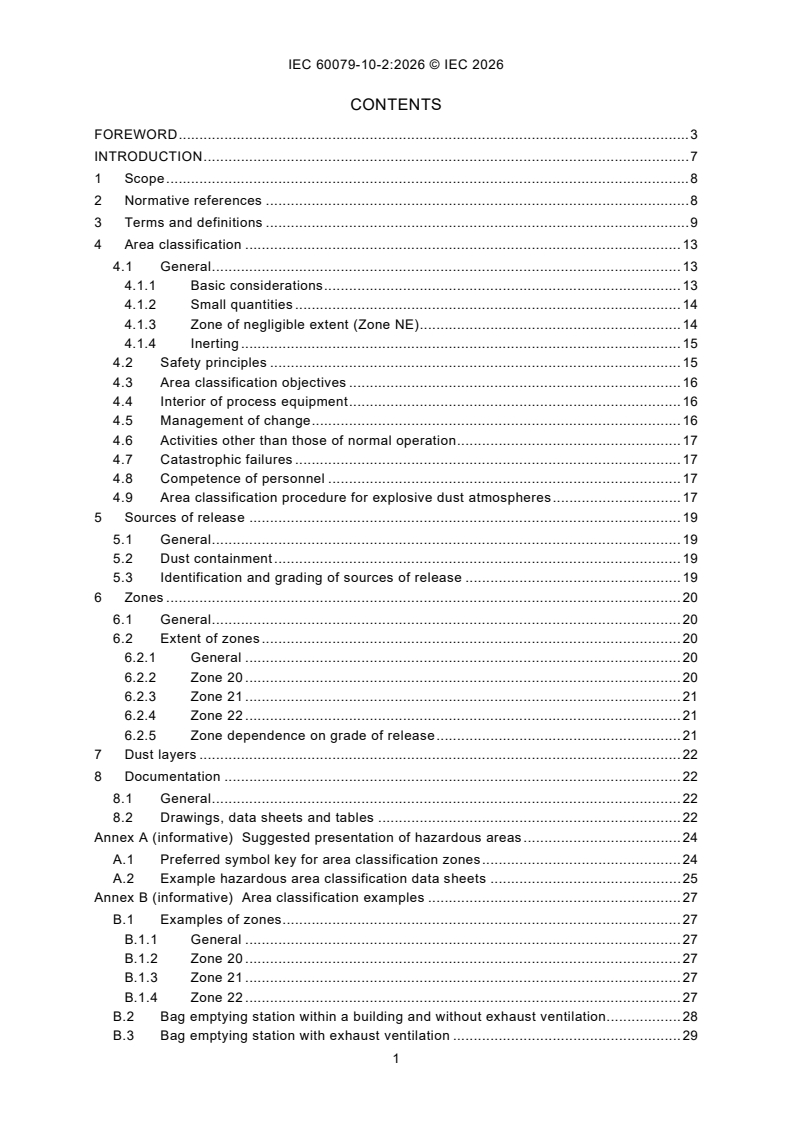
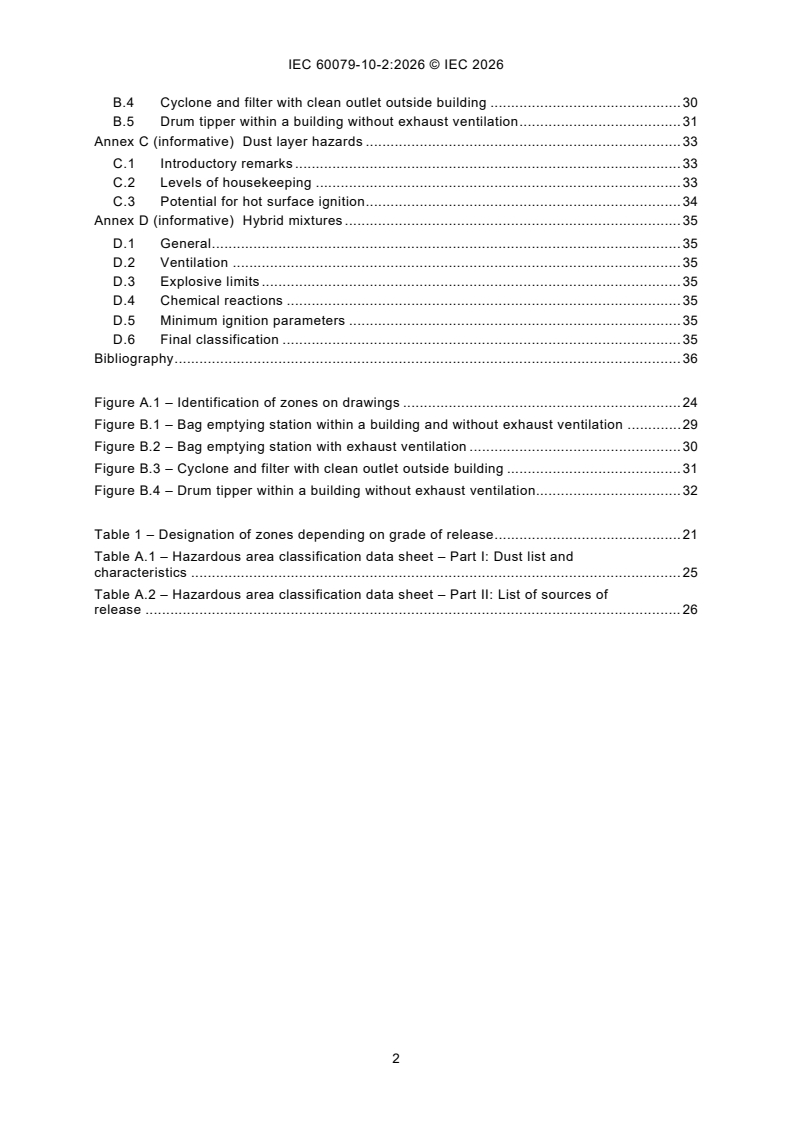
iec60079-10-2{ed3.0}en - Explosive atmospheres - Part 10-2: Classification of areas - Explosive dust atmospheres
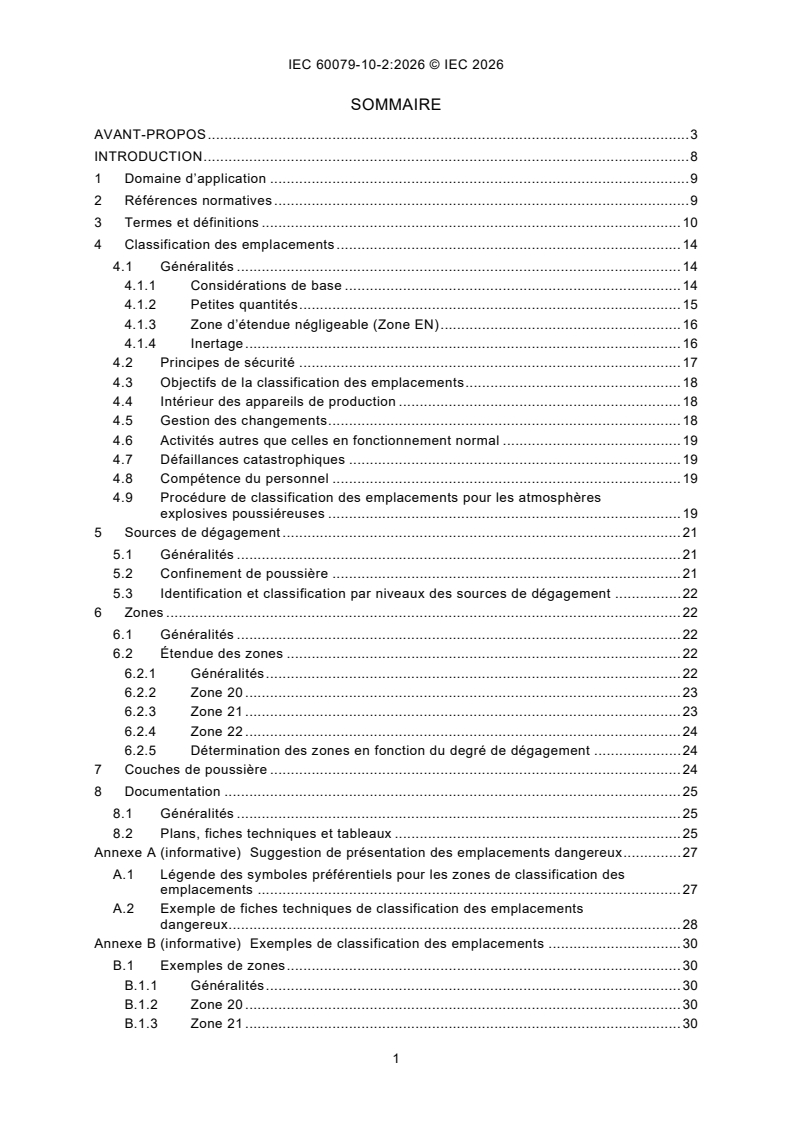
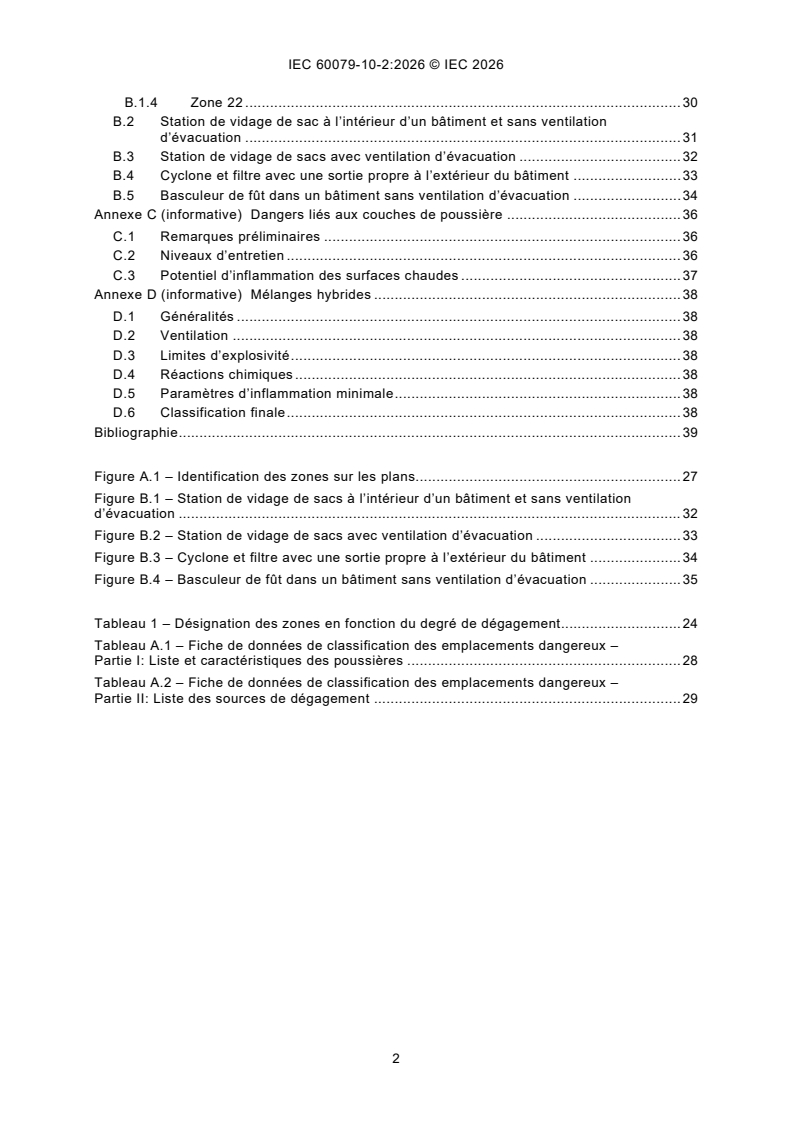
iec60079-10-2{ed3.0}fr - Atmospheres explosives - Partie 10-2: Classement des emplacements - Atmospheres explosives poussiéreuses
IEC 60079-10-2:2026 is an IEC International Standard for classifying areas where explosive dust atmospheres and combustible dust layers may be present. It specifies how to identify dust release sources, assign Zones 20, 21, 22 and Zone EN, and document the result so ignition sources can be assessed and Ex equipment can be selected with the right level of protection. It is intended for people responsible for dusty industrial installations, especially those handling, processing, storing, or transferring combustible dust.
What does IEC 60079-10-2:2026 specify?
IEC 60079-10-2:2026 specifies the identification and classification of areas where explosive dust atmospheres and combustible dust layers are present. The standard treats dust clouds and dust layers separately, because they create different hazards and need different checks in practice.
The document is organized into Clause 1 to Clause 8, followed by four informative annexes and a bibliography.
| Annex | What it covers |
|---|---|
| Annex A | Suggested presentation of hazardous locations, preferred symbols, and example classification sheets |
| Annex B | Worked examples of area classification for typical dust-handling equipment and rooms |
| Annex C | Hazards linked to dust layers, housekeeping, and hot surfaces |
| Annex D | Hybrid mixtures of flammable gas or vapour with dust |
The scope also states that the principles can be used where combustible fibres or flyings may create a hazard, and that hybrid mixtures can be assessed with the same approach.
What are the key requirements of IEC 60079-10-2:2026?
Identify the hazard before assigning a zone
Clause 4 makes area classification the starting point for dust-hazard control. IEC 60079-10-2:2026 requires the assessor to look at both the likelihood of a dust cloud and the contribution of dust layers, because layers can later be dispersed into explosive clouds or can ignite on hot surfaces.
Clause 4.1.1 links classification to the concentration minimal explosive (CME), which means the dust cloud must be considered against the concentration at which a deflagration can support itself. In practice, this matters because a cloud may not be explosive at one moment, but it can become dangerous if concentration changes.
Clause 4.1.2 says that very small quantities may not justify a hazardous-area classification, provided the surrounding controls are adequate. That pushes the reader to judge cleaning, ventilation, work practice, exposure control, and staff competence before defaulting to a classified area.
Clause 4.1.3 introduces Zone EN, an area of negligible extent where consequences of ignition are negligible. This is useful when a very small release cannot reasonably produce damaging consequences, but it still needs careful justification.
Clause 4.1.4 allows inerting either by mixing combustible dust with non-combustible dust or by replacing oxygen with inert gas. In practice, this means the plant has to prove the mixture or atmosphere is really inert, not just assume it.
Determine where dust is released and how far the zone extends
Clause 5 requires the assessor to find the actual sources of dust release. IEC 60079-10-2:2026 distinguishes confinement, such as equipment interiors, from areas outside the confinement, because the same process can create very different risks in those two spaces.
Clause 5.3 classifies dust release as continuous, primary, or secondary. Continuous release leads toward Zone 20, primary release toward Zone 21, and secondary release toward Zone 22. That classification matters because it determines how strict the area classification and equipment selection need to be.
Clause 6 then links the zone type to frequency and duration of explosive dust atmospheres. Clause 6.2.5 gives the basic mapping between release degree and zone designation, which makes the classification method consistent across different plants.
Clause 6.2 also requires the assessor to define the zone boundary from the source of release to the point where the hazard no longer exists. In practice, that means considering dust transport by air movement, weather outdoors, and the possibility that small non-hazardous pockets should be treated as part of a larger classified area.
Treat dust layers as a separate control problem
Clause 7 separates dust layers from dust clouds and makes housekeeping part of the classification decision. IEC 60079-10-2:2026 expects the thickness of dust layers outside confinement to be controlled and known, because layers can create both fire and secondary explosion hazards.
Annex C explains why this matters: a layer can be ignited by a hot surface, and an initial fire or explosion can lift layers into a cloud. For readers, this means housekeeping is not just cleanliness - it is part of explosion-risk control.
Use competent people and keep the classification documented
Clause 4.8 says the classification must be done by competent personnel who understand the dust, the process, and the electrical and mechanical aspects of the installation. Clause 4.9 describes a stepwise procedure: identify dust properties, identify release points, assess the likelihood of release, then define the zones and their limits.
Clause 4.5 requires change management. If a process, material, or control measure changes, the classification must be reviewed and updated by a competent person. The foreword also notes a recommended review interval of no more than three years for installations with regular minor changes.
Clause 8 requires the whole assessment to be documented, including plans, data sheets, zone boundaries, dust-layer thickness, equipment group, maximum surface temperature, and assigned equipment protection levels (EPL). That documentation becomes the basis for equipment selection, inspection, and later revisions.
What terms does IEC 60079-10-2:2026 define?
- Combustible dust - fine solid particles, 500 μm or smaller, that can form explosive mixtures with air under atmospheric conditions.
- Concentration minimal explosive (CME) - the minimum dust concentration in air that can support a deflagration.
- Energy minimale d’inflammation (EMI) - the lowest capacitor discharge energy that is just sufficient to ignite the most ignitable dust/air mixture in test conditions.
- Concentration limite en oxygène (CLO) - the maximum oxygen concentration, under test conditions, at which an explosion cannot occur in a dust-air-inert gas mixture.
- Temperature d’inflammation d’un nuage / d’une couche (MIT) - the lowest hot-surface temperature that ignites a dust cloud or dust layer in specified test conditions.
- Zone EN - a zone of negligible extent where ignition consequences are negligible.
- Source de dégagement de poussière - a point or place from which dust can be released into the atmosphere.
- Equipment protection level (EPL) - the protection level used to match equipment to the classified area and the expected hazard.
Who uses IEC 60079-10-2:2026?
IEC 60079-10-2:2026 is used by process engineers, electrical and mechanical designers, safety specialists, maintenance teams, and competence personnel who classify dusty areas and select equipment for them. It is also used by quality managers, plant managers, and buyers who need to understand whether a process area should be treated as Zone 20, 21, 22, or Zone EN.
Typical industries are those handling combustible dust, including powder processing, bulk solids handling, bag emptying, silos, cyclones, filters, transfer systems, and storage areas. The standard is especially relevant where housekeeping, ventilation, and release control affect the area classification.
What changed in IEC 60079-10-2:2026 from the previous edition?
IEC 60079-10-2:2026 is the third edition and replaces the second edition from 2015. The foreword states that it is a technical revision.
The main changes listed in the foreword include:
- clarified scope for normal atmospheric conditions and normal oxygen content
- revised and added definitions, including CME, CLO, EMI, Zone EN, and updated Zone 20/21/22 wording
- expanded guidance on small quantities, Zone EN, inerting, and competence
- rewritten classification procedure and release-source guidance
- revised treatment of Zone 21 and Zone 22 text
- added and updated informative material in Annex A and Annex C
- editorial updates in Annex D
Which standards are used with IEC 60079-10-2:2026?
| Standard | What it contributes |
|---|---|
| IEC 60079-0 | General requirements for equipment for explosive atmospheres, including terms used in this part |
| IEC 60079-10-1 | Background for gas/vapour area classification and hybrid-mixture comparison |
| IEC 60079-14 | Installation, selection, and inspection of electrical equipment, including the verification dossier |
| ISO/IEC 80079-20-2 | Test methods and dust-property data used for combustible-dust assessment |
| IEC 61511 | Safety integrity concepts used when control measures are assessed as part of the classification |
| IEC 60050-426 | Additional explosive-atmosphere terminology |
| ASTM E11 | Sieve reference used in the dust-size definition |
| EN 14034-4 and ASTM E2931 | Test conditions referenced for oxygen-limiting concentration |
What does the IEC 60079-10-2:2026 document contain?
IEC 60079-10-2:2026 contains the classification method, the release-degree concept, and the zone model used for dust hazards. It also contains documentation guidance so the result can be used later for equipment selection, inspection, and change control.
Annex A provides a plan-symbol legend and example data sheets for dust characteristics and release sources. Annex B gives worked examples for bag emptying stations, cyclones, filters, and drum tipping arrangements, which helps readers apply the method to real plant layouts.
Annex C explains how housekeeping, dust-layer thickness, and hot surfaces affect fire and explosion risk. Annex D addresses hybrid mixtures and how to think about ventilation, explosive limits, minimum ignition parameters, and final classification when gas or vapour is present with dust.
Relations
- Effective Date
- 01-Dec-2023
Buy Documents
REDLINE IEC 60079-10-2:2026 RLV - Explosive atmospheres - Part 10-2: Classification of areas - Explosive dust atmospheres
iec60079-10-2{ed3.0}en - Explosive atmospheres - Part 10-2: Classification of areas - Explosive dust atmospheres
iec60079-10-2{ed3.0}fr - Atmospheres explosives - Partie 10-2: Classement des emplacements - Atmospheres explosives poussiéreuses
Get Certified
Connect with accredited certification bodies for this standard

IMQ S.p.A. (Certification)
Italian electrical product certification.

SLG Prüf- und Zertifizierungs GmbH
German testing and certification body.

UL Solutions
Global safety science company with testing, inspection and certification.
Sponsored listings
Frequently Asked Questions
IEC 60079-10-2:2026 is a standard published by the International Electrotechnical Commission (IEC). Its full title is "Explosive atmospheres - Part 10-2: Classification of areas - Explosive dust atmospheres". This standard covers: IEC 60079-10-2 is concerned with the identification and classification of areas where explosive dust atmospheres and combustible dust layers are present in order to permit the proper assessment of ignition sources in such areas. In this document, explosive dust atmospheres and combustible dust layers are treated separately. In Clause 4, area classification for explosive dust clouds is described, with dust layers acting as one of the possible sources of release. In Clause 7, other general considerations for dust layers are described. The examples in this document are based on a system of effective housekeeping being implemented in the plant to prevent dust layers from accumulating. Where effective housekeeping is not present, the area classification includes the possible formation of explosive dust clouds from dust layers. The principles of this document can also be followed when combustible fibres or flyings might cause a hazard. Atmospheric conditions include variations in pressure and temperature above and below reference levels of 101,3 kPa (1 013 mbar) and 20 °C (293 K), provided that the variations have a negligible effect on the explosive properties of the combustible material. For air with normal oxygen content, typically a volume fraction of 21 % is assumed. It does not apply to: a) underground mining areas; b) dusts of explosives that do not require atmospheric oxygen for combustion such as pyrophoric substances, propellants, pyrotechnics, munitions, peroxides, oxidizers, water‑reactive elements or compounds, or other similar materials; c) catastrophic failures or rare malfunctions which are outside the conditions dealt with in this document; d) rooms used for medical purposes; e) domestic premises; f) where a hazard is due to the presence of flammable gas or vapour, but the principles can be used in the assessment of a hybrid mixture (see also IEC 60079-10-1). This document does not consider the effects of consequential damage following a fire or an explosion. Please refer to the foreword of the document for a detailed listing of the significant technical changes from the previous edition.
IEC 60079-10-2 is concerned with the identification and classification of areas where explosive dust atmospheres and combustible dust layers are present in order to permit the proper assessment of ignition sources in such areas. In this document, explosive dust atmospheres and combustible dust layers are treated separately. In Clause 4, area classification for explosive dust clouds is described, with dust layers acting as one of the possible sources of release. In Clause 7, other general considerations for dust layers are described. The examples in this document are based on a system of effective housekeeping being implemented in the plant to prevent dust layers from accumulating. Where effective housekeeping is not present, the area classification includes the possible formation of explosive dust clouds from dust layers. The principles of this document can also be followed when combustible fibres or flyings might cause a hazard. Atmospheric conditions include variations in pressure and temperature above and below reference levels of 101,3 kPa (1 013 mbar) and 20 °C (293 K), provided that the variations have a negligible effect on the explosive properties of the combustible material. For air with normal oxygen content, typically a volume fraction of 21 % is assumed. It does not apply to: a) underground mining areas; b) dusts of explosives that do not require atmospheric oxygen for combustion such as pyrophoric substances, propellants, pyrotechnics, munitions, peroxides, oxidizers, water‑reactive elements or compounds, or other similar materials; c) catastrophic failures or rare malfunctions which are outside the conditions dealt with in this document; d) rooms used for medical purposes; e) domestic premises; f) where a hazard is due to the presence of flammable gas or vapour, but the principles can be used in the assessment of a hybrid mixture (see also IEC 60079-10-1). This document does not consider the effects of consequential damage following a fire or an explosion. Please refer to the foreword of the document for a detailed listing of the significant technical changes from the previous edition.
IEC 60079-10-2:2026 is classified under the following ICS (International Classification for Standards) categories: 29.260.20 - Electrical apparatus for explosive atmospheres. The ICS classification helps identify the subject area and facilitates finding related standards.
IEC 60079-10-2:2026 has the following relationships with other standards: It is inter standard links to IEC 60079-10-2:2015. Understanding these relationships helps ensure you are using the most current and applicable version of the standard.
IEC 60079-10-2:2026 is available in PDF format for immediate download after purchase. The document can be added to your cart and obtained through the secure checkout process. Digital delivery ensures instant access to the complete standard document.
Standards Content (Sample)
IEC 60079-10-2 ®
Edition 3.0 2026-06
INTERNATIONAL
STANDARD
REDLINE VERSION
Explosive atmospheres -
Part 10-2: Classification of areas - Explosive dust atmospheres
ICS 29.260.20 ISBN 978-2-8327-1371-6
All rights reserved. Unless otherwise specified, no part of this publication may be reproduced or utilized in any form or
by any means, electronic or mechanical, including photocopying and microfilm, without permission in writing from either
IEC or IEC's member National Committee in the country of the requester. If you have any questions about IEC copyright
or have an enquiry about obtaining additional rights to this publication, please contact the address below or your local
IEC member National Committee for further information.
IEC Secretariat Tel.: +41 22 919 02 11
3, rue de Varembé info@iec.ch
CH-1211 Geneva 20 www.iec.ch
Switzerland
About the IEC
The International Electrotechnical Commission (IEC) is the leading global organization that prepares and publishes
International Standards for all electrical, electronic and related technologies.
About IEC publications
The technical content of IEC publications is kept under constant review by the IEC. Please make sure that you have the
latest edition, a corrigendum or an amendment might have been published.
IEC publications search - IEC Products & Services Portal - products.iec.ch
webstore.iec.ch/advsearchform Discover our powerful search engine and read freely all the
The advanced search enables to find IEC publications by a publications previews, graphical symbols and the glossary.
variety of criteria (reference number, text, technical With a subscription you will always have access to up to date
committee, …). It also gives information on projects, content tailored to your needs.
replaced and withdrawn publications.
Electropedia - www.electropedia.org
The world's leading online dictionary on electrotechnology,
IEC Just Published - webstore.iec.ch/justpublished
Stay up to date on all new IEC publications. Just Published containing more than 22 500 terminological entries in English
details all new publications released. Available online and and French, with equivalent terms in 25 additional languages.
once a month by email. Also known as the International Electrotechnical Vocabulary
(IEV) online.
IEC Customer Service Centre - webstore.iec.ch/csc
If you wish to give us your feedback on this publication or
need further assistance, please contact the Customer
Service Centre: sales@iec.ch.
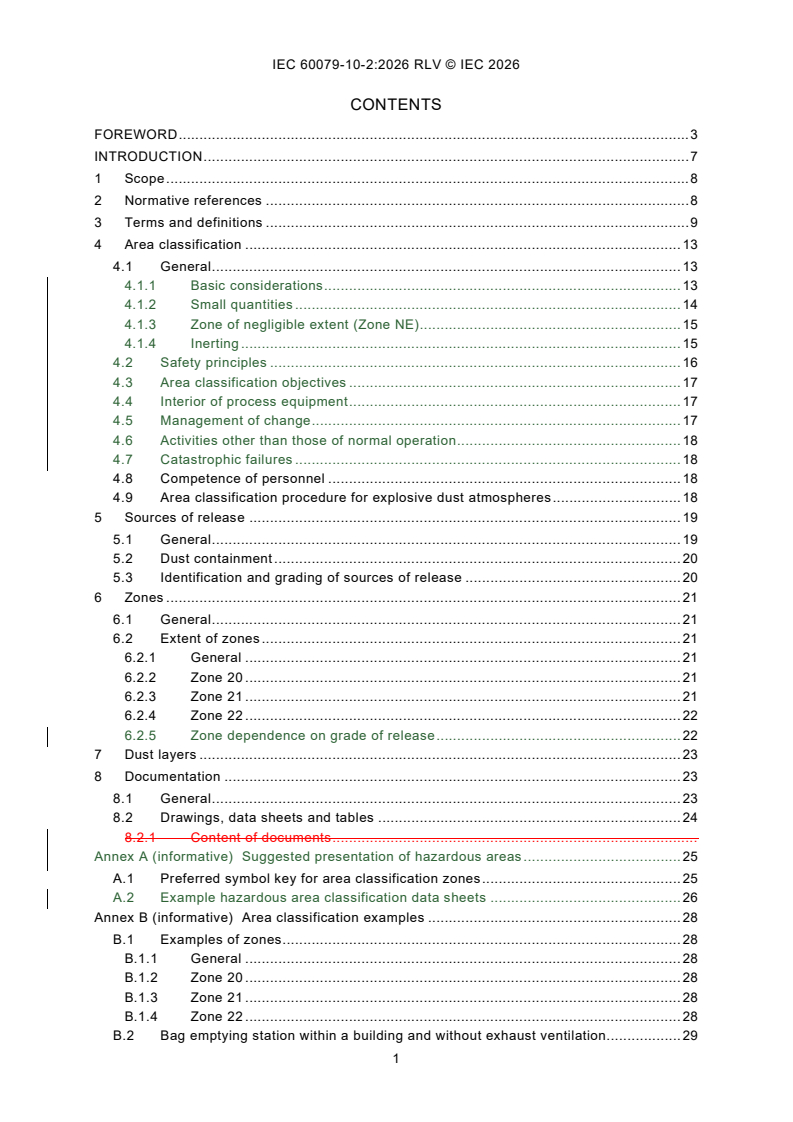
CONTENTS
FOREWORD . 3
INTRODUCTION . 7
1 Scope . 8
2 Normative references . 8
3 Terms and definitions . 9
4 Area classification . 13
4.1 General . 13
4.1.1 Basic considerations . 13
4.1.2 Small quantities . 14
4.1.3 Zone of negligible extent (Zone NE). 15
4.1.4 Inerting . 15
4.2 Safety principles . 16
4.3 Area classification objectives . 17
4.4 Interior of process equipment . 17
4.5 Management of change . 17
4.6 Activities other than those of normal operation . 18
4.7 Catastrophic failures . 18
4.8 Competence of personnel . 18
4.9 Area classification procedure for explosive dust atmospheres . 18
5 Sources of release . 19
5.1 General . 19
5.2 Dust containment . 20
5.3 Identification and grading of sources of release . 20
6 Zones . 21
6.1 General . 21
6.2 Extent of zones . 21
6.2.1 General . 21
6.2.2 Zone 20 . 21
6.2.3 Zone 21 . 21
6.2.4 Zone 22 . 22
6.2.5 Zone dependence on grade of release . 22
7 Dust layers . 23
8 Documentation . 23
8.1 General . 23
8.2 Drawings, data sheets and tables . 24
8.2.1 Content of documents .
Annex A (informative) Suggested presentation of hazardous areas . 25
A.1 Preferred symbol key for area classification zones . 25
A.2 Example hazardous area classification data sheets . 26
Annex B (informative) Area classification examples . 28
B.1 Examples of zones . 28
B.1.1 General . 28
B.1.2 Zone 20 . 28
B.1.3 Zone 21 . 28
B.1.4 Zone 22 . 28
B.2 Bag emptying station within a building and without exhaust ventilation. 29
B.3 Bag emptying station with exhaust ventilation . 30
B.4 Cyclone and filter with clean outlet outside building . 31
B.5 Drum tipper within a building without exhaust ventilation . 32
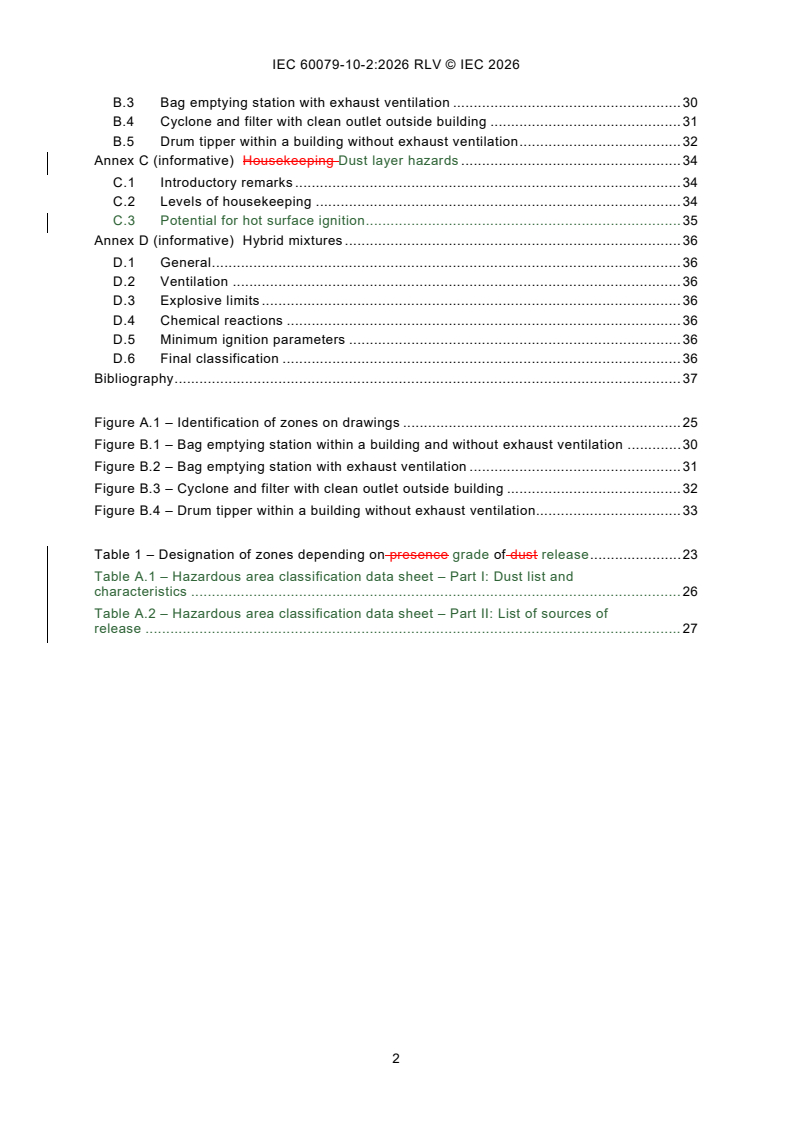
Annex C (informative) Housekeeping Dust layer hazards . 34
C.1 Introductory remarks . 34
C.2 Levels of housekeeping . 34
C.3 Potential for hot surface ignition . 35
Annex D (informative) Hybrid mixtures . 36
D.1 General . 36
D.2 Ventilation . 36
D.3 Explosive limits . 36
D.4 Chemical reactions . 36
D.5 Minimum ignition parameters . 36
D.6 Final classification . 36
Bibliography . 37
Figure A.1 – Identification of zones on drawings . 25
Figure B.1 – Bag emptying station within a building and without exhaust ventilation . 30
Figure B.2 – Bag emptying station with exhaust ventilation . 31
Figure B.3 – Cyclone and filter with clean outlet outside building . 32
Figure B.4 – Drum tipper within a building without exhaust ventilation. 33
Table 1 – Designation of zones depending on presence grade of dust release . 23
Table A.1 – Hazardous area classification data sheet – Part I: Dust list and
characteristics . 26
Table A.2 – Hazardous area classification data sheet – Part II: List of sources of
release . 27
INTERNATIONAL ELECTROTECHNICAL COMMISSION
____________
Explosive atmospheres -
Part 10-2: Classification of areas - Explosive dust atmospheres
FOREWORD
1) The International Electrotechnical Commission (IEC) is a worldwide organization for standardization comprising
all national electrotechnical committees (IEC National Committees). The object of IEC is to promote international
co-operation on all questions concerning standardization in the electrical and electronic fields. To this end and
in addition to other activities, IEC publishes International Standards, Technical Specifications, Technical Reports,
Publicly Available Specifications (PAS) and Guides (hereafter referred to as "IEC Publication(s)"). Their
preparation is entrusted to technical committees; any IEC National Committee interested in the subject dealt with
may participate in this preparatory work. International, governmental and non-governmental organizations liaising
with the IEC also participate in this preparation. IEC collaborates closely with the International Organization for
Standardization (ISO) in accordance with conditions determined by agreement between the two organizations.
2) The formal decisions or agreements of IEC on technical matters express, as nearly as possible, an international
consensus of opinion on the relevant subjects since each technical committee has representation from all
interested IEC National Committees.
3) IEC Publications have the form of recommendations for international use and are accepted by IEC National
Committees in that sense. While all reasonable efforts are made to ensure that the technical content of IEC
Publications is accurate, IEC cannot be held responsible for the way in which they are used or for any
misinterpretation by any end user.
4) In order to promote international uniformity, IEC National Committees undertake to apply IEC Publications
transparently to the maximum extent possible in their national and regional publications. Any divergence between
any IEC Publication and the corresponding national or regional publication shall be clearly indicated in the latter.
5) IEC itself does not provide any attestation of conformity. Independent certification bodies provide conformity
assessment services and, in some areas, access to IEC marks of conformity. IEC is not responsible for any
services carried out by independent certification bodies.
6) All users should ensure that they have the latest edition of this publication.
7) No liability shall attach to IEC or its directors, employees, servants or agents including individual experts and
members of its technical committees and IEC National Committees for any personal injury, property damage or
other damage of any nature whatsoever, whether direct or indirect, or for costs (including legal fees) and
expenses arising out of the publication, use of, or reliance upon, this IEC Publication or any other IEC
Publications.
8) Attention is drawn to the Normative references cited in this publication. Use of the referenced publications is
indispensable for the correct application of this publication.
9) IEC draws attention to the possibility that the implementation of this document may involve the use of (a)
patent(s). IEC takes no position concerning the evidence, validity or applicability of any claimed patent rights in
respect thereof. As of the date of publication of this document, IEC had not received notice of (a) patent(s), which
may be required to implement this document. However, implementers are cautioned that this may not represent
the latest information, which may be obtained from the patent database available at https://patents.iec.ch. IEC
shall not be held responsible for identifying any or all such patent rights.
This redline version of the official IEC Standard allows the user to identify the changes made
to the previous edition IEC 60079-10-2:2015. A vertical bar appears in the margin wherever a
change has been made. Additions are in green text, deletions are in strikethrough red text.
IEC 60079-10-2 has been prepared by Subcommittee SC31J: Classification of hazardous areas
and installation requirements of IEC technical committee 31: Equipment for explosive
atmospheres. It is an International Standard.
This third edition of IEC 60079-10-2 cancels and replaces the second edition of IEC 60079-10-2
published in 2015. This edition constitutes a technical revision.
Users of this document are advised that interpretation sheets clarifying the interpretation of this
document can be published. Interpretation sheets are available from the IEC webstore and can
be found in the "history" tab of the page for each document.
This edition includes the following significant technical changes with respect to the previous
edition:
Type
Explanation of the significance of the Clause Minor and Extension Major
changes editorial technical
changes changes
X
Scope 1
Revised to clarify that this document applies at
standard atmospheric conditions and standard
oxidizing medium.
X
Terms and definitions 3.1.3
Revised the informational note to the
combustible dust definition to correctly point to
the proper sieve size for 500 micron material.
X
Terms and definitions Formerly
The term "extent of zone" was removed as the 3.1.7
term expresses the meaning more clearly than
the definition.
X
Terms and definitions 3.11
Revised the definition of "equipment" to reflect
the IEV defined term.
X
Terms and definitions 3.2.1
Added a definition for Minimum Explosible
Concentration based on NFPA 660's definition.
X
Terms and definitions 3.10
Revised the definitions of Zone 20, 21, and 22
and added a definition of Zone NE to reflect the
IEV defined terms.
X
Terms and definitions 3.2.4
Added definition of "Limiting Oxygen
Concentration" to align with EN definition as
referenced.
X
Terms and definitions 3.2.5
Added definition of "Minimum Ignition Energy" to
align with IEC 80079-20-2 definition.
X
Area classification 4.1
Revised subclause editorially based on
comments received.
X
Revised subclause to include guidance on 4.1.1
particle density vs. ability to travel greater
distances as based on NFPA 499.
X
Area classification 4.1.2
Added description of "small quantities" based on
IEC 60079-10-1.
X
Area classification 4.1.3
Added description of zone of "negligible extent"
to better clarify when such a zone might exist,
based on IEC 60079-10-1.
Type
Explanation of the significance of the Clause Minor and Extension Major
changes editorial technical
changes changes
X
Area classification 4.1.4
Revised the subclause to address inerting by
inert gas or mixture with non-combustible dust.
X
Safety principles 4.2
Existing text was grouped and organized to align
with IEC 60079-10-1 and to improve usability.
X
Area classification objectives 4.3
Existing text was grouped and organized to align
with IEC 60079-10-1 and to improve usability.
X
Interior of process equipment 4.4
Existing text was grouped and organized to align
with IEC 60079-10-1 and to improve usability.
X
Management of change 4.5
Existing text was grouped and organized to align
with IEC 60079-10-1 and to improve usability.
X
Management of change 4.5
Recommended a 3 years interval for reviewing
the classification of an area.
X
Commissioning and maintenance 4.6
Existing text was grouped and organized to align
with IEC 60079-10-1 and to improve usability.
X
Catastrophic failures 4.7
Existing text was grouped and organized to align
with IEC 60079-10-1 and to improve usability.
X
Competence of personnel 4.8
Existing language recommending that competent
personnel conduct the area classification
assessment was converted to mandatory
language based on comments received.
X
Area classification procedure for explosive dust 4.9
atmospheres
Procedure/subclause has been cleaned up
editorially and revised based on comments
received.
X
Zone 21 6.2.3
Revised the subclause making the former "Note
1" into normative text based on comments
received.
X
Zone 22 6.2.4
Revised the section making the former "Note"
into normative text based on comments received.
X
Clause A.1 A.1
Preferred symbols previously shown were moved
to Annex A as the annex is informative, not
normative.
X
Clause A.2 A.2
Sample Table A.1 was added to provide a
possible table format to be used. This is
informative and not normative.
X
Clause C.1 C.1
Added language reference to maximum
recommended dust layer thicknesses, beyond
which classification or improved housekeeping
should be considered.
X
Clause C.3 C.3
Added language referencing the danger of hot
surface ignition of layers of dust.
X
Annex D Annex D
Minor editorial changes to the document to
address comments from CD.
Explanation of the types of significant changes:
– Clarification
– Decrease of technical requirements
1. Minor and editorial changes:
– Minor technical change
– Editorial corrections
These are changes which modify requirements in an editorial or a minor technical way. They include changes of
the wording to clarify technical requirements without any technical change, or a reduction in the level of existing
requirement.
2. Extension: – Addition of technical options
These are changes which add new or modify existing technical requirements, in a way that new options are
given, but without increasing the requirements that are fully compliant with the previous standard. Therefore,
these will not have to be considered for existing area classifications in conformity with the preceding edition.
– Addition of technical requirements
3. Major technical changes:
– Increase of technical requirements
These are changes to technical requirements (addition, increase of the level or removal) made in a way that an
existing area classification in conformity with the preceding edition will not always be able to fulfil the
requirements given in the later edition. These changes have to be considered for existing area classifications in
conformity with the preceding edition.
The text of this International Standard is based on the following documents:
Draft Report on voting
31J/413/FDIS 31J/419/RVD
Full information on the voting for its approval can be found in the report on voting indicated in
the above table.
The language used for the development of this International Standard is English.
This document was drafted in accordance with ISO/IEC Directives, Part 2, and developed in
accordance with ISO/IEC Directives, Part 1 and ISO/IEC Directives, IEC Supplement, available
at www.iec.ch/members_experts/refdocs. The main document types developed by IEC are
described in greater detail at www.iec.ch/publications.
A list of all parts of the IEC 60079 series, under the general title Explosive atmospheres, can
be found on the IEC website.
The committee has decided that the contents of this document will remain unchanged until the
stability date indicated on the IEC website under webstore.iec.ch in the data related to the
specific document. At this date, the document will be
– reconfirmed,
– withdrawn, or
– revised.
INTRODUCTION
Combustible dusts are hazardous because when they are dispersed in air by any means they
may could form potentially explosive atmospheres. Furthermore, layers of dust may could ignite
and act as ignition sources for an explosive atmosphere.
This part of IEC 60079 gives guidance on the identification and classification of areas where
such hazards from dust can arise. It sets out the essential criteria against which the ignition
hazards due to combustible dusts can be assessed and gives guidance on the design and
control parameters which can be used in order to reduce such a hazard. General and special
criteria are given for the process of identification and classification of hazardous areas.
This document contains an informative Annex B giving examples for classifying hazardous
areas.
1 Scope
This part of IEC 60079 is concerned with the identification and classification of areas where
explosive dust atmospheres and combustible dust layers are present in order to permit the
proper assessment of ignition sources in such areas.
In this document, explosive dust atmospheres and combustible dust layers are treated
separately. In Clause 4, area classification for explosive dust clouds is described, with dust
layers acting as one of the possible sources of release. In Clause 7, other general
considerations for dust layers are described.
The examples in this document are based on a system of effective housekeeping being
implemented in the plant to prevent dust layers from accumulating. Where effective
housekeeping is not present, the area classification includes the possible formation of explosive
dust clouds from dust layers.
The principles of this document can also be followed when combustible fibres or flyings might
cause a hazard.
This standard is intended to be applied where there can be a risk due to the presence of
explosive dust atmospheres or combustible dust layers under normal atmospheric conditions
(see Note 1).
NOTE 1 Atmospheric conditions include variations in pressure and temperature above and
below reference levels of 101,3 kPa (1 013 mbar) and 20 °C (293 K), provided that the
variations have a negligible effect on the explosive properties of the combustible material. For
air with normal oxygen content, typically a volume fraction of 21 % is assumed.
It does not apply to
a) underground mining areas;
b) dusts of explosives that do not require atmospheric oxygen for combustion such as
pyrophoric substances, propellants, pyrotechnics, munitions, peroxides, oxidizers,
water-reactive elements or compounds, or other similar materials;
c) catastrophic failures or rare malfunctions which are beyond outside the concept of
abnormality conditions dealt with in this document;
– any risk arising from an emission of toxic gas from the dust.
d) rooms used for medical purposes;
e) domestic premises;
f) This standard does not apply to where a hazard might arise is due to the presence of
flammable gas or vapour, but the principles may can be used in the assessment of a hybrid
mixture (see also IEC 60079-10-1).
NOTE Additional guidance on hybrid mixtures is provided in Annex D.
This document does not consider the effects of consequential damage following a fire or an
explosion.
2 Normative references
The following documents are referred to in the text in such a way that some or all of their content
constitutes requirements of this document. For dated references, only the edition cited applies.
For undated references, the latest edition of the referenced document (including any
amendments) applies.
IEC 60079-0, Explosive atmospheres - Part 0: Equipment - General requirements
IEC 60079-10-1, Explosive atmospheres – Part 10-1: Classification of areas – Explosive gas
atmospheres
ISO/IEC 80079-20-2, Explosive Atmospheres – Part 20-2: Material Characteristics –
Combustible dusts test methods
3 Terms and definitions
For the purposes of this document, the terms and definitions given in IEC 60079-0 and the
following apply.
ISO and IEC maintain terminology databases for use in standardization at the following
addresses:
– IEC Electropedia: available at https://www.electropedia.org/
– ISO Online browsing platform: available at https://www.iso.org/obp
NOTE Additional definitions applicable to explosive atmospheres can be found in IEC 60050-426.
3.1
area
three-dimensional region or space
3.1
dust
3.1.1
dust
generic term including both combustible dust and or combustible flyings
[SOURCE: IEC 60079-0:2026, 3.25, modified – Note 1 to entry removed]
3.1.2
combustible flyings
solid particles, including fibres, where one dimension is greater than 500 µm in nominal size,
which may can form an explosive mixture with air at standard atmospheric pressure and normal
temperature
Note 1 to entry: Examples of flyings include rayon, cotton (including cotton linters and cotton waste) sisal, jute,
hemp, cocoa fibre, oakum and waste kapok.
Note 2 to entry: Combustible flyings are classified as Group IIIA.
[SOURCE: ISO/IEC 80079-20-2:2016, 3.2, modified – "may" replaced with "can"]
3.1.3
combustible dust
finely divided solid particles, 500 μm or less in nominal size, which may can form an explosive
mixture with air at atmospheric pressure and normal temperatures
Note 1 to entry: This includes dust and grit as defined in ISO 4225.
Note 1 to entry: The term solid particles is intended to address particles in the solid phase and not the gaseous or
liquid phase, but does not preclude a hollow particle.
Note 2 to entry: Materials passing a U.S. No. 40 35 Standard sieve as defined in ASTM E 11-04 E11 are considered
to meet the 500 μm criterion.
___________
To be published.
Note 3 to entry: Combustible dust test methods can be found in ISO/IEC 80079-20-2.
[SOURCE: ISO/IEC 80079-20-2:2016, 3.1]
3.1.4
non-conductive dust
combustible dust with electrical resistivity greater than 10 Ω 1 kΩ × m
Note 1 to entry: Non-conductive dust is classified as Group IIIB.
3.1.5
conductive dust
combustible dust metal dusts and other combustible dusts with electrical resistivity equal to or
less than 10 Ω 1 kΩ × m
Note 1 to entry: ISO/IEC 80079-20-2 contains the test method for determining the electrical resistivity of dusts.
Note 2 to entry: Metal dust is treated as conductive dust because it is assumed that surface oxidation cannot be
depended upon to always ensure electrical resistivity greater than 1 kΩ × m.
Note 3 to entry: Conductive dust is classified as Group IIIC.
[SOURCE: ISO/IEC 80079-20-2:2016, 3.1.1, modified – addition of Notes 1 and 3 to entry]
3.14
continuous formation of a dust cloud
locations in which a dust cloud may exist continuously, or may be expected to continue for long
periods or for short periods which occur frequently
3.22
ignition temperature of a dust layer
lowest temperature of a surface at which ignition occurs in a dust on the surface
Note 1 to entry: The ignition temperature of a dust layer may be determined by the test method given in
ISO/IEC 80079-20-2.
3.23
ignition temperature of a dust cloud
lowest temperature of the hot inner wall of a furnace at which ignition occurs in a dust cloud in
air contained therein
Note 1 to entry: The ignition temperature of a dust cloud may be determined by the test method given in ISO/IEC
80079-20-2.
3.2
dust properties
3.2.1
minimum explosible concentration
MEC
minimum concentration of a combustible dust suspended in air, measured in mass per unit
volume, that will support a deflagration
Note 1 to entry: This is sometimes referred to as lower explosion limit (LEL), for example EN 14034-3:2011 or
EN 13237:2024.
[SOURCE: NFPA 660:2025, 3.3.78]
3.2.2
layer ignition temperature
DEPRECATED: minimum ignition temperature of a dust layer
MIT
L
lowest temperature of a hot surface at which ignition occurs in a dust layer under specified test
conditions
[SOURCE: ISO/IEC 80079-20-2:2016, 3.4, modified – addition of new preferred term "layer
ignition temperature" and admitted term "MIT "]
L
3.2.3
cloud ignition temperature
DEPRECATED: minimum ignition temperature of a dust cloud
MIT
C
lowest temperature of a hot surface on which the most ignitible mixture of the dust with air is
ignited under specified test conditions
[SOURCE: ISO/IEC 80079-20-2:2016, 3.5, modified – addition of new preferred term "cloud
ignition temperature" and admitted term "MIT "]
C
3.2.4
limiting oxygen concentration
LOC
maximum oxygen concentration in mixture of a combustible dust and air and an inert gas, in
which an explosion will not occur, determined under test conditions
Note 1 to entry: Test conditions are specified in EN 14034-4 and ASTM E2931.
Note 2 to entry: This is also referred to as limiting oxidant concentration.
[SOURCE: EN 14034-4:2004, 3.7, modified – Notes 1 and 2 to entry added]
3.2.5
minimum ignition energy
MIE
lowest electrical energy stored in a capacitor which upon
discharge is sufficient to effect ignition of the most sensitive dust/air mixture under specified
test conditions
[SOURCE: ISO/IEC 80079-20-2:2016, 3.6]
3.3
explosive dust atmosphere
mixture with air, under atmospheric conditions, of flammable combustible substances in the
form of dust, which, after ignition, permits self-sustaining propagation
Note 1 to entry: Non-conductive dust is classified as Group IIIB.
3.4
hazardous area
area in which combustible dust, in the form of a cloud, is present, or may can be
expected to be present, in quantities such as to require special precautions for the construction,
installation and use of equipment
Note 1 to entry: Hazardous areas are divided into zones based upon the frequency and duration of the occurrence
of explosive dust atmospheres (see 6.2 and 6.3).
Note 2 to entry: The potential of creating an explosive dust cloud from a dust layer also needs to be considered.
Note 3 to entry: For the purposes of this document, an area is a three-dimensional region or space.
3.5
non-hazardous area
area in which combustible dust, in the form of a cloud, is not expected to be present in
quantities such as to require special precautions for the construction, installation and use of
equipment
3.6
hybrid mixture
mixture of a flammable gas or vapour with a dust
3.7
operation
3.7.1
normal operation
operation of equipment conforming electrically and mechanically with
its design specification and used within the limits specified by the manufacturer
Note 1 to entry: Minor releases of dust which may could form a cloud or layer (for example, releases from filters)
can be part of normal operation.
[SOURCE: IEC 60079-0:2026, 3.65, modified – Notes 1, 2 and 3 to entry replaced with new
Note 1 to entry]
3.7.2
abnormal operation
process-linked malfunctions that occur infrequently
3.7.3
catastrophic failure
occurrence which exceeds the design parameters of the process
plant and control system resulting in major release of flammable material dust
Note 1 to entry: Catastrophic failure in this context is applied, for example, to the rupture of a storage silo or a
pneumatic conveyor.
3.8
dust containment
process equipment housing which is intended to handle, process, transport or store materials
inside of it, while minimizing the risk possibility of the release of dust to the surrounding
atmosphere
3.9
source of dust release
point or location from which dust may can be released into the atmosphere
Note 1 to entry: The source of dust release can be from a dust containment or from a dust layer.
3.9.1
continuous grade of release
release which is continuous or is expected to occur frequently or for long periods
3.9.2
primary grade of release
release which can be expected to occur periodically or occasionally during normal operation
3.9.3
secondary grade of release
release which is not expected to occur in normal operation and, if it does occur, is likely to do
so only infrequently and for short periods
3.10
Zones
3.10.1
Zone 20
a placearea in which an explosive dust atmosphere in the form of a cloud of combustible dust
in air is present continuously, or for long periods or frequently
3.10.2
Zone 21
a placearea in which an explosive dust atmosphere in the form of a cloud of combustible dust
in air is likely to occur, occasionally, in normal operation
3.10.3
Zone 22
area in which an explosive dust atmosphere in the form of a cloud of combustible dust in air is
not likely to occur in normal operation but, if it does occur, will persist for a short period only
Note 1 to entry: The potential of creating an explosive dust cloud from a dust layer also needs to be considered.
3.10.4
Zone NE
zone of negligible extent such that if ignition did occur it would have negligible consequences
Note 1 to entry: Zones of negligible extent could be Zone 20 NE, Zone 21 NE, or Zone 22 NE.
[SOURCE: IEC 60079-10-1:2020, 3.3.8, modified – Note 1 to entry adapted]
3.11
equipment
general term including apparatus, fittings, devices, components, and
the like used as a part of, or in connection with, an installation in an explosive atmosphere
Note 1 to entry: Equipment incorporating a Type of Protection can be "Ex Equipment", or an "Ex Component".
[SOURCE: IEC 60079-0:2026, 3.33.1, modified – field of application and Note 1 to entry added]
3.12
verification dossier
set of documents showing the compliance assurance of electrical conformity of equipment and
installations
Note 1 to entry: Requirements for a 'verification dossier' are given in IEC 60079-14.
[SOURCE: IEC 60079-14:2024, 3.1.2, modified – Note 1 to entry added]
3.17
extent of zone
distance in any direction from the edge of a source of release to the point where the hazard
associated with the release is considered to exist no longer
4 Area classification
4.1 General
4.1.1 Basic considerations
This document adopts the concept, similar to that used for flammable gases and vapours, of
using area classification to give an assessment of the likelihood of an explosive dust
atmosphere occurring.
Dusts form explosive atmospheres only at concentrations within when the explosion range
concentration is at or above the minimum explosible concentration (MEC). Although a cloud
with a very high concentration may might not be explosive, the danger nevertheless exists that,
should the concentration fall, it may can enter the explosive range. Depending on the
circumstances, not every source of dust release will necessarily produce an explosive dust
atmosphere. Dust clouds are also rarely of uniform density and consideration should be given
to possible variances in concentration within a cloud for any condition or release.
Airborne dusts that are not removed by mechanical extraction or artificial ventilation settle out
at a rate depending on properties, such as particle size, into layers or accumulations. It shall
be taken into account that a dilute or small continuous source of release, in time, is able to
produce a potentially hazardous dust layer. A diluted or small continuous source of dust release,
in time, could produce a hazardous dust layer.
Dusts with a specific particle density less than 641 kg/m are considered to be fine dust and
can drift on air currents for distances considerably further than those dusts with densities
greater than 641 kg/m .
NOTE 1 The specific particle density value source is NFPA 499: 2024, section 6.9.4. The hazards presented by
dusts are as follows:
– the formation of a dust cloud from any source of dust release, including a layer or accumulation, to form an
explosive dust atmosphere (see Clause 5);
– the formation of dust layers, which are not likely to form a dust cloud, but may could ignite due to self-heating
or exposure to hot surfaces or thermal flux and cause a fire hazard or over-heating of equipment. The ignited
layer may could also act as an ignition source for an explosive atmosphere.
Since explosive dust clouds and dust layers may exist, any source of ignition should be avoided.
Where explosive dust clouds or hazardous dust layers could exist, hazardous area classification
facilitates the selection of equipment such that the sources of ignition can be avoided.
If the source of ignition cannot be avoided, then measures shall be taken to reduce the likelihood
of dust and/or ignition sources so that the likelihood of coincidence is so small as to make the
risk negligible.
NOTE In some cases, where the risk of explosion cannot be completely avoided, it can be necessary to employ
some form of explosion protection such as explosion venting, explosion suppression or explosion isolation.
Subsequent to the completion of the area classification, a risk assessment may be carried out
to assess whether the consequences of ignition of an explosive atmosphere require the use of
equipment of a higher Equipment Protection Level (EPL) or may justify the use of equipment
with a lower Equipment Protection Level than normally required.
The EPL requirements should be recorded, as appropriate, on the hazardous area classification
documents and drawings to allow proper selection of equipment.
NOTE 2 IEC 60079-0 describes EPLs and IEC 60079-14 defines the application of EPLs to an installation.
NOTE 3 This document does not define the methodology for carrying out a risk assessment to vary the EPL ratings
as specification for any risk assessment methodology is out of the scope of this document.
In this document, explosive dust atmospheres and dust layers are treated separately. In this
clause, area classification for explosive dust clouds is described, with dust layers acting as one
of the possible sources of release. Considerations for dust layers are described in Clause 7.
4.1.2 Small quantities
If the quantity of dust available for release is small, whilst a potential explosive condition can
exist, it might not be appropriate to classify as a hazardous area. Notwithstanding this general
guidance, consideration should always be given to the potential for a release and the ability to
adequately avoid combustible conditions, for example by using dust extraction. Small quantities
in small spaces can still be a hazard.
Factors to be considered in determining whether hazardous area classification is appropriate
include all of the following:
a) levels of cleanliness,
b) industry practice,
c) competency and training of personnel handling the combustible dust or flyings,
d) other spill or release control measures,
e) ventilation, and,
f) health risks and exposure controls.
In areas where there are small quantities present and the area is not classified, management
of ignition sources by other than the use of Ex equipment can be appropriate.
An example of this can include small bakeries where the type of handling is mainly manual and
the scale of operation is small and not continuous, such that the potential for significant dust
clouds is low.
The considerations and factors should be documented (see Clause 8).
4.1.3 Zone of negligible extent (Zone NE)
In some cases, a zone of negligible extent could arise and may be treated as non-hazardous.
The zone of negligible extent would also imply either a negligible release rate or a negligible
release quantity.
Such a zone implies that an explosion, if it takes place, will have negligible consequences. The
Zone NE concept can be applied irrespective of any other adjustments for risk assessment to
determine EPL.
The criteria for a Zone NE classification shall be based on all of the following factors:
a) ignition would not result in sufficient pressure to cause harm either due to the limited energy
in the pressure wave or due to damage that could cause flying objects or particles, for
example, broken glass from windows,
b) ignition would not result in sufficient heat to cause harm or a fire in surrounding materials,
c) a release that does not deposit a significant level of dust, which can be indicated by a
discernible difference in surface colour between the material and the underlying surface,
and,
d) consideration of the potential for ignition of a negligible extent release to create a larger
dust cloud due to the presence of dust layers.
NOTE Good housekeeping practices which manage the potential for dust layers could support consideration of
Zone NE.
4.1.4 Inerting
4.1.4.1 Mixtures with non-combustible dust
Combustible dusts or combustible flyings can be rendered inert by mixing with non-combustible
dust. The specific ratio of combustible dust to the inerting material varies widely depending on
the chemistry of the fuel
...
IEC 60079-10-2 ®
Edition 3.0 2026-06
INTERNATIONAL
STANDARD
Explosive atmospheres -
Part 10-2: Classification of areas - Explosive dust atmospheres
ICS 29.260.20 ISBN 978-2-8327-1358-7
All rights reserved. Unless otherwise specified, no part of this publication may be reproduced or utilized in any form or
by any means, electronic or mechanical, including photocopying and microfilm, without permission in writing from either
IEC or IEC's member National Committee in the country of the requester. If you have any questions about IEC copyright
or have an enquiry about obtaining additional rights to this publication, please contact the address below or your local
IEC member National Committee for further information.
IEC Secretariat Tel.: +41 22 919 02 11
3, rue de Varembé info@iec.ch
CH-1211 Geneva 20 www.iec.ch
Switzerland
About the IEC
The International Electrotechnical Commission (IEC) is the leading global organization that prepares and publishes
International Standards for all electrical, electronic and related technologies.
About IEC publications
The technical content of IEC publications is kept under constant review by the IEC. Please make sure that you have the
latest edition, a corrigendum or an amendment might have been published.
IEC publications search - IEC Products & Services Portal - products.iec.ch
webstore.iec.ch/advsearchform Discover our powerful search engine and read freely all the
The advanced search enables to find IEC publications by a publications previews, graphical symbols and the glossary.
variety of criteria (reference number, text, technical With a subscription you will always have access to up to date
committee, …). It also gives information on projects, content tailored to your needs.
replaced and withdrawn publications.
Electropedia - www.electropedia.org
The world's leading online dictionary on electrotechnology,
IEC Just Published - webstore.iec.ch/justpublished
Stay up to date on all new IEC publications. Just Published containing more than 22 500 terminological entries in English
details all new publications released. Available online and and French, with equivalent terms in 25 additional languages.
once a month by email. Also known as the International Electrotechnical Vocabulary
(IEV) online.
IEC Customer Service Centre - webstore.iec.ch/csc
If you wish to give us your feedback on this publication or
need further assistance, please contact the Customer
Service Centre: sales@iec.ch.
CONTENTS
FOREWORD . 3
INTRODUCTION . 7
1 Scope . 8
2 Normative references . 8
3 Terms and definitions . 9
4 Area classification . 13
4.1 General . 13
4.1.1 Basic considerations . 13
4.1.2 Small quantities . 14
4.1.3 Zone of negligible extent (Zone NE). 14
4.1.4 Inerting . 15
4.2 Safety principles . 15
4.3 Area classification objectives . 16
4.4 Interior of process equipment . 16
4.5 Management of change . 16
4.6 Activities other than those of normal operation . 17
4.7 Catastrophic failures . 17
4.8 Competence of personnel . 17
4.9 Area classification procedure for explosive dust atmospheres . 17
5 Sources of release . 19
5.1 General . 19
5.2 Dust containment . 19
5.3 Identification and grading of sources of release . 19
6 Zones . 20
6.1 General . 20
6.2 Extent of zones . 20
6.2.1 General . 20
6.2.2 Zone 20 . 20
6.2.3 Zone 21 . 21
6.2.4 Zone 22 . 21
6.2.5 Zone dependence on grade of release . 21
7 Dust layers . 22
8 Documentation . 22
8.1 General . 22
8.2 Drawings, data sheets and tables . 22
Annex A (informative) Suggested presentation of hazardous areas . 24
A.1 Preferred symbol key for area classification zones . 24
A.2 Example hazardous area classification data sheets . 25
Annex B (informative) Area classification examples . 27
B.1 Examples of zones . 27
B.1.1 General . 27
B.1.2 Zone 20 . 27
B.1.3 Zone 21 . 27
B.1.4 Zone 22 . 27
B.2 Bag emptying station within a building and without exhaust ventilation. 28
B.3 Bag emptying station with exhaust ventilation . 29
B.4 Cyclone and filter with clean outlet outside building . 30
B.5 Drum tipper within a building without exhaust ventilation . 31
Annex C (informative) Dust layer hazards . 33
C.1 Introductory remarks . 33
C.2 Levels of housekeeping . 33
C.3 Potential for hot surface ignition . 34
Annex D (informative) Hybrid mixtures . 35
D.1 General . 35
D.2 Ventilation . 35
D.3 Explosive limits . 35
D.4 Chemical reactions . 35
D.5 Minimum ignition parameters . 35
D.6 Final classification . 35
Bibliography . 36
Figure A.1 – Identification of zones on drawings . 24
Figure B.1 – Bag emptying station within a building and without exhaust ventilation . 29
Figure B.2 – Bag emptying station with exhaust ventilation . 30
Figure B.3 – Cyclone and filter with clean outlet outside building . 31
Figure B.4 – Drum tipper within a building without exhaust ventilation. 32
Table 1 – Designation of zones depending on grade of release . 21
Table A.1 – Hazardous area classification data sheet – Part I: Dust list and
characteristics . 25
Table A.2 – Hazardous area classification data sheet – Part II: List of sources of
release . 26
INTERNATIONAL ELECTROTECHNICAL COMMISSION
____________
Explosive atmospheres -
Part 10-2: Classification of areas - Explosive dust atmospheres
FOREWORD
1) The International Electrotechnical Commission (IEC) is a worldwide organization for standardization comprising
all national electrotechnical committees (IEC National Committees). The object of IEC is to promote international
co-operation on all questions concerning standardization in the electrical and electronic fields. To this end and
in addition to other activities, IEC publishes International Standards, Technical Specifications, Technical Reports,
Publicly Available Specifications (PAS) and Guides (hereafter referred to as "IEC Publication(s)"). Their
preparation is entrusted to technical committees; any IEC National Committee interested in the subject dealt with
may participate in this preparatory work. International, governmental and non-governmental organizations liaising
with the IEC also participate in this preparation. IEC collaborates closely with the International Organization for
Standardization (ISO) in accordance with conditions determined by agreement between the two organizations.
2) The formal decisions or agreements of IEC on technical matters express, as nearly as possible, an international
consensus of opinion on the relevant subjects since each technical committee has representation from all
interested IEC National Committees.
3) IEC Publications have the form of recommendations for international use and are accepted by IEC National
Committees in that sense. While all reasonable efforts are made to ensure that the technical content of IEC
Publications is accurate, IEC cannot be held responsible for the way in which they are used or for any
misinterpretation by any end user.
4) In order to promote international uniformity, IEC National Committees undertake to apply IEC Publications
transparently to the maximum extent possible in their national and regional publications. Any divergence between
any IEC Publication and the corresponding national or regional publication shall be clearly indicated in the latter.
5) IEC itself does not provide any attestation of conformity. Independent certification bodies provide conformity
assessment services and, in some areas, access to IEC marks of conformity. IEC is not responsible for any
services carried out by independent certification bodies.
6) All users should ensure that they have the latest edition of this publication.
7) No liability shall attach to IEC or its directors, employees, servants or agents including individual experts and
members of its technical committees and IEC National Committees for any personal injury, property damage or
other damage of any nature whatsoever, whether direct or indirect, or for costs (including legal fees) and
expenses arising out of the publication, use of, or reliance upon, this IEC Publication or any other IEC
Publications.
8) Attention is drawn to the Normative references cited in this publication. Use of the referenced publications is
indispensable for the correct application of this publication.
9) IEC draws attention to the possibility that the implementation of this document may involve the use of (a)
patent(s). IEC takes no position concerning the evidence, validity or applicability of any claimed patent rights in
respect thereof. As of the date of publication of this document, IEC had not received notice of (a) patent(s), which
may be required to implement this document. However, implementers are cautioned that this may not represent
the latest information, which may be obtained from the patent database available at https://patents.iec.ch. IEC
shall not be held responsible for identifying any or all such patent rights.
IEC 60079-10-2 has been prepared by Subcommittee SC31J: Classification of hazardous areas
and installation requirements of IEC technical committee 31: Equipment for explosive
atmospheres. It is an International Standard.
This third edition of IEC 60079-10-2 cancels and replaces the second edition of IEC 60079-10-2
published in 2015. This edition constitutes a technical revision.
Users of this document are advised that interpretation sheets clarifying the interpretation of this
document can be published. Interpretation sheets are available from the IEC webstore and can
be found in the "history" tab of the page for each document.
This edition includes the following significant technical changes with respect to the previous
edition:
Type
Explanation of the significance of the Clause Minor and Extension Major
changes editorial technical
changes changes
X
Scope 1
Revised to clarify that this document applies at
standard atmospheric conditions and standard
oxidizing medium.
X
Terms and definitions 3.1.3
Revised the informational note to the
combustible dust definition to correctly point to
the proper sieve size for 500 micron material.
X
Terms and definitions Formerly
The term "extent of zone" was removed as the 3.1.7
term expresses the meaning more clearly than
the definition.
X
Terms and definitions 3.11
Revised the definition of "equipment" to reflect
the IEV defined term.
X
Terms and definitions 3.2.1
Added a definition for Minimum Explosible
Concentration based on NFPA 660's definition.
X
Terms and definitions 3.10
Revised the definitions of Zone 20, 21, and 22
and added a definition of Zone NE to reflect the
IEV defined terms.
X
Terms and definitions 3.2.4
Added definition of "Limiting Oxygen
Concentration" to align with EN definition as
referenced.
X
Terms and definitions 3.2.5
Added definition of "Minimum Ignition Energy" to
align with IEC 80079-20-2 definition.
X
Area classification 4.1
Revised subclause editorially based on
comments received.
X
Revised subclause to include guidance on 4.1.1
particle density vs. ability to travel greater
distances as based on NFPA 499.
X
Area classification 4.1.2
Added description of "small quantities" based on
IEC 60079-10-1.
X
Area classification 4.1.3
Added description of zone of "negligible extent"
to better clarify when such a zone might exist,
based on IEC 60079-10-1.
X
Area classification 4.1.4
Revised the subclause to address inerting by
inert gas or mixture with non-combustible dust.
X
Safety principles 4.2
Existing text was grouped and organized to align
with IEC 60079-10-1 and to improve usability.
X
Area classification objectives 4.3
Existing text was grouped and organized to align
with IEC 60079-10-1 and to improve usability.
X
Interior of process equipment 4.4
Existing text was grouped and organized to align
with IEC 60079-10-1 and to improve usability.
Type
Explanation of the significance of the Clause Minor and Extension Major
changes editorial technical
changes changes
X
Management of change 4.5
Existing text was grouped and organized to align
with IEC 60079-10-1 and to improve usability.
X
Management of change 4.5
Recommended a 3 years interval for reviewing
the classification of an area.
X
Commissioning and maintenance 4.6
Existing text was grouped and organized to align
with IEC 60079-10-1 and to improve usability.
X
Catastrophic failures 4.7
Existing text was grouped and organized to align
with IEC 60079-10-1 and to improve usability.
X
Competence of personnel 4.8
Existing language recommending that competent
personnel conduct the area classification
assessment was converted to mandatory
language based on comments received.
X
Area classification procedure for explosive dust 4.9
atmospheres
Procedure/subclause has been cleaned up
editorially and revised based on comments
received.
X
Zone 21 6.2.3
Revised the subclause making the former "Note
1" into normative text based on comments
received.
X
Zone 22 6.2.4
Revised the section making the former "Note"
into normative text based on comments received.
X
Clause A.1 A.1
Preferred symbols previously shown were moved
to Annex A as the annex is informative, not
normative.
X
Clause A.2 A.2
Sample Table A.1 was added to provide a
possible table format to be used. This is
informative and not normative.
X
Clause C.1 C.1
Added language reference to maximum
recommended dust layer thicknesses, beyond
which classification or improved housekeeping
should be considered.
X
Clause C.3 C.3
Added language referencing the danger of hot
surface ignition of layers of dust.
X
Annex D Annex D
Minor editorial changes to the document to
address comments from CD.
Explanation of the types of significant changes:
– Clarification
– Decrease of technical requirements
1. Minor and editorial changes:
– Minor technical change
– Editorial corrections
These are changes which modify requirements in an editorial or a minor technical way. They include changes of
the wording to clarify technical requirements without any technical change, or a reduction in the level of existing
requirement.
2. Extension: – Addition of technical options
These are changes which add new or modify existing technical requirements, in a way that new options are
given, but without increasing the requirements that are fully compliant with the previous standard. Therefore,
these will not have to be considered for existing area classifications in conformity with the preceding edition.
– Addition of technical requirements
3. Major technical changes:
– Increase of technical requirements
These are changes to technical requirements (addition, increase of the level or removal) made in a way that an
existing area classification in conformity with the preceding edition will not always be able to fulfil the
requirements given in the later edition. These changes have to be considered for existing area classifications in
conformity with the preceding edition.
The text of this International Standard is based on the following documents:
Draft Report on voting
31J/413/FDIS 31J/419/RVD
Full information on the voting for its approval can be found in the report on voting indicated in
the above table.
The language used for the development of this International Standard is English.
This document was drafted in accordance with ISO/IEC Directives, Part 2, and developed in
accordance with ISO/IEC Directives, Part 1 and ISO/IEC Directives, IEC Supplement, available
at www.iec.ch/members_experts/refdocs. The main document types developed by IEC are
described in greater detail at www.iec.ch/publications.
A list of all parts of the IEC 60079 series, under the general title Explosive atmospheres, can
be found on the IEC website.
The committee has decided that the contents of this document will remain unchanged until the
stability date indicated on the IEC website under webstore.iec.ch in the data related to the
specific document. At this date, the document will be
– reconfirmed,
– withdrawn, or
– revised.
INTRODUCTION
Combustible dusts are hazardous because when they are dispersed in air by any means they
could form explosive atmospheres. Furthermore, layers of dust could ignite and act as ignition
sources for an explosive atmosphere.
This part of IEC 60079 gives guidance on the identification and classification of areas where
such hazards from dust can arise. It sets out the essential criteria against which the hazards
due to combustible dusts can be assessed and gives guidance on the design and control
parameters which can be used in order to reduce such a hazard. General and special criteria
are given for the process of identification and classification of hazardous areas.
This document contains an informative Annex B giving examples for classifying hazardous
areas.
1 Scope
This part of IEC 60079 is concerned with the identification and classification of areas where
explosive dust atmospheres and combustible dust layers are present in order to permit the
proper assessment of ignition sources in such areas.
In this document, explosive dust atmospheres and combustible dust layers are treated
separately. In Clause 4, area classification for explosive dust clouds is described, with dust
layers acting as one of the possible sources of release. In Clause 7, other general
considerations for dust layers are described.
The examples in this document are based on a system of effective housekeeping being
implemented in the plant to prevent dust layers from accumulating. Where effective
housekeeping is not present, the area classification includes the possible formation of explosive
dust clouds from dust layers.
The principles of this document can also be followed when combustible fibres or flyings might
cause a hazard.
Atmospheric conditions include variations in pressure and temperature above and below
reference levels of 101,3 kPa (1 013 mbar) and 20 °C (293 K), provided that the variations have
a negligible effect on the explosive properties of the combustible material. For air with normal
oxygen content, typically a volume fraction of 21 % is assumed.
It does not apply to
a) underground mining areas;
b) dusts of explosives that do not require atmospheric oxygen for combustion such as
pyrophoric substances, propellants, pyrotechnics, munitions, peroxides, oxidizers,
water-reactive elements or compounds, or other similar materials;
c) catastrophic failures or rare malfunctions which are outside the conditions dealt with in this
document;
d) rooms used for medical purposes;
e) domestic premises;
f) where a hazard is due to the presence of flammable gas or vapour, but the principles can
be used in the assessment of a hybrid mixture (see also IEC 60079-10-1).
NOTE Additional guidance on hybrid mixtures is provided in Annex D.
This document does not consider the effects of consequential damage following a fire or an
explosion.
2 Normative references
The following documents are referred to in the text in such a way that some or all of their content
constitutes requirements of this document. For dated references, only the edition cited applies.
For undated references, the latest edition of the referenced document (including any
amendments) applies.
IEC 60079-0, Explosive atmospheres - Part 0: Equipment - General requirements
3 Terms and definitions
For the purposes of this document, the terms and definitions given in IEC 60079-0 and the
following apply.
ISO and IEC maintain terminology databases for use in standardization at the following
addresses:
– IEC Electropedia: available at https://www.electropedia.org/
– ISO Online browsing platform: available at https://www.iso.org/obp
NOTE Additional definitions applicable to explosive atmospheres can be found in IEC 60050-426.
3.1
dust
3.1.1
dust
combustible dust or combustible flyings
[SOURCE: IEC 60079-0:2026, 3.25, modified – Note 1 to entry removed]
3.1.2
combustible flyings
solid particles, including fibres, where one dimension is greater than 500 µm in nominal size,
which can form an explosive mixture with air at standard atmospheric pressure and temperature
Note 1 to entry: Examples of flyings include rayon, cotton (including cotton linters and cotton waste) sisal, jute,
hemp, cocoa fibre, oakum and waste kapok.
Note 2 to entry: Combustible flyings are classified as Group IIIA.
[SOURCE: ISO/IEC 80079-20-2:2016, 3.2, modified – "may" replaced with "can"]
3.1.3
combustible dust
finely divided solid particles, 500 μm or less in nominal size, which can form an explosive
mixture with air at atmospheric pressure and normal temperatures
Note 1 to entry: The term solid particles is intended to address particles in the solid phase and not the gaseous or
liquid phase, but does not preclude a hollow particle.
Note 2 to entry: Materials passing a U.S. No. 35 Standard sieve as defined in ASTM E11 are considered to meet
the 500 μm criterion.
Note 3 to entry: Combustible dust test methods can be found in ISO/IEC 80079-20-2.
[SOURCE: ISO/IEC 80079-20-2:2016, 3.1]
3.1.4
non-conductive dust
combustible dust with electrical resistivity greater than 1 kΩ × m
Note 1 to entry: Non-conductive dust is classified as Group IIIB.
3.1.5
conductive dust
combustible metal dusts and other combustible dusts with electrical resistivity equal to or less
than 1 kΩ × m
Note 1 to entry: ISO/IEC 80079-20-2 contains the test method for determining the electrical resistivity of dusts.
Note 2 to entry: Metal dust is treated as conductive dust because it is assumed that surface oxidation cannot be
depended upon to always ensure electrical resistivity greater than 1 kΩ × m.
Note 3 to entry: Conductive dust is classified as Group IIIC.
[SOURCE: ISO/IEC 80079-20-2:2016, 3.1.1, modified – addition of Notes 1 and 3 to entry]
3.2
dust properties
3.2.1
minimum explosible concentration
MEC
minimum concentration of a combustible dust suspended in air, measured in mass per unit
volume, that will support a deflagration
Note 1 to entry: This is sometimes referred to as lower explosion limit (LEL), for example EN 14034-3:2011 or
EN 13237:2024.
[SOURCE: NFPA 660:2025, 3.3.78]
3.2.2
layer ignition temperature
DEPRECATED: minimum ignition temperature of a dust layer
MIT
L
lowest temperature of a hot surface at which ignition occurs in a dust layer under specified test
conditions
[SOURCE: ISO/IEC 80079-20-2:2016, 3.4, modified – addition of new preferred term "layer
ignition temperature" and admitted term "MIT "]
L
3.2.3
cloud ignition temperature
DEPRECATED: minimum ignition temperature of a dust cloud
MIT
C
lowest temperature of a hot surface on which the most ignitible mixture of the dust with air is
ignited under specified test conditions
[SOURCE: ISO/IEC 80079-20-2:2016, 3.5, modified – addition of new preferred term "cloud
ignition temperature" and admitted term "MIT "]
C
3.2.4
limiting oxygen concentration
LOC
maximum oxygen concentration in mixture of a combustible dust and air and an inert gas, in
which an explosion will not occur, determined under test conditions
Note 1 to entry: Test conditions are specified in EN 14034-4 and ASTM E2931.
Note 2 to entry: This is also referred to as limiting oxidant concentration.
[SOURCE: EN 14034-4:2004, 3.7, modified – Notes 1 and 2 to entry added]
3.2.5
minimum ignition energy
MIE
lowest electrical energy stored in a capacitor which upon
discharge is sufficient to effect ignition of the most sensitive dust/air mixture under specified
test conditions
[SOURCE: ISO/IEC 80079-20-2:2016, 3.6]
3.3
explosive dust atmosphere
mixture with air, under atmospheric conditions, of combustible substances in the form of dust,
which, after ignition, permits self-sustaining propagation
3.4
hazardous area
area in which dust, in the form of a cloud, is present, or can be expected to be present,
in quantities such as to require special precautions for the construction, installation and use of
equipment
Note 1 to entry: Hazardous areas are divided into zones based upon the frequency and duration of the occurrence
of explosive dust atmospheres (see 6.2).
Note 2 to entry: The potential of creating an explosive dust cloud from a dust layer also needs to be considered.
Note 3 to entry: For the purposes of this document, an area is a three-dimensional region or space.
3.5
non-hazardous area
area in which dust, in the form of a cloud, is not expected to be present in quantities
such as to require special precautions for the construction, installation and use of equipment
3.6
hybrid mixture
mixture of a flammable gas or vapour with a dust
3.7
operation
3.7.1
normal operation
operation of equipment conforming electrically and mechanically with
its design specification and used within the limits specified by the manufacturer
Note 1 to entry: Minor releases of dust which could form a cloud or layer (for example, releases from filters) can be
part of normal operation.
[SOURCE: IEC 60079-0:2026, 3.65, modified – Notes 1, 2 and 3 to entry replaced with new
Note 1 to entry]
3.7.2
abnormal operation
process-linked malfunctions that occur infrequently
3.7.3
catastrophic failure
occurrence which exceeds the design parameters of the process
plant and control system resulting in major release of dust
Note 1 to entry: Catastrophic failure in this context is applied, for example, to the rupture of a storage silo or a
pneumatic conveyor.
3.8
dust containment
process equipment housing which is intended to handle, process, transport or store materials
inside of it, while minimizing the possibility of the release of dust to the surrounding atmosphere
3.9
source of dust release
point or location from which dust can be released into the atmosphere
Note 1 to entry: The source of dust release can be from a dust containment or from a dust layer.
3.9.1
continuous grade of release
release which is continuous or is expected to occur frequently or for long periods
3.9.2
primary grade of release
release which can be expected to occur periodically or occasionally during normal operation
3.9.3
secondary grade of release
release which is not expected to occur in normal operation and, if it does occur, is likely to do
so only infrequently and for short periods
3.10
Zones
3.10.1
Zone 20
area in which an explosive atmosphere in the form of a cloud of combustible dust in air is
present continuously, or for long periods or frequently
3.10.2
Zone 21
area in which an explosive atmosphere in the form of a cloud of combustible dust in air is likely
to occur, occasionally, in normal operation
3.10.3
Zone 22
area in which an explosive atmosphere in the form of a cloud of combustible dust in air is not
likely to occur in normal operation but, if it does occur, will persist for a short period only
Note 1 to entry: The potential of creating an explosive dust cloud from a dust layer also needs to be considered.
3.10.4
Zone NE
zone of negligible extent such that if ignition did occur it would have negligible consequences
Note 1 to entry: Zones of negligible extent could be Zone 20 NE, Zone 21 NE, or Zone 22 NE.
[SOURCE: IEC 60079-10-1:2020, 3.3.8, modified – Note 1 to entry adapted]
3.11
equipment
general term including apparatus, fittings, devices, and the like used
as a part of, or in connection with, an installation
Note 1 to entry: Equipment incorporating a Type of Protection can be "Ex Equipment", or an "Ex Component".
[SOURCE: IEC 60079-0:2026, 3.33.1, modified – field of application and Note 1 to entry added]
3.12
verification dossier
set of documents showing assurance of conformity of equipment and installations
Note 1 to entry: Requirements for a 'verification dossier' are given in IEC 60079-14.
[SOURCE: IEC 60079-14:2024, 3.1.2, modified – Note 1 to entry added]
4 Area classification
4.1 General
4.1.1 Basic considerations
This document adopts the concept, similar to that used for flammable gases and vapours, of
using area classification to give an assessment of the likelihood of an explosive dust
atmosphere occurring.
Dusts form explosive atmospheres only when the concentration is at or above the minimum
explosible concentration (MEC). Although a cloud with a very high concentration might not be
explosive, the danger nevertheless exists that, should the concentration fall, it can enter the
explosive range. Depending on the circumstances, not every source of dust release will
necessarily produce an explosive dust atmosphere. Dust clouds are also rarely of uniform
density and consideration should be given to possible variances in concentration within a cloud
for any condition or release.
Airborne dusts that are not removed by artificial ventilation settle out at a rate depending on
properties, such as particle size, into layers or accumulations. A diluted or small continuous
source of dust release, in time, could produce a hazardous dust layer.
Dusts with a specific particle density less than 641 kg/m are considered to be fine dust and
can drift on air currents for distances considerably further than those dusts with densities
greater than 641 kg/m .
NOTE 1 The specific particle density value source is NFPA 499: 2024, section 6.9.4. The hazards presented by
dusts are as follows:
– the formation of a dust cloud from any source of dust release, including a layer or accumulation, to form an
explosive dust atmosphere (see Clause 5);
– the formation of dust layers, which are not likely to form a dust cloud, but could ignite due to self-heating or
exposure to hot surfaces or thermal flux and cause a fire hazard or over-heating of equipment. The ignited layer
could also act as an ignition source for an explosive atmosphere.
Where explosive dust clouds or hazardous dust layers could exist, hazardous area classification
facilitates the selection of equipment such that the sources of ignition can be avoided.
Subsequent to the completion of the area classification, a risk assessment may be carried out
to assess whether the consequences of ignition of an explosive atmosphere require the use of
equipment of a higher Equipment Protection Level (EPL) or may justify the use of equipment
with a lower Equipment Protection Level than normally required.
The EPL requirements should be recorded, as appropriate, on the hazardous area classification
documents and drawings to allow proper selection of equipment.
NOTE 2 IEC 60079-0 describes EPLs and IEC 60079-14 defines the application of EPLs to an installation.
NOTE 3 This document does not define the methodology for carrying out a risk assessment to vary the EPL ratings
as specification for any risk assessment methodology is out of the scope of this document.
In this document, explosive dust atmospheres and dust layers are treated separately. In this
clause, area classification for explosive dust clouds is described, with dust layers acting as one
of the possible sources of release. Considerations for dust layers are described in Clause 7.
4.1.2 Small quantities
If the quantity of dust available for release is small, whilst a potential explosive condition can
exist, it might not be appropriate to classify as a hazardous area. Notwithstanding this general
guidance, consideration should always be given to the potential for a release and the ability to
adequately avoid combustible conditions, for example by using dust extraction. Small quantities
in small spaces can still be a hazard.
Factors to be considered in determining whether hazardous area classification is appropriate
include all of the following:
a) levels of cleanliness,
b) industry practice,
c) competency and training of personnel handling the combustible dust or flyings,
d) other spill or release control measures,
e) ventilation, and,
f) health risks and exposure controls.
In areas where there are small quantities present and the area is not classified, management
of ignition sources by other than the use of Ex equipment can be appropriate.
An example of this can include small bakeries where the type of handling is mainly manual and
the scale of operation is small and not continuous, such that the potential for significant dust
clouds is low.
The considerations and factors should be documented (see Clause 8).
4.1.3 Zone of negligible extent (Zone NE)
In some cases, a zone of negligible extent could arise and may be treated as non-hazardous.
The zone of negligible extent would also imply either a negligible release rate or a negligible
release quantity.
Such a zone implies that an explosion, if it takes place, will have negligible consequences. The
Zone NE concept can be applied irrespective of any other adjustments for risk assessment to
determine EPL.
The criteria for a Zone NE classification shall be based on all of the following factors:
a) ignition would not result in sufficient pressure to cause harm either due to the limited energy
in the pressure wave or due to damage that could cause flying objects or particles, for
example, broken glass from windows,
b) ignition would not result in sufficient heat to cause harm or a fire in surrounding materials,
c) a release that does not deposit a significant level of dust, which can be indicated by a
discernible difference in surface colour between the material and the underlying surface,
and,
d) consideration of the potential for ignition of a negligible extent release to create a larger
dust cloud due to the presence of dust layers.
NOTE Good housekeeping practices which manage the potential for dust layers could support consideration of
Zone NE.
4.1.4 Inerting
4.1.4.1 Mixtures with non-combustible dust
Combustible dusts or combustible flyings can be rendered inert by mixing with non-combustible
dust. The specific ratio of combustible dust to the inerting material varies widely depending on
the chemistry of the fuel and the inertant. Unless specific data is available for the specific
mixture, testing according to ISO/IEC 80079-20-2 should be used to determine whether the
mixture is combustible.
NOTE Published data is available for some types of coal dust inerted with rock dust. See [8] .
When this concept is applied, it is important that the particle size distribution of the non-
combustible dust and the combustible dust are similar and that a cloud of the mixture maintains
a similar ratio of combustible to inert dust at all points within the cloud, for example, stratification
or separation is not expected.
4.1.4.2 Use of inert gases
Combustible dusts and combustible flyings can also be rendered inert by replacing atmospheric
oxygen in a system with a non-reactive, non-flammable gas.
Where inerting with gas is used, the interior of equipment containing dusts should be classified
as a less onerous zone or as a non-hazardous area. In such cases the reliability of the control
measures should be commensurate with the reduction in hazardous area that is determined for
the interior of the equipment.
4.2 Safety principles
Installations in which dust is handled or stored should be designed, constructed, operated and
maintained so that any releases of dust, and consequently the extent of hazardous areas, are
kept to a minimum, whether in normal or abnormal operation, with regard to frequency, duration
and quantity of a release.
It is important to examine those parts of process equipment and systems from which a release
of dust can arise and to consider modifying the design to minimize the likelihood and frequency
of such releases and the quantity and rate of release of substance.
These fundamental considerations should be examined at an early stage of the design
development of any process plant and should also receive prime attention in carrying out the
area classification study.
In the case of activities other than those of normal operation, for example, commissioning or
nonroutine maintenance, the area classification might not be valid. It is expected that the
activities other than those of normal operation would be dealt with by a safe system of work.
The area classification should take into account any routine maintenance.
In a situation in which there could be an explosive dust atmosphere at least one of the following
items should be controlled so that the likelihood of coincidence is so small as to make the risk
negligible:
a) the likelihood of an explosive dust atmosphere occurring around the source of ignition, or
b) the source of ignition.
___________
Numbers in square brackets refer to the Bibliography.
In particular, Zone 20 or Zone 21 areas should be minimized in number and extent by design
or suitable operating procedures. In other words, plants and installations should be mainly
Zone 22 or non-hazardous. Where release of dust is unavoidable, process equipment items
should be limited to those which give secondary grade releases or, failing this (that is where
primary or continuous grade releases are unavoidable), the releases s
...
IEC 60079-10-2 ®
Edition 3.0 2026-06
NORME
INTERNATIONALE
Atmosphères explosives -
Partie 10-2: Classement des emplacements - Atmosphères explosives
poussiéreuses
ICS 29.260.20 ISBN 978-2-8327-1358-7
Droits de reproduction réservés. Sauf indication contraire, aucune partie de cette publication ne peut être reproduite ni
utilisée sous quelque forme que ce soit et par aucun procédé, électronique ou mécanique, y compris la photocopie et
les microfilms, sans l'accord écrit de l'IEC ou du Comité national de l'IEC du pays du demandeur. Si vous avez des
questions sur le copyright de l'IEC ou si vous désirez obtenir des droits supplémentaires sur cette publication, utilisez
les coordonnées ci-après ou contactez le Comité national de l'IEC de votre pays de résidence.
IEC Secretariat Tel.: +41 22 919 02 11
3, rue de Varembé info@iec.ch
CH-1211 Geneva 20 www.iec.ch
Switzerland
A propos de l'IEC
La Commission Electrotechnique Internationale (IEC) est la première organisation mondiale qui élabore et publie des
Normes internationales pour tout ce qui a trait à l'électricité, à l'électronique et aux technologies apparentées.
A propos des publications IEC
Le contenu technique des publications IEC est constamment revu. Veuillez vous assurer que vous possédez l’édition la
plus récente, un corrigendum ou amendement peut avoir été publié.
Recherche de publications IEC - IEC Products & Services Portal - products.iec.ch
webstore.iec.ch/advsearchform Découvrez notre puissant moteur de recherche et consultez
La recherche avancée permet de trouver des publications gratuitement tous les aperçus des publications, symboles
IEC en utilisant différents critères (numéro de référence, graphiques et le glossaire. Avec un abonnement, vous aurez
texte, comité d’études, …). Elle donne aussi des toujours accès à un contenu à jour adapté à vos besoins.
informations sur les projets et les publications remplacées
ou retirées. Electropedia - www.electropedia.org
Le premier dictionnaire d'électrotechnologie en ligne au
IEC Just Published - webstore.iec.ch/justpublished monde, avec plus de 22 500 articles terminologiques en
Restez informé sur les nouvelles publications IEC. Just anglais et en français, ainsi que les termes équivalents
dans 25 langues additionnelles. Egalement appelé
Published détaille les nouvelles publications parues.
Disponible en ligne et une fois par mois par email. Vocabulaire Electrotechnique International (IEV) en ligne.
Service Clients - webstore.iec.ch/csc
Si vous désirez nous donner des commentaires sur cette
publication ou si vous avez des questions contactez-
nous: sales@iec.ch.
SOMMAIRE
AVANT-PROPOS . 3
INTRODUCTION . 8
1 Domaine d’application . 9
2 Références normatives . 9
3 Termes et définitions . 10
4 Classification des emplacements . 14
4.1 Généralités . 14
4.1.1 Considérations de base . 14
4.1.2 Petites quantités . 15
4.1.3 Zone d’étendue négligeable (Zone EN) . 16
4.1.4 Inertage . 16
4.2 Principes de sécurité . 17
4.3 Objectifs de la classification des emplacements . 18
4.4 Intérieur des appareils de production . 18
4.5 Gestion des changements . 18
4.6 Activités autres que celles en fonctionnement normal . 19
4.7 Défaillances catastrophiques . 19
4.8 Compétence du personnel . 19
4.9 Procédure de classification des emplacements pour les atmosphères
explosives poussiéreuses . 19
5 Sources de dégagement . 21
5.1 Généralités . 21
5.2 Confinement de poussière . 21
5.3 Identification et classification par niveaux des sources de dégagement . 22
6 Zones . 22
6.1 Généralités . 22
6.2 Étendue des zones . 22
6.2.1 Généralités . 22
6.2.2 Zone 20 . 23
6.2.3 Zone 21 . 23
6.2.4 Zone 22 . 24
6.2.5 Détermination des zones en fonction du degré de dégagement . 24
7 Couches de poussière . 24
8 Documentation . 25
8.1 Généralités . 25
8.2 Plans, fiches techniques et tableaux . 25
Annexe A (informative) Suggestion de présentation des emplacements dangereux . 27
A.1 Légende des symboles préférentiels pour les zones de classification des
emplacements . 27
A.2 Exemple de fiches techniques de classification des emplacements
dangereux . 28
Annexe B (informative) Exemples de classification des emplacements . 30
B.1 Exemples de zones . 30
B.1.1 Généralités . 30
B.1.2 Zone 20 . 30
B.1.3 Zone 21 . 30
B.1.4 Zone 22 . 30
B.2 Station de vidage de sac à l’intérieur d’un bâtiment et sans ventilation
d’évacuation . 31
B.3 Station de vidage de sacs avec ventilation d’évacuation . 32
B.4 Cyclone et filtre avec une sortie propre à l’extérieur du bâtiment . 33
B.5 Basculeur de fût dans un bâtiment sans ventilation d’évacuation . 34
Annexe C (informative) Dangers liés aux couches de poussière . 36
C.1 Remarques préliminaires . 36
C.2 Niveaux d’entretien . 36
C.3 Potentiel d’inflammation des surfaces chaudes . 37
Annexe D (informative) Mélanges hybrides . 38
D.1 Généralités . 38
D.2 Ventilation . 38
D.3 Limites d’explosivité . 38
D.4 Réactions chimiques . 38
D.5 Paramètres d’inflammation minimale . 38
D.6 Classification finale . 38
Bibliographie . 39
Figure A.1 – Identification des zones sur les plans. 27
Figure B.1 – Station de vidage de sacs à l’intérieur d’un bâtiment et sans ventilation
d’évacuation . 32
Figure B.2 – Station de vidage de sacs avec ventilation d’évacuation . 33
Figure B.3 – Cyclone et filtre avec une sortie propre à l’extérieur du bâtiment . 34
Figure B.4 – Basculeur de fût dans un bâtiment sans ventilation d’évacuation . 35
Tableau 1 – Désignation des zones en fonction du degré de dégagement. 24
Tableau A.1 – Fiche de données de classification des emplacements dangereux –
Partie I: Liste et caractéristiques des poussières . 28
Tableau A.2 – Fiche de données de classification des emplacements dangereux –
Partie II: Liste des sources de dégagement . 29
COMMISSION ÉLECTROTECHNIQUE INTERNATIONALE
____________
Atmosphères explosives -
Partie 10-2: Classification des emplacements -
Atmosphères explosives poussiéreuses
AVANT-PROPOS
1) La Commission Électrotechnique Internationale (IEC) est une organisation mondiale de normalisation composée
de l’ensemble des comités électrotechniques nationaux (Comités nationaux de l’IEC). L’IEC a pour objet de
favoriser la coopération internationale pour toutes les questions de normalisation dans les domaines de
l’électricité et de l’électronique. À cet effet, l’IEC – entre autres activités – publie des Normes internationales,
des Spécifications techniques, des Rapports techniques, des Spécifications accessibles au public (PAS) et des
Guides (ci-après dénommés "Publication(s) de l’IEC"). Leur élaboration est confiée à des comités d’études, aux
travaux desquels tout Comité national intéressé par le sujet traité peut participer. Les organisations
internationales, gouvernementales et non gouvernementales, en liaison avec l’IEC, participent également aux
travaux. L’IEC collabore étroitement avec l’Organisation Internationale de Normalisation (ISO), selon des
conditions fixées par accord entre les deux organisations.
2) Les décisions ou accords officiels de l’IEC concernant les questions techniques représentent, dans la mesure du
possible, un accord international sur les sujets étudiés, étant donné que les Comités nationaux de l’IEC intéressés
sont représentés dans chaque comité d’études.
3) Les Publications de l’IEC se présentent sous la forme de recommandations internationales et sont agréées
comme telles par les Comités nationaux de l’IEC. Tous les efforts raisonnables sont entrepris afin que l’IEC
s’assure de l’exactitude du contenu technique de ses publications; l’IEC ne peut pas être tenue responsable de
l’éventuelle mauvaise utilisation ou interprétation qui en est faite par un quelconque utilisateur final.
4) Dans le but d’encourager l’uniformité internationale, les Comités nationaux de l’IEC s’engagent, dans toute la
mesure possible, à appliquer de façon transparente les Publications de l’IEC dans leurs publications nationales
et régionales. Toutes divergences entre toutes Publications de l’IEC et toutes publications nationales ou
régionales correspondantes doivent être indiquées en termes clairs dans ces dernières.
5) L’IEC elle-même ne fournit aucune attestation de conformité. Des organismes de certification indépendants
fournissent des services d’évaluation de conformité et, dans certains secteurs, accèdent aux marques de
conformité de l’IEC. L’IEC n’est responsable d’aucun des services effectués par les organismes de certification
indépendants.
6) Tous les utilisateurs doivent s’assurer qu’ils sont en possession de la dernière édition de cette publication.
7) Aucune responsabilité ne doit être imputée à l’IEC, à ses administrateurs, employés, auxiliaires ou mandataires,
y compris ses experts particuliers et les membres de ses comités d’études et des Comités nationaux de l’IEC,
pour tout préjudice causé en cas de dommages corporels et matériels, ou de tout autre dommage de quelque
nature que ce soit, directe ou indirecte, ou pour supporter les coûts (y compris les frais de justice) et les dépenses
découlant de la publication ou de l’utilisation de cette Publication de l’IEC ou de toute autre Publication de l’IEC,
ou au crédit qui lui est accordé.
8) L’attention est attirée sur les références normatives citées dans cette publication. L’utilisation de publications
référencées est obligatoire pour une application correcte de la présente publication.
9) L’IEC attire l’attention sur le fait que la mise en application du présent document peut entraîner l’utilisation d’un
ou de plusieurs brevets. L’IEC ne prend pas position quant à la preuve, à la validité et à l’applicabilité de tout
droit de brevet revendiqué à cet égard. À la date de publication du présent document, l’IEC n’avait pas reçu
notification qu’un ou plusieurs brevets pouvaient être nécessaires à sa mise en application. Toutefois, il y a lieu
d’avertir les responsables de la mise en application du présent document que des informations plus récentes
sont susceptibles de figurer dans la base de données de brevets, disponible à l’adresse https://patents.iec.ch.
L’IEC ne saurait être tenue pour responsable de ne pas avoir identifié de tels droits de brevet.
L’IEC 60079-10-2 a été établie par le sous-comité SC31J: Classification des emplacements
dangereux et règles d’installation, du comité d’études 31 de l’IEC: Équipements pour
atmosphères explosives. Il s’agit d’une Norme internationale.
Cette troisième édition de l’IEC 60079-10-2 annule et remplace la deuxième édition de
l’IEC 60079-10-2 parue en 2015. Cette édition constitue une révision technique.
Les utilisateurs du présent document sont informés que des fiches d’interprétation clarifiant son
interprétation peuvent être publiées. Les fiches d’interprétation sont disponibles sur le webstore
de l’IEC et sont disponibles dans l’onglet "historique" de la page de chaque document.
Cette édition inclut les modifications techniques majeures suivantes par rapport à l’édition
précédente:
Type
Explication de l’importance des Article/paragraphe Modifications Extension Modifications
modifications mineures et techniques
rédactionnelles majeures
X
Domaine d’application 1
Révision pour clarifier que le présent
document s’applique aux conditions
atmosphériques normales et au milieu
oxydant normal.
X
Termes et définitions 3.1.3
Révision de la note d’informations à la
définition de poussière combustible
pour indiquer correctement la taille de
tamis adaptée à un matériau de
500 microns.
X
Termes et définitions Ancien article 3.1.7
Le terme "étendue de zone" a été
supprimé, car celui-ci exprime plus
clairement le sens que la définition.
X
Termes et définitions 3.11
Révision de la définition du terme
"appareil" pour refléter le terme défini
dans l’IEV.
X
Termes et définitions 3.2.1
Ajout de la définition de "concentration
minimale explosive" d’après la
définition de la NFPA 660.
X
Termes et définitions 3.10
Révision des définitions de Zone 20,
Zone 21 et Zone 22 et ajout de la
définition de Zone EN pour refléter les
termes définis dans l’IEV.
X
Termes et définitions 3.2.4
Ajout de la définition de "concentration
limite en oxygène" pour s’aligner sur la
définition EN référencée.
X
Termes et définitions 3.2.5
Ajout de la définition de "énergie
minimale d’inflammation" pour
s’aligner sur la définition de
l’IEC 80079-20-2.
X
Classification des emplacements 4.1
Révision rédactionnelle du paragraphe
selon les commentaires reçus.
X
Révision du paragraphe afin d’y 4.1.1
inclure des recommandations
concernant la relation entre la densité
des particules et leur capacité à
parcourir de plus grandes distances,
conformément à la NFPA 499.
X
Classification des emplacements 4.1.2
Ajout de la description de "petites
quantités" selon l’IEC 60079-10-1.
X
Classification des emplacements 4.1.3
Ajout de la description de zone
"d’étendue négligeable" pour mieux
clarifier lorsqu’une telle zone est
susceptible d’exister, selon
l’IEC 60079-10-1.
X
Classification des emplacements 4.1.4
Révision du paragraphe pour traiter de
l’inertage par gaz inerte ou mélange
avec de la poussière non combustible.
Type
Explication de l’importance des Article/paragraphe Modifications Extension Modifications
modifications mineures et techniques
rédactionnelles majeures
X
Principes de sécurité 4.2
Le texte existant a été regroupé et
organisé pour s’aligner sur
l’IEC 60079-10-1 et améliorer
l’applicabilité.
X
Objectifs de la classification des 4.3
emplacements
Le texte existant a été regroupé et
organisé pour s’aligner sur
l’IEC 60079-10-1 et améliorer
l’applicabilité.
X
Intérieur des appareils de production 4.4
Le texte existant a été regroupé et
organisé pour s’aligner sur
l’IEC 60079-10-1 et améliorer
l’applicabilité.
X
Gestion des changements 4.5
Le texte existant a été regroupé et
organisé pour s’aligner sur
l’IEC 60079-10-1 et améliorer
l’applicabilité.
X
Gestion des changements 4.5
Recommandation d’un intervalle de
3 ans pour la révision de la
classification d’un emplacement.
X
Mise en service et maintenance 4.6
Le texte existant a été regroupé et
organisé pour s’aligner sur
l’IEC 60079-10-1 et améliorer
l’applicabilité.
X
Défaillances catastrophiques 4.7
Le texte existant a été regroupé et
organisé pour s’aligner sur
l’IEC 60079-10-1 et améliorer
l’applicabilité.
X
Compétence du personnel 4.8
La formulation existante
recommandant que le personnel
compétent réalise l’évaluation de
classification des emplacements a été
modifiée pour employer la terminologie
obligatoire selon les commentaires
reçus.
X
Procédure de classification des 4.9
emplacements pour les atmosphères
explosives poussiéreuses
La procédure/le paragraphe a fait
l’objet d’une refonte rédactionnelle et
d’une révision selon les commentaires
reçus.
X
Zone 21 6.2.3
Révision du paragraphe pour intégrer
l’ancienne "Note 1" au texte normatif
selon les commentaires reçus.
X
Zone 22 6.2.4
Révision du paragraphe pour intégrer
l’ancienne "Note" au texte normatif
selon les commentaires reçus.
X
Article A.1 A.1
Les symboles préférentiels
précédemment indiqués ont été
déplacés à l’Annexe A, car celle-ci est
informative et non pas normative.
Type
Explication de l’importance des Article/paragraphe Modifications Extension Modifications
modifications mineures et techniques
rédactionnelles majeures
X
Article A.2 A.2
Le Tableau A.1 sur les échantillons a
été ajouté pour donner un format
possible de tableau à utiliser. Celui-ci
est informatif et non pas normatif.
X
Article C.1 C.1
Ajout d’une mention sur les épaisseurs
maximales recommandées pour les
couches de poussière, au-delà
desquelles il convient de prendre en
compte la classification ou une
amélioration de l’entretien.
X
Article C.3 C.3
Ajout d’une mention sur le danger lié à
l’inflammation des couches de
poussière sur des surfaces chaudes.
X
Annexe D Annexe D
Modifications rédactionnelles mineures
apportées au document afin de tenir
compte des commentaires du CD.
Explication des types de modifications majeures:
– Clarification
– Assouplissement des exigences techniques
1. Modifications mineures et rédactionnelles:
– Modification technique mineure
– Corrections d’ordre rédactionnel
Il s’agit de modifications techniques mineures ou d’ordre rédactionnel, apportées aux exigences. Elles
comportent des modifications de la formulation permettant de clarifier les exigences techniques sans aucune
modification technique ou d’assouplir le niveau de l’exigence existante.
2. Extension: – Addition d’options techniques
Il s’agit de modifications qui ajoutent de nouvelles exigences techniques ou modifient les existantes pour
proposer de nouvelles options sans augmenter pour autant le niveau des exigences totalement conformes à la
norme précédente. Ces modifications ne sont donc pas à prendre en compte pour les classifications des
emplacements existants conformes à l’édition précédente.
– Addition d’exigences techniques
3. Modifications techniques majeures:
– Augmentation des exigences techniques
Il s’agit de modifications apportées aux exigences techniques (addition, augmentation ou assouplissement du
niveau) permettant d’indiquer qu’une classification des emplacements existante conforme à l’édition précédente
n’est pas toujours en mesure de satisfaire aux exigences données dans la nouvelle édition. Ces modifications
sont à prendre en compte pour les classifications des emplacements existantes conformes à l’édition
précédente.
Le texte de cette Norme internationale est issu des documents suivants:
Projet Rapport de vote
31J/413/FDIS 31J/419/RVD
Le rapport de vote indiqué dans le tableau ci-dessus donne toute information sur le vote ayant
abouti à son approbation.
La langue employée pour l’élaboration de cette Norme internationale est l’anglais.
La version française n’a pas été soumise au vote.
Ce document a été rédigé selon les Directives ISO/IEC, Partie 2, il a été développé selon les
Directives ISO/IEC, Partie 1 et les Directives ISO/IEC, Supplément IEC, disponibles sous
www.iec.ch/members_experts/refdocs. Les principaux types de documents développés par
l’IEC sont décrits plus en détail sous www.iec.ch/publications.
Une liste de toutes les parties de la série IEC 60079 publiées sous le titre général Atmosphères
explosives, se trouve sur le site web de l’IEC.
Le comité a décidé que le contenu de ce document ne sera pas modifié avant la date de stabilité
indiquée sur le site web de l’IEC sous webstore.iec.ch dans les données relatives au document
recherché. À cette date, le document sera
– reconduit,
– supprimé, ou
– révisé.
INTRODUCTION
Les poussières combustibles sont dangereuses, car, dispersées dans l’air d’une façon ou d’une
autre, elles sont susceptibles de former des atmosphères explosives. De plus, des couches de
poussière pourraient s’enflammer et agir comme sources d’inflammation pour une atmosphère
explosive.
La présente partie de l’IEC 60079 donne des lignes directrices sur l’identification et la
classification des emplacements où de tels dangers d’inflammation liés aux poussières peuvent
survenir. Elle établit les critères essentiels pour l’évaluation des dangers liés aux poussières
combustibles, ainsi que des recommandations portant sur les paramètres de conception et de
contrôle qui peuvent être utilisés pour réduire ces dangers. Des critères généraux et particuliers
sont donnés pour le processus d’identification et de classification des emplacements
dangereux.
Le présent document contient une Annexe B informative, qui donne des exemples pour la
classification des emplacements dangereux.
1 Domaine d’application
La présente partie de l’IEC 60079 traite de l’identification et de la classification des
emplacements où des atmosphères explosives poussiéreuses et des couches de poussières
combustibles sont présentes afin de permettre une évaluation appropriée des sources
d’inflammation à utiliser dans de tels emplacements.
Dans le présent document, les atmosphères explosives poussiéreuses et les couches de
poussières combustibles sont traitées séparément. La classification des emplacements de
nuages de poussières explosives où les couches de poussière agissent comme l’une des
sources possibles de dégagement est décrit dans l’Article 4. Une description des autres
considérations d’ordre général relatives aux couches de poussière est présentée dans
l’Article 7.
Les exemples donnés dans le présent document sont basés sur un système d’entretien efficace
à mettre en œuvre dans les locaux afin d’empêcher la formation de couches de poussière par
accumulation. En l’absence d’entretien efficace, la classification des emplacements prend en
compte la formation possible de nuages de poussières explosives à partir des couches de
poussière.
Les principes du présent document peuvent également être suivis lorsque des fibres ou
particules volatiles et combustibles sont une source de danger.
Les conditions atmosphériques incluent les variations de pression et de température au-dessus
et au-dessous des niveaux de référence de 101,3 kPa (1 013 mbar) et 20 °C (293 K) à condition
que les variations aient un effet négligeable sur les propriétés explosives de la matière
combustible. Pour l’air présentant une teneur normale en oxygène, un titre volumique de 21 %
est généralement présumé.
Elle ne s’applique pas:
a) aux parties souterraines des mines;
b) aux poussières d’explosifs dont les substances pyrophoriques de combustion telles que les
gaz de propulsion, les artifices, les munitions, les peroxydes d’hydrogène, les oxydants, les
éléments ou composés qui réagissent avec l’eau, ou autres matières similaires, n’exigent
pas l’oxygène atmosphérique;
c) aux défaillances catastrophiques ou aux dysfonctionnements rares, qui dépassent les
conditions indiquées dans le présent document;
d) aux salles utilisées à des fins médicales;
e) locaux à usage domestique;
f) aux emplacements où un danger est dû à la présence de gaz ou de vapeurs inflammables,
mais les principes peuvent être utilisés pour l’évaluation d’un mélange hybride
(voir également l’IEC 60079-10-1).
NOTE Des recommandations supplémentaires relatives aux mélanges hybrides sont données dans l’Annexe D.
Le présent document ne tient pas compte des effets des dommages causés par un feu ou une
explosion.
2 Références normatives
Les documents suivants sont cités dans le texte de sorte qu’ils constituent, pour tout ou partie
de leur contenu, des exigences du présent document. Pour les références datées, seule
l’édition citée s’applique. Pour les références non datées, la dernière édition du document de
référence s’applique (y compris les éventuels amendements).
IEC 60079-0, Atmosphères explosives - Partie 0: Matériel - Exigences générales
3 Termes et définitions
Pour les besoins du présent document, les termes et les définitions de l’IEC 60079-0 ainsi que
les suivants s’appliquent.
L’ISO et l’IEC tiennent à jour des bases de données terminologiques destinées à être utilisées
en normalisation, consultables aux adresses suivantes:
– IEC Electropedia: disponible à l’adresse https://www.electropedia.org/
– ISO Online browsing platform: disponible à l’adresse https://www.iso.org/obp
NOTE D’autres définitions applicables aux atmosphères explosives peuvent être consultées dans l’IEC 60050-426.
3.1
poussière
3.1.1
poussière
poussière combustible ou ensemble de particules combustibles en suspension dans l’air
[SOURCE: IEC 60079-0:2026, 3.25, modifié – La Note 1 à l’article a été supprimée]
3.1.2
particules combustibles en suspension dans l’air
particules solides, y compris les fibres, dont une dimension présente une taille nominale
supérieure à 500 µm, qui peuvent former un mélange explosif avec l’air dans des conditions de
pression et de température normales
Note 1 à l’article: Exemples de particules combustibles en suspension dans l’air: la soie artificielle, le coton (y
compris peluches et résidus d’essuyage), le sisal, le jute, le chanvre, la fibre de coco, l’étoupe et les résidus de
rembourrage.
Note 2 à l’article: Les particules combustibles en suspension dans l’air sont classées en Groupe IIIA.
[SOURCE: ISO/IEC 80079-20-2:2016, 3.2, modifié – Dans la version anglaise, "may" a été
remplacé par "can"]
3.1.3
poussière combustible
particules solides fines, de taille nominale de 500 μm ou moins, qui peuvent former des
mélanges explosifs avec l’air dans des conditions de pression et de températures
atmosphériques normales
Note 1 à l’article: Le terme de particules solides désigne les particules en phase solide et non les phases liquides
ou gazeuses, mais n’exclut pas une particule creuse.
o
Note 2 à l’article: Les matériaux passant par un tamis normalisé US n 35 tel que défini dans l’ASTM E11 sont
considérés comme satisfaisant au critère de 500 µm.
Note 3 à l’article: Les méthodes d’essai pour les poussières combustibles peuvent être consultées dans
l’ISO/IEC 80079-20-2.
[SOURCE: ISO/IEC 80079-20-2:2016, 3.1]
3.1.4
poussière non conductrice
poussière combustible de résistivité électrique supérieure à 1 kΩ × m
Note 1 à l’article: La poussière non conductrice est classée en Groupe IIIB.
3.1.5
poussière conductrice
poussières métalliques combustibles et autres poussières combustibles dont la résistivité
électrique est inférieure ou égale à 1 kΩ × m
Note 1 à l’article: L’ISO/IEC 80079-20-2 décrit la méthode d’essai permettant de déterminer la résistivité électrique
des poussières.
Note 2 à l’article: Les poussières métalliques sont traitées comme des poussières conductrices, car il est considéré
que l’oxydation superficielle ne permet pas de garantir une résistivité électrique supérieure à 1 kΩ × m.
Note 3 à l’article: La poussière conductrice est classée en Groupe IIIC.
[SOURCE: ISO/IEC 80079-20-2:2016, 3.1.1, modifié – Les Notes 1 et 3 à l’article ont été
ajoutées]
3.2
propriétés des poussières
3.2.1
concentration minimale explosive
CME
concentration minimale de poussière combustible en suspension dans l’air, mesurée en masse
par unité de volume, qui supporte une déflagration
Note 1 à l’article: Cette valeur est parfois appelée "limite inférieure d’explosivité" (LIE), par exemple dans les
normes EN 14034-3:2011 ou EN 13237:2024.
[SOURCE: NFPA 660:2025, 3.3.78]
3.2.2
température d’inflammation d’une couche
DÉCONSEILLÉ: température minimale d’inflammation d’une couche de poussière
MIT
L
température la plus faible d’une surface chaude à laquelle une inflammation se produit dans
une couche de poussière dans des conditions d’essai spécifiées
[SOURCE: ISO/IEC 80079-20-2:2016, 3.4, modifié – Le nouveau terme privilégié "température
d’inflammation d’une couche" et le terme toléré "MIT " ont été ajoutés]
L
3.2.3
température d’inflammation d’un nuage
DÉCONSEILLÉ: température minimale d’inflammation d’un nuage de poussière
MIT
C
température la plus faible d’une surface chaude sur laquelle le mélange de poussières le plus
inflammable avec l’air s’enflamme dans des conditions d’essai spécifiées
[SOURCE: ISO/IEC 80079-20-2:2016, 3.5, modifié – Le nouveau terme privilégié "température
d’inflammation d’un nuage" et le terme toléré "MIT " ont été ajoutés]
C
3.2.4
concentration limite en oxygène
CLO
concentration maximale en oxygène, déterminée dans les conditions d’essai, dans un mélange
de poussière combustible, d’air et de gaz inerte, à laquelle une explosion ne peut se produire
Note 1 à l’article: Les conditions d’essai sont spécifiées dans l’EN 14034-4 et l’ASTM E2931.
Note 2 à l’article: Cette valeur est également appelée "concentration limite en oxydant".
[SOURCE: EN 14034-4:2004, 3.7, modifié – Les Notes 1 et 2 à l'article ont été ajoutées]
3.2.5
énergie minimale d’inflammation
EMI
énergie électrique la plus faible stockée dans un
condensateur qui, sous l’effet de la décharge, est juste suffisante pour provoquer l’inflammation
du mélange poussière/air le plus inflammable dans des conditions d’essai spécifiées
[SOURCE: ISO/IEC 80079-20-2:2016, 3.6]
3.3
atmosphère explosive poussiéreuse
mélange avec l’air, sous conditions atmosphériques, de substances combustibles sous forme
de poussières, qui, après inflammation, permet une propagation autoentretenue
3.4
emplacement dangereux
emplacement dans lequel des poussières sous forme de nuage sont ou peuvent
être présentes en quantité telle que des précautions spéciales sont exigées pour la
construction, l’installation et l’utilisation d’appareils
Note 1 à l’article: Les emplacements dangereux sont classés en différentes zones en fonction de la fréquence et
de la durée d’apparition des atmosphères explosives poussiéreuses (voir 6.2).
Note 2 à l’article: La possibilité de créer un nuage de poussière explosif à partir d’une couche de poussière
nécessite aussi sa prise en compte.
Note 3 à l’article: Pour les besoins du présent document, un emplacement est une région ou un espace
tridimensionnel.
3.5
emplacement non dangereux
emplacement dans lequel la présence de poussières sous forme de nuage n’est
pas prévisible en quantité telle que des précautions spéciales sont exigées pour la construction,
l’installation et l’utilisation d’appareils
3.6
mélange hybride
mélange de gaz ou de vapeur inflammable avec une poussière
3.7
fonctionnement
3.7.1
fonctionnement normal
fonctionnement d’un appareil conforme électriquement et
mécaniquement à la spécification de conception et utilisé dans les limites spécifiées par le
fabricant
Note 1 à l’article: Des dégagements mineurs de poussière sous forme de nuage ou de couche (par exemple,
dégagements provenant de filtres) peuvent faire partie d’un fonctionnement normal.
[SOURCE: IEC 60079-0:2026, 3.65, modifié – Les Notes 1, 2 et 3 à l’article ont été remplacées
par la nouvelle Note 1 à l’article]
3.7.2
fonctionnement anormal
dysfonctionnement lié au processus qui survient rarement
3.7.3
défaillance catastrophique
événement dont l’occurrence dépasse les paramètres de conception
du local industriel et du système de régulation, qui occasionne un dégagement important de
poussière
Note 1 à l’article: Dans ce contexte, la notion de défaillance catastrophique s’applique, par exemple, à la rupture
d’un silo de stockage ou d’un transporteur pneumatique.
3.8
confinement de poussière
enceintes des appareils de production dans lesquelles des matières sont manipulées,
travaillées, transportées ou stockées, tout en réduisant le plus possible l’éventualité d’un
dégagement de poussières dans l’atmosphère environnante
3.9
source de dégagement de poussière
point ou lieu d’où des poussières peuvent se dégager dans l’atmosphère
Note 1 à l’article: La source de dégagement de poussière peut être à partir d’un confinement ou d’une couche de
poussière.
3.9.1
degré "dégagement continu"
dégagement qui est continu ou qui est susceptible d’apparaître fréquemment ou sur de longues
périodes
3.9.2
degré "dégagement primaire"
dégagement qui peut être périodique ou occasionnel, en fonctionnement normal
3.9.3
degré "dégagement secondaire"
dégagement non prévisible en fonctionnement normal et qui, s’il se produit néanmoins, le fait
avec une probabilité faible et sur de courtes durées
3.10
Zones
3.10.1
Zone 20
emplacement dans lequel une atmosphère explosive, sous la forme de nuage de poussières
combustibles dans l’air, est présente en permanence, ou sur de longues périodes ou
fréquemment
3.10.2
Zone 21
emplacement dans lequel une atmosphère explosive, sous la forme de nuage de poussières
combustibles dans l’air, est susceptible de se présenter occasionnellement, en fonctionnement
normal
3.10.3
Zone 22
emplacement dans lequel une atmosphère explosive, sous la forme de nuage de poussière
combustible dans l’air, n’est pas susceptible de se présenter en fonctionnement normal, mais
si elle se produit peut persister uniquement sur une courte durée
Note 1 à l’article: La possibilité de créer un nuage de poussière explosif à partir d’une couche de poussière
nécessite aussi sa prise en compte.
3.10.4
Zone EN
zone d’étendue négligeable telle que si l’inflammation se produit, ses conséquences sont
négligeables
Note 1 à l’article: Les zones d’étendue négligeable peuvent être une Zone 20 EN, une Zone 21 EN ou une
Zone 22 EN.
[SOURCE: IEC 60079-10-1:2020, 3.3.8, modifié – La Note 1 à l’article a été adaptée]
3.11
appareil
terme général couvrant le matériel, les éléments de raccordement
ou non, les dispositifs, les composants et autres, utilisés comme partie de, ou avec une
installation électrique
Note 1 à l’article: Un appareil qui intègre un type de protection peut être un "appareil Ex", ou un "composant Ex".
[SOURCE: IEC 60079-0:2026, 3.33, modifié – le domaine d'application et la Note 1 à l’article
ont été ajoutés]
3.12
dossier de vérification
ensemble de documents assurant la conformité de l’appareil et des installations
Note 1 à l’article: Les exigences relatives au "dossier de vérification" sont données dans l’IEC 60079-14.
[SOURCE: IEC 60079-14:2024, 3.1.2, modifié – La Note 1 à l’article a été ajoutée]
4 Classification des emplacements
4.1 Généralités
4.1.1 Considérations de base
Le présent document adopte le concept, similaire à celui utilisé pour les gaz et vapeurs
inflammables, de classification des emplacements pour évaluer la probabilité de l’apparition
d’une atmosphère explosive poussiéreuse.
Les poussières constituent des atmosphères explosives seulement lorsque la concentration est
supérieure ou égale à la concentration minimale explosive (CME). Même si un nuage à très
forte concentration peut ne pas être explosif, le danger existe néanmoins, car, si sa
concentration diminue, il peut provoquer l’explosion. Selon les circonstances, toutes les
sources de dégagement de poussière ne produisent pas nécessairement une atmosphère
explosive poussiéreuse. De même, la densité des nuages de poussière est rarement uniforme
et il convient de ce fait de prendre en compte les possibles variations de concentration au sein
d’un nuage dans toute condition ou pour tout dégagement.
Les poussières en suspension dans l’air qui ne sont pas éliminées par une ventilation artificielle
se déposent en couches ou en tas, à un rythme dépendant de propriétés telles que la taille des
particules. Une source de dégagement de poussière continue, même petite ou diluée, est
susceptible de produire une couche de poussière dangereuse à un moment donné.
Les poussières dont la densité apparente est inférieure à 641 kg/m sont considérées comme
des poussières fines et peuvent dériver sur les courants d’air sur des distances
considérablement plus éloignées que les poussières dont la densité est supérieure à 641 kg/m .
NOTE 1 La référence pour la valeur de la densité apparente des particules est la norme NFPA 499: 2024,
paragraphe 6.9.4. Les dangers présentés par les poussières sont les suivants:
– la formation d’un nuage de poussière à partir de toutes sources de dégagement de poussière, y compris à partir
d’une couche ou d’une accumulation entraînant la création d’une atmosphère explosive poussiéreuse
(voir Article 5);
– la formation de couches de poussière qui ne sont pas susceptibles de former un nuage de poussière, mais qui
pourraient s’enflammer par leur propre échauffement ou du fait de l’exposition à des surfaces chaudes ou à des
flux thermiques, et ainsi constituer un danger d’incendie ou de surchauffe d’un appareil. La couche enflammée
pourrait aussi agir comme source d’inflammation d’une atmosphère explosive.
Lorsqu’il existe un risque de formation de nuages de poussières explosives ou de couches de
poussières dangereuses, la classification des emplacements dangereux facilite la sélection des
appareils de sorte à éviter les sources d’inflammation.
Après la classification des emplacements, une évaluation des risques peut être réalisée pour
évaluer si les conséquences de l’inflammation d’une atmosphère explosive exigent l’utilisation
d’appareils d’un niveau de protection d’appareil (EPL, equipment protection level) supérieur ou
peuvent justifier l’utilisation d’un appareil ayant un niveau de protection d’appareil inférieur à
celui normalement exigé.
Il convient que les exigences d’EPL soient consignées, suivant le cas, dans les documents et
les plans de classification des emplacements dangereux, afin de permettre une sélection
appropriée des appareils.
NOTE 2 L’IEC 60079-0 décrit les EPL et l’IEC 60079-14 définit l’application des EPL à une installation.
NOTE 3 Le présent document ne définit pas la méthodologie pour réaliser une évaluation des risques visant à
varier les caractéristiques assignées EPL, dans la mesure où la spécification d’une méthodologie d’appréciation du
risque ne relève pas du domaine d’application du présent document.
Dans le présent document, les atmosphères explosives poussiéreuses et les couches de
poussière sont traitées séparément. Dans le présent article, la classification des emplacements
pour les nuages de poussières explosives est décrite avec des couches de poussière agissant
comme une des causes possibles de source de dégagement. Des considérations relatives aux
couches de poussière sont décrites dans l’Article 7.
4.1.2 Petites quanti
...