

IEC 61255:2014
(Main)Household electric heating pads - Methods for measuring performance
General Information
- Abstract
IEC 61255:2014 applies to electric heating pads for household use. This International Standard defines the main performance characteristics of electric heating pads and specifies methods for measuring these characteristics, for the information of users. This International Standard does not specify values for performance characteristics. This edition includes the following significant technical changes with respect to the previous edition:
a) extended classification;
b) extended list of measurements;
c) temperature measurement means changed to thermocouples.
- Status
- Published
- Publication Date
- 09-Jul-2014
- Technical Committee
- SC 59C - Electrical heating appliances for household and similar purposes
- Drafting Committee
- MT 1 - TC 59/SC 59C/MT 1
- Current Stage
- PPUB - Publication issued
- Start Date
- 10-Jul-2014
- Completion Date
- 15-Aug-2014
Overview
IEC 61255:2014 - Household Electric Heating Pads – Methods for Measuring Performance is the authoritative international standard for assessing the performance of household electric heating pads. Published by the International Electrotechnical Commission (IEC), this standard details methods for measuring key performance characteristics of electric heating pads intended for domestic use. While IEC 61255:2014 defines how to evaluate these characteristics, it does not establish minimum or maximum acceptable values. Its main objectives are to support manufacturers, test laboratories, and consumers by providing reliable, repeatable, and comprehensive performance measurement protocols.
This edition introduces important updates, including an extended classification system, a broader range of measurements, and the adoption of thermocouples for temperature measurement, reflecting evolving technologies and use cases in household electric heating pads.
Key Topics
Scope of Application
- Applies specifically to electric heating pads for household environments.
- Focuses on performance measurement, not safety (see IEC 60335-2-17 for safety requirements).
Performance Characteristics Assessed
- Dimensions, mass, and textile composition
- Evenness of temperature across the heated area
- Heating-up time and overall energy consumption
- Cyclic temperature variation during operation
- Effect of laundering (washability) on heating pad dimensions
Classification of Heating Pads
- By means of temperature regulation (continuous vs. stepped controls)
- Type of electrical supply (direct mains vs. extra low voltage)
- Intended application (dry or moist, including cosmetic use)
- Cleaning method (hand washable, machine washable, or non-washable)
- Intended period of use (timed operation vs. continuous use)
Test Conditions and Protocols
- Measurements performed under standardized ambient and installation conditions to ensure comparability
- Use of thermocouples and defined test setups to measure temperature accurately and consistently
- Inclusion of procedures to determine standby power consumption as per IEC 62301
Applications
IEC 61255:2014 is instrumental in a range of practical scenarios, such as:
Product Development and Quality Assurance
- Enables manufacturers to design, test, and improve heating pad performance in alignment with recognized international methods.
- Facilitates reliable product comparisons through harmonized measurement protocols.
Consumer Information and Transparency
- Supports the provision of consistent and transparent performance information, aiding consumers in making informed purchase decisions.
Third-Party Performance Testing
- Utilized by independent testing laboratories to provide impartial performance assessments for product certification, market surveillance, or regulatory compliance.
Market Access and International Trade
- Adoption of standardized measurements ensures products meet global market expectations and regulatory requirements, supporting international trade of household electric heating pads.
Related Standards
- IEC 60335-2-17: Household and similar electrical appliances – Safety – Part 2-17: Particular requirements for blankets, pads, clothing and similar flexible heating appliances (addresses safety aspects, complementary to the performance focus of IEC 61255)
- IEC 62301: Household electrical appliances – Measurement of standby power (referenced for standby energy measurements)
- ISO 2439: Polymeric materials, cellular flexible – Determination of hardness (indentation technique) (referenced for test material properties)
- ISO 3758: Textiles – Care labelling code using symbols (can be referenced for cleaning and maintenance instructions)
By following IEC 61255:2014, stakeholders in the electric heating pad sector can ensure robust, transparent, and comparable performance evaluations, contributing to product innovation, consumer protection, and regulatory compliance in the household appliance industry.
Frequently Asked Questions
IEC 61255:2014 is a standard published by the International Electrotechnical Commission (IEC). Its full title is "Household electric heating pads - Methods for measuring performance". This standard covers: IEC 61255:2014 applies to electric heating pads for household use. This International Standard defines the main performance characteristics of electric heating pads and specifies methods for measuring these characteristics, for the information of users. This International Standard does not specify values for performance characteristics. This edition includes the following significant technical changes with respect to the previous edition: a) extended classification; b) extended list of measurements; c) temperature measurement means changed to thermocouples.
IEC 61255:2014 applies to electric heating pads for household use. This International Standard defines the main performance characteristics of electric heating pads and specifies methods for measuring these characteristics, for the information of users. This International Standard does not specify values for performance characteristics. This edition includes the following significant technical changes with respect to the previous edition: a) extended classification; b) extended list of measurements; c) temperature measurement means changed to thermocouples.
IEC 61255:2014 is classified under the following ICS (International Classification for Standards) categories: 97.100.10 - Electric heaters. The ICS classification helps identify the subject area and facilitates finding related standards.
IEC 61255:2014 is available in PDF format for immediate download after purchase. The document can be added to your cart and obtained through the secure checkout process. Digital delivery ensures instant access to the complete standard document.
Standards Content (Sample)
IEC 61255 ®
Edition 2.0 2014-07
INTERNATIONAL
STANDARD
NORME
INTERNATIONALE
Household electric heating pads – Methods for measuring performance
Coussins chauffants électriques pour usage domestique –
Méthodes de mesure des performances
All rights reserved. Unless otherwise specified, no part of this publication may be reproduced or utilized in any form
or by any means, electronic or mechanical, including photocopying and microfilm, without permission in writing from
either IEC or IEC's member National Committee in the country of the requester. If you have any questions about IEC
copyright or have an enquiry about obtaining additional rights to this publication, please contact the address below or
your local IEC member National Committee for further information.
Droits de reproduction réservés. Sauf indication contraire, aucune partie de cette publication ne peut être reproduite
ni utilisée sous quelque forme que ce soit et par aucun procédé, électronique ou mécanique, y compris la photocopie
et les microfilms, sans l'accord écrit de l'IEC ou du Comité national de l'IEC du pays du demandeur. Si vous avez des
questions sur le copyright de l'IEC ou si vous désirez obtenir des droits supplémentaires sur cette publication, utilisez
les coordonnées ci-après ou contactez le Comité national de l'IEC de votre pays de résidence.
IEC Central Office Tel.: +41 22 919 02 11
3, rue de Varembé Fax: +41 22 919 03 00
CH-1211 Geneva 20 info@iec.ch
Switzerland www.iec.ch
About the IEC
The International Electrotechnical Commission (IEC) is the leading global organization that prepares and publishes
International Standards for all electrical, electronic and related technologies.
About IEC publications
The technical content of IEC publications is kept under constant review by the IEC. Please make sure that you have the
latest edition, a corrigenda or an amendment might have been published.
IEC Catalogue - webstore.iec.ch/catalogue Electropedia - www.electropedia.org
The stand-alone application for consulting the entire The world's leading online dictionary of electronic and
bibliographical information on IEC International Standards, electrical terms containing more than 30 000 terms and
Technical Specifications, Technical Reports and other definitions in English and French, with equivalent terms in 14
documents. Available for PC, Mac OS, Android Tablets and additional languages. Also known as the International
iPad. Electrotechnical Vocabulary (IEV) online.
IEC publications search - www.iec.ch/searchpub IEC Glossary - std.iec.ch/glossary
The advanced search enables to find IEC publications by a More than 55 000 electrotechnical terminology entries in
variety of criteria (reference number, text, technical English and French extracted from the Terms and Definitions
committee,…). It also gives information on projects, replaced clause of IEC publications issued since 2002. Some entries
and withdrawn publications. have been collected from earlier publications of IEC TC 37,
77, 86 and CISPR.
IEC Just Published - webstore.iec.ch/justpublished
Stay up to date on all new IEC publications. Just Published IEC Customer Service Centre - webstore.iec.ch/csc
details all new publications released. Available online and If you wish to give us your feedback on this publication or
also once a month by email. need further assistance, please contact the Customer Service
Centre: csc@iec.ch.
A propos de l'IEC
La Commission Electrotechnique Internationale (IEC) est la première organisation mondiale qui élabore et publie des
Normes internationales pour tout ce qui a trait à l'électricité, à l'électronique et aux technologies apparentées.
A propos des publications IEC
Le contenu technique des publications IEC est constamment revu. Veuillez vous assurer que vous possédez l’édition la
plus récente, un corrigendum ou amendement peut avoir été publié.
Catalogue IEC - webstore.iec.ch/catalogue Electropedia - www.electropedia.org
Application autonome pour consulter tous les renseignements
Le premier dictionnaire en ligne de termes électroniques et
bibliographiques sur les Normes internationales,
électriques. Il contient plus de 30 000 termes et définitions en
Spécifications techniques, Rapports techniques et autres
anglais et en français, ainsi que les termes équivalents dans
documents de l'IEC. Disponible pour PC, Mac OS, tablettes
14 langues additionnelles. Egalement appelé Vocabulaire
Android et iPad.
Electrotechnique International (IEV) en ligne.
Recherche de publications IEC - www.iec.ch/searchpub
Glossaire IEC - std.iec.ch/glossary
Plus de 55 000 entrées terminologiques électrotechniques, en
La recherche avancée permet de trouver des publications IEC
en utilisant différents critères (numéro de référence, texte, anglais et en français, extraites des articles Termes et
comité d’études,…). Elle donne aussi des informations sur les Définitions des publications IEC parues depuis 2002. Plus
projets et les publications remplacées ou retirées. certaines entrées antérieures extraites des publications des
CE 37, 77, 86 et CISPR de l'IEC.
IEC Just Published - webstore.iec.ch/justpublished
Service Clients - webstore.iec.ch/csc
Restez informé sur les nouvelles publications IEC. Just
Published détaille les nouvelles publications parues. Si vous désirez nous donner des commentaires sur cette
Disponible en ligne et aussi une fois par mois par email. publication ou si vous avez des questions contactez-nous:
csc@iec.ch.
IEC 61255 ®
Edition 2.0 2014-07
INTERNATIONAL
STANDARD
NORME
INTERNATIONALE
Household electric heating pads – Methods for measuring performance
Coussins chauffants électriques pour usage domestique –
Méthodes de mesure des performances
INTERNATIONAL
ELECTROTECHNICAL
COMMISSION
COMMISSION
ELECTROTECHNIQUE
PRICE CODE
INTERNATIONALE
CODE PRIX L
ICS 97.100.10 ISBN 978-2-8322-1687-3
– 2 – IEC 61255:2014 © IEC 2014
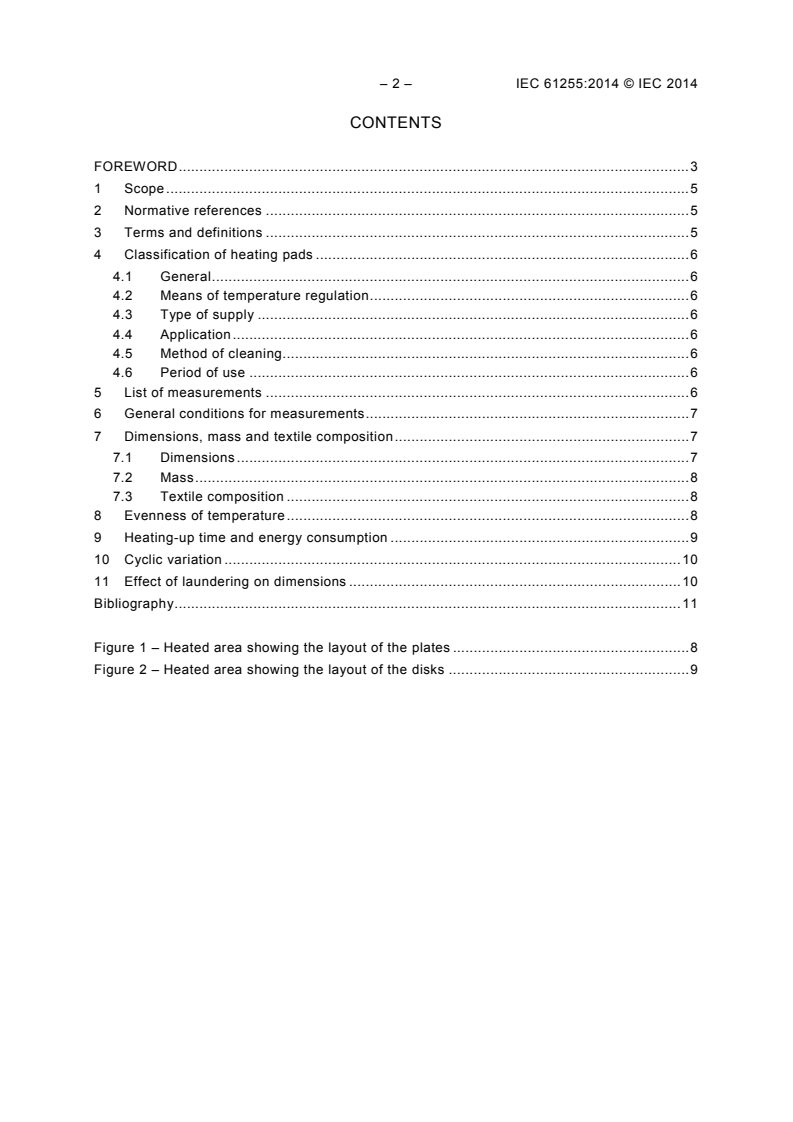
CONTENTS
FOREWORD . 3
1 Scope . 5
2 Normative references . 5
3 Terms and definitions . 5
4 Classification of heating pads . 6
4.1 General . 6
4.2 Means of temperature regulation . 6
4.3 Type of supply . 6
4.4 Application . 6
4.5 Method of cleaning. 6
4.6 Period of use . 6
5 List of measurements . 6
6 General conditions for measurements . 7
7 Dimensions, mass and textile composition . 7
7.1 Dimensions . 7
7.2 Mass . 8
7.3 Textile composition . 8
8 Evenness of temperature . 8
9 Heating-up time and energy consumption . 9
10 Cyclic variation . 10
11 Effect of laundering on dimensions . 10
Bibliography . 11
Figure 1 – Heated area showing the layout of the plates . 8
Figure 2 – Heated area showing the layout of the disks . 9
INTERNATIONAL ELECTROTECHNICAL COMMISSION
____________
HOUSEHOLD ELECTRIC HEATING PADS –
METHODS FOR MEASURING PERFORMANCE
FOREWORD
1) The International Electrotechnical Commission (IEC) is a worldwide organization for standardization comprising
all national electrotechnical committees (IEC National Committees). The object of IEC is to promote
international co-operation on all questions concerning standardization in the electrical and electronic fields. To
this end and in addition to other activities, IEC publishes International Standards, Technical Specifications,
Technical Reports, Publicly Available Specifications (PAS) and Guides (hereafter referred to as “IEC
Publication(s)”). Their preparation is entrusted to technical committees; any IEC National Committee interested
in the subject dealt with may participate in this preparatory work. International, governmental and non-
governmental organizations liaising with the IEC also participate in this preparation. IEC collaborates closely
with the International Organization for Standardization (ISO) in accordance with conditions determined by
agreement between the two organizations.
2) The formal decisions or agreements of IEC on technical matters express, as nearly as possible, an international
consensus of opinion on the relevant subjects since each technical committee has representation from all
interested IEC National Committees.
3) IEC Publications have the form of recommendations for international use and are accepted by IEC National
Committees in that sense. While all reasonable efforts are made to ensure that the technical content of IEC
Publications is accurate, IEC cannot be held responsible for the way in which they are used or for any
misinterpretation by any end user.
4) In order to promote international uniformity, IEC National Committees undertake to apply IEC Publications
transparently to the maximum extent possible in their national and regional publications. Any divergence
between any IEC Publication and the corresponding national or regional publication shall be clearly indicated in
the latter.
5) IEC itself does not provide any attestation of conformity. Independent certification bodies provide conformity
assessment services and, in some areas, access to IEC marks of conformity. IEC is not responsible for any
services carried out by independent certification bodies.
6) All users should ensure that they have the latest edition of this publication.
7) No liability shall attach to IEC or its directors, employees, servants or agents including individual experts and
members of its technical committees and IEC National Committees for any personal injury, property damage or
other damage of any nature whatsoever, whether direct or indirect, or for costs (including legal fees) and
expenses arising out of the publication, use of, or reliance upon, this IEC Publication or any other IEC
Publications.
8) Attention is drawn to the Normative references cited in this publication. Use of the referenced publications is
indispensable for the correct application of this publication.
9) Attention is drawn to the possibility that some of the elements of this IEC Publication may be the subject of
patent rights. IEC shall not be held responsible for identifying any or all such patent rights.
International standard IEC 61255 has been prepared by sub-committee 59C: Heating
appliances, of IEC technical committee 59: Performance of household electrical appliances.
This second edition cancels and replaces the first edition published in 1994. This edition
constitutes a technical revision.
This edition includes the following significant technical changes with respect to the previous
edition:
a) extended classification;
b) extended list of measurements;
c) temperature measurement means changed to thermocouples.
– 4 – IEC 61255:2014 © IEC 2014
The text of this standard is based on the following documents:
FDIS Report on voting
59C/182/FDIS 59C/183/RVD
Full information on the voting for the approval of this standard can be found in the report on
voting indicated in the above table.
This publication has been drafted in accordance with the ISO/IEC Directives, Part 2.
In this standard, the following print types are used:
– test specifications: in italic type
– notes: in small roman type
– other text: in roman type
– terms defined in Clause 3: in bold type.
The committee has decided that the contents of this publication will remain unchanged until
the stability date indicated on the IEC web site under "http://webstore.iec.ch" in the data
related to the specific publication. At this date, the publication will be
• reconfirmed,
• withdrawn,
• replaced by a revised edition, or
• amended.
HOUSEHOLD ELECTRIC HEATING PADS –
METHODS FOR MEASURING PERFORMANCE
1 Scope
This International Standard applies to electric heating pads for household use.
This International Standard defines the main performance characteristics of electric heating
pads and specifies methods for measuring these characteristics, for the information of users.
This International Standard does not specify values for performance characteristics.
NOTE This International Standard does not deal with safety requirements that are covered by IEC 60335-2-17.
2 Normative references
The following documents, in whole or in part, are normatively referenced in this document and
are indispensable for its application. For dated references, only the edition cited applies. For
undated references, the latest edition of the referenced document (including any
amendments) applies.
IEC 62301:2011, Household electrical appliances – Measurement of standby power
ISO 2439, Polymeric materials, cellular flexible – Determination of hardness (indentation
technique)
3 Terms and definitions
For the purposes of this document, the following terms and definitions apply.
3.1
heating pad
appliance comprising a flexible part having a heated area not exceeding 0,3 m on each
face and which is intended to heat part of the human body
Note 1 to entry: If the pad is constructed in a cylindrical or similar form, the limit for heated area is 0,6 m .
3.2
flexible part
all layers of material forming the permanent enclosure of the appliance together with the
heating element, thermostats and all other current-carrying parts contained within it
Note 1 to entry: The flexible part may be inside a detachable cover.
3.3
heated area
area of the flexible part enclosed within the outer perimeter of the heating element or
electro-conductive textile
Note 1 to entry: The heated area includes a margin outside the perimeter that has a width equal to 0,5 times the
average distance between adjacent runs of the heating element.
Note 2 to entry: The heated area includes the return length of the heating element if the average distance
between this part and the adjacent heating element does not exceed the average distance between adjacent runs
of the heating element.
– 6 – IEC 61255:2014 © IEC 2014
Note 3 to entry: If the heating pad has two separate heated areas, the surface between the two areas is
considered to be part of the heated areas, if at any place the distance between the two heating elements does
not exceed 1,5 times the average distance between adjacent runs of the heating element.
4 Classification of heating pads
4.1 General
The classifications of the appliance are stated.
4.2 Means of temperature regulation
Heating pads are classified according to the means of temperature regulation:
– heating pad with a control having continuously variable settings;
– heating pad with a control having step settings.
4.3 Type of supply
Heating pads are classified according to the type of supply:
– heating pad for direct connection to the supply mains;
– extra low voltage heating pad.
NOTE An extra low voltage heating pad has a rated voltage not exceeding 24 V.
4.4 Application
Heating pads are classified according to their application:
– heating pad for dry application;
– heating pad for moist application including cosmetics.
4.5 Method of cleaning
Heating pads are classified according to the method of cleaning:
– washable by hand
– machine washable
– not washable
4.6 Period of use
Heating pads are classified according to the period of use:
– heating pads having a time-based operation
– heating pads for continuous use
5 List of measurements
Performance is determined by means of the following measurements:
– dimensions mass and textile composition (Clause 7);
– evenness of temperature (Clause 8);
– heating-up time and energy consumption (Clause 9);
– cyclic variation (Clause 10);
– effect of laundering (Clause 11).
6 General conditions for measurements
Unless otherwise specified, measurements are made under the following conditions:
a) Test room:
The tests are carried out in a draught-free room in which the ambient temperature is
maintained at 20 °C ± 5 °C.
b) Supply voltage:
The supply voltage is maintained at the rated voltage ± 1 %. When the heating pad is
marked with a rated voltage range, the test report shall state the voltage used for the test.
NOTE 1 If the results obtained by testing the heating pad at rated voltage are considered to be misleading
due to the national supply voltage, the heating pad can also be tested at a voltage corresponding to the
nominal voltage of the national supply system.
c) Arrangement of the heating pad:
The flexible part with any detachable cover fitted placed between sheets of thermal
insulation, the size of which is such that the edges extend at least 100 mm beyond the
out- line of the heated area.
The thermal insulation is made of open-cell polyether having
– cell count 18 + 2 per cm;
– specific mass 30 kg/m + 10 %;
– hardness between 120 N and 170 N at 40 % impression measured according to
ISO 2439.
The thermal insulation is supported over its entire area by a piece of plywood 20 mm thick,
situated not less than 300 mm above the floor.
The thickness of the thermal insulation under the heating pad is approximately 72 mm
and over the heating pad approximately 36 mm.
NOTE 2 The specification of the thermal insulation is taken from IEC 60335-2-17.
7 Dimensions, mass and textile composition
7.1 Dimensions
7.1.1 The areas of the flexible part and the heated area are determined.
The heating pad is spread out without tension on a flat surface and the length and width are
measured at five evenly distributed places. The average values of the area of the flexible
part and the heated area are calculated.
The areas are stated in squared metres (m ).
If the pad is not rectangular, its shape is stated.
7.1.2 The lengths of flexible cords are determined.
The measurements are made, as applicable, between
– the cord-entry of the flexible part and the control or the transformer;
– the control or the transformer and the plug.
The lengths are stated in metres (m), rounded down to the nearest 0,05 m.
– 8 – IEC 61255:2014 © IEC 2014
7.2 Mass
The mass of the heating pad and its cover, if any, is determined.
The mass of the heating pad and the cover, if any, are stated separately and are measured
in grams (g), rounded up to the nearest 10 g.
7.3 Textile composition
The textile composition of the external surface of the heating pad and its cover, if any, is
stated.
8 Evenness of temperature
The evenness of temperature of the heated area is determined.
The temperature rise of the surface of the flexible part is measured by means of
thermocouples attached to the centre of copper plates having dimensions of
65 mm × 65 mm × 0,5 mm.
The plates are placed over the flexible part as shown in Figure 1 so that as many plates as
possible cover the surface.
If the length of the shortest side of the heated area is less than 100 mm, the temperature rise
is measured instead by thermocouples attached to copper disks having a diameter of 15 mm
and a thickness of 1,0 mm. The distance between the centres of adjacent disks is 25 mm. An
example of layout is shown in Figure 2.
65 mm 100 mm
IEC
No part of any plate is to project outside of the heated area.
Figure 1 – Heated area showing the layout of the plates
65 mm
100 mm
15 mm 25 mm
IEC
No part of any plate is to project outside of the heated area.
Figure 2 – Heated area showing the layout of the disks
The test is carried out with the control adjusted to the maximum setting and the temperature
rises are measured when steady conditions are established or at the end of a cycle of
operation.
The average temperature rise is calculated from all the measurements. The difference
between the maximum and minimum temperature rises is also calculated.
NOTE If there is more than one heated area, the calculations are made for each heated area separately.
The uniformity factor is calculated, being the percentage of the heated area which is within
± 2 K of the average temperature rise.
The evenness of temperature is expressed as the difference between the maximum and
minimum temperature rises, rounded to the nearest 1 K, and the uniformity factor, rounded to
the nearest 1 %.
9 Heating-up time and energy consumption
The time taken for the temperature rise of a representative measuring point to rise by 20 K
during the test of Clause 8 is stated in minutes (min), rounded to the nearest 1 min, as the
heating-up time.
The ambient temperature is maintained at 20°C ± 2°C and the heating pad is conditioned for
at least 24 h at this temperature before starting the test.
The temperature rise is measured by means of a thermocouple attached to the centre of a
copper plate having dimensions of 65 mm × 65 mm × 0,5 mm, which is placed in the centre of
the heated area.
The control is adjusted to the maximum setting and the heating pad is operated. The time
taken for the temperature of the measuring point to obtain a temperature rise of 20 K is
measured. The energy consumption during the heating-up time is determined as well as the
energy consumption during a period of operation.
The operation is continued and the energy consumption is measured. The test is terminated
for heating pads having a time-based operation when it switches off. The energy consumed
for heating pads for continuous use is measured after 90 min of operation and between the
second and third hour of operation.
< 100 mm
25 mm
– 10 – IEC 61255:2014 © IEC 2014
The heating-up time is stated, rounded to the nearest minute. The energy consumption
during the heating-up time is stated in Wh, rounded to one decimal place.
The total energy consumed over one cycle of operation by heating pads having a time-based
operation
...