

IEC 60965:2016
(Main)Nuclear power plants - Control rooms - Supplementary control room for reactor shutdown without access to the main control room
- Abstract
IEC 60965:2016 establishes requirements for the Supplementary Control Room provided to enable the operating staff of nuclear power plants to shut down the reactor, where previously operating, and maintain the plant in a safe shut-down state in the event that control of the safety functions can no longer be exercised from the Main Control Room, due to unavailability of the Main Control Room or its facilities. The design has to ensure that the Supplementary Control Room is protected against the hazards, including any localised extreme hazards, leading to the unavailability of the Main Control Room. This new edition includes the following significant technical changes with respect to the previous edition:
- requirements associated with regular testing of the supplementary control room (SCR);
- requirements to assess the time available during which the reactor will be safe but unattended, in order to move from the main control room (MCR) to the SCR and for the SCR to become operational;
- taking into account new requirements laid down by the IAEA.
- Status
- Published
- Publication Date
- 22-Feb-2016
- Current Stage
- PPUB - Publication issued - 60 Publication
- Start Date
- 23-Feb-2016
- Due Date
- 15-Mar-2016
- Completion Date
- 15-Mar-2016
Overview
IEC 60965:2016 is an international standard published by the International Electrotechnical Commission (IEC) that specifies essential requirements for the Supplementary Control Room (SCR) in nuclear power plants. It ensures that operating staff can safely shut down the nuclear reactor and maintain it in a safe shutdown state when the Main Control Room (MCR) or its facilities are unavailable. This standard is crucial for the design of control rooms that provide a backup operational environment, protecting the plant and personnel from potential hazards and extreme conditions.
The 2016 edition is the third revision and includes significant updates to match modern safety expectations and lessons learned from nuclear incidents. Its scope primarily addresses the functional, physical, electrical, and safety principles required for SCR design, aligning with new International Atomic Energy Agency (IAEA) safety requirements.
Key Topics
Functional Design Requirements: IEC 60965 outlines the principles and process for the functional design of the SCR to allow reactor shutdown under emergency conditions where the MCR is inaccessible.
Safety and Hazard Protection: The SCR must be robust and physically separate, offering protection from hazards that could compromise the MCR, including localized extreme hazards and radioactivity.
Operator Accessibility and Transfer Time: The standard requires assessment of safe transfer windows, ensuring that operators can move from the MCR to the SCR and make it operational before the reactor requires active control.
Regular Testing and Validation: To guarantee readiness, IEC 60965 mandates routine testing, inspection, and functional verification of the SCR systems and equipment.
Human Factors Engineering: Design must incorporate ergonomic considerations, ensuring operators can efficiently manage the SCR environment under stress, including structured information presentation and control configuration.
Communication and Control Systems: Multiple, diverse communication paths with predefined plant locations must be implemented, facilitating continuous monitoring and command dissemination.
Compliance with IAEA Standards: The standard integrates requirements from the IAEA SSR-2/1 and guides on design extension conditions, emphasizing the SCR's role during severe plant conditions.
Applications
IEC 60965:2016 applies primarily to nuclear power plant designers, operators, utility companies, vendors, and licensing bodies involved in control room architecture and safety system implementation. Its practical applications include:
- Designing new nuclear facilities with integrated supplementary control rooms to ensure operational resilience.
- Upgrading or retrofitting existing plants to enhance safety through dedicated backup control capabilities.
- Establishing emergency procedures that incorporate SCR usage to maintain control over reactor shutdown.
- Improving operator training by defining control room functionalities and interaction protocols during control transfer scenarios.
- Facilitating regulatory compliance with international nuclear safety standards, reducing risks related to control room unavailability.
Related Standards
Understanding IEC 60965 within the larger IEC SC 45A standard series is critical:
IEC 60964: Addresses design criteria and safety requirements for primary Main Control Rooms in nuclear power plants; complements IEC 60965 by focusing on normal operation control room design.
IEC 61227, IEC 61771, IEC 61772, IEC 61839, IEC 62241: These derivative standards provide detailed guidance on operator controls, display systems, alarm management, and verification and validation procedures for nuclear control rooms.
IAEA SSR-2/1: Safety requirements for nuclear power plants including design requirements for control rooms and supplementary control rooms to mitigate severe accidents.
DS431 (Revision of NS-G-1.3): Defines communication protocols and monitoring trends in key parameters for nuclear safety.
By aligning with these closely related standards, IEC 60965 ensures comprehensive coverage of control room safety, integrating functional, ergonomic, and technical safety measures into nuclear power plant design and operation.
Keywords: IEC 60965 2016, nuclear power plant control room, supplementary control room, reactor shutdown, nuclear safety standards, main control room unavailability, operator transfer time, human factors engineering, safety hazard protection, IAEA nuclear standards, nuclear plant design, emergency control systems, control room functionality, nuclear power plant safety.
Relations
- Effective Date
- 05-Sep-2023
Get Certified
Connect with accredited certification bodies for this standard

DNV
DNV is an independent assurance and risk management provider.

Lloyd's Register
Lloyd's Register is a global professional services organisation specialising in engineering and technology.
DNV Energy Systems
Energy and renewable energy certification.
Sponsored listings
Frequently Asked Questions
IEC 60965:2016 is a standard published by the International Electrotechnical Commission (IEC). Its full title is "Nuclear power plants - Control rooms - Supplementary control room for reactor shutdown without access to the main control room". This standard covers: IEC 60965:2016 establishes requirements for the Supplementary Control Room provided to enable the operating staff of nuclear power plants to shut down the reactor, where previously operating, and maintain the plant in a safe shut-down state in the event that control of the safety functions can no longer be exercised from the Main Control Room, due to unavailability of the Main Control Room or its facilities. The design has to ensure that the Supplementary Control Room is protected against the hazards, including any localised extreme hazards, leading to the unavailability of the Main Control Room. This new edition includes the following significant technical changes with respect to the previous edition: - requirements associated with regular testing of the supplementary control room (SCR); - requirements to assess the time available during which the reactor will be safe but unattended, in order to move from the main control room (MCR) to the SCR and for the SCR to become operational; - taking into account new requirements laid down by the IAEA.
IEC 60965:2016 establishes requirements for the Supplementary Control Room provided to enable the operating staff of nuclear power plants to shut down the reactor, where previously operating, and maintain the plant in a safe shut-down state in the event that control of the safety functions can no longer be exercised from the Main Control Room, due to unavailability of the Main Control Room or its facilities. The design has to ensure that the Supplementary Control Room is protected against the hazards, including any localised extreme hazards, leading to the unavailability of the Main Control Room. This new edition includes the following significant technical changes with respect to the previous edition: - requirements associated with regular testing of the supplementary control room (SCR); - requirements to assess the time available during which the reactor will be safe but unattended, in order to move from the main control room (MCR) to the SCR and for the SCR to become operational; - taking into account new requirements laid down by the IAEA.
IEC 60965:2016 is classified under the following ICS (International Classification for Standards) categories: 27.120.20 - Nuclear power plants. Safety. The ICS classification helps identify the subject area and facilitates finding related standards.
IEC 60965:2016 has the following relationships with other standards: It is inter standard links to IEC 60965:2009. Understanding these relationships helps ensure you are using the most current and applicable version of the standard.
IEC 60965:2016 is available in PDF format for immediate download after purchase. The document can be added to your cart and obtained through the secure checkout process. Digital delivery ensures instant access to the complete standard document.
Standards Content (Sample)
IEC 60965 ®
Edition 3.0 2016-02
INTERNATIONAL
STANDARD
NORME
INTERNATIONALE
Nuclear power plants – Control rooms – Supplementary control room for reactor
shutdown without access to the main control room
Centrales nucléaires de puissance – Salles de commande – Salle de commande
supplémentaire pour l’arrêt des réacteurs sans accès à la salle de commande
principale
All rights reserved. Unless otherwise specified, no part of this publication may be reproduced or utilized in any form
or by any means, electronic or mechanical, including photocopying and microfilm, without permission in writing from
either IEC or IEC's member National Committee in the country of the requester. If you have any questions about IEC
copyright or have an enquiry about obtaining additional rights to this publication, please contact the address below or
your local IEC member National Committee for further information.
Droits de reproduction réservés. Sauf indication contraire, aucune partie de cette publication ne peut être reproduite
ni utilisée sous quelque forme que ce soit et par aucun procédé, électronique ou mécanique, y compris la photocopie
et les microfilms, sans l'accord écrit de l'IEC ou du Comité national de l'IEC du pays du demandeur. Si vous avez des
questions sur le copyright de l'IEC ou si vous désirez obtenir des droits supplémentaires sur cette publication, utilisez
les coordonnées ci-après ou contactez le Comité national de l'IEC de votre pays de résidence.
IEC Central Office Tel.: +41 22 919 02 11
3, rue de Varembé Fax: +41 22 919 03 00
CH-1211 Geneva 20 info@iec.ch
Switzerland www.iec.ch
About the IEC
The International Electrotechnical Commission (IEC) is the leading global organization that prepares and publishes
International Standards for all electrical, electronic and related technologies.
About IEC publications
The technical content of IEC publications is kept under constant review by the IEC. Please make sure that you have the
latest edition, a corrigenda or an amendment might have been published.
IEC Catalogue - webstore.iec.ch/catalogue Electropedia - www.electropedia.org
The stand-alone application for consulting the entire The world's leading online dictionary of electronic and
bibliographical information on IEC International Standards, electrical terms containing 20 000 terms and definitions in
Technical Specifications, Technical Reports and other English and French, with equivalent terms in 15 additional
documents. Available for PC, Mac OS, Android Tablets and languages. Also known as the International Electrotechnical
iPad. Vocabulary (IEV) online.
IEC publications search - www.iec.ch/searchpub IEC Glossary - std.iec.ch/glossary
The advanced search enables to find IEC publications by a 65 000 electrotechnical terminology entries in English and
variety of criteria (reference number, text, technical French extracted from the Terms and Definitions clause of
committee,…). It also gives information on projects, replaced IEC publications issued since 2002. Some entries have been
and withdrawn publications. collected from earlier publications of IEC TC 37, 77, 86 and
CISPR.
IEC Just Published - webstore.iec.ch/justpublished
Stay up to date on all new IEC publications. Just Published IEC Customer Service Centre - webstore.iec.ch/csc
details all new publications released. Available online and If you wish to give us your feedback on this publication or
also once a month by email. need further assistance, please contact the Customer Service
Centre: csc@iec.ch.
A propos de l'IEC
La Commission Electrotechnique Internationale (IEC) est la première organisation mondiale qui élabore et publie des
Normes internationales pour tout ce qui a trait à l'électricité, à l'électronique et aux technologies apparentées.
A propos des publications IEC
Le contenu technique des publications IEC est constamment revu. Veuillez vous assurer que vous possédez l’édition la
plus récente, un corrigendum ou amendement peut avoir été publié.
Catalogue IEC - webstore.iec.ch/catalogue Electropedia - www.electropedia.org
Application autonome pour consulter tous les renseignements
Le premier dictionnaire en ligne de termes électroniques et
bibliographiques sur les Normes internationales,
électriques. Il contient 20 000 termes et définitions en anglais
Spécifications techniques, Rapports techniques et autres
et en français, ainsi que les termes équivalents dans 15
documents de l'IEC. Disponible pour PC, Mac OS, tablettes
langues additionnelles. Egalement appelé Vocabulaire
Android et iPad.
Electrotechnique International (IEV) en ligne.
Recherche de publications IEC - www.iec.ch/searchpub
Glossaire IEC - std.iec.ch/glossary
La recherche avancée permet de trouver des publications IEC 65 000 entrées terminologiques électrotechniques, en anglais
en utilisant différents critères (numéro de référence, texte, et en français, extraites des articles Termes et Définitions des
comité d’études,…). Elle donne aussi des informations sur les publications IEC parues depuis 2002. Plus certaines entrées
projets et les publications remplacées ou retirées. antérieures extraites des publications des CE 37, 77, 86 et
CISPR de l'IEC.
IEC Just Published - webstore.iec.ch/justpublished
Service Clients - webstore.iec.ch/csc
Restez informé sur les nouvelles publications IEC. Just
Published détaille les nouvelles publications parues. Si vous désirez nous donner des commentaires sur cette
Disponible en ligne et aussi une fois par mois par email. publication ou si vous avez des questions contactez-nous:
csc@iec.ch.
IEC 60965 ®
Edition 3.0 2016-02
INTERNATIONAL
STANDARD
NORME
INTERNATIONALE
Nuclear power plants – Control rooms – Supplementary control room for reactor
shutdown without access to the main control room
Centrales nucléaires de puissance – Salles de commande – Salle de commande
supplémentaire pour l’arrêt des réacteurs sans accès à la salle de commande
principale
INTERNATIONAL
ELECTROTECHNICAL
COMMISSION
COMMISSION
ELECTROTECHNIQUE
INTERNATIONALE
ICS 27.120.20 ISBN 978-2-8322-3203-3
– 2 – IEC 60965:2016 © IEC 2016
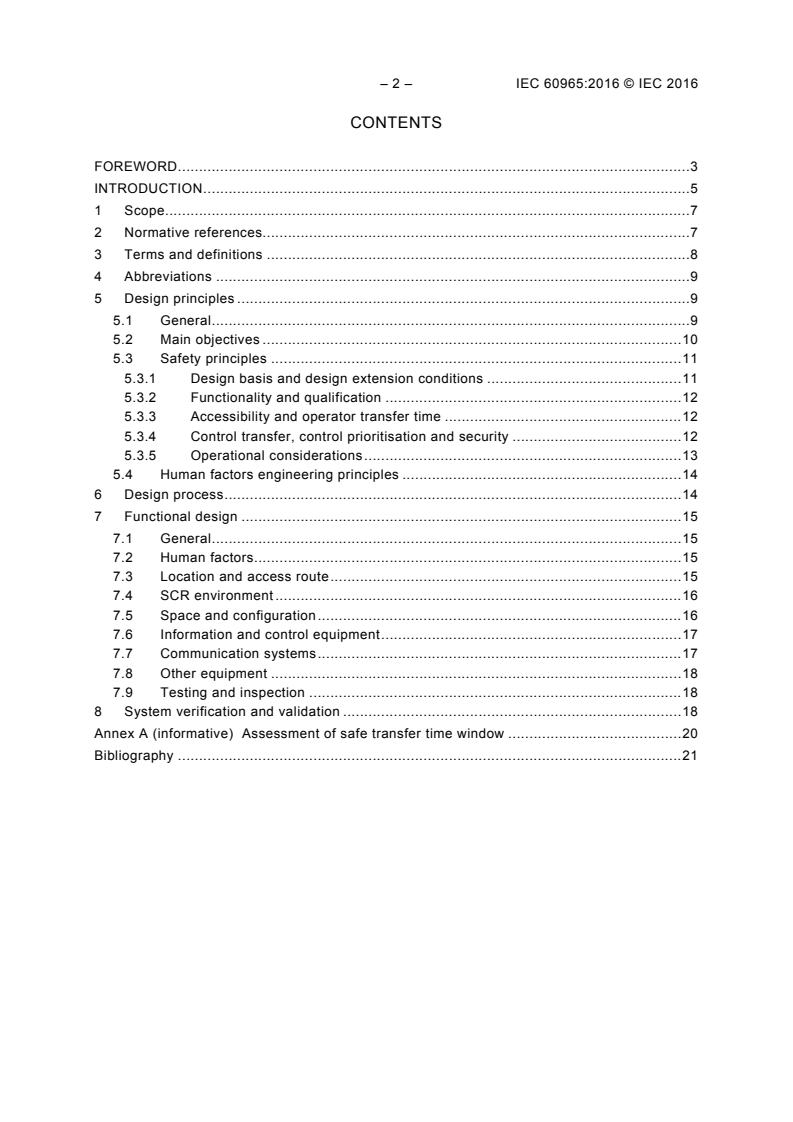
CONTENTS
FOREWORD . 3
INTRODUCTION . 5
1 Scope . 7
2 Normative references. 7
3 Terms and definitions . 8
4 Abbreviations . 9
5 Design principles . 9
5.1 General . 9
5.2 Main objectives . 10
5.3 Safety principles . 11
5.3.1 Design basis and design extension conditions . 11
5.3.2 Functionality and qualification . 12
5.3.3 Accessibility and operator transfer time . 12
5.3.4 Control transfer, control prioritisation and security . 12
5.3.5 Operational considerations . 13
5.4 Human factors engineering principles . 14
6 Design process . 14
7 Functional design . 15
7.1 General . 15
7.2 Human factors . 15
7.3 Location and access route . 15
7.4 SCR environment . 16
7.5 Space and configuration . 16
7.6 Information and control equipment . 17
7.7 Communication systems . 17
7.8 Other equipment . 18
7.9 Testing and inspection . 18
8 System verification and validation . 18
Annex A (informative) Assessment of safe transfer time window . 20
Bibliography . 21
INTERNATIONAL ELECTROTECHNICAL COMMISSION
____________
NUCLEAR POWER PLANTS – CONTROL ROOMS –
SUPPLEMENTARY CONTROL ROOM FOR REACTOR SHUTDOWN
WITHOUT ACCESS TO THE MAIN CONTROL ROOM
FOREWORD
1) The International Electrotechnical Commission (IEC) is a worldwide organization for standardization comprising
all national electrotechnical committees (IEC National Committees). The object of IEC is to promote
international co-operation on all questions concerning standardization in the electrical and electronic fields. To
this end and in addition to other activities, IEC publishes International Standards, Technical Specifications,
Technical Reports, Publicly Available Specifications (PAS) and Guides (hereafter referred to as “IEC
Publication(s)”). Their preparation is entrusted to technical committees; any IEC National Committee interested
in the subject dealt with may participate in this preparatory work. International, governmental and non-
governmental organizations liaising with the IEC also participate in this preparation. IEC collaborates closely
with the International Organization for Standardization (ISO) in accordance with conditions determined by
agreement between the two organizations.
2) The formal decisions or agreements of IEC on technical matters express, as nearly as possible, an international
consensus of opinion on the relevant subjects since each technical committee has representation from all
interested IEC National Committees.
3) IEC Publications have the form of recommendations for international use and are accepted by IEC National
Committees in that sense. While all reasonable efforts are made to ensure that the technical content of IEC
Publications is accurate, IEC cannot be held responsible for the way in which they are used or for any
misinterpretation by any end user.
4) In order to promote international uniformity, IEC National Committees undertake to apply IEC Publications
transparently to the maximum extent possible in their national and regional publications. Any divergence
between any IEC Publication and the corresponding national or regional publication shall be clearly indicated in
the latter.
5) IEC itself does not provide any attestation of conformity. Independent certification bodies provide conformity
assessment services and, in some areas, access to IEC marks of conformity. IEC is not responsible for any
services carried out by independent certification bodies.
6) All users should ensure that they have the latest edition of this publication.
7) No liability shall attach to IEC or its directors, employees, servants or agents including individual experts and
members of its technical committees and IEC National Committees for any personal injury, property damage or
other damage of any nature whatsoever, whether direct or indirect, or for costs (including legal fees) and
expenses arising out of the publication, use of, or reliance upon, this IEC Publication or any other IEC
Publications.
8) Attention is drawn to the Normative references cited in this publication. Use of the referenced publications is
indispensable for the correct application of this publication.
9) Attention is drawn to the possibility that some of the elements of this IEC Publication may be the subject of
patent rights. IEC shall not be held responsible for identifying any or all such patent rights.
International Standard IEC 60965 has been prepared by subcommittee 45A: Instrumentation,
control and electrical systems of nuclear facilities, of IEC technical committee 45: Nuclear
instrumentation.
This third edition cancels and replaces the second edition published in 2009. This edition
constitutes a technical revision.
This edition includes the following significant technical changes with respect to the previous
edition:
a) requirements associated with regular testing of the supplementary control room (SCR);
b) requirements to assess the time available during which the reactor will be safe but
unattended, in order to move from the main control room (MCR) to the SCR and for the
SCR to become operational;
c) reference to SSR-2/1 which includes the following new requirements:
– 4 – IEC 60965:2016 © IEC 2016
1) the SCR should be functionally (as well as physically and electrically) separate from
the MCR,
2) consideration shall be given to the provision of shielding against radioactivity on the
access paths to the SCR;
d) reference to DS431, the revision of NS-G-1.3, including the following new requirements:
1) to implement at least two diverse methods for communication with a set of predefined
locations,
2) to implement features to support monitoring of trends in key plant parameters;
e) requirements for the role, functional capability and robustness of the SCR in design
extension conditions;
The text of this standard is based on the following documents:
FDIS Report on voting
45A/1060/FDIS 45A/1078/RVD
Full information on the voting for the approval of this standard can be found in the report on
voting indicated in the above table.
This publication has been drafted in accordance with the ISO/IEC Directives, Part 2.
The committee has decided that the contents of this publication will remain unchanged until
the stability date indicated on the IEC website under "http://webstore.iec.ch" in the data
related to the specific publication. At this date, the publication will be
• reconfirmed,
• withdrawn,
• replaced by a revised edition, or
• amended.
INTRODUCTION
a) Technical background, main issues and organization of the standard
IEC 60965:1989 was developed to provide requirements relevant to the design of NPP
supplementary control points for reactor shutdown without access to the main control
room. The first edition of IEC 60965 has been used extensively within the nuclear industry.
It was however recognized in 2007 that technical developments especially those which
were based on software technology should be incorporated. It was also recognized that
the relationships with the standard for the main control room (i.e. IEC 60964) and the
derivative standards to that standard (i.e. IEC 61227, IEC 61771, IEC 61772, IEC 61839,
and IEC 62241) should be clarified and conditioned. In 2009 the second edition of
IEC 60965 was published.
In June 2013, during the Moscow meeting, WG A8 experts recommended a limited
revision be launched to take into account the lessons learned from TEPCO Fukushima
Daiichi accident and some comments formulated during the circulation of the FDIS of the
published second edition. In the course of development of this revision, the title of the
standard was amended to refer to Supplementary Control ‘Room’ for consistency with
IAEA SSR-2/1.
This IEC standard specifically focuses on the functional design process of the
supplementary control room of an NPP. It is intended that the standard be used by NPP
designers, design authorities, vendors, utilities, and by licensors.
b) Situation of the current standard in the structure of the IEC SC 45A standard series
IEC 60965 is the third level IEC SC 45A document tackling the issue of the design of a
supplementary control room.
IEC 60965 is to be read in association with IEC 60964 for the design of the main control
room (including the derivative standards mentioned above) which is the appropriate
IEC SC 45A document providing guidance on operator controls, verification and validation
of design, application of visual display units, functional analysis and assignment, and
alarm functions and presentation.
For more details on the structure of the IEC SC 45A standard series, see item d) of this
introduction.
c) Recommendations and limitations regarding the application of this Standard
The purpose of this standard is to provide functional design requirements to be used in the
design of the supplementary control room of a nuclear power plant to meet safety
requirements.
This standard is intended for application to a supplementary control room whose
conceptual design is initiated after the publication of this standard. The recommendations
of the standard may be used for refits, upgrades and modifications.
Aspects for which special recommendations have been provided in this Standard, in
accordance with IAEA safety standards, are:
– definition of the MCR and plant design bases for which the supplementary control room
are to be used;
– access by station staff to the supplementary control room in such emergencies;
– assurance for the station staff that the environment in the supplementary control room
is safe when it is to be used;
– provision of information in the supplementary control room on the state of the reactor
critical functions;
– transfer of control and indication functions from the main control room to the
supplementary control room in emergencies;
– independence and separation of the cabling used by the supplementary control room
from that used by the main control room;
– assurance that a safe state has been reached using the supplementary control room;
– 6 – IEC 60965:2016 © IEC 2016
– communication facilities between the supplementary control room and to the station
management.
To ensure that the Standard will continue to be relevant in future years, the emphasis has
been placed on issues of principle, rather than specific technologies.
d) Description of the structure of the IEC SC 45A standard series and relationships
with other IEC documents and other bodies documents (IAEA, ISO)
The top-level document of the IEC SC 45A standard series is IEC 61513. It provides
general requirements for I&C systems and equipment that are used to perform functions
important to safety in NPPs. IEC 61513 structures the IEC SC 45A standard series.
IEC 61513 refers directly to other IEC SC 45A standards for general topics related to
categorization of functions and classification of systems, qualification, separation of
systems, defence against common cause failure, software aspects of computer-based
systems, hardware aspects of computer-based systems, and control room design. The
standards referenced directly at this second level should be considered together with
IEC 61513 as a consistent document set.
At a third level, IEC SC 45A standards not directly referenced by IEC 61513 are standards
related to specific equipment, technical methods, or specific activities. Usually these
documents, which make reference to second-level documents for general topics, can be
used on their own.
A fourth level extending the IEC SC 45A standard series corresponds to the Technical
Reports which are not normative.
IEC 61513 has adopted a presentation format similar to the basic safety publication
IEC 61508 with an overall safety life-cycle framework and a system life-cycle framework.
Regarding nuclear safety, it provides the interpretation of the general requirements of
IEC 61508-1, IEC 61508-2 and IEC 61508-4, for the nuclear application sector, regarding
nuclear safety. In this framework IEC 60880 and IEC 62138 correspond to IEC 61508-3 for
the nuclear application sector. IEC 61513 refers to ISO as well as to IAEA GS-R-3,
IAEA GS-G-3.1 and IAEA GS-G-3.5 for topics related to quality assurance (QA).
The IEC SC 45A standards series consistently implements and details the principles and
basic safety aspects provided in the IAEA code on the safety of NPPs and in the IAEA
safety series, in particular the Requirements SSR-2/1, establishing safety requirements
related to the design of Nuclear Power Plants, and the Safety Guide NS-G-1.3 dealing with
instrumentation and control systems important to safety in Nuclear Power Plants. The
terminology and definitions used by SC 45A standards are consistent with those used by
the IAEA.
NOTE It is assumed that for the design of I&C systems in NPPs that implement conventional safety functions
(e.g. to address worker safety, asset protection, chemical hazards, process energy hazards) international or
national standards would be applied, that are based on the requirements of a standard such as IEC 61508.
NUCLEAR POWER PLANTS – CONTROL ROOMS –
SUPPLEMENTARY CONTROL ROOM FOR REACTOR SHUTDOWN
WITHOUT ACCESS TO THE MAIN CONTROL ROOM
1 Scope
This International Standard establishes requirements for the Supplementary Control Room
provided to enable the operating staff of nuclear power plants to shut down the reactor, where
previously operating, and maintain the plant in a safe shut-down state in the event that control
of the safety functions can no longer be exercised from the Main Control Room, due to
unavailability of the Main Control Room or its facilities. The design has to ensure that the
Supplementary Control Room is protected against the hazards, including any localised
extreme hazards, leading to the unavailability of the Main Control Room.
The standard also establishes requirements for the selection of functions, the design and
organisation of the human-machine interface, and the procedures which shall be used
systematically to verify and validate the functional design of the supplementary control room.
It is assumed that supplementary control room provided for shutdown operations from outside
the main control room would be unattended during normal plant conditions other than for
periodic testing. The requirements reflect the application of human engineering principles as
they apply to the human-machine interface during such periodic testing and during abnormal
plant conditions.
This standard does not cover special emergency response facilities (e.g. a technical support
centre) or facilities provided for radioactive waste handling. Detailed equipment design is also
outside the scope of the standard.
This standard follows the principles of IAEA Specific Safety Requirements SSR-2/1 and IAEA
Safety Guide NS-G-1.3.
The purpose of this standard is to provide functional design requirements to be used in the
design of the supplementary control room of a nuclear power plant to meet safety
requirements.
This standard is intended for application to a supplementary control room whose conceptual
design is initiated after the publication of this standard. If it is desired to apply it to existing
plants or designs, special care must be taken to ensure a consistent design basis. This
relates, for example, to factors such as the consistency between the supplementary control
room and the main control room, the ergonomic approach, the automation level and the
information technology, and the extent of modifications to be implemented in I&C systems.
2 Normative references
The following documents, in whole or in part, are normatively referenced in this document and
are indispensable for its application. For dated references, only the edition cited applies. For
undated references, the latest edition of the referenced document (including any
amendments) applies.
IEC 60709, Nuclear power plants – Instrumentation and control systems important to safety –
Separation
IEC 60964:2009, Nuclear power plants – Control rooms – Design
– 8 – IEC 60965:2016 © IEC 2016
IEC 61226, Nuclear power plants – Instrumentation and control important to safety –
Classification of instrumentation and control functions
IEC 61513, Nuclear power plants – Instrumentation and control important to safety – General
requirements for systems
IEC 61771, Nuclear power plants – Main control-room – Verification and validation of design
IEC 62646, Nuclear power plants – Control rooms – Computer based procedures
ISO 11064 (all parts), Ergonomic design of control centres
ISO 11064-1, Ergonomic design of control centres – Part 1: Principles for the design of
control centres
ISO 11064-3, Ergonomic design of control centres – Part 3: Control room layout
ISO 11064-6, Ergonomic design of control centres – Part 6: Environmental requirements for
control centres
IAEA SSR-2/1:2012, Safety of nuclear power plants: Design
IAEA NS-G-1.3:2002, Instrumentation and Control Systems Important to Safety in Nuclear
Power Plants (to be replaced by SSG-39)
3 Terms and definitions
For the purposes of this document, the following terms and definitions apply. For other terms,
refer to the general terminology defined in IEC 60964, IEC 61513 and in the IAEA NUSS
programme, such as Safety Guide NS-G-1.3 or the safety glossary.
3.1
control room staff
group of plant personnel stationed in the control room, which is responsible for achieving the
plant operational goals by controlling plant through the human-machine interface. Typically,
the control room staff consists of supervisory operators, and operators who actually monitor
plant and plant conditions and manipulate controls, but may also include those staff members
and experts who are authorised to be present in the control room, e.g. during long lasting
event sequences
[SOURCE: IEC 60964:2009, 3.4]
3.2
design extension conditions
postulated accident conditions that are not considered for design basis accidents, but that are
considered in the design process of the facility in accordance with best estimate methodology,
and for which releases of radioactive material are kept within acceptable limits. Design
extension conditions include conditions in events without significant fuel degradation and
conditions with core melting
[SOURCE: IAEA SSR-2/1:2012, definitions revised as DS462]
3.3
local control points
local control facilities
points (or facilities) located outside the control room where local operators perform control
activities
[SOURCE: IEC 60964:2009, 3.17]
3.4
local operators
operating staff that perform tasks outside the control room
[SOURCE: IEC 60964:2009, 3.18]
3.5
operating staff
plant personnel working on shift to operate the plant. The operating staff includes the control
room staff, maintenance engineers, etc.
[SOURCE: IEC 60964:2009, 3.20]
3.6
supplementary control room
location from which limited plant control and/or monitoring can be carried out to accomplish
the safety functions identified by the safety analysis as required in the event of a loss of
ability to perform those functions from the Main Control Room
Note 1 to entry: For existing plants, the Supplementary Control Room may be a special control room, but in many
cases comprises sets of control panels and displays in switchgear rooms or similar areas. In the latter case, the
term ‘supplementary control point’ is used in this standard.
4 Abbreviations
CBP Computer-Based Procedure
I&C Instrumentation and Control
LCP Local Control Point
MCR Main Control Room
NPP Nuclear Power Plant
PIE Postulated Initiating Event
SCR Supplementary Control Room
V&V Verification and Validation
5 Design principles
5.1 General
Requirement 66 of IAEA SSR-2/1 states: “Instrumentation and control equipment shall be kept
available, preferably at a single location (a supplementary control room) that is physically,
electrically and functionally separate from the control room at the nuclear power plant. The
supplementary control room shall be so equipped that the reactor can be placed and
maintained in a shutdown state, residual heat can be removed, and essential plant variables
can be monitored if there is a loss of ability to perform these essential safety functions in the
control room.”
NOTE 1 The reference to “control room” is interpreted in this standard as “main control room (MCR)”.
– 10 – IEC 60965:2016 © IEC 2016
NOTE 2 Functional separation means that the function of the SCR can be performed despite postulated
malfunctions in the MCR.
NOTE 3 Complete functional separation of paths from human-machine interface control points out to end devices
may be difficult to achieve for all I&C functions, especially for example when a shared actuator requires a common
priority logic controller to select between MCR and SCR control. Any such common equipment is acceptable if
adequate redundant, backup, or field equipment exists that can achieve the required actuation function and is
sufficiently separated from common hazards to minimize the risk that the function may be completely disabled.
Subclauses 6.15 to 6.30 of IAEA NS-G-1.3 provide guidance on the requirements for
supplementary control rooms, including requirements associated with the following:
• definition of the plant design bases that require use of the SCR (6.17, 6.19, 6.20);
• location and configuration of the SCR to promote prompt mobilisation (6.29);
• qualified access path to the SCR, with hazard indication and suitable countermeasures
along this path (6.27, 6.28);
• prevention of unauthorised access to or use of the SCR (6.21);
• safety functions of the MCR and SCR not affected by the same PIE, and independence of
the circuits associated with the SCR from those of the MCR (6.20, 6.23);
• priority of control between the MCR and SCR, and transfer of control from the MCR to the
SCR (6.18, 6.20, 6.24);
• manual control in the SCR accomplished by simple actions (clause 6.22);
• displays and controls in the SCR similar to those in the MCR, to the extent possible (6.22);
• consideration of the difference of purpose between the MCR and the SCR (6.25);
• if long-term use is envisaged, suitable facilities for habitability and workspace for tasks
(6.30).
5.2 Main objectives
The IAEA requirements for the design of the SCR given in 5.1, paragraph 1, shall be met as
detailed in this standard.
The SCR shall be provided with the means to trip the reactor and bring the plant to a safe
state and maintain it in that state without access to the MCR. However, the SCR is not
required to perform all the other plant control and monitoring functions which are typically
performed in the MCR. According to the type of NPP and the detailed safety arguments,
provisions to cope with a predefined set of PIE could be integrated in the SCR.
The SCR is required when the ability to perform safety functions in the MCR is lost. Possible
causes include a control room fire, the entry of excess smoke or a dangerous atmosphere to
the MCR, severe damage to the MCR or its cables such that safety functions cannot be
performed, major damage to the control room area, or major failure of control room facilities.
The design basis PIE and sequences of events for which use of the SCR is necessary shall
be identified. This shall include identification and justification of the assumed conditions
throughout the plant and the corresponding durations for which the SCR may be required.
Since events leading to the unavailability of the MCR are very infrequent, it is anticipated that
the plant safety analysis will demonstrate that such events can only coincide with another
independent event in the plant at an acceptably low frequency; in particular, it is anticipated
that the primary coolant circuit will be intact. However, due account shall be taken of any plant
fault that may occur as a consequence of reactor trip and of any plant faults at shutdown that
are of sufficient frequency to coincide with use of the SCR. In particular, the design of the
SCR shall take account of the possible long-term unavailability of the MCR due to fire or other
reasons.
The criteria for use of the SCR shall be clearly stated in the plant operating procedures.
It shall be possible to determine the complete safety state of the plant from outside the MCR.
This should preferably be from the SCR. The SCR should therefore enable the monitoring of
the state of the relevant plant systems and key plant parameters. All information presented
should comply with the ergonomic principles presented in the relevant parts of ISO 11064.
For the purpose of efficient monitoring and later analysis of the events, key plant parameters
should be recorded to allow display of trends and later access for offline analysis. Automatic
recording is recommended. If the MCR and SCR are assumed not to be staffed for an
extended period of time, automatic recording shall be provided.
From an operational viewpoint (e.g. to simplify operation and avoid misunderstanding), it is
preferable to have only one supplementary control room. Care shall be taken, however, to
meet safety requirements, particularly requirements for redundancy and independence. If two
or more supplementary control points are provided for an existing plant, each supplementary
control point should display all information needed to perform the operator tasks.
Computer-based information displays in the SCR should provide the same functionality for the
presentation of information important to safety as the corresponding displays in the MCR. The
content of the displays for a given plant state and for given operator tasks should be the same
as in the MCR.
There shall be adequate time to reach the SCR before necessary actions are required as well
as sufficient equipment to provide necessary communication between all operating staff
involved in these actions and with on-site and off-site locations. Communication requirements
are given in 7.7.
The layout of the instrumentation and the mode of presentation at the SCR shall provide the
operating staff with adequate information to assess the plant state and to supervise the
shutdown (and subsequent hold down) of the reactor, the long-term cooling of the reactor core
and confinement of all radioactive substances.
The plant systems that can be controlled from the SCR may be limited to those providing the
safety functions.
The SCR shall provide sufficient control over the safety functions to reach and maintain a safe
state, for the defined set of PIEs and conditions for which the MCR cannot be used. The
supervision and control provided at the SCR shall include the state of the safety functions
concerned and control of their initiation and termination, and the state of the related
fundamental safety functions (see IAEA SSR-2/1:2012, Requirement 4).
Facilities for site security monitoring, plant access control and fire alarms which are normally
provided in the MCR shall also be provided in an independent location. This independent
location may be the SCR or may be a location that would not be affected by the same event
that causes the SCR to be used. Where the latter applies, the facilities location shall have a
hazard withstand capability equivalent to that of the SCR.
The design of SCR shall be consistent with the MCR design. The identification and design
process for the relevant controls and indications needed for the SCR shall follow the
requirements of IEC 60964, as summarised in Clause 6 of this standard.
5.3 Safety principles
5.3.1 Design basis and design extension conditions
The design basis of an NPP normally specifies the internal and external hazards to be taken
into account. The design shall ensure that such events are not able to make those functions
of the MCR and SCR (and local control points) required for safe shutdown, monitoring to
ensure safe shutdown and critical functions control and monitoring, unusable or ineffective
simultaneously.
– 12 – IEC 60965:2016 © IEC 2016
If the design basis is extended to address extreme hazards or low probability failure
combinations, the design should ensure that the MCR and SCR will not fail together even
under such circumstances. The implementation of the transfer of control to the SCR shall take
due account of the practical constraints arising from the design basis or design extension
assumptions for use of the SCR.
The above requirement for non-susceptibility of the MCR and SCR to the same design basis
or design extension condition shall be extended to their respective supporting functions,
systems and equipment.
5.3.2 Functionality and qualification
The functions of the SCR shall be classified in accordance with IEC 61226, with due account
being taken of the criteria described in 5.2 for the use of the SCR.
Equipment and systems shall be designed with a degree of redundancy in accordance with
their safety classification. Account shall also be taken of the need for functional isolation and
physical separation where safety and non-safety systems and redundant systems are brought
into close proximity (see IEC 60709).
The SCR equipment shall be suitable for the environmental conditions applicable to its
intended use. The equipment shall be qualified for the design basis PIE and relevant
sequence of events in accordance with its safety classification. Supplementary tests or
analyses may be necessary to provide assurance of adequate reliability and robustness to
withstand the stresses from design extension conditions.
5.3.3 Accessibility and operator transfer time
Taking into account the postulated causes of unavailability of the MCR functions, the SCR
functions shall be so designed (and, if necessary, the SCR so located) that, even under
emergency conditions, the SCR is accessible by safe routes. See 7.3 for further details.
The design shall allow adequate time for control room staff to reach the SCR after the MCR
becomes unavailable. The actions and duration of unattended automatic operation of the
safety functions, after initiation at the MCR, in order to maintain plant safety up to the time
when the SCR becomes operational, should be shown to be satisfactory for this transfer. This
shall include time for access control and time to assess the plant state at the SCR. Annex A
addresses the aspects that are to be considered for theoretical assessment of the safe
transfer time window.
5.3.4 Control transfer, control prioritisation and security
Facilities to disable MCR control and transfer control to the SCR shall be provided. These
facilities shall be classified according to the highest category of safety functions for which
control from the MCR could be disabled. They shall be demonstrated as highly reliable and, if
required, demonstrated to comply with the single failure criterion. Possible failures in SCR
security and the influence of SCR cybersecurity flaws on I&C security shall be analysed and
taken into account.
NOTE The above excludes any requirement to disable the MCR manual ‘reactor trip’ function.
The control transfer facilities shall disable the MCR controls in order to ensure that a fire or
damage affecting the MCR cannot cause spurious control actions. The facilities shall also be
such as to avoid or minimize transients of the controlled variables during the transfer of
control, in both directions: from MCR to SCR and from SCR to MCR.
The control transfer facilities may be on the route from the MCR to the SCR, or at the SCR, or
in the MCR itself if analysis shows that this cannot lead to failure to accomplish the control
transfer or failure of control from the SCR. Where the facilities are located in the MCR,
additional means that do not involve the MCR should also be provided.
The SCR should include a means to identify the control status of the SCR and of the MCR
controls (i.e. whether “enabled” or “disabled”).
I&C systems shall be so designed to prevent both the MCR and SCR from taking control of
plant systems simultaneously.
I&C systems shall be so designed that there is an acceptably low probability of false signals
from the MCR elements of the systems affecting plant safety. I&C systems shall be so
designed that there is an acceptably low probability of false signals from the SCR elements of
the systems interfering with the supervision and control of plant from the MCR under normal
or abnormal conditions. Examples of design techniques to achieve these objectives are the
use of: transfer switches, coded signals, optical isolation links.
A malfunction of the equipment controlling the transfer of control from the MCR to the SCR
could lead to unintended isolation of the MCR. Therefore, the failure modes of the equipment
that implements the control transfer function shall be analysed and shown to be acceptable.
This analysis shall consider all PIEs for which operation from the MCR is credited.
When an SCR is in use, actions taken from it shall have priority over any other manual control
actions, except when control has to be taken at a local control point.
The design of the SCR shall include provisions to prevent unauthorised access or use. The
means of control transfer shall also include provisions to prevent unauthorised transfer of
control from the MCR to the SCR and vice versa. Access to the SCR, and any attempt at
control transfer to the SCR, shall be indicated by the provision of alarms in the MCR.
Where an SCR is unattended during normal plant operation, the SCR shall be regularly
verified to ensure that the assigned level of security is being met.
All the procedures used during MCR software modification shall be also applied to the
modification of SCR software.
5.3.5 Operational considerations
The SCR shall be designed to minimise operator errors.
The design shall include the provision of written instructions in the SCR for operation of:
• plant systems and control devices;
• information and recording systems;
• communication equipment;
• any other equipment to be operated from the SCR.
The operating procedures for actions to be taken from the SCR (e.g. plant cooldown) shall be
simple and clear. They shall be based on the same principles and the way of presentation as
the MCR operating procedures, and shall deviate only where difference
...