

IEC 60335-2-2:2026
(Main)Household and similar electrical appliances - Safety - Part 2-2: Particular requirements for vacuum cleaners and water-suction cleaning appliances
- Abstract
IEC 60335-2-2:2026 deals with the safety of electric vacuum cleaners and water suction cleaning appliances for household and similar purposes, their rated voltage being not more than 250 V for single phase (AC) supplied appliances, direct current (DC) supplied appliances and battery-operated appliances and 480 V for multi-phase centrally-sited vacuum cleaners. This standard also applies to vacuum cleaners for animal grooming, centrally-sited vacuum cleaners, and automatic battery-operated cleaners.
This standard also applies to spray extraction appliances in which
– the pressure of the employed liquid solution does not exceed 2,5 MPa;
– the product of the pressure (in MPa) and the flow of liquid solution (in litres per minute) do not exceed 100; and
– the temperature of the liquid solution at the spray nozzle outlet does not exceed 60 °C.
This standard also applies to vacuum cleaners and water suction cleaning appliances provided with a blowing function or inflating function.
This standard also applies to motorized cleaning heads and current-carrying hoses associated with a particular vacuum cleaner or water suction cleaning appliance.
Appliances not intended for normal household use, but which nevertheless can be a source of danger to the public, such as appliances intended to be used by laypersons in shops and other premises for normal housekeeping purposes, are within the scope of this standard.
Examples of appliances for household use are appliances for typical housekeeping functions used in the household environment that can also be used by non-expert users for typical intermittent housekeeping functions:
– in shops, schools and other similar working environments;
– in farm houses;
– by clients in hotels, motels and other residential type environments;
– in bed and breakfast type environments.
Household environments include the dwelling and its associated buildings, the garden, etc.
As far as is practicable, this standard deals with the common hazards presented by appliances that are encountered by all persons in and around the home. However, in general, it does not take into account
– persons (including children) whose physical, sensory or mental capabilities; or lack of experience and knowledge prevents them from using the appliance safely without supervision or instruction;
– children playing with the appliance.
Attention is drawn to the fact that
– for appliances intended to be used in vehicles or on board ships or aircraft, additional requirements can be necessary;
– in many countries, additional requirements are specified by the national health authorities, the national authorities responsible for the protection of labour, the national water supply authorities and similar authorities.
This standard does not apply to
– appliances intended exclusively for industrial purposes;
– appliances intended to be used in locations where special conditions prevail, such as the presence of a corrosive or explosive atmosphere (dust, vapour or gas);
– wet and dry vacuum cleaners, including power brush, for commercial use (IEC 60335-2-69);
– floor treatment and wet scrubbing machines, including rug shampooers, for household and similar use (IEC 60335-2-10);
– hand-held mains-operated garden blowers, vacuums and blower vacuums (IEC 60335 2 100, IEC 62841-4-6);
– spray extraction machines for commercial use (IEC 60335-2-68);
– high-pressure cleaners and steam cleaners (with a rated pressure not less than 2,5 MPa) (IEC 60335-2-79);
– appliances having vacuum-pressure functions for skin care (IEC 60335-2-115).
This eighth edition cancels and replaces the seventh edition published in 2019. This edition constitutes a technical revision.
This edition includes the following significant technical changes with respect to the previous edition:
– alignment with IEC 60335-1:2020;
– conversion of some notes to normative text (Clause 1);
– addition of multi-phase central vacuum cleaners to the scope (Clause 1);
–
- Status
- Published
- Publication Date
- 14-Jul-2026
- Technical Committee
- TC 61 - Safety of household and similar electrical appliances
- Drafting Committee
- WG 67 - Cleaning appliances for household use
- Current Stage
- PPUB - Publication issued - 60 Publication
- Start Date
- 15-Jul-2026
- Due Date
- 31-Jul-2026
- Completion Date
- 31-Jul-2026
Buy Documents
IEC 60335-2-2:2026 - Household and similar electrical appliances - Safety - Part 2-2: Particular requirements for vacuum cleaners and water-suction cleaning appliances
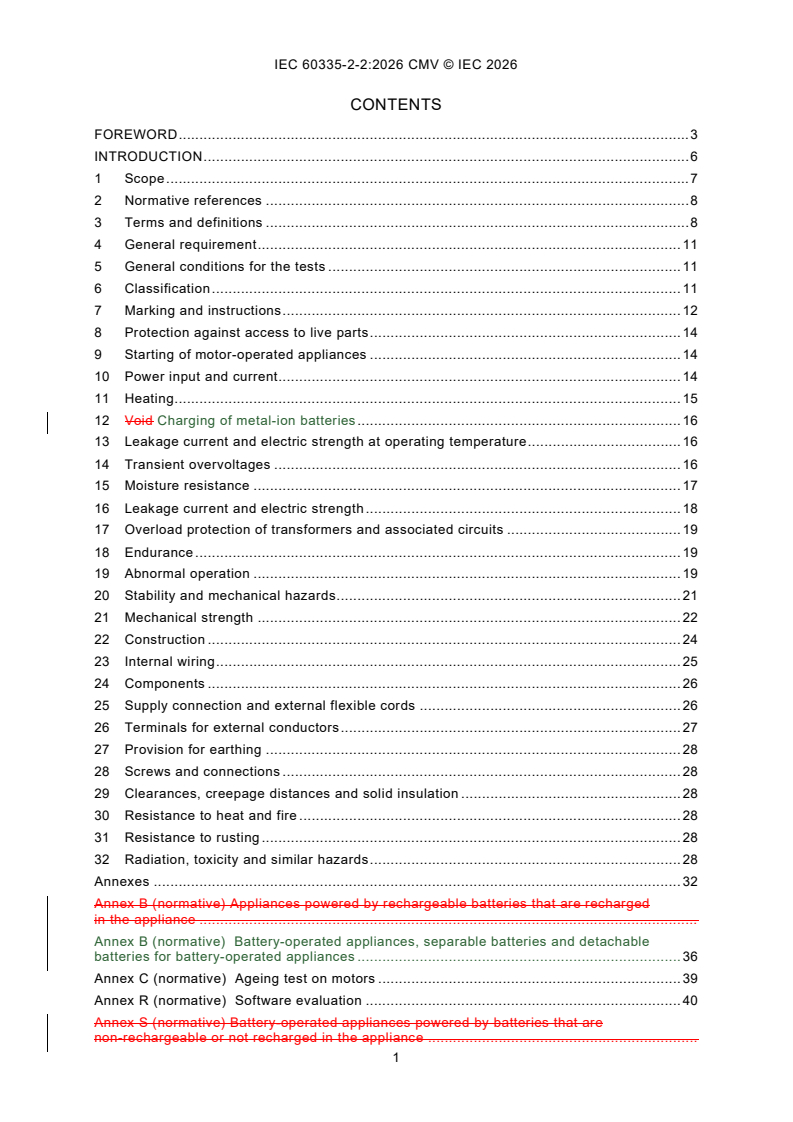
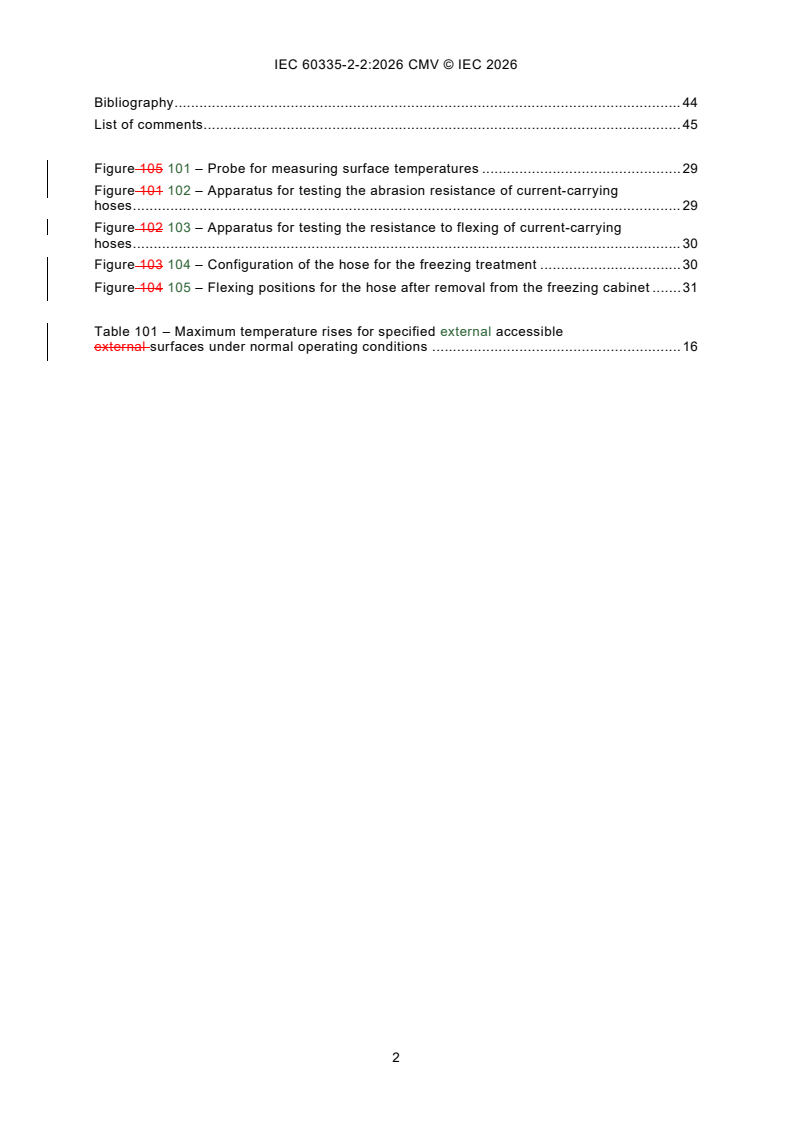
REDLINE IEC 60335-2-2:2026 CMV - Household and similar electrical appliances - Safety - Part 2-2: Particular requirements for vacuum cleaners and water-suction cleaning appliances
IEC 60335-2-2:2026 EXV - Household and similar electrical appliances - Safety - Part 2-2: Particular requirements for vacuum cleaners and water-suction cleaning appliances
IEC 60335-2-2:2026 is an IEC International Standard in the IEC 60335 household appliance safety series. It gives particular safety requirements for electric vacuum cleaners and water-suction cleaning appliances for household and similar purposes, including related appliances such as vacuum cleaners for animal grooming, centrally-sited vacuum cleaners, automatic battery-operated cleaners, spray extraction appliances within stated limits, and appliances with blowing or inflating functions. It is written for manufacturers, test laboratories, certifiers, and buyers who need to check whether a vacuum cleaner or related cleaning appliance is designed, marked, and tested for safe use.
What does IEC 60335-2-2:2026 specify?
IEC 60335-2-2:2026 specifies the safety requirements that apply to the appliance families named in the scope, and it does so as a Part 2 standard alongside the general requirements of IEC 60335-1. The document combines the general household appliance safety framework with vacuum-cleaner-specific clauses, annexes, test methods, and construction rules.
The scope covers appliances rated at not more than 250 V for single-phase AC, DC supplied appliances, and battery-operated appliances, and up to 480 V for multi-phase centrally-sited vacuum cleaners. It also covers motorized cleaning heads and current-carrying hoses associated with a particular vacuum cleaner or water-suction cleaning appliance.
The scope includes appliances used outside the home when they are still intended for laypersons and normal housekeeping tasks, such as in shops, schools, farm houses, hotels, motels, and bed and breakfast type environments. It excludes industrial-only appliances and several related product families covered by other IEC standards, including commercial wet and dry vacuum cleaners, floor treatment and wet scrubbing machines, hand-held mains-operated garden blowers and blower vacuums, commercial spray extraction machines, high-pressure cleaners and steam cleaners with rated pressure not less than 2.5 MPa, and appliances with vacuum-pressure functions for skin care.
The standard is organized into Clauses 1 to 32, followed by annexes. The annexes provide routine tests, battery rules, component-specific requirements, fire tests, software evaluation, and remote-communication measures.
| Annex | What it covers |
|---|---|
| A | Routine tests |
| B | Battery-operated appliances, separable batteries and detachable batteries |
| C | Ageing test on motors |
| D | Thermal motor protectors |
| E | Needle-flame test |
| F | Capacitors |
| G | Safety isolating transformers |
| H | Switches |
| I | Motors having basic insulation that is inadequate for the rated voltage of the appliance |
| J | Coated printed circuit boards |
| K | Overvoltage categories |
| L | Guidance for the measurement of clearances and creepage distances |
| M | Pollution degree |
| P | Guidance for appliances used in tropical climates |
| R | Software evaluation |
| U | Appliances intended for remote communication through public networks |
What are the key requirements of IEC 60335-2-2:2026?
IEC 60335-2-2:2026 requires these appliances to be safe in normal use, including foreseeable carelessness, and it checks that by type testing. Clause 4 states the basic safety principle, and Clause 5 says the tests are type tests, normally carried out on one appliance and in clause order unless a clause says otherwise.
General safety, marking and instructions
Clause 7 requires the appliance to be marked and supplied with instructions that support safe installation and use. The clause covers supply nature symbols, class symbols, the detachable power supply part symbol, and symbols for ash vacuum cleaners and motorized cleaning heads where relevant.
This matters in practice because the marking must identify the appliance correctly and the instructions must tell the user how to install, connect, and maintain it safely. Clause 7 also requires markings to remain legible after cleaning and after the tests, which is important for serviceability and traceability.
Electrical protection and operating performance
Clauses 8, 10 to 16, and 17 address access to live parts, power input and current, heating, charging of metal-ion batteries, leakage current, electric strength, transient overvoltages, moisture resistance, and transformer overload protection. Clause 12 is specific to metal-ion batteries and requires charging to stay within the specified operating region for charging, with tests carried out using a fully discharged battery and monitored cell voltage, temperature, and charging current.
Clause 14 requires clearance-related parts to withstand impulse voltage testing, and Clause 15 subjects the enclosure to moisture testing and includes a special test for motorized cleaning heads of water-suction cleaning appliances. Clause 16 repeats leakage current and electric strength checks after the operating tests, so insulation performance is verified both during use and immediately after conditioning.
In practical terms, these clauses check whether the appliance heats up too much, leaks too much current, or fails insulation tests under the conditions it will actually see in service. For battery products, the charging system has to be compatible with the declared charging limits, not just the battery chemistry.
Abnormal operation and mechanical safety
Clause 19 tests the appliance under fault and misuse conditions such as stalled motors, disconnected phases, abnormal heating, and electronic-circuit faults. It also includes extra checks for mains-voltage selector switches, DC supplied appliances with reversed polarity, centrally-sited vacuum cleaners, ash vacuum cleaners, docking stations with suction mode, and appliances with electronic off functions or remote control features.
Clause 20 covers stability and moving parts, and Clause 21 covers mechanical strength, including impact and drop testing where applicable. For example, hand-held battery-operated appliances and hand-held remote controls are dropped from 1 m on a concrete surface, which matters because these products are frequently handled, stored, and dropped in real use.
Construction, wiring, cords and components
Clauses 22 to 28 control the way the appliance is built. They cover disconnecting means, protection against water and live parts, cord anchorage, handles and grips, sharp edges, materials that may not be used, component choice, terminals, earthing, and screws and connections.
Clause 24 ties many internal parts to their relevant IEC component standards, including switches, transformers, appliance couplers, thermal links, capacitors, and automatic controls. This matters because the appliance is not assessed as a single box only - important internal parts must also be suitable for the duty they see in the appliance.
Insulation, fire performance, and special cases
Clause 29 sets the requirements for clearances, creepage distances, and solid insulation, and it points to Annex J for coated printed circuit boards and to the insulation-coordination annexes and guidance annexes where relevant. Clause 30 addresses resistance to heat and fire, including glow-wire and needle-flame testing for non-metallic parts, with stronger attention for unattended appliances, centrally-sited vacuum cleaners, docking stations, and ash vacuum cleaners.
Clauses 31 and 32 cover resistance to rusting and radiation, toxicity, and similar hazards. The practical effect is that the appliance has to remain safe after environmental exposure, material ageing, and foreseeable ignition risk scenarios.
Battery-operated appliances, software, and remote communication
Annex B gives the special rules for battery-operated appliances, separable batteries, and detachable batteries. It changes how the appliance is classified and tested, including battery charging, abnormal operation, mechanical strength, and protection against access to live parts.
Annex R covers software evaluation, and Annex U covers appliances intended for remote communication through public networks. Annex U focuses on avoiding unauthorized access and the effects of transmission failures where these could affect compliance with the standard.
What terms does IEC 60335-2-2:2026 define?
- Battery-operated appliance - An appliance powered by a battery system rather than a direct mains supply, with Annex B giving the additional safety checks that apply to it.
- Centrally-sited vacuum cleaner - A vacuum cleaner covered by the scope for multi-phase systems up to 480 V, with extra attention in clauses on abnormal operation and construction.
- Spray extraction appliance - A vacuum cleaner or water-suction cleaning appliance that sprays liquid solution, provided it stays within the pressure, flow, and nozzle-temperature limits in the scope.
- Motorized cleaning head - A powered cleaning head associated with a vacuum cleaner or water-suction cleaning appliance, with its own marking and moisture-related requirements.
- Current-carrying hose - A hose that carries electrical current as part of the appliance and therefore needs dedicated construction and mechanical checks.
- Detachable power supply part - A separable supply part identified by a specific symbol in Clause 7 and treated as a defined appliance part in the safety rules.
- Type X attachment - A cord attachment method that affects how the cord is assembled, anchored, and inspected in Clauses 25 and 26.
- Protective earthing - The document uses earthing to mean protective earthing unless otherwise specified, which matters whenever accessible metal parts or earthing terminals are involved.
Who uses IEC 60335-2-2:2026?
IEC 60335-2-2:2026 is used by manufacturers of vacuum cleaners, water-suction cleaning appliances, motorized cleaning heads, docking stations, and battery-powered cleaning products. It is also used by design engineers, compliance teams, quality managers, test laboratories, certification bodies, and auditors who need to verify safety before market release.
Buyers and sourcing teams use it to compare products and supplier claims against a recognized safety basis. It is especially relevant where products are intended for household use, layperson use in public-facing premises, or mixed-use environments such as hotels, schools, and farm houses.
What changed in IEC 60335-2-2:2026 from the previous edition?
IEC 60335-2-2:2026 cancels and replaces the seventh edition published in 2019 and states that it is a technical revision. The listed technical changes are alignment with IEC 60335-1:2020, conversion of some notes to normative text in Clause 1, and addition of multi-phase centrally-sited vacuum cleaners to the scope.
Which standards are used with IEC 60335-2-2:2026?
| Standard | Contribution |
|---|---|
| IEC 60335-1:2020+AMD1:2025 | General household appliance safety requirements used with this Part 2-2 |
| IEC 61032 | Test probes for access and enclosure checks |
| IEC 60990:2016 | Leakage current measurement circuits |
| IEC 61180 | Standard impulse waveform for overvoltage testing |
| IEC 60664-1:2020 and IEC 60664-1/AMD1:2025 | Insulation coordination and correction factors |
| IEC 60664-3:2016 | PCB coating spacing rules in Clause 29 |
| IEC 60664-4:2005 | Additional creepage-distance values at higher frequencies |
| IEC 60695-2-11, IEC 60695-2-12, IEC 60695-2-13 | Glow-wire and material flammability/ignition checks |
| IEC 60529 | Degree of protection and water-ingress-related test methods |
| IEC 61558-1:2017, IEC 61558-2-6, IEC 61558-2-16:2021 | Transformers and safety isolating transformer requirements |
| IEC 61058-1:2016 and IEC 61058-1-1:2016 | Switch requirements and endurance testing |
| IEC 60730-1:2022 and IEC 60730-2-9 | Automatic controls and capillary thermal cut-outs |
| IEC 60320-1 and IEC 60320-3 | Appliance couplers and appliance outlets |
| IEC 62133-1:2017 and IEC 62133-2:2017 | Referenced in battery-related context in Annex B |
| IEC 62885-1:2026 | Test material and test equipment for surface-cleaning appliances |
What does the IEC 60335-2-2:2026 document contain?
IEC 60335-2-2:2026 contains clause-by-clause safety requirements, test conditions, and component-specific annexes, plus figures and tables that define the test setups and acceptance checks. It includes leakage-current circuit figures, a test finger nail figure, impulse voltage and screw torque tables, and figures for hose abrasion, flexing, and freezing tests.
The document also contains the detailed methods used to verify thermal, electrical, mechanical, moisture, and fire safety. Those methods support design validation, type testing, certification, and ongoing compliance assessment for the appliance and for key parts such as batteries, switches, transformers, cords, and motorized cleaning heads.
Relations
- Effective Date
- 14-Mar-2025
Buy Documents
IEC 60335-2-2:2026 - Household and similar electrical appliances - Safety - Part 2-2: Particular requirements for vacuum cleaners and water-suction cleaning appliances
REDLINE IEC 60335-2-2:2026 CMV - Household and similar electrical appliances - Safety - Part 2-2: Particular requirements for vacuum cleaners and water-suction cleaning appliances
IEC 60335-2-2:2026 EXV - Household and similar electrical appliances - Safety - Part 2-2: Particular requirements for vacuum cleaners and water-suction cleaning appliances
Get Certified
Connect with accredited certification bodies for this standard

CIS Institut d.o.o.
Personal Protective Equipment (PPE) certification body. Notified Body NB-2890 for EU Regulation 2016/425 PPE.

Kiwa BDA Testing
Building and construction product certification.
Kmetijski inštitut Slovenije
Agricultural Institute of Slovenia. Soil testing, plant health, agricultural product analysis.
Sponsored listings
Frequently Asked Questions
IEC 60335-2-2:2026 is a standard published by the International Electrotechnical Commission (IEC). Its full title is "Household and similar electrical appliances - Safety - Part 2-2: Particular requirements for vacuum cleaners and water-suction cleaning appliances". This standard covers: IEC 60335-2-2:2026 deals with the safety of electric vacuum cleaners and water suction cleaning appliances for household and similar purposes, their rated voltage being not more than 250 V for single phase (AC) supplied appliances, direct current (DC) supplied appliances and battery-operated appliances and 480 V for multi-phase centrally-sited vacuum cleaners. This standard also applies to vacuum cleaners for animal grooming, centrally-sited vacuum cleaners, and automatic battery-operated cleaners. This standard also applies to spray extraction appliances in which – the pressure of the employed liquid solution does not exceed 2,5 MPa; – the product of the pressure (in MPa) and the flow of liquid solution (in litres per minute) do not exceed 100; and – the temperature of the liquid solution at the spray nozzle outlet does not exceed 60 °C. This standard also applies to vacuum cleaners and water suction cleaning appliances provided with a blowing function or inflating function. This standard also applies to motorized cleaning heads and current-carrying hoses associated with a particular vacuum cleaner or water suction cleaning appliance. Appliances not intended for normal household use, but which nevertheless can be a source of danger to the public, such as appliances intended to be used by laypersons in shops and other premises for normal housekeeping purposes, are within the scope of this standard. Examples of appliances for household use are appliances for typical housekeeping functions used in the household environment that can also be used by non-expert users for typical intermittent housekeeping functions: – in shops, schools and other similar working environments; – in farm houses; – by clients in hotels, motels and other residential type environments; – in bed and breakfast type environments. Household environments include the dwelling and its associated buildings, the garden, etc. As far as is practicable, this standard deals with the common hazards presented by appliances that are encountered by all persons in and around the home. However, in general, it does not take into account – persons (including children) whose physical, sensory or mental capabilities; or lack of experience and knowledge prevents them from using the appliance safely without supervision or instruction; – children playing with the appliance. Attention is drawn to the fact that – for appliances intended to be used in vehicles or on board ships or aircraft, additional requirements can be necessary; – in many countries, additional requirements are specified by the national health authorities, the national authorities responsible for the protection of labour, the national water supply authorities and similar authorities. This standard does not apply to – appliances intended exclusively for industrial purposes; – appliances intended to be used in locations where special conditions prevail, such as the presence of a corrosive or explosive atmosphere (dust, vapour or gas); – wet and dry vacuum cleaners, including power brush, for commercial use (IEC 60335-2-69); – floor treatment and wet scrubbing machines, including rug shampooers, for household and similar use (IEC 60335-2-10); – hand-held mains-operated garden blowers, vacuums and blower vacuums (IEC 60335 2 100, IEC 62841-4-6); – spray extraction machines for commercial use (IEC 60335-2-68); – high-pressure cleaners and steam cleaners (with a rated pressure not less than 2,5 MPa) (IEC 60335-2-79); – appliances having vacuum-pressure functions for skin care (IEC 60335-2-115). This eighth edition cancels and replaces the seventh edition published in 2019. This edition constitutes a technical revision. This edition includes the following significant technical changes with respect to the previous edition: – alignment with IEC 60335-1:2020; – conversion of some notes to normative text (Clause 1); – addition of multi-phase central vacuum cleaners to the scope (Clause 1); –
IEC 60335-2-2:2026 deals with the safety of electric vacuum cleaners and water suction cleaning appliances for household and similar purposes, their rated voltage being not more than 250 V for single phase (AC) supplied appliances, direct current (DC) supplied appliances and battery-operated appliances and 480 V for multi-phase centrally-sited vacuum cleaners. This standard also applies to vacuum cleaners for animal grooming, centrally-sited vacuum cleaners, and automatic battery-operated cleaners. This standard also applies to spray extraction appliances in which – the pressure of the employed liquid solution does not exceed 2,5 MPa; – the product of the pressure (in MPa) and the flow of liquid solution (in litres per minute) do not exceed 100; and – the temperature of the liquid solution at the spray nozzle outlet does not exceed 60 °C. This standard also applies to vacuum cleaners and water suction cleaning appliances provided with a blowing function or inflating function. This standard also applies to motorized cleaning heads and current-carrying hoses associated with a particular vacuum cleaner or water suction cleaning appliance. Appliances not intended for normal household use, but which nevertheless can be a source of danger to the public, such as appliances intended to be used by laypersons in shops and other premises for normal housekeeping purposes, are within the scope of this standard. Examples of appliances for household use are appliances for typical housekeeping functions used in the household environment that can also be used by non-expert users for typical intermittent housekeeping functions: – in shops, schools and other similar working environments; – in farm houses; – by clients in hotels, motels and other residential type environments; – in bed and breakfast type environments. Household environments include the dwelling and its associated buildings, the garden, etc. As far as is practicable, this standard deals with the common hazards presented by appliances that are encountered by all persons in and around the home. However, in general, it does not take into account – persons (including children) whose physical, sensory or mental capabilities; or lack of experience and knowledge prevents them from using the appliance safely without supervision or instruction; – children playing with the appliance. Attention is drawn to the fact that – for appliances intended to be used in vehicles or on board ships or aircraft, additional requirements can be necessary; – in many countries, additional requirements are specified by the national health authorities, the national authorities responsible for the protection of labour, the national water supply authorities and similar authorities. This standard does not apply to – appliances intended exclusively for industrial purposes; – appliances intended to be used in locations where special conditions prevail, such as the presence of a corrosive or explosive atmosphere (dust, vapour or gas); – wet and dry vacuum cleaners, including power brush, for commercial use (IEC 60335-2-69); – floor treatment and wet scrubbing machines, including rug shampooers, for household and similar use (IEC 60335-2-10); – hand-held mains-operated garden blowers, vacuums and blower vacuums (IEC 60335 2 100, IEC 62841-4-6); – spray extraction machines for commercial use (IEC 60335-2-68); – high-pressure cleaners and steam cleaners (with a rated pressure not less than 2,5 MPa) (IEC 60335-2-79); – appliances having vacuum-pressure functions for skin care (IEC 60335-2-115). This eighth edition cancels and replaces the seventh edition published in 2019. This edition constitutes a technical revision. This edition includes the following significant technical changes with respect to the previous edition: – alignment with IEC 60335-1:2020; – conversion of some notes to normative text (Clause 1); – addition of multi-phase central vacuum cleaners to the scope (Clause 1); –
IEC 60335-2-2:2026 is classified under the following ICS (International Classification for Standards) categories: 13.120 - Domestic safety; 97.080 - Cleaning appliances. The ICS classification helps identify the subject area and facilitates finding related standards.
IEC 60335-2-2:2026 has the following relationships with other standards: It is inter standard links to IEC 60335-2-2:2019. Understanding these relationships helps ensure you are using the most current and applicable version of the standard.
IEC 60335-2-2:2026 is available in PDF format for immediate download after purchase. The document can be added to your cart and obtained through the secure checkout process. Digital delivery ensures instant access to the complete standard document.
Standards Content (Sample)
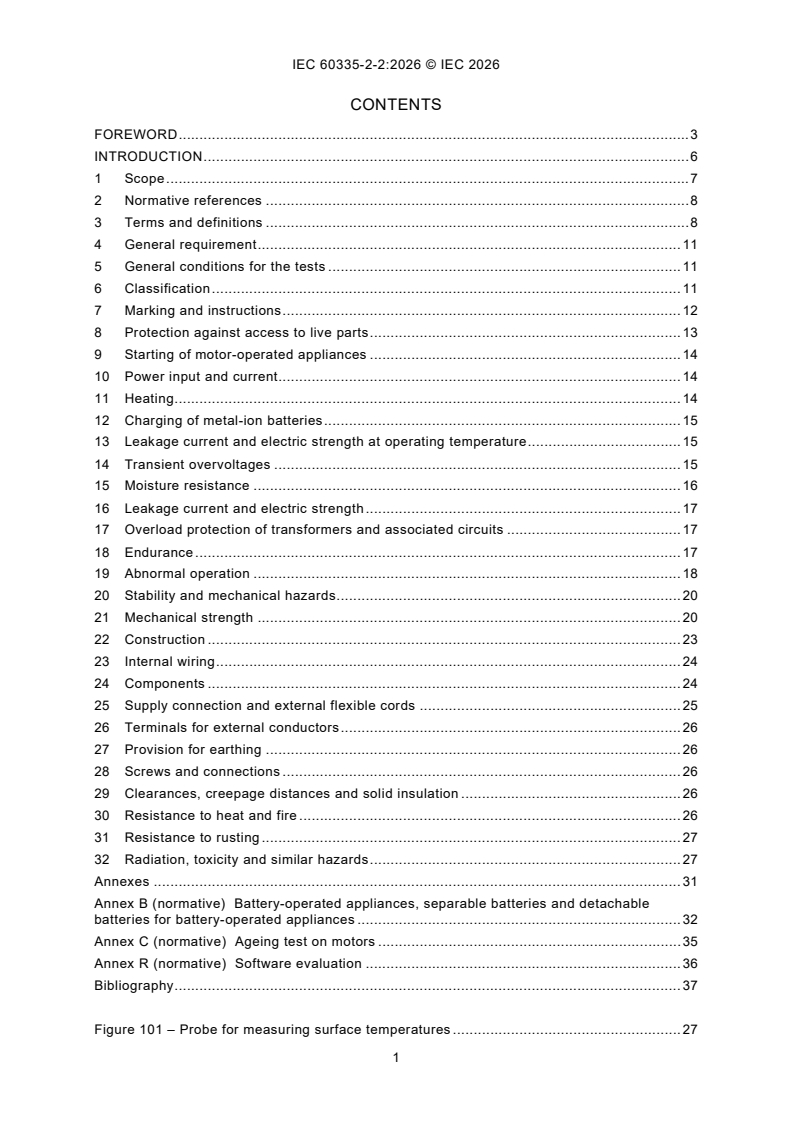
Contents
- 1 Scope
- 2 Normative references
- 3 Terms and definitions
- 3.1 Definitions relating to physical characteristics
- 3.5 Definitions relating to types of appliances
- 3.6 Definitions relating to parts of an appliance
- 3.8 Definitions relating to miscellaneous matters
- 4 General requirement
- 5 General conditions for the tests
- 6 Classification
- 7 Marking and instructions
- 8 Protection against access to live parts
- 9 Starting of motor-operated appliances
- 10 Power input and current
- 11 Heating
- 12 Charging of metal-ion batteries
- 13 Leakage current and electric strength at operating temperature
- 14 Transient overvoltages
- 15 Moisture resistance
- 16 Leakage current and electric strength
- 17 Overload protection of transformers and associated circuits
- 18 Endurance
- 19 Abnormal operation
- 20 Stability and mechanical hazards
- 21 Mechanical strength
- 22 Construction
- 23 Internal wiring
- 24 Components
- 25 Supply connection and external flexible cords
- 26 Terminals for external conductors
- 27 Provision for earthing
- 28 Screws and connections
- 29 Clearances, creepage distances and solid insulation
- 30 Resistance to heat and fire
- 31 Resistance to rusting
- 32 Radiation, toxicity and similar hazards
- Annex B
- 3 Terms and definitions
- 7 Marking and instructions
- 19 Abnormal operation
- 20 Stability and mechanical hazards
- 21 Mechanical strength
- 22 Construction
- 24 Components
- 30 Resistance to heat and fire
- Annex C
- Annex R
- Bibliography
INTRODUCTION It has been assumed in the drafting of this International Standard that the execution of its provisions is entrusted to appropriately qualified and experienced persons. Guidance documents concerning the application of the safety requirements for appliances can be accessed via TC 61 supporting documents on the IEC website https://www.iec.ch/tc61/supportingdocuments This information is given for the convenience of users of this International Standard and does not constitute a replacement for the normative text in this standard. This standard recognizes the internationally accepted level of protection against hazards such as electrical, mechanical, thermal, fire and radiation of appliances when operated as in normal use taking into account the manufacturer's instructions. It also covers abnormal situations that can be expected in practice and takes into account the way in which electromagnetic phenomena can affect the safe operation of appliances.
This standard takes into account the requirements of IEC 60364 as far as possible so that there is compatibility with the wiring rules when the appliance is connected to the supply mains. However, national wiring rules can differ.
If an appliance within the scope of this standard also incorporates functions that are covered by another part 2 of IEC 60335, the relevant part 2 is applied to each function separately, as far as is reasonable. If applicable, the influence of one function on the other is taken into account.
When a part 2 standard does not include additional requirements to cover hazards dealt with in Part 1, Part 1 applies.
NOTE 1 This means that the technical committees responsible for the part 2 standards have determined that it is not necessary to specify particular requirements for the appliance in question over and above the general requirements.
This standard is a product family standard dealing with the safety of appliances and takes precedence over horizontal and generic standards covering the same subject. NOTE 2 Horizontal publications, basic safety publications and group safety publications covering a hazard are not applicable since they have been taken into consideration when developing the general and particular requirements for the IEC 60335 series of standards.
An appliance that complies with the text of this standard will not necessarily be considered to comply with the safety principles of the standard if, when examined and tested, it is found to have other features that impair the level of safety covered by these requirements. An appliance employing materials or having forms of construction differing from those detailed in the requirements of this standard may be examined and tested according to the intent of the requirements and, if found to be substantially equivalent, may be considered to comply with the standard.
NOTE 3 Standards dealing with non-safety aspects of household appliances are:
- IEC standards published by TC 59 concerning methods of measuring performance;
- CISPR 11, CISPR 14-1 and relevant IEC 61000-3 series standards concerning electromagnetic emissions;
- CISPR 14-2 concerning electromagnetic immunity;
- IEC standards published by TC 111 concerning environmental matters.
1 Scope
This clause of Part 1 is replaced by the following.
This part of IEC 60335 deals with the safety of electric vacuum cleaners and water-suction cleaning appliances for household and similar purposes, their rated voltage being not more than 250 V for single phase (AC) supplied appliances, direct current (DC) supplied appliances and battery-operated appliances and 480 V for multi-phase centrally-sited vacuum cleaners. This standard also applies to vacuum cleaners for animal grooming, centrally-sited vacuum cleaners, and automatic battery-operated cleaners.
This standard also applies to spray extraction appliances in which - the pressure of the employed liquid solution does not exceed 2,5 MPa; - the product of the pressure (in MPa) and the flow of liquid solution (in litres per minute) does not exceed 100; and - the temperature of the liquid solution at the spray nozzle outlet does not exceed 60 °C. This standard also applies to vacuum cleaners and water-suction cleaning appliances provided with a blowing function or inflating function.
This standard also applies to motorized cleaning heads and current-carrying hoses associated with a particular vacuum cleaner or water-suction cleaning appliance. Appliances not intended for normal household use, but which nevertheless can be a source of danger to the public, such as appliances intended to be used by laypersons in shops and other premises for normal housekeeping purposes, are within the scope of this standard. Examples of appliances for household use are appliances for typical housekeeping functions used in the household environment that can also be used by non-expert users for typical intermittent housekeeping functions:
- in shops, schools and other similar working environments;
- in farm houses;
- by clients in hotels, motels and other residential type environments;
- in bed and breakfast type environments.
NOTE 101 Household environments include the dwelling and its associated buildings, the garden, etc. As far as is practicable, this standard deals with the common hazards presented by appliances that are encountered by all persons in and around the home. However, in general, it does not take into account - persons (including children) whose - physical, sensory or mental capabilities; or - lack of experience and knowledge prevents them from using the appliance safely without supervision or instruction; - children playing with the appliance.
Attention is drawn to the fact that - for appliances intended to be used in vehicles or on board ships or aircraft, additional requirements can be necessary; - in many countries, additional requirements are specified by the national health authorities, the national authorities responsible for the protection of labour, the national water supply authorities and similar authorities.
This standard does not apply to - appliances intended exclusively for industrial purposes; - appliances intended to be used in locations where special conditions prevail, such as the presence of a corrosive or explosive atmosphere (dust, vapour or gas); - wet and dry vacuum cleaners, including power brush, for commercial use (IEC 60335-2-69); - floor treatment and wet scrubbing machines, including rug shampooers, for household and similar use (IEC 60335-2-10); - hand-held mains-operated garden blowers, vacuums and blower vacuums (IEC 60335-2-100, IEC 62841-4-6); - spray extraction machines for commercial use (IEC 60335-2-68); - high-pressure cleaners and steam cleaners (with a rated pressure not less than 2,5 MPa) (IEC 60335-2-79); - appliances having vacuum-pressure functions for skin care (IEC 60335-2-115).
2 Normative references
This clause of Part 1 is applicable except as follows.
Addition:
IEC 60584-1, Thermocouples - Part 1: EMF specifications and tolerances IEC TS 62885-1:2026, Surface cleaning appliances - Part 1: General requirements on test material and test equipment ISO 216, Writing paper and certain classes of printed matter - Trimmed sizes - A and B series, and indication of machine direction ISO 6344-2:2021, Coated abrasives - Determination and designation of grain size distribution - Part 2: Macrogrit sizes P12 to P220 ISO 7010, Graphical symbols - Safety colours and safety signs - Registered safety signs ISO 14688-1, Geotechnical investigation and testing - Identification and classification of soil - Part 1: Identification and description
3 Terms and definitions
This clause of Part 1 is applicable except as follows.
3.1 Definitions relating to physical characteristics
3.1.4 Addition:
Note 101 to entry: For appliances incorporating a booster setting, the rated power input corresponds to the operation of the appliance without the booster setting being used.
3.1.9 Modification:
Replace the first paragraph with the following:
operation of the appliance under the conditions specified in 3.1.9.101 to 3.1.9.104 3.1.9.101 The appliance is supplied at rated voltage and operated continuously with the main air inlet adjusted to give a power input P after 20 s.
m Three minutes later, a final adjustment of the main air inlet is made, if necessary. P is calculated from the formula:
m P = 0,5 (P + P ) m f i where P is the power input in watts, after 3 min of operation with the main air inlet unobstructed. Any f device that ensures a flow of air to cool the motor in the event of a blockage of the main air inlet is allowed to operate; P is the power input in watts, after a further 20 s of operation with the main air inlet blocked.
Any device that is adjustable without the aid of a tool, and which ensures a flow of air to cool the motor in the event of a blockage of a main air inlet, is rendered inoperative. If Pi has a rapid non-linear decrease or cannot be measured due to the appliance suction motor stopping before 20 s, the main air inlet is gradually blocked to the extent that the motor +5 stops after 20 s. In this case, P is the maximum value of power input in the last two − 0 i seconds before the motor shuts off.
If the appliance is marked with a rated voltage range, it is supplied at the mean value of the range if the difference between the limits of the range does not exceed 10 % of the mean value. If the difference exceeds 10 %, the supply voltage is the upper value of the range. The measurements are made with the appliance fitted with a clean dust bag and filter, any water collection container being empty. If the appliance is intended to be used only with a hose, detachable nozzles and tubes are removed and the hose is laid out straight. If the appliance is provided with a hose as an accessory, it is operated without the hose. 3.1.9.102 Rotating brushes and similar devices are in operation but not in contact with any surface. Motorized cleaning heads are connected by means of the hose or tube and are in operation but not in contact with any surface.
3.1.9.103 Appliances equipped with a blowing function or inflating function are also operated whilst equipped with the hose as described in the instructions for use. Power adjustment controls are set to the highest input power. The hose is not equipped with any attachments, e.g. nozzles.
3.1.9.104 Spray extraction appliances are operated with the spray extraction pump with the nozzle giving the highest load, the vacuum motor and the device for agitating the carpet pile (if any) all in use. The liquid dispensing system is filled and is in operation. Any heating element is energized and, if user adjustable, is adjusted to the highest temperature setting. The wastewater tank is empty at the beginning of the test.
Spray extraction appliances intended for carpet are operated on a carpet meeting the construction specifications given in IEC TS 62885-1:2026, Table 5. The appliance is moved backwards and forwards at a rate of 10 cycles per minute over a distance of 1 m. Spray extraction appliances intended for upholstery cleaning or hard surface cleaning are operated without their rotating brushes or similar devices being in contact with upholstery or any other surface. Suction hoses are laid out straight with the main air inlet unobstructed.
3.5 Definitions relating to types of appliances
3.5.101 ash vacuum cleaner vacuum cleaner intended to vacuum cold ash from fireplaces, chimneys, ovens, ashtrays and similar places of ash accumulation 3.5.102 automatic battery-operated cleaner vacuum cleaner that operates without human control only within a defined perimeter, within a pre-programmed area or in an area self-controlled by the appliance Note 1 to entry: The cleaner consists of the mobile part and can have a docking station. 3.5.103 centrally-sited vacuum cleaner vacuum cleaner that is connected to a ducting system installed in the building Note 1 to entry: During use, the nozzle and its associated hose are connected to one of the suction inlets of the ducting system.
3.5.104 water-suction cleaning appliance appliance for aspirating an aqueous solution that can contain foaming detergent 3.5.105 spray extraction appliance water-suction cleaning appliance for carpet, upholstery or hard surface cleaning equipped with a spray function for liquid
3.6 Definitions relating to parts of an appliance
3.6.101 docking station unit that can provide:
- manual or automatic battery charging facilities,
- dust removal,
- data processing facility, and
- suction for the functional part Note 1 to entry: A docking station is also known as a base unit. 3.6.102 motorized cleaning head accessory containing a motor that is powered from the appliance and which is attached to the end of a hose or tube
3.8 Definitions relating to miscellaneous matters
3.8.101 booster setting position of a control resulting in a temporary higher power input that is automatically reduced to the power input value when the setting is not used 3.8.102 inflating function operation mode where the air outlet is used to inflate objects
3.8.103 blowing function operation mode where the air outlet is used for an intended function Note 1 to entry: Examples of intended functions are blowing debris away from an area or drying. Note 2 to entry: Based on the intended functions, other standards can also apply.
4 General requirement
This clause of Part 1 is applicable.
5 General conditions for the tests
This clause of Part 1 is applicable except as follows.
5.2 Addition:
A new hose is used for each of the tests of 21.101 to 21.105. The test of 19.105 may be carried out on a separate appliance.
5.101 For spray extraction appliances stating in the instructions to fill a liquid container with water, the liquid container shall be filled with water at a temperature of - (60 ± 5) °C, or - (15 ± 5) °C if it is intended to be filled with cold water only. If, during operation, a liquid container intended to be manually filled by the user is emptied or the wastewater container becomes full, the appliance is switched off while the liquid containers are filled or the wastewater container is emptied, as applicable. Operation is then continued until the specified test duration is completed.
6 Classification
This clause of Part 1 is applicable except as follows.
6.1 Modification:
Replace the first paragraph with the following:
Vacuum cleaners for animal grooming shall be class II or class III. Vacuum cleaners provided with user accessible socket outlets or appliance outlets shall be class I if the socket outlet or appliance outlet has an earthing contact. Appliances may be class 0, unless they are:
- provided with user accessible socket outlets or appliance outlets with an earthing contact;
- centrally-sited vacuum cleaners;
- water-suction cleaning appliances;
- vacuum cleaners for animal grooming; or
- intended for outdoor use.
6.2 Addition:
Vacuum cleaners for animal grooming and water-suction cleaning appliances, and their detachable power supply parts shall be at least IPX4. This is not applicable to detachable power supply parts if they have pins for insertion into a socket-outlet or if the functional part of the appliance cannot operate while connected to the detachable power supply part.
7 Marking and instructions
This clause of Part 1 is applicable except as follows.
7.1 Addition:
Ash vacuum cleaners shall be marked with symbol ISO 7000-0434A (2004-01), symbol ISO 7000-0790 (2004-01) and warning sign ISO 7010-W021(2011-05). 7.6 Addition:
[symbol IEC 60417-5935 motorized cleaning head for water suction (2012-09)] cleaning
[warning sign ISO 7010- warning; flammable materials W021(2011-05)]
7.12 Addition:
The instructions shall include the substance of the following:
This appliance is intended for typical housekeeping functions by an untrained user. The instructions for appliances having a current-carrying hose operating at other than safety extra-low voltage shall include the substance of the following:
CAUTION: This hose contains electrical connections:
- do not use to suck up water (not applicable to water-suction cleaning appliances);
- do not immerse in water for cleaning;
- the hose should be checked regularly and must not be used if damaged. The instructions for vacuum cleaners incorporating rotating brushes or similar devices, and water-suction cleaning appliances, shall state that the plug shall be removed from the socketoutlet before cleaning or maintaining the appliance. If symbol IEC 60417-5935 (2012-09) is used, its meaning shall be explained. The instructions for vacuum cleaners with a blowing function or inflating function shall include information concerning the use of these functions.
The instructions for spray extraction appliances shall state if the appliance is intended for cleaning of carpets, upholstery or hard surfaces. If different accessories are provided, the use of each accessory shall be explained.
The instructions for ash vacuum cleaners shall include the substance of the following:
This appliance is intended to pick up cold ash from fireplaces, chimneys, ovens, ashtrays, and similar places of ash accumulation.
WARNING: Risk of fire.
- Do not pick up hot, glowing or burning ash. Pick up cold ash only;
- The dust container must be emptied and cleaned before and after each use;
- Do not use paper dust bags or bags made from similar flammable materials;
- Do not use any other vacuum cleaner to vacuum ash;
- Do not rest the ash vacuum cleaner on flammable or polymeric surfaces, including carpeting and vinyl tile.
7.14 Addition:
The height of symbol IEC 60417-5935 (2012-09) shall be at least 15 mm. For ash vacuum cleaners only, the height of symbol ISO 7000-0434A (2004-01), symbol ISO 7000-0790 (2004-01) and warning sign ISO 7010-W021 (2011-05) shall be at least 15 mm. Compliance is checked by measurement.
7.15 Addition:
Symbol ISO 7000-0434A (2004-01) shall be located next to symbol ISO 7000-0790 (2004-01). 7.101 Motorized cleaning heads shall be marked with:
- rated voltage or rated voltage range in volts;
- symbol for nature of supply, unless the rated frequency is marked;
- rated power input in watts;
- name, trademark or identification mark of the manufacturer or responsible vendor;
- model or type reference.
Motorized cleaning heads for water-suction cleaning appliances shall be marked with symbol IEC 60417-5935 (2012-09).
Compliance is checked by inspection.
8 Protection against access to live parts
This clause of Part 1 is applicable except as follows.
8.1.1 Addition:
For parts of appliances situated not more than 850 mm above the floor after installation or in normal use, in addition to the use of test probe 18, test probe 19 of IEC 61032 is also applied wherever test probe 18 is used and with the same test conditions used for test probe 18.
If the instructions state that a part is to be removed when replacing a lamp or a drive belt, and a tool is required for its removal, the part is not considered to be a detachable part provided that:
- an instruction to disconnect the appliance from the supply before opening is marked on the cover or is visible during its removal; and
- after removal of the cover, access to live parts is prevented by at least basic insulation.
9 Starting of motor-operated appliances
This clause of Part 1 is not applicable.
10 Power input and current
This clause of Part 1 is applicable except as follows.
10.1 Addition:
The power input of motorized cleaning heads is measured separately. Booster settings are not used during these measurements.
11 Heating
This clause of Part 1 is applicable except as follows.
11.2 Addition after the seventh paragraph:
For appliances incorporating an automatic cord reel, the cord is completely unreeled after 30 min of operation.
11.3 Addition:
...
Contents
- 1 Scope
- 2 Normative references
- 3 Terms and definitions
- 3.1 Definitions relating to physical characteristics
- 3.5 Definitions relating to types of appliances
- 3.6 Definitions relating to parts of an appliance
- 3.8 Definitions relating to miscellaneous matters
- 4 General requirement
- 5 General conditions for the tests
- 6 Classification
- 7 Marking and instructions
- 8 Protection against access to live parts
- 9 Starting of motor-operated appliances
- 10 Power input and current
- 11 Heating
- 12 Void Charging of metal-ion batteries
- 13 Leakage current and electric strength at operating temperature
- 14 Transient overvoltages
- 15 Moisture resistance
- 16 Leakage current and electric strength
- 17 Overload protection of transformers and associated circuits
- 18 Endurance
- 19 Abnormal operation
- 20 Stability and mechanical hazards
- 21 Mechanical strength
- 22 Construction
- 23 Internal wiring
- 24 Components
- 25 Supply connection and external flexible cords
- 26 Terminals for external conductors
- 27 Provision for earthing
- 28 Screws and connections
- 29 Clearances, creepage distances and solid insulation
- 30 Resistance to heat and fire
- 31 Resistance to rusting
- 32 Radiation, toxicity and similar hazards
- Annex B
- 6 Classification
- 7 Marking and instructions
- 11 Heating
- 19 Abnormal operation
- 21 Mechanical strength
- 22 Construction
- 24 Components
- 30 Resistance to heat and fire
- Annex B
- 3 Terms and definitions
- 7 Marking and instructions
- 19 Abnormal operation
- 20 Stability and mechanical hazards
- 21 Mechanical strength
- 22 Construction
- 24 Components
- 30 Resistance to heat and fire
- Annex C
- Annex R
- Annex S 1
- 6 Classification
- 7 Marking and instructions
- 19 Abnormal operation
- 21 Mechanical strength
- 22 Construction
- 24 Components
- 30 Resistance to heat and fire
- Bibliography
- 2 This revision is for alignment with IEC 60335-1:2020 and to include multi-phase centrally-
- 4 Appliances covered by this standard can have a blowing or inflating function. Requirements
- 6 This revision maintains the normal operation while charging, as specified in IEC 60335-
- 7 Separation into several subclauses is necessary to cover the variety of product types in
- 8 This addition is made to clearly indicate which air inlet is intended. Some product types
- 13 The exclusion for SELV current-carrying hoses is now integrated into Subclauses 21.101 to
- 14 The water temperature for spray extraction machines intended to be filled with water is
- 16 A clarification is added because detachable power supply parts are now allowed as part of
- 17 This is added to clarify appliances used in a commercial environment where no training is
- 18 The requirements for instructions are made more specific because this cautionary statement
- 19 This revision specifies the size requirements only for the symbol used on ash vacuum
- 24 Minor revisions are made to the requirements for external surface temperatures to align
- 25 A modification is added to address the requirements for different designs of liquid
- 26 The running overload test of Subclause 19.9 is not applicable. This test for docking
- 27 The limits are now specified in Subclause 19.103 because Subclause 19.9 is no longer
INTRODUCTION It has been assumed in the drafting of this International Standard that the execution of its provisions is entrusted to appropriately qualified and experienced persons. Guidance documents concerning the application of the safety requirements for appliances can be accessed via TC 61 supporting documents on the IEC website https://www.iec.ch/tc61/supportingdocuments This information is given for the convenience of users of this International Standard and does not constitute a replacement for the normative text in this standard. This standard recognizes the internationally accepted level of protection against hazards such as electrical, mechanical, thermal, fire and radiation of appliances when operated as in normal use taking into account the manufacturer's instructions. It also covers abnormal situations that can be expected in practice and takes into account the way in which electromagnetic phenomena can affect the safe operation of appliances.
This standard takes into account the requirements of IEC 60364 as far as possible so that there is compatibility with the wiring rules when the appliance is connected to the supply mains. However, national wiring rules may can differ.
If an appliance within the scope of this standard also incorporates functions that are covered by another part 2 of IEC 60335, the relevant part 2 is applied to each function separately, as far as is reasonable. If applicable, the influence of one function on the other is taken into account.
When a part 2 standard does not include additional requirements to cover hazards dealt with in Part 1, Part 1 applies.
NOTE 1 This means that the technical committees responsible for the part 2 standards have determined that it is not necessary to specify particular requirements for the appliance in question over and above the general requirements.
This standard is a product family standard dealing with the safety of appliances and takes precedence over horizontal and generic standards covering the same subject. NOTE 2 Horizontal and generic standards Horizontal publications, basic safety publications and group safety publications covering a hazard are not applicable since they have been taken into consideration when developing the general and particular requirements for the IEC 60335 series of standards. For example, in the case of temperature requirements for surfaces on many appliances, generic standards, such as ISO 13732-1 for hot surfaces, are not applicable in addition to Part 1 or part 2 standards. 1 An appliance that complies with the text of this standard will not necessarily be considered to comply with the safety principles of the standard if, when examined and tested, it is found to have other features that impair the level of safety covered by these requirements. An appliance employing materials or having forms of construction differing from those detailed in the requirements of this standard may be examined and tested according to the intent of the requirements and, if found to be substantially equivalent, may be considered to comply with the standard.
NOTE 3 Standards dealing with non-safety aspects of household appliances are:
- IEC standards published by TC 59 concerning methods of measuring performance;
- CISPR 11, CISPR 14-1 and relevant IEC 61000-3 series standards concerning electromagnetic emissions;
- CISPR 14-2 concerning electromagnetic immunity;
- IEC standards published by TC 111 concerning environmental matters. 1
1 Scope
This clause of Part 1 is replaced by the following.
This part of IEC 60335 deals with the safety of electric vacuum cleaners and water-suction cleaning appliances for household and similar purposes, including vacuum cleaners for animal grooming, their rated voltage being not more than 250 V for single phase (AC) supplied appliances, direct current (DC) supplied appliances and battery-operated appliances and 480 V for multi-phase centrally-sited vacuum cleaners 2.
This standard also applies to vacuum cleaners for animal grooming, centrally-sited vacuum cleaners, and automatic battery-operated cleaners.
This standard also applies to spray extraction appliances in which - the pressure of the employed liquid solution does not exceed 2,5 MPa; - the product of the pressure (in MPa) and the flow of liquid solution (in litres per minute) does not exceed 100; and - the temperature of the liquid solution at the spray nozzle outlet does not exceed 60 °C. 3 This standard also applies to vacuum cleaners and water-suction cleaning appliances provided with a blowing function or inflating function. 4 This standard also applies to motorized cleaning heads and current-carrying hoses associated with a particular vacuum cleaner or water-suction cleaning appliance. Battery-operated appliances and other DC supplied appliances are within the scope of this standard. Dual supply appliances, either mains-supplied or battery-operated, are regarded as battery-operated appliances when operated in the battery mode. Appliances not intended for normal household use, but which nevertheless may can be a source of danger to the public, such as appliances intended to be used by laymen laypersons in shops and other premises for normal housekeeping purposes, are within the scope of this standard. NOTE 101 Examples of such appliances are appliances intended to be used for normal housekeeping purposes in hotels, offices, schools, hospitals and similar premises.
Examples of appliances for household use are appliances for typical housekeeping functions used in the household environment that can also be used by non-expert users for typical intermittent housekeeping functions: 5 - in shops, schools and other similar working environments; - in farm houses; - by clients in hotels, motels and other residential type environments; - in bed and breakfast type environments.
NOTE 101 Household environments include the dwelling and its associated buildings, the garden, etc. As far as is practicable, this standard deals with the common hazards presented by appliances that are encountered by all persons in and around the home. However, in general, it does not take into account - persons (including children) whose - physical, sensory or mental capabilities; or - lack of experience and knowledge prevents them from using the appliance safely without supervision or instruction; - children playing with the appliance.
NOTE 102 Attention is drawn to the fact that - for appliances intended to be used in vehicles or on board ships or aircraft, additional requirements can be necessary; - in many countries, additional requirements are specified by the national health authorities, the national authorities responsible for the protection of labour, the national water supply authorities and similar authorities.
NOTE 103 This standard does not apply to - appliances intended exclusively for industrial purposes; - appliances intended to be used in locations where special conditions prevail, such as the presence of a corrosive or explosive atmosphere (dust, vapour or gas); - wet and dry vacuum cleaners, including power brush, for commercial use (IEC 60335-2-69); - floor treatment and wet scrubbing machines, including rug shampooers, for household and similar use (IEC 60335-2-10); - hand-held mains-operated garden blowers, vacuums and blower vacuums (IEC 60335-2-100, IEC 62841-4-6); - spray extraction machines for commercial use (IEC 60335-2-68); - high-pressure cleaners and steam cleaners (with a rated pressure not less than 2,5 MPa) (IEC 60335-2-79); - appliances having vacuum-pressure functions for skin care (IEC 60335-2-115).
2 Normative references
This clause of Part 1 is applicable except as follows.
Addition:
IEC 60584-1, Thermocouples - Part 1: EMF specifications and tolerances IEC TS 62885-1:20182026, Surface cleaning appliances - Part 1: General requirements on test material and test equipment ISO 216, Writing paper and certain classes of printed matter - Trimmed sizes - A and B series, and indication of machine direction ISO 6344-2:2021, Coated abrasives – Grain size analysis - Determination and designation of grain size distribution - Part 2: Macrogrit sizes P12 to P220 ISO 7010:2011, Graphical symbols - Safety colours and safety signs - Registered safety signs ISO 14688-1, Geotechnical investigation and testing - Identification and classification of soil - Part 1: Identification and description
3 Terms and definitions
This clause of Part 1 is applicable except as follows.
3.1 Definitions relating to physical characteristics
3.1.4 Addition:
Note 101 to entry: For appliances incorporating a booster setting, the rated power input corresponds to the operation of the appliance without the booster setting being used.
3.1.9 Replacement 6 normal operation Modification:
Replace the first paragraph with the following:
operation of the appliance under the following conditions specified in 3.1.9.101 to 3.1.9.104 7 3.1.9.101 The appliance is supplied at rated voltage and operated continuously with the main 8 air inlet adjusted to give a power input P after 20 s.
m Three minutes later, a final adjustment of the main air inlet is made, if necessary. P is calculated from the formula:
m P = 0,5 (P + P ) m f i where P is the power input in watts, after 3 min of operation with the main air inlet unobstructed. Any f device that ensures a flow of air to cool the motor in the event of a blockage of the main air inlet is allowed to operate; P is the power input in watts, after a further 20 s of operation with the main air inlet blocked.
Any device that is adjustable without the aid of a tool, and which ensures a flow of air to cool the motor in the event of a blockage of a main air inlet, is rendered inoperative. If P
has a rapid non-linear decrease or cannot be measured due to the appliance suction motor stopping before 20 s, the main air inlet is gradually blocked to the extent that the motor +5 stops after 20 s. In this case, P is the maximum value of power input in the last two − 0
seconds before the motor shuts off.
If the appliance is marked with a rated voltage range, it is supplied at the mean value of the range if the difference between the limits of the range does not exceed 10 % of the mean value. If the difference exceeds 10 %, the supply voltage is the upper value of the range. The measurements are made with the appliance fitted with a clean dust bag and filter, any water collection container being empty. If the appliance is intended to be used only with a hose, detachable nozzles and tubes are removed and the hose is laid out straight. If the appliance is provided with a hose as an accessory, it is operated without the hose. 3.1.9.102 Rotating brushes and similar devices are in operation but not in contact with any surface. Motorized cleaning heads are connected by means of the hose or tube and are in operation but not in contact with any surface.
Appliance outlets for other accessories are loaded with a resistive load in accordance with the marking. 9 Automatic battery-operated cleaners are operated with a clean dust bag or filter on the carpet meeting the construction specifications given in Table 1 in IEC TS 62885-1:2018. A frame of 1,5 m by 1,5 m is used on the carpet to limit the area of action. The air inlet is unobstructed. 10 3.1.9.103 Appliances equipped with a blowing function or inflating function are also operated whilst equipped with the hose as described in the instructions for use. Power adjustment controls are set to the highest input power. The hose is not equipped with any attachments, e.g. nozzles.
3.1.9.104 Spray extraction appliances are operated with the spray extraction pump with the nozzle giving the highest load, the vacuum motor and the device for agitating the carpet pile (if any) all in use. The liquid dispensing system is filled and is in operation. Any heating element is energized and, if user adjustable, is adjusted to the highest temperature setting. The wastewater tank is empty at the beginning of the test. 11
Spray extraction appliances intended for carpet are operated on a carpet meeting the construction specifications given in IEC TS 62885-1:2026, Table 5. The appliance is moved backwards and forwards at a rate of 10 cycles per minute over a distance of 1 m. Spray extraction appliances intended for upholstery cleaning or hard surface cleaning are operated without their rotating brushes or similar devices being in contact with upholstery or any other surface. Suction hoses are laid out straight with the main air inlet unobstructed.
3.5 Definitions relating to types of appliances
3.5.101 ash vacuum cleaner vacuum cleaner intended to vacuum cold ash from fireplaces, chimneys, ovens, ashtrays and similar places of ash accumulation 3.5.102 automatic battery-operated cleaner vacuum cleaner that operates without human control only within a defined perimeter, within a pre-programmed area or in an area self-controlled by the appliance Note 1 to entry: The cleaner consists of the mobile part and may can have a docking station. 3.5.103 centrally-sited vacuum cleaner vacuum cleaner that is connected to a ducting system installed in the building Note 1 to entry: During use, the nozzle and its associated hose are connected to one of the suction inlets of the ducting system.
3.5.104 water-suction cleaning appliance appliance for aspirating an aqueous solution that may can contain foaming detergent 3.5.105 spray extraction appliance water-suction cleaning appliance for carpet, upholstery or hard surface cleaning equipped with a spray function for liquid 12
3.6 Definitions relating to parts of an appliance
3.6.101 docking station unit that may can provide:
- manual or automatic battery charging facilities,
- dust removal,
- data processing facility, and
- suction for the mobile functional part Note 1 to entry: A docking station is also known as a base unit. 3.6.102 motorized cleaning head accessory containing a motor that is supplied powered from the vacuum cleaner appliance and which is attached to the end of a hose or tube
3.8 Definitions relating to miscellaneous matters
3.8.101 booster setting position of a control resulting in a temporary higher power input that is automatically reduced to the power input value when the setting is not used 3.8.102 inflating function operation mode where the air outlet is used to inflate objects 3.8.103 blowing function operation mode where the air outlet is used for an intended function Note 1 to entry: Examples of intended functions are blowing debris away from an area or drying. Note 2 to entry: Based on the intended functions, other standards can also apply.
4 General requirement
This clause of Part 1 is applicable.
5 General conditions for the tests
This clause of Part 1 is applicable except as follows.
5.2 Addition:
A new hose is used for each of the tests of 21.101 to 21.105. The test of 19.105 may be carried out on a separate appliance.
5.101 Current-carrying hoses operating at safety extra-low voltage are not subjected to the tests of 21.101 to 21.105. 13 For spray extraction appliances stating in the instructions to fill a liquid container with water, the liquid container shall be filled with water at a temperature 14 of - (60 ± 5) °C, or - (15 ± 5) °C if it is intended to be filled with cold water only. If, during operation, a liquid container intended to be manually filled by the user is emptied or the wastewater container becomes full, the appliance is switched off while the liquid containers are filled or the wastewater container is emptied, as applicable. Operation is then continued until the specified test duration is completed.
6 Classification
This clause of Part 1 is applicable except as follows.
6.1 Modification:
Vacuum cleaners and water-suction cleaning appliances shall be class I, class II or class III. Replace the first paragraph with the following:
Vacuum cleaners for animal grooming shall be class II or class III. Stationary parts of automatic battery-operated cleaners may be class 0 if the rated voltage does not exceed 150 V.
Vacuum cleaners provided with user accessible socket outlets or appliance outlets shall be class I if the socket outlet or appliance outlet has an earthing contact. Appliances may be class 0, unless they are:
- provided with user accessible socket outlets or appliance outlets with an earthing contact;
- centrally-sited vacuum cleaners;
- water-suction cleaning appliances;
- vacuum cleaners for animal grooming; or
- intended for outdoor use. 15 6.2 Addition:
Vacuum cleaners for animal grooming and water-suction cleaning appliances, and their detachable power supply parts shall be at least IPX4. This is not applicable to detachable power supply parts if they have pins for insertion into a socket-outlet or if the functional part of the appliance cannot operate while connected to the detachable power supply part. 16
7 Marking and instructions
This clause of Part 1 is applicable except as follows.
7.1 Addition:
The appliance shall be marked with the sum of its rated power input and the maximum load of the appliance outlet in watts (if applicable). 9 Ash vacuum cleaners shall be marked with symbol ISO 7000-0434A (2004-01), symbol ISO 7000-0790 (2004-01) and warning sign ISO 7010-W021(2011-06-05).
7.6 Addition:
[symbol IEC 60417-5935 motorized cleaning head for water suction (2012-09)] cleaning
[warning sign ISO 7010- warning; risk of fire/flammable materials W021(2011-06-05)]
7.12 Addition:
The instructions shall include the substance of the following:
This appliance is intended for typical housekeeping functions by an untrained user. 17
The instructions for appliances having a current-carrying hose operating at other than safety extra-low voltage shall include the substance of the following:
CAUTION: This hose contains electrical connections:
- do not use to suck up water (for vacuum cleaners onlynot applicable to watersuction cleaning appliances); 18
- do not immerse in water for cleaning;
- the hose should be checked regularly and must not be used if damaged. The instructions for vacuum cleaners incorporating rotating brushes or similar devices, and water-suction cleaning appliances, shall state that the plug must shall be removed from the socket-outlet before cleaning or maintaining the appliance.
If symbol IEC 60417-5935 (2012-09) is used, its meaning shall be explained. The instructions for vacuum cleaners with a blowing function or inflating function shall include information concerning the use of these functions.
The instructions for spray extraction appliances shall state if the appliance is intended for cleaning of carpets, upholstery or hard surfaces. If different accessories are provided, the use of each accessory shall be explained.
7.12.1 Addition:
The instructions for ash vacuum cleaners shall include the substance of the following:
This appliance is intended to pick up cold ash from fireplaces, chimneys, ovens, ashtrays, and similar places of ash accumulation.
WARNING: Risk of fire.
- Do not pick up hot, glowing or burning ash. Pick up cold ash only;
- The dust container must be emptied and cleaned before and after each use;
- Do not use paper dust bags or bags made from similar flammable materials;
- Do not use any other vacuum cleaner to vacuum ash;
- Do not rest the ash vacuum cleaner on flammable or polymeric surfaces, including carpeting and vinyl tile.
7.14 Addition:
The height of symbol IEC 60417-5935 (2012-09), symbol ISO 7000-0434A (2004-01), symbol ISO 7000-0790 (2004-01) and Warning sign ISO 7010 W021 (2011-06) shall be at least 15 mm. For ash vacuum cleaners only, the height of symbol ISO 7000-0434A (2004-01), symbol ISO 7000-0790 (2004-01) and warning sign ISO 7010-W021 (2011-05) shall be at least 15 mm. 19 Compliance is checked by measurement.
7.15 Addition:
...
Contents
- Annex B (normative) Battery-operated appliances, separable batteries and detachable
- Annex I (normative) Motors having basic insulation that is inadequate for the rated
- Annex L (informative) Guidance for the measurement of clearances and creepage
- Annex P (informative) Guidance for the application of this standard to appliances
- Annex S (informative) Guidance for the application of this standard on measurement
- Annex U (normative) Appliances intended for remote communication through public
- FOREWORD
- 1 Scope
- 2 Normative references
- 3 Terms and definitions
- 3.1 Definitions relating to physical characteristics
- 3.1.1 rated voltage
- 3.1.2 rated voltage range
- 3.1.3 working voltage
- 3.1.4 rated power input
- 3.1.5 rated power input range
- 3.1.6 rated current
- 3.1.7 rated frequency
- 3.1.8 rated frequency range
- 3.1.9 normal operation
- 3.1.10 rated impulse voltage
- 3.1.11 dangerous malfunction
- 3.1.12 outlet load
- 3.2 Definitions relating to means of connection
- 3.2.1 supply leads
- 3.2.2 interconnection cord
- 3.2.3 supply cord
- 3.2.4 type X attachment
- 3.2.5 type Y attachment
- 3.2.6 type Z attachment
- 3.3 Definitions relating to protection against electric shock
- 3.3.1 basic insulation
- 3.3.2 supplementary insulation
- 3.3.3 double insulation
- 3.3.4 reinforced insulation
- 3.3.5 functional insulation
- 3.3.6 protective impedance
- 3.3.7 class 0 appliance
- 3.3.8 class 0I appliance
- 3.3.9 class I appliance
- 3.3.10 class II appliance
- 3.3.11 class II construction
- 3.3.12 class III appliance
- 3.3.13 class III construction
- 3.3.14 clearance
- 3.3.15 creepage distance
- 3.4 Definitions relating to extra-low voltage
- 3.4.1 extra-low voltage
- 3.4.2 safety extra-low voltage
- 3.4.3 safety isolating transformer
- 3.4.4 protective extra-low voltage circuit
- 3.5 Definitions relating to types of appliances
- 3.5.1 portable appliance
- 3.5.2 hand-held appliance
- 3.5.3 stationary appliance
- 3.5.4 fixed appliance
- 3.5.5 built-in appliance
- 3.5.6 heating appliance
- 3.5.7 motor-operated appliance
- 3.5.8 combined appliance
- 3.5.9 battery-operated appliance
- 3.6 Definitions relating to parts of an appliance
- 3.6.1 non-detachable part
- 22.11 3.6.2
- 3.6.3 accessible part
- 3.6.4 live part
- 3.6.5 tool
- 3.6.6 small part
- 3.6.7 detachable power supply part
- 3.6.8 cell
- 3.6.9 battery
- 3.6.10 detachable battery
- 3.6.11 separable battery
- 3.6.12 integral battery
- 3.7 Definitions relating to safety components
- 3.7.1 thermostat
- 3.7.2 temperature limiter
- 3.7.3 thermal cut-out
- 3.7.4 self-resetting thermal cut-out
- 3.7.5 non-self-resetting thermal cut-out
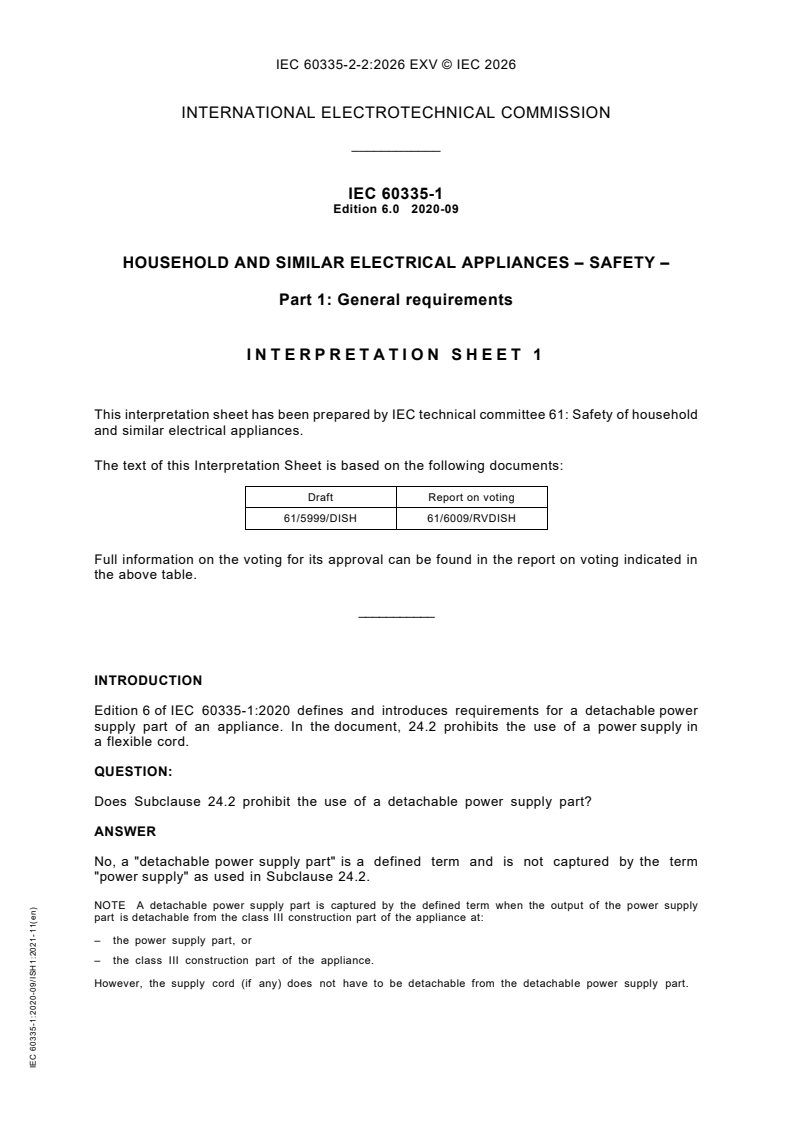
INTRODUCTION Edition 6 of IEC 60335-1:2020 defines and introduces requirements for a detachable power supply part of an appliance. In the document, 24.2 prohibits the use of a power supply in a flexible cord.
QUESTION:
Does Subclause 24.2 prohibit the use of a detachable power supply part? ANSWER No, a "detachable power supply part" is a defined term and is not captured by the term "power supply" as used in Subclause 24.2.
NOTE A detachable power supply part is captured by the defined term when the output of the power supply part is detachable from the class III construction part of the appliance at:
- the power supply part, or
- the class III construction part of the appliance.
However, the supply cord (if any) does not have to be detachable from the detachable power supply part.
IEC 60335-1:2020-09/ISH1:2021-11(en)
INTERNATIONAL ELECTROTECHNICAL COMMISSION
IEC 60335-1 Edition 6.0 2020-09
Household and similar electrical appliances - Safety - Part 1: General requirements
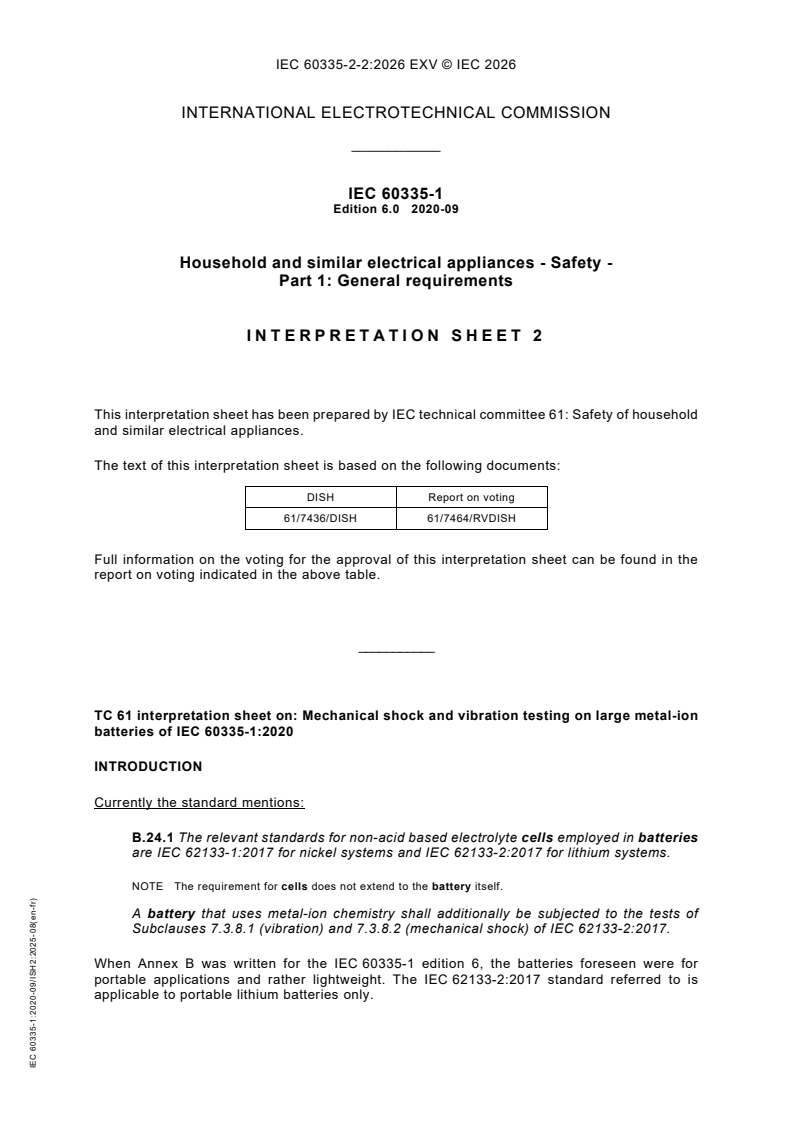
INTERPRETATION SHEET 2
This interpretation sheet has been prepared by IEC technical committee 61: Safety of household and similar electrical appliances.
The text of this interpretation sheet is based on the following documents:
DISH Report on voting 61/7436/DISH 61/7464/RVDISH
Full information on the voting for the approval of this interpretation sheet can be found in the report on voting indicated in the above table.
TC 61 interpretation sheet on: Mechanical shock and vibration testing on large metal-ion batteries of IEC 60335-1:2020 INTRODUCTION Currently the standard mentions:
B.24.1 The relevant standards for non-acid based electrolyte cells employed in batteries are IEC 62133-1:2017 for nickel systems and IEC 62133-2:2017 for lithium systems. NOTE The requirement for cells does not extend to the battery itself. A battery that uses metal-ion chemistry shall additionally be subjected to the tests of Subclauses 7.3.8.1 (vibration) and 7.3.8.2 (mechanical shock) of IEC 62133-2:2017. When Annex B was written for the IEC 60335-1 edition 6, the batteries foreseen were for portable applications and rather lightweight. The IEC 62133-2:2017 standard referred to is applicable to portable lithium batteries only.
IEC 60335-1:2020-09/ISH2:2025-08(en-fr)
For non-portable and/or large batteries (mass > 12 kg), the tests of IEC 62133-2 for mechanical shock and vibration are not suitable.
QUESTION:
What test sequence for mechanical shock and vibration can be followed for large batteries? ANSWER:
For practical reasons, IEC 60335-1 should follow the same differentiation as the UN 38.3 transport test or IEC 62281 standard (Safety of primary and secondary lithium cells and batteries during transport).
For larger batteries with a mass exceeding 12 kg, Subclauses 6.4.3 (Test T-3: Vibration) and 6.4.4 (Test T-4: Shock) of IEC 62281:2019, including AMD1:2021 and AMD2:2023, may be applied.
NOTE 1 The tests are technically identical to Test T.3 and Test T.4 of the UN manual of tests and criteria, section 38.3 rev.8 (2023).
NOTE 2 In accordance with Table 5 of IEC 62281:2019, testing is carried out on the battery without packaging.
CONTENTS FOREWORD ........................................................................................................................... 5 INTRODUCTION IEC 60335-1:2020+AMD1:2025 ..................................................................... 8 INTRODUCTION to IEC 60335-2-2:2026 ................................................................................ 10 1 Scope ............................................................................................................................ 11 2 Normative references .................................................................................................... 12 3 Terms and definitions .................................................................................................... 17 4 General requirement ...................................................................................................... 31 5 General conditions for the tests ..................................................................................... 31 6 Classification ................................................................................................................. 36 7 Marking and instructions ................................................................................................ 37 8 Protection against access to live parts ........................................................................... 46 9 Starting of motor-operated appliances ........................................................................... 49 10 Power input and current ................................................................................................. 49 11 Heating .......................................................................................................................... 51 12 Charging of metal-ion batteries ...................................................................................... 58 13 Leakage current and electric strength at operating temperature ..................................... 59 14 Transient overvoltages .................................................................................................. 62 15 Moisture resistance ....................................................................................................... 62 16 Leakage current and electric strength ............................................................................ 66 17 Overload protection of transformers and associated circuits .......................................... 68 18 Endurance ..................................................................................................................... 69 19 Abnormal operation ....................................................................................................... 69 20 Stability and mechanical hazards ................................................................................... 81 21 Mechanical strength ...................................................................................................... 82 22 Construction .................................................................................................................. 86 23 Internal wiring .............................................................................................................. 101 24 Components ................................................................................................................ 103 25 Supply connection and external flexible cords ............................................................. 108 26 Terminals for external conductors ................................................................................ 117 27 Provision for earthing .................................................................................................. 120 28 Screws and connections .............................................................................................. 121 29 Clearances, creepage distances and solid insulation ................................................... 124 30 Resistance to heat and fire .......................................................................................... 132 31 Resistance to rusting ................................................................................................... 137 32 Radiation, toxicity and similar hazards ......................................................................... 137 Annex A (informative) Routine tests ................................................................................... 155
Annex B (normative) Battery-operated appliances, separable batteries and detachable
batteries for battery-operated appliances ............................................................................ 157 Annex C (normative) Ageing test on motors ....................................................................... 183 Annex D (normative) Thermal motor protectors .................................................................. 185 Annex E (normative) Needle-flame test .............................................................................. 186 Annex F (normative) Capacitors ......................................................................................... 187
Annex G (normative) Safety isolating transformers ............................................................ 189 Annex H (normative) Switches ........................................................................................... 190
Annex I (normative) Motors having basic insulation that is inadequate for the rated
voltage of the appliance ...................................................................................................... 192 Annex J (normative) Coated printed circuit boards ............................................................. 194 Annex K (informative) Overvoltage categories ................................................................... 195
Annex L (informative) Guidance for the measurement of clearances and creepage
distances ............................................................................................................................ 196 Annex M (informative) Pollution degree ............................................................................. 199 Annex N (normative) Proof tracking test ............................................................................. 200 Annex O (informative) Selection and sequence of the tests of Clause 30 ........................... 201
Annex P (informative) Guidance for the application of this standard to appliances
used in tropical climates ..................................................................................................... 206 Annex Q (informative) Sequence of tests for the evaluation of electronic circuits ............... 208 Annex R (normative) Software evaluation .......................................................................... 211
Annex S (informative) Guidance for the application of this standard on measurement
of power input and current based on the requirements of 10.1 and 10.2 concerning the representative period .......................................................................................................... 226 Annex T (normative) UV-C radiation effect on non-metallic materials ................................. 227
Annex U (normative) Appliances intended for remote communication through public
networks ............................................................................................................................. 230 Bibliography ........................................................................................................................ 235 Index of defined terms ........................................................................................................ 238
Figure 1 – Circuit diagram for leakage current measurement at operating temperature for single-phase connection of class II appliances and for parts of class ll construction ...... 139 Figure 2 – Circuit diagram for leakage current measurement at operating temperature for single-phase connection of other than class II appliances or parts of class ll construction ........................................................................................................................ 140 Figure 3 – Circuit diagram for leakage current measurement at operating temperature for three-phase with neutral class II appliances and for parts of class ll construction .......... 141 Figure 4 – Circuit diagram for leakage current measurement at operating temperature for three-phase with neutral appliances other than those of class II or parts of class ll construction ........................................................................................................................ 142 Figure 5 – Small part .......................................................................................................... 143 Figure 6 – Example of an electronic circuit with low-power points ....................................... 143 Figure 7 – Test finger nail ................................................................................................... 144 Figure 8 – Flexing test apparatus ........................................................................................ 145 Figure 9 – Constructions of cord anchorages ...................................................................... 146 Figure 10 – An example of parts of an earthing terminal ..................................................... 147 Figure 11 – Examples of clearances ................................................................................... 148 Figure 12 – Example of the placement of the cylinder ......................................................... 149 Figure 13 – Small parts cylinder .......................................................................................... 150 Figure 14 – Example of a specified operating region of a lithium-ion cell during charging ............................................................................................................................. 151 Figure 101 – Probe for measuring surface temperatures ..................................................... 151 Figure 102 – Apparatus for testing the abrasion resistance of current-carrying hoses ......... 152
Figure 103 – Apparatus for testing the resistance to flexing of current-carrying hoses ........ 153 Figure 104 – Configuration of the hose for the freezing treatment ....................................... 153 Figure 105 – Flexing positions for the hose after removal from the freezing cabinet ............ 154 Figure B.1 – Examples of battery-operated appliance constructions and application of normative Annex B (1 of 2) ................................................................................................. 180 Figure B.2 – Examples of correct polarity connection marking representing three batteries ............................................................................................................................. 182 Figure I.1 – Simulation of faults .......................................................................................... 193 Figure L.1 – Sequence for the determination of clearances ................................................. 196 Figure L.2 – Sequence for the determination of creepage distances ................................... 197 Figure L.3 – Measurement of clearances ............................................................................ 198 Figure O.1 – Tests for resistance to heat ............................................................................ 201 Figure O.2 – Selection and sequence of tests for resistance to fire in hand-held appliances .......................................................................................................................... 202 Figure O.3 – Selection and sequence of tests for resistance to fire in attended appliances .......................................................................................................................... 202 Figure O.4 – Selection and sequence of tests for resistance to fire in unattended appliances .......................................................................................................................... 203 Figure O.5 – Some applications of the term "within a distance of 3 mm" ............................. 205 Figure Q.1 – Flowchart outlining the sequence of tests for the evaluation of electronic circuits (1 of 2) .................................................................................................................... 209 Figure R.1 – Examples of software separation .................................................................... 222 Figure S.1 – Flowchart giving guidance on measurement of power input and current concerning the representative period .................................................................................. 226
Table 1 – Power input deviation ............................................................................................ 49 Table 2 – Current deviation ................................................................................................... 50 Table 3 – Maximum normal temperature rises ....................................................................... 54 Table 101 – Maximum temperature rises for specified external accessible surfaces under normal operating conditions ........................................................................................ 57 Table 4 – Voltage for electric strength test ............................................................................ 61 Table 5 – Characteristics of high-voltage sources ................................................................. 61 Table 6 – Impulse test voltage .............................................................................................. 62 Table 7 – Test voltages......................................................................................................... 68 Table 8 – Maximum winding temperature .............................................................................. 72 Table 9 – Maximum abnormal temperature rise ..................................................................... 77 Table 20 – Halogen-free cord sets and cords ...................................................................... 106 Table 10 – Dimensions of cables and conduits .................................................................... 109 Table 11 – Minimum cross-sectional area of conductors ..................................................... 112 Table 12 – Pull force and torque ......................................................................................... 114 Table 13 – Nominal cross-sectional area of conductors ...................................................... 119 Table 14 – Torque for testing screws and nuts .................................................................... 122 Table 15 – Rated impulse voltage ....................................................................................... 125 Table 16 – Minimum clearances .......................................................................................... 125 Table 17 – Minimum creepage distances for basic insulation .............................................. 129 Table 18 – Minimum creepage distances for functional insulation ....................................... 130
...