


IEC 63086-1:2020
(Main)Household and similar electrical air cleaning appliances - Methods for measuring the performance - Part 1: General requirements
Household and similar electrical air cleaning appliances - Methods for measuring the performance - Part 1: General requirements
IEC 63086-1:2020 applies to electrically powered household and similar air cleaners intended for use on rated single-phase AC input voltage circuits not exceeding 250 V and DC input voltage circuits not exceeding 48 V.
If the test methods in this document are applied to combination products (air conditioners, humidifiers, dehumidifiers, heaters, etc.) with air cleaning function, they are only aimed at their air cleaning function when tested.
Battery-operated appliances are within the scope of this document. Dual-supply appliances, either mains-supplied or battery-operated, are regarded as battery-operated appliances when operated in the battery mode.
This document is not applicable to:
- appliances intended exclusively for industrial purposes;
- appliances intended for use in medical treatment locations, such as surgical suites, laboratories, medical treatments rooms, etc.
- household range hoods or cooking fume extractors – see IEC 61591.
This first edition cancels and replaces IEC PAS 62587 published in 2008.
Appareils d'épuration d'air électriques domestiques et appareils similaires - Méthodes de mesure de l’aptitude à la fonction - Partie 1: exigences générales
L'IEC 63086-1:2020 s'applique aux appareils d'épuration d'air domestiques et appareils similaires électriques destinés à être utilisés sur des circuits à tension d'entrée en courant alternatif monophasé assigné ne dépassant pas 250 V et sur des circuits à tension d'entrée en courant continu ne dépassant pas 48 V.
Si les méthodes d'essai du présent document sont appliquées à des produits mixtes (des climatiseurs, des humidificateurs, des déshumidificateurs, des chauffages, etc.) avec une fonction d'épuration d'air, elles ne visent qu'à assurer leur fonction d'épuration de l'air lors des essais.
Les appareils alimentés par batterie relèvent du domaine d'application du présent document. Les appareils à double alimentation, qu'ils soient alimentés par le réseau ou par batterie, sont considérés comme des appareils alimentés par batterie lorsqu'ils fonctionnement en mode batterie.
Le présent document ne s’applique pas:
- aux appareils destinés exclusivement à un usage industriel;
- aux appareils destinés à être utilisés dans des lieux de soins médicaux (les blocs opératoires, les laboratoires, les salles de soins médicaux, etc.).
- aux hottes domestiques ni aux hottes de cuisine (voir l'IEC 61591).
Cette première édition annule et remplace l'IEC PAS 62587, publiée en 2008.
General Information
- Status
- Published
- Publication Date
- 20-Jul-2023
- Technical Committee
- SC 59N - Electrical air cleaners for household and similar purposes
- Current Stage
- PPUB - Publication issued
- Start Date
- 09-Apr-2020
- Completion Date
- 08-May-2020
Relations
- Effective Date
- 05-Sep-2023
- Effective Date
- 05-Sep-2023
Overview
IEC 63086-1:2020 is an international standard developed by the International Electrotechnical Commission (IEC) that defines methods for measuring the performance of household and similar electrical air cleaning appliances. This first part of the series establishes the general requirements for testing electrically powered air cleaners designed for single-phase AC circuits up to 250 V and DC circuits up to 48 V. It also covers battery-operated and dual-supply devices (when in battery mode).
This standard replaces the previous IEC PAS 62587 (2008) and focuses specifically on the air cleaning function of appliances, including combination products such as air conditioners, humidifiers, and heaters with built-in air cleaning functionality.
IEC 63086-1 excludes appliances for industrial use, medical treatment locations like surgical suites and laboratories, and household range hoods or cooking fume extractors (covered under IEC 61591).
Key Topics
Scope and Applicability
Defines the voltage limits and device types covered, including specifications for AC, DC, battery-operated, and combination devices limited to their air cleaning function.Test Environment and Conditions
Specifies the conditions under which devices are tested, including test chamber size (typically 30 m³), air exchange rate, and environmental parameters like temperature and humidity.Instrumentation and Equipment
Details the required instrumentation such as thermometers, hygrometers, timers, power supplies, and detectors (including CO detectors) necessary for accurate performance measurement.Device Placement
Guidelines on placement of different device types during testing, including floor, table, wall-mounted, robotic, and direct plug-in air cleaners to ensure standardized measurement conditions.Performance Metrics
Defines measurement procedures for air exchange rate, noise levels, and energy efficiency, including power consumption during maximum performance operation and standby.Standardized Calculations
Introduces calculation methods for pollutant concentration decay, clean air delivery rate (CADR), and decay constants to quantify air cleaning performance with precision.Test Chamber Design
Provides schematics and structural requirements for the test chamber and test stands, ensuring consistency and repeatability of test results globally.
Applications
IEC 63086-1 is essential for:
- Manufacturers of household and similar electrical air cleaning appliances aiming to validate and certify product performance according to internationally recognized methods.
- Certification Bodies providing conformity assessment based on standardized testing parameters to ensure consumer safety and product efficacy.
- Regulatory Authorities that require benchmarking of appliance performance for market approval or environmental compliance.
- Consumers and Industry Stakeholders looking for reliable and standardized data on appliance performance related to pollutant reduction, noise levels, and energy consumption.
- Testing combination air cleaning functions in devices like HVAC units, humidifiers, and heaters under controlled conditions without interference from non-air cleaning features.
Related Standards
- IEC 61591 – Covers household range hoods and cooking fume extractors, excluded from IEC 63086-1 scope.
- Other IEC 63086 Series Parts – Subsequent parts address specific technologies, pollutant types, or advanced methodologies for air cleaning performance measurement.
- ISO/IEC Directives Part 2 – Provides framework for preparation of IEC standards, ensuring consistency in development processes.
- International Electrotechnical Vocabulary (IEV) – Supports consistent terminology across IEC standards.
Keywords: IEC 63086-1, electrical air cleaning appliances, household air cleaners, performance measurement methods, clean air delivery rate, noise measurement, energy efficiency, test chamber, battery-operated air cleaners, IEC standards, pollutant reduction testing.
Buy Documents
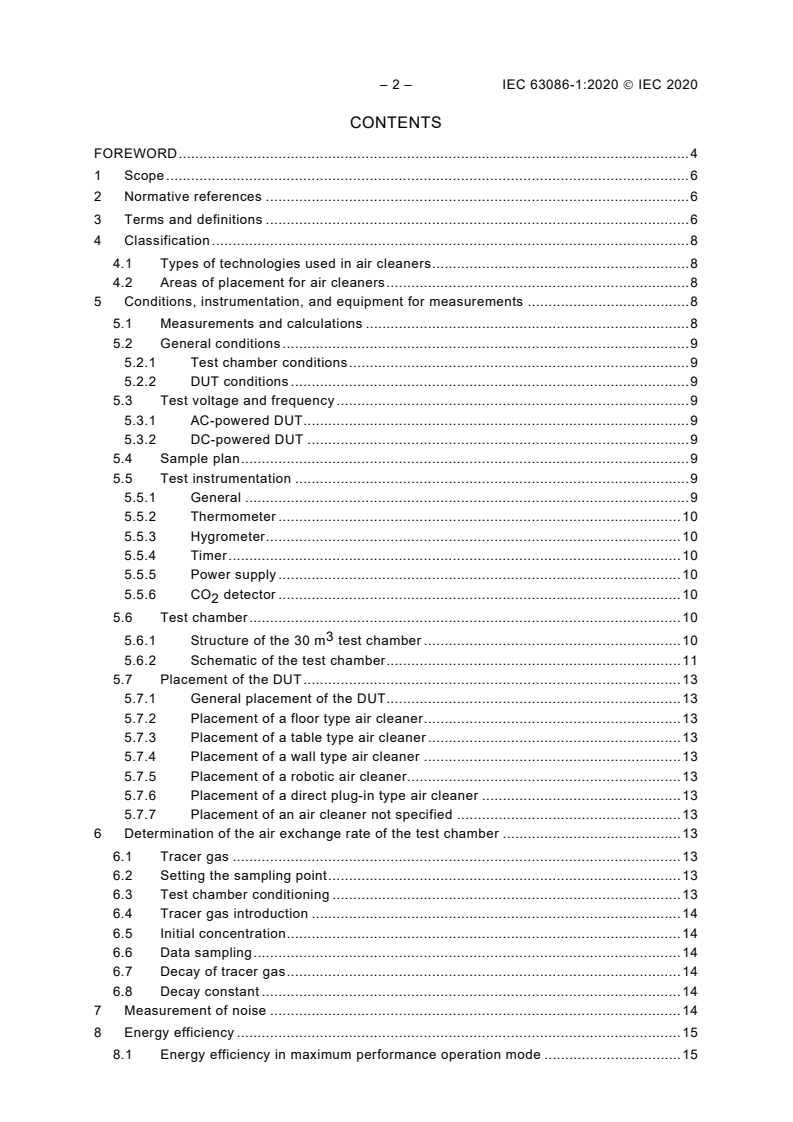
IEC 63086-1:2020 - Household and similar electrical air cleaning appliances - Methods for measuring the performance - Part 1: General requirements Released:4/9/2020

IEC 63086-1:2020+AMD1:2023 CSV - Household and similar electrical air cleaning appliances - Methods for measuring the performance - Part 1: General requirements Released:7/21/2023
Get Certified
Connect with accredited certification bodies for this standard

Institut za varilstvo d.o.o. (Welding Institute)
Slovenia's leading welding institute since 1952. ISO 3834, EN 1090, pressure equipment certification, NDT personnel, welder qualification. Only IIW Au
Sponsored listings
Frequently Asked Questions
IEC 63086-1:2020 is a standard published by the International Electrotechnical Commission (IEC). Its full title is "Household and similar electrical air cleaning appliances - Methods for measuring the performance - Part 1: General requirements". This standard covers: IEC 63086-1:2020 applies to electrically powered household and similar air cleaners intended for use on rated single-phase AC input voltage circuits not exceeding 250 V and DC input voltage circuits not exceeding 48 V. If the test methods in this document are applied to combination products (air conditioners, humidifiers, dehumidifiers, heaters, etc.) with air cleaning function, they are only aimed at their air cleaning function when tested. Battery-operated appliances are within the scope of this document. Dual-supply appliances, either mains-supplied or battery-operated, are regarded as battery-operated appliances when operated in the battery mode. This document is not applicable to: - appliances intended exclusively for industrial purposes; - appliances intended for use in medical treatment locations, such as surgical suites, laboratories, medical treatments rooms, etc. - household range hoods or cooking fume extractors – see IEC 61591. This first edition cancels and replaces IEC PAS 62587 published in 2008.
IEC 63086-1:2020 applies to electrically powered household and similar air cleaners intended for use on rated single-phase AC input voltage circuits not exceeding 250 V and DC input voltage circuits not exceeding 48 V. If the test methods in this document are applied to combination products (air conditioners, humidifiers, dehumidifiers, heaters, etc.) with air cleaning function, they are only aimed at their air cleaning function when tested. Battery-operated appliances are within the scope of this document. Dual-supply appliances, either mains-supplied or battery-operated, are regarded as battery-operated appliances when operated in the battery mode. This document is not applicable to: - appliances intended exclusively for industrial purposes; - appliances intended for use in medical treatment locations, such as surgical suites, laboratories, medical treatments rooms, etc. - household range hoods or cooking fume extractors – see IEC 61591. This first edition cancels and replaces IEC PAS 62587 published in 2008.
IEC 63086-1:2020 is classified under the following ICS (International Classification for Standards) categories: 23.120 - Ventilators. Fans. Air-conditioners. The ICS classification helps identify the subject area and facilitates finding related standards.
IEC 63086-1:2020 has the following relationships with other standards: It is inter standard links to IEC PAS 62587:2008, IEC 63086-1:2020/AMD1:2023. Understanding these relationships helps ensure you are using the most current and applicable version of the standard.
IEC 63086-1:2020 is available in PDF format for immediate download after purchase. The document can be added to your cart and obtained through the secure checkout process. Digital delivery ensures instant access to the complete standard document.
Standards Content (Sample)
IEC 63086-1 ®
Edition 1.0 2020-04
INTERNATIONAL
STANDARD
NORME
INTERNATIONALE
Household and similar electrical air cleaning appliances – Methods for
measuring the performance
Part 1: General requirements
Appareils d'épuration d'air électriques domestiques et appareils similaires –
Méthodes de mesure de l'aptitude à la fonction
Partie 1: Exigences générales
All rights reserved. Unless otherwise specified, no part of this publication may be reproduced or utilized in any form
or by any means, electronic or mechanical, including photocopying and microfilm, without permission in writing from
either IEC or IEC's member National Committee in the country of the requester. If you have any questions about IEC
copyright or have an enquiry about obtaining additional rights to this publication, please contact the address below or
your local IEC member National Committee for further information.
Droits de reproduction réservés. Sauf indication contraire, aucune partie de cette publication ne peut être reproduite
ni utilisée sous quelque forme que ce soit et par aucun procédé, électronique ou mécanique, y compris la photocopie
et les microfilms, sans l'accord écrit de l'IEC ou du Comité national de l'IEC du pays du demandeur. Si vous avez des
questions sur le copyright de l'IEC ou si vous désirez obtenir des droits supplémentaires sur cette publication, utilisez
les coordonnées ci-après ou contactez le Comité national de l'IEC de votre pays de résidence.
IEC Central Office Tel.: +41 22 919 02 11
3, rue de Varembé info@iec.ch
CH-1211 Geneva 20 www.iec.ch
Switzerland
About the IEC
The International Electrotechnical Commission (IEC) is the leading global organization that prepares and publishes
International Standards for all electrical, electronic and related technologies.
About IEC publications
The technical content of IEC publications is kept under constant review by the IEC. Please make sure that you have the
latest edition, a corrigendum or an amendment might have been published.
IEC publications search - webstore.iec.ch/advsearchform Electropedia - www.electropedia.org
The advanced search enables to find IEC publications by a The world's leading online dictionary on electrotechnology,
variety of criteria (reference number, text, technical containing more than 22 000 terminological entries in English
committee,…). It also gives information on projects, replaced and French, with equivalent terms in 16 additional languages.
and withdrawn publications. Also known as the International Electrotechnical Vocabulary
(IEV) online.
IEC Just Published - webstore.iec.ch/justpublished
Stay up to date on all new IEC publications. Just Published IEC Glossary - std.iec.ch/glossary
details all new publications released. Available online and 67 000 electrotechnical terminology entries in English and
once a month by email. French extracted from the Terms and Definitions clause of
IEC publications issued since 2002. Some entries have been
IEC Customer Service Centre - webstore.iec.ch/csc collected from earlier publications of IEC TC 37, 77, 86 and
If you wish to give us your feedback on this publication or CISPR.
need further assistance, please contact the Customer Service
Centre: sales@iec.ch.
A propos de l'IEC
La Commission Electrotechnique Internationale (IEC) est la première organisation mondiale qui élabore et publie des
Normes internationales pour tout ce qui a trait à l'électricité, à l'électronique et aux technologies apparentées.
A propos des publications IEC
Le contenu technique des publications IEC est constamment revu. Veuillez vous assurer que vous possédez l’édition la
plus récente, un corrigendum ou amendement peut avoir été publié.
Recherche de publications IEC - Electropedia - www.electropedia.org
webstore.iec.ch/advsearchform Le premier dictionnaire d'électrotechnologie en ligne au
La recherche avancée permet de trouver des publications IEC monde, avec plus de 22 000 articles terminologiques en
en utilisant différents critères (numéro de référence, texte, anglais et en français, ainsi que les termes équivalents dans
comité d’études,…). Elle donne aussi des informations sur les 16 langues additionnelles. Egalement appelé Vocabulaire
projets et les publications remplacées ou retirées. Electrotechnique International (IEV) en ligne.
IEC Just Published - webstore.iec.ch/justpublished Glossaire IEC - std.iec.ch/glossary
Restez informé sur les nouvelles publications IEC. Just 67 000 entrées terminologiques électrotechniques, en anglais
Published détaille les nouvelles publications parues. et en français, extraites des articles Termes et Définitions des
Disponible en ligne et une fois par mois par email. publications IEC parues depuis 2002. Plus certaines entrées
antérieures extraites des publications des CE 37, 77, 86 et
Service Clients - webstore.iec.ch/csc CISPR de l'IEC.
Si vous désirez nous donner des commentaires sur cette
publication ou si vous avez des questions contactez-nous:
sales@iec.ch.
IEC 63086-1 ®
Edition 1.0 2020-04
INTERNATIONAL
STANDARD
NORME
INTERNATIONALE
Household and similar electrical air cleaning appliances – Methods for
measuring the performance
Part 1: General requirements
Appareils d'épuration d'air électriques domestiques et appareils similaires –
Méthodes de mesure de l'aptitude à la fonction
Partie 1: Exigences générales
INTERNATIONAL
ELECTROTECHNICAL
COMMISSION
COMMISSION
ELECTROTECHNIQUE
INTERNATIONALE
ICS 23.120 ISBN 978-2-8322-8115-4
– 2 – IEC 63086-1:2020 IEC 2020
CONTENTS
FOREWORD . 4
1 Scope . 6
2 Normative references . 6
3 Terms and definitions . 6
4 Classification . 8
4.1 Types of technologies used in air cleaners . 8
4.2 Areas of placement for air cleaners . 8
5 Conditions, instrumentation, and equipment for measurements . 8
5.1 Measurements and calculations . 8
5.2 General conditions . 9
5.2.1 Test chamber conditions . 9
5.2.2 DUT conditions . 9
5.3 Test voltage and frequency . 9
5.3.1 AC-powered DUT . 9
5.3.2 DC-powered DUT . 9
5.4 Sample plan . 9
5.5 Test instrumentation . 9
5.5.1 General . 9
5.5.2 Thermometer . 10
5.5.3 Hygrometer . 10
5.5.4 Timer . 10
5.5.5 Power supply . 10
5.5.6 CO detector . 10
5.6 Test chamber . 10
5.6.1 Structure of the 30 m test chamber . 10
5.6.2 Schematic of the test chamber . 11
5.7 Placement of the DUT . 13
5.7.1 General placement of the DUT . 13
5.7.2 Placement of a floor type air cleaner . 13
5.7.3 Placement of a table type air cleaner . 13
5.7.4 Placement of a wall type air cleaner . 13
5.7.5 Placement of a robotic air cleaner. 13
5.7.6 Placement of a direct plug-in type air cleaner . 13
5.7.7 Placement of an air cleaner not specified . 13
6 Determination of the air exchange rate of the test chamber . 13
6.1 Tracer gas . 13
6.2 Setting the sampling point . 13
6.3 Test chamber conditioning . 13
6.4 Tracer gas introduction . 14
6.5 Initial concentration . 14
6.6 Data sampling . 14
6.7 Decay of tracer gas . 14
6.8 Decay constant . 14
7 Measurement of noise . 14
8 Energy efficiency . 15
8.1 Energy efficiency in maximum performance operation mode . 15
8.2 Standby power . 15
Annex A (informative) Determination of the test chamber mixing level . 16
Annex B (normative) Standardization of calculations . 17
B.1 Pollutant concentration . 17
B.2 Slope of decay line . 17
B.3 Clean air delivery rate (CADR) . 17
B.3.1 Tabulation and calculation . 17
B.3.2 Certification, verification or other formal reporting . 17
Annex C (normative) Test stand for wall and direct plug-in type air cleaners . 18
Bibliography . 19
Figure 1 – Schematic of the 30 m test chamber . 12
Figure C.1 – Construction requirements for test stand for wall and direct plug-in type
air cleaners . 18
Table 1 – 30 m test chamber . 11
– 4 – IEC 63086-1:2020 IEC 2020
INTERNATIONAL ELECTROTECHNICAL COMMISSION
____________
HOUSEHOLD AND SIMILAR ELECTRICAL AIR CLEANING APPLIANCES –
METHODS FOR MEASURING THE PERFORMANCE
Part 1: General requirements
FOREWORD
1) The International Electrotechnical Commission (IEC) is a worldwide organization for standardization comprising
all national electrotechnical committees (IEC National Committees). The object of IEC is to promote international
co-operation on all questions concerning standardization in the electrical and electronic fields. To this end and
in addition to other activities, IEC publishes International Standards, Technical Specifications, Technical Reports,
Publicly Available Specifications (PAS) and Guides (hereafter referred to as "IEC Publication(s)"). Their
preparation is entrusted to technical committees; any IEC National Committee interested in the subject dealt with
may participate in this preparatory work. International, governmental and non-governmental organizations liaising
with the IEC also participate in this preparation. IEC collaborates closely with the International Organization for
Standardization (ISO) in accordance with conditions determined by agreement between the two organizations.
2) The formal decisions or agreements of IEC on technical matters express, as nearly as possible, an international
consensus of opinion on the relevant subjects since each technical committee has representation from all
interested IEC National Committees.
3) IEC Publications have the form of recommendations for international use and are accepted by IEC National
Committees in that sense. While all reasonable efforts are made to ensure that the technical content of IEC
Publications is accurate, IEC cannot be held responsible for the way in which they are used or for any
misinterpretation by any end user.
4) In order to promote international uniformity, IEC National Committees undertake to apply IEC Publications
transparently to the maximum extent possible in their national and regional publications. Any divergence between
any IEC Publication and the corresponding national or regional publication shall be clearly indicated in the latter.
5) IEC itself does not provide any attestation of conformity. Independent certification bodies provide conformity
assessment services and, in some areas, access to IEC marks of conformity. IEC is not responsible for any
services carried out by independent certification bodies.
6) All users should ensure that they have the latest edition of this publication.
7) No liability shall attach to IEC or its directors, employees, servants or agents including individual experts and
members of its technical committees and IEC National Committees for any personal injury, property damage or
other damage of any nature whatsoever, whether direct or indirect, or for costs (including legal fees) and
expenses arising out of the publication, use of, or reliance upon, this IEC Publication or any other IEC Publications.
8) Attention is drawn to the Normative references cited in this publication. Use of the referenced publications is
indispensable for the correct application of this publication.
9) Attention is drawn to the possibility that some of the elements of this IEC Publication may be the subject of patent
rights. IEC shall not be held responsible for identifying any or all such patent rights.
International Standard IEC 63086 has been prepared by IEC technical committee 59:
Performance of household and similar electrical appliances.
This first edition cancels and replaces IEC PAS 62587 published in 2008.
The text of this International Standard is based on the following documents:
FDIS Report on voting
59/722/FDIS 59/725/RVD
Full information on the voting for the approval of this International Standard can be found in the
report on voting indicated in the above table.
This document has been drafted in accordance with the ISO/IEC Directives, Part 2.
In this standard, the following print types are used:
– terms defined in Clause 3: bold type.
A list of all parts in the IEC 63086 series, published under the general title Household and
similar electrical air cleaning appliances – Methods for measuring the performance can be found
on the IEC website.
The committee has decided that the contents of this document will remain unchanged until the
stability date indicated on the IEaC website under "http://webstore.iec.ch" in the data related to
the specific document. At this date, the document will be
• reconfirmed,
• withdrawn,
• replaced by a revised edition, or
• amended.
– 6 – IEC 63086-1:2020 IEC 2020
HOUSEHOLD AND SIMILAR ELECTRICAL AIR CLEANING APPLIANCES –
METHODS FOR MEASURING THE PERFORMANCE
Part 1: General requirements
1 Scope
This part of IEC 63086 applies to electrically powered household and similar air cleaners
intended for use on rated single-phase AC input voltage circuits not exceeding 250 V and DC
input voltage circuits not exceeding 48 V.
NOTE 1 See Clause 4 for examples of different technologies and placements of household and similar air cleaners.
NOTE 2 If the test methods in this document are applied to combination products (air conditioners, humidifiers,
dehumidifiers, heaters, etc.) with air cleaning function, they are only aimed at their air cleaning function when tested.
NOTE 3 Battery-operated appliances are within the scope of this document. Dual-supply appliances, either mains-
supplied or battery-operated, are regarded as battery-operated appliances when operated in the battery mode.
NOTE 4 This document is not applicable to:
• appliances intended exclusively for industrial purposes;
• appliances intended for use in medical treatment locations, such as surgical suites, laboratories, medical
treatments rooms, etc.
• household range hoods or cooking fume extractors – see IEC 61591.
2 Normative references
The following documents are referred to in the text in such a way that some or all of their content
constitutes requirements of this document. For dated references, only the edition cited applies.
For undated references, the latest edition of the referenced document (including any
amendments) applies.
IEC 60704 (all parts), Household and similar electrical appliances – Test code for the
determination of airborne acoustical noise
IEC 62301:2011, Household electrical appliances – Measurement of standby power
3 Terms and definitions
For the purposes of this document, the following terms and definitions apply.
ISO and IEC maintain terminological databases for use in standardization at the following
addresses:
• IEC Electropedia: available at http://www.electropedia.org/
• ISO Online browsing platform: available at http://www.iso.org/obp
3.1
air cleaner
electrically powered household, or similar, appliance that employs one or multiple technologies
to reduce one or more types of indoor air pollutants
3.2
robotic air cleaner
air cleaner that operates and changes its physical location autonomously without user
intervention
Note 1 to entry: The robotic air cleaner can consist of a part that houses the air cleaning function and can have a
docking station and/or other accessories to assist its operation.
3.3
fresh-air air cleaner
air cleaner connected to the external environment, which provides pollutant-reduced outdoor
air into an indoor space
Note 1 to entry: The fresh-air air cleaner can also include other auxiliary functions, such as heat exchange.
3.4
combination products
air cleaner that includes a secondary function besides air cleaning within the same housing,
such as humidifying, dehumidifying, heating, or air conditioning
3.5
DUT
device under test
air cleaner undergoing examination
3.6
test chamber
self-contained room with determined volume, shape, and dimensions, which is used to measure
the performance of the DUT
3.7
target pollutant
specific air pollutant with defined components, including three main categories: particulate
matter, gaseous pollutants, and microorganisms
3.8
operation decay rate
reduction rate of the target pollutant in the test chamber, due to operation of the DUT
−1
Note 1 to entry: Units are per hour (h ).
3.9
CADR
clean air delivery rate
flow rate of clean air (with respect to the target pollutant) delivered by the DUT calculated as
the product of the measured operation decay rate and the associated test chamber volume
3 −1
Note 1 to entry: The unit is cubic metres per hour (m h ).
3.10
automatic operation mode
setting of the DUT chosen by the user in which the performance is regulated by the air cleaner
without further user interaction
3.11
manual operation mode
setting of the DUT, chosen by the user, that is not influenced by further external operator
interaction, air quality sensor data, and/or timers throughout the duration of the test
– 8 – IEC 63086-1:2020 IEC 2020
3.12
maximum performance operation mode
manual operation mode where the DUT is set to the highest flow rate with all air cleaning
functions switched on and set to maximum, where applicable
Note 1 to entry: If the DUT has zero flow rate, the CADR is measured with all air cleaning functions switched on.
Note 2 to entry: "All air cleaning functions switched on" implies that the requirements for testing are that all available
filters, either for particle and gas filtration, or a combination of both, are inserted in the DUT for each type of test
described in the applicable parts of IEC 63086-2.
3.13
energy efficiency in maximum performance operation mode
volume of cleaned air provided by consumption of a certain amount of energy calculated by
dividing the CADR of the DUT by the electrical power input
3 −1 −1
Note 1 to entry: The unit is cubic metres per watt hour (m W h ).
4 Classification
4.1 Types of technologies used in air cleaners
According to the cleaning principles, the following types of technologies or combinations are
used in air cleaning, but are not limited to:
• mechanical filtration type;
• physical and/or chemical adsorption type;
• chemical catalysis type;
• electrostatic filtration type;
• photocatalytic type;
• plasma type;
• ozone generating type;
• hydroxyl generating type;
4.2 Areas of placement for air cleaners
According to the installation modes described by the manufacturer, the following placement
types exist for air cleaners, but are not limited to:
• floor type;
• table type;
• wall type;
• direct plug-in type;
• ceiling type;
• portable in-vehicle type;
• robotic type;
• fresh-air type
5 Conditions, instrumentation, and equipment for measurements
5.1 Measurements and calculations
All calculations and reporting of values shall use the methods of standardization of calculations,
as described in Annex B.
5.2 General conditions
5.2.1 Test chamber conditions
Unless otherwise specified, each test shall be conducted in the test chamber without influence
of outside air, direct sunlight and other radiation effects.
The test temperature and acceptable range of variation shall be (23 ± 3) °C.
The test relative humidity and acceptable range of variation shall be (50 ± 10) %.
5.2.2 DUT conditions
5.2.2.1 DUT with manual operation mode
A DUT with manual operation mode shall be tested in accordance with the manufacturer's
instructions in the maximum performance operation mode.
5.2.2.2 DUT with only automatic operation mode
A DUT with only automatic operation mode shall be tested in accordance with the
manufacturer’s instructions.
NOTE A testing method for DUT with only automatic operation mode is under consideration and will be presented
in the applicable parts of IEC 63086-2.
5.3 Test voltage and frequency
5.3.1 AC-powered DUT
The test voltage and frequency shall comply with the rated voltages and frequencies listed in
IEC 62301:2011, Table 1. If the corresponding country or region is not included in the table, the
voltage and frequency as stated by the manufacturer shall be used. In both cases, the test
voltage and frequency shall be maintained at the rated voltage and frequency ±1 % throughout
the duration of the test.
NOTE A stabilized power supply can be required to meet these requirements.
5.3.2 DC-powered DUT
The rated voltage as stated by the manufacturer shall be used. The test voltage shall be
maintained at the rated voltage ±1 % throughout the duration of the test.
NOTE A stabilized power supply can be required to meet these requirements.
5.4 Sample plan
For increased confidence in the test results, a minimum of three samples of the DUT should be
tested. Some performance tests can require additional samples or replacement parts if the
performance is adversely impacted by testing. If additional samples or replacement parts are
used, they shall be recorded in the report.
NOTE All measurements of performance within each test method of IEC 63086-2 are carried out on the same DUT.
5.5 Test instrumentation
5.5.1 General
All measurement instruments shall be operated in accordance with the manufacturer’s
specification. The instruments shall meet the requirements in 5.5.2 to 5.5.6.
– 10 – IEC 63086-1:2020 IEC 2020
5.5.2 Thermometer
The accuracy shall be within ±0,5 °C.
5.5.3 Hygrometer
The accuracy shall be within ±2 % RH.
5.5.4 Timer
The accuracy shall be within ±1 s in 24 h.
5.5.5 Power supply
5.5.5.1 General
The connection between the DUT and the power supply shall be made in such a way that an
uninterruptable power supply is guaranteed throughout the duration of the test.
5.5.5.2 AC power supply
The AC power supply shall comply with IEC 62301:2011, 4.3.2.
5.5.5.3 DC power supply
The power supply is a DC stabilized supply.
5.5.5.4 Power meter
The power meter shall comply with IEC 62301:2011.
5.5.6 CO detector
The accuracy shall be within ±3 % of reading or ±50 ppm (parts per million), whichever is greater.
The resolution shall be 1 ppm.
5.6 Test chamber
5.6.1 Structure of the 30 m test chamber
The parameters of the 30 m test chamber are described in Table 1.
Table 1 – 30 m test chamber
Items Parameters
Interior volume (30 ± 1,5) m
Height = (2,5 ± 0,1) m
Interior dimensions
The width shall be within 85 % and 100 % of the length.
All surfaces shall be low-adsorptive, chemically inert, non-corrosive, easy to
clean, and with sufficient structural integrity. Recommended material for the walls,
Surfaces
ceiling and floor: stainless steel AISI grades 304, 310, or 316, glass or equivalent.
All conducting surfaces shall be grounded.
Welding, silicon rubber strip material, and low-emission glass sealant may be
Sealing material
used, where necessary.
The ceiling-mounted mixing fan shall have a diameter of between 1,0 m and 1,4 m
−1
with three blades and a minimal airspeed of 1 ms . The air speed shall be
measured 0,5 m below the fan blade's surface and laterally halfway between the
Mixing fan
central axis and the blade's tip. Installation location: on the ceiling in the centre of
the test chamber, with the distance of the highest point on the blades to the
ceiling's surface of between 0,25 m and 0,5 m.
3 −1
The wall-mounted recirculation fan shall have a flow rate of between 700 m h
3 −1 −1
and 800 m h , and a maximum airspeed of 15 ms measured at the centre of the
Recirculation fan
fan exhaust at 0,5 m from the face. Installation location: 1,5 m above the floor of
the test chamber and 0,4 m away from the wall measured at the centre of the fan
exhaust, with the airflow exhaust not directed at the DUT and/or sample point.
The test chamber air treatment unit shall be used for conditioning of the air (i.e.
Test chamber air
temperature, humidity), and filtration of the target pollutant. It may be operated in
treatment unit
recirculation mode or supply fresh air from the external environment.
−1
The air leakage rate shall be not greater than 0,05 h , in accordance with the
Leakage rate
measurement procedure described in Clause 6.
The mixing level shall be greater than 95 %, in accordance with the procedure
Mixing level
provided in Annex A.
NOTE 1 One example of the test chamber dimensions is 3,46 m length, 3,46 m width and 2,5 m height.
NOTE 2 The dimensions shown above are for the 30 m test chamber. Other size chambers are under
consideration.
NOTE 3 A test for fresh-air air cleaners is under discussion and development as an IEC 63086-2 standard.
5.6.2 Schematic of the test chamber
A schematic of the 30 m test chamber is shown in Figure 1 as an example.
– 12 – IEC 63086-1:2020 IEC 2020
Dimensions in metres
Key
1. DUT
2. Mixing fan mounted on the ceiling (arrows indicate the flow direction downward)
3. Recirculation fan mounted on the wall
4. Air inlet from the test chamber air treatment unit sealed off during testing using a valve close to test chamber
wall
5. Air exhaust from the test chamber air treatment unit sealed off during testing using a valve close to the test
chamber wall
6. Supporting and measurement equipment (power source, power meter, etc.)
7. Test chamber wall with sampling point and optional observation window
8. Test chamber door with optional observation window
9. The sampling point position or location of the measurement device for the target pollutant shall be at
(1,0 ± 0,2) m above the floor and at (0,5 ± 0,1) m away from the wall. The sampling point shall not be in the
exhaust stream of the DUT.
10. The pollutant injection point shall be at (1,0 ± 0,2) m from the ceiling and at (0,5 ± 0,1) m from the wall. The
injection point shall not be within 0,5 m horizontally of the sampling point.
11. Test chamber air treatment unit (temperature, humidity, and filtration) shall maintain the test chamber
environment within the limits indicated in 5.2.1 prior to the test. The test chamber air treatment unit shall not
operate during the tests.
12. Air supply port for mixing level measurement, sealed off during testing, using a valve close to test chamber wall
13. Air exhaust port for mixing level measurement, sealed off during testing, using a valve close to test chamber
wall
NOTE Items 12 and 13 are optional and used only in the mixing level test shown in Annex A.
3 1
Figure 1 – Schematic of the 30 m test chamber
___________
Any recession or expansion of the air inlet, outlet, door, window, or portable HVAC unit in the test stand, shall be
included in the calculation of the test chamber volume.
5.7 Placement of the DUT
5.7.1 General placement of the DUT
The DUT shall be located in the centre of the test chamber.
5.7.2 Placement of a floor type air cleaner
A floor type air cleaner shall be placed directly on the floor.
5.7.3 Placement of a table type air cleaner
A table type air cleaner shall be placed on a table with a height of 700 mm.
5.7.4 Placement of a wall type air cleaner
A wall type air cleaner shall be attached to the test stand described in Annex C at a height of
700 mm.
5.7.5 Placement of a robotic air cleaner
A robotic air cleaner shall be placed in a 1 m ((1,00 ± 0,05) m × (1,00 ± 0,05) m) square area
with perforated stainless-steel walls of 100 mm in height.
5.7.6 Placement of a direct plug-in type air cleaner
An air cleaner that is intended for direct plug-in mounting to the electrical mains receptacle
shall be placed on a test stand described in Annex C.
5.7.7 Placement of an air cleaner not specified
Where the placement of the air cleaner is not specified by the manufacturer, the DUT shall be
classified according to its height. If the height of the DUT is less than 0,7 m from the floor, the
DUT shall be placed on a table of 0,7 m in height. In all other cases, the DUT shall be placed
on the floor of the test chamber.
6 Determination of the air exchange rate of the test chamber
6.1 Tracer gas
Carbon dioxide (CO ) is regarded as the tracer gas. The decay constant of the tracer gas in the
test chamber is measured, which yields the exchange rate.
6.2 Setting the sampling point
Set the sampling point at least 1 m away from the air inlet and outlet of the test chamber. The
sampling point shall be at least 0,5 m away from the walls and its height shall be set at
(1,0 ± 0,5) m above the floor. The sampling point shall be equipped with a sampling port
connected to a CO measurement device outside of the test chamber. A continuous-reading
measurement instrument shall be used.
6.3 Test chamber conditioning
Turn on the test chamber air treatment unit to reduce the background concentration of
6 −3
particulate matter (larger than 0,3 µm in diameter) to a level below 10 m . Record the
background concentration of CO and start the temperature and humidity control device to set
the temperature and relative humidity to the test chamber conditions specified in 5.2.1.
– 14 – IEC 63086-1:2020 IEC 2020
6.4 Tracer gas introduction
Turn on the mixing fan and recirculation fan.
Turn on the tracer gas supply and introduce the gas into the test chamber. As soon as the
concentration reaches a value greater than 4 000 ppm (parts per million), turn off the tracer gas
supply and keep the mixing fan on for another 10 min. After the tracer gas is completely mixed,
turn off the mixing fan. The recirculation fan shall run continuously during the test.
6.5 Initial concentration
Measure the initial concentration of the tracer gas C , taking the time t = 0 in the later
calculation.
6.6 Data sampling
Record the concentration for at least 240 min.
6.7 Decay of tracer gas
−kt
C = C e
t 0
where:
C is the concentration of CO at the time t in ppm;
t 2
C is the initial concentration of CO at the time t = 0 in ppm;
0 2
−1
k is the decay constant in h ;
t is the time in h.
6.8 Decay constant
By linear regression of InC as a function of t, the decay constant k is obtained by:
t
n nn
t lnC − t lnC
∑ i t) ∑∑i) t)
( ( (
i 1 iiii11
n
−=k
nn1
tt−
(∑ ii) (∑ )
ii11
n
where
i is the index of the individual sample;
t is the time of the i-th sample;
i
n is the total number of samples.
7 Measurement of noise
The measurement shall be conducted in accordance with the IEC 60704 series.
==
== =
8 Energy efficiency
8.1 Energy efficiency in maximum performance operation mode
The energy efficiency in maximum performance operation mode is calculated in accordance
with:
Q
η =
P
where
3 −1 −1
η is the energy efficiency in maximum performance operation mode in m W h ;
3 −1
Q is the CADR in m h ;
P is the input power in W.
In the case of combination products, the energy efficiency in maximum performance
operation mode shall be measured with only the air cleaning function switched on.
NOTE The calculation of the energy efficiency in automatic operation mode and for robotic air cleaners is under
consideration.
8.2 Standby power
The measurement shall be conducted in accordance with IEC 62301.
NOTE The unit is watts (W).
– 16 – IEC 63086-1:2020 IEC 2020
Annex A
(informative)
Determination of the test chamber mixing level
A.1 Carbon dioxide (CO ) is regarded as a tracer gas. During the whole test, the test chamber
door shall be closed.
A.2 The flow rates at the air supply and exhaust of the test chamber are controlled to an air
−1
.
exchange rate of 0,5 h
3 3 −1
NOTE For a 30 m test chamber, this equals a flow rate of 15 m h .
A.3 CO is continuously injected at the air supply port into the chamber to maintain a stable
concentration at the air supply port (4 000 ppm is recommended).
A.4 The CO concentration is continuously monitored at the air exhaust port of the test
chamber over a period of 120 min.
A.5 The expression of mixing level σ is then defined as:
mix
n
C ()i −⋅Ci() Δt
( )
∑ m
i
=1−×100 %
σ
mix
n
Ci()⋅Δt
( )
∑
i
where
σ is the mixing level;
mix
in min;
Δt is the sampling interval of CO
i is the index of the individual sample;
n is the total number of samples;
C (i) is the measured CO concentration at the air exhaust port in ppm (parts per million);
m 2
C(i) is the theoretical CO concentration at the air exhaust port for a mixing level of 100 % in
ppm;
G Δt⋅i
C(i) C + C(0)−C exp−⋅
( )
supply supply
V 60
C is the constant CO concentration at the air supply port in ppm;
supply 2
C(0) is the background CO concentration inside the test chamber at the initial time in ppm;
3 −1
G is the flow rate at the air supply port in m h ;
V is the volume of test chamber in m .
=
Annex B
(normative)
Standardization of calculations
B.1 Pollutant concentration
Round to four (4) significant figures.
Example: 111,12 = 111,1
B.2 Slope of decay line
Round to five (5) decimal places.
Example: 0,156 743 23 = 0,156 74
B.3 Clean air delivery rate (CADR)
B.3.1 Tabulation and calculation
Round to one (1) decimal place.
Example: 150,324 5 = 150,3
B.3.2 Certification, verification or other formal reporting
Round to nearest whole number.
Example: 150,324 5 = 150
– 18 – IEC 63086-1:2020 IEC 2020
Annex C
(normative)
Test stand for wall and direct plug-in type air cleaners
The construction requirements for the test stand for wall and direct plug-in type air cleaners
are shown in Figure C.1.
Figure C.1 – Construction requirements for test stand for wall and
direct plug-in type air cleaners
Bibliography
IEC 61591, Cooking fume extractors – Methods for measuring performance
IEC TS 62950:2017, Household and similar electrical appliances – Specifying smart capabilities
of appliances and devices – General aspects
IEC 63086-2 (all parts) , Household and similar electrical air cleaning appliances – Methods for
measuring the performance
___________
___________
Under preparation.
– 20 – IEC 63086-1:2020 IEC 2020
SOMMAIRE
AVANT-PROPOS . 22
1 Domaine d’application . 24
2 Références normatives . 24
3 Termes et définitions . 24
4 Classification . 26
4.1 Types de technologies utilisées dans les épurateurs d'air . 26
4.2 Zones de placement des épurateurs d'air . 26
5 Conditions, instruments, et matériel de mesure . 27
5.1 Mesurages et calculs . 27
5.2 Conditions générales . 27
5.2.1 Conditions de la chambre d'essai . 27
5.2.2 Condition du DUT . 27
5.3 Tension et fréquence d'essai . 27
5.3.1 DUT alimenté en courant alternatif . 27
5.3.2 DUT alimenté en courant continu . 27
5.4 Plan d’échantillonnage . 28
5.5 Instrumentation d'essai . 28
5.5.1 Généralités . 28
5.5.2 Thermomètre . 28
5.5.3 Hygromètre . 28
5.5.4 Temporisateur . 28
5.5.5 Alimentation électrique . 28
5.5.6 Détecteur de CO2 . 28
5.6 Chambre d'essai . 28
5.6.1 Structure de la chambre 30 m . 28
5.6.2 Schéma de la chambre d'essai . 29
5.7 Emplacement du DUT . 31
5.7.1 Emplacement général du DUT . 31
5.7.2 Emplacement d'un épurateur d'air au sol . 31
5.7.3 Emplacement d'un épurateur d'air sur une table . 31
5.7.4 Emplacement d'un épurateur d'air sur une paroi . 31
5.7.5 Emplacement d'un épurateur d'air robotisé . 31
5.7.6 Emplacement d'un épurateur d'air enfichable direct . 31
5.7.7 Emplacement non spécifié d'un épurateur d'air . 31
6 Détermination du taux de renouvellement de l'air de la chambre d'essai . 31
6.1 Gaz traceur .
...
IEC 63086-1 ®
Edition 1.1 2023-07
CONSOLIDATED VERSION
INTERNATIONAL
STANDARD
NORME
INTERNATIONALE
colour
inside
Household and similar electrical air cleaning appliances – Methods for
measuring the performance –
Part 1: General requirements
Appareils d'épuration d'air électriques domestiques et appareils similaires –
Méthodes de mesure de l’aptitude à la fonction –
Partie 1: Exigences générales
All rights reserved. Unless otherwise specified, no part of this publication may be reproduced or utilized in any form
or by any means, electronic or mechanical, including photocopying and microfilm, without permission in writing from
either IEC or IEC's member National Committee in the country of the requester. If you have any questions about IEC
copyright or have an enquiry about obtaining additional rights to this publication, please contact the address below or
your local IEC member National Committee for further information.
Droits de reproduction réservés. Sauf indication contraire, aucune partie de cette publication ne peut être reproduite ni
utilisée sous quelque forme que ce soit et par aucun procédé, électronique ou mécanique, y compris la photocopie et
les microfilms, sans l'accord écrit de l'IEC ou du Comité national de l'IEC du pays du demandeur. Si vous avez des
questions sur le copyright de l'IEC ou si vous désirez obtenir des droits supplémentaires sur cette publication, utilisez
les coordonnées ci-après ou contactez le Comité national de l'IEC de votre pays de résidence.
IEC Secretariat Tel.: +41 22 919 02 11
3, rue de Varembé info@iec.ch
CH-1211 Geneva 20 www.iec.ch
Switzerland
About the IEC
The International Electrotechnical Commission (IEC) is the leading global organization that prepares and publishes
International Standards for all electrical, electronic and related technologies.
About IEC publications
The technical content of IEC publications is kept under constant review by the IEC. Please make sure that you have the
latest edition, a corrigendum or an amendment might have been published.
IEC publications search - webstore.iec.ch/advsearchform IEC Products & Services Portal - products.iec.ch
The advanced search enables to find IEC publications by a Discover our powerful search engine and read freely all the
variety of criteria (reference number, text, technical publications previews. With a subscription you will always have
committee, …). It also gives information on projects, replaced access to up to date content tailored to your needs.
and withdrawn publications.
Electropedia - www.electropedia.org
IEC Just Published - webstore.iec.ch/justpublished
The world's leading online dictionary on electrotechnology,
Stay up to date on all new IEC publications. Just Published
containing more than 22 300 terminological entries in English
details all new publications released. Available online and once
and French, with equivalent terms in 19 additional languages.
a month by email.
Also known as the International Electrotechnical Vocabulary
(IEV) online.
IEC Customer Service Centre - webstore.iec.ch/csc
If you wish to give us your feedback on this publication or need
further assistance, please contact the Customer Service
Centre: sales@iec.ch.
A propos de l'IEC
La Commission Electrotechnique Internationale (IEC) est la première organisation mondiale qui élabore et publie des
Normes internationales pour tout ce qui a trait à l'électricité, à l'électronique et aux technologies apparentées.
A propos des publications IEC
Le contenu technique des publications IEC est constamment revu. Veuillez vous assurer que vous possédez l’édition la
plus récente, un corrigendum ou amendement peut avoir été publié.
Recherche de publications IEC - Découvrez notre puissant moteur de recherche et consultez
webstore.iec.ch/advsearchform gratuitement tous les aperçus des publications. Avec un
La recherche avancée permet de trouver des publications IEC abonnement, vous aurez toujours accès à un contenu à jour
en utilisant différents critères (numéro de référence, texte, adapté à vos besoins.
comité d’études, …). Elle donne aussi des informations sur les
projets et les publications remplacées ou retirées. Electropedia - www.electropedia.org
Le premier dictionnaire d'électrotechnologie en ligne au monde,
IEC Just Published - webstore.iec.ch/justpublished
avec plus de 22 300 articles terminologiques en anglais et en
Restez informé sur les nouvelles publications IEC. Just
français, ainsi que les termes équivalents dans 19 langues
Published détaille les nouvelles publications parues.
additionnelles. Egalement appelé Vocabulaire
Disponible en ligne et une fois par mois par email.
Electrotechnique International (IEV) en ligne.
Service Clients - webstore.iec.ch/csc
Si vous désirez nous donner des commentaires sur cette
publication ou si vous avez des questions contactez-nous:
sales@iec.ch.
IEC Products & Services Portal - products.iec.ch
IEC 63086-1 ®
Edition 1.1 2023-07
CONSOLIDATED VERSION
INTERNATIONAL
STANDARD
NORME
INTERNATIONALE
colour
inside
Household and similar electrical air cleaning appliances – Methods for
measuring the performance –
Part 1: General requirements
Appareils d'épuration d'air électriques domestiques et appareils similaires –
Méthodes de mesure de l’aptitude à la fonction –
Partie 1: Exigences générales
INTERNATIONAL
ELECTROTECHNICAL
COMMISSION
COMMISSION
ELECTROTECHNIQUE
INTERNATIONALE
ICS 23.120 ISBN 978-2-8322-7322-7
IEC 63086-1 ®
Edition 1.1 2023-07
CONSOLIDATED VERSION
REDLINE VERSION
VERSION REDLINE
colour
inside
Household and similar electrical air cleaning appliances – Methods for
measuring the performance –
Part 1: General requirements
Appareils d'épuration d'air électriques domestiques et appareils similaires –
Méthodes de mesure de l’aptitude à la fonction –
Partie 1: Exigences générales
– 2 – IEC 63086-1:2020+AMD1:2023 CSV
IEC 2023
CONTENTS
FOREWORD . 4
1 Scope . 6
2 Normative references . 6
3 Terms and definitions . 6
4 Classification . 8
4.1 Types of technologies used in air cleaners . 8
4.2 Areas of placement for air cleaners . 8
5 Conditions, instrumentation, and equipment for measurements . 9
5.1 Measurements and calculations . 9
5.2 General conditions . 9
5.2.1 Test chamber conditions . 9
5.2.2 DUT conditions . 9
5.3 Test voltage and frequency . 9
5.3.1 AC-powered DUT . 9
5.3.2 DC-powered DUT . 9
5.4 Sample plan . 9
5.5 Test instrumentation . 10
5.5.1 General . 10
5.5.2 Thermometer . 10
5.5.3 Hygrometer . 10
5.5.4 Timer . 10
5.5.5 Power supply . 10
5.5.6 CO detector . 10
5.6 Test chamber . 10
5.6.1 Structure of the 30 m test chamber . 10
5.6.2 Schematic of the 30 m test chamber . 11
5.7 Placement of the DUT . 13
5.7.1 General placement of the DUT . 13
5.7.2 Placement of a floor type air cleaner . 13
5.7.3 Placement of a table type air cleaner . 13
5.7.4 Placement of a wall type air cleaner . 13
5.7.5 Placement of a robotic air cleaner. 13
5.7.6 Placement of a direct plug-in type air cleaner . 13
5.7.7 Placement of an air cleaner not specified . 13
6 Determination of the air exchange rate of the test chamber . 13
6.1 Tracer gas . 13
6.2 Setting the sampling point . 13
6.3 Test chamber conditioning . 13
6.4 Tracer gas introduction . 14
6.5 Initial concentration . 14
6.6 Data sampling . 14
6.7 Decay of tracer gas . 14
6.8 Decay constant . 14
7 Measurement of noise . 14
8 Energy efficiency . 15
IEC 2023
8.1 Energy efficiency in maximum performance operation mode . 15
8.2 Standby power . 15
Annex A (informative) Determination of the test chamber mixing level . 16
Annex B (normative) Standardization of calculations . 17
B.1 Pollutant concentration . 17
B.2 Slope of decay line . 17
B.3 Clean air delivery rate (CADR) . 17
B.3.1 Tabulation and calculation . 17
B.3.2 Certification, verification or other formal reporting . 17
Annex C (normative) Test stand for wall and direct plug-in type air cleaners . 18
Bibliography . 19
Figure 1 – Schematic of the 30 m test chamber . 12
Figure C.1 – Construction requirements for test stand for wall and direct plug-in type
air cleaners . 18
Table 1 – 30 m test chamber . 11
– 4 – IEC 63086-1:2020+AMD1:2023 CSV
IEC 2023
INTERNATIONAL ELECTROTECHNICAL COMMISSION
____________
HOUSEHOLD AND SIMILAR ELECTRICAL AIR CLEANING APPLIANCES –
METHODS FOR MEASURING THE PERFORMANCE
Part 1: General requirements
FOREWORD
1) The International Electrotechnical Commission (IEC) is a worldwide organization for standardization comprising
all national electrotechnical committees (IEC National Committees). The object of IEC is to promote international
co-operation on all questions concerning standardization in the electrical and electronic fields. To this end and
in addition to other activities, IEC publishes International Standards, Technical Specifications, Technical Reports,
Publicly Available Specifications (PAS) and Guides (hereafter referred to as "IEC Publication(s)"). Their
preparation is entrusted to technical committees; any IEC National Committee interested in the subject dealt with
may participate in this preparatory work. International, governmental and non-governmental organizations liaising
with the IEC also participate in this preparation. IEC collaborates closely with the International Organization for
Standardization (ISO) in accordance with conditions determined by agreement between the two organizations.
2) The formal decisions or agreements of IEC on technical matters express, as nearly as possible, an international
consensus of opinion on the relevant subjects since each technical committee has representation from all
interested IEC National Committees.
3) IEC Publications have the form of recommendations for international use and are accepted by IEC National
Committees in that sense. While all reasonable efforts are made to ensure that the technical content of IEC
Publications is accurate, IEC cannot be held responsible for the way in which they are used or for any
misinterpretation by any end user.
4) In order to promote international uniformity, IEC National Committees undertake to apply IEC Publications
transparently to the maximum extent possible in their national and regional publications. Any divergence between
any IEC Publication and the corresponding national or regional publication shall be clearly indicated in the latter.
5) IEC itself does not provide any attestation of conformity. Independent certification bodies provide conformity
assessment services and, in some areas, access to IEC marks of conformity. IEC is not responsible for any
services carried out by independent certification bodies.
6) All users should ensure that they have the latest edition of this publication.
7) No liability shall attach to IEC or its directors, employees, servants or agents including individual experts and
members of its technical committees and IEC National Committees for any personal injury, property damage or
other damage of any nature whatsoever, whether direct or indirect, or for costs (including legal fees) and
expenses arising out of the publication, use of, or reliance upon, this IEC Publication or any other IEC Publications.
8) Attention is drawn to the Normative references cited in this publication. Use of the referenced publications is
indispensable for the correct application of this publication.
9) Attention is drawn to the possibility that some of the elements of this IEC Publication may be the subject of patent
rights. IEC shall not be held responsible for identifying any or all such patent rights.
This consolidated version of the official IEC Standard and its amendment has been
prepared for user convenience.
IEC 63086-1 edition 1.1 contains the first edition (2020-04) [documents 59/722/FDIS and
59/725/RVD] and its amendment 1 (2023-07) [documents 59N/25/CDV and 59N/34/RVC].
In this Redline version, a vertical line in the margin shows where the technical content is
modified by amendment 1. Additions are in green text, deletions are in strikethrough red
text. A separate Final version with all changes accepted is available in this publication.
IEC 2023
International Standard IEC 63086 has been prepared by IEC technical committee 59:
Performance of household and similar electrical appliances.
This document has been drafted in accordance with the ISO/IEC Directives, Part 2.
In this standard, the following print types are used:
– terms defined in Clause 3: bold type.
A list of all parts in the IEC 63086 series, published under the general title Household and
similar electrical air cleaning appliances – Methods for measuring the performance can be found
on the IEC website.
The committee has decided that the contents of this document and its amendment will remain
unchanged until the stability date indicated on the IEC website under webstore.iec.ch in the
data related to the specific document. At this date, the document will be
• reconfirmed,
• withdrawn,
• replaced by a revised edition, or
• amended.
IMPORTANT – The 'colour inside' logo on the cover page of this publication indicates
that it contains colours which are considered to be useful for the correct understanding
of its contents. Users should therefore print this document using a colour printer.
– 6 – IEC 63086-1:2020+AMD1:2023 CSV
IEC 2023
HOUSEHOLD AND SIMILAR ELECTRICAL AIR CLEANING APPLIANCES –
METHODS FOR MEASURING THE PERFORMANCE
Part 1: General requirements
1 Scope
This part of IEC 63086 applies to electrically powered household and similar air cleaners
intended for use on rated single-phase AC input voltage circuits not exceeding 250 V and DC
input voltage circuits not exceeding 48 V.
For combination products, this document is used to measure the performance of the appliance
at reducing pollutants.
This document is not applicable to:
• appliances intended exclusively for industrial purposes;
• appliances intended for use in medical treatment locations, such as surgical suites,
laboratories, medical treatment rooms;
• cooking fume extractors (see IEC 61591).
NOTE 1 See Clause 4 for examples of different technologies and placements of household and similar air cleaners.
NOTE 2 If the test methods in this document are applied to combination products (air conditioners, humidifiers,
dehumidifiers, heaters, etc.) with air cleaning function, they are only aimed at their air cleaning function when tested.
NOTE 32 Battery-operated appliances are within the scope of this document. Dual-supply appliances, either mains-
supplied or battery-operated, are regarded as battery-operated appliances when operated in the battery mode.
NOTE 4 This document is not applicable to:
• appliances intended exclusively for industrial purposes;
• appliances intended for use in medical treatment locations, such as surgical suites, laboratories, medical
treatments rooms, etc.
• household range hoods or cooking fume extractors – see IEC 61591.
NOTE 3 A cooking fume extractor and an air cleaner differ significantly in their main use. A cooking fume extractor
is designed to capture fumes close to the cooking surface in a kitchen environment. In the case of the cooking fume
extractor, the focus is on the direct capture of the cooking fumes (first yield capture rate), whereas in the case of air
cleaners, the focus is on general household air pollutant reduction.
2 Normative references
The following documents are referred to in the text in such a way that some or all of their content
constitutes requirements of this document. For dated references, only the edition cited applies.
For undated references, the latest edition of the referenced document (including any
amendments) applies.
IEC 60704 (all parts), Household and similar electrical appliances – Test code for the
determination of airborne acoustical noise
IEC 62301:2011, Household electrical appliances – Measurement of standby power
3 Terms and definitions
For the purposes of this document, the following terms and definitions apply.
IEC 2023
ISO and IEC maintain terminological databases for use in standardization at the following
addresses:
• IEC Electropedia: available at http://www.electropedia.org/
• ISO Online browsing platform: available at http://www.iso.org/obp
3.1
air cleaner
electrically powered household, or similar, appliance that employs one or multiple technologies
to reduce one or more types of indoor air pollutants
3.2
robotic air cleaner
air cleaner that operates and changes its physical location autonomously without user
intervention
Note 1 to entry: The robotic air cleaner can consist of a part that houses the air cleaning function and can have a
docking station and/or other accessories to assist its operation.
3.3
fresh-air air cleaner
air cleaner connected to the external environment, which provides pollutant-reduced outdoor
air into an indoor space
Note 1 to entry: The fresh-air air cleaner can also include other auxiliary functions, such as heat exchange.
3.4
combination products
air cleaner that includes a secondary function besides air cleaning within the same housing,
such as humidifying, dehumidifying, heating, or air conditioning
3.5
DUT
device under test
air cleaner undergoing examination
3.6
test chamber
self-contained room with determined volume, shape, and dimensions, which is used to measure
the performance of the DUT
3.7
target pollutant
specific air pollutant with defined components, including three main categories: particulate
matter, gaseous pollutants, and microorganisms
3.8
operation decay rate
reduction rate of the target pollutant in the test chamber, due to operation of the DUT
−1
Note 1 to entry: Units are The unit is per hour (h ).
3.9
CADR
clean air delivery rate
flow rate of clean air (with respect to the target pollutant) delivered by the DUT calculated as
the product of the measured operation decay rate and the associated test chamber volume
3 −1
Note 1 to entry: The unit is cubic metres per hour (m h ).
– 8 – IEC 63086-1:2020+AMD1:2023 CSV
IEC 2023
3.10
automatic operation mode
setting of the DUT chosen by the user in which the performance is regulated by the air cleaner
without further user interaction
3.11
manual operation mode
setting of the DUT, chosen by the user, that is not influenced by further external operator
interaction, air quality sensor data, and/or timers throughout the duration of the test
3.12
maximum performance operation mode
manual operation mode where the DUT is set to the highest flow rate with all air cleaning
functions switched on and set to maximum, where applicable
Note 1 to entry: If the DUT has zero flow rate, the CADR is measured with all air cleaning functions switched on.
Note 2 to entry: "All air cleaning functions switched on" implies that the requirements for testing are that all available
filters, either for particle and gas filtration, or a combination of both, are inserted in the DUT for each type of test
described in the applicable parts of IEC 63086-2.
3.13
energy efficiency in maximum performance operation mode
volume of cleaned air provided by consumption of a certain amount of energy calculated by
dividing the CADR of the DUT by the electrical power input
3 −1 −1
Note 1 to entry: The unit is cubic metres per watt hour (m W h ).
4 Classification
4.1 Types of technologies used in air cleaners
According to the cleaning principles, the following types of technologies or combinations are
used in air cleaning, but are not limited to:
• mechanical filtration type;
• physical and/or chemical adsorption type;
• chemical catalysis type;
• electrostatic filtration type;
• photocatalytic type;
• plasma type;
• ozone generating type;
• hydroxyl generating type;
4.2 Areas of placement for air cleaners
According to the installation modes described by the manufacturer, the following placement
types exist for air cleaners, but are not limited to:
• floor type;
• table type;
• wall type;
• direct plug-in type;
• ceiling type;
• portable in-vehicle type;
IEC 2023
• robotic type;
• fresh-air type
5 Conditions, instrumentation, and equipment for measurements
5.1 Measurements and calculations
All calculations and reporting of values shall use the methods of standardization of calculations,
as described in Annex B.
5.2 General conditions
5.2.1 Test chamber conditions
Unless otherwise specified, each test shall be conducted in the test chamber without influence
of outside air, direct sunlight and other radiation effects.
The test temperature and acceptable range of variation shall be (23 ± 3) °C.
The test relative humidity and acceptable range of variation shall be (50 ± 10) %.
5.2.2 DUT conditions
5.2.2.1 DUT with manual operation mode
A DUT with manual operation mode shall be tested in accordance with the manufacturer's
instructions in the maximum performance operation mode.
5.2.2.2 DUT with only automatic operation mode
A DUT with only automatic operation mode shall be tested in accordance with the
manufacturer’s instructions.
NOTE A testing method for DUT with only automatic operation mode is under consideration and will be presented
in the applicable parts of IEC 63086-2.
5.3 Test voltage and frequency
5.3.1 AC-powered DUT
The test voltage and frequency shall comply with the rated voltages and frequencies listed in
IEC 62301:2011, Table 1. If the corresponding country or region is not included in the table, the
voltage and frequency as stated by the manufacturer shall be used. In both cases, the test
voltage and frequency shall be maintained at the rated voltage and frequency ±1 % throughout
the duration of the test.
NOTE A stabilized power supply can be required to meet these requirements.
5.3.2 DC-powered DUT
The rated voltage as stated by the manufacturer shall be used. The test voltage shall be
maintained at the rated voltage ±1 % throughout the duration of the test.
NOTE A stabilized power supply can be required to meet these requirements.
5.4 Sample plan
For increased confidence in the test results, a minimum of three samples of the DUT should be
tested. Some performance tests can require additional samples or replacement parts if the
– 10 – IEC 63086-1:2020+AMD1:2023 CSV
IEC 2023
performance is adversely impacted by testing. If additional samples or replacement parts are
used, they shall be recorded in the report.
NOTE All measurements of performance within each test method of IEC 63086-2 are carried out on the same DUT.
5.5 Test instrumentation
5.5.1 General
All measurement instruments shall be operated in accordance with the manufacturer’s
specification. The instruments shall meet the requirements in 5.5.2 to 5.5.6.
5.5.2 Thermometer
The accuracy shall be within ±0,5 °C.
5.5.3 Hygrometer
The accuracy shall be within ±2 % RH.
5.5.4 Timer
The accuracy shall be within ±1 s in 24 h.
5.5.5 Power supply
5.5.5.1 General
The connection between the DUT and the power supply shall be made in such a way that an
uninterruptable power supply is guaranteed throughout the duration of the test.
5.5.5.2 AC power supply
The AC power supply shall comply with IEC 62301:2011, 4.3.2.
5.5.5.3 DC power supply
The power supply is a DC stabilized supply.
5.5.5.4 Power meter
The power meter shall comply with IEC 62301:2011.
5.5.6 CO detector
The accuracy shall be within ±3 % of reading or ±50 ppm (parts per million), whichever is greater.
The resolution shall be 1 ppm.
5.6 Test chamber
5.6.1 Structure of the 30 m test chamber
The parameters of the 30 m test chamber are described in Table 1.
IEC 2023
Table 1 – 30 m test chamber
Items Parameters
Interior volume (30 ± 1,5) m
Height = (2,5 ± 0,1) m
Interior dimensions
The width shall be within 85 % and 100 % of the length.
All surfaces shall be low-adsorptive, chemically inert, non-corrosive, easy to
clean, and with sufficient structural integrity. Recommended material for the walls,
Surfaces
ceiling and floor: stainless steel AISI grades 304, 310, or 316, glass or equivalent.
All conducting surfaces shall be grounded.
Welding, silicon rubber strip material, and low-emission glass sealant may be
Sealing material
used, where necessary.
The ceiling-mounted mixing fan shall have a diameter of between 1,0 m and 1,4 m
−1
with three blades and a minimal airspeed of 1 ms . The air speed shall be
measured 0,5 m below the fan blade's surface and laterally halfway between the
Mixing fan
central axis and the blade's tip. Installation location: on the ceiling in the centre of
the test chamber, with the distance of the highest point on the blades to the
ceiling's surface of between 0,25 m and 0,5 m.
3 −1
The wall-mounted recirculation fan shall have a flow rate of between 700 m h
3 −1 −1
and 800 m h , and a maximum airspeed of 15 ms measured at the centre of the
Recirculation fan
fan exhaust at 0,5 m from the face. Installation location: 1,5 m above the floor of
the test chamber and 0,4 m away from the wall measured at the centre of the fan
exhaust, with the airflow exhaust not directed at the DUT and/or sample point.
The test chamber air treatment unit shall be used for conditioning of the air (i.e.
Test chamber air
temperature, humidity), and filtration of the target pollutant. It may be operated in
treatment unit
recirculation mode or supply fresh air from the external environment.
−1
The air leakage rate shall be not greater than 0,05 h , in accordance with the
Leakage rate
measurement procedure described in Clause 6.
The mixing level shall be greater than 95 %, in accordance with the procedure
Mixing level
provided in Annex A.
NOTE 1 One example of the test chamber dimensions is 3,46 m length, 3,46 m width and 2,5 m height.
NOTE 2 The dimensions shown above are for the 30 m test chamber. Other size chambers are under
consideration.
NOTE 3 A test for fresh-air air cleaners is under discussion and development as an IEC 63086-2 standard.
5.6.2 Schematic of the 30 m test chamber
A schematic of the 30 m test chamber is shown in Figure 1 as an example.
– 12 – IEC 63086-1:2020+AMD1:2023 CSV
IEC 2023
Dimensions in metres
Key
1. DUT
2. Mixing fan mounted on the ceiling (arrows indicate the flow direction downward)
3. Recirculation fan mounted on the wall
4. Air inlet from the test chamber air treatment unit sealed off during testing using a valve close to test chamber
wall
5. Air exhaust from the test chamber air treatment unit sealed off during testing using a valve close to the test
chamber wall
6. Supporting and measurement equipment (power source, power meter, etc.)
7. Test chamber wall with sampling point and optional observation window
8. Test chamber door with optional observation window
9. The sampling point position or location of the measurement device for the target pollutant shall be at
(1,0 ± 0,2) m above the floor and at (0,5 ± 0,1) m away from the wall. The sampling point shall not be in the
exhaust stream of the DUT.
10. The pollutant injection point shall be at (1,0 ± 0,2) m from the ceiling and at (0,5 ± 0,1) m from the wall. The
injection point shall not be within 0,5 m horizontally of the sampling point.
11. Test chamber air treatment unit (temperature, humidity, and filtration) shall maintain the test chamber
environment within the limits indicated in 5.2.1 prior to the test. The test chamber air treatment unit shall not
operate during the tests.
12. Air supply port for mixing level measurement, sealed off during testing, using a valve close to test chamber wall
13. Air exhaust port for mixing level measurement, sealed off during testing, using a valve close to test chamber
wall
NOTE Items 12 and 13 are optional and used only in the mixing level test shown in Annex A.
3 1
Figure 1 – Schematic of the 30 m test chamber
___________
Any recession or expansion of the air inlet, outlet, door, window, or portable HVAC unit in the test stand, shall be
included in the calculation of the test chamber volume.
IEC 2023
5.7 Placement of the DUT
5.7.1 General placement of the DUT
The DUT shall be located in the centre of the test chamber.
5.7.2 Placement of a floor type air cleaner
A floor type air cleaner shall be placed directly on the floor.
5.7.3 Placement of a table type air cleaner
A table type air cleaner shall be placed on a table with a height of 700 mm.
5.7.4 Placement of a wall type air cleaner
A wall type air cleaner shall be attached to the test stand described in Annex C at a height of
700 mm.
5.7.5 Placement of a robotic air cleaner
A robotic air cleaner shall be placed in a 1 m ((1,00 ± 0,05) m × (1,00 ± 0,05) m) square area
with perforated stainless-steel walls of 100 mm in height.
5.7.6 Placement of a direct plug-in type air cleaner
An air cleaner that is intended for direct plug-in mounting to the electrical mains receptacle
shall be placed on a test stand described in Annex C.
5.7.7 Placement of an air cleaner not specified
Where the placement of the air cleaner is not specified by the manufacturer, the DUT shall be
classified according to its height. If the height of the DUT is less than 0,7 m from the floor, the
DUT shall be placed on a table of 0,7 m in height. In all other cases, the DUT shall be placed
on the floor of the test chamber.
6 Determination of the air exchange rate of the test chamber
6.1 Tracer gas
Carbon dioxide (CO ) is regarded as the tracer gas. The decay constant of the tracer gas in the
test chamber is measured, which yields the exchange rate.
6.2 Setting the sampling point
Set the sampling point at least 1 m away from the air inlet and outlet of the test chamber. The
sampling point shall be at least 0,5 m away from the walls and its height shall be set at
(1,0 ± 0,5) m above the floor. The sampling point shall be equipped with a sampling port
connected to a CO measurement device outside of the test chamber. A continuous-reading
measurement instrument shall be used.
6.3 Test chamber conditioning
Turn on the test chamber air treatment unit to reduce the background concentration of
6 −3
particulate matter (larger than 0,3 µm in diameter) to a level below 10 m . Record the
background concentration of CO and start the temperature and humidity control device to set
the temperature and relative humidity to the test chamber conditions specified in 5.2.1.
– 14 – IEC 63086-1:2020+AMD1:2023 CSV
IEC 2023
6.4 Tracer gas introduction
Turn on the mixing fan and recirculation fan.
Turn on the tracer gas supply and introduce the gas into the test chamber. As soon as the
concentration reaches a value greater than 4 000 ppm (parts per million), turn off the tracer gas
supply and keep the mixing fan on for another 10 min. After the tracer gas is completely mixed,
turn off the mixing fan. The recirculation fan shall run continuously during the test.
6.5 Initial concentration
Measure the initial concentration of the tracer gas C , taking the time t = 0 in the later
calculation.
6.6 Data sampling
Record the concentration for at least 240 min.
6.7 Decay of tracer gas
−kt
C = C e
t 0
where:
C is the concentration of CO at the time t in ppm;
t 2
C is the initial concentration of CO at the time t = 0 in ppm;
0 2
−1
k is the decay constant in h ;
t is the time in h.
6.8 Decay constant
By linear regression of InC as a function of t, the decay constant k is obtained by:
t
n nn
t lnC − t lnC
∑ i t) ∑∑i) t)
( ( (
i 1 iiii11
n
−=k
nn1
tt−
∑ ∑
( ii) ( )
ii11
n
where
i is the index of the individual sample;
t is the time of the i-th sample;
i
n is the total number of samples.
7 Measurement of noise
The measurement shall be conducted in accordance with the IEC 60704 series.
==
== =
IEC 2023
8 Energy efficiency
8.1 Energy efficiency in maximum performance operation mode
The energy efficiency in maximum performance operation mode is calculated in accordance
with:
Q
η =
P
where
3 −1 −1
η is the energy efficiency in maximum performance operation mode in m W h ;
3 −1
Q is the CADR in m h ;
P is the input power in W.
In the case of combination products, the energy efficiency in maximum performance
operation mode shall be measured with only the air cleaning function switched on.
NOTE The calculation of the energy efficiency in automatic operation mode and for robotic air cleaners is under
consideration.
8.2 Standby power
The measurement shall be conducted in accordance with IEC 62301.
NOTE The unit is watts (W).
– 16 – IEC 63086-1:2020+AMD1:2023 CSV
IEC 2023
Annex A
(informative)
Determination of the test chamber mixing level
A.1 Carbon dioxide (CO ) is regarded as a tracer gas. During the whole test, the test chamber
door shall be closed.
A.2 The flow rates at the air supply and exhaust of the test chamber are controlled to an air
−1
.
exchange rate of 0,5 h
3 3 −1
NOTE For a 30 m test chamber, this equals a flow rate of 15 m h .
A.3 CO is continuously injected at the air supply port into the chamber to maintain a stable
concentration at the air supply port (4 000 ppm is recommended).
A.4 The CO concentration is continuously monitored at the air exhaust port of the test
chamber over a period of 120 min.
A.5 The expression of mixing level σ is then defined as:
mix
n
C ()i −⋅Ci() Δt
( )
∑ m
i
=1−×100 %
σ
mix n
Ci()⋅Δt
( )
∑
i
where
σ is the mixing level;
mix
Δt is the sampling interval of CO in min;
i is the index of the individual sample;
n is the total number of samples;
C (i) is the measured CO concentration at the air exhaust port in ppm (parts per million);
m 2
C(i) is the theoretical CO concentration at the air exhaust port for a mixing level of 100 % in
ppm;
G Δt⋅i
C(i) C + C(0)−C exp−⋅
( )
supply supply
V 60
C is the constant CO concentration at the air supply port in ppm;
supply 2
C(0) is the background CO concentration inside the test chamber at the initial time in ppm;
3 −1
G is the flow rate at the air supply port in m h ;
V is the volume of test chamber in m .
=
IEC 2023
Annex B
(normative)
Standardization of calculations
B.1 Pollutant concentration
Round to four (4) significant figures.
Example: 111,12 = 111,1
B.2 Slope of decay line
Round to five (5) decimal places.
Example: 0,156 743 23 = 0,156 74
B.3 Clean air delivery rate (CADR)
B.3.1 Tabulation and calculation
Round to one (1) decimal place.
Example: 150,324 5 = 150,3
B.3.2 Certification, verification or other formal reporting
Round to nearest whole number.
Example: 150,324 5 = 150
– 18 – IEC 63086-1:2020+AMD1:2023 CSV
IEC 2023
Annex C
(normative)
Test stand for wall and direct plug-in type air cleaners
The construction requirements for the test stand for wall and direct plug-in type air cleaners
are shown in Figure C.1.
Figure C.1 – Construction requirements for test stand for wall and
direct plug-in type air cleaners
IEC 2023
Bibliography
IEC 61591, Cooking fume extractors – Methods for measuring performance
IEC TS 62950:2017, Household and similar electrical appliances – Specifying smart capabilities
of appliances and devices – General aspects
IEC 63086-2 (all parts) , Household and similar electrical air cleaning appliances – Methods for
measuring the performance
___________
___________
Under preparation.
– 20 – IEC 63086-1:2020+AMD1:2023 CSV
IEC 2023
SOMMAIRE
AVANT-PROPOS . 22
1 Domaine d’application . 24
2 Références normatives . 24
3 Termes et définitions . 25
4 Classification . 26
4.1 Types de technologies utilisées dans les épurateurs d'air . 26
4.2 Zones de placement des épurateurs d'air . 27
5 Conditions, instruments, et matériel de mesure . 27
5.1 Mesurages et calculs . 27
5.2 Conditions générales . 27
5.2.1 Conditions de la chambre d'essai . 27
5.2.2 Condition du DUT . 27
5.3 Tension et fréquence d'essai . 27
5.3.1 DUT alimenté en courant alternatif . 27
5.3.2 DUT alimenté en courant continu . 28
5.4 Plan d’échantillonnage . 28
5.5 Instrumentation d'essai . 28
5.5.1 Généralités .
...
Questions, Comments and Discussion
Ask us and Technical Secretary will try to provide an answer. You can facilitate discussion about the standard in here.
Loading comments...