

IEC 62387:2020
(Main)Radiation protection instrumentation - Dosimetry systems with integrating passive detectors for individual, workplace and environmental monitoring of photon and beta radiation
General Information
- Abstract
IEC 62387:2020 applies to all kinds of passive dosimetry systems that are used for measuring:
- the personal dose equivalent Hp(10) (for individual whole body monitoring),
- the personal dose equivalent Hp(3) (for individual eye lens monitoring),
- the personal dose equivalent Hp(0,07) (for both individual whole body skin and local skin for extremity monitoring),
- the ambient dose equivalent H*(10) (for workplace and environmental monitoring),
- the directional dose equivalent H'(3) (for workplace and environmental monitoring), or
- the directional dose equivalent H'(0,07) (for workplace and environmental monitoring).
This document applies to dosimetry systems that measure external photon and/or beta radiation in the dose range between 0,01 mSv and 10 Sv and in the energy ranges given in Table 1. All the energy values are mean energies with respect to the fluence. The dosimetry systems usually use electronic devices for the data evaluation and thus are often computer controlled.
- Status
- Published
- Publication Date
- 30-Jan-2020
- Technical Committee
- SC 45B - Radiation protection instrumentation
- Drafting Committee
- WG 8 - TC 45/SC 45B/WG 8
- Current Stage
- PPUB - Publication issued
- Start Date
- 31-Jan-2020
- Completion Date
- 03-Jan-2020
Buy Documents
IEC 62387:2020 RLV - Radiation protection instrumentation - Dosimetry systems with integrating passive detectors for individual, workplace and environmental monitoring of photon and beta radiation Released:1/31/2020
IEC 62387:2020 - Radiation protection instrumentation - Dosimetry systems with integrating passive detectors for individual, workplace and environmental monitoring of photon and beta radiation Released:1/31/2020
Overview
IEC 62387:2020 - Radiation protection instrumentation - Dosimetry systems with integrating passive detectors - defines requirements and test methods for passive integrating dosimetry systems used for individual, workplace and environmental monitoring of photon and beta radiation. The standard covers systems that measure dose quantities such as Hp(10), Hp(3), Hp(0,07), H(10)*, H'(3) and H'(0,07) over the dose range 0.01 mSv to 10 Sv. IEC 62387:2020 applies to passive detectors that are typically read and evaluated by electronic, often computer‑controlled, equipment.
Key Topics and Technical Requirements
- Scope of measurement: Personal dose equivalents (Hp(10), Hp(3), Hp(0,07)) and ambient/directional dose equivalents (H*(10), H'(3), H'(0,07)).
- Dose and energy ranges: Specified measurable dose range (0.01 mSv–10 Sv); energy ranges for photons and betas are given in the standard’s Table 1.
- General test procedures: Reference conditions, phantom selection, dosemeter positioning, uncertainty and non‑linearity considerations, and test sample sizes.
- Performance requirements: Coefficient of variation, linearity, overload/after‑effects, reusability and model capability.
- Radiation performance tests: Energy and angular dependence for photon and beta incidence for each measured quantity; response to mixed radiation fields.
- Design and information: Requirements for system design, dose indication, assignment of values to dosemeters, contamination retention, and user instructions.
- Software, data and interfaces: Requirements for software design, identification, authenticity, alarms, data storage/transmission and hardware/software interfaces.
- Environmental and durability tests: Temperature, humidity, light exposure, fading, sealing, reader stability and other environmental performance tests.
Practical Applications and Users
IEC 62387:2020 is essential for:
- Manufacturers of passive integrating dosimetry systems and readers (design, testing and certification).
- Calibration and testing laboratories performing type testing and conformity assessments.
- Radiation protection professionals in healthcare, nuclear power, industrial radiography, research and environmental monitoring who select or verify dosimetry systems.
- Regulatory bodies and employers who require compliance evidence for occupational and public radiation monitoring programs.
This standard helps ensure accurate personal dosimetry, workplace monitoring, and environmental monitoring using passive detectors, improving dose measurement traceability and system reliability.
Related Standards (if applicable)
Consult IEC 62387:2020 alongside other IEC and national standards on radiation protection instrumentation, calibration procedures and local regulatory requirements for comprehensive compliance and implementation.
Relations
- Effective Date
- 09-Feb-2026
- Effective Date
- 09-Feb-2026
- Effective Date
- 05-Sep-2023
Buy Documents
IEC 62387:2020 RLV - Radiation protection instrumentation - Dosimetry systems with integrating passive detectors for individual, workplace and environmental monitoring of photon and beta radiation Released:1/31/2020
IEC 62387:2020 - Radiation protection instrumentation - Dosimetry systems with integrating passive detectors for individual, workplace and environmental monitoring of photon and beta radiation Released:1/31/2020
Get Certified
Connect with accredited certification bodies for this standard

CIS Institut d.o.o.
Personal Protective Equipment (PPE) certification body. Notified Body NB-2890 for EU Regulation 2016/425 PPE.

Kiwa BDA Testing
Building and construction product certification.
Kmetijski inštitut Slovenije
Agricultural Institute of Slovenia. Soil testing, plant health, agricultural product analysis.
Sponsored listings
Frequently Asked Questions
IEC 62387:2020 is a standard published by the International Electrotechnical Commission (IEC). Its full title is "Radiation protection instrumentation - Dosimetry systems with integrating passive detectors for individual, workplace and environmental monitoring of photon and beta radiation". This standard covers: IEC 62387:2020 applies to all kinds of passive dosimetry systems that are used for measuring: - the personal dose equivalent Hp(10) (for individual whole body monitoring), - the personal dose equivalent Hp(3) (for individual eye lens monitoring), - the personal dose equivalent Hp(0,07) (for both individual whole body skin and local skin for extremity monitoring), - the ambient dose equivalent H*(10) (for workplace and environmental monitoring), - the directional dose equivalent H'(3) (for workplace and environmental monitoring), or - the directional dose equivalent H'(0,07) (for workplace and environmental monitoring). This document applies to dosimetry systems that measure external photon and/or beta radiation in the dose range between 0,01 mSv and 10 Sv and in the energy ranges given in Table 1. All the energy values are mean energies with respect to the fluence. The dosimetry systems usually use electronic devices for the data evaluation and thus are often computer controlled.
IEC 62387:2020 applies to all kinds of passive dosimetry systems that are used for measuring: - the personal dose equivalent Hp(10) (for individual whole body monitoring), - the personal dose equivalent Hp(3) (for individual eye lens monitoring), - the personal dose equivalent Hp(0,07) (for both individual whole body skin and local skin for extremity monitoring), - the ambient dose equivalent H*(10) (for workplace and environmental monitoring), - the directional dose equivalent H'(3) (for workplace and environmental monitoring), or - the directional dose equivalent H'(0,07) (for workplace and environmental monitoring). This document applies to dosimetry systems that measure external photon and/or beta radiation in the dose range between 0,01 mSv and 10 Sv and in the energy ranges given in Table 1. All the energy values are mean energies with respect to the fluence. The dosimetry systems usually use electronic devices for the data evaluation and thus are often computer controlled.
IEC 62387:2020 is classified under the following ICS (International Classification for Standards) categories: 13.280 - Radiation protection. The ICS classification helps identify the subject area and facilitates finding related standards.
IEC 62387:2020 has the following relationships with other standards: It is inter standard links to EN ISO 22188:2025, EN ISO 15382:2025, IEC 62387:2012. Understanding these relationships helps ensure you are using the most current and applicable version of the standard.
IEC 62387:2020 is available in PDF format for immediate download after purchase. The document can be added to your cart and obtained through the secure checkout process. Digital delivery ensures instant access to the complete standard document.
Standards Content (Sample)
IEC 62387 ®
Edition 2.0 2020-01
REDLINE VERSION
INTERNATIONAL
STANDARD
colour
inside
Radiation protection instrumentation – Passive integrating Dosimetry systems
with integrating passive detectors for personal individual, workplace and
environmental monitoring of photon and beta radiation
All rights reserved. Unless otherwise specified, no part of this publication may be reproduced or utilized in any form
or by any means, electronic or mechanical, including photocopying and microfilm, without permission in writing from
either IEC or IEC's member National Committee in the country of the requester. If you have any questions about IEC
copyright or have an enquiry about obtaining additional rights to this publication, please contact the address below or
your local IEC member National Committee for further information.
IEC Central Office Tel.: +41 22 919 02 11
3, rue de Varembé info@iec.ch
CH-1211 Geneva 20 www.iec.ch
Switzerland
About the IEC
The International Electrotechnical Commission (IEC) is the leading global organization that prepares and publishes
International Standards for all electrical, electronic and related technologies.
About IEC publications
The technical content of IEC publications is kept under constant review by the IEC. Please make sure that you have the
latest edition, a corrigendum or an amendment might have been published.
IEC publications search - webstore.iec.ch/advsearchform Electropedia - www.electropedia.org
The advanced search enables to find IEC publications by a The world's leading online dictionary on electrotechnology,
variety of criteria (reference number, text, technical containing more than 22 000 terminological entries in English
committee,…). It also gives information on projects, replaced and French, with equivalent terms in 16 additional languages.
and withdrawn publications. Also known as the International Electrotechnical Vocabulary
(IEV) online.
IEC Just Published - webstore.iec.ch/justpublished
Stay up to date on all new IEC publications. Just Published IEC Glossary - std.iec.ch/glossary
details all new publications released. Available online and 67 000 electrotechnical terminology entries in English and
once a month by email. French extracted from the Terms and Definitions clause of
IEC publications issued since 2002. Some entries have been
IEC Customer Service Centre - webstore.iec.ch/csc collected from earlier publications of IEC TC 37, 77, 86 and
If you wish to give us your feedback on this publication or CISPR.
need further assistance, please contact the Customer Service
Centre: sales@iec.ch.
IEC 62387 ®
Edition 2.0 2020-01
REDLINE VERSION
INTERNATIONAL
STANDARD
colourcolour
insinsiidede
Radiation protection instrumentation – Passive integrating Dosimetry systems
with integrating passive detectors for personal individual, workplace and
environmental monitoring of photon and beta radiation
INTERNATIONAL
ELECTROTECHNICAL
COMMISSION
ICS 13.280 ISBN 978-2-8322-5317-5
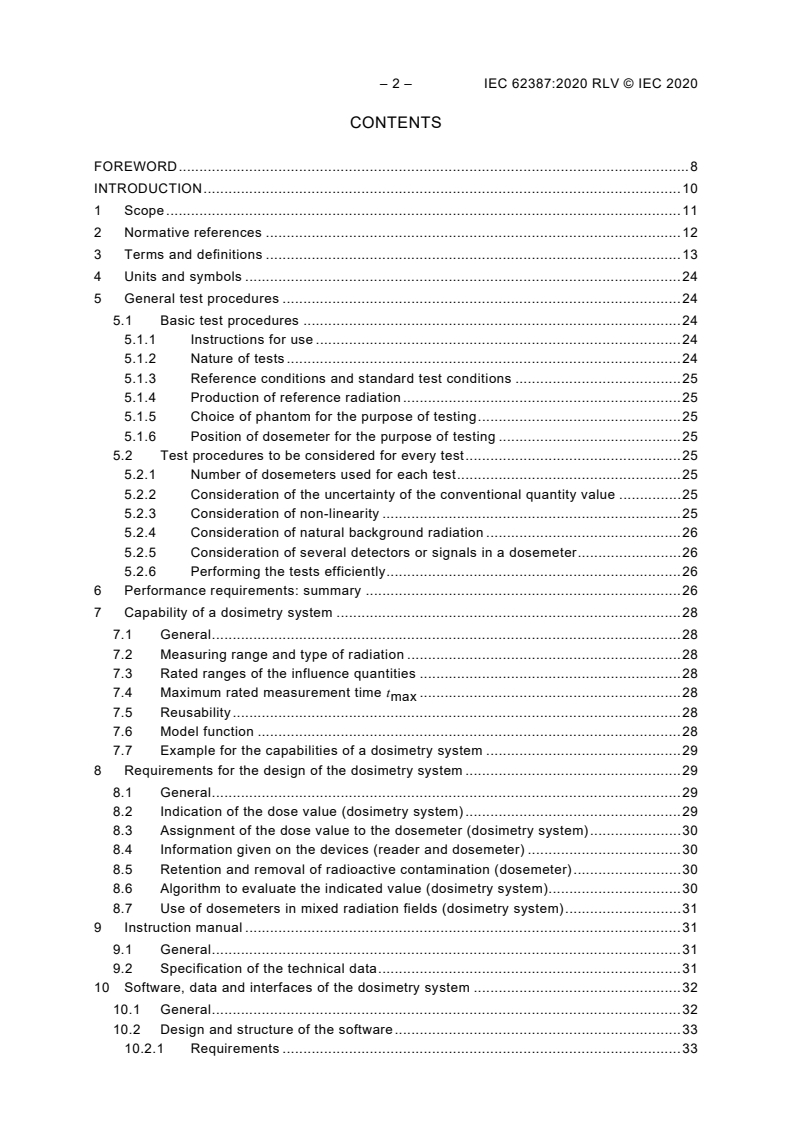
– 2 – IEC 62387:2020 RLV © IEC 2020
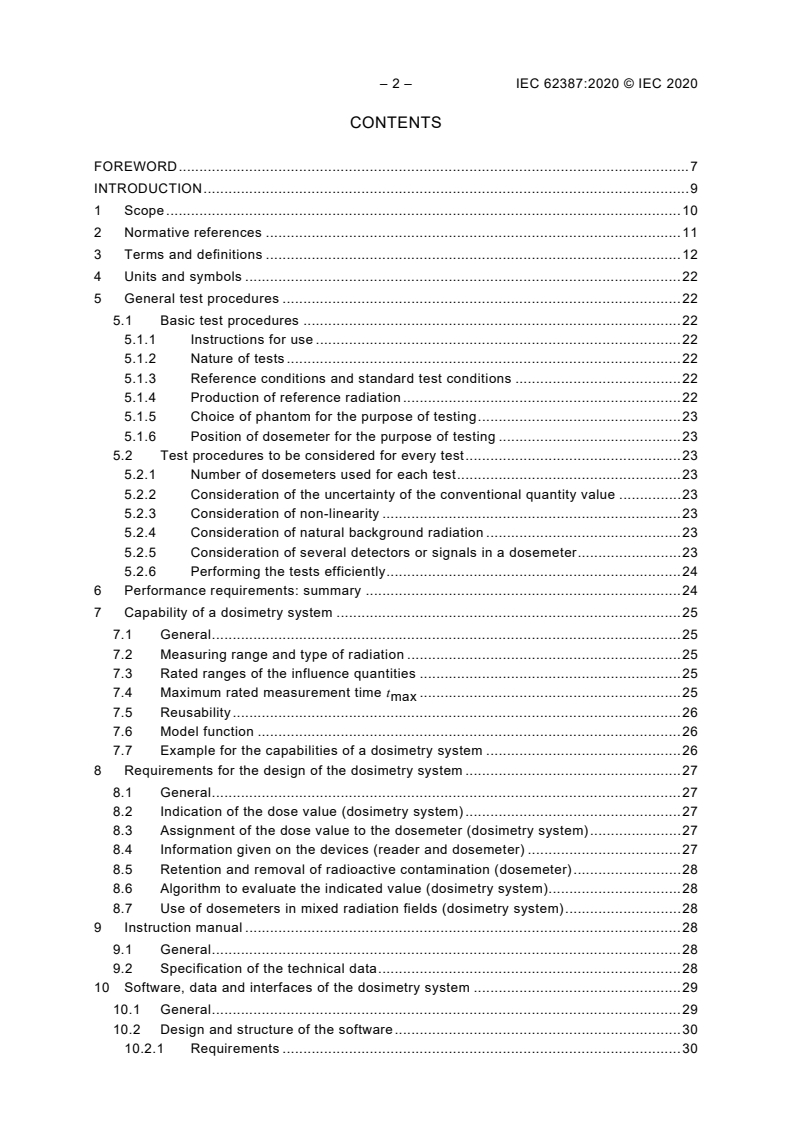
CONTENTS
FOREWORD . 8
INTRODUCTION . 10
1 Scope . 11
2 Normative references . 12
3 Terms and definitions . 13
4 Units and symbols . 24
5 General test procedures . 24
5.1 Basic test procedures . 24
5.1.1 Instructions for use . 24
5.1.2 Nature of tests . 24
5.1.3 Reference conditions and standard test conditions . 25
5.1.4 Production of reference radiation . 25
5.1.5 Choice of phantom for the purpose of testing . 25
5.1.6 Position of dosemeter for the purpose of testing . 25
5.2 Test procedures to be considered for every test . 25
5.2.1 Number of dosemeters used for each test . 25
5.2.2 Consideration of the uncertainty of the conventional quantity value . 25
5.2.3 Consideration of non-linearity . 25
5.2.4 Consideration of natural background radiation . 26
5.2.5 Consideration of several detectors or signals in a dosemeter . 26
5.2.6 Performing the tests efficiently . 26
6 Performance requirements: summary . 26
7 Capability of a dosimetry system . 28
7.1 General . 28
7.2 Measuring range and type of radiation . 28
7.3 Rated ranges of the influence quantities . 28
7.4 Maximum rated measurement time t . 28
max
7.5 Reusability . 28
7.6 Model function . 28
7.7 Example for the capabilities of a dosimetry system . 29
8 Requirements for the design of the dosimetry system . 29
8.1 General . 29
8.2 Indication of the dose value (dosimetry system) . 29
8.3 Assignment of the dose value to the dosemeter (dosimetry system) . 30
8.4 Information given on the devices (reader and dosemeter) . 30
8.5 Retention and removal of radioactive contamination (dosemeter) . 30
8.6 Algorithm to evaluate the indicated value (dosimetry system). 30
8.7 Use of dosemeters in mixed radiation fields (dosimetry system) . 31
9 Instruction manual . 31
9.1 General . 31
9.2 Specification of the technical data . 31
10 Software, data and interfaces of the dosimetry system . 32
10.1 General . 32
10.2 Design and structure of the software . 33
10.2.1 Requirements . 33
10.2.2 Method of test. 33
10.3 Identification of the software . 33
10.3.1 Requirements . 33
10.3.2 Method of test. 33
10.4 Authenticity of the software and the presentation of results . 33
10.4.1 Requirements . 33
10.4.2 Method of test. 34
10.5 Alarm and stop of system operation under abnormal operating conditions . 34
10.5.1 Requirements . 34
10.5.2 Method of test. 34
10.6 Control of input data by the dosimetry system . 35
10.6.1 Requirements . 35
10.6.2 Method of test. 35
10.7 Storage of data . 35
10.7.1 Requirements . 35
10.7.2 Method of test. 36
10.8 Transmission of data . 36
10.8.1 Requirements . 36
10.8.2 Method of test. 36
10.9 Hardware interfaces and software interfaces . 37
10.9.1 Requirements . 37
10.9.2 Method of test. 37
10.10 Documentation for the software test . 37
10.10.1 Requirements . 37
10.10.2 Method of test. 38
11 Radiation performance requirements and tests (dosimetry system) . 38
11.1 General . 38
11.2 Coefficient of variation . 39
11.3 Non-linearity . 39
11.3.1 Requirements . 39
11.3.2 Method of test. 39
11.3.3 Interpretation of results . 39
11.4 Overload characteristics, after-effects, and reusability . 41
11.4.1 Requirements . 41
11.4.2 Method of test. 41
11.4.3 Interpretation of the results . 41
11.5 Radiation energy and angle of incidence for H (10) or H*(10) dosemeters . 42
p
11.5.1 Photon radiation . 42
11.5.2 Beta radiation . 44
11.6 Radiation energy and angle of incidence for H (3) or H'(3) dosemeters . 44
p
11.6.1 Photon radiation . 44
11.6.2 Beta radiation . 46
11.7 Radiation energy and angle of incidence for H (0,07) or H'(0,07) dosemeters . 47
p
11.7.1 Photon radiation . 47
11.7.2 Beta radiation . 49
11.8 Over response indication due to radiation incidence incident from the side of
an H (10), H (3) or H (0,07) dosemeter . 50
p p p
11.8.1 Requirements . 50
11.8.2 Method of test. 50
– 4 – IEC 62387:2020 RLV © IEC 2020
11.8.3 Interpretation of the results . 51
11.9 Indication of the presence of beta dose for H (0,07) whole body dosemeters . 51
p
12 Response to mixed irradiations (dosimetry system) . 51
12.1 Requirements . 51
12.2 Method of test . 52
12.2.1 General . 52
12.2.2 Preparation of the test . 52
12.2.3 Practical test . 52
12.3 Interpretation of the results . 53
13 Environmental performance requirements and tests . 53
13.1 General . 53
13.1.1 General requirement . 53
13.1.2 General method of test . 53
13.2 Ambient temperature and relative humidity (dosemeter) . 54
13.2.1 General . 54
13.2.2 Requirements . 54
13.2.3 Method of test. 54
13.2.4 Interpretation of the results . 55
13.3 Light exposure (dosemeter) . 55
13.3.1 General . 55
13.3.2 Requirements . 55
13.3.3 Method of test. 55
13.3.4 Interpretation of the results . 56
13.4 Dose build-up, fading and self-irradiation, and response to natural radiation
(dosemeter) . 56
13.4.1 General . 56
13.4.2 Requirements . 56
13.4.3 Method of test. 56
13.4.4 Interpretation of the results . 57
13.5 Sealing (dosemeter) . 58
13.6 Reader stability (reader) . 58
13.6.1 General . 58
13.6.2 Requirements . 58
13.6.3 Method of test. 58
13.6.4 Interpretation of the results . 58
13.7 Ambient temperature (reader) . 59
13.7.1 General . 59
13.7.2 Requirements . 59
13.7.3 Method of test. 59
13.7.4 Interpretation of the results . 59
13.8 Light exposure (reader) . 60
13.8.1 General . 60
13.8.2 Requirements . 60
13.8.3 Method of test. 60
13.8.4 Interpretation of the results . 60
13.9 Primary power supply (reader) . 61
13.9.1 General . 61
13.9.2 Requirements . 61
13.9.3 Method of test. 61
13.9.4 Interpretation of the results . 61
14 Electromagnetic performance requirements and tests (dosimetry system) . 62
14.1 General . 62
14.2 Requirements . 62
14.3 Method of test . 62
14.4 Interpretation of the results . 63
15 Mechanical performance requirements and tests . 63
15.1 General requirement . 63
15.2 Drop (dosemeter) . 64
15.2.1 Requirements . 64
15.2.2 Method of test. 64
15.2.3 Interpretation of the results . 64
16 Documentation . 64
16.1 Type test report . 64
16.2 Certificate issued by the laboratory performing the type test . 65
Annex A (normative) Confidence limits . 79
A.1 General . 79
A.2 Confidence interval for the mean, x . 80
A.3 Confidence interval for a combined quantity . 80
Annex B (informative) Causal connection between readout signals, indicated value
and measured value . 82
Annex C (informative) Overview of the necessary actions that have to be performed
for a type test according to this document . 83
Annex D (informative) Usage categories of passive dosemeters .
Annex E D (informative) Uncertainty of dosimetry systems. 85
Annex F (informative) Conversion coefficients h (3;α), h (0,07;α), and h ’ (0,07;α)
pK pK K
from air kerma, K , to the dose equivalent H (3), H (0,07), and H ’(0,07), respectively,
a p p
for radiation qualities defined in ISO 4037-1 .
Annex G (informative) Conversion coefficients h (0,07;source;α) and h (3;source;α)
pD pD
from personal absorbed dose in 0,07 mm depth, D (0,07), to the dose equivalent
p
H (0,07) and H (3), respectively, for radiation qualities defined in ISO 6980-1 .
p p
Annex E (informative) Conversion coefficients h (0,07;source;α), h' (0,07;source;α),
pD D
h (3;source;α), and h' (3;source;α) from personal absorbed dose in 0,07 mm depth,
pD D
D (0,07), to the corresponding dose equivalent quantities for radiation qualities
p
defined in ISO 6980-1 . 89
Annex H F (informative) Computational method of test for mixed irradiations . 93
Bibliography . 95
Figure 1 – Stepwise irradiation of an H*(10) dosemeter at 90° angle of incidence . 43
Figure A.1 – Test for confidence interval . 79
Figure B.1 – Data evaluation in dosimetry systems . 82
Figure F.1 – Flow chart of a computer program to perform tests according to 12.2 . 94
Table 1 – Mandatory and maximum energy ranges covered by this document . 11
Table 2 – Values of c and c for w different dose values and n indications for each
1 2
dose value . 40
Table 3 – Angular irradiations Angles of incidence of irradiation for H (10) and H*(10)
p
dosemeters . 42
– 6 – IEC 62387:2020 RLV © IEC 2020
Table 4 – Angular irradiations Angles of incidence of irradiation for H (3) and H'(3)
p
dosemeters . 45
Table 5 – Angles of incidence of irradiation for H (0,07) and H'(0,07) dosemeters . 48
p
Table 6 – Symbols . 66
Table 7 – Reference conditions and standard test conditions . 69
Table 8 – Performance requirements for H (10) dosemeters . 70
p
Table 9 – Performance requirements for H (3) dosemeters . 71
p
Table 10 – Performance requirements for H (0,07) dosemeters . 72
p
Table 11 – Performance requirements for H*(10) dosemeters . 73
Table 12 – Performance requirements for H'(3) dosemeters . 74
Table 13 – Performance requirements for H'(0,07) dosemeters . 75
Table 14 – Environmental performance requirements for dosemeters and readers . 76
Table 15 – Electromagnetic disturbance performance requirements for dosimetry
systems according to Clause 14 . 77
Table 16 – Mechanical disturbances performance requirements for dosemeters . 78
Table 17 – List of abbreviations . 78
Table A.1 – Student’s t-value for a double sided 95 % confidence interval . 80
Table C.1 – Schedule for a type test of a dosemeter for H (10) fulfilling the
p
requirements within the mandatory ranges . 83
Table D.1 – Usage categories of passive dosemeters .
Table F.1 – Conversion coefficients h (3;N,α) from air kerma, K , to the dose
pK a
equivalent H (3) for radiation qualities defined in ISO 4037-1 and for the slab
p
phantom, reference distance 2 m .
Table F.2 – Conversion coefficients h (3;S,α) and h (3;R,α) from air kerma, K , to
pK pK a
the dose equivalent H (3) for radiation qualities defined in ISO 4037-1 and for the
p
slab phantom .
Table F.3 – Conversion coefficients h (0,07;S,α) and h (0,07;R,α) from air kerma,
pK pK
K , to the dose equivalent H (0,07) for radiation qualities defined in ISO 4037-1 and
a p
for the rod, pillar, and slab phantom .
Table F.4 – Conversion coefficients h ’ (0,07;N,α), h ’ (0,07;S,α), and h ’ (0,07;R,α)
K K K
from air kerma, K , to H ’(0,07) for radiation qualities defined in ISO 4037-1 .
a
Table G.1 – Measured conversion coefficients h (3;source;α) from personal absorbed
pD
dose in 0,07 mm depth, D (0,07), to the dose equivalent H (3) for the slab phantom
p p
for radiation qualities defined in ISO 6980-1 .
Table G.2 – Measured conversion coefficients h (0,07;source;α) from personal
pD
absorbed dose in 0,07 mm depth, D (0,07), to the dose equivalent H (0,07) for the
p p
slab phantom for radiation qualities defined in ISO 6980-1 .
Table E.1 – Conversion coefficients h (0,07;source;α) from personal absorbed
pD slab
dose in 0,07 mm depth, D (0,07), to the dose equivalent H (0,07) for the slab phantom
p p
for radiation qualities defined in ISO 6980-1 . 89
Table E.2 – Conversion coefficients h (0,07;source;α) from personal absorbed
pD rod
dose in 0,07 mm depth, D (0,07), to the dose equivalent H (0,07) for the rod phantom
p p
for radiation qualities defined in ISO 6980-1 . 90
Table E.3 – Conversion coefficients h' (0,07;source;α) from personal absorbed dose in
D
0,07 mm depth, D (0,07), to the dose equivalent H'(0,07) for the ICRU sphere for
p
radiation qualities defined in ISO 6980-1 . 91
Table E.4 – Conversion coefficients h (3;source;α) from personal absorbed
pD cylinder
dose in 0,07 mm depth, D (0,07), to the dose equivalent H (3) for the cylinder
p p
phantom for radiation qualities defined in ISO 6980-1 . 92
Table E.5 – Conversion coefficients h' (3;source;α) from personal absorbed dose in
D
0,07 mm depth, D (0,07), to the dose equivalent H'(3) for the ICRU sphere for
p
radiation qualities defined in ISO 6980-1 . 92
Table F.1 – Example of dosemeter response table and range limits . 93
– 8 – IEC 62387:2020 RLV © IEC 2020
INTERNATIONAL ELECTROTECHNICAL COMMISSION
____________
RADIATION PROTECTION INSTRUMENTATION –
PASSIVE INTEGRATING DOSIMETRY SYSTEMS WITH INTEGRATING
PASSIVE DETECTORS FOR PERSONAL INDIVIDUAL, WORKPLACE AND
ENVIRONMENTAL MONITORING OF PHOTON AND BETA RADIATION
FOREWORD
1) The International Electrotechnical Commission (IEC) is a worldwide organization for standardization comprising
all national electrotechnical committees (IEC National Committees). The object of IEC is to promote
international co-operation on all questions concerning standardization in the electrical and electronic fields. To
this end and in addition to other activities, IEC publishes International Standards, Technical Specifications,
Technical Reports, Publicly Available Specifications (PAS) and Guides (hereafter referred to as “IEC
Publication(s)”). Their preparation is entrusted to technical committees; any IEC National Committee interested
in the subject dealt with may participate in this preparatory work. International, governmental and non-
governmental organizations liaising with the IEC also participate in this preparation. IEC collaborates closely
with the International Organization for Standardization (ISO) in accordance with conditions determined by
agreement between the two organizations.
2) The formal decisions or agreements of IEC on technical matters express, as nearly as possible, an international
consensus of opinion on the relevant subjects since each technical committee has representation from all
interested IEC National Committees.
3) IEC Publications have the form of recommendations for international use and are accepted by IEC National
Committees in that sense. While all reasonable efforts are made to ensure that the technical content of IEC
Publications is accurate, IEC cannot be held responsible for the way in which they are used or for any
misinterpretation by any end user.
4) In order to promote international uniformity, IEC National Committees undertake to apply IEC Publications
transparently to the maximum extent possible in their national and regional publications. Any divergence
between any IEC Publication and the corresponding national or regional publication shall be clearly indicated in
the latter.
5) IEC itself does not provide any attestation of conformity. Independent certification bodies provide conformity
assessment services and, in some areas, access to IEC marks of conformity. IEC is not responsible for any
services carried out by independent certification bodies.
6) All users should ensure that they have the latest edition of this publication.
7) No liability shall attach to IEC or its directors, employees, servants or agents including individual experts and
members of its technical committees and IEC National Committees for any personal injury, property damage or
other damage of any nature whatsoever, whether direct or indirect, or for costs (including legal fees) and
expenses arising out of the publication, use of, or reliance upon, this IEC Publication or any other IEC
Publications.
8) Attention is drawn to the Normative references cited in this publication. Use of the referenced publications is
indispensable for the correct application of this publication.
9) Attention is drawn to the possibility that some of the elements of this IEC Publication may be the subject of
patent rights. IEC shall not be held responsible for identifying any or all such patent rights.
This redline version of the official IEC Standard allows the user to identify the changes
made to the previous edition. A vertical bar appears in the margin wherever a change
has been made. Additions are in green text, deletions are in strikethrough red text.
International Standard IEC 62387 has been prepared by subcommittee 45B: Radiation
protection instrumentation, of IEC technical committee 45: Nuclear instrumentation.
This second edition cancels and replaces the first edition of IEC 62387 published in 2012.
This edition constitutes a technical revision.
This edition includes the following significant technical changes with respect to the previous
edition:
• Modification of title.
• Addition of performance requirements for dosemeters to measure H'(3) for both photon
and beta radiation.
• Adoption of the cylinder instead of the slab phantom for the quantity H (3).
p
• Correction and clarification of several subclauses to obtain a better applicability.
The text of this standard is based on the following documents:
FDIS Report on voting
45B/945/FDIS 45B/954/RVD
Full information on the voting for the approval of this standard can be found in the report on
voting indicated in the above table.
This publication has been drafted in accordance with the ISO/IEC Directives, Part 2.
The committee has decided that the contents of this publication will remain unchanged until
the stability date indicated on the IEC web site under "http://webstore.iec.ch" in the data
related to the specific publication. At this date, the publication will be
• reconfirmed,
• withdrawn,
• replaced by a revised edition, or
• amended.
IMPORTANT – The 'colour inside' logo on the cover page of this publication indicates
that it contains colours which are considered to be useful for the correct
understanding of its contents. Users should therefore print this document using a
colour printer.
– 10 – IEC 62387:2020 RLV © IEC 2020
INTRODUCTION
A dosimetry system may consist of the following elements:
a) a passive device, referred to herein as a detector, which, after the exposure to radiation,
stores a signal for use in measuring one or more quantities of the incident radiation field;
b) a “dosemeter”, that incorporates some means of identification and contains one or more
detectors and may contain electronic components, e.g. for the readout (e.g., in a direct ion
storage (DIS) dosemeter);
c) a “reader” which is used to readout the stored information (signal) from the detector, in
order to determine the radiation dose;
d) a “computer” with appropriate “software” to control the reader, store the signals
transmitted from the reader, calculate, display and store the evaluated dose in the form of
an electronic file or paper copy;
e) “additional equipment” and documented procedures (instruction manual) for performing
associated processes such as deleting stored dose information, cleaning dosemeters, or
those needed to ensure the effectiveness of the whole system.
RADIATION PROTECTION INSTRUMENTATION –
PASSIVE INTEGRATING DOSIMETRY SYSTEMS WITH INTEGRATING
PASSIVE DETECTORS FOR PERSONAL INDIVIDUAL, WORKPLACE AND
ENVIRONMENTAL MONITORING OF PHOTON AND BETA RADIATION
1 Scope
This document applies to all kinds of passive dosimetry systems that are used for measuring:
– the personal dose equivalent H (10) (for individual whole body dosimetry monitoring),
p
– the personal dose equivalent H (3) (for individual eye lens dosimetry monitoring),
p
– the personal dose equivalent H (0,07) (for both individual whole body skin and local skin
p
for extremity dosimetry monitoring),
– the ambient dose equivalent H*(10) (for workplace and environmental dosimetry
monitoring),
– the directional dose equivalent H'(3) (for workplace and environmental monitoring), or
– the directional dose equivalent H ’(0,07) (for workplace and environmental dosimetry
monitoring).
NOTE 1 The term “environmental dosimetry” means ambient, area, and environmental monitoring in this standard.
This document applies to dosimetry systems that measure external photon and/or beta
radiation in the dose range between 0,01 mSv and 10 Sv and in the energy ranges given in
Table 1. All the energy values are mean energies with respect to the prevailing dose quantity
fluence. The dosimetry systems usually use electronic devices for the data evaluation and
thus are often computer controlled.
Table 1 – Mandatory and maximum energy ranges covered by this document
Measuring Mandatory mean Maximum mean Mandatory mean Maximum mean energy
quantity energy range for energy range for energy range for range for testing beta-
a
photon radiation testing photon beta-particle particle radiation
a
radiation radiation
H (10),
b
p
80 keV to 1,25 MeV 12 keV to 10 7 MeV – –
H*(10)
c
b
0,7 MeV to 1,2 MeV
c
0,8 MeV
H (3), almost equivalent to E
max
p
30 keV to 250 keV 8 keV to 10 7 MeV almost equivalent to
H'(3) from 2,27 MeV to
an E of 2,27 MeV
max
3,54 MeV
c
0,06 MeV to 1,2 MeV
almost equivalent to E
max
0,24 MeV to 0,8 MeV
H (0,07), 8 keV to 10 MeV
from 0,225 MeV to
p
30 keV to 250 keV almost equivalent to
b
H'(0,07) 1,25 MeV
3,54 MeV
an E of 2,27 MeV
max
d e
0,07 MeV to 1,2 MeV
a 147
The following beta radiation sources are suggested for the different mean energies: For 0,06 MeV: Pm;
90 90 106 106
for 0,8 MeV: Sr/ Y; for 1,2 MeV: Ru/ Rh.
b 60
1,25 MeV is the mean energy of photon radiation from Co.
bc
For beta-particle radiation, an energy of 0,7 MeV is required to reach the radiation sensitive layers of the
eye lens in a depth of about 3 mm (approximately 3 mm of ICRU tissue).
cd
For beta-particle radiation, an energy of 0,07 MeV is required to penetrate the dead layer of skin of 0,07 mm
(approximately 0,07 mm of ICRU tissue).
e
0,07 MeV, 0,8 MeV and 1,2 MeV beta mean energy are almost equivalent to an E of 0,225 MeV,
max
2,27 MeV and 3,54 MeV, respectively.
– 12 – IEC 62387:2020 RLV © IEC 2020
NOTE 21 In this document, “dose” means dose equivalent, unless otherwise stated.
NOTE 32 For H (10) and H*(10) no beta radiation is considered. Reasons:
p
a) H (10) and H*(10) are a conservative estimate for the effective dose which is not a suitable quantity for beta
p
radiation.
b) No conversion coefficients are available in ICRU 56, ICRU 57 or ISO 6980-3.
NOTE 43 The maximum energy ranges are the energy limits within which type tests according to this document
are possible.
NOTE 4 Direct ion storage (DIS) dosemeters are covered in this document as they are often operated without an
online display but a separate reader.
The test methods concerning the design (Clause 8), the instruction manual (Clause 9), the
software (Clause 10), environmental influences (Clause 13), electromagnetic influences
(Clause 14), mechanical influences (Clause 15), and the documentation (Clause 16) are
independent of the type of radiation. Therefore, they can also be applied to other dosimetry
systems, e.g. for neutrons, utilizing the corresponding type of radiation for testing.
This document is intended to be applied to dosimetry systems that are capable of evaluating
doses in the required quantity and unit (Sv) from readout signals in any quantity and unit. The
only correction that may be applied to the evaluated dose (indicated value) is the one
resulting from natural background radiation using extra dosemeters.
NOTE 5 The correction due to natural background can be made before or after the dose calculation.
2 Normative references
The following documents are referred to in the text in such a way that some or all of their
content constitutes requirements of this document. For dated references, only the edition
cited applies. For undated references, the latest edition of the referenced document (including
any amendments) applies.
IEC 61000-4-2, Electromagnetic compatibility (EMC) – Part 4-2: Testing and measurement
techniques – Electrostatic discharge immunity test
IEC 61000-4-3, Electromagnetic compatibility (EMC) – Part 4-3: Testing and measurement
techniques – Radiated, radio-frequency, electromagnetic field immunity test
IEC 61000-4-4, Electromagnetic compatibility (EMC) – Part 4-4: Testing and measurement
techniques – Electrical fast transient/burst immunity test
IEC 61000-4-5, Electromagnetic compatibility (EMC) – Part 4-5: Testing and measurement
techniques – Surge immunity test
IEC 61000-4-6, Electromagnetic compatibility (EMC) – Part 4-6: Testing and measurement
techniques – Immunity to conducted disturbances, induced by radio-frequency fields
IEC 61000-4-8, Electromagnetic compatibility (EMC) – Part 4-8: Testing and measurement
techniques – Power frequency magnetic field immunity test
IEC 61000-4-11, Electromagnetic compatibility (EMC) – Part 4-11: Testing and measurement
techniques – Voltage dips, short interruptions and voltage variations immunity tests
IEC 61000-6-2, Electromagnetic compatibility (EMC) – Part 6-2: Generic standards –
Immunity for industrial environments
ISO 4037 (all parts), Radiological protection – X and gamma reference radiation for
calibrating dosemeters and doserate meters and for determining their response as a function
of photon energy
ISO 4037-3:19992019, Radiological protection – X and gamma reference radiation for
calibrating dosemeters and doserate meters and for determining th
...
IEC 62387 ®
Edition 2.0 2020-01
INTERNATIONAL
STANDARD
NORME
INTERNATIONALE
colour
inside
Radiation protection instrumentation – Dosimetry systems with integrating
passive detectors for individual, workplace and environmental monitoring of
photon and beta radiation
Instrumentation pour la radioprotection – Systèmes dosimétriques avec
détecteurs intégrés passifs pour le contrôle radiologique individuel, du lieu
de travail et de l'environnement des rayonnements photoniques et bêta
All rights reserved. Unless otherwise specified, no part of this publication may be reproduced or utilized in any form
or by any means, electronic or mechanical, including photocopying and microfilm, without permission in writing from
either IEC or IEC's member National Committee in the country of the requester. If you have any questions about IEC
copyright or have an enquiry about obtaining additional rights to this publication, please contact the address below or
your local IEC member National Committee for further information.
Droits de reproduction réservés. Sauf indication contraire, aucune partie de cette publication ne peut être reproduite
ni utilisée sous quelque forme que ce soit et par aucun procédé, électronique ou mécanique, y compris la photocopie
et les microfilms, sans l'accord écrit de l'IEC ou du Comité national de l'IEC du pays du demandeur. Si vous avez des
questions sur le copyright de l'IEC ou si vous désirez obtenir des droits supplémentaires sur cette publication, utilisez
les coordonnées ci-après ou contactez le Comité national de l'IEC de votre pays de résidence.
IEC Central Office Tel.: +41 22 919 02 11
3, rue de Varembé info@iec.ch
CH-1211 Geneva 20 www.iec.ch
Switzerland
About the IEC
The International Electrotechnical Commission (IEC) is the leading global organization that prepares and publishes
International Standards for all electrical, electronic and related technologies.
About IEC publications
The technical content of IEC publications is kept under constant review by the IEC. Please make sure that you have the
latest edition, a corrigendum or an amendment might have been published.
IEC publications search - webstore.iec.ch/advsearchform Electropedia - www.electropedia.org
The advanced search enables to find IEC publications by a The world's leading online dictionary on electrotechnology,
variety of criteria (reference number, text, technical containing more than 22 000 terminological entries in English
committee,…). It also gives information on projects, replaced and French, with equivalent terms in 16 additional languages.
and withdrawn publications. Also known as the International Electrotechnical Vocabulary
(IEV) online.
IEC Just Published - webstore.iec.ch/justpublished
Stay up to date on all new IEC publications. Just Published IEC Glossary - std.iec.ch/glossary
details all new publications released. Available online and 67 000 electrotechnical terminology entries in English and
once a month by email. French extracted from the Terms and Definitions clause of
IEC publications issued since 2002. Some entries have been
IEC Customer Service Centre - webstore.iec.ch/csc collected from earlier publications of IEC TC 37, 77, 86 and
If you wish to give us your feedback on this publication or CISPR.
need further assistance, please contact the Customer Service
Centre: sales@iec.ch.
A propos de l'IEC
La Commission Electrotechnique Internationale (IEC) est la première organisation mondiale qui élabore et publie des
Normes internationales pour tout ce qui a trait à l'électricité, à l'électronique et aux technologies apparentées.
A propos des publications IEC
Le contenu technique des publications IEC est constamment revu. Veuillez vous assurer que vous possédez l’édition la
plus récente, un corrigendum ou amendement peut avoir été publié.
Recherche de publications IEC - Electropedia - www.electropedia.org
webstore.iec.ch/advsearchform Le premier dictionnaire d'électrotechnologie en ligne au
La recherche avancée permet de trouver des publications IEC monde, avec plus de 22 000 articles terminologiques en
en utilisant différents critères (numéro de référence, texte, anglais et en français, ainsi que les termes équivalents dans
comité d’études,…). Elle donne aussi des informations sur les 16 langues additionnelles. Egalement appelé Vocabulaire
projets et les publications remplacées ou retirées. Electrotechnique International (IEV) en ligne.
IEC Just Published - webstore.iec.ch/justpublished Glossaire IEC - std.iec.ch/glossary
Restez informé sur les nouvelles publications IEC. Just 67 000 entrées terminologiques électrotechniques, en anglais
Published détaille les nouvelles publications parues. et en français, extraites des articles Termes et Définitions des
Disponible en ligne et une fois par mois par email. publications IEC parues depuis 2002. Plus certaines entrées
antérieures extraites des publications des CE 37, 77, 86 et
Service Clients - webstore.iec.ch/csc CISPR de l'IEC.
Si vous désirez nous donner des commentaires sur cette
publication ou si vous avez des questions contactez-nous:
sales@iec.ch.
IEC 62387 ®
Edition 2.0 2020-01
INTERNATIONAL
STANDARD
NORME
INTERNATIONALE
colour
inside
Radiation protection instrumentation – Dosimetry systems with integrating
passive detectors for individual, workplace and environmental monitoring of
photon and beta radiation
Instrumentation pour la radioprotection – Systèmes dosimétriques avec
détecteurs intégrés passifs pour le contrôle radiologique individuel, du lieu
de travail et de l'environnement des rayonnements photoniques et bêta
INTERNATIONAL
ELECTROTECHNICAL
COMMISSION
COMMISSION
ELECTROTECHNIQUE
INTERNATIONALE
ICS 13.280 ISBN 978-2-8322-7696-9
– 2 – IEC 62387:2020 © IEC 2020
CONTENTS
FOREWORD . 7
INTRODUCTION . 9
1 Scope . 10
2 Normative references . 11
3 Terms and definitions . 12
4 Units and symbols . 22
5 General test procedures . 22
5.1 Basic test procedures . 22
5.1.1 Instructions for use . 22
5.1.2 Nature of tests . 22
5.1.3 Reference conditions and standard test conditions . 22
5.1.4 Production of reference radiation . 22
5.1.5 Choice of phantom for the purpose of testing . 23
5.1.6 Position of dosemeter for the purpose of testing . 23
5.2 Test procedures to be considered for every test . 23
5.2.1 Number of dosemeters used for each test . 23
5.2.2 Consideration of the uncertainty of the conventional quantity value . 23
5.2.3 Consideration of non-linearity . 23
5.2.4 Consideration of natural background radiation . 23
5.2.5 Consideration of several detectors or signals in a dosemeter . 23
5.2.6 Performing the tests efficiently . 24
6 Performance requirements: summary . 24
7 Capability of a dosimetry system . 25
7.1 General . 25
7.2 Measuring range and type of radiation . 25
7.3 Rated ranges of the influence quantities . 25
7.4 Maximum rated measurement time t . 25
max
7.5 Reusability . 26
7.6 Model function . 26
7.7 Example for the capabilities of a dosimetry system . 26
8 Requirements for the design of the dosimetry system . 27
8.1 General . 27
8.2 Indication of the dose value (dosimetry system) . 27
8.3 Assignment of the dose value to the dosemeter (dosimetry system) . 27
8.4 Information given on the devices (reader and dosemeter) . 27
8.5 Retention and removal of radioactive contamination (dosemeter) . 28
8.6 Algorithm to evaluate the indicated value (dosimetry system). 28
8.7 Use of dosemeters in mixed radiation fields (dosimetry system) . 28
9 Instruction manual . 28
9.1 General . 28
9.2 Specification of the technical data . 28
10 Software, data and interfaces of the dosimetry system . 29
10.1 General . 29
10.2 Design and structure of the software . 30
10.2.1 Requirements . 30
10.2.2 Method of test. 30
10.3 Identification of the software . 30
10.3.1 Requirements . 30
10.3.2 Method of test. 31
10.4 Authenticity of the software and the presentation of results . 31
10.4.1 Requirements . 31
10.4.2 Method of test. 31
10.5 Alarm and stop of system operation under abnormal operating conditions . 31
10.5.1 Requirements . 31
10.5.2 Method of test. 32
10.6 Control of input data by the dosimetry system . 32
10.6.1 Requirements . 32
10.6.2 Method of test. 32
10.7 Storage of data . 32
10.7.1 Requirements . 32
10.7.2 Method of test. 33
10.8 Transmission of data . 33
10.8.1 Requirements . 33
10.8.2 Method of test. 34
10.9 Hardware interfaces and software interfaces . 34
10.9.1 Requirements . 34
10.9.2 Method of test. 34
10.10 Documentation for the software test . 34
10.10.1 Requirements . 34
10.10.2 Method of test. 35
11 Radiation performance requirements and tests (dosimetry system) . 35
11.1 General . 35
11.2 Coefficient of variation . 36
11.3 Non-linearity . 36
11.3.1 Requirements . 36
11.3.2 Method of test. 36
11.3.3 Interpretation of results . 36
11.4 Overload characteristics, after-effects, and reusability . 37
11.4.1 Requirements . 37
11.4.2 Method of test. 38
11.4.3 Interpretation of the results . 38
11.5 Radiation energy and angle of incidence for H (10) or H*(10) dosemeters . 39
p
11.5.1 Photon radiation . 39
11.5.2 Beta radiation . 41
11.6 Radiation energy and angle of incidence for H (3) or H'(3) dosemeters . 41
p
11.6.1 Photon radiation . 41
11.6.2 Beta radiation . 43
11.7 Radiation energy and angle of incidence for H (0,07) or H'(0,07) dosemeters . 44
p
11.7.1 Photon radiation . 44
11.7.2 Beta radiation . 46
11.8 Over indication due to radiation incident from the side of an H (10), H (3) or
p p
H (0,07) dosemeter . 47
p
11.8.1 Requirements . 47
11.8.2 Method of test. 47
– 4 – IEC 62387:2020 © IEC 2020
11.8.3 Interpretation of the results . 48
11.9 Indication of the presence of beta dose for H (0,07) whole body dosemeters . 48
p
12 Response to mixed irradiations (dosimetry system) . 48
12.1 Requirements . 48
12.2 Method of test . 49
12.2.1 General . 49
12.2.2 Preparation of the test . 49
12.2.3 Practical test . 49
12.3 Interpretation of the results . 50
13 Environmental performance requirements and tests . 50
13.1 General . 50
13.1.1 General requirement . 50
13.1.2 General method of test . 50
13.2 Ambient temperature and relative humidity (dosemeter) . 51
13.2.1 General . 51
13.2.2 Requirements . 51
13.2.3 Method of test. 51
13.2.4 Interpretation of the results . 51
13.3 Light exposure (dosemeter) . 52
13.3.1 General . 52
13.3.2 Requirements . 52
13.3.3 Method of test. 52
13.3.4 Interpretation of the results . 52
13.4 Dose build-up, fading and self-irradiation (dosemeter) . 52
13.4.1 General . 52
13.4.2 Requirements . 53
13.4.3 Method of test. 53
13.4.4 Interpretation of the results . 53
13.5 Sealing (dosemeter) . 53
13.6 Reader stability (reader) . 53
13.6.1 General . 53
13.6.2 Requirements . 54
13.6.3 Method of test. 54
13.6.4 Interpretation of the results . 54
13.7 Ambient temperature (reader) . 54
13.7.1 General . 54
13.7.2 Requirements . 54
13.7.3 Method of test. 54
13.7.4 Interpretation of the results . 55
13.8 Light exposure (reader) . 55
13.8.1 General . 55
13.8.2 Requirements . 55
13.8.3 Method of test. 55
13.8.4 Interpretation of the results . 56
13.9 Primary power supply (reader) . 56
13.9.1 General . 56
13.9.2 Requirements . 56
13.9.3 Method of test. 56
13.9.4 Interpretation of the results . 57
14 Electromagnetic performance requirements and tests (dosimetry system) . 57
14.1 General . 57
14.2 Requirements . 57
14.3 Method of test . 58
14.4 Interpretation of the results . 58
15 Mechanical performance requirements and tests . 58
15.1 General requirement . 58
15.2 Drop (dosemeter) . 59
15.2.1 Requirements . 59
15.2.2 Method of test. 59
15.2.3 Interpretation of the results . 59
16 Documentation . 60
16.1 Type test report . 60
16.2 Certificate issued by the laboratory performing the type test . 60
Annex A (normative) Confidence limits . 73
A.1 General . 73
A.2 Confidence interval for the mean, x . 73
A.3 Confidence interval for a combined quantity . 74
Annex B (informative) Causal connection between readout signals, indicated value
and measured value . 76
Annex C (informative) Overview of the necessary actions that have to be performed
for a type test according to this document . 77
Annex D (informative) Uncertainty of dosimetry systems . 78
Annex E (informative) Conversion coefficients h (0,07;source;α), h' (0,07;source;α),
pD D
h (3;source;α), and h' (3;source;α) from personal absorbed dose in 0,07 mm depth,
pD D
D (0,07), to the corresponding dose equivalent quantities for radiation qualities
p
defined in ISO 6980-1 . 79
Annex F (informative) Computational method of test for mixed irradiations . 83
Bibliography . 85
Figure 1 – Stepwise irradiation of an H*(10) dosemeter at 90° angle of incidence . 40
Figure A.1 – Test for confidence interval . 73
Figure B.1 – Data evaluation in dosimetry systems . 76
Figure F.1 – Flow chart of a computer program to perform tests according to 12.2 . 84
Table 1 – Mandatory and maximum energy ranges covered by this document . 10
Table 2 – Values of c and c for w different dose values and n indications for each
1 2
dose value . 37
Table 3 – Angles of incidence of irradiation for H (10) and H*(10) dosemeters . 39
p
Table 4 – Angles of incidence of irradiation for H (3) and H'(3) dosemeters . 42
p
Table 5 – Angles of incidence of irradiation for H (0,07) and H'(0,07) dosemeters . 45
p
Table 6 – Symbols . 61
Table 7 – Reference conditions and standard test conditions . 63
Table 8 – Performance requirements for H (10) dosemeters . 64
p
Table 9 – Performance requirements for H (3) dosemeters . 65
p
Table 10 – Performance requirements for H (0,07) dosemeters . 66
p
– 6 – IEC 62387:2020 © IEC 2020
Table 11 – Performance requirements for H*(10) dosemeters . 67
Table 12 – Performance requirements for H'(3) dosemeters . 68
Table 13 – Performance requirements for H'(0,07) dosemeters . 69
Table 14 – Environmental performance requirements for dosemeters and readers . 70
Table 15 – Electromagnetic disturbance performance requirements for dosimetry
systems according to Clause 14 . 71
Table 16 – Mechanical disturbances performance requirements for dosemeters . 72
Table 17 – List of abbreviations . 72
Table A.1 – Student’s t-value for a double sided 95 % confidence interval . 74
Table C.1 – Schedule for a type test of a dosemeter for H (10) fulfilling the
p
requirements within the mandatory ranges . 77
Table E.1 – Conversion coefficients h (0,07;source;α) from personal absorbed
pD slab
dose in 0,07 mm depth, D (0,07), to the dose equivalent H (0,07) for the slab phantom
p p
for radiation qualities defined in ISO 6980-1 . 79
Table E.2 – Conversion coefficients h (0,07;source;α) from personal absorbed
pD rod
dose in 0,07 mm depth, D (0,07), to the dose equivalent H (0,07) for the rod phantom
p p
for radiation qualities defined in ISO 6980-1 . 80
Table E.3 – Conversion coefficients h' (0,07;source;α) from personal absorbed dose in
D
0,07 mm depth, D (0,07), to the dose equivalent H'(0,07) for the ICRU sphere for
p
radiation qualities defined in ISO 6980-1 . 81
Table E.4 – Conversion coefficients h (3;source;α) from personal absorbed
pD cylinder
dose in 0,07 mm depth, D (0,07), to the dose equivalent H (3) for the cylinder
p p
phantom for radiation qualities defined in ISO 6980-1 . 82
Table E.5 – Conversion coefficients h' (3;source;α) from personal absorbed dose in
D
0,07 mm depth, D (0,07), to the dose equivalent H'(3) for the ICRU sphere for
p
radiation qualities defined in ISO 6980-1 . 82
Table F.1 – Example of dosemeter response table and range limits . 83
INTERNATIONAL ELECTROTECHNICAL COMMISSION
____________
RADIATION PROTECTION INSTRUMENTATION –
DOSIMETRY SYSTEMS WITH INTEGRATING PASSIVE DETECTORS
FOR INDIVIDUAL, WORKPLACE AND ENVIRONMENTAL MONITORING
OF PHOTON AND BETA RADIATION
FOREWORD
1) The International Electrotechnical Commission (IEC) is a worldwide organization for standardization comprising
all national electrotechnical committees (IEC National Committees). The object of IEC is to promote
international co-operation on all questions concerning standardization in the electrical and electronic fields. To
this end and in addition to other activities, IEC publishes International Standards, Technical Specifications,
Technical Reports, Publicly Available Specifications (PAS) and Guides (hereafter referred to as “IEC
Publication(s)”). Their preparation is entrusted to technical committees; any IEC National Committee interested
in the subject dealt with may participate in this preparatory work. International, governmental and non-
governmental organizations liaising with the IEC also participate in this preparation. IEC collaborates closely
with the International Organization for Standardization (ISO) in accordance with conditions determined by
agreement between the two organizations.
2) The formal decisions or agreements of IEC on technical matters express, as nearly as possible, an international
consensus of opinion on the relevant subjects since each technical committee has representation from all
interested IEC National Committees.
3) IEC Publications have the form of recommendations for international use and are accepted by IEC National
Committees in that sense. While all reasonable efforts are made to ensure that the technical content of IEC
Publications is accurate, IEC cannot be held responsible for the way in which they are used or for any
misinterpretation by any end user.
4) In order to promote international uniformity, IEC National Committees undertake to apply IEC Publications
transparently to the maximum extent possible in their national and regional publications. Any divergence
between any IEC Publication and the corresponding national or regional publication shall be clearly indicated in
the latter.
5) IEC itself does not provide any attestation of conformity. Independent certification bodies provide conformity
assessment services and, in some areas, access to IEC marks of conformity. IEC is not responsible for any
services carried out by independent certification bodies.
6) All users should ensure that they have the latest edition of this publication.
7) No liability shall attach to IEC or its directors, employees, servants or agents including individual experts and
members of its technical committees and IEC National Committees for any personal injury, property damage or
other damage of any nature whatsoever, whether direct or indirect, or for costs (including legal fees) and
expenses arising out of the publication, use of, or reliance upon, this IEC Publication or any other IEC
Publications.
8) Attention is drawn to the Normative references cited in this publication. Use of the referenced publications is
indispensable for the correct application of this publication.
9) Attention is drawn to the possibility that some of the elements of this IEC Publication may be the subject of
patent rights. IEC shall not be held responsible for identifying any or all such patent rights.
International Standard IEC 62387 has been prepared by subcommittee 45B: Radiation
protection instrumentation, of IEC technical committee 45: Nuclear instrumentation.
This second edition cancels and replaces the first edition of IEC 62387 published in 2012.
This edition constitutes a technical revision.
This edition includes the following significant technical changes with respect to the previous
edition:
• Modification of title.
• Addition of performance requirements for dosemeters to measure H'(3) for both photon
and beta radiation.
• Adoption of the cylinder instead of the slab phantom for the quantity H (3).
p
• Correction and clarification of several subclauses to obtain a better applicability.
– 8 – IEC 62387:2020 © IEC 2020
The text of this standard is based on the following documents:
FDIS Report on voting
45B/945/FDIS 45B/954/RVD
Full information on the voting for the approval of this standard can be found in the report on
voting indicated in the above table.
This publication has been drafted in accordance with the ISO/IEC Directives, Part 2.
The committee has decided that the contents of this publication will remain unchanged until
the stability date indicated on the IEC web site under "http://webstore.iec.ch" in the data
related to the specific publication. At this date, the publication will be
• reconfirmed,
• withdrawn,
• replaced by a revised edition, or
• amended.
IMPORTANT – The 'colour inside' logo on the cover page of this publication indicates
that it contains colours which are considered to be useful for the correct
understanding of its contents. Users should therefore print this document using a
colour printer.
INTRODUCTION
A dosimetry system may consist of the following elements:
a) a passive device, referred to herein as a detector, which, after the exposure to radiation,
stores a signal for use in measuring one or more quantities of the incident radiation field;
b) a “dosemeter”, that incorporates some means of identification and contains one or more
detectors and may contain electronic components, e.g. for the readout (e.g., in a direct ion
storage (DIS) dosemeter);
c) a “reader” which is used to readout the stored information (signal) from the detector, in
order to determine the radiation dose;
d) a “computer” with appropriate “software” to control the reader, store the signals
transmitted from the reader, calculate, display and store the evaluated dose in the form of
an electronic file or paper copy;
e) “additional equipment” and documented procedures (instruction manual) for performing
associated processes such as deleting stored dose information, cleaning dosemeters, or
those needed to ensure the effectiveness of the whole system.
– 10 – IEC 62387:2020 © IEC 2020
RADIATION PROTECTION INSTRUMENTATION –
DOSIMETRY SYSTEMS WITH INTEGRATING PASSIVE DETECTORS
FOR INDIVIDUAL, WORKPLACE AND ENVIRONMENTAL MONITORING
OF PHOTON AND BETA RADIATION
1 Scope
This document applies to all kinds of passive dosimetry systems that are used for measuring:
– the personal dose equivalent H (10) (for individual whole body monitoring),
p
– the personal dose equivalent H (3) (for individual eye lens monitoring),
p
– the personal dose equivalent H (0,07) (for both individual whole body skin and local skin
p
for extremity monitoring),
– the ambient dose equivalent H*(10) (for workplace and environmental monitoring),
– the directional dose equivalent H'(3) (for workplace and environmental monitoring), or
– the directional dose equivalent H'(0,07) (for workplace and environmental monitoring).
This document applies to dosimetry systems that measure external photon and/or beta
radiation in the dose range between 0,01 mSv and 10 Sv and in the energy ranges given in
Table 1. All the energy values are mean energies with respect to the fluence. The dosimetry
systems usually use electronic devices for the data evaluation and thus are often computer
controlled.
Table 1 – Mandatory and maximum energy ranges covered by this document
Measuring Mandatory mean Maximum mean Mandatory mean Maximum mean energy
quantity energy range for energy range for energy range for range for testing beta-
a
photon radiation testing photon beta-particle particle radiation
a
radiation radiation
H (10),
b
p
80 keV to 1,25 MeV 12 keV to 7 MeV – –
H*(10)
H (3),
c c
p
30 keV to 250 keV 8 keV to 7 MeV 0,8 MeV 0,7 MeV to 1,2 MeV
H'(3)
H (0,07),
b d e
p
30 keV to 250 keV 8 keV to 1,25 MeV 0,24 MeV to 0,8 MeV 0,07 MeV to 1,2 MeV
H'(0,07)
a 147
The following beta radiation sources are suggested for the different mean energies: For 0,06 MeV: Pm;
90 90 106 106
for 0,8 MeV: Sr/ Y; for 1,2 MeV: Ru/ Rh.
b 60
1,25 MeV is the mean energy of photon radiation from Co.
c
For beta-particle radiation, an energy of 0,7 MeV is required to reach the radiation sensitive layers of the
eye lens in a depth of about 3 mm (approximately 3 mm of ICRU tissue).
d
For beta-particle radiation, an energy of 0,07 MeV is required to penetrate the dead layer of skin of 0,07 mm
(approximately 0,07 mm of ICRU tissue).
e
0,07 MeV, 0,8 MeV and 1,2 MeV beta mean energy are almost equivalent to an E of 0,225 MeV,
max
2,27 MeV and 3,54 MeV, respectively.
NOTE 1 In this document, “dose” means dose equivalent, unless otherwise stated.
NOTE 2 For H (10) and H*(10) no beta radiation is considered. Reasons:
p
a) H (10) and H*(10) are a conservative estimate for the effective dose which is not a suitable quantity for beta
p
radiation.
b) No conversion coefficients are available in ICRU 56, ICRU 57 or ISO 6980-3.
NOTE 3 The maximum energy ranges are the energy limits within which type tests according to this document are
possible.
NOTE 4 Direct ion storage (DIS) dosemeters are covered in this document as they are often operated without an
online display but a separate reader.
The test methods concerning the design (Clause 8), the instruction manual (Clause 9), the
software (Clause 10), environmental influences (Clause 13), electromagnetic influences
(Clause 14), mechanical influences (Clause 15), and the documentation (Clause 16) are
independent of the type of radiation. Therefore, they can also be applied to other dosimetry
systems, e.g. for neutrons, utilizing the corresponding type of radiation for testing.
This document is intended to be applied to dosimetry systems that are capable of evaluating
doses in the required quantity and unit (Sv) from readout signals in any quantity and unit. The
only correction that may be applied to the evaluated dose (indicated value) is the one
resulting from natural background radiation using extra dosemeters.
NOTE 5 The correction due to natural background can be made before or after the dose calculation.
2 Normative references
The following documents are referred to in the text in such a way that some or all of their
content constitutes requirements of this document. For dated references, only the edition
cited applies. For undated references, the latest edition of the referenced document (including
any amendments) applies.
IEC 61000-4-2, Electromagnetic compatibility (EMC) – Part 4-2: Testing and measurement
techniques – Electrostatic discharge immunity test
IEC 61000-4-3, Electromagnetic compatibility (EMC) – Part 4-3: Testing and measurement
techniques – Radiated, radio-frequency, electromagnetic field immunity test
IEC 61000-4-4, Electromagnetic compatibility (EMC) – Part 4-4: Testing and measurement
techniques – Electrical fast transient/burst immunity test
IEC 61000-4-5, Electromagnetic compatibility (EMC) – Part 4-5: Testing and measurement
techniques – Surge immunity test
IEC 61000-4-6, Electromagnetic compatibility (EMC) – Part 4-6: Testing and measurement
techniques – Immunity to conducted disturbances, induced by radio-frequency fields
IEC 61000-4-8, Electromagnetic compatibility (EMC) – Part 4-8: Testing and measurement
techniques – Power frequency magnetic field immunity test
IEC 61000-4-11, Electromagnetic compatibility (EMC) – Part 4-11: Testing and measurement
techniques – Voltage dips, short interruptions and voltage variations immunity tests
IEC 61000-6-2, Electromagnetic compatibility (EMC) – Part 6-2: Generic standards –
Immunity for industrial environments
ISO 4037 (all parts), Radiological protection – X and gamma reference radiation for
calibrating dosemeters and doserate meters and for determining their response as a function
of photon energy
ISO 4037-3:2019, Radiological protection – X and gamma reference radiation for calibrating
dosemeters and doserate meters and for determining their response as a function of photon
energy – Part 3: Calibration of area and personal dosemeters and the measurement of their
response as a function of energy and angle of incidence
– 12 – IEC 62387:2020 © IEC 2020
ISO 6980 (all parts), Nuclear energy – Reference beta-particle radiation
ISO 6980-3, Nuclear energy – Reference beta-particle radiation – Part 3: Calibration of area
and personal dosemeters and the determination of their response as a function of beta
radiation energy and angle of incidence
ISO 8529 (all parts), Reference neutron radiations
ISO/IEC Guide 98-3:2008, Uncertainty of measurement – Part 3: Guide to the expression of
uncertainty in measurement (GUM:1995)
3 Terms and definitions
F
...