

IEC 62325-451-1:2013
(Main)Framework for energy market communications - Part 451-1: Acknowledgement business process and contextual model for CIM European market
General Information
- Abstract
IEC 62351-451-1:2013 specifies a UML package for the acknowledgment business process and its associated document contextual model, assembly model and XML schema for use within the European style electricity markets, on the basis of the European style market contextual model (IEC 62325-351). The relevant aggregate core components (ACCs) defined in IEC 62325-351 have been contextualised into aggregated business information entities (ABIEs) to satisfy the requirements of the European style market acknowledgment business process. The contextualised ABIEs have been assembled into the acknowledgment document contextual model.
- Status
- Published
- Publication Date
- 06-Oct-2013
- Technical Committee
- TC 57 - Power systems management and associated information exchange
- Drafting Committee
- WG 16 - TC 57/WG 16
- Current Stage
- DELPUB - Deleted Publication
- Start Date
- 30-Jan-2017
- Completion Date
- 28-Aug-2026
Overview
IEC 62325-451-1:2013 is an international standard developed by the International Electrotechnical Commission (IEC) that provides a structured framework for the acknowledgement business process and its related contextual models within European electricity markets. This standard is part of the IEC 62325 series focused on the framework for energy market communications, facilitating reliable and standardized communication among market participants in the European style electricity market. It defines a UML package, an assembly model, and XML schemas that enable consistent message exchange, particularly acknowledgements, using the Common Information Model (CIM).
This standard builds upon the European style market contextual model defined in IEC 62325-351 and ensures interoperability by contextualizing Aggregate Core Components (ACCs) into Aggregated Business Information Entities (ABIEs), which are essential for acknowledgement processes.
Key Topics
Acknowledgement Business Process
The standard specifies the details of the acknowledgement business process in energy markets, including:- Technical acknowledgements embodying receipt confirmations
- Application acknowledgements indicating business-level acceptance or rejections
Document Contextual Model
A detailed UML-based model that structures the acknowledgement documents to ensure clarity, traceability, and integration with the broader market communication framework.Message Assembly Model and XML Schema
Defines how messages are constructed from the contextual model and how they are serialized into XML format, promoting standardized electronic communication.Market Role Definitions and Coding Schemes
Incorporates the use of consistent codes and market roles that are essential for uniform interpretation across all market participants.Business Rules and Timing for Acknowledgements
Establishes rules governing the generation and timing of acknowledgements to maintain efficient and transparent market operations.
Applications
IEC 62325-451-1:2013 is primarily applied within European electricity market environments to:
- Facilitate seamless communication between market actors such as transmission system operators, producers, suppliers, and regulators through standardized acknowledgement messages.
- Improve data integrity and message traceability by providing a well-defined business process and a structured model for acknowledging data receipt and processing status.
- Support regulatory compliance for electronic communication by adhering to internationally recognized message formats and business processes.
- Enable software developers and system integrators to build interoperable energy market communication systems, particularly those leveraging the Common Information Model (CIM) framework.
- Enhance operational efficiency by reducing misunderstandings and miscommunications related to transaction messages, leading to faster issue resolution and improved market clearing processes.
Related Standards
To fully leverage IEC 62325-451-1:2013, it is important to consider its relationship with the following complementary standards:
- IEC 62325-351 – European style market contextual model: Provides the broader market information model framework on which the acknowledgement process is based.
- IEC 62325 series – Framework for energy market communications: A complete set of standards detailing various aspects of electronic communications in energy markets.
- IEC 62325-450 – General modeling framework: Offers foundational concepts and methodologies for developing market communication models.
- Common Information Model (CIM) standards – Including IEC 61970 and IEC 61968: Define industry-standard data models for energy management, used extensively in conjunction with IEC 62325 market communication standards.
Keywords: IEC 62325-451-1, energy market communications, acknowledgement business process, contextual model, CIM European market, electricity market messaging, UML model, XML schema, European electricity market, market participant communication, IEC standards for energy markets.
Relations
- Effective Date
- 05-Sep-2023
Get Certified
Connect with accredited certification bodies for this standard

ANCE
Mexican certification and testing association.

Intertek Slovenia
Intertek testing, inspection, and certification services in Slovenia.

LNE (Laboratoire National de Métrologie et d'Essais)
French national laboratory for metrology and testing.
Sponsored listings
Frequently Asked Questions
IEC 62325-451-1:2013 is a standard published by the International Electrotechnical Commission (IEC). Its full title is "Framework for energy market communications - Part 451-1: Acknowledgement business process and contextual model for CIM European market". This standard covers: IEC 62351-451-1:2013 specifies a UML package for the acknowledgment business process and its associated document contextual model, assembly model and XML schema for use within the European style electricity markets, on the basis of the European style market contextual model (IEC 62325-351). The relevant aggregate core components (ACCs) defined in IEC 62325-351 have been contextualised into aggregated business information entities (ABIEs) to satisfy the requirements of the European style market acknowledgment business process. The contextualised ABIEs have been assembled into the acknowledgment document contextual model.
IEC 62351-451-1:2013 specifies a UML package for the acknowledgment business process and its associated document contextual model, assembly model and XML schema for use within the European style electricity markets, on the basis of the European style market contextual model (IEC 62325-351). The relevant aggregate core components (ACCs) defined in IEC 62325-351 have been contextualised into aggregated business information entities (ABIEs) to satisfy the requirements of the European style market acknowledgment business process. The contextualised ABIEs have been assembled into the acknowledgment document contextual model.
IEC 62325-451-1:2013 is classified under the following ICS (International Classification for Standards) categories: 33.200 - Telecontrol. Telemetering. The ICS classification helps identify the subject area and facilitates finding related standards.
IEC 62325-451-1:2013 has the following relationships with other standards: It is inter standard links to IEC 62325-451-1:2017. Understanding these relationships helps ensure you are using the most current and applicable version of the standard.
IEC 62325-451-1:2013 is available in PDF format for immediate download after purchase. The document can be added to your cart and obtained through the secure checkout process. Digital delivery ensures instant access to the complete standard document.
Standards Content (Sample)
IEC 62325-451-1 ®
Edition 1.0 2013-10
INTERNATIONAL
STANDARD
NORME
INTERNATIONALE
colour
inside
Framework for energy market communications –
Part 451-1: Acknowledgement business process and contextual model for CIM
European market
Cadre pour les communications pour le marché de l'énergie –
Partie 451-1: Processus métier d'accusé de réception et modèle contextuel pour
le marché européen CIM
All rights reserved. Unless otherwise specified, no part of this publication may be reproduced or utilized in any form
or by any means, electronic or mechanical, including photocopying and microfilm, without permission in writing from
either IEC or IEC's member National Committee in the country of the requester.
If you have any questions about IEC copyright or have an enquiry about obtaining additional rights to this publication,
please contact the address below or your local IEC member National Committee for further information.
Droits de reproduction réservés. Sauf indication contraire, aucune partie de cette publication ne peut être reproduite ni
utilisée sous quelque forme que ce soit et par aucun procédé, électronique ou mécanique, y compris la photocopie et les
microfilms, sans l'accord écrit de la CEI ou du Comité national de la CEI du pays du demandeur.
Si vous avez des questions sur le copyright de la CEI ou si vous désirez obtenir des droits supplémentaires sur cette
publication, utilisez les coordonnées ci-après ou contactez le Comité national de la CEI de votre pays de résidence.
IEC Central Office Tel.: +41 22 919 02 11
3, rue de Varembé Fax: +41 22 919 03 00
CH-1211 Geneva 20 info@iec.ch
Switzerland www.iec.ch
About the IEC
The International Electrotechnical Commission (IEC) is the leading global organization that prepares and publishes
International Standards for all electrical, electronic and related technologies.
About IEC publications
The technical content of IEC publications is kept under constant review by the IEC. Please make sure that you have the
latest edition, a corrigenda or an amendment might have been published.
Useful links:
IEC publications search - www.iec.ch/searchpub Electropedia - www.electropedia.org
The advanced search enables you to find IEC publications The world's leading online dictionary of electronic and
by a variety of criteria (reference number, text, technical electrical terms containing more than 30 000 terms and
committee,…). definitions in English and French, with equivalent terms in
It also gives information on projects, replaced and additional languages. Also known as the International
withdrawn publications. Electrotechnical Vocabulary (IEV) on-line.
IEC Just Published - webstore.iec.ch/justpublished Customer Service Centre - webstore.iec.ch/csc
Stay up to date on all new IEC publications. Just Published If you wish to give us your feedback on this publication
details all new publications released. Available on-line and or need further assistance, please contact the
also once a month by email. Customer Service Centre: csc@iec.ch.
A propos de la CEI
La Commission Electrotechnique Internationale (CEI) est la première organisation mondiale qui élabore et publie des
Normes internationales pour tout ce qui a trait à l'électricité, à l'électronique et aux technologies apparentées.
A propos des publications CEI
Le contenu technique des publications de la CEI est constamment revu. Veuillez vous assurer que vous possédez
l’édition la plus récente, un corrigendum ou amendement peut avoir été publié.
Liens utiles:
Recherche de publications CEI - www.iec.ch/searchpub Electropedia - www.electropedia.org
La recherche avancée vous permet de trouver des Le premier dictionnaire en ligne au monde de termes
publications CEI en utilisant différents critères (numéro de électroniques et électriques. Il contient plus de 30 000
référence, texte, comité d’études,…). termes et définitions en anglais et en français, ainsi que
Elle donne aussi des informations sur les projets et les les termes équivalents dans les langues additionnelles.
publications remplacées ou retirées. Egalement appelé Vocabulaire Electrotechnique
International (VEI) en ligne.
Just Published CEI - webstore.iec.ch/justpublished
Service Clients - webstore.iec.ch/csc
Restez informé sur les nouvelles publications de la CEI.
Just Published détaille les nouvelles publications parues. Si vous désirez nous donner des commentaires sur
Disponible en ligne et aussi une fois par mois par email. cette publication ou si vous avez des questions
contactez-nous: csc@iec.ch.
IEC 62325-451-1 ®
Edition 1.0 2013-10
INTERNATIONAL
STANDARD
NORME
INTERNATIONALE
colour
inside
Framework for energy market communications –
Part 451-1: Acknowledgement business process and contextual model for CIM
European market
Cadre pour les communications pour le marché de l'énergie –
Partie 451-1: Processus métier d'accusé de réception et modèle contextuel pour
le marché européen CIM
INTERNATIONAL
ELECTROTECHNICAL
COMMISSION
COMMISSION
ELECTROTECHNIQUE
PRICE CODE
INTERNATIONALE
CODE PRIX X
ICS 33.200 ISBN 978-2-8322-1147-2
– 2 – 62325-451-1 IEC:2013
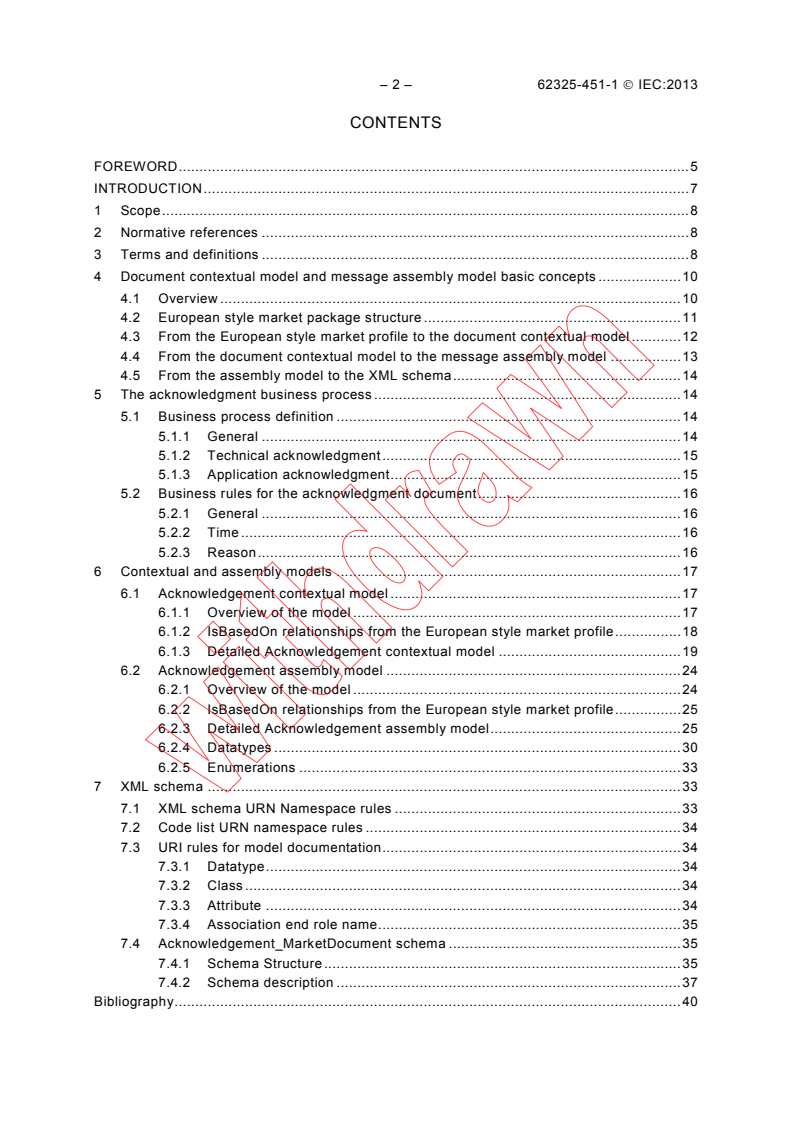
CONTENTS
FOREWORD . 5
INTRODUCTION . 7
1 Scope . 8
2 Normative references . 8
3 Terms and definitions . 8
4 Document contextual model and message assembly model basic concepts . 10
4.1 Overview . 10
4.2 European style market package structure . 11
4.3 From the European style market profile to the document contextual model . 12
4.4 From the document contextual model to the message assembly model . 13
4.5 From the assembly model to the XML schema . 14
5 The acknowledgment business process . 14
5.1 Business process definition . 14
5.1.1 General . 14
5.1.2 Technical acknowledgment . 15
5.1.3 Application acknowledgment . 15
5.2 Business rules for the acknowledgment document . 16
5.2.1 General . 16
5.2.2 Time . 16
5.2.3 Reason . 16
6 Contextual and assembly models . 17
6.1 Acknowledgement contextual model . 17
6.1.1 Overview of the model . 17
6.1.2 IsBasedOn relationships from the European style market profile . 18
6.1.3 Detailed Acknowledgement contextual model . 19
6.2 Acknowledgement assembly model . 24
6.2.1 Overview of the model . 24
6.2.2 IsBasedOn relationships from the European style market profile . 25
6.2.3 Detailed Acknowledgement assembly model . 25
6.2.4 Datatypes . 30
6.2.5 Enumerations . 33
7 XML schema . 33
7.1 XML schema URN Namespace rules . 33
7.2 Code list URN namespace rules . 34
7.3 URI rules for model documentation . 34
7.3.1 Datatype . 34
7.3.2 Class . 34
7.3.3 Attribute . 34
7.3.4 Association end role name . 35
7.4 Acknowledgement_MarketDocument schema . 35
7.4.1 Schema Structure . 35
7.4.2 Schema description . 37
Bibliography . 40
62325-451-1 IEC:2013 – 3 –
Figure 1 – IEC 62325-450 modelling framework . 11
Figure 2 – Overview of European style market profile dependency . 12
Figure 3 – Message assembly criteria . 13
Figure 4 – Acknowledgement process . 15
Figure 5 – Acknowledgement contextual model . 18
Figure 6 – Acknowledgement assembly model . 24
Figure 7 – Acknowledgement_MarketDocument XML schema structure – 1/2 . 36
Figure 8 – Acknowledgement_MarketDocument XML schema structure – 2/2 . 37
Table 1 – Codes used at the document header level . 17
Table 2 – Codes used at the TimeSeries level when there is a Reason code of A03 at
the document header level . 17
Table 3 – Codes used at the Period level when there is a Reason code A03 at the
document header level and a code A21 at the TimeSeries level . 17
Table 4 – IsBasedOn dependency. 19
Table 5 – Attributes of Acknowledgement contextual
model::Acknowledgement_MarketDocument . 19
Table 6 – Association ends of Acknowledgement contextual
model::Acknowledgement_MarketDocument with other classes . 20
Table 7 – Attributes of Acknowledgement contextual model::MarketParticipant . 21
Table 8 – Association ends of Acknowledgement contextual model:: MarketParticipant
with other classes . 21
Table 9 – Attributes of Acknowledgement contextual model::MarketRole . 21
Table 10 – Attributes of Acknowledgement contextual model::Reason . 21
Table 11 – Attributes of Acknowledgement contextual
model::Received_MarketDocument . 22
Table 12 – Attributes of Acknowledgement contextual
model::Receiver_MarketParticipant . 22
Table 13 – Association ends of Acknowledgement contextual
model::Receiver_MarketParticipant with other classes . 22
Table 14 – Attributes of Acknowledgement contextual model::Time_Period . 23
Table 15 – Association ends of Acknowledgement contextual model:: Time_Period with
other classes . 23
Table 16 – Attributes of Acknowledgement contextual model::TimeSeries . 23
Table 17 – Association ends of Acknowledgement contextual model:: TimeSeries with
other classes . 24
Table 18 – IsBasedOn dependency . 25
Table 19 – Attributes of Acknowledgement assembly
model::Acknowledgement_MarketDocument . 26
Table 20 – Association ends of Acknowledgement assembly
model::Acknowledgement_MarketDocument with other classes . 28
Table 21 – Attributes of Acknowledgement assembly model::Reason . 28
Table 22 – Attributes of Acknowledgement assembly model::Time_Period . 29
Table 23 – Association ends of Acknowledgement assembly model:: Time_Period with
other classes . 29
Table 24 – Attributes of Acknowledgement assembly model::TimeSeries . 29
– 4 – 62325-451-1 IEC:2013
Table 25 – Association ends of Acknowledgement assembly model:: TimeSeries with
other classes . 30
Table 26 – Attributes of ESMPDataTypes::ESMP_DateTimeInterval . 30
Table 27 – Attributes of ESMPDataTypes::ESMP_DateTime . 30
Table 28 – Attributes of ESMPDataTypes::ESMPVersion_String . 31
Table 29 – Attributes of ESMPDataTypes::ID_String . 31
Table 30 – Attributes of ESMPDataTypes::MarketRoleKind_String . 31
Table 31 – Attributes of ESMPDataTypes::MessageKind_String . 31
Table 32 – Attributes of ESMPDataTypes::PartyID_String . 32
Table 33 – Attributes of ESMPDataTypes::PayloadId_String . 32
Table 34 – Attributes of ESMPDataTypes::ReasonCode_String . 32
Table 35 – Attributes of ESMPDataTypes::ReasonText_String . 32
Table 36 – Attributes of ESMPDataTypes::YMDHM_DateTime . 33
62325-451-1 IEC:2013 – 5 –
INTERNATIONAL ELECTROTECHNICAL COMMISSION
____________
FRAMEWORK FOR ENERGY MARKET COMMUNICATIONS –
Part 451-1: Acknowledgement business process
and contextual model for CIM European market
FOREWORD
1) The International Electrotechnical Commission (IEC) is a worldwide organization for standardization comprising
all national electrotechnical committees (IEC National Committees). The object of IEC is to promote
international co-operation on all questions concerning standardization in the electrical and electronic fields. To
this end and in addition to other activities, IEC publishes International Standards, Technical Specifications,
Technical Reports, Publicly Available Specifications (PAS) and Guides (hereafter referred to as “IEC
Publication(s)”). Their preparation is entrusted to technical committees; any IEC National Committee interested
in the subject dealt with may participate in this preparatory work. International, governmental and non-
governmental organizations liaising with the IEC also participate in this preparation. IEC collaborates closely
with the International Organization for Standardization (ISO) in accordance with conditions determined by
agreement between the two organizations.
2) The formal decisions or agreements of IEC on technical matters express, as nearly as possible, an international
consensus of opinion on the relevant subjects since each technical committee has representation from all
interested IEC National Committees.
3) IEC Publications have the form of recommendations for international use and are accepted by IEC National
Committees in that sense. While all reasonable efforts are made to ensure that the technical content of IEC
Publications is accurate, IEC cannot be held responsible for the way in which they are used or for any
misinterpretation by any end user.
4) In order to promote international uniformity, IEC National Committees undertake to apply IEC Publications
transparently to the maximum extent possible in their national and regional publications. Any divergence
between any IEC Publication and the corresponding national or regional publication shall be clearly indicated in
the latter.
5) IEC itself does not provide any attestation of conformity. Independent certification bodies provide conformity
assessment services and, in some areas, access to IEC marks of conformity. IEC is not responsible for any
services carried out by independent certification bodies.
6) All users should ensure that they have the latest edition of this publication.
7) No liability shall attach to IEC or its directors, employees, servants or agents including individual experts and
members of its technical committees and IEC National Committees for any personal injury, property damage or
other damage of any nature whatsoever, whether direct or indirect, or for costs (including legal fees) and
expenses arising out of the publication, use of, or reliance upon, this IEC Publication or any other IEC
Publications.
8) Attention is drawn to the Normative references cited in this publication. Use of the referenced publications is
indispensable for the correct application of this publication.
9) Attention is drawn to the possibility that some of the elements of this IEC Publication may be the subject of
patent rights. IEC shall not be held responsible for identifying any or all such patent rights.
International Standard IEC 62325-451-1 has been prepared by IEC technical committee 57:
Power systems management and associated information exchange.
The text of this standard is based on the following documents:
FDIS Report on voting
57/1381/FDIS 57/1396/RVD
Full information on the voting for the approval of this standard can be found in the report on
voting indicated in the above table.
This publication has been drafted in accordance with the ISO/IEC Directives, Part 2.
A list of all parts in the IEC 62325 series, published under the general title Framework for
energy market communications, can be found on the IEC website.
– 6 – 62325-451-1 IEC:2013
The committee has decided that the contents of this publication will remain unchanged until
the stability date indicated on the IEC web site under "http://webstore.iec.ch" in the data
related to the specific publication. At this date, the publication will be
• reconfirmed,
• withdrawn,
• replaced by a revised edition, or
• amended.
IMPORTANT – The 'colour inside' logo on the cover page of this publication indicates
that it contains colours which are considered to be useful for the correct
understanding of its contents. Users should therefore print this document using a
colour printer.
62325-451-1 IEC:2013 – 7 –
INTRODUCTION
This International Standard is one of the IEC 62325-451-x series for deregulated energy
market data exchanges based on the European style market profile. This standard,
IEC 62325-451-1, defines the document contextual model, the message assembly model as
well as the XML schema to be used for the acknowledgement process.
The principal objective of the IEC 62325 series of standards is to produce standards which
facilitate the integration of market application software developed independently by different
vendors into a market management system, between market management systems and
market participant systems. This is accomplished by defining message exchanges to enable
these applications or systems access to public data and exchange information independent of
how such information is represented internally.
The Common Information Model (CIM) described in IEC 62325-301 , IEC 61970-301 and
IEC 61968-11 specifies the basis for the semantics for message exchange.
This European style market profile is based on different parts of the CIM IEC standard and
specifies the content of the messages exchanged.
This document provides for the European-style market profile the generic technical and
application acknowledgement document that can be used in all European style market
processes. These market processes are based on the European regulations, and on the
concepts of third party access and zonal market.This standard was originally based upon the
work of the European Transmission System Operators (ETSO) Task Force EDI (Electronic
Data Interchange) and then on the work of the European Network of Transmission System
Operators (ENTSO-E) Working Group EDI.
______________
To be published.
– 8 – 62325-451-1 IEC:2013
FRAMEWORK FOR ENERGY MARKET COMMUNICATIONS –
Part 451-1: Acknowledgement business process
and contextual model for CIM European market
1 Scope
This International Standard is one of the IEC 62325-451-x series for deregulated energy
market data exchanges and is applicable to European style electricity markets.
Based on the European style market contextual model (IEC 62325-351), this particular
International Standard specifies a UML package for the acknowledgment business process
and its associated document contextual model, assembly model and XML schema for use
within the European style electricity markets.
The relevant aggregate core components (ACCs) defined in IEC 62325-351 have been
contextualised into aggregated business information entities (ABIEs) to satisfy the
requirements of the European style market acknowledgment business process.
The contextualised ABIEs have been assembled into the acknowledgment document
contextual model.
A related assembly model and an XML schema for the exchange of acknowledgement
information between market participants is automatically generated from the Assembled
document contextual model.
2 Normative references
The following documents, in whole or in part, are normatively referenced in this document and
are indispensable for its application. For dated references, only the edition cited applies. For
undated references, the latest edition of the referenced document (including any
amendments) applies.
IEC 61970-2:2004, Energy management system application program interface (EMS-API) –
Part 2: Glossary
IEC 62325-351, Framework for energy market communications – Part 351: CIM European
market model exchange profile
IEC 62325-450:2013, Framework for energy market communications – Part 450: Profile and
context modeling rules
IEC 62361-100, Power systems management and associated information exchange –
Interoperability in the long term – Part 100: CIM profiles to XML schema mapping
3 Terms and definitions
For the purposes of this document, the terms and definitions of IEC 61970-2, as well as the
following apply.
______________
To be published.
62325-451-1 IEC:2013 – 9 –
NOTE General glossary definitions can be found in IEC 60050, International Electrotechnical Vocabulary.
3.1
aggregate business information entity
ABIE
re-use of an aggregate core component (ACC) in a specified business context
[SOURCE: ISO/TS 15000-5:2005, 6.1.3]
3.2
aggregate core component
ACC
collection of related pieces of business information that together convey a distinct business
meaning, independent of any specific business context
Note 1 to entry: Expressed in modelling terms, it is the representation of an object class, independent of any
specific business context.
[SOURCE: ISO/TS 15000-5:2005, 4.6.1]
3.3
application program interface
API
set of public functions provided by an executable application component for use by other
executable application components
3.4
assembly model
assembly model is a model that prepares information in a business context for assembly into
electronic documents for data interchange
3.5
Based on
IsBasedOn
use of an artefact that has been restricted according to the requirements of a specific
business context
[SOURCE: IEC 62325-450:2013, 3.4]
3.6
Business Context
formal description of a specific business circumstance as identified by the values of a set of
context categories, allowing different business circumstances to be uniquely distinguished
[SOURCE: UN/Cefact]
3.7
information model
representation of concepts, relationships, constraints, rules, and operations to specify data
semantics for a chosen domain of discourse
Note 1 to entry: It can provide shareable, stable, and organized structure of information requirements for the
domain context.
3.8
market management system
MMS
computer system comprised of a software platform providing basic support services and a set
of applications providing the functionality needed for the effective management of the
electricity market
– 10 – 62325-451-1 IEC:2013
Note 1 to entry: These software systems in an electricity market may include support for capacity allocation,
scheduling energy, ancillary or other services, real-time operations and settlements.
3.9
message business information entity
MBIE
aggregation of a set of ABIEs that respects a define set of assembly rules
3.10
profile
basic outline of all the information that is required to satisfy a specific environment
4 Document contextual model and message assembly model basic concepts
4.1 Overview
IEC 62325-450 defines a set of Common Information Model (CIM) profiles that follows a
layered modelling framework as outlined in Figure 1, going from CIM to different regional
contextual models and their subsequent contextualized documents for information exchange;
the final step being the message specifications for information interchange.
The regional contextual models are the basic components that are necessary to build
electronic documents for information interchange. The European style market contextual
model (IEC 62325-351) is, as an example, a regional contextual model. The components are
also termed aggregate core components (ACCs).
A document contextual model is based upon a specific business requirements specification
and is constructed from the contextualisation of the ACCs that can be found in the European
style market contextual model. The contextualised ACCs at this stage are termed aggregate
business Information entities (ABIEs). These ABIEs are the constructs that are assembled
together into a specific electronic document to satisfy the information requirements outlined in
the business requirements specification. The transformation from an ACC to an ABIE must
respect the rules defined in IEC 62325-450.
Once a document contextual model has been built, that satisfactorily meets the business
requirements, a message assembly model can be automatically generated from it. The
automatic generation respects the rules defined in IEC 62361-100.
The XML schema then may be automatically generated from the message assembly model. If
necessary, specific mapping can take place at this stage to transform the CIM class and
attribute names into more market resilient names.
62325-451-1 IEC:2013 – 11 –
IEC 2531/13
Figure 1 – IEC 62325-450 modelling framework
4.2 European style market package structure
The main package structure of the European style market profile is described in Figure 2.
For each business process, a business process package is described in an IEC 62325-451-x
(x from 1 to i) standard.
A business process package contains:
• The document contextual model (ABIE) and the automatically generated message
assembly model (MBIE) for each electronic document required to enable the
completion of the business process. Each document is a sub contextual model derived
by restriction from the European style market profile.
• The XML schema of the business document that is automatically generated from the
message assembly model.
The European style market profile (ESMP), as defined in IEC 62325-351, provides the core
components permitted for use in an IEC 62325-451-x standard. All ABIEs must be “based on”
the IEC 62325-351 core components:
• ESMPClasses: Defining all the semi-contextual classes of the European style market
profile derived by restriction from the CIM information model.
• ESMPDataTypes: Defining all the core Datatypes used within the ESMP classes.
– 12 – 62325-451-1 © IEC:2013
All the core components that are used in every electronic document structure have been
harmonized and centralized in the European style market profile.
pkg ESMPProfile_Dependency
Standard::301
301 - CIM Information Model
IEC61970
IEC61968
IEC62325
(from TC57CIM)
(from TC57CIM)
(from TC57CIM)
«IsBasedOn»
Standard::351
351 - European Style Market Profile
ESMPClasses ESMPDataTypes ESMPEnumerations
(from IEC62325-351)
(from IEC62325-351) (from IEC62325-351)
«IsBasedOn»
Standard::451-x
Document Contextual Models For Business Processes
Standard::451-1
Standard::451-2
A
IEC62325-451-1 IEC62325-451-2
+ DocumentVersion + DocumentVersion
+ Business Process + Business Process
+ Acknowledgement Document + Schedule Document
+ Anomaly Report Document
+ Confirmation Report Document
(from EuropeanStyleMarketProfile)
(from EuropeanStyleMarketProfile)
Standard::451-3
IEC62325-451-3
+ DocumentVersion
+ Business Process
+ Bid Document
+ Capacity Auction Specification Document
... Other
+ Capacity Document
Contextual
+ Allocation Result Document
+ Total Allocation Result Document
Models
+ Implicit Auction Result Document
+ Publication Document
+ Rights Document
(from EuropeanStyleMarketProfile)
IEC 2532/13
Figure 2 – Overview of European style market profile dependency
4.3 From the European style market profile to the document contextual model
The document contextual model for a given business process is constructed by an information
analyst who identifies all the information requirements necessary to satisfy the business
process.
62325-451-1 © IEC:2013 – 13 –
Once the information requirements have been identified, the information analyst identifies the
related ACCs that are available in the European style market profile and contextualises them
to meet the information requirements. This contextualisation step creates a set of ABIEs.
In a final step the information analyst assembles together into a specific document contextual
model package the ABIEs to form a document model satisfying the business requirements.
All document contextual models share the same core components and core datatypes. These
are defined in the European style market profile (IEC 62325-351) and are contextualised and
refined in all document contextual models (IEC 62325-451-x series) respecting the rules as
described in IEC 62325-450.
4.4 From the document contextual model to the message assembly model
Once the document contextual model has been finalised, the message assembly model may
be automatically generated.
All document contextual models share the same core components and core datatypes. These
are defined in the European style market profile (IEC 62325-351) and are contextualised and
refined in all document contextual models (IEC 62325-451-x series) respecting the rules as
described in IEC 62325-450.
To enable this automatic generation a series of principles have been elaborated based on the
underlying structures defined in the European style market profile.
The message assembly model is generated into a separate package and respects the
following basic criteria:
1) There shall be one class that is not dependent through a relationship on another class.
This class shall be deemed the Root class.
2) When there is a dependant class, that has a [0.1] or [1.1] multiplicity in all the dependent
class association ends, then if it is a leaf class, the leaf class attributes shall be integrated
into the parent class.
3) The multiplicity of the integrated attributes shall correspond to the multiplicity of the
association end related to the dependent class. However, if an attribute has a multiplicity
of [0.1] then this multiplicity shall become the multiplicity of the integrated attribute. For
example, in Figure 3, the MarketParticipant class has a [1.1] relationship with the parent
Schedule_MarketDocument for two associations (Sender_ and Receiver_) and its “mRID”
has a [1.1] multiplicity, thus the resulting combination is a [1.1] multiplicity. Consequently
the “mRID” attribute is moved to the parent class for these two relations respecting the
[1.1] multiplicity.
class examples
+Sender_MarketParticipant
«ABIE»
«ABIE»
Schedule Contextual Model:: 1.1
Schedule Contextual Model:
Schedule_MarketDocument
+Receiver_MarketParticipant
:MarketParticipant
+ mRID :ID_String
1.1
+ mRID :PartyID_String
+ type :MessageKind_String
+Subject_MarketParticipant
+ createdDateTime :ESMP_DateTime
+ revisionNumber :ESMPVersion_String 0.1
IEC 2533/13
Figure 3 – Message assembly criteria
4) The name of the integrated attribute in the integrating class shall be the concatenation of
the association end role name and the name of the attribute of the original class. For
example, in Figure 3, there are three specific end role names,
– 14 – 62325-451-1 IEC:2013
“Sender_MarketParticipant”, “Receiver_MarketParticipant” and
“Subject_MarketParticipant”. Consequently the “mRID” attribute to be integrated into the
parent class shall be “Sender_MarketParticipant.mRID” and
“Receiver_MarketParticipant.mRID” with a multiplicity of [1.1] and
“Subject_MarketParticipant.mRID” with a multiplicity of [0.1].
5) The attributes that are integrated into a class shall maintain the same datatypes as
defined in the dependant class.
6) The parent class could have associations with more than one leaf class. The integration
rule is applied for each leaf class that fulfil the association requirement of 0.1 or 1.1.
7) In the case where there is a hierarchy of dependant classes, the integration process is
iterative starting from the leaf classes.
8) Attributes and Associations are ordered.
The resulting message assembly model shall be the model used for the creation of
technological implementations such as XML schema.
4.5 From the assembly model to the XML schema
The final modelling step applies a standardized set of criteria in order to generate a uniform
XML schema from the assembly model. This transformation process respects the rules
defined in IEC 62361-100.
5 The acknowledgment business process
5.1 Business process definition
5.1.1 General
The acknowledgment business process is generic and can be used in all the electricity market
business processes at two levels:
• System level: To detect syntax errors (XML parsing errors, etc.);
• Application level: To detect semantic errors (invalid data, wrong process, etc.).
If there is a problem encountered at the first level, then a technical acknowledgement may be
sent to inform the originator of the problem.
If errors are encountered at the second level or if the application can successfully process the
information, then an application acknowledgement may be sent to inform the originator of the
situation.
Figure 4 provides an overview of the acknowledgement process.
62325-451-1 IEC:2013 – 15 –
act Acknowledgement
Or iginator Recipient
Receive Electronic
Send Electronic
document
Document
No
Send technical
Acknowledgement
Can the document be
syntactically processed?
Correct document
and resubmit
Yes
Send application
acknowledgement
No
rejecting complete
document in
Is the document
question semantically correct?
Yes
Send application
Await eventual
acknowledgement
reply
accepting complete
document in question
Process document
in question
IEC 2534/13
Figure 4 – Acknowledgement process
5.1.2 Technical acknowledgment
A technical acknowledgement occurs when an XML document is received that cannot be
correctly processed for submission to the application. Such an error could occur for example
whenever the XML parser cannot correctly parse the incoming document. Other instances
could be the incapacity to correctly identify the originator of the document in relation to the
process requested.
In such a case a technical acknowledgement can be sent to the document originator providing
the information that the XML document in question cannot be correctly processed by the
system.
5.1.3 Application acknowledgment
Within each business process of European style markets, business rules are to be defined
stating whether or not an application acknowledgment is to be sent upon reception of an
electronic document.
In particular, where the originator is in an “operator” type role (system operator, market
operator, interconnection capacity allocator, etc.) and the recipient is in a “market participant”
type role, all electronic documents sent by entities in the role of an operator shall be
– 16 – 62325-451-1 IEC:2013
considered as received and correct, and the acknowledgement process is not required unless
an acknowledgment document is required by a specific process.
Otherwise, upon reception, checks are to be carried out at the application level to assess that
the received document can be correctly processed by the application. The originator is
informed that:
• its document, which is stated as valid after this verification, is ready to be processed
by the reception of an acknowledgement document accepting the document in
question;
• its document is rejected for processing by the reception of an acknowledgement
document rejecting the document in question with details on the level of errors.
5.2 Business rules for the acknowledgment document
5.2.1 General
All the business rules described in IEC 62325-351 are also valid for this standard. Additional
rules are provided hereafter.
5.2.2 Time
For all time intervals, the start date and time is included in the scope of the interval whereas
the end date and time is excluded from the scope of the interval, i.e. [start date and time, end
date and time].
5.2.3 Reason
5.2.3.1 General
There shall be at least one Reason class at the document header level that provides the
information to either accept or reject the document.
If there are no errors, i.e., the received document is fully accepted, then there shall be no
reason text attribute in the Reason class in order to enable an automated processing of the
acknowledgement in such a case.
If there are errors at the TimeSeries level as many Reason classes as necessary may be
used to provide the details of the error. Specifically it shall be used:
• To identify a TimeSeries which has been completely rejected;
• To identify a TimeSeries where there are selective errors at the Time_Period level.
A timeInterval that is in error shall be identified in relation to its position in the incoming
document.
If there are errors at the Time_Period level as many Reason classes as necessary shall be
used to identify the error.
5.2.3.2 Reason code examples
Table 1, Table 2 and Table 3 provide examples of the possible combinations of the use of
reason codes:
62325-451-1 IEC:2013 – 17 –
Table 1 – Codes used at the document header level
Code Reason
A01 Message fully accepted
A02 Message fully rejected
A03 Message contains errors at the time series level
A51 Message identification or version conflict
A52 Time series missing from new version of message
A53 Receiving party incorrect
A94 Document cannot be processed by receiving system
Table 2 – Codes used at the TimeSeries level when there is a Reason code of A03
at the document header level
Code Reason
A20 Time series fully rejected
A21 Time series accepted with specific time interval errors
A41 Resolution inconsistency
A50 Senders timeseries version conflict
A54 Global position not in balance
A55 Time series identification conflict
A56 Corresponding time series not netted
A57 Deadline limit exceeded
A59 Not compliant with local market rules
Table 3 – Codes used at the Period level when there is a Reason code A03
at the document header level and a code A21 at the TimeSeries level
Code Reason
A42 Quantity inconsistency
A46 Quantities must not be signed values
A49 Position inconsistency
A59 Not compliant with local market rules
6 Contextual and assembly models
6.1 Acknowledgement contextual model
6.1.1 Overview of the model
Figure 5 shows the model.
– 18 – 62325-451-1 IEC:2013
Figure 5 – Acknowledgement contextual model
6.1.2 IsBasedOn relationships from the European style market profile
Table 4 shows the traceability dependency of the classes used in this package towards the
upper level.
class Acknowledgement document model
«ABIE»
Receiv ed_Mar ketDocument
«ABIE»
+Received_MarketDocument
+ mRID :ID_String [0.1]
Acknowledgement_Mar ketDocument
+ revisionNumber :ESMPVersion_String [0.1]
1.1
+ mRID :ID_String
+ type :MessageKind_String [0.1]
+ createdDateTime :ESMP_DateTime
+ title :PayloadId_String [0.1]
+ createdDateTime :ESMP_DateTime [0.1]
«ABIE»
+Sender_MarketParticipant
Mar ketPar ticipant
+Rejected_TimeSeries 0.*
1.1
+ mRID :PartyID_String
«ABIE»
TimeSer ies
+MarketRole 1.1
+ mRID :ID_String
+ version :ESMPVersion_String [0.1] «ABIE»
Mar ketRole
+ type :MarketRoleKind_String
+MarketRole 0.1
+InError_Period 0.*+InError_Peri
...