

IEC 60730-1:2010
(Main)Automatic electrical controls for household and similar use - Part 1: General requirements
General Information
- Abstract
IEC 60730-1:2010 applies to automatic electrical controls for use in, on, or in association with equipment for household and similar use, including controls for heating, air conditioning and similar applications. The equipment may use electricity, gas, oil, solid fuel, solar thermal energy, etc., or a combination thereof. This standard also applies to the inherent safety; to the operating values, operating times, and operating sequences where such are associated with equipment safety, and to the testing of automatic electrical control devices used in, or in association with, household or similar equipment. This standard is also applicable to controls for appliances within the scope of IEC 60335-1 as well as controls for building automation systems within the scope of ISO 16484-2. The principal changes in this edition as compared to the previous edition are as follows:
- changes to the low temperature test requirements for in-line cords;
- revision to the pollution degree for the environment surronding contacts;
- addition of the use of screwless terminals on printed circuit boards and revisions to creepage distances;
- additions of CISPR 11 EMC requirements;
- incorporation of EMC test levels from IEC 60335 series;
- additional testing for flexible cords;
- revisions to the requirements for resistance to heat, fire and tracking including replacement of clause 21 and Annexes F and G;
- new Annex T for additional requirements for non-SELV supplied sensor cable or cord;
- new requirements in H.27.1 for first and second fault approach to ensure functional safety;
- incorporation of software techniques from IEC 61508-3 in H.11.12;
- replacement of Annex D (Canada and USA) with reference to UL 746C;
- updates to the references and bibliography;
- the keyword index was deleted.
- Status
- Published
- Publication Date
- 09-Mar-2010
- Technical Committee
- TC 72 - Automatic electrical controls
- Drafting Committee
- WG 10 - TC 72/WG 10
- Current Stage
- DELPUB - Deleted Publication
- Start Date
- 19-Nov-2013
- Completion Date
- 28-Aug-2026
Overview
IEC 60730-1:2010, titled "Automatic electrical controls for household and similar use - Part 1: General requirements," is an international standard published by the International Electrotechnical Commission (IEC). This standard addresses the design, testing, and safety requirements for automatic electrical control devices used in household and similar applications. These controls are integral to equipment such as heating systems, air conditioning units, and other appliances that may operate using electricity, gas, oil, solid fuel, solar thermal energy, or combinations thereof.
The IEC 60730-1 standard ensures the safety, reliability, and performance of automatic electrical controls by setting guidelines on operating values, sequences, and timings, as well as testing procedures that help protect users and equipment. It also harmonizes controls used in household appliances with those in building automation systems, supporting compatibility with other key standards such as IEC 60335-1 and ISO 16484-2.
Key Topics
IEC 60730-1:2010 covers a broad range of technical and safety aspects for automatic electrical controls, including:
- Safety Requirements: Protection against electric shock, provision for protective earthing, and resistance to heat, fire, and tracking.
- Environmental Considerations: Tests for moisture and dust resistance, pollution degrees, and environmental stress to ensure durability under varying conditions.
- Construction Standards: Requirements for terminals, terminations, mechanical strength, and the use of printed circuit boards including screwless terminals and creepage distances.
- Electrical Performance: Rating, classification, insulation resistance, heating, leakage current measurement, and electromagnetic compatibility (EMC) requirements for both emission and immunity.
- Software and Functional Safety: Incorporation of software techniques from IEC 61508-3 and fault approaches to ensure reliable control operation.
- Testing Procedures: Comprehensive testing protocols such as low temperature tests for cords, EMC compliance tests, and endurance evaluations.
- Markings and Information: Guidelines on indelibility of markings, user information, and documentation for compliance.
Applications
IEC 60730-1:2010 is widely applied across multiple domains involving automatic controls in:
- Household Appliances: Controls for heating systems, air conditioners, refrigerators, and other electrical appliances used in residential settings.
- Building Automation: Integration with building management systems enhancing energy efficiency and safety in commercial and residential buildings.
- Energy Systems: Controls for devices utilizing various energy sources like electricity, gas, oil, solid fuel, or renewable thermal energy.
- Safety-Critical Devices: Ensuring functional safety and protection in automatic control devices operating under varying electrical and environmental conditions.
- Manufacturing and Compliance: Used by manufacturers to design and test automatic electrical controls ensuring products meet international safety standards.
Related Standards
IEC 60730-1:2010 works in conjunction with several other standards to provide comprehensive coverage for electrical controls:
- IEC 60335-1: Safety of household and similar electrical appliances – General requirements, often referenced for appliance control compatibility.
- ISO 16484-2: Building automation systems – Requirements applicable to networked control devices in building management.
- IEC 61508-3: Functional safety of electrical/electronic systems – Particularly for software development and fault mitigation techniques in automated controls.
- UL 746C: Applicable in Canada and USA, replacing certain annexes to address specific regional safety requirements.
- CISPR 11: Standards for electromagnetic emissions, integrated into IEC 60730-1 for EMC conformity.
Practical Value
Adhering to IEC 60730-1:2010 helps manufacturers develop reliable and safe automatic controls that comply with international safety, performance, and EMC requirements. This standard enhances product durability through rigorous environmental and mechanical testing routines, which reduces risk of failure and improves user protection. Additionally, compliance facilitates smoother market entry across regions, fosters interoperability with other building systems, and supports sustainability goals by ensuring compatibility with renewable energy controls.
By following IEC 60730-1, manufacturers and system integrators can ensure:
- Safer household and building automation equipment
- Reduced risk of electrical hazards
- Improved product lifecycle and reliability
- Compliance with global regulatory frameworks for electrical controls
For detailed guidelines and the latest amendments, stakeholders are encouraged to consult the full IEC 60730-1:2010 publication and associated normative documents.
Relations
- Effective Date
- 25-Aug-2026
- Effective Date
- 25-Aug-2026
- Effective Date
- 25-Aug-2026
- Effective Date
- 05-Sep-2023
- Effective Date
- 05-Sep-2023
- Effective Date
- 05-Sep-2023
- Effective Date
- 05-Sep-2023
Frequently Asked Questions
IEC 60730-1:2010 is a standard published by the International Electrotechnical Commission (IEC). Its full title is "Automatic electrical controls for household and similar use - Part 1: General requirements". This standard covers: IEC 60730-1:2010 applies to automatic electrical controls for use in, on, or in association with equipment for household and similar use, including controls for heating, air conditioning and similar applications. The equipment may use electricity, gas, oil, solid fuel, solar thermal energy, etc., or a combination thereof. This standard also applies to the inherent safety; to the operating values, operating times, and operating sequences where such are associated with equipment safety, and to the testing of automatic electrical control devices used in, or in association with, household or similar equipment. This standard is also applicable to controls for appliances within the scope of IEC 60335-1 as well as controls for building automation systems within the scope of ISO 16484-2. The principal changes in this edition as compared to the previous edition are as follows: - changes to the low temperature test requirements for in-line cords; - revision to the pollution degree for the environment surronding contacts; - addition of the use of screwless terminals on printed circuit boards and revisions to creepage distances; - additions of CISPR 11 EMC requirements; - incorporation of EMC test levels from IEC 60335 series; - additional testing for flexible cords; - revisions to the requirements for resistance to heat, fire and tracking including replacement of clause 21 and Annexes F and G; - new Annex T for additional requirements for non-SELV supplied sensor cable or cord; - new requirements in H.27.1 for first and second fault approach to ensure functional safety; - incorporation of software techniques from IEC 61508-3 in H.11.12; - replacement of Annex D (Canada and USA) with reference to UL 746C; - updates to the references and bibliography; - the keyword index was deleted.
IEC 60730-1:2010 applies to automatic electrical controls for use in, on, or in association with equipment for household and similar use, including controls for heating, air conditioning and similar applications. The equipment may use electricity, gas, oil, solid fuel, solar thermal energy, etc., or a combination thereof. This standard also applies to the inherent safety; to the operating values, operating times, and operating sequences where such are associated with equipment safety, and to the testing of automatic electrical control devices used in, or in association with, household or similar equipment. This standard is also applicable to controls for appliances within the scope of IEC 60335-1 as well as controls for building automation systems within the scope of ISO 16484-2. The principal changes in this edition as compared to the previous edition are as follows: - changes to the low temperature test requirements for in-line cords; - revision to the pollution degree for the environment surronding contacts; - addition of the use of screwless terminals on printed circuit boards and revisions to creepage distances; - additions of CISPR 11 EMC requirements; - incorporation of EMC test levels from IEC 60335 series; - additional testing for flexible cords; - revisions to the requirements for resistance to heat, fire and tracking including replacement of clause 21 and Annexes F and G; - new Annex T for additional requirements for non-SELV supplied sensor cable or cord; - new requirements in H.27.1 for first and second fault approach to ensure functional safety; - incorporation of software techniques from IEC 61508-3 in H.11.12; - replacement of Annex D (Canada and USA) with reference to UL 746C; - updates to the references and bibliography; - the keyword index was deleted.
IEC 60730-1:2010 is classified under the following ICS (International Classification for Standards) categories: 97.120 - Automatic controls for household use. The ICS classification helps identify the subject area and facilitates finding related standards.
IEC 60730-1:2010 has the following relationships with other standards: It is inter standard links to EN 1854:2010, EN ISO 23553-1:2022, EN ISO 23553-1:2014, IEC 60730-1:1999/AMD1:2003, IEC 60730-1:2013, IEC 60730-1:1999/AMD2:2007, IEC 60730-1:1999. Understanding these relationships helps ensure you are using the most current and applicable version of the standard.
IEC 60730-1:2010 is available in PDF format for immediate download after purchase. The document can be added to your cart and obtained through the secure checkout process. Digital delivery ensures instant access to the complete standard document.
Standards Content (Sample)
IEC 60730-1 ®
Edition 4.0 2010-03
INTERNATIONAL
STANDARD
NORME
INTERNATIONALE
colour
inside
Automatic electrical controls for household and similar use –
Part 1: General requirements
Dispositifs de commande électrique automatiques à usage domestique et
analogue –
Partie 1: Exigences générales
All rights reserved. Unless otherwise specified, no part of this publication may be reproduced or utilized in any form or by
any means, electronic or mechanical, including photocopying and microfilm, without permission in writing from either IEC or
IEC's member National Committee in the country of the requester.
If you have any questions about IEC copyright or have an enquiry about obtaining additional rights to this publication,
please contact the address below or your local IEC member National Committee for further information.
Droits de reproduction réservés. Sauf indication contraire, aucune partie de cette publication ne peut être reproduite
ni utilisée sous quelque forme que ce soit et par aucun procédé, électronique ou mécanique, y compris la photocopie
et les microfilms, sans l'accord écrit de la CEI ou du Comité national de la CEI du pays du demandeur.
Si vous avez des questions sur le copyright de la CEI ou si vous désirez obtenir des droits supplémentaires sur cette
publication, utilisez les coordonnées ci-après ou contactez le Comité national de la CEI de votre pays de résidence.
IEC Central Office
3, rue de Varembé
CH-1211 Geneva 20
Switzerland
Email: inmail@iec.ch
Web: www.iec.ch
About the IEC
The International Electrotechnical Commission (IEC) is the leading global organization that prepares and publishes
International Standards for all electrical, electronic and related technologies.
About IEC publications
The technical content of IEC publications is kept under constant review by the IEC. Please make sure that you have the
latest edition, a corrigenda or an amendment might have been published.
ƒ Catalogue of IEC publications: www.iec.ch/searchpub
The IEC on-line Catalogue enables you to search by a variety of criteria (reference number, text, technical committee,…).
It also gives information on projects, withdrawn and replaced publications.
ƒ IEC Just Published: www.iec.ch/online_news/justpub
Stay up to date on all new IEC publications. Just Published details twice a month all new publications released. Available
on-line and also by email.
ƒ Electropedia: www.electropedia.org
The world's leading online dictionary of electronic and electrical terms containing more than 20 000 terms and definitions
in English and French, with equivalent terms in additional languages. Also known as the International Electrotechnical
Vocabulary online.
ƒ Customer Service Centre: www.iec.ch/webstore/custserv
If you wish to give us your feedback on this publication or need further assistance, please visit the Customer Service
Centre FAQ or contact us:
Email: csc@iec.ch
Tel.: +41 22 919 02 11
Fax: +41 22 919 03 00
A propos de la CEI
La Commission Electrotechnique Internationale (CEI) est la première organisation mondiale qui élabore et publie des
normes internationales pour tout ce qui a trait à l'électricité, à l'électronique et aux technologies apparentées.
A propos des publications CEI
Le contenu technique des publications de la CEI est constamment revu. Veuillez vous assurer que vous possédez
l’édition la plus récente, un corrigendum ou amendement peut avoir été publié.
ƒ Catalogue des publications de la CEI: www.iec.ch/searchpub/cur_fut-f.htm
Le Catalogue en-ligne de la CEI vous permet d’effectuer des recherches en utilisant différents critères (numéro de référence,
texte, comité d’études,…). Il donne aussi des informations sur les projets et les publications retirées ou remplacées.
ƒ Just Published CEI: www.iec.ch/online_news/justpub
Restez informé sur les nouvelles publications de la CEI. Just Published détaille deux fois par mois les nouvelles
publications parues. Disponible en-ligne et aussi par email.
ƒ Electropedia: www.electropedia.org
Le premier dictionnaire en ligne au monde de termes électroniques et électriques. Il contient plus de 20 000 termes et
définitions en anglais et en français, ainsi que les termes équivalents dans les langues additionnelles. Egalement appelé
Vocabulaire Electrotechnique International en ligne.
ƒ Service Clients: www.iec.ch/webstore/custserv/custserv_entry-f.htm
Si vous désirez nous donner des commentaires sur cette publication ou si vous avez des questions, visitez le FAQ du
Service clients ou contactez-nous:
Email: csc@iec.ch
Tél.: +41 22 919 02 11
Fax: +41 22 919 03 00
IEC 60730-1 ®
Edition 4.0 2010-03
INTERNATIONAL
STANDARD
NORME
INTERNATIONALE
colour
inside
Automatic electrical controls for household and similar use –
Part 1: General requirements
Dispositifs de commande électrique automatiques à usage domestique et
analogue –
Partie 1: Exigences générales
INTERNATIONAL
ELECTROTECHNICAL
COMMISSION
COMMISSION
ELECTROTECHNIQUE
PRICE CODE
INTERNATIONALE
XH
CODE PRIX
ICS 97.120 ISBN 2-8318-1080-9
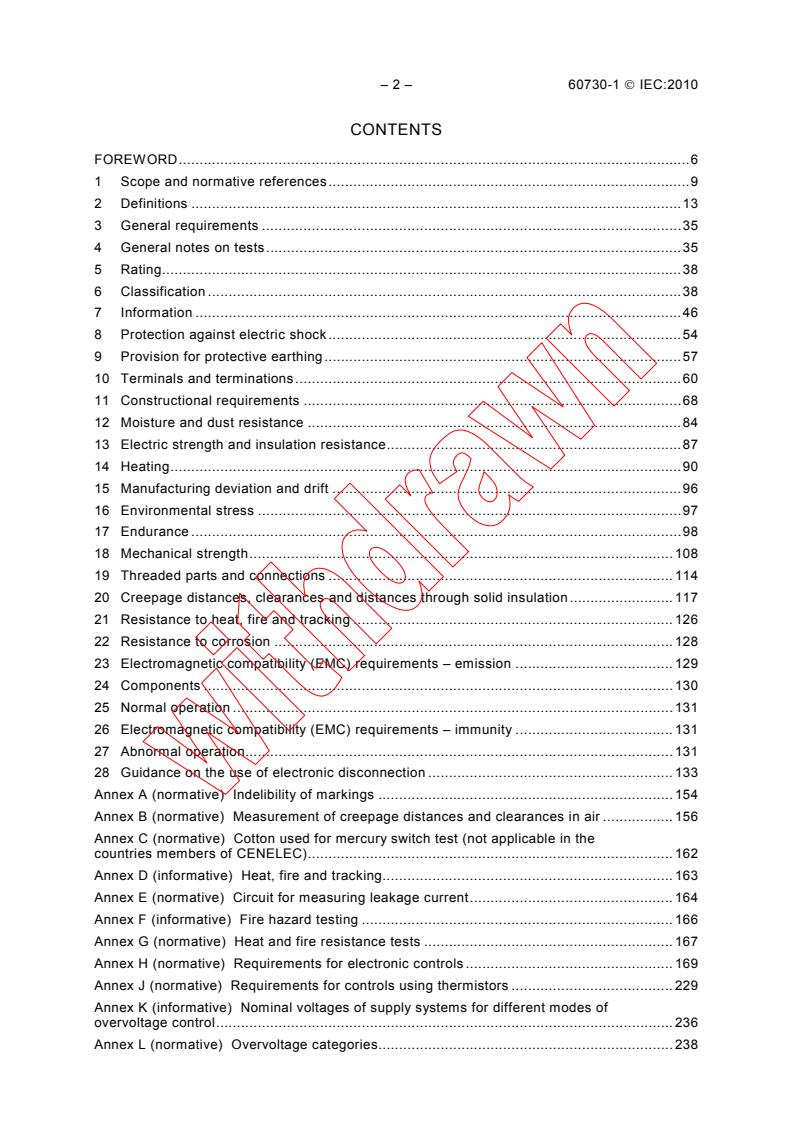
– 2 – 60730-1 © IEC:2010
CONTENTS
FOREWORD.6
1 Scope and normative references.9
2 Definitions .13
3 General requirements .35
4 General notes on tests.35
5 Rating.38
6 Classification .38
7 Information .46
8 Protection against electric shock.54
9 Provision for protective earthing.57
10 Terminals and terminations.60
11 Constructional requirements .68
12 Moisture and dust resistance .84
13 Electric strength and insulation resistance.87
14 Heating.90
15 Manufacturing deviation and drift .96
16 Environmental stress .97
17 Endurance .98
18 Mechanical strength.108
19 Threaded parts and connections . 114
20 Creepage distances, clearances and distances through solid insulation. 117
21 Resistance to heat, fire and tracking . 126
22 Resistance to corrosion . 128
23 Electromagnetic compatibility (EMC) requirements – emission . 129
24 Components .130
25 Normal operation .131
26 Electromagnetic compatibility (EMC) requirements – immunity . 131
27 Abnormal operation.131
28 Guidance on the use of electronic disconnection . 133
Annex A (normative) Indelibility of markings . 154
Annex B (normative) Measurement of creepage distances and clearances in air . 156
Annex C (normative) Cotton used for mercury switch test (not applicable in the
countries members of CENELEC). 162
Annex D (informative) Heat, fire and tracking. 163
Annex E (normative) Circuit for measuring leakage current. 164
Annex F (informative) Fire hazard testing . 166
Annex G (normative) Heat and fire resistance tests . 167
Annex H (normative) Requirements for electronic controls . 169
Annex J (normative) Requirements for controls using thermistors . 229
Annex K (informative) Nominal voltages of supply systems for different modes of
overvoltage control. 236
Annex L (normative) Overvoltage categories. 238
60730-1 © IEC:2010 – 3 –
Annex M (informative) Typical usage . 239
Annex N (normative) Pollution degrees. 240
Annex P (normative) Printed circuit board coating performance test. 241
Annex Q (normative) Printed circuit board coating performance test . 243
Annex R (informative) Explanatory notes for surge immunity test . 246
Annex S (informative) Guidance for applying Clause 20. 251
Annex T (normative) Requirements for SELV and PELV . 253
Annex U (normative) Requirements for relays when used as controls in IEC 60335
appliances . 256
Bibliography . 259
Figure 1 – Test pin . 134
Figure 2 – Standard test finger . 135
Figure 3 – Test nail . 136
Figure 4 – Impact test for free-standing controls . 137
Figure 5 – Tumbling barrel . 137
Figure 6 – Ball-pressure apparatus. 138
Figure 7 – Void . 138
Figure 8 – Apparatus for testing durability of markings on rating labels . 139
Figure 9 – Apparatus for flexing test . 140
Figure 10 – Screw terminals and stud terminals. 141
Figure 11 – Pillar terminals.143
Figure 12 – Mantle terminals .144
Figure 13a – Saddle terminals . 145
Figure 13b – Lug terminals.145
Figure 14 – Tabs. 146
Figure 15 – Tabs for non-reversible connectors . 147
Figure 16 – Receptacles.148
Figure 17 – Measurement of creepage and clearance. 149
Figure 25 – Diagram for leakage current measurement at operating temperature for
single-phase connection of class II controls. 151
Figure 26 – Diagram for leakage current measurement at operating temperature for
single-phase connection of control other than class II . 151
Figure 27 – Diagram for leakage current measurement at operating temperature for
three-phase connection of class II controls . 152
Figure 28 – Diagram for leakage current measurement at operating temperature for
three-phase connection of controls other than those of class II . 152
Figure 29 – Diagram for leakage current measurement at operating temperature for
single-phase connection of control other than class II . 153
Figure 30 – Diagram for leakage current measurement at operating temperature for two-
phase connection of control to three-wire, ground neutral supply other than class II . 153
Figure E.1 – Circuit for measuring leakage currents. 165
Figure H.1 – V-Model for the software life cycle . 194
Figure H.2 – (H.26.5.4.2 of the previous edition) – Voltage variation test. 207
– 4 – 60730-1 © IEC:2010
Figure H.3 (H.26.10.1 of the previous edition) – Ring wave characteristics (open-circuit
voltage). 212
Figure H.4 (H.26.10.2 of the previous edition) – Schematic of a ring wave generator
0,5 s/100 kHz. 212
Figure H.5 (H.27.1.1 of the previous edition) – Example of an electronic circuit with low
power points . 218
Figure P.1 − Test sample. 242
Figure Q.1 – Test sample. 244
Figure Q.2 – Examples of land configurations (see also Figure Q.1) . 245
Figure R.1 – Example of surge protection by shielding in buildings with common earth
reference systems. 249
Figure R.2 – Example of secondary surge protection in buildings with separate common
earth reference systems. 249
Figure R.3 – Example of primary and secondary surge protection of indoor/outdoor
equipment. 250
Table 1 (7.2 of the previous edition) .49
Table 2 (9.3.2 of the previous edition) .59
Table 3 (10.1.4 of the previous edition).61
Table 4 (10.1.8 of the previous edition).63
Table 5 (10.1.9 of the previous edition).64
Table 6 (10.2.1 of the previous edition).66
Table 7 (10.2.4.2 of the previous edition) – Material and plating for tabs .67
Table 8 (10.2.4.3 of the previous edition).68
Table 9 (11.7.2 of the previous edition).78
Table 10 (11.8.2 of the previous edition).79
Table 11 (13.1 of the previous edition).87
14)
Table 12 (13.2 of the previous edition) .88
Table 13 (14.1 of the previous edition).93
Table 14 (17.2.1 of the previous edition) – Electrical conditions for the overvoltage test
(this table applies in all countries except Canada, and the USA) . 100
Table 15 (17.2.2 of the previous edition) – Electrical conditions for the overload tests of
17.7 and 17.10 (this table applies in Canada, USA, and all countries which use an
overload test).101
Table 16 (17.2.3 of the previous edition) – Electrical conditions for the overload tests of
17.8, 17.9, 17.11, 17.12 and 17.13 (this table applies in Canada, USA, and all countries
which use an overload test).102
Table 17 (18.4.1 of the previous edition) – Minimum thickness of sheet metal for
enclosures made of carbon steel or stainless steel . 110
Table 18 (18.4.2 of the previous edition) Minimum thickness of sheet metal for
enclosures of aluminium, copper or brass. 111
Table 19 (18.7 of the previous edition). 113
Table 20 (19.1 of the previous edition). 115
Table 21 (20.1 of the previous edition) – Rated impulse voltage for equipment energized
directly from the supply mains (from IEC 60664-1, Annex F, table F.1). 118
Table 22 (20.2 of the previous edition) – Clearances for insulation co-ordination (from
IEC 60664-1, Annex F, table F.2) . 119
60730-1 © IEC:2010 – 5 –
Table 23 (20.3 of the previous edition) – Minimum creepage distances for basic
insulation . 123
Table 24 (20.4 of the previous edition) – Minimum creepage distances for operational
insulation . 124
Table 25 (21.4 of the previous edition) – Mercury switch short-circuit conditions . 128
Table 26 (27.2.3 of the previous edition) – Maximum winding temperature (for test of
mechanical blocked output conditions) . 132
6)
Table H.1 (H.11.12.7 of the previous edition) . 188
Table H.2 – Semi formal methods .194
Table H.3 – Software architecture specification . 195
Table H.4 – Module design specification. 196
Table H.5 – Design and coding standards. 196
Table H.6 – Software module testing . 197
Table H.7 – Software integration testing . 198
Table H.8 – Software safety validation. 198
Table H.9 (H.11.12.6 of the previous edition) – Combinations of analytical measures
during hardware development. 199
Table H.10 (H.23 of the previous edition) – Emission. 203
Table H.11 (H.26.2.1 of the previous edition) – Applicable test levels. 204
Table H.12 (H.26.5.2 of the previous edition) – Test values for voltage dips and
interruptions. 205
Table H.13 (H.26.5.4.2 of the previous edition) – Timing of short-term supply voltage
variations . 206
Table H.14 (H.26.8.2 of the previous edition) – Test voltages for test level 2 (depending
on the installation class conditions) . 209
Table H.15 (H.26.9.2 of the previous edition) – Test application for electrical fast
transient burst test . 210
Table H.16 (H.26.10.4 of the previous edition) – Peak voltages. 211
Table H.17 (H.26.12.2.1 of the previous edition) – Test levels for conducted
disturbances on mains and I/O lines .213
Table H.18 (H.26.12.3.1 of the previous edition) – Immunity to radiated electromagnetic
fields. 214
Table H.19 (H.26.13.2 of the previous edition) − Test values for supply frequency
variations . 215
Table H.20 (H.26.14.2 of the previous edition) – Test level for continuous fields . 216
Table H.21 (H.27.1 of the previous edition) – Electrical/electronic component fault
modes table . 220
Table J.1 (7.2 of the previous edition). 231
Table K.1 – Inherent control or equivalent protective control . 236
Table K.2 – Cases where protective control is necessary and control is provided by
surge arresters having a ratio of clamping voltage to rated voltage not smaller than that
specified by IEC 60099-1 . 237
Table M.1 – Typical usage. 239
Table P.1 – Environmental cycling conditions . 242
– 6 – 60730-1 © IEC:2010
INTERNATIONAL ELECTROTECHNICAL COMMISSION
____________
AUTOMATIC ELECTRICAL CONTROLS
FOR HOUSEHOLD AND SIMILAR USE –
Part 1: General requirements
FOREWORD
1) The International Electrotechnical Commission (IEC) is a worldwide organization for standardization comprising
all national electrotechnical committees (IEC National Committees). The object of IEC is to promote
international co-operation on all questions concerning standardization in the electrical and electronic fields. To
this end and in addition to other activities, IEC publishes International Standards, Technical Specifications,
Technical Reports, Publicly Available Specifications (PAS) and Guides (hereafter referred to as “IEC
Publication(s)”). Their preparation is entrusted to technical committees; any IEC National Committee interested
in the subject dealt with may participate in this preparatory work. International, governmental and non-
governmental organizations liaising with the IEC also participate in this preparation. IEC collaborates closely
with the International Organization for Standardization (ISO) in accordance with conditions determined by
agreement between the two organizations.
2) The formal decisions or agreements of IEC on technical matters express, as nearly as possible, an international
consensus of opinion on the relevant subjects since each technical committee has representation from all
interested IEC National Committees.
3) IEC Publications have the form of recommendations for international use and are accepted by IEC National
Committees in that sense. While all reasonable efforts are made to ensure that the technical content of IEC
Publications is accurate, IEC cannot be held responsible for the way in which they are used or for any
misinterpretation by any end user.
4) In order to promote international uniformity, IEC National Committees undertake to apply IEC Publications
transparently to the maximum extent possible in their national and regional publications. Any divergence
between any IEC Publication and the corresponding national or regional publication shall be clearly indicated in
the latter.
5) IEC itself does not provide any attestation of conformity. Independent certification bodies provide conformity
assessment services and, in some areas, access to IEC marks of conformity. IEC is not responsible for any
services carried out by independent certification bodies.
6) All users should ensure that they have the latest edition of this publication.
7) No liability shall attach to IEC or its directors, employees, servants or agents including individual experts and
members of its technical committees and IEC National Committees for any personal injury, property damage or
other damage of any nature whatsoever, whether direct or indirect, or for costs (including legal fees) and
expenses arising out of the publication, use of, or reliance upon, this IEC Publication or any other IEC
Publications.
8) Attention is drawn to the Normative references cited in this publication. Use of the referenced publications is
indispensable for the correct application of this publication.
9) Attention is drawn to the possibility that some of the elements of this IEC Publication may be the subject of
patent rights. IEC shall not be held responsible for identifying any or all such patent rights.
International Standard IEC 60730-1 has been prepared by IEC technical committee 72:
Automatic controls for household use.
This fourth edition cancels and replaces the third edition published in 1999, Amendment 1
(2003), and Amendment 2 (2007).
The main technical modifications of this standard since this previous publication are listed
below:
– changes to the low temperature test requirements for in-line cords;
– revision to the pollution degree for the environment surrounding contacts;
– addition of the use of screwless terminals on printed circuit boards and revisions to
creepage distances;
– additions of CISPR 11 EMC requirements;
60730-1 © IEC:2010 – 7 –
– incorporation of EMC test levels from IEC 60335 series;
– additional testing for flexible cords;
– revisions to the requirements for resistance to heat, fire and tracking including
replacement of Clause 21 and Annexes F and G;
– new Annex T for additional requirements for non-SELV supplied sensor cable or cord;
– new requirements in H.27.1 for first and second fault approach to ensure functional
safety;
– incorporation of software techniques from IEC 61508-3 in H.11.12;
– replacement of Annex D (Canada and USA) with a reference to UL 746C;
– updates to the references and bibliography;
– the keyword index was deleted as unnecessary due to the availability of search
functions for electronic editions of the standard.
The text of this standard is based on the following documents:
FDIS Report on voting
72/789/FDIS 72/790/RVD
Full information on the voting for the approval of this standard can be found in the report on
voting indicated in the above table.
A list of all parts of the IEC 60730 series, under the general title: Automatic controls for
household and similar use, can be found on the IEC website.
In the development of a fully international standard to cover automatic controls for household
and similar use, it has been necessary to take into consideration the differing requirements
resulting from practical experience in various parts of the world and to recognize the variation
in national electrical systems and wiring rules.
The “in some countries” notes regarding differing national practices are contained in the
following subclauses:
2.1.5 12.1.6 18.1.6.2
2.7.2 12.3 18.1.6.3
2.7.3 Table 12 (13.2.1), Note 14 18.4
2.14.2 13.3.4 19.2.4.1
4.2.1 14.1.1 19.2.5.1
6.6.1 Table 13 (14.7.4), Notes 1, 7 20
Table 1 (7.2), Note 9 14.4 21.1
7.4.3 15.1 21.4
7.4.3.2 16.2.1 27.2.3.1
8.1.1 17.1.3.1 Annex C
8.4 Table 14 (17.2.5) Annex D
9.3.2 17.2.2
9.3.4 Table 15 (17.2.5) H.26.10
9.5.2 17.2.3 Table H.16 (H.26.10.4)
Table 3 (10.1.4), Note 1 17.2.3.1
10.1.4.2 Table 16 (17.2.5)
10.1.4.3 17.5.1 Table H.21 (H.27.1), Note 7
10.1.14 17.6.2 Table K.1
10.1.16 17.7.7 Table K.2
– 8 – 60730-1 © IEC:2010
10.1.16.1 17.8.4.1 R.1
Table 6 (10.2.1), Note 1 17.10 T.3.2
11.5 17.10.4
Table 10 (11.8.2), Note 1 17.12.5
11.11.1.2 17.14
11.11.1.3 18.1.6
11.11.1.4 18.1.6.1
It is envisaged that in the next edition of this standard it will be found possible to remove those
differences that are covered by new IEC standards now being prepared by other technical
committees.
This part 1 is to be used in conjunction with the appropriate part 2 for a particular type of
control, or for controls for particular applications. This part 1 may also be applied, so far as
reasonable, to controls not mentioned in a part 2, and to controls designed on new principles,
in which cases additional requirements may be considered to be necessary.
See also 4.3.5.2 and 4.3.5.3.
Where, for a particular clause or subclause, the text of part 2 indicates:
Addition: the part 1 text applies with the additional requirement indicated in a part 2;
Modification: the part 1 text applies with a minor change as indicated in a part 2;
Replacement: the part 2 text contains a change which replaces the part 1 text in its
entirety.
Where no change is necessary, the part 2 indicates that the relevant clause or subclause
applies.
NOTE In this standard the following print types are used:
– Requirements proper: in roman type.
– Test specifications: in italic type.
– Explanatory matter: in smaller roman type.
The committee has decided that the contents of this publication will remain unchanged until the
stability date indicated on the IEC web site under "http://webstore.iec.ch" in the data related to
the specific publication. At this date, the publication will be
• reconfirmed,
• withdrawn,
• replaced by a revised edition, or
• amended.
IMPORTANT – The 'colour inside' logo on the cover page of this publication indicates
that it contains colours which are considered to be useful for the correct understanding
of its contents. Users should therefore print this document using a colour printer.
60730-1 © IEC:2010 – 9 –
AUTOMATIC ELECTRICAL CONTROLS
FOR HOUSEHOLD AND SIMILAR USE –
Part 1: General requirements
1 Scope and normative references
1.1 In general, this International Standard applies to automatic electrical controls for use in,
on, or in association with equipment for household and similar use, including controls for
heating, air-conditioning and similar applications. The equipment may use electricity, gas, oil,
solid fuel, solar thermal energy, etc., or a combination thereof.
1.1.1 This International Standard applies to the inherent safety; to the operating values,
operating times, and operating sequences where such are associated with equipment safety,
and to the testing of automatic electrical control devices used in, or in association with,
household or similar equipment.
This standard is also applicable to controls for appliances within the scope of IEC 60335-1.
This standard is also applicable to controls for building automation systems within the scope of
ISO 16484-2
Throughout this standard the word "equipment" means "appliance and equipment."
This standard does not apply to automatic electrical controls intended exclusively for industrial
applications unless explicitly mentioned in the relevant part 2.
This standard is also applicable to individual controls utilized as part of a control system or
controls which are mechanically integral with multifunctional controls having non-electrical
outputs.
Automatic electrical controls for equipment not intended for normal household use, but which
nevertheless may be used by the public, such as equipment intended to be used by laymen in
shops, in light industry and on farms, are within the scope of this standard.
See also Annex J.
This standard is also applicable to relays when used as controls for IEC 60335 appliances.
Additional requirements for the safety and operating values of relays when used as controls for
IEC 60335 appliances are contained in Annex U.
NOTE 1 These requirements are referred to by IEC 61810-1, Scope.
NOTE 2 This standard is intended to be used for the testing of any stand-alone relay which is intended to be used
as a control of an appliance according to IEC 60335-1. It is not intended to be used for any other stand-alone relay,
or to replace the IEC 61810 series of standards.
1.1.2 This standard applies to automatic electrical controls, mechanically or electrically
operated, responsive to or controlling such characteristics as temperature, pressure, passage
of time, humidity, light, electrostatic effects, flow, or liquid level, current, voltage, acceleration,
or combinations thereof.
1.1.3 This standard applies to starting relays, which are a specific type of automatic electrical
control, intended to switch the starting winding of a motor. Such controls may be built into, or
be separate from, the motor.
– 10 – 60730-1 © IEC:2010
1.1.4 This standard applies to manual controls when such are electrically and/or mechanically
integral with automatic controls.
Requirements for manual switches not forming part of an automatic control are contained in IEC 61058-1.
1.2 This standard applies to controls with a rated voltage not exceeding 690 V and with a
rated current not exceeding 63 A.
1.3 This standard does not take into account the response value of an automatic action of a
control, if such a response value is dependent upon the method of mounting the control in the
equipment. Where a response value is of significant purpose for the protection of the user, or
surroundings, the value defined in the appropriate household equipment standard or as
determined by the manufacturer shall apply.
1.4 This standard applies also to controls incorporating electronic devices, requirements for
which are contained in Annex H.
This standard applies also to controls using NTC or PTC thermistors, requirements for which
are contained in Annex J.
1.5 Normative references
The following referenced documents are indispensable for the application of this document. For
dated references, only the edition cited applies. For undated references, the latest edition of
the referenced document (including any amendments) applies.
IEC 60038, IEC standard voltages
1)
IEC 60065:2001, Audio, video and similar electronic apparatus – Safety requirements
Amendment 1 (2004)
IEC 60068-2-75, Environmental testing – Part 2-75: Tests – Test Eh: Hammer tests
IEC 60085:2007, Electrical insulation – Thermal evaluation and designation
IEC 60099-1, Surge arresters – Part 1: Non-linear resistor type gapped arresters for a.c.
systems
IEC 60112:2003, Method for the determination of the proof and the comparative tracking
indices of solid insulating materials
IEC 60127-1:2006, Miniature fuses – Part 1: Definitions for miniature fuses and general
requirements for miniature fuse-links
IEC 60227-1, Polyvinyl chloride insulated cables of rated voltages up to and including 450/750
V – Part 1: General requirements
IEC 60245-1, Rubber insulated cables – Rated voltages up to and including 450/750 V – Part 1:
General requirements
IEC 60269-1, Low-voltage fuses – Part 1:General requirements
___________
1)
There exists a consolidated edition 7.1 including IEC 60065:2001 and its Amendment 1 (2004).
60730-1 © IEC:2010 – 11 –
IEC 60335-1:2001, Household and similar electrical appliances – Safety – Part 1: General
2)
requirements
Amendment 1 (2004)
Amendment 2 (2006)
IEC 60364 (all parts), Low-voltage electrical installations
IEC 60384-14, Fixed capacitors for use in electronic equipment – Part 14: Sectional
specification: Fixed capacitors for electromagnetic interference suppression and connection to
the supply mains
IEC 60384-16, Fixed capacitors for use in electronic equipment – Part 16: Sectional
specification: Fixed metallized polypropylene film dielectric d.c. capacitors
IEC 60384-17, Fixed capacitors for use in electronic equipment – Part 17: Sectional
specification: Fixed metallized polypropylene film dielectric a.c. and pulse capacitors
IEC 60417 (all parts), Graphical symbols for use on equipment
IEC 60423, Conduit systems for cable management – Outside diameters of conduits for
electrical installations and threads for conduits and fittings
3)
IEC 60529:1989, Degrees of protection provided by enclosures (IP code)
Amendment 1 (1999)
IEC 60539 (all parts), Directly heated negative temperature coefficient thermistors
IEC 60664-1:2007, Insulation coordination for equipment within low-voltage systems – Part 1:
Principles, requirements and tests
IEC 60664-3:2003, Insulation coordination for equipment within low-voltage systems – Part 3:
Use of coating, potting or moulding for protection against pollution
IEC 60695-2-10, Fire Hazard testing – Part 2-10: Glowing/hot-wire based test methods – Glow-
wire apparatus and common test procedure
IEC 60695-2-11:2000, Fire hazard testing – Part 2-11: Glowing/hot-wire based test methods –
Glow-wire flammability test method for end-products
IEC 60695-10-2, Fire hazard testing – Part 10-2: Abnormal heat – Ball pressure test
IEC 60738-1, Thermistors – Directly heated positive step-function temperature coefficient –
Part 1: Generic specification
IEC 60738-1-1, Thermistors – Directly heated positive step-function temperature coefficient –
Part 1-1: Blank detail specification – Current limiting application – Assessment level EZ
IEC 60947-1:2007, Low-voltage switchgear and controlgear – Part 1: General rules
___________
2)
There exists a consolidated edition 4.2 including IEC 60335-1:2001 and its Amendments 1 (2004) and 2 (2006).
3)
There exists a consolidated edition 2.1 including IEC 60529:1989 and its Amendment 1 (1999).
– 12 – 60730-1 © IEC:2010
IEC 60998-2-2, Connecting devices for low-voltage circuits for household and similar purposes
– Part 2-2: Particular requirements for connecting devices as separate entities with
screwless-type clamping units
IEC 60998-2-3:2002, Connecting devices for low-voltage circuits for household and similar
purposes – Part 2-3: Particular requirements for connecting devices as separate entities with
insulation-piercing clamping units
IEC 61000 (all parts), Electromagnetic compatibility (EMC)
IEC 61000-3-2:2005, Electromagnetic compatibility (EMC) – Part 3-2: Limits – Limits for
harmonic current emissions (equipment input current ≤ 16 A per phase)
Amendment 1 (2008)
4)
Amendment 2 (2009)
IEC 61000-3-3:2008, Electromagnetic compatibility (EMC) – Part 3-3: Limits – Limitation of
voltage changes, voltage fluctuations and flicker in public low-voltage supply systems, for
equipment with rated current ≤16 A per phase and not subject to conditional connection
IEC 61000-4-2:2008, Electromagnetic compatibility (EMC) – Part 4-2: Testing and
measurement techniques – Electrostatic discharge immunity test
IEC 61000-4-3:2008, Electromagnetic compatibility (EMC) – Part 4-3: Testing and
measurement techniques – Radiated, radio-frequency, electromagnetic field immunity test
IEC 61000-4-4:2004, Electromagnetic compatibility (EMC) – Part 4-4: Testing and
measurement techniques – Electrical fast transient/burst immunity test
IEC 61000-4-5:2005, Electromagnetic compatibility (EMC) – Part 4-5: Testing and
measurement techniques – Surge immunity test
IEC 61000-4-6:2008, Electromagnetic compatibility (EMC) – Part 4-6: Testing and
measurement techniques – Immunity to conducted disturbances, induced by radio-frequency
fields
IEC 61000-4-8:1993, Electromagnetic compatibility (EMC) – Part 4-8: Testing and
5)
measurement techniques – Power frequency magnetic field immunity test
Amendment 1 (2000)
IEC 61000-4-11:2004, Electromagnetic compatibility (EMC) – Part 4-11: Testing and
measurement techniques – Voltage dips, short interruptions and voltage variations immunity
tests
IEC 61000-4-13:2002, Electromagnetic compatibility (EMC) – Part 4-13: Testing and
measurement techniques – Harmonics and interharmonics including mains signalling at a.c.
6)
power port, low frequency immunity tests
Amendment 1 (2009)
___________
4)
There
...