

IEC 62656-1:2014
(Main)Standardized product ontology register and transfer by spreadsheets - Part 1: Logical structure for data parcels
General Information
- Abstract
IEC 62656-1:2014 specifies the logical structure for a set of spreadsheets, used as "data parcels", to define, transfer and register product ontologies. The spreadsheet interface structure defined in this part of IEC 62656 contains the following:
- Definition and specification of the logical structure and layout of the spreadsheet interface for definition, transfer, and registering of a reference dictionary;
- Definition and specification of library instance data belonging to a class of a reference dictionary described by a set of spreadsheets conformant to this part of IEC 62656;
- Definition and specification of the meta dictionary that enables the definition and transfer of a reference dictionary as a set of instance data conforming to the meta dictionary;
- Definition and specification of the meta-model as data that enables the definition and transfer of a reference dictionary as a set of instance data conforming to the meta-meta-dictionary;
- Specification of the mapping between the dictionary data expressed in the spreadsheet format and the EXPRESS model specified by IEC 61360-2/ISO 13584-42 (with some elements of ISO 13584-25);
- Description of the basic semantic mapping between the dictionary data expressed in the spreadsheet formats defined in this part of IEC 62656 and that of DIN 4002.
- Status
- Published
- Publication Date
- 25-Aug-2014
- Technical Committee
- SC 3D - Classes, Properties and Identification of products - Common Data Dictionary (CDD)
- Drafting Committee
- MT 62656-1 - TC 3/SC 3D/MT 62656-1
- Current Stage
- PPUB - Publication issued
- Start Date
- 26-Aug-2014
- Completion Date
- 31-Jul-2014
Overview
IEC 62656-1:2014 is an international standard developed by the International Electrotechnical Commission (IEC) that specifies the logical structure for product ontology data parcels using spreadsheets. This first part of IEC 62656 defines a standardized spreadsheet interface aimed at simplifying the definition, transfer, and registration of product ontologies. The standard provides a comprehensive framework for representing product ontology data in a structured spreadsheet format, promoting interoperability and consistency in ontology management across various applications.
This standard facilitates the creation and exchange of reference dictionaries and library instance data, ensuring alignment with established data modeling languages such as EXPRESS (per IEC 61360-2/ISO 13584-42) and incorporating semantic mappings compatible with DIN 4002. Its methodical approach supports the detailed structuring, versioning, and semantic referencing necessary for complex product ontology data.
Key Topics
Logical Structure for Spreadsheets
IEC 62656-1 defines the specifications for the layout and logical organization of spreadsheets used as data parcels. This includes mandatory header sections, instruction columns, and data sections structured for consistent representation of ontology elements.Meta Dictionary and Meta-Model
The standard introduces a meta dictionary to facilitate the definition and transfer of reference dictionaries as instance data. It further defines a meta-model that enables handling meta-meta-dictionaries, supporting hierarchical and layered ontology definitions.Semantic Mapping and Data Types
It specifies the mapping between spreadsheet-expressed dictionary data and the EXPRESS modeling language, ensuring syntactic and semantic compatibility. The standard also extends type systems with specialized data types and supports complex constructs such as classification trees, property specialization, and unit variables.Parcellized Ontology Model (POM)
The POM concept underpins this standard, enabling the modular packaging of ontology data parcels. This model supports layering, parcel identification, version control, and conformance classes, allowing organized and scalable ontology management.Use Cases and Scenarios
Practical scenarios include dictionary parcel formats for ontology definitions, library parcel formats for instance data, and higher-layer parcel formats for complex ontology structures. These use cases demonstrate how product ontologies can be effectively created, shared, and maintained.
Applications
IEC 62656-1:2014 is instrumental in industries and domains where standardized and interoperable product ontologies are critical. Key applications include:
Product Data Management
Facilitates harmonized product descriptions, improving data exchange between manufacturers, suppliers, and clients.Knowledge Representation in Engineering
Supports engineers and designers in creating consistent, machine-readable ontologies for product components and systems.Supply Chain Integration
Enables seamless transfer and registration of product ontologies across supply chain partners, increasing efficiency and reducing errors.Digital Twin and IoT Systems
Provides structured ontology data essential for digital twins and Internet of Things (IoT) platforms to maintain accurate and up-to-date product information.Standardized Data Exchange Formats
Aligns with other IEC and ISO standards, creating unified formats for product information that can be easily integrated into enterprise software solutions.
Related Standards
IEC 61360-2 / ISO 13584-42
Defines the EXPRESS modeling language used as a reference for mapping product ontology data within IEC 62656-1.ISO 13584-25
Provides additional elements referenced for detailed data modeling in product ontologies.DIN 4002
Offers semantic reference points to ensure basic semantic mapping consistency with the IEC 62656-1 spreadsheet data formats.IEC 62656 (other parts)
Subsequent parts of the IEC 62656 series expand on the ontology register and transfer process, complementing the logical structure defined in Part 1.
Keywords: IEC 62656-1, product ontology, data parcels, spreadsheets, logical structure, meta dictionary, EXPRESS model, product data management, ontology transfer, standardized ontology register, IEC standards, product data exchange, semantic mapping.
Frequently Asked Questions
IEC 62656-1:2014 is a standard published by the International Electrotechnical Commission (IEC). Its full title is "Standardized product ontology register and transfer by spreadsheets - Part 1: Logical structure for data parcels". This standard covers: IEC 62656-1:2014 specifies the logical structure for a set of spreadsheets, used as "data parcels", to define, transfer and register product ontologies. The spreadsheet interface structure defined in this part of IEC 62656 contains the following: - Definition and specification of the logical structure and layout of the spreadsheet interface for definition, transfer, and registering of a reference dictionary; - Definition and specification of library instance data belonging to a class of a reference dictionary described by a set of spreadsheets conformant to this part of IEC 62656; - Definition and specification of the meta dictionary that enables the definition and transfer of a reference dictionary as a set of instance data conforming to the meta dictionary; - Definition and specification of the meta-model as data that enables the definition and transfer of a reference dictionary as a set of instance data conforming to the meta-meta-dictionary; - Specification of the mapping between the dictionary data expressed in the spreadsheet format and the EXPRESS model specified by IEC 61360-2/ISO 13584-42 (with some elements of ISO 13584-25); - Description of the basic semantic mapping between the dictionary data expressed in the spreadsheet formats defined in this part of IEC 62656 and that of DIN 4002.
IEC 62656-1:2014 specifies the logical structure for a set of spreadsheets, used as "data parcels", to define, transfer and register product ontologies. The spreadsheet interface structure defined in this part of IEC 62656 contains the following: - Definition and specification of the logical structure and layout of the spreadsheet interface for definition, transfer, and registering of a reference dictionary; - Definition and specification of library instance data belonging to a class of a reference dictionary described by a set of spreadsheets conformant to this part of IEC 62656; - Definition and specification of the meta dictionary that enables the definition and transfer of a reference dictionary as a set of instance data conforming to the meta dictionary; - Definition and specification of the meta-model as data that enables the definition and transfer of a reference dictionary as a set of instance data conforming to the meta-meta-dictionary; - Specification of the mapping between the dictionary data expressed in the spreadsheet format and the EXPRESS model specified by IEC 61360-2/ISO 13584-42 (with some elements of ISO 13584-25); - Description of the basic semantic mapping between the dictionary data expressed in the spreadsheet formats defined in this part of IEC 62656 and that of DIN 4002.
IEC 62656-1:2014 is classified under the following ICS (International Classification for Standards) categories: 01.040.01 - Generalities. Terminology. Standardization. Documentation (Vocabularies); 01.110 - Technical product documentation. The ICS classification helps identify the subject area and facilitates finding related standards.
IEC 62656-1:2014 is available in PDF format for immediate download after purchase. The document can be added to your cart and obtained through the secure checkout process. Digital delivery ensures instant access to the complete standard document.
Standards Content (Sample)
IEC 62656-1 ®
Edition 1.0 2014-08
INTERNATIONAL
STANDARD
NORME
INTERNATIONALE
colour
inside
Standardized product ontology register and transfer by spreadsheets –
Part 1: Logical structure for data parcels
Enregistrement d'ontologie de produits normalisés et transfert par tableurs –
Partie 1: Structure logique pour les paquets de données
All rights reserved. Unless otherwise specified, no part of this publication may be reproduced or utilized in any form
or by any means, electronic or mechanical, including photocopying and microfilm, without permission in writing from
either IEC or IEC's member National Committee in the country of the requester. If you have any questions about IEC
copyright or have an enquiry about obtaining additional rights to this publication, please contact the address below or
your local IEC member National Committee for further information.
Droits de reproduction réservés. Sauf indication contraire, aucune partie de cette publication ne peut être reproduite
ni utilisée sous quelque forme que ce soit et par aucun procédé, électronique ou mécanique, y compris la photocopie
et les microfilms, sans l'accord écrit de l'IEC ou du Comité national de l'IEC du pays du demandeur. Si vous avez des
questions sur le copyright de l'IEC ou si vous désirez obtenir des droits supplémentaires sur cette publication, utilisez
les coordonnées ci-après ou contactez le Comité national de l'IEC de votre pays de résidence.
IEC Central Office Tel.: +41 22 919 02 11
3, rue de Varembé Fax: +41 22 919 03 00
CH-1211 Geneva 20 info@iec.ch
Switzerland www.iec.ch
About the IEC
The International Electrotechnical Commission (IEC) is the leading global organization that prepares and publishes
International Standards for all electrical, electronic and related technologies.
About IEC publications
The technical content of IEC publications is kept under constant review by the IEC. Please make sure that you have the
latest edition, a corrigenda or an amendment might have been published.
IEC Catalogue - webstore.iec.ch/catalogue Electropedia - www.electropedia.org
The stand-alone application for consulting the entire The world's leading online dictionary of electronic and
bibliographical information on IEC International Standards, electrical terms containing more than 30 000 terms and
Technical Specifications, Technical Reports and other definitions in English and French, with equivalent terms in 14
documents. Available for PC, Mac OS, Android Tablets and additional languages. Also known as the International
iPad. Electrotechnical Vocabulary (IEV) online.
IEC publications search - www.iec.ch/searchpub IEC Glossary - std.iec.ch/glossary
The advanced search enables to find IEC publications by a More than 55 000 electrotechnical terminology entries in
variety of criteria (reference number, text, technical English and French extracted from the Terms and Definitions
committee,…). It also gives information on projects, replaced clause of IEC publications issued since 2002. Some entries
and withdrawn publications. have been collected from earlier publications of IEC TC 37,
77, 86 and CISPR.
IEC Just Published - webstore.iec.ch/justpublished
Stay up to date on all new IEC publications. Just Published IEC Customer Service Centre - webstore.iec.ch/csc
details all new publications released. Available online and If you wish to give us your feedback on this publication or
also once a month by email. need further assistance, please contact the Customer Service
Centre: csc@iec.ch.
A propos de l'IEC
La Commission Electrotechnique Internationale (IEC) est la première organisation mondiale qui élabore et publie des
Normes internationales pour tout ce qui a trait à l'électricité, à l'électronique et aux technologies apparentées.
A propos des publications IEC
Le contenu technique des publications IEC est constamment revu. Veuillez vous assurer que vous possédez l’édition la
plus récente, un corrigendum ou amendement peut avoir été publié.
Catalogue IEC - webstore.iec.ch/catalogue Electropedia - www.electropedia.org
Application autonome pour consulter tous les renseignements
Le premier dictionnaire en ligne de termes électroniques et
bibliographiques sur les Normes internationales,
électriques. Il contient plus de 30 000 termes et définitions en
Spécifications techniques, Rapports techniques et autres
anglais et en français, ainsi que les termes équivalents dans
documents de l'IEC. Disponible pour PC, Mac OS, tablettes
14 langues additionnelles. Egalement appelé Vocabulaire
Android et iPad.
Electrotechnique International (IEV) en ligne.
Recherche de publications IEC - www.iec.ch/searchpub
Glossaire IEC - std.iec.ch/glossary
La recherche avancée permet de trouver des publications IEC Plus de 55 000 entrées terminologiques électrotechniques, en
en utilisant différents critères (numéro de référence, texte, anglais et en français, extraites des articles Termes et
comité d’études,…). Elle donne aussi des informations sur les Définitions des publications IEC parues depuis 2002. Plus
projets et les publications remplacées ou retirées. certaines entrées antérieures extraites des publications des
CE 37, 77, 86 et CISPR de l'IEC.
IEC Just Published - webstore.iec.ch/justpublished
Service Clients - webstore.iec.ch/csc
Restez informé sur les nouvelles publications IEC. Just
Published détaille les nouvelles publications parues. Si vous désirez nous donner des commentaires sur cette
Disponible en ligne et aussi une fois par mois par email. publication ou si vous avez des questions contactez-nous:
csc@iec.ch.
IEC 62656-1 ®
Edition 1.0 2014-08
INTERNATIONAL
STANDARD
NORME
INTERNATIONALE
colour
inside
Standardized product ontology register and transfer by spreadsheets –
Part 1: Logical structure for data parcels
Enregistrement d'ontologie de produits normalisés et transfert par tableurs –
Partie 1: Structure logique pour les paquets de données
INTERNATIONAL
ELECTROTECHNICAL
COMMISSION
COMMISSION
ELECTROTECHNIQUE
PRICE CODE
INTERNATIONALE
XH
CODE PRIX
ICS 01.040.01; 01.110 ISBN 978-2-8322-1745-0
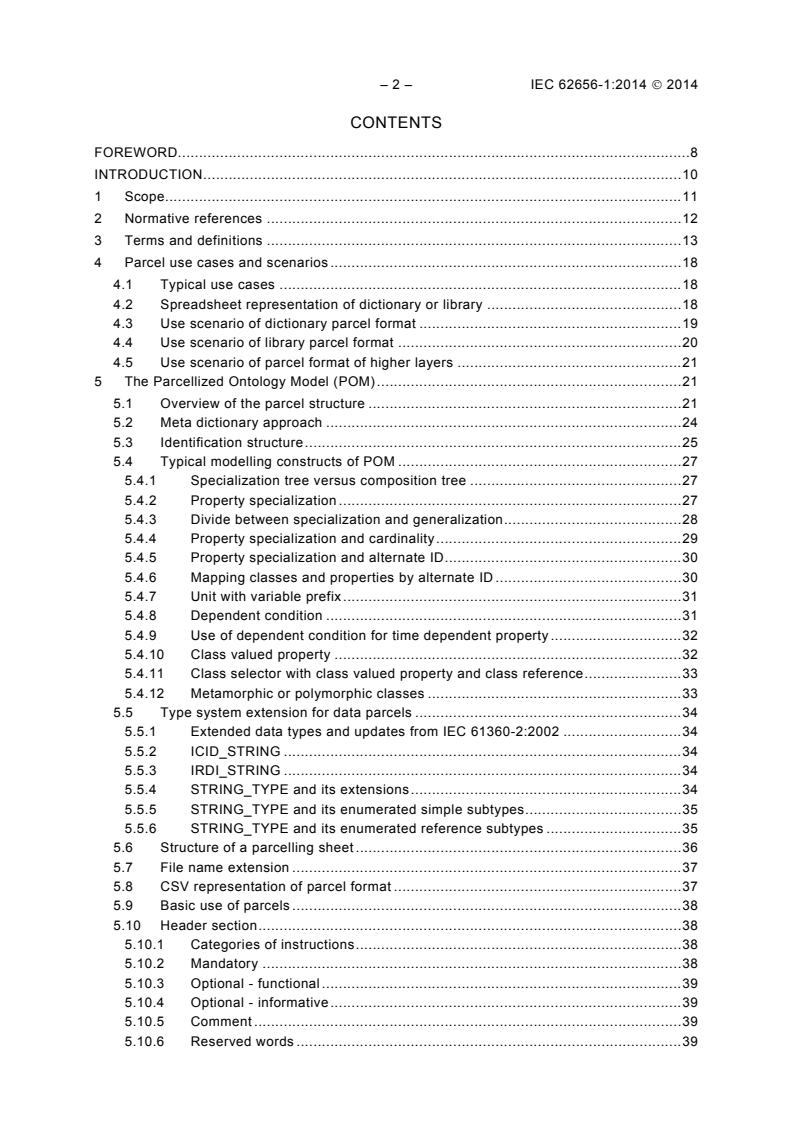
– 2 – IEC 62656-1:2014 2014
CONTENTS
FOREWORD. 8
INTRODUCTION . 10
1 Scope . 11
2 Normative references . 12
3 Terms and definitions . 13
4 Parcel use cases and scenarios . 18
4.1 Typical use cases . 18
4.2 Spreadsheet representation of dictionary or library . 18
4.3 Use scenario of dictionary parcel format . 19
4.4 Use scenario of library parcel format . 20
4.5 Use scenario of parcel format of higher layers . 21
5 The Parcellized Ontology Model (POM) . 21
5.1 Overview of the parcel structure . 21
5.2 Meta dictionary approach . 24
5.3 Identification structure . 25
5.4 Typical modelling constructs of POM . 27
5.4.1 Specialization tree versus composition tree . 27
5.4.2 Property specialization . 27
5.4.3 Divide between specialization and generalization . 28
5.4.4 Property specialization and cardinality . 29
5.4.5 Property specialization and alternate ID . 30
5.4.6 Mapping classes and properties by alternate ID . 30
5.4.7 Unit with variable prefix . 31
5.4.8 Dependent condition . 31
5.4.9 Use of dependent condition for time dependent property . 32
5.4.10 Class valued property . 32
5.4.11 Class selector with class valued property and class reference . 33
5.4.12 Metamorphic or polymorphic classes . 33
5.5 Type system extension for data parcels . 34
5.5.1 Extended data types and updates from IEC 61360-2:2002 . 34
5.5.2 ICID_STRING . 34
5.5.3 IRDI_STRING . 34
5.5.4 STRING_TYPE and its extensions . 34
5.5.5 STRING_TYPE and its enumerated simple subtypes . 35
5.5.6 STRING_TYPE and its enumerated reference subtypes . 35
5.6 Structure of a parcelling sheet . 36
5.7 File name extension . 37
5.8 CSV representation of parcel format . 37
5.9 Basic use of parcels . 38
5.10 Header section . 38
5.10.1 Categories of instructions . 38
5.10.2 Mandatory . 38
5.10.3 Optional - functional . 39
5.10.4 Optional - informative . 39
5.10.5 Comment . 39
5.10.6 Reserved words . 39
5.11 Instruction Column . 39
5.11.1 General rule . 39
5.11.2 Class ID . 39
5.11.3 Preferred name of the class . 40
5.11.4 Definition of the class . 40
5.11.5 Note for the class . 41
5.11.6 Alternate class ID . 41
5.11.7 Super alternate class ID . 42
5.11.8 Sub-alternate class ID . 42
5.11.9 Source language . 42
5.11.10 Parcel mode . 43
5.11.11 Parcel identifier . 43
5.11.12 Parcel conformance class identifier . 44
5.11.13 Default supplier . 44
5.11.14 Default version . 45
5.11.15 Default data supplier . 45
5.11.16 Default data version . 46
5.11.17 Data object identifier name . 47
5.11.18 Property ID . 47
5.11.19 Preferred name of the property . 48
5.11.20 Definition . 49
5.11.21 Note . 50
5.11.22 Data type . 50
5.11.23 Unit of measurement . 51
5.11.24 Requirement . 52
5.11.25 Alternative units of measurement . 52
5.11.26 Variable prefix for the unit . 53
5.11.27 Super property . 54
5.11.28 Alternate property ID . 54
5.11.29 Super alternate ID . 55
5.11.30 Sub-alternate ID of property . 56
5.11.31 Equivalent property ID . 57
5.11.32 ID for the unit of measurement . 57
5.11.33 Property value format . 58
5.11.34 Identifier encoding . 58
5.11.35 Cell delimiter . 59
5.11.36 Decimal mark . 59
5.11.37 Pattern constraint . 60
5.11.38 Relational constraint . 60
5.12 Data section for instances . 61
5.12.1 General . 61
5.12.2 Enumeration types or non quantitative types . 62
5.12.3 Level type . 62
5.12.4 String type . 63
5.12.5 Translatable string type . 63
5.12.6 Boolean type . 63
5.12.7 Class reference type (Class instance type) . 63
5.12.8 Aggregate type . 64
5.12.9 Named type . 66
– 4 – IEC 62656-1:2014 2014
5.12.10 Placement types . 67
5.12.11 Entity instance type . 67
6 Use of parcel for Domain Ontology description . 67
6.1 Dictionary as an instance of meta-dictionary . 67
6.2 Identification of conjunctive parcels . 70
6.3 Roles and definition of dictionary parcels . 70
6.4 Properties of meta-dictionary (meta-ontology) . 71
6.4.1 Overview of meta-classes . 71
6.4.2 Meta-properties for dictionary meta-class . 72
6.4.3 Meta-properties for class meta-class . 73
6.4.4 Meta-properties for property meta-class . 74
6.4.5 Meta-properties for supplier meta-class . 75
6.4.6 Meta-properties for enumeration meta-class . 76
6.4.7 Meta-properties for data-type meta-class . 77
6.4.8 Meta-properties for document meta-class . 77
6.4.9 Meta-properties for object meta-class . 78
6.4.10 Meta-properties for UoM meta-class . 78
6.4.11 Meta-properties for term meta-class . 79
6.4.12 Meta-properties for relation meta-class . 80
7 Use of parcel for meta-ontology (MO) description . 84
7.1 Overview of meta-meta-classes . 84
7.2 Meta-properties for class meta-meta-class . 85
7.3 Meta-properties for property meta-meta-class . 85
7.4 Meta-properties for term meta-meta-class . 86
7.5 Meta-properties for relation meta-meta-class . 87
8 Mechanism for structural extension . 87
8.1 General . 87
8.2 Example . 88
9 Conformance classes for parcelling spreadsheet . 88
Annex A (normative) Information object registration . 90
Annex B (normative) Meta-dictionary file and updates . 91
Annex C (normative) Reserved words. 92
Annex D (normative) Description examples of data types . 95
Annex E (normative) Meta-properties used by normative meta-classes . 98
Annex F (normative) Properties for optional meta-classes . 119
Annex G (normative) Predefined classes and properties in Meta-Ontology . 130
G.1 General . 130
G.2 Predefined meta-classes in Meta-Ontology . 130
G.3 Predefined meta-properties in meta-ontology . 133
Annex H (normative) Predefined meta-relations in meta-ontology . 153
Annex I (normative) Axiomatic properties used by each Meta-meta-class . 156
Annex J (normative) Predefined classes and properties in Axiomatic Ontology . 164
J.1 General . 164
J.2 Predefined meta-classes in Axiomatic Ontology . 164
J.3 Predefined meta-properties in Axiomatic ontology . 166
Annex K (informative) Mapping of meta-properties to EXPRESS . 173
K.1 EXPRESS mapping for mandatory meta-classes . 173
K.2 EXPRESS mapping for optional meta-classes . 182
Annex L (informative) Meta-class properties mapped with DIN 4002. 186
Annex M (informative) Use case of relation for units and quantities . 199
Annex N (informative) Guide for the use of placement data types . 202
N.1 Primitive coordinates . 202
N.2 EXPRESS language codes . 203
Annex O (informative) Foundation in mathematical-logic . 205
O.1 Class and property as sets . 205
O.2 Property specialization explained by set theory . 207
O.3 Mathematical basis of POM . 209
Bibliography . 212
Figure 1 – Parcel use scenario . 19
Figure 2 – Parcel architecture as four levels of spreadsheets . 23
Figure 3 – Components of POM architecture depicted as packages . 24
Figure 4 – Schematic diagram of Parcellized Ontology Model (POM) . 25
Figure 5 – A generalized enumeration . 29
Figure 6 – A specialized enumeration . 30
Figure 7 – Dependent property, condition, and dependent condition . 32
Figure 8 – STRING_TYPE and its extensions . 35
Figure 9 – ENUM_TYPE and its simple subtypes . 35
Figure 10 – ENUM_TYPE and its complex subtypes . 36
Figure 11 – Structure of a parcelling sheet . 37
Figure 12 – Display example of Default data supplier used for IEC 61968-11 . 46
Figure 13 – Display example of property ID . 48
Figure 14 – Display example of preferred name . 49
Figure 15 – Display example of definition . 50
Figure 16 – Display example of data type . 51
Figure 17 – Display example of unit of measurement . 51
Figure 18 – Display example of key . 52
Figure 19 – Display example of alternative units . 53
Figure 20 – Display example of variable prefix unit . 54
Figure 21 – Display example of Super-property for properties . 54
Figure 22 – Display example of alternate property ID . 55
Figure 23 – Display example of super alternate property ID . 56
Figure 24 – Display example of sub-alternate property ID . 56
Figure 25 – Display example of equivalent property ID . 57
Figure 26 – Display example of ID for the unit of measurement . 58
Figure 27 – Display example of value format . 58
Figure 28 – Display example of pattern constraint . 60
Figure 29 – Display example of relational constraint . 61
Figure 30 – Display example of ENUM_INT_TYPE or ENUM_CODE_TYPE . 62
Figure 31 – Display example of LEVEL_TYPE . 63
Figure 32 – Display example of TRANSLATABLE_STRING_TYPE . 63
– 6 – IEC 62656-1:2014 2014
Figure 33 – Display example of BOOLEAN_TYPE . 63
Figure 34 – Display example of CLASS_INSTANCE_TYPE . 64
Figure 35 – Display example of SET OF STRING_TYPE . 65
Figure 36 – Display example of LIST OF STRING_TYPE . 65
Figure 37 – Display example of LIST OF TRANLATABLE_STRING_TYPE . 65
Figure 38 – Display example of SET OF LEVEL OF INT_MEASURE_TYPE . 66
Figure 39 – Display example of SET OF SET OF STRING_TYPE . 66
Figure 40 – Display example of NAMED TYPE . 67
Figure 41 – Configuration of a dictionary parcel . 68
Figure 42 – Parcels for Domain Library and Domain Ontology (Dictionary) . 70
Figure 43 – Relation, function, and predication . 84
Figure 44 – Definition example of the Relation meta-class . 84
Figure M.1 – Example of UoM meta-class for defining units for length . 199
Figure M.2 – Sample specification of the relation meta-class for quantity and system of
units of measurement . 200
Figure M.3 – Quantity and system of units of measurement expressed as relations . 201
Figure N.1 – Local coordinate system and the primitive coordinates . 202
Figure N.2 – Extracts of EXPRESS codes for placement types . 203
Figure N.3 – Extracts of EXPRESS codes for CSG primitives . 204
Figure O.1 – Class, property and property-value function . 206
Figure O.2 – Class and Property and its characteristic function . 206
Figure O.3 – Property specialization by restriction of the domain . 207
Figure O.4 – Property specialization by restriction of the codomain . 208
Figure O.5 – Property specialization by limiting the selectable function set . 208
Figure O.6 – Architecture of POM . 209
Figure O.7 – Examples of instances at DL layer . 210
Table 1 – Description of the property ID code . 48
Table 2 – Example of correspondence within multiple languages . 66
Table 3 – Meta-classes for building a domain-dictionary . 71
Table 4 – Formula specification for property constraint . 82
Table 5 – Conformance classes . 89
Table C.1 – Key words for instruction in class header . 92
Table D.1 – Description examples for simple data types . 95
Table D.2 – Description examples for complex data types . 96
Table E.1 – Meta-properties used by dictionary meta-class . 99
Table E.2 – Meta-properties used by class meta-class . 101
Table E.3 – Meta-properties used by property meta-class . 105
Table E.4 – Meta-properties used by supplier meta-class . 109
Table E.5 – Meta-properties used by enumeration meta-class . 111
Table E.6 – Meta-properties used by datatype meta-class . 113
Table E.7 – Meta-properties used by document meta-class . 115
Table F.1 – Meta-properties used by object meta-class . 120
Table F.2 – Meta-properties used by UoM meta-class . 121
Table F.3 – Meta-properties used by term meta-class . 124
Table F.4 – Meta-properties used by relation meta-class . 127
Table G.1 – List of meta-classes in Meta-Ontology . 131
Table G.2 – List of meta-properties defined at meta-ontology (MO) layer . 134
Table H.1 – List of meta-relations predefined at MO layer . 154
Table I.1 – Axiomatic properties used by class meta-meta-class . 157
Table I.2 – Axiomatic properties used by property meta-meta-class . 159
Table I.3 – Axiomatic properties used by term meta-meta-class . 161
Table I.4 – Axiomatic properties used by relation meta-meta-class . 162
Table J.1 – Predefined meta-classes in Axiomatic Ontology . 165
Table J.2 – List of axiomatic meta-properties defined at Axiomatic Ontology (AO) layer . 167
Table K.1 – Mapping to EXPRESS modelling languages for meta-properties of
dictionary meta-class . 173
Table K.2 – Mapping to EXPRESS modelling languages for meta-properties of property
meta-class . 176
Table K.3 – Mapping to EXPRESS modelling languages for meta-properties of supplier
meta-class . 178
Table K.4 – Mapping to EXPRESS modelling languages for meta-properties of
enumeration meta-class . 179
Table K.5 – Mapping to EXPRESS modelling languages for meta-properties of
datatype meta-class . 180
Table K.6 – Mapping to EXPRESS modelling languages for meta-properties of
document meta-class . 181
Table K.7 – Mapping to EXPRESS modelling languages for meta-properties of object
meta-class . 183
Table K.8 – Mapping to EXPRESS modelling languages for meta-properties of
terminology meta-class . 184
Table L.1 – Meta-properties for the definition of a class or a property, mapped with DIN
4002 . 187
Table L.2 – Meta-properties for the definition of an enumeration, mapped with DIN
4002 . 193
Table L.3 – Meta-properties for the definition of a data type, mapped with DIN 4002 . 195
Table L.4 – Meta-properties for the definition of a UoM, mapped with DIN 4002 . 197
– 8 – IEC 62656-1:2014 2014
INTERNATIONAL ELECTROTECHNICAL COMMISSION
____________
STANDARDIZED PRODUCT ONTOLOGY REGISTER
AND TRANSFER BY SPREADSHEETS –
Part 1: Logical structure for data parcels
FOREWORD
1) The International Electrotechnical Commission (IEC) is a worldwide organization for standardization comprising
all national electrotechnical committees (IEC National Committees). The object of IEC is to promote
international co-operation on all questions concerning standardization in the electrical and electronic fields. To
this end and in addition to other activities, IEC publishes International Standards, Technical Specifications,
Technical Reports, Publicly Available Specifications (PAS) and Guides (hereafter referred to as “IEC
Publication(s)”). Their preparation is entrusted to technical committees; any IEC National Committee interested
in the subject dealt with may participate in this preparatory work. International, governmental and non-
governmental organizations liaising with the IEC also participate in this preparation. IEC collaborates closely
with the International Organization for Standardization (ISO) in accordance with conditions determined by
agreement between the two organizations.
2) The formal decisions or agreements of IEC on technical matters express, as nearly as possible, an international
consensus of opinion on the relevant subjects since each technical committee has representation from all
interested IEC National Committees.
3) IEC Publications have the form of recommendations for international use and are accepted by IEC National
Committees in that sense. While all reasonable efforts are made to ensure that the technical content of IEC
Publications is accurate, IEC cannot be held responsible for the way in which they are used or for any
misinterpretation by any end user.
4) In order to promote international uniformity, IEC National Committees undertake to apply IEC Publications
transparently to the maximum extent possible in their national and regional publications. Any divergence
between any IEC Publication and the corresponding national or regional publication shall be clearly indicated in
the latter.
5) IEC itself does not provide any attestation of conformity. Independent certification bodies provide conformity
assessment services and, in some areas, access to IEC marks of conformity. IEC is not responsible for any
services carried out by independent certification bodies.
6) All users should ensure that they have the latest edition of this publication.
7) No liability shall attach to IEC or its directors, employees, servants or agents including individual experts and
members of its technical committees and IEC National Committees for any personal injury, property damage or
other damage of any nature whatsoever, whether direct or indirect, or for costs (including legal fees) and
expenses arising out of the publication, use of, or reliance upon, this IEC Publication or any other IEC
Publications.
8) Attention is drawn to the Normative references cited in this publication. Use of the referenced publications is
indispensable for the correct application of this publication.
9) Attention is drawn to the possibility that some of the elements of this IEC Publication may be the subject of
patent rights. IEC shall not be held responsible for identifying any or all such patent rights.
International Standard IEC 62656-1 has been prepared by subcommittee 3D, Product
properties and classes and their identification, of IEC technical committee 3: Information
structures, documentation and graphical symbols.
The text of this standard is based on the following documents:
FDIS Report on voting
3D/226/FDIS 3D/229/RVD
Full information on the voting for the approval of this standard can be found in the report on
voting indicated in the above table.
This publication has been drafted in accordance with the ISO/IEC Directives, Part 2.
A list of all parts in the IEC 62656 series, published under the general title Standardized
product ontology register and transfer by spreadsheets, can be found on the IEC website.
The committee has decided that the contents of this publication will remain unchanged until
the stability date indicated on the IEC web site under "http://webstore.iec.ch" in the data
related to the specific publication. At this date, the publication will be
• reconfirmed,
• withdrawn,
• replaced by a revised edition, or
• amended.
IMPORTANT – The 'colour inside' logo on the cover page of this publication indicates
that it contains colours which are considered to be useful for the correct
understanding of its contents. Users should therefore print this document using a
colour printer.
– 10 – IEC 62656-1:2014 2014
INTRODUCTION
IEC 62656 consists of the following parts, under the general title Standardized product
ontology register and transfer by spreadsheets:
– Part 1: Logical structure for data parcels;
– Part 2: Application guide for use with IEC CDD;
– Part 3 : Interface for common information model.
_______________
To be published.
STANDARDIZED PRODUCT ONTOLOGY REGISTER
AND TRANSFER BY SPREADSHEETS –
Part 1: Logical structure for data parcels
1 Scope
This part of IEC 62656 specifies the logical structure for a set of spreadsheets, used as “data
parcels”, to define, transfer and register product ontologies. Such ontology descriptions in
other literatures or disciplines are sometimes called “reference dictionaries”. Thus the logical
data structure described in this standard is named “Parcellized Ontology Model” or “POM” for
short, and each vehicle of transport of the model is called a “parcel”, and may be used for
definition, transfer, and registering of a reference dictionary as a collection of metadata, or for
similar purposes for instances belonging to a certain class of the reference dictionary.
Moreover, this ontology model allows for modelling or modifying an ontology model per se as
a set of instance data, thus it enables an ontology model to evolve over time.
This part of IEC 62656 also includes a standard mapping between the meta-data of dictionary
parcels in the spreadsheet format conforming to this standard and the meta-data represented
in IEC 61360-2 compliant EXPRESS model for dictionary exchange.
It is assumed that a tool supporting this part of IEC 62656 may read and write a set of
spreadsheet data whose semantics and syntax are defined in this part of standard, where the
physical file structure of the spreadsheets may be based on the CSV (Comma Separated
Values) format, typically used in a commercial spreadsheet application, or any other tabular
formats including XML schema compatible or convertible to the CSV format.
The spreadsheet interface structure defined in this part of IEC 62656 contains the following:
– Definition and specification of the logical structure and layout of the spreadsheet interface
for definition, transfer, and registering of a reference dictionary;
– Definition and specification of library instance data belonging to a class of a reference
dictionary described by a set of spreadsheets conformant to this part of IEC 62656;
– Definition and specification of the meta dictionary that enables the definition and transfer
of a reference dictionary as a set of instance data conforming to the meta dictionary;
– Definition and specification of the meta-model as data that enables the definition and
transfer of a reference dictionary as a set of instance data conforming to the meta-meta-
dictionary
– Specification of the mapping between the dictionary dat
...