


IEC 61400-3-1:2019
(Main)Wind energy generation systems - Part 3-1: Design requirements for fixed offshore wind turbines
Wind energy generation systems - Part 3-1: Design requirements for fixed offshore wind turbines
IEC 61400-3-1:2019 outlines the minimum design requirements for fixed offshore wind turbines and is not intended for use as a complete design specification or instruction manual.
Several different parties may be responsible for undertaking the various elements of the design, manufacture, assembly, installation, erection, commissioning, operation and maintenance of an offshore wind turbine and for ensuring that the requirements of this document are met. The division of responsibility between these parties is a contractual matter and is outside the scope of this document.
This edition cancels and replaces the first edition of IEC 61400-3 published in 2009. This edition includes the following significant technical changes with respect to the first edition of IEC 61400-3:
a) The design load table has been revised to simplify the approach to waves, both for several gust cases with the Normal Sea State, and for a number of cases with the Extreme Sea State. The guidance for load calculations has been altered accordingly;
c) For load safety factors reference is now made directly to IEC 61400-1;
d) Control system has been aligned with the latest updates in IEC 61400-1;
e) Wave spectra has been replaced by a reference to ISO 19901-1;
f) The annex on ice loading has been revised and updated
g) Two informative annexes concerning tropical cyclones have been introduced
h) Other parts of the text have been aligned with IEC 61400-1
Systèmes de génération d’énergie éolienne - Partie 3-1: Exigences de conception des éoliennes en mer fixes
l'IEC 61400-3-1:2019 spécifie des exigences complémentaires d'évaluation des conditions externes sur un site d'éoliennes en mer, ainsi que les exigences essentielles de conception, afin d'assurer l'intégrité technique des éoliennes en mer fixes. Elle a pour objet de fournir un niveau de protection approprié contre les dommages causés par tous les dangers pendant la durée de vie prévue.
Le présent document se concentre sur l'intégrité technique des éléments de structure d'une éolienne en mer, mais concerne également les sous-systèmes, tels que les mécanismes de commande et de protection, les systèmes électriques internes et les systèmes mécaniques.
Cette édition annule et remplace la première édition de l'IEC 61400-3 parue en 2009. Cette édition constitue une révision technique. Cette édition inclut les modifications techniques majeures suivantes par rapport à la première édition de l'IEC 61400-3:
a) Le tableau des charges de conception a été révisé afin de simplifier l'approche par vagues, à la fois pour plusieurs cas de rafales avec l'état de mer normale et pour de nombreux cas avec l'état de mer extrême. Les recommandations concernant les calculs de charge ont été modifiées en conséquence;
b) Pour les facteurs de sécurité de charge, il est désormais fait directement référence à l'IEC 61400-1;
c) Le système de commande a été aligné sur les dernières mises à jour de l'IEC 61400-1;
d) La première édition consacrée aux spectres d'ondes a été remplacée par une référence à l'ISO 19901-1;
e) L'annexe consacrée aux surcharges de glace a été révisée et mise à jour
f) Deux annexes informatives concernant les cyclones tropicaux ont été introduites:
g) Les autres parties du texte ont été alignées sur l'IEC 61400-1.
General Information
- Status
- Published
- Publication Date
- 04-Apr-2019
- Technical Committee
- TC 88 - Wind energy generation systems
- Drafting Committee
- WG 3 - TC 88/WG 3
- Current Stage
- PPUB - Publication issued
- Start Date
- 05-Apr-2019
- Completion Date
- 22-Mar-2019
Relations
- Effective Date
- 05-Sep-2023
Overview
IEC 61400-3-1:2019 - Wind energy generation systems – Part 3-1: Design requirements for fixed offshore wind turbines - defines the minimum design requirements for fixed offshore wind turbines. It is a high-level international standard for establishing design loading, structural safety classes, quality assurance, and procedures for site assessment, but it is not a complete design specification or an instruction manual. This 2019 edition replaces IEC 61400-3 (2009) and introduces significant technical updates to wave, control, ice and load-factor guidance.
Key topics and technical requirements
- External conditions & metocean assessment: requirements for defining wind, wave, current, ice and other environmental conditions at an offshore site; use of a metocean database and defined reference periods.
- Design load table & load cases: revised load table simplifying wave treatment for Normal and Extreme Sea States; defined design situations (power production, start-up, shutdown, parked, transport/assembly, ice scenarios, etc.).
- Structural design & load calculations: guidance for aerodynamic, hydrodynamic, gravitational, inertial and ice loads; simulation and ultimate/fatigue limit state analysis.
- Hydrodynamics & wave treatment: reference to ISO 19901-1 for wave spectra and updated informative annexes (shallow water, breaking waves, calculation guidance).
- Control and electrical systems: alignment of control-system requirements with the latest IEC 61400-1 updates; electrical system considerations for offshore network connection conditions.
- Foundations, substructure and installation: requirements for foundation design, assembly, installation, erection and site access; documentation and planning criteria.
- Safety classes, quality assurance and documentation: roles and responsibilities are contractual; standard defines safety classes, QA expectations and required records.
- Special topics: updated annex on ice loading and two informative annexes on tropical cyclones.
Practical applications - who uses this standard
IEC 61400-3-1 is intended for:
- Offshore wind turbine designers and structural engineers (design basis, load calculations)
- Turbine manufacturers and substructure designers (component specification and verification)
- Project developers and EPC contractors (procurement and installation planning)
- Certification bodies and regulators (conformance, type certification and permitting)
- Operations, maintenance and safety teams (commissioning, O&M manuals and limiting conditions)
- Consultants performing site metocean assessments, risk and fatigue analyses
Typical uses include establishing the design basis, conducting load and fatigue analyses, preparing procurement specifications, and supporting certification and permitting of fixed offshore wind projects.
Related standards
- IEC 61400-1 - Wind turbine design requirements (referenced for load safety factors and control alignment)
- ISO 19901‑1 - Offshore structures - Metocean design and operating considerations (referenced for wave spectra)
- IEC 61400-3 (2009) - Superseded by this edition
Keywords: IEC 61400-3-1, fixed offshore wind turbines, design requirements, offshore wind design, metocean, load cases, foundation design, ice loading, wave spectra.
Buy Documents
IEC 61400-3-1:2019 - Wind energy generation systems - Part 3-1: Design requirements for fixed offshore wind turbines Released:4/5/2019
IEC 61400-3-1:2019 - Wind energy generation systems - Part 3-1: Design requirements for fixed offshore wind turbines Released:4/5/2019
Get Certified
Connect with accredited certification bodies for this standard

DNV
DNV is an independent assurance and risk management provider.

Lloyd's Register
Lloyd's Register is a global professional services organisation specialising in engineering and technology.
DNV Energy Systems
Energy and renewable energy certification.
Sponsored listings
Frequently Asked Questions
IEC 61400-3-1:2019 is a standard published by the International Electrotechnical Commission (IEC). Its full title is "Wind energy generation systems - Part 3-1: Design requirements for fixed offshore wind turbines". This standard covers: IEC 61400-3-1:2019 outlines the minimum design requirements for fixed offshore wind turbines and is not intended for use as a complete design specification or instruction manual. Several different parties may be responsible for undertaking the various elements of the design, manufacture, assembly, installation, erection, commissioning, operation and maintenance of an offshore wind turbine and for ensuring that the requirements of this document are met. The division of responsibility between these parties is a contractual matter and is outside the scope of this document. This edition cancels and replaces the first edition of IEC 61400-3 published in 2009. This edition includes the following significant technical changes with respect to the first edition of IEC 61400-3: a) The design load table has been revised to simplify the approach to waves, both for several gust cases with the Normal Sea State, and for a number of cases with the Extreme Sea State. The guidance for load calculations has been altered accordingly; c) For load safety factors reference is now made directly to IEC 61400-1; d) Control system has been aligned with the latest updates in IEC 61400-1; e) Wave spectra has been replaced by a reference to ISO 19901-1; f) The annex on ice loading has been revised and updated g) Two informative annexes concerning tropical cyclones have been introduced h) Other parts of the text have been aligned with IEC 61400-1
IEC 61400-3-1:2019 outlines the minimum design requirements for fixed offshore wind turbines and is not intended for use as a complete design specification or instruction manual. Several different parties may be responsible for undertaking the various elements of the design, manufacture, assembly, installation, erection, commissioning, operation and maintenance of an offshore wind turbine and for ensuring that the requirements of this document are met. The division of responsibility between these parties is a contractual matter and is outside the scope of this document. This edition cancels and replaces the first edition of IEC 61400-3 published in 2009. This edition includes the following significant technical changes with respect to the first edition of IEC 61400-3: a) The design load table has been revised to simplify the approach to waves, both for several gust cases with the Normal Sea State, and for a number of cases with the Extreme Sea State. The guidance for load calculations has been altered accordingly; c) For load safety factors reference is now made directly to IEC 61400-1; d) Control system has been aligned with the latest updates in IEC 61400-1; e) Wave spectra has been replaced by a reference to ISO 19901-1; f) The annex on ice loading has been revised and updated g) Two informative annexes concerning tropical cyclones have been introduced h) Other parts of the text have been aligned with IEC 61400-1
IEC 61400-3-1:2019 is classified under the following ICS (International Classification for Standards) categories: 27.180 - Wind turbine energy systems. The ICS classification helps identify the subject area and facilitates finding related standards.
IEC 61400-3-1:2019 has the following relationships with other standards: It is inter standard links to IEC 61400-3:2009. Understanding these relationships helps ensure you are using the most current and applicable version of the standard.
IEC 61400-3-1:2019 is available in PDF format for immediate download after purchase. The document can be added to your cart and obtained through the secure checkout process. Digital delivery ensures instant access to the complete standard document.
Standards Content (Sample)
IEC 61400-3-1 ®
Edition 1.0 2019-04
INTERNATIONAL
STANDARD
colour
inside
Wind energy generation systems –
Part 3-1: Design requirements for fixed offshore wind turbines
All rights reserved. Unless otherwise specified, no part of this publication may be reproduced or utilized in any form
or by any means, electronic or mechanical, including photocopying and microfilm, without permission in writing from
either IEC or IEC's member National Committee in the country of the requester. If you have any questions about IEC
copyright or have an enquiry about obtaining additional rights to this publication, please contact the address below or
your local IEC member National Committee for further information.
IEC Central Office Tel.: +41 22 919 02 11
3, rue de Varembé info@iec.ch
CH-1211 Geneva 20 www.iec.ch
Switzerland
About the IEC
The International Electrotechnical Commission (IEC) is the leading global organization that prepares and publishes
International Standards for all electrical, electronic and related technologies.
About IEC publications
The technical content of IEC publications is kept under constant review by the IEC. Please make sure that you have the
latest edition, a corrigendum or an amendment might have been published.
IEC publications search - webstore.iec.ch/advsearchform Electropedia - www.electropedia.org
The advanced search enables to find IEC publications by a The world's leading online dictionary on electrotechnology,
variety of criteria (reference number, text, technical containing more than 22 000 terminological entries in English
committee,…). It also gives information on projects, replaced and French, with equivalent terms in 16 additional languages.
and withdrawn publications. Also known as the International Electrotechnical Vocabulary
(IEV) online.
IEC Just Published - webstore.iec.ch/justpublished
Stay up to date on all new IEC publications. Just Published IEC Glossary - std.iec.ch/glossary
details all new publications released. Available online and 67 000 electrotechnical terminology entries in English and
once a month by email. French extracted from the Terms and Definitions clause of
IEC publications issued since 2002. Some entries have been
IEC Customer Service Centre - webstore.iec.ch/csc collected from earlier publications of IEC TC 37, 77, 86 and
If you wish to give us your feedback on this publication or CISPR.
need further assistance, please contact the Customer Service
Centre: sales@iec.ch.
IEC 61400-3-1 ®
Edition 1.0 2019-04
INTERNATIONAL
STANDARD
colour
inside
Wind energy generation systems –
Part 3-1: Design requirements for fixed offshore wind turbines
INTERNATIONAL
ELECTROTECHNICAL
COMMISSION
ICS 27.180 ISBN 978-2-8322-6600-7
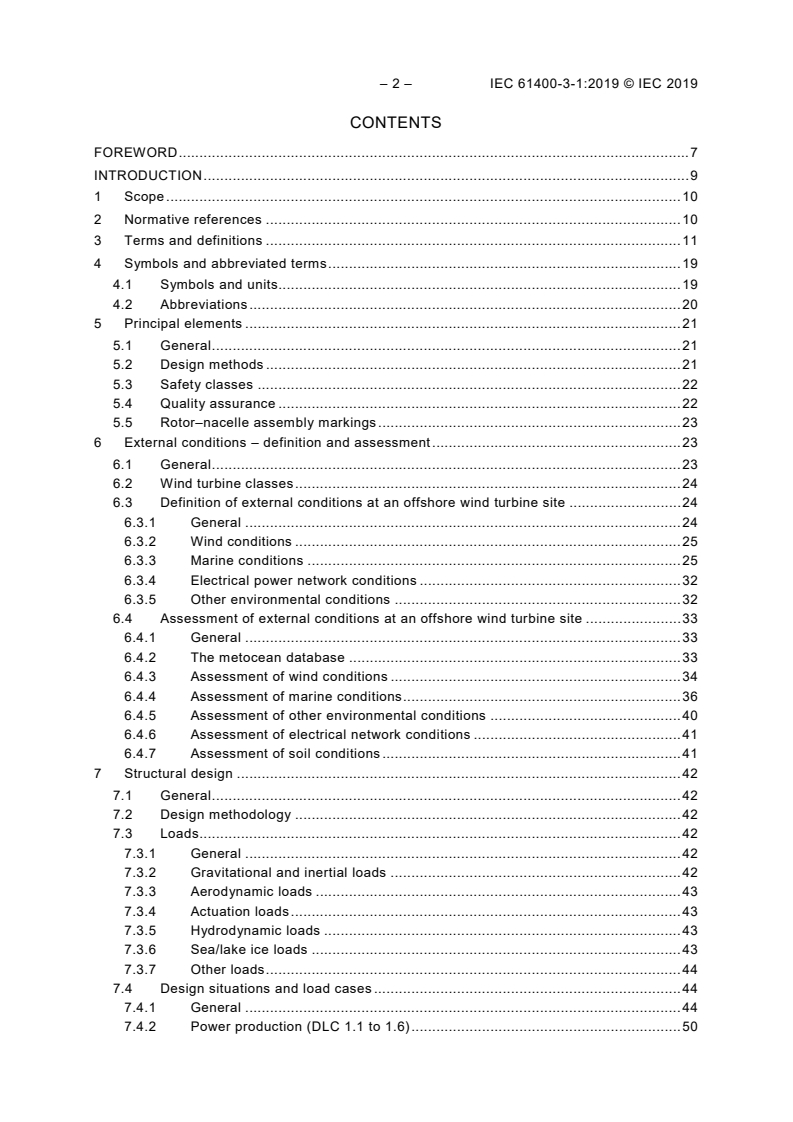
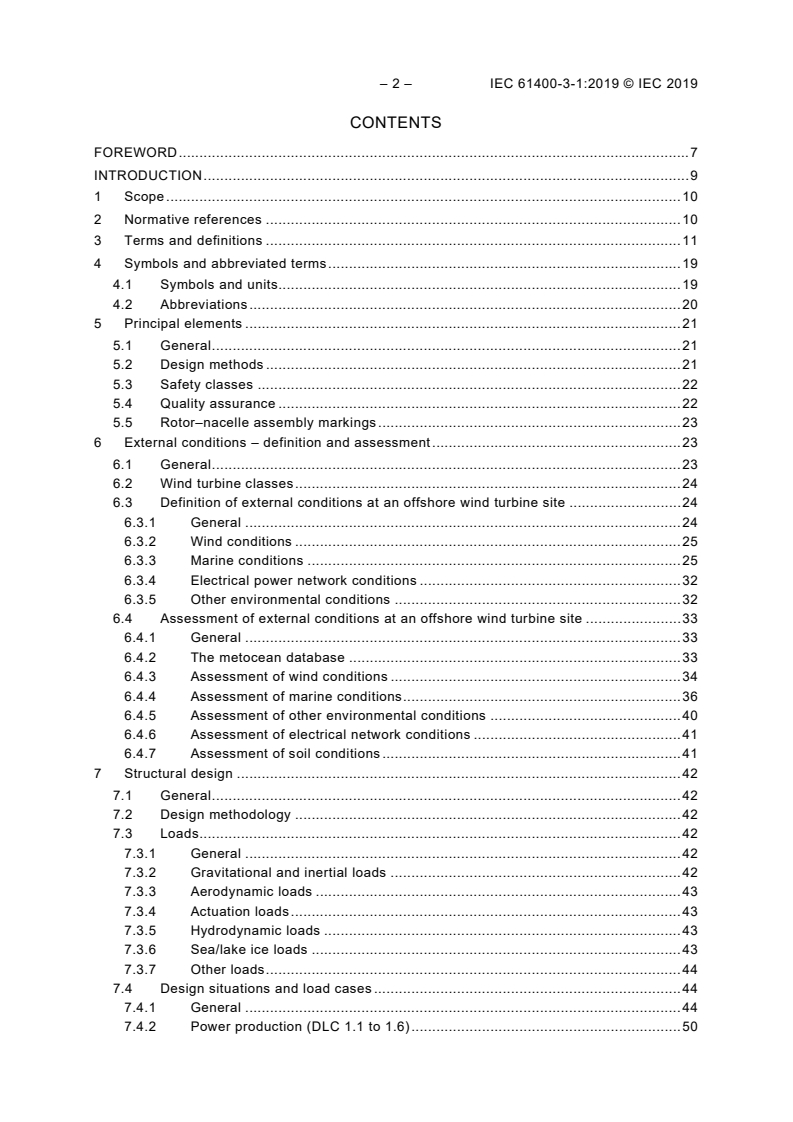
– 2 – IEC 61400-3-1:2019 © IEC 2019
CONTENTS
FOREWORD . 7
INTRODUCTION . 9
1 Scope . 10
2 Normative references . 10
3 Terms and definitions . 11
4 Symbols and abbreviated terms . 19
4.1 Symbols and units. 19
4.2 Abbreviations . 20
5 Principal elements . 21
5.1 General . 21
5.2 Design methods . 21
5.3 Safety classes . 22
5.4 Quality assurance . 22
5.5 Rotor–nacelle assembly markings . 23
6 External conditions – definition and assessment . 23
6.1 General . 23
6.2 Wind turbine classes . 24
6.3 Definition of external conditions at an offshore wind turbine site . 24
6.3.1 General . 24
6.3.2 Wind conditions . 25
6.3.3 Marine conditions . 25
6.3.4 Electrical power network conditions . 32
6.3.5 Other environmental conditions . 32
6.4 Assessment of external conditions at an offshore wind turbine site . 33
6.4.1 General . 33
6.4.2 The metocean database . 33
6.4.3 Assessment of wind conditions . 34
6.4.4 Assessment of marine conditions . 36
6.4.5 Assessment of other environmental conditions . 40
6.4.6 Assessment of electrical network conditions . 41
6.4.7 Assessment of soil conditions . 41
7 Structural design . 42
7.1 General . 42
7.2 Design methodology . 42
7.3 Loads. 42
7.3.1 General . 42
7.3.2 Gravitational and inertial loads . 42
7.3.3 Aerodynamic loads . 43
7.3.4 Actuation loads . 43
7.3.5 Hydrodynamic loads . 43
7.3.6 Sea/lake ice loads . 43
7.3.7 Other loads . 44
7.4 Design situations and load cases . 44
7.4.1 General . 44
7.4.2 Power production (DLC 1.1 to 1.6) . 50
7.4.3 Power production plus occurrence of fault or loss of electrical network
connection (DLC 2.1 – 2.5) . 51
7.4.4 Start up (DLC 3.1 to 3.3). 53
7.4.5 Normal shutdown (DLC 4.1 to 4.2) . 54
7.4.6 Emergency stop (DLC 5.1) . 54
7.4.7 Parked (standstill or idling) (DLC 6.1 to 6.4) . 55
7.4.8 Parked plus fault conditions (DLC 7.1 to 7.2) . 56
7.4.9 Transport, assembly, maintenance and repair (DLC 8.1 to 8.4) . 57
7.4.10 Sea/lake ice design load cases . 60
7.5 Load and load effect calculations . 61
7.5.1 General . 61
7.5.2 Relevance of hydrodynamic loads . 61
7.5.3 Calculation of hydrodynamic loads . 62
7.5.4 Calculation of sea/lake ice loads . 62
7.5.5 Overall damping assessment for support structure response evaluations . 62
7.5.6 Simulation requirements . 64
7.5.7 Other requirements . 65
7.6 Ultimate limit state analysis. 66
7.6.1 Method . 66
7.6.2 Ultimate strength analysis . 68
7.6.3 Fatigue failure . 68
7.6.4 Special partial safety factors . 69
7.6.5 Assessment of cyclic loading for foundation assessment . 69
8 Control system . 69
9 Mechanical systems . 70
10 Electrical system . 70
11 Foundation and substructure design . 70
12 Assembly, installation and erection . 71
12.1 General . 71
12.2 Planning . 72
12.3 Installation conditions . 72
12.4 Site access . 72
12.5 Environmental conditions . 73
12.6 Documentation . 73
12.7 Receiving, handling and storage . 73
12.8 Support structure systems . 73
12.9 Assembly of offshore wind turbine . 73
12.10 Erection of offshore wind turbine . 74
12.11 Fasteners and attachments . 74
12.12 Cranes, hoists and lifting equipment . 74
13 Commissioning, operation and maintenance . 74
13.1 General . 74
13.2 Design requirements for safe operation, inspection and maintenance . 75
13.3 Instructions concerning commissioning . 76
13.3.1 General . 76
13.3.2 Energization . 76
13.3.3 Commissioning tests . 76
13.3.4 Records . 76
– 4 – IEC 61400-3-1:2019 © IEC 2019
13.3.5 Post commissioning activities . 76
13.4 Operator’s instruction manual . 76
13.4.1 General . 76
13.4.2 Instructions for operations and maintenance record . 77
13.4.3 Instructions for unscheduled automatic shutdown . 77
13.4.4 Instructions for diminished reliability . 77
13.4.5 Work procedures plan . 77
13.4.6 Emergency procedures plan . 78
13.5 Maintenance manual . 78
Annex A (informative) Key design parameters for an offshore wind turbine . 80
A.1 Offshore wind turbine identifiers . 80
A.1.1 General . 80
A.1.2 Rotor-nacelle assembly (machine) parameters . 80
A.1.3 Support structure parameters . 80
A.1.4 Wind conditions (based on a 10-min reference period and including
wind farm wake effects where relevant) . 80
A.1.5 Marine conditions (based on a 3-hour reference period where relevant) . 81
A.1.6 Electrical network conditions at turbine . 81
A.2 Other environmental conditions . 82
A.3 Limiting conditions for transport, erection and maintenance . 82
Annex B (informative) Shallow water hydrodynamics and breaking waves . 83
B.1 Selection of suitable wave theories . 83
B.2 Modelling of irregular wave trains. 84
B.3 Wave height distributions . 84
B.3.1 General . 84
B.3.2 The Goda model for maximum wave height . 84
B.3.3 The Battjes and Groenendijk wave height distribution . 87
B.3.4 The Forristall wave and crest height distributions . 90
B.4 Breaking waves . 92
B.5 Reference documents . 95
Annex C (informative) Guidance on calculation of hydrodynamic loads . 96
C.1 General . 96
C.2 Morison’s equation . 97
C.3 Diffraction . 98
C.4 Slap and slam loading . 99
C.5 Vortex-induced vibrations. 102
C.5.1 General . 102
C.5.2 Critical velocities for cross-flow motion . 103
C.5.3 Critical velocities for in-line motion . 104
C.6 Appurtenances . 105
C.6.1 General . 105
C.6.2 Alternative method for estimating hydrodynamic coefficients accounting
for appurtenances and marine growth . 105
C.7 Calculation methods . 112
C.7.1 General . 112
C.7.2 Explicit approach . 113
C.7.3 Constrained wave approach. 113
C.8 Reference documents . 113
Annex D (informative) Recommendations for design of offshore wind turbine support
structures with respect to ice loads . 115
D.1 Introductory remarks . 115
D.2 General . 115
D.3 Choice of ice thickness . 116
D.4 Load cases . 117
D.4.1 General . 117
D.4.2 Horizontal load from fast ice cover originating from temperature
fluctuations (DLC D1) . 117
D.4.3 Horizontal load from fast ice cover originating from water level
fluctuations and arch effect (DLC D2) . 118
D.4.4 Horizontal load from moving ice (DLC D3, D4, D7 and D8) . 118
D.4.5 Vertical load from fast ice cover (DLC D5) . 122
D.4.6 Pressure from ice ridges (DLC D6) . 123
D.4.7 Dynamic loading (DLC D3, D4, D7, and D8). 123
D.5 Requirements on stochastic simulation . 126
D.6 Requirements on model testing . 126
D.7 Reference documents . 127
D.8 Databases for ice conditions . 129
Annex E (informative) Offshore wind turbine foundation and substructure design . 130
Annex F (informative) Statistical extrapolation of operational metocean parameters
for ultimate strength analysis . 131
F.1 General . 131
F.2 Use of IFORM to determine 50-yr significant wave height conditional on
mean wind speed . 131
F.3 Examples of joint distributions of V and H and approximations to the
s
environmental contour . 133
F.4 Choice of sea state duration . 135
F.5 Determination of the extreme individual wave height to be embedded in SSS . 135
F.6 Reference documents . 136
Annex G (informative) Corrosion protection . 137
G.1 General . 137
G.2 The marine environment . 137
G.3 Corrosion protection considerations . 138
G.4 Corrosion protection systems – Support structures . 138
G.5 Corrosion protection in the rotor–nacelle assembly . 139
G.6 Reference documents . 140
Annex H (informative) Prediction of extreme wave heights during tropical cyclones . 141
H.1 General . 141
H.2 Wind field estimation for tropical cyclones . 141
H.3 Wave estimation for tropical cyclones . 142
H.4 Reference documents . 142
H.5 Databases for tropical storms conditions . 143
Annex I (informative) Recommendations for alignment of safety levels in tropical
cyclone regions . 144
I.1 General . 144
I.2 Global robustness level criteria . 144
I.3 Design load cases. 145
Bibliography . 147
– 6 – IEC 61400-3-1:2019 © IEC 2019
Figure 1 – Parts of a fixed offshore wind turbine . 13
Figure 2 – Design process for an offshore wind turbine . 22
Figure 3 – Definition of water levels . 30
Figure 4 – The two approaches to calculate the design load effect . 67
Figure B.1 – Regular wave theory selection diagram . 83
Figure B.2 – Comparison of wave height distribution results . 92
Figure C.1 – Breaking wave and cylinder parameters . 100
Figure C.2 – Oblique inflow parameters . 101
Figure C.3 – Distribution over height of the maximum impact line force (γ = 0°) . 102
Figure C.4 – Response of model and full-scale cylinder in-line and cross-flow . 104
Figure C.5 – Geometrical definition of blocking and shielding . 109
Figure C.6 – Influence of a fixed boundary on the drag coefficient on a circular cylinder
5 6
in oscillatory supercritical flow KC > 20, R = 10 – 2 x 10 . 110
e
Figure C.7 – Shielding factors . 111
Figure C.8 – Recommended value for the added mass coefficient C of a circular
m
cylinder; influence of a fixed boundary . 112
Figure D.1 – Ice force coefficients for plastic limit analysis . 121
Figure D.2 – Ice load history for frequency lock-in conditions . 125
Figure D.3 – Time history of horizontal force component of ice load acting on a conical
structure . 125
Figure F.1 – Example of the construction of the 50-year environmental contour for a 3-
hour sea state duration. . 132
Table 1 – Conversion between extreme wind speeds of different averaging periods . 34
Table 2 – Design load cases . 46
Table 3 – Design load cases for sea/lake ice . 61
Table B.1 – Constants h and h and normalised wave heights h as a function of H . 88
1 2 x % tr
Table B.2 – Breaking wave type . 94
Table I.1 – Additional load cases for tropical cyclone affected regions . 146
INTERNATIONAL ELECTROTECHNICAL COMMISSION
____________
WIND ENERGY GENERATION SYSTEMS –
Part 3-1: Design requirements for fixed offshore wind turbines
FOREWORD
1) The International Electrotechnical Commission (IEC) is a worldwide organization for standardization comprising
all national electrotechnical committees (IEC National Committees). The object of IEC is to promote
international co-operation on all questions concerning standardization in the electrical and electronic fields. To
this end and in addition to other activities, IEC publishes International Standards, Technical Specifications,
Technical Reports, Publicly Available Specifications (PAS) and Guides (hereafter referred to as “IEC
Publication(s)”). Their preparation is entrusted to technical committees; any IEC National Committee interested
in the subject dealt with may participate in this preparatory work. International, governmental and non-
governmental organizations liaising with the IEC also participate in this preparation. IEC collaborates closely
with the International Organization for Standardization (ISO) in accordance with conditions determined by
agreement between the two organizations.
2) The formal decisions or agreements of IEC on technical matters express, as nearly as possible, an international
consensus of opinion on the relevant subjects since each technical committee has representation from all
interested IEC National Committees.
3) IEC Publications have the form of recommendations for international use and are accepted by IEC National
Committees in that sense. While all reasonable efforts are made to ensure that the technical content of IEC
Publications is accurate, IEC cannot be held responsible for the way in which they are used or for any
misinterpretation by any end user.
4) In order to promote international uniformity, IEC National Committees undertake to apply IEC Publications
transparently to the maximum extent possible in their national and regional publications. Any divergence
between any IEC Publication and the corresponding national or regional publication shall be clearly indicated in
the latter.
5) IEC itself does not provide any attestation of conformity. Independent certification bodies provide conformity
assessment services and, in some areas, access to IEC marks of conformity. IEC is not responsible for any
services carried out by independent certification bodies.
6) All users should ensure that they have the latest edition of this publication.
7) No liability shall attach to IEC or its directors, employees, servants or agents including individual experts and
members of its technical committees and IEC National Committees for any personal injury, property damage or
other damage of any nature whatsoever, whether direct or indirect, or for costs (including legal fees) and
expenses arising out of the publication, use of, or reliance upon, this IEC Publication or any other IEC
Publications.
8) Attention is drawn to the Normative references cited in this publication. Use of the referenced publications is
indispensable for the correct application of this publication.
9) Attention is drawn to the possibility that some of the elements of this IEC Publication may be the subject of
patent rights. IEC shall not be held responsible for identifying any or all such patent rights.
International Standard IEC 61400-3-1 has been prepared by IEC technical committee 88:
Wind energy generation systems.
This edition cancels and replaces the first edition of IEC 61400-3 published in 2009. This
edition constitutes a technical revision.
This edition includes the following significant technical changes with respect to the first
edition of IEC 61400-3:
a) Clause 12 has been merged with Clause 6 in order to acknowledge that the design of the
wind turbine support structure is generally site specific for offshore projects;
b) The design load table has been revised to simplify the approach to waves, both for several
gust cases with the Normal Sea State, and for a number of cases with the Extreme Sea
State. The guidance for load calculations has been altered accordingly;
c) For load safety factors reference is now made directly to IEC 61400-1;
d) Clause 8 on the control system has been aligned with the latest updates in IEC 61400-1;
– 8 – IEC 61400-3-1:2019 © IEC 2019
e) Annex B to edition one on wave spectra has been replaced by a reference to ISO 19901-1;
f) The annex on ice loading has been revised and updated (now Annex D);
g) Two informative annexes concerning tropical cyclones have been introduced: Annex H on
wave height assessment and Annex I on safety level;
h) Other parts of the text have been aligned with IEC 61400-1.
This part is to be read in conjunction with IEC 61400-1, Wind turbines – Part 1: Design
requirements .
The text of this International Standard is based on the following documents:
FDIS Report on voting
88/708/FDIS 88/712/RVD
Full information on the voting for the approval of this International Standard can be found in
the report on voting indicated in the above table.
This publication has been drafted in accordance with the ISO/IEC Directives, Part 2.
A list of all parts of the IEC 61400 series, published under the general title Wind energy
generation systems, can be found on the IEC website.
Future standards in this series will carry the new general title as cited above. Titles of existing
standards in this series will be updated at the time of the next edition.
This document has been drafted in accordance with the ISO/IEC Directives, Part 2.
The committee has decided that the contents of this document will remain unchanged until the
stability date indicated on the IEC website under "http://webstore.iec.ch" in the data related to
the specific document. At this date, the document will be
• reconfirmed,
• withdrawn,
• replaced by a revised edition, or
• amended.
A bilingual version of this publication may be issued at a later date.
IMPORTANT – The 'colour inside' logo on the cover page of this publication indicates
that it contains colours which are considered to be useful for the correct
understanding of its contents. Users should therefore print this document using a
colour printer.
___________
Under preparation. Stage at the time of publication: IEC/RFDIS 61400-1:2018.
INTRODUCTION
This part of IEC 61400 outlines the minimum design requirements for fixed offshore wind
turbines and is not intended for use as a complete design specification or instruction manual.
Several different parties may be responsible for undertaking the various elements of the
design, manufacture, assembly, installation, erection, commissioning, operation and
maintenance of an offshore wind turbine and for ensuring that the requirements of this
document are met. The division of responsibility between these parties is a contractual matter
and is outside the scope of this document.
Any of the requirements of this document may be altered if it can be suitably demonstrated
that the safety of the system is not compromised. Compliance with this document does not
relieve any person, organization, or corporation from the responsibility of observing other
applicable regulations.
The document is not intended to give requirements for floating offshore wind turbines. For
floating installations, reference is made to IEC 61400-3-2.
– 10 – IEC 61400-3-1:2019 © IEC 2019
WIND ENERGY GENERATION SYSTEMS –
Part 3-1: Design requirements for fixed offshore wind turbines
1 Scope
This part of IEC 61400 specifies additional requirements for assessment of the external
conditions at an offshore wind turbine site and specifies essential design requirements to
ensure the engineering integrity of fixed offshore wind turbines. Its purpose is to provide an
appropriate level of protection against damage from all hazards during the planned lifetime.
This document focuses on the engineering integrity of the structural components of an
offshore wind turbine but is also concerned with subsystems such as control and protection
mechanisms, internal electrical systems and mechanical systems.
A wind turbine shall be considered as a fixed offshore wind turbine if the support structure is
subject to hydrodynamic loading and it is founded on the seabed. The design requirements
specified in this document are not sufficient to ensure the engineering integrity of floating
offshore wind turbines. For floating installations, reference is made to IEC 61400-3-2. In the
remainder of this document, the term “offshore wind turbine” is assumed to refer to those that
are fixed to the seabed.
This document should be used together with the appropriate IEC and ISO standards
mentioned in Clause 2. In particular, this document is fully consistent with the requirements of
IEC 61400-1. The safety level of the offshore wind turbine designed according to this
document shall be at or exceed the level inherent in IEC 61400-1. In some clauses, where a
comprehensive statement of requirements aids clarity, replication of text from IEC 61400-1 is
included.
2 Normative references
The following documents are referred to in the text in such a way that some or all of their
content constitutes requirements of this document. For dated references, only the edition
cited applies. For undated references, the latest edition of the referenced document (including
any amendments) applies.
IEC 60721 (all parts), Classification of environmental conditions
IEC 61400-1:2018, Wind energy generation systems – Part 1: Design requirements
ISO 2394:1998, General principles on reliability for structures
ISO 2533:1975, Standard Atmosphere
ISO 19900:2002, Petroleum and natural gas industries – General requirements for offshore
structures
ISO 19901-1:2015, Petroleum and natural gas industries – Specific requirements for offshore
structures – Part 1: Metocean design and operating conditions
___________
Under preparation. Stage at the time of publication: IEC/RFDIS 61400-1:2018.
ISO 19901-4:2003, Petroleum and natural gas industries – Specific requirements for offshore
structures – Part 4: Geotechnical and foundation design considerations
ISO 19902:2007, Petroleum and natural gas industries – Fixed steel offshore structures
ISO 19903:2006, Petroleum and natural gas industries – Fixed concrete offshore structures
3 Terms and definitions
For the purposes of this document, the terms and definitions given in IEC 61400-1 and the
following apply.
ISO and IEC maintain terminological databases for use in standardization at the following
addresses:
• IEC Electropedia: available at http://www.electropedia.org/
• ISO Online browsing platform: available at http://www.iso.org/obp
3.1
air gap
clearance between the highest water surface that occurs during the extreme environmental
conditions and the lowest exposed part not designed to withstand wave impingement
3.2
arch effect
action of an arch ice (or its collapse) upon a substructure
3.3
arch ice
ice build-up between substructures or between a substructure and shore that has an arch
shape and eventually collapses
3.4
co-directional
acting in the same direction
3.5
current
flow of water past a fixed location usually described in terms of a current speed and direction
3.6
diffraction
phenomenon that describes the bending of waves around obstacles and spreading of waves
past openings
3.7
design wave
deterministic wave with a defined height, period and direction, used for the design of an
offshore structure
Note 1 to entry: A design wave may be accompanied by a requirement for the use of a particular periodic wave
theory.
3.8
designer
party or parties responsible for the design of an offshore wind turbine
– 12 – IEC 61400-3-1:2019 © IEC 2019
3.9
environmental conditions
characteristics of the environment (wind, waves, sea currents, water level, sea/lake ice,
marine growth, scour and overall seabed movement, etc.) which may affect the wind turbine
behaviour
3.10
external conditions
external factors affecting operation of an offshore wind turbine, including the environmental
conditions, the electrical network conditions, and other climatic factors (temperature, snow,
ice, etc.)
3.11
extreme significant wave height
significant wave height of the sea state over the reference period with an annual probability of
exceedance of 1/N (“return period”: N years), extrapolated from the extreme distribution of
significant wave height at the site
3.12
extreme wave height
individual wave height (generally the zero up-crossing wave height) with an annual probability
of exceedance of 1/N (“return period”: N years)
3.13
fast ice cover
rigid continuous cover of ice not in motion
3.14
fetch
distance over which the wind blows over the sea with approximately constant wind speed and
direction
3.15
fixed offshore wind turbine
wind turbine with a sub-structure that is subject to hydrodynamic loading and is founded on
the seabed
3.16
floating offshore wind turbine
wind turbine with a sub-structure that is subject to hydrodynamic loading and is supported by
buoyancy and a station-keeping system
3.17
foundation
part of an offshore wind turbine support structure which transfers the loads acting on the
structure into the seabed
Note 1 to entry: Different foundation concepts are shown in Figure 1 together with the other parts of an offshore
wind turbine support structure.
Figure 1 – Parts of a fixed offshore wind turbine
3.18
highest astronomical tide
highest still water level that can be expected to occur under any combination of astronomical
conditions and under average meteorological conditions
Note 1 to entry: Storm surges, which are meteorologically generated and essentially irregular, are superimposed
on the tidal variations, so that a total still water level above highest astronomical tide may occur.
3.19
hindcasting
method of simulating historical (metocean) data for a region through numerical modelling
3.20
hub height
height of the centre of the swept area of the wind turbine rotor above the mean sea level
3.21
hummocked ice
crushed ice and ice floes piled up into ridges when large ice floes meet with each other or
with a rigid obstacle, for example an offshore wind turbine support structure
3.22
ice floe
sheet of ice in size from metres to several kilometres, not rigidly frozen to a shore, still or in
motion
– 14 – IEC 61400-3-1:2019 © IEC 2019
3.23
ice ridge
angular ice blocks of various sizes that pile up on ice floes as they collide pushed by wind and
currents
Note 1 to entry: The part of the ridge that is above the water surface is known as the sail; that below it as the keel.
The upper part of the keel can be consolidated, consisting of refrozen ice blocks, refrozen rafted ice or a
combination of these, and is known as the consolidated layer.
3.24
icing
build-up of a cover of ice or frost on parts of an offshore wind turbine that can result in added
loads and/or changed properties
3.25
land-locked waters
waters almost or entirely surrounded by land
3.26
load effect
effect of a single load or combination of loads on a structural component or system, for
example internal force, stress, strain, motion, etc.
3.27
lowest astronomical tide
lowest still water level that can be expected to occur unde
...
IEC 61400-3-1 ®
Edition 1.0 2019-04
INTERNATIONAL
STANDARD
NORME
INTERNATIONALE
colour
inside
Wind energy generation systems –
Part 3-1: Design requirements for fixed offshore wind turbines
Systèmes de génération d'énergie éolienne –
Partie 3-1: Exigences de conception des éoliennes en mer fixes
All rights reserved. Unless otherwise specified, no part of this publication may be reproduced or utilized in any form
or by any means, electronic or mechanical, including photocopying and microfilm, without permission in writing from
either IEC or IEC's member National Committee in the country of the requester. If you have any questions about IEC
copyright or have an enquiry about obtaining additional rights to this publication, please contact the address below or
your local IEC member National Committee for further information.
Droits de reproduction réservés. Sauf indication contraire, aucune partie de cette publication ne peut être reproduite
ni utilisée sous quelque forme que ce soit et par aucun procédé, électronique ou mécanique, y compris la photocopie
et les microfilms, sans l'accord écrit de l'IEC ou du Comité national de l'IEC du pays du demandeur. Si vous avez des
questions sur le copyright de l'IEC ou si vous désirez obtenir des droits supplémentaires sur cette publication, utilisez
les coordonnées ci-après ou contactez le Comité national de l'IEC de votre pays de résidence.
IEC Central Office Tel.: +41 22 919 02 11
3, rue de Varembé info@iec.ch
CH-1211 Geneva 20 www.iec.ch
Switzerland
About the IEC
The International Electrotechnical Commission (IEC) is the leading global organization that prepares and publishes
International Standards for all electrical, electronic and related technologies.
About IEC publications
The technical content of IEC publications is kept under constant review by the IEC. Please make sure that you have the
latest edition, a corrigendum or an amendment might have been published.
IEC publications search - webstore.iec.ch/advsearchform Electropedia - www.electropedia.org
The advanced search enables to find IEC publications by a The world's leading online dictionary on electrotechnology,
variety of criteria (reference number, text, technical containing more than 22 000 terminological entries in English
committee,…). It also gives information on projects, replaced and French, with equivalent terms in 16 additional languages.
and withdrawn publications. Also known as the International Electrotechnical Vocabulary
(IEV) online.
IEC Just Published - webstore.iec.ch/justpublished
Stay up to date on all new IEC publications. Just Published IEC Glossary - std.iec.ch/glossary
details all new publications released. Available online and 67 000 electrotechnical terminology entries in English and
once a month by email. French extracted from the Terms and Definitions clause of
IEC publications issued since 2002. Some entries have been
IEC Customer Service Centre - webstore.iec.ch/csc collected from earlier publications of IEC TC 37, 77, 86 and
If you wish to give us your feedback on this publication or CISPR.
need further assistance, please contact the Customer Service
Centre: sales@iec.ch.
A propos de l'IEC
La Commission Electrotechnique Internationale (IEC) est la première organisation mondiale qui élabore et publie des
Normes internationales pour tout ce qui a trait à l'électricité, à l'électronique et aux technologies apparentées.
A propos des publications IEC
Le contenu technique des publications IEC est constamment revu. Veuillez vous assurer que vous possédez l’édition la
plus récente, un corrigendum ou amendement peut avoir été publié.
Recherche de publications IEC - Electropedia - www.electropedia.org
webstore.iec.ch/advsearchform Le premier dictionnaire d'électrotechnologie en ligne au
La recherche avancée permet de trouver des publications IEC monde, avec plus de 22 000 articles terminologiques en
en utilisant différents critères (numéro de référence, texte, anglais et en français, ainsi que les termes équivalents dans
comité d’études,…). Elle donne aussi des informations sur les 16 langues additionnelles. Egalement appelé Vocabulaire
projets et les publications remplacées ou retirées. Electrotechnique International (IEV) en ligne.
IEC Just Published - webstore.iec.ch/justpublished Glossaire IEC - std.iec.ch/glossary
Restez informé sur les nouvelles publications IEC. Just 67 000 entrées terminologiques électrotechniques, en anglais
Published détaille les nouvelles publications parues. et en français, extraites des articles Termes et Définitions des
Disponible en ligne et une fois par mois par email. publications IEC parues depuis 2002. Plus certaines entrées
antérieures extraites des publications des CE 37, 77, 86 et
Service Clients - webstore.iec.ch/csc CISPR de l'IEC.
Si vous désirez nous donner des commentaires sur cette
publication ou si vous avez des questions contactez-nous:
sales@iec.ch.
IEC 61400-3-1 ®
Edition 1.0 2019-04
INTERNATIONAL
STANDARD
NORME
INTERNATIONALE
colour
inside
Wind energy generation systems –
Part 3-1: Design requirements for fixed offshore wind turbines
Systèmes de génération d'énergie éolienne –
Partie 3-1: Exigences de conception des éoliennes en mer fixes
INTERNATIONAL
ELECTROTECHNICAL
COMMISSION
COMMISSION
ELECTROTECHNIQUE
INTERNATIONALE
ICS 27.180 ISBN 978-2-8322-7609-9
– 2 – IEC 61400-3-1:2019 © IEC 2019
CONTENTS
FOREWORD . 7
INTRODUCTION . 9
1 Scope . 10
2 Normative references . 10
3 Terms and definitions . 11
4 Symbols and abbreviated terms . 19
4.1 Symbols and units. 19
4.2 Abbreviations . 20
5 Principal elements . 21
5.1 General . 21
5.2 Design methods . 21
5.3 Safety classes . 22
5.4 Quality assurance . 22
5.5 Rotor–nacelle assembly markings . 23
6 External conditions – definition and assessment . 23
6.1 General . 23
6.2 Wind turbine classes . 24
6.3 Definition of external conditions at an offshore wind turbine site . 24
6.3.1 General . 24
6.3.2 Wind conditions . 25
6.3.3 Marine conditions . 25
6.3.4 Electrical power network conditions . 32
6.3.5 Other environmental conditions . 32
6.4 Assessment of external conditions at an offshore wind turbine site . 33
6.4.1 General . 33
6.4.2 The metocean database . 33
6.4.3 Assessment of wind conditions . 34
6.4.4 Assessment of marine conditions . 36
6.4.5 Assessment of other environmental conditions . 40
6.4.6 Assessment of electrical network conditions . 41
6.4.7 Assessment of soil conditions . 41
7 Structural design . 42
7.1 General . 42
7.2 Design methodology . 42
7.3 Loads. 42
7.3.1 General . 42
7.3.2 Gravitational and inertial loads . 42
7.3.3 Aerodynamic loads . 43
7.3.4 Actuation loads . 43
7.3.5 Hydrodynamic loads . 43
7.3.6 Sea/lake ice loads . 43
7.3.7 Other loads . 44
7.4 Design situations and load cases . 44
7.4.1 General . 44
7.4.2 Power production (DLC 1.1 to 1.6) . 50
7.4.3 Power production plus occurrence of fault or loss of electrical network
connection (DLC 2.1 – 2.5) . 51
7.4.4 Start up (DLC 3.1 to 3.3). 53
7.4.5 Normal shutdown (DLC 4.1 to 4.2) . 54
7.4.6 Emergency stop (DLC 5.1) . 54
7.4.7 Parked (standstill or idling) (DLC 6.1 to 6.4) . 55
7.4.8 Parked plus fault conditions (DLC 7.1 to 7.2) . 56
7.4.9 Transport, assembly, maintenance and repair (DLC 8.1 to 8.4) . 57
7.4.10 Sea/lake ice design load cases . 60
7.5 Load and load effect calculations . 61
7.5.1 General . 61
7.5.2 Relevance of hydrodynamic loads . 61
7.5.3 Calculation of hydrodynamic loads . 62
7.5.4 Calculation of sea/lake ice loads . 62
7.5.5 Overall damping assessment for support structure response evaluations . 62
7.5.6 Simulation requirements . 64
7.5.7 Other requirements . 65
7.6 Ultimate limit state analysis. 66
7.6.1 Method . 66
7.6.2 Ultimate strength analysis . 68
7.6.3 Fatigue failure . 68
7.6.4 Special partial safety factors . 69
7.6.5 Assessment of cyclic loading for foundation assessment . 69
8 Control system . 69
9 Mechanical systems . 70
10 Electrical system . 70
11 Foundation and substructure design . 70
12 Assembly, installation and erection . 71
12.1 General . 71
12.2 Planning . 72
12.3 Installation conditions . 72
12.4 Site access . 72
12.5 Environmental conditions . 73
12.6 Documentation . 73
12.7 Receiving, handling and storage . 73
12.8 Support structure systems . 73
12.9 Assembly of offshore wind turbine . 73
12.10 Erection of offshore wind turbine . 74
12.11 Fasteners and attachments . 74
12.12 Cranes, hoists and lifting equipment . 74
13 Commissioning, operation and maintenance . 74
13.1 General . 74
13.2 Design requirements for safe operation, inspection and maintenance . 75
13.3 Instructions concerning commissioning . 76
13.3.1 General . 76
13.3.2 Energization . 76
13.3.3 Commissioning tests . 76
13.3.4 Records . 76
– 4 – IEC 61400-3-1:2019 © IEC 2019
13.3.5 Post commissioning activities . 76
13.4 Operator’s instruction manual . 76
13.4.1 General . 76
13.4.2 Instructions for operations and maintenance record . 77
13.4.3 Instructions for unscheduled automatic shutdown . 77
13.4.4 Instructions for diminished reliability . 77
13.4.5 Work procedures plan . 77
13.4.6 Emergency procedures plan . 78
13.5 Maintenance manual . 78
Annex A (informative) Key design parameters for an offshore wind turbine . 80
A.1 Offshore wind turbine identifiers . 80
A.1.1 General . 80
A.1.2 Rotor-nacelle assembly (machine) parameters . 80
A.1.3 Support structure parameters . 80
A.1.4 Wind conditions (based on a 10-min reference period and including
wind farm wake effects where relevant) . 80
A.1.5 Marine conditions (based on a 3-hour reference period where relevant) . 81
A.1.6 Electrical network conditions at turbine . 81
A.2 Other environmental conditions . 82
A.3 Limiting conditions for transport, erection and maintenance . 82
Annex B (informative) Shallow water hydrodynamics and breaking waves . 83
B.1 Selection of suitable wave theories . 83
B.2 Modelling of irregular wave trains. 84
B.3 Wave height distributions . 84
B.3.1 General . 84
B.3.2 The Goda model for maximum wave height . 84
B.3.3 The Battjes and Groenendijk wave height distribution . 87
B.3.4 The Forristall wave and crest height distributions . 90
B.4 Breaking waves . 92
B.5 Reference documents . 95
Annex C (informative) Guidance on calculation of hydrodynamic loads . 96
C.1 General . 96
C.2 Morison’s equation . 97
C.3 Diffraction . 98
C.4 Slap and slam loading . 99
C.5 Vortex-induced vibrations. 102
C.5.1 General . 102
C.5.2 Critical velocities for cross-flow motion . 103
C.5.3 Critical velocities for in-line motion . 104
C.6 Appurtenances . 105
C.6.1 General . 105
C.6.2 Alternative method for estimating hydrodynamic coefficients accounting
for appurtenances and marine growth . 105
C.7 Calculation methods . 112
C.7.1 General . 112
C.7.2 Explicit approach . 113
C.7.3 Constrained wave approach. 113
C.8 Reference documents . 113
Annex D (informative) Recommendations for design of offshore wind turbine support
structures with respect to ice loads . 115
D.1 Introductory remarks . 115
D.2 General . 115
D.3 Choice of ice thickness . 116
D.4 Load cases . 117
D.4.1 General . 117
D.4.2 Horizontal load from fast ice cover originating from temperature
fluctuations (DLC D1) . 117
D.4.3 Horizontal load from fast ice cover originating from water level
fluctuations and arch effect (DLC D2) . 118
D.4.4 Horizontal load from moving ice (DLC D3, D4, D7 and D8) . 118
D.4.5 Vertical load from fast ice cover (DLC D5) . 122
D.4.6 Pressure from ice ridges (DLC D6) . 123
D.4.7 Dynamic loading (DLC D3, D4, D7, and D8). 123
D.5 Requirements on stochastic simulation . 126
D.6 Requirements on model testing . 126
D.7 Reference documents . 127
D.8 Databases for ice conditions . 129
Annex E (informative) Offshore wind turbine foundation and substructure design . 130
Annex F (informative) Statistical extrapolation of operational metocean parameters
for ultimate strength analysis . 131
F.1 General . 131
F.2 Use of IFORM to determine 50-yr significant wave height conditional on
mean wind speed . 131
F.3 Examples of joint distributions of V and H and approximations to the
s
environmental contour . 133
F.4 Choice of sea state duration . 135
F.5 Determination of the extreme individual wave height to be embedded in SSS . 135
F.6 Reference documents . 136
Annex G (informative) Corrosion protection . 137
G.1 General . 137
G.2 The marine environment . 137
G.3 Corrosion protection considerations . 138
G.4 Corrosion protection systems – Support structures . 138
G.5 Corrosion protection in the rotor–nacelle assembly . 139
G.6 Reference documents . 140
Annex H (informative) Prediction of extreme wave heights during tropical cyclones . 141
H.1 General . 141
H.2 Wind field estimation for tropical cyclones . 141
H.3 Wave estimation for tropical cyclones . 142
H.4 Reference documents . 142
H.5 Databases for tropical storms conditions . 143
Annex I (informative) Recommendations for alignment of safety levels in tropical
cyclone regions . 144
I.1 General . 144
I.2 Global robustness level criteria . 144
I.3 Design load cases. 145
Bibliography . 147
– 6 – IEC 61400-3-1:2019 © IEC 2019
Figure 1 – Parts of a fixed offshore wind turbine . 13
Figure 2 – Design process for an offshore wind turbine . 22
Figure 3 – Definition of water levels . 30
Figure 4 – The two approaches to calculate the design load effect . 67
Figure B.1 – Regular wave theory selection diagram . 83
Figure B.2 – Comparison of wave height distribution results . 92
Figure C.1 – Breaking wave and cylinder parameters . 100
Figure C.2 – Oblique inflow parameters . 101
Figure C.3 – Distribution over height of the maximum impact line force (γ = 0°) . 102
Figure C.4 – Response of model and full-scale cylinder in-line and cross-flow . 104
Figure C.5 – Geometrical definition of blocking and shielding . 109
Figure C.6 – Influence of a fixed boundary on the drag coefficient on a circular cylinder
5 6
in oscillatory supercritical flow KC > 20, R = 10 – 2 x 10 . 110
e
Figure C.7 – Shielding factors . 111
Figure C.8 – Recommended value for the added mass coefficient C of a circular
m
cylinder; influence of a fixed boundary . 112
Figure D.1 – Ice force coefficients for plastic limit analysis . 121
Figure D.2 – Ice load history for frequency lock-in conditions . 125
Figure D.3 – Time history of horizontal force component of ice load acting on a conical
structure . 125
Figure F.1 – Example of the construction of the 50-year environmental contour for a 3-
hour sea state duration. . 132
Table 1 – Conversion between extreme wind speeds of different averaging periods . 34
Table 2 – Design load cases . 46
Table 3 – Design load cases for sea/lake ice . 61
Table B.1 – Constants h and h and normalised wave heights h as a function of H . 88
1 2 x % tr
Table B.2 – Breaking wave type . 94
Table I.1 – Additional load cases for tropical cyclone affected regions . 146
INTERNATIONAL ELECTROTECHNICAL COMMISSION
____________
WIND ENERGY GENERATION SYSTEMS –
Part 3-1: Design requirements for fixed offshore wind turbines
FOREWORD
1) The International Electrotechnical Commission (IEC) is a worldwide organization for standardization comprising
all national electrotechnical committees (IEC National Committees). The object of IEC is to promote
international co-operation on all questions concerning standardization in the electrical and electronic fields. To
this end and in addition to other activities, IEC publishes International Standards, Technical Specifications,
Technical Reports, Publicly Available Specifications (PAS) and Guides (hereafter referred to as “IEC
Publication(s)”). Their preparation is entrusted to technical committees; any IEC National Committee interested
in the subject dealt with may participate in this preparatory work. International, governmental and non-
governmental organizations liaising with the IEC also participate in this preparation. IEC collaborates closely
with the International Organization for Standardization (ISO) in accordance with conditions determined by
agreement between the two organizations.
2) The formal decisions or agreements of IEC on technical matters express, as nearly as possible, an international
consensus of opinion on the relevant subjects since each technical committee has representation from all
interested IEC National Committees.
3) IEC Publications have the form of recommendations for international use and are accepted by IEC National
Committees in that sense. While all reasonable efforts are made to ensure that the technical content of IEC
Publications is accurate, IEC cannot be held responsible for the way in which they are used or for any
misinterpretation by any end user.
4) In order to promote international uniformity, IEC National Committees undertake to apply IEC Publications
transparently to the maximum extent possible in their national and regional publications. Any divergence
between any IEC Publication and the corresponding national or regional publication shall be clearly indicated in
the latter.
5) IEC itself does not provide any attestation of conformity. Independent certification bodies provide conformity
assessment services and, in some areas, access to IEC marks of conformity. IEC is not responsible for any
services carried out by independent certification bodies.
6) All users should ensure that they have the latest edition of this publication.
7) No liability shall attach to IEC or its directors, employees, servants or agents including individual experts and
members of its technical committees and IEC National Committees for any personal injury, property damage or
other damage of any nature whatsoever, whether direct or indirect, or for costs (including legal fees) and
expenses arising out of the publication, use of, or reliance upon, this IEC Publication or any other IEC
Publications.
8) Attention is drawn to the Normative references cited in this publication. Use of the referenced publications is
indispensable for the correct application of this publication.
9) Attention is drawn to the possibility that some of the elements of this IEC Publication may be the subject of
patent rights. IEC shall not be held responsible for identifying any or all such patent rights.
International Standard IEC 61400-3-1 has been prepared by IEC technical committee 88:
Wind energy generation systems.
This bilingual version (2019-11) corresponds to the monolingual English version, published in
2019-04.
This edition cancels and replaces the first edition of IEC 61400-3 published in 2009. This
edition constitutes a technical revision.
This edition includes the following significant technical changes with respect to the first
edition of IEC 61400-3:
a) Clause 12 has been merged with Clause 6 in order to acknowledge that the design of the
wind turbine support structure is generally site specific for offshore projects;
– 8 – IEC 61400-3-1:2019 © IEC 2019
b) The design load table has been revised to simplify the approach to waves, both for several
gust cases with the Normal Sea State, and for a number of cases with the Extreme Sea
State. The guidance for load calculations has been altered accordingly;
c) For load safety factors reference is now made directly to IEC 61400-1;
d) Clause 8 on the control system has been aligned with the latest updates in IEC 61400-1;
e) Annex B to edition one on wave spectra has been replaced by a reference to ISO 19901-1;
f) The annex on ice loading has been revised and updated (now Annex D);
g) Two informative annexes concerning tropical cyclones have been introduced: Annex H on
wave height assessment and Annex I on safety level;
h) Other parts of the text have been aligned with IEC 61400-1.
This part is to be read in conjunction with IEC 61400-1, Wind turbines – Part 1: Design
requirements .
The text of this International Standard is based on the following documents:
FDIS Report on voting
88/708/FDIS 88/712/RVD
Full information on the voting for the approval of this International Standard can be found in
the report on voting indicated in the above table.
The French version of this standard has not been voted upon.
This publication has been drafted in accordance with the ISO/IEC Directives, Part 2.
A list of all parts of the IEC 61400 series, published under the general title Wind energy
generation systems, can be found on the IEC website.
Future standards in this series will carry the new general title as cited above. Titles of existing
standards in this series will be updated at the time of the next edition.
This document has been drafted in accordance with the ISO/IEC Directives, Part 2.
The committee has decided that the contents of this document will remain unchanged until the
stability date indicated on the IEC website under "http://webstore.iec.ch" in the data related to
the specific document. At this date, the document will be
• reconfirmed,
• withdrawn,
• replaced by a revised edition, or
• amended.
IMPORTANT – The 'colour inside' logo on the cover page of this publication indicates
that it contains colours which are considered to be useful for the correct
understanding of its contents. Users should therefore print this document using a
colour printer.
___________
Under preparation. Stage at the time of publication: IEC/RFDIS 61400-1:2018.
INTRODUCTION
This part of IEC 61400 outlines the minimum design requirements for fixed offshore wind
turbines and is not intended for use as a complete design specification or instruction manual.
Several different parties may be responsible for undertaking the various elements of the
design, manufacture, assembly, installation, erection, commissioning, operation and
maintenance of an offshore wind turbine and for ensuring that the requirements of this
document are met. The division of responsibility between these parties is a contractual matter
and is outside the scope of this document.
Any of the requirements of this document may be altered if it can be suitably demonstrated
that the safety of the system is not compromised. Compliance with this document does not
relieve any person, organization, or corporation from the responsibility of observing other
applicable regulations.
The document is not intended to give requirements for floating offshore wind turbines. For
floating installations, reference is made to IEC 61400-3-2.
– 10 – IEC 61400-3-1:2019 © IEC 2019
WIND ENERGY GENERATION SYSTEMS –
Part 3-1: Design requirements for fixed offshore wind turbines
1 Scope
This part of IEC 61400 specifies additional requirements for assessment of the external
conditions at an offshore wind turbine site and specifies essential design requirements to
ensure the engineering integrity of fixed offshore wind turbines. Its purpose is to provide an
appropriate level of protection against damage from all hazards during the planned lifetime.
This document focuses on the engineering integrity of the structural components of an
offshore wind turbine but is also concerned with subsystems such as control and protection
mechanisms, internal electrical systems and mechanical systems.
A wind turbine shall be considered as a fixed offshore wind turbine if the support structure is
subject to hydrodynamic loading and it is founded on the seabed. The design requirements
specified in this document are not sufficient to ensure the engineering integrity of floating
offshore wind turbines. For floating installations, reference is made to IEC 61400-3-2. In the
remainder of this document, the term “offshore wind turbine” is assumed to refer to those that
are fixed to the seabed.
This document should be used together with the appropriate IEC and ISO standards
mentioned in Clause 2. In particular, this document is fully consistent with the requirements of
IEC 61400-1. The safety level of the offshore wind turbine designed according to this
document shall be at or exceed the level inherent in IEC 61400-1. In some clauses, where a
comprehensive statement of requirements aids clarity, replication of text from IEC 61400-1 is
included.
2 Normative references
The following documents are referred to in the text in such a way that some or all of their
content constitutes requirements of this document. For dated references, only the edition
cited applies. For undated references, the latest edition of the referenced document (including
any amendments) applies.
IEC 60721 (all parts), Classification of environmental conditions
IEC 61400-1:2018, Wind energy generation systems – Part 1: Design requirements
ISO 2394:1998, General principles on reliability for structures
ISO 2533:1975, Standard Atmosphere
ISO 19900:2002, Petroleum and natural gas industries – General requirements for offshore
structures
ISO 19901-1:2015, Petroleum and natural gas industries – Specific requirements for offshore
structures – Part 1: Metocean design and operating conditions
___________
Under preparation. Stage at the time of publication: IEC/RFDIS 61400-1:2018.
ISO 19901-4:2003, Petroleum and natural gas industries – Specific requirements for offshore
structures – Part 4: Geotechnical and foundation design considerations
ISO 19902:2007, Petroleum and natural gas industries – Fixed steel offshore structures
ISO 19903:2006, Petroleum and natural gas industries – Fixed concrete offshore structures
3 Terms and definitions
For the purposes of this document, the terms and definitions given in IEC 61400-1 and the
following apply.
ISO and IEC maintain terminological databases for use in standardization at the following
addresses:
• IEC Electropedia: available at http://www.electropedia.org/
• ISO Online browsing platform: available at http://www.iso.org/obp
3.1
air gap
clearance between the highest water surface that occurs during the extreme environmental
conditions and the lowest exposed part not designed to withstand wave impingement
3.2
arch effect
action of an arch ice (or its collapse) upon a substructure
3.3
arch ice
ice build-up between substructures or between a substructure and shore that has an arch
shape and eventually collapses
3.4
co-directional
acting in the same direction
3.5
current
flow of water past a fixed location usually described in terms of a current speed and direction
3.6
diffraction
phenomenon that describes the bending of waves around obstacles and spreading of waves
past openings
3.7
design wave
deterministic wave with a defined height, period and direction, used for the design of an
offshore structure
Note 1 to entry: A design wave may be accompanied by a requirement for the use of a particular periodic wave
theory.
3.8
designer
party or parties responsible for the design of an offshore wind turbine
– 12 – IEC 61400-3-1:2019 © IEC 2019
3.9
environmental conditions
characteristics of the environment (wind, waves, sea currents, water level, sea/lake ice,
marine growth, scour and overall seabed movement, etc.) which may affect the wind turbine
behaviour
3.10
external conditions
external factors affecting operation of an offshore wind turbine, including the environmental
conditions, the electrical network conditions, and other climatic factors (temperature, snow,
ice, etc.)
3.11
extreme significant wave height
significant wave height of the sea state over the reference period with an annual probability of
exceedance of 1/N (“return period”: N years), extrapolated from the extreme distribution of
significant wave height at the site
3.12
extreme wave height
individual wave height (generally the zero up-crossing wave height) with an annual probability
...
Questions, Comments and Discussion
Ask us and Technical Secretary will try to provide an answer. You can facilitate discussion about the standard in here.
Loading comments...