

IEC 61400-6:2020
(Main)Wind energy generation systems - Part 6: Tower and foundation design requirements
General Information
- Abstract
IEC 61400-6:2020 specifies requirements and general principles to be used in assessing the structural integrity of onshore wind turbine support structures (including foundations). The scope includes the geotechnical assessment of the soil for generic or site specific purposes. The strength of any flange and connection system connected to the rotor nacelle assembly (including connection to the yaw bearing) are designed and documented according to this document or according to IEC 61400-1. The scope includes all life cycle issues that may affect the structural integrity such as assembly and maintenance.
The contents of the corrigendum of November 2020 have been included in this copy.
- Status
- Published
- Publication Date
- 12-Jun-2025
- Technical Committee
- TC 88 - Wind energy generation systems
- Drafting Committee
- MT 6 - TC 88/MT 6
- Current Stage
- PPUB - Publication issued
- Start Date
- 21-Apr-2020
- Completion Date
- 27-Mar-2020
Buy Documents
IEC 61400-6:2020 - Wind energy generation systems - Part 6: Tower and foundation design requirements Released:4/21/2020


IEC 61400-6:2020+AMD1:2025 CSV - Wind energy generation systems - Part 6: Tower and foundation design requirements Released:6/13/2025
IEC 61400-6:2020 - Wind energy generation systems - Part 6: Tower and foundation design requirements Released:4/21/2020
Overview
IEC 61400-6:2020 - "Wind energy generation systems - Part 6: Tower and foundation design requirements" - provides the requirements and general principles for assessing the structural integrity of onshore wind turbine support structures, including towers and foundations. The 2020 edition (with the November 2020 corrigendum included) covers design bases, materials, loading, geotechnical assessment (generic and site‑specific), and life‑cycle issues such as assembly, inspection and maintenance. It also defines reporting and interface requirements for load data and connection interfaces to the rotor nacelle assembly.
Key topics and technical requirements
- Design basis and loading: Principles of limit‑state design, required load data for fatigue and extreme events, structural damping, and load combinations.
- Materials and durability: Material categories for steel and concrete towers, durability and exposure class requirements, and execution/inspection requirements.
- Steel towers: Ultimate strength, stability, fatigue limit states, ring flange and bolted connection design and verification, and detailing of openings and stiffeners.
- Concrete towers and foundations: Reference design principles, reinforcement/prestressing, fatigue/ULS/SLS checks, crack control, and execution tolerances.
- Foundations – geotechnical design: Site investigation data, geotechnical limit states, gravity base, piled and rock‑anchored foundations, corrosion protection, and post‑installation monitoring.
- Connections and interfaces: Strength and documentation requirements for flanges/connection systems between tower and rotor nacelle assembly (or per IEC 61400‑1).
- Fatigue and serviceability: Methods for fatigue assessment, load histories, and serviceability limit state criteria including deflections and cracking.
- Lifecycle considerations: Assembly, maintenance, inspection regimes and documentation to ensure long‑term structural integrity.
Practical applications
- Use IEC 61400‑6 when designing, verifying or certifying onshore wind turbine towers and foundations.
- Apply for selecting foundation type (gravity, piled, rock‑anchored) based on geotechnical site assessment.
- Use by structural and geotechnical engineers to prepare design calculations, finite element analyses and fatigue assessments.
- Reference for OEMs, project developers, certification bodies and asset owners to ensure consistent load/interface documentation and life‑cycle maintenance planning.
Who uses this standard
- Structural, geotechnical and wind turbine design engineers
- Foundation and civil contractors
- Certification and conformity assessment bodies
- Wind farm developers, operators and asset managers
- Manufacturers of tower sections, flanges and anchor systems
Related standards
- IEC 61400‑1 (Wind turbine design requirements) - referenced for rotor/tower interface and load cases
- IEC 61400‑2 (small wind turbines) - load case methodology when applicable
Keywords: IEC 61400-6, tower and foundation design, wind energy generation systems, onshore wind turbine foundations, geotechnical assessment, flange connections, fatigue analysis, ultimate limit state, serviceability.
Relations
- Effective Date
- 05-Sep-2023
- Effective Date
- 05-Sep-2023
Buy Documents
IEC 61400-6:2020 - Wind energy generation systems - Part 6: Tower and foundation design requirements Released:4/21/2020
IEC 61400-6:2020+AMD1:2025 CSV - Wind energy generation systems - Part 6: Tower and foundation design requirements Released:6/13/2025
IEC 61400-6:2020 - Wind energy generation systems - Part 6: Tower and foundation design requirements Released:4/21/2020
Get Certified
Connect with accredited certification bodies for this standard

DNV
DNV is an independent assurance and risk management provider.

Lloyd's Register
Lloyd's Register is a global professional services organisation specialising in engineering and technology.
DNV Energy Systems
Energy and renewable energy certification.
Sponsored listings
Frequently Asked Questions
IEC 61400-6:2020 is a standard published by the International Electrotechnical Commission (IEC). Its full title is "Wind energy generation systems - Part 6: Tower and foundation design requirements". This standard covers: IEC 61400-6:2020 specifies requirements and general principles to be used in assessing the structural integrity of onshore wind turbine support structures (including foundations). The scope includes the geotechnical assessment of the soil for generic or site specific purposes. The strength of any flange and connection system connected to the rotor nacelle assembly (including connection to the yaw bearing) are designed and documented according to this document or according to IEC 61400-1. The scope includes all life cycle issues that may affect the structural integrity such as assembly and maintenance. The contents of the corrigendum of November 2020 have been included in this copy.
IEC 61400-6:2020 specifies requirements and general principles to be used in assessing the structural integrity of onshore wind turbine support structures (including foundations). The scope includes the geotechnical assessment of the soil for generic or site specific purposes. The strength of any flange and connection system connected to the rotor nacelle assembly (including connection to the yaw bearing) are designed and documented according to this document or according to IEC 61400-1. The scope includes all life cycle issues that may affect the structural integrity such as assembly and maintenance. The contents of the corrigendum of November 2020 have been included in this copy.
IEC 61400-6:2020 is classified under the following ICS (International Classification for Standards) categories: 27.180 - Wind turbine energy systems. The ICS classification helps identify the subject area and facilitates finding related standards.
IEC 61400-6:2020 has the following relationships with other standards: It is inter standard links to IEC 61400-6:2020/AMD1:2025, IEC 61400-6:2020/COR1:2020. Understanding these relationships helps ensure you are using the most current and applicable version of the standard.
IEC 61400-6:2020 is available in PDF format for immediate download after purchase. The document can be added to your cart and obtained through the secure checkout process. Digital delivery ensures instant access to the complete standard document.
Standards Content (Sample)
IEC 61400-6 ®
Edition 1.0 2020-04
INTERNATIONAL
STANDARD
colour
inside
Wind energy generation systems –
Part 6: Tower and foundation design requirements
All rights reserved. Unless otherwise specified, no part of this publication may be reproduced or utilized in any form
or by any means, electronic or mechanical, including photocopying and microfilm, without permission in writing from
either IEC or IEC's member National Committee in the country of the requester. If you have any questions about IEC
copyright or have an enquiry about obtaining additional rights to this publication, please contact the address below or
your local IEC member National Committee for further information.
IEC Central Office Tel.: +41 22 919 02 11
3, rue de Varembé info@iec.ch
CH-1211 Geneva 20 www.iec.ch
Switzerland
About the IEC
The International Electrotechnical Commission (IEC) is the leading global organization that prepares and publishes
International Standards for all electrical, electronic and related technologies.
About IEC publications
The technical content of IEC publications is kept under constant review by the IEC. Please make sure that you have the
latest edition, a corrigendum or an amendment might have been published.
IEC publications search - webstore.iec.ch/advsearchform Electropedia - www.electropedia.org
The advanced search enables to find IEC publications by a The world's leading online dictionary on electrotechnology,
variety of criteria (reference number, text, technical containing more than 22 000 terminological entries in English
committee,…). It also gives information on projects, replaced and French, with equivalent terms in 16 additional languages.
and withdrawn publications. Also known as the International Electrotechnical Vocabulary
(IEV) online.
IEC Just Published - webstore.iec.ch/justpublished
Stay up to date on all new IEC publications. Just Published IEC Glossary - std.iec.ch/glossary
details all new publications released. Available online and 67 000 electrotechnical terminology entries in English and
once a month by email. French extracted from the Terms and Definitions clause of
IEC publications issued since 2002. Some entries have been
IEC Customer Service Centre - webstore.iec.ch/csc collected from earlier publications of IEC TC 37, 77, 86 and
If you wish to give us your feedback on this publication or CISPR.
need further assistance, please contact the Customer Service
Centre: sales@iec.ch.
IEC 61400-6 ®
Edition 1.0 2020-04
INTERNATIONAL
STANDARD
colour
inside
Wind energy generation systems –
Part 6: Tower and foundation design requirements
INTERNATIONAL
ELECTROTECHNICAL
COMMISSION
ICS 27.180 ISBN 978-2-8322-8004-1
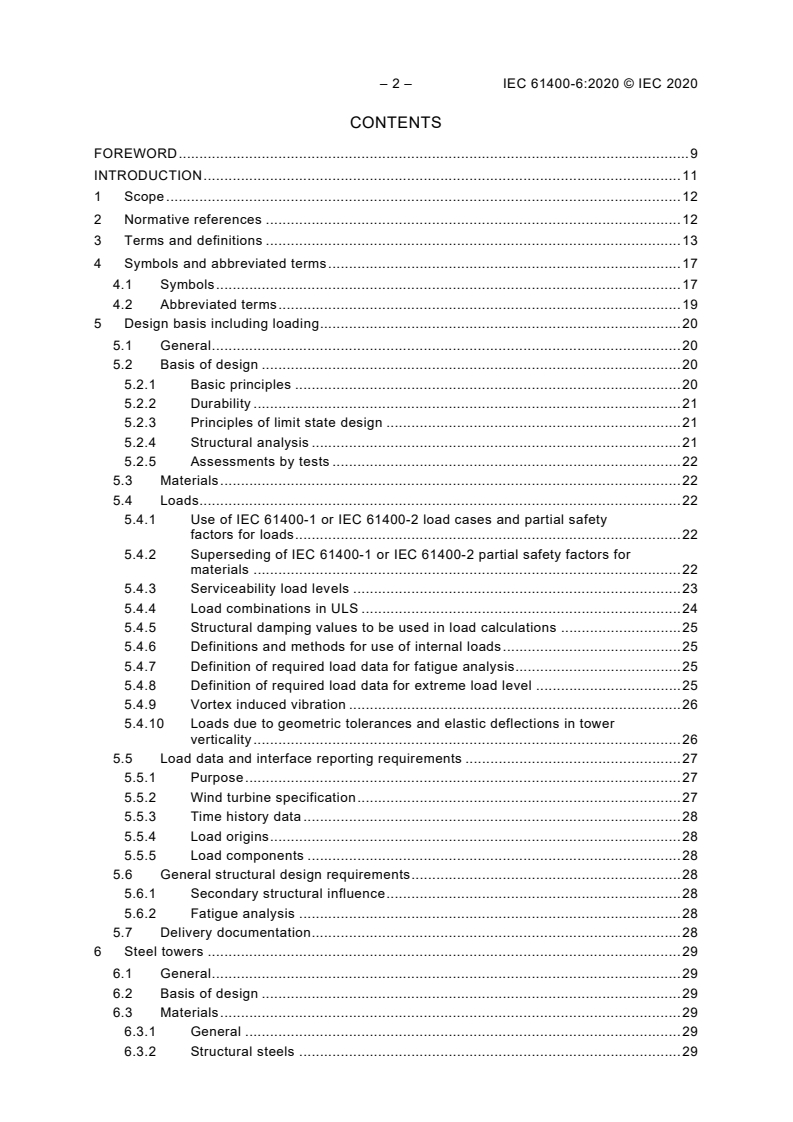
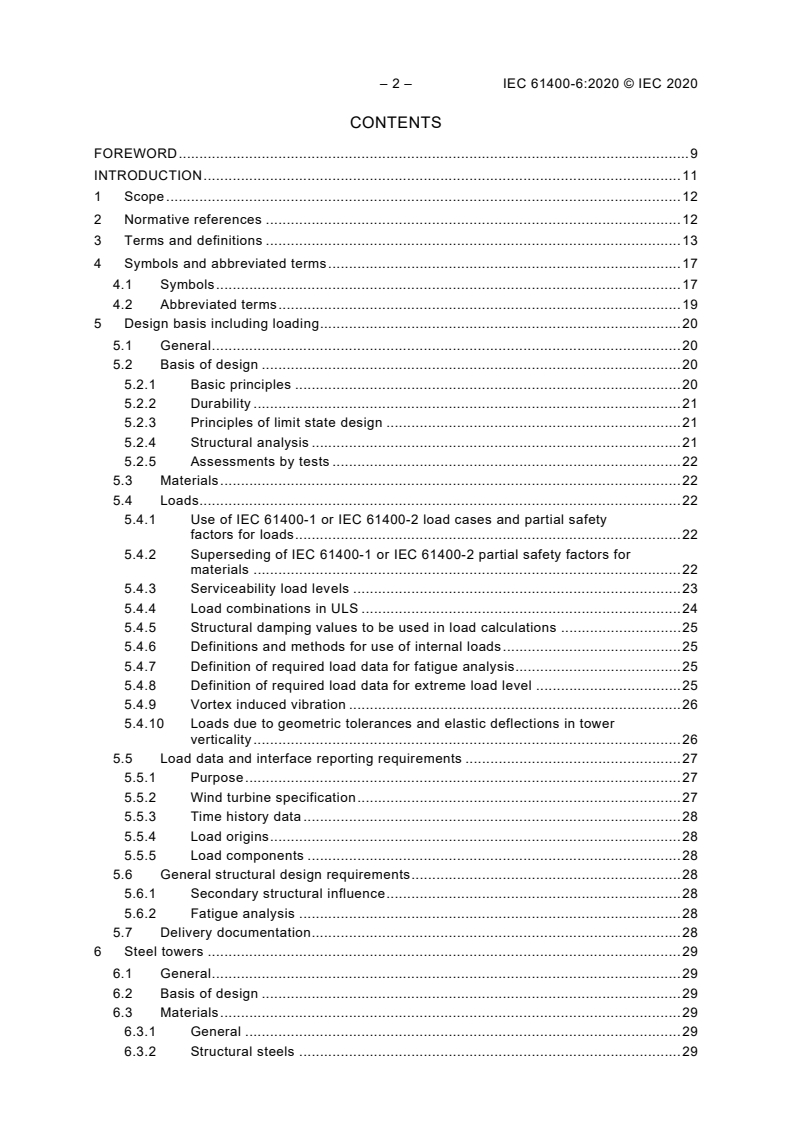
– 2 – IEC 61400-6:2020 © IEC 2020
CONTENTS
FOREWORD . 9
INTRODUCTION . 11
1 Scope . 12
2 Normative references . 12
3 Terms and definitions . 13
4 Symbols and abbreviated terms . 17
4.1 Symbols . 17
4.2 Abbreviated terms . 19
5 Design basis including loading . 20
5.1 General . 20
5.2 Basis of design . 20
5.2.1 Basic principles . 20
5.2.2 Durability . 21
5.2.3 Principles of limit state design . 21
5.2.4 Structural analysis . 21
5.2.5 Assessments by tests . 22
5.3 Materials . 22
5.4 Loads. 22
5.4.1 Use of IEC 61400-1 or IEC 61400-2 load cases and partial safety
factors for loads . 22
5.4.2 Superseding of IEC 61400-1 or IEC 61400-2 partial safety factors for
materials . 22
5.4.3 Serviceability load levels . 23
5.4.4 Load combinations in ULS . 24
5.4.5 Structural damping values to be used in load calculations . 25
5.4.6 Definitions and methods for use of internal loads . 25
5.4.7 Definition of required load data for fatigue analysis . 25
5.4.8 Definition of required load data for extreme load level . 25
5.4.9 Vortex induced vibration . 26
5.4.10 Loads due to geometric tolerances and elastic deflections in tower
verticality . 26
5.5 Load data and interface reporting requirements . 27
5.5.1 Purpose . 27
5.5.2 Wind turbine specification . 27
5.5.3 Time history data . 28
5.5.4 Load origins . 28
5.5.5 Load components . 28
5.6 General structural design requirements . 28
5.6.1 Secondary structural influence . 28
5.6.2 Fatigue analysis . 28
5.7 Delivery documentation . 28
6 Steel towers . 29
6.1 General . 29
6.2 Basis of design . 29
6.3 Materials . 29
6.3.1 General . 29
6.3.2 Structural steels . 29
6.3.3 Bolts and anchors . 32
6.4 Ultimate strength analysis for towers and openings . 32
6.4.1 General . 32
6.4.2 Partial safety factors . 32
6.4.3 Verification of ultimate strength . 32
6.4.4 Tower assessment . 32
6.4.5 Detail assessments. 33
6.5 Stability. 33
6.5.1 General . 33
6.5.2 Partial safety factor. 34
6.5.3 Assessment . 34
6.5.4 Door frames/stiffeners . 34
6.6 Fatigue limit state . 35
6.6.1 General . 35
6.6.2 Partial safety factor for materials . 35
6.6.3 Assessment . 36
6.6.4 Details . 36
6.7 Ring flange connections . 36
6.7.1 General . 36
6.7.2 Design assumptions and requirements, execution of ring flanges . 36
6.7.3 Ultimate limit state analysis of flange and bolted connection . 38
6.7.4 Fatigue limit state analysis of bolted connection . 38
6.8 Bolted connections resisting shear through friction . 40
6.8.1 General requirements . 40
6.8.2 Test-assisted design . 41
6.8.3 Design without test . 42
7 Concrete towers and foundations. 42
7.1 General . 42
7.2 Basis of design . 42
7.2.1 Reference standard for concrete design . 42
7.2.2 Partial safety factors . 43
7.2.3 Basic variables . 43
7.3 Materials . 45
7.4 Durability . 46
7.4.1 Durability requirements . 46
7.4.2 Exposure classes . 46
7.4.3 Concrete cover . 46
7.5 Structural analysis . 46
7.5.1 Finite element analysis . 46
7.5.2 Foundation slabs . 47
7.5.3 Regions with discontinuity in geometry or loads . 47
7.5.4 Cast in anchor bolt arrangements . 48
7.6 Concrete to concrete joints . 48
7.7 Ultimate limit state . 48
7.7.1 General . 48
7.7.2 Shear and punching shear . 48
7.8 Fatigue limit state . 49
7.8.1 General . 49
7.8.2 Reinforcement and prestressing steel fatigue failure . 49
– 4 – IEC 61400-6:2020 © IEC 2020
7.8.3 Concrete fatigue failure . 49
7.9 Serviceability limit state . 50
7.9.1 Load dependent stiffness reduction . 50
7.9.2 Stress limitation . 50
7.9.3 Crack control . 50
7.9.4 Deformations . 51
7.10 Execution . 51
7.10.1 General . 51
7.10.2 Requirements . 51
7.10.3 Inspection of materials and products. 51
7.10.4 Falsework and formwork . 51
7.10.5 Reinforcement and embedded steel . 51
7.10.6 Pre-stressing . 51
7.10.7 Precast concrete elements. 52
7.10.8 Geometrical tolerances . 52
8 Foundations – Geotechnical design . 52
8.1 General . 52
8.2 Basis of design . 52
8.2.1 General . 52
8.2.2 Geotechnical limit states . 53
8.3 Geotechnical data . 53
8.3.1 General . 53
8.3.2 Specific considerations . 55
8.4 Supervision, monitoring and maintenance of construction . 56
8.5 Gravity base foundations . 56
8.5.1 General . 56
8.5.2 Ultimate limit state (ULS) . 57
8.5.3 Serviceability limit state (SLS) . 60
8.6 Piled foundations . 62
8.6.1 General . 62
8.6.2 Pile loads . 62
8.6.3 Ultimate limit state . 63
8.6.4 Serviceability limit state . 64
8.7 Rock anchored foundations . 65
8.7.1 General . 65
8.7.2 Types of rock anchor foundation . 65
8.7.3 Geotechnical data . 65
8.7.4 Corrosion protection . 65
8.7.5 Anchor inspection and maintenance . 66
8.7.6 Post tension tolerances and losses . 66
8.7.7 Ultimate limit state . 66
8.7.8 Serviceability limit state . 67
8.7.9 Robustness check . 67
8.7.10 Rock anchor design . 68
9 Operation, service and maintenance requirements . 70
9.1 Operation, maintenance and monitoring . 70
9.2 Periodic structural inspections . 70
9.3 Embedded steel structural section inspections . 71
9.4 Bolt tension maintenance . 71
9.5 Structural health monitoring . 71
Annex A (informative) List of suitable design codes and guidelines for the calculation
basis . 72
A.1 General . 72
A.2 Reference documents . 72
Annex B (informative) List of material for structural steel . 73
B.1 General . 73
B.2 Structural steel . 73
Annex C (informative) Bolts . 74
C.1 General . 74
C.2 Reference documents . 75
Annex D (informative) Z-values for structural steel . 76
D.1 General . 76
D.2 Definition of Z-value according to Eurocode . 76
D.3 Reference documents . 76
Annex E (informative) Simplified buckling verification for openings in tubular steel
towers . 77
Annex F (informative) Fatigue verification . 80
F.1 General . 80
F.2 Specific details . 80
Annex G (informative) Methods for ring flange verification . 81
G.1 Method for ultimate strength analysis according to Petersen/Seidel . 81
G.1.1 Basics . 81
G.1.2 Calculation method . 81
G.1.3 Extension by Tobinaga and Ishihara . 84
G.2 Method for fatigue strength analysis according to Schmidt/Neuper . 85
G.2.1 Basics . 85
G.2.2 Formulas for the tri-linear approximation . 86
G.3 Reference documents . 87
Annex H (informative) Crack control – Guidance on 7.9.3 . 88
H.1 General . 88
H.2 Crack control based on Eurocode 2 . 88
H.3 Crack control based on Japanese standards . 88
H.4 Crack control based on ACI 318 . 89
H.5 Reference documents . 89
Annex I (informative) Finite element analysis for concrete. 90
I.1 General . 90
I.2 Order and type of elements . 90
I.3 Constitutive modelling . 91
I.4 Solution methods . 91
I.5 Implicit approach . 91
I.6 Steps in conducting of a finite element analysis . 92
I.7 Checking results . 92
I.8 Reference documents . 93
Annex J (informative) Tower-foundation anchorage . 94
J.1 General . 94
J.2 Embedded anchorages . 94
J.3 Bolted anchorages . 95
– 6 – IEC 61400-6:2020 © IEC 2020
J.4 Grout . 95
J.5 Anchor bolts . 95
J.6 Embedded ring . 95
J.7 Anchorage load transfer . 96
Annex K (informative) Strut-and-tie section . 97
K.1 General . 97
K.2 Example of a rock anchor foundation . 98
K.3 Reference documents . 101
Annex L (informative) Guidance on selection of soil modulus and foundation rotational
stiffness . 103
L.1 General . 103
L.2 Soil model . 103
L.3 Dynamic rotational stiffness . 105
L.4 Static rotational stiffness . 106
L.5 Reference documents . 107
Annex M (informative) Guidance for rock anchored foundation design . 108
M.1 General . 108
M.2 Corrosion protection . 108
M.2.1 Standard anchors . 108
M.2.2 Corrosion protection of bar anchors . 109
M.3 Product approval . 110
M.4 Rock anchor design . 110
M.5 Grout design . 110
M.6 Testing and execution . 110
M.7 Suitability/performance test . 111
M.8 Acceptance/proof test . 111
M.9 Supplementary extended creep tests . 111
M.10 Reference documents . 111
Annex N (informative) Internal loads – Explanation of internal loads . 112
Annex O (informative) Seismic load estimation for wind turbine tower and foundation . 114
O.1 General . 114
O.2 Vertical ground motion . 114
O.3 Structure model . 114
O.4 Soil amplification . 115
O.5 Time domain simulation . 116
O.6 Reference documents . 116
Annex P (informative) Structural damping ratio for the tower of wind turbine . 117
P.1 General . 117
P.2 First mode structural damping ratio . 117
P.3 Second mode structural damping ratio . 118
P.4 Higher mode damping . 118
P.5 Reference documents . 119
Annex Q (informative) Guidance on partial safety factors for geotechnical limit states . 120
Q.1 General . 120
Q.2 Equilibrium . 120
Q.3 Bearing capacity . 120
Q.4 Sliding resistance . 121
Q.5 Overall stability . 121
Q.6 Reference documents . 122
Bibliography . 123
Figure 1 – Flange notations as an example of an L-flange . 31
Figure 2 – Door opening geometry . 35
Figure 3 – Flange gaps k in the area of the tower wall . 37
Figure 4 – Bolt force as a function of wall force . 39
Figure 5 – S-N curve for detail category 36 . 40
Figure 6 – Thermal effects around tower cross-section . 44
Figure 7 – Illustration of rock anchor length . 70
Figure E.1 – Circumferentially edge-stiffened opening . 78
Figure E.2 – Definition of W and t according to JSCE . 79
s s
Figure G.1 – Simplification of system to segment model . 81
Figure G.2 – Locations of plastic hinges for different failure modes . 82
Figure G.3 – Geometric parameters . 83
Figure G.4 – Modification factor 𝛌𝛌 for different 𝜶𝜶 [1] . 85
Figure G.5 – Tri-linear approximation of the non-linear relation between bolt force and
tension force of the bolted connection . 86
Figure K.1 – Example for the design of a deep beam using the strut-and-tie method . 97
Figure K.2 – Simple shapes of strut-and-tie models . 97
Figure K.3 – Three examples for carrying load in a deep beam . 98
Figure K.4 – Strut-and-tie models for a rock-anchor foundation . 101
Figure K.5 – Top tie reinforcement in a rock-anchor foundation. 101
Figure L.1 – Example stress-strain relationship for soil . 103
Figure L.2 – Loading and unloading behaviour of soil . 104
Figure L.3 – Variation of shear modulus with soil strain. 105
Figure L.4 – Reduction in rotational stiffness due to load eccentricity. 106
Figure L.5 – Illustrative example of reduction in foundation rotational stiffness due to
increasing load eccentricity . 107
Figure M.1 – Section through rock and anchor . 108
Figure M.2 – Typical anchor configuration with corrosion protection . 109
Figure N.1 – Representation of internal loads . 113
Figure O.1 – Structure model for response spectrum method . 115
Figure P.1 – First mode damping ratio for the steel tower of wind turbine . 118
Table 1 – Flange tolerances . 37
Table 2 – Summary of geotechnical limit states . 53
Table B.1 – National and regional steel standards and types . 73
Table C.1 – Comparison of bolt material in ISO 898-1, JIS B1186 and ASTM A490M-12 . 74
Table E.1 – Coefficients for Formula (E.3) . 78
[1]
Table H.1 – Limit value of crack width based on Japanese standards . 89
Table P.1 – Damping coefficients . 117
Table Q.1 – Minimum partial safety factors for the equilibrium limit state (European
and North American practice) . 120
– 8 – IEC 61400-6:2020 © IEC 2020
Table Q.2 – Minimum partial safety factors on for the equilibrium limit state (JSCE) . 120
Table Q.3 – Minimum partial material and resistance factors for the bearing resistance
limit state, ULS . 121
Table Q.4 – Minimum partial material and resistance factors for the sliding resistance
limit state, ULS . 121
Table Q.5 – Minimum partial material and resistance factors for the overall stability
limit state, ULS . 122
INTERNATIONAL ELECTROTECHNICAL COMMISSION
____________
WIND ENERGY GENERATION SYSTEMS –
Part 6: Tower and foundation design requirements
FOREWORD
1) The International Electrotechnical Commission (IEC) is a worldwide organization for standardization comprising
all national electrotechnical committees (IEC National Committees). The object of IEC is to promote international
co-operation on all questions concerning standardization in the electrical and electronic fields. To this end and
in addition to other activities, IEC publishes International Standards, Technical Specifications, Technical Reports,
Publicly Available Specifications (PAS) and Guides (hereafter referred to as "IEC Publication(s)"). Their
preparation is entrusted to technical committees; any IEC National Committee interested in the subject dealt with
may participate in this preparatory work. International, governmental and non-governmental organizations liaising
with the IEC also participate in this preparation. IEC collaborates closely with the International Organization for
Standardization (ISO) in accordance with conditions determined by agreement between the two organizations.
2) The formal decisions or agreements of IEC on technical matters express, as nearly as possible, an international
consensus of opinion on the relevant subjects since each technical committee has representation from all
interested IEC National Committees.
3) IEC Publications have the form of recommendations for international use and are accepted by IEC National
Committees in that sense. While all reasonable efforts are made to ensure that the technical content of IEC
Publications is accurate, IEC cannot be held responsible for the way in which they are used or for any
misinterpretation by any end user.
4) In order to promote international uniformity, IEC National Committees undertake to apply IEC Publications
transparently to the maximum extent possible in their national and regional publications. Any divergence between
any IEC Publication and the corresponding national or regional publication shall be clearly indicated in the latter.
5) IEC itself does not provide any attestation of conformity. Independent certification bodies provide conformity
assessment services and, in some areas, access to IEC marks of conformity. IEC is not responsible for any
services carried out by independent certification bodies.
6) All users should ensure that they have the latest edition of this publication.
7) No liability shall attach to IEC or its directors, employees, servants or agents including individual experts and
members of its technical committees and IEC National Committees for any personal injury, property damage or
other damage of any nature whatsoever, whether direct or indirect, or for costs (including legal fees) and
expenses arising out of the publication, use of, or reliance upon, this IEC Publication or any other IEC Publications.
8) Attention is drawn to the Normative references cited in this publication. Use of the referenced publications is
indispensable for the correct application of this publication.
9) Attention is drawn to the possibility that some of the elements of this IEC Publication may be the subject of patent
rights. IEC shall not be held responsible for identifying any or all such patent rights.
International Standard IEC 61400-6 has been prepared by IEC technical committee TC 88: Wind
energy generation systems.
The text of this standard is based on the following documents:
FDIS Report on voting
88/751/FDIS 88/754/RVD
Full information on the voting for the approval of this International Standard can be found in the
report on voting indicated in the above table.
This document has been drafted in accordance with the ISO/IEC Directives, Part 2.
Future standards in this series will carry the new general title as cited above. Titles of existing
standards in this series will be updated at the time of the next edition.
– 10 – IEC 61400-6:2020 © IEC 2020
The committee has decided that the contents of this document will remain unchanged until the
stability date indicated on the IEC website under "http://webstore.iec.ch" in the data related to
the specific document. At this date, the document will be
• reconfirmed,
• withdrawn,
• replaced by a revised edition, or
• amended.
IMPORTANT – The 'colour inside' logo on the cover page of this publication indicates
that it contains colours which are considered to be useful for the correct understanding
of its contents. Users should therefore print this document using a colour printer.
INTRODUCTION
This document has been developed for the design of onshore wind turbine towers and
foundations that will build on and complement the IEC 61400-1 relating to design criteria and
provide a complete set of technical requirements for the structural and geotechnical design.
The requirements are also applicable to wind turbines covered by IEC 61400-2. It is envisaged
that the proposed work will be followed by the development of another part, directed towards
the design of offshore support structures, thus also complementing IEC 61400-3-1.
Civil engineering practices associated with the scope of the standard have regional variations.
It is not the intention of this document to conflict with those practices but to supplement them
particularly in ensuring that all important features of typical wind turbine towers and foundations
are fully and correctly considered. To this end, the relevant parts in existing standards for design
of steel and concrete structures and for geotechnical design have been identified for
participating countries and regions.
The principles included in this document apply to the sections of the tower of an offshore fixed
structure above the splash zone if the loading has been calculated according to
IEC 61400-3-1.
This document will include the evaluation and calibration of partial safety factors for material
strengths to be used together with the safety elements in IEC 61400-1 and IEC 61400-2 for
loads and for verification of static equilibrium.
– 12 – IEC 61400-6:2020 © IEC 2020
WIND ENERGY GENERATION SYSTEMS –
Part 6: Tower and foundation design requirements
1 Scope
This part of IEC 61400 specifies requirements and general principles to be used in assessing
the structural integrity of onshore wind turbine supp
...
IEC 61400-6 ®
Edition 1.1 2025-06
CONSOLIDATED VERSION
INTERNATIONAL
STANDARD
Wind energy generation systems –
Part 6: Tower and foundation design requirements
ICS 27.180 ISBN 978-2-8327-0510-0
All rights reserved. Unless otherwise specified, no part of this publication may be reproduced or utilized in any form or
by any means, electronic or mechanical, including photocopying and microfilm, without permission in writing from either
IEC or IEC's member National Committee in the country of the requester. If you have any questions about IEC copyright
or have an enquiry about obtaining additional rights to this publication, please contact the address below or your local
IEC member National Committee for further information.
IEC Secretariat Tel.: +41 22 919 02 11
3, rue de Varembé info@iec.ch
CH-1211 Geneva 20 www.iec.ch
Switzerland
About the IEC
The International Electrotechnical Commission (IEC) is the leading global organization that prepares and publishes
International Standards for all electrical, electronic and related technologies.
About IEC publications
The technical content of IEC publications is kept under constant review by the IEC. Please make sure that you have the
latest edition, a corrigendum or an amendment might have been published.
IEC publications search - IEC Products & Services Portal - products.iec.ch
webstore.iec.ch/advsearchform Discover our powerful search engine and read freely all the
The advanced search enables to find IEC publications by a publications previews, graphical symbols and the glossary.
variety of criteria (reference number, text, technical With a subscription you will always have access to up to date
committee, …). It also gives information on projects, content tailored to your needs.
replaced and withdrawn publications.
Electropedia - www.electropedia.org
The world's leading online dictionary on electrotechnology,
IEC Just Published - webstore.iec.ch/justpublished
Stay up to date on all new IEC publications. Just Published containing more than 22 500 terminological entries in English
details all new publications released. Available online and and French, with equivalent terms in 25 additional languages.
once a month by email. Also known as the International Electrotechnical Vocabulary
(IEV) online.
IEC Customer Service Centre - webstore.iec.ch/csc
If you wish to give us your feedback on this publication or
need further assistance, please contact the Customer
Service Centre: sales@iec.ch.
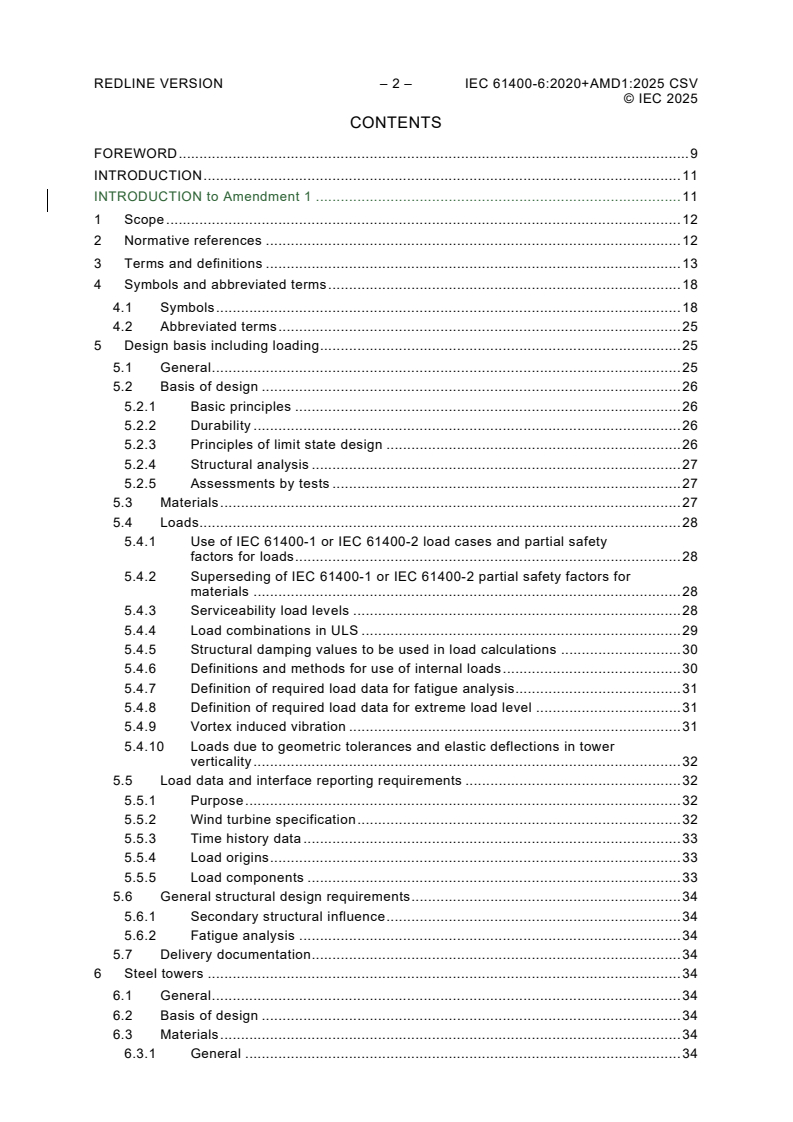
REDLINE VERSION – 2 – IEC 61400-6:2020+AMD1:2025 CSV
© IEC 2025
CONTENTS
FOREWORD . 9
INTRODUCTION . 11
INTRODUCTION to Amendment 1 . 11
1 Scope . 12
2 Normative references . 12
3 Terms and definitions . 13
4 Symbols and abbreviated terms . 18
4.1 Symbols . 18
4.2 Abbreviated terms . 25
5 Design basis including loading . 25
5.1 General . 25
5.2 Basis of design . 26
5.2.1 Basic principles . 26
5.2.2 Durability . 26
5.2.3 Principles of limit state design . 26
5.2.4 Structural analysis . 27
5.2.5 Assessments by tests . 27
5.3 Materials . 27
5.4 Loads. 28
5.4.1 Use of IEC 61400-1 or IEC 61400-2 load cases and partial safety
factors for loads . 28
5.4.2 Superseding of IEC 61400-1 or IEC 61400-2 partial safety factors for
materials . 28
5.4.3 Serviceability load levels . 28
5.4.4 Load combinations in ULS . 29
5.4.5 Structural damping values to be used in load calculations . 30
5.4.6 Definitions and methods for use of internal loads . 30
5.4.7 Definition of required load data for fatigue analysis . 31
5.4.8 Definition of required load data for extreme load level . 31
5.4.9 Vortex induced vibration . 31
5.4.10 Loads due to geometric tolerances and elastic deflections in tower
verticality . 32
5.5 Load data and interface reporting requirements . 32
5.5.1 Purpose . 32
5.5.2 Wind turbine specification . 32
5.5.3 Time history data . 33
5.5.4 Load origins . 33
5.5.5 Load components . 33
5.6 General structural design requirements . 34
5.6.1 Secondary structural influence . 34
5.6.2 Fatigue analysis . 34
5.7 Delivery documentation . 34
6 Steel towers . 34
6.1 General . 34
6.2 Basis of design . 34
6.3 Materials . 34
6.3.1 General . 34
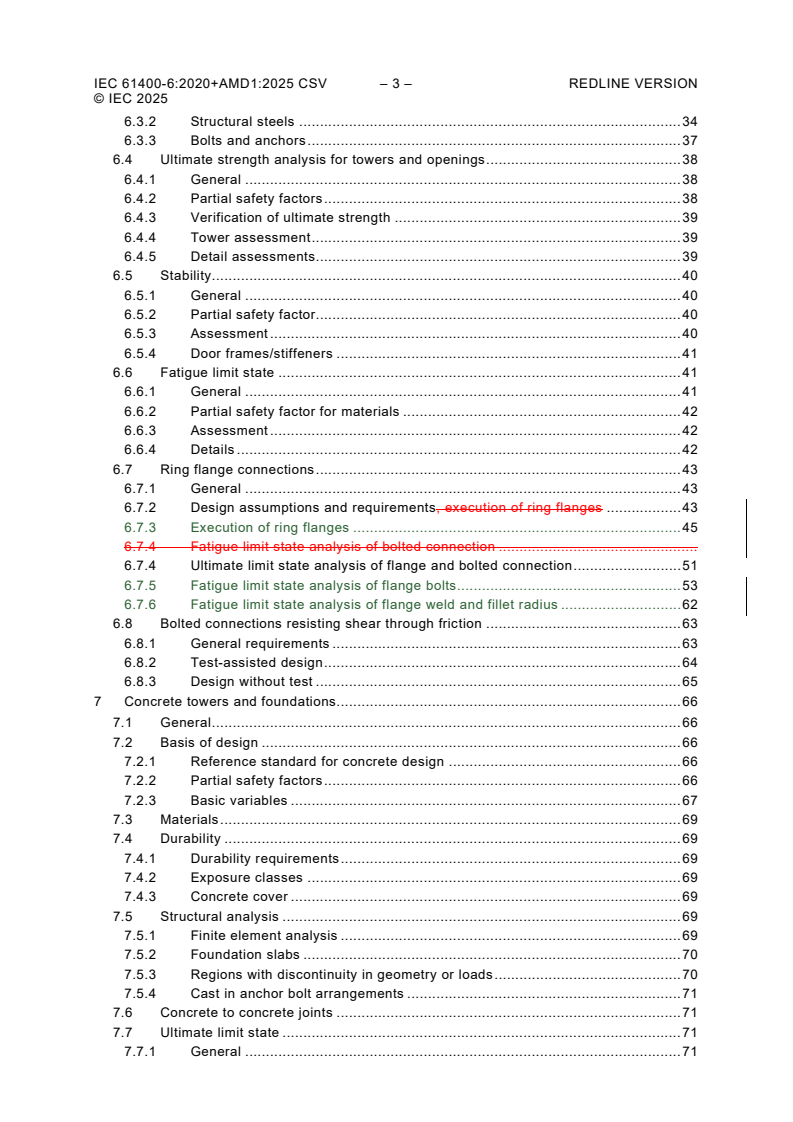
© IEC 2025
6.3.2 Structural steels . 34
6.3.3 Bolts and anchors . 37
6.4 Ultimate strength analysis for towers and openings . 38
6.4.1 General . 38
6.4.2 Partial safety factors . 38
6.4.3 Verification of ultimate strength . 39
6.4.4 Tower assessment . 39
6.4.5 Detail assessments. 39
6.5 Stability. 40
6.5.1 General . 40
6.5.2 Partial safety factor. 40
6.5.3 Assessment . 40
6.5.4 Door frames/stiffeners . 41
6.6 Fatigue limit state . 41
6.6.1 General . 41
6.6.2 Partial safety factor for materials . 42
6.6.3 Assessment . 42
6.6.4 Details . 42
6.7 Ring flange connections . 43
6.7.1 General . 43
6.7.2 Design assumptions and requirements, execution of ring flanges . 43
6.7.3 Execution of ring flanges . 45
6.7.4 Fatigue limit state analysis of bolted connection .
6.7.4 Ultimate limit state analysis of flange and bolted connection . 51
6.7.5 Fatigue limit state analysis of flange bolts . 53
6.7.6 Fatigue limit state analysis of flange weld and fillet radius . 62
6.8 Bolted connections resisting shear through friction . 63
6.8.1 General requirements . 63
6.8.2 Test-assisted design . 64
6.8.3 Design without test . 65
7 Concrete towers and foundations. 66
7.1 General . 66
7.2 Basis of design . 66
7.2.1 Reference standard for concrete design . 66
7.2.2 Partial safety factors . 66
7.2.3 Basic variables . 67
7.3 Materials . 69
7.4 Durability . 69
7.4.1 Durability requirements . 69
7.4.2 Exposure classes . 69
7.4.3 Concrete cover . 69
7.5 Structural analysis . 69
7.5.1 Finite element analysis . 69
7.5.2 Foundation slabs . 70
7.5.3 Regions with discontinuity in geometry or loads . 70
7.5.4 Cast in anchor bolt arrangements . 71
7.6 Concrete to concrete joints . 71
7.7 Ultimate limit state . 71
7.7.1 General . 71
REDLINE VERSION – 4 – IEC 61400-6:2020+AMD1:2025 CSV
© IEC 2025
7.7.2 Shear and punching shear . 72
7.8 Fatigue limit state . 72
7.8.1 General . 72
7.8.2 Reinforcement and prestressing steel fatigue failure . 72
7.8.3 Concrete fatigue failure . 72
7.9 Serviceability limit state . 73
7.9.1 Load dependent stiffness reduction . 73
7.9.2 Stress limitation . 73
7.9.3 Crack control . 73
7.9.4 Deformations . 74
7.10 Execution . 74
7.10.1 General . 74
7.10.2 Requirements . 74
7.10.3 Inspection of materials and products. 74
7.10.4 Falsework and formwork . 74
7.10.5 Reinforcement and embedded steel . 74
7.10.6 Pre-stressing . 74
7.10.7 Precast concrete elements. 75
7.10.8 Geometrical tolerances . 75
8 Foundations – Geotechnical design . 75
8.1 General . 75
8.2 Basis of design . 75
8.2.1 General . 75
8.2.2 Geotechnical limit states . 76
8.3 Geotechnical data . 76
8.3.1 General . 76
8.3.2 Specific considerations . 78
8.4 Supervision, monitoring and maintenance of construction . 79
8.5 Gravity base foundations . 79
8.5.1 General . 79
8.5.2 Ultimate limit state (ULS) . 80
8.5.3 Serviceability limit state (SLS) . 83
8.6 Piled foundations . 85
8.6.1 General . 85
8.6.2 Pile loads . 85
8.6.3 Ultimate limit state . 86
8.6.4 Serviceability limit state . 87
8.7 Rock anchored foundations . 88
8.7.1 General . 88
8.7.2 Types of rock anchor foundation . 88
8.7.3 Geotechnical data . 88
8.7.4 Corrosion protection . 88
8.7.5 Anchor inspection and maintenance . 89
8.7.6 Post tension tolerances and losses . 89
8.7.7 Ultimate limit state . 89
8.7.8 Serviceability limit state . 90
8.7.9 Robustness check . 90
8.7.10 Rock anchor design . 91
9 Operation, service and maintenance requirements . 93
© IEC 2025
9.1 Operation, maintenance and monitoring . 93
9.2 Periodic structural inspections . 93
9.3 Embedded steel structural section inspections . 94
9.4 Bolt tension maintenance . 94
9.5 Structural health monitoring . 94
Annex A (informative) List of suitable design codes and guidelines for the calculation
basis . 95
A.1 General . 95
A.2 Reference documents . 95
Annex B (informative) List of material for structural steel . 96
B.1 General . 96
B.2 Structural steel . 96
Annex C (informative) Bolts . 97
C.1 General . 97
C.2 Reference documents . 98
C.3 Use of HV bolt assemblies . 98
C.4 Water immersion test . 99
Annex D (informative) Z-values for structural steel . 100
D.1 General . 100
D.2 Definition of Z-value according to Eurocode . 100
D.3 Reference documents . 100
Annex E (informative) Simplified buckling verification for openings in tubular steel
towers . 101
Annex F (informative) Fatigue verification . 104
F.1 General . 104
F.2 Specific details . 104
Annex G (informative) Methods for ring flange verification . 105
G.1 Method for ultimate strength analysis according to Petersen/Seidel . 105
G.1.1 Basics . 105
G.1.2 Calculation method . 105
G.1.3 Extension by Tobinaga and Ishihara . 109
G.2 Method for fatigue strength analysis according to Schmidt/Neuper Seidel . 110
G.2.1 Basics .
G.2.2 Formulas for the tri-linear approximation .
G.2.1 Conditions for calculation model . 112
G.2.2 Bolt force curve . 113
G.2.3 Bolt moment curve . 120
G.2.4 Calculation of force required to close inclination . 121
G.3 Reference documents . 122
Annex H (informative) Crack control – Guidance on 7.9.3 . 124
H.1 General . 124
H.2 Crack control based on Eurocode 2 . 124
H.3 Crack control based on Japanese standards . 124
H.4 Crack control based on ACI 318 . 125
H.5 Reference documents . 125
Annex I (informative) Finite element analysis for concrete . 126
I.1 General . 126
I.2 Order and type of elements . 126
REDLINE VERSION – 6 – IEC 61400-6:2020+AMD1:2025 CSV
© IEC 2025
I.3 Constitutive modelling . 127
I.4 Solution methods . 127
I.5 Implicit approach . 127
I.6 Steps in conducting of a finite element analysis . 128
I.7 Checking results . 128
I.8 Reference documents . 129
Annex J (informative) Tower-foundation anchorage . 130
J.1 General . 130
J.2 Embedded anchorages . 130
J.3 Bolted anchorages . 131
J.4 Grout . 131
J.5 Anchor bolts . 131
J.6 Embedded ring . 131
J.7 Anchorage load transfer . 132
Annex K (informative) Strut-and-tie section . 133
K.1 General . 133
K.2 Example of a rock anchor foundation . 134
K.3 Reference documents . 137
Annex L (informative) Guidance on selection of soil modulus and foundation rotational
stiffness . 139
L.1 General . 139
L.2 Soil model . 139
L.3 Dynamic rotational stiffness . 141
L.4 Static rotational stiffness . 142
L.5 Reference documents . 143
Annex M (informative) Guidance for rock anchored foundation design . 144
M.1 General . 144
M.2 Corrosion protection . 144
M.2.1 Standard anchors . 144
M.2.2 Corrosion protection of bar anchors . 145
M.3 Product approval . 146
M.4 Rock anchor design . 146
M.5 Grout design . 146
M.6 Testing and execution . 146
M.7 Suitability/performance test . 147
M.8 Acceptance/proof test . 147
M.9 Supplementary extended creep tests . 147
M.10 Reference documents . 147
Annex N (informative) Internal loads – Explanation of internal loads . 148
Annex O (informative) Seismic load estimation for wind turbine tower and foundation . 150
O.1 General . 150
O.2 Vertical ground motion . 150
O.3 Structure model . 150
O.4 Soil amplification . 151
O.5 Time domain simulation . 152
O.6 Reference documents . 152
Annex P (informative) Structural damping ratio for the tower of wind turbine . 153
P.1 General . 153
© IEC 2025
P.2 First mode structural damping ratio . 153
P.3 Second mode structural damping ratio . 154
P.4 Higher mode damping . 154
P.5 Reference documents . 155
Annex Q (informative) Guidance on partial safety factors for geotechnical limit states . 156
Q.1 General . 156
Q.2 Equilibrium . 156
Q.3 Bearing capacity . 156
Q.4 Sliding resistance . 157
Q.5 Overall stability . 157
Q.6 Reference documents . 158
Bibliography . 159
Figure 1 – Flange notations as an example of an L-flange . 36
Figure 2 – Door opening geometry . 41
Figure 3 – Flange gaps k in the area of the tower wall .
Figure 4 – Bolt force as a function of wall force .
Figure 5 – S-N curve for detail category 36 .
Figure 8 – Bolt force F as a function of external force Z (including dead weight) . 45
S
Figure 9 – Flange gaps with gap height k and gap length l at the tower wall and
k
flange surface inclination α . 45
S
Figure 10 – Illustration of parallel gaps and angular gaps . 46
Figure 11 – Example for flatness measurement evaluation (D = 6 000 mm) . 47
Figure 12 – Clarification of flatness values for the individual flange (u ) and resulting
tol
gap height after mating of two flanges (k) . 48
Figure 13 – Schematic representation of k and k . 51
limit,unloaded limit,loaded
Figure 14 – Schematic representation for the correct shimming of an unacceptable gap . 51
Figure 15 – Total settlement f as function of DFT . 56
Z,tot sbw
Figure 16 – Coating thickness reference points . 57
Figure 17 – Gap shape (L = 2 000 mm / k = 1,0 mm) . 60
gap design
Figure 18 – S-N-curve for bolts (examples M30 and M80 shown) . 62
Figure 19 – Distance requirements for the flange weld in case fillet radius is not
explicitly assessed . 63
Figure 6 – Thermal effects around tower cross-section . 67
Figure 7 – Illustration of rock anchor length . 93
Figure E.1 – Circumferentially edge-stiffened opening . 102
Figure E.2 – Definition of W and t according to JSCE . 103
s s
Figure G.1 – Simplification of system to segment model . 105
Figure G.2 – Locations of plastic hinges for different failure modes . 106
Figure G.3 – Geometric parameters . 107
Figure G.6 – Location of plastic hinges for T-flanges . 109
Figure G.4 – Modification factor 𝛌𝛌 for different 𝜶𝜶 [1] . 110
Figure G.7 – Illustration of bolt force model (L- and T-flanges) . 113
Figure K.1 – Example for the design of a deep beam using the strut-and-tie method . 133
REDLINE VERSION – 8 – IEC 61400-6:2020+AMD1:2025 CSV
© IEC 2025
Figure K.2 – Simple shapes of strut-and-tie models . 133
Figure K.3 – Three examples for carrying load in a deep beam . 134
Figure K.4 – Strut-and-tie models for a rock-anchor foundation . 136
Figure K.5 – Top tie reinforcement in a rock-anchor foundation. 137
Figure L.1 – Example stress-strain relationship for soil . 139
Figure L.2 – Loading and unloading behaviour of soil . 140
Figure L.3 – Variation of shear modulus with soil strain. 141
Figure L.4 – Reduction in rotational stiffness due to load eccentricity. 142
Figure L.5 – Illustrative example of reduction in foundation rotational stiffness due to
increasing load eccentricity . 143
Figure M.1 – Section through rock and anchor . 144
Figure M.2 – Typical anchor configuration with corrosion protection . 145
Figure N.1 – Representation of internal loads . 149
Figure O.1 – Structure model for response spectrum method . 151
Figure P.1 – First mode damping ratio for the steel tower of wind turbine . 154
Table 1 – Flange tolerances .
Table 3 – Flange tolerances . 47
Table 2 – Summary of geotechnical limit states . 76
Table B.1 – National and regional steel standards and types . 96
Table C.1 – Comparison of bolt material in ISO 898-1, JIS B1186 and ASTM A490M-12 . 97
Table C.2 – Mean preload after installation . 98
Table E.1 – Coefficients for Formula (E.3) . 102
Table G.1 – Data points for external forces and bolt forces for determination of
polynomial coefficients . 115
[1]
Table H.1 – Limit value of crack width based on Japanese standards . 125
Table P.1 – Damping coefficients . 153
Table Q.1 – Minimum partial safety factors for the equilibrium limit state (European
and North American practice) . 156
Table Q.2 – Minimum partial safety factors on for the equilibrium limit state (JSCE) . 156
Table Q.3 – Minimum partial material and resistance factors for the bearing resistance
limit state, ULS . 157
Table Q.4 – Minimum partial material and resistance factors for the sliding resistance
limit state, ULS . 157
Table Q.5 – Minimum partial material and resistance factors for the overall stability
limit state, ULS . 158
© IEC 2025
INTERNATIONAL ELECTROTECHNICAL COMMISSION
____________
WIND ENERGY GENERATION SYSTEMS –
Part 6: Tower and foundation design requirements
FOREWORD
1) The International Electrotechnical Commission (IEC) is a worldwide organization for standardization comprising
all national electrotechnical committees (IEC National Committees). The object of IEC is to promote international
co-operation on all questions concerning standardization in the electrical and electronic fields. To this end and
in addition to other activities, IEC publishes International Standards, Technical Specifications, Technical Reports,
Publicly Available Specifications (PAS) and Guides (hereafter referred to as "IEC Publication(s)"). Their
preparation is entrusted to technical committees; any IEC National Committee interested in the subject dealt with
may participate in this preparatory work. International, governmental and non-governmental organizations liaising
with the IEC also participate in this preparation. IEC collaborates closely with the International Organization for
Standardization (ISO) in accordance with conditions determined by agreement between the two organizations.
2) The formal decisions or agreements of IEC on technical matters express, as nearly as possible, an international
consensus of opinion on the relevant subjects since each technical committee has representation from all
interested IEC National Committees.
3) IEC Publications have the form of recommendations for international use and are accepted by IEC National
Committees in that sense. While all reasonable efforts are made to ensure that the technical content of IEC
Publications is accurate, IEC cannot be held responsible for the way in which they are used or for any
misinterpretation by any end user.
4) In order to promote international uniformity, IEC National Committees undertake to apply IEC Publications
transparently to the maximum extent possible in their national and regional publications. Any divergence between
any IEC Publication and the corresponding national or regional publication shall be clearly indicated in the latter.
5) IEC itself does not provide any attestation of conformity. Independent certification bodies provide conformity
assessment services and, in some areas, access to IEC marks of conformity. IEC is not responsible for any
services carried out by independent certification bodies.
6) All users should ensure that they have the latest edition of this publication.
7) No liability shall attach to IEC or its directors, employees, servants or agents including individual experts and
members of its technical committees and IEC National Committees for any personal injury, property damage or
other damage of any nature whatsoever, whether direct or indirect, or for costs (including legal fees) and
expenses arising out of the publication, use of, or reliance upon, this IEC Publication or any other IEC Publications.
8) Attention is drawn to the Normative references cited in this publication. Use of the referenced publications is
indispensable for the correct application of this publication.
9) IEC draws attention to the possibility that the implementation of this document may involve the use of (a) patent(s).
IEC takes no position concerning the evidence, validity or applicability of any claimed patent rights in respect
thereof. As of the date of publication of this document, IEC had not received notice of (a) patent(s), which may
be required to implement this document. However, implementers are cautioned that this may not represent the
latest information, which may be obt
...
IEC 61400-6 ®
Edition 1.0 2020-04
INTERNATIONAL
STANDARD
NORME
INTERNATIONALE
colour
inside
Wind energy generation systems –
Part 6: Tower and foundation design requirements
Systèmes de génération d'énergie éolienne –
Partie 6: Exigences en matière de conception du mât et de la fondation
All rights reserved. Unless otherwise specified, no part of this publication may be reproduced or utilized in any form
or by any means, electronic or mechanical, including photocopying and microfilm, without permission in writing from
either IEC or IEC's member National Committee in the country of the requester. If you have any questions about IEC
copyright or have an enquiry about obtaining additional rights to this publication, please contact the address below or
your local IEC member National Committee for further information.
Droits de reproduction réservés. Sauf indication contraire, aucune partie de cette publication ne peut être reproduite
ni utilisée sous quelque forme que ce soit et par aucun procédé, électronique ou mécanique, y compris la photocopie
et les microfilms, sans l'accord écrit de l'IEC ou du Comité national de l'IEC du pays du demandeur. Si vous avez des
questions sur le copyright de l'IEC ou si vous désirez obtenir des droits supplémentaires sur cette publication, utilisez
les coordonnées ci-après ou contactez le Comité national de l'IEC de votre pays de résidence.
IEC Central Office Tel.: +41 22 919 02 11
3, rue de Varembé info@iec.ch
CH-1211 Geneva 20 www.iec.ch
Switzerland
About the IEC
The International Electrotechnical Commission (IEC) is the leading global organization that prepares and publishes
International Standards for all electrical, electronic and related technologies.
About IEC publications
The technical content of IEC publications is kept under constant review by the IEC. Please make sure that you have the
latest edition, a corrigendum or an amendment might have been published.
IEC publications search - webstore.iec.ch/advsearchform Electropedia - www.electropedia.org
The advanced search enables to find IEC publications by a The world's leading online dictionary on electrotechnology,
variety of criteria (reference number, text, technical containing more than 22 000 terminological entries in English
committee,…). It also gives information on projects, replaced and French, with equivalent terms in 16 additional languages.
and withdrawn publications. Also known as the International Electrotechnical Vocabulary
(IEV) online.
IEC Just Published - webstore.iec.ch/justpublished
Stay up to date on all new IEC publications. Just Published IEC Glossary - std.iec.ch/glossary
details all new publications released. Available online and 67 000 electrotechnical terminology entries in English and
once a month by email. French extracted from the Terms and Definitions clause of
IEC publications issued since 2002. Some entries have been
IEC Customer Service Centre - webstore.iec.ch/csc collected from earlier publications of IEC TC 37, 77, 86 and
If you wish to give us your feedback on this publication or CISPR.
need further assistance, please contact the Customer Service
Centre: sales@iec.ch.
A propos de l'IEC
La Commission Electrotechnique Internationale (IEC) est la première organisation mondiale qui élabore et publie des
Normes internationales pour tout ce qui a trait à l'électricité, à l'électronique et aux technologies apparentées.
A propos des publications IEC
Le contenu technique des publications IEC est constamment revu. Veuillez vous assurer que vous possédez l’édition la
plus récente, un corrigendum ou amendement peut avoir été publié.
Recherche de publications IEC - Electropedia - www.electropedia.org
webstore.iec.ch/advsearchform Le premier dictionnaire d'électrotechnologie en ligne au
La recherche avancée permet de trouver des publications IEC monde, avec plus de 22 000 articles terminologiques en
en utilisant différents critères (numéro de référence, texte, anglais et en français, ainsi que les termes équivalents dans
comité d’études,…). Elle donne aussi des informations sur les 16 langues additionnelles. Egalement appelé Vocabulaire
projets et les publications remplacées ou retirées. Electrotechnique International (IEV) en ligne.
IEC Just Published - webstore.iec.ch/justpublished Glossaire IEC - std.iec.ch/glossary
Restez informé sur les nouvelles publications IEC. Just 67 000 entrées terminologiques électrotechniques, en anglais
Published détaille les nouvelles publications parues. et en français, extraites des articles Termes et Définitions des
Disponible en ligne et une fois par mois par email. publications IEC parues depuis 2002. Plus certaines entrées
antérieures extraites des publications des CE 37, 77, 86 et
Service Clients - webstore.iec.ch/csc CISPR de l'IEC.
Si vous désirez nous donner des commentaires sur cette
publication ou si vous avez des questions contactez-nous:
sales@iec.ch.
IEC 61400-6 ®
Edition 1.0 2020-04
INTERNATIONAL
STANDARD
NORME
INTERNATIONALE
colour
inside
Wind energy generation systems –
Part 6: Tower and foundation design requirements
Systèmes de génération d'énergie éolienne –
Partie 6: Exigences en matière de conception du mât et de la fondation
INTERNATIONAL
ELECTROTECHNICAL
COMMISSION
COMMISSION
ELECTROTECHNIQUE
INTERNATIONALE
ICS 27.180 ISBN 978-2-8322-8803-0
– 2 – IEC 61400-6:2020 © IEC 2020
CONTENTS
FOREWORD . 9
INTRODUCTION . 11
1 Scope . 12
2 Normative references . 12
3 Terms and definitions . 13
4 Symbols and abbreviated terms . 17
4.1 Symbols . 17
4.2 Abbreviated terms . 19
5 Design basis including loading . 20
5.1 General . 20
5.2 Basis of design . 20
5.2.1 Basic principles . 20
5.2.2 Durability . 21
5.2.3 Principles of limit state design . 21
5.2.4 Structural analysis . 21
5.2.5 Assessments by tests . 22
5.3 Materials . 22
5.4 Loads. 22
5.4.1 Use of IEC 61400-1 or IEC 61400-2 load cases and partial safety
factors for loads . 22
5.4.2 Superseding of IEC 61400-1 or IEC 61400-2 partial safety factors for
materials . 22
5.4.3 Serviceability load levels . 23
5.4.4 Load combinations in ULS . 24
5.4.5 Structural damping values to be used in load calculations . 25
5.4.6 Definitions and methods for use of internal loads . 25
5.4.7 Definition of required load data for fatigue analysis . 25
5.4.8 Definition of required load data for extreme load level . 25
5.4.9 Vortex induced vibration . 26
5.4.10 Loads due to geometric tolerances and elastic deflections in tower
verticality . 26
5.5 Load data and interface reporting requirements . 27
5.5.1 Purpose . 27
5.5.2 Wind turbine specification . 27
5.5.3 Time history data . 28
5.5.4 Load origins . 28
5.5.5 Load components . 28
5.6 General structural design requirements . 28
5.6.1 Secondary structural influence . 28
5.6.2 Fatigue analysis . 28
5.7 Delivery documentation . 28
6 Steel towers . 29
6.1 General . 29
6.2 Basis of design . 29
6.3 Materials . 29
6.3.1 General . 29
6.3.2 Structural steels . 29
6.3.3 Bolts and anchors . 32
6.4 Ultimate strength analysis for towers and openings . 32
6.4.1 General . 32
6.4.2 Partial safety factors . 32
6.4.3 Verification of ultimate strength . 32
6.4.4 Tower assessment . 32
6.4.5 Detail assessments. 33
6.5 Stability. 33
6.5.1 General . 33
6.5.2 Partial safety factor. 34
6.5.3 Assessment . 34
6.5.4 Door frames/stiffeners . 34
6.6 Fatigue limit state . 35
6.6.1 General . 35
6.6.2 Partial safety factor for materials . 35
6.6.3 Assessment . 36
6.6.4 Details . 36
6.7 Ring flange connections . 36
6.7.1 General . 36
6.7.2 Design assumptions and requirements, execution of ring flanges . 36
6.7.3 Ultimate limit state analysis of flange and bolted connection . 38
6.7.4 Fatigue limit state analysis of bolted connection . 38
6.8 Bolted connections resisting shear through friction . 40
6.8.1 General requirements . 40
6.8.2 Test-assisted design . 41
6.8.3 Design without test . 42
7 Concrete towers and foundations. 42
7.1 General . 42
7.2 Basis of design . 42
7.2.1 Reference standard for concrete design . 42
7.2.2 Partial safety factors . 43
7.2.3 Basic variables . 43
7.3 Materials . 45
7.4 Durability . 46
7.4.1 Durability requirements . 46
7.4.2 Exposure classes . 46
7.4.3 Concrete cover . 46
7.5 Structural analysis . 46
7.5.1 Finite element analysis . 46
7.5.2 Foundation slabs . 47
7.5.3 Regions with discontinuity in geometry or loads . 47
7.5.4 Cast in anchor bolt arrangements . 48
7.6 Concrete to concrete joints . 48
7.7 Ultimate limit state . 48
7.7.1 General . 48
7.7.2 Shear and punching shear . 48
7.8 Fatigue limit state . 49
7.8.1 General . 49
7.8.2 Reinforcement and prestressing steel fatigue failure . 49
– 4 – IEC 61400-6:2020 © IEC 2020
7.8.3 Concrete fatigue failure . 49
7.9 Serviceability limit state . 50
7.9.1 Load dependent stiffness reduction . 50
7.9.2 Stress limitation . 50
7.9.3 Crack control . 50
7.9.4 Deformations . 51
7.10 Execution . 51
7.10.1 General . 51
7.10.2 Requirements . 51
7.10.3 Inspection of materials and products. 51
7.10.4 Falsework and formwork . 51
7.10.5 Reinforcement and embedded steel . 51
7.10.6 Pre-stressing . 51
7.10.7 Precast concrete elements. 52
7.10.8 Geometrical tolerances . 52
8 Foundations – Geotechnical design . 52
8.1 General . 52
8.2 Basis of design . 52
8.2.1 General . 52
8.2.2 Geotechnical limit states . 53
8.3 Geotechnical data . 53
8.3.1 General . 53
8.3.2 Specific considerations . 55
8.4 Supervision, monitoring and maintenance of construction . 56
8.5 Gravity base foundations . 56
8.5.1 General . 56
8.5.2 Ultimate limit state (ULS) . 57
8.5.3 Serviceability limit state (SLS) . 60
8.6 Piled foundations . 62
8.6.1 General . 62
8.6.2 Pile loads . 62
8.6.3 Ultimate limit state . 63
8.6.4 Serviceability limit state . 64
8.7 Rock anchored foundations . 65
8.7.1 General . 65
8.7.2 Types of rock anchor foundation . 65
8.7.3 Geotechnical data . 65
8.7.4 Corrosion protection . 65
8.7.5 Anchor inspection and maintenance . 66
8.7.6 Post tension tolerances and losses . 66
8.7.7 Ultimate limit state . 66
8.7.8 Serviceability limit state . 67
8.7.9 Robustness check . 67
8.7.10 Rock anchor design . 68
9 Operation, service and maintenance requirements . 70
9.1 Operation, maintenance and monitoring . 70
9.2 Periodic structural inspections . 70
9.3 Embedded steel structural section inspections . 71
9.4 Bolt tension maintenance . 71
9.5 Structural health monitoring . 71
Annex A (informative) List of suitable design codes and guidelines for the calculation
basis . 72
A.1 General . 72
A.2 Reference documents . 72
Annex B (informative) List of material for structural steel . 73
B.1 General . 73
B.2 Structural steel . 73
Annex C (informative) Bolts . 74
C.1 General . 74
C.2 Reference documents . 75
Annex D (informative) Z-values for structural steel . 76
D.1 General . 76
D.2 Definition of Z-value according to Eurocode . 76
D.3 Reference documents . 76
Annex E (informative) Simplified buckling verification for openings in tubular steel
towers . 77
Annex F (informative) Fatigue verification . 80
F.1 General . 80
F.2 Specific details . 80
Annex G (informative) Methods for ring flange verification . 81
G.1 Method for ultimate strength analysis according to Petersen/Seidel . 81
G.1.1 Basics . 81
G.1.2 Calculation method . 81
G.1.3 Extension by Tobinaga and Ishihara . 84
G.2 Method for fatigue strength analysis according to Schmidt/Neuper . 85
G.2.1 Basics . 85
G.2.2 Formulas for the tri-linear approximation . 86
G.3 Reference documents . 87
Annex H (informative) Crack control – Guidance on 7.9.3 . 88
H.1 General . 88
H.2 Crack control based on Eurocode 2 . 88
H.3 Crack control based on Japanese standards . 88
H.4 Crack control based on ACI 318 . 89
H.5 Reference documents . 89
Annex I (informative) Finite element analysis for concrete. 90
I.1 General . 90
I.2 Order and type of elements . 90
I.3 Constitutive modelling . 91
I.4 Solution methods . 91
I.5 Implicit approach . 91
I.6 Steps in conducting of a finite element analysis . 92
I.7 Checking results . 92
I.8 Reference documents . 93
Annex J (informative) Tower-foundation anchorage . 94
J.1 General . 94
J.2 Embedded anchorages . 94
J.3 Bolted anchorages . 95
– 6 – IEC 61400-6:2020 © IEC 2020
J.4 Grout . 95
J.5 Anchor bolts . 95
J.6 Embedded ring . 95
J.7 Anchorage load transfer . 96
Annex K (informative) Strut-and-tie section . 97
K.1 General . 97
K.2 Example of a rock anchor foundation . 98
K.3 Reference documents . 102
Annex L (informative) Guidance on selection of soil modulus and foundation rotational
stiffness . 103
L.1 General . 103
L.2 Soil model . 103
L.3 Dynamic rotational stiffness . 105
L.4 Static rotational stiffness . 106
L.5 Reference documents . 107
Annex M (informative) Guidance for rock anchored foundation design . 108
M.1 General . 108
M.2 Corrosion protection . 108
M.2.1 Standard anchors . 108
M.2.2 Corrosion protection of bar anchors . 109
M.3 Product approval . 110
M.4 Rock anchor design . 110
M.5 Grout design . 110
M.6 Testing and execution . 110
M.7 Suitability/performance test . 111
M.8 Acceptance/proof test . 111
M.9 Supplementary extended creep tests . 111
M.10 Reference documents . 111
Annex N (informative) Internal loads – Explanation of internal loads . 112
Annex O (informative) Seismic load estimation for wind turbine tower and foundation . 114
O.1 General . 114
O.2 Vertical ground motion . 114
O.3 Structure model . 114
O.4 Soil amplification . 115
O.5 Time domain simulation . 116
O.6 Reference documents . 116
Annex P (informative) Structural damping ratio for the tower of wind turbine . 117
P.1 General . 117
P.2 First mode structural damping ratio . 117
P.3 Second mode structural damping ratio . 118
P.4 Higher mode damping . 118
P.5 Reference documents . 119
Annex Q (informative) Guidance on partial safety factors for geotechnical limit states . 120
Q.1 General . 120
Q.2 Equilibrium . 120
Q.3 Bearing capacity . 120
Q.4 Sliding resistance . 121
Q.5 Overall stability . 121
Q.6 Reference documents . 122
Bibliography . 123
Figure 1 – Flange notations as an example of an L-flange . 31
Figure 2 – Door opening geometry . 35
Figure 3 – Flange gaps k in the area of the tower wall . 37
Figure 4 – Bolt force as a function of wall force . 39
Figure 5 – S-N curve for detail category 36 . 40
Figure 6 – Thermal effects around tower cross-section . 44
Figure 7 – Illustration of rock anchor length . 70
Figure E.1 – Circumferentially edge-stiffened opening . 78
Figure E.2 – Definition of W and t according to JSCE . 79
s s
Figure G.1 – Simplification of system to segment model . 81
Figure G.2 – Locations of plastic hinges for different failure modes . 82
Figure G.3 – Geometric parameters . 83
Figure G.4 – Modification factor λ for different α [1] . 85
Figure G.5 – Tri-linear approximation of the non-linear relation between bolt force and
tension force of the bolted connection . 86
Figure K.1 – Example for the design of a deep beam using the strut-and-tie method . 97
Figure K.2 – Simple shapes of strut-and-tie models . 97
Figure K.3 – Three examples for carrying load in a deep beam . 98
Figure K.4 – Strut-and-tie models for a rock-anchor foundation . 101
Figure K.5 – Top tie reinforcement in a rock-anchor foundation. 101
Figure L.1 – Example stress-strain relationship for soil . 103
Figure L.2 – Loading and unloading behaviour of soil . 104
Figure L.3 – Variation of shear modulus with soil strain. 105
Figure L.4 – Reduction in rotational stiffness due to load eccentricity. 106
Figure L.5 – Illustrative example of reduction in foundation rotational stiffness due to
increasing load eccentricity . 107
Figure M.1 – Section through rock and anchor . 108
Figure M.2 – Typical anchor configuration with corrosion protection . 109
Figure N.1 – Representation of internal loads . 113
Figure O.1 – Structure model for response spectrum method . 115
Figure P.1 – First mode damping ratio for the steel tower of wind turbine . 118
Table 1 – Flange tolerances . 37
Table 2 – Summary of geotechnical limit states . 53
Table B.1 – National and regional steel standards and types . 73
Table C.1 – Comparison of bolt material in ISO 898-1, JIS B1186 and ASTM A490M-12 . 74
Table E.1 – Coefficients for Formula (E.3) . 78
[1]
Table H.1 – Limit value of crack width based on Japanese standards . 89
Table P.1 – Damping coefficients . 117
Table Q.1 – Minimum partial safety factors for the equilibrium limit state (European
and North American practice) . 120
– 8 – IEC 61400-6:2020 © IEC 2020
Table Q.2 – Minimum partial safety factors on for the equilibrium limit state (JSCE) . 120
Table Q.3 – Minimum partial material and resistance factors for the bearing resistance
limit state, ULS . 121
Table Q.4 – Minimum partial material and resistance factors for the sliding resistance
limit state, ULS . 121
Table Q.5 – Minimum partial material and resistance factors for the overall stability
limit state, ULS . 122
INTERNATIONAL ELECTROTECHNICAL COMMISSION
____________
WIND ENERGY GENERATION SYSTEMS –
Part 6: Tower and foundation design requirements
FOREWORD
1) The International Electrotechnical Commission (IEC) is a worldwide organization for standardization comprising
all national electrotechnical committees (IEC National Committees). The object of IEC is to promote international
co-operation on all questions concerning standardization in the electrical and electronic fields. To this end and
in addition to other activities, IEC publishes International Standards, Technical Specifications, Technical Reports,
Publicly Available Specifications (PAS) and Guides (hereafter referred to as "IEC Publication(s)"). Their
preparation is entrusted to technical committees; any IEC National Committee interested in the subject dealt with
may participate in this preparatory work. International, governmental and non-governmental organizations liaising
with the IEC also participate in this preparation. IEC collaborates closely with the International Organization for
Standardization (ISO) in accordance with conditions determined by agreement between the two organizations.
2) The formal decisions or agreements of IEC on technical matters express, as nearly as possible, an international
consensus of opinion on the relevant subjects since each technical committee has representation from all
interested IEC National Committees.
3) IEC Publications have the form of recommendations for international use and are accepted by IEC National
Committees in that sense. While all reasonable efforts are made to ensure that the technical content of IEC
Publications is accurate, IEC cannot be held responsible for the way in which they are used or for any
misinterpretation by any end user.
4) In order to promote international uniformity, IEC National Committees undertake to apply IEC Publications
transparently to the maximum extent possible in their national and regional publications. Any divergence between
any IEC Publication and the corresponding national or regional publication shall be clearly indicated in the latter.
5) IEC itself does not provide any attestation of conformity. Independent certification bodies provide conformity
assessment services and, in some areas, access to IEC marks of conformity. IEC is not responsible for any
services carried out by independent certification bodies.
6) All users should ensure that they have the latest edition of this publication.
7) No liability shall attach to IEC or its directors, employees, servants or agents including individual experts and
members of its technical committees and IEC National Committees for any personal injury, property damage or
other damage of any nature whatsoever, whether direct or indirect, or for costs (including legal fees) and
expenses arising out of the publication, use of, or reliance upon, this IEC Publication or any other IEC Publications.
8) Attention is drawn to the Normative references cited in this publication. Use of the referenced publications is
indispensable for the correct application of this publication.
9) Attention is drawn to the possibility that some of the elements of this IEC Publication may be the subject of patent
rights. IEC shall not be held responsible for identifying any or all such patent rights.
International Standard IEC 61400-6 has been prepared by IEC technical committee TC 88: Wind
energy generation systems.
The text of this standard is based on the following documents:
FDIS Report on voting
88/751/FDIS 88/754/RVD
Full information on the voting for the approval of this International Standard can be found in the
report on voting indicated in the above table.
This document has been drafted in accordance with the IS
...