

IEC 61754-4:1997/AMD1:1999
(Amendment)Amendment 1 - Fibre optic connector interfaces - Part 4: Type SC connector family
General Information
- Abstract
- Status
- Published
- Publication Date
- 23-Jun-1999
- Technical Committee
- SC 86B - Fibre optic interconnecting devices and passive components
- Current Stage
- DELPUB - Deleted Publication
- Start Date
- 17-Jul-2013
- Completion Date
- 28-Aug-2026
Overview
IEC 61754-4:1997/AMD1:1999 is an important amendment to the international standard governing fibre optic connector interfaces, specifically targeting the Type SC connector family. Developed by IEC Technical Committee 86, Subcommittee 86B (Fibre optic interconnecting devices and passive components), the amendment introduces additional standardized interfaces and dimensions for SC (Subscriber Connector) connectors. This update is essential for ensuring reliable interconnection, compatibility, and optimal optical performance of fibre optic networks utilizing SC connectors in both single-mode and multi-mode applications.
Key features in this amendment include duplex connector interfaces, angled physical contact (APC) interfaces, and detailed specifications that support the interoperability and mechanical integrity of SC connectors across various vendors and use cases.
Key Topics
SC Duplex Connector Interfaces
The amendment specifies standard interfaces for SC duplex connectors, focusing on push/pull designs that ensure easy handling and robust performance.Angled Physical Contact (APC) Connectors
New interfaces for simplex and duplex SC connectors with angled polished endfaces are defined. These are categorized by typical angle values (8, 9, and 12 degrees), which help reduce back reflection and optimize performance for fibres with specific dispersion characteristics.Intermateability and Performance
The document details which connector interfaces and their corresponding adaptors are intermateable and stresses that achieving designated optical performance requires matching ferrule endface polishing conditions.Dimensional and Tolerance Specifications
Tables in the amendment define all critical dimensions and tolerances for the various interface types. This covers ferrule diameters, housing configurations, chamfers, and alignment features, ensuring physical and optical compatibility.
Applications
The SC connector family is widely used in both enterprise and telecommunications environments due to its reliability, simplicity, and strong standardization. This amendment delivers practical value in several areas:
Network Infrastructure
Standardized SC connectors support the rapid and error-free deployment of fibre optic cabling in backbone, access, and data center networks.Compatibility Across Manufacturers
With interfaces, dimensions, and performance criteria set internationally, system integrators and end-users can confidently interconnect SC connectors from different suppliers without compatibility concerns.Reduced Optical Loss and Back Reflection
By specifying APC connectors with precise polishing angles, the amendment helps minimize unwanted signal reflections-critical for high-speed, high-performance optical networks.Flexible Deployment for Single-mode and Multi-mode Fibres
The amendment’s clear delineation of interfaces for both simplex and duplex, as well as different polishing types, means that organizations can deploy the optimal SC connector type based on fibre and network requirements.
Related Standards
To ensure full compliance and interoperability in fibre optic network design and implementation, consider referencing the following related standards:
- IEC 61754-4: Base standard for SC connector family interfaces
- IEC 61753: Performance standards for fibre optic connectors
- IEC 61755: Endface geometry and fibre core criteria
- IEC 61300 series: Test and measurement procedures for fibre optic interconnecting devices
By adhering to IEC 61754-4:1997/AMD1:1999 and its related standards, organizations ensure global compatibility, network performance, and streamlined maintenance in their fibre optic systems.
Relations
- Effective Date
- 05-Sep-2023
- Effective Date
- 05-Sep-2023
- Effective Date
- 05-Sep-2023
Get Certified
Connect with accredited certification bodies for this standard

ANCE
Mexican certification and testing association.

Intertek Slovenia
Intertek testing, inspection, and certification services in Slovenia.

LNE (Laboratoire National de Métrologie et d'Essais)
French national laboratory for metrology and testing.
Sponsored listings
Frequently Asked Questions
IEC 61754-4:1997/AMD1:1999 is a standard published by the International Electrotechnical Commission (IEC). Its full title is "Amendment 1 - Fibre optic connector interfaces - Part 4: Type SC connector family". This standard covers: Amendment 1 - Fibre optic connector interfaces - Part 4: Type SC connector family
Amendment 1 - Fibre optic connector interfaces - Part 4: Type SC connector family
IEC 61754-4:1997/AMD1:1999 is classified under the following ICS (International Classification for Standards) categories: 33.180.20 - Fibre optic interconnecting devices. The ICS classification helps identify the subject area and facilitates finding related standards.
IEC 61754-4:1997/AMD1:1999 has the following relationships with other standards: It is inter standard links to IEC 60874-19:1995, IEC 61754-4:1997, IEC 61754-4:2013. Understanding these relationships helps ensure you are using the most current and applicable version of the standard.
IEC 61754-4:1997/AMD1:1999 is available in PDF format for immediate download after purchase. The document can be added to your cart and obtained through the secure checkout process. Digital delivery ensures instant access to the complete standard document.
Standards Content (Sample)
NORME CEI
INTERNATIONALE IEC
61754-4
INTERNATIONAL
STANDARD
AMENDEMENT 1
AMENDMENT 1
1999-06
Amendement 1
Interfaces de connecteurs pour
fibres optiques –
Partie 4:
Famille de connecteurs du type SC
Amendment 1
Fibre optic connector interfaces –
Part 4:
Type SC connector family
IEC 1999 Droits de reproduction réservés Copyright - all rights reserved
International Electrotechnical Commission 3, rue de Varembé Geneva, Switzerland
Telefax: +41 22 919 0300 e-mail: inmail@iec.ch IEC web site http://www.iec.ch
CODE PRIX
Commission Electrotechnique Internationale
Q
PRICE CODE
International Electrotechnical Commission
Pour prix, voir catalogue en vigueur
For price, see current catalogue
– 2 – 61754-4 amend. 1 © CEI:1999
AVANT-PROPOS
Le présent amendement a été établi par le sous-comité 86B: Dispositifs d'interconnexion et
composants passifs à fibres optiques, du comité d'études 86 de la CEI: Fibres optiques.
Le texte de cet amendement est issu des documents suivants:
FDIS Rapport de vote
86B/1200/FDIS 86B/1235/RVD
Le rapport de vote indiqué dans le tableau ci-dessus donne toute information sur le vote ayant
abouti à l'approbation de cet amendement.
–––––––––––
Page 19
Ajouter les nouveaux articles 4, 5 et 6 suivants:
4 Interfaces des connecteurs duplex SC
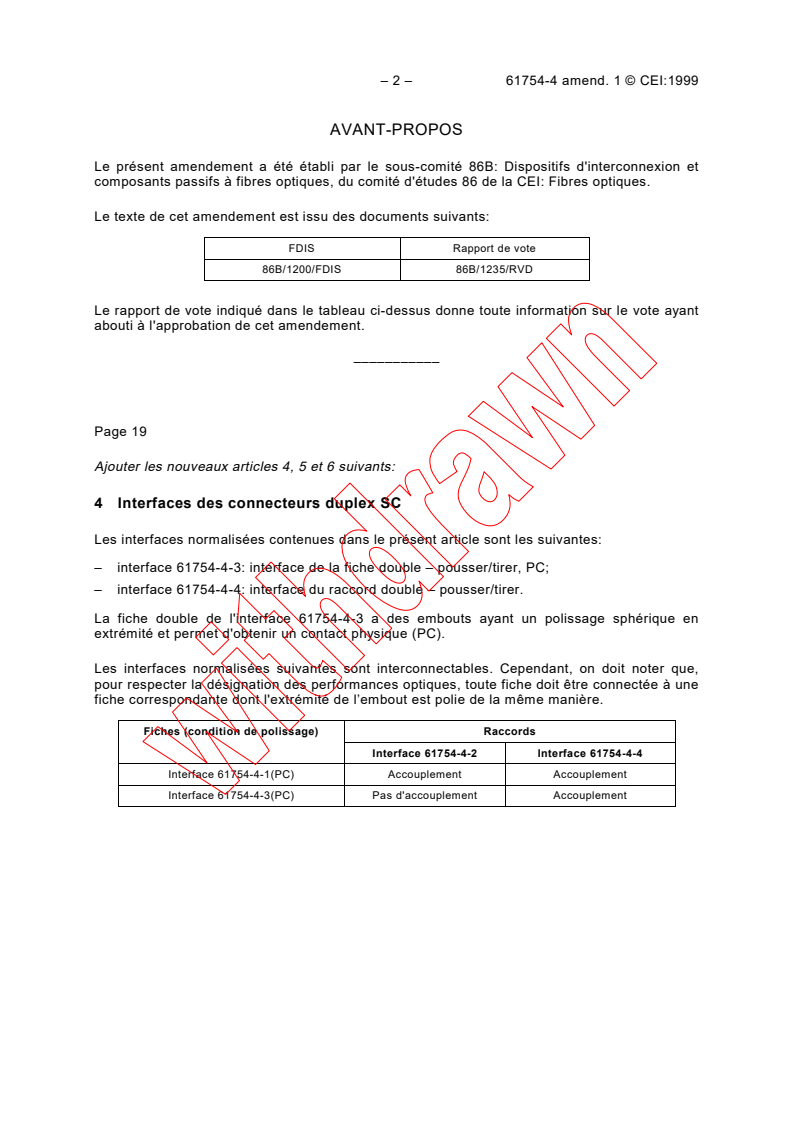
Les interfaces normalisées contenues dans le présent article sont les suivantes:
– interface 61754-4-3: interface de la fiche double – pousser/tirer, PC;
– interface 61754-4-4: interface du raccord double – pousser/tirer.
La fiche double de l'interface 61754-4-3 a des embouts ayant un polissage sphérique en
extrémité et permet d'obtenir un contact physique (PC).
Les interfaces normalisées suivantes sont interconnectables. Cependant, on doit noter que,
pour respecter la désignation des performances optiques, toute fiche doit être connectée à une
fiche correspondante dont l'extrémité de l’embout est polie de la même manière.
Fiches (condition de polissage) Raccords
Interface 61754-4-2 Interface 61754-4-4
Interface 61754-4-1(PC) Accouplement Accouplement
Interface 61754-4-3(PC) Pas d'accouplement Accouplement
61754-4 Amend. 1 © IEC:1999 – 3 –
FOREWORD
This amendment has been prepared by subcommittee 86B: Fibre optic interconnecting devices
and passive components, of IEC technical committee 86: Fibre optics.
The text of this amendment is based on the following documents:
FDIS Report on voting
86B/1200/FDIS 86B/1235/RVD
Full information on the voting for the approval of this amendment can be found in the report on
voting indicated in the above table.
–––––––––––
Page 19
Add the following new clauses 4, 5 and 6:
4 SC duplex connector interfaces
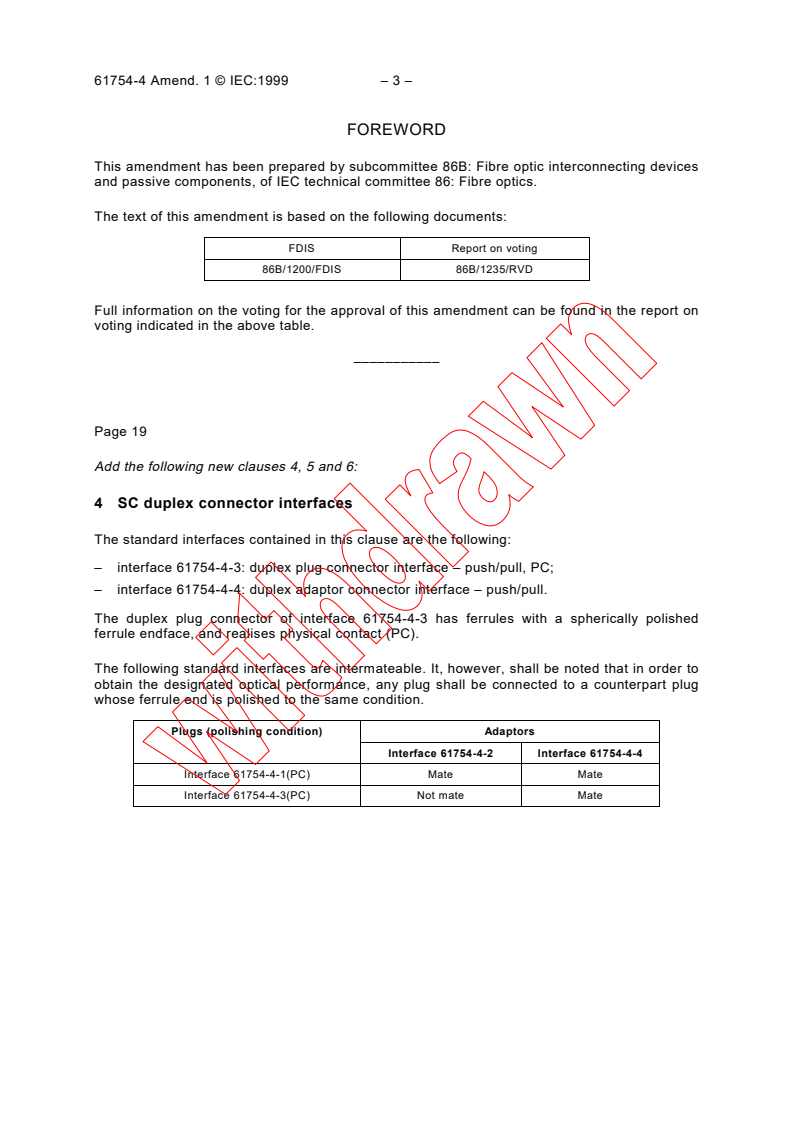
The standard interfaces contained in this clause are the following:
– interface 61754-4-3: duplex plug connector interface – push/pull, PC;
– interface 61754-4-4: duplex adaptor connector interface – push/pull.
The duplex plug connector of interface 61754-4-3 has ferrules with a spherically polished
ferrule endface, and realises physical contact (PC).
The following standard interfaces are intermateable. It, however, shall be noted that in order to
obtain the designated optical performance, any plug shall be connected to a counterpart plug
whose ferrule end is polished to the same condition.
Plugs (polishing condition) Adaptors
Interface 61754-4-2 Interface 61754-4-4
Interface 61754-4-1(PC) Mate Mate
Interface 61754-4-3(PC) Not mate Mate
– 4 – 61754-4 amend. 1 © CEI:1999
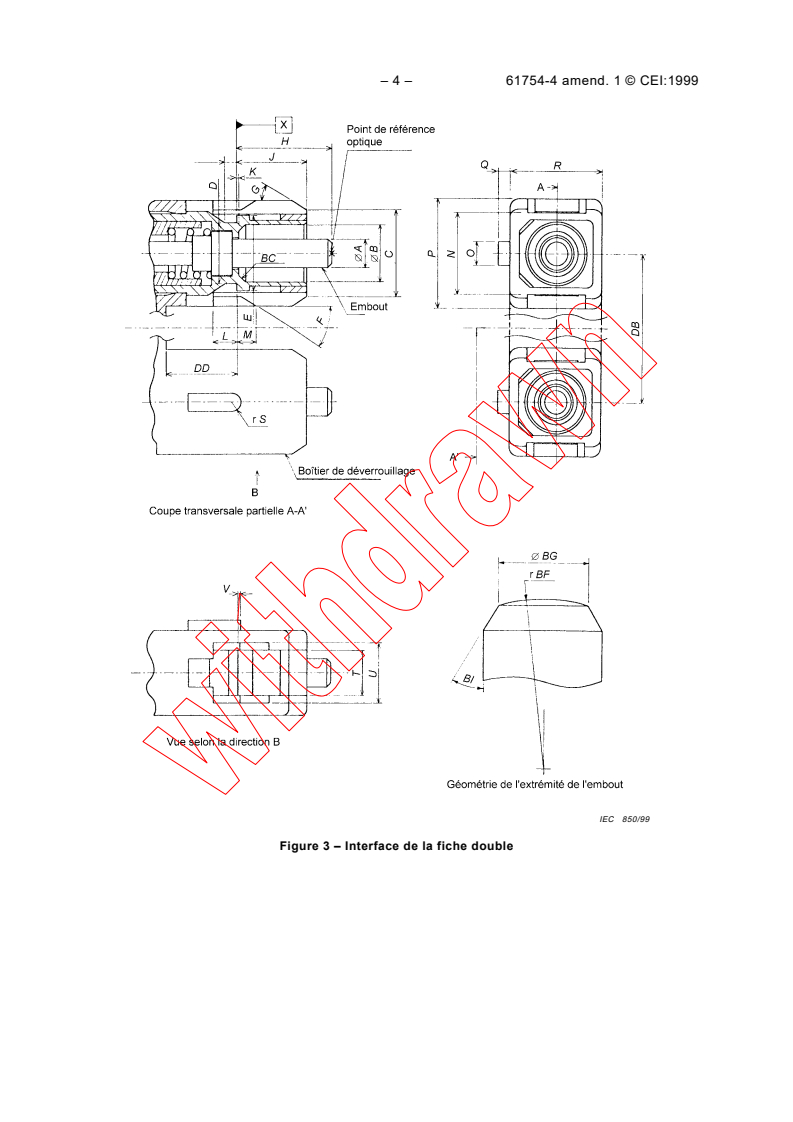
IEC 850/99
Figure 3 – Interface de la fiche double
61754-4 Amend. 1 © IEC:1999 – 5 –
IEC 850/99
Figure 3 – Duplex plug connector interface
– 6 – 61754-4 amend. 1 © CEI:1999
Tableau 3a – Dimensions de l'interface de la fiche double
Dimensions
Référence mm Notes
Minimum Maximum
A 1, voir tableau 3b
B 4,80 4,90
C 6,80 7,40
D 4,90 5,30
E 6,70 6,80
F 19° 23°
G 25° 35°
H 7,15 7,50 2
I 0,80 1,20
J 5,30 5,50
K – 0,05 3
L 2,11 2,50 4
M 2,0 2,80 4 et 5
N 6,60 6,80
O 1,60 1,80
P 8,79 8,89 6
Q 0,80 1,00
R 7,29 7,39
S 0,80 0,90 Rayon
T 4,05 4,15
U 5,40 5,60
V 0 0,5 4
BC 0 0,5 chanfrein à 45 degrés
BF 10 25 Rayon, 7
BG – – Diamètre, voir tableau 3b
BI 25° 35°
DB – – 8, 9
DD 7,00 –
NOTE 1 – Un chanfrein ou un rayon est autorisé à une distance maximale de 1,2 mm de l'extrémité de
l’embout.
NOTE 2 – La dimension H correspond à une extrémité de fiche non accouplée. Cette extrémité peut se
déplacer sous l'effet d'une compression axiale lors du contact direct entre faces, ainsi la dimension H est
variable. La force de compression de l’embout doit être comprise entre 7,8 N et 11,8 N lorsque la dimension
H est de 7 mm ± 0,1 mm.
NOTE 3 – Une valeur négative de cette dimension signifie que le lamage intérieur est à gauche du plan de
référence.
NOTE 4 – Le boîtier de déverrouillage doit pouvoir être déplacé à droite et à gauche. Ces dimensions sont
données pour le boîtier de déverrouillage en position extrême à droite.
NOTE 5 – Il convient que la dimension M soit inférieure à 0 mm pour le boîtier de déverrouillage en position
extrême à gauche.
NOTE 6 – Il est permis que le boîtier de déverrouillage soit un manchon rigide. Lorsque deux fiches
monovoies sont retenues ensemble par un manchon souple, la dimension P doit être comprise entre
8,89 mm et 8,99 mm.
NOTE 7 – La dimension BF doit être mesurée sur un diamètre de 0,25 mm atour de l’axe de l’embout. Il
convient que l'excentricité du dôme de la face terminale ayant un polissage sphérique soit inférieure à 50 μm.
NOTE 8 – Il est permis que le boîtier de déverrouillage soit un manchon rigide. Lorsque deux fiches
monovoies sont retenues ensemble par un manchon ou une bride de fixation avec un espace intermédiaire,
la dimension DB doit être de 12,7 mm en dimension de base.
NOTE 9 – Il est recommandé que les embouts aient un axe commun avec les bagues d'alignement
d'adaptateur double.
61754-4 Amend. 1 © IEC:1999 – 7 –
Table 3a – Dimensions of the duplex plug connector interface
Dimensions
Reference mm Notes
Minimum Maximum
A 1, see table 3b
B 4,80 4,90
C 6,80 7,40
D 4,90 5,30
E 6,70 6,80
F 19° 23°
G 25° 35°
H 7,15 7,50 2
I 0,80 1,20
J 5,30 5,50
K 0,05 3
L 2,11 2,50 4
M 2,0 2,80 4 and 5
N 6,60 6,80
O 1,60 1,80
P 8,79 8,89 6
Q 0,80 1,00
R 7,29 7,39
S 0,80 0,90 Radius
T 4,05 4,15
U 5,40 5,60
V 0 0,5 4
BC 0 0,5 45 degree chamfer
BF 10 25 Radius, 7
BG – – Diameter, see table 3b
BI 25° 35°
DB – – 8, 9
DD 7,00 –
NOTE 1 – A chamfer or radius is allowed to a maximum depth of 1,2 mm from the ferrule endface.
NOTE 2 – Dimension H is given for plug endface when not mated. It is movable by a certain axial
compression force, with direct contacting endfaces, and therefore dimension H is variable. Ferrule
compression force shall be 7,8 N to 11,8 N when the dimension H is 7 mm ± 0,1 mm.
NOTE 3 – The negative dimension indicates that the position of the inside bottom plane is left-direction
relative to the reference plane.
NOTE 4 – The delatch housing shall be movable towards right and left direction. These dimensions are
given when the delatch housing is moved in its extreme right-direction position.
NOTE 5 – Dimension M should be below 0 mm, when the delatch housing is moved to its most left-
direction position.
NOTE 6 – The delatch housing may be a rigid sleeve. When two simplex plugs are retained together by a
flexible sleeve, the dimension P shall be from 8,89 mm to 8,99 mm.
NOTE 7 – Dimension BF shall be measured over a diameter of 0,25 mm around the ferrule axis. The
dome eccentricity of the spherical polished endface should be less than 50 μm.
NOTE 8 – The delatch housing may be a rigid sleeve. When two simplex plugs are retained together by a
sleeve or a clamp with a clearance, the dimension DB shall be 12,7 mm as a basic dimension.
NOTE 9 – The ferrules should be capable of taking up a common axis with the duplex adapter alignment
sleeves.
– 8 – 61754-4 amend. 1 © CEI:1999
Tableau 3b – Variantes
Dimensions
mm
Variante A BG Notes
Minimum Maximum Minimum Maximum
1 2,4985 2,4995 1,75 2,20 Voir note
2 2,4980 2,4995 1,75 2,20 Voir note
3 2,4985 2,4995 1,90 2,20 Voir note
4 2,4980 2,4995 1,90 2,20 Voir note
5 2,497 2,4995 1,75 2,20 Voir note
6 2,497 2,4995 1,90 2,20 Voir note
NOTE – Ajouter le numéro de la variante au numéro de référence de l'interface.
61754-4 Amend. 1 © IEC:1999 – 9 –
Table 3b – Grade
Dimensions
mm
Grade A BG Notes
Minimum Maximum Minimum Maximum
1 2,4985 2,4995 1,75 2,20 See note
2 2,4980 2,4995 1,75 2,20 See note
3 2,4985 2,4995 1,90 2,20 See note
4 2,4980 2,4995 1,90 2,20 See note
5 2,497 2,4995 1,75 2,20 See note
6 2,497 2,4995 1,90 2,20 See note
NOTE – Add the grade number to the interface reference number.
– 10 – 61754-4 amend. 1 © CEI:1999
IEC 851/99
Figure 4a – Interface du raccord double
61754-4 Amend. 1 © IEC:1999 – 11 –
IEC 851/99
Figure 4a – Duplex adaptor connector interface
– 12 – 61754-4 amend. 1 © CEI:1999
Tableau 4a – Dimensions de l'interface du raccord double
Dimensions
Référence mm Notes
Minimum Maximum
A Voir tableau 4b
B 4,39 4,69
D 4,9 5,5
H 6,9 7,1
I 0,4 0,8
J 5,51 5,90
K 0,06 1,00
L 1,9 2,1
O 2,0 2,2
P 9,00 9,10
R 7,40 7,50
S 1,0 1,1 Rayon
T 3,80 4,04
U 5,0 5,3
V 0,6 1,6
AA
27° 33°
AB 0,8 1,0
AC 0,4 0,6 Rayon
AD 0,7 0,8
AE 0,4 0,6
AI 2,7 2,8
BA 5,4 5,6 Voir note
BB 10,8 11,2 Voir note
DB 12,65 12,75
DD – 6,99
NOTE – Peut avoir l'allure indiquée en pointillés en figure 4a.
61754-4 Amend. 1 © IEC:1999 – 13 –
Table 4a – Dimensions of the duplex adaptor connector interface
Dimensions
Reference mm Notes
Minimum Maximum
A See table 4b
B 4,39 4,69
D 4,9 5,5
H 6,9 7,1
I 0,4 0,8
J 5,51 5,90
K 0,06 1,00
L 1,9 2,1
O 2,0 2,2
P 9,00 9,10
R 7,40 7,50
S 1,0 1,1 Radius
T 3,80 4,04
U 5,0 5,3
V 0,6 1,6
AA 27° 33°
AB 0,8 1,0
AC 0,4 0,6 Radius
AD 0,7 0,8
AE 0,4 0,6
AI 2,7 2,8
BA 5,4 5,6 See note
BB 10,8 11,2 See note
DB 12,65 12,75
DD – 6,99
NOTE – It may be of a structure as shown by a dash line in figure 4a.
– 14 – 61754-4 amend. 1 © CEI:1999
Tableau 4b – Variantes
Dimensions
Variante mm Notes
Minimum Maximum
1 Bague élastique, 1 et 2
NOTE 1 – L'élément d'alignement du connecteur est une bague élastique.
Cet élément doit pouvoir recevoir une pointe de calibrage jusqu'au
centre du raccord avec une force comprise entre 2 N et 5,9 N, cette
insertion étant réalisée alors qu'une autre pointe de calibrage est déjà
insérée de l'autre côté. Le centre du raccord est défini par la position droite
de la dimension H.
NOTE 2 – Ajouter le numéro de la variante au numéro de référence de
l'interface.
C ou R
∅ CK ∅ CL
IEC 852/99
Figure 4b – Pointe de calibrage pour le raccord
Tableau 4c – Dimensions de la pointe de calibrage
Dimensions
Référence mm Notes
Minimum Maximum
CK 2,4985 2,4995 Rugosité de la surface
Variante N4 (0,2 μm rayon)
CL 2,8 4,8
CN 7 15
61754-4 Amend. 1 © IEC:1999 – 15 –
Table 4b – Grade
Dimensions
Grade mm Notes
Minimum Maximum
1 Resilient sleeve, 1 and 2
NOTE 1 – The connector alignment feature is a resilient sleeve. The feature
shall accept a gauge pin to the centre of the adaptor with a force of 2 N to
5,9 N under the condition that another gauge pin is inserted into the feature
from the other side. The centre of the adaptor is defined by the right side
position of the dimension H.
NOTE 2 – Add grade number to the interface reference number.
C or R
∅ CK ∅ CL
IEC 852/99
Figure 4b – Pin gauge for adaptor
Table 4c – Pin gauge dimensions
Dimensions
mm
Reference Notes
Minimum Maximum
CK 2,4985 2,4995 Surface roughness
Grade N4 (0,2 μm radius)
CL 2,8 4,8
CN 7 15
– 16 – 61754-4 amend. 1 © CEI:1999
5 Interfaces des connecteurs SC angulaires du type PC
Cet article définit les interfaces normalisées des fiches monovoies dotées d'embouts ayant un
polissage d'extrémité angulaire sphérique (plutôt que perpendiculaire) orienté vers la clef du
connecteur et qui sont nommées PC angulaire ou APC. Les interfaces normalisées contenues
dans le présent article sont les suivantes:
– interface 61754-4-5: interface de la fiche monovoie – pousser/tirer, APC.8 degrés;
– interface 61754-4-6: interface de la fiche monovoie – pousser/tirer, APC.9 degrés;
– interface 61754-4-7: interface de la fiche monovoie – pousser/tirer, APC.12 degrés.
Les fiches monovoies des interfaces 61754-4-5, 61754-4-6 et 61754-4-7 ont des embouts avec
une extrémité de l’embout à polissage sphérique à angle de leur extrémité polie; PC ou APC
angulaires.
Les fiches pour APC sont caractérisées par l'angle de leur extrémité polie. L'angle nominal de
l'extrémité polie est de 8, 9 et 12 degrés. Les fiches ayant un angle de polissage de 8 et
9 degrés sont généralement utilisées pour les fibres à dispersion nulle de 1,3 μm et les fiches
ayant un angle de polissage de 12 degrés sont utilisées pour les fibres de 1,55 μm subissant
une dispersion.
Les interfaces normalisées suivantes sont interconnectables. Cependant, on doit noter que,
pour respecter la désignation des performances optiques, toute fiche doit être connectée à une
fiche correspondante dont l'extrémité de l’embout est polie de la même manière.
Fiche (condition de polissage) Raccord
Interface 61754-4-2 Interface 61754-4-4
Interface 61754-4-5 (APC. 8 degrés) Accouplement Accouplement
Interface 61754-4-6 (APC. 9 degrés) Accouplement Accouplement
Interface 61754-4-7 (APC. 12 degrés) Accouplement Accouplement
61754-4 Amend. 1 © IEC:1999 – 17 –
5 SC angled PC connector interfaces
This clause defines the standard interfaces for simplex plugs which have ferrules with endfaces
polished spherically at an angle (rather than perpendicularly) which are oriented to the
connector key, and are termed angled PC or APC. The standard interfaces contained in this
clause are the following:
– interface 61754-4-5: simplex plug connector interface – push/pull, APC.8 degrees;
– interface 61754-4-6: simplex plug connector interface – push/pull, APC.9 degrees;
– interface 61754-4-7: simplex plug connector interface – push/pull, APC.12 degrees.
The simplex plugs of interfaces 61754-4-5, 61754-4-6 and 61754-4-7 have ferrules with an
endface polished spherically at angle of their polished endface, and the nomenclature is angled
PC or APC.
The plugs for APC are categorized by the angle of their polished endface. The nominal angles
of the polished endface are 8, 9 and 12 degrees. Plugs having polished angles of 8 and 9
degrees are generally used for 1,3 μm zero dispersion fibre; and plugs having polished angles
of 12 degrees are used for 1,55 μm dispersion shifted fibre.
The following standard interfaces ar
...