


IEC 62841-3-3:2024
(Main)Electric motor-operated hand-held tools, transportable tools and lawn and garden machinery - Safety - Part 3-3: Particular requirements for transportable planers and thicknessers
General Information
- Abstract
IEC 62841-3-3:2024 is to be used in conjunction with IEC 62841-1:2014. This document supplements or modifies the corresponding clauses in IEC 62841-1, so as to convert it into the IEC Standard: Particular requirements for transportable planers and thicknessers.
IEC 62841-1:2014, Clause 1 is applicable, except as follows:
This document applies to transportable planers, thicknessers and combined planers and thicknessers intended for cutting wood and analogous materials with a maximum planing width of 330 mm.
This document does not apply to planers, thicknessers or combined planers and thicknessers other than transportable.
NOTE 101 ISO 19085-7:2019 gives requirements for planers, thicknessers or combined planers and thicknessers other than transportable.
- Status
- Published
- Publication Date
- 20-Jun-2024
- Technical Committee
- TC 116 - Safety of motor-operated electric tools
- Drafting Committee
- WG 9 - TC 116/WG 9
- Current Stage
- PPUB - Publication issued
- Start Date
- 21-Jun-2024
- Completion Date
- 12-Jul-2024
Buy Documents
IEC 62841-3-3:2024 EXV - Electric motor-operated hand-held tools, transportable tools and lawn and garden machinery - Safety - Part 3-3: Particular requirements for transportable planers and thicknessers Released:6/21/2024
IEC 62841-3-3:2024 - Electric motor-operated hand-held tools, transportable tools and lawn and garden machinery - Safety - Part 3-3: Particular requirements for transportable planers and thicknessers Released:6/21/2024
Overview - IEC 62841-3-3:2024 (Transportable planers & thicknessers safety)
IEC 62841-3-3:2024 is the IEC particular standard that defines safety requirements for electric motor‑operated transportable planers and thicknessers (including combined machines) intended for cutting wood and analogous materials. It is to be used in conjunction with IEC 62841-1:2014, supplementing or modifying the general requirements so they apply specifically to transportable planers and thicknessers with a maximum planing width of 330 mm. Non‑transportable machines are excluded (see ISO 19085‑7:2019 for those).
This standard targets manufacturers, designers, test laboratories and conformity assessment bodies seeking to ensure equipment safety, reduce mechanical and electrical hazards, and meet international market requirements for woodworking machinery.
Key topics and technical requirements
The standard supplements IEC 62841‑1 and addresses domain‑specific hazards and tests, including:
- Machine classification and scope - applicability to transportable planers, thicknessers and combined units (max 330 mm width).
- Mechanical hazards and guards - requirements for cutter blocks, bridge‑type and swivel‑type guards, anti‑kickback devices and push tools to reduce risk of contact and kickback.
- Construction and mechanical strength - tests for table sizes, guide stability, bridge deflection, impact and torque resistance.
- Electrical safety - protection against access to live parts, starting controls, input/current limits, insulation, creepage and clearance requirements, and leakage/electric strength tests (with normative annexes).
- Thermal and fire resistance - temperature rise limits, winding temperatures and materials resistance to heat and fire.
- Endurance, abnormal operation and overload - tests to verify continued safe operation under normal and fault conditions.
- Noise and vibration - informative annexes describing measurement methods for noise and vibration emissions.
- Battery tools and powered devices - normative annexes that cover battery tools, battery packs and battery tools with mains connections.
- Detailed test methods and annexes - measurement of creepage/clearances, leakage current, electric strength, routine test rules, stability testing for bridge‑type guards and more.
Applications - who uses IEC 62841-3-3 and why
- Manufacturers and product designers use the standard to design compliant transportable planers and thicknessers and to select guards, motors and electrical components that meet international safety expectations.
- Test laboratories and certification bodies apply the specified tests and annex procedures for conformity assessment and CE/market access testing.
- Safety engineers and compliance officers rely on the standard to evaluate risk controls, documentation and instruction manuals.
- Procurement specialists and end users reference the standard indirectly when specifying safer equipment for workshops, job sites, and educational facilities.
Benefits include improved user safety, clearer product instructions and easier international market acceptance.
Related standards
- IEC 62841‑1:2014 - General requirements for electric motor‑operated hand‑held and transportable tools (normative companion).
- ISO 19085‑7:2019 - Requirements for non‑transportable planers and thicknessers (referenced for exclusions).
Keywords: IEC 62841-3-3, transportable planers, thicknessers, safety standard, woodworking machinery, electrical safety, guards, anti-kickback, noise and vibration, creepage distances.
Relations
- Effective Date
- 11-Sep-2026
Buy Documents
IEC 62841-3-3:2024 EXV - Electric motor-operated hand-held tools, transportable tools and lawn and garden machinery - Safety - Part 3-3: Particular requirements for transportable planers and thicknessers Released:6/21/2024
IEC 62841-3-3:2024 - Electric motor-operated hand-held tools, transportable tools and lawn and garden machinery - Safety - Part 3-3: Particular requirements for transportable planers and thicknessers Released:6/21/2024
Get Certified
Connect with accredited certification bodies for this standard

DVS-ZERT GmbH
German welding certification society.
CARES (UK Certification Authority for Reinforcing Steels)
UK certification for reinforcing steels and construction.
EWF/IIW (European/International Welding Federation)
International welding personnel certification.
Sponsored listings
Frequently Asked Questions
IEC 62841-3-3:2024 is a standard published by the International Electrotechnical Commission (IEC). Its full title is "Electric motor-operated hand-held tools, transportable tools and lawn and garden machinery - Safety - Part 3-3: Particular requirements for transportable planers and thicknessers". This standard covers: IEC 62841-3-3:2024 is to be used in conjunction with IEC 62841-1:2014. This document supplements or modifies the corresponding clauses in IEC 62841-1, so as to convert it into the IEC Standard: Particular requirements for transportable planers and thicknessers. IEC 62841-1:2014, Clause 1 is applicable, except as follows: This document applies to transportable planers, thicknessers and combined planers and thicknessers intended for cutting wood and analogous materials with a maximum planing width of 330 mm. This document does not apply to planers, thicknessers or combined planers and thicknessers other than transportable. NOTE 101 ISO 19085-7:2019 gives requirements for planers, thicknessers or combined planers and thicknessers other than transportable.
IEC 62841-3-3:2024 is to be used in conjunction with IEC 62841-1:2014. This document supplements or modifies the corresponding clauses in IEC 62841-1, so as to convert it into the IEC Standard: Particular requirements for transportable planers and thicknessers. IEC 62841-1:2014, Clause 1 is applicable, except as follows: This document applies to transportable planers, thicknessers and combined planers and thicknessers intended for cutting wood and analogous materials with a maximum planing width of 330 mm. This document does not apply to planers, thicknessers or combined planers and thicknessers other than transportable. NOTE 101 ISO 19085-7:2019 gives requirements for planers, thicknessers or combined planers and thicknessers other than transportable.
IEC 62841-3-3:2024 is classified under the following ICS (International Classification for Standards) categories: 25.140.20 - Electric tools. The ICS classification helps identify the subject area and facilitates finding related standards.
IEC 62841-3-3:2024 has the following relationships with other standards: It is inter standard links to IEC 61029-2-3:1993/AMD1:2001. Understanding these relationships helps ensure you are using the most current and applicable version of the standard.
IEC 62841-3-3:2024 is available in PDF format for immediate download after purchase. The document can be added to your cart and obtained through the secure checkout process. Digital delivery ensures instant access to the complete standard document.
Standards Content (Sample)
IEC 62841-3-3 ®
Edition 1.0 2024-06
EXTENDED VERSION
INTERNATIONAL
STANDARD
colour
inside
This extended version of IEC 62841-3-3:2024 includes the content of the references made to
IEC 62841-1:2014
Electric motor-operated hand-held tools, transportable tools and lawn and
garden machinery – Safety –
Part 3-3: Particular requirements for transportable planers and thicknessers
All rights reserved. Unless otherwise specified, no part of this publication may be reproduced or utilized in any form
or by any means, electronic or mechanical, including photocopying and microfilm, without permission in writing from
either IEC or IEC's member National Committee in the country of the requester. If you have any questions about IEC
copyright or have an enquiry about obtaining additional rights to this publication, please contact the address below or
your local IEC member National Committee for further information.
IEC Secretariat Tel.: +41 22 919 02 11
3, rue de Varembé info@iec.ch
CH-1211 Geneva 20 www.iec.ch
Switzerland
About the IEC
The International Electrotechnical Commission (IEC) is the leading global organization that prepares and publishes
International Standards for all electrical, electronic and related technologies.
About IEC publications
The technical content of IEC publications is kept under constant review by the IEC. Please make sure that you have the
latest edition, a corrigendum or an amendment might have been published.
IEC publications search - webstore.iec.ch/advsearchform IEC Products & Services Portal - products.iec.ch
The advanced search enables to find IEC publications by a Discover our powerful search engine and read freely all the
variety of criteria (reference number, text, technical publications previews, graphical symbols and the glossary.
committee, …). It also gives information on projects, replaced With a subscription you will always have access to up to date
and withdrawn publications. content tailored to your needs.
IEC Just Published - webstore.iec.ch/justpublished
Electropedia - www.electropedia.org
Stay up to date on all new IEC publications. Just Published
The world's leading online dictionary on electrotechnology,
details all new publications released. Available online and once
containing more than 22 500 terminological entries in English
a month by email.
and French, with equivalent terms in 25 additional languages.
Also known as the International Electrotechnical Vocabulary
IEC Customer Service Centre - webstore.iec.ch/csc
(IEV) online.
If you wish to give us your feedback on this publication or need
further assistance, please contact the Customer Service
Centre: sales@iec.ch.
IEC 62841-3-3 ®
Edition 1.0 2024-06
EXTENDED VERSION
INTERNATIONAL
STANDARD
colour
inside
This extended version of IEC 62841-3-3:2024 includes the content of the references made to
IEC 62841-1:2014
Electric motor-operated hand-held tools, transportable tools and lawn and
garden machinery – Safety –
Part 3-3: Particular requirements for transportable planers and thicknessers
INTERNATIONAL
ELECTROTECHNICAL
COMMISSION
ICS 25.140.20 ISBN 978-2-8322-9275-4
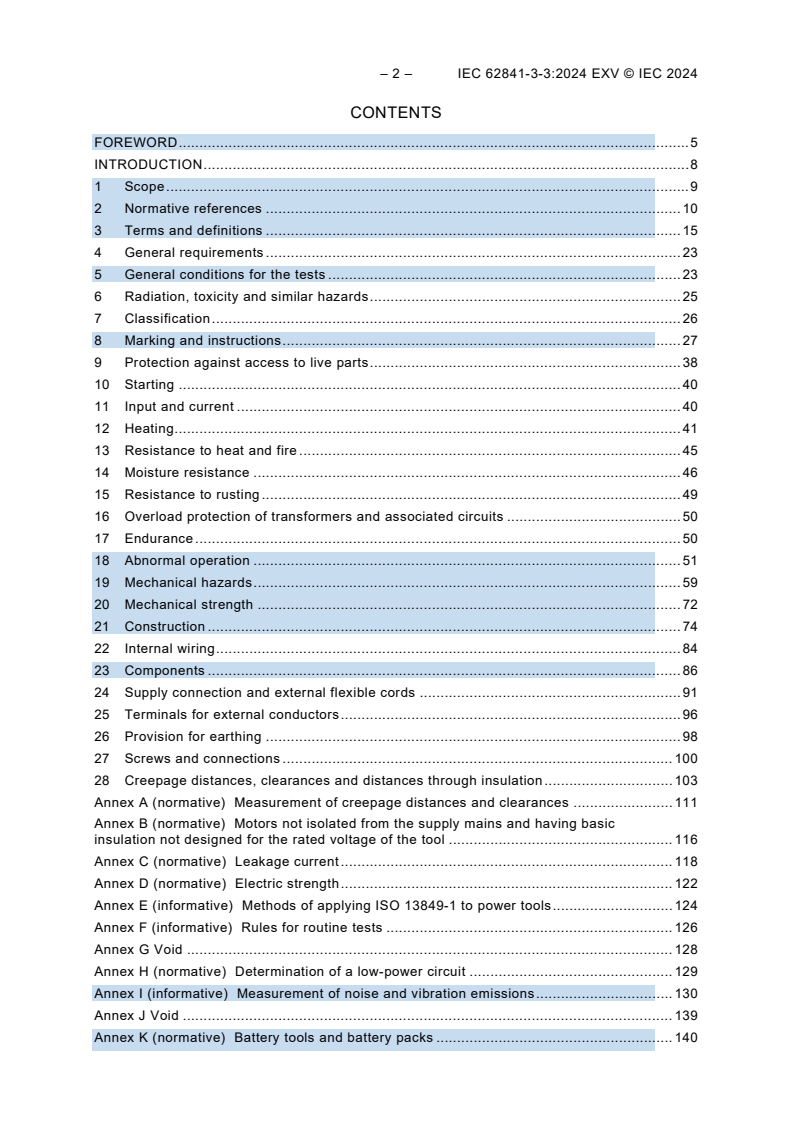
– 2 – IEC 62841-3-3:2024 EXV © IEC 2024
CONTENTS
FOREWORD . 5
INTRODUCTION . 8
1 Scope . 9
2 Normative references . 10
3 Terms and definitions . 15
4 General requirements . 23
5 General conditions for the tests . 23
6 Radiation, toxicity and similar hazards . 25
7 Classification . 26
8 Marking and instructions . 27
9 Protection against access to live parts . 38
10 Starting . 40
11 Input and current . 40
12 Heating . 41
13 Resistance to heat and fire . 45
14 Moisture resistance . 46
15 Resistance to rusting . 49
16 Overload protection of transformers and associated circuits . 50
17 Endurance . 50
18 Abnormal operation . 51
19 Mechanical hazards . 59
20 Mechanical strength . 72
21 Construction . 74
22 Internal wiring . 84
23 Components . 86
24 Supply connection and external flexible cords . 91
25 Terminals for external conductors . 96
26 Provision for earthing . 98
27 Screws and connections . 100
28 Creepage distances, clearances and distances through insulation . 103
Annex A (normative) Measurement of creepage distances and clearances . 111
Annex B (normative) Motors not isolated from the supply mains and having basic
insulation not designed for the rated voltage of the tool . 116
Annex C (normative) Leakage current . 118
Annex D (normative) Electric strength . 122
Annex E (informative) Methods of applying ISO 13849-1 to power tools . 124
Annex F (informative) Rules for routine tests . 126
Annex G Void . 128
Annex H (normative) Determination of a low-power circuit . 129
Annex I (informative) Measurement of noise and vibration emissions . 130
Annex J Void . 139
Annex K (normative) Battery tools and battery packs . 140
Annex L (normative) Battery tools and battery packs provided with mains connection
or non-isolated sources. 160
Annex AA (normative) Stability test for bridge-type guards . 179
Bibliography . 185
Figure 101 – Example of a combined planer and thicknesser . 22
Figure 102 – Example of a thicknesser . 23
Figure 103 – Cutter block . 61
Figure 104 – Measurement of the cutter block chip groove. 62
Figure 105 – Bridge-type guard . 66
Figure 106 – Details of two alternative bridge type guard leading edges . 66
Figure 107 – Example of a swivel-type guard . 67
Figure 108 – Design preventing kickback . 69
Figure 109 – Examples of anti-kickback devices . 70
Figure 110 – Test probe . 71
Figure 111 – Example of a push stick . 84
Figure 1 – Test fingernail . 108
Figure 2 – Flexing test apparatus . 109
Figure 3 – Overload test of a class II armature . 110
Figure A.1 – Clearance gap for parallel sided and V-shaped groove . 112
Figure A.2 – Clearance gap for rib and uncemented joint with groove . 113
Figure A.3 – Clearance gap for uncemented joint and diverging-sided groove . 114
Figure A.4 – Clearance gap between wall and screw . 115
Figure B.1 – Simulation of fault conditions . 117
Figure C.1 – Diagram for leakage current measurement for single-phase connection
and three-phase tools suitable for single-phase supply . 120
Figure C.2 – Diagram for leakage current measurement for three-phase connection . 121
Figure C.3 – Circuit of the leakage current meter . 121
Figure H.1 – Example of an electronic circuit with low-power points . 129
Figure I.1 – Test bench . 137
Figure I.2 – Positions of a hand-held power tool and microphones for the
hemispherical / cylindrical measurement surface . 137
Figure I.3 – Microphone positions on a cubic measurement surface . 138
Figure I.4 – Directions of vibration measurement . 138
Figure K.1 – Measurement of clearances . 159
Figure L.1 – Measurement of clearances . 178
Figure AA.1 – Bridge deflection . 180
Figure AA.2 – Bridge free play . 181
Figure AA.3 – Bridge strength test . 183
Figure AA.4 – Side impact resistance test . 184
Figure AA.5 – Side impact test apparatus . 184
Table 1 – Maximum normal temperature rises (1 of 2) . 43
Table 2 – Maximum outside surface temperature rises . 45
Table 3 – Maximum winding temperature . 52
– 4 – IEC 62841-3-3:2024 EXV © IEC 2024
Table 4 – Required performance levels . 58
Table 101 – Table sizes . 63
Table 102 – Parallel guide sizes . 68
Table 103 – Material specification . 70
Table 5 – Impact energies. 72
Table 6 – Test torques . 73
Table 104 – Metal characteristics for guards above and below the table . 74
Table 7 – Switch trigger force . 78
Table 8 – Minimum cross-sectional area and AWG sizes of supply cords . 92
Table 9 – Pull and torque value . 94
Table 10 – Quick-connect terminals for earthing conductors . 99
Table 11 – Torque for testing screws and nuts . 102
Table 12 – Minimum creepage distances and clearances . 105
Table D.1 – Test voltages . 122
Table F.1 – Test voltages for the electric strength test . 127
Table I.101 – Noise test conditions for planers and thicknessers . 135
Table K.1 – Minimum creepage distances and clearances between parts of opposite
polarity . 158
Table L.1 – Minimum creepage distances and clearances between parts of opposite
polarity . 177
INTERNATIONAL ELECTROTECHNICAL COMMISSION
____________
ELECTRIC MOTOR-OPERATED HAND-HELD TOOLS, TRANSPORTABLE
TOOLS AND LAWN AND GARDEN MACHINERY –
SAFETY –
Part 3-3: Particular requirements for transportable
planers and thicknessers
FOREWORD
1) The International Electrotechnical Commission (IEC) is a worldwide organization for standardization comprising
all national electrotechnical committees (IEC National Committees). The object of IEC is to promote
international co-operation on all questions concerning standardization in the electrical and electronic fields. To
this end and in addition to other activities, IEC publishes International Standards, Technical Specifications,
Technical Reports, Publicly Available Specifications (PAS) and Guides (hereafter referred to as "IEC
Publication(s)"). Their preparation is entrusted to technical committees; any IEC National Committee interested
in the subject dealt with may participate in this preparatory work. International, governmental and non-
governmental organizations liaising with the IEC also participate in this preparation. IEC collaborates closely
with the International Organization for Standardization (ISO) in accordance with conditions determined by
agreement between the two organizations.
2) The formal decisions or agreements of IEC on technical matters express, as nearly as possible, an international
consensus of opinion on the relevant subjects since each technical committee has representation from all
interested IEC National Committees.
3) IEC Publications have the form of recommendations for international use and are accepted by IEC National
Committees in that sense. While all reasonable efforts are made to ensure that the technical content of IEC
Publications is accurate, IEC cannot be held responsible for the way in which they are used or for any
misinterpretation by any end user.
4) In order to promote international uniformity, IEC National Committees undertake to apply IEC Publications
transparently to the maximum extent possible in their national and regional publications. Any divergence
between any IEC Publication and the corresponding national or regional publication shall be clearly indicated in
the latter.
5) IEC itself does not provide any attestation of conformity. Independent certification bodies provide conformity
assessment services and, in some areas, access to IEC marks of conformity. IEC is not responsible for any
services carried out by independent certification bodies.
6) All users should ensure that they have the latest edition of this publication.
7) No liability shall attach to IEC or its directors, employees, servants or agents including individual experts and
members of its technical committees and IEC National Committees for any personal injury, property damage or
other damage of any nature whatsoever, whether direct or indirect, or for costs (including legal fees) and
expenses arising out of the publication, use of, or reliance upon, this IEC Publication or any other IEC
Publications.
8) Attention is drawn to the Normative references cited in this publication. Use of the referenced publications is
indispensable for the correct application of this publication.
9) IEC draws attention to the possibility that the implementation of this document may involve the use of (a)
patent(s). IEC takes no position concerning the evidence, validity or applicability of any claimed patent rights in
respect thereof. As of the date of publication of this document, IEC had not received notice of (a) patent(s),
which may be required to implement this document. However, implementers are cautioned that this may not
represent the latest information, which may be obtained from the patent database available at
https://patents.iec.ch. IEC shall not be held responsible for identifying any or all such patent rights.
This extended version (EXV) of the official IEC Standard provides the user with the
comprehensive content of the Standard.
made to IEC 62841-1:2014.
The specific content of IEC 62841-3-3:2024 is displayed on a blue background.
– 6 – IEC 62841-3-3:2024 EXV © IEC 2024
IEC 62841-3-3 has been prepared by IEC technical committee 116: Safety of motor-operated
electric tools. It is an International Standard.
The text of this International Standard is based on the following documents:
Draft Report on voting
116/761/FDIS 116/796/RVD
Full information on the voting for its approval can be found in the report on voting indicated in
the above table.
The language used for the development of this International Standard is English.
This document was drafted in accordance with ISO/IEC Directives, Part 2, and developed in
accordance with ISO/IEC Directives, Part 1 and ISO/IEC Directives, IEC Supplement,
available at www.iec.ch/members_experts/refdocs. The main document types developed by
IEC are described in greater detail at www.iec.ch/publications.
This document is to be used in conjunction with IEC 62841-1:2014.
This document supplements or modifies the corresponding clauses in IEC 62841-1, so as to
convert it into the IEC Standard: Particular requirements for transportable planers and
thicknessers.
Where a particular subclause of IEC 62841-1 is not mentioned in this document, that
subclause applies as far as reasonable. Where this document states "addition", "modification"
or "replacement", the relevant text in IEC 62841-1 is to be adapted accordingly.
The following print types are used:
– requirements: in roman type;
– test specifications: in italic type;
– notes: in small roman type.
The terms defined in Clause 3 are printed in bold typeface.
Subclauses, notes, tables and figures which are additional to those in IEC 62841-1 are
numbered starting from 101.
Subclauses, notes, tables and figures in Annex K and Annex L which are additional to those
in the main body of this document are numbered starting from 301.
A list of all parts in the IEC 62841 series, published under the general title: Electric motor-
operated hand-held tools, transportable tools and lawn and garden machinery – Safety, can
be found on the IEC website.
The committee has decided that the contents of this document will remain unchanged until the
stability date indicated on the IEC website under webstore.iec.ch in the data related to the
specific document. At this date, the document will be
• reconfirmed,
• withdrawn, or
• revised.
IMPORTANT – The "colour inside" logo on the cover page of this document indicates
that it contains colours which are considered to be useful for the correct
understanding of its contents. Users should therefore print this document using a
colour printer.
– 8 – IEC 62841-3-3:2024 EXV © IEC 2024
INTRODUCTION
Individual countries may wish to consider the application of this Part 1 of IEC 62841, so far as
is reasonable, to tools not mentioned in an individual part of IEC 62841-2, IEC 62841-3 or
IEC 62841-4 and to tools designed on new principles.
Examples of standards dealing with non-safety aspects of hand-held tools, transportable
tools and lawn and garden machinery are
– standards dealing with EMC aspects;
– standards dealing with environmental aspects.
ELECTRIC MOTOR-OPERATED HAND-HELD TOOLS, TRANSPORTABLE
TOOLS AND LAWN AND GARDEN MACHINERY –
SAFETY –
Part 3-3: Particular requirements for transportable
planers and thicknessers
1 Scope
This International Standard deals with the safety of electric motor-operated or magnetically
driven:
– hand-held tools (IEC 62841-2);
– transportable tools (IEC 62841-3);
– lawn and garden machinery (IEC 62841-4).
The above listed categories are hereinafter referred to as “tools” or “machines”.
The rated voltage is not more than 250 V for single-phase a.c. or d.c. tools, and 480 V for
three-phase a.c. tools. The rated input is not more than 3 700 W.
The limits for the applicability of this standard for battery tools are given in K.1 and L.1.
This standard deals with the hazards presented by tools which are encountered by all persons
in the normal use and reasonably foreseeable misuse of the tools.
Tools with electric heating elements are within the scope of this standard.
Requirements for motors not isolated from the supply, and having basic insulation not
designed for the rated voltage of the tools, are given in Annex B. Requirements for
rechargeable battery-powered motor-operated or magnetically driven tools and the battery
packs for such tools are given in Annex K. Requirements for such tools that are also operated
and/or charged directly from the mains or a non-isolated source are given in Annex L.
Hand-held electric tools, which can be mounted on a support or working stand for use as fixed
tools without any alteration of the tool itself, are within the scope of this standard and such
combination of a hand-held tool and a support is considered to be a transportable tool and
thus covered by the relevant Part 3.
This document applies to transportable planers, thicknessers and combined planers and
thicknessers intended for cutting wood and analogous materials with a maximum planing
width of 330 mm.
This document does not apply to planers, thicknessers or combined planers and
thicknessers other than transportable.
NOTE 101 ISO 19085-7:2019 gives requirements for planers, thicknessers or combined planers and
thicknessers other than transportable.
This standard does not apply to:
– tools intended to be used in the presence of explosive atmosphere (dust, vapour or gas);
– tools used for preparing and processing food;
– tools for medical purposes;
– 10 – IEC 62841-3-3:2024 EXV © IEC 2024
NOTE 1 IEC 60601 series covers a variety of tools for medical purposes.
– tools intended to be used with cosmetics or pharmaceutical products;
– heating tools;
NOTE 2 IEC 60335-2-45 covers a variety of heating tools.
– electric motor-operated household and similar electrical appliances;
NOTE 3 IEC 60335 series covers a variety of electric motor-operated household and similar electrical appliances.
– electrical equipment for industrial machine-tools;
NOTE 4 IEC 60204 series deals with electrical safety of machinery.
– small low voltage transformer operated bench tools intended for model making, e.g. the
making of radio controlled model aircraft or cars, etc.
NOTE 5 In the United States of America, the following conditions apply:
This standard deals with tools used in non-hazardous locations in accordance with the National Electrical Code,
NFPA 70.
NOTE 6 In Canada, the following conditions apply:
This standard deals with tools used in non-hazardous locations in accordance with the Canadian Electric Code,
Part 1, CSA C22.1, and General Requirements – Canadian Electrical Code, Part II, CAN/CSA-C22.2 No. 0.
2 Normative references
The following documents, in whole or in part, are normatively referenced in this document and
are indispensable for its application. For dated references, only the edition cited applies. For
undated references, the latest edition of the referenced document (including any
amendments) applies.
IEC 60061, Lamp caps and holders together with gauges for the control of interchangeability
and safety, available at http://std.iec.ch/iec60061
IEC 60065:2001, Audio, video and similar electronic apparatus – Safety requirements
Amendment 2:2010
Amendment 1:2005
IEC 60068-2-75:1997, Environmental testing – Part 2-75: Tests – Test Eh: Hammer tests
IEC/TR 60083, Plugs and socket-outlets for domestic and similar general use standardized in
member countries of IEC
IEC 60085:2007, Electrical insulation – Thermal evaluation and designation
IEC 60127 (all parts), Miniature fuses
IEC 60227 (all parts), Polyvinyl chloride insulated cables of rated voltages up to and including
450/750 V
IEC 60238, Edison screw lampholders
IEC 60245 (all parts), Rubber insulated cables – Rated voltages up to and including
450/750 V
_________
There exists a consolidated version (Edition 7.2:2011) which includes IEC 60065:2001 and its Amendment 1
(2005) and Amendment 2 (2010).
IEC 60252-1, AC motor capacitors – Part 1: General – Performance, testing and rating –
Safety requirements – Guidance for installation and operation
IEC 60320 (all parts), Appliance couplers for household and similar general purposes
IEC 60320-1, Appliance couplers for household and similar general purposes – Part 1:
General requirements
IEC 60335-1:2010, Household and similar electrical appliances – Safety – Part 1: General
requirements
IEC 60384-14, Fixed capacitors for use in electronic equipment – Part 14: Sectional
specification – Fixed capacitors for electromagnetic interference suppression and connection
to the supply mains
IEC 60417, Graphical symbols for use on equipment, available at http://www.graphical-
symbols.info/graphical-symbols/equipment/db1.nsf/$enHome?OpenForm
IEC 60529:1989, Degrees of protection provided by enclosures (IP Code)
Amendment 1:1999
Amendment 2:2013
IEC 60664-1, Insulation coordination for equipment within low-voltage systems – Part 1:
Principles, requirements and tests
IEC 60695-2-11:2000, Fire hazard testing – Part 2-11: Glowing/hot-wire based test methods –
Glow-wire flammability test method for end-products
IEC 60695-2-13:2010, Fire hazard testing – Part 2-13: Glowing/hot-wire based test methods –
Glow-wire ignition temperature (GWIT) test method for materials
IEC 60695-10-2:2003, Fire hazard testing – Part 10-2: Abnormal heat – Ball pressure test
IEC 60695-11-10:2013, Fire hazard testing – Part 11-10: Test flames – 50 W horizontal and
vertical flame test methods
IEC 60730-1:2010, Automatic electrical controls for household and similar use – Part 1:
General requirements
IEC 60825-1:2007, Safety of laser products – Part 1: Equipment classification and
requirements
IEC 60884 (all parts), Plugs and socket-outlets for household and similar purposes
IEC 60906-1, IEC system of plugs and socket-outlets for household and similar purposes –
Part 1: Plugs and socket-outlets 16 A 250 V a.c.
IEC 60990:1999, Methods of measurement of touch current and protective conductor current
IEC 60998-2-1, Connecting devices for low-voltage circuits for household and similar
purposes – Part 2-1: Particular requirements for connecting devices as separate entities with
screw-type clamping units
_________
There exists a consolidated version (Edition 2.2:2013) which includes IEC 60529:1989 and its Amendment 1
(1999) and Amendment 2 (2013).
– 12 – IEC 62841-3-3:2024 EXV © IEC 2024
IEC 60998-2-2, Connecting devices for low-voltage circuits for household and similar
purposes – Part 2-2: Particular requirements for connecting devices as separate entities with
screwless-type clamping units
IEC 60999-1:1999, Connecting devices – Electrical copper conductors – Safety requirements
for screw-type and screwless-type clamping units – Part 1: General requirements and
2 2
particular requirements for clamping units for conductors from 0,2 mm up to 35 mm
(included)
IEC 61000-4-2:2008, Electromagnetic compatibility (EMC) – Part 4-2: Testing and
measurement techniques – Electrostatic discharge immunity test
IEC 61000-4-3:2006, Electromagnetic compatibility (EMC) – Part 4-3: Testing and
measurement techniques – Radiated, radio-frequency, electromagnetic field immunity test
Amendment 1:2007
Amendment 2:2010
IEC 61000-4-4:2012, Electromagnetic compatibility (EMC) – Part 4-4: Testing and
measurement techniques – Electrical fast transient/burst immunity test
IEC 61000-4-5:2005, Electromagnetic compatibility (EMC) – Part 4-5: Testing and
measurement techniques – Surge immunity test
IEC 61000-4-6:2008, Electromagnetic compatibility (EMC) – Part 4-6: Testing and
measurement techniques – Immunity to conducted disturbances, induced by radio-frequency
fields
IEC 61000-4-11:2004, Electromagnetic compatibility (EMC) – Part 4-11: Testing and
measurement techniques – Voltage dips, short interruptions and voltage variations immunity
tests
IEC 61032:1997, Protection of persons and equipment by enclosures – Probes for verification
IEC 61056-1, General purpose lead-acid batteries (valve-regulated types) – Part 1: General
requirements, functional characteristics – Methods of test
IEC 61058-1:2000, Switches for appliances – Part 1: General requirements
Amendment 1:2001
Amendment 2:2007
IEC 61210, Connecting devices – Flat quick-connect terminations for electrical copper
conductors – Safety requirements
IEC 61540:1997, Electrical accessories – Portable residual current devices without integral
overcurrent protection for household and similar use (PRCDs)
Amendment 1:1998
IEC 61558-1, Safety of power transformers, power supplies, reactors and similar products –
Part 1: General requirements and tests
_________
There exists a consolidated version (Edition 3.2:2010) which includes IEC 61000-4-3:2006 and its Amendment
1 (2007) and Amendment 2 (2010).
There exists a consolidated version (Edition 3.2:2008) which includes IEC 61058-1:2000 and its Amendment 1
(2001) and Amendment 2 (2007).
There exists a consolidated version (Edition 1.1:1999) which includes IEC 61540:1997 and its Amendment 1
(2001).
IEC 61558-2-4, Safety of transformers, reactors, power supply units and similar products for
supply voltages up to 1 100 V – Part 2-4: Particular requirements and tests for isolating
transformers and power supply units incorporating isolating transformers
IEC 61558-2-6, Safety of transformers, reactors, power supply units and similar products for
supply voltages up to 1 100 V – Part 2-6: Particular requirements and tests for safety isolating
transformers and power supply units incorporating safety isolating transformers
IEC 61558-2-16, Safety of transformers, reactors, power supply units and similar products for
supply voltages up to 1 100 V – Part 2-16: Particular requirements and tests for switch mode
power supply units and transformers for switch mode power supply units
IEC 61951-1, Secondary cells and batteries containing alkaline or other non-acid electrolytes
– Portable sealed rechargeable single cells – Part 1: Nickel-cadmium
IEC 61951-2, Secondary cells and batteries containing alkaline or other non-acid electrolytes
– Portable sealed rechargeable single cells – Part 2: Nickel-metal hydride
IEC 61960, Secondary cells and batteries containing alkaline or other non-acid electrolytes –
Secondary lithium cells and batteries for portable applications
IEC 61984, Connectors – Safety requirements and tests
IEC 62133, Secondary cells and batteries containing alkaline or other non-acid electrolytes –
Safety requirements for portable sealed secondary cells, and for batteries made from them,
for use in portable applications
IEC 62233, Measurement methods for electromagnetic fields of household appliances and
similar apparatus with regard to human exposure
IEC 62471, Photobiological safety of lamps and lamp systems
IEC/TR 62471-2:2009, Photobiological safety of lamps and lamp systems – Part 2: Guidance
on manufacturing requirements relating to non-laser optical radiation safety
IEC 62841-1:2014, Electric motor-operated hand-held tools, transportable tools and lawn and
garden machinery – Safety – Part 1: General requirements
ISO 180:2023, Plastics – Determination of Izod impact strength
ISO 1463, Metallic and oxide coatings – Measurement of coating thickness – Microscopical
method
ISO 2178, Non-magnetic coatings on magnetic substrates – Measurement of coating
thickness – Magnetic method
ISO 2768-1, General tolerances – Part 1: Tolerances for linear and angular dimensions
without individual tolerance indications
ISO 3744, Acoustics – Determination of sound power levels and sound energy levels of noise
sources using sound pressure – Engineering methods for an essentially free field over a
reflecting plane
ISO 3864-2, Graphical symbols – Safety colours and safety signs – Part 2: Design principles
for product safety labels
– 14 – IEC 62841-3-3:2024 EXV © IEC 2024
ISO 3864-3, Graphical symbols – Safety colours and safety signs – Part 3: Design principles
for graphical symbols for use in safety signs
ISO 4871:1996, Acoustics – Declaration and verification of noise emission values of
machinery and equipment
ISO 5347 (all parts), Methods for the calibration of vibration and shock pick-ups
ISO 5349-1, Mechanical vibration – Measurement and evaluation of human exposure to hand-
transmitted vibration – Part 1: General requirements
ISO 5349-2, Mechanical vibration – Measurement and evaluation of human exposure to hand-
transmitted vibration – Part 2: Practical guidance for measurement in the workplace
ISO 7000:2012, Graphical symbols for use on equipment – Index and synopsis
ISO 7010, Graphical symbols – Safety colours and safety signs – Registered safety signs
ISO 7574-4, Acoustics – Statistical methods for determining and verifying stated noise
emission values of machinery and equipment – Part 4: Methods for stated values for batches
of machines
ISO 8041, Human response to vibration – Measuring instrumentation
ISO 9772:2012, Cellular plastics – Determination of horizontal burning characteristics of small
specimens subjected to a small flame
ISO 11201, Acoustics – Noise emitted by machinery and equipment – Determination of
emission sound pressure levels at a work station and at other specified positions in an
essentially free field over a reflecting plane with negligible environmental corrections
ISO 11203, Acoustics – Noise emitted by machinery and equipment – Determination of
emission sound pressure levels at a work station and at other specified positions from the
sound power level
ISO 12100, Safety of machinery – General principles for design – Risk assessment and risk
reduction
ISO 13849-1, Safety of machinery – Safety-related parts of control systems – Part 1: General
principles for design
ISO 13850, Safety of machinery – Emergency stop – Principles for design
ISO/TR 11690-3, Acoustics – Recommended practice for the design of low-noise workplaces
containing machinery – Part 3: Sound propagation and noise prediction in workrooms
ISO 16063-1, Methods for the calibration of vibration and shock transducers – Part 1: Basic
concepts
EN 12096, Mechanical vibration – Declaration and verification of vibration emission values
ASTM B 258, Standard specification for standard nominal diameters and cross-sectional
areas of AWG sizes of solid round wires used as electrical conductors
UL 969, Standard for marking and labeling systems
NOTE 1 In the United States of America, the following normative reference applies:
US, Code of Federal Regulations (CFR) Title 21, Food and Drugs.
NOTE 2 In Canada, the following normative reference applies:
C.R.C., c. 1370, Radiation Emitting Devices Regulations
NOTE 3 In Europe (EN 62841-1), the following normative references apply:
CR 1030-1, Hand-arm vibration – Guidelines for vibration hazards reduction – Part 1: Engineering methods by
design of machinery
EN ISO 11688-1, Acoustics – Recommended practice for the design of low-noise machinery and equipment –
Part 1: Planning (ISO/TR 11688-1)
3 Terms and definitions
For the purposes of this document, the following terms and definitions apply.
Where the terms voltage and current are used, they imply the r.m.s. values, unless otherwise
specified.
Where in this standard the expressions “with the aid of a tool”, “without the aid of a tool”, and
“requires the use of a tool”, are used, the word “tool” means a hand tool, for example a
screwdriver, which may be used to operate a screw or other fixing means.
3.1
accessible part
conductive part or surface of insulating materials that can be touched by means of the test
probe B of IEC 61032:1997
3.2
accessory
device that is attached only to the output mechanism of the tool
3.3
adjustable guard
guard which is adjustable as a whole or which incorporates adjustable part(s). For manually
adjustable guards, the adjustment remains fixed during a particular operation
3.4
all-pole disconnection
disconnection of all supply conductors except the protective earthing (grounding) conductor
by a single initiating action
3.5
attachment
device attached to the housing or other component of the tool and which may or may not be
attached to the output mechanism and does not modify the normal use of the tool within the
scope of this standard
3.6
basic insulation
insulation applied to live parts to provide protection against electric shock. Insulation applied
to live parts not intended to provide electric shock protection is considered to be insulation
for functional purposes, such as magnet wire insulation
3.7
battery
assembly of one or more cells intended to provide electrical current to the tool
– 16 – IEC 62841-3-3:2024 EXV © IEC 2024
3.8
class I tool
tool in which protection against electric shock does not rely on basic, double or reinforced
insulation only, but which includes an additional safety precaution in that conductive
accessible parts are connected to the protective earthing conductor in the fixed wiring of the
installation in such a way that conductive accessible parts cannot become live in the event of
a failure of the basic insulation
Note 1 to entry: Also considered as class I tools are tools with double insulation and/or reinforced insulation
throughout, but also having an earthing terminal or earthing contact.
3.9
class II tool
tool in which protection against electric shock does not rely on basic insulation only, but in
which additional safety precautions, such as double insulation or reinforced insulation, are
provided, there being no provision for protective earthing or reliance upon installation
conditions
3.10
class III tool
tool in which protection against electric shock relies on supply at safety extra-low voltage,
and in which voltages higher than those of safety extra-low voltages are not generated
3.11
class II construction
part of a tool for which protection against electric shock relies upon double insulation or
reinforced insulation
3.12
class III construction
part of a tool for which protection against electric shock relies upon safety extra-low voltage,
and in which voltages higher than those of safety extra-low voltages are not generated
3.13
clearance
shortest distance between two conductive parts, or between a conductive part and the outer
surface of the enclosure, considered as though metal foil were pressed into contact with
accessible surfaces of insulating material, measured through air
Note 102 to entry: Examples of clearances are given in Annex A.
3.14
control device
device used by the user to adjust and/or regulate an electrical or mechanical function of the
tool
3.15
creepage distance
shortest path between two conductive parts, or between a conductive part and the outer
surface of the enclosure, considered as though metal foil were pressed into contact with
accessible surfaces of insulating material, measured along the surface of the insulating
material
Note 1 to entry: Examples of creepage distances are given in Annex A.
3.16
detac
...
IEC 62841-3-3 ®
Edition 1.0 2024-06
INTERNATIONAL
STANDARD
NORME
INTERNATIONALE
Electric motor-operated hand-held tools, transportable tools and lawn and
garden machinery – Safety –
Part 3-3: Particular requirements for transportable planers and thicknessers
Outils électroportatifs à moteur, outils portables et machines pour jardins et
pelouses – Sécurité –
Partie 3-3: Exigences particulières pour les dégauchisseuses et les raboteuses
portables
All rights reserved. Unless otherwise specified, no part of this publication may be reproduced or utilized in any form
or by any means, electronic or mechanical, including photocopying and microfilm, without permission in writing from
either IEC or IEC's member National Committee in the country of the requester. If you have any questions about IEC
copyright or have an enquiry about obtaining additional rights to this publication, please contact the address below or
your local IEC member National Committee for further information.
Droits de reproduction réservés. Sauf indication contraire, aucune partie de cette publication ne peut être reproduite ni
utilisée sous quelque forme que ce soit et par aucun procédé, électronique ou mécanique, y compris la photocopie et
les microfilms, sans l'accord écrit de l'IEC ou du Comité national de l'IEC du pays du demandeur. Si vous avez des
questions sur le copyright de l'IEC ou si vous désirez obtenir des droits supplémentaires sur cette publication, utilisez
les coordonnées ci-après ou contactez le Comité national de l'IEC de votre pays de résidence.
IEC Secretariat Tel.: +41 22 919 02 11
3, rue de Varembé info@iec.ch
CH-1211 Geneva 20 www.iec.ch
Switzerland
About the IEC
The International Electrotechnical Commission (IEC) is the leading global organization that prepares and publishes
International Standards for all electrical, electronic and related technologies.
About IEC publications
The technical content of IEC publications is kept under constant review by the IEC. Please make sure that you have the
latest edition, a corrigendum or an amendment might have been published.
IEC publications search - webstore.iec.ch/advsearchform IEC Products & Services Portal - products.iec.ch
The advanced search enables to find IEC publications by a Discover our powerful search engine and read freely all the
variety of criteria (reference number, text, technical publications previews, graphical symbols and the glossary.
committee, …). It also gives information on projects, replaced With a subscription you will always have access to up to date
and withdrawn publications. content tailored to your needs.
IEC Just Published - webstore.iec.ch/justpublished
Electropedia - www.electropedia.org
Stay up to date on all new IEC publications. Just Published
The world's leading online dictionary on electrotechnology,
details all new publications released. Available online and once
containing more than 22 500 terminological entries in English
a month by email.
and French, with equivalent terms in 25 additional languages.
Also known as the International Electrotechnical Vocabulary
IEC Customer Service Centre - webstore.iec.ch/csc
(IEV) online.
If you wish to give us your feedback on this publication or need
further assistance, please contact the Customer Service
Centre: sales@iec.ch.
A propos de l'IEC
La Commission Electrotechnique Internationale (IEC) est la première organisation mondiale qui élabore et publie des
Normes internationales pour tout ce qui a trait à l'électricité, à l'électronique et aux technologies apparentées.
A propos des publications IEC
Le contenu technique des publications IEC est constamment revu. Veuillez vous assurer que vous possédez l’édition la
plus récente, un corrigendum ou amendement peut avoir été publié.
Recherche de publications IEC - IEC Products & Services Portal - products.iec.ch
webstore.iec.ch/advsearchform Découvrez notre puissant moteur de recherche et consultez
La recherche avancée permet de trouver des publications IEC gratuitement tous les aperçus des publications, symboles
en utilisant différents critères (numéro de référence, texte, graphiques et le glossaire. Avec un abonnement, vous aurez
comité d’études, …). Elle donne aussi des informations sur les toujours accès à un contenu à jour adapté à vos besoins.
projets et les publications remplacées ou retirées.
Electropedia - www.electropedia.org
IEC Just Published - webstore.iec.ch/justpublished
Le premier dictionnaire d'électrotechnologie en ligne au monde,
Restez informé sur les nouvelles publications IEC. Just
avec plus de 22 500 articles terminologiques en anglais et en
Published détaille les nouvelles publications parues.
français, ainsi que les termes équivalents dans 25 langues
Disponible en ligne et une fois par mois par email.
additionnelles. Egalement appelé Vocabulaire
Electrotechnique International (IEV) en ligne.
Service Clients - webstore.iec.ch/csc
Si vous désirez nous donner des commentaires sur cette
publication ou si vous avez des questions contactez-nous:
sales@iec.ch.
IEC 62841-3-3 ®
Edition 1.0 2024-06
INTERNATIONAL
STANDARD
NORME
INTERNATIONALE
Electric motor-operated hand-held tools, transportable tools and lawn and
garden machinery – Safety –
Part 3-3: Particular requirements for transportable planers and thicknessers
Outils électroportatifs à moteur, outils portables et machines pour jardins et
pelouses – Sécurité –
Partie 3-3: Exigences particulières pour les dégauchisseuses et les raboteuses
portables
INTERNATIONAL
ELECTROTECHNICAL
COMMISSION
COMMISSION
ELECTROTECHNIQUE
INTERNATIONALE
ICS 25.140.20 ISBN 978-2-8322-9100-9
– 2 – IEC 62841-3-3:2024 © IEC 2024
CONTENTS
FOREWORD . 4
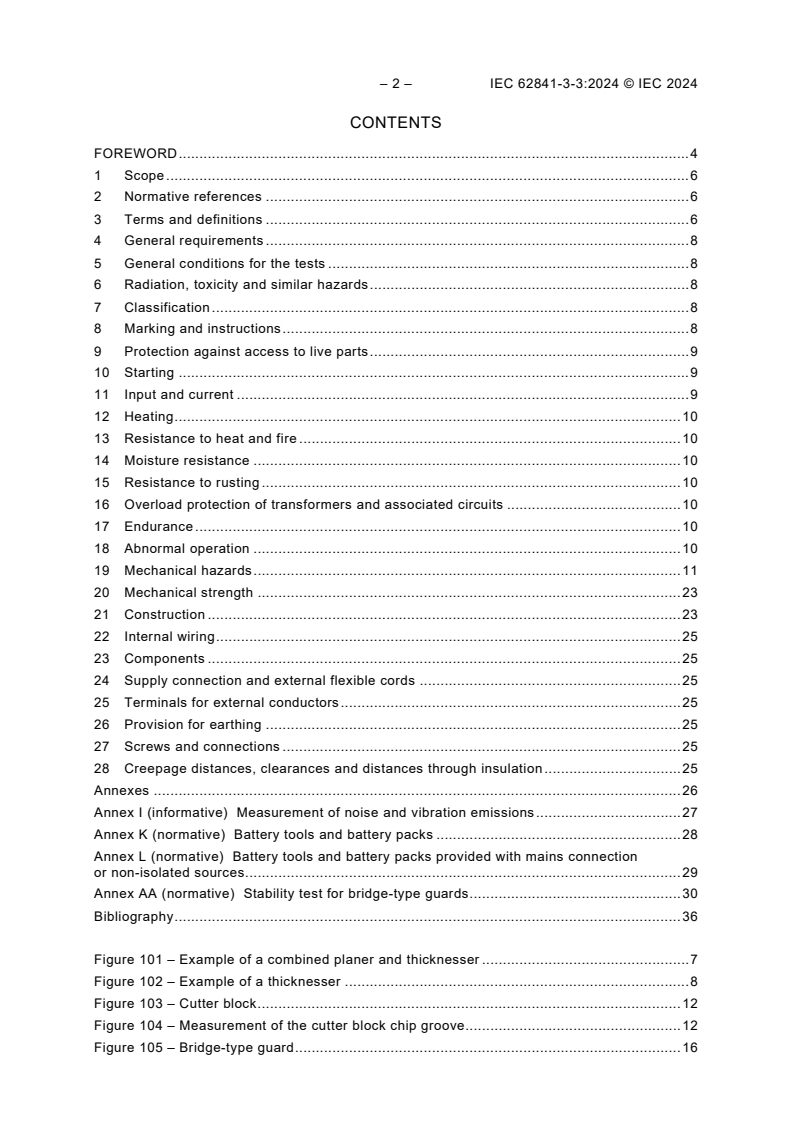
1 Scope . 6
2 Normative references . 6
3 Terms and definitions . 6
4 General requirements . 8
5 General conditions for the tests . 8
6 Radiation, toxicity and similar hazards . 8
7 Classification . 8
8 Marking and instructions . 8
9 Protection against access to live parts . 9
10 Starting . 9
11 Input and current . 9
12 Heating . 10
13 Resistance to heat and fire . 10
14 Moisture resistance . 10
15 Resistance to rusting . 10
16 Overload protection of transformers and associated circuits . 10
17 Endurance . 10
18 Abnormal operation . 10
19 Mechanical hazards . 11
20 Mechanical strength . 23
21 Construction . 23
22 Internal wiring . 25
23 Components . 25
24 Supply connection and external flexible cords . 25
25 Terminals for external conductors . 25
26 Provision for earthing . 25
27 Screws and connections . 25
28 Creepage distances, clearances and distances through insulation . 25
Annexes . 26
Annex I (informative) Measurement of noise and vibration emissions . 27
Annex K (normative) Battery tools and battery packs . 28
Annex L (normative) Battery tools and battery packs provided with mains connection
or non-isolated sources . 29
Annex AA (normative) Stability test for bridge-type guards . 30
Bibliography . 36
Figure 101 – Example of a combined planer and thicknesser . 7
Figure 102 – Example of a thicknesser . 8
Figure 103 – Cutter block . 12
Figure 104 – Measurement of the cutter block chip groove . 12
Figure 105 – Bridge-type guard . 16
Figure 106 – Details of two alternative bridge type guard leading edges . 17
Figure 107 – Example of a swivel-type guard . 18
Figure 108 – Design preventing kickback . 20
Figure 109 – Examples of anti-kickback devices . 20
Figure 110 – Test probe . 22
Figure 111 – Example of a push stick . 24
Figure AA.1 – Bridge deflection. 31
Figure AA.2 – Bridge free play . 32
Figure AA.3 – Bridge strength test . 34
Figure AA.4 – Side impact resistance test . 35
Figure AA.5 – Side impact test apparatus . 35
Table 4 – Required performance levels . 10
Table 101 – Table sizes . 13
Table 102 – Parallel guide sizes . 18
Table 103 – Material specification . 21
Table 104 – Metal characteristics for guards above and below the table . 23
Table I.101 – Noise test conditions for planers and thicknessers . 27
– 4 – IEC 62841-3-3:2024 © IEC 2024
INTERNATIONAL ELECTROTECHNICAL COMMISSION
____________
ELECTRIC MOTOR-OPERATED HAND-HELD TOOLS, TRANSPORTABLE
TOOLS AND LAWN AND GARDEN MACHINERY –
SAFETY –
Part 3-3: Particular requirements for transportable
planers and thicknessers
FOREWORD
1) The International Electrotechnical Commission (IEC) is a worldwide organization for standardization comprising
all national electrotechnical committees (IEC National Committees). The object of IEC is to promote international
co-operation on all questions concerning standardization in the electrical and electronic fields. To this end and
in addition to other activities, IEC publishes International Standards, Technical Specifications, Technical Reports,
Publicly Available Specifications (PAS) and Guides (hereafter referred to as "IEC Publication(s)"). Their
preparation is entrusted to technical committees; any IEC National Committee interested in the subject dealt with
may participate in this preparatory work. International, governmental and non-governmental organizations liaising
with the IEC also participate in this preparation. IEC collaborates closely with the International Organization for
Standardization (ISO) in accordance with conditions determined by agreement between the two organizations.
2) The formal decisions or agreements of IEC on technical matters express, as nearly as possible, an international
consensus of opinion on the relevant subjects since each technical committee has representation from all
interested IEC National Committees.
3) IEC Publications have the form of recommendations for international use and are accepted by IEC National
Committees in that sense. While all reasonable efforts are made to ensure that the technical content of IEC
Publications is accurate, IEC cannot be held responsible for the way in which they are used or for any
misinterpretation by any end user.
4) In order to promote international uniformity, IEC National Committees undertake to apply IEC Publications
transparently to the maximum extent possible in their national and regional publications. Any divergence between
any IEC Publication and the corresponding national or regional publication shall be clearly indicated in the latter.
5) IEC itself does not provide any attestation of conformity. Independent certification bodies provide conformity
assessment services and, in some areas, access to IEC marks of conformity. IEC is not responsible for any
services carried out by independent certification bodies.
6) All users should ensure that they have the latest edition of this publication.
7) No liability shall attach to IEC or its directors, employees, servants or agents including individual experts and
members of its technical committees and IEC National Committees for any personal injury, property damage or
other damage of any nature whatsoever, whether direct or indirect, or for costs (including legal fees) and
expenses arising out of the publication, use of, or reliance upon, this IEC Publication or any other IEC
Publications.
8) Attention is drawn to the Normative references cited in this publication. Use of the referenced publications is
indispensable for the correct application of this publication.
9) IEC draws attention to the possibility that the implementation of this document may involve the use of (a)
patent(s). IEC takes no position concerning the evidence, validity or applicability of any claimed patent rights in
respect thereof. As of the date of publication of this document, IEC had not received notice of (a) patent(s), which
may be required to implement this document. However, implementers are cautioned that this may not represent
the latest information, which may be obtained from the patent database available at https://patents.iec.ch. IEC
shall not be held responsible for identifying any or all such patent rights.
IEC 62841-3-3 has been prepared by IEC technical committee 116: Safety of motor-operated
electric tools. It is an International Standard.
The text of this International Standard is based on the following documents:
Draft Report on voting
116/761/FDIS 116/796/RVD
Full information on the voting for its approval can be found in the report on voting indicated in
the above table.
The language used for the development of this International Standard is English.
This document was drafted in accordance with ISO/IEC Directives, Part 2, and developed in
accordance with ISO/IEC Directives, Part 1 and ISO/IEC Directives, IEC Supplement, available
at www.iec.ch/members_experts/refdocs. The main document types developed by IEC are
described in greater detail at www.iec.ch/publications.
This document is to be used in conjunction with IEC 62841-1:2014.
This document supplements or modifies the corresponding clauses in IEC 62841-1, so as to
convert it into the IEC Standard: Particular requirements for transportable planers and
thicknessers.
Where a particular subclause of IEC 62841-1 is not mentioned in this document, that subclause
applies as far as reasonable. Where this document states "addition", "modification" or
"replacement", the relevant text in IEC 62841-1 is to be adapted accordingly.
The following print types are used:
– requirements: in roman type;
– test specifications: in italic type;
notes: in small roman type.
–
The terms defined in Clause 3 are printed in bold typeface.
Subclauses, notes, tables and figures which are additional to those in IEC 62841-1 are
numbered starting from 101.
Subclauses, notes, tables and figures in Annex K and Annex L which are additional to those in
the main body of this document are numbered starting from 301.
A list of all parts in the IEC 62841 series, published under the general title: Electric motor-
operated hand-held tools, transportable tools and lawn and garden machinery – Safety, can be
found on the IEC website.
The committee has decided that the contents of this document will remain unchanged until the
stability date indicated on the IEC website under webstore.iec.ch in the data related to the
specific document. At this date, the document will be
• reconfirmed,
• withdrawn, or
• revised.
– 6 – IEC 62841-3-3:2024 © IEC 2024
ELECTRIC MOTOR-OPERATED HAND-HELD TOOLS, TRANSPORTABLE
TOOLS AND LAWN AND GARDEN MACHINERY –
SAFETY –
Part 3-3: Particular requirements for transportable
planers and thicknessers
1 Scope
IEC 62841-1:2014, Clause 1 is applicable, except as follows:
Addition:
This document applies to transportable planers, thicknessers and combined planers and
thicknessers intended for cutting wood and analogous materials with a maximum planing width
of 330 mm.
This document does not apply to planers, thicknessers or combined planers and
thicknessers other than transportable.
NOTE 101 ISO 19085-7:2019 gives requirements for planers, thicknessers or combined planers and
thicknessers other than transportable.
2 Normative references
IEC 62841-1:2014, Clause 2 is applicable, except as follows:
Addition:
IEC 62841-1:2014, Electric motor-operated hand-held tools, transportable tools and lawn and
garden machinery – Safety – Part 1: General requirements
ISO 180:2023, Plastics – Determination of Izod impact strength
3 Terms and definitions
IEC 62841-1:2014, Clause 3 is applicable, except as follows:
Addition:
3.101
combined planer and thicknesser
tool designed to carry out the functions of both a planer and a thicknesser
Note 101 to entry: See Figure 101.
Key
1 outfeed table
2 bridge type guard
3 infeed table
4 detachable working stand
5 parallel guide
Figure 101 – Example of a combined planer and thicknesser
3.102
cutter block
rotating assembly consisting of the drum, the blades, the blade fixing systems and the spindle
3.103
planer
tool designed to plane the surface of wood by means of a horizontally rotating cutter block
located between two frames used to position and support the workpiece
Note 101 to entry: The lower surface of the workpiece is planed.
3.104
thicknesser
tool designed to plane wood to a set thickness by means of a horizontally rotating cutter block,
the distance between the knives and the surface of the table supporting the workpiece being
adjustable
Note 101 to entry: The upper surface of the workpiece is planed.
Note 102 to entry: See Figure 102.
– 8 – IEC 62841-3-3:2024 © IEC 2024
Figure 102 – Example of a thicknesser
4 General requirements
IEC 62841-1:2014, Clause 4 is applicable.
5 General conditions for the tests
IEC 62841-1:2014, Clause 5 is applicable, except as follows:
5.17 Addition:
The mass of the tool includes the cutter block.
6 Radiation, toxicity and similar hazards
IEC 62841-1:2014, Clause 6 is applicable.
7 Classification
IEC 62841-1:2014, Clause 7 is applicable.
8 Marking and instructions
IEC 62841-1:2014, Clause 8 is applicable, except as follows:
8.1 Addition:
Tools shall also be marked with the planing width.
8.3 Addition:
The direction of rotation of the cutter block shall be indicated on the tool by an arrow raised or
sunk, or by any other means not less visible and indelible.
8.14.2 a) Addition:
101) Instruction how to check the guard adjusting arrangements and return springs, when
fitted, for faultless condition before use;
102) Instruction to use blades which are well sharpened and maintained. If blades are re-
sharpenable, information about the limits of re-sharpening;
103) Instruction to use only cutting blades designed for this tool;
104) Instruction how the blades shall be assembled and adjusted, if applicable;
105) Instruction that any portion of the cutter block not being used for planing shall be
adjusted to be guarded;
106) Instruction how to inspect the anti-kickback devices and feed speed spindles to ensure
safe operation;
107) Instruction to wear suitable personal protective equipment (PPE). This could include
– hearing protection, to reduce the risk of induced hearing loss;
– respiratory protection, to reduce the risk of inhalation of harmful dust; and
– gloves for handling the cutter block and rough material, to reduce injuries from sharp
edges;
108) For cutting wood, instruction on the correct assembly of a dust-collecting device;
109) Instructions how to adjust the guards and parallel guide in relation to the different work.
8.14.2 b) Addition:
101) Information what kind of work can be performed safely;
102) For those tools designed for rabbeting: instruction for the safe operation;
103) Information about the location where the push-stick shall be stored when not in use;
104) Instruction on the situations in which the push-stick is to be used;
105) Information about the effects caused by metal parts penetrated into the workpiece and
splintery workpieces;
106) Instruction how correctly to use roller tables when cutting long workpieces;
107) A warning not to do the following operations:
– stopped work (i.e. any cut which does not involve the full workpiece length);
– recesses, tenons or moulds; and
– planing of badly bowed wood where there is inadequate contact on the infeed table.
9 Protection against access to live parts
IEC 62841-1:2014, Clause 9 is applicable.
10 Starting
IEC 62841-1:2014, Clause 10 is applicable.
11 Input and current
IEC 62841-1:2014, Clause 11 is applicable.
– 10 – IEC 62841-3-3:2024 © IEC 2024
12 Heating
IEC 62841-1:2014, Clause 12 is applicable.
13 Resistance to heat and fire
IEC 62841-1:2014, Clause 13 is applicable.
14 Moisture resistance
IEC 62841-1:2014, Clause 14 is applicable.
15 Resistance to rusting
IEC 62841-1:2014, Clause 15 is applicable.
16 Overload protection of transformers and associated circuits
IEC 62841-1:2014, Clause 16 is applicable.
17 Endurance
IEC 62841-1:2014, Clause 17 is applicable.
18 Abnormal operation
IEC 62841-1:2014, Clause 18 is applicable, except as follows:
18.8 Replacement of Table 4:
Table 4 – Required performance levels
Type and purpose of SCF Minimum Performance Level (PL)
Power switch – prevent unwanted switch-on b
Power switch – provide desired switch-off c
Provide desired direction of rotation b
Any electronic control to pass the test of 18.3 a
Prevent exceeding thermal limits as in 18.4 and 18.5.3 a
Prevent output speed of the cutter block from exceeding 130 % of Not an SCF
n as in 19.101.5
Provide stopping time as required by 19.105 a
Restart prevention as required by 21.18.2.1 b
Prevent self-resetting as required in 23.3 b
19 Mechanical hazards
IEC 62841-1:2014, Clause 19 is applicable, except as follows:
19.4 Addition:
The handles or positions for lifting and transportation shall be identified clearly on the tool.
19.6 This subclause of IEC 62841-1:2014 is not applicable.
19.7 Replacement:
Tools shall be provided with means to fix the tool to a table or a similar support.
Compliance is checked by inspection.
Tools shall have a sufficient stability.
Compliance is checked by the following test.
The tool is not fixed to a table or a similar support and placed on a horizontal fixed chipboard
with smooth surface.
When a push force of 100 N is applied to the front edge of the tool in the direction of the
workpiece feed, the tool shall not move or start to tip.
The force in then increased to 300 N or until the tool begins to move horizontally, whichever is
achieved first. During this test, the tool shall not tip over.
19.101 Requirements for all tools
19.101.1 Blades shall be changeable without detachment of the adjustable guard specified
in 19.102.4.1 over the cutter block. The adjustable guard shall remain permanently attached
to the tool, but it may be moved to enable the changing of the blades.
Compliance is checked by inspection.
19.101.2 The cutter block shall have a circular shape in any cross section perpendicular to
the axis of the cutter block which performs the function of chip thickness limitation.
Compliance is checked by inspection.
19.101.3 The cutting edge of the blades shall not extend more than 1,1 mm (see dimension a
in Figure 103) past the surface of the cutter block.
Compliance is checked by measurement.
– 12 – IEC 62841-3-3:2024 © IEC 2024
Key
1 outfeed table
2 infeed table
3 table lips
4 cutting circle
Figure 103 – Cutter block
19.101.4 There shall be no recess in the cutter block except for the cutting blades and their
fastening devices (see Figure 103).
The chip groove in front of the blade shall have a maximum depth, d, measured radially to the
cutter block in accordance with Figure 104.
Compliance is checked by inspection and by measurement.
Chip groove dimensions
Cutter block diameter, D, in millimetres D ≤ 80 80 < D ≤ 120
d in millimetres ≤ 6,00 ≤ 8,00
Figure 104 – Measurement of the cutter block chip groove
19.101.5 The blades shall be fixed to the cutter block in such a way that friction alone is not
relied upon to prevent ejection of the blades.
The clamping screws, if any, shall engage for a minimum of six full threads when fitted to a
steel cutter block. When the cutter block is made of material other than steel, the clamping
arrangement shall have the same degree of strength as that provided by the requirement for
the clamping screw for a steel block. The cutter block shall ensure that blade(s) are clamped
over their total length.
Compliance is checked by inspection and by the following test:
The blades are fitted to the cutter block in accordance with the manufacturer's instructions.
The projection of the blades is measured, and the cutter block is run at no-load speed n for
5 min. After this test, the projection of the blades is measured again, and the displacement shall
not exceed 0,15 mm.
The cutter block is then run at the test speed n for 5 min. The projection of the blades is
p
measured and the displacement from the previous shall not exceed 0,15 mm,
where
n is the no-load speed in revolutions per minute of the cutter block at rated voltage or at the
upper limit of the rated voltage range; and
n = 1,5 × n
p 0
19.101.6 Handles and levers shall not impede the operator when feeding or loading the
workpiece.
Compliance is checked by inspection.
19.102 Requirements for planers
19.102.1 Table dimensions
The dimensions of the tables supporting the workpiece shall comply with Table 101.
Table 101 – Table sizes
Working width (W) Minimum length of the tables
measured from the cutter block axis to the end of the table
(infeed and outfeed table)
mm mm
W ≤ 200 1,5 × W
W > 200 1,75 × W
The outfeed table surface, if not adjustable, shall be in line with the cutting circle diameter, as
illustrated in Figure 103.
If the outfeed table height is adjustable, it shall not be possible to adjust it more than 1,1 mm
below the cutting circle diameter.
At any depth of cut, the distance b (see Figure 103) between the cutting circle and the lips of
the tables shall not exceed 5 mm measured radially.
Compliance is checked by inspection and by measurement.
– 14 – IEC 62841-3-3:2024 © IEC 2024
19.102.2 Infeed table lip
The lip of the infeed table shall be strong enough to prevent deformation or damage.
Compliance is checked by the following test:
Blows are applied on the lip with a spring-operated impact test apparatus (mass of 250 g with
an energy of 1,0 J). Three blows are applied to every point of the lip supposed to be weak. After
testing, the lip shall remain intact without visible fissure or deformation prejudicial to the correct
operating of the tool.
19.102.3 Rabbeting
Cutting blades for planers designed for rabbeting shall extend over the edge of the cutter
block by not more than 5,0 mm.
The thickness of the body of such blades shall be not less than 3,0 mm.
For tools designed for rabbeting, the side of the cutting blades used for rabbeting shall be
guarded with an adjustable guard or a self-closing guard that is manually lockable in the
closed position without the aid of a tool when not being used for rabbeting. This adjustable
guard or self-closing guard shall be located not more than 3,0 mm from the cutting blade when
in the closed position.
The guard shall be designed so that it cannot touch the blades.
The part of the cutter block not used during the rabbeting operation shall be completely
guarded.
Tools not intended for rabbeting shall be so designed that this operation is not possible.
Compliance is checked by inspection and by measurement.
19.102.4 Guarding
19.102.4.1 General
Planers shall have adjustable guards covering the cutter block above the table on both sides
of the parallel guide.
The cover of the cutter block behind the parallel guide shall be fixed to the parallel guide so
that the cutter block is automatically protected when moving the parallel guide.
Compliance is checked by inspection.
19.102.4.2 Parts not used during work (behind the parallel guide)
Access to blades shall be prevented by a guard, the dimensions of which are such as to cover
the cutter block, located behind the guide, whatever the position of the guide, e.g. by an
extended part of the guide.
If the guide is adjustable in position (transverse adjustment or inclination), the guard
displacement shall be associated with the guide displacement.
Compliance is checked by inspection.
19.102.4.3 Parts used during work (in front of the parallel guide)
19.102.4.3.1 General
Access to blades usable during work shall be prevented by a device rigidly locked with the
frame of the tool, which allows only the used part of the cutter block to be uncovered. This
device shall be:
– a bridge-type guard or swivel-type guard for planers with a planing width not greater than
100 mm; or
– a bridge-type guard for planers with a planing width greater than 100 mm.
Compliance is checked by inspection.
19.102.4.3.2 Bridge-type guard
A bridge-type guard shall comply with items a) through j) below:
a) The bridge guard shall be able to lie flat on at least one of the tool tables, when planing is
not carried out (rest position).
b) The bridge length, intended to prevent access to the blades, shall be at least equal to the
working width.
c) In the rest position, the bridge shall cover the slot and extend on the tables on both sides,
over a distance at least equal to 10 mm from the lips when the slot width, see Figure 105,
is maximum.
d) When the bridge is set at any height, the front part of the bridge shall cover at least the area
in the vertical plane passing through the edge of the infeed table lip, for the maximum slot
width.
e) At any height, the differences of level between the front part and the rear part of the bridge
shall not exceed 5,0 mm.
f) During the transverse adjustment, the bridge shall move in a direction parallel with the
cutter block axis.
g) It shall be possible to lock the horizontal adjustment of the bridge type guard in any position
without the aid of a tool and the bridge type guard shall remain in its locked position.
h) It shall be adjustable in height from 0 mm to 85 mm above the outfeed table and this
adjustment shall be stepless and it shall return automatically to its pre-set position (for
example by spring loading) after being pressed down.
i) The upper surface of the bridge shall be smooth, rounded and free of projection.
j) Its lower surface shall be so designed that there is no obstruction to the passage of the
workpiece through the tool. The leading edge of the guard at the infeed side shall be shaped
in such a way that one of the requirements of Figure 106 is met.
In addition, the guard shall have sufficient stability and shall be in compliance with the tests as
described in Annex AA.
Compliance is checked by inspection, by measurement and by the tests of Annex AA.
– 16 – IEC 62841-3-3:2024 © IEC 2024
Key
1 planing width
2 infeed table
3 slot width
4 outfeed table
5 table lips
a) View without guard
Key
1 infeed table
2 bridge width
3 bridge length intended to cover the cutter block
4 outfeed table
5 bridge lying flat on the tables
6 bridge set at the maximum height
b) View with guard
Figure 105 – Bridge-type guard
Dimensions in millimetres
Figure 106 – Details of two alternative bridge type guard leading edges
19.102.4.3.3 Swivel-type guard
Figure 107 illustrates an example of a swivel-type guard.
A swivel-type guard shall comply with items a) through e) below.
a) When planing is not carried out, the guard shall cover the whole cutter block whatever the
parallel guide adjustment is.
b) Whatever the used working width is, the guard shall cover the part of the cutter block which
is not being used and shall open on contact with the workpiece.
c) It shall remain in contact with the workpiece during the whole planing action and there shall
be no means to lock it in the open position.
d) It shall return automatically to the closed position with a maximum time of 0,2 s for the
maximum working open width position.
e) The gap between lower surface of the guard and outfeed table shall be not greater than
4,0 mm.
Compliance is checked by inspection and by measurement.
– 18 – IEC 62841-3-3:2024 © IEC 2024
Key
1 parallel guide
2 swivel-type guard
Figure 107 – Example of a swivel-type guard
19.102.4.3.4 Guard material
The bridge-type guard or swivel type guard shall be made from a material such that any
unintended contact with the rotating cutter block does not cause any of the following:
– damage prejudicial to the functioning of the guard such as breaking or partial rupture;
– damage to blades; or
– damage to the guard in case of shock with the workpiece.
Compliance is checked by applying blows on the guard with a spring-operated impact test
apparatus (mass of 250 g with an energy of 1,0 J). Three blows are applied to every point of
the guard supposed to be weak. After testing, the guard shall remain intact without visible
fissure or deformation prejudicial to the correct operating of the tool.
19.102.5 Parallel guide
Planers shall be provided with a parallel guide. The parallel guide shall comply with the
dimensions specified in Table 102. The whole length of the parallel guide shall not exceed the
table length.
Table 102 – Parallel guide sizes
Working width, W Minimum length of the parallel Minimum height of the parallel
guide measured from the cutter guide
block axis on both sides of the
cutter block
mm mm mm
W ≤ 200 1,15 × W 0,4 × W
W > 200 1,25 × W 0,5 × W
The guiding surface as well as its upper surface shall have no gaps.
Compliance is checked by inspection and by measurement.
19.103 Requirements for thicknessers
19.103.1 Thicknessers shall be designed to prevent kickback in accordance with a) through
c) below:
a) arrangement of the cutter block between barriers on the infeed and outfeed side designed
in accordance with Figure 108; or
b) providing anti-kickback devices; or
c) other designs.
If the case of b), the anti-kickback devices shall fulfil the requirements specified in Figure 109,
shall have a width of 3 mm to 8 mm and shall be made of a material of sufficient mechanical
strength. The anti-kickback devices shall extend over the whole width of the cutter block. The
hardness of the device tips shall not be less than 100 HRB.
The anti-kickback devices shall fall under their own weight to their rest position. Stops shall be
provided to prevent their rotation around the axis except for an angular sector corresponding to
the rest position and the maximum thicknessing capacity. In the rest position, the anti-kickback
devices shall extend at least 2,0 mm below the cutting blade.
The spindle for the anti-kickback devices shall have a diameter of at least 12,0 mm.
Compliance for a) is checked by inspection and by measurement in accordance with Figure 108.
The stiffness of the barriers is checked by applying a perpendicular force of 100 N in the middle
of each barrier for 10 s. The deflection during the force applied shall not exceed 0,4 mm. The
permanent deflection after removing the force shall be less than 0,2 mm.
Compliance for b) is checked by inspection, by checking the hardness of the device tips, by
functional test as follows and by measurement in accordance with Figure 109.
The infeed table is set at a cutting height of h + 1,2 mm, h being the height of a piece of beech
wood of 100 mm width by 30 mm height which has previously been planed on both sides.
A retracting force of 300 N is applied to the workpiece and the anti-kickback devices shall hold
the workpiece in all positions over the cutting width.
The test is repeated but with the infeed table set at maximum capacity of thicknessing and a
piece of beech wood of the same thickness and 100 mm width.
Compliance for c) is checked as follows:
For all cases in accordance with Table 103, the material described is placed on the infeed table
with the tool set at its operating speed in accordance with 8.14.2 and adjusted to the dimensions
of the material and depth of cut in accordance with Table 103.
The material is fed through its full length using a push-stick as needed to assist the infeed of
the material with the operator positioned out of the line of material (in case of kickback).
The test shall be conducted in all positions over the cutting width.
If the material does not kickback or move backwards more than 50 mm in all sizes and materials,
the test is fulfilled.
– 20 – IEC 62841-3-3:2024 © IEC 2024
Key
1 maximum clearance (equal to the maximum cutting depth plus 1 mm)
2 maximum clearance (1 mm)
3 feed direction
4 infeed barrier
5 outfeed barrier
6 cutter block
7 motor and enclosure
8 workpieces
9 feeding roller
10 direction of rotation
Figure 108 – Design preventing kickback
Key
← feed direction
Figure 109 – Examples of anti-kickback devices
Table 103 – Material specification
Material Dimensions Depth of cut
Hard wood
Maximum capacity × 1 m length × 100 mm width Maximum
(Mahogany)
Hard wood
Minimum capacity × 1 m length × 100 mm width Maximum
(Mahogany)
Soft wood
Maximum capacity × 1 m length × 100 mm width Maximum
(Pine)
Soft wood
Minimum capacity × 1 m length × 100 mm width Maximum
(Pine)
19.103.2 A stop shall be provided to prevent the upward movement of the table to 0,5 mm
below the anti-kickback devices, if any.
Compliance is checked by inspection and by measurement.
19.103.3 Thicknessers shall be equipped with an automatic feeding mechanism for the
workpiece consisting of infeed and outfeed rollers.
Compliance is checked by inspection.
19.103.4 Thicknessers shall be provided with fixed lateral and top guards which prevent any
access to the cutter block.
Compliance is checked by inspection.
19.103.5 In order to prevent the feeding of oversized workpieces, a device located at the
infeed side of the tool shall limit the maximum cutting height.
Lateral guides shall be provided to restrict the working width to the cutter block width.
Compliance is checked by inspection.
19.103.6 The length of the table shall extend at least from the cutting height limiting device to
the centre of the outfeed roller.
Compliance is checked by inspection and by measurement.
19.103.7 Chip ejection apertures which are not capable of having powered chip extraction
devices fitted to them shall be constructed in such a way that the cutter block is not accessible
through them.
Compliance is checked by applying the test probe of Figure 110.
– 22 – IEC 62841-3-3:2024 © IEC 2024
Dimensions
...