

IEC 60947-1:1999/AMD1:2000
(Amendment)Amendment 1 - Low-voltage switchgear and controlgear - Part 1: General rules
General Information
- Abstract
- Status
- Published
- Publication Date
- 17-Aug-2000
- Technical Committee
- SC 121A - Low-voltage switchgear and controlgear
- Current Stage
- DELPUB - Deleted Publication
- Start Date
- 29-Mar-2004
- Completion Date
- 28-Aug-2026
Overview
IEC 60947-1:1999/AMD1:2000 is Amendment 1 to the foundational international standard for low-voltage switchgear and controlgear – Part 1: General rules, developed by the International Electrotechnical Commission (IEC). This amendment introduces comprehensive guidelines and terminology aimed at supporting environmental considerations throughout the product lifecycle for low-voltage electrical equipment. With increasing global emphasis on sustainable practices, understanding and applying this amendment is critical for manufacturers, designers, and stakeholders seeking compliance and improved environmental performance in switchgear and controlgear applications.
Key Topics
- Environmental Aspects: The amendment formalizes approaches to minimize environmental impact during the entire life cycle of low-voltage products, from raw material acquisition to manufacturing, distribution, use, recycling, and disposal.
- Life Cycle Assessment (LCA): Definitions and guidance are provided on life cycle analysis, including phases such as inventory analysis, impact assessment, and improvement assessment, in line with international best practices (e.g., ISO 14040).
- Definitions and Principles: Key terminology covering concepts such as recyclability, environmental impact assessments (EIA), environmental burden, and end of life.
- Best Practices for Design and Manufacturing:
- Conservation of materials and energy
- Reduction of harmful emissions and waste
- Use of recyclable materials
- Minimization of hazardous substances
- Design for disassembly, maintenance, and recyclability
- Provision of adequate environmental information for users
- Inputs and Outputs Consideration:
- Attention to material and energy requirements at each life phase
- Assessment of outputs including air emissions, water effluents, waste, and other releases such as noise or radiation
Applications
IEC 60947-1:1999/AMD1:2000 is applicable to the entire range of low-voltage switchgear and controlgear products. Its practical value lies in:
- Product Development: Guiding manufacturers to embed environmentally sound practices from the outset, leading to products that are more resource-efficient, easier to recycle, and less polluting.
- Design Optimization: Supporting design for the environment (DFE) by encouraging material choices and product designs that make maintenance, disassembly, and recycling more straightforward.
- Regulatory Compliance: Assisting organizations in meeting regulations and customer expectations regarding environmental responsibility and sustainability in electrical installations.
- Documentation and Communication: Enabling stakeholders to clearly document and justify environmental choices in the product lifecycle, supporting transparency and informed decision-making across the supply chain.
- Industry Innovation: Promoting continuous improvement and pollution prevention through adoption of advanced techniques such as LCA.
Related Standards
For comprehensive environmental management and assessment in electrotechnical products, refer to these related standards:
- IEC 60068 (all parts) – Environmental testing methods for electrotechnical products
- IEC 60721 (all parts) – Classification of environmental conditions
- IEC Guide 106 – Specifying environmental conditions for equipment performance evaluation
- ISO 14040:1997 – Environmental management, life cycle assessment principles, and framework
These standards collectively support a sustainable approach to product development, manufacturing, and lifecycle management in line with global environmental objectives.
Key SEO Terms: IEC 60947-1, low-voltage switchgear, controlgear, environmental aspects, life cycle assessment, sustainable electrical products, recyclability, environmental impact assessment, product lifecycle, IEC standards for environment, DFE, waste reduction, electrotechnical standards.
Relations
- Effective Date
- 05-Sep-2023
- Effective Date
- 05-Sep-2023
Get Certified
Connect with accredited certification bodies for this standard

IMQ S.p.A. (Certification)
Italian electrical product certification.

SLG Prüf- und Zertifizierungs GmbH
German testing and certification body.

UL Solutions
Global safety science company with testing, inspection and certification.
Sponsored listings
Frequently Asked Questions
IEC 60947-1:1999/AMD1:2000 is a standard published by the International Electrotechnical Commission (IEC). Its full title is "Amendment 1 - Low-voltage switchgear and controlgear - Part 1: General rules". This standard covers: Amendment 1 - Low-voltage switchgear and controlgear - Part 1: General rules
Amendment 1 - Low-voltage switchgear and controlgear - Part 1: General rules
IEC 60947-1:1999/AMD1:2000 is classified under the following ICS (International Classification for Standards) categories: 29.130.20 - Low voltage switchgear and controlgear. The ICS classification helps identify the subject area and facilitates finding related standards.
IEC 60947-1:1999/AMD1:2000 has the following relationships with other standards: It is inter standard links to IEC 60947-1:1999, IEC 60947-1:2004. Understanding these relationships helps ensure you are using the most current and applicable version of the standard.
IEC 60947-1:1999/AMD1:2000 is available in PDF format for immediate download after purchase. The document can be added to your cart and obtained through the secure checkout process. Digital delivery ensures instant access to the complete standard document.
Standards Content (Sample)
NORME CEI
INTERNATIONALE IEC
60947-1
INTERNATIONAL
STANDARD
AMENDEMENT 1
AMENDMENT 1
2000-08
Amendement 1
Appareillage à basse tension –
Partie 1:
Règles générales
Amendment 1
Low-voltage switchgear and controlgear –
Part 1:
General rules
IEC 2000 Droits de reproduction réservés Copyright - all rights reserved
International Electrotechnical Commission 3, rue de Varembé Geneva, Switzerland
Telefax: +41 22 919 0300 e-mail: inmail@iec.ch IEC web site http://www.iec.ch
CODE PRIX
Commission Electrotechnique Internationale
J
PRICE CODE
International Electrotechnical Commission
Pour prix, voir catalogue en vigueur
For price, see current catalogue
– 2 – 60947-1 amend. 1 © CEI:2000
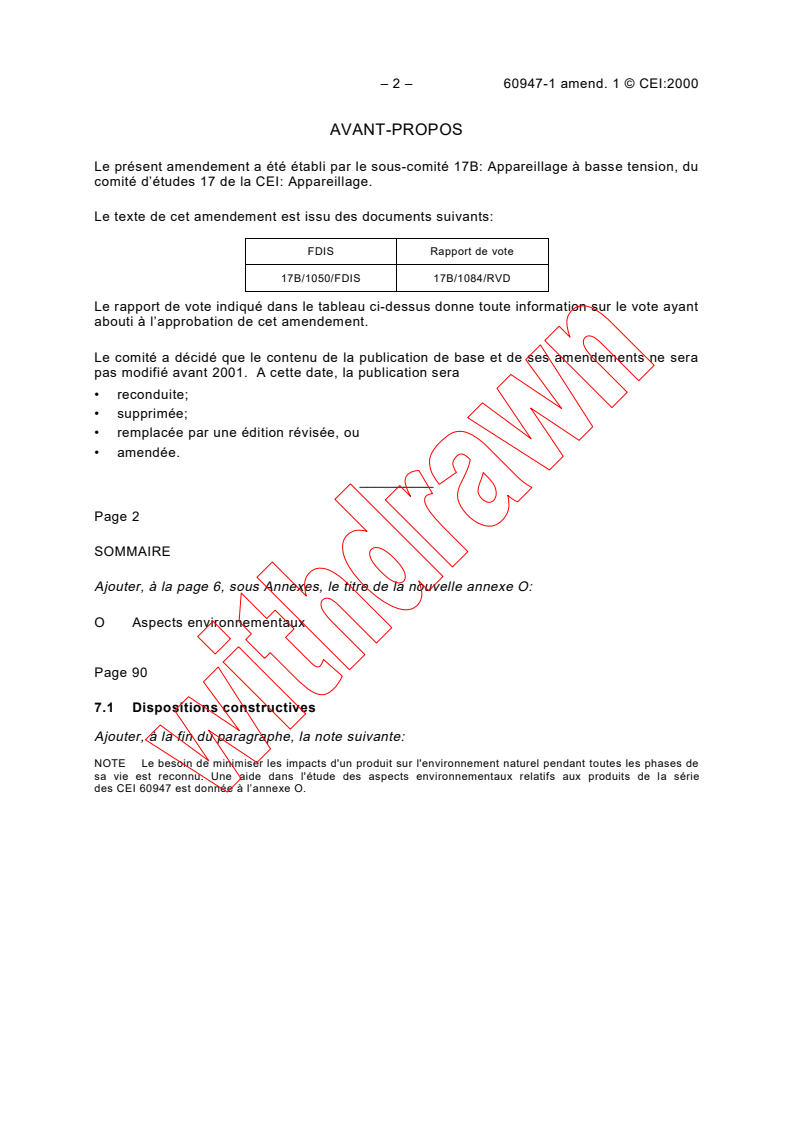
AVANT-PROPOS
Le présent amendement a été établi par le sous-comité 17B: Appareillage à basse tension, du
comité d’études 17 de la CEI: Appareillage.
Le texte de cet amendement est issu des documents suivants:
FDIS Rapport de vote
17B/1050/FDIS 17B/1084/RVD
Le rapport de vote indiqué dans le tableau ci-dessus donne toute information sur le vote ayant
abouti à l’approbation de cet amendement.
Le comité a décidé que le contenu de la publication de base et de ses amendements ne sera
pas modifié avant 2001. A cette date, la publication sera
• reconduite;
• supprimée;
• remplacée par une édition révisée, ou
• amendée.
__________
Page 2
SOMMAIRE
Ajouter, à la page 6, sous Annexes, le titre de la nouvelle annexe O:
O Aspects environnementaux
Page 90
7.1 Dispositions constructives
Ajouter, à la fin du paragraphe, la note suivante:
NOTE Le besoin de minimiser les impacts d'un produit sur l'environnement naturel pendant toutes les phases de
sa vie est reconnu. Une aide dans l'étude des aspects environnementaux relatifs aux produits de la série
des CEI 60947 est donnée à l’annexe O.
60947-1 Amend. 1 © IEC:2000 – 3 –
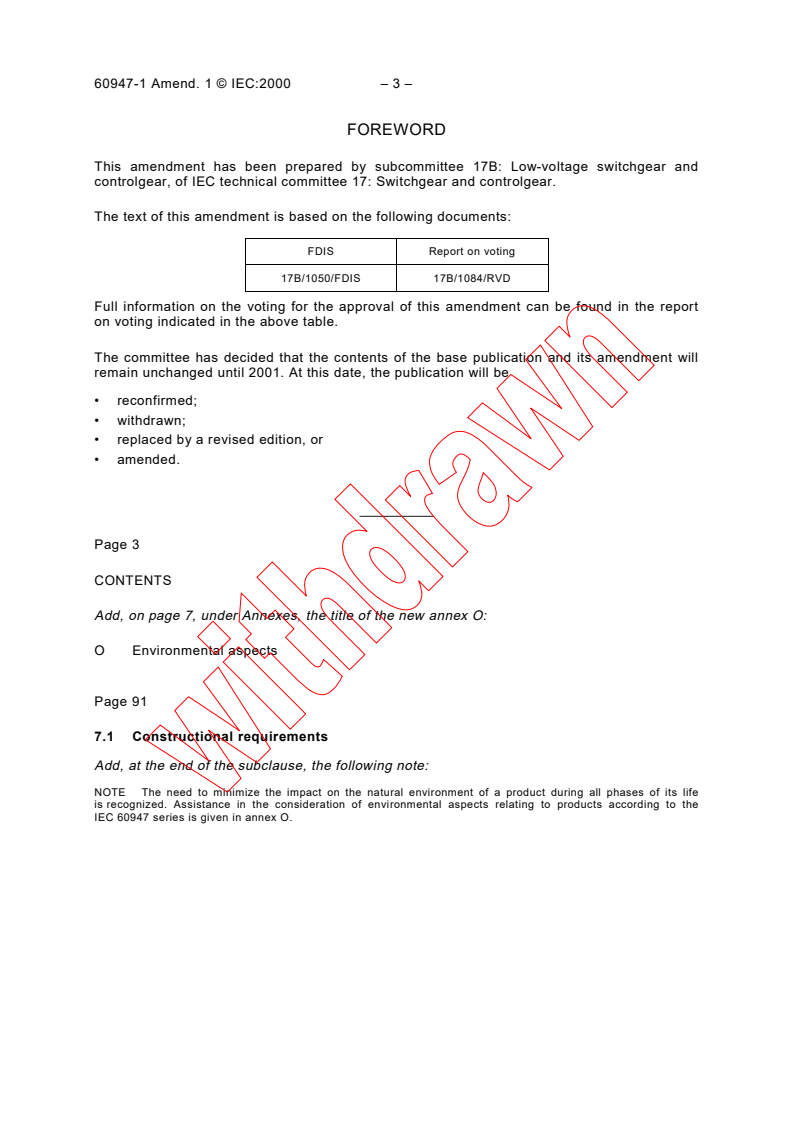
FOREWORD
This amendment has been prepared by subcommittee 17B: Low-voltage switchgear and
controlgear, of IEC technical committee 17: Switchgear and controlgear.
The text of this amendment is based on the following documents:
FDIS Report on voting
17B/1050/FDIS 17B/1084/RVD
Full information on the voting for the approval of this amendment can be found in the report
on voting indicated in the above table.
The committee has decided that the contents of the base publication and its amendment will
remain unchanged until 2001. At this date, the publication will be
• reconfirmed;
• withdrawn;
• replaced by a revised edition, or
• amended.
__________
Page 3
CONTENTS
Add, on page 7, under Annexes, the title of the new annex O:
O Environmental aspects
Page 91
7.1 Constructional requirements
Add, at the end of the subclause, the following note:
NOTE The need to minimize the impact on the natural environment of a product during all phases of its life
is recognized. Assistance in the consideration of environmental aspects relating to products according to the
IEC 60947 series is given in annex O.
– 4 – 60947-1 amend. 1 © CEI:2000
Page 324
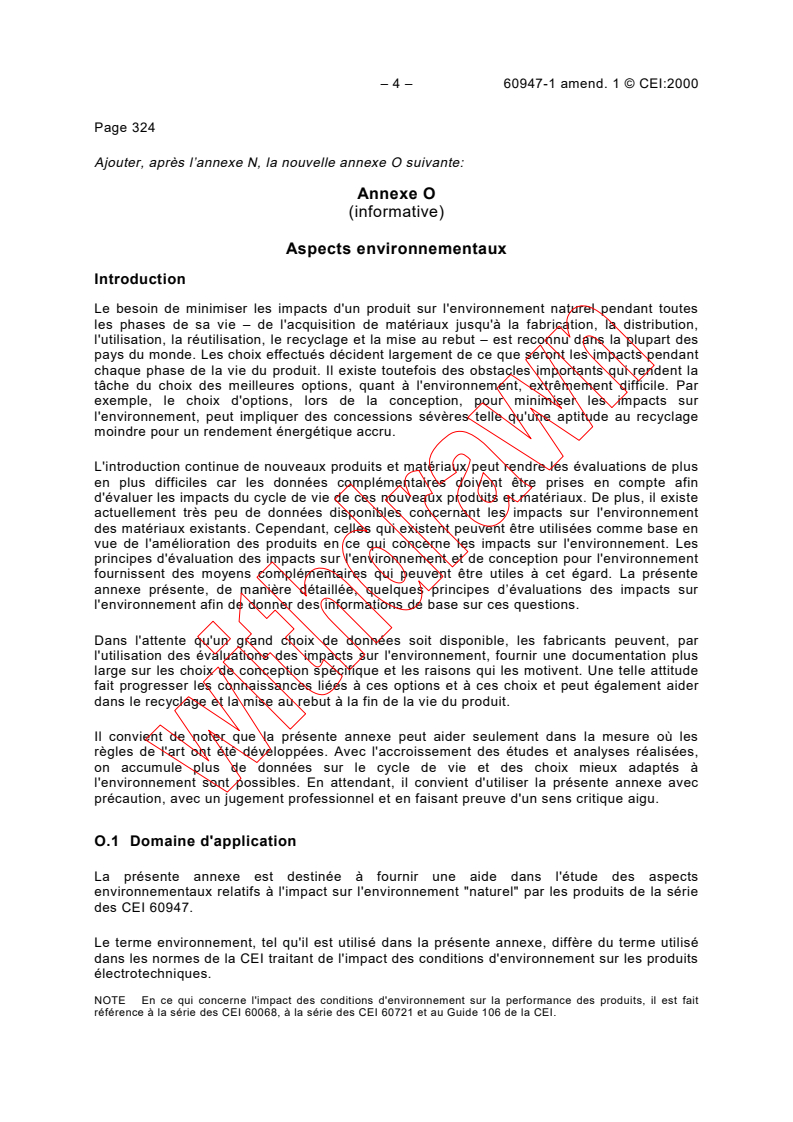
Ajouter, après l’annexe N, la nouvelle annexe O suivante:
Annexe O
(informative)
Aspects environnementaux
Introduction
Le besoin de minimiser les impacts d'un produit sur l'environnement naturel pendant toutes
les phases de sa vie – de l'acquisition de matériaux jusqu'à la fabrication, la distribution,
l'utilisation, la réutilisation, le recyclage et la mise au rebut – est reconnu dans la plupart des
pays du monde. Les choix effectués décident largement de ce que seront les impacts pendant
chaque phase de la vie du produit. Il existe toutefois des obstacles importants qui rendent la
tâche du choix des meilleures options, quant à l'environnement, extrêmement difficile. Par
exemple, le choix d'options, lors de la conception, pour minimiser les impacts sur
l'environnement, peut impliquer des concessions sévères telle qu'une aptitude au recyclage
moindre pour un rendement énergétique accru.
L'introduction continue de nouveaux produits et matériaux peut rendre les évaluations de plus
en plus difficiles car les données complémentaires doivent être prises en compte afin
d'évaluer les impacts du cycle de vie de ces nouveaux produits et matériaux. De plus, il existe
actuellement très peu de données disponibles concernant les impacts sur l'environnement
des matériaux existants. Cependant, celles qui existent peuvent être utilisées comme base en
vue de l'amélioration des produits en ce qui concerne les impacts sur l'environnement. Les
principes d'évaluation des impacts sur l'environnement et de conception pour l'environnement
fournissent des moyens complémentaires qui peuvent être utiles à cet égard. La présente
annexe présente, de manière détaillée, quelques principes d’évaluations des impacts sur
l'environnement afin de donner des informations de base sur ces questions.
Dans l'attente qu'un grand choix de données soit disponible, les fabricants peuvent, par
l'utilisation des évaluations des impacts sur l'environnement, fournir une documentation plus
large sur les choix de conception spécifique et les raisons qui les motivent. Une telle attitude
fait progresser les connaissances liées à ces options et à ces choix et peut également aider
dans le recyclage et la mise au rebut à la fin de la vie du produit.
Il convient de noter que la présente annexe peut aider seulement dans la mesure où les
règles de l'art ont été développées. Avec l'accroissement des études et analyses réalisées,
on accumule plus de données sur le cycle de vie et des choix mieux adaptés à
l'environnement sont possibles. En attendant, il convient d'utiliser la présente annexe avec
précaution, avec un jugement professionnel et en faisant preuve d'un sens critique aigu.
O.1 Domaine d'application
La présente annexe est destinée à fournir une aide dans l'étude des aspects
environnementaux relatifs à l'impact sur l'environnement "naturel" par les produits de la série
des CEI 60947.
Le terme environnement, tel qu'il est utilisé dans la présente annexe, diffère du terme utilisé
dans les normes de la CEI traitant de l'impact des conditions d'environnement sur les produits
électrotechniques.
NOTE En ce qui concerne l'impact des conditions d'environnement sur la performance des produits, il est fait
référence à la série des CEI 60068, à la série des CEI 60721 et au Guide 106 de la CEI.
60947-1 Amend. 1 © IEC:2000 – 5 –
Page 325
Add, after annex N, the following new annex O:
Annex O
(informative)
Environmental aspects
Introduction
The need to minimize the impact on the natural environment of a product during all phases of
its life − from acquiring materials to manufacturing, distribution, use, re-use, recycling and
disposal − is recognized in most countries around the world. The choices made largely decide
what those impacts will be during each phase of that product’s life. There are, however,
considerable obstacles that make the task of selecting the best environmental options very
difficult. For example, selecting design options to minimize environmental impact can involve
difficult trade-off such as less recyclability for more energy efficiency.
The continuous introduction of new products and materials can make evaluation increasingly
difficult, since additional data must be developed to assess the life cycle impacts of such new
products and materials. Moreover, there is currently very little data available on the
environmental impacts of existing materials. However, those which exist can be used as a
basis for improvement of the products with respect to environmental impact. Environmental
impact assessment (EIA) and design for environment (DFE) principles provide additional
instruments that may be useful in this respect. This annex details some EIA principles to give
background information on these issues.
Until more data are available, manufacturers can document more extensively, through the use
of environmental impact assessments (EIAs), the specific design choices and the reasons
behind them. This expands the knowledge based on such options and choices, and it may
also assist in the recycling and disposal of the product at the end of life (EOL).
It should be noted that this annex can assist only insofar as the state of the art has been
developed. As more studies and analyses are completed, more life-cycle data will be
accumulated and better environmentally sound choices will be possible. Until then, the
recommendation is to use this annex with care, professional judgement and a sound critical
ability.
O.1 Scope
This annex is intended to give assistance in the consideration of environmental aspects
relating to the impacts on the “natural” environment of products of the IEC 60947 series.
The term environment, as used in this annex, differs from the term used in the IEC standards
dealing with the impact of environmental conditions on electrotechnical products.
NOTE As regards the impact of environmental conditions on the performance of products, reference is made to
the IEC 60068 and IEC 60721 series and to IEC Guide 106.
– 6 – 60947-1 amend. 1 © CEI:2000
O.2 Définitions
Pour les besoins de la présente annexe, les définitions suivantes s'appliquent.
O.2.1
environnement "naturel" (désigné ci-après environnement)
éléments qui affectent la qualité de la vie tels que la qualité de l'eau, de l'air et du sol ainsi
que la préservation de l'énergie et des matériaux, et la réduction du gaspillage
O.2.2
cycle de vie
étapes consécutives et reliées entre elles, et tous les intrants et sortants significatifs
directement associés d'un système à partir de l'extraction ou de l'exploitation des ressources
naturelles jusqu'à la mise au rebut définitive de tous les matériaux comme étant des déchets
irrécupérables ou de l'énergie dissipée
O.2.3
analyse du cycle de vie
ensemble systématique de procédures destinées à compiler et à examiner les entrées et les
sorties de matériaux et d'énergie, et les impacts sur l'environnement associés pouvant être
attribués directement au fonctionnement d'un système économique pendant toute la durée de
son cycle de vie
O.2.4
contrainte sur l'environnement
tout changement apporté à l'environnement susceptible, en permanence ou provisoirement,
d'entraîner la perte de ressources naturelles ou la détérioration de la qualité naturelle de l'air,
de l'eau ou du sol
O.2.5
impact sur l'environnement
conséquences pour la santé de l'homme, pour le bien-être de la flore et de la faune ou pour la
disponibilité future de ressources naturelles, attribuables aux intrants et sortants d'un
système
O.2.6
évaluation des impacts sur l'environnement
procédé pour déterminer l'ampleur et l'importance des impacts sur l'environnement dans la
limite des cibles, domaine d'application et objectifs définis dans l'évaluation du cycle de vie
O.2.7
recyclage
ensemble de procédés destinés à détourner des matériaux, qui seraient autrement mis au
rebut comme des déchets, vers un système économique où ils contribuent à la production de
matériaux utiles
O.2.8
aptitude au recyclage
propriété d'une substance, ou d'un matériau et des pièces fabriquées à partir de ces
substances ou matériaux, leur permettant d'être recyclés
O.2.9
fin de vie
état d'un produit lorsqu'il est définitivement mis hors d'emploi
60947-1 Amend. 1 © IEC:2000 – 7 –
O.2 Definitions
For the purpose of this annex, the following definitions apply.
O.2.1
“natural” environment (hereinafter referred to as environment)
attributes which affect the quality of life, such as water, air, and soil quality, conservation of
energy and materials and avoidance of waste
O.2.2
life cycle
consecutive and interlinked stages, and all directly associated significant inputs and outputs,
of a system from the extraction or exploitation of natural resources to the final disposal of all
materials as irretrievable wastes or dissipated energy
O.2.3
life cycle assessment (LCA)
systematic set of procedures for compiling and examining the inputs and outputs of materials
and energy and associated environmental impacts directly attributable to the functioning of an
economic system throughout its life cycle
O.2.4
environmental burden
any change to the environment which, permanently or temporarily, results in loss of natural
resources or deterioration of the natural quality of air, water or soil
O.2.5
environmental impact
consequences for human health, for the well-being of flora and fauna or for the future
availability of natural resources, attributable to the input and output streams of a system
O.2.6
environmental impact assessment (EIA)
process to determine the magnitude and significance of environmental impacts within the
confines of the goals, scope and objectives defined in the life cycle assessment
O.2.7
recycling
set of processes for diverting materials that would otherwise be disposed of as wastes, into
an economic system where they contribute to the production of useful material
O.2.8
recyclability
property of a substance or a material and parts made thereof that makes it possible to be
recycled
O.2.9
end of life
state of a product when it is finally removed from use
– 8 – 60947-1 amend. 1 © CEI:2000
O.2.10
conception pour l'environnement
ensemble de procédures destinées à la conception d'un produit pour optimiser les
caractéristiques écologiques du produit soumis aux conditions techniques et économiques
existantes
O.3 Considérations générales
Il convient de vérifier que la considération des points suivants conduise toujours à minimiser
l'impact du produit sur l'environnement pendant son cycle de vie:
− la préservation des matériaux pour la sauvegarde des ressources;
− l'usage efficace de l'énergie et des ressources;
− la réduction des émissions et des déchets;
− le contenu minimal en matériau d'un produit (y compris le matériau d'emballage);
− la diminution du nombre de matériaux différents;
− la substitution ou la réduction de l'utilisation de substances dangereuses;
− la réutilisation/remise à neuf des sous-assemblages ou des composants;
− la conception pour rendre facile la maintenance, le démontage et l'aptitude au recyclage si
applicable;
− le revêtement de surface ou d'autres combinaisons de matériaux gênant l'aptitude au
recyclage;
− le mode d'emploi/l'information adéquate relative à l'environnement pour l'utilisateur.
O.4 Intrants et sortants à considérer
O.4.1 Généralités
La figure O.1, établie sur la base des travaux de l'ISO/TC 207/GT1, indique les liens existants
entre les étapes du principe de cycle de vie environnemental d'un produit, la fonction d'un
produit, sa conception, ses performances et d'autres éléments externes. Les objectifs
principaux des normes d'environnement font aussi l'objet d'une liste, avec la consommation
de matériaux et d'énergie, les émissions dans l'environnement, l'aptitude au recyclage et le
démontage. A chaque étape du cycle de vie du produit, il est recommandé d'examiner
l'équilibre matériaux/énergie. Lorsque les données seront disponibles, l'étude couvrira
l'ensemble du cycle de vie "du début à la fin". La figure O.1 est également l'illustration des
cycles de l'amélioration d'un produit qui aboutira à la prévention de la pollution et à la
préservation des ressources.
O.4.2 Intrants et sortants
Les impacts d'un produit sur l’environnement sont largement déterminés par les intrants qui
sont utilisés et les sortants qui sont générés à tous les stades du cycle de vie des produits. Le
changement d'un seul intrant, soit pour altérer les matériaux et l'énergie utilisés, soit pour
influencer un seul sortant, peut affecter d'autres intrants et sortants (voir figure O.1).
60947-1 Amend. 1 © IEC:2000 – 9 –
O.2.10
design for environment (DFE)
set of procedures for designing a product to optimize ecological features of the product under
existing technical and economical conditions
O.3 General considerations
It should be checked that consideration of the following points always leads to minimizing the
environmental impacts of the product throughout its life cycle:
− material conservation for preservation of resources;
− efficient use of energy and resources;
− reduction of emissions and waste;
− minimum material content of product (including packaging material);
− decreasing the number of different materials;
− substitution or reduction in use of hazardous substances;
− re-use/refurbishing of subassemblies or components;
− design for easy maintainability, disassembly and recyclability if applicable;
− surface coating or other material combinations impeding recyclability;
− adequate environmental instruction/information for the user.
O.4 Inputs and outputs to be considered
O.4.1 General
Figure O.1, based on the work of ISO/TC 207/WG1, presents the correlation between
principal steps in the environmental life cycle of a product, the product’s function, its design,
performance and other external considerations. The major objectives of environmental
standards are also listed, namely consumption of material and energy, environmental
emissions, recyclability, disassembly. At each step of a product’s life cycle the materials and
energy balance should be considered. When data are available, the study will cover the span
of the life cycle from “cradle to grave”. Figure O.1 also illustrate
...