

IEC TS 61244-2:2014
(Main)Determination of long-term radiation ageing in polymers - Part 2: Procedures for predicting ageing at low dose rates
General Information
- Abstract
IEC TS 61244-2:2014, which is a technical specification, applies to procedures for predicting ageing of polymeric materials at low dose rates. The object is to present three methods which can be used to extrapolate data obtained from high dose rate experiments to the low dose rates typical of service conditions. The techniques described are methods which have been found to be useful for a range of elastomeric, thermoplastic and thermoset materials. This edition includes the following significant technical changes with respect to the previous edition:
a) examples and background information moved to annexes;
b) examples updated with more recent references.
- Status
- Published
- Publication Date
- 21-Aug-2014
- Technical Committee
- TC 112 - Evaluation and qualification of electrical insulating materials and systems
- Drafting Committee
- WG 2 - TC 112/WG 2
- Current Stage
- PPUB - Publication issued
- Start Date
- 22-Aug-2014
- Completion Date
- 30-Nov-2014
Overview
IEC TS 61244-2:2014, titled "Determination of long-term radiation ageing in polymers – Part 2: Procedures for predicting ageing at low dose rates", is an important technical specification developed by the International Electrotechnical Commission (IEC). This document focuses on methods to predict the ageing behavior of polymeric materials under low radiation dose rates, which are typical of real-life service conditions. Since accelerated ageing tests often use higher dose rates that differ from operational environments, the specification addresses how to reliably extrapolate high dose rate experimental data to these lower dose rates. This helps in assessing the long-term durability and performance of various polymers exposed to radiation.
Designed primarily for materials such as elastomers, thermoplastics, and thermosets, the standard provides three key procedures useful across a broad spectrum of polymeric materials. The 2014 edition updates examples and background information to reflect recent research and technology advancements.
Key Topics
Power Law Extrapolation Method
This method uses mathematical models based on power laws to extend ageing predictions from high to low dose rates. It involves fitting experimental data and determining model parameters to enable reliable extrapolation.Superposition of Time Dependent Data
This technique relies on the principle of superposition, combining data sets at varying times and conditions to create a master curve that predicts polymer ageing behavior under low dose rates. It includes test procedures for thermal and combined radiation-thermal ageing.Superposition of Dose to Equivalent Damage (DED) Data
This method superimposes data based on dose and equivalent damage levels to predict the polymer degradation at lower dose rates. The approach accounts for thermal-radiation interactions and complex dose rate dependencies.Limitations and Applicability
The standard clearly defines where each method applies effectively, along with any constraints, ensuring users apply the procedures within valid conditions for accuracy.Annexes with Practical Examples
Annexes provide illustrative case studies across different polymer types like polypropylene, crosslinked polyethylene (XLPE), neoprene cable jackets, and others, demonstrating practical application of the methods.
Applications
IEC TS 61244-2:2014 is highly valuable for industries and researchers involved in the evaluation of polymer materials exposed to radiation over long durations. Key application areas include:
Nuclear Power and Radiation Environments
Predicting the lifespan and performance degradation of polymeric insulating materials, cable jackets, and elastomers used in nuclear reactors or radiation-exposed electrical equipment.Electrical Insulation Materials
Assessing insulation reliability in power cables and components where polymer ageing affects safety and operation.Medical and Industrial Radiochemistry
Guiding material selection and lifetime estimation for polymers used in devices or environments with radiation exposure.Research and Development
Supporting the development of new polymer formulations with enhanced radiation resistance by enabling accurate lifetime predictions.Quality Assurance and Compliance
Assisting manufacturers in conforming to international standards for radiation ageing testing and reporting.
The standard’s focus on low dose rate predictions ensures that testing approaches reflect real operating scenarios, leading to safer, more durable polymer-based solutions in critical sectors.
Related Standards
IEC TS 61244-1: Standards for Determination of Radiation Ageing in Polymers
Part 1 covers general procedures and high dose rate testing, complementing Part 2’s low dose rate prediction methods.IEC 60544 Series: Evaluation and Qualification of Electrical Insulating Materials and Systems
Broader standards for assessing electrical insulation materials, often used alongside TS 61244-2 for comprehensive polymer ageing evaluation.ISO 11137: Sterilization of Health Care Products - Radiation
Relevant for polymers used in medical applications exposed to radiation sterilization.ASTM Standards on Polymer Ageing
Various ASTM methods address polymer degradation, providing comparative frameworks supporting IEC methodologies.
Using IEC TS 61244-2 in conjunction with these and other related international standards ensures a rigorous, globally harmonized approach to predicting and managing polymer ageing under radiation exposure.
By following the procedures outlined in IEC TS 61244-2:2014, professionals can confidently predict long-term radiation ageing effects at service-relevant low dose rates, enhancing material reliability and extending the life of critical polymer-based components. This supports improved safety, performance, and sustainability in electrical engineering and related industries.
Get Certified
Connect with accredited certification bodies for this standard

IMQ S.p.A. (Certification)
Italian electrical product certification.

SLG Prüf- und Zertifizierungs GmbH
German testing and certification body.

UL Solutions
Global safety science company with testing, inspection and certification.
Sponsored listings
Frequently Asked Questions
IEC TS 61244-2:2014 is a technical specification published by the International Electrotechnical Commission (IEC). Its full title is "Determination of long-term radiation ageing in polymers - Part 2: Procedures for predicting ageing at low dose rates". This standard covers: IEC TS 61244-2:2014, which is a technical specification, applies to procedures for predicting ageing of polymeric materials at low dose rates. The object is to present three methods which can be used to extrapolate data obtained from high dose rate experiments to the low dose rates typical of service conditions. The techniques described are methods which have been found to be useful for a range of elastomeric, thermoplastic and thermoset materials. This edition includes the following significant technical changes with respect to the previous edition: a) examples and background information moved to annexes; b) examples updated with more recent references.
IEC TS 61244-2:2014, which is a technical specification, applies to procedures for predicting ageing of polymeric materials at low dose rates. The object is to present three methods which can be used to extrapolate data obtained from high dose rate experiments to the low dose rates typical of service conditions. The techniques described are methods which have been found to be useful for a range of elastomeric, thermoplastic and thermoset materials. This edition includes the following significant technical changes with respect to the previous edition: a) examples and background information moved to annexes; b) examples updated with more recent references.
IEC TS 61244-2:2014 is classified under the following ICS (International Classification for Standards) categories: 17.240 - Radiation measurements; 29.035.01 - Insulating materials in general. The ICS classification helps identify the subject area and facilitates finding related standards.
IEC TS 61244-2:2014 is available in PDF format for immediate download after purchase. The document can be added to your cart and obtained through the secure checkout process. Digital delivery ensures instant access to the complete standard document.
Standards Content (Sample)
IEC TS 61244-2 ®
Edition 2.0 2014-08
TECHNICAL
SPECIFICATION
SPECIFICATION
TECHNIQUE
Determination of long-term radiation ageing in polymers –
Part 2: Procedures for predicting ageing at low dose rates
Détermination du vieillissement à long terme sous rayonnement dans les
polymères –
Partie 2: Méthodes pour prédire le vieillissement à faible débit de dose
All rights reserved. Unless otherwise specified, no part of this publication may be reproduced or utilized in any form
or by any means, electronic or mechanical, including photocopying and microfilm, without permission in writing from
either IEC or IEC's member National Committee in the country of the requester. If you have any questions about IEC
copyright or have an enquiry about obtaining additional rights to this publication, please contact the address below or
your local IEC member National Committee for further information.
Droits de reproduction réservés. Sauf indication contraire, aucune partie de cette publication ne peut être reproduite
ni utilisée sous quelque forme que ce soit et par aucun procédé, électronique ou mécanique, y compris la photocopie
et les microfilms, sans l'accord écrit de l'IEC ou du Comité national de l'IEC du pays du demandeur. Si vous avez des
questions sur le copyright de l'IEC ou si vous désirez obtenir des droits supplémentaires sur cette publication, utilisez
les coordonnées ci-après ou contactez le Comité national de l'IEC de votre pays de résidence.
IEC Central Office Tel.: +41 22 919 02 11
3, rue de Varembé Fax: +41 22 919 03 00
CH-1211 Geneva 20 info@iec.ch
Switzerland www.iec.ch
About the IEC
The International Electrotechnical Commission (IEC) is the leading global organization that prepares and publishes
International Standards for all electrical, electronic and related technologies.
About IEC publications
The technical content of IEC publications is kept under constant review by the IEC. Please make sure that you have the
latest edition, a corrigenda or an amendment might have been published.
IEC Catalogue - webstore.iec.ch/catalogue Electropedia - www.electropedia.org
The stand-alone application for consulting the entire The world's leading online dictionary of electronic and
bibliographical information on IEC International Standards, electrical terms containing more than 30 000 terms and
Technical Specifications, Technical Reports and other definitions in English and French, with equivalent terms in 14
documents. Available for PC, Mac OS, Android Tablets and additional languages. Also known as the International
iPad. Electrotechnical Vocabulary (IEV) online.
IEC publications search - www.iec.ch/searchpub IEC Glossary - std.iec.ch/glossary
The advanced search enables to find IEC publications by a More than 55 000 electrotechnical terminology entries in
variety of criteria (reference number, text, technical English and French extracted from the Terms and Definitions
committee,…). It also gives information on projects, replaced clause of IEC publications issued since 2002. Some entries
and withdrawn publications. have been collected from earlier publications of IEC TC 37,
77, 86 and CISPR.
IEC Just Published - webstore.iec.ch/justpublished
Stay up to date on all new IEC publications. Just Published IEC Customer Service Centre - webstore.iec.ch/csc
details all new publications released. Available online and If you wish to give us your feedback on this publication or
also once a month by email. need further assistance, please contact the Customer Service
Centre: csc@iec.ch.
A propos de l'IEC
La Commission Electrotechnique Internationale (IEC) est la première organisation mondiale qui élabore et publie des
Normes internationales pour tout ce qui a trait à l'électricité, à l'électronique et aux technologies apparentées.
A propos des publications IEC
Le contenu technique des publications IEC est constamment revu. Veuillez vous assurer que vous possédez l’édition la
plus récente, un corrigendum ou amendement peut avoir été publié.
Catalogue IEC - webstore.iec.ch/catalogue Electropedia - www.electropedia.org
Application autonome pour consulter tous les renseignements
Le premier dictionnaire en ligne de termes électroniques et
bibliographiques sur les Normes internationales,
électriques. Il contient plus de 30 000 termes et définitions en
Spécifications techniques, Rapports techniques et autres
anglais et en français, ainsi que les termes équivalents dans
documents de l'IEC. Disponible pour PC, Mac OS, tablettes
14 langues additionnelles. Egalement appelé Vocabulaire
Android et iPad.
Electrotechnique International (IEV) en ligne.
Recherche de publications IEC - www.iec.ch/searchpub
Glossaire IEC - std.iec.ch/glossary
La recherche avancée permet de trouver des publications IEC Plus de 55 000 entrées terminologiques électrotechniques, en
en utilisant différents critères (numéro de référence, texte, anglais et en français, extraites des articles Termes et
comité d’études,…). Elle donne aussi des informations sur les Définitions des publications IEC parues depuis 2002. Plus
projets et les publications remplacées ou retirées. certaines entrées antérieures extraites des publications des
CE 37, 77, 86 et CISPR de l'IEC.
IEC Just Published - webstore.iec.ch/justpublished
Service Clients - webstore.iec.ch/csc
Restez informé sur les nouvelles publications IEC. Just
Published détaille les nouvelles publications parues. Si vous désirez nous donner des commentaires sur cette
Disponible en ligne et aussi une fois par mois par email. publication ou si vous avez des questions contactez-nous:
csc@iec.ch.
IEC TS 61244-2 ®
Edition 2.0 2014-08
TECHNICAL
SPECIFICATION
SPECIFICATION
TECHNIQUE
Determination of long-term radiation ageing in polymers –
Part 2: Procedures for predicting ageing at low dose rates
Détermination du vieillissement à long terme sous rayonnement dans les
polymères –
Partie 2: Méthodes pour prédire le vieillissement à faible débit de dose
INTERNATIONAL
ELECTROTECHNICAL
COMMISSION
COMMISSION
ELECTROTECHNIQUE
PRICE CODE
INTERNATIONALE
V
CODE PRIX
ICS 17.240; 29.035.01 ISBN 978-2-8322-1828-0
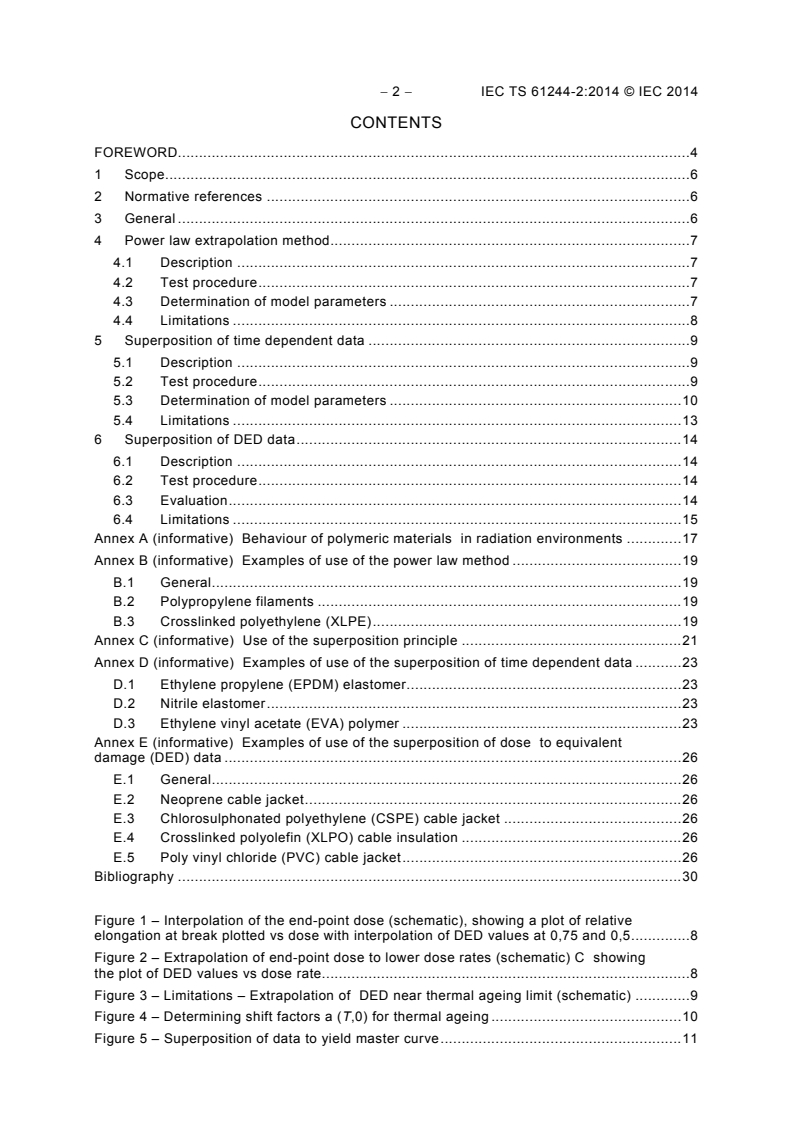
− 2 − IEC TS 61244-2:2014 © IEC 2014
CONTENTS
FOREWORD. 4
1 Scope . 6
2 Normative references . 6
3 General . 6
4 Power law extrapolation method . 7
4.1 Description . 7
4.2 Test procedure . 7
4.3 Determination of model parameters . 7
4.4 Limitations . 8
5 Superposition of time dependent data . 9
5.1 Description . 9
5.2 Test procedure . 9
5.3 Determination of model parameters . 10
5.4 Limitations . 13
6 Superposition of DED data . 14
6.1 Description . 14
6.2 Test procedure . 14
6.3 Evaluation . 14
6.4 Limitations . 15
Annex A (informative) Behaviour of polymeric materials in radiation environments . 17
Annex B (informative) Examples of use of the power law method . 19
B.1 General . 19
B.2 Polypropylene filaments . 19
B.3 Crosslinked polyethylene (XLPE) . 19
Annex C (informative) Use of the superposition principle . 21
Annex D (informative) Examples of use of the superposition of time dependent data . 23
D.1 Ethylene propylene (EPDM) elastomer . 23
D.2 Nitrile elastomer . 23
D.3 Ethylene vinyl acetate (EVA) polymer . 23
Annex E (informative) Examples of use of the superposition of dose to equivalent
damage (DED) data . 26
E.1 General . 26
E.2 Neoprene cable jacket . 26
E.3 Chlorosulphonated polyethylene (CSPE) cable jacket . 26
E.4 Crosslinked polyolefin (XLPO) cable insulation . 26
E.5 Poly vinyl chloride (PVC) cable jacket . 26
Bibliography . 30
Figure 1 – Interpolation of the end-point dose (schematic), showing a plot of relative
elongation at break plotted vs dose with interpolation of DED values at 0,75 and 0,5 . 8
Figure 2 – Extrapolation of end-point dose to lower dose rates (schematic) C showing
the plot of DED values vs dose rate. 8
Figure 3 – Limitations – Extrapolation of DED near thermal ageing limit (schematic) . 9
Figure 4 – Determining shift factors a (T,0) for thermal ageing . 10
Figure 5 – Superposition of data to yield master curve . 11
Figure 6 – Determination of activation energy E . 11
D
Figure 7 – Determination of shift factors a (T, ) for combined thermal-radiation
ageing, relative to the master curve in Figure 4 . 12
D
Figure 8 – Fitting experimental values of a (T, ) to the empirical model Equation (2) . 13
Figure 9 – Calculated DED using Equation (5) . 13
Figure 10 – DED values under combined thermal-radiation conditions (schematic) . 15
Figure 11– Superposition of DED data (schematic) . 15
Figure A.1 – Schematic illustrating the types of dose rate effects which can occur in
radiation aged polymeric materials . 18
Figure B.1 – Elongation at break of polypropylene irradiated in air (from [10]) . 19
Figure B.2 – Extrapolation of end-point dose from data in Figure B.1 . 20
Figure B.3 – Dose required to reach 100 % elongation at 20 °C for an XLPE cable
insulation material [11] . 20
Figure C.1 – Schematic – Superposition principle for thermal ageing . 21
Figure C.2 – Schematic – Superposition principle for combined thermal-radiation
ageing . 22
Figure D.1 – Experimental data for EPDM elastomer fitted to the superposition model . 24
Figure D.2 – Calculated DED for 50 % compression set at 20 °C . 24
Figure D.3 – Calculated DED for 50 % compression set at 40 °C . 25
Figure D.4 – Calculated DED for e/e = 0,5 . 25
Figure E.1 – Superposition of DED data at 50 °C for a neoprene cable jacket
material [7] . 27
Figure E.2 – Superposition of DED data for several different CSPE cable jacket
materials . 28
Figure E.3 – Superposition of DED data for a XLPO cable insulation material [7] . 29
Figure E.4 – Superposition of DED data for PVC showing complex dose rate
dependence – Homogeneous oxidation data only . 29
− 4 − IEC TS 61244-2:2014 © IEC 2014
INTERNATIONAL ELECTROTECHNICAL COMMISSION
____________
DETERMINATION OF LONG-TERM RADIATION AGEING IN POLYMERS –
Part 2: Procedures for predicting ageing at low dose rates
FOREWORD
1) The International Electrotechnical Commission (IEC) is a worldwide organization for standardization comprising
all national electrotechnical committees (IEC National Committees). The object of IEC is to promote
international co-operation on all questions concerning standardization in the electrical and electronic fields. To
this end and in addition to other activities, IEC publishes International Standards, Technical Specifications,
Technical Reports, Publicly Available Specifications (PAS) and Guides (hereafter referred to as “IEC
Publication(s)”). Their preparation is entrusted to technical committees; any IEC National Committee interested
in the subject dealt with may participate in this preparatory work. International, governmental and non-
governmental organizations liaising with the IEC also participate in this preparation. IEC collaborates closely
with the International Organization for Standardization (ISO) in accordance with conditions determined by
agreement between the two organizations.
2) The formal decisions or agreements of IEC on technical matters express, as nearly as possible, an international
consensus of opinion on the relevant subjects since each technical committee has representation from all
interested IEC National Committees.
3) IEC Publications have the form of recommendations for international use and are accepted by IEC National
Committees in that sense. While all reasonable efforts are made to ensure that the technical content of IEC
Publications is accurate, IEC cannot be held responsible for the way in which they are used or for any
misinterpretation by any end user.
4) In order to promote international uniformity, IEC National Committees undertake to apply IEC Publications
transparently to the maximum extent possible in their national and regional publications. Any divergence
between any IEC Publication and the corresponding national or regional publication shall be clearly indicated in
the latter.
5) IEC itself does not provide any attestation of conformity. Independent certification bodies provide conformity
assessment services and, in some areas, access to IEC marks of conformity. IEC is not responsible for any
services carried out by independent certification bodies.
6) All users should ensure that they have the latest edition of this publication.
7) No liability shall attach to IEC or its directors, employees, servants or agents including individual experts and
members of its technical committees and IEC National Committees for any personal injury, property damage or
other damage of any nature whatsoever, whether direct or indirect, or for costs (including legal fees) and
expenses arising out of the publication, use of, or reliance upon, this IEC Publication or any other IEC
Publications.
8) Attention is drawn to the Normative references cited in this publication. Use of the referenced publications is
indispensable for the correct application of this publication.
9) Attention is drawn to the possibility that some of the elements of this IEC Publication may be the subject of
patent rights. IEC shall not be held responsible for identifying any or all such patent rights.
The main task of IEC technical committees is to prepare International Standards. In
exceptional circumstances, a technical committee may propose the publication of a technical
specification when
• the required support cannot be obtained for the publication of an International Standard,
despite repeated efforts, or
• the subject is still under technical development or where, for any other reason, there is the
future but no immediate possibility of an agreement on an International Standard.
Technical specifications are subject to review within three years of publication to decide
whether they can be transformed into International Standards.
IEC TS 61244-2, which is a technical specification, has been prepared by IEC technical
committee 112: Evaluation and qualification of electrical insulating materials and systems.
This second edition cancels and replaces the first edition published in 1996 and constitutes a
technical revision.
This edition includes the following significant technical changes with respect to the previous
edition:
a) examples and background information moved to annexes;
b) examples updated with more recent references.
The text of this technical specification is based on the following documents:
Enquiry draft Report on voting
112/288/DTS 112/305/RVC
Full information on the voting for the approval of this technical specification can be found in
the report on voting indicated in the above table.
This publication has been drafted in accordance with the ISO/IEC Directives, Part 2.
A list of all parts in the IEC 61244 series, published under the general title Determination of
long-term ageing in polymers, can be found on the IEC website.
The committee has decided that the contents of this publication will remain unchanged until
the stability date indicated on the IEC web site under "http://webstore.iec.ch" in the data
related to the specific publication. At this date, the publication will be
• transformed into an International standard,
• reconfirmed,
• withdrawn,
• replaced by a revised edition, or
• amended.
− 6 − IEC TS 61244-2:2014 © IEC 2014
DETERMINATION OF LONG-TERM RADIATION AGEING IN POLYMERS –
Part 2: Procedures for predicting ageing at low dose rates
1 Scope
This part of IEC TS 61244, which is a technical specification, applies to procedures for
predicting ageing of polymeric materials at low dose rates.
The object is to present three methods which can be used to extrapolate data obtained from
high dose rate experiments to the low dose rates typical of service conditions. These methods
assume that homogeneous oxidation has been achieved under the test conditions. The
techniques described in the following clauses are methods which have been found to be
useful for a range of elastomeric, thermoplastic and thermoset materials. The procedures
require a considerable number of test data to enable predictions to be made under low dose
rate conditions.
2 Normative references
The following documents, in whole or in part, are normatively referenced in this document and
are indispensable for its application. For dated references, only the edition cited applies. For
undated references, the latest edition of the referenced document (including any
amendments) applies.
IEC 60544-2, Guide for determining the effects of ionizing radiation on insulating materials –
Part 2: Procedures for irradiation and test
IEC 61244-1, Determination of long-term radiation ageing in polymers – Part 1: Techniques
for monitoring diffusion-limited oxidation
3 General
The general guidelines of IEC 60544-2 shall be used in the selection of specimen types,
radiation source, dosimetry and temperature control. All irradiations shall be carried out in air
or at constant oxygen overpressure, although as noted in IEC 61244-1, oxygen overpressure
techniques entail some risk of over-ageing the samples. The homogeneity of oxidation
through the specimen thickness can be checked using profiling techniques such as those
described in IEC 61244-1. The test report shall include details of the irradiation source, dose
rate, atmosphere, temperature, sample type and thickness.
All of the procedures described require extensive data obtained over considerable periods of
time. Each method has been found to be of practical use within its limitations, but none of the
methods can be used where there is more than one mechanism operating with different
apparent activation energies.
The power-law extrapolation method (Clause 4) is the simplest of the predictive techniques
and requires the least amount of experimental data. This procedure cannot be used at dose
rates low enough for thermal ageing to dominate, but appears to be valid for extrapolation of
data obtained at near ambient temperatures (20 °C to 30 °C) for polymers such as polyolefins.
Because of the limited data involved, caution should be used in extrapolating by more than a
factor of 10 in dose rate.
Both of the superposition methods can make use of data obtained under combined
thermal/radiation ageing and are able to predict behaviour in the dose rate regime where
thermal degradation is important, but require considerably more experimental data than the
power-law extrapolation method. The superposition of time-dependent data (Clause 5) is not
applicable to all materials; for instance, it cannot be used with materials which exhibit
complex dose rate effects. Where it is applicable, the procedure does lend itself to calculation
of the effects of quite complex temperature-dose rate conditions. The superposition of dose to
equivalent damage (DED) data (Clause 6) can be used for most materials but, like all of the
procedures, it cannot be used to extrapolate through thermal transitions of the polymer.
The general behaviour of polymeric materials aged in radiation environments is described in
Annex A.
4 Power law extrapolation method
4.1 Description
This method is based on the extrapolation of radiation ageing data obtained under isothermal
conditions in air or in oxygen overpressure over a range of dose rates. The upper limit to the
dose rate is such that homogeneous oxidation conditions are achieved. The test data
obtained at the different dose rates are used to determine endpoint criteria which are
extrapolated graphically to the service dose rate.
4.2 Test procedure
The maximum dose rate at which homogeneous oxidation will occur in the test material shall
be assessed. Information in the literature can be used to support an estimation of the
maximum dose rate, or to calculate or measure the oxidation layer thickness (IEC 61244-1).
Once the maximum dose rate has been established, at least two (preferably three) other dose
rates shall be selected, such that the dose rate range covers at least one order of magnitude.
For each of the dose rates selected, samples of the polymer shall be exposed to radiation for
at least four ageing times and a property measured that is sensitive to the degradation of the
material.
NOTE For cable insulation materials, the measured property would usually be elongation at break; for seal
materials, compression set would be appropriate. Suggested properties for other types of component are given in
IEC 60544-2.
4.3 Determination of model parameters
The measured damage parameter is plotted against absorbed dose to establish the endpoint
at each dose rate. A number of endpoint criteria can be interpolated from the graph (Figure 1);
typical endpoint criteria can be the reduction of elongation at break e to 100 % or 50 %
absolute. A sufficient number of absorbed doses shall be used to enable the endpoint criterion
to be established without extrapolation.
The dose at which the end point criterion is reached, i.e. dose to equivalent damage (DED), is
plotted against the dose rate in a log-log plot (Figure 2). For most polymers in the radiation-
dominated region, this plot is found to be linear, with a slope of n, enabling extrapolation to
lower dose rates [1] . The endpoint dose is then given by
n
= K⋅ D
DED = (1)
where
___________
Numbers in square brackets refer to the Bibliography.
− 8 − IEC TS 61244-2:2014 © IEC 2014
D is the dose rate;
K and n are empirical constants specific to the material tested. The value of the parameter
n = <1 and is usually in the range 0 to 0,4.
Experimental data at
constant dose rate
0,75
0,5
0,25
DED 0,75 DED 0,5
Dose
IEC
Figure 1 – Interpolation of the end-point dose (schematic), showing a plot of relative
elongation at break plotted vs dose with interpolation of DED values at 0,75 and 0,5
e/e = 0,5
o
e/e = 0,75
o
log dose rate
IEC
NOTE The slope of the plot for each end-point criterion is the parameter n.
Figure 2 – Extrapolation of end-point dose to lower dose rates (schematic) showing the
plot of DED values vs dose rate
4.4 Limitations
This procedure can be a useful method for estimating the behaviour of some polymers at low
dose rates but reference to Figure A.1 immediately shows its potential limitations. For all
materials they have to break down at dose rates low enough for thermal ageing to become
dominant (Figure 3). On a log-log plot of DED versus dose rate used for extrapolation, the
e/e
o
log DED
thermal ageing limit is represented by a line of slope = 1, i.e. constant time conditions,
whereas the slope of the extrapolated data is generally < 1. Extrapolation to dose rates within
the thermally dominated region would give unrealistically high values for the predicted DED.
This problem can be partially accounted for if separate thermal ageing data are available;
these would allow determination of the appropriate thermal only result. If the additional data
indicate that thermal effects will dominate, the thermal results can be used for predictions.
The power law extrapolation method also cannot be used for materials which exhibit complex
dose rate effects such that the log-log plot of DED versus dose rate is non-linear.
Thermal ageing
limit (slope =1)
Extrapolated
DED value
Actual DED value
log dose rate
IEC
NOTE Extrapolation using the parameter n will give significantly higher estimates of DED if extrapolations are
made near to the thermal ageing limit.
Figure 3 – Limitations – Extrapolation of DED near thermal ageing limit (schematic)
Although the linear extrapolation method assumes that homogeneous oxidation conditions
have been obtained in all of the experiments, it appears to be useful in some materials at
dose rates where heterogeneous oxidation would be expected to occur. This may arise
because cracks generated in the thin oxidized surface layer can then propagate through the
bulk unoxidized material, so that the observed macroscopic properties are determined by
degradation in that surface layer.
Some examples of the use of the power law extrapolation method are given in Annex B.
5 Superposition of time dependent data
5.1 Description
The second procedure which can be used to extrapolate to lower dose rates makes use of
additional data obtained at elevated temperatures under irradiation. The method uses the
superposition principle which has been used extensively for thermal ageing (time-temperature
superposition). In this method it is extended to time-temperature-dose rate superposition for
combined thermal-radiation environments [2, 3]. The basic principle of the superposition
technique is described in Annex C.
5.2 Test procedure
Data shall be obtained at a minimum of three dose rates and at least two, preferably three,
temperatures at each of these dose rates. For each of these temperature-dose rate conditions,
measurements shall be made at a minimum of three times. In addition, thermal ageing data on
unirradiated material shall be obtained for at least three temperatures. This is the minimum
log DED
− 10 − IEC TS 61244-2:2014 © IEC 2014
data set for this method; more accurate assessment of the model parameters will be obtained
if more data are available.
5.3 Determination of model parameters
The model based on the superposition of time-dependent data is described by the following
semi-empirical relationship between the superposition shift factor a(T, D) and the temperature
and dose rate [3]. It has been shown to be useful for a number of polymers:
D D
a (T, ) = exp { −E/R (1/T − 1/T )} [1 + k . x . exp {Ex/R (1/T − 1/T )}] (2)
ref ref
where
T is the temperature in Kelvin;
T is the reference temperature; i.e. the temperature at which a (T,0) = 1. For ease
ref
of assessment, T is usually chosen to be one of the temperatures used in the
ref
combined thermal-radiation ageing measurements.
is the dose rate;
D
−1 −1
R is the gas constant (8,314 J.mol .K );
E, k and x are the model parameters. The parameter E is the value of the activation energy
for thermal-only ageing. The parameters k and x are independent of temperature
and dose rate, and determined by fitting the values of a (T, D ) obtained
experimentally to the empirical equation above.
Determination of the model parameters E, k and x is carried out in several stages (as
illustrated by Figures 4 to 8).
The first stage in the evaluation is to superpose plots of the damage parameter versus log
(time) obtained for thermal-only ageing to yield a master curve (Figures 4 and 5).
log a (T1,0)
log a (T2,0)
T T T
1 2 ref
log (time)
IEC
NOTE The curves represent measurements of a damage parameter (e.g. elongation at break) as a function of
ageing time at three different temperatures, one of which is the reference temperature T .
ref
Figure 4 – Determining shift factors a (T,0) for thermal ageing
Damage parameter
Master curve at T = T
ref
log [a (T,0) × time]
IEC
NOTE The experimental data is superposed using the values of a (T, 0) shown in Figure 4 to form a master curve.
Figure 5 – Superposition of data to yield master curve
For the condition where = 0, Equation (2) simplifies to the Arrhenius relationship:
D
a (T,0) = exp {−E/R (1/T − 1/T )} (3)
ref
where
a (T,0) is the shift factor for thermal-only ageing.
The values of the shift factor a (T,0) required to superpose the data at each temperature can
then be plotted versus 1/T, where T is the temperature in Kelvin (Figure 6). The activation
energy E for thermal-only degradation is then determined from the slope of the straight line
plot using Equation (3).
Slope = − log e × E/R
a (T,0) = 1
T = T
ref
-1
1/T (K )
IEC
NOTE The shift factors a (T, 0) are plotted against 1/T to determine the parameter E.
Figure 6 – Determination of activation energy E
Damage parameter
log a (T,0)
− 12 − IEC TS 61244-2:2014 © IEC 2014
In the second stage of the evaluation, the time dependent data obtained under combined
thermal-radiation ageing conditions are superposed on the master curve as shown in Figure 7.
The shift factors a (T, D), at temperature T and dose rate D, required to superpose the data
are determined for each temperature-dose rate condition. At this stage of the evaluation,
values of the shift factor a (T, D) are known for the matrix of temperatures and dose rates
used.
log a (T , D )
1 1
Master curve at T = T
ref
for thermal ageing
log a (T , D )
2 2
T , D T , D
2 2 1 1
log (time)
IEC
D
Figure 7 – Determination of shift factors a (T, ) for combined thermal-radiation ageing,
relative to the master curve in Figure 4
The values of a (T, D) are then plotted against the dose rate D on a log-log plot (Figure 8).
The limiting slope of this plot at high dose rates is the parameter x, since for the condition
T = T , Equation (2) simplifies to
ref
. (4)
D
a (T , D) = 1 + k x
ref
The parameter x usually takes the value x ≤ 1. The parameter k determines the position of the
curve on the dose rate axis.
Having determined the parameters E, k and x from the experimental data, the empirical model
can be used to calculate the DED at lower dose rates or temperatures. This can be
determined using the equation:
.
DED = D t / a(T, D) (5)
m
where
t is the time required to reach the selected damage level at the reference conditions
m
of T = T and D = 0 (i.e. on the master curve);
ref
a(T, D) is calculated from Equation (2). This is shown in Figure 9; the limiting slope of the
log-log plot of DED versus dose rate is (1−x) at high dose rates.
Damage parameter
Best fit of equation (2) to
•
experimental value of a (T, D)
Experimental values
T
ref
T
Limiting
slope = x
T
log dose rate
IEC
D
Figure 8 – Fitting experimental values of a (T, ) to the empirical model Equation (2)
Limiting slope = (1 − x)
T
ref
T
T
log dose rate (Gy/h)
IEC
Figure 9 – Calculated DED using Equation (5)
5.4 Limitations
Despite its semi-empirical nature, the general form of the superposition model (Equation (2))
has been found to be of practical use in radiation environments for a range of polymeric
components and is particularly useful for elastomeric materials. Some examples of the use of
the model are given in Annex D.
This empirical model can only be used for those materials where the shape of the damage
parameter versus log (time) curve does not change with temperature and dose rate. In
practice, this limits its use to those materials where a single mechanism, e.g. oxidation,
dominates both thermal and radiation degradation. If the curve shape changes, superposition
of data is not possible and the method cannot be used. The procedure can satisfactorily
model the change in DED as the material moves from the radiation dominated region into the
thermal dominated region at low dose rate but cannot be used for those materials which show
•
log a (T, D)
log DED
− 14 − IEC TS 61244-2:2014 © IEC 2014
complex dose rate effects. The procedure shall not be used to extrapolate through a thermal
transition of the polymer.
6 Superposition of DED data
6.1 Description
This procedure also makes use of data obtained under combined thermal-radiation ageing.
Time-temperature-dose rate superposition in this case is applied to plots of log DED versus
log (dose rate) rather than damage parameter versus log (time). The shift factors for
superposition of DED versus dose rate data are a function of temperature only and are
determined by the Arrhenius relationship [4]. This procedure can be applied to a wide range of
materials, including those for which superposition of time dependent data is inappropriate.
6.2 Test procedure
Measurements of the damage parameter as a function of dose at several dose rates and at
least two temperatures are needed for superposition to be carried out. Sufficient data needs
to be obtained at each temperature-dose rate condition for the DED value to be determined
without extrapolation. DED can be assessed for a number of damage levels.
6.3 Evaluation
For each temperature-dose rate condition the DED value is determined from a plot of the
damage parameter versus dose as shown in Figure 1. These DED values are then plotted
versus log (dose rate), noting any data which are subject to DLO effects (Figure 10). The data
points are shifted horizontally on the dose rate axis (Figure 11) by using shift factors a (T)
calculated from the Arrhenius relationship (Equation (6)) with an activation energy equal to
that for thermal-only ageing.
a (T) = exp {−E/R (1/T − 1/T )} (6)
ref
where
E is the activation energy;
T is the temperature in Kelvin;
−1. −1
R is the gas constant (8,314 J.mol K );
T is the reference temperature.
ref
T
T
T
log dose rate
IEC
NOTE DED values for three different temperatures have been determined from plots of the damage parameter
versus ageing time, as illustrated in Figure 1.
Figure 10 – DED values under combined thermal-radiation conditions (schematic)
log a (T1)
Thermal ageing at T = T
ref
log a (T2)
log a (T3)
log [D/a(T)]
IEC
NOTE The DED values shown in Figure 10 have been shifted on the log (dose rate) axis by the shift factors a (T),
which are determined from thermal-only ageing.
Figure 11 – Superposition of DED data (schematic)
The superposed curve of DED as a function of dose rate enables prediction of the DED at
lower dose rates than can be accessed experimentally.
6.4 Limitations
Although this procedure can satisfactorily be used to extrapolate data both in the radiation
dominated region and in the thermally dominated region, it cannot be used if the temperature
range of interest is at or near a thermal transition of the polymer. The method can also be
used for materials that show complex behaviour that cannot be simulated by use of the power
log DED
log DED
− 16 − IEC TS 61244-2:2014 © IEC 2014
law nor the superposition of time dependent data. Some examples of the use of this method
are shown in Annex E.
Care shall be taken in using this method for polymeric materials that are semi-crystalline, e.g.
crosslinked polyethylene (XLPE), crosslinked polyolefin (XLPO) and some ethylene propylene
(EPR). In these materials, reverse temperature effects can occur, such that degradation
occurs more rapidly at lower temperatures than at higher temperatures in the presence of
radiation. If this effect occurs, DED values plotted as log DED versus log(dose rate) will only
superpose for temperature above the crystalline melting point (see Annex E) and the method
cannot be used to extrapolate to lower temperatures.
Annex A
(informative)
Behaviour of polymeric materials
in radiation environments
Polymeric materials are important in radiation environments because of their use in a range of
equipment e.g. as seals and gaskets, cable insulation and jackets. The behaviour of polymers
under irradiation is strongly influenced by the atmosphere in which they are irradiated,
particularly the presence of oxygen. When polymers are irradiated in oxygen-containing atmo-
spheres, the irradiation dose required to reach a particular level of degradation usually
changes with dose rate. The existence of such dose rate effects in the radiation ageing of
polymeric materials has been recognised for many years. A sufficient understanding has now
been achieved to enable the development of predictive methodologies. The types of dose rate
effects which are seen in polymers are illustrated schematically in Figure A.1, where DED is
defined as the dose required to reach a specific level of a damage parameter (such as
elongation at break, tensile strength, compression set, etc.).
Figure A.1 illustrates behaviour that is seen in most, but not all, polymers. In an inert
atmosphere, represented by curve 1, degradation is independent of dose rate over a wide
range of dose rates. When dose rates are small enough for thermal degradation effects to
dominate, curve I will approach the line representing thermal ageing under inert conditions.
On a log-log plot of DED versus dose rate, this thermal ageing will be represented by a
straight line of slope equal to one.
In the presence of oxygen, dose rate effects can arise from several processes. At high dose
rates, diffusion limited oxidation becomes important (Figure A.1); in this region DED tends to
increase with increasing dose rate. It should be noted that Figure A.1 is schematic and is only
indicative of the types of behaviour that can occur. The diffusion-limited region in particular is
very dependent on the type of polymer, its thickness, the permeation rate for oxygen and the
sensitivity of the material to surface properties. The observed degradation is strongly
influenced by the thickness of the oxidation layer. At high enough dose rates, oxidation will
only occur in a thin surface layer which does not affect the bulk properties of most polymers.
In this case, the degradation observed is similar to that seen in an inert atmosphere and DED
approaches the inert ageing line. The dose rate above which heterogeneous oxidation occurs
can be determined theoretically or by the use of profiling techniques. These procedures are
discussed in detail in IEC 61244-1.
In the homogeneous oxidation region, dose rate effects are reduced for many polymers; the
slope of the log-log DED versus dose rate plot remains constant or nearly constant with
decreasing dose rate (curve 2 in Figure A.1), until the dose rate is sufficiently low for thermal
degradation to become dominant. The slope of the DED plot against dose rate is determined
by the reaction rate of the dominant chemical reaction. If the reaction rate is high relative to
the initiation rate, the slope is small and may approach zero; whereas at low reaction rates,
the slope is higher but <1.
In a few polymers irradiated in oxygen-containing environments, more complex dose rate
effects are observed in the homogeneous oxidation region.
Additional information on the degradation of polymers can be found in refs [5 – 8]. Much of
this information relates to cable insulation materials but the general principles are applicable
to other polymeric components.
− 18 − IEC TS 61
...