


IEC 62642-3:2010
(Main)Alarm systems - Intrusion and hold-up systems - Part 3: Control and indicating equipment
General Information
- Abstract
IEC 62642-3:2010 specifies the requirements, performance criteria and testing procedures for control and indicating equipment (CIE) intended for use in intrusion and hold-up alarm systems (I&HAS) installed in buildings. This document also applies to CIE to be used in IAS or HAS. The CIE may incorporate processing functions of other I&HAS components or its processing requirements may be distributed among such components.
- Status
- Published
- Publication Date
- 04-Oct-2010
- Technical Committee
- TC 79 - Alarm and electronic security systems
- Current Stage
- PPUB - Publication issued
- Start Date
- 05-Oct-2010
- Completion Date
- 31-Oct-2010


Overview
IEC 62642-3:2010 sets the international standard for control and indicating equipment (CIE) used in intrusion and hold-up alarm systems (I&HAS) installed in buildings. Published by the International Electrotechnical Commission (IEC), this standard specifies essential requirements, performance criteria, and testing procedures to ensure the reliable operation and security of alarm system components responsible for managing and indicating alarms.
This standard applies not only to CIE dedicated to intrusion and hold-up alarm systems but also to equipment used in general intrusion alarm systems (IAS) and hold-up alarm systems (HAS). The document addresses both centralized and distributed processing functions within these alarm systems, ensuring a comprehensive approach to system integrity and function.
Keywords: IEC 62642-3, intrusion alarm systems, hold-up alarm systems, control and indicating equipment, alarm system standards, IEC alarm standards
Key Topics
IEC 62642-3:2010 covers several crucial aspects of control and indicating equipment within security alarm systems, including:
- Functional Requirements: Defines inputs such as intruder detection, hold-up activation, tamper detection, faults, user inputs, and masking. It also sets standards for outputs, operational controls, user authorization, and access levels.
- Security Grade: Specifies the levels of security protection and measures for tamper detection, protection against substitution, and monitoring of unauthorized interference.
- Construction and Environmental Performance: Details design standards to ensure robustness against environmental factors including electromagnetic compatibility (EMC) and other operating conditions.
- Operation and Processing: Covers the processing of alarms, faults, delays, setting and unsetting procedures, inhibit/isolate functions, and event recording for audit trails and incident investigations.
- Testing Procedures: Encompasses laboratory and field testing protocols such as functional, operational, tamper security, substitution monitoring, timing performance, interconnection, and environmental tests.
- Event Recording and Notification: Establishes requirements for logging events at the control equipment and remote locations to maintain system integrity and accountability.
- Product Documentation and Marking: Requires clear installation, maintenance, and operating instructions alongside appropriate labeling to ensure proper system use and compliance verification.
Applications
IEC 62642-3:2010 is integral for manufacturers, system integrators, and security professionals involved in designing, installing, and maintaining intrusion and hold-up alarm systems in commercial, industrial, and residential buildings. Key applications include:
- Designing CIE for modern security alarm panels that coordinate sensors and alarm devices.
- Ensuring compliance in control equipment to meet international safety and security requirements.
- Enhancing the reliability of alarm systems by implementing rigorous tamper protection and fault monitoring.
- Facilitating certification and testing of alarm components to increase trustworthiness for end users.
- Supporting integration of alarm systems with monitoring centers via verified interconnection and communication standards.
- Guiding installers in setting up alarm systems that meet environmental and electromagnetic compatibility standards.
Target Users: Security system manufacturers, certification bodies, installation companies, building security managers
Related Standards
To ensure comprehensive security and compatibility, IEC 62642-3:2010 is often used alongside other IEC and international standards covering alarm systems and components, including:
- IEC 62642-1: General requirements for intrusion and hold-up alarm systems.
- IEC 62642-4: Specification for hold-up alarm systems (HAS) components.
- ISO/IEC 27001: Information security management, relevant for alarm system data protection.
- EN 50131 Series: European standards for alarm systems, notably for intruder alarm system components and system design.
- IEC 61000 Series: Electromagnetic compatibility (EMC) standards critical for alarm equipment operation in complex electrical environments.
Adhering to IEC 62642-3:2010 along with these related standards helps organizations create secure, reliable, and internationally compliant intrusion and hold-up alarm systems.
For more information and access to the official IEC 62642-3:2010 document, visit the IEC Webstore or contact your local IEC member National Committee. Staying updated with standard revisions ensures your alarm system components meet the highest global safety and security benchmarks.
Get Certified
Connect with accredited certification bodies for this standard

CIS Institut d.o.o.
Personal Protective Equipment (PPE) certification body. Notified Body NB-2890 for EU Regulation 2016/425 PPE.

Kiwa BDA Testing
Building and construction product certification.
Kmetijski inštitut Slovenije
Agricultural Institute of Slovenia. Soil testing, plant health, agricultural product analysis.
Sponsored listings
Frequently Asked Questions
IEC 62642-3:2010 is a standard published by the International Electrotechnical Commission (IEC). Its full title is "Alarm systems - Intrusion and hold-up systems - Part 3: Control and indicating equipment". This standard covers: IEC 62642-3:2010 specifies the requirements, performance criteria and testing procedures for control and indicating equipment (CIE) intended for use in intrusion and hold-up alarm systems (I&HAS) installed in buildings. This document also applies to CIE to be used in IAS or HAS. The CIE may incorporate processing functions of other I&HAS components or its processing requirements may be distributed among such components.
IEC 62642-3:2010 specifies the requirements, performance criteria and testing procedures for control and indicating equipment (CIE) intended for use in intrusion and hold-up alarm systems (I&HAS) installed in buildings. This document also applies to CIE to be used in IAS or HAS. The CIE may incorporate processing functions of other I&HAS components or its processing requirements may be distributed among such components.
IEC 62642-3:2010 is classified under the following ICS (International Classification for Standards) categories: 13.320 - Alarm and warning systems. The ICS classification helps identify the subject area and facilitates finding related standards.
IEC 62642-3:2010 is available in PDF format for immediate download after purchase. The document can be added to your cart and obtained through the secure checkout process. Digital delivery ensures instant access to the complete standard document.
Standards Content (Sample)
IEC 62642-3 ®
Edition 1.0 2010-10
INTERNATIONAL
STANDARD
NORME
INTERNATIONALE
Alarm systems – Intrusion and hold-up systems –
Part 3: Control and indicating equipment
Systèmes d’alarme – Systèmes d'alarme contre l’intrusion et les hold-up –
Partie 3: Equipement de contrôle et de signalisation
All rights reserved. Unless otherwise specified, no part of this publication may be reproduced or utilized in any form or by
any means, electronic or mechanical, including photocopying and microfilm, without permission in writing from either IEC or
IEC's member National Committee in the country of the requester.
If you have any questions about IEC copyright or have an enquiry about obtaining additional rights to this publication,
please contact the address below or your local IEC member National Committee for further information.
Droits de reproduction réservés. Sauf indication contraire, aucune partie de cette publication ne peut être reproduite
ni utilisée sous quelque forme que ce soit et par aucun procédé, électronique ou mécanique, y compris la photocopie
et les microfilms, sans l'accord écrit de la CEI ou du Comité national de la CEI du pays du demandeur.
Si vous avez des questions sur le copyright de la CEI ou si vous désirez obtenir des droits supplémentaires sur cette
publication, utilisez les coordonnées ci-après ou contactez le Comité national de la CEI de votre pays de résidence.
IEC Central Office
3, rue de Varembé
CH-1211 Geneva 20
Switzerland
Email: inmail@iec.ch
Web: www.iec.ch
About the IEC
The International Electrotechnical Commission (IEC) is the leading global organization that prepares and publishes
International Standards for all electrical, electronic and related technologies.
About IEC publications
The technical content of IEC publications is kept under constant review by the IEC. Please make sure that you have the
latest edition, a corrigenda or an amendment might have been published.
ƒ Catalogue of IEC publications: www.iec.ch/searchpub
The IEC on-line Catalogue enables you to search by a variety of criteria (reference number, text, technical committee,…).
It also gives information on projects, withdrawn and replaced publications.
ƒ IEC Just Published: www.iec.ch/online_news/justpub
Stay up to date on all new IEC publications. Just Published details twice a month all new publications released. Available
on-line and also by email.
ƒ Electropedia: www.electropedia.org
The world's leading online dictionary of electronic and electrical terms containing more than 20 000 terms and definitions
in English and French, with equivalent terms in additional languages. Also known as the International Electrotechnical
Vocabulary online.
ƒ Customer Service Centre: www.iec.ch/webstore/custserv
If you wish to give us your feedback on this publication or need further assistance, please visit the Customer Service
Centre FAQ or contact us:
Email: csc@iec.ch
Tel.: +41 22 919 02 11
Fax: +41 22 919 03 00
A propos de la CEI
La Commission Electrotechnique Internationale (CEI) est la première organisation mondiale qui élabore et publie des
normes internationales pour tout ce qui a trait à l'électricité, à l'électronique et aux technologies apparentées.
A propos des publications CEI
Le contenu technique des publications de la CEI est constamment revu. Veuillez vous assurer que vous possédez
l’édition la plus récente, un corrigendum ou amendement peut avoir été publié.
ƒ Catalogue des publications de la CEI: www.iec.ch/searchpub/cur_fut-f.htm
Le Catalogue en-ligne de la CEI vous permet d’effectuer des recherches en utilisant différents critères (numéro de référence,
texte, comité d’études,…). Il donne aussi des informations sur les projets et les publications retirées ou remplacées.
ƒ Just Published CEI: www.iec.ch/online_news/justpub
Restez informé sur les nouvelles publications de la CEI. Just Published détaille deux fois par mois les nouvelles
publications parues. Disponible en-ligne et aussi par email.
ƒ Electropedia: www.electropedia.org
Le premier dictionnaire en ligne au monde de termes électroniques et électriques. Il contient plus de 20 000 termes et
définitions en anglais et en français, ainsi que les termes équivalents dans les langues additionnelles. Egalement appelé
Vocabulaire Electrotechnique International en ligne.
ƒ Service Clients: www.iec.ch/webstore/custserv/custserv_entry-f.htm
Si vous désirez nous donner des commentaires sur cette publication ou si vous avez des questions, visitez le FAQ du
Service clients ou contactez-nous:
Email: csc@iec.ch
Tél.: +41 22 919 02 11
Fax: +41 22 919 03 00
IEC 62642-3 ®
Edition 1.0 2010-10
INTERNATIONAL
STANDARD
NORME
INTERNATIONALE
Alarm systems – Intrusion and hold-up systems –
Part 3: Control and indicating equipment
Systèmes d’alarme – Systèmes d'alarme contre l’intrusion et les hold-up –
Partie 3: Equipement de contrôle et de signalisation
INTERNATIONAL
ELECTROTECHNICAL
COMMISSION
COMMISSION
ELECTROTECHNIQUE
PRICE CODE
INTERNATIONALE
XC
CODE PRIX
ICS 13.320 ISBN 978-2-88912-198-4
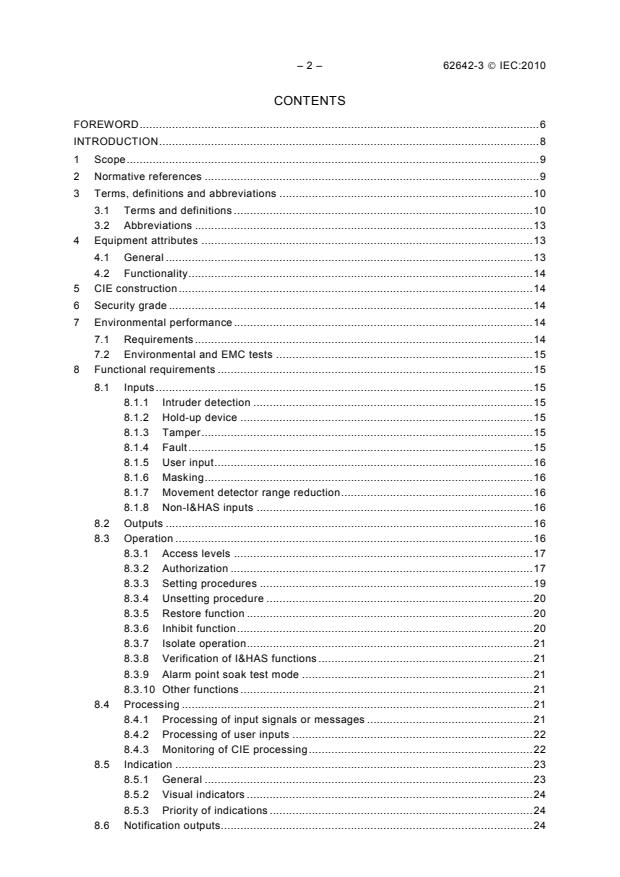
– 2 – 62642-3 © IEC:2010
CONTENTS
FOREWORD.6
INTRODUCTION.8
1 Scope.9
2 Normative references .9
3 Terms, definitions and abbreviations .10
3.1 Terms and definitions .10
3.2 Abbreviations .13
4 Equipment attributes .13
4.1 General .13
4.2 Functionality.14
5 CIE construction.14
6 Security grade .14
7 Environmental performance.14
7.1 Requirements.14
7.2 Environmental and EMC tests .15
8 Functional requirements .15
8.1 Inputs.15
8.1.1 Intruder detection .15
8.1.2 Hold-up device .15
8.1.3 Tamper.15
8.1.4 Fault.15
8.1.5 User input.16
8.1.6 Masking.16
8.1.7 Movement detector range reduction.16
8.1.8 Non-I&HAS inputs .16
8.2 Outputs .16
8.3 Operation .16
8.3.1 Access levels .17
8.3.2 Authorization .17
8.3.3 Setting procedures .19
8.3.4 Unsetting procedure .20
8.3.5 Restore function .20
8.3.6 Inhibit function.20
8.3.7 Isolate operation.21
8.3.8 Verification of I&HAS functions .21
8.3.9 Alarm point soak test mode .21
8.3.10 Other functions .21
8.4 Processing .21
8.4.1 Processing of input signals or messages .21
8.4.2 Processing of user inputs .22
8.4.3 Monitoring of CIE processing.22
8.5 Indication .23
8.5.1 General .23
8.5.2 Visual indicators .24
8.5.3 Priority of indications .24
8.6 Notification outputs.24
62642-3 © IEC:2010 – 3 –
8.6.1 Other notification .24
8.7 Tamper security (detection/protection) .24
8.7.1 Tamper protection .25
8.7.2 Tamper detection.25
8.7.3 Monitoring of substitution.27
8.8 Interconnections.27
8.9 Timing .27
8.10 Event recording .27
8.10.1 Event recording at the CIE.28
8.10.2 Event recording at the ARC or other remote location .28
8.11 Power supply.28
9 Product documentation.29
9.1 Installation and maintenance .29
9.2 Operating instructions .30
10 Marking and labelling .30
11 Tests .30
11.1 Test conditions.30
11.1.1 Laboratory conditions and tolerance .30
11.1.2 Mounting .30
11.1.3 CIE test configuration .31
11.1.4 Power supply.31
11.1.5 Event log checks .31
11.1.6 Documentation .32
11.2 Test procedures .32
11.2.1 Tolerances .32
11.2.2 Wire-free devices .32
11.3 Reduced functional test.32
11.4 Functional tests.33
11.4.1 Processing intruder alarm signals or messages .33
11.4.2 Processing of hold-up signals or messages .35
11.4.3 Processing of tamper signals or messages .37
11.4.4 Processing of fault signals or messages .38
11.4.5 Processing masking signals or messages .40
11.4.6 Processing reduction of range signals or messages.42
11.4.7 CIE processing in the presence of non-I&HAS inputs.43
11.5 Access level .44
11.5.1 Access to the functions and controls.44
11.6 Authorization requirements.45
11.6.1 Mechanical key tests .45
11.6.2 Logical key tests.46
11.6.3 Invalid authorization attempts .48
11.7 Operational tests .49
11.7.1 Setting procedures .49
11.7.2 Prevention of setting and overriding of prevention of setting
procedures .51
11.7.3 The set state .52
11.7.4 Unsetting procedures .52
11.7.5 Setting and/or unsetting automatically at pre-determined times .54
11.7.6 Inhibit and isolate functions.55
– 4 – 62642-3 © IEC:2010
11.7.7 Test functions.57
11.7.8 Other functions.57
11.7.9 Monitoring of CIE processing.58
11.7.10 Availability of indications .59
11.8 Tamper security tests .59
11.8.1 ACE type A.59
11.8.2 Tamper protection .59
11.8.3 Tamper detection – Access to the inside of the housing.60
11.8.4 Tamper detection – Removal from mounting.61
11.8.5 Tamper detection – Penetration of the housing.62
11.9 Substitution tests.62
11.9.1 Tests for monitoring of substitution of components .62
11.9.2 Tests for monitoring of substitution – Timing requirements .62
11.10 Testing of I&HAS timing performance .62
11.11 Testing for interconnections.63
11.11.1 Monitoring of interconnections .63
11.11.2 Testing of monitoring of periodic communication .63
11.11.3 Testing of verification during setting procedure .64
11.11.4 Test for security of communication.65
11.12 Event log .65
11.13 Marking and documentation .66
11.14 Environmental and EMC tests.66
Annex A (informative) Interconnection types .68
Annex B (informative) Summary of timing requirements .70
Annex C (normative) Use of non-I&HAS interface .71
Annex D (informative) Summary of function cross-references .72
Bibliography.75
Figure A.1 – Specific wired interconnections.68
Figure A.2 – Non-specific wired interconnections.69
Figure A.3 – Wire-free interconnections .69
Table 1 – Recognition of additional fault conditions .15
Table 2 – Recognition of biometric keys.18
Table 3 – Time intervals for methods of authorization used in combination .18
Table 4 – Detection of repeated invalid authorization attempts.19
Table 5 – Monitoring of processing .22
Table 6 – Indications supplementary to those of IEC 62642-1 .23
Table 7 – Tamper protection .25
Table 8 – Tamper detection .26
Table 9 – Tool dimension for tamper detection.26
Table 10 – Removal from mounting.26
Table 11 – Additional events to be included in event log .27
Table 12 – Reduced functional test .33
Table 13 – Tests of the processing of intruder signals or messages.34
Table 14 – Tests of the processing of hold-up signals or messages .36
62642-3 © IEC:2010 – 5 –
Table 15 – Tests of the processing of tamper signal or messages.37
Table 16 – Test of processing of fault signals or messages.39
Table 17 – Test of processing of masking signals or messages .41
Table 18 – Test of processing of reduction of range signals or messages .42
Table 19 – Test of CIE processing in the presence of non-I&HAS inputs.44
Table 20 – Test of the access to the functions and controls .44
Table 21 – Test for disabling user input device by invalid keys .48
Table 22 – Test for generation of tamper signal or message by invalid keys .49
Table 23 – Test of setting procedure.50
Table 24 – Test of prevention of setting and overriding of prevention of setting
procedure .51
Table 25 – Test for unsetting procedure.53
Table 26 – Test of setting and/or unsetting automatically at pre-determined times .55
Table 27 – Inhibit and isolate functions .56
Table 28 – Verification of test functions .57
Table 29 – Test of CIE process monitoring.58
Table 30 – Test of availability of indications.59
Table 31 – Test of event log .65
Table 32 – Environmental and EMC tests .67
Table B.1 – Timing table .70
Table C.1 – Conditions for use of non-I&HAS interface for control and indicating
purposes.71
Table D.1 – Cross-references .72
– 6 – 62642-3 © IEC:2010
INTERNATIONAL ELECTROTECHNICAL COMMISSION
____________
ALARM SYSTEMS –
INTRUSION AND HOLD-UP SYSTEMS –
Part 3: Control and indicating equipment
FOREWORD
1) The International Electrotechnical Commission (IEC) is a worldwide organization for standardization comprising
all national electrotechnical committees (IEC National Committees). The object of IEC is to promote
international co-operation on all questions concerning standardization in the electrical and electronic fields. To
this end and in addition to other activities, IEC publishes International Standards, Technical Specifications,
Technical Reports, Publicly Available Specifications (PAS) and Guides (hereafter referred to as “IEC
Publication(s)”). Their preparation is entrusted to technical committees; any IEC National Committee interested
in the subject dealt with may participate in this preparatory work. International, governmental and non-
governmental organizations liaising with the IEC also participate in this preparation. IEC collaborates closely
with the International Organization for Standardization (ISO) in accordance with conditions determined by
agreement between the two organizations.
2) The formal decisions or agreements of IEC on technical matters express, as nearly as possible, an international
consensus of opinion on the relevant subjects since each technical committee has representation from all
interested IEC National Committees.
3) IEC Publications have the form of recommendations for international use and are accepted by IEC National
Committees in that sense. While all reasonable efforts are made to ensure that the technical content of IEC
Publications is accurate, IEC cannot be held responsible for the way in which they are used or for any
misinterpretation by any end user.
4) In order to promote international uniformity, IEC National Committees undertake to apply IEC Publications
transparently to the maximum extent possible in their national and regional publications. Any divergence
between any IEC Publication and the corresponding national or regional publication shall be clearly indicated in
the latter.
5) IEC itself does not provide any attestation of conformity. Independent certification bodies provide conformity
assessment services and, in some areas, access to IEC marks of conformity. IEC is not responsible for any
services carried out by independent certification bodies.
6) All users should ensure that they have the latest edition of this publication.
7) No liability shall attach to IEC or its directors, employees, servants or agents including individual experts and
members of its technical committees and IEC National Committees for any personal injury, property damage or
other damage of any nature whatsoever, whether direct or indirect, or for costs (including legal fees) and
expenses arising out of the publication, use of, or reliance upon, this IEC Publication or any other IEC
Publications.
8) Attention is drawn to the Normative references cited in this publication. Use of the referenced publications is
indispensable for the correct application of this publication.
9) Attention is drawn to the possibility that some of the elements of this IEC Publication may be the subject of
patent rights. IEC shall not be held responsible for identifying any or all such patent rights.
International Standard IEC 62642-3 has been prepared by IEC technical committee 79: Alarm
and electronic security systems.
This standard is based on EN 50131-3 (2006).
The text of this standard is based on the following documents:
FDIS Report on voting
79/310/FDIS 79/321/RVD
Full information on the voting for the approval of this standard can be found in the report on
voting indicated in the above table.
This publication has been drafted in accordance with the ISO/IEC Directives, Part 2.
62642-3 © IEC:2010 – 7 –
A list of all parts of the IEC 62642 series can be found, under the general title Alarm systems
– Intrusion and hold-up systems, on the IEC website.
The committee has decided that the contents of this publication will remain unchanged until
the stability date indicated on the IEC web site under "http://webstore.iec.ch" in the data
related to the specific publication. At this date, the publication will be
• reconfirmed,
• withdrawn,
• replaced by a revised edition, or
• amended.
– 8 – 62642-3 © IEC:2010
INTRODUCTION
This part 3 of the IEC 62642 series of standards gives requirements for control and indicating
equipment used in intrusion and hold-up alarm systems. The other parts of this series of
standards are as follows:
Part 1 System requirements
Part 2-2 Intrusion detectors – Passive infrared detectors
Part 2-3 Intrusion detectors – Microwave detectors
Part 2-4 Intrusion detectors – Combined passive infrared / microwave detectors
Part 2-5 Intrusion detectors – Combined passive infrared / ultrasonic detectors
Part 2-6 Intrusion detectors – Opening contacts (magnetic)
Part 2-71 Intrusion detectors – Glass break detectors – Acoustic
Part 2-72 Intrusion detectors – Glass break detectors – Passive
Part 2-73 Intrusion detectors – Glass break detectors – Active
Part 3 Control and indicating equipment
Part 4 Warning devices
Part 5-3 Interconnections – Requirements for equipment using radio frequency techniques
Part 6 Power supplies
Part 7 Application guidelines
Part 8 Security fog devices/systems
In order to insure the consistency of the whole IEC 62642 series, the terminology is defined at
one place that is the master document IEC 62642-1 that gives general requirements
concerning the intrusion system. Exception is made for specific terms to control and indicating
equipment and where repetition is deemed essential for the clarity of this document.
Reference has been included to various implications arising from the detector standards. Full
detail of the interconnection requirements could be the subject of a future standard.
A number of requirements are contained in this standard for which a formal test procedure
can only be written by defining (and hence restricting) the technology by which the
requirement is achieved. Accordingly, it has been recognised that such functions can be
tested only by agreement between manufacturer and test house, according to documented
information relating to how the required functionality has been achieved.
A table to cross reference IEC 62642-1 requirements against this standard and tests has been
included in Annex D.
62642-3 © IEC:2010 – 9 –
ALARM SYSTEMS –
INTRUSION AND HOLD-UP SYSTEMS –
Part 3: Control and indicating equipment
1 Scope
This part of the IEC 62642 specifies the requirements, performance criteria and testing
procedures for control and indicating equipment (CIE) intended for use in intrusion and hold-
up alarm systems (I&HAS) installed in buildings. This document also applies to CIE to be
used in IAS or HAS.
The CIE may incorporate processing functions of other I&HAS components or its processing
requirements may be distributed among such components.
This standard specifies the requirements for CIE installed in buildings using specific or non-
specific wired interconnections or wire-free interconnections. These requirements also apply
to ancillary control equipment (ACE) that are installed inside or outside of the supervised
premises and mounted in indoor or outdoor environments.
Where CIE shares means of detection, interconnection, control, communication, processing
and/or power supplies with other applications, these requirements apply to I&HAS functions
only.
This standard specifies performance requirements for CIE at each of the four security grades
identified in the IEC 62642-1. Requirements are also specified for four environmental classes
covering applications for indoor and outdoor locations.
This standard includes mandatory functions, which shall be provided on all CIE for the
appropriate security grade, as well as optional functions that may additionally be provided.
NOTE In this standard reference to the term “I&HAS” is used throughout, except where there is specific need to
differentiate between the IAS and HAS portions of a system. The term is intended to include IAS and HAS when
such systems are installed separately.
2 Normative references
The following referenced documents are indispensable for the application of this document.
For dated references, only the edition cited applies. For undated references, the latest edition
of the referenced document (including any amendments) applies.
IEC 60068-1:1988, Environmental testing – Part 1: General and guidance
IEC 60068-2-75:1997, Environmental testing – Part 2-75: Tests – Test Eh: Hammer tests
IEC 60073, Basic and safety principles for man-machine interface, marking and identification
– Coding principles for indicators and actuators
IEC 60529, Degrees of protection provided by enclosures (IP Code)
IEC 62599-1, Alarm systems – Part 1: Environmental test methods
– 10 – 62642-3 © IEC:2010
IEC 62599-2, Alarm systems – Part 2: Electromagnetic compatibility – Immunity requirements
for components of fire and security alarm systems
IEC 62642-1:2010, Alarm systems – Intrusion and hold-up systems – Part 1: System
requirements
IEC 62642-5-3, Alarm systems – Intrusion and hold-up systems – Part 5-3: Interconnections –
Requirements for equipment using radio frequency techniques
EN 50131-6:2008, Alarm systems – Intrusion and hold-up systems – Part 6: Power supplies
3 Terms, definitions and abbreviations
3.1 Terms and definitions
For the purposes of this document, the terms and definitions given in the IEC 62642-1, as well
as the following, apply.
3.1.1
acknowledge
action of a user to accept an indication
3.1.2
alarm point
one or more detector(s) providing a common signal or message, at the CIE or at the ACE for
the purpose of indication or processing
3.1.3
alarm signal or message
signal or message generated by an alarm point
3.1.4
biometric key
use of biometric characteristic by an authorized user to gain access to restricted functions or
parts of a CIE
EXAMPLE: finger print or iris recognition.
3.1.5
conditioning
exposure of the Equipment Under Test (EUT) to environmental conditions in order to
determine the effect of such conditions on the EUT
3.1.6
detector
device designed to generate an alarm signal or message in response to the sensing of an
abnormal condition indicating the presence of a hazard
3.1.7
digital key
portable device containing digitally coded information used by an authorized user to gain
access to restricted functions or parts of a CIE
EXAMPLE: magnetic card, electronic token or similar.
___________
The transformation of this document as IEC 62642-6 is under preparation.
62642-3 © IEC:2010 – 11 –
3.1.8
entry route facility
means to ignore signals or messages from specified detectors during unsetting for a specified
time period
3.1.9
entry time
time permitted for unsetting procedure where entry route is used
3.1.10
exit route facility
means to ignore signals or messages from specified detectors during setting for a specified
period
3.1.11
external power source
EPS
energy supply external to the I&HAS which may be non-continuous
EXAMPLE: main power supply.
NOTE For Type A and Type B PS only. The EPS is derived as described in EN 50131-6.
3.1.12
fail to set
condition when defined setting procedure has not been completed within a specific time so
that I&HAS is left in the “setting mode”
3.1.13
false acceptance rate
FAR
proportion of biometric verification transactions with wrongful claims of identity that are
incorrectly accepted
3.1.14
false rejection rate
FRR
proportion of biometric verification transactions with truthful claims of identity that are
incorrectly denied
3.1.15
interaction
any deliberate operation or act by the user to control or vary the function of the I&HAS
3.1.16
intrusion
entry into the supervised premises by an unauthorised person(s)
3.1.17
logical key
logical information used by an authorized user to gain access to restricted functions or parts
of a CIE
EXAMPLE: PIN code, digital key, biometric key.
– 12 – 62642-3 © IEC:2010
3.1.18
mechanical key
implement relying solely on physical shape to determine its uniqueness, used by an
authorized user to gain access to restricted functions or parts of a CIE
3.1.19
non-I&HAS interface
device external to the I&HAS used to carry out some or all ACE functions
EXAMPLES: Computer, PDA.
3.1.20
operating mode
set, unset, setting and unsetting are the four operating modes
3.1.21
open by normal means
opening of the equipment housing by the procedure defined by the manufacturer
3.1.22
personal identification number
PIN code
code used by an authorised user to gain access to restricted functions or parts of a CIE
(example, numeric or alphanumeric)
3.1.23
soak
an attribute of an alarm point such that signals or messages that normally create notifications
are prevented from doing so, but continue to be recorded in the event log
3.1.24
storage device
SD
device which stores energy
EXAMPLE: a battery.
3.1.25
supervised premises transceiver
SPT
equipment at the supervised premises, including the interface to the I&HAS and the interface
to the alarm transmission network.
3.1.26
test condition
condition of an alarm system in which the normal functions are modified for test purposes
3.1.27
user input
command generated by a deliberate user action
3.1.28
user input device
device used for user input
EXAMPLES: ACE, physical lock with electrical contacts.
62642-3 © IEC:2010 – 13 –
3.2 Abbreviations
For the purposes of this document, the following abbreviations are used.
ACE ancillary control equipment
APS alternative power source
ARC alarm receiving centre
CIE control and indicating equipment
EPS external power source
EUT equipment under test
FAR false acceptance rate
FRR false rejection rate
HAS hold-up alarm system
IAS intrusion alarm system
I&HAS intrusion and hold-up alarm system
PDA personal digital assistant
PIN personal identification number
PS power supply
SD storage device
SPT supervised premises transceiver
WD warning device
4 Equipment attributes
4.1 General
CIE shall include attributes for the reception of signals and/or messages, processing the
information, notification and indication as appropriate. The detailed requirements are provided
in Clause 8.
NOTE If a function is provided that is optional for a particular grade and a claim of compliance is made, it should
meet the applicable requirements for the grade for which compliance is claimed (if any are given). If there are no
specifications for the function at the grade in question, the requirements for any higher grade (as identified by the
manufacturer) apply.
Compliance with this standard shall be demonstrated by assessment of Clause 4 through to
Clause 10 and the application of the tests of Clause 11.
Annex D provides a cross reference between the requirements of IEC 62642-1 and the
requirements and tests of this standard.
– 14 – 62642-3 © IEC:2010
4.2 Functionality
Functions additional to the mandatory functions specified in this standard may be included in
I&HAS providing they do not influence the correct operation of the mandatory functions.
Where provided, these additional functions shall not affect compliance with the requirements
of this standard, except as permitted by IEC 62642-1, 8.3.13.
It is permitted for the CIE to include functionality for special purposes that would render the
I&HAS non-compliant with IEC 62642-1. The manufacturer’s documentation shall include a
warning to this effect.
If use of a function(s) or combination of functions within the CIE would result in the installed
I&HAS not being compliant with IEC 62642-1 or being compliant at a lower security grade
(examples are function(s) reducing the security of the I&HAS) the manufacturer shall, either:
a) detail the configuration(s) which are compliant with IEC 62642-1;
or
b) detail the function(s) or combination of functions that would result in the installed I&HAS
not being compliant with IEC 62642-1.
The manufacturer shall document the fact that compliance labelling should be removed or
adjusted if non-compliant configurations are selected.
5 CIE construction
The CIE may be in a single housing or be distributed in multiple housings and may be
combined with other I&HAS components.
Provision shall be made to allow adequate fixing of the housing to the mounting surface.
Use of equipment not part of the I&HAS may be used to carry out ACE functions (examples
are computer, PDA) if the conditions specified in Annex C are met.
6 Security grade
The CIE and ACE shall be declared to comply with one of four security grades (with grade 1
being the lowest and grade 4 being the highest) and shall meet all the requirements of that
grade.
The requirements for the performance of the CIE will vary depending upon its grade. Any
testing will be carried out according to the grade declared in the CIE documentation and
marking.
7 Environmental performance
7.1 Requirements
CIE and ACE shall be suitable for use in at least one of the environmental classes defined in
IEC 62642-1.
When the requirements of the four environmental classes are inadequate, due to the extreme
conditions experienced in certain geographic locations, special national conditions are given
in IEC 62642-1, Annex A.
62642-3 © IEC:2010 – 15 –
7.2 Environmental and EMC tests
IEC 62599-2 specifies EMC susceptibility tests relevant to I&HAS components. The operating
conditions for these tests are specified in Table 32 of this standard.
IEC 62599-1 describes environmental test methods relevant to I&HAS components. The tests
applicable are specified in Table 32 of this standard.
NOTE Other environmental aspects, covered by Regional Regulatory Directives, are outside the scope of this
standard.
8 Functional requirements
8.1 Inputs
Depending on the grade of the CIE and ACE, means shall be provided to receive signals or
messages from detectors, hold-up trigger devices and information from user input devices as
specified in the following subclauses.
NOTE 1 This standard does not specify details of interconnections or the format of these signals or messages.
Details of possible means of transfer of the information are included in some of the component standards belonging
tothe IEC 62642 series.
NOTE 2 Some system components may require up to 180 s to initialise before normal functionality is available
(for example: detectors).
8.1.1 Intruder detection
The CIE shall provide the means to receive signals or messages from intruder detectors.
8.1.2 Hold-up device
When a CIE provides hold-up facilities, means shall be provided to receive signals or
messages from hold-up devices.
8.1.3 Tamper
The CIE shall provide the means to receive tamper signals or messages.
8.1.4 Fault
Dependent on the grade, CIE shall include means to recognize the fault conditions as
specified in Table 1 of IEC 62642-1, and in addition those faults shown in the Table 1 below.
Table 1 – Recognition of additional fault conditions
Faults Grade 1 Grade 2 Grade 3 Grade 4
a
Battery change required M M M M
b
Power output fault Op Op M M
Monitoring of processing Op Op M M
M = Mandatory Op = Optional
a
applies to type “C” PS only as defined in EN 50131-6.
b
as in EN 50131-6, 4.2.5.
– 16 – 62642-3 © IEC:2010
8.1.5 User input
The CIE shall provide the means to receive information from user i
...