


IEC 62941:2019
(Main)Terrestrial photovoltaic (PV) modules - Quality system for PV module manufacturing
Terrestrial photovoltaic (PV) modules - Quality system for PV module manufacturing
IEC 62941:2019 is applicable to organizations manufacturing photovoltaic (PV) modules certified to IEC 61215 series and IEC 62108 for design qualification and type approval and IEC 61730 for safety qualification and type approval. The design qualification and type approval of PV modules depend on appropriate methods for product and process design, as well as appropriate control of materials and processes used to manufacture the product. This document lays out best practices for product design, manufacturing processes, and selection and control of materials used in the manufacture of PV modules that have met the requirements of IEC 61215 series, IEC 61730, or IEC 62108. These standards also form the basis for factory audit criteria of such sites by various certifying and auditory bodies.
The object of this document is to provide a framework for the improved confidence in the ongoing consistency of performance and reliability of certified PV modules. The requirements of this document are defined with the assumption that the quality management system of the organization has already fulfilled the requirements of ISO 9001 or equivalent quality management system. This document is not intended to replace or remove any requirements of ISO9001 or equivalent quality management system. By maintaining a manufacturing system in accordance with this document, PV modules are expected to maintain their performance as determined from the test sequences in IEC 61215 series, IEC 62108, or IEC 61730.
Modules photovoltaïques (PV) pour applications terrestres – Système de qualité pour la fabrication des modules photovoltaïques
IEC 62941:2019 que aux organismes fabriquant des modules photovoltaïques (PV) certifiés au titre de la série IEC 61215 et de l'IEC 62108 pour la qualification de la conception et l'homologation et de l'IEC 61730 pour la qualification de la sûreté de fonctionnement et l'homologation. La qualification de la conception et l'homologation des modules PV reposent sur des méthodes appropriées de conception du produit et des processus, ainsi que sur une maîtrise adéquate des matériaux et procédés employés lors de la fabrication du produit. Le présent document établit les meilleures pratiques en ce qui concerne la conception des produits, les processus de fabrication, le choix et la maîtrise des matériaux utilisés dans la fabrication des modules PV satisfaisant aux exigences de la série IEC 61215, de l'IEC 61730 ou de l'IEC 62108. Ces normes constituent également la base des critères pour l'audit d'usine de ces sites par différents organismes de certification et d'audit.
Le présent document a pour objectif de fournir un cadre en vue de renforcer la confiance en ce qui concerne la cohérence constante des performances et la fiabilité des modules PV certifiés. Les exigences du présent document sont définies en partant de l'hypothèse que le système de management de la qualité de l'organisme satisfait d'ores et déjà aux exigences de l'ISO 9001 ou d'un système de management de la qualité équivalent. Le présent document n'est pas destiné à remplacer ou à supprimer les exigences de d'ISO 9001 ou d'un système de management de la qualité équivalent. En respectant un système de fabrication conforme au présent document, il est attendu que les modules PV conservent leurs performances telles que déterminées par les séquences d'essais de la série IEC 61215, l'IEC 62108 ou l'IEC 61730.
General Information
- Status
- Published
- Publication Date
- 11-Dec-2019
- Technical Committee
- TC 82 - Solar photovoltaic energy systems
- Drafting Committee
- WG 2 - TC 82/WG 2
- Current Stage
- PPUB - Publication issued
- Start Date
- 12-Dec-2019
- Completion Date
- 13-Dec-2019
Relations
- Effective Date
- 05-Sep-2023
Overview
IEC 62941:2019 is an international standard published by the International Electrotechnical Commission (IEC) that defines a quality system for manufacturing terrestrial photovoltaic (PV) modules. This standard applies specifically to organizations producing PV modules certified under the IEC 61215 series and IEC 62108 (design qualification and type approval), as well as IEC 61730 (safety qualification and type approval). IEC 62941:2019 provides a structured framework and best practices for product design, manufacturing processes, and material control to ensure consistent performance and reliability of certified PV modules throughout their lifecycle.
This standard assumes that manufacturers already implement a quality management system based on ISO 9001 or an equivalent system, and it is designed to complement, not replace, such quality frameworks. By implementing IEC 62941:2019, manufacturers can maintain PV module performance in line with rigorous testing and certification requirements, ensuring long-term product reliability and safety.
Key Topics
Quality System Framework for PV Modules
IEC 62941 establishes a comprehensive quality system tailored explicitly for PV module manufacturing, addressing processes essential for compliance with relevant IEC certification standards.Manufacturing Process Control
Emphasizes control over process design, production operations, and monitoring resources such as performance rating (IV) measurement equipment and solar simulators. It highlights the importance of validated and documented production controls to guarantee module consistency.Material Selection and Control
Focuses on the systematic selection, inspection, procurement, and use of materials critical for PV module durability and performance.Design and Development Management
Covers planning, input requirements, design outputs, and change controls related to both product and manufacturing processes to optimize module quality.Audit and Monitoring Procedures
Incorporates factory audit criteria used by certification bodies, continuous monitoring, performance data analysis, and corrective actions to ensure ongoing product compliance and improvement.Compliance and Certification Support
Linked closely with certification standards IEC 61215, IEC 62108, and IEC 61730, helping manufacturers sustain their qualified status through consistent quality management.
Applications
PV Module Manufacturers
This standard is crucial for manufacturers aiming to produce terrestrial PV modules that meet international safety, performance, and reliability standards, whether flat-panel or concentrator photovoltaic (CPV) designs.Quality Assurance Teams
Enables QA professionals to implement and maintain effective quality control strategies aligned with international certification and testing standards.Certification and Auditing Bodies
Provides criteria for factory inspections and audits, facilitating independent verification of manufacturing quality systems tailored to PV module production.Renewable Energy Project Developers
Developers and suppliers of solar energy solutions can specify modules manufactured under IEC 62941 to ensure product longevity and minimize risk.
Related Standards
- IEC 61215 – Design qualification and type approval for terrestrial PV modules
- IEC 62108 – Design qualification and type approval for concentrator photovoltaic modules
- IEC 61730 – Safety qualification and type approval for PV modules
- ISO 9001 – Quality management systems – Requirements (foundation for quality management system assumed in IEC 62941)
- IEC 60812 – Failure Modes and Effects Analysis (FMEA) for quality control
- IEC 60891, 60904 series – Measurement and correction procedures for photovoltaic devices
Implementing IEC 62941:2019 alongside these standards ensures a holistic approach to PV module manufacturing quality, reinforcing product reliability, safety, and market acceptance in a highly competitive solar energy sector.
Get Certified
Connect with accredited certification bodies for this standard

DNV
DNV is an independent assurance and risk management provider.

Lloyd's Register
Lloyd's Register is a global professional services organisation specialising in engineering and technology.
DNV Energy Systems
Energy and renewable energy certification.
Sponsored listings
Frequently Asked Questions
IEC 62941:2019 is a standard published by the International Electrotechnical Commission (IEC). Its full title is "Terrestrial photovoltaic (PV) modules - Quality system for PV module manufacturing". This standard covers: IEC 62941:2019 is applicable to organizations manufacturing photovoltaic (PV) modules certified to IEC 61215 series and IEC 62108 for design qualification and type approval and IEC 61730 for safety qualification and type approval. The design qualification and type approval of PV modules depend on appropriate methods for product and process design, as well as appropriate control of materials and processes used to manufacture the product. This document lays out best practices for product design, manufacturing processes, and selection and control of materials used in the manufacture of PV modules that have met the requirements of IEC 61215 series, IEC 61730, or IEC 62108. These standards also form the basis for factory audit criteria of such sites by various certifying and auditory bodies. The object of this document is to provide a framework for the improved confidence in the ongoing consistency of performance and reliability of certified PV modules. The requirements of this document are defined with the assumption that the quality management system of the organization has already fulfilled the requirements of ISO 9001 or equivalent quality management system. This document is not intended to replace or remove any requirements of ISO9001 or equivalent quality management system. By maintaining a manufacturing system in accordance with this document, PV modules are expected to maintain their performance as determined from the test sequences in IEC 61215 series, IEC 62108, or IEC 61730.
IEC 62941:2019 is applicable to organizations manufacturing photovoltaic (PV) modules certified to IEC 61215 series and IEC 62108 for design qualification and type approval and IEC 61730 for safety qualification and type approval. The design qualification and type approval of PV modules depend on appropriate methods for product and process design, as well as appropriate control of materials and processes used to manufacture the product. This document lays out best practices for product design, manufacturing processes, and selection and control of materials used in the manufacture of PV modules that have met the requirements of IEC 61215 series, IEC 61730, or IEC 62108. These standards also form the basis for factory audit criteria of such sites by various certifying and auditory bodies. The object of this document is to provide a framework for the improved confidence in the ongoing consistency of performance and reliability of certified PV modules. The requirements of this document are defined with the assumption that the quality management system of the organization has already fulfilled the requirements of ISO 9001 or equivalent quality management system. This document is not intended to replace or remove any requirements of ISO9001 or equivalent quality management system. By maintaining a manufacturing system in accordance with this document, PV modules are expected to maintain their performance as determined from the test sequences in IEC 61215 series, IEC 62108, or IEC 61730.
IEC 62941:2019 is classified under the following ICS (International Classification for Standards) categories: 27.160 - Solar energy engineering. The ICS classification helps identify the subject area and facilitates finding related standards.
IEC 62941:2019 has the following relationships with other standards: It is inter standard links to IEC TS 62941:2016. Understanding these relationships helps ensure you are using the most current and applicable version of the standard.
IEC 62941:2019 is available in PDF format for immediate download after purchase. The document can be added to your cart and obtained through the secure checkout process. Digital delivery ensures instant access to the complete standard document.
Standards Content (Sample)
IEC 62941 ®
Edition 1.0 2019-12
INTERNATIONAL
STANDARD
NORME
INTERNATIONALE
Terrestrial photovoltaic (PV) modules – Quality system for PV module
manufacturing
Modules photovoltaïques (PV) pour applications terrestres – Système de qualité
pour la fabrication des modules photovoltaïques
All rights reserved. Unless otherwise specified, no part of this publication may be reproduced or utilized in any form
or by any means, electronic or mechanical, including photocopying and microfilm, without permission in writing from
either IEC or IEC's member National Committee in the country of the requester. If you have any questions about IEC
copyright or have an enquiry about obtaining additional rights to this publication, please contact the address below or
your local IEC member National Committee for further information.
Droits de reproduction réservés. Sauf indication contraire, aucune partie de cette publication ne peut être reproduite
ni utilisée sous quelque forme que ce soit et par aucun procédé, électronique ou mécanique, y compris la photocopie
et les microfilms, sans l'accord écrit de l'IEC ou du Comité national de l'IEC du pays du demandeur. Si vous avez des
questions sur le copyright de l'IEC ou si vous désirez obtenir des droits supplémentaires sur cette publication, utilisez
les coordonnées ci-après ou contactez le Comité national de l'IEC de votre pays de résidence.
IEC Central Office Tel.: +41 22 919 02 11
3, rue de Varembé info@iec.ch
CH-1211 Geneva 20 www.iec.ch
Switzerland
About the IEC
The International Electrotechnical Commission (IEC) is the leading global organization that prepares and publishes
International Standards for all electrical, electronic and related technologies.
About IEC publications
The technical content of IEC publications is kept under constant review by the IEC. Please make sure that you have the
latest edition, a corrigendum or an amendment might have been published.
IEC publications search - webstore.iec.ch/advsearchform Electropedia - www.electropedia.org
The advanced search enables to find IEC publications by a The world's leading online dictionary on electrotechnology,
variety of criteria (reference number, text, technical containing more than 22 000 terminological entries in English
committee,…). It also gives information on projects, replaced and French, with equivalent terms in 16 additional languages.
and withdrawn publications. Also known as the International Electrotechnical Vocabulary
(IEV) online.
IEC Just Published - webstore.iec.ch/justpublished
Stay up to date on all new IEC publications. Just Published IEC Glossary - std.iec.ch/glossary
details all new publications released. Available online and 67 000 electrotechnical terminology entries in English and
once a month by email. French extracted from the Terms and Definitions clause of
IEC publications issued since 2002. Some entries have been
IEC Customer Service Centre - webstore.iec.ch/csc collected from earlier publications of IEC TC 37, 77, 86 and
If you wish to give us your feedback on this publication or CISPR.
need further assistance, please contact the Customer Service
Centre: sales@iec.ch.
A propos de l'IEC
La Commission Electrotechnique Internationale (IEC) est la première organisation mondiale qui élabore et publie des
Normes internationales pour tout ce qui a trait à l'électricité, à l'électronique et aux technologies apparentées.
A propos des publications IEC
Le contenu technique des publications IEC est constamment revu. Veuillez vous assurer que vous possédez l’édition la
plus récente, un corrigendum ou amendement peut avoir été publié.
Recherche de publications IEC - Electropedia - www.electropedia.org
webstore.iec.ch/advsearchform Le premier dictionnaire d'électrotechnologie en ligne au
La recherche avancée permet de trouver des publications IEC monde, avec plus de 22 000 articles terminologiques en
en utilisant différents critères (numéro de référence, texte, anglais et en français, ainsi que les termes équivalents dans
comité d’études,…). Elle donne aussi des informations sur les 16 langues additionnelles. Egalement appelé Vocabulaire
projets et les publications remplacées ou retirées. Electrotechnique International (IEV) en ligne.
IEC Just Published - webstore.iec.ch/justpublished Glossaire IEC - std.iec.ch/glossary
Restez informé sur les nouvelles publications IEC. Just 67 000 entrées terminologiques électrotechniques, en anglais
Published détaille les nouvelles publications parues. et en français, extraites des articles Termes et Définitions des
Disponible en ligne et une fois par mois par email. publications IEC parues depuis 2002. Plus certaines entrées
antérieures extraites des publications des CE 37, 77, 86 et
Service Clients - webstore.iec.ch/csc CISPR de l'IEC.
Si vous désirez nous donner des commentaires sur cette
publication ou si vous avez des questions contactez-nous:
sales@iec.ch.
IEC 62941 ®
Edition 1.0 2019-12
INTERNATIONAL
STANDARD
NORME
INTERNATIONALE
Terrestrial photovoltaic (PV) modules – Quality system for PV module
manufacturing
Modules photovoltaïques (PV) pour applications terrestres – Système de qualité
pour la fabrication des modules photovoltaïques
INTERNATIONAL
ELECTROTECHNICAL
COMMISSION
COMMISSION
ELECTROTECHNIQUE
INTERNATIONALE
ICS 27.160 ISBN 978-2-8322-7625-9
– 2 – IEC 62941:2019 © IEC 2019
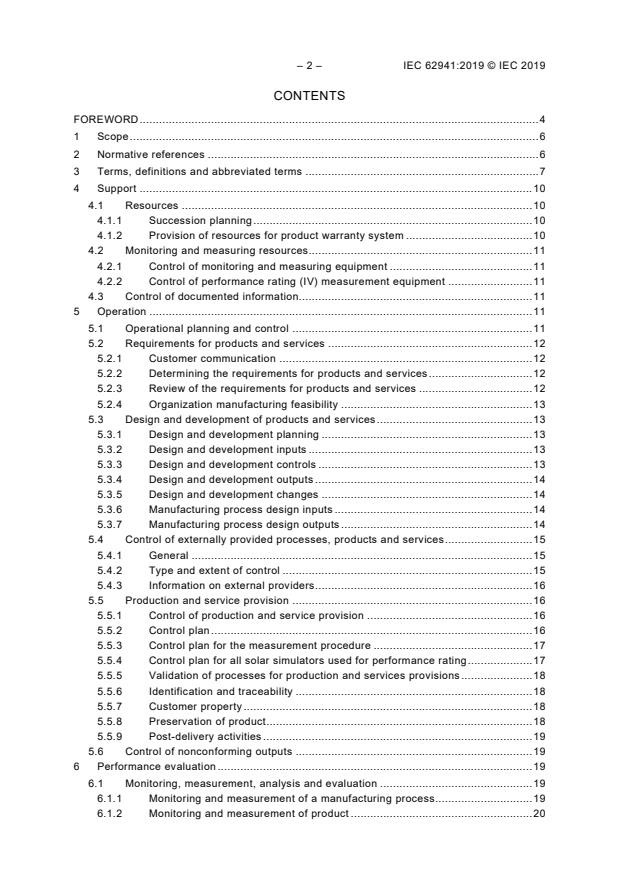
CONTENTS
FOREWORD . 4
1 Scope . 6
2 Normative references . 6
3 Terms, definitions and abbreviated terms . 7
4 Support . 10
4.1 Resources . 10
4.1.1 Succession planning . 10
4.1.2 Provision of resources for product warranty system . 10
4.2 Monitoring and measuring resources. 11
4.2.1 Control of monitoring and measuring equipment . 11
4.2.2 Control of performance rating (IV) measurement equipment . 11
4.3 Control of documented information. 11
5 Operation . 11
5.1 Operational planning and control . 11
5.2 Requirements for products and services . 12
5.2.1 Customer communication . 12
5.2.2 Determining the requirements for products and services . 12
5.2.3 Review of the requirements for products and services . 12
5.2.4 Organization manufacturing feasibility . 13
5.3 Design and development of products and services . 13
5.3.1 Design and development planning . 13
5.3.2 Design and development inputs . 13
5.3.3 Design and development controls . 13
5.3.4 Design and development outputs . 14
5.3.5 Design and development changes . 14
5.3.6 Manufacturing process design inputs . 14
5.3.7 Manufacturing process design outputs . 14
5.4 Control of externally provided processes, products and services . 15
5.4.1 General . 15
5.4.2 Type and extent of control . 15
5.4.3 Information on external providers . 16
5.5 Production and service provision . 16
5.5.1 Control of production and service provision . 16
5.5.2 Control plan . 16
5.5.3 Control plan for the measurement procedure . 17
5.5.4 Control plan for all solar simulators used for performance rating . 17
5.5.5 Validation of processes for production and services provisions . 18
5.5.6 Identification and traceability . 18
5.5.7 Customer property . 18
5.5.8 Preservation of product . 18
5.5.9 Post-delivery activities . 19
5.6 Control of nonconforming outputs . 19
6 Performance evaluation . 19
6.1 Monitoring, measurement, analysis and evaluation . 19
6.1.1 Monitoring and measurement of a manufacturing process . 19
6.1.2 Monitoring and measurement of product . 20
6.1.3 Ongoing product monitoring . 20
6.2 Customer satisfaction . 21
6.3 Analysis and evaluation . 21
6.4 Internal audit . 21
7 Improvement . 21
7.1 Corrective and preventive action . 21
7.2 Continual improvement . 21
Annex A (informative) Correspondence between ISO 9001:2015 and IEC 62941 . 22
Bibliography . 25
– 4 – IEC 62941:2019 © IEC 2019
INTERNATIONAL ELECTROTECHNICAL COMMISSION
____________
TERRESTRIAL PHOTOVOLTAIC (PV) MODULES –
QUALITY SYSTEM FOR PV MODULE MANUFACTURING
FOREWORD
1) The International Electrotechnical Commission (IEC) is a worldwide organization for standardization comprising
all national electrotechnical committees (IEC National Committees). The object of IEC is to promote
international co-operation on all questions concerning standardization in the electrical and electronic fields. To
this end and in addition to other activities, IEC publishes International Standards, Technical Specifications,
Technical Reports, Publicly Available Specifications (PAS) and Guides (hereafter referred to as “IEC
Publication(s)”). Their preparation is entrusted to technical committees; any IEC National Committee interested
in the subject dealt with may participate in this preparatory work. International, governmental and non-
governmental organizations liaising with the IEC also participate in this preparation. IEC collaborates closely
with the International Organization for Standardization (ISO) in accordance with conditions determined by
agreement between the two organizations.
2) The formal decisions or agreements of IEC on technical matters express, as nearly as possible, an international
consensus of opinion on the relevant subjects since each technical committee has representation from all
interested IEC National Committees.
3) IEC Publications have the form of recommendations for international use and are accepted by IEC National
Committees in that sense. While all reasonable efforts are made to ensure that the technical content of IEC
Publications is accurate, IEC cannot be held responsible for the way in which they are used or for any
misinterpretation by any end user.
4) In order to promote international uniformity, IEC National Committees undertake to apply IEC Publications
transparently to the maximum extent possible in their national and regional publications. Any divergence
between any IEC Publication and the corresponding national or regional publication shall be clearly indicated in
the latter.
5) IEC itself does not provide any attestation of conformity. Independent certification bodies provide conformity
assessment services and, in some areas, access to IEC marks of conformity. IEC is not responsible for any
services carried out by independent certification bodies.
6) All users should ensure that they have the latest edition of this publication.
7) No liability shall attach to IEC or its directors, employees, servants or agents including individual experts and
members of its technical committees and IEC National Committees for any personal injury, property damage or
other damage of any nature whatsoever, whether direct or indirect, or for costs (including legal fees) and
expenses arising out of the publication, use of, or reliance upon, this IEC Publication or any other IEC
Publications.
8) Attention is drawn to the Normative references cited in this publication. Use of the referenced publications is
indispensable for the correct application of this publication.
9) Attention is drawn to the possibility that some of the elements of this IEC Publication may be the subject of
patent rights. IEC shall not be held responsible for identifying any or all such patent rights.
International Standard IEC 62941 has been prepared by IEC technical committee 82: Solar
.
photovoltaic energy systems
The text of this International Standard is based on the following documents:
FDIS Report on voting
82/1635/FDIS 82/1641/RVD
Full information on the voting for the approval of this International Standard can be found in
the report on voting indicated in the above table.
This document has been drafted in accordance with the ISO/IEC Directives, Part 2.
The committee has decided that the contents of this document will remain unchanged until the
stability date indicated on the IEC website under "http://webstore.iec.ch" in the data related to
the specific document. At this date, the document will be
• reconfirmed,
• withdrawn,
• replaced by a revised edition, or
• amended.
– 6 – IEC 62941:2019 © IEC 2019
TERRESTRIAL PHOTOVOLTAIC (PV) MODULES –
QUALITY SYSTEM FOR PV MODULE MANUFACTURING
1 Scope
This document is applicable to organizations manufacturing photovoltaic (PV) modules
certified to IEC 61215 series and IEC 62108 for design qualification and type approval and
IEC 61730 for safety qualification and type approval. The design qualification and type
approval of PV modules depend on appropriate methods for product and process design, as
well as appropriate control of materials and processes used to manufacture the product. This
document lays out best practices for product design, manufacturing processes, and selection
and control of materials used in the manufacture of PV modules that have met the
requirements of IEC 61215 series, IEC 61730, or IEC 62108. These standards also form the
basis for factory audit criteria of such sites by various certifying and auditory bodies.
The object of this document is to provide a framework for the improved confidence in the
ongoing consistency of performance and reliability of certified PV modules. The requirements
of this document are defined with the assumption that the quality management system of the
organization has already fulfilled the requirements of ISO 9001 or equivalent quality
management system. This document is not intended to replace or remove any requirements of
ISO9001 or equivalent quality management system. By maintaining a manufacturing system in
accordance with this document, PV modules are expected to maintain their performance as
determined from the test sequences in IEC 61215 series, IEC 62108, or IEC 61730.
This document is applicable to all PV modules independent of design and technology, i.e. flat
panel, concentrator photovoltaic (CPV). Quality controls for CPV and nonconventional flat-
plate manufacturing will differ somewhat from those of more conventional designs; this
document has not considered these differences.
2 Normative references
The following documents are referred to in the text in such a way that some or all of their
content constitutes requirements of this document. For dated references, only the edition
cited applies. For undated references, the latest edition of the referenced document (including
any amendments) applies.
IEC 60812: Failure modes and effects analysis (FMEA and FMECA)
IEC 60891, Photovoltaic devices – Procedure for temperature and irradiance corrections to
measured I-V characteristics
IEC 60904-1, Photovoltaic devices – Part 1: Measurement of photovoltaic current-voltage
characteristics
IEC 60904-2, Photovoltaic devices – Part 2: Requirements for photovoltaic reference devices
IEC 60904-3, Photovoltaic devices – Part 3: Measurement principles for terrestrial
photovoltaic (PV) solar devices with reference spectral irradiance data
IEC 60904-4, Photovoltaic devices – Part 4: Reference solar devices – Procedures for
establishing calibration traceability
IEC 60904-7, Photovoltaic devices – Part 7: Computation of the spectral mismatch correction
for measurements of photovoltaic devices
IEC 60904-9, Photovoltaic devices – Part 9: Solar simulator performance requirements
IEC 61215 (all parts), Terrestrial photovoltaic (PV) modules – Design qualification and type
approval
IEC 61730-1, Photovoltaic (PV) module safety qualification – Part 1: Requirements for
construction
IEC 61730-2, Photovoltaic (PV) module safety qualification – Part 2: Requirements for testing
IEC TS 61836, Solar photovoltaic energy systems – Terms, definitions and symbols
IEC 61853-1, Photovoltaic (PV) module performance testing and energy rating – Part 1:
Irradiance and temperature performance measurements and power rating
IEC 62108, Concentrator photovoltaic (CPV) modules and assemblies – Design qualification
and type approval
IEC 62759-1, Photovoltaic (PV) modules – Transportation testing – Part 1: Transportation and
shipping of module package units
IEC TS 62915, Photovoltaic (PV) modules – Type approval, design and safety qualification –
Retesting
ISO/IEC Guide 98-3:2008, Uncertainty of measurement – Part 3: Guide to the expression of
uncertainty in measurement
ISO 9001:2015, Quality management systems – Requirements
3 Terms, definitions and abbreviated terms
For the purposes of this document, the terms and definitions given in IEC TS 61836 and the
following apply.
ISO and IEC maintain terminological databases for use in standardization at the following
addresses:
• IEC Electropedia: available at http://www.electropedia.org/
• ISO Online browsing platform: available at http://www.iso.org/obp
3.1
containment
action taken to protect the customer from the effect of a harmful situation
Note 1 to entry: Containment may include correcting an existing situation or adding additional screening or
retesting.
3.2
control plan
documented description of the systems and processes, and controls required for maintaining
the product and process quality as well as reaction to non-conformance
– 8 – IEC 62941:2019 © IEC 2019
3.3
customer
end user, investor, installer who purchases modules from the organization for their own use
3.4
design lifetime
design target period during which PV modules are expected to safely satisfy the specified
performance under the specified conditions
Note 1 to entry: Specified conditions include application of use, installation environment configurations and
operation conditions of the PV module in use. The design target period is set considering changes in performance
of PV modules due to aging degradation of parts and materials used in the stated environment.
3.5
Design Failure Mode and Effects Analysis
DFMEA
application of the Failure Mode and Effects Analysis (FMEA) method specifically to design
activities related to the product/service
3.6
Define, Measure, Analyse, Improve, Control
DMAIC
data-driven quality strategy for improving processes and an integral part of a Six Sigma
quality initiative
3.7
Electrostatic discharge
ESD
transfer of electric charge between bodies of different electric potential in proximity or through
direct contact
Note 1 to entry: Electrostatic discharge (ESD) events are known to damage semiconductor devices such as
diodes.
3.8
Failure, Modes and Effects Analysis
FMEA
document that defines the design, process, or solution with requirements and includes
potential modes, causes and severity of effects of failure, along with an evaluation of the
likelihood of their occurrence and ease of detection
Note 1 to entry: FMEA provides a mechanism to prioritize the risks and take appropriate mitigation steps.
3.9
key materials
those materials that affect safety, reliability, product performance, or lifetime of the PV
module
Note 1 to entry: Key materials may include indirect materials. Those materials which are used during the
manufacturing process of PV modules, but are not found in the end product. In most chemical processes,
catalyzers are indirect materials.
3.10
organization
entity that supplies modules to the customer and that has responsibility for design, production,
and after-sales service for the modules or entity that owns the trademark of the PV modules
Note 1 to entry: The organization may subcontract some of its responsibilities for design, production, and the
after-sales service.
3.11
out of control action plan
OCAP
supporting document to an SPC (Statistical Process Control) chart
Note 1 to entry: An OCAP is typically presented as a flowchart that guides manufacturing floor employees'
reactions to out-of-control situations.
Note 2 to entry: An OCAP consists of activators (which define out-of-control conditions); checkpoints (which are
likely causes for the conditions); and terminators (which contain the action that should resolve the conditions).
Note 3 to entry: OCAPs should be dynamic and updated continually as and when new knowledge and information
become available. A frequently occurring OCAP activator is an indication of a systemic issue in the process.
3.12
Plan, Do, Check, Act
PDCA
four-step process for quality improvement
Note 1 to entry: In the first step (Plan), a way to affect improvement is developed. In the second step (Do), the
plan is carried out, preferably on a small scale. In the third step (Check), a study takes place between what was
predicted and what was observed in the previous step. In the last step (Act), action is taken on the causal system
to affect the desired change.
3.13
Process Failure Modes and Effects Analysis
PFMEA
application of the FMEA method specifically to manufacturing process and activities to the
product/service
3.14
prototype
early sample, model, or release of a product built to test a concept or process, but may not
have been produced with the intended future processes
3.15
Quality Management System
QMS
formalized system that documents the structure, responsibilities, and procedures required to
achieve effective quality management
3.16
quality plan
document, or several documents, that together specify quality standards, practices, resources,
specifications, and the sequence of activities relevant to a particular product, service, project,
or contract
3.17
reliability
ability of an item to perform a required function under given conditions for a given time
interval
3.18
repeatability
closeness of agreement between the results of successive measurements of the same
measurand, carried out under the same conditions of measurement, i.e.:
– by the same measurement procedure,
– by the same observer,
– with the same measuring instruments, used under the same conditions,
– in the same laboratory,
– at relatively short intervals of time
– 10 – IEC 62941:2019 © IEC 2019
Note 1 to entry: The concept of "measurement procedure" is defined in VIM:2007,2.5.
3.19
reproducibility
closeness of agreement between the results of measurements of the same value of a quantity,
when the individual measurements are made under different conditions of measurement:
– principle of measurement,
– method of measurement,
– observer,
– measuring instruments,
– reference standards,
– laboratory,
– under conditions of use of the instruments, different from those customarily used,
– after intervals of time relatively long compared with the duration of a single measurement
Note 1 to entry: The concepts of "principle of measurement" and "method of measurement" are respectively
defined in JCGM200:2007, VIM 2.3 and 2.4.
Note 2 to entry: "reproducibility" also applies to the instance where only certain of the above conditions are taken
into account, provided that these are stated.
3.20
statistical capability
statistical measure of the inherent process variability of a given characteristic in comparison
to the specification limits
3.21
statistical process control
SPC
application of statistical techniques to control and monitor process. It is used to determine the
stability and predictability of a process
3.22
supplier
provider of materials to an organization that builds, manufactures and/or assembles PV
modules
4 Support
4.1 Resources
4.1.1 Succession planning
The organization shall plan for succession for key functions that affect customer satisfaction,
quality, reliability, safety, and performance.
4.1.2 Provision of resources for product warranty system
In addition to the basic QMS-required resource planning, the organization shall determine and
provide the resources needed to maintain the product warranty system, including provision of
after-sales service and for identifying cause of failure and any appropriate follow-up actions
such as adjustment to quality control plan or warranty recall. For repairable products, the
organization shall determine and include staffing and training of service personnel to do in-
field service and adequately plan for maintaining spare part depots and service centres to
ensure the necessary quality of service for customers.
4.2 Monitoring and measuring resources
4.2.1 Control of monitoring and measuring equipment
Monitoring and measurement equipment referenced in the control plan shall be characterized
by measurement system analysis to understand gauge capabilities (repeatability and
reproducibility).
Software shall be considered an integral part of monitoring and measuring equipment and
shall be appropriately controlled and validated. For changes that affect configuration,
including software, the organization shall revalidate monitoring and measurement equipment.
For monitoring and measurement equipment determined to be out of tolerance at the time of
calibration, corrective actions shall be taken to determine impact to the product and
documented per 4.1.
4.2.2 Control of performance rating (IV) measurement equipment
For the equipment used to measure the power performance of the module, the organization
shall maintain a control program compliant to IEC 60891 and IEC 60904 series of standards.
Records of compliance shall be maintained.
Solar simulators shall be initially qualified according to IEC 60904-9 and shall include
characterization of spectrum quality, uniformity of irradiance, and temporal instability of
irradiance. Solar simulator manufacturer’s data may be used to initially validate that the solar
simulator meets the requirements of the organization.
Solar simulators and the methodology used for performance rating shall have an initial
estimate of the uncertainty according to ISO/IEC Guide 98-3. The uncertainty analysis shall
be re-evaluated at least annually. When any critical change is found in measurement
uncertainty, root cause analysis shall be made prior to taking a corrective action. This
information shall be recorded and maintained.
Solar simulators with a BBB rating or better are suggested for performance rating of modules,
but the simulator requirement may vary with the solar cell technology, the geometry of the
module, the match between the reference module and the test modules, and the power
measurement uncertainty if it is indicated on the product literature.
The organization shall retain all calibration documents including the reference device
calibration certificate, or a report that can be traceable to international or national
measurement standards. This information shall be traceable for each module manufactured
and made available to customers upon request.
4.3 Control of documented information
Records related to design, qualification, engineering changes, monitoring, and measurement
of manufacturing processes and products, final testing, and customer details that are
necessary to secure the warranty condition and that are defined by the organization, shall be
retained for at least the warranty period.
5 Operation
5.1 Operational planning and control
In planning product realization, the organization shall also determine the following, as
appropriate:
a) Product certification requirements.
– 12 – IEC 62941:2019 © IEC 2019
b) Design lifetime aligned with the stated warranty under specific conditions and a
documented method to ensure compliance to stated warranty by a combination of product
reliability and after-sales services.
c) Recycling requirements at the end of the modules’ lifetime.
d) Quality assurance and control measures to be applied to production to meet requirements
of the applicable PV standards.
e) ESD safe environmental area.
The organization shall identify the ESD sensitive materials and components and shall
determine an ESD safe environmental area and maintain an ESD safe environment at the
raw material storage, processing, assembly areas, and all through packaging and shipping.
ESD requirements should consider ANSI/ESD S20.20, or equivalent standards.
If ESD protection is sufficient, and it can be determined that the electrostatic potential of
the work areas is low, it would not be necessary to create a designated ‘ESD safe
environmental area’.
f) Packaging, storage and transportation requirements.
Customer requirements and references to related technical specifications, as applicable,
shall be included in the planning of product realization as a component of the quality plan.
NOTE Since the geographies where the modules will be installed may not be identified when they are shipped,
the organization is asked to pay best attention to the generic recycling requirements at the end of the modules’
lifetime.
5.2 Requirements for products and services
5.2.1 Customer communication
The organization shall also determine and implement effective arrangements for
communicating with customers in relation to the following:
a) Safety, workmanship warranty, output power warranty, and installation guidelines
including electrical and mechanical installation instruction.
b) Application notes detailing specific attention and care needed to secure module design
lifetime in the installed configuration.
c) The definition of a warrantable defect or safety critical defect and the rules or process to
manage stated defects, and
d) Product recall notices.
5.2.2 Determining the requirements for products and services
The organization shall determine product warranty workmanship and power degradation and
its relationship to design lifetime under specified and intended use conditions.
The organization shall incorporate requirements arising from applicable previous failure
information, customer complaints, competitive analysis, supplier feedback, and other relevant
inputs. The organization shall maintain traceability to these requirements.
The organization shall establish a method for specifying the nameplate power of a module
with an allowed tolerance at standard test conditions per IEC 61215 series, or IEC 62108 (see
4.2.1 and 4.2.2 for proper control of solar simulators).
5.2.3 Review of the requirements for products and services
The organization shall ensure that all modified products, not covered by the retest guidelines
as defined in IEC TS 62915, are qualified to all related type designs and that the modified
products are evaluated for impact on the safety, performance and warranty.
5.2.4 Organization manufacturing feasibility
The organization shall investigate, conduct risk analysis, confirm and document the
manufacturing feasibility at the necessary scale of the proposed products in the contract
where applicable.
The organization shall manage the risks prior to manufacturing transfer.
The organization shall confirm consistency of quality of the modules between before and after
manufacturing transfer. The confirmation process and the results shall be documented and
recorded.
5.3 Design and development of products and services
5.3.1 Design and development planning
The organization shall include production processes in the design and development planning.
The organization shall also determine:
a) The responsibilities and authorities for a project design and development team.
b) The process to conduct DFMEAs as defined in IEC 60812 or equivalent, reliability testing,
design lifetime evaluation, and product specification generation, and
c) The requirements for PFMEAs as defined in IEC 60812 or equivalent, specifications,
layouts, control plan, and work instructions.
5.3.2 Design and development inputs
The inputs shall also include the following:
a) Functional, performance, and safety requirements including design lifetime, power,
maintainability, durability, transportation, timing, and costs, and including the material
requirements defined in IEC 61730-1.
b) Identification of product, traceability, and packaging requirements.
c) Requirements for proper handling of product and components for ESD and
d) Lessons learned from previous designs.
NOTE IEC 62759-1 defines transportation testing for designing packaging materials.
5.3.3 Design and development controls
The organization shall include standard requirements from applicable IEC and national
standards for validation of the design.
Performance testing activities including durability of prototype modules shall be monitored for
timely completion and conformance to requirements. Performance testing shall conform to a
product and process approval procedure including a reliability test plan similar to applicable
standards. As a minimum, prototyped or pre-production PV modules shall be tested according
to IEC 61215 series, IEC 61730-1, IEC 61730-2, IEC TS 62915, IEC 62108, or equivalent.
Validation of the design lifetime shall be confirmed with relevant internal data or published
documents and recorded. The records shall be disclosed to the auditor if requested.
Product approval should be subsequent to the verification of the manufacturing process. This
product and manufacturing process approval procedure should also be applied to suppliers of
key materials.
NOTE IEC 61215 series does not intend to test long term reliability of PV modules.
– 14 – IEC 62941:2019 © IEC 2019
5.3.4 Design and development outputs
Design and development outputs shall also include the following:
a) an installation manual for safe and proper installation and use.
b) DFMEAs as defined in IEC 60812, or equivalent, which are to be updated during design
reviews, and a related design qualification/verification and reliability test plan, and
c) characteristics of the product that cannot be fully verified later by non-destructive methods
and the designated means to control those characteristics for adequate product
performance.
5.3.5 Design and development changes
The organization shall implement a change management system for materials and processes
and ensure all changes impacting form, fit and function adhere to product requirements and
defined internal/external qualification and certification requirements such as IEC TS 62915.
Traceability of changes shall be documented and maintained in the organization’s QMS.
All design and development changes shall be evaluated for risks and documented in the
appropriate FMEA as defined in IEC 60812 or equivalent.
Qualification, safety, compliance, and reliability tests shall be documented.
The conditions of qualification, safety and reliability tests should be defined by taking into
consideration the specified condition required by IEC 61215 series, IEC 61730-1, IEC 61730-
2, IEC TS 62915, IEC 62108, or equivalent.
Such changes shall not be released to customers before applicable tests are verified to be
satisfactory. Certification of the change may be necessary prior to release to a customer. If
the change has impact to form, fit, function, safety, performance, or decrease in reliability of
the product, notification to the appropriate customer is required.
5.3.6 Manufacturing process design inputs
The organization shall identify, document, and review the manufacturing process design input
requirements, including the following:
a) Product design output data and key materials used in manufacturing.
b) Targets for productivity, process capability and cost.
c) Customers’ requirements, if any, and
d) Lessons learned from previous developments.
NOTE The manufacturing process design includes the use of error-proofing methods and statistical process
control methods to a degree appropriate to the magnitude of the problems and commensurate with the risks
encountered.
5.3.7 Manufacturing process design outputs
The manufacturing process design output shall be expressed in terms that can be verified
against manufacturing process design input requirements and validated. The manufacturing
process design output shall include data for quality, and reliability including the following:
a) Specifications and drawings.
b) Manufacturing process flow chart/layout.
c) Manufacturing PFMEAs as defined in IEC 60812 or equivalent risk management tool.
d) Control plan (see 5.5.2).
e) Work instructions.
f) Process approval acceptance criteria.
g) An ESD protection plan if necessary.
h) Error-proofing methods, as appropriate.
i) Methods for product identification and traceability.
j) Methods for detection and feedback of product/manufacturing process nonconformities,
and
k) Process for handling raw materials from the time of their receipt.
l) PFMEAs, or equivalent, should cover the process from material receipt to product delivery,
and where appropriate, installation and maintenance.
5.4 Control of externally provided processes, products and services
5.4.1 General
Materials, components, and sub-assemblies that have a safety, performance, or reliability
implication on the finished product and that are purchased from or prepared by a supplier
require a level of control adequate to ensure that the overall risks are minimal.
The organization shall define a process for the supplier’s notification of changes and ensure
that the supplier maintain traceability of relevant changes. It is the responsibility of the
organization or the manufacturer to ensure that the components, sub-assemblies and
assemblies completed by subcontractors meet the quality plans, including relevant safety
performance and certification requirements.
The organization shall complete the following actions to ensure their suppliers can meet
product requirements by doing the following:
a) Set up a QMS. QMS requirements for key materials may include ISO 9001 compliance.
b) Evaluate the quality performance of key materials and audit the supplier of key materials
on a regular basis.
c) Ensure that materials used in the product conform with material specifications provided by
the organization.
d) Periodically carry out onsite audits to check that:
• the material produced is conformal with applicable organization or manufacturer
specifications;
e) the supplier has the capability to deliver the goods on time;
f) the supplier maintains product quality consistently, notifies and seeks approval when there
is any change of products, process, and manufacturing location, or significant process
excursion that may affect form, fit, function, reliability, or performance.
g) Urge the supplier to improve its quality performance if necessary, and
h) Apply methods for incoming inspections and preparation of raw materials.
5.4.2 Type and extent of control
The organization shall have a consistent process to ensure the quality of key materials using
an appropriate combination of the following methods:
a) Receipt and review of certificate of conformance or analysis.
b) Evaluation of statistical data of purchased products and key materials.
c) Receiving inspection or testing such as statistical sampling based on performance.
Statistical sampling may be based on ANSI/ASQ Z1.4, Z1.9 or equivalent national
standards.
d) Product evaluation or material analysis by an independent laboratory or testing facility.
– 16 – IEC 62941:2019 © IEC 2019
e) Evidence of supplier inspections when the supplier has been delegated inspection
authority based on the history of product conformance to requirements, and
f) When a deficiency is identified, the organization shall take appropriate steps (for example,
out-of-control action p
...
Questions, Comments and Discussion
Ask us and Technical Secretary will try to provide an answer. You can facilitate discussion about the standard in here.
Loading comments...