


IEC 62315-1:2003
(Main)DTV profiles for uncompressed digital video interfaces - Part 1: General
General Information
- Abstract
IEC 62315-1:2003 specifies requirements for digital television (DTV) monitors that use an uncompressed, baseband, digital video interface. These requirements apply to baseband, digital, video interfaces that use the VESA E-EDID Standard for the discovery of supported video formats. This standard also specifies the video formats to be supported by a DTV monitor. The timing requirements for 14 video formats are specified along with requirements for video format discovery. A mechanism allowing a video source to discover the preferred format of a DTV monitor is also described.
- Status
- Published
- Publication Date
- 26-Mar-2003
- Technical Committee
- TC 100 - Audio, video and multimedia systems and equipment
- Drafting Committee
- PT 62315 - TC 100/PT 62315
- Current Stage
- PPUB - Publication issued
- Start Date
- 27-Mar-2003
- Completion Date
- 31-Aug-2003
Buy Documents
IEC 62315-1:2003 - DTV profiles for uncompressed digital video interfaces - Part 1: General Released:3/27/2003
IEC 62315-1:2003 - DTV profiles for uncompressed digital video interfaces - Part 1: General Released:3/27/2003
Overview
IEC 62315-1:2003 defines DTV profiles for uncompressed, baseband digital video interfaces used between video sources and digital television (DTV) monitors. The standard focuses on how a DTV monitor advertises supported formats and how a source discovers and selects the preferred video format using the VESA E-EDID discovery mechanism. It specifies the video formats and the timing requirements for 14 video formats, plus a discovery mechanism for preferred-format negotiation. The document also provides guidance on applying the profiles to interfaces such as DVI and OpenLDI.
Key topics and technical requirements
- Mandatory and optional formats: Any conformant monitor must support 640×480p @ 60 Hz; HDTV monitors (16:9) must support either 1280×720p or 1920×1080i. Support for 720×480i and 720×576i is optional.
- Timing specifications: Detailed waveform timing diagrams and parameters (horizontal/vertical timing, total lines, blanking intervals) are provided for multiple progressive and interlaced formats (see Clauses 6.x).
- Format discovery: Uses VESA E-EDID and E-DDC structures to enumerate supported formats and includes an extension for additional detailed timing descriptors.
- Colorimetry: Specifies colorimetry considerations keyed to common broadcast references (see Clause 7).
- Interface application guidance: Informative annexes describe application to DVI (Annex A) and OpenLDI (Annex B), including sync and cabling considerations.
- Interoperability note: Recommends implementing digital content protection for interoperability between devices.
Applications and who uses this standard
IEC 62315-1 is practical for:
- Display and monitor manufacturers - to ensure DTV monitors advertise and support required DTV timing profiles and aspect ratios.
- Set-top box, tuner and source-device designers - to implement correct output formats and EDID-based negotiation so HDTV/EDTV content displays correctly.
- System integrators and AV installers - to select compatible source/display combinations and troubleshoot format negotiation.
- Test labs and compliance engineers - to validate timing, E-EDID descriptors, and colorimetry against the standard.
- Firmware and driver developers - to implement EDID parsing and preferred-format selection algorithms.
Practical benefits include reliable interoperability, fewer manual format switches, consistent display of SD/ED/HD content, and clear requirements for implementing uncompressed digital video links.
Related standards
- ITU‑R BT.601 (studio encoding parameters)
- ITU‑R BT.709 (HDTV colorimetry)
- VESA E‑EDID (Enhanced Extended Display Identification Data)
- VESA E‑DDC (Enhanced Display Data Channel)
- References to DVI and OpenLDI in informative annexes
Keywords: IEC 62315-1, DTV profiles, uncompressed digital video interfaces, E-EDID, timing requirements, DTV monitor, DVI, OpenLDI, video format discovery.
Buy Documents
IEC 62315-1:2003 - DTV profiles for uncompressed digital video interfaces - Part 1: General Released:3/27/2003
IEC 62315-1:2003 - DTV profiles for uncompressed digital video interfaces - Part 1: General Released:3/27/2003
Get Certified
Connect with accredited certification bodies for this standard

ANCE
Mexican certification and testing association.

Intertek Slovenia
Intertek testing, inspection, and certification services in Slovenia.

LNE (Laboratoire National de Métrologie et d'Essais)
French national laboratory for metrology and testing.
Sponsored listings
Frequently Asked Questions
IEC 62315-1:2003 is a standard published by the International Electrotechnical Commission (IEC). Its full title is "DTV profiles for uncompressed digital video interfaces - Part 1: General". This standard covers: IEC 62315-1:2003 specifies requirements for digital television (DTV) monitors that use an uncompressed, baseband, digital video interface. These requirements apply to baseband, digital, video interfaces that use the VESA E-EDID Standard for the discovery of supported video formats. This standard also specifies the video formats to be supported by a DTV monitor. The timing requirements for 14 video formats are specified along with requirements for video format discovery. A mechanism allowing a video source to discover the preferred format of a DTV monitor is also described.
IEC 62315-1:2003 specifies requirements for digital television (DTV) monitors that use an uncompressed, baseband, digital video interface. These requirements apply to baseband, digital, video interfaces that use the VESA E-EDID Standard for the discovery of supported video formats. This standard also specifies the video formats to be supported by a DTV monitor. The timing requirements for 14 video formats are specified along with requirements for video format discovery. A mechanism allowing a video source to discover the preferred format of a DTV monitor is also described.
IEC 62315-1:2003 is classified under the following ICS (International Classification for Standards) categories: 33.160.40 - Video systems. The ICS classification helps identify the subject area and facilitates finding related standards.
IEC 62315-1:2003 is available in PDF format for immediate download after purchase. The document can be added to your cart and obtained through the secure checkout process. Digital delivery ensures instant access to the complete standard document.
Standards Content (Sample)
INTERNATIONAL IEC
STANDARD
62315-1
First edition
2003-03
DTV profiles for uncompressed
digital video interfaces –
Part 1:
General
Reference number
Publication numbering
As from 1 January 1997 all IEC publications are issued with a designation in the
60000 series. For example, IEC 34-1 is now referred to as IEC 60034-1.
Consolidated editions
The IEC is now publishing consolidated versions of its publications. For example,
edition numbers 1.0, 1.1 and 1.2 refer, respectively, to the base publication, the
base publication incorporating amendment 1 and the base publication incorporating
amendments 1 and 2.
Further information on IEC publications
The technical content of IEC publications is kept under constant review by the IEC,
thus ensuring that the content reflects current technology. Information relating to
this publication, including its validity, is available in the IEC Catalogue of
publications (see below) in addition to new editions, amendments and corrigenda.
Information on the subjects under consideration and work in progress undertaken
by the technical committee which has prepared this publication, as well as the list
of publications issued, is also available from the following:
• IEC Web Site (www.iec.ch)
• Catalogue of IEC publications
The on-line catalogue on the IEC web site (http://www.iec.ch/searchpub/cur_fut.htm)
enables you to search by a variety of criteria including text searches, technical
committees and date of publication. On-line information is also available on
recently issued publications, withdrawn and replaced publications, as well as
corrigenda.
• IEC Just Published
This summary of recently issued publications (http://www.iec.ch/online_news/
justpub/jp_entry.htm) is also available by email. Please contact the Customer
Service Centre (see below) for further information.
• Customer Service Centre
If you have any questions regarding this publication or need further assistance,
please contact the Customer Service Centre:
Email: custserv@iec.ch
Tel: +41 22 919 02 11
Fax: +41 22 919 03 00
INTERNATIONAL IEC
STANDARD
62315-1
First edition
2003-03
DTV profiles for uncompressed
digital video interfaces –
Part 1:
General
IEC 2003 Copyright - all rights reserved
No part of this publication may be reproduced or utilized in any form or by any means, electronic or
mechanical, including photocopying and microfilm, without permission in writing from the publisher.
International Electrotechnical Commission, 3, rue de Varembé, PO Box 131, CH-1211 Geneva 20, Switzerland
Telephone: +41 22 919 02 11 Telefax: +41 22 919 03 00 E-mail: inmail@iec.ch Web: www.iec.ch
PRICE CODE
Commission Electrotechnique Internationale
X
International Electrotechnical Commission
Международная Электротехническая Комиссия
For price, see current catalogue
– 2 – 62315-1 IEC:2003(E)
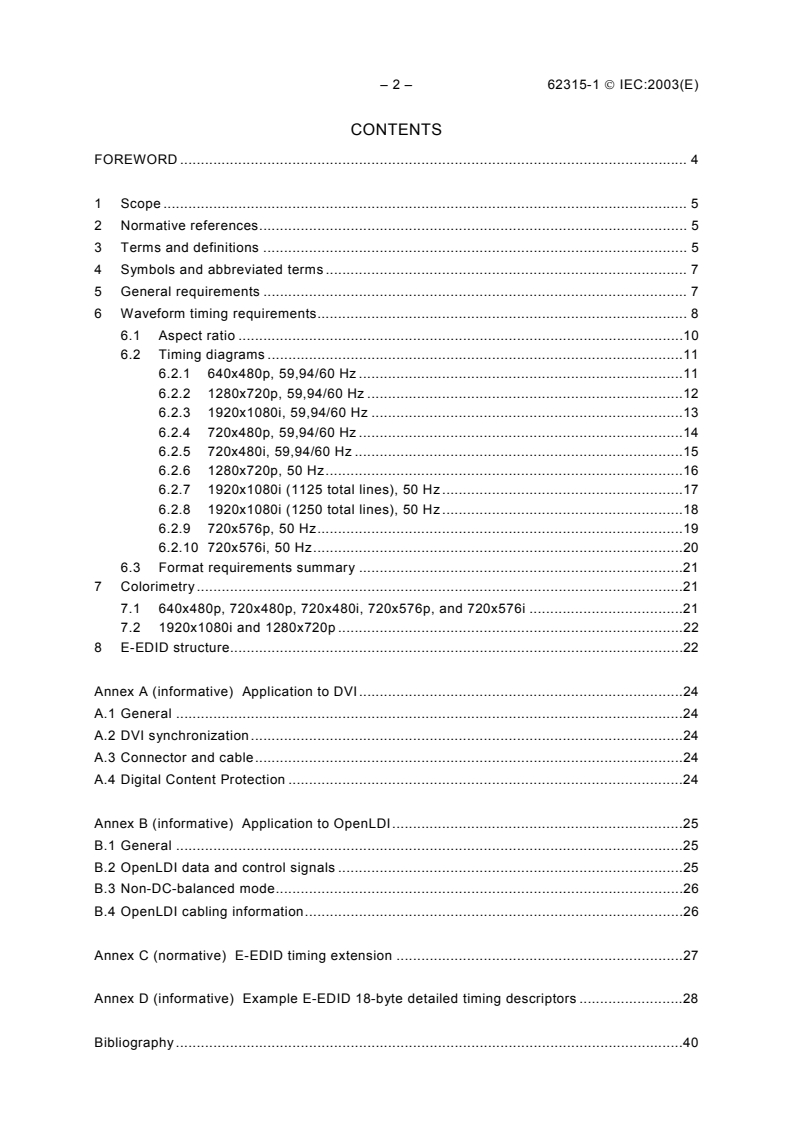
CONTENTS
FOREWORD . 4
1 Scope . 5
2 Normative references. 5
3 Terms and definitions . 5
4 Symbols and abbreviated terms . 7
5 General requirements . 7
6 Waveform timing requirements. 8
6.1 Aspect ratio .10
6.2 Timing diagrams .11
6.2.1 640x480p, 59,94/60 Hz .11
6.2.2 1280x720p, 59,94/60 Hz .12
6.2.3 1920x1080i, 59,94/60 Hz .13
6.2.4 720x480p, 59,94/60 Hz .14
6.2.5 720x480i, 59,94/60 Hz .15
6.2.6 1280x720p, 50 Hz.16
6.2.7 1920x1080i (1125 total lines), 50 Hz .17
6.2.8 1920x1080i (1250 total lines), 50 Hz .18
6.2.9 720x576p, 50 Hz.19
6.2.10 720x576i, 50 Hz.20
6.3 Format requirements summary .21
7 Colorimetry .21
7.1 640x480p, 720x480p, 720x480i, 720x576p, and 720x576i .21
7.2 1920x1080i and 1280x720p .22
8 E-EDID structure.22
Annex A (informative) Application to DVI.24
A.1 General .24
A.2 DVI synchronization.24
A.3 Connector and cable.24
A.4 Digital Content Protection .24
Annex B (informative) Application to OpenLDI.25
B.1 General .25
B.2 OpenLDI data and control signals .25
B.3 Non-DC-balanced mode.26
B.4 OpenLDI cabling information.26
Annex C (normative) E-EDID timing extension .27
Annex D (informative) Example E-EDID 18-byte detailed timing descriptors .28
Bibliography.40
62315-1 IEC:2003(E) – 3 –
Figure 1 – Timing parameters for 640x480p, 59,94/60 Hz.11
Figure 2 – Timing parameters for 1280x720p, 59,94/60 Hz.12
Figure 3 – Timing parameters for 1920x1080i, 59,94/60 Hz .13
Figure 4 – Timing parameters for 720x480p, 59,94/60 Hz.14
Figure 5 – Timing parameters for 720x480i, 59,94/60 Hz.15
Figure 6 – Timing parameters for 1280x720p, 50 Hz. .16
Figure 7 – Timing parameters for 1920x1080i (1125 total lines), 50 Hz.17
Figure 8 – Timing parameters for 1920x1080i (1250 total lines), 50 Hz.18
Figure 9 – Timing parameters for 720x576p, 50 Hz. .19
Figure 10 – Timing parameters for 720x576i, 50 Hz.20
Figure B.1 – OpenLDI synchronization .25
Table 1 – Video formats .8
Table 2 – Timing parameters for the uncompressed digital video interface . 9
Table 3 – Summary of video format requirements.21
Table A.1 – Synchronizing signal data for DVI.24
Table B.1 – OpenLDI control signals .25
Table C.1 – E-EDID extension block that contains extra detailed timing descriptors .27
Table D.1 – Example detailed timing descriptor for 1280x720p (50 Hz, 16:9).28
Table D.2 – Example detailed timing descriptor for 1920x1080i (50 Hz, 16:9, 1125 lines).29
Table D.3 – Example detailed timing descriptor for 720x576p (50 Hz, 4:3) .30
Table D.4 – Example detailed timing descriptor for 720x576p (50 Hz, 16:9) .31
Table D.5 – Example detailed timing descriptor for 720x576i (50 Hz, 4:3) .32
Table D.6 – Example detailed timing descriptor for 720x576i (50 Hz, 16:9).33
Table D.7 – Example detailed timing descriptor for 1280x720p (60 Hz, 16:9).34
Table D.8 – Example detailed timing descriptor for 1920x1080i (60 Hz, 16:9).35
Table D.9 – Example detailed timing descriptor for 720x480p (59,94 Hz, 4:3).36
Table D.10 – Example detailed timing descriptor for 720x480p (59,94 Hz, 16:9).37
Table D.11 – Example detailed timing descriptor for 720x480i (59,94 Hz, 4:3).38
Table D.12 – Example detailed timing descriptor for 720x480i (59,94 Hz, 16:9).39
– 4 – 62315-1 IEC:2003(E)
INTERNATIONAL ELECTROTECHNICAL COMMISSION
___________
DTV PROFILES FOR UNCOMPRESSED DIGITAL
VIDEO INTERFACES –
Part 1: General
FOREWORD
1) The IEC (International Electrotechnical Commission) is a worldwide organization for standardization comprising
all national electrotechnical committees (IEC National Committees). The object of the IEC is to promote
international co-operation on all questions concerning standardization in the electrical and electronic fields. To
this end and in addition to other activities, the IEC publishes International Standards. Their preparation is
entrusted to technical committees; any IEC National Committee interested in the subject dealt with may
participate in this preparatory work. International, governmental and non-governmental organizations liaising
with the IEC also participate in this preparation. The IEC collaborates closely with the International
Organization for Standardization (ISO) in accordance with conditions determined by agreement between the
two organizations.
2) The formal decisions or agreements of the IEC on technical matters express, as nearly as possible, an
international consensus of opinion on the relevant subjects since each technical committee has representation
from all interested National Committees.
3) The documents produced have the form of recommendations for international use and are published in the form
of standards, technical specifications, technical reports or guides and they are accepted by the National
Committees in that sense.
4) In order to promote international unification, IEC National Committees undertake to apply IEC International
Standards transparently to the maximum extent possible in their national and regional standards. Any
divergence between the IEC Standard and the corresponding national or regional standard shall be clearly
indicated in the latter.
5) The IEC provides no marking procedure to indicate its approval and cannot be rendered responsible for any
equipment declared to be in conformity with one of its standards.
6) Attention is drawn to the possibility that some of the elements of this International Standard may be the subject
of patent rights. The IEC shall not be held responsible for identifying any or all such patent rights.
International Standard IEC 62315-1 has been prepared by technical area 4, Digital systems
interfaces, of IEC technical committee 100: Audio, video and multimedia systems and
equipment.
The text of this standard is based on the following documents:
CDV Report on voting
100/507/CDV 100/608/RVC
Full information on the voting for the approval of this standard can be found in the report on
voting indicated in the above table.
This publication has been drafted in accordance with the ISO/IEC Directives, Part 2.
The committee has decided that the contents of this publication will remain unchanged until 2005.
At this date, the publication will be
• reconfirmed;
• withdrawn;
• replaced by a revised edition, or
• amended.
62315-1 IEC:2003(E) – 5 –
DTV PROFILES FOR UNCOMPRESSED DIGITAL
VIDEO INTERFACES –
Part 1: General
1 Scope
This part of IEC 62315 specifies requirements for digital television (DTV) monitors that use an
uncompressed, baseband, digital video interface. These requirements apply to baseband,
digital, video interfaces that use the VESA E-EDID Standard for the discovery of supported
video formats.
This standard also specifies the video formats to be supported by a DTV monitor. The timing
requirements for 14 video formats are specified along with requirements for video format
discovery. A mechanism allowing a video source to discover the preferred format of a DTV
monitor is also described.
A digital video interface is not specified in this part; however, it is envisaged that such
interfaces will appear in future parts of IEC 62315.
NOTE 1 It is recommended that devices using the DTV profiles defined in this document, incorporate a digital
content protection system on such interfaces in order to ensure interoperability between devices.
2 Normative references
The following referenced documents are indispensable for the application of this document.
For dated references, only the edition cited applies. For undated references, the latest edition
of the referenced document (including any amendments) applies.
ITU-R BT.601-5: 1995, Studio encoding parameters of digital television for standard 4:3 and
wide-screen 16:9 aspect ratios
ITU-R BT.709-5: 2002, Parameter values for the HDTV standards for production and
international programme exchange
VESA E-EDID Standard, VESA Enhanced Extended Display Identification Data Standard,
Release A, Revision 1, February 9, 2000.
VESA E-DDC Standard, VESA Enhanced Display Data Channel Standard, Version 1,
September 2, 1999.
3 Terms and definitions
For the purposes of this document, the following terms and definitions apply.
3.1
aspect ratio
ratio of width to height of a picture or display screen
3.2
aspect ratio, display
aspect ratio of the DTV monitor
– 6 – 62315-1 IEC:2003(E)
3.3
aspect ratio, picture
aspect ratio of the picture, which is made up of the active pixels in the video format
NOTE The pixels are not necessarily square. The video image may be smaller than the active pixel region, with
background data filling the rest of the region.
3.4
digital television (DTV)
device that receives, decodes, and presents audio and video material that has been
transmitted in a compressed form
NOTE The device may be a single unit or it may be constructed from individual components (e.g. a digital
terrestrial set top box and an analogue television).
3.5
digital video interface
cable between a video source and DTV monitor that transfers uncompressed digital video
information
3.6
monitor
device capable of displaying video
3.7
monitor, DTV
EDTV, HDTV or SDTV monitor, or any combination of these three
3.8
monitor, EDTV
device capable of displaying 640x480p and either 720x576p or 720x480p in 16:9 or 4:3
aspect ratios
3.9
monitor, HDTV
EDTV monitor, with a 16:9 screen, capable of displaying 1920x1080i or 1280x720p video
3.10
monitor, SDTV
device capable of displaying 720x480i video in 16:9 or 4:3 aspect ratios
3.11
tuner
video source that decodes a digital video transmission and outputs this transmission as video
3.12
tuner, EDTV
tuner capable of converting signals into 640x480p and either 720x576p or 720x480p
3.13
tuner, HDTV
EDTV tuner capable of converting signals into 1920x1080i and 1280x720p
3.14
video source
device that sends video information to a DTV monitor using the digital video interface
62315-1 IEC:2003(E) – 7 –
4 Symbols and abbreviated terms
ATSC Advanced Television Systems Committee
DDWG Digital Display Working Group
DTV Digital TeleVision
DVI Digital Visual Interface
E-DDC Enhanced Display Data Channel
E-EDID Enhanced Extended Display Identification Data
EDTV Enhanced Definition Television
EIA Electronic Industries Alliance
HDTV High Definition Television
i interlaced scanning
p progressive scanning
lsb least significant bit
LVDS Low Voltage Differential Signalling
MPEG Moving Picture Experts Group
MTS Monitor Timing Specification (a specific VESA standard)
OpenLDI Open LVDS Display Interface
PSIP Program and System Information Protocol
SDTV Standard Definition TeleVision
SMPTE Society of Motion Picture and Television Engineers
VESA Video Electronics Standards Association
5 General requirements
Any DTV monitor conforming to this standard shall support the 640x480p format at 60 Hz, as
defined in 6.2.1. The DTV monitor shall also support either 720x480p or 720x576p, as defined
in 6.2.4 and 6.2.9 respectively, in one of two picture aspect ratios, 4:3 or 16:9. Additionally,
any HDTV monitor conforming to this standard shall have a 16:9 display aspect ratio and shall
support either 1280x720p or 1920x1080i, as defined in 6.2.2, 6.2.3, 6.2.6, 6.2.7, and 6.2.8.
Formats of 720x576i and 720x480i, defined in 6.2.10 and 6.2.5 are optional within this
standard.
NOTE 1 This implicitly allows any source device to only support 720x576p, 720x480p, or 640x480p. For the
source device to supply high definition content to any HDTV monitor, it should be capable of supporting 1280x720p
and 1920x1080i, since an HDTV monitor may only support one of the two formats. In some cases, the source
device will need to convert video from its original format (e.g. 720x480i) to a format supported by the DTV Monitor
(e.g. 720x480p).
The DTV tuner and DTV monitor requirements specified by this standard are summarized in
Table 1. The requirements of 50 Hz applications are different from the requirements of 60 Hz
applications, as given in Table 1.
NOTE 2 The product definitions are explained in Clause 3.
– 8 – 62315-1 IEC:2003(E)
Table 1 – Video formats
Product EDTV HDTV EDTV HDTV
Video format
definition monitor monitor tuner tuner
50 Hz applications
SDTV 720x576i, 50 Hz o o o o
EDTV 640x480p, 60 Hz X X
X* X*
XX
EDTV 720x576p, 50 Hz
HDTV 1280x720p, 50 Hz o o X
X*
o oX
HDTV 1920x1080i, 50 Hz
60 Hz applications
SDTV 720x480i, 60 Hz o o o o
EDTV 640x480p, 60 Hz X X
X* X*
EDTV 720x480p, 60 Hz X X
HDTV 1280x720p, 60 Hz o o X
X*
HDTV 1920x1080i, 60 Hz o oX
Key
X Required by this standard
X* At least one of the two formats is required, the other is optional
oOptional
6 Waveform timing requirements
Timing parameters shall conform to Table 2 and to the timing diagrams in 6.2. The DTV
monitor shall be capable of displaying either 59,94 or 60 Hz (frame rate for progressive scan
and field rate for interlaced scan) for those formats listed in Table 1 that it supports.
Therefore, the 59,94 Hz and 60 Hz versions of a format shall be considered as the same
format with slightly different pixel clocks. DTVs shall accept video when its pixel clock is
accurate to within 0.5 % of the clock frequencies specified in Table 2.
62315-1 IEC:2003(E) – 9 –
62315-1 IEC:2003(E)
Table 2 – Timing parameters for the uncompressed digital video interface
Source of
Horizontal
Vertical lines original
Frequency pixels Vertical Horizontal Pixel Horizontal Horizontal
Picture
specification
±0,5% blanking frequency frequency blanking period
aspect
Bibliography
ratio
Hz Interlaced/ μs kHz MHz μs μs
Active Total Active Total reference
progressive
number
60 480 525 Progressive 640 800 1429 31,500 25,200 6,35 31,75 4x3 [17]
Normative
reference
60 1080 1125 Interlaced 1920 2200 667 33,750 74,250 3,77 29,63 16x9
(Clause 2)
Normative
reference
60 720 750 Progressive 1280 1650 667 45,000 74,250 4,98 22,22 16x9
(Clause 2)
60 480 525 Progressive 720 858 1429 31,500 27,027 5,11 31,75 4x3,16x9 [5]
60 480 525 Interlaced 1440* 1716* 1429 15,750 27,027 10,21 63,49 4x3,16x9 [5]
50 1080 1125 Interlaced 1920 2640 800 28,125 74,250 9,70 35,56 16x9 [10]
Normative
reference
50** 1080 1250 Interlaced 1920 2304 2720 31,250 72,000 5,33 32 16x9
(Clause 2)
50 720 750 Progressive 1280 1980 800 37,500 74,250 9,43 26,67 16x9 [12]
50 576 625 Progressive 720 864 1568 31,250 27,000 5,33 32,00 4x3,16x9 [21]
50 576 625 Interlaced 1440* 1728* 1568 15,625 27,000 10,67 64,00 4x3,16x9 [2]
* The pixels are double-clocked for each line to meet minimum clock speed requirements, thus the active horizontal pixels listed are 1440
rather than 720.
** Some regions are adopting this format instead of 1125 vertical lines in order to improve compatibility with 100 Hz cathode-ray tube televisions.
– 10 – 62315-1 IEC:2003(E)
Timing for the digital video interface on a DTV monitor shall support a base format of
640x480p, 60 Hz.
In countries supporting 50 Hz, the DTV monitor shall support an additional base format of
720x576p, 50 Hz, in at least one of the two picture aspect ratios, 4:3 and 16:9. In countries
supporting 60 Hz, the DTV monitor shall support an additional base format of 720x480p,
60 Hz, in at least one of the two picture aspect ratios, 4:3 and 16:9.
An HDTV monitor shall support the timing requirements for either 1280x720p, 1920x1080i, or
both, at the frequency appropriate for its country, 50 Hz or 60 Hz.
NOTE The 720x576i, 50 Hz, and 720x480i, 60 Hz, timings are optional.
6.1 Aspect ratio
The 720-line formats (720x576p, 720x576i, 720x480p, 720x480i) are available in two different
picture aspect ratios, 4:3 and 16:9. The DTV monitor shall support at least one of these and
shall state which picture aspect ratio it supports for a given format (see notes 1 and 2).
The DTV monitor shall list only one picture aspect ratio for a 720-vertical-line format in the E-
EDID structure at any given time and the signal shall be processed accordingly (see notes 3
and 4).
NOTE 1 Formats with different picture aspect ratios are considered to be different formats that may be
independently supported and discovered.
NOTE 2 The source is able to choose how to supply the picture aspect ratio that a DTV monitor supports. For
example, with the 16x9 data format and a 4x3 DTV monitor, the source may:
a) use pan and scan information to crop the data to fewer horizontal pixels and then resample up to the required
pixels for output to the DTV monitor, or
b) vertically resample and create blank panels above and below the picture to send this “letterbox” with the
required lines for output.
Other picture scaling methods are possible in either the video source or DTV monitor. For example, picture aspect
scaling (picture expand, shrink, etc.) can be accomplished in the video source, such as adding black lines in the
active video portion of the signal for non-standard picture aspect ratios.
NOTE 3 It is possible for a DTV monitor to support both aspect ratios of the 720x480 formats through a user-
selectable option on the DTV monitor. In this case, the E-EDID timing descriptor may be changed to reflect the
user-requested picture aspect ratio. Video sources should have a method for tracking changes to user-selected
aspect ratios.
NOTE 4 As shown in the timing diagrams (see 6.2), there is no difference in the timing parameters for formats
that have different picture aspect ratios but are otherwise the same format. For a DTV monitor to simultaneously
support both formats, the DTV monitor requires an indication from the source that describes the aspect ratio in
which the video should be displayed These involve sending picture aspect ratio information from a video source to
the DTV monitor. It is envisaged that future parts of this standard will provide standardized methods to accomplish
this task.
62315-1 IEC:2003(E) – 11 –
6.2 Timing diagrams
6.2.1 640x480p, 59,94/60 Hz
The timing parameters for 640x480p, 59,94/60 Hz, shall be as illustrated in Figure 1.
∗
NOTE This timing is based on VESA Monitor Timings Specification, version 1.0 revision 0.8 [16] . The only
difference is that the VESA version defines blanking to not include the border, while this standard includes the
border within the blanking interval.
800 Total horizontal clocks per line
Data
enable
160 640 clocks for active video
48 clocks
HSYNC
Progressive frame: 45 vertical blanking lines 480 active vertical lines
Data
enable
800 clocks
HSYNC
515 516 517 524 525 1 2 3 4 5 6 7 35 36 515 516 525
VSYNC
IEC 739/03
Figure 1 – Timing parameters for 640x480p, 59,94/60 Hz
———————
∗
Figures in square brackets refer to the bibliography.
~ ~
~ ~
~ ~
~ ~
~
~
~
~
~ ~
~ ~
– 12 – 62315-1 IEC:2003(E)
6.2.2 1280x720p, 59,94/60 Hz
The timing parameters for 1280x720p, 59,59/60 Hz, shall be as illustrated in Figure 2. This
format uses a 16:9 aspect ratio.
NOTE This timing is based on EIA-770.3-C [6], but there are two differences. First, EIA-770.3-C uses tri-level
sync, while this standard uses bi-level. Bi-level sync timing is accomplished using the second half of the EIA-770.3-
C tri-level sync, defining the actual sync time to be the rising edge of that pulse. Second, EIA-770.3-C uses a
composite sync while this standard uses separate sync signals, thus eliminating the need for serrations during
vertical sync.
1 650 Total horizontal clocks per line
Data
enable
370 1 280 clocks for active video
220 clocks
HSYNC
720 active vertical lines
Progressive frame: 30 vertical blanking lines
Data
enable
1 650 clocks
HSYNC
745 746 747 748 749 750 1 2 3 4 5 6 7 25 26 745 746 750
VSYNC
IEC 740/03
Figure 2 – Timing parameters for 1280x720p, 59,94/60 Hz
~ ~
~ ~
~ ~
~ ~
~ ~
~ ~
62315-1 IEC:2003(E) – 13 –
6.2.3 1920x1080i, 59,94/60 Hz
The timing parameters for 1920x1080i, 59,59/60 Hz, shall be as illustrated in Figure 3. This
format uses a 16:9 aspect ratio.
NOTE This timing is based on EIA-770.3-C [6], but there are two differences. First, EIA-770.3-C uses tri-level
sync, while this standard uses bi-level. Bi-level sync timing is accomplished using the second half of the EIA-770.3-
C tri-level sync, defining the actual sync time to be the rising edge of that pulse. Second, EIA-770.3-C uses a
composite sync while this standard uses separate sync signals, thus eliminating the need for serrations during
vertical sync.
2 200 total horizontal clocks per line
Data
enable
280 1 920 clocks for active video
88 148 clocks
HSYNC
540 active vertical lines per field
Field 1: 22 vertical blanking lines
Data
enable
2 200 clocks
HSYNC
1123 1124 1125 1 2 3 4 5 6 7 8 19 20 21 560 561 562
VSYNC
540 active vertical lines per field
Field 2: 23 vertical blanking lines
Data
enable
2 200 clocks
1 100
HSYNC
560 561 562 563 564 565 566 567 568 569 570 582 583 584 1 123 1 124 1 125
VSYNC
IEC 741/03
Figure 3 – Timing parameters for 1920x1080i, 59,94/60 Hz
~ ~ ~ ~
~ ~ ~ ~
~ ~ ~ ~
~ ~ ~ ~
– 14 – 62315-1 IEC:2003(E)
6.2.4 720x480p, 59,94/60 Hz
The timing parameters for 720x480p, 59,59/60 Hz, shall be as illustrated in Figure 4. This
format can use either 4:3 or 16:9 picture aspect ratio. The DTV tells the video source, through
the EDID structure, which format it supports. The video source then formats the picture and
scales the horizontal resolution for proper display.
NOTE This timing is based on EIA-770.2-C [5], with one difference. EIA-770.2-C has a composite sync while this
standard uses separate sync signals, thus eliminating the need for serrations during vertical sync.
858 total horizontal clocks per line
Data
enable
138 720 clocks for active video
16 60 clocks
HSYNC
480 active vertical lines
Progressive frame: 45 vertical blanking lines
Data
enable
858 clocks
HSYNC
522 523 524 525 1 7 8 9 10 11 12 13 42 43 522 523 524 525
VSYNC
IEC 742/03
Figure 4 – Timing parameters for 720x480p, 59,94/60 Hz
~
~
~
~
~ ~
~ ~
~ ~
~ ~
62315-1 IEC:2003(E) – 15 –
6.2.5 720x480i, 59,94/60 Hz
The timing parameters for 720x480i, 59,59/60 Hz, shall be as illustrated in Figure 5. This
format can use either 4:3 or 16:9 picture aspect ratio. The DTV tells the video source, through
the EDID structure, which format it supports. The video source then formats the picture and
scales the horizontal resolution for proper display.
NOTE This timing is based on EIA-770.2-C [5], with a few differences. Whereas EIA-770.2-C has a composite
sync, this format uses separate sync signals, thus eliminating the need for serrations during vertical sync. Whereas
EIA-770.2-C uses conventional clocking, this format assumes the pixels are double clocked to meet minimum clock
speed requirements of the interface.
1 716 total horizontal clocks per line
Data
enable
276 1 440 clocks for active video
38 114 clocks
HSYNC
240 active vertical lines per field
Field 1: 22 vertical blanking lines
Data
enable
1 716 clocks
HSYNC
524 525 1 2 3 4 5 6 7 8 9 21 22 261 262 263
VSYNC
240 active vertical lines per field
Field 2: 23 vertical blanking lines
Data
enable
858 238
1 716 clocks
HSYNC
261 262 263 264 265 266 267 268 269 270 271 280 281 524 525 1
VSYNC
IEC 743/03
Figure 5 – Timing parameters for 720x480i, 59,94/60 Hz
~ ~ ~ ~
~ ~ ~ ~
~ ~
~
~
~
~
~
~
– 16 – 62315-1 IEC:2003(E)
6.2.6 1280x720p, 50 Hz
The timing parameters for 1280x720p, 50 Hz, shall be as illustrated in Figure 6. This format
uses a 16:9 aspect ratio.
NOTE This timing is based on SMPTE 296M [12], but there are two differences. First, SMPTE 296M uses tri-level
sync, while this standard uses bi-level. Bi-level sync timing is accomplished using the second half of the SMPTE
296M tri-level sync, defining the actual sync time to be the rising edge of that pulse. Second, SMPTE 296M uses a
composite sync while this standard uses separate sync signals, thus eliminating the need for serrations during
vertical sync.
1 980 total horizontal clocks per line
Data
enable
700 1 280 clocks for active video
440 220 clocks
HSYNC
720 active vertical lines
Progressive frame: 30 vertical blanking lines
Data
enable
1 980 clocks
HSYNC
745 746 747 748 749 750 1 2 3 4 5 6 7 25 26 745 746 750
VSYNC
IEC 744/03
Figure 6 – Timing parameters for 1280x720p, 50 Hz
~ ~
~ ~
~ ~
~ ~
~ ~
~ ~
62315-1 IEC:2003(E) – 17 –
6.2.7 1920x1080i (1125 total lines), 50 Hz
The timing parameters for 1920x1080i, 1125 total lines, 50 Hz, shall be as illustrated in
Figure 7. This format uses a 16:9 aspect ratio.
NOTE This timing is based on SMPTE 274M [10], but there are two differences. First, SMPTE 274M uses tri-level
sync, while this standard uses bi-level. Bi-level sync timing is accomplished using the second half of the SMPTE
274M tri-level sync, defining the actual sync time to be the rising edge of that pulse. Second, SMPTE 274M uses a
composite sync while this standard uses separate sync signals, thus eliminating the need for serrations during
vertical sync.
2 640 total horizontal clocks per line
Data
enable
720 1 920 clocks for active video
528 148 clocks
HSYNC
540 active vertical lines per field
Field 1: 22 vertical blanking lines
Data
enable
2 640 clocks
HSYNC
1 123 1 124 1 125 1 2 3 4 5 6 7 8 19 20 21 560 561 562
VSYNC
540 active vertical lines per field
Field 2: 23 vertical blanking lines
Data
enable
2 640 clocks
1 320
HSYNC
560 561 562 563 564 565 566 567 568 569 570 582 583 584 1123 1124 1125
VSYNC
IEC 745/03
Figure 7 – Timing parameters for 1920x1080i (1125 total lines), 50 Hz
~ ~ ~ ~
~ ~ ~ ~
~ ~ ~ ~
~ ~ ~ ~
– 18 – 62315-1 IEC:2003(E)
6.2.8 1920x1080i (1250 total lines), 50 Hz
The timing parameters for 1920x1080i, 1250 total lines, 50 Hz, shall be as illustrated in
Figure 8. This format uses a 16:9 aspect ratio.
NOTE This format is based on ITU-R BT.709-5, but there are two differences. First, there are 1080 active lines
instead of 1152, secondly, ITU-R BT.709-5 use tri-level sync, while this standard uses bi-level sync.
2 304 total horizontal clocks per line
Data
enable
384 1 920 clocks for active video
184 clocks
HSYNC
Field 1: 85 vertical blanking lines 540 active vertical lines per field
Data
enable
2 304 clocks 352
HSYNC
1 227 1 250 1 2 3 4 5 6 7 8 61 62 63 602 603 604
VSYNC
Field 2: 85 vertical blanking lines 540 active vertical lines per field
Data
Enable
2 304 clocks
32 1 152
HSYNC
602 603 625 626 627 628 629 630 631 632 686 687 688 1 227 1 228 1 229
VSYNC
IEC 746/03
First field = 624,5 lines ; second field = 625,5 lines
Figure 8 – Timing parameters for 1920x1080i (1250 total lines), 50 Hz
~
~
~ ~
~ ~
~
~ ~
~
~
~ ~
~
~ ~ ~ ~
~ ~ ~ ~
62315-1 IEC:2003(E) – 19 –
6.2.9 720x576p, 50 Hz
The timing parameters for 720x576p, 50 Hz, shall be as illustrated in Figure 9. This format
can use either 4:3 or 16:9 picture aspect ratio. The DTV tells the video source, through the
EDID structure, which format it supports. The video source then formats the picture and
scales the horizontal resolution for proper display.
NOTE This timing is based on ITU-R BT.1358 [4]. The DTV tells the video source, through the EDID structure,
which formats it supports. The video source then formats the picture and scales the horizontal resolution for proper
display.
864 total horizontal clocks per line
Data
enable
144 720 clocks for active video
12 68 clocks
HSYNC
Progressive frame: 49 vertical blanking lines 576 active vertical lines
Data
enable
864 clocks
HSYNC
620 621 622 624 625 1 2 3 4 5 6 7 44 45 620 621 622 623
VSYNC
IEC 747/03
Figure 9 – Timing parameters for 720x576p, 50 Hz
~
~ ~
~
~ ~
~ ~
~ ~
~ ~
– 20 – 62315-1 IEC:2003(E)
6.2.10 720x576i, 50 Hz
The timing parameters for 720x576i, 50 Hz, shall be as illustrated in Figure 10. This format
can use either 4:3 or 16:9 picture aspect ratio. The DTV tells the video source, through the
EDID structure, which format it supports. The video source then formats the picture and
scales the horizontal resolution for proper display.
NOTE This timing is based on ITU-R BT.656–4 [2] except for horizontal and vertical synchronization pulses
duration which are based on ITU-R BT.711–1 [3] and ITU-R BT.470–6 [1]. This format assumes the pixels are
double clocked to meet minimum clock speed requirements for the interface. Thus, the clock is 27 MHz. The DTV
monitor tells the video source, through the EDID structure, which formats it supports. The video source then
formats the picture and scales the horizontal resolution for proper display.
1 728 total horizontal clocks per line
Data
enable
288 1 440 clocks for active video
24 138 clocks
HSYNC
288 active vertical lines per field
Field 1: 24 vertical blanking lines
Data
enable
1 728 clocks
HSYNC
623 624 625 1 2 3 4 5 6 7 8 22 23 310 311 312
VSYNC
288 active vertical lines per field
Field 2: 25 vertical blanking lines
Data
enable
1 728 clocks
864 264
HSYNC
310 311 312 313 314 315 316 317 318 319 320 335 336 623 624 625
VSYNC
IEC 748/03
Figure 10 – Timing parameters for 720x576i, 50 Hz
~ ~ ~ ~
~ ~ ~ ~
~ ~
~
~
~ ~
~ ~
62315-1 IEC:2003(E) – 21 –
6.3 Format requirements summary
The required support for the formats defined in this standard is summarized in Table 3.
Table 3 – Summary of video format requirements
Picture aspect Pixel
Format Field rate Requirement on DTV monitor
ratio (H:V) aspect ratio (H:V)
50 Hz countries
640x480p 59,94 Hz, 60 Hz 4:3 1:1 Required
720x576p 50 Hz 4:3 8:9
At least one of these two is required
720x576p 50 Hz 16:9 32:27
1280x720p 50 Hz 16:9 1:1 Optional, but at least one format
shall be supported by an HDTV
1920x1080i 50 Hz 16:9 1:1
monitor.
720x576i 50 Hz 4:3 8:9 Optional
720x576i 50 Hz 16:9 32:27 Optional
60 Hz countries
640x480p 59,94 Hz, 60 Hz 4:3 1:1 Required
720x480p 59,94 Hz, 60 Hz 4:3 8:9 At least one of these two is required
720x480p 59,94 Hz, 60 Hz 16:9 32:27
1280x720p 59,94 Hz, 60 Hz 16:9 1:1 Optional, but at least one format
shall be supported by an HDTV
1920x1080i 59,94 Hz, 60 Hz 16:9 1:1
monitor.
720x480i 59,94 Hz, 60 Hz 4:3 8:9 Optional
720x480i 59,94 Hz, 60 Hz 16:9 32:27 Optional
7 Colorimetry
The colorimetry of this interface shall be RGB (red, green, and blue), with encoding
parameters based on the format.
7.1 640x480p, 720x480p, 720x480i, 720x576p, and 720x576i
ITU-R BT.601-5, subclause 3.5 shall be used for any colour space conversion needed in the
course of processing. The encoding parameter values shall be as defined in Table 3 of ITU-R
BT.601-5 and as summarized in (a) through (d):
a) The scale of the signal shall be 0 to 255 (8-bit coding).
b) The R, G, and B signals shall have 220 quantization levels
c) The black level shall correspond to level 16.
d) The peak white level shall correspond to level 235.
In addition, the 640x480p format is an exception to these rules and shall use all 256
quantization levels.
NOTE 1 The colour space used by the 480-line and 576-line formats is most commonly based on ITU-R BT.470–6
[1]. The service provider (e.g., cable, satellite, terrestrial, etc.) is expected to signal to the video source which
colour space is being transmitted and associate it with the video content.
NOTE 2 If a signal includes black levels below 16, these should be ignored and treated as 16. If a signal includes
white levels above 235, these should be ignored and treated as 235.
NOTE 3 It is envisaged that future Parts of this standard will provide signalling for alternate colour space
conversions.
– 22 – 62315-1 IEC:2003(E)
7.2 1920x1080i and 1280x720p
Any colour space conversion needed in the course of processing shall be in accordance with
ITU-R BT.709-5 Part 1, Clause 4.
The digital representation shall be as defined in BT.709-4 Part 1, Section 6.10 and is
summarized below:
a) the coding shall be 8-bit coding;
b) the black level shall correspond to level 16;
c) the nominal peak shall be 235.
BT.709-4 requires 480i format video signals to use 0.0 IRE black level set-up.
NOTE A digitized analogue signal may inadvertently use the 7.5 IRE black level set-up. In this case, the video
source should change the black level to 0.0 IRE.
8 E-EDID structure
The data structure used to describe timing formats shall conform to VESA E-EDID Data
Structure Version 1, Revision 3 as described in VESA Enhanced Extended Display Identi-
fication Data Standard, Release A, Revision 1, February 9, 2000, (E-EDID). The DTV monitor
shall support VESA Enhanced Display Data Channel Standard, Version 1, September 2, 1999,
(E-DDC) as the method of transporting E-EDID information. In 59,94 Hz or 60 Hz applications,
a DTV monitor shall support both the 60 Hz and 59,94 Hz version of any format it supports.
The 60 Hz version shall be described in the EDID structure for HDTV formats, the 59,94 Hz
version shall be described for all 480-line formats.
The preferred timing format shall be described in the first 18-byte “detailed timing descriptor”
and shall include the Display Aspect Ratio. Two of the four 18-byte descriptors contained in
E-EDID Block 0 are reserved for a monitor Range Limits Descriptor and a monitor Name
Descriptor. Consequently, the E-EDID standard provides a method for including only two
detailed timing descriptors, while twelve new DTV formats are defined in this standard.
NOTE 1 The first timing descriptor indicates a DTV monitor's most preferred format. When more that one format
can be transmitted from the source, the preferred format should be used.
NOTE 2 The E-EDID standard can accommodate additional timing formats.
If a DTV monitor supports more than two video formats from this standard, the structure
specified in Annex C shall be used to include any additional 18-byte detailed timing
descriptors necessary to describe all the formats. Therefore, the DTV monitor shall enumerate
all of the DTV formats that it supports in E-EDID block 0 and in the newly defined extension
block. The timing extension examples in Annex D specify formats, using data blocks provided
in the E-EDID standard. Consistent with other applications, it is not necessary to enumerate
640x480p, since this format is required to be supported in all cases.
The E-EDID 18-byte detailed timing descriptor allows the designation of an interlaced format;
however, there is no method to specify separate vertical blanking intervals or sync offsets for
Field 1 and Field 2. Therefore, the following rules apply for interlaced formats:
a) the Field 1 Vertical Blanking Interval shall equal the Vertical Blanking Lines in the Detailed
Timing Descriptor;
b) the Field 2 Vertical Blanking Interval shall equal the Vertical Blanking Lines in the Detailed
Timing Descriptor + 1;
c) the Field 1 Vertical Sync Offse
...
IEC 62315-1 ®
Edition 1.0 2003-03
INTERNATIONAL
STANDARD
NORME
INTERNATIONALE
DTV profiles for uncompressed digital video interfaces –
Part 1: General
Profils DTV des interfaces vidéo numériques non comprimées –
Partie 1: Généralités
All rights reserved. Unless otherwise specified, no part of this publication may be reproduced or utilized in any form
or by any means, electronic or mechanical, including photocopying and microfilm, without permission in writing from
either IEC or IEC's member National Committee in the country of the requester.
If you have any questions about IEC copyright or have an enquiry about obtaining additional rights to this publication,
please contact the address below or your local IEC member National Committee for further information.
Droits de reproduction réservés. Sauf indication contraire, aucune partie de cette publication ne peut être reproduite ni
utilisée sous quelque forme que ce soit et par aucun procédé, électronique ou mécanique, y compris la photocopie et les
microfilms, sans l'accord écrit de la CEI ou du Comité national de la CEI du pays du demandeur.
Si vous avez des questions sur le copyright de la CEI ou si vous désirez obtenir des droits supplémentaires sur cette
publication, utilisez les coordonnées ci-après ou contactez le Comité national de la CEI de votre pays de résidence.
IEC Central Office Tel.: +41 22 919 02 11
3, rue de Varembé Fax: +41 22 919 03 00
CH-1211 Geneva 20 info@iec.ch
Switzerland www.iec.ch
About the IEC
The International Electrotechnical Commission (IEC) is the leading global organization that prepares and publishes
International Standards for all electrical, electronic and related technologies.
About IEC publications
The technical content of IEC publications is kept under constant review by the IEC. Please make sure that you have the
latest edition, a corrigenda or an amendment might have been published.
Useful links:
IEC publications search - www.iec.ch/searchpub Electropedia - www.electropedia.org
The advanced search enables you to find IEC publications The world's leading online dictionary of electronic and
by a variety of criteria (reference number, text, technical electrical terms containing more than 30 000 terms and
committee,…). definitions in English and French, with equivalent terms in
It also gives information on projects, replaced and additional languages. Also known as the International
withdrawn publications. Electrotechnical Vocabulary (IEV) on-line.
IEC Just Published - webstore.iec.ch/justpublished Customer Service Centre - webstore.iec.ch/csc
Stay up to date on all new IEC publications. Just Published If you wish to give us your feedback on this publication
details all new publications released. Available on-line and or need further assistance, please contact the
also once a month by email. Customer Service Centre: csc@iec.ch.
A propos de la CEI
La Commission Electrotechnique Internationale (CEI) est la première organisation mondiale qui élabore et publie des
Normes internationales pour tout ce qui a trait à l'électricité, à l'électronique et aux technologies apparentées.
A propos des publications CEI
Le contenu technique des publications de la CEI est constamment revu. Veuillez vous assurer que vous possédez
l’édition la plus récente, un corrigendum ou amendement peut avoir été publié.
Liens utiles:
Recherche de publications CEI - www.iec.ch/searchpub Electropedia - www.electropedia.org
La recherche avancée vous permet de trouver des Le premier dictionnaire en ligne au monde de termes
publications CEI en utilisant différents critères (numéro de électroniques et électriques. Il contient plus de 30 000
référence, texte, comité d’études,…). termes et définitions en anglais et en français, ainsi que
Elle donne aussi des informations sur les projets et les les termes équivalents dans les langues additionnelles.
publications remplacées ou retirées. Egalement appelé Vocabulaire Electrotechnique
International (VEI) en ligne.
Just Published CEI - webstore.iec.ch/justpublished
Service Clients - webstore.iec.ch/csc
Restez informé sur les nouvelles publications de la CEI.
Just Published détaille les nouvelles publications parues. Si vous désirez nous donner des commentaires sur
Disponible en ligne et aussi une fois par mois par email. cette publication ou si vous avez des questions
contactez-nous: csc@iec.ch.
IEC 62315-1 ®
Edition 1.0 2003-03
INTERNATIONAL
STANDARD
NORME
INTERNATIONALE
DTV profiles for uncompressed digital video interfaces –
Part 1: General
Profils DTV des interfaces vidéo numériques non comprimées –
Partie 1: Généralités
INTERNATIONAL
ELECTROTECHNICAL
COMMISSION
COMMISSION
ELECTROTECHNIQUE
PRICE CODE
INTERNATIONALE
CODE PRIX X
ICS 33.160.40 ISBN 978-2-83220-456-6
– 2 – 62315-1 IEC:2003
CONTENTS
FOREWORD . 4
1 Scope . 6
2 Normative references . 6
3 Terms and definitions . 6
4 Symbols and abbreviated terms . 8
5 General requirements . 8
6 Waveform timing requirements . 9
6.1 Aspect ratio . 11
6.2 Timing diagrams . 12
6.2.1 640x480p, 59,94/60 Hz . 12
6.2.2 1280x720p, 59,94/60 Hz . 13
6.2.3 1920x1080i, 59,94/60 Hz . 14
6.2.4 720x480p, 59,94/60 Hz . 15
6.2.5 720x480i, 59,94/60 Hz . 16
6.2.6 1280x720p, 50 Hz . 17
6.2.7 1920x1080i (1125 total lines), 50 Hz . 18
6.2.8 1920x1080i (1250 total lines), 50 Hz . 19
6.2.9 720x576p, 50 Hz . 20
6.2.10 720x576i, 50 Hz . 21
6.3 Format requirements summary . 22
7 Colorimetry . 22
7.1 640x480p, 720x480p, 720x480i, 720x576p, and 720x576i . 22
7.2 1920x1080i and 1280x720p . 23
8 E-EDID structure . 23
Annex A (informative) Application to DVI . 25
A.1 General . 25
A.2 DVI synchronization. 25
A.3 Connector and cable . 25
A.4 Digital Content Protection . 25
Annex B (informative) Application to OpenLDI . 26
B.1 General . 26
B.2 OpenLDI data and control signals . 26
B.3 Non-DC-balanced mode . 27
.......................................................................................... 27
B.4 OpenLDI cabling information
Annex C (normative) E-EDID timing extension . 28
Annex D (informative) Example E-EDID 18-byte detailed timing descriptors . 29
Bibliography . 41
62315-1 IEC:2003 – 3 –
Figure 1 – Timing parameters for 640x480p, 59,94/60 Hz. . 12
Figure 2 – Timing parameters for 1280x720p, 59,94/60 Hz. . 13
Figure 3 – Timing parameters for 1920x1080i, 59,94/60 Hz . 14
Figure 4 – Timing parameters for 720x480p, 59,94/60 Hz. . 15
Figure 5 – Timing parameters for 720x480i, 59,94/60 Hz . 16
Figure 6 – Timing parameters for 1280x720p, 50 Hz. . 17
Figure 7 – Timing parameters for 1920x1080i (1125 total lines), 50 Hz. . 18
Figure 8 – Timing parameters for 1920x1080i (1250 total lines), 50 Hz . 19
Figure 9 – Timing parameters for 720x576p, 50 Hz. . 20
Figure 10 – Timing parameters for 720x576i, 50 Hz . 21
Figure B.1 – OpenLDI synchronization . 26
Table 1 – Video formats . 9
Table 2 – Timing parameters for the uncompressed digital video interface . 10
Table 3 – Summary of video format requirements . 22
Table A.1 – Synchronizing signal data for DVI . 25
Table B.1 – OpenLDI control signals . 26
Table C.1 – E-EDID extension block that contains extra detailed timing descriptors . 28
Table D.1 – Example detailed timing descriptor for 1280x720p (50 Hz, 16:9) . 29
Table D.2 – Example detailed timing descriptor for 1920x1080i (50 Hz, 16:9, 1125 lines) . 30
Table D.3 – Example detailed timing descriptor for 720x576p (50 Hz, 4:3) . 31
Table D.4 – Example detailed timing descriptor for 720x576p (50 Hz, 16:9) . 32
Table D.5 – Example detailed timing descriptor for 720x576i (50 Hz, 4:3) . 33
Table D.6 – Example detailed timing descriptor for 720x576i (50 Hz, 16:9) . 34
Table D.7 – Example detailed timing descriptor for 1280x720p (60 Hz, 16:9) . 35
Table D.8 – Example detailed timing descriptor for 1920x1080i (60 Hz, 16:9) . 36
Table D.9 – Example detailed timing descriptor for 720x480p (59,94 Hz, 4:3) . 37
Table D.10 – Example detailed timing descriptor for 720x480p (59,94 Hz, 16:9) . 38
Table D.11 – Example detailed timing descriptor for 720x480i (59,94 Hz, 4:3) . 39
Table D.12 – Example detailed timing descriptor for 720x480i (59,94 Hz, 16:9) . 40
– 4 – 62315-1 IEC:2003
INTERNATIONAL ELECTROTECHNICAL COMMISSION
___________
DTV PROFILES FOR UNCOMPRESSED DIGITAL
VIDEO INTERFACES –
Part 1: General
FOREWORD
1) The IEC (International Electrotechnical Commission) is a worldwide organization for standardization comprising
all national electrotechnical committees (IEC National Committees). The object of the IEC is to promote
international co-operation on all questions concerning standardization in the electrical and electronic fields. To
this end and in addition to other activities, the IEC publishes International Standards. Their preparation is
entrusted to technical committees; any IEC National Committee interested in the subject dealt with may
participate in this preparatory work. International, governmental and non-governmental organizations liaising
with the IEC also participate in this preparation. The IEC collaborates closely with the International
Organization for Standardization (ISO) in accordance with conditions determined by agreement between the
two organizations.
2) The formal decisions or agreements of the IEC on technical matters express, as nearly as possible, an
international consensus of opinion on the relevant subjects since each technical committee has representation
from all interested National Committees.
3) The documents produced have the form of recommendations for international use and are published in the form
of standards, technical specifications, technical reports or guides and they are accepted by the National
Committees in that sense.
4) In order to promote international unification, IEC National Committees undertake to apply IEC International
Standards transparently to the maximum extent possible in their national and regional standards. Any
divergence between the IEC Standard and the corresponding national or regional standard shall be clearly
indicated in the latter.
5) The IEC provides no marking procedure to indicate its approval and cannot be rendered responsible for any
equipment declared to be in conformity with one of its standards.
6) Attention is drawn to the possibility that some of the elements of this International Standard may be the subject
of patent rights. The IEC shall not be held responsible for identifying any or all such patent rights.
International Standard IEC 62315-1 has been prepared by technical area 4, Digital systems
interfaces, of IEC technical committee 100: Audio, video and multimedia systems and
equipment.
This bilingual version (2012-12) corresponds to the monolingual English version, published in
2003-03.
The text of this standard is based on the following documents:
CDV Report on voting
100/507/CDV 100/608/RVC
Full information on the voting for the approval of this standard can be found in the report on
voting indicated in the above table.
The French version of this standard has not been voted upon.
This publication has been drafted in accordance with the ISO/IEC Directives, Part 2.
62315-1 IEC:2003 – 5 –
The committee has decided that the contents of this publication will remain unchanged until
2005. At this date, the publication will be
• reconfirmed;
• withdrawn;
• replaced by a revised edition, or
• amended.
– 6 – 62315-1 IEC:2003
DTV PROFILES FOR UNCOMPRESSED DIGITAL
VIDEO INTERFACES –
Part 1: General
1 Scope
This part of IEC 62315 specifies requirements for digital television (DTV) monitors that use an
uncompressed, baseband, digital video interface. These requirements apply to baseband,
digital, video interfaces that use the VESA E-EDID Standard for the discovery of supported
video formats.
This standard also specifies the video formats to be supported by a DTV monitor. The timing
requirements for 14 video formats are specified along with requirements for video format
discovery. A mechanism allowing a video source to discover the preferred format of a DTV
monitor is also described.
A digital video interface is not specified in this part; however, it is envisaged that such
interfaces will appear in future parts of IEC 62315.
NOTE It is recommended that devices using the DTV profiles defined in this document, incorporate a digital
content protection system on such interfaces in order to ensure interoperability between devices.
2 Normative references
The following referenced documents are indispensable for the application of this document.
For dated references, only the edition cited applies. For undated references, the latest edition
of the referenced document (including any amendments) applies.
ITU-R BT.601-5: 1995, Studio encoding parameters of digital television for standard 4:3 and
wide-screen 16:9 aspect ratios
ITU-R BT.709-5: 2002, Parameter values for the HDTV standards for production and
international programme exchange
VESA E-EDID Standard, VESA Enhanced Extended Display Identification Data Standard,
Release A, Revision 1, February 9, 2000.
VESA E-DDC Standard, VESA Enhanced Display Data Channel Standard, Version 1,
September 2, 1999.
3 Terms and definitions
For the purposes of this document, the following terms and definitions apply.
3.1
aspect ratio
ratio of width to height of a picture or display screen
3.2
aspect ratio, display
aspect ratio of the DTV monitor
62315-1 IEC:2003 – 7 –
3.3
aspect ratio, picture
aspect ratio of the picture, which is made up of the active pixels in the video format
NOTE The pixels are not necessarily square. The video image may be smaller than the active pixel region, with
background data filling the rest of the region.
3.4
digital television (DTV)
device that receives, decodes, and presents audio and video material that has been
transmitted in a compressed form
NOTE The device may be a single unit or it may be constructed from individual components (e.g. a digital
terrestrial set top box and an analogue television).
3.5
digital video interface
cable between a video source and DTV monitor that transfers uncompressed digital video
information
3.6
monitor
device capable of displaying video
3.7
monitor, DTV
EDTV, HDTV or SDTV monitor, or any combination of these three
3.8
monitor, EDTV
device capable of displaying 640x480p and either 720x576p or 720x480p in 16:9 or 4:3
aspect ratios
3.9
monitor, HDTV
EDTV monitor, with a 16:9 screen, capable of displaying 1920x1080i or 1280x720p video
3.10
monitor, SDTV
device capable of displaying 720x480i video in 16:9 or 4:3 aspect ratios
3.11
tuner
video source that decodes a digital video transmission and outputs this transmission as video
3.12
tuner, EDTV
tuner capable of converting signals into 640x480p and either 720x576p or 720x480p
3.13
tuner, HDTV
EDTV tuner capable of converting signals into 1920x1080i and 1280x720p
3.14
video source
device that sends video information to a DTV monitor using the digital video interface
– 8 – 62315-1 IEC:2003
4 Symbols and abbreviated terms
ATSC Advanced Television Systems Committee
DDWG Digital Display Working Group
DTV Digital TeleVision
DVI Digital Visual Interface
E-DDC Enhanced Display Data Channel
E-EDID Enhanced Extended Display Identification Data
EDTV Enhanced Definition Television
EIA Electronic Industries Alliance
HDTV High Definition Television
i interlaced scanning
p progressive scanning
lsb least significant bit
LVDS Low Voltage Differential Signalling
MPEG Moving Picture Experts Group
MTS Monitor Timing Specification (a specific VESA standard)
OpenLDI Open LVDS Display Interface
PSIP Program and System Information Protocol
SDTV Standard Definition TeleVision
SMPTE Society of Motion Picture and Television Engineers
VESA Video Electronics Standards Association
5 General requirements
Any DTV monitor conforming to this standard shall support the 640x480p format at 60 Hz, as
defined in 6.2.1. The DTV monitor shall also support either 720x480p or 720x576p, as defined
in 6.2.4 and 6.2.9 respectively, in one of two picture aspect ratios, 4:3 or 16:9. Additionally,
any HDTV monitor conforming to this standard shall have a 16:9 display aspect ratio and shall
support either 1280x720p or 1920x1080i, as defined in 6.2.2, 6.2.3, 6.2.6, 6.2.7, and 6.2.8.
Formats of 720x576i and 720x480i, defined in 6.2.10 and 6.2.5 are optional within this
standard.
NOTE 1 This implicitly allows any source device to only support 720x576p, 720x480p, or 640x480p. For the
source device to supply high definition content to any HDTV monitor, it should be capable of supporting 1280x720p
and 1920x1080i, since an HDTV monitor may only support one of the two formats. In some cases, the source
device will need to convert video from its original format (e.g. 720x480i) to a format supported by the DTV Monitor
(e.g. 720x480p).
The DTV tuner and DTV monitor requirements specified by this standard are summarized in
Table 1. The requirements of 50 Hz applications are different from the requirements of 60 Hz
applications, as given in Table 1.
NOTE 2 The product definitions are explained in Clause 3.
62315-1 IEC:2003 – 9 –
Table 1 – Video formats
Product EDTV HDTV EDTV HDTV
Video format
definition monitor monitor tuner tuner
50 Hz applications
SDTV 720x576i, 50 Hz o o o o
EDTV 640x480p, 60 Hz X X
X* X*
X X
EDTV 720x576p, 50 Hz
HDTV 1280x720p, 50 Hz o o X
X*
o o X
HDTV 1920x1080i, 50 Hz
60 Hz applications
SDTV 720x480i, 60 Hz o o o o
EDTV 640x480p, 60 Hz X X
X* X*
EDTV 720x480p, 60 Hz X X
HDTV 1280x720p, 60 Hz o o X
X*
HDTV 1920x1080i, 60 Hz o o X
Key
X Required by this standard
X* At least one of the two formats is required, the other is optional
o Optional
6 Waveform timing requirements
Timing parameters shall conform to Table 2 and to the timing diagrams in 6.2. The DTV
monitor shall be capable of displaying either 59,94 or 60 Hz (frame rate for progressive scan
and field rate for interlaced scan) for those formats listed in Table 1 that it supports.
Therefore, the 59,94 Hz and 60 Hz versions of a format shall be considered as the same
format with slightly different pixel clocks. DTVs shall accept video when its pixel clock is
accurate to within 0.5 % of the clock frequencies specified in Table 2.
– 10 – 62315-1 IEC:2003
Table 2 – Timing parameters for the uncompressed digital video interface
Source of
Horizontal
Vertical lines original
pixels Vertical Horizontal Horizontal
Frequency Horizontal Pixel
Picture
specification
±0,5% blanking frequency frequency blanking period
aspect
Bibliography
ratio
Hz kHz MHz
Interlaced/ µs µs µs
Active Total Active Total reference
progressive
number
60 480 525 Progressive 640 800 1429 31,500 25,200 6,35 31,75 4x3 [17]
Normative
reference
60 1080 1125 Interlaced 1920 2200 667 33,750 74,250 3,77 29,63 16x9
(Clause 2)
Normative
reference
60 720 750 Progressive 1280 1650 667 45,000 74,250 4,98 22,22 16x9
(Clause 2)
60 480 525 Progressive 720 858 1429 31,500 27,027 5,11 31,75 4x3,16x9 [5]
60 480 525 Interlaced 1440* 1716* 1429 15,750 27,027 10,21 63,49 4x3,16x9 [5]
50 1080 1125 Interlaced 1920 2640 800 28,125 74,250 9,70 35,56 16x9 [10]
Normative
reference
50** 1080 1250 Interlaced 1920 2304 2720 31,250 72,000 5,33 32 16x9
(Clause 2)
50 720 750 Progressive 1280 1980 800 37,500 74,250 9,43 26,67 16x9 [12]
50 576 625 Progressive 720 864 1568 31,250 27,000 5,33 32,00 4x3,16x9 [21]
50 576 625 Interlaced 1440* 1728* 1568 15,625 27,000 10,67 64,00 4x3,16x9 [2]
* The pixels are double-clocked for each line to meet minimum clock speed requirements, thus the active horizontal pixels listed are 1440
rather than 720.
** Some regions are adopting this format instead of 1125 vertical lines in order to improve compatibility with 100 Hz cathode-ray tube televisions.
62315-1 IEC:2003 – 11 –
Timing for the digital video interface on a DTV monitor shall support a base format of
640x480p, 60 Hz.
In countries supporting 50 Hz, the DTV monitor shall support an additional base format of
720x576p, 50 Hz, in at least one of the two picture aspect ratios, 4:3 and 16:9. In countries
supporting 60 Hz, the DTV monitor shall support an additional base format of 720x480p,
60 Hz, in at least one of the two picture aspect ratios, 4:3 and 16:9.
An HDTV monitor shall support the timing requirements for either 1280x720p, 1920x1080i, or
both, at the frequency appropriate for its country, 50 Hz or 60 Hz.
NOTE The 720x576i, 50 Hz, and 720x480i, 60 Hz, timings are optional.
6.1 Aspect ratio
The 720-line formats (720x576p, 720x576i, 720x480p, 720x480i) are available in two different
picture aspect ratios, 4:3 and 16:9. The DTV monitor shall support at least one of these and
shall state which picture aspect ratio it supports for a given format (see notes 1 and 2).
The DTV monitor shall list only one picture aspect ratio for a 720-vertical-line format in the E-
EDID structure at any given time and the signal shall be processed accordingly (see notes 3
and 4).
NOTE 1 Formats with different picture aspect ratios are considered to be different formats that may be
independently supported and discovered.
NOTE 2 The source is able to choose how to supply the picture aspect ratio that a DTV monitor supports. For
example, with the 16x9 data format and a 4x3 DTV monitor, the source may:
a) use pan and scan information to crop the data to fewer horizontal pixels and then resample up to the required
pixels for output to the DTV monitor, or
b) vertically resample and create blank panels above and below the picture to send this “letterbox” with the
required lines for output.
Other picture scaling methods are possible in either the video source or DTV monitor. For example, picture aspect
scaling (picture expand, shrink, etc.) can be accomplished in the video source, such as adding black lines in the
active video portion of the signal for non-standard picture aspect ratios.
NOTE 3 It is possible for a DTV monitor to support both aspect ratios of the 720x480 formats through a user-
selectable option on the DTV monitor. In this case, the E-EDID timing descriptor may be changed to reflect the
user-requested picture aspect ratio. Video sources should have a method for tracking changes to user-selected
aspect ratios.
NOTE 4 As shown in the timing diagrams (see 6.2), there is no difference in the timing parameters for formats
that have different picture aspect ratios but are otherwise the same format. For a DTV monitor to simultaneously
support both formats, the DTV monitor requires an indication from the source that describes the aspect ratio in
which the video should be displayed These involve sending picture aspect ratio information from a video source to
the DTV monitor. It is envisaged that future parts of this standard will provide standardized methods to accomplish
this task.
– 12 – 62315-1 IEC:2003
6.2 Timing diagrams
6.2.1 640x480p, 59,94/60 Hz
The timing parameters for 640x480p, 59,94/60 Hz, shall be as illustrated in Figure 1.
∗
NOTE This timing is based on VESA Monitor Timings Specification, version 1.0 revision 0.8 [16] . The only
difference is that the VESA version defines blanking to not include the border, while this standard includes the
border within the blanking interval.
800 Total horizontal clocks per line
Data
enable
160 640 clocks for active video
48 clocks
HSYNC
Progressive frame: 45 vertical blanking lines 480 active vertical lines
Data
enable
800 clocks
HSYNC
515 516 517 524 525 1 2 3 4 5 6 7 35 36 515 516 525
VSYNC
IEC 739/03
Figure 1 – Timing parameters for 640x480p, 59,94/60 Hz
___________
∗
Figures in square brackets refer to the bibliography.
~ ~
~ ~
~ ~
~ ~
~
~
~
~
~ ~
~ ~
62315-1 IEC:2003 – 13 –
6.2.2 1280x720p, 59,94/60 Hz
The timing parameters for 1280x720p, 59,59/60 Hz, shall be as illustrated in Figure 2. This
format uses a 16:9 aspect ratio.
NOTE This timing is based on EIA-770.3-C [6], but there are two differences. First, EIA-770.3-C uses tri-level
sync, while this standard uses bi-level. Bi-level sync timing is accomplished using the second half of the EIA-770.3-
C tri-level sync, defining the actual sync time to be the rising edge of that pulse. Second, EIA-770.3-C uses a
composite sync while this standard uses separate sync signals, thus eliminating the need for serrations during
vertical sync.
1 650 Total horizontal clocks per line
Data
enable
370 1 280 clocks for active video
220 clocks
HSYNC
720 active vertical lines
Progressive frame: 30 vertical blanking lines
Data
enable
1 650 clocks
HSYNC
745 746 747 748 749 750 1 2 3 4 5 6 7 25 26 745 746 750
VSYNC
IEC 740/03
Figure 2 – Timing parameters for 1280x720p, 59,94/60 Hz
~ ~
~ ~
~ ~
~ ~
~ ~
~ ~
– 14 – 62315-1 IEC:2003
6.2.3 1920x1080i, 59,94/60 Hz
The timing parameters for 1920x1080i, 59,59/60 Hz, shall be as illustrated in Figure 3. This
format uses a 16:9 aspect ratio.
NOTE This timing is based on EIA-770.3-C [6], but there are two differences. First, EIA-770.3-C uses tri-level
sync, while this standard uses bi-level. Bi-level sync timing is accomplished using the second half of the EIA-770.3-
C tri-level sync, defining the actual sync time to be the rising edge of that pulse. Second, EIA-770.3-C uses a
composite sync while this standard uses separate sync signals, thus eliminating the need for serrations during
vertical sync.
2 200 total horizontal clocks per line
Data
enable
280 1 920 clocks for active video
88 148 clocks
HSYNC
540 active vertical lines per field
Field 1: 22 vertical blanking lines
Data
enable
2 200 clocks
HSYNC
1123 1124 1125 1 2 3 4 5 6 7 8 19 20 21 560 561 562
VSYNC
540 active vertical lines per field
Field 2: 23 vertical blanking lines
Data
enable
2 200 clocks
1 100
HSYNC
560 561 562 563 564 565 566 567 568 569 570 582 583 584 1 123 1 124 1 125
VSYNC
IEC 741/03
Figure 3 – Timing parameters for 1920x1080i, 59,94/60 Hz
~ ~ ~ ~
~ ~ ~ ~
~ ~ ~ ~
~ ~ ~ ~
62315-1 IEC:2003 – 15 –
6.2.4 720x480p, 59,94/60 Hz
The timing parameters for 720x480p, 59,59/60 Hz, shall be as illustrated in Figure 4. This
format can use either 4:3 or 16:9 picture aspect ratio. The DTV tells the video source, through
the EDID structure, which format it supports. The video source then formats the picture and
scales the horizontal resolution for proper display.
NOTE This timing is based on EIA-770.2-C [5], with one difference. EIA-770.2-C has a composite sync while this
standard uses separate sync signals, thus eliminating the need for serrations during vertical sync.
858 total horizontal clocks per line
Data
enable
138 720 clocks for active video
16 60 clocks
HSYNC
480 active vertical lines
Progressive frame: 45 vertical blanking lines
Data
enable
858 clocks 122
HSYNC
522 523 524 525 1 7 8 9 10 11 12 13 42 43 522 523 524 525
VSYNC
IEC 742/03
Figure 4 – Timing parameters for 720x480p, 59,94/60 Hz
~
~
~
~
~ ~
~ ~
~ ~
~ ~
– 16 – 62315-1 IEC:2003
6.2.5 720x480i, 59,94/60 Hz
The timing parameters for 720x480i, 59,59/60 Hz, shall be as illustrated in Figure 5. This
format can use either 4:3 or 16:9 picture aspect ratio. The DTV tells the video source, through
the EDID structure, which format it supports. The video source then formats the picture and
scales the horizontal resolution for proper display.
NOTE This timing is based on EIA-770.2-C [5], with a few differences. Whereas EIA-770.2-C has a composite
sync, this format uses separate sync signals, thus eliminating the need for serrations during vertical sync. Whereas
EIA-770.2-C uses conventional clocking, this format assumes the pixels are double clocked to meet minimum clock
speed requirements of the interface.
1 716 total horizontal clocks per line
Data
enable
276 1 440 clocks for active video
38 114 clocks
HSYNC
240 active vertical lines per field
Field 1: 22 vertical blanking lines
Data
enable
1 716 clocks
HSYNC
524 525 1 2 3 4 5 6 7 8 9 21 22 261 262 263
VSYNC
240 active vertical lines per field
Field 2: 23 vertical blanking lines
Data
enable
858 238
1 716 clocks
HSYNC
261 262 263 264 265 266 267 268 269 270 271 280 281 524 525 1
VSYNC
IEC 743/03
Figure 5 – Timing parameters for 720x480i, 59,94/60 Hz
~ ~ ~ ~
~ ~ ~ ~
~ ~
~ ~
~ ~
~
~
62315-1 IEC:2003 – 17 –
6.2.6 1280x720p, 50 Hz
The timing parameters for 1280x720p, 50 Hz, shall be as illustrated in Figure 6. This format
uses a 16:9 aspect ratio.
NOTE This timing is based on SMPTE 296M [12], but there are two differences. First, SMPTE 296M uses tri-level
sync, while this standard uses bi-level. Bi-level sync timing is accomplished using the second half of the SMPTE
296M tri-level sync, defining the actual sync time to be the rising edge of that pulse. Second, SMPTE 296M uses a
composite sync while this standard uses separate sync signals, thus eliminating the need for serrations during
vertical sync.
1 980 total horizontal clocks per line
Data
enable
700 1 280 clocks for active video
440 220 clocks
HSYNC
720 active vertical lines
Progressive frame: 30 vertical blanking lines
Data
enable
1 980 clocks
HSYNC
745 746 747 748 749 750 1 2 3 4 5 6 7 25 26 745 746 750
VSYNC
IEC 744/03
Figure 6 – Timing parameters for 1280x720p, 50 Hz
~ ~
~ ~
~ ~
~ ~
~ ~
~ ~
– 18 – 62315-1 IEC:2003
6.2.7 1920x1080i (1125 total lines), 50 Hz
The timing parameters for 1920x1080i, 1125 total lines, 50 Hz, shall be as illustrated in
Figure 7. This format uses a 16:9 aspect ratio.
NOTE This timing is based on SMPTE 274M [10], but there are two differences. First, SMPTE 274M uses tri-level
sync, while this standard uses bi-level. Bi-level sync timing is accomplished using the second half of the SMPTE
274M tri-level sync, defining the actual sync time to be the rising edge of that pulse. Second, SMPTE 274M uses a
composite sync while this standard uses separate sync signals, thus eliminating the need for serrations during
vertical sync.
2 640 total horizontal clocks per line
Data
enable
720 1 920 clocks for active video
528 148 clocks
HSYNC
540 active vertical lines per field
Field 1: 22 vertical blanking lines
Data
enable
2 640 clocks
HSYNC
1 123 1 124 1 125 1 2 3 4 5 6 7 8 19 20 21 560 561 562
VSYNC
540 active vertical lines per field
Field 2: 23 vertical blanking lines
Data
enable
2 640 clocks
1 320
HSYNC
560 561 562 563 564 565 566 567 568 569 570 582 583 584 1123 1124 1125
VSYNC
IEC 745/03
Figure 7 – Timing parameters for 1920x1080i (1125 total lines), 50 Hz
~ ~ ~ ~
~ ~ ~ ~
~ ~ ~ ~
~ ~ ~ ~
62315-1 IEC:2003 – 19 –
6.2.8 1920x1080i (1250 total lines), 50 Hz
The timing parameters for 1920x1080i, 1250 total lines, 50 Hz, shall be as illustrated in
Figure 8. This format uses a 16:9 aspect ratio.
NOTE This format is based on ITU-R BT.709-5, but there are two differences. First, there are 1080 active lines
instead of 1152, secondly, ITU-R BT.709-5 use tri-level sync, while this standard uses bi-level sync.
2 304 total horizontal clocks per line
Data
enable
384 1 920 clocks for active video
184 clocks
HSYNC
Field 1: 85 vertical blanking lines 540 active vertical lines per field
Data
enable
2 304 clocks 352
HSYNC
1 227 1 250 1 2 3 4 5 6 7 8 61 62 63 602 603 604
VSYNC
Field 2: 85 vertical blanking lines 540 active vertical lines per field
Data
Enable
2 304 clocks
32 1 152
HSYNC
602 603 625 626 627 628 629 630 631 632 686 687 688 1 227 1 228 1 229
VSYNC
IEC 746/03
First field = 624,5 lines ; second field = 625,5 lines
Figure 8 – Timing parameters for 1920x1080i (1250 total lines), 50 Hz
~
~
~ ~
~ ~
~
~ ~
~ ~
~ ~
~
~ ~ ~ ~
~ ~ ~ ~
– 20 – 62315-1 IEC:2003
6.2.9 720x576p, 50 Hz
The timing parameters for 720x576p, 50 Hz, shall be as illustrated in Figure 9. This format
can use either 4:3 or 16:9 picture aspect ratio. The DTV tells the video source, through the
EDID structure, which format it supports. The video source then formats the picture and
scales the horizontal resolution for proper display.
NOTE This timing is based on ITU-R BT.1358 [4]. The DTV tells the video source, through the EDID structure,
which formats it supports. The video source then formats the picture and scales the horizontal resolution for proper
display.
864 total horizontal clocks per line
Data
enable
144 720 clocks for active video
12 68 clocks
HSYNC
Progressive frame: 49 vertical blanking lines 576 active vertical lines
Data
enable
864 clocks
HSYNC
620 621 622 624 625 1 2 3 4 5 6 7 44 45 620 621 622 623
VSYNC
IEC 747/03
Figure 9 – Timing parameters for 720x576p, 50 Hz
~
~ ~
~
~ ~
~ ~
~ ~
~ ~
62315-1 IEC:2003 – 21 –
6.2.10 720x576i, 50 Hz
The timing parameters for 720x576i, 50 Hz, shall be as illustrated in Figure 10. This format
can use either 4:3 or 16:9 picture aspect ratio. The DTV tells the video source, through the
EDID structure, which format it supports. The video source then formats the picture and
scales the horizontal resolution for proper display.
NOTE This timing is based on ITU-R BT.656–4 [2] except for horizontal and vertical synchronization pulses
duration which are based on ITU-R BT.711–1 [3] and ITU-R BT.470–6 [1]. This format assumes the pixels are
double clocked to meet minimum clock speed requirements for the interface. Thus, the clock is 27 MHz. The DTV
monitor tells the video source, through the EDID structure, which formats it supports. The video source then
formats the picture and scales the horizontal resolution for proper display.
1 728 total horizontal clocks per line
Data
enable
288 1 440 clocks for active video
24 138 clocks
HSYNC
288 active vertical lines per field
Field 1: 24 vertical blanking lines
Data
enable
1 728 clocks
HSYNC
623 624 625 1 2 3 4 5 6 7 8 22 23 310 311 312
VSYNC
288 active vertical lines per field
Field 2: 25 vertical blanking lines
Data
enable
1 728 clocks
864 264
HSYNC
310 311 312 313 314 315 316 317 318 319 320 335 336 623 624 625
VSYNC
IEC 748/03
Figure 10 – Timing parameters for 720x576i, 50 Hz
~ ~ ~ ~
~ ~ ~ ~
~ ~
~
~
~ ~
~ ~
– 22 – 62315-1 IEC:2003
6.3 Format requirements summary
The required support for the formats defined in this standard is summarized in Table 3.
Table 3 – Summary of video format requirements
Picture aspect Pixel
Format Field rate Requirement on DTV monitor
ratio (H:V) aspect ratio (H:V)
50 Hz countries
640x480p 59,94 Hz, 60 Hz 4:3 1:1 Required
720x576p 50 Hz 4:3 8:9
At least one of these two is required
720x576p 50 Hz 16:9 32:27
1280x720p 50 Hz 16:9 1:1 Optional, but at least one format
shall be supported by an HDTV
1920x1080i 50 Hz 16:9 1:1
monitor.
720x576i 50 Hz 4:3 8:9 Optional
720x576i 50 Hz 16:9 32:27 Optional
60 Hz countries
640x480p 59,94 Hz, 60 Hz 4:3 1:1 Required
720x480p 59,94 Hz, 60 Hz 4:3 8:9 At least one of these two is required
720x480p 59,94 Hz, 60 Hz 16:9 32:27
1280x720p 59,94 Hz, 60 Hz 16:9 1:1 Optional, but at least one format
shall be supported by an HDTV
1920x1080i 59,94 Hz, 60 Hz 16:9 1:1
monitor.
720x480i 59,94 Hz, 60 Hz 4:3 8:9 Optional
720x480i 59,94 Hz, 60 Hz 16:9 32:27 Optional
7 Colorimetry
The colorimetry of this interface shall be RGB (red, green, and blue), with encoding
parameters based on the format.
7.1 640x480p, 720x480p, 720x480i, 720x576p, and 720x576i
ITU-R BT.601-5, subclause 3.5 shall be used for any colour space conversion needed in the
course of processing. The encoding parameter values shall be as defined in Table 3 of ITU-R
BT.601-5 and as summarized in (a) through (d):
a) The scale of the signal shall be 0 to 255 (8-bit coding).
b) The R, G, and B signals shall have 220 quantization levels
c) The black level shall correspond to level 16.
d) The peak white level shall correspond to level 235.
In addition, the 640x480p format is an exception to these rules and shall use all 256
quantization levels.
NOTE 1 The colour space used by the 480-line and 576-line formats is most commonly based on ITU-R BT.470–6
[1]. The service provider (e.g., cable, satellite, terrestrial, etc.) is expected to signal to the video source which
colour space is being transmitted and associate it with the video content.
NOTE 2 If a signal includes black levels below 16, these should be ignored and treated as 16. If a signal includes
white levels above 235,
...