

IEC 62457:2007
(Main)Multimedia home networks - Home network communication protocol over IP for multimedia household appliances
General Information
- Abstract
specifies the requirements for the interface between the Home Network Lower Layer for a country's home network of standalone-type household appliances and the TCP/IP Layer for cases where it is intended to introduce a TCP/IP Layer to each of the nodes comprising such home network of standalone-type household appliances. The specified interface in the Home Network Lower Layer consists of 2 portions, the TCP/IP Interface and the lower medium-specific Interface. Figure 3 shows the composition of the Home Network Layer and the standardized portions. In Annex C, this standard specifies the requirements for the lower medium-specific Interface One of these layers shall be IEEE 802.15.1, short-distance radio standard additional layers can be added in the future).
- Status
- Published
- Publication Date
- 10-Sep-2007
- Technical Committee
- TC 100 - Audio, video and multimedia systems and equipment
- Current Stage
- PPUB - Publication issued
- Start Date
- 11-Sep-2007
- Completion Date
- 28-Aug-2026
Buy Documents
IEC 62457:2007 - Multimedia home networks - Home network communication protocol over IP for multimedia household appliances Released:9/11/2007
IEC 62457:2007 - Multimedia home networks - Home network communication protocol over IP for multimedia household appliances Released:9/11/2007
Overview
IEC 62457:2007 - "Multimedia home networks – Home network communication protocol over IP for multimedia household appliances" - defines the interface and behavioral requirements for introducing a TCP/IP layer into standalone-type household appliances within a country’s home network. The standard splits the Home Network Lower Layer into two specified portions: the TCP/IP interface and a lower medium‑specific interface. Annex C normatively addresses the lower medium‑specific interface and designates IEEE 802.15.1 (short‑distance radio) as one required layer, with provision for additional media in the future.
Key topics and technical requirements
- TCP/IP interface and requirements
- IP addressing, multicast, DHCP and manual address methods
- UDP transport and designated port usage
- Topology, subnet relationships and routing considerations
- Home Network frame and packet formats
- Detailed packet/frame structures for transmission, encapsulation and flag fields
- Multiple packet types (address resolution, MAC initialization, control messages)
- Address resolution mechanisms
- MAC/IP and IP/MAC resolution sequences (request/response flows)
- Hardware/MAC resolution and MAC address allocation/confirmation procedures
- Lists and tables for address relation and allocation storage
- Booting and address acquisition
- NMa acquisition booting sequences and processing after IP acquisition
- MAC address server behavior, detection and allocation sequences
- Lower-layer medium requirements
- Normative requirements for physical/medium-specific behavior (Annex C)
- Explicit support for IEEE 802.15.1 and guidance on acceptable subnet topologies
- Operational states and timing
- Software internal status transitions: cold start, warm start, normal operation, error/stop
- Time period parameters and provisions for updating data after address acquisition
Applications and who should use it
IEC 62457 targets professionals and organizations involved in building IP-enabled multimedia home devices and networks:
- Appliance manufacturers (smart TVs, networked AV devices, smart kitchen/white goods)
- Firmware and embedded systems engineers implementing home‑network stacks
- Chipset vendors and module suppliers providing TCP/IP + radio interfaces
- System integrators and product compliance teams validating interoperability
- IoT/home automation architects designing device addressing and discovery
Practical uses include implementing standardized IP-based communication between household appliances, ensuring predictable MAC/IP resolution, enabling multicast and DHCP compatibility, and supporting short‑range radio (IEEE 802.15.1) subnets.
Related standards and keywords
- Normative reference to IEEE 802.15.1 (Bluetooth/WPAN short‑distance radio) in Annex C
- Relies on standard TCP/IP, UDP, DHCP, and multicast practices
Keywords: IEC 62457, multimedia home networks, home network communication protocol, TCP/IP for appliances, IEEE 802.15.1, MAC/IP address resolution, DHCP, UDP, home network lower layer.
Buy Documents
IEC 62457:2007 - Multimedia home networks - Home network communication protocol over IP for multimedia household appliances Released:9/11/2007
IEC 62457:2007 - Multimedia home networks - Home network communication protocol over IP for multimedia household appliances Released:9/11/2007
Get Certified
Connect with accredited certification bodies for this standard

ANCE
Mexican certification and testing association.

Intertek Slovenia
Intertek testing, inspection, and certification services in Slovenia.

LNE (Laboratoire National de Métrologie et d'Essais)
French national laboratory for metrology and testing.
Sponsored listings
Frequently Asked Questions
IEC 62457:2007 is a standard published by the International Electrotechnical Commission (IEC). Its full title is "Multimedia home networks - Home network communication protocol over IP for multimedia household appliances". This standard covers: specifies the requirements for the interface between the Home Network Lower Layer for a country's home network of standalone-type household appliances and the TCP/IP Layer for cases where it is intended to introduce a TCP/IP Layer to each of the nodes comprising such home network of standalone-type household appliances. The specified interface in the Home Network Lower Layer consists of 2 portions, the TCP/IP Interface and the lower medium-specific Interface. Figure 3 shows the composition of the Home Network Layer and the standardized portions. In Annex C, this standard specifies the requirements for the lower medium-specific Interface One of these layers shall be IEEE 802.15.1, short-distance radio standard additional layers can be added in the future).
specifies the requirements for the interface between the Home Network Lower Layer for a country's home network of standalone-type household appliances and the TCP/IP Layer for cases where it is intended to introduce a TCP/IP Layer to each of the nodes comprising such home network of standalone-type household appliances. The specified interface in the Home Network Lower Layer consists of 2 portions, the TCP/IP Interface and the lower medium-specific Interface. Figure 3 shows the composition of the Home Network Layer and the standardized portions. In Annex C, this standard specifies the requirements for the lower medium-specific Interface One of these layers shall be IEEE 802.15.1, short-distance radio standard additional layers can be added in the future).
IEC 62457:2007 is classified under the following ICS (International Classification for Standards) categories: 33.040.40 - Data communication networks; 33.160.01 - Audio, video and audiovisual systems in general. The ICS classification helps identify the subject area and facilitates finding related standards.
IEC 62457:2007 is available in PDF format for immediate download after purchase. The document can be added to your cart and obtained through the secure checkout process. Digital delivery ensures instant access to the complete standard document.
Standards Content (Sample)
IEC 62457
Edition 1.0 2007-09
INTERNATIONAL
STANDARD
Multimedia home networks – Home network communication protocol over IP for
multimedia household appliances
All rights reserved. Unless otherwise specified, no part of this publication may be reproduced or utilized in any form
or by any means, electronic or mechanical, including photocopying and microfilm, without permission in writing from
either IEC or IEC's member National Committee in the country of the requester.
If you have any questions about IEC copyright or have an enquiry about obtaining additional rights to this publication,
please contact the address below or your local IEC member National Committee for further information.
IEC Central Office
3, rue de Varembé
CH-1211 Geneva 20
Switzerland
Email: inmail@iec.ch
Web: www.iec.ch
About the IEC
The International Electrotechnical Commission (IEC) is the leading global organization that prepares and publishes
International Standards for all electrical, electronic and related technologies.
About IEC publications
The technical content of IEC publications is kept under constant review by the IEC. Please make sure that you have the
latest edition, a corrigenda or an amendment might have been published.
ƒ Catalogue of IEC publications: www.iec.ch/searchpub
The IEC on-line Catalogue enables you to search by a variety of criteria (reference number, text, technical committee,…).
It also gives information on projects, withdrawn and replaced publications.
ƒ IEC Just Published: www.iec.ch/online_news/justpub
Stay up to date on all new IEC publications. Just Published details twice a month all new publications released. Available
on-line and also by email.
ƒ Electropedia: www.electropedia.org
The world's leading online dictionary of electronic and electrical terms containing more than 20 000 terms and definitions
in English and French, with equivalent terms in additional languages. Also known as the International Electrotechnical
Vocabulary online.
ƒ Customer Service Centre: www.iec.ch/webstore/custserv
If you wish to give us your feedback on this publication or need further assistance, please visit the Customer Service
Centre FAQ or contact us:
Email: csc@iec.ch
Tel.: +41 22 919 02 11
Fax: +41 22 919 03 00
IEC 62457
Edition 1.0 2007-09
INTERNATIONAL
STANDARD
Multimedia home networks – Home network communication protocol over IP for
multimedia household appliances
INTERNATIONAL
ELECTROTECHNICAL
COMMISSION
PRICE CODE
XB
ICS 33.040; 33.160.01 ISBN 2-8318-9306-2
– 2 – 62457 © IEC:2007(E)
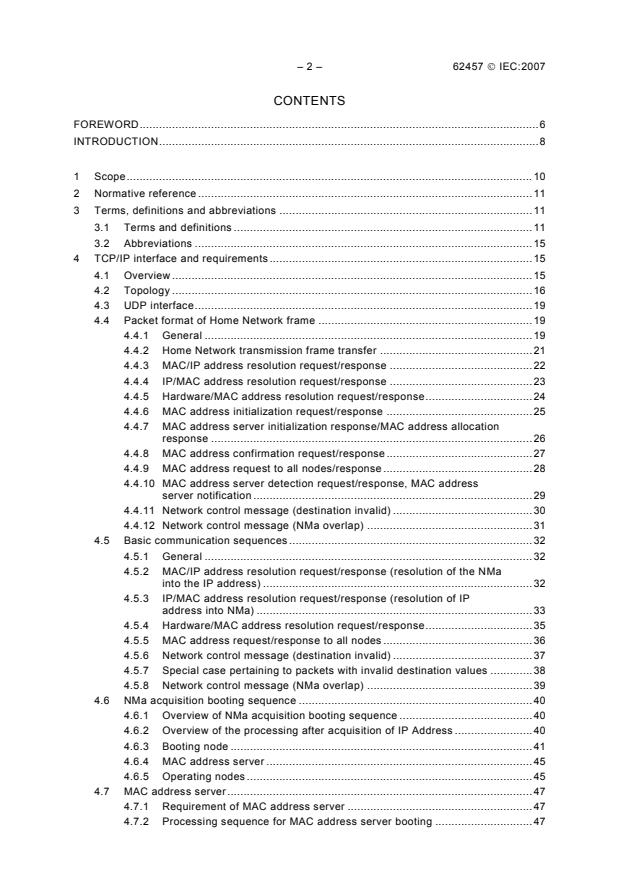
CONTENTS
FOREWORD.6
INTRODUCTION.8
1 Scope.10
2 Normative reference .11
3 Terms, definitions and abbreviations .11
3.1 Terms and definitions .11
3.2 Abbreviations .15
4 TCP/IP interface and requirements .15
4.1 Overview .15
4.2 Topology .16
4.3 UDP interface.19
4.4 Packet format of Home Network frame .19
4.4.1 General .19
4.4.2 Home Network transmission frame transfer .21
4.4.3 MAC/IP address resolution request/response .22
4.4.4 IP/MAC address resolution request/response .23
4.4.5 Hardware/MAC address resolution request/response.24
4.4.6 MAC address initialization request/response .25
4.4.7 MAC address server initialization response/MAC address allocation
response .26
4.4.8 MAC address confirmation request/response.27
4.4.9 MAC address request to all nodes/response .28
4.4.10 MAC address server detection request/response, MAC address
server notification .29
4.4.11 Network control message (destination invalid) .30
4.4.12 Network control message (NMa overlap) .31
4.5 Basic communication sequences .32
4.5.1 General .32
4.5.2 MAC/IP address resolution request/response (resolution of the NMa
into the IP address) .32
4.5.3 IP/MAC address resolution request/response (resolution of IP
address into NMa) .33
4.5.4 Hardware/MAC address resolution request/response.35
4.5.5 MAC address request/response to all nodes .36
4.5.6 Network control message (destination invalid) .37
4.5.7 Special case pertaining to packets with invalid destination values .38
4.5.8 Network control message (NMa overlap) .39
4.6 NMa acquisition booting sequence .40
4.6.1 Overview of NMa acquisition booting sequence .40
4.6.2 Overview of the processing after acquisition of IP Address .40
4.6.3 Booting node .41
4.6.4 MAC address server .45
4.6.5 Operating nodes .45
4.7 MAC address server.47
4.7.1 Requirement of MAC address server .47
4.7.2 Processing sequence for MAC address server booting .47
62457 © IEC:2007(E) – 3 –
4.7.3 Processing by operating MAC address server.48
4.8 Time period parameters .50
4.9 Provision for updating data after NMa acquisition .51
5 TCP/IP and requirements .51
5.1 IP .51
5.1.1 Protocols to be used.51
5.1.2 IP Address.51
5.1.3 Multicast address .51
5.1.4 DHCP .51
5.1.5 Method for obtaining IP Address by manual setting, etc.52
5.1.6 Routing.52
5.2 UDP .52
5.2.1 Protocols to be used.52
5.2.2 Port Number .52
6 Lower-layer medium-specific interface and requirements.52
6.1 Interface and requirements on lower-layer medium.52
6.2 Software internal status transition .52
6.2.1 Overview .52
6.2.2 Stop status .54
6.2.3 Cold start status .54
6.2.4 Warm start status .55
6.2.5 Communication suspension status.55
6.2.6 Normal operation status.56
6.2.7 Error stop status.57
6.2.8 Temporary stop status .58
Annex A (informative) Basic booting sequence .59
Annex B (informative) Basic MAC address server booting sequence.66
Annex C (normative) Requirements on IEEE 802.15.1 .68
Bibliography.74
Figure 1 – Grouping of relationship between household appliances and audiovisual
equipment, PCs and PC-related equipment.9
Figure 2 – Examples of data communication between household appliance and
audiovisual equipment, PCs and PC-related equipment .9
Figure 3 – The composition of the Home Network layer and the specified portions.10
Figure 4 – Encapsulation of Home Network frame.16
Figure 5 – Example of a subnet using Layer 2 bridges .17
Figure 6 – Example of a subnet connection using Home Network routers.17
Figure 7 – Relationship between IP subnet and Home Network subnet .18
Figure 8 – Home Network frame packet format .19
Figure 9 – Notation for bits in the flag field.21
Figure 10 – IEEE 802.15.1 Address described in bits.21
Figure 11 – Basic MAC/IP address resolution sequence .33
Figure 12 – Basic IP/MAC address resolution sequence .34
– 4 – 62457 © IEC:2007(E)
Figure 13 – Basic Hardware/MAC address resolution sequence.35
Figure 14 – Basic “MAC address request/response to all nodes" sequence.37
Figure 15 – Basic “destination invalid” processing sequence.38
Figure 16 – Basic sequence for handling detected NMa overlap .39
Figure 17 – Flowchart for determining provisional NMa to be used.42
Figure 18 – Check for NMas in use by other nodes .43
Figure 19 – Example of duplicated provisional NMa .44
Figure 20 – Format for UsedMAC.46
Figure 21 – Example of UsedMAC .46
Figure 22 – Internal software status transitions .53
Figure A.1 – A-MODE booting, NMas not retained (with MAC address server) .60
Figure A.2 – SR-MODE booting, NMas not retained (with MAC address server).61
Figure A.3 – A-MODE booting, NMas not retained (without MAC address server) .62
Figure A.4 – SR-MODE booting, NMas not retained (without MAC address server) .63
Figure A.5 – A-MODE booting, NMas retained (with MAC address server) .64
Figure A.6 – A-MODE booting, NMas retained (without MAC address server) .65
Figure B.1 – Booting of a single MAC address server .66
Figure B.2 – Near-simultaneous booting of two or more MAC address servers.67
Figure C.1 – Layer structure .68
Figure C.2 – Basic form of subnet.69
Figure C.3 – Example of a subnet connection using Home Network routers .69
Figure C.4 – Example of an unacceptable subnet connection (scatternet).70
Figure C.5 – Example of a connection using a home network gateway.70
Figure C.6 – Example of a subnet using Layer 2 bridges.71
Figure C.7 – Examples of Home Network communication software implementation.72
Figure C.8 – Packet structure .73
Table 1 – Packet type numbers of the Home Network frame .20
Table 2 – Hardware type.20
Table 3 – Format for “Home Network transmission frame transfer” packets.22
Table 4 – Format for “MAC/IP address resolution request” packets .22
Table 5 – Format for “MAC/IP address resolution response” packets .23
Table 6 – Format for “IP/MAC address resolution request” packets .23
Table 7 – Format for “IP/MAC address resolution response” packets .24
Table 8 – Format for “hardware/MAC address resolution request” packets.24
Table 9 – Format for “hardware/MAC address resolution response” packets .25
Table 10 – Format for “MAC address initialization request” packets .26
Table 11 – Format for “MAC address initialization response” packets .26
Table 12 – Format for “MAC address server initialization response” packets.27
Table 13 – Format for “MAC address allocation response” packets .27
Table 14 – Format for “MAC address confirmation request” packets .28
Table 15 – Format for “MAC address confirmation response” packets.28
Table 16 – Format for “ MAC address request to all nodes” packets.28
62457 © IEC:2007(E) – 5 –
Table 17 – Format for “MAC address response to all nodes” packets .29
Table 18 – Format for “MAC address server detection request” packets.29
Table 19 – Format for “MAC address server notification” packets.30
Table 20 – Format for “MAC address server detection response” packets .30
Table 21 – Format for “network control message (destination invalid)” packets .31
Table 22 – Format for “NMa overlap” network control message packets.31
Table 23 – Address Relation table .32
Table 24 – Booting modes .40
Table 25 – Sample for storing allocated NMas .48
Table 26 – Time period parameters.50
– 6 – 62457 © IEC:2007(E)
INTERNATIONAL ELECTROTECHNICAL COMMISSION
____________
MULTIMEDIA HOME NETWORKS –
HOME NETWORK COMMUNICATION PROTOCOL
OVER IP FOR MULTIMEDIA HOUSEHOLD APPLIANCES
FOREWORD
1) The International Electrotechnical Commission (IEC) is a worldwide organization for standardization comprising
all national electrotechnical committees (IEC National Committees). The object of IEC is to promote
international co-operation on all questions concerning standardization in the electrical and electronic fields. To
this end and in addition to other activities, IEC publishes International Standards, Technical Specifications,
Technical Reports, Publicly Available Specifications (PAS) and Guides (hereafter referred to as “IEC
Publication(s)”). Their preparation is entrusted to technical committees; any IEC National Committee interested
in the subject dealt with may participate in this preparatory work. International, governmental and non-
governmental organizations liaising with the IEC also participate in this preparation. IEC collaborates closely
with the International Organization for Standardization (ISO) in accordance with conditions determined by
agreement between the two organizations.
2) The formal decisions or agreements of IEC on technical matters express, as nearly as possible, an international
consensus of opinion on the relevant subjects since each technical committee has representation from all
interested IEC National Committees.
3) IEC Publications have the form of recommendations for international use and are accepted by IEC National
Committees in that sense. While all reasonable efforts are made to ensure that the technical content of IEC
Publications is accurate, IEC cannot be held responsible for the way in which they are used or for any
misinterpretation by any end user.
4) In order to promote international uniformity, IEC National Committees undertake to apply IEC Publications
transparently to the maximum extent possible in their national and regional publications. Any divergence
between any IEC Publication and the corresponding national or regional publication shall be clearly indicated in
the latter.
5) IEC provides no marking procedure to indicate its approval and cannot be rendered responsible for any
equipment declared to be in conformity with an IEC Publication.
6) All users should ensure that they have the latest edition of this publication.
7) No liability shall attach to IEC or its directors, employees, servants or agents including individual experts and
members of its technical committees and IEC National Committees for any personal injury, property damage or
other damage of any nature whatsoever, whether direct or indirect, or for costs (including legal fees) and
expenses arising out of the publication, use of, or reliance upon, this IEC Publication or any other IEC
Publications.
8) Attention is drawn to the Normative references cited in this publication. Use of the referenced publications is
indispensable for the correct application of this publication.
9) Attention is drawn to the possibility that some of the elements of this IEC Publication may be the subject of
patent rights. IEC shall not be held responsible for identifying any or all such patent rights.
International Standard IEC 62457 has been prepared by technical area 9: Audio, video and
multimedia applications for end-user network, of IEC technical committee 100: Audio, video
and multimedia systems and equipment.
The text of this standard is based on the following documents:
CDV Report on voting
100/1197/CDV 100/1271/RVC
Full information on the voting for the approval of this standard can be found in the report on
voting indicated in the above table.
This publication has been drafted in accordance with the ISO/IEC Directives, Part 2.
62457 © IEC:2007(E) – 7 –
The committee has decided that the contents of this publication will remain unchanged until
the maintenance result date indicated on the IEC web site under "http://webstore.iec.ch" in
the data related to the specific publication. At this date, the publication will be
• reconfirmed,
• withdrawn,
• replaced by a revised edition, or
• amended.
– 8 – 62457 © IEC:2007(E)
INTRODUCTION
By enabling standalone-type household appliances (household appliances other than
audiovisual equipment, PCs and PC-related equipment) such as white appliances (e.g. air
conditioners, refrigerators), sensors, health, exercise and fitness equipment to connect to and
work in conjunction with audiovisual equipment, PCs and/or PC-related equipment, it
becomes possible to deliver multimedia application services, such as displaying a “washing
completed” message of a washing machine on a TV screen or operating an air conditioner via
a TV screen, that otherwise would not be possible (see Figure 1).
To achieve these services, a home network standard for networks of standalone-type
household appliances and network standards for audiovisual equipment, PCs and PC-related
equipment are needed. It is also necessary to establish a system that allows equipment
belonging to a network to exchange data with other equipment of different types of networks.
A commonly used approach to allow networks of different types to exchange data with each
other is to use Gateways.
Because data transferred within, into and out of networks of standalone-type household
appliances are control data, which are much smaller in volume than data similarly transferred
for networks of audiovisual equipment, PCs and PC-related equipment, and because
standalone-type household appliances have longer service lives than audiovisual equipment,
PCs and PC-related equipment, home network standards for networks of standalone-type
household appliances have been established separately from network standards for
audiovisual equipment, PCs and PC-related equipment, and many different protocol standards
1)
have been in use for a long time in different countries .
On the other hand, recent advances in device and software technology have made it possible
to implement TCP/IP (which has been adopted worldwide for audiovisual equipment, PCs and
PC-related equipment) in certain standalone-type household appliances, and so establishing
a home network standard for networks of standalone-type household appliances in the form of
a standard for layers above TCP/IP would allow data to be directly exchanged between
household appliances and audiovisual equipment, PCs and PC-related equipment via TCP/IP
(see Figure 2 example1, example2). In turn, this would allow the creation of multimedia
application services that enable household appliances to work in conjunction with audiovisual
equipment, PCs and PC-related equipment.
The advantages of applying this standard are:
• it can be applied to many types of Home Network standards.
• both Home Network nodes with TCP/IP Layer and without can coexist under the same
Home Network middleware.
• Household appliances can communicate with audiovisual equipment, PCs and PC-related
equipment, and vice versa, without requiring any gateway.
• Household appliances can handle text and audiovisual data.
• Audiovisual equipment, PCs and PC-related equipment can handle Household appliances
data.
• Household appliances can freely select a suitable lower-layer medium from various lower-
layer media below TCP/IP.
—————————
CEBus, ECHONET, Konnex, LonTalk, others.
62457 © IEC:2007(E) – 9 –
Network for audiovisual equipment
Digital TVs
Operating household appliances via a TV screen
HDD recorders
and displaying the operation status of household
appliances on a TV screen
Network for PCs and
PC-related equipment
AAiirrccoonn
PC
PC
PDA CCeelllluullaarr pphhoonneess
WWaasshhiinngg EElleeccttrriicc
FFrriiddggee
mmaacchhiinnee oovveenn
Operating household appliances by means of
a cellular phone or PC on the premises and
Network for household appliances
displaying the operation status of a household
appliances on a cellular phone or PC screen
on the premises
Figure 1 – Grouping of relationship between household appliances and audiovisual
equipment, PCs and PC-related equipment
Audiovisual equipment, PCs and
Household appliance
Middleware for PC-related equipment
Middleware for
Home Network
AV,PC equipment
AV, PC equipment
Middleware for
Network
Network
household appliances
System
http
http
example1
TCP/IP Layer
TCP/IP Layer
TCP/IP Layer
Lower Media Layer
Lower Media Layer
Audiovisual equipment, PCs and
Household appliance
PC-related equipment
Middleware for
Home Network
Home Network
AV, PC equipment
Middleware for
Middleware for
household appliances
Network
household appliances
System
http
example2
TCP/IP Layer
TCP/IP Layer
TCP/IP Layer
TCP/IP Layer
Lower Media Layer
Lower Media Layer
Audiovisual equipment, PCs and
Household appliance
PC-related equipment
Middleware for
Home Network
AV, PC equipment
Middleware for
Network
household appliances
General
http
System
Gateway
TCP/IP Layer
Lower Media Layer
Lower Media Layer
Figure 2 – Examples of data communication between household appliance and
audiovisual equipment, PCs and PC-related equipment
– 10 – 62457 © IEC:2007(E)
MULTIMEDIA HOME NETWORKS –
HOME NETWORK COMMUNICATION PROTOCOL
OVER IP FOR MULTIMEDIA HOUSEHOLD APPLIANCES
1 Scope
This International Standard specifies the requirements for the interface between the Home
Network Lower Layer for a country’s home network of standalone-type household appliances
and the TCP/IP Layer for cases where it is intended to introduce a TCP/IP Layer to each of
the nodes comprising such home network of standalone-type household appliances. The
specified interface in the Home Network Lower Layer consists of 2 portions, the TCP/IP
Interface and the lower medium-specific Interface. Figure 3 shows the composition of the
Home Network Layer and the standardized portions. In Annex C, this standard specifies the
requirements for the lower medium-specific Interface One of these layers shall be IEEE
802.15.1, short-distance radio standard additional layers can be added in the future).
OSI
Application Layer
Layer 7
Application
Layer 6
Presentati Home Network Upper Layer
(Home Network Middleware)
Layer 5
Session
Layer 4
Transport
Home Network Lower Layer
lower medium - TCP/IP Interface
Layer 3
(Home Network Middleware)
specific Interface
Network
lower medium- TCP/IP Layer
Power Radio Infrared
Layer 2 Twisted
Upper Layer
…….
Data Link line Commu- pair line
nication
lower medium - Lower Layer
Layer 1
Physical
TCP/IP media e.g. IEEE802.15.1 or
Non –TCP/IP media
IEEE802.3 or IEEE 802.11b
NOTE 1 Grey coloured portions are standardized.
NOTE 2 TCP/IP Interface is the same even if the lower medium is different, however the lower medium-specific
Interface is different.
NOTE 3 Home Network Lower Layer and Home Network Upper Layer are prepared for CEBus, ECHONET,
Konnex, LonTalk, others respectively.
NOTE 4 Each OSI Layer is roughly mapped to each Home Network Layer.
Figure 3 – The composition of the Home Network layer and the specified portions
62457 © IEC:2007(E) – 11 –
2 Normative reference
The following referenced documents are indispensable for the application of this document.
For dated references, only the edition cited applies. For undated references, the latest edition
of the referenced document (including any amendments) applies.
IEEE Std 802.15.1-2005, IEEE Standard for Information technology – Telecommunications
and information exchange between systems – Local and metropolitan area networks –
Specific requirements – Part 15.1: Wireless medium access control (MAC) and physical layer
(PHY) specifications for wireless personal area networks (WPANs)
3 Terms, definitions and abbreviations
For the purposes of this document, the following terms and definitions apply.
3.1 Terms and definitions
3.1.1
Bluetooth
wireless technology that is a worldwide specification for a small-form factor, low-cost radio
solution providing links between mobile computers, mobile phones, other portable handheld
devices, and connectivity to the Internet
NOTE The specification is developed, published and promoted by the Bluetooth Special Interest Group (SIG).
Main specifications are adopted as IEEE Std 802.15.1. In this standard, Bluetooth means IEEE 802.15.1.
3.1.2
Bluetooth Network Encapsulation Protocol
BNEP
protocol specified in Bluetooth. IP packet is encapsulated according to this protocol
3.1.3
cold start
method for starting the Home Network node by starting initial setting processing while
abandoning previous information related to network addresses
3.1.4
Group ad-hoc Networks
GN
Piconet which comprises a master and a slave as defined in IEEE 802.15.1 and which is not
connected to any outside network or node
3.1.5
Hardware address
Ha
address based on a medium-specific addressing scheme
3.1.6
Home Network
generic name for various equipment-type Home Network standards mainly for household
appliances
NOTE Specifically, it refers to CEBus, Konnex, ECHONET, LonTalk, etc.
3.1.7
Home Network device
a home device, home electric product, or building/store device, such as lighting, air
conditioning, refrigeration, power equipment, ordinary home appliances, sensors, actuators,
etc.
– 12 – 62457 © IEC:2007(E)
NOTE A Home Network node provided with a communication interface and system compatible function
conforming to the Home Network standard. A Home Network node provided with a controller function for the
centralized control unit with functions to monitor, control, and operate them or an operating unit (remote control,
etc.).
3.1.8
Home Network domain
a range on the network within which information transmission is logically guaranteed by the
Home Network
NOTE Property and security control, including homes and stores, are generally thought to use the same range as
a domain, but the domain is not limited by any standard.
3.1.9
Home Network frame
frame which is generated in the Home Network lower layer as specified in this standard;. the
frame consists of a Home Network transmission frame or an associated managing packet
3.1.10
Home Network gateway
a Home Network node which connects a home network domain to an external system
(including other Home Network domains)
NOTE Multiple Home Network gateways may exist in the domain depending on differences in the external
system(s) to be connected.
3.1.11
Home Network lower-layer
interface between Home Network upper layer and the lower medium upper-layer
NOTE Some parts depend on the medium characteristics. This standard is contained in this layer. This layer
mainly consists of OSI Layer 3, 4, and 2.
3.1.12
Home Network master router
a router that acquires a Net ID at the time of initialization and stores it; there is one Home
Network master router in each Home Network subnet
3.1.13
Home Network node
communication node conforming to a Home Network standard, referred to as “node” herein
unless otherwise specified
NOTE In a Home Network, a Home Network node is a Home Network communication function which is uniquely
identified by a Network address. There is no distinction between the application functions of nodes. The term node
is used to describe the function of one communication terminal of the Home Network.
3.1.14
Home Network router
a Home Network node used to connect Home Network subnets
NOTE A Home Network router connects the subnets of different lower-layer communication protocols (for different
protocols, regardless of transmission media type) or divides the same protocol into subnets. The lower-layer
communication protocol is connected seamlessly on the system using routing processing based on Network
addresses as a function.
3.1.15
Home Network subnet
a group of nodes in the Home Network domain, using the same media or different media
connected by layer 2 bridges, referred to as a “subnet” herein unless otherwise specified
NOTE Each subnet has a Net ID. Different subnets can be connected by a Home Network router.
62457 © IEC:2007(E) – 13 –
3.1.16
Home Network transmission frame
frame that is generated in the Home Network upper layer and transmitted between nodes via
the Home Network lower layer
NOTE Each Home Network has its own frame format, but a Home Network transmission frame normally contains
headers, address information, acquisition and setting information for other nodes.
3.1.17
Home Network upper layer
processing block of the Home Network communication middleware
NOTE The Home Network upper layer performs the communication protocol processing to simplify the processing
performed when the application software remotely controls or monitors devices, stores the information necessary
for that purpose, and manages various pieces of information including that on the status of the device itself and of
other devices. This layer mainly consists of OSI Layers 4, 5, 6, and 7.
3.1.18
IPme
IP multicast address
this address is used for IP multicasting. The specific number is assigned to this standard
3.1.19
layer 2 bridge
device used to store and transfer packets
NOTE Layer 2 bridges cover up to OSI Layer 2 (the data link layer). Layer 2 bridges are classified into several
types by function including transparent bridges that discard or transfer packets based on MAC address values,
converter bridges that perform MAC header conversions and source routing bridges with the additional capability to
handle destination path information. Layer 2 bridges are defined in IEEE Std 802.1D.
3.1.20
MAC address server
server which allocates Network MAC addresses in a subnet
3.1.21
net ID
a subnet identifier; it is also a component of a Network address
3.1.22
Network Access Points
NAP
an access point connected to the Internet which acts as a IEEE 802.15.1 master.
IEEE 802.15.1 slaves are connected to a IEEE 802.15.1 master to form a Piconet and thus
are connected to the Internet
3.1.23
Network address
Na
an address permitting unique identification of a Home Network node in the domain
NOTE This address enables the Home Network communication processing block and the application software to
disregard differences in the lower-layer communication software. A Network address is a logical address that is
defined separately from the Hardware address to lower-layer communication software; it consists of at least a Net
ID and a Node ID.
3.1.24
Network MAC address
NMa
a unique Home Network lower layer address that allows Layer 2 communication (transmission
medium) to be performed
– 14 – 62457 © IEC:2007(E)
NOTE This address for each Home Network node is uniquely assigned in the Home Network subnet by the Home
Network lower layer of the Home Network node itself or MAC address server.
3.1.25
node ID
an identifier used to identify a Home Network node uniquely within the Home Network subnet.
NOTE A node ID is a logical address converted from the NMa by the Home Network upper layer. This is a
component of a Network address.
3.1.26
park mode
a low power consumption mode defined in the IEEE 802.15.1 specification
NOTE Upon entry into this mode, two different addresses are given by the master and synchronization is
maintained thereafter by periodic beacon pulses from the master. While in Park mode, a negotiation to cancel Park
mode can be made within the preset window period.
3.1.27
Personal Area Networking Profile
PAN
specified in Bluetooth
NOTE This profile is for IP communication over IEEE 802.15.1.IP Packet is encapsulated by BNEP and behaves
like Ethernet networking.
3.1.28
Personal Area Networking Profile User
PANU
slave nodes specified in Personal Area Networking
3.1.29
Piconet
a network that has a single master and two or more slaves as specified in the IEEE 802.15.1.
3.1.30
profile
profiles specify Bluetooth communication functions and protocol requirements by purpose to
maintain interconnectivity
NOTE In the Bluetooth specification version 1.1, Generic Access Profile, Serial Port Profile, etc. are defined.
3.1.31
scatternet
network that looks like two or more Piconets connected together because of the “time-series”
manner in which a node belongs to one of the two or more Piconets
3.1.32
Service Discovery Protocol
SDP
upon establishment of a link between two nodes, this protocol (which is defined in
IEEE 802.15.1) is used to acquire service records (service class, protocol, etc.) held by the
nodes
3.1.33
warm start
method of starting the Home Network node by starting initial setting processing while keeping
previous Network addresses and initial setting information
62457 © IEC:2007(E) – 15 –
3.2 Abbreviations
BNEP Bluetooth Network Encapsulation Protocol
DHCP Dynamic Host Configuration Protocol
GN Group Ad-hoc Networks
Ha Hardware address
IP Internet Protocol
Ipme IP multicast address
LSB the Least Significant Bit
MAC Media Access Control
MSB the Most Significant Bit
Na Network Address
NAP Network Access Point
Nma Network MAC address
OSI Open System Interface
PAN Personal Area Networking Profile
PANU Personal Area Networking Profile User
SDP Service Discovery Protocol
TCP Transmission Control Protocol
UDP User Datagram Protocol
4 TCP/IP interface and requirements
4.1 Overview
When introducing lower layer media into Home Networks, some Home Networks require a
definition on an Internet Protocol (IP) network whereas others do not; the selection should be
made according to the application requirements. This standard provides International
Standards for protocols that operate on IP. In the case where Home Networks operate in an
IP network, each Home Network subnet is mapped onto an IP subnet and the Home Network
frames (Home Network transmission frames or associated control packets) are encapsulated
into IP packets and transferred over the IP network (see Figure 4).IP networks are classified
into IPv4 and IPv6 networks; this standard uses IPv4. Each Home Network node shall have an
IP address, which shall be either a unique global IP address or a private IP address, in
addition to a Hardware address. Although this standard does not specify a method for
acquiring IP addresses, the operation of a node as a Home Network node is premised on the
acquisition of an IP address. The IP network transfer protocol used to transfer a Home
Network frame shall be the connectionless User Datagram Protocol (UDP). When transferring
a Home Network frame, the UDP shall permanently use the port number specified in this
standard. Each Home Network frame is encapsulated into one UDP packet. Each Home
Network node shall also have a Network Address (Na) in the Home Network Upper Layer and
Network MAC address (NMa) in the Home Network Lower Layer, in addition to the IP address.
For destination addresses and sender addresses for Home Network transmission frames, Na
shall be used. For destination addresses and sender addresses for Home Network frames, for
IP headers, IP addresses shall be used. All Home Network nodes operating on an IP subnet
shall be capable of using the IP multicast addresses assigned for the Home Network. A Home
Network frame to be broadcast or group-broadcast is mapped onto IP multicast packets
addressed to the specified IP multicast address. Because there are many media other than
IEEE 802.15.1, IEEE 802.3, etc. that have been defined as lower layer media , they have their
own layer structures, functions, addressing schemes and topologies. This standard also
defines interfaces as medium-specific interfaces that are separated from the TCP/IP interface.
– 16 – 62457 © IEC:2007(E)
Home Network
Header Home Network transmission
transmission frame or
associated control packet
frame or associated control
packet (defined in this standard)
Home Network frame
Home Network frame
UDP header Home Network frame
UDP packet
IP header UDP header Home Network frame
IP packet
Figure 4 – Encapsulation of Home Network frame
NMa Acquisition Booting Sequence is specified in this standard. Each Home Network node
has a unique Na which is held by the Home Network upper layer to allow the node to be
identified regardless of the types of media or with IP or with non-IP. Each of the components
of a Na corresponds uniquely to a NMa set by the Home Network lower layer at the time of
initialization. This standard stipulates three NMa setting methods: the MAC Address Server
Method, the Distributed Method that does not use any MAC address server, and the Manual
Setting Method. In this standard, three address setting modes are acceptable: a) the “Server
Required Mode” (SR-MODE), where a MAC address server shall always be used for NMa
setting under some administrator; b) the “Automatic Mode” (A-MODE), where no MAC address
server exists in which the NMa setting mechanism is operated in a distributed manner; and c)
the “Manual Mode” (M-MODE), in which NMas are defined manually.
4.2 Topology
The common accommodation requirements for all IP medium types are as follows:
a) A single IP subnet that contains nodes using different media connected by means of Layer
2 bridges shall be treated as a Home Network subnet. That is, node sets using different
Home Network media but connected using Layer 2 bridges are defined as a single Home
Network subnet. This allows node sets using different media to be connected without
using a Home Network router and eli
...
IEC 62457 ®
Edition 1.0 2007-09
INTERNATIONAL
STANDARD
NORME
INTERNATIONALE
colour
inside
Multimedia home networks – Home network communication protocol over IP for
multimedia household appliances
Réseaux résidentiels multimédia – Protocole de communication de réseau
résidentiel sur IP destiné aux appareils domestiques multimédia
IEC 62457:2012
All rights reserved. Unless otherwise specified, no part of this publication may be reproduced or utilized in any form
or by any means, electronic or mechanical, including photocopying and microfilm, without permission in writing from
either IEC or IEC's member National Committee in the country of the requester.
If you have any questions about IEC copyright or have an enquiry about obtaining additional rights to this publication,
please contact the address below or your local IEC member National Committee for further information.
Droits de reproduction réservés. Sauf indication contraire, aucune partie de cette publication ne peut être reproduite ni
utilisée sous quelque forme que ce soit et par aucun procédé, électronique ou mécanique, y compris la photocopie et les
microfilms, sans l'accord écrit de la CEI ou du Comité national de la CEI du pays du demandeur.
Si vous avez des questions sur le copyright de la CEI ou si vous désirez obtenir des droits supplémentaires sur cette
publication, utilisez les coordonnées ci-après ou contactez le Comité national de la CEI de votre pays de résidence.
IEC Central Office Tel.: +41 22 919 02 11
3, rue de Varembé Fax: +41 22 919 03 00
CH-1211 Geneva 20 info@iec.ch
Switzerland www.iec.ch
About the IEC
The International Electrotechnical Commission (IEC) is the leading global organization that prepares and publishes
International Standards for all electrical, electronic and related technologies.
About IEC publications
The technical content of IEC publications is kept under constant review by the IEC. Please make sure that you have the
latest edition, a corrigenda or an amendment might have been published.
Useful links:
IEC publications search - www.iec.ch/searchpub Electropedia - www.electropedia.org
The advanced search enables you to find IEC publications The world's leading online dictionary of electronic and
by a variety of criteria (reference number, text, technical electrical terms containing more than 30 000 terms and
committee,…). definitions in English and French, with equivalent terms in
It also gives information on projects, replaced and additional languages. Also known as the International
withdrawn publications. Electrotechnical Vocabulary (IEV) on-line.
IEC Just Published - webstore.iec.ch/justpublished Customer Service Centre - webstore.iec.ch/csc
Stay up to date on all new IEC publications. Just Published If you wish to give us your feedback on this publication
details all new publications released. Available on-line and or need further assistance, please contact the
also once a month by email. Customer Service Centre: csc@iec.ch.
A propos de la CEI
La Commission Electrotechnique Internationale (CEI) est la première organisation mondiale qui élabore et publie des
Normes internationales pour tout ce qui a trait à l'électricité, à l'électronique et aux technologies apparentées.
A propos des publications CEI
Le contenu technique des publications de la CEI est constamment revu. Veuillez vous assurer que vous possédez
l’édition la plus récente, un corrigendum ou amendement peut avoir été publié.
Liens utiles:
Recherche de publications CEI - www.iec.ch/searchpub Electropedia - www.electropedia.org
La recherche avancée vous permet de trouver des Le premier dictionnaire en ligne au monde de termes
publications CEI en utilisant différents critères (numéro de électroniques et électriques. Il contient plus de 30 000
référence, texte, comité d’études,…). termes et définitions en anglais et en français, ainsi que
Elle donne aussi des informations sur les projets et les les termes équivalents dans les langues additionnelles.
publications remplacées ou retirées. Egalement appelé Vocabulaire Electrotechnique
International (VEI) en ligne.
Just Published CEI - webstore.iec.ch/justpublished
Service Clients - webstore.iec.ch/csc
Restez informé sur les nouvelles publications de la CEI.
Just Published détaille les nouvelles publications parues. Si vous désirez nous donner des commentaires sur
Disponible en ligne et aussi une fois par mois par email. cette publication ou si vous avez des questions
contactez-nous: csc@iec.ch.
IEC 62457 ®
Edition 1.0 2007-09
INTERNATIONAL
STANDARD
NORME
INTERNATIONALE
colour
inside
Multimedia home networks – Home network communication protocol over IP for
multimedia household appliances
Réseaux résidentiels multimédia – Protocole de communication de réseau
résidentiel sur IP destiné aux appareils domestiques multimédia
INTERNATIONAL
ELECTROTECHNICAL
COMMISSION
COMMISSION
ELECTROTECHNIQUE
PRICE CODE
INTERNATIONALE
CODE PRIX XB
ICS 30.040; 33.160.01 ISBN 978-2-83220-318-7
– 2 – 62457 IEC:2007
CONTENTS
FOREWORD . 6
INTRODUCTION . 8
1 Scope . 10
2 Normative reference . 11
3 Terms, definitions and abbreviations . 11
3.1 Terms and definitions . 11
3.2 Abbreviations . 15
4 TCP/IP interface and requirements . 15
4.1 Overview . 15
4.2 Topology . 16
4.3 UDP interface . 19
4.4 Packet format of Home Network frame . 19
4.4.1 General . 19
4.4.2 Home Network transmission frame transfer . 21
4.4.3 MAC/IP address resolution request/response . 22
4.4.4 IP/MAC address resolution request/response . 23
4.4.5 Hardware/MAC address resolution request/response . 24
4.4.6 MAC address initialization request/response . 25
4.4.7 MAC address server initialization response/MAC address allocation
response . 26
4.4.8 MAC address confirmation request/response . 27
4.4.9 MAC address request to all nodes/response . 28
4.4.10 MAC address server detection request/response, MAC address
server notification . 29
4.4.11 Network control message (destination invalid) . 30
4.4.12 Network control message (NMa overlap) . 31
4.5 Basic communication sequences . 32
4.5.1 General . 32
4.5.2 MAC/IP address resolution request/response (resolution of the NMa
into the IP address) . 32
4.5.3 IP/MAC address resolution request/response (resolution of IP
address into NMa) . 33
4.5.4 Hardware/MAC address resolution request/response . 35
4.5.5 MAC address request/response to all nodes . 36
4.5.6 Network control message (destination invalid) . 37
4.5.7 Special case pertaining to packets with invalid destination values . 38
4.5.8 Network control message (NMa overlap) . 39
4.6 NMa acquisition booting sequence . 40
4.6.1 Overview of NMa acquisition booting sequence . 40
4.6.2 Overview of the processing after acquisition of IP Address . 40
4.6.3 Booting node . 41
4.6.4 MAC address server . 45
4.6.5 Operating nodes . 45
4.7 MAC address server . 47
4.7.1 Requirement of MAC address server . 47
4.7.2 Processing sequence for MAC address server booting . 47
62457 IEC:2007 – 3 –
4.7.3 Processing by operating MAC address server . 48
4.8 Time period parameters . 50
4.9 Provision for updating data after NMa acquisition . 51
5 TCP/IP and requirements . 51
5.1 IP . 51
5.1.1 Protocols to be used . 51
5.1.2 IP Address . 51
5.1.3 Multicast address . 51
5.1.4 DHCP . 51
5.1.5 Method for obtaining IP Address by manual setting, etc. . 52
5.1.6 Routing . 52
5.2 UDP . 52
5.2.1 Protocols to be used . 52
5.2.2 Port Number . 52
6 Lower-layer medium-specific interface and requirements . 52
6.1 Interface and requirements on lower-layer medium . 52
6.2 Software internal status transition . 52
6.2.1 Overview . 52
6.2.2 Stop status . 54
6.2.3 Cold start status . 54
6.2.4 Warm start status . 55
6.2.5 Communication suspension status . 55
6.2.6 Normal operation status . 56
6.2.7 Error stop status . 57
6.2.8 Temporary stop status . 58
Annex A (informative) Basic booting sequence . 59
Annex B (informative) Basic MAC address server booting sequence . 66
Annex C (normative) Requirements on IEEE 802.15.1 . 68
Bibliography . 74
Figure 1 – Grouping of relationship between household appliances and audiovisual
equipment, PCs and PC-related equipment . 9
Figure 2 – Examples of data communication between household appliance and
audiovisual equipment, PCs and PC-related equipment . 9
Figure 3 – The composition of the Home Network layer and the specified portions . 10
Figure 4 – Encapsulation of Home Network frame . 16
Figure 5 – Example of a subnet using Layer 2 bridges . 17
Figure 6 – Example of a subnet connection using Home Network routers . 17
Figure 7 – Relationship between IP subnet and Home Network subnet . 18
Figure 8 – Home Network frame packet format . 19
Figure 9 – Notation for bits in the flag field . 21
Figure 10 – IEEE 802.15.1 Address described in bits . 21
Figure 11 – Basic MAC/IP address resolution sequence . 33
Figure 12 – Basic IP/MAC address resolution sequence . 34
– 4 – 62457 IEC:2007
Figure 13 – Basic Hardware/MAC address resolution sequence . 35
Figure 14 – Basic “MAC address request/response to all nodes" sequence . 37
Figure 15 – Basic “destination invalid” processing sequence . 38
Figure 16 – Basic sequence for handling detected NMa overlap . 39
Figure 17 – Flowchart for determining provisional NMa to be used . 42
Figure 18 – Check for NMas in use by other nodes . 43
Figure 19 – Example of duplicated provisional NMa . 44
Figure 20 – Format for UsedMAC . 46
Figure 21 – Example of UsedMAC . 46
Figure 22 – Internal software status transitions . 53
Figure A.1 – A-MODE booting, NMas not retained (with MAC address server) . 60
Figure A.2 – SR-MODE booting, NMas not retained (with MAC address server) . 61
Figure A.3 – A-MODE booting, NMas not retained (without MAC address server) . 62
Figure A.4 – SR-MODE booting, NMas not retained (without MAC address server) . 63
Figure A.5 – A-MODE booting, NMas retained (with MAC address server) . 64
Figure A.6 – A-MODE booting, NMas retained (without MAC address server) . 65
Figure B.1 – Booting of a single MAC address server . 66
Figure B.2 – Near-simultaneous booting of two or more MAC address servers . 67
Figure C.1 – Layer structure . 68
Figure C.2 – Basic form of subnet . 69
Figure C.3 – Example of a subnet connection using Home Network routers . 69
Figure C.4 – Example of an unacceptable subnet connection (scatternet) . 70
Figure C.5 – Example of a connection using a home network gateway . 70
Figure C.6 – Example of a subnet using Layer 2 bridges . 71
Figure C.7 – Examples of Home Network communication software implementation . 72
Figure C.8 – Packet structure . 73
Table 1 – Packet type numbers of the Home Network frame . 20
Table 2 – Hardware type . 20
Table 3 – Format for “Home Network transmission frame transfer” packets . 22
Table 4 – Format for “MAC/IP address resolution request” packets . 22
Table 5 – Format for “MAC/IP address resolution response” packets . 23
Table 6 – Format for “IP/MAC address resolution request” packets . 23
Table 7 – Format for “IP/MAC address resolution response” packets . 24
Table 8 – Format for “hardware/MAC address resolution request” packets . 24
Table 9 – Format for “hardware/MAC address resolution response” packets . 25
Table 10 – Format for “MAC address initialization request” packets . 26
Table 11 – Format for “MAC address initialization response” packets . 26
Table 12 – Format for “MAC address server initialization response” packets . 27
Table 13 – Format for “MAC address allocation response” packets . 27
Table 14 – Format for “MAC address confirmation request” packets . 28
Table 15 – Format for “MAC address confirmation response” packets . 28
Table 16 – Format for “ MAC address request to all nodes” packets. 28
62457 IEC:2007 – 5 –
Table 17 – Format for “MAC address response to all nodes” packets . 29
Table 18 – Format for “MAC address server detection request” packets . 29
Table 19 – Format for “MAC address server notification” packets. 30
Table 20 – Format for “MAC address server detection response” packets . 30
Table 21 – Format for “network control message (destination invalid)” packets . 31
Table 22 – Format for “NMa overlap” network control message packets . 31
Table 23 – Address Relation table . 32
Table 24 – Booting modes . 40
Table 25 – Sample for storing allocated NMas . 48
Table 26 – Time period parameters. 50
– 6 – 62457 IEC:2007
INTERNATIONAL ELECTROTECHNICAL COMMISSION
____________
MULTIMEDIA HOME NETWORKS –
HOME NETWORK COMMUNICATION PROTOCOL
OVER IP FOR MULTIMEDIA HOUSEHOLD APPLIANCES
FOREWORD
1) The International Electrotechnical Commission (IEC) is a worldwide organization for standardization comprising
all national electrotechnical committees (IEC National Committees). The object of IEC is to promote
international co-operation on all questions concerning standardization in the electrical and electronic fields. To
this end and in addition to other activities, IEC publishes International Standards, Technical Specifications,
Technical Reports, Publicly Available Specifications (PAS) and Guides (hereafter referred to as “IEC
Publication(s)”). Their preparation is entrusted to technical committees; any IEC National Committee interested
in the subject dealt with may participate in this preparatory work. International, governmental and non-
governmental organizations liaising with the IEC also participate in this preparation. IEC collaborates closely
with the International Organization for Standardization (ISO) in accordance with conditions determined by
agreement between the two organizations.
2) The formal decisions or agreements of IEC on technical matters express, as nearly as possible, an international
consensus of opinion on the relevant subjects since each technical committee has representation from all
interested IEC National Committees.
3) IEC Publications have the form of recommendations for international use and are accepted by IEC National
Committees in that sense. While all reasonable efforts are made to ensure that the technical content of IEC
Publications is accurate, IEC cannot be held responsible for the way in which they are used or for any
misinterpretation by any end user.
4) In order to promote international uniformity, IEC National Committees undertake to apply IEC Publications
transparently to the maximum extent possible in their national and regional publications. Any divergence
between any IEC Publication and the corresponding national or regional publication shall be clearly indicated in
the latter.
5) IEC provides no marking procedure to indicate its approval and cannot be rendered responsible for any
equipment declared to be in conformity with an IEC Publication.
6) All users should ensure that they have the latest edition of this publication.
7) No liability shall attach to IEC or its directors, employees, servants or agents including individual experts and
members of its technical committees and IEC National Committees for any personal injury, property damage or
other damage of any nature whatsoever, whether direct or indirect, or for costs (including legal fees) and
expenses arising out of the publication, use of, or reliance upon, this IEC Publication or any other IEC
Publications.
8) Attention is drawn to the Normative references cited in this publication. Use of the referenced publications is
indispensable for the correct application of this publication.
9) Attention is drawn to the possibility that some of the elements of this IEC Publication may be the subject of
patent rights. IEC shall not be held responsible for identifying any or all such patent rights.
International Standard IEC 62457 has been prepared by technical area 9: Audio, video and
multimedia applications for end-user network, of IEC technical committee 100: Audio, video
and multimedia systems and equipment.
This bilingual version (2012-10) corresponds to the monolingual English version, published in
2007-09.
The text of this standard is based on the following documents:
CDV Report on voting
100/1197/CDV 100/1271/RVC
Full information on the voting for the approval of this standard can be found in the report on
voting indicated in the above table.
The French version of this standard has not been voted upon.
62457 IEC:2007 – 7 –
This publication has been drafted in accordance with the ISO/IEC Directives, Part 2.
The committee has decided that the contents of this publication will remain unchanged until
the maintenance result date indicated on the IEC web site under "http://webstore.iec.ch" in
the data related to the specific publication. At this date, the publication will be
• reconfirmed,
• withdrawn,
• replaced by a revised edition, or
• amended.
IMPORTANT – The 'colour inside' logo on the cover page of this publication indicates
that it contains colours which are considered to be useful for the correct
understanding of its contents. Users should therefore print this document using a
colour printer.
– 8 – 62457 IEC:2007
INTRODUCTION
By enabling standalone-type household appliances (household appliances other than
audiovisual equipment, PCs and PC-related equipment) such as white appliances (e.g. air
conditioners, refrigerators), sensors, health, exercise and fitness equipment to connect to and
work in conjunction with audiovisual equipment, PCs and/or PC-related equipment, it
becomes possible to deliver multimedia application services, such as displaying a “washing
completed” message of a washing machine on a TV screen or operating an air conditioner via
a TV screen, that otherwise would not be possible (see Figure 1).
To achieve these services, a home network standard for networks of standalone-type
household appliances and network standards for audiovisual equipment, PCs and PC-related
equipment are needed. It is also necessary to establish a system that allows equipment
belonging to a network to exchange data with other equipment of different types of networks.
A commonly used approach to allow networks of different types to exchange data with each
other is to use Gateways.
Because data transferred within, into and out of networks of standalone-type household
appliances are control data, which are much smaller in volume than data similarly transferred
for networks of audiovisual equipment, PCs and PC-related equipment, and because
standalone-type household appliances have longer service lives than audiovisual equipment,
PCs and PC-related equipment, home network standards for networks of standalone-type
household appliances have been established separately from network standards for
audiovisual equipment, PCs and PC-related equipment, and many different protocol standards
1)
have been in use for a long time in different countries .
On the other hand, recent advances in device and software technology have made it possible
to implement TCP/IP (which has been adopted worldwide for audiovisual equipment, PCs and
PC-related equipment) in certain standalone-type household appliances, and so establishing
a home network standard for networks of standalone-type household appliances in the form of
a standard for layers above TCP/IP would allow data to be directly exchanged between
household appliances and audiovisual equipment, PCs and PC-related equipment via TCP/IP
(see Figure 2 example1, example2). In turn, this would allow the creation of multimedia
application services that enable household appliances to work in conjunction with audiovisual
equipment, PCs and PC-related equipment.
The advantages of applying this standard are:
• it can be applied to many types of Home Network standards.
• both Home Network nodes with TCP/IP Layer and without can coexist under the same
Home Network middleware.
• Household appliances can communicate with audiovisual equipment, PCs and PC-related
equipment, and vice versa, without requiring any gateway.
• Household appliances can handle text and audiovisual data.
• Audiovisual equipment, PCs and PC-related equipment can handle Household appliances
data.
• Household appliances can freely select a suitable lower-layer medium from various lower-
layer media below TCP/IP.
—————————
CEBus, ECHONET, Konnex, LonTalk, others.
62457 IEC:2007 – 9 –
Network for audiovisual equipment
Digital TVs
Operating household appliances via a TV screen
HDD recorders
and displaying the operation status of household
appliances on a TV screen
Network for PCs and
PC-related equipment
AAiirrccoonn
PC
PC
PDA CCeelllluullaarr pphhoonneess
WWaasshhiinngg EElleeccttrriicc
FFrriiddggee
mmaacchhiinnee oovveenn
Operating household appliances by means of
a cellular phone or PC on the premises and
Network for household appliances
displaying the operation status of a household
appliances on a cellular ph one or PC screen
on the premises
Figure 1 – Grouping of relationship between household appliances and audiovisual
equipment, PCs and PC-related equipment
Audiovisual equipment, PCs and
Household appliance
Middleware for PC-related equipment
Middleware for
Home Network
AV,PC equipment
AV, PC equipment
Middleware for
Network
Network
household appliances
System
http
http
example1
TCP/IP Layer
TCP/IP Layer
TCP/IP Layer
Lower Media Layer
Lower Media Layer
Audiovisual equipment, PCs and
Household appliance
PC-related equipment
Middleware for
Home Network
Home Network
AV, PC equipment
Middleware for
Middleware for
household appliances Network
household appliances
System
http
example2
TCP/IP Layer
TCP/IP Layer
TCP/IP Layer
TCP/IP Layer
Lower Media Layer
Lower Media Layer
Audiovisual equipment, PCs and
Household appliance
PC-related equipment
Middleware for
Home Network
AV, PC equipment
Middleware for
Network
household appliances
General
http
System
Gateway
TCP/IP Layer
Lower Media Layer
Lower Media Layer
Figure 2 – Examples of data communication between household appliance and
audiovisual equipment, PCs and PC-related equipment
– 10 – 62457 IEC:2007
MULTIMEDIA HOME NETWORKS –
HOME NETWORK COMMUNICATION PROTOCOL
OVER IP FOR MULTIMEDIA HOUSEHOLD APPLIANCES
1 Scope
This International Standard specifies the requirements for the interface between the Home
Network Lower Layer for a country’s home network of standalone-type household appliances
and the TCP/IP Layer for cases where it is intended to introduce a TCP/IP Layer to each of
the nodes comprising such home network of standalone-type household appliances. The
specified interface in the Home Network Lower Layer consists of 2 portions, the TCP/IP
Interface and the lower medium-specific Interface. Figure 3 shows the composition of the
Home Network Layer and the standardized portions. In Annex C, this standard specifies the
requirements for the lower medium-specific Interface One of these layers shall be IEEE
802.15.1, short-distance radio standard additional layers can be added in the future).
OSI
Application Layer
Layer 7
Application
Layer 6
Presentati Home Network Upper Layer
(Home Network Middleware)
Layer 5
Session
Layer 4
Transport
Home Network Lower Layer
lower medium - TCP/IP Interface
Layer 3
(Home Network Middleware)
specific Interface
Network
lower medium- TCP/IP Layer
Power Radio
Layer 2 Twisted Infrared
Upper Layer
…….
Data Link line Commu- pair line
nication
lower medium - Lower Layer
Layer 1
Physical
TCP/IP media e.g. IEEE802.15.1 or
Non –TCP/IP media
IEEE802.3 or IEEE 802.11b
NOTE 1 Grey coloured portions are standardized.
NOTE 2 TCP/IP Interface is the same even if the lower medium is different, however the lower medium-specific
Interface is different.
NOTE 3 Home Network Lower Layer and Home Network Upper Layer are prepared for CEBus, ECHONET,
Konnex, LonTalk, others respectively.
NOTE 4 Each OSI Layer is roughly mapped to each Home Network Layer.
Figure 3 – The composition of the Home Network layer and the specified portions
62457 IEC:2007 – 11 –
2 Normative reference
The following referenced documents are indispensable for the application of this document.
For dated references, only the edition cited applies. For undated references, the latest edition
of the referenced document (including any amendments) applies.
IEEE Std 802.15.1-2005, IEEE Standard for Information technology – Telecommunications
and information exchange between systems – Local and metropolitan area networks –
Specific requirements – Part 15.1: Wireless medium access control (MAC) and physical layer
(PHY) specifications for wireless personal area networks (WPANs)
3 Terms, definitions and abbreviations
For the purposes of this document, the following terms and definitions apply.
3.1 Terms and definitions
3.1.1
Bluetooth
wireless technology that is a worldwide specification for a small-form factor, low-cost radio
solution providing links between mobile computers, mobile phones, other portable handheld
devices, and connectivity to the Internet
NOTE The specification is developed, published and promoted by the Bluetooth Special Interest Group (SIG).
Main specifications are adopted as IEEE Std 802.15.1. In this standard, Bluetooth means IEEE 802.15.1.
3.1.2
Bluetooth Network Encapsulation Protocol
BNEP
protocol specified in Bluetooth. IP packet is encapsulated according to this protocol
3.1.3
cold start
method for starting the Home Network node by starting initial setting processing while
abandoning previous information related to network addresses
3.1.4
Group ad-hoc Networks
GN
Piconet which comprises a master and a slave as defined in IEEE 802.15.1 and which is not
connected to any outside network or node
3.1.5
Hardware address
Ha
address based on a medium-specific addressing scheme
3.1.6
Home Network
generic name for various equipment-type Home Network standards mainly for household
appliances
NOTE Specifically, it refers to CEBus, Konnex, ECHONET, LonTalk, etc.
3.1.7
Home Network device
a home device, home electric product, or building/store device, such as lighting, air
conditioning, refrigeration, power equipment, ordinary home appliances, sensors, actuators,
etc.
– 12 – 62457 IEC:2007
NOTE A Home Network node provided with a communication interface and system compatible function
conforming to the Home Network standard. A Home Network node provided with a controller function for the
centralized control unit with functions to monitor, control, and operate them or an operating unit (remote control,
etc.).
3.1.8
Home Network domain
a range on the network within which information transmission is logically guaranteed by the
Home Network
NOTE Property and security control, including homes and stores, are generally thought to use the same range as
a domain, but the domain is not limited by any standard.
3.1.9
Home Network frame
frame which is generated in the Home Network lower layer as specified in this standard;. the
frame consists of a Home Network transmission frame or an associated managing packet
3.1.10
Home Network gateway
a Home Network node which connects a home network domain to an external system
(including other Home Network domains)
NOTE Multiple Home Network gateways may exist in the domain depending on differences in the external
system(s) to be connected.
3.1.11
Home Network lower-layer
interface between Home Network upper layer and the lower medium upper-layer
NOTE Some parts depend on the medium characteristics. This standard is contained in this layer. This layer
mainly consists of OSI Layer 3, 4, and 2.
3.1.12
Home Network master router
a router that acquires a Net ID at the time of initialization and stores it; there is one Home
Network master router in each Home Network subnet
3.1.13
Home Network node
communication node conforming to a Home Network standard, referred to as “node” herein
unless otherwise specified
NOTE In a Home Network, a Home Network node is a Home Network communication function which is uniquely
identified by a Network address. There is no distinction between the application functions of nodes. The term node
is used to describe the function of one communication terminal of the Home Network.
3.1.14
Home Network router
a Home Network node used to connect Home Network subnets
NOTE A Home Network router connects the subnets of different lower-layer communication protocols (for different
protocols, regardless of transmission media type) or divides the same protocol into subnets. The lower-layer
communication protocol is connected seamlessly on the system using routing processing based on Network
addresses as a function.
3.1.15
Home Network subnet
a group of nodes in the Home Network domain, using the same media or different media
connected by layer 2 bridges, referred to as a “subnet” herein unless otherwise specified
NOTE Each subnet has a Net ID. Different subnets can be connected by a Home Network router.
62457 IEC:2007 – 13 –
3.1.16
Home Network transmission frame
frame that is generated in the Home Network upper layer and transmitted between nodes via
the Home Network lower layer
NOTE Each Home Network has its own frame format, but a Home Network transmission frame normally contains
headers, address information, acquisition and setting information for other nodes.
3.1.17
Home Network upper layer
processing block of the Home Network communication middleware
NOTE The Home Network upper layer performs the communication protocol processing to simplify the processing
performed when the application software remotely controls or monitors devices, stores the information necessary
for that purpose, and manages various pieces of information including that on the status of the device itself and of
other devices. This layer mainly consists of OSI Layers 4, 5, 6, and 7.
3.1.18
IPme
IP multicast address
this address is used for IP multicasting. The specific number is assigned to this standard
3.1.19
layer 2 bridge
device used to store and transfer packets
NOTE Layer 2 bridges cover up to OSI Layer 2 (the data link layer). Layer 2 bridges are classified into several
types by function including transparent bridges that discard or transfer packets based on MAC address values,
converter bridges that perform MAC header conversions and source routing bridges with the additional capability to
handle destination path information. Layer 2 bridges are defined in IEEE Std 802.1D.
3.1.20
MAC address server
server which allocates Network MAC addresses in a subnet
3.1.21
net ID
a subnet identifier; it is also a component of a Network address
3.1.22
Network Access Points
NAP
an access point connected to the Internet which acts as a IEEE 802.15.1 master.
IEEE 802.15.1 slaves are connected to a IEEE 802.15.1 master to form a Piconet and thus
are connected to the Internet
3.1.23
Network address
Na
an address permitting unique identification of a Home Network node in the domain
NOTE This address enables the Home Network communication processing block and the application software to
disregard differences in the lower-layer communication software. A Network address is a logical address that is
defined separately from the Hardware address to lower-layer communication software; it consists of at least a Net
ID and a Node ID.
3.1.24
Network MAC address
NMa
a unique Home Network lower layer address that allows Layer 2 communication (transmission
medium) to be performed
– 14 – 62457 IEC:2007
NOTE This address for each Home Network node is uniquely assigned in the Home Network subnet by the Home
Network lower layer of the Home Network node itself or MAC address server.
3.1.25
node ID
an identifier used to identify a Home Network node uniquely within the Home Network subnet.
NOTE A node ID is a logical address converted from the NMa by the Home Network upper layer. This is a
component of a Network address.
3.1.26
park mode
a low power consumption mode defined in the IEEE 802.15.1 specification
NOTE Upon entry into this mode, two different addresses are given by the master and synchronization is
maintained thereafter by periodic beacon pulses from the master. While in Park mode, a negotiation to cancel Park
mode can be made within the preset window period.
3.1.27
Personal Area Networking Profile
PAN
specified in Bluetooth
NOTE This profile is for IP communication over IEEE 802.15.1.IP Packet is encapsulated by BNEP and behaves
like Ethernet networking.
3.1.28
Personal Area Networking Profile User
PANU
slave nodes specified in Personal Area Networking
3.1.29
Piconet
a network that has a single master and two or more slaves as specified in the IEEE 802.15.1.
3.1.30
profile
profiles specify Bluetooth communication functions and protocol requirements by purpose to
maintain interconnectivity
NOTE In the Bluetooth specification version 1.1, Generic Access Profile, Serial Port Profile, etc. are defined.
3.1.31
scatternet
network that looks like two or more Piconets connected together because of the “time-series”
manner in which a node belongs to one of the two or more Piconets
3.1.32
Service Discovery Protocol
SDP
upon establishment of a link between two nodes, this protocol (which is defined in
IEEE 802.15.1) is used to acquire service records (service class, protocol, etc.) held by the
nodes
3.1.33
warm start
method of starting the Home Network node by starting initial setting processing while keeping
previous Network addresses and initial setting information
62457 IEC:2007 – 15 –
3.2 Abbreviations
BNEP Bluetooth Network Encapsulation Protocol
DHCP Dynamic Host Configuration Protocol
GN Group Ad-hoc Networks
Ha Hardware address
IP Internet Protocol
Ipme IP multicast address
LSB the Least Significant Bit
MAC Media Access Control
MSB the Most Significant Bit
Na Network Address
NAP Network Access Point
Nma Network MAC address
OSI Open System Interface
PAN Personal Area Networking Profile
PANU Personal Area Networking Profile User
SDP Service Discovery Protocol
TCP Transmission Control Protocol
UDP User Datagram Protocol
4 TCP/IP interface and requirements
4.1 Overview
When introducing lower layer media into Home Networks, some Home Networks require a
definition on an Internet Protocol (IP) network whereas others do not; the selection should be
made according to the application requirements. This standard provides International
Standards for protocols that operate on IP. In the case where Home Networks operate in an
IP network, each Home Network subnet is mapped onto an IP subnet and the Home Network
frames (Home Network transmission frames or associated control packets) are encapsulated
into IP packets and tr
...